高齢者の自殺念慮測定尺度に関する批判的論評
著者 孟 浚鎬
雑誌名 評論・社会科学
号 115
ページ 27‑41
発行年 2015‑12‑30
権利 同志社大学社会学会
URL http://doi.org/10.14988/pa.2017.0000014597
要約:本研究は,自殺念慮測定尺度を使用している学術論文に着目し,それらを統計学的 な観点から批判的に論評することを目的とした。そのことに資する学術論文は,データベ ース「CiNii」と「Pubmed」から抽出した。抽出できた10件の学術論文で用いられていた 3種類の自殺念慮測定尺度を批判的論評の最終的な検討材料とした。それら3種類の自殺 念慮測定尺度に対し,測定尺度の内容的妥当性と構成概念妥当性を,適切な統計学的手法 が採用されているか否かの観点から吟味した。その結果,統計学的に適切な解析方法を用 いて検討されていた自殺念慮測定尺度はSIQのみであったが,その尺度は高齢者にそのま ま適用するには無理があるものと推察された。今後,高齢者の自殺に関する予防的介入に 関する適切な示唆を得るには,自殺念慮そのものを適切に測定できる尺度の開発が急務で あり,次いで,自殺念慮の関連要因を解明することが急がれるものと思料された。
キーワード:高齢者,自殺念慮,測定尺度,批判的論評
目次 1.序論
1-1.研究目的 1-2.研究方法 2.本論
2-1.文献検索で抽出した論文の概要 2-2.自殺念慮に関連する測定尺度の概要 2-3.自殺念慮に関する測定尺度の妥当性の検討 3.結論
1.序 論
1-1.研究目的
超高齢社会に突入した日本の深刻な社会問題のひとつとして高齢者の自殺問題がある
(本橋ら
2008 : 176)。日本の高齢者の自殺問題の深刻さは,政府が早急に解決すべき課
────────────
†同志社大学大学院社会学研究科社会福祉学専攻博士後期課程
*2015年9月28日受付,査読審査を経て2015年10月14日掲載決定
論文
高齢者の自殺念慮測定尺度に関する批判的論評
孟 浚鎬
†27
題として位置づけていることからも明らかである(孟
2014 : 118)。もちろん,これは
日本のみに認められる社会現象ではなく,多くの先進国に共通した特徴となっている(OECD 2009)。
自殺研究は,デュルケムらの研究を嚆矢に現在に至っている(大山ら
2006 : 1)。19
世紀初頭の自殺研究では,デュルケムを始め多くの研究者が,自殺をひとつの社会現象 として位置づけ,自殺と性別や年齢,職業,信仰,世帯構成,経済状況等の特性との関 連性の解明(社会病理学的アプローチ)を重視した研究を展開した。また,20世紀の 自殺研究では,自殺者の増加を背景に,精神医学,心理学,さらには社会福祉などの領 域において多様なアプローチが志向された。その時期に開発された心理学的剖検(psy-chological autopsy)は,それまでにない斬新なアプローチとして位置づけられたが,既
に死亡した者を対象としていたこと,また,基礎資料を得るには時間がかかりすぎると いう難点(粟田2005 : 94)を呈していたことから,その手法は次第に自殺研究から衰
退した経緯がある。1970
年代になると自殺の予測研究が始まり,その予測因子として「自殺念慮」(パクら
2006 : 61)の概念が注目された。それは,完全に自殺リスクと一致しないという限
界はあるものの,それ自体が自殺の強力な予測因子になりうる可能性があることから
(粟田
2005 : 94),自殺念慮は,現在に至るまで,自殺の予測因子として多くの研究に
おいて使用されている(Shahら
2000 a;パクら 2006 ; Kim
ら2014)。しかしながら,
日本では,自殺の予測因子に関連する研究は,そのほとんど鬱(以下,「うつ」)や精神 的健康との関連で自殺リスクが議論されている(粟田
2003;長谷屋 2004)。特に,高齢
者を対象とした自殺の予測因子に関する研究では,うつのスクリーニングを基礎とした 水 準 で 留 ま っ て い る(大 野 ら2001;高 橋 2003;畠 山 2004;前 田 ら 2004;本 橋 ら
2008;大塚ら 2008)。もちろん,自殺念慮を自殺の予測因子として位置づけた研究(粟
田
2003;長谷屋 2004;森田 2008)もないわけではないが,それらは 1
項目で自殺念慮の有無を問うものである。なお,大学生を対象とする自殺念慮に関する測定尺度を用い た研究(大塚
1998;佐藤ら 2011)もあるが,高齢者を対象とする自殺念慮に関する測
定尺度を用いた研究は皆無であり,さらに,高齢者を対象とする自殺の予測因子として 自殺念慮測定尺度の開発もいまだなされていない。したがって,高齢者の自殺の予測因 子として従来の測定尺度が高齢者の自殺念慮を正確に把握できるものであるか,また,高齢者に適用できる尺度であるかを検討する必要がある。
高齢者の自殺を防ぐためには,自殺の強力な予測因子である自殺念慮の把握と同時 に,その背景要因を解明し,適切な介入を行うことが必要である。そのために,自殺念 慮に関する数量化が可能な尺度の開発が急がれよう。近年,抽象的な概念を数量化する には,別言すると,ある事象・現象を測定する尺度を開発するには,「妥当性(内容的
高齢者の自殺念慮測定尺度に関する批判的論評 28
妥当性や構成概念妥当性など)」と「信頼性」の検討が必須とされている。自殺予防に 関する有効な介入方法を開発するためには,自殺念慮に関連する要因の解明に資する高 齢者用の自殺念慮測定尺度の開発が急務となろう。
そこで本研究では,高齢者の自殺念慮測定尺度の開発に資する基本情報を得ることを ねらいとして,高齢者の自殺念慮測定尺度を用いた国内・外の学術論文について統計学 的な視点から批判的論評を行うことを目的とした。
1-2.研究方法
自殺念慮測定尺度の開発に関連する学術論文は,日本のデータベース「CiNii」と米 国のデータベース「Pubmed」で検索した。検索におけるキーワードは「suicidal idea-
tion, suicidal thinking, suicidal thought(自殺念慮,自殺願望,希死念慮,自殺思考)」,
「elderly, older people, older adults(高齢者)」,「research, scale, index(調査,尺度,指 標)」とした。
ただし,検索の結果,「CiNii」では,高齢者を対象とした自殺念慮測定尺度に関する 研究は見当たらなかった。そこで本研究では,「Pubmed」で検索された学術論文のみを 分析に用いるものとした。
「Pubmed」の検索から前記キーワードに関連する学術論文が
42
件検索できた。本研 究では,その中から①60歳未満の者を対象としている論文,②定性的研究(質的研究 や事例研究,文献研究など),③自殺念慮ではなく,うつ尺度や孤独感尺度を用いてい る論文は分析から除外した。日本では,高齢者は65
歳以上とされているが,本研究に おいては世界基準として60
歳以上を高齢者と定義した。なお,前記の学術論文を除外 した理由は,批判的論評を①高齢者を対象とした論文に限定する,②質的研究や事例研 究などでは数量化された測定尺度が用いられていないこと,③うつ尺度や孤独感尺度は 自殺念慮との直接的な関連がない質問が含まれている,ことに依る。ただし,自殺念慮 に関する研究は社会福祉学領域よりも精神医学領域や心理学領域において研究蓄積が多 いことから,本研究においては,領域を問わず,高齢者の自殺念慮に関する量的研究は すべて分析の対象とした。以上の基準で選定された学術論文に対し,批判的論評は,妥当性のうちの内容的妥当 性と構成概念妥当性の側面から行った。このとき,内容的妥当性の検討の適切さは①探 索的因子分析が最尤法もしくは最小二乗法を用いてなされているか(豊田
2000 : 23),
②因子抽出における回転法はプロマックス回転を採用しているか(豊田
1998 : 280-281)
を判断基準とした。また,構成概念妥当性の検討の適切さは③構造方程式モデリング
(Structural Equation Modeling)を用いた確認的因子分析がなされているか(豊田
2000 : 29-30),また因子構造の適合度に問題はないかを判断基準とした。
高齢者の自殺念慮測定尺度に関する批判的論評 29
2.本 論
2-1.文献検索で抽出した論文の概要
高齢者の自殺念慮に関する
42
件の研究のうち,何らかの測定尺度を用いた研究は35
件であった。前記35
件の研究のうち,うつ尺度や孤独感尺度を用いている研究は19
件(Koyama ら
2014 ; Rushing
ら2013 ; Abe
ら2012 ; Fukunaga
ら2012 ; Almeida
ら2011 ; Chen
ら2009 ; Dombrovski
ら2008 ; Awata
ら2007 ; McLaren
ら2007 ; Seki
ら2006 ; Friedman
ら2005 ; Fujisawa
ら2005 ; Pfaff
ら2004 ; Linden
ら1998 ; Opdyke
ら1996 ; Lapierre
ら1991 ; Hill
ら1988 ; Kivelä
ら1986 ; Martin
ら1986)であった。なお,国際精
神障害診断尺度及び精神状態診断尺度を用いている研究は4
件(Wongpakaranら2013 ; Chaudieu
ら2011 ; Kurimoto
ら2010 ; Arvaniti
ら2005)であった。さらに,研究対象を 60
歳未満の成人としている研究が2
件認められた(Parkら2014 ; Zisook
ら2010)。こ
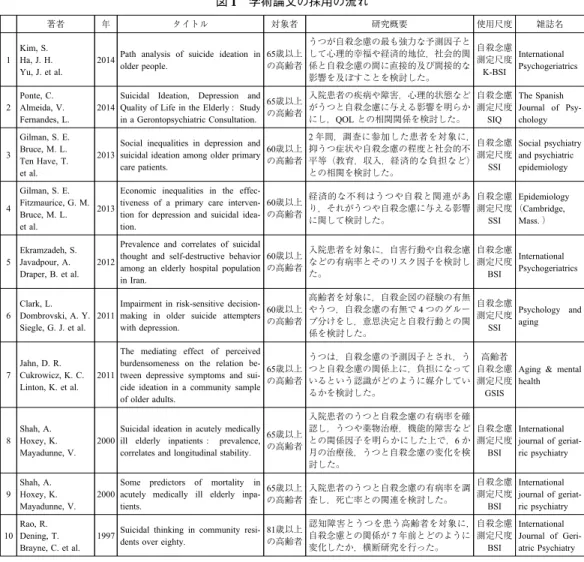
れらの論文を除外すると,60歳以上の高齢者を対象に自殺念慮測定尺度を用いていた 研究は10
件となっていた(図1)。
以上の
10
件の学術論文において(表1),年齢階層に着目すると,60
歳以上65
歳未 満の高齢者を対象とした論文が4
件,65歳以上を対象とした論文が5
件,81歳以上を 対象とした論文が1
件となっていた。また前記10
件の論文のうち,一般在宅高齢者を図1 学術論文の採用の流れ 高齢者の自殺念慮測定尺度に関する批判的論評 30
対象にした論文は少なく
2
件,残りの8
件は,病気で入院しているか治療を受けている 患者を対象としていた。さらに論文の内容に着目すると,自殺念慮に影響を与えるリス ク因子を明らかにする論文が多数を占めていた。なお,前記の
10
件に絞り込まれた学術論文の中の自殺念慮測定尺度に着目するなら,その内訳は①Beckらが開発した自殺念慮尺度
SSI(Scale for Suicidal Ideation)は 3
件,BSI(Beck Scale for Suicidal Ideation)が 5
件,②Reynoldsの自殺念慮尺度SIQ(Scale for Suicidal Questionnaire)が 1
件,③Heiselらの高齢者自殺念慮尺度GSIS(Geriatric Suicidal Ideation Scale)が 1
件であった。図1 学術論文の採用の流れ
著者 年 タイトル 対象者 研究概要 使用尺度 雑誌名
1 Kim, S.
Ha, J. H.
Yu, J. et al.
2014 Path analysis of suicide ideation in older people.
65歳以上 の高齢者
うつが自殺念慮の最も強力な予測因子と して心理的幸福や経済的地位,社会的関 係と自殺念慮の間に直接的及び間接的な 影響を及ぼすことを検討した。
自殺念慮 測定尺度 K-BSI
International Psychogeriatrics
2 Ponte, C.
Almeida, V.
Fernandes, L.
2014
Suicidal Ideation, Depression and Quality of Life in the Elderly : Study in a Gerontopsychiatric Consultation.
65歳以上 の高齢者
入院患者の疾病や障害,心理的状態など がうつと自殺念慮に与える影響を明らか にし,QOLとの相関関係を検討した。
自殺念慮 測定尺度 SIQ
The Spanish Journal of Psy- chology
3
Gilman, S. E.
Bruce, M. L.
Ten Have, T.
et al.
2013
Social inequalities in depression and suicidal ideation among older primary care patients.
60歳以上 の高齢者
2年間,調査に参加した患者を対象に,
抑うつ症状や自殺念慮の程度と社会的不 平等(教育,収入,経済的な負担など)
との相関を検討した。
自殺念慮 測定尺度 SSI
Social psychiatry and psychiatric epidemiology
4
Gilman, S. E.
Fitzmaurice, G. M.
Bruce, M. L.
et al.
2013
Economic inequalities in the effec- tiveness of a primary care interven- tion for depression and suicidal idea- tion.
60歳以上 の高齢者
経済的な不利はうつや自殺と関連があ り,それがうつや自殺念慮に与える影響 に関して検討した。
自殺念慮 測定尺度 SSI
Epidemiology
(Cambridge, Mass.)
5
Ekramzadeh, S.
Javadpour, A.
Draper, B. et al.
2012
Prevalence and correlates of suicidal thought and self-destructive behavior among an elderly hospital population in Iran.
60歳以上 の高齢者
入院患者を対象に,自害行動や自殺念慮 などの有病率とそのリスク因子を検討し た。
自殺念慮 測定尺度 BSI
International Psychogeriatrics
6 Clark, L.
Dombrovski, A. Y.
Siegle, G. J. et al.
2011
Impairment in risk-sensitive decision- making in older suicide attempters with depression.
60歳以上 の高齢者
高齢者を対象に,自殺企図の経験の有無 やうつ,自殺念慮の有無で4つのグルー プ分けをし,意思決定と自殺行動との関 係を検討した。
自殺念慮 測定尺度 SSI
Psychology and aging
7 Jahn, D. R.
Cukrowicz, K. C.
Linton, K. et al.
2011
The mediating effect of perceived burdensomeness on the relation be- tween depressive symptoms and sui- cide ideation in a community sample of older adults.
65歳以上 の高齢者
うつは,自殺念慮の予測因子とされ,う つと自殺念慮の関係上に,負担になって いるという認識がどのように媒介してい るかを検討した。
高齢者 自殺念慮 測定尺度 GSIS
Aging & mental health
8 Shah, A.
Hoxey, K.
Mayadunne, V.
2000
Suicidal ideation in acutely medically ill elderly inpatients : prevalence, correlates and longitudinal stability.
65歳以上 の高齢者
入院患者のうつと自殺念慮の有病率を確 認し,うつや薬物治療,機能的障害など との関係因子を明らかにした上で,6か 月の治療後,うつと自殺念慮の変化を検 討した。
自殺念慮 測定尺度 BSI
International journal of geriat- ric psychiatry
9 Shah, A.
Hoxey, K.
Mayadunne, V.
2000
Some predictors of mortality in acutely medically ill elderly inpa- tients.
65歳以上 の高齢者
入院患者のうつと自殺念慮の有病率を調 査し,死亡率との関連を検討した。
自殺念慮 測定尺度 BSI
International journal of geriat- ric psychiatry 10
Rao, R.
Dening, T.
Brayne, C. et al.
1997 Suicidal thinking in community resi- dents over eighty.
81歳以上 の高齢者
認知障害とうつを患う高齢者を対象に,
自殺念慮との関係が7年前とどのように 変化したか,横断研究を行った。
自殺念慮 測定尺度 BSI
International Journal of Geri- atric Psychiatry
高齢者の自殺念慮測定尺度に関する批判的論評 31
2-2.自殺念慮に関する測定尺度の概要
①Beckらが開発した自殺念慮尺度
BSI(Beck Scale for Suicidal Ideation)
Beck
らのBSI(表 2)は,自殺の可能性がある入院患者と外来患者を対象に自殺念
慮の程度を測定することを目的に開発された尺度である。Beckらは
BSI
に先行して自 殺念慮尺度SSI
を開発している。このSSI
は,臨床医(Clinician)が半構造化面接法で 用いた自殺傾向性に関する評価項目を30
項目の他者評定尺度として設定し,最終的に19
項目から構成される測定尺度としたものである(Beckら1979 : 345)。その後,Beck
らは,他者評定尺度としてのSSI
を自己評定尺度のBSI
に修正している(Steer 1993 :232)。この BSI
は,SSIの19
項目に「行った自殺企図の回数」と「自殺意図の深刻性」の
2
項目を加えて合計21
項目の尺度となっている。ただし,追加された2
項目は,自 殺経験者用の項目である。前記19
項目で構成される尺度の因子数には,2因子(自殺 の準備,自殺の動機付け)と3
因子(積極的自殺欲求,自殺念慮,自殺の準備)がある(Beckら
1979 ; 1997)。この尺度の回答方法は 3
件法(0点から2
点)と4
件法(13目 の項目のみ)で,総合得点の範囲は0〜38
点となっている。日本では,大塚ら(1998)が翻訳版として,文化に合わない項目を修正した日本語版
SSI
が作成されている。②Reynoldsが開発した自殺念慮尺度
SIQ(Suicidal Ideation Questionnaire)
Reynolds
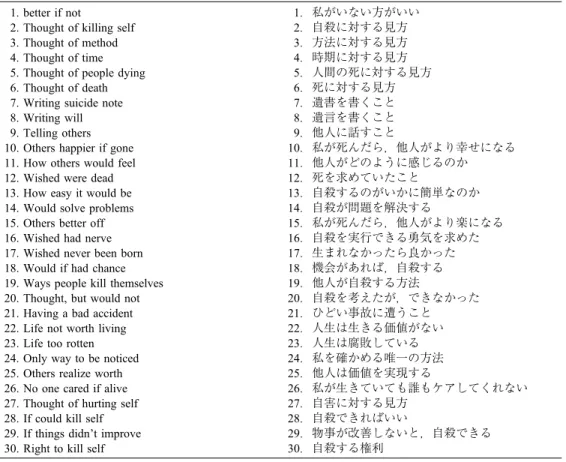
が開発した自殺念慮尺度SIQ(表 3)は,青少年の自殺念慮を測定するため
の尺度で,最近
1
か月間の状況を頻度で問う30
項目の自己評定尺度である。SIQは,自殺念慮について
7
件法(0:「まったく思わない」〜6:「ほとんど毎日思う」)で回答を 求め,その総合得点は0〜180
点となっている。得点が高くなればなるほど,自殺の危 険性が高いと評価される(Davis 1992 : 298)。SIQの因子数は,3因子(具体的な自殺 計画と希望,他人の観点と反応,病的な思い)となっている(Pintoら1997 ; Potard
ら2014 : 472)。SIQ
には,中学生版であるSIQ-JR(Suicidal Ideation Questionnaire-Junior)
と,成人版である
ASIQ(Adult Suicidal Ideation Questionnaire)が開発されている。SIQ- JR
は,SIQ の30
項目から15
項目に圧縮され(Davis 1992 : 298),ASIQは25
項目に圧 縮され,前記同様の3
因子で構成される尺度となっている(Reynolds 1991 : 293)。③Heiselら が 開 発 し た 高 齢 者 版 の 自 殺 念 慮 尺 度
GSIS(Geriatric Suicidal Ideation Scale)
Heisel
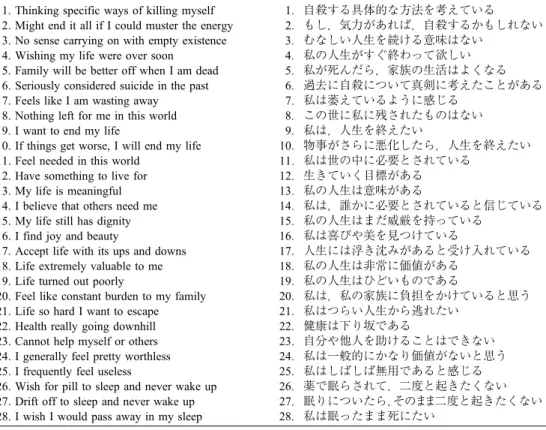
らが開発したGSIS(表 4)は,高齢者の自殺念慮を測定するために開発され
た自己評定尺度である。開発に先立って文献研究ならびに高齢者の精神的健康に関する 専門家による議論を通して
80
項目が用意され,最終的に31
項目に圧縮されている。回 答は5
件法(1:「まったくそうではない」〜5:「そうである」)で求め,総得点は0〜
155
点となっている(Heisel 2006 : 743)。GSISの31
項目は,自殺念慮,死に対する思 い,自己喪失と社会的価値,人生に対する姿勢(life orientation)の4
因子で構成されて高齢者の自殺念慮測定尺度に関する批判的論評 32
表2 自殺念慮尺度BSI(Beck Scale for Suicidal Ideation)
1. Wish to live 0. Moderate to strong 1. Weak 2. None 2. Wish to die
0. None 1. Weak 2. Moderate to strong 3. Reasons for living/dying
0. For living outweigh for dying 1. About equal
2. For dying outweigh for living 4. Desire to make active suicide attempt
0. None 1. Weak 2. Moderate to strong 5. Passive suicidal desire
0. Would take precautions to save life 1. Would leave life/death to chance
2. Would avoid steps necessary to save or maintain life 6. Time dimension : Duration of suicide ideation/wish
0. Brief, fleeting periods 1. Longer periods
2. Continuous(chronic)or almost continuous 7.Time dimension : Frequency of suicide
0. Rare, occasional 1. Intermittent 2. Persistent or continuous 8. attitude toward ideation/wish
0. Rejecting
1. Ambivalent;indifferent 2. Accepting
9. Control over suicidal action/acting−out wish 0. Has sense of control
1. Unsure of control 2. Has no sense of control
10. Deterrents to active attempt(e.g., family, religion, irreversibility)
0. Would not attempt because of a deterrent 1. Some concern about deterrents 2. Minimal or no concern about deterrents 11. Reason for contemplated attempt
0. To manipulate the environment;get attention, revenge 1. Combination of 0 and 2
2. Escape, surcease, solve problems
12. Method : Specificity/planning of contemplated attempt 0. Not considered
1. Considered, but details not worked out 2. Details worked out/well formulated
13. Method : Availability/opportunity for contemplated attempt 0. Method not available;no opportunity
1. Method would take time/effort;opportunity not readily available 2 a. Method and opportunity available
2 b. Future opportunity or availability of method anticipated 14. Sense of capability to carry out attempt
0. No courage, too weak, afraid, incompetent 1. Unsure of courage, competence 2. Sure of competence, courage 15. Expectancy/anticipation of actual attempt
0. No
1. Uncertain, not sure 2. Yes
16. Actual preparation for contemplated attempt 0. None
1. Partial(e.g., starting to collect pills)
2. Complete(e.g., had pills, loaded gun)
17. Suicide note 1. None
2. Started but not completed;only thought about 3. Completed
18. Final acts in anticipation of death(e.g., insurance, will)
0. None
1. Thought about or made some arrangements 2. Made definite plans or completed arrangements 19. Deception/concealment of contemplated suicide
0. Revealed ideas openly 1. Held back on revealing 2. Attempted to deceive, conceal, lie
1.生きたいと思う気持ち 0.普通またはそれ以上ある 1.わずかにある 2.全くない 2.死にたいと思う気持ち
0.全くない 1.わずかにある 2.普通またはそれ以上ある 3.生死に対する見方
0.死よりも生を重視 1.生死はどちらも同等 2.生よりも死を重視 4.自殺に対する積極的な念慮
0.全くない 1.わずかにある 2.普通またはそれ以上ある 5.自殺に対する消極的な念慮
0.生きるために注意を払っている 1.生死は運に任せる
2.生きるために必要な手段は特にとらない 6.自殺念慮の期間
0.短い期間 1.長い時間続く
2.連続的(慢性的)またはほとんど連続的 7.自殺企図の頻度
0.希に起こる 1.たまに起こる
2.永続的または連続的に起こる 8.自殺念慮や願望に対する自分自身の態度
0.拒絶できる 1.曖昧か無関心 2.受け入れてしまう
9.自殺行動や願望の実行に対するコントロール 0.コントロールできる
1.分からない
2.全くコントロールできない
10.積極的な自殺企図を抑制できるもの(例:家族,信仰など)
0.抑制できるものがあるので行動しない 1.懸念すべきことはある
2.抑制できるものが少ないか,全くない 11.自殺企図の動機
0.現在の状況から逃れるため,注意を引く,もしくは復讐のため 1.現在の状況から逃れたいのと現実逃避が混ざっているため 2.現実逃避,問題の解決を諦めているため
12.方法:具体性または自殺企図の計画 0.考えていない
1.考えたことはあるが,詳しくは計画していない 2.詳しく考え,十分に計画した
13.方法:機会または自殺企図の可能性 0.実現する方法と機会がない
1.時間と努力が必要で,その機会がなかった 2 a.方法と機会の可能性はある
2 b.今後,計画している方法と機会がある 14.自殺企図の実行能力
0.自殺する勇気がない,弱い,怖い
1.自殺する勇気と自信があるか自分にはよく分からない 2.自殺する勇気と自信がある
15.予測または自殺企図の予定 0.ない
1.不確かである 2.ある
16.自殺企図の実行準備 0.していない
1.部分的に準備している(例:薬を集め始める)
2.完了している(例:薬を持っている,弾を込めている 17.遺書
0.ない
1.書き始めたが,完了していない;考えただけである 2.書き終えている
18.自殺の最終的な準備(例:保険,遺言)
0.してない
1.考えた,または多少の準備をしている 2.きちんと整えたか,整理を完了している 19.偽りまたは自殺の意思の隠蔽
0.誰かに自殺の意思を示した
1.誰かに自殺の意思を示すのを差し控える 2.偽ったり, 隠したり,嘘をついたりする 出所:Beckら(1979)「Assessment of suicidal intention : the Scale for Suicide Ideation」
和文は,品川心療内科(2008)「自殺企図評価尺度SSI」を参考に筆者作成
高齢者の自殺念慮測定尺度に関する批判的論評 33
いる(Heisel 2002 : 430)。
2-3.自殺念慮に関する測定尺度の妥当性の検討
①探索的因子分析の適用
自殺念慮尺度
BSI,自殺念慮尺度 SIQ,高齢者自殺念慮尺度 GSIS
のすべてにおい て,内容的妥当性の検討のために探索的因子分析がなされていた。ただし,因子負荷量(パラメータ)の推定に最尤法を採用していた測定尺度は,自殺念慮尺度
BSI
のみであ っ た(Beckら1997 : 1044)。自 殺 念 慮 尺 度 SIQ
で は,主 成 分 法(Principal componentanalysis)が採用され(Pinto
ら1997 : 64),高齢者自殺念慮尺度 GSIS
においては,主 因子法(Principal axis factoring)が採用されていた(Heisel ら2006 : 745)。
潜在変数の内容を変化させるための回転法として,プロマックス回転が採用されてい た測定尺度は自殺念慮尺度
BSI
のみであった(Beckら1997 : 1044)。高齢者自殺念慮
尺度GSIS
では直接オブリミン(direct oblimin)回転が,自殺念慮尺度SIQ
では直交回表3 自殺念慮尺度SIQ(Suicidal Ideation Questionnaire)
1. better if not
2. Thought of killing self 3. Thought of method 4. Thought of time 5. Thought of people dying 6. Thought of death 7. Writing suicide note 8. Writing will 9. Telling others 10. Others happier if gone 11. How others would feel 12. Wished were dead 13. How easy it would be 14. Would solve problems 15. Others better off 16. Wished had nerve 17. Wished never been born 18. Would if had chance 19. Ways people kill themselves 20. Thought, but would not 21. Having a bad accident 22. Life not worth living 23. Life too rotten 24. Only way to be noticed 25. Others realize worth 26. No one cared if alive 27. Thought of hurting self 28. If could kill self 29. If things didn’t improve 30. Right to kill self
1.私がいない方がいい 2.自殺に対する見方 3.方法に対する見方 4.時期に対する見方 5.人間の死に対する見方 6.死に対する見方 7.遺書を書くこと 8.遺言を書くこと 9.他人に話すこと
10.私が死んだら,他人がより幸せになる 11.他人がどのように感じるのか 12.死を求めていたこと
13.自殺するのがいかに簡単なのか 14.自殺が問題を解決する
15.私が死んだら,他人がより楽になる 16.自殺を実行できる勇気を求めた 17.生まれなかったら良かった 18.機会があれば,自殺する 19.他人が自殺する方法
20.自殺を考えたが,できなかった 21.ひどい事故に遭うこと 22.人生は生きる価値がない 23.人生は腐敗している 24.私を確かめる唯一の方法 25.他人は価値を実現する
26.私が生きていても誰もケアしてくれない 27.自害に対する見方
28.自殺できればいい
29.物事が改善しないと,自殺できる 30.自殺する権利
出所:Zhangら(2014)「Validation of the Chinese version of the Reynolds’suicidal ideation questionnaire : psychometric properties and its short version」
和文は,筆者作成
高齢者の自殺念慮測定尺度に関する批判的論評 34
転(バリマックス回転)が採用されていた(Pintoら
1997 : 64)。
②確認的因子分析の適用
確認的因子分析により構成概念妥当性が統計学的に検討されていた尺度は,自殺念慮 尺度
BSI
と自殺念慮尺度SIQ
であった。自殺念慮測定尺度SIQ
は,Potardら(2014)の研究において確認的因子分析が行われ,3因子(斜交)モデルが検討され,それらが データに適合することが示されている(Potardら
2014 : 472)
(1)。ただし,自殺念慮尺度BSI
は,Holdenら(2005)の研究において2
因子二次因子モデルがデータに適合しな いことが明らかにされている(Holdenら2005 : 233)。
以上,従来の研究で用いられていた
4
種類の自殺念慮関連の測定尺度に関する妥当性 を内容的妥当性と構成概念妥当性における統計学的な側面での解析結果は表5
に示した 通りである。表4 自殺念慮尺度GSIS(Geriatric Suicidal Ideation Scale)
1. Thinking specific ways of killing myself 2. Might end it all if I could muster the energy 3. No sense carrying on with empty existence 4. Wishing my life were over soon
5. Family will be better off when I am dead 6. Seriously considered suicide in the past 7. Feels like I am wasting away 8. Nothing left for me in this world 9. I want to end my life
10. If things get worse, I will end my life 11. Feel needed in this world
12. Have something to live for 13. My life is meaningful 14. I believe that others need me 15. My life still has dignity 16. I find joy and beauty
17. Accept life with its ups and downs 18. Life extremely valuable to me 19. Life turned out poorly
20. Feel like constant burden to my family 21. Life so hard I want to escape 22. Health really going downhill 23. Cannot help myself or others 24. I generally feel pretty worthless 25. I frequently feel useless
26. Wish for pill to sleep and never wake up 27. Drift off to sleep and never wake up 28. I wish I would pass away in my sleep
1.自殺する具体的な方法を考えている 2.もし,気力があれば,自殺するかもしれない 3.むなしい人生を続ける意味はない
4.私の人生がすぐ終わって欲しい 5.私が死んだら,家族の生活はよくなる 6.過去に自殺について真剣に考えたことがある 7.私は萎えているように感じる
8.この世に私に残されたものはない 9.私は,人生を終えたい
10.物事がさらに悪化したら,人生を終えたい 11.私は世の中に必要とされている
12.生きていく目標がある 13.私の人生は意味がある
14.私は,誰かに必要とされていると信じている 15.私の人生はまだ威厳を持っている
16.私は喜びや美を見つけている
17.人生には浮き沈みがあると受け入れている 18.私の人生は非常に価値がある
19.私の人生はひどいものである
20.私は,私の家族に負担をかけていると思う 21.私はつらい人生から逃れたい
22.健康は下り坂である
23.自分や他人を助けることはできない 24.私は一般的にかなり価値がないと思う 25.私はしばしば無用であると感じる 26.薬で眠らされて,二度と起きたくない
27.眠りについたら,そのまま二度と起きたくない
28.私は眠ったまま死にたい
出所:Heiselら(2006)「The development and initial validation of the Geriatric Suicide Ideation Scale」
和文は,筆者作成
高齢者の自殺念慮測定尺度に関する批判的論評 35
3.結 論
本研究は,自殺念慮測定尺度を使用している国内・外の学術論文を取り上げ,それら を統計学的な観点から批判的な論評を行うことを目的に行った。
検索した学術論文において数量化をねらいとして開発された自殺念慮測定尺度は,
Beck
らのBSI, Reynolds
のSIQ, Heisel
らのGSIS
の3
種類であった。ただし,内容的 妥当性と構成概念妥当性が統計学的に十分検証された測定尺度はSIQ
のみであった(表
5)。しかしながら,SIQ
は青少年を対象に開発された尺度であり,自殺計画や他人の観点と反応など,高齢者の自殺念慮のみをはかるのに内容的にもそのまま適用するこ とには無理であると推察された。また,従来の自殺念慮測定尺度は,自殺行為の予測に 重点が置かれ,自殺念慮から始まり自殺計画と自殺企図を経て自殺に至るといった連続 的なプロセス(O’Connellら
2004 : 895-896)あるいは連続的な概念(ジャン 2006 : 13)
における自殺念慮を扱っていない。つまり,自殺念慮より自殺行為(自殺計画と自殺企 図)に焦点が置かれている測定尺度がほとんどであり,自殺念慮そのものを正確に測れ る尺度は皆無であった。
高齢者の自殺や自殺計画,自殺企図といったプロセス全体の予防や高齢者の安心・安 全で豊かな生活の維持・向上ためには,前記プロセスにおける自殺念慮に影響を与える 要因の解明が不可欠である。そのことに資する自殺念慮測定尺度の開発が急務である。
なお,高齢者用の
GSIS
は,項目数が多いことによる高齢者に対する負担や測定内容が 自殺念慮というよりもうつの概念に近い項目が配置されていた。今後は,時間的・精神 的負担を与えない高齢者の自殺念慮そのものを適切に測定する尺度を開発することが重 要である。そのような尺度が開発されるなら,それは高齢者の自殺予防のための適切な 方策の開発にとって有効な機能を発するものと言えよう。注
⑴ なお,3因子(斜交)モデルの適合度は,GFIが0.92, AGFIが0.91, RMSEAが0.05で,概ね良好な値 表5 自殺念慮測定尺度の内容的及び構成概念妥当性
自殺念慮 測定尺度
探索的因子分析
(内容的妥当性)
確認的因子分析
(構成概念妥当性)
分析の実施 最尤法または
最小二乗法 斜交回転 分析の実施 適合度
1 BSI ○ ○ ○ ○ 不適合
2 SIQ ○ × × ○ 適合
3 GSIS ○ × ○ ×
高齢者の自殺念慮測定尺度に関する批判的論評 36
が示されていた。ただし,CFIに関しては,一般的に良好であるとされている0.9以上(豊田2003;
山本ら2002)ではなかった。
参考文献
粟田主一(2003)「都市部住宅地域に在住する高齢者の自殺予防プログラムの開発−高齢者の自殺念慮の出 現頻度と関連要因の調査から−(特集1.うつ病による自殺を予防する)」『精神科』3(5),422-429.
粟田主一(2005)「地域在住高齢者の自殺念慮に関する1年間の前向きコホート研究」『東北医学雑誌』
117, 94-96.
大塚明子・瀬戸正弘・菅野純(1998)「自殺念慮尺度の作成と自殺念慮に関連する要因の研究」『カウンセ リング研究』31(3),247-258.
大塚耕太郎・酒井明夫・智田文徳(2008)「高齢者のうつと自殺への介入−予防介入,危機介入,事後介入
−」『老年精神医学雑誌』19(2),183-197.
大野裕・坂本真士・田中江里子・ほか(2001)「高齢者のうつ病および自殺予防プログラムの開発に関する 実践的研究」『研究助成論文集』250-257.
大山博史・渡邉洋一・坂下智恵・ほか(2006)「地域介入による高齢者自殺予防:本邦における介入研究の 分析と統合(特集:自殺予防のための多角的取り組み:医学−心理−社会を軸として)」『ストレス科 学』21(1),1-10.
佐藤寛・佐藤美幸・三田村仰(2014)「短縮版Suicidal Ideation Questionnaireの日本語版の作成:日本の大 学生における信頼性と妥当性」『臨床心理学』14(3),395-401.
品川心療内科(2008)「自殺企図評価尺度(SSI)」http : //shinbashi-ssn.blog.so-net.ne.jp/2008-06-07-10(2015.
09. 02)
L6W(2006)「-JI DE' K;:&@ (S *O4U」%W0R)0RF 7:RG.5!(=
ジャンミヒ(2006)「高齢者のうつと自殺思考に関する構造モデル」ギョンヒ大学大学院博士学位論 文.
高橋祥友(2003)「高齢者にみる自殺の特徴と問題点(特集 高齢者と社会病理)」『老年精神医学雑誌』14
(4),430-435.
豊田秀樹(1998)『共分散構造分析〈入門編〉−構造方程式モデリング−』朝倉書店.
豊田秀樹(2000)『共分散構造分析[応用編]−構造方程式モデリング−』朝倉書店.
豊田秀樹(2003)『共分散構造分析[疑問編]−構造方程式モデリング−』朝倉書店.
長谷屋誠(2004)「高齢者の希死念慮に影響を及ぼす要因の検討−秋田県と愛知県の在宅高齢者を比較して
−」『自殺予防と危機介入』25(1),40-48.
畠山禮子(2004)「秋田県内の高齢者自殺とうつ病の一考察−精神保健の視点から−」『秋田桂城短期大学 紀要』(17),1-9.
79,・M=+(2006)「-JI K;<"@ BTH 6Q/ DEPH 3#2 S (1CJ A
*」『N>8$' :V:?』22, 50-90.(=パクホンギル・ジョンソクギュン(2006)「齢者の自殺念 慮に影響を及ぼすうつ病を媒介した関連要因の研究」『精神保健と社会事業』22, 50-90.)
本橋豊・金子善博(2008)「高齢者自殺の文化的側面」『老年精神医学雑誌』19(2),176-182.
前田雅也・佐藤新(2004)「単身高齢者の抱える問題−自殺とうつを中心に−(特集 高齢者の一人暮ら し)」『老年精神医学雑誌』15(2),162-168.
孟浚鎬(2014)「韓国における高齢者自殺予防事業の問題と今後の在り方」『評論・社会科学』107, 117- 129.
森田次朗(2008)「自殺願望の規定要因に関する一考察−JGSS-2006データによる分析−」『JGSSで見た日 本人の意識と行動:日本版General Social Surveys研究論文集』7, 107-119.
山本嘉一郎・小野寺孝義(2002)『Amosによる共分散構造分析と解析事例』ナカニシヤ出版.
Abe, Y., Fujise, N. and Fukunaga, R., et al.(2012)Comparisons of the prevalence of and risk factors for elderly depression between urban and rural populations in Japan,International Psychogeriatrics,24(8), 1235-1241.
Almeida, L., and Quintão, S.(2011)[Depression and suicidal ideation in elderly institutionalized and non- 高齢者の自殺念慮測定尺度に関する批判的論評 37
institutionalized in Portugal],Acta medica portuguesa,25(6), 350-358.
Arvaniti, A., Livaditis, M., and Kanioti, E., et al.(2005)Mental health problems in the elderly in residential care in Greece−A pilot study,Aging & mental health,9(2), 142-145.
Awata, S., Bech, P., and Koizumi, Y., et al.(2007)Validity and utility of the Japanese version of the WHO-Five Well-Being Index in the context of detecting suicidal ideation in elderly community residents,International psychogeriatrics,19(01), 77-88.
Beck, A. T., Kovacs, M., and Weissman, A.(1979)Assessment of suicidal intention : the Scale for Suicide Idea- tion,Journal of consulting and clinical psychology, 47(2), 343.
Beck, A. T., Brown, G. K., and Steer, R. A.(1997)Psychometric characteristics of the Scale for Suicide Ideation with psychiatric outpatients.Behaviour Research and Therapy,35(11), 1039-1046.
Chaudieu, I., Norton, J., and Ritchie, K. A., et al.(2011)Late-life health consequences of exposure to trauma in a general elderly population : the mediating role of reexperiencing posttraumatic symptoms,Journal of Clinical Psychiatry,72(7), 929-35.
Chen, W. J., Chen, C. C., and Ho, C. K., et al.(2009)The suitability of the BSRS-5 for assessing elderly who have attempted suicide and need to be referred for professional mental health consultation in a metropolitan city, Taiwan,International journal of geriatric psychiatry, 24(10), 1151-1157.
Clark, L., Dombrovski, A. Y., and Siegle, G. J., et al.(2011)Impairment in risk-sensitive decision-making in older suicide attempters with depression,Psychology and aging,26(2), 321.
Davis, J. M.(1992)Suicidal ideation questionnaire,Journal of Psychoeducational Assessment,10(3), 298-301.
Dombrovski, A. Y., Butters, M. A., and Reynolds III, C. F., et al.(2008)Cognitive performance in suicidal de- pressed elderly : preliminary report,The American Journal of Geriatric Psychiatry, 16(2), 109-115.
Ekramzadeh, S., Javadpour, A., and Draper, B., et al.(2012)Prevalence and correlates of suicidal thought and self -destructive behavior among an elderly hospital population in Iran, International Psychogeriatrics, 24(09), 1402-1408.
Friedman, B., Heisel, M. J., and Delavan, R. L.(2005)Psychometric Properties of the 15-Item Geriatric Depres- sion Scale in Functionally Impaired, Cognitively Intact, Community-Dwelling Elderly Primary Care Patients, Journal of the American Geriatrics Society,53(9), 1570-1576.
Fujisawa, D., Tanaka, E., and Sakamoto, S., et al.(2005)The development of a brief screening instrument for de- pression and suicidal ideation for elderly : the Depression and Suicide Screen,Psychiatry and clinical neuro- sciences,59(6), 634-638.
Fukunaga, R., Abe, Y., and Nakagawa, Y. et al.(2012)Living alone is associated with depression among the eld- erly in a rural community in japan,Psychogeriatrics,12(3), 179-185.
Gilman, S. E., Bruce, M. L., and Ten Have, T., et al.(2013)Social inequalities in depression and suicidal ideation among older primary care patients,Social psychiatry and psychiatric epidemiology,48(1), 59-69.
Gilman, S. E., Fitzmaurice, G. M., and Bruce, M. L., et al.(2013)Economic inequalities in the effectiveness of a primary care intervention for depression and suicidal ideation,Epidemiology(Cambridge, Mass.), 24(1), 14- 22.
Heisel, M. J., and Flett, G. L.(2006)The development and initial validation of the Geriatric Suicide Ideation Scale,The American Journal of Geriatric Psychiatry,14(9), 742-751.
Heisel, M. J., Flett, G. L., and Besser, A.(2002)Cognitive functioning and geriatric suicide ideation : testing a mediational model,The American journal of geriatric psychiatry,10(4), 428-436.
Holden, R. R., and DeLisle, M. M.(2005)Factor analysis of the Beck Scale for Suicide Ideation with female sui- cide attempters,Assessment, 12(2), 231-238.
Jahn, D. R., Cukrowicz, K. C., and Linton, K., et al.(2011)The mediating effect of perceived burdensomeness on the relation between depressive symptoms and suicide ideation in a community sample of older adults,Aging
& mental health,15(2), 214-220.
Kim, S., Ha, J. H., and Yu, J., et al.(2014)Path analysis of suicide ideation in older people,International Psy- 高齢者の自殺念慮測定尺度に関する批判的論評
38
chogeriatrics,26(03), 509-515.
Kivelä, S. L., Nissinen, A., and Tuomilehto, J., et al.(1986)Prevalence of depressive and other symptoms in eld- erly Finnish men,Acta Psychiatrica Scandinavica,73(1), 93-100.
Koyama, A., Fukunaga, R., and Abe, Y., et al.(2014)Item non-response on self-reported depression screening questionnaire among community-dwelling elderly,Journal of affective disorders,162, 30-33.
Kurimoto, A., Awata, S., and Ohkubo, T., et al.(2010)Reliability and validity of the Japanese version of the ab- breviated Lubben Social Network Scale,Nihon Ronen Igakkai zasshi. Japanese journal of geriatrics, 48(2), 149-157.
Lapierre, Y. D.(1991)Controlling acute episodes of depression,International clinical psychopharmacology,6(2), 23-35.
Linden, M., Kurtz, G., and Baltes, M. M., et al.(1998)Depression in the very elderly,Nervenarzt,69(1), 27-37.
Martin, A. J., Tebbs, V. M., and Ashford, J. J.(1986)Affective disorders in general practice. Treatment of 6000 patients with fluvoxamine,Pharmatherapeutica,5(1), 40-49.
McLaren, S., Gomez, R., and Bailey, M., et al.(2007)The association of depression and sense of belonging with suicidal ideation among older adults : Applicability of resiliency models,Suicide and Life-Threatening Behav- ior,37(1), 89-102.
OECD(2009)「Society at a Glance 2009 : OECD SOCIAL INDICATORS」(http : //www.oecd-ilibrary.org/doc- server/download/8109011e.pdf?expires=1424174665&id=id&accname=guest&checksum=DEDC2BED986C 050B3E16659F19D6B04D, 2014. 11. 18)
Opdyke, K. S., Reynolds, C. F., and Frank, E., et al.(1996)Effect of continuation treatment on residual symptoms in late-life depression : How well is well ?,Depression and anxiety,4(6), 312-319.
O’Connell, H., Chin, A. V., and Cunningham, C., et al.(2004)Recent developments : suicide in older people, BMJ : British Medical Journal,329(7471), 895-899.
Park, J. I., Han, M. I., and Kim, M. S., et al.(2014)Predictors of suicidal ideation in older individuals receiving home-care services,International journal of geriatric psychiatry, 29(4), 367-376.
Pfaff, J. J., and Almeida, O. P.(2004)Identifying suicidal ideation among older adults in a general practice set- ting,Journal of affective disorders,83(1), 73-77.
Pinto, A., Whisman, M. A., and McCoy, K. J.(1997)Suicidal ideation in adolescents : Psychometric properties of the suicidal ideation questionnaire in a clinical sample.Psychological Assessment,9(1), 63.
Ponte, C., Almeida, V., and Fernandes, L.(2014)Suicidal Ideation, Depression and Quality of Life in the Elderly : Study in a Gerontopsychiatric Consultation,The Spanish Journal of Psychology,17, E 14, 1-10.
Potard, C., Kubiszewski, V., and Gimenes, G., et al.(2014). Validation of the French version of the Suicidal Idea- tion Questionnaire among adolescents,Psychiatry research,215(2), 471-476.
Rao, R., Dening, T., and Brayne, C., et al.(1997)Suicidal thinking in community residents over eighty,Interna- tional Journal of Geriatric Psychiatry,12(3), 337-343.
Reynolds, W. M.(1991)Psychometric characteristics of the Adult Suicidal Ideation Questionnaire in college stu- dents,Journal of personality assessment,56(2), 289-307.
Rushing, N. C., Corsentino, E., and Hames, J. L., et al.(2013)The relationship of religious involvement indicators and social support to current and past suicidality among depressed older adults,Aging & mental health,17(3), 366-374.
Seki, T., Awata, S., and Koizumi, Y., et al.(2006)[Association between depressive symptoms and cerebrovascu- lar lesions on MRI in community-dwelling elderly individuals],Nihon Ronen Igakkai zasshi. Japanese journal of geriatrics,43(1), 102-107.
Shah, A., Hoxey, K., and Mayadunne, V.(2000 a)Suicidal ideation in acutely medically ill elderly inpatients : prevalence, correlates and longitudinal stability,International journal of geriatric psychiatry, 15(2), 162-169.
Shah, A., Hoxey, K., and Mayadunne, V.(2000 b)Some predictors of mortality in acutely medically ill elderly in- patients,International journal of geriatric psychiatry,15(6), 493-499.
高齢者の自殺念慮測定尺度に関する批判的論評 39
Steer, R. A., Rissmiller, D. J., and Ranieri, W. F., et al.(1993)Dimensions of suicidal ideation in psychiatric in- patients,Behaviour research and therapy,31(2), 229-236.
Tan, L. L., and Wong, H. B.(2008)Severity of depression and suicidal ideations among elderly people in Singa- pore,International Psychogeriatrics,20(02), 338-346.
Wongpakaran, T., and Wongpakaran, N.(2013)Detection of suicide among the elderly in a long term care facil- ity,Clinical interventions in aging,8, 1553-1559.
Zhang, Y., Yip, P. S. F., & Fu, K. W.(2014)Validation of the Chinese version of the Reynolds’suicidal ideation questionnaire : psychometric properties and its short version.Health and quality of life outcomes, 12(33), 1-9.
Zisook, S., Kasckow, J. W., and Lanouette, N. M., et al.(2010)Augmentation with citalopram for suicidal idea- tion in middle-aged and older outpatients with schizophrenia and schizoaffective disorder who have subthresh- old depressive symptoms : a randomized controlled trial,The Journal of clinical psychiatry,71(7), 915-922.
高齢者の自殺念慮測定尺度に関する批判的論評 40
The purpose of this critical review is to statistically review both domestic and foreign stud- ies which use suicidal ideation scales. We gathered 11 studies from database of “CiNii” and
“Pubmed”, and eventually received three suicidal ideation scales from them. We checked their content and construct validity and evaluated them from the standpoint of the correct statistical procedure. As a result, such statistical procedure was only SIQ in the four scales. But it has been estimated that there is impossible to directly apply to the elderly. Therefore what is needed for a suggestion of preventive intervention is to develop a proper suicidal ideation scale of the elderly which is focused on scaling suicidal ideation and find its true factors.
Key words: Elderly, Suicidal ideation, Scale, Critical review
A Critical Review of the Suicidal Ideation Scale of the Elderly
Joonho Maeng
高齢者の自殺念慮測定尺度に関する批判的論評 41