_____________________________________________________________________________
HOOGERVORST, Tom. 2015. Malay youth language in Malaysia. In Dwi Noverini DJENAR, ed.
Youth language in Indonesia and Malaysia. NUSA 58: 25-49. [Permanent URL:
http://hdl.handle.net/10108/84124]
Malay youth language in West Malaysia Tom HOOGERVORST
Royal Netherlands Institute of Southeast Asian and Caribbean Studies
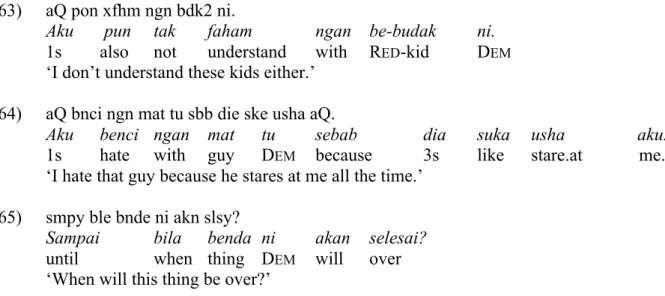
This paper typologises the sociolect of ‘young people’ – in the broadest sense of the word – in West Malaysia. The focus is on speakers of colloquial Malay, a language variety which is itself poorly documented. Linguistic scholarship has thus far prioritised the standardised Malay variety promoted by language planners and, more recently, regional dialects. Sociolects and contact varieties have received relatively scant attention, especially in Malaysia. I start by situating the Malay youth language in Malaysia’s language ecology. The next three sections describe, respectively, three distinctive lexico-semantic characteristics of this youth language: common processes of shortening words, semantic innovation, and the influence from languages in contact, including English and Chinese varieties. The final section addresses the ways in which young speakers of colloquial Malay write down their language informally. Throughout this paper, I will compare the Malay youth language used in West Malaysia with its much better known Indonesian equivalent.
1. Introduction1
To those who have learned Malay academically, an everyday conversation between young people often proves to be a linguistic terra incognita. This study offers a preliminary description of the youth language (bahasa remaja) of West Malaysia – i.e. the Peninsula – charting the speech habits of young speakers of colloquial Malay, the words they use and the new meanings they give to existing words. In recognition of this volume’s general theme, I will make comparisons with the much better known Indonesian youth language (bahasa gaul) wherever possible.
Although the official languages of Indonesia and Malaysia, respectively Bahasa Indonesia
‘Indonesian’ and Bahasa Malaysia ‘Malaysian’, are both standardised varieties of Malay, they exhibit numerous differences in pronunciation, orthography, lexicon and grammar. As a result, in certain domains the two languages are mutually unintelligible – a long-time point of contention of the transnational Malay language organisation (Majlis Bahasa Brunei- Indonesia-Malaysia or MABBIM). Unsurprisingly, the differences are even greater between the numerous vernacular varieties of the Malay language. A comparison of some common colloquial words in Malaysian and Indonesian in Table 1 will suffice to illustrate this point:
1 I would like to express my gratitude to Keng We Koh, Azam Othman, Kartini Abd Wahab, Janet Yong and two anonymous reviewers for their valuable suggestions and points for improvements. Some of the field notes used in this paper are collected during my (unrelated) fieldwork for the Sealinks Project (University of Oxford) and I am grateful for funding received from the European Research Council, as part of Grant Agreement No 206148 awarded to Nicole Boivin.
Malaysian Indonesian
awék céwék ‘girl’
bapuk béncong ‘transvestite, sissy’
bengap goblok ‘stupid’
biul sinting ‘crazy’
borak ngomong ‘to chat’
cintan cintrong ‘love’
gempak dahsyat ‘awesome’
jiwang sénsi ‘sentimental’
jom yuk ‘let’s go’
konék kontol ‘penis’
lawa comél ‘pretty’
lépak ngécéng ‘to hang out’
mak nyah waria ‘transsexual’
menyampah sebel ‘frustrated, disgusted’
ponténg2 bolos ‘to skip, to be absent’
sékéh tonjok ‘to hit with the first’
Table 1: Colloquialisms in Malaysian and Indonesian
This study relies on a corpus of data collected during several short trips to Kuala Lumpur and its satellite cities in April 2007, February 2008, February 2009, November 2009, March 2011, June 2013 and July 2014. Eleven of my consultants were men and five were women, all between the age of 16 and 35 at the time of consultation. I am particularly grateful to Shuhaiza Soib and Muhammad Zuhri Soib, who kindly provided me with shelter and enlightened me on several aspects of the Malay youth language.
This study is divided into five sections. First, some background is given on the concept of youth language and its sociolinguistic position in the Malaysian context. The following section deals with the phonological process of syllabic shortening for a certain set of frequently used lexical items, which is common in colloquial Malay varieties in general but displays certain unique features in the Malay youth language. I then call attention to some of the slang words used in Malay youth language and the process of attributing slang meanings to existing vocabulary. Subsequently, the lexical influence of other languages is addressed, especially English and Chinese dialects. The last section examines the ways in which Malay youth language is written down, including in digital messages. I will conclude by summarising the issues identified in this study and suggest some directions for further research.
Lastly, a note on the spelling should be included here. Regional dialects of Malay, in West Malaysia and elsewhere, exhibit vast phonological differences. The (historical) word-final /a/, for instance, may be realised as /ɔ/ in Negeri Sembilan and parts of the northern Malay Peninsula, as /a/ in the vicinity of Penang and as /ǝ/ in Johor, whereas the word-final /r/ is pronounced as /ɣ/ or /ɾ/ in some regions and omitted altogether in others (cf. Omar 1977, 2008). In addition, several but not all West Malaysian dialects display vowel lowering (*i → e, *u → o) in closed final syllables. For the sake of consistency, this study adheres to the standard orthography (with the orthographic <e> denoting /ǝ/ and <é> denoting /e/) (but see
2 Some authors have proposed a Hokkien etymology of ponténg (cf. Hamilton 1924: 55; Jones 2009: 151), but this remains uncertain.
section 6 for examples of non-standard writing of Malay youth language). For Hokkien, I use Pe̍h-ōe-jīromanisation and the dictionary of Douglas (1899); for Cantonese, I use the Jyut6 Ping3 romanisation and the online dictionary of Sheik (2003-2014).
2. Defining Malay youth language
The concepts of slang and youth language merit some clarification here. I will use the term slang in reference to lexicon and other linguistic habits restricted to speakers from a specific social group, such as young people, criminals, the gay community, etc. Slang is almost invariably situated outside the domain of standardised or official language. By definition, most slang words are ephemeral and prone to intergenerational replacement, although they may occasionally enter the mainstream vernacular or even official speech strata (cf.
Zuckermann 2003: 23). Slang also tends to incorporate vulgar language, taboo words and other expressions considered inappropriate in formal communication. Colloquialisms are different, as they encompass informal speech styles known to and used by a more general segment of the speech community. The extent to which colloquialisms are considered an integral part of the standard language – as used in public discourse, politics and media – differs from one speech community to another. In Malaysia, both slang words and colloquialisms are typically absent in locally compiled dictionaries.
Youth language is defined here as slang used by young people. In general, the social use of language is learnt during adolescence, a phase in life characterised by the development of peer-group participation, orientation to vernacular culture, opposition to legitimised institutional culture, and the formation of ‘popular’ groups with the associated speech styles and identities (Eckert 1997). Much more than adults, the speech of young people exhibits playfulness, flexibility and the desire to innovate. Youth language can thus be classified as an
‘antilanguage’; it serves the social function of marking group identity and distinguishing insiders from outsiders (cf. Halliday 1978). Youth language is meant to be incomprehensible to outsiders; language forms are deliberately manipulated to achieve this incomprehensibility and the linguistic norms are rapidly changing to sustain it (cf. Kiessling & Mous 2004). It also often serves as an interethnic bridge in a typically multicultural large city, whether in Malaysia, Africa or the western world. Consequently, youth language tends to draw its lexical inspiration from different speech communities in contact. The influence of English is extremely common across the world’s youth languages and evidences a deliberate embrace of
‘global’ culture. Indeed, the urban youth culture associated with hip-hop, Hollywood and hamburgers is as common in Malaysia as anywhere.
While essentially a subset of colloquial peninsular Malay, the Malay youth language is not used nor understood by the entire Malay speech community. To complicate matters, colloquial Malay has itself received scant academic attention. Although recent scholarship has drawn attention to colloquial Malay varieties of West Malaysia (Koh 1990), Singapore (Aman 1999), Indonesia (Sneddon 2006; Ewing 2005) and Sabah (Hoogervorst 2011), much remains to be done in this field. Most studies on Malay youth languages available to me deal with the speech of at least one generation ago.3 The modern Indonesian youth language (bahasa gaul) is described in several popular publications (e.g., Constantine & Marching 2004; David 2007). With regard to Malaysian slangs, specific in-group vocabulary has been documented for students (Ariffin 2006: 25-6), motor gangs (Hamzah 2006: 14-5; Yong 2009;
3 See e.g., Dreyfuss (1983) and Van der Meij (1983) on Jakarta’s “youth” language (then known as Prokém) and Purnama (1993) on that of Brunei Darussalam.
Ismail 2010: 5), drug addicts (Mohamad Azhari et al. 2012) and the gay community (Prentice 1994). For the use of slang words in Malaysian English, we may call attention to a book chapter by Amir Muhammad (2009) aptly titled ‘Unwelcome words’. Despite having largely remained outside the academic gaze thus far, both colloquial Malay and the Malay youth language feature prominently in Malaysian popular culture. We encounter it in TV-shows and sitcoms (e.g., Pi Mai Pi Mai Tang Tu), movies (e.g., Baik Punya Cilok), popular comics and magazines (e.g., Ujang, Gempak) and youth novels known as cerpén remaja. It is also found abundantly on the Internet.
The popularity of colloquialisms and slang in Malaysia stands in stark contrast with the more official attitudes towards the use of substandard language. The Malaysian government has deemed it in the best interest of the multi-ethnic nation to develop and foreground the Malay language as one of the hall-marks of a collective Malaysian identity. Consequently, anything that could damage the prestige (martabat) of Malay was, and continues to be, shunned and discouraged (cf. Ahmad 1999: 108). This attitude has materialised through the establishment of the Déwan Bahasa dan Pustaka (‘Institute of Language and Literature’, henceforth DBP), an influential governmental body responsible for the use and coordination of the Malay language in Malaysia and Brunei Darussalam. Through conferences, campaigns, publications and other activities, DBP encourages ‘correct language’ (bahasa yang betul) and constantly expands the Malay vocabulary to meet the demands of the modern era. In addition to the ungrammatical or otherwise incorrect use of Malay, DPB is known to take issue with excessive foreign influence, both lexical and grammatical, and code-mixing.4 Both phenomena have been criticised and regarded as a threat capable of polluting (mencemarkan) the purity (kemurnian) of the Malay language (Sulaiman & Karim 2010: 18; also cf. Ahmad 1999: 296; Baharom 2006; Said 2010; Majed 2011). In the journal issued by the DBP, one author goes as far as calling substandard Malay a ‘parasite’ (Osman 2010). Some Malaysian scholars, however, have internalised less hostile attitudes (cf. Amir 2006: 18; Zahid 2006: 22), asserting that the phenomenon of slang (bahasa slanga) and its users – who belong to specific social groups and are therefore incapable of damaging the Malay language in its entirety – should not be ridiculed or belittled (mencemuh atau memandang rendah). In concurrence with the above statement, the present study aims to document the contemporary Malay youth language from a purely descriptive point of view, leaving notions of correctness and appropriate language usage for more qualified authorities to pursue.
3. Syllabic shortening
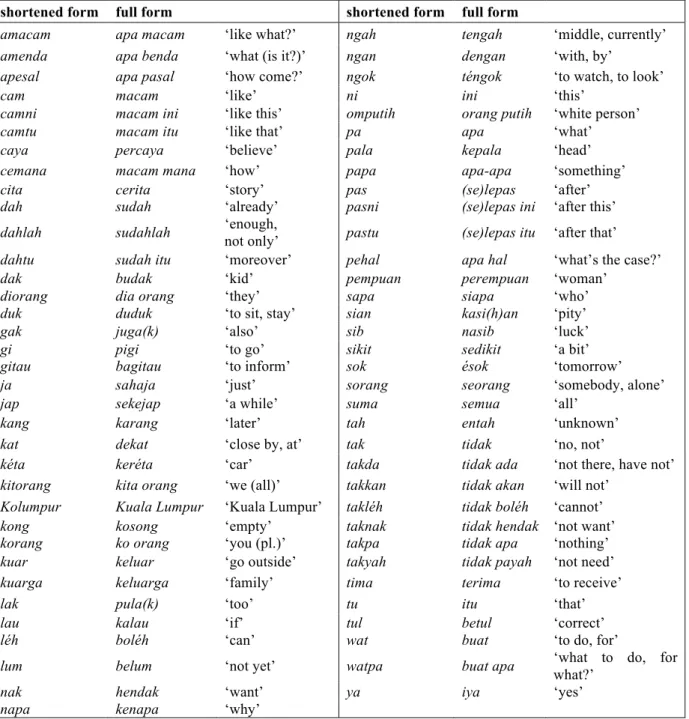
This section addresses the process of syllabic shortening or ‘clipping’ in the Malay youth language. Before calling attention to examples specific to Malay youth language, however, it needs to be pointed out that this reflects a common – and hitherto rather poorly documented – tendency in colloquial Malay varieties in general. First-syllable dropping is particularly common in frequently used vocabulary, e.g., dah ‘already’ from sudah. We also encounter contracted interrogative pronouns, such as apesal ‘how come?’ from apa pasal. In addition, vowel sequences and liquid consonants (/l/ and /r/) are often assimilated, e.g., cerita ‘story’
→ cita, keluar ‘to go outside’ → kuar, dia orang ‘they’ → diorang, etc. Some examples of
‘clipped’ forms in colloquial peninsular Malay are listed in Table 2.
4 Code-mixing is somewhat condescendingly called bahasa rojak, referring to a popular dish consisting of mixed vegetables.
shortened form full form shortened form full form
amacam apa macam ‘like what?’ ngah tengah ‘middle, currently’
amenda apa benda ‘what (is it?)’ ngan dengan ‘with, by’
apesal apa pasal ‘how come?’ ngok téngok ‘to watch, to look’
cam macam ‘like’ ni ini ‘this’
camni macam ini ‘like this’ omputih orang putih ‘white person’
camtu macam itu ‘like that’ pa apa ‘what’
caya percaya ‘believe’ pala kepala ‘head’
cemana macam mana ‘how’ papa apa-apa ‘something’
cita cerita ‘story’ pas (se)lepas ‘after’
dah sudah ‘already’ pasni (se)lepas ini ‘after this’
dahlah sudahlah ‘enough,
not only’ pastu (se)lepas itu ‘after that’
dahtu sudah itu ‘moreover’ pehal apa hal ‘what’s the case?’
dak budak ‘kid’ pempuan perempuan ‘woman’
diorang dia orang ‘they’ sapa siapa ‘who’
duk duduk ‘to sit, stay’ sian kasi(h)an ‘pity’
gak juga(k) ‘also’ sib nasib ‘luck’
gi pigi ‘to go’ sikit sedikit ‘a bit’
gitau bagitau ‘to inform’ sok ésok ‘tomorrow’
ja sahaja ‘just’ sorang seorang ‘somebody, alone’
jap sekejap ‘a while’ suma semua ‘all’
kang karang ‘later’ tah entah ‘unknown’
kat dekat ‘close by, at’ tak tidak ‘no, not’
kéta keréta ‘car’ takda tidak ada ‘not there, have not’
kitorang kita orang ‘we (all)’ takkan tidak akan ‘will not’
Kolumpur Kuala Lumpur ‘Kuala Lumpur’ takléh tidak boléh ‘cannot’
kong kosong ‘empty’ taknak tidak hendak ‘not want’
korang ko orang ‘you (pl.)’ takpa tidak apa ‘nothing’
kuar keluar ‘go outside’ takyah tidak payah ‘not need’
kuarga keluarga ‘family’ tima terima ‘to receive’
lak pula(k) ‘too’ tu itu ‘that’
lau kalau ‘if’ tul betul ‘correct’
léh boléh ‘can’ wat buat ‘to do, for’
lum belum ‘not yet’ watpa buat apa ‘what to do, for
what?’
nak hendak ‘want’ ya iya ‘yes’
napa kenapa ‘why’
Table 2: Commonly shortened forms
A different process of syllabic shortening in colloquial peninsular Malay is partial reduplication, which is used – alongside full reduplication – to indicate plurality or diversity;
standard Malay only allows the latter construction. Partially reduplicated forms are created according to the Ce-RED principle, e.g., makan-makan ~ memakan ‘to have a relaxed meal’
and budak-budak ~ bebudak ‘people’.5 Word-final nasals are retained and assimilated to the
5 I cannot assess whether these forms represent innovations or retentions. The process of partial reduplication is quite common in Austronesian languages and is also attested in a limited set of standard Malay nouns, e.g., lekaki ~ laki-laki ‘man’, kekura ~ kura-kura ‘turtle, tortoise’ and lelangit ~ langit-langit ‘canopy, palate’. It has been revived by Malay language planners to facilitate the production of new vocabulary, e.g., rambut ‘hair’ → rerambut ‘(blood) capillaries’, kunci ‘key’ → kekunci ‘keys on the computer board’ and jari ‘finger’ → jejari
‘radius (in a circumference)’ (Ahmad 1999: 257-8).
word-initial phoneme of the reduplicated stem, e.g., jalan-jalan ~ jenjalan ‘to go out’ and kawan-kawan ~ kengkawan ‘friends’.
Malay youth language displays a third process – unknown in mainstream colloquial Malay – in which the final syllable is dropped, e.g., berap ‘how much’ (berapa), bran ← beran ‘to dare, to be brave’ (berani), kenap ‘why?’ (kenapa), lem ‘slow (esp. of brains)’ (lembap), pen
‘important’ (penting), pon ‘to skip school’ (ponténg), seng ‘stupid’ (sengal) and steng ← seteng ‘half’ (setengah). Consider the following examples:
(1) Aku tak bran nak buat camni.
1s not dare want do like.that
‘I’m afraid to do so.’
(2) Ko ajar aku lah, aku lem sikit.
2s teach 1s PART 1s slow little
‘You should teach me, I’m a bit slow’
(3) Aku nak pon kelas ja sok.
1s want skip class PART tomorrow
‘I just want to skip class tomorrow.’
(4) Kenap takléh datang pe-pagi?
why cannot come RED-morning
‘Why can’t you come in the morning?’
Malay youth language also exhibits a number of words and phrases that can be shortened as a whole, e.g., baktang ‘bring (it) on’ (bawak datang), bancau ‘k.o. grass jelly syrup’ (bandung cincau), cikadung ‘a girl wearing a head-scarf’ (cikaro tudung), koktang ‘a cigarette’ (rokok sebatang), léklu ‘take a break’ (riléks dulu), naslem ‘a fragrant rice dish’ (nasi lemak), pacer
‘what’s up?’ (apa cerita), rotcai ‘k.o. flatbread’ (roti canai), sado ‘huge’ (besar bodoh), sapkok ‘to smoke’ (hisap rokok) and trimas ‘thanks’ (terima kasih), as well as profanities such as kimak ‘motherfucker’ (puki mak = ‘mother’s vagina’) and sengsengub ‘idiotic’
(sengal-sengal ubi = ‘stupid like a yam’). Consider the following examples:
(5) Macam mana nak sado cam kau?
How want huge like 2s
‘How can I get huge like you?’
(6) Aku nak ucap trimas se-sangat kat korang.
1s want say thanks RED-very LOC 2p.
‘I’d like to say a big “thank you” to you guys.’
(7) Pacer muntah-muntah ni?
what’s.up RED-vomit DEM
‘How come you keep throwing up?’
(8) Léklu, nak sapkok jap.
take.a.break want smoke a.while
‘Take a break; I’d like to have a smoke.’
(9) Hari tu, aku mémang cam sengsengub sikit.
day DEM 1s really like stupid a.bit
‘I really felt quite stupid that day.’
Shortened forms in which the last syllable is dropped also occur in the Indonesian bahasa gaul, but the actual words used are different. Well-known Indonesian examples include cé
‘girl’ (céwék), co ‘boy’ (cowok), ker ‘work’ (kerja), kul ‘college’ (kuliah) and say ‘sweetheart’
(sayang). We also find similar processes of creating compound forms, including bispak
‘slutty’ (bisa ‘can’ + pakai ‘to use’), gapsos ‘socially clueless’ (gagap ‘to stammer’ + sosial
‘social’), gapték ‘technologically clueless’ (gagap ‘to stammer’ + téknologi ‘technology’), jaim ‘concerned about one’s image’ (jaga ‘to protect’ + iméj ‘image’), mupéng ‘overtly eager’
(muka ‘face’ + péngén ‘want’) and pérék ‘an easy lay’ (perempuan ‘woman’ + ékspérimén
‘experimenting’).
4. Semantic innovation
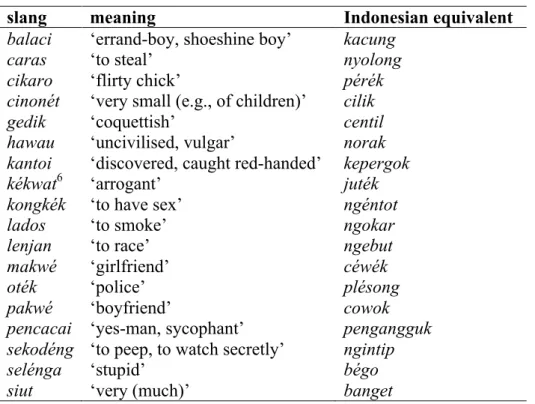
The Malay lexicon, like any other non-endangered language, is constantly enriched with new vocabulary, while infrequently used words fall into oblivion. Malay neologisms often remain lexicographically undocumented when created spontaneously, rather than deliberately through the efforts of language planners. Table 3 lists examples of Malay slang words absent in the prestigious Kamus Dewan (Baharom 2007) published by DBP, arguably the most authoritative Malay dictionary.
slang meaning Indonesian equivalent
balaci ‘errand-boy, shoeshine boy’ kacung
caras ‘to steal’ nyolong
cikaro ‘flirty chick’ pérék
cinonét ‘very small (e.g., of children)’ cilik
gedik ‘coquettish’ centil
hawau ‘uncivilised, vulgar’ norak kantoi ‘discovered, caught red-handed’ kepergok
kékwat6 ‘arrogant’ juték
kongkék ‘to have sex’ ngéntot
lados ‘to smoke’ ngokar
lenjan ‘to race’ ngebut
makwé ‘girlfriend’ céwék
oték ‘police’ plésong
pakwé ‘boyfriend’ cowok
pencacai ‘yes-man, sycophant’ pengangguk sekodéng ‘to peep, to watch secretly’ ngintip
selénga ‘stupid’ bégo
siut ‘very (much)’ banget
Table 3: Malaysian slang words Consider the following examples:
6 Originally used in bahasa nyah (gay slang). Prentice (1994: 41) gives kéwat ‘thinking o’s. handsome and behaving in an appropriately arrogant manner’. Some consultants derive the word from ‘catwalk’.
(10) Kéta dia kena caras.
car 3s got steal
‘His car got stolen!’
(11) Wah gedik=nya makwé dia!
PART coquettish=3s girlfriend 3s
‘Wow, his girlfriend is so coquettish!’
(12) Kantoi lah, korang selalu sekodéng aku.
discovered PART 2p always peep 1s
‘Gotcha! You people are always peeping at me.’
(13) Laju siut kéta dia! Ko dah cuba lenjan ka?
fast very car 3s 2s already try race PART
‘His car is really fast! Have you tried to race with it?’
Some words in Malay youth language have undergone slight changes in pronunciation. The word masyuk ‘profitable, rich’, for example, comes from masuk ‘to enter’ and the word usha
‘to stare at, to check out’ appears to be derived from usaha ‘effort’. These examples reflect the common process of giving new meanings to existing words. In the Malay youth language of the 1970s, the word bergetah ‘rubbery, sticky’ came to mean ‘sexy’, while jambu ‘guava’
became ‘pretty’ and kodok ‘frog’ was used for ‘woman’ (Teo Kok Seong 2006: 8). Along similar lines, Table 4 lists a set of semantic innovations in the contemporary Malay youth language.
slang meaning original meaning Indonesian equivalent
anak ikan ‘catamite’ ‘young fish’ gemblak
balak7 ‘penis, boyfriend’ ‘log, timber’ batang
bapak ‘freaking (adj.)’ ‘father’ buanget
barai ‘broken, whacked’ ‘scattered’ caur
barang ‘breasts’ ‘goods’ tokét
bodoh ‘damn (adj.)’ ‘stupid’ sialan
cara ‘excellent(ly)’ ‘method’ dahsyat
gila ‘super’ ‘crazy’ gila
jamban ‘buttocks, ass’ ‘toilet seat’ bokong
kemut ‘stingy’ ‘throbbing motion’ pelit
kopék ‘breasts’ ‘emptied of milk’ tokét
kutu ‘tout’ ‘parasite’ calo
lalang ‘indecisive’ ‘k.o. tall grass’ plinplan
lapuk ‘broke’ ‘mouldy’ bokék
lembap ‘slow’ ‘moist, clammy’ lélét
lembik ‘effeminate, homosexual’ ‘soft’ lembék
masak ‘screwed, in trouble’ ‘cooked’ berantakan
menonggéng ‘crazily’ ‘to stick one’s buttocks in the air’ gila-gilaan
panas ‘pissed off’ ‘hot’ gondok
sangap ‘horny’ ‘to yawn’ sangé
sengal ‘stupid’ ‘pain in the joints’ goblok
sentap ‘offended’ ‘to pull sharply’ bété
toyol ‘a cheat sheet’ ‘a type of ghost’ contékan
Table 4: Slang meanings of existing words
7 This word is probably derived from Dutch balk ‘beam, log’ (Prentice 1994: 39).
Consider the following examples:
(14) Dia dah kapel-kapel sikit ngan balak dia.
3s PART RED-make.love a.bit with boyfriend 3s.
‘She’s already made love a bit with her boyfriend.’
(15) Bapak gila laju=nya dia bawak motor.
Freaking crazy speed=3s.POS 3s drive motorcycle.
‘He drives the motorcycle [with] freaking crazy speed.’
(16) Téngok dia punya jamban!
Look 3s POS ass
‘Look at her ass!’
(17) Aku rindu bodoh tempat ni!
1s miss damn place DEM
‘I miss this place a damn lot!’
(18) Cara siut korang édit!
excellent very 2p edit
‘You guys have edited it amazingly!’
(19) Aku tengah sibuk menonggéng.
1s currently busy crazily
‘I’m crazily busy at the moment.’
(20) Cam sentap dah aku kat sini.
like offended PART 1s LOC here
‘I’m getting offended here.’
(21) Cikgu gua ni sengal dan lembap.
teacher 1s DEM stupid and slow
‘My teacher is stupid and slow.’
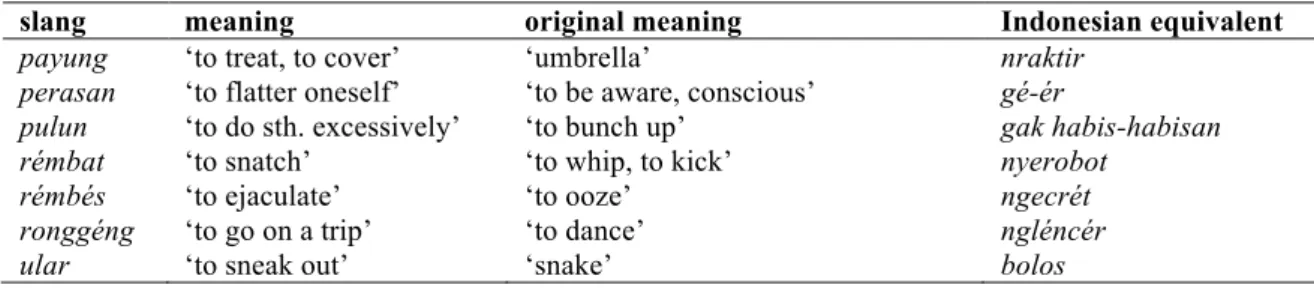
The same phenomenon is observed in a set of frequently used verbs and verbalised nouns, as listed in Table 5.
slang meaning original meaning Indonesian equivalent
anjing ‘to scold’ ‘dog’ nyomélin
ayat ‘to chat up’ ‘sentence’ pédékaté
bahan ‘to ridicule’ ‘object’ ngerjain
belah ‘to go away, to fuck off’ ‘to split in two’ minggat
cengkadak ‘to stuff’ ‘praying mantis’ nguntal
gébang ‘to boast’ ‘to chat’ nyombong
geli-geli ‘to fool around’ ‘to tickle’ néko-néko
goréng ‘to fabricate stories’ ‘to fry, to butter up’ ngarang kapur ‘to steal’ ‘chalk; to calcify, to whitewash’ nyolong
kelentong ‘to tell a fib’ ‘a rattle’ ngomong kosong
kencing ‘to deceive’ ‘to urinate’ ngadalin
layak ‘to have sex’ ‘to trample down’ ngéntot
lentok ‘to sleep’ ‘to incline to one side’ bobok
meroyan ‘to flip (out)’ ‘complications following childbirth’ ngamuk pangkah ‘to get turned down’ ‘a line drawn across’ ketolak
slang meaning original meaning Indonesian equivalent
payung ‘to treat, to cover’ ‘umbrella’ nraktir
perasan ‘to flatter oneself’ ‘to be aware, conscious’ gé-ér
pulun ‘to do sth. excessively’ ‘to bunch up’ gak habis-habisan
rémbat ‘to snatch’ ‘to whip, to kick’ nyerobot
rémbés ‘to ejaculate’ ‘to ooze’ ngecrét
ronggéng ‘to go on a trip’ ‘to dance’ ngléncér
ular ‘to sneak out’ ‘snake’ bolos
Table 5: Verbs with slang meanings
The following examples illustrate how some of the words listed above can be used:
(22) Te-tiba dia nak payung makan kat hotél.
suddenly 3s want treat eat LOC hotel
‘Suddenly he wanted to buy me dinner at a hotel.’
(23) Macam mana nak ayat awék omputih?
how want chat.up girl Caucasian
‘How does one chat up white girls?’
(24) Dahlah, sebelum kena anjing dengan cikgu.
enough before get scold by teacher
‘Stop it, before we get scolded by the teacher.’
(25) You takléh ular lah camni!
2s cannot sneak.out PART like.this
‘You can’t sneak out like this!’
(26) Amenda lah Hadi duk meroyan pasal aku?
what.is.it PART Hadi stay flip.out about 1s
‘How come Hadi keeps flipping out about me?’
(27) Ko ni apesal lentok le-lebih?
2s DEM how.come sleep RED-more
‘Why are you sleeping so much?’
(28) Sapa kencing gua pancung!
who deceive 1s behead
‘I’ll decapitate whoever deceives [me]!’
(29) Takyah nak gébang sangat lah.
not.need want boast much PART
‘There is no need to boast too much.’
(30) Belah lah ko! Pindah negara lain!
go.away PART 2s move land other
‘Fuck off you! Move to another country!’
Colloquial Malay has a rich repertoire of terms used to characterise people. The word jinjang
‘old-fashioned, uncivilised (esp. Chinese people)’, for example, is said to derive from Jinjang,
a predominantly Chinese district of Kuala Lumpur. The words mat ‘guy’ and minah ‘girl’ go back to the common Malay names Mamat and Aminah and can be used in a variety of combinations. Since the 1970s, the derogatory term minah karan ‘voltage girl’ came to refer to a generation of female workers who moved from the countryside into the cities to work in the emerging Malaysian electronics industry, and who often faced criticism for going against the traditional Malay values (e.g., Ackerman 1991; Razak 2006). Another generic term applied to a specific social group is mat motor ‘motor guy’, later replaced by mat rempit (Razak 2006).8 A mat rempit is somebody involved in illegal street races, a Malaysian subculture often associated with stealing motorcycles, drug abuse and other types of undesired behaviour (cf. Ismail 2010). Another commonly used term is mat saléh (female:
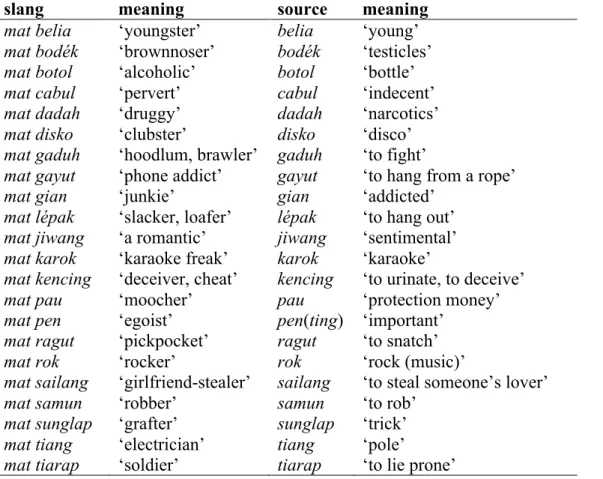
minah saléh), which refers to Caucasians. Folk etymology has it that this word is derived from the English phrase ‘mad sailor’. More likely, to my mind, it is a reference to the name Mat Salleh, an aristocrat from Perak who was one of the first Malay rulers to embrace and work for the British regime during the late 19th century (cf. Gullick 1987: 77-8). By analogy, we find the ethnonyms mat melayu ‘Malay’, mat cina ‘Chinese’, mat india ‘Indian’, mat bangla ‘Bangladeshi’ and mat indon ‘Indonesian’. Several more combinations with mat are found in Malay youth language, as listed in Table 6.
slang meaning source meaning
mat belia ‘youngster’ belia ‘young’
mat bodék ‘brownnoser’ bodék ‘testicles’
mat botol ‘alcoholic’ botol ‘bottle’
mat cabul ‘pervert’ cabul ‘indecent’
mat dadah ‘druggy’ dadah ‘narcotics’
mat disko ‘clubster’ disko ‘disco’
mat gaduh ‘hoodlum, brawler’ gaduh ‘to fight’
mat gayut ‘phone addict’ gayut ‘to hang from a rope’
mat gian ‘junkie’ gian ‘addicted’
mat lépak ‘slacker, loafer’ lépak ‘to hang out’
mat jiwang ‘a romantic’ jiwang ‘sentimental’
mat karok ‘karaoke freak’ karok ‘karaoke’
mat kencing ‘deceiver, cheat’ kencing ‘to urinate, to deceive’
mat pau ‘moocher’ pau ‘protection money’
mat pen ‘egoist’ pen(ting) ‘important’
mat ragut ‘pickpocket’ ragut ‘to snatch’
mat rok ‘rocker’ rok ‘rock (music)’
mat sailang ‘girlfriend-stealer’ sailang ‘to steal someone’s lover’
mat samun ‘robber’ samun ‘to rob’
mat sunglap ‘grafter’ sunglap ‘trick’
mat tiang ‘electrician’ tiang ‘pole’
mat tiarap ‘soldier’ tiarap ‘to lie prone’
Table 6: Combinations with mat
As can be seen from the examples above, terms with mat are often used in a rather derogatory way. In all these examples, mat can be replaced by minah for females. The usage of mat and
8 This word is presumably derived from ‘ramp it’ (i.e., the throttle), hence the verb merempit ‘to race a motorcycle’.
minah to characterise people is unique to Malaysian slang and has no direct Indonesian equivalent.9
5. Influence from other languages
In a country as ethnically diverse as Malaysia, it is not surprising that young people draw on a variety of sources to keep their language and subculture dynamic and up-to-date. Chinese Malaysians have at their disposal a diverse blend of popular culture from China, Hong Kong and Taiwan, in such languages as Cantonese, Hokkien, Mandarin, Hakka and others (cf. Koh 2008). Young Malaysians of South Asian origins do not restrict themselves to the dominant Tamil culture, but also incorporate North Indian elements, particularly Bollywood-related, into their lifestyles (Mandal 2007). A similar type of hybridity can also be seen in the Malay youth language. Before addressing the important roles of English and Chinese varieties, let us first explore some other lexical sources that have contributed vocabulary to the Malay youth language.
The colloquial term réndék ~ meréndék ‘to be together with so.’ has been connected to Tamil reɳɖɨ (ெர!") ‘two’ (cf. Teo Kok Seong 2006: 8). Other loanwords from colloquial Tamil include anéy ‘brother (used to Indian male)’ from aɳɳe (அ"ேண) ‘older brother’, maca
‘dude’ from maccaː (ம"சா) ‘brother-in-law’, pondan ‘effeminate’ from poɳɖan (ெப#ட!)
‘woman, wife’ and pundék ‘cunt’ from puɳɖe (!"ைட).10 The word syok ‘pleasant, attractive’ is presumably a borrowing from Urdu śauq (قﻮﺷ) ‘desire, love, cheerfulness’,11 whereas aci ‘fair’ – mostly used in the combinations tak aci ‘unfair’ and mana aci? ‘how is this fair?’ – appears to reflect Urdu acchī (ﯽﮭﭼا) ‘good, proper, reasonable’. The words cilok
‘to steal, to weave through traffic’ and lalok ‘daydreaming’ go back to the Minangkabau language, with the original meanings of ‘to steal’ and ‘to sleep’. The word hampéh ‘useless’
appears to be derived from a regional pronunciation of Malay hampas ‘residue’. Interestingly, we also encounter the Korean loan samdol ‘dumb’, apparently from the stereotypical bumpkin character Sam-dol (삼돌) in Korean movies and sitcoms.12 Along similar lines, we find gaban ‘epic’, which is taken from Space Cop Gaban, a popular Japanese television series in the early 1980s.13 Consider the following examples:
(31) Cita ni lawak tahap gaban!
story DEM funny level epic
‘This story is funny on an epic level!’
9 Needless to say, comparable phenomena exist cross-linguistically. Illustratively, Dutch exhibits Jan met de pet
‘Joe sixpack’, Jan Modaal ‘average Joe’, Jan Splinter ‘person on a low income’, Jan Soldaat ‘soldier’, Jan Hen
‘fool’, etc.
10 See Hoogervorst (2015:270) for more examples.
11 The word is spelled shiok in Singaporean English. Alternatively, it may be derived from Hokkien sioh (惜) ‘to love’.
12 If this etymology is correct, the word was borrowed as early as the 1960s; it features in P. Ramlee’s movies in the meaning of ‘a simple man’ (Azam Othman, pers. comm.).
13 In Japanese: Uchū Keiji Gyaban (宇宙刑事ギャバン).
(32) Mana aci dia sorang ja dapat?
How fair 3s alone PART get
‘How is it fair that only she gets one?’
(33) Ko ni jantan paling samdol di dunia.
2s DEM male most dumb LOC world
‘You’re the dumbest man on earth.’
(34) You cakap you sayang I, tapi you duk meréndék 2s say 2s love 1s but 2s stay be.together ngan orang lain.
with people other
‘You say you love me, but you keep meeting other people.’
(35) Lu bawak motor cam hampéh tul, cilok sini cilok 2s take motorcycle like useless really weave here weave sana!
there
‘You’re such a useless motorcyclist, weaving in and out of traffic!’
From colonial times into the present era of globalisation, English has asserted a profound influence on colloquial Malay. Code-switching and code-mixing between Malay and English is widespread in urban Malaysia, much to the chagrin of language purists. The delicate balance between the two languages remains a complicated issue and the Malaysian government frequently undertakes measures to promote the use of Malay at the cost of English. The government-run television station RTM (Radio Télevisyen Malaysia), for example, has recently banned the use of English, including the widespread use of the personal pronouns ‘I’ and ‘you’ (Khoo Gaik Cheng 2006: 109). These borrowed personal pronouns are extremely common in colloquial Malay, presumably because they provide a welcome opportunity to circumvent the somewhat complicated high-low and formal-informal distinctions characterising the conventional pronominal paradigm. Other frequently occurring English loanwords in the Malay youth language include brader ~ bro ‘brother’, dono ‘don’t know’, hénsem ‘handsome’, koman ‘common’, kompem ‘confirm’, konpius ‘confuse’, péberet ‘favourite’, pémes ‘famous’, popla ‘popular’, retis ‘artist’, riléks ‘relax’, sémpoi (←
sémpol) ‘simple’, sis ‘sister’, and tenét ‘internet’. Consider the following examples:
(36) Awék tu buat dono ja kat dia.
girl DEM do don’t.know PART LOC 3s
‘That girl is pretending she doesn’t know him.’
(37) Kamera ni sémpoi sikit dari yang lama punya.
camera DEM simple a.bit from REL last POS
‘This camera is a bit simpler than the last one.’
(38) Jangan duk nak main tenét ja.
don’t stay want play internet PART
‘Stop playing around on the internet all the time.’
(39) Ni kedai péberet aku. Pémes gila!
DEM store favourite 1s famous crazy
‘This is my favourite store. It’s super famous!’
The Malay youth language also exhibits a set of English loanwords with changed meanings (see Table 7). As mentioned in the introduction, the word-final /r/ is omitted in pronunciation in the southern dialects.
Slang English changed meaning bajét budget ‘to estimate’
bést best ‘great’
bler blur ‘ignorant’
éksyen action ‘snobbish, show-off’
kapel couple ‘to make love’
kéndu can do ‘attractive’
kerék crack ‘snobbish’
konar corner ‘to talk in circles' laser laser ‘to criticise, to scold’
mémber member ‘friend’
power power ‘great’
riki recce14 ‘to gain information about so.’
romén romance ‘to make out’
saman summon ‘(to issue) a fine’
selamber15 slumber ‘laid-back, not serious’
slék slack ‘dodgy, suspicious’
sound sound ‘to inform’
térer terror ‘terrific, good at sth.’
Table 7: English loanwords with changed meanings
Consider the following examples:
(40) Muka laki aku tak kéndu sangat.
face husband 1s not can.do much
‘My husband’s face isn’t too attractive.’
Takyah nak cakap konar-konar sangat!
not.need want talk RED-corner much
‘No need to talk in circles!’
(41) Jangan nak éksyen ja tau.
don’t want snobbish PART PART
‘Just don’t be so snobbish.’
(42) Suma orang buat muka slék bila dia cakap camtu.
all people make face suspicious when 3s say like.that
‘Everybody made a suspicious face when he said so.’
14 Slang for ‘reconnaissance’, ‘reconnoitring’, etc.
15 Possibly also influenced by the (in southern dialects) homophonous Malay word selamba ‘shameless’.
(43) Kau ni takyah se-sedap mulut nak laser orang 2s DEM not.need RED-nice mouth want criticise person lain.
other
‘You don’t have to criticise other people whenever you feel like it.’
(44) Dia wat muka kerék kat I te-tiap hari.
3s make face arrogant LOC 1s RED-every day
‘Every day she gave me an arrogant look.’
(45) Aku tak bajét lak dia fikir camtu.
1s not estimate also 3s think like.that
‘I also didn’t expect that he would think so.’
This type of semantic innovations is not automatically understood by Malay-English bilinguals. The phrase mémber sound in the meaning of ‘a friend told (me)’, for example, is unintelligible to outsiders even if they understand the individual words (Teo Kok Seong 2006:
6). Along similar lines, the combination kontrol hénsem (‘control’ + ‘handsome’) has come to mean ‘to look nonchalant’ in Malay youth language.
Other English-derived constructions that do not occur as such in mainstream English include otai ‘o(ld-)ti(mer)’ → ‘leader’, paipon ‘pipe on’ → ‘smoking cannabis through a pipe’, pengkid ‘punk kid’ → ‘an androgynous lesbian’, poyo ‘p(roud) o(f) yo(urself)’ → ‘arrogant’
and hybrid forms such as cagla ~ mencagla ‘to seek popularity’ (mencari ‘to seek’ +
‘glamour’), capap ~ mencapap ‘to seek attention’ (mencari ‘to seek’ + ‘publicity’), lampi ‘of slow understanding’ (lambat ‘slow’ + ‘pick up’),16 wikang ‘k.o. motorcycle trick (“stoppie”)’
(‘wheelie’ + belakang ‘back’) and mapléy ‘a mamak restaurant’ (mamak ‘Tamil Muslim’ +
‘place’),17 the latter also yielding the verb memapléy ‘to eat at a mamak restaurant’.
Malay youth language also exhibits hybrid (Anglo-Malay) phrases, such as potong stim ‘to cut steam (i.e. to interrupt enjoyment)’ and tukang spin ‘a spinner (i.e. a person who likes to quibble)’. A frequently used abbreviation is BBNU (budak baru nak ‘up’) ‘a kid about to reach adolescence’, exhibiting the Indonesian bahasa gaul equivalent ABG (anak baru gedé) in the same meaning. We may also call attention to the phenomenon of literally translating certain English expressions into Malay, e.g., kacang ‘easily solvable’ from the word’s literal meaning of ‘peanuts’ and kipas susah mati as a word-for-word translation of ‘die-hard fan’.18 Consider the following examples:
(46) Tak habis-habis nak cagla ni!
not Red-finish want seek.popularity DEM
‘She’s so desperately seeking popularity!’
16 The corresponding Indonesian term is télmi, a portmanteau consisting of telat (from Dutch te laat) ‘too late’
and mikir ‘to think’.
17 This may also be a pun to the colloquial Tamil word maːppɭe (மா#பி&ைள) ‘bridegroom, cousin, in-law’, which is used by some Malaysians to address South Indian males.
18 Originally, Malay kipas only referred to ‘fan’ in the sense of a device for creating a breeze, not in the sense of an admirer.
(47) Macam pengkid ja rambut Justin Bieber.
like butch.lesbian PART hair Justin.Bieber
‘Justin Bieber’s hair is like [that of] a butch lesbian.’
(48) Otai punya lagu mémang bést.
old-timer POS song really great
‘Old songs are really great.’
(49) Poyo gila ko mamat! Takyah nak mencapap arrogant crazy 2s dude not.need want seek.attention wéh!
PART
‘You’re so arrogant dude! No need to come look for attention!’
(50) Mémang kacang lah bagi yang pandai, tapi budak really peanuts PART for REL skilled but kid lampi cam ko ni léh pecah pala.
slow like 2s DEM can break head
‘It’s really easy for skilled people, but a slow kid like you might break his head over it.’
Malaysia’s Chinese languages provide an additional source of vocabulary. The personal pronouns gua ‘I, me’ and lu ‘you’ are taken from Hokkien góa (我) and lú (汝) respectively;19 they were probably borrowed for similar reasons as English ‘I’ and ‘you’.
Another frequently used Hokkien loan that entered the Malay language in the 1980s is bohsia, from Hokkien bô-sian (無聲) ‘silent’, used in this case to label girls in search of a good time and easy money (Razak 2006; Jones 2009: 184). The male equivalent is bohjan, a portmanteau of bohsia and jantan ‘male’ (Chow Chai Khim 2010: 38). Analogously, the popular compound bohlayan ‘fed up with’ appears to be a compound consisting of Hokkien bô (無) ‘not’ and Malay layan ‘to entertain’. Another hybrid construction is the word tokan
‘drug dealer’, which consists of toké ‘businessman’ (from Hokkien thâu-ke (頭家) ‘the master of a house or shop’) and Malay ikan ‘fish’, thus denoting a wealthy fish proprietor.
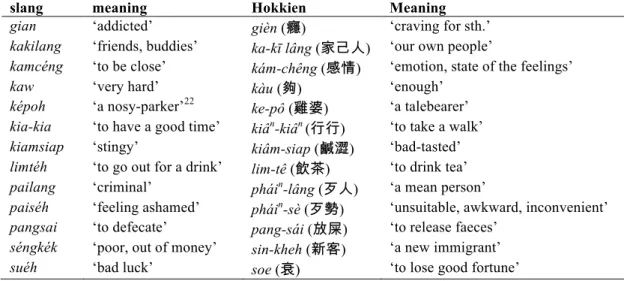
More Hokkien loanwords in Malay youth language are listed in Table 8. The line between youth slang and generic slang is somewhat obscure here, as some of the words listed are also understood by people of other age groups, especially those who interact regularly with Hokkien speakers.
slang meaning Hokkien Meaning
bojio ‘to not invite so.’ bô-chio (無招) ‘not invite’
cau ‘to go (away)’ cháu (走) ‘to run’
cibai ‘vagina’ chi-bai (膣屄) ‘vagina’20
cincai ‘arbitrarily, not careful’ chhìn-chhái (清采) ‘at random; no matter how’
cun ‘pretty’ chún (準) ‘suited, correct’21
19 Cf. Indonesian gua and lu in the same meaning. Standard Hokkien has lí (你) ‘you’, whereas lú is only found in specific sub-dialects (Jones 2009: 56-8).
20 The Indonesian slang word céwék ‘girl’ is sometimes derived from the same form (e.g., Torchia 2007: 34), which strikes me as unconvincing on a phonological level.
21 Jones (2009: 112) translates this word as ‘just nice’.
slang meaning Hokkien Meaning
gian ‘addicted’ gièn (癮) ‘craving for sth.’
kakilang ‘friends, buddies’ ka-kī lâng (家己人) ‘our own people’
kamcéng ‘to be close’ kám-chêng (感情) ‘emotion, state of the feelings’
kaw ‘very hard’ kàu (夠) ‘enough’
képoh ‘a nosy-parker’22 ke-pô (雞婆) ‘a talebearer’
kia-kia ‘to have a good time’ kiân-kiân (行行) ‘to take a walk’
kiamsiap ‘stingy’ kiâm-siap (鹹澀) ‘bad-tasted’
limtéh ‘to go out for a drink’ lim-tê (飲茶) ‘to drink tea’
pailang ‘criminal’ pháin-lâng (歹人) ‘a mean person’
paiséh ‘feeling ashamed’ pháin-sè (歹勢) ‘unsuitable, awkward, inconvenient’
pangsai ‘to defecate’ pang-sái (放屎) ‘to release faeces’
séngkék ‘poor, out of money’ sin-kheh (新客) ‘a new immigrant’
suéh ‘bad luck’ soe (衰) ‘to lose good fortune’
Table 8: Slang words from Hokkien
Consider the following examples:
(51) Napa you orang bojio aku?
Why 2s people not.invite 1s
‘Why didn’t you people invite me?’
(52) Budak tu kena pukul kaw-kaw dengan cikgu.
kid DEM got beat RED-very.hard by teacher.
‘That kid got beaten very hard by the teacher.’
(53) I mémang banyak kakilang di kelab ini.
1s really many friends LOC club DEM
‘I really have a lot of friends in this club.’
(54) Oké géng, gua cau dulu. Jumpa lagi.
okay gang 1s go first meet again
‘Okay gang, I’m off. See you later.’
22 Also compare Singapore English kaypoh ‘a nosy-parker’ and Indonesian bahasa gaul képo ‘someone who wants to know everything or pretends to know everything’.
(55) Aku kenal budak tu tapi tak kamcéng ah.
1s know guy DEM but not close PART
‘I know that guy, but we’re not too close.’
(56) Cemana you boléh tau awék cun tu syok kat you?
how 2s can know girl pretty DEM attractive LOC 2s
‘How do you know that pretty girl is attracted to you?’
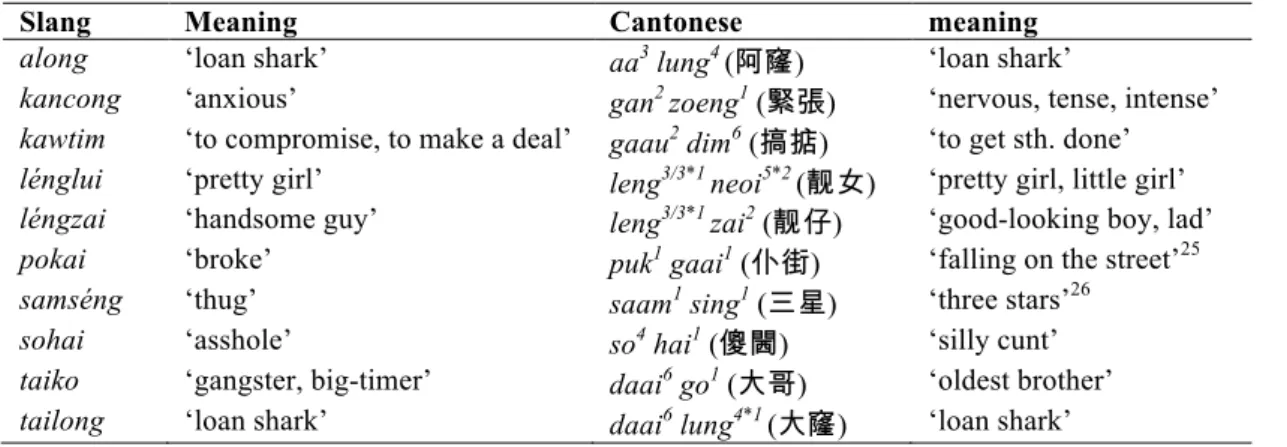
Cantonese, another widely spoken Chinese variety in Malaysia, has also influenced Malay youth language. Several of these loanwords are crime-related and may have been confined to criminal slang before they were adopted by young people.23 The word pau ‘protection money’, for example, reflects Cantonese baau1 (包) ‘a package’, yielding the expressions kena pau ‘to be robbed of money’, mat pau ‘moocher’ and kaki pau ‘extortionist’. From the same source is the compound tapau, from Cantonese daa2 baau1 (打包), which carries the less nefarious meaning of ‘doggie-bag’. The word langsi ‘ill-mannered’ comes from the Cantonese slang term lan2 si2 (𨶙屎), which literally translates as ‘dick shit’ and refers to obnoxious people or behaviour.24 The Cantonese term saai3 laang5*1 (晒冷) ‘to display one’s men; to show one’s hand (in cards)’ presumably became sailang ‘all or nothing; to steal someone’s chance’ in generic Malaysian slang. In Malay youth language, it is mostly used in the context of stealing someone’s lover. The word kapcai ‘underbone motorcycle’ (motor bébék in Indonesian) is a hybrid form consisting of ‘cub’ (originally the Honda Super Cub) and Cantonese zai2 (仔) ‘little’. Other Cantonese loanwords in Malay youth language are indicated in Table 9.
Consider the following examples:
(57) Kalau nak dua harga boléh kawtim tak?
If want two price can make.a.deal PART
‘Can we make a deal on the price if I take two?’
(58) Léngzai tak léngzai takpa lah.
Handsome not handsome doesn’t.matter PART
‘It doesn’t matter whether [a boy] is handsome or not.’
(59) Budak tu suka sailang awék mémber sendiri.
guy DEM like steal.away girlfriend buddy own
‘That guy likes to steal the girlfriends of his own buddies.’
(60) Mémber ko kena pau ngan samséng.
friend 2s robbed with gangster
‘Your friend had to pay protection money to a gangster.’
23 This development does not stand in isolation. See Van der Meij (1983) on the same phenomenon in Jakarta’s slang.
24 Clearly unaware of this meaning, the otherwise rather strict Malaysian film censorship board (Lembaga Penapisan Filem) passed a 2011 crime film entitled Kongsi: Lu Langsi Lu Mati (‘The Society: If You Misbehave, You Die’).