12 (2016)
フィジー語の複他動詞と投擲動詞
岡本 進
(東京外国語大学大学院)
キーワード:複他動詞,意味役割,名詞抱合
1.
はじめにフィジー語はオーストロネシア語族、東マラヨ・ポリネシア語派、オセアニア諸語に属 す言語で、基本語順はVPA である(Ethnologue より要約)。本稿の目的は、フィジー語の複 他動詞は、通言語的にどのように位置づけられるかを考察することである。
本稿の例文・図表番号、グロス、文字飾り、先行研究の日本語訳については、特に断り のない限り筆者によるものである。出典を明記していない例文については筆者が作例した ものであり、それらについてはすべてフィジー語母語話者であるLG氏(男性、1962年生ま れ)の確認を取っている。
2.
単他動詞単他動詞は、動詞語根に他動詞派生接尾辞-Ci, -Cakiが付加された形式で表される1。こ れらの接尾辞は3人称単数の目的語標示-aとの音融合により、-Ca, -Cakaとなる(Schütz
1985: 132)。(1)は-Ciが動詞語根に付加された単他動詞文である。
(1) au na moku-t-a PREDICATE [ na i vakatawa ]P
1SG FUT strike-TR-3SG ART guard
「わたしは羊飼いを打つ」 (新約聖書: マタイによる福音書26章31節2)
3.
複他動詞3.1節で典型的な複他動詞について述べ、3.2節ではそれと異なる振る舞いをする別の種 類の動詞(投擲動詞)について述べる。
1Cは子音(ゼロを含む)を表し、どの子音が現れるかは動詞ごとに語彙的に定められている(Milner 1956:
27)。本稿では、-Ci, -Caki の付加された他動詞をそれぞれ -Ci他動詞、-Caki他動詞のように言及する。
2本稿における聖書からの引用とその日本語訳は、それぞれ Rokovada et al.(eds.)(2010) “Nai Vola Tabu
3.1 典型的な複他動詞
Malchukov et al.(2010: 2)は、‘give’, ‘lend’, ‘hand’, ‘sell’ など、物理的な譲渡を表す動詞を 典型的な複他動詞であるとしている。本小節ではこのような動詞について見る。
フィジー語の solia ‘give’ の配列は indirective(T=P≠R)タイプである。以下、具体例を見 る。(2a)、(2b)に見るように、T項は動詞の -a と一致しており、(1)の単他動詞のP項と同 様のふるまいをしている。(2b)ではR項は前置詞で標示されている。
(2) a . sa tala-ø-a mai PREDICATE [ e dua na tamata ]P [ na Kalou ]A ASP send-TR-3SG hither 3SG one ART man ART god
「神から遣わされた一人の人がいた (lit. 神が一人の男を送った)。」
(新約聖書: ヨハネによる福音書1章6節)
b. dou soli-ø-a ga PREDICATE [ vei ira ]R [ na kaa+kana me+ra kani-ø-a ]T
2PA give-TR-3SG only to 3PL ART thing+eat SUB+3PL eat-TR-3SG
「あなたがたが彼らに食べる物を与えなさい」
(新約聖書: マタイによる福音書14章16節)
3.2. 投擲動詞
Malchukov et al.(2010)は、3.1節で述べたように、‘give’ にあたる動詞を典型的な複他動詞
としているが、‘throw’ にあたる動詞(以下投擲動詞とする)についても、記述は少ないもの の、考慮している(Malchukov et al. 2010: 49, 54- 55など)。本小節では投擲動詞について述べ る。
Dixon(1988: 217)は、‘ditransitive’ という術語を用いていないものの、フィジー語ボウマ ー方言において、これらの動詞は「3つの「参与者」が必然的に関わらなければならない 活動を表す動詞」であるとし、複他動詞の一種であることを示唆している。
投擲動詞は、T項の種類や投げ方によって異なる語根を持つという点で興味深い(表1)。
表1: 投擲動詞の例
viri-ka (石、ボールを)投げる rabo-ka (投石器で)投げる
kolo-va (棒、棍棒を)投げる dia-ka (ナイフを)投げる
(Schütz 1985: 139より抜粋)
もう一つ興味深いのは、3.1節で見た典型的な複他動詞が indirective(T=P≠R) タイプの配 列であるのに対し、このような投擲動詞の -Ci他動詞形はすべて、secundative(T≠P=R) タイ プの配列であるように思われる点である。(3)では、動詞の目的語標示は(明示的な名詞句 はないものの)R項を示し、T項は前置詞eで標示されている。
(3)(...) ka vaka-viri-k-a PREDICATE [ e+na vatu ]T
and FREQ-throw-TR-3SG with+ART stone 「(都の外に引きずり出して)石を投げ始めた」
(新約聖書: 使徒言行録7章58節)
投擲動詞は他動詞接尾辞-Ciだけでなく、-Cakiも付加されうる。投擲動詞の-Caki他動詞 形はT項を目的語に取るので、indirectiveタイプの配列である。
(4)(... ) rau viri-tak-a tiko PREDICATE [ na no-drau lawa ]T [ ki wasaliwa ]R
3DU throw-TR-3SGCNT ART PC-3DU net to ocean 「(...)湖で網を打っている (のを御覧になった)」
(新約聖書: マルコによる福音書1章16節)
4.
考察前節で見たように、同じ-Ciという他動詞接尾辞が付加されていても、典型的な複他動詞 と投擲動詞で配列が異なっている。すなわち、前者はindirectiveタイプであるが、後者は
secundativeタイプである。この相違について本節で考察する。
4.1. -Ci
他動詞目的語の意味役割結論から述べると、投擲動詞の-Ci他動詞形の目的語はrecipientではない。たとえば、
(5)のgone「子供」はボールを受け取ることを含意しない。受け取ることを含意しないとい うことから、(5)のgone「子供」の意味役割はrecipientではなくgoalであるといえる。
(5) e aa viri-k-a PREDICATE [ na gone ]goal [ e na polo ]T
3SG PST throw-TR-3SG ART child with ART ball
「彼は子供にボールを投げつけた(子供はボールをキャッチしてない)」
-Ci他動詞がgoalを目的語に取ることは、(6)のような移動動詞からも明らかである。
(6) era lako-v-a PREDICATE [ na raba ni vuravura ]goal (...) 3PL go-TR-3SG ART width of earth
「彼らは地上の広い場所に攻め上って行って、(...)」
(新約聖書: ヨハネの黙示録20章9節)
加えて、(7)のように -Ci他動詞はlocationも目的語に取りうる。
(7) eratou qoli-v-a PREDICATE [ na vanua oqoo ]location
3PA fish-TR-3SG ART place this
「彼らはここで釣りをする」 (Milner 1956: 26)
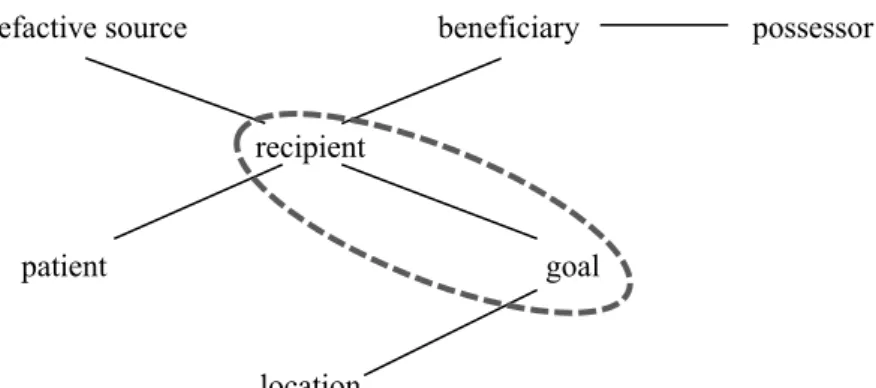
以上のことを踏まえ、Malchukov et al.(2010: 52)のR項の意味地図を用いて-Ci他動詞が 取りうる目的語の意味役割を表すと図1のようになる。
malefactive source beneficiary possessor
recipient
patient goal
location
図1: -Ciが表す目的語の意味役割( 線内)
-Ci他動詞は、patientだけでなく、様々な意味役割の名詞句を目的語にとり、そこには goalも含まれる。しかしrecipientは目的語として実現できないので、必ず前置詞で標示さ れる。次小節ではrecipientを標示する前置詞について詳述する。
4.2. 前置詞 vei / ki
Newman(1996)によれば、通言語的にrecipentはgoalと同様の扱いを受けうる(Newman
1996: 88- 89)。フィジー語のrecipientとgoalについてもこのことが当てはまり、前置詞vei
/ kiで標示される3。(8)はgoalの例である。
(8) erau lako tiko PREDICATE [ ki na i teitei ]goal
3DU go CNT to ART garden 「彼らは庭に行っている」
(Schütz 1985: 346)
(9)はrecipientの例である。3.2節で述べたように、投擲動詞の-Caki他動詞形は
indirectiveタイプの配列であり、recipientはveiで標示される。
(9) e aa viri-tak-a PREDICATE [ na polo ]T [ vei Jone ]recipient
3SG PST throw-TR-3SG ART ball to PN
「彼はチョネにボールを投げた(チョネはキャッチした)」
以上のことを踏まえ、Malchukov et al.(2010: 52)のR項の意味地図を用いてvei / kiの表す 範囲を示すと、図2のようになる。
malefactive source beneficiary possessor
recipient
patient goal
location
図2: 前置詞vei / kiの意味地図( 線内)
3 veiとkiの出現は相補分布的である。前者は人名・代名詞に前置し、後者は地名・普通名詞に前置する。
4.3. 抱合
Malchukov et al.(2010: 43)によれば、複他動詞構文において、R項ではなくT項が抱合さ
れる傾向がある。フィジー語においても、T項の抱合が観察される。(10)はその例である。
フィジー語の抱合は、(i)-Ci, -Cakiの欠如、(ii)名詞句の冠詞naの欠如、(iii)動詞語根と名詞 句の隣接性という3点で特徴づけられる(Aranovich 2013: 479- 480)。(10)では動詞soliが接 尾辞-øiなしで現れ(通常の他動詞文では(2a)のようにsoli-ø-aという形式で用いられる)、T
項であるkaa ni lolomaが抱合されている4。
(10)(...) ni o sa soli [ kaa ni loloma ]T PREDICATE (...) when 2SG ASP give thing of love
「(...)あなたは施しをするときには、(...)」
(新約聖書: マタイによる福音書6章2節)
R項の抱合は、recipientでは許容されないが(11)a、goalでは許容される(11)b。
(11) a.* au aa soli [ gone ]recipient PREDICATE b.au aa viri [ gone ]goal PREDICATE
1SG PST give child 1SG PST throw child
(「子供に与えた」を意図) 「私は子供に投げた」
フィジー語の複他動詞構文の抱合について、次のようにまとめることができる。目的語 がT項の場合、抱合可能である。目的語がR項の場合、goalであれば抱合可能であるが、
recipientであれば抱合不可能である。
5.
おわりに本稿ではフィジー語の投擲動詞を複他動詞として分析し、典型的な複他動詞構文との相 違を明らかにした。その結果を踏まえると、複他動詞構文と投擲動詞構文の配列は、それ ぞれ次頁の図3、図4のよう図示できる。
4フィジー語では、(10)のように、名詞語幹のみならず名詞句も「抱合」されうる。音韻的に一語を構成 しているとは言えないため、(10)のような形式を名詞抱合とみなさない立場もある(Gerdts 1998 など)。こ の問題については稿を改めて論じる。
P
T recipient 図3: 単他動詞と複他動詞の項の対応
P
T goal 図4: 単他動詞と投擲動詞の項の対応
Malchukov et al.(2010)では、‘give’ を典型的な複他動詞としているため、R項はrecipient
を想定している(Malchukov et al. 2010: 2)。このようなA, recipient, Tの3項の対立を持つ複 他動詞の場合、フィジー語はindirectiveタイプの配列である(図3)。一方、投擲動詞はA,
goal, Tの3項の対立を持つ。そのため、非典型的な複他動詞と見なすことができ、その配
列はsecundativeタイプである(図4)。このような配列の違いは、フィジー語において、
recipientは他動詞目的語となりえないが、goalはなりうるということに起因する(4.1節)。
このことから、フィジー語のrecipientは必ず前置詞句で現れると換言できる。recipient はgoalと同じ前置詞vei / kiで標示でされる。これは通言語学的によく観察される分布であ る(4.2節)。
加えて、recipientとgoalの差異は、抱合の成立にも関っているということを示した。す なわちgoalは抱合の目的語として現れうるが、recipientは現れない(4.3節)。
本稿では、通言語的な対照のため、フィジー語の投擲動詞を複他動詞として扱った。し かし、フィジー語の記述において、投擲動詞を複他動詞とみなすべきか否かという問題が ある。前置詞句を必須項と見なすか周辺項と見なすかについてもまた、今後考察する必要 がある。
略号一覧
- morpheme boudary 形態素境界
+ fusion 融合 1, 2, 3 1st, 2nd, 3rd person 1, 2, 3人称
ART article 冠詞
ASP aspect アスペクト
CNT continuous 継続
DU dual 双数
FREQ frequentative 反復
FUT future 未来
PA paucal 少数
PC possessive classifier 所有類別
PL plural 複数
PN proper noun 固有名詞
PST past 過去
SG singular 単数
SUB subordinate marker 従属節標示
TR transitive suffix 他動
調査資料
共同訳聖書実行委員会(編)(1988) 『聖書 新共同訳』東京: 日本聖書協会.
Rokovada, Vilimoni, Unaisi Rokovada, Epeli Tarai, Emosi Kainabau, Josateki Koroi, James Michael Ah Koy, Robert Wolfgramm (eds.) (2010) Nai Vola Tabu Vakadewataki Vou (New Fijian Translation Bible). Suva: Ah Koy Christian Trust.
参考文献・URL
Aranovich, Paúl (2013) Transitivity and polysynthesis in Fijian. Language 89 (3), 465- 500.
Dixon, R. M. W. (1988) A Grammar of Boumaa Fijian. Chicago: University of Chicago Press.
Gerdts, Donna B. (1998) Incorporation. In: Andrew Spencer and M. Arnold Zwicky (eds.) The Handbook of Morphology, 84- 100. Oxford: Blackwell.
Malchukov, Andrej, Martin Haspelmath and Bernard Comrie (2010) Ditransitive Constructions: A Typological Overview. In: Malchukov, Andrej and Martin Haspelmath and Bernard Comrie (eds.) Studies in Ditransitive Constructions: A Comperative Handbook, 1- 64. Berlin/New York: De Gruyter Mouton.
Milner, G. B. (1956) Fijian Grammar. Suva: Government Press.
Newman, John (1996) Give: A Cognitive Linguistic Study. Berlin/New York: De Gruyter Mouton.
Schütz, Albert J. (1985) Fijian Language. Honolulu: University of Hawaii Press.
Ethnologue Fijian: http://www.ethnologue.com/language/fij (最終閲覧日2016/5/18)