35
Prosodic features of recorded English teaching materials: A pilot study
Margaret Maeda
Abstract
Recorded English teaching materials are almost always advertised as
"natural" or sometimes as "authentic" even when they sound quite unnatural and are almost certainly not authentic in the sense of being unscripted conversation. The aim of this study was to find characteristic prosodic features of teaching tapes and compare them with dialogue not originally recorded for second language learners of English. Extracts were taken from materials recorded for beginners to intermediate learners, including radio English lessons and audiocassette
tapes, and they were compared with extracts from TV documentaries.
The teaching material was made for the Japanese and the international markets. All were recorded by American English speakers. They were judged for naturalness by four native-speaking E.F.L. teachers. Using a Kay Elemetric Computerized Speech Laboratory, the following features were examined: intonation patterns, mean pitch of male and female speakers, speech rates and articulation rates, and duration of syllables. Judgement of the tapes and acoustic analysis suggested that much of the speech recorded for teaching was not similar to speech
recorded for native-speaking listeners . However, American-made teaching tapes were judged as more natural than Japan -made tapes , and acoustic analysis suggested that some features of natural speech were more skillfully imitated.
Background
No instrumental studies of the prosodic features of teaching tapes have been carried out, as far as the writer is aware . Research areas relevant to the present study are foreigner talk , teacher talk and baby talk, which are all forms of simplified speech addressed to language learners. Ferguson (1981: 15) classifies teacher talk as a subtype of foreigner talk, and in a comparison table with baby talk , Hatch (1983a:
155) lists studies of both foreigner and teacher talk together under the heading of foreigner talk. Studies of teacher talk have looked at differences between talk outside and inside the classroom on the levels of discourse, syntax, and lexis , but there has been less study of the phonology of teacher talk, especially at the prosodic level (mainly pitch , duration and loudness) (for summaries of teacher talk studies
, see Chaudron, 1988, Chapter 3, and Hatch , 1983a: 155-158) . Accounts of the prosody of teacher talk have been criticized as being impressionistic (Chaudron, 1988; Griffiths, 1991) with very little attempt to quantify the features described. They mention "exaggerated intonation ,"
(Hatch, 1983a: 66) "louder" and "slow" speech (Henzl , 1973: 217) , and longer pauses (Hakansson, 1986) , but except for the last writer , who used an oscillogram to measure pause duration in the classroom talk of
Prosodic features of recorded English teaching materials: A pilot study 37 teachers of Swedish as a second language, no instrumental measurements have been made, except for stopwatch measurement of speech rate.
Foreigner or teacher talk and baby talk have many prosodic features in common: exaggerated intonation, high mean pitch, slow speech rate,
and longer and more frequent pauses coinciding more with phrase boundaries than adult NS - NS (native speaker to native speaker) speech. Ferguson (1981) and Hatch (1983a: 155) have drawn attention to these similarities. In first language acquisition research, the prosodic features of baby talk have been measured acoustically as part of carefully designed experiments (Garnica, 1977; Fernald & Simon, 1984; Fernald et al, 1989) . Garnica (1977) compared the speech of mothers on verbal tasks carried out with three experimental groups:
adults, two-year-olds and five-year-olds. She measured mean pitch and pitch range and found significant differences between speech addressed by mothers to adults and two-year-olds, but not between speech addressed to adults and five-year-olds. Speech addressed to two-year- olds had a higher mean pitch by about 70 Hz (197.6 Hz to adults; 267.3 Hz to two-year-olds) and had a wider pitch range. Measurement of the duration of content words showed prolonged duration on two content
words in a sentence where the same sentences spoken to adults only had one, so that two words were accented instead of the usual one per sentence or phrase. Features which were found in baby talk which were not found in the present study of teaching tapes, were rising pitch terminals on statements and imperatives, and whispering.
Fernald & Simon (1984) compared speech by German mothers to
adults and to newborns. Some of the features they measured were mean pitch, pitch contour types, and mean Fo excursion , which is a similar measurement to pitch range . Other features were length of pauses, their correspondence with sentence boundaries, and articulation rate, which is the total number of syllables divided by the total speech time, exclusive of pauses. They found a mean pitch of 257 Hz in speech addressed to babies, compared with 203 Hz in speech addressed to adults
, and they found wider pitch excursions . They also found whispering.
Another feature not characteristic of teacher talk was repeated pitch patterns, either upward or downward glides, which may have the function of communicating maternal affect . In a later study; Fernald et al (1989) studied the speech of both mothers and father to infants of around one year. The parents were native speakers of Italian , German, French, British English, American English and Japanese . All groups of parents raised their mean pitch when talking to infants and most groups widened their pitch range, but fathers did so less than mothers.
American English speakers used the most exaggerated prosody when speaking to infants. Women raised their mean pitch from 206 Hz to 308 Hz, and men from 105 Hz to 146 Hz . The tasks in these experiments were similar to teaching in the classroom: telling stories , giving instructions, or talking about pictures .
Conditions for recording teaching tapes are different from classroom teaching in some respects. Speakers on tapes cannot adjust to the level of the listeners by interacting with them, but only to the estimated level of the learners. It consists of instructions , explanations, example sentences, like speech in the classroom, but the use of dialogues on tapes
Prosodic features of recorded English teaching materials: A pilot study 39 makes acting ability more important than it is for classroom teaching.
The dialogues on teaching tapes are intended to simulate natural conversation, and nearly all textbooks carry claims that accompanying taped material is "natural."
Abercrombie (1965: 2) divides spoken language into three categories:
reading aloud, monologue and conversation. Conversation is by far the most commonly occurring form of spoken language. The only way of
obtaining recordings of genuine spontaneous conversation is to record surreptitiously (p. 5) . If speakers know they are being recorded the conversation is not spontaneous. Reading aloud forms a much smaller proportion of all spoken language than conversation, but it is more common than most people suppose. For example, presenters of docu- mentaries may not be speaking with a script, but the text of their speech
starts out in written form. Reading aloud or speaking from a memo- rized script is an adaptation of conversation. Abercrombie calls it
"spoken prose" (p . 4) . Spoken prose has "phonetic peculiarities" (p. 2) which distinguishes it from real conversation, among them: (1) Evenness of tempo compared with the frequent variations in tempo of
conversation. (2) Pauses closely related to the grammatical structure of the sentences. In real conversation, the end of a sentence "is more likely to be shown by the intonation than by a pause, and pauses often come between two words in close grammatical connection" (p. 8) .
Abercrombie (1965: 9) states that "when we, as language teachers, claim we are teaching the spoken language, most of the time what we are teaching is spoken prose". According to Abercrombie's definitions of real conversation and spoken prose, dialogues on teaching tapes
should be counted as spoken prose , not real conversation, because the dialogues have been written before being recorded .
Although tapes are described as natural even in beginning textbooks , it is doubtful that it is possible to use real conversation as listening material with low level learners . Abercrombie (1965: 6) describes the content of real conversation as "pretty horrifying ... sometimes unintelligible... and disorganized ." The tempo of natural conversation is variable, with speakers sometimes reaching double average speeds . In a paper on speech rates in British English , Tauroza and Allison (1990) state that "teachers and researchers consider the speed of speech to be one of the key factors affecting listening comprehension" (p . 90) . In other words, if the speech is too fast , learners will not understand it.
Hatch (1983b: 81) , not writing about listening materials , asserts, "As teachers we believe that a pedagogical sequence from simple to complex is important for language teaching ." But in commenting on a study of speech rates of teachers (1983a: 81) , she says, "Teacher 10 must be one of the few teachers in the world who has really internalized our teacher- training directions on using a natural rate of speech when teaching beginners." This contradiction is reflected in the claims , even on beginning textbooks, that recordings on tapes are natural , even when they are far from being natural.
Griffiths (1990) investigated the effect of different speech rates on the comprehension of low intermediate second language learners . His hypothesis was that average speech rates would give higher scores than moderately fast rates, and slow rates, higher scores than average rates . Fast speech resulted in reduced comprehension but he found that slow
Prosodic features of recorded English teaching materials: A pilot study 41 rates did not result in higher scores than average rates. He found that lower intermediate students could cope with natural speaking rates if the language was carefully controlled, and few benefits would be obtained from speaking slowly. Kelch (1985) compared the effect of input modified for speech rate and syntactic complexity. He found comprehension to be little affected by syntactic modification, but much improved by slower speech rate.
In a carefully controlled experiment, Tauroza and Allison (1990) investigated speech rates in speech addressed to native listeners in a variety of situations, in order to provide standards to assess the speed of commercially produced listening materials for second language learning. The varieties of speech recorded were radio news broadcasts and documentaries, unscripted conversations, and prepared interviews.
95 percent of their data fell within a range of 190 to 320 syllables per minute, and based on the results of their study, they produced the following table of speech rates:
Table 1.
Estimate of standard rates of speech (syllables per minute) according to Tauroza & Allison 1990.
Fast
Moderately fast Average
Moderately slow Slow
above 320 280-320 230-280 190-230 below 190
Method
Materials
Broadly, two kinds of recordings were used in this study: extracts from recorded teaching material, and extracts from documentaries made by American TV news stations. There were two types of teaching material: made in Japan for the Japanese market (seven recordings) , and made in the U.S. for the international market (six recordings) .
The teaching materials were thirteen 20 - 30 second extracts from dialogues used with course material for learners from beginning to intermediate level. Two were radio English lessons for Japanese junior high school students and two were tapes used with course books in Japanese junior high schools. The three false beginner tapes made in Japan are aimed at university students who have had six years of English in high school. The materials made for the international market were taken from widely used, popular textbooks . The dialogues chosen were intended for use as listening practice rather than for presenting new grammatical structures, because oral presentation of new structures is often deliberately slow and clear. Some of the material was designed for use with the listeners looking at scripts , particularly lower level material, and some was not (see Appendix C) . Dialogues were selected which had one male and one female speaker.
The extracts from the documentaries were one extract each from CNN and CBS programs. The CNN and CBS recordings were not originally made for teaching purposes, but the CNN tape used in this
Prosodic features of recorded English teaching materials: A pilot study 43 study is sold as English-teaching material, and other CBS recordings are also sold as teaching material for advanced students. The CNN extract is an interview of a well-known American male actor about his family life. The CBS recording is of three female members of the public
who were the victims of scams. The CNN and CBS tapes are not genuine conversation as Abercrombie defined it, as they were not secretly recorded, and although they were almost certainly not scripted, they were probably prepared. Obtaining samples of genuine conversation by secret recording would present ethical difficulties, but this material can reasonably be called authentic listening material in the sense that it is designed for native speakers to listen to rather than language learners. The CNN and 'CBS tapes were used as samples of
near natural speech for acoustic comparison with the teaching tapes, and as a control in the evaluation of the teaching tapes to check if the
Table 2.
Materials examined
Level of textbook Type of material No. of extracts Beginner
False beginner
Intermediate Authentic
J jhs radio series, Levels 1 & 2 J jhs textbook, Level 1 & 3 International
Japanese International International
CNN CBS
2 2 1 3 2 3 2 Key:
International:
Japanese:
J jhs
Textbook produced in the U.S. for the international market.
Textbook produced for the Japanese market.
Japanese junior high school
judges would give high marks to material which was not made for teaching purposes.
Evaluation of naturalness of tapes
The fifteen extracts were evaluated for naturalness by four native speaking teachers of English as Foreign Language. They were asked to make a quick judgement of the naturalness of each recording according to a six-point scale, taking into account the level of the tape (for the evaluation sheet used, see Appendix A) . The level of each tape was indicated on the evaluation sheet as Beginner , False Beginner, Intermediate or Advanced (CNN and CBS) . These were broader categories than indicated on the textbooks . For the exact levels indicated on the textbooks, see Appendix B.
Using a Kay Elemetric Computerized Speech Laboratory , the mean pitch of speakers, speech rates, articulation rates, and the duration of syllables were measured. Intonation patterns were evaluated visually , because a suitable method of measurement had not been decided on for this study. The teaching tapes were compared with each other and with the CNN and CBS recordings.
Since this is a pilot study, using a small number of judges and an insufficiently large amount of data on which to run reliable statistical tests, the reporting of results is descriptive and tentative . A larger study is being prepared which will use more judges and more taped materials.
Prosodic features of recorded English teaching materials: A pilot study 45
Results
Mean pitch
Mean pitch differs depending on a number of factors including discourse and situational factors, individual differences and group accents (Graddol, 1986) . Fernald et al (1989) found that mean pitches of British subjects talking to adults were higher than Americans' mean pitches (British / American men: 127 / 105 Hz; British / American women: 222 / 206 Hz) . Garnica's (1977) figures for American mothers talking to adults were similar to Fernald et al's figures: 198 Hz and 203 Hz. Fant (1956, cited in Laver, 1994: 451) gives 120 Hz for men and 220 Hz for women in conversational speech in European languages.
Graddol (1986) has 219 Hz for British men and 122 Hz for British women reading dialogues, which is the same kind of reading as on the teaching tapes, except that Graddol's study was not related to language acquisition. Fant's maximum ranges are 50 - 250 Hz for men and 120 - 480 Hz for women (1956, cited in Laver, 1994) .
Figure la) shows that the mean pitches of men on the tapes are high even compared with Fant's 120 Hz, which is higher than Fernald's 105 Hz. It also shows that there is a trend downward in pitch with increasing level of tape. More data will be needed to confirm this trend.
Figure 1b) shows that the mean pitches of women on the tapes are high, but the trend downwards is less clear. Women's range is wider than men's so there is more variability in the data.
Figure la) Mean pitch of men
350 300 250
•5 200 150
o c4 loo 50 0
_ A
f
N./
TRWWNW1111111111WM-
I 2 3 4 5 6 7 S 9
Teaching tapes
10 11 12 13
Figure Ib) Mean pitch of women
Figure 1. Mean pitch of men and women on compared with conversational speech Hz for men, 220 Hz for women).
teaching tapes Want 1956: 120
Prosodic features of recorded English teaching materials: A pilot study 47 The mean pitch of men and women on the low level tapes made for the Japanese market was high, and the pitch of the intermediate tapes and the low level tapes made tor the international market was near average
(see Appendix B) . Some of the pitch peaks of both the men and the women, over 500 Hz for women and as high as 300 Hz for men, were extremely high. All the men who reached 300 Hz sounded as if they were straining their voices. However, one of the tapes made in Japan (Tape number 9 in Appendixes B, C, and D) , which was very high pitched, received quite favorable evaluations despite sounding unnatural to the writer. One explanation may be that intonation is so variable,
depending on discourse and situational factors and individual differences, that a variety of different pitch ranges is acceptable to listeners. The judges may have responded more to another prosodic feature, syllable length, when evaluating the tapes (see the section
"Duration of unstressed syllables" below .)
Pitch Patterns
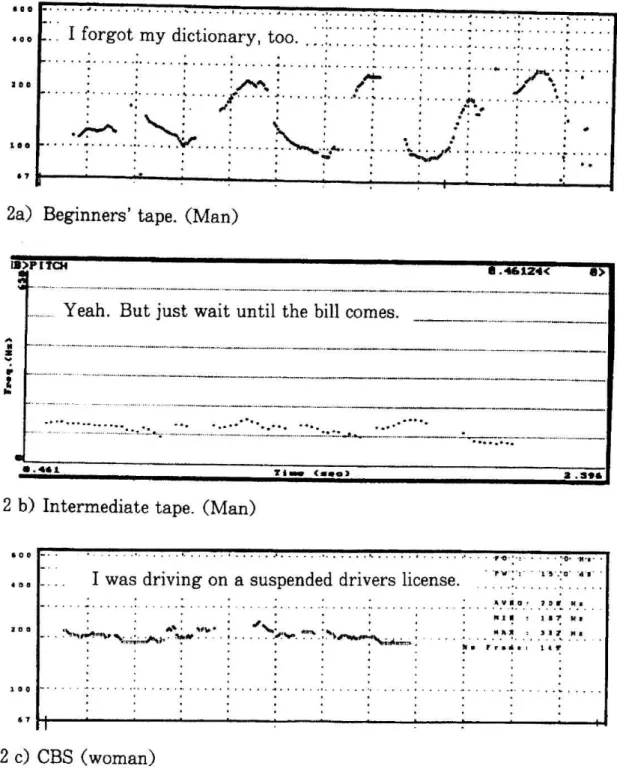
One of the most striking features of teaching tapes is exaggerated intonation. Some judges remarked on "over-acting" in the tapes. Low level tapes often had several wide pitch excursions in a phrase, with a pitch peak on every content word, giving sentences an up-down rhythm.
A sentence taken from a beginning teaching tape made in Japan has five words with three large pitch peaks. (see Figure 2a) . Fernald & Simon
(1989) found more accented words per phrase in baby talk than in adult- to-adult speech. In first language acquisition it is believed that making words stand out helps infants to acquire language. It is likely that for
second language learners , accenting words makes them easier to perceive. In spontaneous speech there is, at most, one pitch prominence per phrase, usually the last content word, and the rest of the phrase is
400
400
300
100
•7
2a)
I forgot my dictionary,
' • ...
)o. ..
... •
•
•
•...
• ...
r
• ...
•
• •
•
. S
•
•
Beginners' tape. (Man)
M I V
a
lOP I ?CH
8 . 46124<
Yeah. But just wait until the bill comes.
... •••••^••••• ...
•• ....
. ... • • •• ••• • • •
• .• • • 4..• •
• •
••• 4".••^^^••:•••".
0.461 Time (s•e)
.311,6
2 b) Intermediate tape . (Man)
6 0 0 - . . _ . , . _-... .. ... ...
40 0 _...I was driving on a suspended drivers license.
•...
• •...
•
100 -... ...
• •
67 f
2 c) CBS (woman)
Figure 2. Pitch patterns on teaching tapes .
Prosodic features of recorded English teaching materials: A pilot study 49 typically quite flat. The intonation contours of the intermediate tapes
(see Figure 2b) were similar to those on the CBS and CNN tapes. A sentence from the CBS tape (Figure 2c) has eight words with one small pitch peak on "suspended," and the phrase has a narrow pitch range.
Baby talk studies give figures for pitch range, but there are problems in measuring pitch range to show exaggerated intonation. Two sentences of the same length, one with one pitch peak and the other with several, could have the same pitch range. Graddol (1986) discusses problems with measuring pitch range and the various methods researchers have used to measure it.
Speech rates
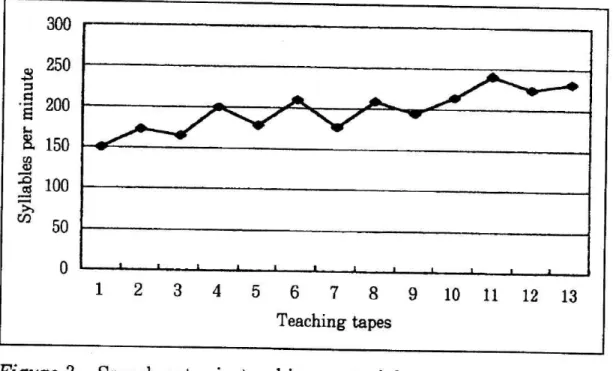
Speech rates (see Appendix C) increased approximately with the level of the materials as advertised by the publishers, and reached rates at the low end of average for speech to native speakers (Tauroza & Allison
1990, see Table 1) at the intermediate level. Griffiths (1990) found that low intermediate students could cope with listening passages which were
spoken at average rates. The fairly close relation between increase in speech rate and level of material suggests that speech rate on teaching tapes is quite well controlled. However, Griffiths' (1990) finding that very slow rates did not lead to better comprehension than average rates might indicate that the very slowest tapes do not need to be so slow, even for beginners.
It was thought possible that on the faster low level tapes, high speech rates might be compensated for by less syntactic complexity and shorter utterance length, but calculation of average number of words per T-unit
(a syntactic main clause and its associated subordinate clauses) did not show any consistent inverse relation between length of T-unit and speech rate. A larger sample of tapes and more extracts per tape
will need to be analyzed to confirm or refute this hypothesis .
Figure 3. Speech rates in teaching materials .
Articulation rates
The rate of articulation is the speech rate excluding pause time . Pauses at the end of phrases and sentences are known as boundary or juncture pauses, and those within phrases are classified as hesitation pauses. Speed of speaking is more dependent on frequency and duration of pauses than it is on speed of articulation (Goldman -Eisler , 1968) , and there are physical limits to the speed at which sounds can be articulated. Goldman- Eisler gives figures cited from Miller (1951) of a maximum of between 6.7 and 8.2 syllables per second and an average of 5 to 5.5 sps. She found a range of 4.4 to 5.9 syllables per second
Prosodic features of recorded English teaching materials: A pilot study 51
among the eight subjects she used in an experiment, and a five times greater range of pause time than articulation time.
Fernald & Simon (1984) found an average of 5.8 sps for German mothers speaking to adults and 4.2 sps for the same mothers speaking to babies. In this study, the range was 3.84 to 5.02 sps for the teaching tapes (see Appendix D) . Griffiths (1991) minimizes the role of slower enunciation in teacher talk. He cites Goldman-Eisler's claim that speech rate is largely determined by the duration and frequency of pauses and that native speakers rarely draw out their syllables, but her
research was not connected with either first of second language acquisition.
Duration of unstressed syllables
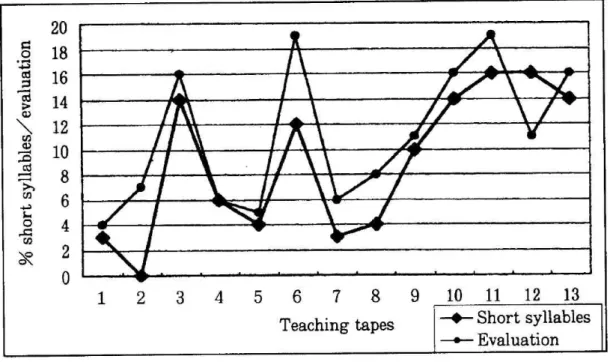
In collecting data for this study, there was a striking scarcity of short
Figure 4. Percentages of short syllables per extract and evaluation of extracts.
syllables in the slow-sounding extracts . In NS-NS speech and some teaching tapes, unstressed syllables and unstressed words like "a" or
"the" can b
e less than 40 ms (milliseconds) long, and are commonly less than 80 ms. In some slow extracts , the absence or near absence of syllables under 100 ms was conspicuous . Low evaluations given by the judges to tapes were remarkably consistent with low percentages of short syllables (see Appendix D and Figure 5) . Low evaluation was more consistent with lack of short syllables than mean pitch or speech rate.
Summary
Chaudron (1988) reports that a number of teacher talk studies (including Henzl, 1973, and Hakansson, 1986) show that teachers' speech rates increase in relation to the level of the learners . The same seems to true of teaching tapes even though the speakers are not interacting with learners. The tapes which had a low percentage of short syllables consistently received low ratings for naturalness . This was the feature most closely tied with low evaluation for naturalness . Only one of the tapes made in Japan did not have a low percentage of short syllables . Interestingly, one of the authors of the textbook is a well-known researcher into second language listening.
Mean pitches were very high compared with NS-NS speech . They decreased with increasing level, but the trend was not so clear as for increasing speech rate. It was less clear for women , who have a wider pitch range, than for men. Pitch fluctuations were wide and numerous
Prosodic features of recorded English teaching materials: A pilot study 53 in utterances on low level tapes, but intonation patterns on intermediate
tapes were similar to those in the documentaries, with a narrow pitch range fewer and smaller pitch excursions.
The more natural tapes, mostly the tapes produced for the international market, sounded as if they were recorded by professional actors, and the tapes made in Japan were probably recorded by language teachers. The least natural recordings, particularly those made for junior high school students, gave the impression of being designed to reinforce the teaching of grammatical structures rather than to teach the spoken language. Many excellent textbooks are being produced to teach false beginners in Japan at the university level. They are skillfully designed to engage often unmotivated students by using material which interests this group of students. The tapes which accompany the books have well designed listening tasks, but unfortunately, the acting skill of the speakers is not good.
Internationally produced textbooks are not so well designed to appeal to Japanese learners, but the acting of the speakers on the tapes is better.
The very slow tapes, with drawn out unstressed syllables and unstressed words like "a" and "the," may be giving listeners too much help and may not be preparing them to move towards authentic listening.
Further Research
Further work will use more native-speaking teachers of American English as judges and will need more intermediate material produced in
Japan and complete beginners material made in the U .S. for a balance between the two types of material. Such a balance would probably show more clearly the differences between listening material recorded by teachers and by actors.
Study of pitch patterns will require examination of more material than can be included in an evaluation of naturalness , because pitch phenomena are more variable than duration-related features like syllable length, articulation rates and speech rates .
Some research has already been undertaken to assess the efects of different speech rates on second language comprehension . Research into the efects of manipulation of the other prosodic features considered in this study, like pausing, syllable duration and pitch patterns , might show what modifications of prosody are helpful or unnecessary in the preparation of graded listening materials.
References
Abercrombie, D. (1965). Conversation and spoken prose . In Studies in Phonetics
and Linguistics, Oxford University Press, Oxford.
Chaudron, C. (1988). Second Language Classrooms. Cambridge University Press . Cruttenden, A. (1986). Intonation. Cambridge University Press .
Fant, G. (1956) . On the predictability of formant levels and spectrum envelopes
from formant frequencies. In Halle, M., Lunt, H., & MacLean , H., (eds.).
For Roman Jakobson, The Hague: Mouton, 109-20.
Fernald, A. and Simon, T. (1984). Expanded intonation contours in mothers' speech to newborns. Developmental Psychology, 20, 104-13.
Fernald, A., (1989) . Taeschner, T., Dunn, J., Papousek , M., Boysson-Bardies, B., Fukui, I. A cross-language study of prosodic modifications in mothers' and
Prosodic features of recorded English teaching materials: A pilot study 55 fathers' speech to preverbal infants. Journal of Child Language, 16, 477-501.
Garnica, 0. (1977). Some prosodic and paraliguistic features of speech to young children. In Snow, C. E. and Ferguson, C. E. (eds.) , Talking to Children:
Language input and acquisition. Cambridge, MA: University Press, 63-88.
Goldman-Eisler, (1968). Psycholinguistics: Experiments in Spontaneous Speech.
London: Academic Press.
Graddol, D. (1986). Dicourse specific pitch behaviour. In Johns-Lewis, C. (ed.) Intonation in Discourse. London: Groom Helm.
Griffiths, R. T. (1990). Speech rate and NNS comprehension: A preliminary study in time-benefit analysis. Language Learning, 40: 311-36.
Griffiths, R. T. (1991). Pausological research in an L2 context: A rationale, and review of selected studies. Applied Linguistics, 12: 345-364.
Hakansson, G. (1986) . Quantitative aspects of teacher talk. In G. Kasper, (ed.) Learning, teaching and communication in the foreign language classroom,
83-98. Aarhus Denmark: Aarhus University Press.
Hatch, E. (1983a) . Psycholinguistics: a Second Language Perspective. Rowley, Mass.: Newbury House.
Hatch, E. (1983b) . Simplified input and second language acquisition. In Andersen (ed.) Pidginization and Creolization as Second Language Acquisition. Rowley, Mass.: Newbury House.
Henzl, V. (1973). Linguistic register of foreign language instruction. Language
Learning, 23: 207-222.
Kelch, K. (1982) . Modified input as an aid to comprehension. Studies in Second Laguage Acquisition, 7, 81-90.
Laver, J. (1994) . Principles of Phonetics. Cambridge University Press.
Miller, G. A. (1951). Language and Communication. New York: McGraw-Hill.
(Cited in Goldman-Eisler, 1968) .
Tauroza, S., & Allison, D. (1990) . Speech rates in British English. Applied Linguistics, 11, 90-105.
Appendix A
Teaching Tape Evaluation Sheet with Results Entered Name of judge:
Date of collection:
Approximate length of teaching experience:
Na Level of material
Grades 1. Very
poor
2. Poor 3. 4. 5. Good 6. Very
good 1 Beginner
(J jhs radio) ABD C
2 Intermediate
(I) CD B A
3 False beginner
(J) AD BC
4 False beginner
(I) C ABD
5 Beginner
(J ~hs) ABCD
6 Advanced
(CNN) C ABD
7 Intermediate
(I) C ABD
8 Beginner
(J jhs) ABD C
9 Beginner
(I) BC AD
10 False beginner
(J) AC BD
11 False beginner
(I) C A BD
12 False beginner
(J) D ABC
13 Intermediate
(I) ABCD
14 Advanced
(CBS) C ABD
15 Beginner
(jhs) ABD C
Key:
Bracketed information was not available to the judges . ABCD Codes for the four judges.
J Material produced for the Japanese market.
I Material produced international market
jhs Material produced for junior high school students.
Prosodic features of recorded English teaching materials: A pilot study 57
Appendix B
Mean Pitch of Male and Female Speakers
Level of text Market Mean pitch of women
Mean pitch of men
1 1' year jhs J 305 200
2 1' year jhs (radio) J 229 158
3 Beginner I 194 149
4 2' year jhs (radio) J 267 146
5 3rd year jhs J 286 191
6 False beginner I 226 134
7 False beginner J 309 168
8 False beginner J 293 159
9 False beg. - low int. 333 171
10 False beg. - low int I 211 156
11 High beg. - high int. I 183 110
12 Low in - int. I 186 121
13 Intermediate I 193 122
14 CNN 103,142
15 CBS 146,255,222
Speech Rates, of Extracts
Appendix C
Mean Number of Words per T-Unit, and Evaluations
Level of text Market Syllables per minute
Mean no.
of words per T-unit
Evaluation
Taxt available or not
1 1' year jhs J~ 150 5.0 4
text
2 1' year jhs (radio) J 171 3.8 7 text
3 Beginner I 164 5.0 16 text
4 2nd year jhs (radio) J 200 5.6 6 text
5 3rd year jhs J 177 4.0 5 text
6 False beginner I 210 4.3 19 text
7 False beginner J 176 4.0 6 no text
8 False beginner J 208 5.8 8 no text
9 False beg. -- low int. J 193 5.1 11 no text
10 False beg. - low int. I 215 4.8 16 text
11 High beg. - high int. I 241 5.2 19 text
12 Low int. - int. I 224 6.4 11 no text
13 Intermediate I 232 5.7 16 no text
14 CNN:
whole interview 251 10.3 23
interviewee 273
15 CBS:
3 speakers 276 272 291 8.8 23
2' Speaker Key:
jhs beg.
int.
Material produced for junior high school students . Beginner
Intermediate
Prosodic features of recorded English teaching materials: A pilot study 59
Appendix D
Percentages of Short Syllables and Articulation Rates
Percentage AR
Level of text Market of short Evaluation (syllables
syllables per second)
1 1' year jhs J 3 4 3.84
2 1' year jhs (radio) J 0 7 3.89
3 Beginner I 14 16 4.24
4 2nd year jhs (radio) J 6 6 4.07
5 3rd year jhs J 4 5 3.53
6 False beginner I 12 19 4.48
7 False beginner J 3 6 4.09
8 False beginner J 4 8 4.46
9 False beg. - low int. J 10 11 4.54
10 False beg. - low int. I 14 16 4.86
11 High beg. - high int. I 16 19 5.02
12 Low int. - int. I 16 11 4.59
13 Intermediate I 14 16 4.92
14 CNN 26 23 6.20
15 CBS 12 23 5.00
Key:
AR: Articulation Rate
英語録 音教材 の韻律 的特徴
前 田 マ ー ガ レ ッ ト
現 在 市 販 され て い る殆 ど全 て の 日本 で制 作 され た英 語 の 録 音 教 材 は、 不 自然 な発 音 の会 話 が 録音 され て い る に も関 わ らず 、 誠 しや か に"自 然"も し くは"本 物"な ど とい う宣 伝 文 句 と共 に販 売 され て い る。 故 に筆 者 は こ れ ら録 音 テ ー プの韻 律 的 特 徴 を調 べ、 また そ の特 徴(ラ ジ オ の英 会 話 番 組 を 含 む)と ア メ リカで 全 世 界 向 け に制 作 され た英 語 の録 音 教 材 とア メ リカ で放 映 され た テ レ ビ ドキ ュ メ ン ト番 組 の 自然 な会 話 の 韻 律 を 比 べ る こ と と した。 方 法 と して 、 ま ず先 に、 初 級 者 と中 級 者 用 に 作 成 され た テ ー プ (ラ ジオ放 送 教 材 を含 む)と テ レ ビ ドキ ュ メ ン ト番組 の ピ ッチ曲 線 を コ ン ピュ ー タ音 声解 析 装 置 を用 い抽 出 した。 これ ら全 て の テ ー プ は英 語 母 語 話 者(ア メ リカ人)に よ って録 音 され た もの で あ る。 次 に 、 こ れ らの 録 音 テ ー プ の 一 部 を 再 度 一 本 の テ ー プ に ラ ン ダ ム に 録 音 し、 そ れ を4人 の E.F.L.教 員(英 語 母 語 話 者)に 聞 い て も らい 、 発 音 が どれ だ け 自然 で あ るか ラ ンク付 け して も ら った◎ この研 究 で今 回音 響 的調 査 した内 容 は、 イ ン トネ ・一シ ョン パ ター ン、 男女 の ミ ィー ン ピ ッチ、 ス ピ ー チ レー ト、
調 音 度、 と シ ラブ ル の長 さで あ る。 この研 究 でわ か った こ と は殆 ど全 て の 日本 国 内で 作 成 され た教 材 用 テ ー プの発 話 は テ レ ビ ドキ ュ メ ン ト番 組 内 の発話 とは ま った くと言 って もい い程 似 て い な い、 しか しア メ リカで 制 作 され た教 材 用 テ0プ の発 話 は 日本 製 の 物 に比 べ て は るか に 自然 で 音 響 的 分 析 に お いて も、 これ らの発 話 は ナチ ュ ラル ス ピー チ に似 る よ うに 巧 妙 に 発 音 され て い る。