原 著
川崎病巨大冠動脈瘤に対する外科治療
山内 仁紫1),落 雅美1),赤石 純子1),大森 裕也1)
檜山 和弘1),佐地 嘉章1),藤井 正大1),内木場庸子2)
小川 俊一2),清水 一雄1)
日本医科大学第二外科1),小児科2)
Key words:
川崎病,巨大冠動脈瘤,冠動脈バイパス術
Surgical Therapy in Patients with Giant Coronary Artery Aneurysm due to Kawasaki Disease
Hitoshi Yamauchi,1) Masami Ochi,1) Junko Akaishi,1) Hiroya Ohmori,1) Kazuhiro Hinokiyama,1) Yoshiaki Saji,1) Masahiro Fujii,1) Yoko Uchikoba,2) Shunichi Ogawa,2) and Kazuo Shimizu1)
1)Department of Surgery II, Division of Cardiovascular Surgery, Nippon Medical School
2)Department of Pediatrics, Nippon Medical School, Tokyo, Japan
Background: Optimal treatment for patients with giant coronary aneurysms (maximal diameter more than 8 mm) resulting from Kawasaki disease (KD) remains controversial. We therefore studied the influence of surgical therapy in patients with giant coro- nary aneurysms due to KD.
Methods: During the last 12 years, 17 patients with giant aneurysms resulting from KD underwent coronary artery bypass grafting (CABG) in our institute. The mean age at the time of acute KD was 2.3 years, and the mean length of time from the diagnosis of acute KD to CABG was 7.0 years. Preoperative reduced ventricular function was recognized in 8 patients (47%) and old myocardial infarction in 5 patients (29%). Multivariate logistic regression analysis using patient characteristics showed that the length of time from acute KD to CABG was the only predictor for ventricular functional deterioration (p=0.03, odds ratio 1.55, 95%CI: 1.033–2.325). Based on this result, we divided the patients into a short-range group (group S) and a long-range group (group L); the mean length of time from the diagnosis of acute KD to CABG was within 3.5 years and 13.9 years, respectively.
Preoperative demographic variables, graft patency, and postoperative cardiac events rate were compared between the two groups.
Results: Graft patency was 93% and 100% in groups L and S, respectively. The respective rates of freedom from cardiac events were 71% and 100% in groups L and S during the mean postoperative follow-up periods of 6.8앐3.2 years (group L) and 4.4앐3.2 years (group S).
Conclusions: Our experience suggested that surgical therapy with a short interval between the diagnosis of acute KD and CABG could result in favorable long-term outcome.
別刷請求先:〒113-8603 東京都文京区千駄木 1-1-5 日本医科大学第二外科 山内 仁紫 平成14年11月28日受付
平成16年 2 月 2 日受理
要 旨
背 景:川崎病巨大冠動脈瘤の問題点は,瘤内血栓による心筋梗塞の発症で,これによる突然死や心機能低下を防 止することは重要な課題であるが,巨大冠動脈瘤の治療方針はいまだ確立していない.われわれは川崎病巨大冠動 脈瘤に対して動脈グラフトを用いた冠動脈バイパス術,瘤縫縮術を早期に積極的に行う方針としてきたので,今回,
手術成績および術後遠隔期予後からこの方針の妥当性を検討した.
対象と方法:対象は1991〜2002年に冠動脈バイパス術を行った巨大冠動脈瘤(最大径 8mm以上)を伴った川崎病既往 児17例で,手術時の年齢は 3〜29歳(平均10.9歳),急性川崎病の発症年齢は 6 カ月〜5 歳(平均2.3歳),発症から手 術までの期間は 1〜18年(平均7.0年)であった.術前の左室造影で壁運動の低下を認めた症例が 8 例(47%),心筋梗 塞の既往を認めた症例が 5 例(29%)であった.左室壁運動の低下に注目し,これらの背景因子を多変量解析すると 急性川崎病の発症から手術までの期間が唯一の予測因子であった(p=0.03,odds ratio 1.55,95%CI: 1.03〜2.33).そ こで対象の17例を発症から手術までの期間が10年以下のS群(1〜7.7年,平均3.5年)と10年以上のL群(10〜18年,平均 14.1年)の 2 群に分け術前術後経過を比較検討した.
はじめに
川崎病急性期に形成された冠動脈瘤は多様な経過を たどることが知られている.多くは縮小傾向を示す が,ひとたび巨大冠動脈瘤を形成すると,瘤径の拡大 に伴う瘤内血流速度の低下により瘤内血栓形成を来し 心筋梗塞を発症する.諸家の報告では巨大冠動脈瘤の 心筋梗塞の発症率は30%以上とされ1–3),この二次血栓 形成による冠動脈瘤の完全閉塞が引き起こす突然死や 心機能低下を防止することは重要な課題であるが,巨 大冠動脈瘤を形成した場合の治療方針はいまだ確立し ていない.われわれは川崎病巨大冠動脈瘤に対して動 脈グラフトを用いた冠動脈バイパス術,瘤縫縮術を早 期に積極的に行う方針としてきたので,今回,手術成 績および術後遠隔期予後からこの方針の妥当性を検討 した.
対象と方法
対象は1991〜2002年に冠動脈バイパス術を行った巨 大冠動脈瘤を伴った川崎病既往児17例で,冠動脈瘤(直 径 4mm以上)を左冠動脈主幹部(LMT)に 4,左冠動脈前 下行枝(LAD)に14,右冠動脈(RCA)に 9 個認めた.こ のうち巨大冠動脈瘤(直径 8mm以上)はLMTに 3,LAD に12,RCAに 8 個認めた.有意狭窄病変は 0〜2 カ所(平 均1.3カ所)で,明らかな狭窄病変を認めない症例が 4 例 であった.手術時の年齢は 3〜29歳(平均10.9歳),急性 川崎病の発症年齢は 6 カ月〜6 歳(平均2.3歳),正確な 発症年齢が明らかでない症例が 2 例あった.発症から 手術までの期間は 1〜18年(平均7.0年)であった.術前の 左室造影で心筋梗塞の既往を認めた症例が 5 例(29%), 壁運動の低下を認めた症例が 8 例(47%)であった(Table 1).左室壁運動の低下に注目し,Table 1 に示した背景 因子を多変量解析すると急性川崎病の発症から手術ま での期間が唯一の予測因子であった(p=0.03,odds ratio 1.55,95%CI: 1.03〜2.33).そこで対象の17例を発症か ら手術までの期間が10年以下のS群(0.4〜8.3年,平均3.5
年)(Table 2)と10年以上のL群(10.2〜18.5年,平均13.9 年)(Table 3)の 2 群に分け術前術後経過を比較検討し た.統計学的解析はSPSS 11.0J(SPSS Inc,Chicago,IL)
を用い,2 群間の比較はMann-Whitney U-testで行った.
心事故回避率はnon-parametric Kaplan-Meier法を用い,2 群間の比較はlog-rank testで行った.手術は全例人工心肺 使用,心停止下に,すべて動脈グラフトを用いて行っ た.左内胸動脈(LITA)-LAD 12例,LITA-diagonal(D1)- LAD sequential graft 4 例,右内胸動脈(RITA)は 3 例に,
右胃大網動脈(RGEA)は 2 例に使用し,吻合は 7-0 poripropilen糸を用い連続吻合にて行った(Fig. 1).冠動 脈瘤縫縮術は 4 例(LMT 1,RCA 3)に,瘤を縦切開し瘤 壁を切除しネラトンカテーテルで内腔を確保しつつ連 続縫合で行った(Fig. 2A,B).
結 果
S群とL群の比較では,術前の心筋梗塞の既往がS群10 例中 1 例(10%),L群 7 例中 4 例(57%),左室壁運動 の低下がS群 1 例(10%),L群 7 例(100%)であり,L群 に左室壁運動の低下を多く認めた(p=0.03).術後経過観 察期間はS群で1.0〜10.5年(平均4.4年),L群で3.0年〜
10.3年(平均6.8年)でグラフト開存率はS群で100%(13/
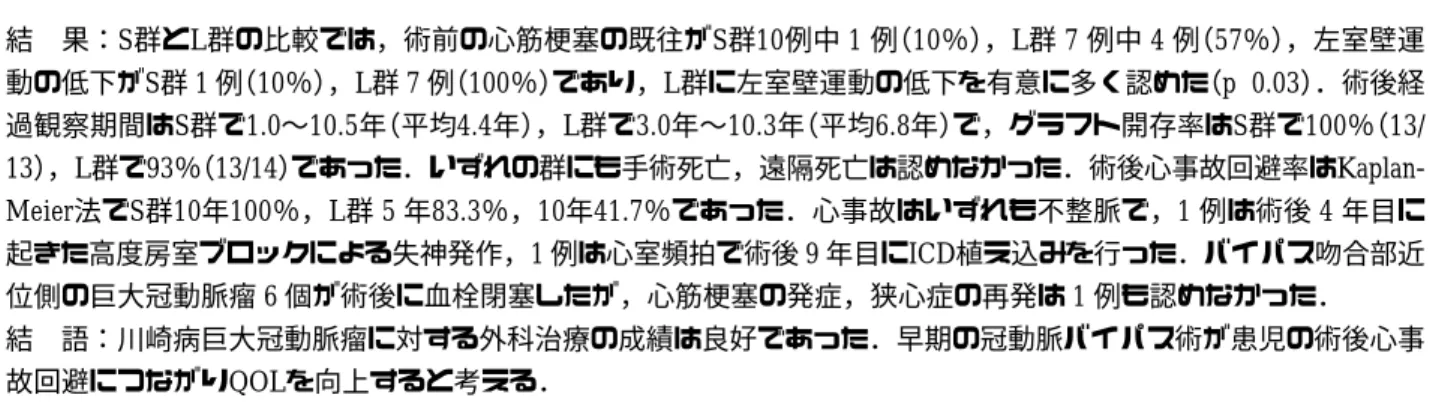
結 果:S群とL群の比較では,術前の心筋梗塞の既往がS群10例中 1 例(10%),L群 7 例中 4 例(57%),左室壁運 動の低下がS群 1 例(10%),L群 7 例(100%)であり,L群に左室壁運動の低下を有意に多く認めた(p=0.03).術後経 過観察期間はS群で1.0〜10.5年(平均4.4年),L群で3.0年〜10.3年(平均6.8年)で,グラフト開存率はS群で100%(13/
13),L群で93%(13/14)であった.いずれの群にも手術死亡,遠隔死亡は認めなかった.術後心事故回避率はKaplan- Meier法でS群10年100%,L群 5 年83.3%,10年41.7%であった.心事故はいずれも不整脈で,1 例は術後 4 年目に 起きた高度房室ブロックによる失神発作,1 例は心室頻拍で術後 9 年目にICD植え込みを行った.バイパス吻合部近 位側の巨大冠動脈瘤 6 個が術後に血栓閉塞したが,心筋梗塞の発症,狭心症の再発は 1 例も認めなかった.
結 語:川崎病巨大冠動脈瘤に対する外科治療の成績は良好であった.早期の冠動脈バイパス術が患児の術後心事 故回避につながりQOLを向上すると考える.
Age at surgery (year) 3–29 (mean 10.9)
Age of acute KD 0.5–6 (mean 2.3)
Time in years 1–18 (mean 7.0)*
Number of large aneurysms 1–3 (mean 1.8) Number of stenoses 0–2 (mean 1.3)
Number of grafts 1–3 (mean 1.5)
OMI 5/17 (29%)
Asynergy 8/17 (47%)
*: Time in years was the only predictor for ventricular functional deterioration (p=0.03, odds ratio 1.55, 95%CI: 1.033–2.325).
KD: Kawasaki disease, Time in years: interval from diagnosis of acute KD to coronary artery bypass grafting (CABG), OMI: old myocardial infarction
Table 1 Characteristics of 17 patients
13),L群で93%(13/14)で両群間に有意差を認めなかっ た(Table 4).冠動脈瘤縫縮術の術後経過も良好で,flow wireを用いた瘤内血流速度の測定でも瘤径の縮小に伴い 血流速度の上昇を認めた(Fig. 3).L群の 1 例で左冠動 脈系への 3 枝バイパスグラフトである両側内胸動脈に よるcomposite graftが閉塞したため,1 年 5 カ月後に RGEAを用い再手術施行した.いずれの群にも手術死 亡,遠隔死亡は認めなかった.術後心事故回避率は Kaplan-Meier法でS群10年100%,L群 5 年83.3%,10年 41.7%で,心事故発生率はL群で高い傾向を示した(Fig.
4).心事故はいずれも不整脈で,1 例は術後 4 年目に起 きた右冠動脈に閉塞病変のある症例の高度房室ブロッ クによる失神発作,1 例は前壁中隔の梗塞部を起源とし た心室頻拍で術後 9 年目に植え込み型除細動器(ICD)植 え込みを行った.バイパス吻合部近位側の巨大冠動脈 瘤 6 個が術後に血栓閉塞し,そのうち 2 例は術前の造 影で明らかな狭窄病変を認めていなかった.瘤の血栓閉 塞にもかかわらず,心筋梗塞の発症,狭心症の再発は 1 例も認めなかった(Fig. 5).冠動脈縫縮術を行った 4 例
Case no. Sex Age Range Aneurysm Stenosis Surgical procedure
1 M 3 2.0 LAD* (−) LITA-LAD
2 M 3 1.8 LAD, RCA* #7 LITA-LAD
3 F 4 1.7 LMT*, RCA (−) LITA-LAD, plication LMT
4 M 5 1.0 LAD*, RCA* (−) LITA-LAD, plication RCA
5 M 6 1.0 LAD*, RCA* #2, #6 LITA-LAD
6 M 8 2.3 LAD* #6 LITA-D1-LAD
7 M 8 5.1 LMT*, RCA* #2, #6 LITA-LAD, RGEA-RCA
8 M 9 6.5 LAD* #6 LITA-D1-LAD
9 M 9 7.7 LAD* #6 LITA-LAD
10 M 9 7.0 LAD*, RCA #6 LITA-LAD
Range: interval from diagnosis of acute KD to CABG, Aneurysm: Large aneurysm (maximal diameter>4 mm)
*: Giant aneurysm (maximal diameter>8 mm)
LAD: left anterior discending coronary artery, LITA: left internal thoracic artery, RCA: right coronary artery, LMT: left main coronary trunk, D1: diagonal artery, RGEA: right gastro-epiploic artery
Case no. Sex Age Range Aneurysm Stenosis Surgical procedure 11 F 11 10.0 LMT*, RCA* (−) LITA-LAD-D1-LCx, plication RCA
12 M 12 12.6 LAD* #1, #6 LITA-LAD
13 F 17 16.0 LAD* #2, #7 LITA-LAD, RITA-D1
14 M 17 12.8 LAD*, RCA* #3, #7 LITA-LAD, RGEA-RCA
15 M 17 - LAD*, RCA #2, #7 LITA-LAD
16 F 18 18.0 LMT*, RCA* #6 LITA-D1-LAD, plication RCA 17 M 29 - LAD*, RCA* #6 LITA-D1-LAD, RITA-RCA The time of diagnosis as acute KD was unclear in two patients
LCx: left circumflex
Table 2 Patient characteristics and surgical procedure in group S (short-range group)
Table 3 Patient characteristics and surgical procedure in group L (long-range group)
Fig. 1 LITA-LAD anastomosis of a 3-year-old boy (case 1).
では血栓閉塞や狭窄病変への進行は 1 例もなかった.
考 察
1974年川崎病冠動脈病変に対し自己大伏在静脈を用 いて冠動脈バイパス術を行った北村らの報告から4),多
Fig. 2
A This 11-year-old girl (case 11) underwent downsizing of a giant coronary aneurysm in the right coronary artery.
Preoperative aneurysm (left side), after downsizing (right side).
B Preoperative right coronary angiogram (left side). Postoperative angiogram shows that the giant aneurysm was reduced from 20 mm to 8 mm in size (right side).
Group S (n = 10) Group L (n = 7) P value
Age at acute KD 3.4앐0.48 1.5앐0.71 0.03
Age at surgery 6.5앐2.6 17.1앐5.9 0.001
Interval in years 3.5앐2.5 13.9앐3.5 0.003
OMI 1 (10%) 4 (57%) 0.15
Asynergy 1 (10%) 7 (100%) 0.03
Valvular dysfunction 0 (0%) 1 (14%) 1.0
Arrhythmia 0 (0%) 2 (29%) 0.34
No. of large AN 1.8앐0.4 1.8앐0.4 0.63
No. of grafts 1.3앐0.48 1.9앐0.69 0.15
Postoperative follow-up 4.4앐3.2 6.8앐3.2 0.75
Graft patency 13/13 (100%) 13/14 (93%) 1.0
Interval in years: interval from diagnosis of acute KD to CABG No: number, AN: aneurysm
Table 4 Patient characteristics and postoperative variables
Fig. 3 Plication of aneurysm was performed to improve the stagnation of flow inside the aneurysm. Preoperative average peak velocity was 15 cm/sec, and coronary flow ratio was 1.2 (left side). Postopera- tive average peak velocity was 22 cm/sec, and coronary flow ratio was 2.5 (right side).
Group S Group L
years 14 12 10 8 6 4 2 0 1.1 1.0 0.9 0.8 0.7 0.6 0.5 0.4
Fig. 4 Postoperative actuarial freedom from car- diac events of groups S and L.
Group S: short-term group, group L: long-term group
A B
くの冠動脈バイパス術が行われた.しかしその後の経 過観察から,大伏在静脈グラフトは 1〜2 年の経過でし ばしば閉塞することが明らかとなり5),内胸動脈(ITA)
を用いた冠動脈バイパス術に移行した.ITAは患児の成 長や心 筋の需要に適応し優れた開存性をもつ l i v e conduit であり6),小児期に冠動脈バイパス術を受ける 川崎病患児に対する第一選択のグラフトと考えられ,
ITA群と大伏在静脈群との比較で有意にITA群に長期生 存が得られると報告されている7).
加藤らの報告によると,594例の川崎病患児における 冠動脈造影所見にて26例(4.4%)に巨大冠動脈瘤を認 め,このうち12例では狭窄または閉塞病変に進行,さ らに心筋梗塞がこの12例中 8 例に発症し,4 例が死亡し た2).Checchiaらの13例の川崎病患児に対する心臓移植 の報告では,全例冠動脈瘤の閉塞が原因で高度心機能 低下や心室性不整脈を生じ,このうち 8 例で移植前に 冠動脈バイパス術を行ったが心機能は回復せず,全例 1 年以内に心臓移植を行っている8).川崎病冠動脈病変の うち高度狭窄病変では側副血行の発達が豊富なことが 多いが,巨大冠動脈瘤で狭窄病変がないか,軽度の場 合の瘤内血栓形成よる急性閉塞は心筋梗塞を発症し,
心機能低下や突然死を引き起こす.われわれの症例で も,心筋梗塞の既往が 5 例(29%)に認められ,特にL群 では 7 例中 4 例(57%)と高頻度であった.また,バイ パス術後の冠動脈造影所見では吻合部近位側の巨大冠 動脈瘤 6 個が血栓閉塞したが,心筋梗塞の発症,狭心 症の再発は,1 例も認めなかった.これらのことから,
冠動脈バイパス術は,瘤内血栓による心筋梗塞の発症 Fig. 5
A Preoperative left coronary angiogram of a 5-year-old boy (case 4) shows left coronary giant aneurysm without significant stenotic lesion.
B Postoperative native left coronary angiogram (left side) and LITA-LAD graft (right side). Large coronary aneurysm proximal to the anastomosis occluded with thrombus formation without development of myocar- dial infarction or recurrence of angina.
A B
を予防し得る可能性が示唆された.さらに心筋梗塞の 発症は,乳頭筋機能不全による僧帽弁逆流,壁運動の 低下,左室瘤,心室性不整脈の発症など,遠隔期,患 児のQOLを低下させる要因となることから早期の外科 治療が有用と思われる.しかし,川崎病冠動脈病変の 特記すべき特徴に冠動脈瘤の消退があり,冠動脈瘤の 半数が急性川崎病後 6〜24カ月で消退したという報告も ある9).このことから,急性川崎病発症から 1〜2 年は 抗凝固療法を行い慎重に経過観察したうえで,冠動脈 瘤が直径 8mm以上で縮小傾向がなく,負荷心筋シンチ 等で心筋虚血を認める場合は,冠動脈バイパス術の適 応とすべきと考えており,われわれの17例は狭窄病変 の有無にかかわらず,全例術前に心筋虚血を認めてい る.
明らかな狭窄病変を伴わない巨大冠動脈瘤で心筋虚 血が認められ,手術適応となった場合の術式に関して は考慮が必要である.われわれの症例では,1 例でITA グラフトが閉塞した.この症例(症例11)は狭窄病変のな いLMTの巨大冠動脈瘤に対し,両側ITAによるcomposite graftで-LAD,-D1-左回旋枝(LCx)の吻合を行ったが,早 期にグラフトの閉塞を認めた.このことからsequential 吻合やcomposite graftは狭窄病変がない場合にはflow competitionを起こすため行うべきではないと思われた.
成人例冠動脈バイパス術では日常的に使用される,
LITA-RITAやLITA-RAの成績に関して,良好とする報告 が多い.また,ITAのcomposite graftにおける血液供給能 に関して成人例では問題がないと考えられているが10), 小児例では十分でない可能性があり注意が必要であ
【参 考 文 献】
1)Kato H, Ichinose E, Kawasaki T: Myocardial infarction in Kawasaki disease: Clinical analyses in 195 cases. J Pediatr 1986; 108: 923–927
2)Kato H, Sugimura T, Akagi T, et al: Long-term consequences of Kawasaki disease. A 10- to 21-year follow-up study of 594 patients. Circulation 1996; 94: 1379–1385
3)Tatara K, Kusakawa S: Long-term prognosis of giant coro- nary aneurysm in Kawasaki disease: An angiographic study. J Pediatr 1987; 111: 705–710
4)Kitamura S, Kawashima Y, Fujita T, et al: Aorto coronary bypass grafting in a child with coronary artery obstruction due to mucocutaneous lymphnode syndrome: Report of a case. Cir- culation 1976; 53: 1035–1040
5)Suma K, Takeuchi Y, Shiroma K, et al: Early and late postop- erative studies in coronary arterial lesions resulting from Kawasaki’s disease in children. J Thorac Cardiovasc Surg 1982; 84: 224–229
6)Kitamura S, Seki T, Kawachi K, et al: Excellent patency and growth potential of internal mammary artery grafts in pediat- ric coronary artery bypass surgery. Circulation 1988; 78 (3 pt 2): I129–139
7)Kitamura S, Kameda Y, Seki T, et al: Long-term outcome of myocardial revascularization in patients with Kawasaki coro- nary artery disease. A multicenter cooperative study. J Thorac Cardiovasc Surg 1994; 107: 663–674
8)Checchia PA, Pahl E, Shaddy RE, et al: Cardiac transplanta- tion for Kawasaki disease. Pediatrics 1997; 100: 695–699 9)Kato H, Ichinose E, Yoshioka F, et al: Fate of coronary aneu-
rysms in Kawasaki disease: Serial coronary angiography and long-term follow-up study. Am J Cardiol. 1982; 49: 1758–1766 10)Ochi M, Hatori N, Bessho R, et al: Adequacy of flow capacity of bilateral internal thoracic artery T graft. Ann Thorac Surg 2001; 72: 2008–2012
11)Kuramochi Y, Ohkubo T, Takechi N, et al: Hemodynamic fac- tors of thrombus formation in coronary aneurysms associated with Kawasaki disease. Pediatr Int 2000; 42: 470–475 12)Suma H, Fukumoto H, Takeuchi A: Coronary artery bypass
grafting by utilizing in situ right gastroepiploic artery: Basic study and clinical application. Ann Thorac Surg 1987; 44: 394–
397
13)Takeuchi Y, Gomi A, Okamura Y, et al: Coronary revascularization in a child with Kawasaki disease: Use of right gastroepiploic artery. Ann Thorac Surg 1990; 50: 294–296 る.これに対して,LITA-LADグラフトは症例 1,3,4
のごとく狭窄病変を認めない場合でも良好に開存し全 く問題がなく,さらにこのうち 2 例(症例 1,4)では術 後に瘤の血栓閉塞を認めている(Fig. 5).
瘤内血流速度を速める目的で冠動脈瘤縫縮術をこれ まで 4 例に行った.われわれの行ったflow wire,pres- sure wireを用いた血流力学的検討では,瘤径の拡大に伴 い瘤内血流速度の低下が認められ,瘤内血栓形成の原 因と考えられる11).したがって瘤縫縮により血流速度を 速めることで血栓形成の危険を低下させ得ると考えて いる.瘤縫縮の手術適応としては,これまでの経験で は単独で適応となったものはなく,全例で他枝に対す る冠動脈バイパス術と同時に行っている.年少児の ソーセージ状の右冠動脈瘤のようにバイパス吻合部が 末梢となりRITAが届かず,冠動脈外科領域では新たな 動脈グラフトとして用いられている胃大網動脈は12),年 長児で良好とする報告もあるが13),年少児では患児の成 長の問題から疑問であり,適当なグラフト材料がない ため瘤縫縮の良い適応となる.またLMTの巨大瘤では LADのバイパスだけではLCxの血栓閉塞の危険があり瘤 縫縮が必要な場合がある.さらに急速な瘤径の拡大を 認める巨大瘤は破裂の危険性があり瘤縫縮の適応と考 えている.また瘤壁に高度石灰化病変を伴っていない ことや,ソーセージ状の右冠動脈瘤のようなバイパス を併用しない瘤縫縮では瘤の前後に狭窄病変がないこ とも必要条件である.しかし,瘤縫縮が瘤の破裂を防 止し得るかどうかは議論の余地があり,血栓形成の危 険を低下させ得るかどうかについても,われわれの 4 例 の経験では,平均2.5年の経過観察で血栓閉塞や狭窄病 変への進行はなく全例良好な結果を得ているが,今後 の長期の慎重な経過観察が必要である.
以上が巨大冠動脈瘤に対する現在の外科治療方針で あるが,手術時期については必ずしも現在の方針通り に手術が行われていたわけではない.急性川崎病発症 から手術までの期間の長いL群では,多くが心筋梗塞発 症後に当院受診しており,心機能低下,僧帽弁閉鎖不 全,不整脈などを認め,バイパス術後の心事故回避率 も L 群で低値であった. S 群の術後心事故回避率は Kaplan-Meier法で10年100%であり,L群との比較のみな らず,諸家の報告による巨大冠動脈瘤の心筋梗塞の発 症率を考慮しても,外科治療の予後は良好であった.
これらのことから,川崎病巨大冠動脈瘤に対する早期 の外科的介入は患児の術後心事故回避につながり,さ らなるQOLの向上をもたらすものと考える.
結 語
川崎病巨大冠動脈瘤に対する外科治療の成績は良好 であった.早期の冠動脈バイパス術が患児の術後心事 故回避につながりQOLを向上すると考える.