• 検索結果がありません。

Java による PRAM コンパイラの作成

N/A
N/A
Protected

Academic year: 2021

シェア "Java による PRAM コンパイラの作成"

Copied!
68
0
0

読み込み中.... (全文を見る)

全文

(1)

卒業研究報告書

Java による PRAM コンパイラの作成

指 導 教 員

石水 隆 助手

03-1-47-162

神谷 道利

近畿大学理工学部情報学科

平成

19

2

5

日提出

(2)

概要

様々な分野で計算量の大きな問題を短時間で解く事が求められている。計算速度を向 上させる方法としてはプロセッサの性能の向上、アルゴリズムの最適化等が存在するが それぞれには限界が存在するため一定以上の向上が見受けられなくなってきている。そ こで現在ではプロセッサの並列処理による高速化が注目されている。

並列処理とは、ある問題を解く際、その問題をより小さい複数の部分問題に分割し、

その部分問題を複数のプロセッサで解く処理である。並列処理を行うことにより、単一 のプロセッサによる逐次処理よりも高速に問題を解くことができ、またより複雑な問題 を解く事ができる。

しかし、並列計算機は非常に高価であるため、並列アルゴリズムの設計およびその計

算量の解析を実際の並列計算機を用いて実験的に行うことは困難である。そこで、本研

究では並列アルゴリズムの実験的評価を容易化するツールである PRAM シミュレータ

の一部として PRAM コンパイラを作成する。

(3)

目次

1 序論 ... 1

1.1 本研究の背景 ... 1

1.2 本研究の目的 ... 3

1.3 本報告書の構成 ... 3

2 研究内容 ... 4

2.1 PRAM 用並列言語 ... 4

2.2 並列アセンブラ ... 4

2.3 PRAM コンパイラ ... 5

3 結果 ... 6

4 考察・今後の課題 ... 7

5 謝辞 ... 8

付録 1 K05

言語の文法... 10

付録 2 K05

言語の文法...11

付録 3 VSM

アセンブラの文法... 12

付録 4 PRAM

コンパイラプログラム... 14

(4)

1 序論

1.1 本研究の背景 1.1.1 並列処理

様々な分野で高速な計算機を用いて計算量の大きな問題を短時間でとくことが求められてい る。計算速度を上昇させるための方法の1つとしてプロセッサの性能の向上が考えられる。だが これには 3.0 × 10

7

m/s という光速の限界が存在し現在の1万倍ほどしか速くすることができな い。またアルゴリズムの改良によって劇的な高速化が可能であるが、これには計算量の下界が存 在する。ソーティングを例にとった場合、クイックソートによる計算量の O(n log n) が下界とさ れ、これ以上の改良は不可能とされている。だが、並列処理を用いた場合そのような限界は本質 的に存在しない。

並列処理(Parallel Processing)とは、ある問題を解く際、その問題をより小さい複数の部分問 題に分割し、その部分問題を複数のプロセッサで解く処理である。並列処理を行うことにより、

単一のプロセッサによる逐次処理よりも高速に問題を解くことができ、またより複雑な問題を解 く事ができる。

しかし、並列処理を行うためにはプロセッサ間での通信や同期、メモリへのアクセスなど並列 独特の動きが必要となる。すなわち従来の逐次処理でのアルゴリズムを適応させることができな いため、並列処理専用の並列アルゴリズム (Parallel Algorithm) が必要となる。

1.1.2 並列計算機

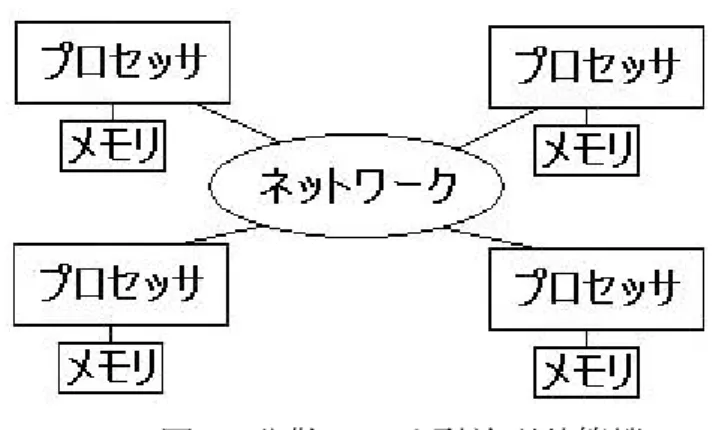
並列計算機(Parallel Computer)とは複数のプロセッサを持ち、並列処理を行える計算機であ る。並列計算機は大きく2つに分類される。図 1 のように全てのプロセッサが共通のメモリを 使用して読み書きを行い、他のプロセッサ間で通信を行う共有メモリ型並列計算機 (Shared Memory Parallel Computer) と、図 2 のように各プロセッサがそれぞれメモリを持ちネットワ ークを通じて通信を行う分散メモリ型並列計算機 (Distributed Memory Parallel Computer) で ある。

図 1 共有メモリ型並列計算機 図 2 分散メモリ型並列計算機

(5)

1.1.3 並列計算モデル

並 列 ア ル ゴ リ ズ ム の 設 計 、 解 析 は 、 並 列 計 算 機 を 抽 象 化 し た 並 列 計 算 モ デ ル (Parallel Computing Model) 上で行われる。代表的な並列計算モデルとして PRAM(Parallel Random Access Machine)、Mesh、HyperCube、BSP(Bulk Synchronous Parallel)などがある。

1.1.4 PRAM

並列アルゴリズムの設計およびその計算量の評価は多くの場合 PRAM(Parallel Random Access Machine)[2] 上で行われる。

PRAM は共有メモリ型の並列計算モデルである。 PRAM は演算命令、メモリアクセス命令、

出力命令、全てのがその移動に関係なく1単位時間で行われる、1命令ごとに同期が取られる、

通信のコストが一切発生しない、等の仮定が設けられた理想的なモデルであるため、 PRAM 上 ではアルゴリズムの設計および評価を比較的容易に行う事ができる。しかし実際の大規模なプロ セッサでのメモリ共有や、通信、プロセッサ間の同期の高速化は非常に困難であるため、 PRAM アルゴリズムの実験的な評価を行うために PRAM シミュレータが必要となる

1.1.5 PRAM シミュレータ

PRAM アルゴリズムの実行をシミュレートする PRAM シミュレータは以下の4要素から成 る① PRAM 用並列言語②並列アセンブラ③ PRAM コンパイラ④ PVSM ( Parallel Virtual Stack Machine ) 。以下にそれぞれの説明を記す。

① 並列命令に対応した高級言語。

② 並列命令に対応したアセンブリコード。

③ ①の PRAM 用並列言語を②の並列アセンブリコードに変換するコンパイラ。

④ 並列アセンブラを実行するインタプリタ。

図 3 に PRAM シミュレータの実行の流れを示す。

ユーザは PRAM 用並列言語を用いて PRAM 用並列言語アルゴリズムを記述する。次に PRAM 用並列言語プログラムを PRAM コンパイラを用いて並列アセンブラプログラムに変換 し PVSM を用いて並列アセンブラプログラムを実行することにより PRAM アルゴリズムの実 行をシミュレートできる。

図 3 PRAMシミュレータによる実行の流れ

(6)

1.2 本研究の目的

本研究では JAVA 言語を用いて PRAM シミュレータの一部である PRAM コンパイラの設計を 行う。本研究で作成した PRAM コンパイラは PRAM 用並列言語に拡張した K05 言語で書かれ たソースプログラムを、スタック上での演算機能を備えた仮想計算機(Virtual Stack Machine)

のアセンブラコードに翻訳することができる。並列アセンブラプログラムを PVSM で実行する ことにより、 PRAM 用並列言語プログラムを PRAM 上で動作させた場合の出力および実行時間 を測定でき、 PRAM アルゴリズムの計算量を実験的に評価することができる。

1.3 本報告書の構成

本報告書の構成を以下に述べる。 2 章では、本研究で作成した PRAM コンパイラについて述

べる。 3 章では、 PRAM コンパイラの検証を行う。またいくつかのプログラムを実行すること

により作成したコンパイラの正当性を検証する。4 章では、3 章の結果を得た上で今後の課題

を示す。

(7)

2 研究内容

2.1 PRAM 用並列言語

本研究で使用する PRAM 用並列言語は、 JAVA 風の手続き言語である。この言語は付録 1 に示 す K05 言語を並列処理に対応するように拡張した拡張 K05 言語である。拡張 K05 言語は K05 言語に並列処理を行う parallel 文および特殊記号「 $p 」を追加したものである。 parallel 文の 書式を以下に示す。

parallel (式1 , 式2)文

式1、 式2は int 型の評価値を持つ式であり、 文は parallel を含まない任意の文である。 parallel 文はプロセッサ番号式1から式2までのプロセッサを用いて後ろに続く文を並列に実行する。ま た文中に特殊記号「$p」を記述すると「$p」は実行中のプロセッサ番号の値を持つ変数として 処理される。

拡張 K05 言語プログラムは、0番目のプロセッサのみが命令を実行する逐次状態と parallel 文により指定された複数のプロセッサが命令を実行する並列状態を持つ。プログラム開始時は逐 次状態で開始し、 parallel 命令によって並列状態に移行し、文が終了すればまた逐次状態へ移行 して実行する。付録 2 に拡張 K05 言語の文法を示す。

2.2 並列アセンブラ

本研究で使用する並列アセンブラは付録 3 に示す VSM アセンブラを並列処理に対応させるよ うに拡張した拡張 VSM アセンブラである。拡張 VSM アセンブラは VSM アセンブラの命令セ ットに「 PARA 」 「 SYNC 」 「 PUSHP 」を加えたものである。各命令の働きを以下に示す。

PARA ・・・・並列状態開始命令。逐次状態から並列状態へと移行する。

SYNC ・・・・同期命令。並列状態の時プロセッサ間で同期を取り逐次状態に移行する。

PUSHP・・・プロセッサ番号挿入命令。スタックに命令を実行しているプロセッサのプロセッ

サ番号を入れる。

(8)

2.3 PRAM コンパイラ

コンパイラとは高水準言語 (high level programming language) で書かれたプログラムを計算 機が実現可能な形式へ変換する変換機である。本研究では高水準言語である拡張 K05 言語を低 級言語である拡張 VSM アセンブラに変換する。以下に本研究で作成した PRAM コンパイラの 構成を示す。

① 字句解析部

原始プログラムを読み、空白や記号等で区切り単語を生成する。

② 構文解析部

字句解析で得た単語の文法的な関係をまとめ、分類する。

③ 制約検索部

プログラムから型情報を抽出し、使用時に矛盾がないかを調べる。

④ コード生成部

上記の情報を元にアセンブラコードを生成する。

付録 4 に本研究で作成した PRAM コンパイラプログラムを示す。以下に本研究で作成した PRAM コンパイラの使用方法を示す。

foo.k を PRAM 用並列アルゴリズム言語によって記述された PRAM 用アルゴリズムとする。

以下のコマンドを実行すると、 foo.k が並列アセンブラに変換され、 outputfile に出力される。

Outputfile を省略した場合は OpCode.asm に出力される。

> java Pram foo.k [outputfile]

PRAM コンパイラにより生成された並列アセンブラは PVSM インタプリタにより実行される。

以下に PVSM インタプリタの使用方法を示す。

foo.asm を拡張 VSM アセンブラとする。以下のコマンドにより foo.asm が PVSM により実 行される

> java Pvsm [-c] [foo.asm]

ファイル名 foo.asm を省略したときは OpCode.asm が実行される。

また、実行時にオプション-c を指定することにより、拡張 K05 言語で書かれた PRAM プログ

ラムを PRAM 上で実行したときの PRAM で実行したときの実行時間を計測できる。

(9)

3 結果

本研究は、 作成したコンパイラの正当性を検証するため、 簡単な PRAM プログラムを作成し、

それが正しくコンパイルされているか検証を行う。図 4 に拡張 K05 言語によるプログラム例を 示す。

図 4 拡張 K05 言語プログラム

図 4 のプログラム例はプロセッサ番号 0 番から 15 番までのプロセッサが実行中のプロセッサ 番号の値を持つ変数として処理され、並列に実行するというプログラムである。本研究で作成さ れたコンパイラにより図 4 のプログラムは図 5 に示す拡張 VSM アセンブラに変換される。

図 5 拡張 VSM アセンブラプログラム

図 5 の拡張 VSM アセンブラを PVSM で実行することにより図 6 に示す実行結果が得られる。

図 6 PVSM インタプリタの実行結果

以上の結果から、本研究で作成した PRAM コンパイラは正しくコンパイルされ、並列処理さ

れた結果が出力される事を確認した。また PVSM インタプリタの出力により、図 4 のプログラ

ムを PRAM 上に実行させたときの実行時間を測定できる。

(10)

4 考察・今後の課題

本研究では並列アルゴリズムの設計、正当性の証明、およびその計算量の評価を実験的に行う ためのツールである PRAM シミュレータの一部として PRAM コンパイラを作成した。また PRAM アルゴリズムを記述できる拡張 K05 言語および拡張 VSM アセンブラを作成した。本研 究で作成した PRAM コンパイラを用いることにより PRAM アルゴリズムの設計、正当性の証 明、およびその計算量の評価を実験的に行うことが出来る。

しかし今回作成したシミュレータには対応していない JAVA 言語の命令が多数存在する。また

parallel 文中で parallel を使用できない構造になっている。よってこれらに対応させてさらに多

様なアルゴリズムに対応させることが今後の課題である。

(11)

5 謝辞

本研究を行うにあたり、並列処理の基礎から自分たちの研究内容まで様々なご指導ご鞭撻をい

ただき、石水隆助手には誠に感謝しております。また同じ研究を目的とした共同研究者の板東俊

助君、池田直樹君には様々な相談にものって頂き、深い感謝、敬愛の気持ちを表します

(12)

参考文献

[1]

平成17年度第5セメスター 情報・コンピュータシステムプロジェクトⅠ指導書

[2] Joseph JáJá:”An Introduction to Parallel Algorithms”, Addison-Wesley(1992)

(13)

付録1 K05

言語の文法

<Program>::=<Main_fanction>

<Main_fanction>::= ”main” “(” “)”<Block>

<Block>::= “{” { <Var_decl> } { <Statement> } “}”

<Var_decl>::= (“int” | “boolean”) NAME [ “[” INT”]” ] {“,” NAME [ “[“ INT “]” ] } “;”

<Statement>::= <If_statement> | <While_statement> | <Assignment>

| <Write_statement> | <Writechar_statement>

| “{” { <Statement> } “}” | “;”

<If_statement>::= “(” <Expression> “)” <Statement>

<While_statement> :: = “while” “(” <Expression> “)” <Statement>

<Assignment>::= <Lefthand_side> “=” <Expression> “;”

<Writeint_statement>::= “writeint” “(” <Expression> “)” “;”

<Writechar_statement>::= “writechar””(” <Expression> “)” “;”

<Lefthand_side>::= NAME | NAME “[” <Expression> “]”

<Expression> ::= <Logical_term> { “||“ <Logical_term> }

<Logical_term> ::= <Logical_factor> { “&&“ <Logical_factor> }

<Logical_factor> ::= <Arithmetic_expression>

| <Arithmetic_expression> “==“ <Arithmetic_expression>

| <Arithmetic_expression> “!=“ <Arithmetic_expression>

| <Arithmetic_expression> “<“ <Arithmetic_expression>

| <Arithmetic_expression> “<=“ <Arithmetic_expression>

| <Arithmetic_expression> “>“ <Arithmetic_expression>

| <Arithmetic_expression> “>=“ <Arithmetic_expression>

<Arithmetic_expression> ::= <Arithmetic_term> { ( “+“ | “-“) <Arithmetic_term> }

<Arithmetic_term> ::= <Arithmetic_factor> { ( “*“ | “/“ | “%“) <Arithmetic_factor> }

<Arithmetic_factor> ::= <Unsigned_factor> | “!“ <Arithmetic_factor>

| “-“ <Arithmetic_factor>

<Unsigned_factor> ::= NAME | NAME “[” <Expression> “]“ | INT | CHAR

| “(“ <Expression> “)“ | “readint“ | “readchar“ | “true“ | “false“

(14)

付録2

拡張

K05

言語の文法

<Program>::=<Main_fanction>

<Main_fanction>::= ”main” “(” “)”<Block>

<Block>::= “{” { <Var_decl> } { <Statement> } “}”

<Var_decl>::= (“int” | “boolean”) NAME [ “[” INT”]” ] {“,” NAME [ “[“ INT “]” ] } “;”

<Statement>::= <If_statement> | <While_statement> | <Para_statement>

|<Assignment>| <Write_statement>

| <Writechar_statement>| “{” { <Statement> } “}” | “;”

<If_statement>::= “(” <Expression> “)” <Statement>

<While_statement> :: = “while” “(” <Expression> “)” <Statement>

<Para_statement>::= “parallel” “(” <Expression> “,” <Expression> “)” <Statement>

<Assignment>::= <Lefthand_side> “=” <Expression> “;”

<Writeint_statement>::= “writeint” “(” <Expression> “)” “;”

<Writechar_statement>::= “writechar””(” <Expression> “)” “;”

<Lefthand_side>::= NAME | NAME “[” <Expressi

<Expression> ::= <Logical_term> { “||“ <Logical_term> }

<Logical_term> ::= <Logical_factor> { “&&“ <Logical_factor> }

<Logical_factor> ::= <Arithmetic_expression>

| <Arithmetic_expression> “==“ <Arithmetic_expression>

| <Arithmetic_expression> “!=“ <Arithmetic_expression>

| <Arithmetic_expression> “<“ <Arithmetic_expression>

| <Arithmetic_expression> “<=“ <Arithmetic_expression>

| <Arithmetic_expression> “>“ <Arithmetic_expression>

| <Arithmetic_expression> “>=“ <Arithmetic_expression>

<Arithmetic_expression> ::= <Arithmetic_term> { ( “+“ | “-“) <Arithmetic_term> }

<Arithmetic_term> ::= <Arithmetic_factor> { ( “*“ | “/“ | “%“) <Arithmetic_factor> }

<Arithmetic_factor> ::= <Unsigned_factor> | “!“ <Arithmetic_factor>

| “-“ <Arithmetic_factor>

<Unsigned_factor> ::= NAME | NAME “[” <Expression> “]“ | INT | CHAR

|”$p”| “(“ <Expression> “)“ | “readint“ | “readchar“ | “true“ | “false“

(15)

付録3 VSM アセンブラの文法

ASSGN:

addr = Stack [--SP];

Dseg[addr] = Stack[SP] = Stack [SP+1];

ADD: BINOP(+);

SUM: BINOP(-);

MUL: BINOP(*);

DIV:

If (Stack[SP] == 0) {

printf(“Zero divider detected¥n”);

return -2;

}

BINOP(¥);

MOD:

If (Stack[SP] == 0) {

printf(“Zero divider detected¥n”);

return -2;

}

BINOP(%);

CSIGN: Stack [SP] = -Stack[SP];

AND: BINOP(&&);

OR: BINOP(||);

NOT: Stack [SP] = !Stack [SP];

COPY: ++SP; Stack [SP] = Stack [SP-1];

PUSH: Stack [++SP] = Dseg[addr];

PUSHI: Stack [++SP] = addr;

REMOVE: --SP;

POP: Dseg[addr] = Stack[SP--];

INC: Stack [SP] = ++ Stack [SP];

DEC: Stack [SP] = -- Stack [SP];

COMP:

Stack [SP-1] = Stack [SP-1] > Stack [SP] ? 1:

Stack [SP-1] < Stack [SP] ? -1 0;

SP--;

BLT: if (Stack [SP--] < 0) Pctr = addr;

BLE: if (Stack [SP--] <= 0) Pctr = addr;

(16)

BEQ: if (Stack [SP--] == 0) Pctr = addr;

BNE: if (Stack [SP--] != 0) Pctr = addr;

BGE: if (Stack [SP--] >= 0) Pctr = addr;

BGT: if (Stack [SP--] > 0) Pctr = addr;

JUMP: Pctr = addr;

HALT: return 0;

INPUT: scanf(“%d%*c”, &Stack[++SP]);

INPUTC:scanf(“%c%*c”, &Stack[++SP]);

OUTPUT:printf(“%15d¥n”, Stack [SP--]

OUTPUTC:printf(“%15c¥n”, Stack [SP--]

LOAD: Stack [SP] = Dseg[Stack [SP]];

(17)

付録4 PRAM コンパイラプログラム

本研究用いた

PRAM

コンパイラプログラムをいかに示す。本研究で作成したプログラムは以下の構成から なる。

(1) InputFile.java (2) Instraction.java

(3) InstractionSegment.java (4) LexicalAnalyzer.java (5) Operators.java (6) Symbol.java (7) TruthValue.java (8) Type.java (9) Var.java (10) VarTable.java (11) Pram.java

(1) InputFile.java

import ioTools.*;

import java.io.*;

public class InputFile {

BufferedReader buffer; /* 入力ファイルのバッファ */

String line; /*

入力ファイルの

1

行分の文字列 */

int linenum; /*

入力ファイルの行番号 */

int columnnum; /* 入力ファイルの列番号 */

char currentc; /*

読み込んだ文字 */

char nextc; /*

次に読み込む文字 */

/*

コンストラクタでは, inputFileName というファイルを開き,

そのファイルを今後 buffer で参照する.また linenum,

columnnum, currentc, nextc を初期化する */

public InputFile(String inputFileName) { buffer = FileIo.fRead(inputFileName);

linenum = 0;

columnnum = 0;

//入力ファイルから一行読む readInputFile();

//最初の一文字目を読んで,

その文字を nextc に格納する.

nextc = ' ';

(18)

nextChar();

}

//buffer

から一行読み, 文字列変数 line にその行を格納するメソッド.

public void readInputFile() {

try {

line = buffer.readLine();

} catch(IOException error_report) {

/*

読込みエラーが発生したら, キャッチした例外を表示し,

ファイルを閉じ, 処理系を終了させる */

System.out.println(error_report);

closeFile();

System.exit(1);

} }

//入力ファイルを閉じるメソッド.

public void closeFile() {

try {

buffer.close();

} catch(IOException error_report) { System.out.println(error_report);

System.exit(1);

} }

//次の文字を得るメソッド.(問題 2.7

で作成する)

public char nextChar() {

if (line == null) { //ファイル末に達したら'¥0'を返す.

currentc = nextc;

nextc = '¥0';

return currentc;

} else if (columnnum >= line.length()) { //行末に達したら'¥n'を返す readInputFile();

currentc = nextc;

nextc = '¥n';

linenum++;

columnnum = 0;

return currentc;

(19)

} else { //通常の動作.読んだ一文字を nextc に格納し,

その値を返す.

currentc = nextc;

nextc = line.charAt(columnnum);

columnnum++;

return currentc;

} }

public static void main(String[] args) {

InputFile inFile = new InputFile("bsort.k");

do {

do { //この do-while 文は問題 2.7 でのみ必要な処理である.

inFile.nextChar();

System.out.print(inFile.currentc);

} while(inFile.currentc != '¥n' && inFile.currentc != '¥0');

/*

次の

2

行は, 問題 2.6 でのみ必要な処理である.

System.out.println(inFile.line);

inFile.readInputFile();

*/

} while(inFile.line != null);

} }

(2) Instraction.java

class Instraction implements Operators {

int operator; /*

オペレータ */

int operand; /* int

型オペランド */

double doubleOperand; /* double

型オペランド */

String stringOperand; /* String

型オペランド*/

boolean register; /* アドレス修飾 */

//

オペランドを持たない場合のコンストラクタ

public Instraction (int op) {

operator = op;

operand = Integer.MAX_VALUE;

doubleOperand = Double.NaN;

stringOperand = "";

register = false;

(20)

}

public Instraction (int op, boolean r) {

operator = op;

operand = Integer.MAX_VALUE;

doubleOperand = Double.NaN;

stringOperand = "";

register = r;

}

// int

型オペランドを持つ場合のコンストラクタ

public Instraction (int op, int i) {

operator = op;

operand = i;

doubleOperand = Double.NaN;

stringOperand = "";

register = false;

}

public Instraction (int op, int i, boolean r) {

operator = op;

operand = i;

doubleOperand = Double.NaN;

stringOperand = "";

register = r;

}

// char

型オペランドを持つ場合のコンストラクタ

public Instraction (int op, char c) {

operator = op;

operand = (int) c;

doubleOperand = Double.NaN;

stringOperand = "";

register = false;

}

public Instraction (int op, char c, boolean r) {

operator = op;

operand = (int) c;

(21)

doubleOperand = Double.NaN;

stringOperand = "";

register = r;

}

// double

型オペランドを持つ場合のコンストラクタ

public Instraction (int op, double d) {

operator = op;

operand = Integer.MAX_VALUE;

doubleOperand = d;

stringOperand = "";

register = false;

}

public Instraction (int op, double d, boolean r) {

operator = op;

operand = Integer.MAX_VALUE;

doubleOperand = d;

stringOperand = "";

register = r;

}

// String

型オペランドを持つ場合のコンストラクタ

public Instraction (int op, String str) {

operator = op;

operand = Integer.MAX_VALUE;

doubleOperand = Double.NaN;

stringOperand = str;

register = false;

}

public Instraction (int op, String str, boolean r) {

operator = op;

operand = Integer.MAX_VALUE;

doubleOperand = Double.NaN;

stringOperand = str;

register = r;

}

(22)

public String toString() { char c;

switch(operator) {

case PUSH: /* int

型オペランドを持つ場合 */

case PUSHI:

case POP:

case SETFR:

case INCFR:

case DECFR:

case BEQ:

case BNE:

case BLE:

case BLT:

case BGE:

case BGT:

case JUMP:

case CALL:

return opName() + "¥t" + operand + "¥t";

case PUSHC: /* char

型オペランドを持つ場合 */

c = (char) operand;

switch (c) {

case '¥0':

return opName() + "¥t¥'¥¥0¥'¥t";

case '¥b':

return opName() + "¥t¥'¥¥b¥'¥t";

case '¥n':

return opName() + "¥t¥'¥¥n¥'¥t";

case '¥r':

return opName() + "¥t¥'¥¥r¥'¥t";

case '¥t':

return opName() + "¥t¥'¥¥t¥'¥t";

default:

return opName() + "¥t¥'" + c + "¥'¥t";

}

case PUSHD: /* double

型オペランドを持つ場合 */

return opName() + "¥t" + doubleOperand + "¥t";

case PUSHB: /* boolean

型オペランドを持つ場合 */

return opName() + (operand != 0);

case PUSHS: /* String

型オペランドを持つ場合 */

(23)

String str = "";

for (int i=0; i<stringOperand.length(); i++) {

c = stringOperand.charAt(i);

switch (c) {

case '¥0':

str += "¥¥0";

break;

case '¥b':

str += "¥¥b";

break;

case '¥n':

str += "¥¥n";

break;

case '¥r':

str += "¥¥r";

break;

case '¥t':

str += "¥¥t";

break;

default:

str += stringOperand.charAt(i);

break;

} }

return opName() + "¥t¥"" + str + "¥"¥t";

default:

return opName() + "¥t¥t"; /* オペランドを持たない場合 */

} }

//

オペランドコードをオペランド名に変換

public String opName() {

switch(operator) {

case NOP: return "NOP "; // no operation case ASSGN: return "ASSGN "; // assign case ADD: return "ADD "; // + case ADDLHS: return "ADDLHS "; // +=

case SUB: return "SUB "; // -

case SUBLHS: return "SUBLHS "; // -=

(24)

case MUL: return "MUL "; // * case MULLHS: return "MULLHS "; // *=

case DIV: return "DIV "; // / case DIVLHS: return "DIVLHS "; // /=

case MOD: return "MOD "; // % case MODLHS: return "MODLHS "; // %=

case CSIGN: return "CSIGN "; // 単項- case AND: return "AND "; // and case OR: return "OR "; // or case NOT: return "NOT "; // not

case XOR: return "XOR "; // exclusive or case COMP: return "COMP "; // comp case COPY: return "COPY "; // copy case PUSH: return "PUSH "; // push

case PUSHI: return "PUSHI "; // push integer case PUSHC: return "PUSHC "; // push char case PUSHD: return "PUSHD "; // push double case PUSHB: return "PUSHB "; // push boolean case PUSHS: return "PUSHS "; // push string case POP: return "POP "; // pop

case REMOVE: return "REMOVE "; // remove case LOAD: return "LOAD "; // load case INC: return "INC "; // ++

case DEC: return "DEC "; // -- case PREINC: return "PREINC "; // 前置++

case PREDEC: return "PREDEC "; // 前置-- case POSTINC: return "POSTINC"; // 後置++

case POSTDEC: return "POSTDEC"; // 後置--

case SETFR: return "SETFR "; // set frame register case INCFR: return "INCFR "; // inc frame register case DECFR: return "DECFR "; // dec frame register case JUMP: return "JUMP "; // jump

case BEQ: return "BEQ "; // == ?

case BNE: return "BNE "; // != ?

case BLT: return "BLT "; // < ?

case BLE: return "BLE "; // <= ?

case BGT: return "BGT "; // > ?

case BGE: return "BGE "; // >= ?

case CALL: return "CALL "; // call

(25)

case RET: return "RET "; // return

case INPUT: return "INPUT "; // input integer case INPUTC: return "INPUTC "; // input character case INPUTD: return "INPUTD "; // input double case INPUTS: return "INPUTS "; // input string case OUTPUT: return "OUTPUT "; // output integer case OUTPUTC: return "OUTPUTC"; // output character case OUTPUTD: return "OUTPUTD"; // output double case OUTPUTL: return "OUTPUTL"; // output line

case OUTPUTS: return "OUTPUTS"; // output string case CASTI: return "CASTI "; // cast int

case CASTC: return "CASTC "; // cast char case CASTD: return "CASTD "; // cast double case CASTB: return "CASTB "; // cast boolean case CASTS: return "CASTS "; // cast string;

case RAND: return "RAND "; // random case HALT: return "HALT "; // halt case PARA: return "PARA "; // parallel case SYNC: return "SYNC "; // syncronous

case PUSHP: return "PUSHP "; // push processor number case EOF: return "EOF "; // end of file

default: return "ERROR "; // error }

} }

(3) InstractionSegment.java

import ioTools.*; //ファイル入出力用 import java.io.*; //ファイル入出力用

import java.util.ArrayList; //ArrayList

処理用

public class InstractionSegment implements Operators { ArrayList iseg;

int isegPtr;

int size;

boolean debugSW;

public InstractionSegment(boolean dsw) {

(26)

iseg = new ArrayList();

isegPtr = 0;

size = 0;

debugSW = dsw;

}

// Iseg

Instraction

型命令を加える

public int appendCode (Instraction inst) {

if (size == isegPtr) {

if (debugSW) System.out.println(isegPtr+": "+inst);

iseg.add (inst);

size++;

} else {

Instraction oldInst = ((Instraction) iseg.get(isegPtr));

if (debugSW) System.out.print (isegPtr+": "+oldInst);

iseg.remove (isegPtr);

iseg.add (isegPtr, inst);

if (debugSW) System.out.println ("-> "+inst);

}

isegPtr++;

return isegPtr-1;

}

// Iseg

にオペランド無し命令を加える

public int appendCode (int operator) {

if (size == isegPtr) {

Instraction inst = new Instraction (operator);

if (debugSW) System.out.println (isegPtr+": "+inst);

iseg.add (inst);

size++;

} else {

Instraction inst = ((Instraction) iseg.get (isegPtr));

if (debugSW) System.out.print (isegPtr+": "+inst);

inst.operator = operator;

inst.operand = Integer.MAX_VALUE;

inst.doubleOperand = Double.NaN;

inst.stringOperand = "";

inst.register = false;

if (debugSW) System.out.println ("-> "+inst);

(27)

}

isegPtr++;

return isegPtr-1;

}

public int appendCode (int operator, boolean register) { if (size == isegPtr) {

Instraction inst = new Instraction (operator, register);

if (debugSW) System.out.println (isegPtr+": "+inst);

iseg.add (inst);

size++;

} else {

Instraction inst = ((Instraction) iseg.get (isegPtr));

if (debugSW) System.out.print (isegPtr+": "+inst);

inst.operator = operator;

inst.operand = Integer.MAX_VALUE;

inst.doubleOperand = Double.NaN;

inst.stringOperand = "";

inst.register = register;

if (debugSW) System.out.println ("-> "+inst);

}

isegPtr++;

return isegPtr-1;

}

// Iseg

int

型オペランド付命令を加える

public int appendCode (int operator, int operand) { if (size == isegPtr) {

Instraction inst = new Instraction (operator, operand);

if (debugSW) System.out.println (isegPtr+": "+inst);

iseg.add (inst);

size++;

} else {

Instraction inst = ((Instraction) iseg.get (isegPtr));

replace (isegPtr, inst, operator, operand, Double.NaN, "", false);

}

isegPtr++;

return isegPtr-1;

}

(28)

public int appendCode (int operator, int operand, boolean register) { if (size == isegPtr) {

Instraction inst = new Instraction (operator, operand, register);

if (debugSW) System.out.println (isegPtr+": "+inst);

iseg.add (inst);

size++;

} else {

Instraction inst = ((Instraction) iseg.get (isegPtr));

replace (isegPtr, inst, operator, operand, Double.NaN, "", register);

}

isegPtr++;

return isegPtr-1;

}

// Iseg

double

型オペランド付命令を加える

public int appendCode (int operator, double doubleOperand) { if (size == isegPtr) {

Instraction inst = new Instraction (operator, doubleOperand);

if (debugSW) System.out.println (isegPtr+": "+inst);

iseg.add (inst);

size++;

} else {

Instraction inst = ((Instraction) iseg.get (isegPtr));

replace (isegPtr, inst, operator, Integer.MAX_VALUE, doubleOperand, "", false);

}

isegPtr++;

return isegPtr-1;

}

public int appendCode (int operator, double doubleOperand, boolean register) { if (size == isegPtr) {

Instraction inst = new Instraction (operator, doubleOperand, register);

if (debugSW) System.out.println (isegPtr+": "+inst);

iseg.add (inst);

size++;

} else {

Instraction inst = ((Instraction) iseg.get (isegPtr));

replace (isegPtr, inst, operator, Integer.MAX_VALUE, doubleOperand, "",

(29)

register);

}

isegPtr++;

return isegPtr-1;

}

// Iseg

String

型オペランド付命令を加える

public int appendCode (int operator, String stringOperand) { if (size == isegPtr) {

Instraction inst = new Instraction (operator, stringOperand);

if (debugSW) System.out.println (isegPtr+": "+inst);

iseg.add (inst);

size++;

} else {

Instraction inst = ((Instraction) iseg.get (isegPtr));

replace (isegPtr, inst, operator, Integer.MAX_VALUE, Double.NaN, stringOperand, false);

}

isegPtr++;

return isegPtr-1;

}

public int appendCode (int operator, String stringOperand, boolean register) { if (size == isegPtr) {

Instraction inst = new Instraction (operator, stringOperand, register);

if (debugSW) System.out.println (isegPtr+": "+inst);

iseg.add (inst);

size++;

} else {

Instraction inst = ((Instraction) iseg.get (isegPtr));

replace (isegPtr, inst, operator, Integer.MAX_VALUE, Double.NaN, stringOperand, register);

}

isegPtr++;

return isegPtr-1;

}

public int operator (int addr) { /*

オペレータを返す */

if (addr < 0 || addr >= size)

(30)

executeError("Illegal iseg address ", addr);

return ((Instraction) iseg.get (addr)).operator;

}

public int operand (int addr) { /*

オペランドを返す */

if (addr < 0 || addr >= size)

executeError("Illegal iseg address ", addr);

return ((Instraction) iseg.get (addr)).operand;

}

public char charOperand (int addr) { /* char

型オペランドを返す */

if (addr < 0 || addr >= size)

executeError("Illegal iseg address ", addr);

return (char) ((Instraction) iseg.get (addr)).operand;

}

public double doubleOperand (int addr) { /* double

型オペランドを返す */

if (addr < 0 || addr >= size)

executeError("Illegal iseg address ", addr);

return ((Instraction) iseg.get (addr)).doubleOperand;

}

public boolean boolOperand (int addr) { /* boolean

型オペランドを返す */

if (addr < 0 || addr >= size)

executeError("Illegal iseg address ", addr);

return (((Instraction) iseg.get (addr)).operand != 0);

}

public String stringOperand (int addr) { /* String

型オペランドを返す */

if (addr < 0 || addr >= size)

executeError("Illegal iseg address ", addr);

return ((Instraction) iseg.get (addr)).stringOperand;

}

public boolean register (int addr) { /*

レジスタを返す */

if (addr < 0 || addr >= size)

executeError("Illegal iseg address ", addr);

return ((Instraction) iseg.get (addr)).register;

}

(31)

//

命令のジャンプ先のアドレスをチェック

public void checkAddress (int addr) {

Instraction inst = (Instraction) iseg.get(addr);

switch(inst.operator) { case JUMP:

case BEQ:

case BNE:

case BLT:

case BLE:

case BGT:

case BGE:

case CALL:

if(inst.operand < 0 || inst.operand >= size)

syntaxError ("Illegal iseg address : " + inst, addr);

break;

default:

break;

} }

//

指定したアドレスの命令を表示

public void print (int addr) {;

System.out.print(addr + ": " + (Instraction) iseg.get (addr));

}

// Iseg

を表示

public void dump() {

for (int i=0; i<isegPtr; i++)

System.out.println(i + ": " + (Instraction) iseg.get (i));

}

// Iseg

をデフォルトファイルに出力

public void dump2file() {

PrintWriter outputFile = FileIo.fWrite ("OpCode.asm", false);

for (int i=0; i<isegPtr; i++)

outputFile.println ((Instraction) iseg.get (i));

outputFile.close();

}

(32)

// Iseg

を指定したファイルに出力

public void dump2file (String fileName) {

PrintWriter outputFile = FileIo.fWrite (fileName, false);

for (int i=0; i<isegPtr; i++)

outputFile.println ((Instraction) iseg.get (i));

outputFile.close();

}

//

命令のオペレータ、オペランドを変更する

void replace (int addr, Instraction inst, int operator, int operand, double doubleOperand, String stringOperand, boolean register) {

if (debugSW)

System.out.print (addr + ": " + inst);

inst.operator = operator;

inst.operand = operand;

inst.doubleOperand = doubleOperand;

inst.stringOperand = stringOperand;

inst.register = register;

if (debugSW)

System.out.println ("-> " + inst);

}

// addr

番目の命令の オペレータ,オペランド を operator, operand に変更する

public void replaceCode (int addr, int operator, int operand) {

Instraction inst = ((Instraction) iseg.get (addr));

replace (addr, inst, operator, operand, Double.NaN, "", inst.register);

}

// addr

番目の命令のオペランド を operand に変更する

public void replaceCode (int addr, int operand) {

Instraction inst = ((Instraction) iseg.get (addr));

replace (addr, inst, inst.operator, operand, Double.NaN, "", inst.register);

}

// addr

番目の命令の オペレータ,オペランド を operator, doubleOperand に変更する

public void replaceCode (int addr, int operator, double doubleOperand) {

Instraction inst = ((Instraction) iseg.get (addr));

replace (addr, inst, operator, Integer.MAX_VALUE, doubleOperand, "", inst.register);

(33)

}

// addr

番目の命令のオペランド を doubleOperand に変更する

public void replaceCode (int addr, double doubleOperand) {

Instraction inst = ((Instraction) iseg.get (addr));

replace (addr, inst, inst.operator, Integer.MAX_VALUE, doubleOperand, "", inst.register);

}

// addr

番目の命令の オペレータ,オペランド を operator, stringOperand に変更する

public void replaceCode (int addr, int operator, String stringOperand) {

Instraction inst = ((Instraction) iseg.get (addr));

replace (addr, inst, operator, Integer.MAX_VALUE, Double.NaN, stringOperand, inst.register);

}

// addr

番目の命令のオペランド を stringOperand に変更する

public void replaceCode (int addr, String stringOperand) {

Instraction inst = ((Instraction) iseg.get (addr));

replace (addr, inst, inst.operator, Integer.MAX_VALUE, Double.NaN, stringOperand, inst.register);

}

// addr

番目の命令を inst に変更する

public void replaceCode (int addr, Instraction inst) {

Instraction oldInst = ((Instraction) iseg.get (addr));

if (debugSW) System.out.print(addr+": "+oldInst);

iseg.remove (addr);

iseg.add (addr, inst);

if (debugSW) System.out.println ("-> "+inst);

}

void syntaxError (String err_mes, int addr) { /*

文法エラー */

System.out.println ("Syntax error at line " + addr);

System.out.println (err_mes);

System.out.println ((Instraction) iseg.get (addr));

System.exit(1);

}

(34)

void executeError (String err_mes, int addr) { /*

実行時エラー */

System.out.println ("Execute error at line " + addr);

System.out.println (err_mes);

System.out.println ((Instraction) iseg.get (addr));

System.exit (1);

} }

(4) LexicalAnalyzer.java

public class LexicalAnalyzer implements Symbol { int ttype; /*

トークンの型 */

int value; /*

整数の場合その値 文字の場合文字コード */

String name; /*

変数の場合その名前 */

String string; /* 文字列の場合その文字列自身 */

InputFile inFile; /* InputFile

クラスのインスタンス (入力ファイル) */

//コンストラクタでは,

入力ファイルの読込みと, 各種初期化を行う.

public LexicalAnalyzer(String fname) { //入力ファイルを開く

inFile = new InputFile(fname);

//フィールドの初期化

value = 0;

name = null;

string = null;

}

public int nextToken() { /*

字句解析 次のトークンを得る */

ttype = S_NULL;

char c;

do { /*

空白をスキップ */

c = inFile.nextChar();

} while (c == ' ' || c == '¥t' || c == '¥n');

if (c == '¥0') ttype = S_EOF; /* End of file */

else if (c == '0') { /*

符号無し整数(0) */

(35)

value = 0;

ttype = S_INTEGER;

} else if (Character.isDigit(c)) { /* 符号無し整数 */

value = extractIntValue(c);

ttype = S_INTEGER;

} else if (Character.isLowerCase(c) || Character.isUpperCase(c)

|| c=='_') {

String str = extractWord(c);

switch (c) { case 'b':

if (str.equals("boolean")) ttype = S_BOOLEAN;/* boolean */

else ttype = S_NAME; /*

変数名 */

break;

case 'f':

if (str.equals("false")) ttype = S_FALSE; /* false */

else if (str.equals ("for")) ttype = S_FOR; /* for */

else ttype = S_NAME; /*

変数名 */

break;

case 'i':

if (str.equals("if")) ttype = S_IF; /* if */

else if (str.equals("int")) ttype = S_INT; /* int */

else ttype = S_NAME; /*

変数名 */

break;

case 'm':

if (str.equals("main")) ttype = S_MAIN; /* main */

else ttype = S_NAME; /*

変数名 */

break;

case 'p':

if(str.equals("parallel")) ttype = S_PARALLEL; /* parallel */

break;

case 'r':

if (str.equals("readint")) ttype = S_READINT;/* readint */

else if (str.equals("readchar")) ttype = S_READCHAR;

/* readchar */

(36)

else ttype = S_NAME; /*

変数名 */

break;

case 's':

if (str.equals ("String")) ttype = S_STRING; /* String */

else ttype = S_NAME; /*

変数名 */

break;

case 't':

if (str.equals("true")) ttype = S_TRUE; /* true */

else ttype = S_NAME; /*

変数名 */

break;

case 'w':

if (str.equals("while")) ttype = S_WHILE; /* while */

else if (str.equals ("write")) ttype = S_WRITE; /* write */

else if (str.equals ("writedouble")) ttype = S_WRITEDOUBLE;

/* writedouble */

else if (str.equals ("writechar")) ttype = S_WRITECHAR;

/* writechar */

else if (str.equals ("writeint")) ttype = S_WRITEINT; /*

writeint */

else if (str.equals ("writechar")) ttype = S_WRITECHAR;

/* writechar */

else if (str.equals ("writeln")) ttype = S_WRITELN; /*

writeln */

else if (str.equals ("writestr")) ttype = S_WRITESTR; /*

writestr */

else ttype = S_NAME; /*

変数名 */

break;

default:

ttype = S_NAME; /*

変数名 */

break;

}

name = str;

} else {

switch(c) {

case '(':

(37)

ttype = S_LPAREN; /* ( */

break;

case ')':

ttype = S_RPAREN; /* ) */

break;

case '{':

ttype = S_LBRACE; /* { */

break;

case '}':

ttype = S_RBRACE; /* } */

break;

case '[':

ttype = S_LBRACKET; /* [ */

break;

case ']':

ttype = S_RBRACKET; /* ] */

break;

case ',':

ttype = S_COMMA; /* , */

break;

case ';':

ttype = S_SEMICOLON; /* ; */

break;

case '+':

ttype = S_ADD; /* + */

break;

case '-':

ttype = S_SUB; /* - */

break;

case '*':

ttype = S_MUL; /* * */

break;

case '/':

ttype = S_DIV; /* / */

break;

case '%':

ttype = S_MOD; /* % */

break;

case '=':

(38)

if (inFile.nextc == '=') { /* == */

inFile.nextChar();

ttype = S_EQUAL;

} else ttype = S_ASSIGN; /* = */

break;

case '<':

if (inFile.nextc == '=') { /* <= */

inFile.nextChar();

ttype = S_LESSEQ;

} else ttype = S_LESS; /* < */

break;

case '>':

if (inFile.nextc == '=') { /* >= */

inFile.nextChar();

ttype = S_GREATEQ;

} else ttype = S_GREAT; /* < */

break;

case '!':

if (inFile.nextc == '=') { /* != */

inFile.nextChar();

ttype = S_NOTEQ;

} else ttype = S_NOT; /* ! */

break;

case '&':

if(inFile.nextc == '&') { /* && */

inFile.nextChar();

ttype = S_AND;

} else syntaxError();

break;

case '|':

if (inFile.nextc == '|') { /* || */

inFile.nextChar();

ttype = S_OR;

} else syntaxError();

break;

case '¥'': /*

文字 */

c = inFile.nextChar();

if (c != '¥'' && inFile.nextc == '¥'') {

inFile.nextChar();

(39)

ttype = S_CHARACTER;

value = (int) c;

} else syntaxError();

break;

case '"' :

String str = "";

c = inFile.nextChar();

while (c != '¥"') { str += c;

c = inFile.nextChar();

}

ttype = S_STR;

string = str;

break;

case '$':

if (inFile.nextc == 'p') { /* $p */

inFile.nextChar();

ttype = S_PROCESSOR;

} else syntaxError();

break;

default:

syntaxError();

break;

} }

return ttype;

}

public int extractIntValue(char c) { /* c

で始まる整数を得る */

int v = Character.digit(c, 10); /* 文字を整数に変換 */

while (Character.isDigit(inFile.nextc)) { c = inFile.nextChar();

v = v * 10 + Character.digit(c, 10);

}

return v;

}

(40)

public String extractWord(char c) { /* c

で始まる文字列を得る */

String s = String.valueOf(c);

while (Character.isLowerCase(inFile.nextc) || Character.isUpperCase(inFile.nextc) || Character.isDigit(inFile.nextc) || inFile.nextc=='_') {

c = inFile.nextChar();

s = s + c;

}

return s;

}

public void syntaxError() { /*

文法エラー */

System.out.println("Systax error at line " + inFile.linenum);

System.out.println(inFile.line);

inFile.closeFile();

System.exit(1);

} }

(5) Operators.java

interface Operators {

static final int NOP = 0; // no operation static final int ASSGN = 1; // assign static final int ADD = 2; // + static final int ADDLHS = 3; // +=

static final int SUB = 4; // - static final int SUBLHS = 5; // -=

static final int MUL = 6; // * static final int MULLHS = 7; // *=

static final int DIV = 8; // / static final int DIVLHS = 9; // /=

static final int MOD = 10; // % static final int MODLHS = 11; // %=

static final int CSIGN = 12; //

単項-

static final int AND = 13; // and

static final int OR = 14; // or

static final int NOT = 15; // not

(41)

static final int XOR = 16; // exclusive or static final int COMP = 17; // comp static final int COPY = 18; // copy static final int PUSH = 19; // push

static final int PUSHI = 20; // push integer static final int PUSHC = 21; // push character static final int PUSHD = 22; // push double static final int PUSHB = 23; // push boolean static final int PUSHS = 24; // push string static final int REMOVE = 25; // remove static final int LOAD = 26; // load static final int POP = 27; // pop static final int INC = 28; // ++

static final int DEC = 29; // -- static final int PREINC = 30; //

前置++

static final int PREDEC = 31; //

前置--

static final int POSTINC = 32; //

後置++

static final int POSTDEC = 33; //

後置--

static final int SETFR = 34; // set frame register static final int INCFR = 35; // inc frame register static final int DECFR = 36; // dec frame register static final int JUMP = 37; // jump

static final int BLT = 38; // < ? static final int BLE = 39; // <= ? static final int BEQ = 40; // == ? static final int BNE = 41; // != ? static final int BGE = 42; // > ? static final int BGT = 43; // >= ? static final int CALL = 44; // call static final int RET = 45; // return

static final int INPUT = 46; // input integer

static final int INPUTC = 47; // input character

static final int INPUTD = 48; // input double

static final int INPUTS = 49; // input string

static final int OUTPUT = 50; // output integer

static final int OUTPUTC = 51; // output character

static final int OUTPUTD = 52; // output double

static final int OUTPUTB = 53; // output boolean

static final int OUTPUTS = 54; // output string

(42)

static final int OUTPUTL = 55; // output line static final int CASTI = 56; // cast to integer;

static final int CASTC = 57; // cast to char;

static final int CASTD = 58; // cast to double;

static final int CASTB = 59; // cast to boolean;

static final int CASTS = 60; // cast to string;

static final int RAND = 61; // random static final int HALT = 62; // halt static final int PARA = 63; // parallel static final int SYNC = 64; // synchronous

static final int PUSHP = 65; // push processor number static final int EOF =255; // end of file

static final int ERROR = -1; // error }

(6) Symbol.java

interface Symbol {

static final int S_ERROR = -1;

static final int S_NULL = 0;

static final int S_MAIN = 1; /* main */

static final int S_IF = 2; /* if */

static final int S_ELSE = 3; /* else */

static final int S_WHILE = 4; /* while */

static final int S_FOR = 5; /* for */

static final int S_DO = 6; /* do */

static final int S_READINT = 7; /* readint */

static final int S_READCHAR = 8; /* readchar */

static final int S_READDOUBLE = 9; /* readdouble */

static final int S_READSTR = 10; /* readstr */

static final int S_WRITE = 11; /* write */

static final int S_WRITEINT = 12; /* writeint */

static final int S_WRITECHAR = 13; /* writechar */

static final int S_WRITEDOUBLE = 14;/* writedouble */

static final int S_WRITESTR = 15; /* writestr */

static final int S_WRITELN = 16; /* writeln */

static final int S_RAND = 17; /* rand */

static final int S_INT = 18; /* int */

static final int S_CHAR = 19; /* char */

(43)

static final int S_BOOLEAN = 20; /* boolean */

static final int S_DOUBLE = 21; /* double */

static final int S_STRING = 22; /* String */

static final int S_EQUAL = 23; /* == */

static final int S_NOTEQ = 24; /* != */

static final int S_LESS = 25; /* < */

static final int S_GREAT = 26; /* > */

static final int S_LESSEQ = 27; /* <= */

static final int S_GREATEQ = 28; /* >= */

static final int S_AND = 29; /* && */

static final int S_OR = 30; /* || */

static final int S_NOT = 31; /* ! */

static final int S_ADD =32; /* + */

static final int S_SUB = 33; /* - */

static final int S_MUL = 34; /* * */

static final int S_DIV = 35; /* / */

static final int S_MOD = 36; /* % */

static final int S_ASSIGN = 37; /* = */

static final int S_ADDLHS = 38; /* += */

static final int S_SUBLHS = 39; /* -= */

static final int S_MULLHS = 40; /* *= */

static final int S_DIVLHS = 41; /* /= */

static final int S_MODLHS = 42; /* %= */

static final int S_INC = 43; /* ++ */

static final int S_DEC = 44; /* -- */

static final int S_SEMICOLON = 45; /* ; */

static final int S_LPAREN = 46; /* ( */

static final int S_RPAREN = 47; /* ) */

static final int S_LBRACE = 48; /* { */

static final int S_RBRACE = 49; /* } */

static final int S_LBRACKET = 50; /* [ */

static final int S_RBRACKET = 51; /* ] */

static final int S_COMMA = 52; /* , */

static final int S_INTEGER = 53; /*

整数 */

static final int S_CHARACTER =54; /*

文字 */

static final int S_NAME = 55; /*

変数名 */

static final int S_TRUE = 56; /* true */

static final int S_FALSE = 57; /* false */

static final int S_DOUBLEVAL = 58; /*

実数 */

図  1  共有メモリ型並列計算機 図  2  分散メモリ型並列計算機

参照

関連したドキュメント

 人権宣言の草案作成プロセスが始まったのは2011年 7 月であるが,手順として は AICHR によって設けられた起草グループがまず草案を作成し,それを2012年

では,この言語産出の過程でリズムはどこに保持されているのか。もし語彙と一緒に保

本研究では,並列 SAT ソルバ Glucans を作成した.並列 SAT ソルバ Glucans は SAT Competition 2011 で高速だった逐次 SAT ソルバ Glucose , GLUEMINISAT ,

 さて,日本語として定着しつつある「ポスト真実」の原語は,英語の 'post- truth' である。この語が英語で市民権を得ることになったのは,2016年

2.先行研究 シテイルに関しては、その後の研究に大きな影響を与えた金田一春彦1950

Birdwhistell)は、カメラフィル ムを使用した研究を行い、キネシクス(Kinesics 動作学)と非言語コミュニケーションにつ いて研究を行いました。 1952 年に「Introduction

本稿 は昭和56年度文部省科学研究費 ・奨励

本節では本研究で実際にスレッドのトレースを行うた めに用いた Linux ftrace 及び ftrace を利用する Android Systrace について説明する.. 2.1