
IRUCAA@TDC : Oral condition and health status of elderly 8020 achievers in Aichi Prefecture
8
0
0
全文
(2) 37. Bull Tokyo Dent Coll (2006) 47(2): 37–43. Original Article. Oral Condition and Health Status of Elderly 8020 Achievers in Aichi Prefecture Masanori Hashimoto*, Katsumi Yamanaka**, Tsukasa Shimosato*, Akira Ozawa*,***, Tooru Takigawa*, Shinsuke Hidaka*, Takeshi Sakai*,*** and Toshihide Noguchi**** * Aichi Dental Association, 3-5-18 Marunouchi, Naka-ku, Nagoya 460-0002, Japan ** Laboratory of Public Health, School of Nutritional Science, Nagoya University of Arts and Sciences, 57, Takenoyama, Iwasaki-cho, Nisshin, Aichi 470-0196, Japan *** Japan Dental Association, 4-1-20 Kudankita, Chiyoda-ku, Tokyo 102-0073, Japan **** Department of Periodontology, School of Dentistry, Aichi-Gakuin University, 2-11 Suemoridori, Chikusa-ku, Nagoya 464-8651, Japan. Received 27 October, 2005/Accepted for publication 29 May, 2006. Abstract The purpose of this study was to investigate differences in oral condition and health status between persons with 20 or more teeth at the age of 80 (8020 elderly) and persons of the same age with less than 20 teeth (non-8020 elderly). This study was conducted by a team belonging to the Aichi Dental Association. Number of remaining teeth, Community Periodontal Index of Treatment Needs (CPITN), salivary blood test, masticatory ability, bone mineral density (BMD), grip strength, balance test (length of time one can stand on one leg with eyes open), height, weight and body mass index (BMI) were all examined. The percentages of CPITN code 0, 1 and 2 were 68% in the 8020 male elderly and 72% in the 8020 female elderly. The positive percentage in the salivary blood test in the 8020 elderly was lower than that in the non-8020 elderly. Masticatory ability was 1.55 g in the 8020 male elderly, and 1.53 g in the 8020 female elderly. Relative masticatory ability in the 8020 female elderly was 20% higher than that in the non-8020 female elderly. BMD in the 8020 female elderly was significantly higher than that in the non-8020 female elderly. Grip strength in the 8020 elderly was also significantly higher than that in the non8020 elderly. The duration of balance test in the 8020 male elderly was 2.2 times longer than that in the non-8020 male elderly. The 8020 elderly showed good oral condition and health status was found to be better in the 8020 elderly than in the non-8020 elderly. Key words:. 8020—Oral condition—Health status. This is an excerpt from a manuscript originally published in Japanese: The Journal of the Japanese Academy of Occlusion and Health 3:130–135, 1997.. 37.
(3) 38. Hashimoto M et al.. Introduction The average life expectancy for males in Japan was the second highest in the world in 2004, and the highest for females. The percentage of people aged 65 years or now exceeds 15%, and our society has become known as an “aging society”. Epidemiological surveys concerning the lifestyles of the elderly are being carried out in various locations throughout the country. Diet plays an important role in quality of life (QOL) for the elderly, and has a close relationship to oral function. However, the number of remaining teeth in the Japanese elderly aged 80 years was 8.3 according to a survey of dental diseases in 19994). The Ministry of Health, Labour and Welfare initiated a campaign for the elderly to retain at least 20 teeth until the age of 80 years (known as the 8020 movement)11). The Aichi Dental Association has honored 2,960 achievers of the 8020 campaign every year since 1989. The purpose of this study was to investigate differences in oral condition and health status between 8020 and non-8020 elderly persons. This study was conducted by a team belonging to the Aichi Dental Association.. Methods 1. Participants 1) 8020 achievers There were 217 participants (126 males and 91 females) with at least 20 teeth each (not including tooth roots only) at the age of 80 years or more. The average age was the same for both sexes, at 81.0 years for both males and females. They were honored as 8020 achievers by The Aichi Dental Association and lived in Nagoya city, Aichi Prefecture. 2) Non-8020 achievers As a comparison to the 8020 achievers, 104 elderly persons aged 80 years or more (54 males and 50 females), living in Nagoya, and with less than 20 teeth, were also enrolled in this investigation. The average age was 81.8 years (males) and 81.4 years (females).. 2. Methods of investigation Our investigation comprised of an oral and a health examination. 1) Oral examination (1) Teeth Total number of remaining teeth (number of intact teeth, number of treated teeth, and number of untreated teeth) and number of missing teeth were determined. (2) Community periodontal index of treatment needs (CPITN) To assess periodontal condition, the World Health Organization CPITN 1) was used. (3) Salivary blood test Occult blood in saliva was tested using Salivaster (Showa Pharmacy Inc. Japan)27), as a means to screen and evaluate periodontal patients. The reaction of the test comprised of double positive (ⳭⳭ), positive (Ⳮ), and negative (ⳮ). (4) Masticatory ability A chewing gum method was adopted to objectively and easily evaluate the masticatory ability of the participants. After participants chewed 1 piece of gum (Lotte, Japan) 100 times at their preferred rhythm, the weight of the gum was measured against its original weight and the amount of sugar (g) released and absorbed was calculated26). 2) Health examination (1) Bone mineral density (BMD) Bone mineral density (g/cm2) was determined by a measurement at a specific point 1/3 along the radius from the wrist. The measurement was determined by dual energy X ray absorptiometry (DCS-600EX: ALOKA Inc. Japan). (2) Grip strength A dynamometer was used to determine the grip strength (kg) of both hands. Only the higher grip values were recorded. (3) Balance test To assess balance, the length of time (seconds) participants were able to balance on one leg with eyes open was measured. (4) Body mass index (BMI) To determine the obesity levels of the participants, BMI was calculated as the participant’s weight (kg) divided by the square of.
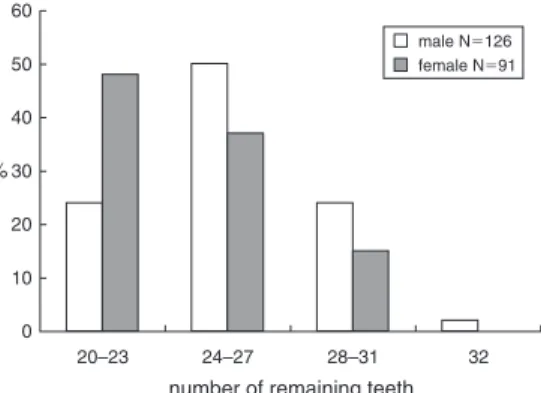
(4) 39. 8020 Achievers’ Oral and Health Condition. their height (m2). 3) Statistical analysis Student’s t -test was used to compare the mean values between the two groups. A p value of less than 0.05 was taken to be statistically significant.. Results The distribution of the number of remaining teeth in the 8020 achievers is shown in Fig. 1. Seventy-six point one percent of males and 51.6% of females in the 8020 achievers had 24 remaining teeth or more. The number of intact teeth in the 8020 elderly was 9.8. 60 male N⫽126 female N⫽91. 50 40. % 30 20 10 0 20–23. 24–27. 28–31. 32. number of remaining teeth. Fig. 1 Distribution of 8020 elderly according to total number of remaining teeth. in male and 9.9 in female. The number of treated teeth was 15.1 (males) and 14.3 (females), and the number of untreated teeth was 0.7 (males) and 0.5 (females). The percentages of the 8020 elderly with CPITN code 0, 1 and 2 were 67.4% for males, and 72.5% for females. Among them, 19.0% males and 13.2% females achieved code 0, as shown in Fig. 2. The percentages of the 8020 elderly with code 4 were 4.0% for males and 4.3% for females. In the 8020 non-achievers, the percentages with code 0, 1 and 2 were 61.1% for males and 52.0% for females, and the percentages with code 4 were 11.1% in males and 6.0% in females. The results of the 8020 achievers’ salivary blood tests are shown in Fig. 3. The percentages of positive values in the salivary blood test in the 8020 elderly were 16.7% in males and 16.5% in females. However, the percentages of positive values in the salivary blood test in the non-8020 elderly were 44.4% in males and 30.0% in females. The masticatory ability in the 8020 elderly was 1.55g in males and 1.53g in females. These values were higher than the values of the non-8020 elderly (1.44 g in males and 1.27g in females). The distribution of the average BMD in the 8020 elderly is shown in Fig. 4. BMD in the 8020 males was higher than that in the 8020 females, as shown in Tables 1 and 2. BMD in. 40. 90. male N⫽126 female N⫽91. 35. male N⫽126 female N⫽91. 80 70. 30. 60. 25. %. % 20. 50 40. 15. 30. 10. 20. 5. 10 0. 0 0. 1. 2. 3. 4. CPITN code. Fig. 2 Distribution of 8020 elderly according to CPITN code. ⫺. ⫹. ⫹⫹. Salivary blood test. Fig. 3 Distribution of 8020 elderly according to salivary blood test.
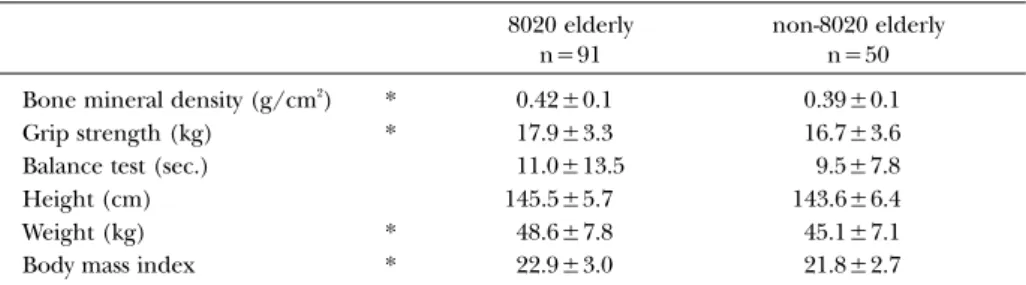
(5) 40. Hashimoto M et al.. the 8020 females was significantly higher than that in the non-8020 females, as shown in Table 2. However, BMD in the 8020 males was not significantly higher than that in the non8020 males, as shown in Table 1. Duration of balance in the 8020 males was. 50 45. male N⫽126 female N⫽91. 40 35 30. 30.7 sec, which was 2.2 times longer than that in the non-8020 males, as shown in Table 1. However, there was no significant difference in the duration of balance test between the 8020 and non-8020 females. Average grip strength in the 8020 elderly was 28.4 kg in male, 17.9 kg in female, which was significantly higher than that in the non8020 elderly, as shown in Tables 1 and 2. In addition, average weight and average BMI in the 8020 females were significantly higher than that in the non-8020 females.. % 25 20 15. Discussion. 10 5 0 0.20–0.29 0.30–0.39 0.40–0.49 0.50–0.59 0.60–0.69 0.70–0.79 0.80–0.89. BMD(g/cm2). Fig. 4 Distribution of 8020 elderly according to bone mineral density (BMD). At the beginning of this century, the Ministry of Health, Labour and Welfare launched a national health campaign known as “Healthy Japan 21”, in which targets for. Table 1 Mean value and standard deviation of physical condition in 8020 and non-8020 elderly (male). Bone mineral density (g/cm2) Grip strength (kg) Balance test (sec.) Height (cm) Weight (kg) Body mass index. ** **. 8020 elderly n⳱126. non-8020 elderly n⳱54. 0.62Ⳳ0.1 28.4Ⳳ4.3 30.7Ⳳ43.1 158.8Ⳳ5.3 55.9Ⳳ7.9 22.2Ⳳ2.9. 0.61Ⳳ0.1 24.9Ⳳ4.9 13.7Ⳳ16.0 158.2Ⳳ5.7 55.4Ⳳ8.1 21.1Ⳳ3.0. 1) Balance test shows length of time of standing on one leg with eyes open. 2) There were significant differences between 8020 elderly and non-8020 elderly by t -test. (**: p⬍0.01). Table 2 Mean value and standard deviation of physical condition in 8020 and non-8020 elderly (female) 8020 elderly n⳱91 Bone mineral density (g/cm2) Grip strength (kg) Balance test (sec.) Height (cm) Weight (kg) Body mass index. * *. * *. 0.42Ⳳ0.1 17.9Ⳳ3.3 11.0Ⳳ13.5 145.5Ⳳ5.7 48.6Ⳳ7.8 22.9Ⳳ3.0. non-8020 elderly n⳱50 0.39Ⳳ0.1 16.7Ⳳ3.6 9.5Ⳳ7.8 143.6Ⳳ6.4 45.1Ⳳ7.1 21.8Ⳳ2.7. 1) Balance test shows length of time of standing on one leg with eyes open. 2) There were significant differences between 8020 elderly and non-8020 elderly by t -test. (*: p⬍0.05).
(6) 8020 Achievers’ Oral and Health Condition. dental health were set for the year 2010, aimed at realizing a longer and healthier life for the people. One of the goals was that the percentage of the elderly aged 80 years with 20 or more teeth should be increased from 11.5% to 20% or higher. Recently, in a Japanese society composed largely of elderly people, the 8020 movement has been spreading all over the country in Japan. However, the average number of remaining teeth in 80 year-old-people is 8.2, and the percentage with 20 or more teeth is 15.3% according to a national survey4). In the epidemiological field, recently, many reports on the oral condition and health status of the elderly aged 80 years have been published to evaluate the meaning of the 8020 movement. According to the survey of 329 elderly honored by the Aichi Dental Association as 8020 achievers in 1992, there was a higher percentage of treated teeth and a lower percentage of untreated teeth. This was similar to the finding in this study that the number of untreated teeth of the 8020 elderly was very few: 0.7 in males and 0.5 in females, despite them having enough teeth. Besides decay, periodontal disease is one of the main causes of tooth loss, especially for the elderly19). Concerning masticatory ability, the 8020 elderly, especially females, demonstrated a high ability, which was similar to the ability of adults with 28 teeth in the report of Yano et al.26). Low masticatory ability was reported to have a significant correlation with low BMD 5), which leads to osteoporosis. Osteoporosis, especially in females, has become a major problem in the aging society. Osteoporosis is the second most common cause of bed-ridden conditions among the elderly, following the first instance of cerebral artery disturbances. In this study, BMD in 8020 females was significantly higher than that in non-8020 females. This finding would suggest there is a relationship between low BMD and number of lost teeth in the elderly 6,7,8,13,20,24). It was also reported that there was a relationship between number of retained teeth and age-adjusted Stiffness25). Stiffness indicates BMD by ultrasound method.. 41. Generally, grip strength is measured to determine muscle power. In this study, grip strength in the 8020 elderly was significantly higher than that in the non-8020 elderly. The grip strength in the 8020 elderly in this study was high compared to that in the healthy elderly who lived in Fukushima Prefecture18). It was also reported that good masticatory ability had a positive effect on grip strength5,23). It was suggested that length of time of standing on one leg was shorter for fallers than for non-fallers3). In this study, duration of balance in 8020 males was 2.2 times longer than that in non-8020 males. In another study18), duration of balance in 8020 males was 1.9 times longer than that in elderly persons with an average age of 80.3 years18). It was also reported that elderly persons with good masticatory ability showed longer duration in the balance test17,23). The Japan Obesity Association asserts that the BMI is the standard for judging obesity, and that a BMI of 22 is the average value, while a BMI of 26.4 was the actual value for obesity. In this study, BMI in the 8020 elderly was 22.2 in male, 22.9 in female, with only 5% of male and 13% of female 8020 elderly showing a BMI of 26.4 or more. In addition to the oral condition and health status data shown in this study, such as those on CPITN, masticatory ability, BMD, grip strength, balance test and BMI, there have also been several other reports on 8020 achievers or the elderly aged 80 years. Two reports showed that 8020 achievers were not fond of sweets around 20 or 40 years of age14,15). Other studies showed that 8020 achievers had relatively good occlusal and maxillofacial form12,13,16). It has also been found that a higher percentage of 8020 achievers were satisfied with life and felt healthy13). There is a close relationship between number of teeth and heart rate10). Masticatory ability is more important to QOL than number of retained teeth2). Maintaining masticatory ability is important in maintaining daily life activities and social participation9). Most 80 year-old elderly persons would recover their masticatory ability with the assistance of a.
(7) 42. Hashimoto M et al.. prosthesis22). A future goal is for the elderly aged 80 years to have 24 teeth or more21). Further investigation concerning oral condition and health status in the elderly is required in order to maintain a high quality of life in such people.. References 1) Ainamo J, Barmues D, Beagrie G, Cutress T, Martin J, Infirri JS (1983) Development of the World Health Organization community periodontal index of treatment needs. Int Dent J 32:281–291. 2) Andoh Y, Hanada N (1999) The relationship between oral condition and health status in the elderly. J Jpn Dent Assoc 52:20–29. (in Japanese) 3) Haga H, Shibata H, Shichita K, Matsuzaki T, Hatano S (1986) Fall in the institutionalized elderly in Japan. Arch Gerontol Geriatr 5:1–9. 4) Health Policy Bureau Ministry of Health and Welfare (2001) Report on the Survey of Dental Diseases (1999), Oral Health Association of Japan, Tokyo. (in Japanese) 5) Hirano H, Ishiyama N, Watanabe I, Suzuki T (1993) Oral examination of longitudinal interdisciplinary study on aging (II) Masticatory ability in relation to oral status and general health. Rounen Shigaku 7:150–155. (in Japanese) 6) Inagaki K, Ohshima Y, Suzuki H, Fujishiro H, Nagira T, Yoshinari N, Hashimoto M, Takigawa T, Ozawa A, Noguchi T (1996) Periodontal conditions in patients with osteoporosis. J Jpn Soc Periodontol 38:220–225. (in Japanese) 7) Kitafusa H, Motegi E, Nomura M, Miyazaki H, Yamaguchi T, Suzuki S, Yoshino A, Takeuchi F, Takane Y, Sasaki M, Harazaki M, Yamaguchi H, Hirai M, Sekiguchi M, Takane H (2003) Bone mineral density of persons achieving “8020” compared to care elderly people. J Jpn Acad Occlu Health 9:11–15. (in Japanese) 8) Klemetti E, Collin H-L, Forss H, Markkanen H, Lassila V (1994) Mineral status of skeleton and advanced periodontal disease. J Clin Periodontol 21:184–188. 9) Matsukubo T, Kimoto T, Hirai M, Matsubara M, Yoda T, Tanaka H (1997) Questionnairebased survey on oral condition and health status of people aged 80 years or more who live in Bunkyo ward of Tokyo. J Jpn Dent Assoc 50: 4–11. (in Japanese). 10) Matsumura K, Ansai T, Awano S, Takehara T, Abe I, Iida M, Takata Y (2003) Association of dental status with blood pressure and heart rate in 80-year-old Japanese subjects. Jpn Heart J 44:943–951. (in Japanese) 11) Miyatake K (1992) 8020 movement. J Jpn Dent Assoc 45:15–24. (in Japanese) 12) Miyazaki H, Motegi E, Saito C, Harazaki M, Isshiki Y, Suzuki N, Sekiguchi M, Yuasa T (2001) A study of model and cephalograms in elderly persons over 80 years old with at least 20 teeth. Orthod Wavws 60:118–125. (in Japanese) 13) Miyazaki H, Motegi E, Saito C, Harazaki M, Suzuki N, Yatabe K, Yamaguchi H (2004) Report of dental diseases, quality of life, oral health and general health of elderly persons over 80 years old with at least 20 teeth. Shikwa Gakuho 104:140–145. (in Japanese) 14) Mizuno T, Nakagaki H, Murakami T, Kato K, Tsuboi S, Takigawa T, Ozawa A, Kumeno C, Ohno Y (1993) Lifestyles related to preserving 20 or more teeth at 80 years of age. Jpn J Public Health 40:189–195. (in Japanese) 15) Mizuno T, Nakagaki H, Murakami T, Kato K, Tsuboi S, Kato S, Inoue C, Takeuchi K, Saida A, Inoue K, Mizutani Y, Ozawa A, Takigawa T, Kumeno C (1994) Dental health surveys at 80 years old in Tokoname city. J Dent Health 44:161–169. (in Japanese) 16) Motegi E, Miyazaki H, Isshiki Y (1999) Observation of teeth arrangement and occlusion in 8020 achievers. J Jpn Dent Assoc 52:15–25. (in Japanese) 17) Nagai H, Shibata H, Haga H, Ueno M, Suyama Y, Yasumura S, Matsuzaki T, Sakihara S, Taira K (1990) Chewing ability in relation to physical health status. Jpn J Geriat 27:63–68. (in Japanese) 18) Shimada H, Uchiyama Y, Kakurai S (2002) Relationship between lifestyle activities and physical functions in elderly persons utilizing care facilities. Jpn J Geriat 39:197–203. (in Japanese) 19) Shimazaki Y, Soh I, Koga T, Miyazaki H, Takehara T (2003) Risk factors for tooth loss in the institutionalized elderly; a six year cohort study. Community Dent Health 20: 123–127. 20) Taguchi A, Fujiwara S, Masunari N, Suzuki G (2004) Self reported number of remaining teeth is associated with bone mineral density of the femoral neck, but not of the spine, in Japanese men and women. Osteoporos Int 15:842–846. 21) Takeuchi F, Miyazaki H, Nomura M, Motegi E, Harazaki M, Yatabe K, Yamaguchi H, Hirai M, Sato K (2005) Report on occlusal conditions.
(8) 8020 Achievers’ Oral and Health Condition. 22). 23). 24) 25). and occlusal force measured with a pressure sensitive film in elderly persons over 80 years old with a least 20 teeth. Shikwa Gakuho 105: 154–162. (in Japanese) Tatematsu M, Mori T, Kawaguchi T, Takeuchi K, Hattori M, Morita I, Nakagaki H, Murakami T, Tuboi S, Hayashizaki J, Murakami H, Yamamoto M, Ito Y (2004) Masticatory performance in 80-year-old individuals. Gerodontology 21: 112–119. (in Japanese) Teraoka K, Nagai H, Shibata H, Okada S, Takeuchi T (1992) Effect of eating ability on physical activities in the elderly. J Dent Health 42:2–6. (in Japanese) von Wowern N, Klausen B, Kollerup G (1994) Osteoporosis. A risk factor in periodontal disease. J Periodontol 65:1134–1138. Yamanaka K, Fujiwara N, Wakabayashi Y, Kimura T (1996) Ultrasonic calcaneal density measurements and oral examinations in subacute myelo-optico neuropathy (SMON). 43. patients. (continued report). Annual Report of SMON Research Committee in 1996 pp. 136–140. (in Japanese) 26) Yano M, Ando Y, Kobayashi H, Watanabe Y, Kobayashi S, Horii K, Ishigami K, Nagase Y, Sasaki K (1989) Epidemiological survey on adult dental health (II) masticatory ability. Niigata Dent J 19:25–38. (in Japanese) 27) Yasui T, Tanaka S, Onozawa H, Matsumoto M, Tanaka S, Nakao S (1991) Massscreening of periodontal diseases using new test paper for detecting salivary occult blood. Nippon Shika Hyouron 587:189–197. (in Japanese) Reprint requests to: Dr. Masanori Hashimoto Aichi Dental Association, 3-5-18 Marunouchi, Naka-ku, Nagoya 460-0002, Japan Fax:81-52-951-5108.
(9)
図
関連したドキュメント
The data presented here suggest that SEMA3A has a tumor suppressor function in OPC because our Kaplan–Meier survival analysis showed that low SEMA3A expression significantly
In this paper, Part 2 , presents current status of children's Satoumi activity cases in Japan and compares them with those of the South Pacific on knowledge of marine
熱力学計算によれば、この地下水中において安定なのは FeSe 2 (cr)で、Se 濃度はこの固相の 溶解度である 10 -9 ~10 -8 mol dm
The mGoI framework provides token machine semantics of effectful computations, namely computations with algebraic effects, in which effectful λ-terms are translated to transducers..
An example of a database state in the lextensive category of finite sets, for the EA sketch of our school data specification is provided by any database which models the
A NOTE ON SUMS OF POWERS WHICH HAVE A FIXED NUMBER OF PRIME FACTORS.. RAFAEL JAKIMCZUK D EPARTMENT OF
Our analyses reveal that the estimated cumulative risk of HD symptom onset obtained from the combined data is slightly lower than the risk estimated from the proband data
A lemma of considerable generality is proved from which one can obtain inequali- ties of Popoviciu’s type involving norms in a Banach space and Gram determinants.. Key words
