JAIST Repository
https://dspace.jaist.ac.jp/
Title
スマートホームにおける人間中心のサイバーフィジカ ルシステムのためのパーソナル熱的快適性モデルの研 究
Author(s) 房, 媛
Citation
Issue Date 2020‑06
Type Thesis or Dissertation Text version ETD
URL http://hdl.handle.net/10119/16723 Rights
Description Supervisor:リム 勇仁, 先端科学技術研究科, 博士
Doctoral Dissertation
Personal Thermal Comfort Model for Cyber-Physical Human Centric Framework
in Smart Homes
Yuan FANG
Supervisor: Associate Professor Yuto LIM
Graduate School of Advanced Science and Technology Japan Advanced Institute of Science and Technology
[Information Science]
June, 2020
Abstract
The current human society faces many problems, such as greenhouse gas (GHG) emissions, depletion of resources, and aging of the population. Future human centric society is that balances economic advancement with the resolution of social problems, and that is a system that highly integrates cyberspace and physical space using new technologies, such as the Internet of Things (IoT), Cyber-Physical Systems (CPS), and Artificial Intelligence (AI). In another view, the human centric society (HCS) understood as a smart and skilled operator who performs not only cooperative work with robots but also work aided by machines as and if needed by means of human CPS, advanced human-machine interaction technologies and adaptive automation towards achieving human-automation symbiosis work systems. To realize our future society, it is also essential to look at the mimic of a future society in the field of smart homes, which is the best practice for the viewpoint of system implementation of the CPS approach with human centric module.
The most central place of life and work scenes of HCS is the home environment that provides a safe living environment and comfort for the residents to meet people’s physi- cal and psychological needs. Smart Homes use the computation technology, the sensing technology, and the control technology to provide comfort and energy saving. The Cyber- Physical Home System (CPHS) comprises a smart system for a variety of services and applications in the home environment to provide home automation control, especially for the aims of comfortability and energy savings. Thermal comfort is an assessment of one’s satisfaction with the environment surroundings. Personal satisfaction of thermal comfort is affected by many factors belongs the human centric domain.
CPS is the core technology to implement the HCS system. There is deep interaction between the cyber world and the physical world. CPHS is one of the most valuable domains for CPS applications. For future HCS system, the human has deep interaction of the cyber world and the physical world. However, several significant problems need to be solved in the CPS-based human centric system, the first is the computation problem, which is current CPS system does not consider the human centric, which leads to the event-
driven task, the usage of time-delay model in the CPS system cannot meet the human demands and needs. The second problem is human centric model is generalized by a group of people, in which the control methods that use this model still cannot achieve the best target set for an individual. The third problem is that the CPHS is successfully verified and implemented, but this system cannot meet the thermal comfort of user preference.
Personal thermal comfort should be pointed out to address this problem.
The purpose of this dissertation is to propose a Cyber-Physical Human Centric frame- work and to implement its Cyber-Physical Human Centric system with the personal ther- mal comfort model in smart homes domain. To accomplish this purpose, three research objectives in this dissertation are proposed.
First, this dissertation is to propose a Cyber-Physical Human Centric (CPHC) frame- work by focusing on the deep interaction between the human centric and CPS application, the human centric control, and the implementation of human centric CPS system applica- tion. The current CPS model is designed fundamentally for the system of systems, and it does not consider the human factor. Aiming the CPS computation problem, which leads to the consideration of the event-driven task, the usage of the time-delay model in the CPS system cannot meet the mixed requirement of time-driven and event-driven tasks schedul- ing. To mitigate this problem, I propose a new time task model with two algorithms, i.e., a mixed time cost and deadline first (MTCDF) algorithm, and a human-centric MTCDF algorithm into the Cyber-Physical Human Centric (CPHC) Framework.
Second, the control module is one of the essential modules in the CPS system to ensure the entire system operates according to the achievable target set. Most of the CPS system is designed to meet a single target value or multiple target values of the system. Although many control methods, e.g., conventional PID and MPC, are proposed not only to minimize the processing time of the controller to achieve the target set but also to ensure the high accuracy of the controller. However, those control methods do not consider the human centric module due to the difficulties of modeling human factors.
As mentioned in the previous research works, the human factor model is generalized by a group of people, in which the control methods that use this model still cannot achieve the best target set. In this dissertation, a generalized thermal comfort model is focused first. Based on the collected data, a personal thermal comfort (PTC) model
is derived. Since the PTC is a comprehensive evaluation influenced by complex factors and random variables, it is difficult to apply the results in the real environment of the smart homes. With the development of IoT technology, a wearable device becomes our daily objects and also have the advantage of connected to the service platforms. This means that the measured data can be personalized. In this dissertation, a well-known wearable device is used to measure human heart rate, then the heart rate, heat sensation, environmental parameters, and so on as inputs into the artificial neural network (ANN) model for predicting the PTC model. In this dissertation, the PTC model is proposed and extend the existing energy efficient thermal comfort control (EETCC) system to achieve a better thermal comfort sensation while saving more energy. Through these, the differences between system computation and human needs are determined, then provide necessary for improving the personal thermal comfort control system. Besides that, the physiology parameter from the heart rate is well-studied, and its correlation with the environmental factors, i.e., PMV, airspeed, temperature, and humidity, are deeply investigated to reveal the human thermal comfort level of the existing system in the smart home environment.
Third, although the EETCC system is successfully verified and implemented in the iHouse environment, the thermal comfort of a resident does not be considered by the EETCC system. Notably, the personalization character of the PTC model with an arti- ficial neural network (ANN), long short-term memory (LSTM) deep learning technique, which is not considered either. In this dissertation, the challenges of the EETCC/PTC are focused on achieving both high accuracy and high energy efficiency. In this way, the CPHC framework can be verified for its implementation with a human centric module.
And this dissertation the improving the personal thermal sensation and reducing energy consumption through the experiments with CPHC system Implementation of smart home in the winter season.
Keywords: human centric society, cyber-physical system, smart homes, time task model, cyber-physical human centric framework, personal thermal comfort, energy effi- cient and thermal comfort control, heart rate predication, artificial neural networks
Acknowledgments
First of all, the author takes this opportunity to express the most sincere gratitude to her family, who gives her great love and fully understanding through all these years, which is her strongest motivation to continue her studies and pursue her life goals. For her husband, Dr.Wang Weizhen, and her daughter FANG Qiuchen, they give the author deep love and understanding. The author always says thank you for their lived city for more than three years, Nomi city, their people give them lots of help.
The author wishes to express her sincere gratitude to her principal supervisor As- sociate Professor Yuto LIM, and Professor Yasuo TAN of Japan Advanced Institute of Science and Technology for their constant encouragement, inspiring instruction, and patient guidance throughout this research endeavor. Also thanks to Yoshi MAKINO and all of the staff in StarBED, who give her useful knowledge that help her to finish her emulation experiments at StarBED.
The author also would like to thank Professor Keiichi YASUMOTO of Nara Ad- vanced Institute of Science and Technology, and his Ubiquitous Computer Lab gives her insightful comments on her minor research.
The author also would like to express her gratitude to the members of the examination committee of his doctoral dissertation, Professor Nianyu ZOU of Dalian Polytechnic University and Associate Professor Daisuke ISHII, for their valuable comments and suggestions to improve the quality of this dissertation.
Last but not least, the author wishes to appreciate all members of “Tan and Lim Lab” for their help and cooperation, “Dalian Polytechnic University” for the working sup- port, the “Computer Science Teaching and Research Section”, and “School of Information Science and Engineering” for their kind support and collaboration.
Contents
Abstract i
Acknowledgments iv
List of Figures xi
List of Tables xii
List of Abbreviations xiii
List of Symbols xv
1 Introduction 1
1.1 Research Background . . . 3
1.1.1 Smart Homes and its Implementations . . . 3
1.1.2 Cyber-Physical Systems and its Applications . . . 5
1.1.3 Human Centric Systems . . . 7
1.2 Problem Statement and Motivation . . . 11
1.2.1 Computation Problem . . . 13
1.2.2 Control Problem . . . 13
1.2.3 Implementation Problem . . . 14
1.3 Purpose and Objectives . . . 14
1.4 Structure of Dissertation . . . 15
2 Cyber-Physical Human Centric Framework 18 2.1 Introduction . . . 18
2.2 Related Works . . . 18
2.2.1 The Hierarchical Human Need . . . 18
2.2.2 Cyber-Physical Social System . . . 19
2.2.3 Human-in-the-loop CPS . . . 19
2.2.4 Human Thermal Comfort . . . 20
2.2.5 Problem and Motivation . . . 21
2.3 Cyber-Physical Human Centric Framework . . . 22
2.3.1 Concept of Human Centric CPS . . . 22
2.3.2 Architecture of Cyber-Physical Human Centric Framework . . . 22
2.3.3 Contents of Cyber-Physical Human Centric Framework . . . 24
2.3.4 Time Delay Model to Time Task Model of Computation Module . . 27
2.3.5 Personal Thermal Comfort of Control Module . . . 27
2.4 Summary . . . 28
3 Time Task Model for Computation Module 29 3.1 Introduction . . . 29
3.1.1 Modeling of CPS . . . 29
3.1.2 Time Delay Model . . . 31
3.1.3 Time Task Model . . . 32
3.2 Time Task Model of CPHC Framework . . . 33
3.2.1 Scheduling Procedure . . . 35
3.2.2 Mixed Time Cost and Deadline-First (MTCDF) Algorithm . . . 37
3.3 Human Centric Scheduling Based Time Task Model . . . 38
3.3.1 Scheduling Procedure . . . 39
3.3.2 Human Centric MTCDF Algorithm . . . 40
3.4 Simulation and Results . . . 41
3.4.1 MTCDF . . . 41
3.4.2 Human Centric MTCDF . . . 44
3.5 Summary . . . 45
4 Personal Thermal Comfort Model for Control Module 47 4.1 Introduction . . . 47
4.2 Background and Motivation . . . 48
4.2.1 Thermal Comfort . . . 48
4.2.2 Energy Efficient and Thermal Comfort Control . . . 54
4.2.3 Personal Thermal Comfort Model . . . 56
4.2.4 Motivation . . . 58
4.3 Case Study 1: Experiment and Modeling of Personal Thermal Comfort Model . . . 59
4.3.1 Content and Participants . . . 59
4.3.2 Experimental Environment, iHouse . . . 60
4.3.3 Subjective Comfort Level . . . 62
4.3.4 Experimental Procedure . . . 63
4.3.5 Results and Discussion . . . 64
4.4 Case Study 2: Simulation Verification of Personal Thermal Comfort Model 76 4.4.1 Artificial Neural Networks . . . 76
4.4.2 Methodology . . . 79
4.4.3 Result . . . 81
4.5 Summary . . . 83
5 Implementation of Cyber-Physical Human Centric System for Smart Homes 87 5.1 Introduction . . . 87
5.2 Background . . . 88
5.2.1 Artificial Neural Networks for PTC . . . 88
5.2.2 EETCC/PTC Control Algorithm . . . 89
5.3 Design and Modelling of CPHCF-based PTC Model . . . 90
5.3.1 Implementation Model . . . 90
5.3.2 EETCC/PTC Control . . . 92
5.4 Heart Rate Prediction and Analysis . . . 92
5.4.1 Related Works . . . 93
5.4.2 Methodology . . . 95
5.4.3 Result . . . 97
5.5 Personal Thermal Comfort Prediction and Analysis . . . 100
5.5.1 Human Subjects . . . 100
5.5.2 Environment and Main Sensors . . . 100
5.5.3 Procedure . . . 101
5.5.4 Results and Analysis . . . 102
5.6 Discussions . . . 107
5.6.1 Prediction Performance of Personal Thermal Comfort Model . . . . 107
5.6.2 Heart Rate and Personal Thermal Comfort . . . 108
5.7 Summary . . . 109
6 Conclusion and Future Work 110 6.1 Conclusion . . . 110
6.2 Directions and Future Works . . . 113
Bibliography 124
Publications 125
List of Figures
1-1 What is Cyber-Physical Systems by JEITA.1 . . . 7
1-2 Proposed conceptual framework for Cyber-Physical Human Centric System. 17 2-1 Maslow’s hierarchy of needs to Cyber-Physical Human Centric System. . . 19
2-2 Concept of human centric CPS. . . 22
2-3 The architecture of CPHCS based on the DIKWS. . . 24
2-4 The CPHC framework. . . 25
3-1 General time model for CPS. . . 32
3-2 Example of time delay model. . . 32
3-3 Example of time task model. . . 33
3-4 CPHC framework. . . 34
3-5 Example of scheduling results. . . 35
3-6 Example of schematic diagram. . . 36
3-7 Example of adjacency matrix. . . 37
3-8 Compare different scheduling algorithms with N=5. . . 40
3-9 Successful ratio with N = 5 based on the MTCDF. . . 42
3-10 Successful ratio with N = 10 based on the MTCDF. . . 43
3-11 Successful ratio with N = 100 based on the MTCDF. . . 43
3-12 Optimal scheduling index Γ withN = 5 of MTCDF. . . 43
3-13 Optimal scheduling index Γ withN = 10 of MTCDF. . . 44
3-14 Optimal scheduling index Γ withN = 100 of MTCDF. . . 44
3-15 Average success ratio with MDTH. . . 45
4-1 PPD against PMV. . . 53
4-2 Flowchart of EETCC algorithm. . . 55
4-3 Content of the Personal Thermal Comfort model. . . 57
4-4 Personal Thermal Comfort model. . . 58
4-5 iHouse exterior and architectural plan. . . 61
4-6 Badroom 1 of iHouse. . . 61
4-7 Summary of SCL in Google form application. . . 63
4-8 Distribution of heart rate. . . 65
4-9 The relationship between heart rate and SCL. . . 66
4-10 Average Pearson Correlation rbetween the environmental parameters and heart rate. . . 68
4-11 Personal thermal comfort individual differences. . . 69
4-12 PMV represents air speed against operative temperature without EETCC. 70 4-14 Subjective Comfort Level (SCL) represents air speed against operative tem- perature. . . 71
4-13 PMV represents air speed against operative temperature with EETCC. . . 72
4-15 Thermal sensation and thermal comfort at different indoor air temperatures. 74 4-16 Control state, PMV, and SCL. . . 75
4-17 Structure diagram of neural network with two hidden layers for PTC model. 77 4-18 BP neural network implementation process. . . 79
4-19 Confusion matrix of subjective comfort level. . . 83
4-20 PTC prediction pP M V box plot. . . 84
4-21 Compare the percentage of PMV in Category B. . . 84
4-22 Simulation pP M V in 24 Hours. . . 85
4-23 Energy consumption. . . 86
5-1 The processing of ANN for EETCC/PTC. . . 89
5-2 Cyber-Physical Human Centric System implementation architecture. . . . 91
5-3 The EETCC implementation model architecture. . . 91
5-4 The EETCC/PTC implementation model architecture. . . 91
5-5 Effects of parasympathetic and sympathetic stimulation on normal sinus rhythm. . . 95
5-6 Statistical heart rate data. . . 96
5-7 Accuracy with epoch 10 times. . . 98
5-8 Compare classification to predict heart rate and measure heart rate. . . 98
5-9 Heart rate predation in one hour . . . 99
5-10 Heart rate predation in 10 minutes. . . 99
5-11 The step of procedure. . . 101
5-12 PMV represents airspeed against operative temperature with EETCC and EETCC/PTC. . . 103
5-13 Subjective Comfort Level of the EETCC model and the EETCC/PTC model.104 5-14 Thermal sensation and thermal comfort. . . 105
5-15 Control state and PMV changes. . . 106
5-16 Comparison between multiple controller energy consumption for winter. . . 107
5-17 Performance of the EETCC/PTC model. . . 108
5-18 The best regression plots of the pP M V based EETCC/PTC. . . 108
List of Tables
2.1 The average human’s comfort degree on the 7-point ASHRAE scale . . . . 21
2.2 Human factor level of CPHCS . . . 27
3.1 Time task parameters . . . 36
3.2 The scheduling result of example . . . 36
3.3 Simulation example of time task parameters . . . 39
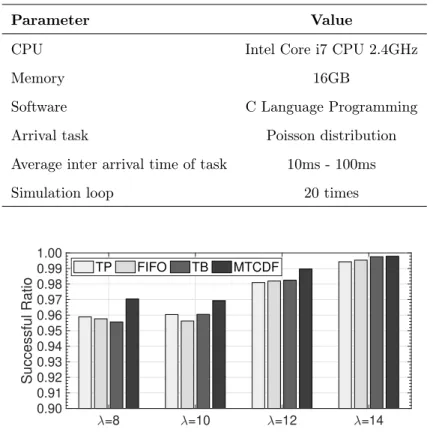
3.4 Simulation parameters and settings for MTCDF. . . 42
3.5 Simulation parameters and settings for MDTH. . . 45
4.1 The average human’s comfort degree on the 7-point ASHRAE scale . . . . 54
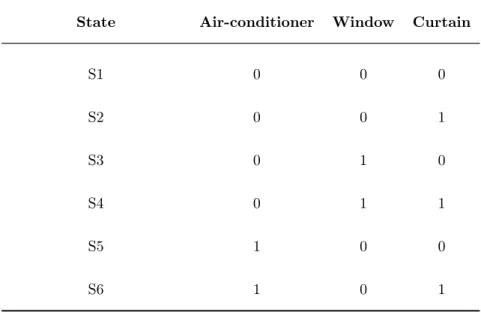
4.2 States of the actuators . . . 56
4.3 Brief information of participants . . . 60
4.4 Brief information on main sensors and wearable device . . . 62
4.5 Subjective comfort data record structure example . . . 62
4.6 Experiment sets . . . 64
4.7 Simulation parameters and settings. . . 82
4.8 A brief information of PTC predication model simulation setting . . . 82
5.1 A brief information of EETCC/PTC predication model training . . . 92
5.2 Participants information . . . 97
5.3 Brief information of participants . . . 100
5.4 Brief step of experiment . . . 101
5.5 Experiment data sets . . . 102
List of Abbreviations
ANN Artificial Neural Networks
CPHCS Cyber-Physical Human Centric Systems CPHS Cyber-Physical Home System
CPS Cyber-Physical Systems
CPSS Cyber-Physical Social System
DE Discrete-Event
ECG Electrocardiogram
EDF Earliest Deadline First
EETCC Energy Efficient and Thermal Comfort Control
HCS human centric society
HF High Frequency
HRV Heart Rate Variability
HVAC Heating, Ventilation, and Air Conditioning ICT Information and Communications Technology
IoT Internet of Things
LF Low Frequency
MDTH Mixed deadline first, time cost and human centric MPC Model Predictive Control
MTCDF Mixed time cost and deadline first PID Proportional Integral Derivative
PMV Predicted Mean Vote
PPD Predicted Percentage of Dissatisfied
PTC Personal Thermal Comfort
PTIDES Programming Temporally Integrated Distributed Embedded Systems
RM Rate Monotonic
RTS Real-time System
SCL Subjective Comfort Level
SoS System of Systems
TDM Time Delay Model
TTM Time Task Model
List of Symbols
Chapter 3
Tphysical a set of physical time
Ta arrival time
Td deadline time
Tlogical a set of logical time
Te execute time
Tmodel a set of model time
Tdelay time delay
Ts start time
Tf finished time
Tw waiting time
P rio event priority
Human human centric value created by framework calculate pi a dependency relation (edge)
Ti,j the j time task ofi platform Si,j the state of the elements
Vi,j value of the time task Ti,j with state Si,j
Γ the optimal scheduling index Chapter 4
P M V Predicted Mean Vote index
P P D Predicted Percentage Dissatisfaction
M metabolic rate
W effective mechanical power
Pa water vapor partial pressure
Tr room air temperature
fcl clothing surface area factor tcl clothing surface temperature T¯r mean radiant temperature
hc convective heat transfer coefficient Rclo clothing surface radiative energy Cclo clothing surface convection energy Iclo clothing insulation
vr relative air velocity
Ti surface temperature of wall i Chapter 5
HRm denote the measured heart rate HRrest the heart rate at rest
AGE the user’s age
Eaircond energy consumption of HVAC
COP the coefficient of performance
tstart the start time of the implementation
tend the end time of the implementation
Qaricond heat gain due to air conditioner
Chapter 1 Introduction
In society up to now, we have to face many challenges that endanger the survival of humankind such as global environmental problems, growing economic disparity, and the depletion of resources. Many countries facing critical social problems, such as the declining birthrate and aging population, labor shortage, rural depopulation, and increased fiscal spending. The human centric society with Cyber-Physical Systems, Internet of Things, and Artificial Intelligence as the core technology community is considered to be the most effective way to solve these problems.
Future society is a human centric society. In [1] , Thoma, et al. have proposed that the new Human Centric Intelligent Society, which results from these social problems will connect information from many different sources across the physical and virtual worlds, using a human centric information and communication technology (ICT) system to con- nect both physical and virtual worlds. Besides that, Srivastava, et al. [2] have surveyed the important opportunities in human centric sensing that identifies those said social prob- lems and describes the emerging solutions to these social problems. Meanwhile, Bryson and Theodorou in [3] have reviewed the necessity and tractability of maintaining human control and its related mechanisms by which such human control can be achievable. They also claimed that what makes the human control problem both most interesting and most threatening are that achieving consensus around any human-centered approach requires at least some measure of agreement on broad existential concerns.
On the other hand, Chujo, et al. [4] have proposed a Human Centric Engine sys- tem that is dedicated for mobile phone by aiming for the development of ubiquitous
computation. In the future society, Romero, et al. [5] conclude the need of the human centric society by presenting early concepts and future projections of the so-called Oper- ator 4.0, understood as a smart and skilled operator who performs not only cooperative work with robots but also work aided by machines as and if needed by means of hu- man Cyber-Physical Systems (CPS), advanced human-machine interaction technologies and adaptive automation towards achieving human-automation symbiosis work systems.
Through these discussions, I could conclude that the elements of CPS and human centric society are essential to build our future society.
To realize our future society, it is also important to look at the mimic of a future society in the field of smart homes, which is the best practice for the viewpoint of system implementation of the CPS approach with human centric module. In smart homes, a home is the most crucial place that provides a safe living environment and comfort for the residents to meet people’s physical and psychological needs. It is also a place not only where people gather with families and friends, but also people can relax, do any activities, obtain entertainment and enjoyment, and go to sleep. Besides that, smart homes that represent a branch of ubiquitous computing involves incorporating smartness into houses for comfort, healthcare, safety, security, and energy conservation. Edward Lee [6] has introduced the concept of CPS, Yuto, et al. [7] have extended this concept to the Cyber-Physical Home System (CPHS), which comprises a smart system for a variety of services and applications in the smart home environment to provide home automation control, especially not only for the aim of comfortability, but also energy savings. Today, many active researches on CPHS have led to a plethora of smart home system solutions for various application domains that influence our daily life and the way we live. One example of CPHS applications is the thermal comfort with energy saving service, in particular the Energy Efficient Thermal Comfort Control (EETCC) system [7], which operates and controls the home appliances, devices, sensors, and actuators in a timely manner assists residents to live on their own comfortable, convenient, relax, restful, and pleasant. Since smart homes provide ambient environmental conditions for the residents to live, this also means that the residents are the most important factor for the implementation of human-like system implementation. In other words, the residents have a strong interaction with all the smart home systems and their surrounding environments.
Unlike the previous works on smart homes and human interaction, Ooi, et al. [8] have presented an adaptive Model Predictive Control (MPC) based controller that is integrated into the existing EETCC system for the CPHS environment. One of the significant this work is that the adaptive MPC based controller can monitor the temperature in a real- time manner by using the sensed raw environmental data from the experimental house, iHouse. Meanwhile, Chen, et al. [9] have proposed a human-centric smart home energy management system that integrates ubiquitous sensing data from the physical and cyber spaces to discover the patterns of power usage and cognitively understand the behaviors of human beings. The relationship between physical and cyber spaces is established to infer residents demands for electricity dynamically, and then the optimal scheduling of the home energy system is triggered to respond to both the residents requirements and electricity rates.
In summary, the intensive study and implementation of human centric system for smart home environment are still limited nowadays.
1.1 Research Background
1.1.1 Smart Homes and its Implementations
In 1984, smart home is firstly used by the American Association of House Builders (now National Association of House Builders). Smart homes [10] is a home-like environment that possesses ambient intelligence and automatic control, in which it responds to the behavior of residents with various facilities. Alam, et al. [11] have proposed the smart homes provide comfort, health care, and security services to their inhabitants. Comfort and health care services can be provided locally as well as remotely. Smart Homes are home environments that incorporate ambient intelligence and automatic control that re- acts to the behavior of its residents with various home appliances and devices. Smart Homes are one of the CPS application domains. The smart home is one of the key tech- nologies to solve the problem of an aging society. In the future, a smart home will integrate into daily life with dedicated artificial intelligence, computational power, communication skills, monitoring, and controlling abilities needed to improve everyday activities. The interaction between people and home appliances will be devoted to improving comfort,
healthcare, safety, security, and energy savings [12, 13]. There are numerous researchers focus on a smart home in different domains. Chan, et al. [14] have reviewed a selection of projects in developed countries on smart homes examining the various technologies available. Future perspectives on smart homes as part of a home-based health care net- work are presented facing an aging world, maintaining good health and independence for as long as possible is essential. In [15], old aging people application is proposed in smart home. In [16], smart home is an application of ubiquitous computing in which the home environment is monitored by ambient intelligence to provide context-aware services and facilitate remote home control. In [17], the concept of the smart home investigates technologies for smart homes, in which advanced technological systems that allow the automation of domestic tasks are developing rapidly. In [18], the authors have proposed a holistic framework that incorporates different components from Internet of Things (IoT) architectures introduced, to integrate smart home objects efficiently in a cloud-centric IoT based solution to contribute towards narrowing the gap between the existing state- of-the-art smart home applications and the prospect of their integration into IoT enabled the environment. In [19], data transmissions within the smart home system are secured by asymmetric encryption schemes with secret keys being generated by chaotic systems.
In the smart home thermal comfort area, Zhu, et al. [20] have proposed a novel hybrid intelligent control system to manage space heating devices in a smart home with advanced technologies to save energy while to increase the thermal comfort level. Lim and Tan [21]
have compared to the conventional temperature control system, a thermal comfort control (TCC) system can provide better human comfort. Due to system complexity, the TCC system is usually designed as a hybrid system. To ensure the design of a highly energy efficient thermal comfort control, the authors address the time delay modeling issues.
There is the current implementation of the smart home environments, one is Aware Home project [22], built-in 1999 from Georgia Tech. It is a living laboratory for research in ubiquitous computing for everyday activities. Another one is the experiment environ- ment, iHouse that is used in this dissertation is located at Nomi City, Ishikawa Prefecture, Japan. iHouse stands for Ishikawa, internetted, inspiring, and intelligent house, which is an advanced experimental environment for future smart homes in Japan, and it has been implemented according to Standard House Design by Architectural Institute of Japan. It
is a conventional two-floor Japanese style house featuring more than 300 sensors, home appliances, and electronic house devices that are connected using ECHONET Lite ver- sion 1.1 and ECHONET version 3.6.2. An ECHONET Lite system incorporates groups of devices with the same management of properties, security, and so on. Therefore, the largest area that ECHONET Lite can manage is referred to as a domain. A domain will be specified as the range of controlled resources (home equipment, appliances and consumer electronics, sensors, controllers, remote controls, etc.) present within the net- work range determined by ECHONET Lite. A system is defined as that which performs communication and linked operations between devices and the controllers that monitor/- control/operate them and between devices themselves. A system lies within one domain and does not extend over a number of domains. A domain includes one or more systems.
Thus, the same device or controller can exist in more than one system. When connecting a system to another system lying outside the domain, an ECHONET Lite gateway is used as an interface. Through this ECHONET, iHouse can be developed for the research of smart home environment monitoring, energy savings, human thermal comfort, and so on.
1.1.2 Cyber-Physical Systems and its Applications
Cyber-Physical Systems (CPS) are defined as tight integration of computation, com- mu- nication, and control with deep interaction between physical and cyber elements in which embedded devices, such as different sensors and actuators, are wireless or wired networked to sense, monitor and control the physical world [23, 24]. Jifeng [25] has interpreted the CPS as controllable, credible, and scalable networked physical equipment systems, which is in-depth integration of computation, communications, and control ability based on en- vironmental perception. CPS enables the cyber world to interact with the physical world to monitor and control the intended parameter on a real-time basis. The systems of CPS represent the intersection of several system trends, such as real-time embedded systems, distributed systems, control systems, and networked wireless systems. Liu, et al. [26]
have reviewed the most critical part is the physical system and the core part is the cyber system. In recent years, CPS has enlivened many fields of manufacturing, automotive systems, military systems, smart homes, smart transportation systems, power generation and distribution, energy conservation, heat ventilation air-conditioning (HVAC) system,
aircraft, and smart city. In a typical CPS application, sensor nodes collect information from the physical world as a source of CPS input. Upon receiving the input information, a controller makes a corresponding decision by computing, and actuators perform a relevant action in the physical world through the closed-loop feedback. The significance of CPS is to connect physical devices to the Internet, so that physical devices have five major functions such as computing, communication, precise control, remote coordination, and autonomy. CPS is essentially a network with control properties, but it is different from existing control systems. CPS puts communication on the same footing as computing and control, because the coordination between physical devices in distributed application systems emphasized by CPS is inseparable from communication. CPS’s remote coordina- tion ability, autonomy ability, and the type and number of control objects for the internal equipment of the network, especially the network scale far exceeds the existing industrial control network. The National Science Foundation (NSF) believes that CPS will connect the entire world. Just as the Internet has changed human interaction, CPS will change our interaction with the physical world. CPS is the system of systems where its physical and computational resources are strictly interlinked together. In some home domains, Cyber-Physical Home System (CPHS) offers residents to live more comfortably, conve- niently, cost effectively, and more securely using the CPS approach. A typical CPHS, where it is comprised of the cyber world, physical world, and the communication network in between them. The control domain, which includes data logging and supervisor con- troller is part of the cyber world while the sensor domain and actuator domain are part of the physical world. Both cyber and physical worlds can be linked together by networks and communication protocols that are not limited to wired networks but also wireless networks. One example of CPHS systems is the implementation of Energy Effcient and Thermal Comfort Control (EETCC) system [7], in which the home appliances, devices, sensors, and actuators are synergized in a timely manner to assist people to live on their own comfortable, convenient, relax, restful, and pleasant. In the viewpoint of Japan, JEITA (Japan Electronics and Information Technology Industries Association) defines CPS is a wide range of data is collected from the physical world via sensor networks, analyzed and transformed into knowledge in cyberspace using big data processing tech- nologies and other tools to create information and value that will energize the industry
and solve social problems. As shown in Figure 1-1. In housework support smart houses area. Multiple menu suggestions provided based on refrigerator contents, coordination with microwave for automatic adjustment of cooking time, etc. In addition to cleaning robots, laundry robots divide clothing up, automating laundry detergent input and menu selection. Household robots help with child-raising, look after pets and water the plants.
Combining solar power, batteries and electric cars, etc., not only save energy in daily life but also secure power in times of emergency.
CPS makes vibrant lives and industries.
A wide range of data is collected from the physical world via sensor networks, analyzed and transformed into knowledge in cyberspace using big data processing technologies and other tools to create information and value that will energize industry and solve social problems.
Health
Infectious disease prevention and treatment
Agriculture and forestry
Flood control, marine products, ocean resources
Cities, energy, disaster prevention
In vivo imaging and sound measurement Jet-injected drug delivery
Vegetation
Feed back results of analysis Physical world sensing Physical world feedback
Wide-area sensing
Hydrosphere
Resilient infrastructure
Building maintenance Waterworks and wastewater maintenance
Human society
Guidance and senior support
Diverse big data Real-time collection, storage and processing
technologies
Context-aware feedback technologies
High-level real-world modeling technologies Real-world big data processing technologies High-level real-world sensing and actuation technologies
Ultra-high-speed Internet and cloud technologies
Multi-core processor servers Very-large-scale disk storage M2
M
Bi g da ta
Energy Energy Energy Energy Energy Energy Energy Energy Energy Energy Energy Energy Energy Food Food Food Food Food Food SafetySafetySafetySafetySafetySafetySafety CO
CO2
CO2 SecuritySecuritySecuritySecuritySecuritySecuritySecuritySecurity Population Population Population Population Health Health Health Health Water Water Water Water WaterSafetySafetySafetySafety
What is Cyber Physical System?
Health management Medical diagnosis
Increasing the amount
of food Flood control and
flood simulation
Checking fishing
ground status Indoor-outdoor 3D modeling Map building for autonomous mobile robots Measuring forest activation
Utilizing forest resources
Power systems IT & Electronics
Supporting the Future
Figure 1-1: What is Cyber-Physical Systems by JEITA.1
1.1.3 Human Centric Systems
Human centric system is the design, development, and deployment of the system with human centric needs. It emerges from the convergence of multiple disciplines that are concerned both with understanding human beings which must consider human’s physio- logical, needs, health, preference, security, social, wisdom, and so on, which can exactly match the needs of Maslow’s pyramid model. [27]. In this dissertation, the human needs extend in the data-information-knowledge-wisdom-service-social (DIKWSS) hierarchy in
1Figure source: https://www.jeita.or.jp/cps/about/
IoT society from the physical world to the cyber world. The CPHC models must be modified and integrated on the basis of the existing human, physical world, and cyber world.
The Architecture of Human Centric System
A kind of the CPHC system structure model is proposed which can be based on the three-dimensional knowledge and technology architecture. The three vertical levels are I. Physical layer, II. Cyber layer, and III. Human layer. The horizontal expansion of the three aspects, (a).Cyber-Physical to Human (CP2H) technical implementation, (b). DIKWSS concept and (c).Information Flow (computation and control). Based on this architecture of human centric system for CPHS framework, the human factors are defined in three layer.
Personal Thermal Comfort
Thermal comfort is an assessment of one’s satisfaction with the environment surroundings in which an individual is depending on factors such as indoor temperature, activity level, clothing, and relative humidity. Thermal comfort is an important goal of HVAC system design engineers. Today, the Predicted Mean Vote/Predicted Percentage of Dissatisfied (PMV/PPD) model [28] is well-established evaluating the environmental thermal comfort model and it is also assessed by the subjective evaluation of the ANSI/ASHRAE Standard 55 [29]. The said environmental thermal comfort model is widely used in the calculation and evaluation of environments such as offices and classrooms for the groups of people.
This leads to many people feeling either cold or hot in the built environment as it is supposed to be thermally comfortable for most people.
However, in smart homes, the human thermal comfort takes an attribute for an in- dividual resident as the unit of analysis rather than the groups of people. Compared to the environmental thermal comfort model, the human thermal comfort is a highly subjec- tive feeling and hard to be measured objectively in a single person. Although PMV and ASHRAE Standard 55 are widely used as an indoor thermal comfort scale, they have not yet been able to fully elucidate the relationship between individual’s feelings and envi- ronment parameters, especially in smart home domains. Rupp, et al. [30] have reviewed
and proposed the human thermal comfort in the resident building by considering light, noise, vibration, temperature, relative humidity, etc. But, it is not considered the human thermal comfort relationship in between the environmental parameters and the human physiological parameters.
The relationship between the human thermal comfort and the physiological parame- ters should be investigated to get a better understanding of the mechanisms underlying the thermal comfort for automation control in smart homes. For many decades, the hu- man thermal comfort has been studied in terms of environmental factors and physiology parameters.
Several sophisticated theories and objective indicators have been developed, such as the operative temperature, sufficient temperature, and effective standardized temperature.
Luo, et al. [31] have explored the notion of comfort expectations and ask the question of whether the change as a result of long term exposure to mild indoor climates. Okamoto, et al. [32] have revealed new physiological markers of the response to indoor airflow sen- sation that airflow alter the feelings of the participants. Heart rate variability (HRV) as a predictive bio-marker of thermal comfort. The result of this study suggests that it could be possible to design automatic real-time thermal comfort controllers based on people’s HRV. Both research teams from Nkurikiyeyezu, et al. [33] and Zhu, et al. [34] have been studied on the Electrocardiogram (ECG) data. The frequency domain method is adopted to obtain the HRV results and to explore the human thermal comfort under different environments. The results are shown that the observation of different low frequency/high frequency (LF/HF) values under different situations, the air temperature has the most significant effects on the LF/HF values. These changes in the air temperature could easily lead to the excitation of the sympathetic nerve that could also promote the activities of the thermoregulatory effectors, i.e., thermal dis-comfort. Additionally, the relationships between the LF/HF, the thermal sensation and the thermal comfort are also revealed.
Hasan, et al. [35] have proposed the sensitivity of the PMV thermal comfort model with relative to its environmental factors and personal parameters using the wearable devices.
It is found that the expected error range of PMV is high when the other parameters are ignored, such as clothing and metabolic rate. Besides that, Zhu, et al. [36] have focused on the dynamic thermal environment that gives an effect to the human thermal comfort.
In [37], Salamone, et al. have described a workflow for the assessment of the thermal conditions of users through the analysis of their specific psychophysical conditions over- coming the limitation of the physic-based model in order to investigate and consider other possible relations between the subjective and objective variables. Anvari-Moghaddam, et al [38] have proposed a multi-objective mixed integer nonlinear algorithm to ensure an optimal task scheduling and a thermal comfort zone for the inhabitants in smart home.
Verhoeven and Hester [39] have proposed a thermal modeling which can be implemented in a thermal control system and can be used by that thermostat to enhance control of a heating, ventilation, and air conditioning system. Vanus, et al [40] have described the basic principles and methods of evaluation of thermal comfort by using objective and sub- jective factors. The experimental measurements of objective parameters of the internal environment and thermal comfort evaluation were conducted in a smart home. Zhu, et al [20] have presented a novel hybrid intelligent control system to manage space heating devices in a smart home to save energy while to increase thermal comfort level. The ap- proach combines a meta-heuristic algorithm used to compute a set point from the PMV model with a Proportional-Integral-Derivative (PID) controller for indoor temperature regulation.
Over the previous researches, the personal thermal comfort in the field of smart homes has reported the relationship between air temperature, air speed, and relative humidity with dynamic control of PMV and PPD value. However, the personal physiological is not obtained in a real-time manner and its correlation with environmental factors is not well- investigated, especially in smart home environment. Although many theoretical models that based on the PMV as an index of thermal comfort are the most commonly used and well-accepted in worldwide researchers, several studies pose that these models are not accurate for predicting the thermal sensation of residents in the buildings with natural ventilation, and these models tend to be underestimated or overestimated the actual con- ditions of thermal comfort. With the continuous development of the IoT paradigm, we can easily obtain human physiological data from the IoT devices, such as smart wearable de- vices, thermal cameras, medication equipment, and so on. Heart rate is one of the human physiological data that can be measured by using the smart wearable device daily and timely. The sensing technologies of the smart wearable device with the measured data are
providing a novel opportunity to understand human behavior and intention. Besides that, the measured data is identical and unique to an individual person. However, the mea- sured data forms a challenge to the relationship with the aforementioned environmental thermal comfort model, which cannot well-match to the personalized data. Many recent pieces of research are focusing on investigating the beneficiary of wearable technologies.
For example, Kobiela, et al. [41] have aimed the person’s individual momentary ther- mal sensation and comfort that involve physiological data, especially skin temperatures and Heart rate (HR)/HRV features based on the heart activity, then investigate those features to improve the prediction accuracy, which includes physiological data based on two data sources a smartwatch and a portable chest belt device. Georgiou, et al. [42]
have investigated the smart wearable devices that provide the reliable and high-precision measurement compared to the classic heart rate measurement. Seshadri, et al. [43] have provided a comprehensive review of the applications of wearable technology for assessing the biomechanical and physiological parameters of the athletes. Wang, et al. [44] have brought forward the human centric interactive clothing concept applied in daily wearable under the CPS framework.
1.2 Problem Statement and Motivation
Cyber-Physical Human Centric System needs to solve many problems,
1. Computation problem. Most scheduling strategies used in existing CPS systems are event-based task strategies using a timestamp. [45] [46] [47] The system executes the command from the system computation strategy and people’s command. But there is a different time delay and time requirement between humans and the system.
2. Control problem. Current control methods, e.g. PID and MPC are proposed not only to minimize the processing time of the controller to achieve the target set, but also to ensure the height accuracy of the controller. [48] [49] However, those control methods do not consider the human centric module due to the difficulties of modeling the human factors.
3. Communication problem. Different networks use different communication protocols, and it is necessary to establish reasonable middleware [50] [51] to convert different
network protocols.
4. Implementation problem. The implementation problems faced by various applica- tion systems based on the CPS system are about the management of scheduling tasks and how to achieve the energy saving , safety and reliability of the application requirements. [46] [52] [53] [54]
5. Security and privacy protection problem. The combination of the cyber system, physical system, and human is promoting the performance of the CPHCS. At the same time, it also introduces a new integrated security threat into CPHCS, which combines engineering safety [55] threat of physical system, information security threat of cyber system and human error operation.
6. Collaboration of distributed systems problem. Different systems have different com- puting capabilities, transmission capabilities and control capabilities. To achieve the purpose of collaborative work, the problem of distributed systems need to be solved.
7. Multi-systems heterogeneous data fusion problem. Although the data obtained from IoT devices or physical sensors come from different data source systems, they may represent the same information (such as the same event or individual). In particular, the information obtained from these data source system is complementary, which can help the system of systems enhance the understanding of the perceived information.
According to the aforementioned related works, there is no clear research work on the smart home system using CPS approach with human centric module and its implemen- tation study. This leads to my motivation is to use the concept of CPS to build a smart home system with human centric module in order to realize our future society. There are three main problems in this research. First, the device, system or platform can provide efficient and effective performance based on the desired value, but, human’s need and so- cial do not consider at all. Second, many existing research works consider human factors into the system design, but no tight synchronization in between the human preference and the system. Third, many implementation issues are not considered when the smart home system using the CPS approach with human centric module. These three main problems are further discussed in the following sections.
1.2.1 Computation Problem
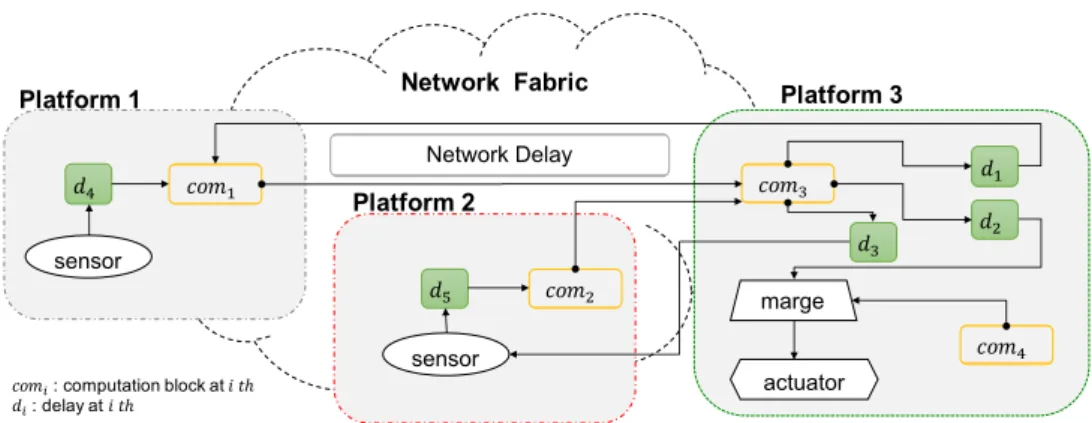
The CPS system is designed fundamentally for system of systems. The CPS system strictly needs to meet the requirement of real-time when multi-platform and multi-system are considered. Besides that, the CPS system uses a time delay model for its applications.
Since the current CPS system does not consider the human factor, which leads to the factor of event-driven task, the usage of time delay model in the CPS system cannot meet the mixed requirement of time-driven and event-driven tasks schedulling. To mitigate this problem, I propose a novel time task model with two algorithms, i.e., a mixed time cost and deadline first (MTCDF) algorithm and a human-centric MTCDF algorithm into the Cyber-Physical Human Centric (CPHC) Framework.
1.2.2 Control Problem
In the CPS system, the control module is one of the importance modules to ensure the entire system operate according to the achievable target set. Most of the CPS systems are designed to meet single target value or multiple target values of the system. Although many control methods, e.g., conventional PID and MPC are proposed not only to minimize the processing time of the controller to achieve the target set, but also to ensure the high accuracy of the controller. However, those control methods do not consider the human centric module due to the difficulties of modeling the human factors. As mentioned in the previous research works, human factor model is generalized by a group of people, in which the control methods that use this model still cannot achieve the best target set.
Moreover, the human factor model becomes more difficult when individual or single person is considered. In this dissertation, a generalized thermal comfort model is focused first.
Based on the collected data, a personal thermal comfort (PTC) model is derived. Since the PTC is a comprehensive evaluation influenced by complex factors and random variables, it is difficult to apply the smart home application that results to the real environment. With the development of IoT technology, a wearable device becomes our daily objects and also have the advantage of connected to the service platforms. This means that the measured data can be personalized. In this dissertation, a well-known wearable device is used to measure human heart rate, then the heart rate, heat sensation, environmental parameters, and so on as inputs into the artificial neural network (ANN) model for predicting the PTC
model. In this dissertation, I propose the PTC model and extend the existing EETCC system to achieve a better thermal comfort sensation while saving more energy.
1.2.3 Implementation Problem
The implementation of CPS system for smart home domain can be found in [7], i.e., EETCC system. Although the EETCC system is successfully verified and implemented in the iHouse environment, this system not only cannot meet the thermal comfort of an resident, but also the EETCC system does not consider the PTC model with artificial neural network (ANN), long short-term memory (LSTM) technique. In this dissertation, the challenges of the EETCC/PTC is focused to achieve both high accuracy and high energy efficiency. By this way, the CPHC framework can be verified for its implementation with human centric module.
1.3 Purpose and Objectives
The purpose of this dissertation is to propose a Cyber-Physical Human Centric framework and to implement its Cyber-Physical Human Centric system with the personal thermal comfort model in smart homes domain. To accomplish this purpose, three research ob- jectives are summarized as follows:
1. To present a computation module of Cyber-Physical Human Centric (CPHC) frame- work for computation time delay model problem. The CPHC framework is intro- duced into the CPS system, which expands the theoretical framework of the CPS.
A time task model for different time requirements and cross-platform is proposed to solve the problem of the success rate of task scheduling between complex systems and people. (Material related to this objective appears in published papers [3], [4], [5], [9], [10] and in an as yet unpublished paper [2])
2. To propose personal thermal comfort model for control problem between CPS and human requirements. For the study of the relationship between people, environment and system, especially the relationship between human physical and psychological factors and environment and system. A significant part of this research is to use the commercial smart wearable devices as the measurement device incorporated with
the other sensors and actuators to build and propose the generic CPHC framework (Material related to this objective appears in published papers [1], [8], [7] and in an as yet unpublished paper [2])
3. To propose implementation PTC model of CPHC System in Smart Homes. Be- sides the environmental factors, the physiology parameter from the heart rate is well-studied and its correlation with the environmental factors, i.e., PMV, airspeed, temperature, and humidity are deeply investigated to reveal the thermal comfort level of the plain air-conditioner (Air-con) and EETCC systems in the smart home environment. Through the questionnaire method, the subjective comfort level (SCL) of the human thermal comfort is directly obtained and verified with the thermal comfort level of the EETCC systems. In this way, a generic human thermal comfort model that can be applied to the CPHCS framework is attained in which the coeffi- cients of this model can be fine-tuned to well-fix to the individual thermal comfort.
Based on artificial intelligence algorithms, simulation and experiment of different levels of prediction models are realized. These include human heart rate prediction and human thermal comfort prediction. (Material related to this objective appears in published papers [1], [8] and in an as yet unpublished paper [2])
1.4 Structure of Dissertation
The remainder of this dissertation is organized as follows:
• Chapter 2. Cyber-Physical Human Centric Framework
In Chapter 2, some of the key related theories and technologies for the human centric society, especially for smart homes will be introduced. To propose the Cyber- Physical Human Centric framework, the Human Centric CPS architecture is also be analyzed. Follow the architecture, three components, which are computation, communication, and control, are introduced for the proposed framework. At the end of chapter 2, the overview and main motivation of proposed Cyber-Physical Human Centric framework is explained.
• Chapter 3. Time Task Model for Computation Module
In this chapter, we propose two mixed weight scheduling algorithms of the CPHC
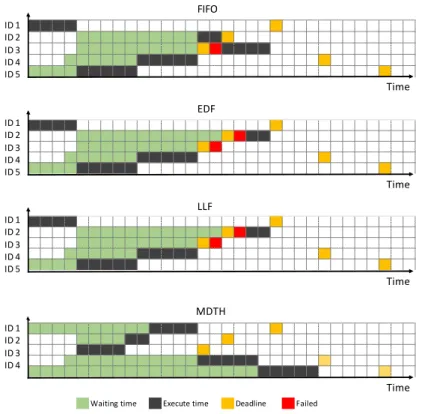
framework scheme. One is the mixed time cost and deadline-first (MTCDF) algo- rithm, other is human-centric MTCDF base the time task model of CPHC frame- work. MTCDF is used to priorities the scheduling of tasks with a time deadline and records the computation time. human-centric MTCDF is used to priorities the scheduling of tasks with a time deadline and human centric requirement. Based on the MTCDF and human-centric MTCDF, the successful ratio is also be analyzed through simulation.
• Chapter 4. Personal Thermal Comfort Model for Control Module
In Chapter 4, a personal thermal comfort prediction model scheme is proposed, which incorporates the proposed CPHC framework and Energy Efficient and Ther- mal Comfort Control (EETCC) algorithm. Through an experiment to collect six participators’ heart rate, subjective comfort level, environment sensing data, and EETCC computation and control data in the morning session and the afternoon session. The thermal comfort gap in the system comfort evaluation and personal is found. Analysis of the experiment data, the correlation between the personal thermal comfort factors and environment factors in the CPHC framework would be optimized. The CPHC framework scheme would achieve better person thermal comfort performance. Besides, this experiment uses a commonly used IoT wearable device for heart rate measuring, which also provides a prerequisite for future work expansion.
For discussing the personal thermal comfort prediction, there are two simulation studies in this chapter. The prediction direction is divided into the human physio- logical prediction (heart rate) and the personal thermal sensation prediction. The general simulation scheme design is based on neural networks. The Long Short- Term Memory (LSTM) algorithm and Back Propagation (BP) network algorithm are used. There are two case studies in this chapter. The simulation results are discussed at the end of each case.
• Chapter 5. Implementation of Cyber-Physical Human Centric System for Smart Homes
Based on chapter 4 simulation, the implementation of personal thermal comfort prediction is discussed in chapter 5 in the morning session and afternoon session.
There are ten participators in the experiment. The EETCC and EETCC/PTC are compared by experiments in the system thermal comfort, human thermal comfort sensation, and energy efficiency.
• Chapter 6. Conclusion and Future Work
Chapter 6 summarizes the dissertation and draws some future trends.
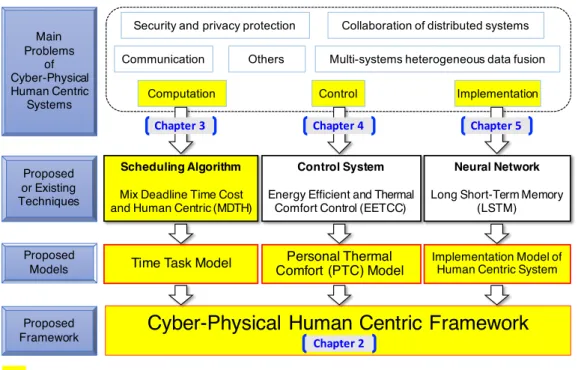
The proposed conceptual framework for Cyber-Physical Human Centric system as shown in Figure 1-2 and structure of dissertation.
Proposed Models
Proposed Framework
Proposed or Existing Techniques
Main Problems
of Cyber-Physical Human Centric
Systems Computation
Communication
Control Implementation
Security and privacy protection
Multi-systems heterogeneous data fusion Collaboration of distributed systems
Cyber-Physical Human Centric Framework
Others
Scheduling Algorithm Mix Deadline Time Cost and Human Centric (MDTH)
Neural Network Long Short-Term Memory
(LSTM) Control System
Energy Efficient and Thermal Comfort Control (EETCC)
Time Task Model Personal Thermal Comfort (PTC) Model
Implementation Model of Human Centric System
Chapter 3 Chapter 4 Chapter 5
Chapter 2 My proposed research works
Figure 1-2: Proposed conceptual framework for Cyber-Physical Human Centric System.
Chapter 2
Cyber-Physical Human Centric Framework
2.1 Introduction
In this chapter, the theoretical basis and related works of the proposed Cyber-Physical Human Centric (CPHC) framework are discussed. The structure of CPHC is explained in detail. Finally, how to use the proposed CPHC framework, corresponding solutions are provided for the two key technical points of time delay model to time task model and thermal comfort to personal thermal comfort.
2.2 Related Works
2.2.1 The Hierarchical Human Need
Maslow’s hierarchy of needs is a theory in psychology proposed by Abraham Maslow in his 1943 paper "A Theory of Human Motivation" in Psychological Review.[27] Maslow subsequently extended the idea to include his observations of humans’ innate curiosity.
His theories parallel many other theories of human developmental psychology, some of which focus on describing the stages of growth in humans. He then decided to create a classification system which reflected the universal needs of society as its base and then proceeding to more acquired emotions.[56] Maslow’s hierarchy of needs is used to study how humans intrinsically partake in behavioral motivation. Maslow’s need [57] used the
terms "physiological", "safety", "belonging and love", "social needs" or "esteem", and
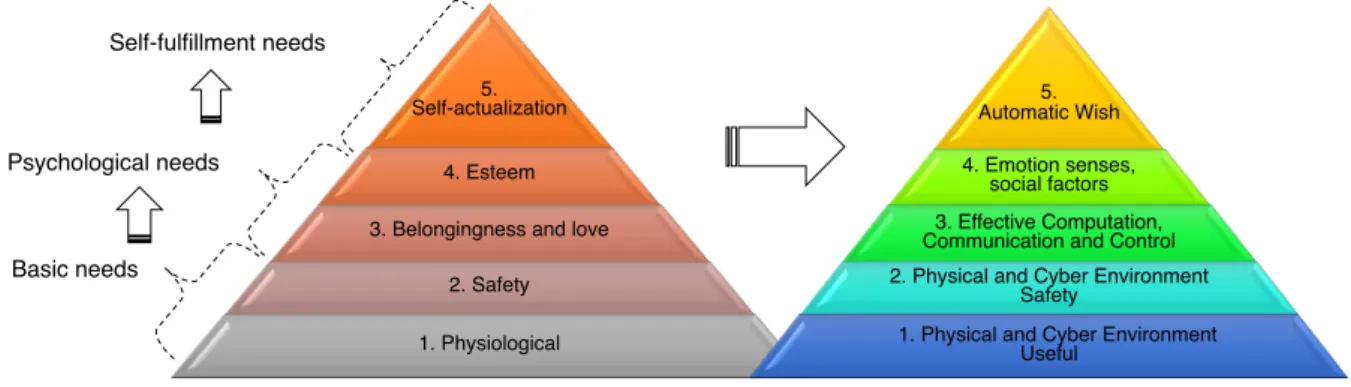
"self-actualization" to describe the pattern through which human motivations generally move. This means that in order for motivation to arise at the next stage, each stage must be satisfied within the individual themselves. The Maslow’s hierarchy of needs to Cyber-Physical Human Centric System shown in Figure 2-1.
Ⅱ. Cyber-Physical Human Centric Framework 5.
Self-actualization 4. Esteem 3. Belongingness and love
2. Safety 1. Physiological
5.
Automatic Wish 4. Emotion senses,
social factors 3. Effective Computation, Communication and Control 2. Physical and Cyber Environment
Safety
1. Physical and Cyber Environment Useful
Ⅰ. Maslow’s Hierarchy of Needs theory Self-fulfillment needs
Psychological needs
Basic needs
Figure 2-1: Maslow’s hierarchy of needs to Cyber-Physical Human Centric System.
2.2.2 Cyber-Physical Social System
Human and system cannot be separated. A system is designed for human requirements;
at the same time, a human using a system to make his life better. With the high develop- ment of CPS and IoT technology, the performance inner requirements of human centric keep on increasing. Up to now, previous studies have shown that interaction is essential between the CPS and humans. A cyber-physical social system (CPSS) in Liu et al. [58]
regards human factors as a part of a system instead of placing them outside the sys- tem boundary. Higashino and Uchiyama [59] proposed the human centric cyber-physical system application where the effects of human activities are taken into consideration for designing and developing CPS based societal systems. So, CPSS is the human need and social based on the desired value, but do not consider device, system, or platform can provide efficient and effective performance at all.
2.2.3 Human-in-the-loop CPS
Schirner et al. [60] proposed a prototyping platform and a design framework for rapid exploration of a novel human-in-loop application serves as an accelerator for new research
into a broad class of systems that augment human interaction with the physical world.
Sowe et al. [61] presents people in a loop of cyber-physical-human systems. Ma et al.
[62]propose a human-in-the-loop reference model for CPS, which extends the traditional cyber-physical interaction into a closed-loop process based on cyber, physical, and human factors. Nunes et al. [63] survey research on human-in-the-loop applications towards the Internet of all. However, those research are use the human as the control factor in CPS systems. So, the lack of human-in-the-loop is to consider human factors into the system design, but no tight synchronization between human preference and the system.
2.2.4 Human Thermal Comfort
Thermal comfort is described as the state of the mind that expresses satisfaction with its thermal surrounding. Assessing thermal comfort is primarily regulated using models based on static heat model transfer equations. P.O. Fanger has been proposed the pre- dicted mean vote/predicted percentage of dissatisfied (PMV/PPD) model in 1970 [28].
This model has been presented by ISO-7730 (2005) [64]. The static thermal models, how- ever, have some limitations. For example, the PMV/PPD model is based on laboratory experiments on adults in highly controlled thermal chambers for a relatively extended period. It is not suitable for different age range of people at home. Halawa et al. [65]
review the studies on adaptive thermal comfort and look critically at the foundation and underlying assumptions of the adaptive model approach and its findings. Craenendonck [66] review the experiments of human thermal comfort in controlled and semi-controlled environments.
Although the PMV/PPD model gives us a way in judging the thermal comfort level, the human’s subjective evaluation is essential. In this paper, we use the ASHRAE 55 [29] to make the subjective evaluation level into seven-level evaluation, as shown in Table 4.1. It contains seven thermal sensation levels, that are “cold (−3)”, “cool (−2)”, “slightly cool (−1)”, “neutral (0)”, “warm (1)”, “slightly warm (2)” and “hot(3)”, respectively. In [40, 67, 68], the subjective comfort evaluation methods are given in smart homes. This subjective evaluation level is modified as a subjective comfort level (SCL) to be used for the participant to answer their direct thermal sensation via the online questionnaire with the intention to study the difference in between human’s subjective thermal comfort and