
Intonational variations at the end of
interrogative sentences in Japanese dialects : From the Corpus of Japanese Dialects
著者(英) Nobuko Kibe, Tomoyo Otsuki, Kumiko Sato journal or
publication title
Proceedings of the LREC 2018 Special Speech Sessions
page range 21‑28
year 2018‑05‑09
URL http://doi.org/10.15084/00001912
Intonational Variations at the End of Interrogative Sentences in Japanese Dialects: From the “Corpus of Japanese Dialects”
Nobuko Kibe, Tomoyo Otsuki, Kumiko Sato
National Institute for Japanese Language and Linguistics (NINJAL) {nkibe, otsukit, satok}@ninjal.ac.jp
Abstract
In general, it is said that interrogative sentences have a final rising intonation (Kori 2003). However, this rule is not true of some Japanese dialects. Kibe (2010, 2011,2013) classify sentence-final tones of interrogatives in Japanese dialects into four types: Type A as a rising tone (Tōkyō dialect), Type B as a falling tone (Hirosaki dialect, Kagoshima dialect), Type C as a rising/falling tone (Hiroshima dialect), and Type D as a gradual rising tone (Fukuoka dialect). Since the data in Kibe (2010, 2011 and 3013) were extracted from an existing nation-wide dialect survey where an elicitation task was employed, it is not clear whether how much such intonation patterns appear in a spontaneous speech in each region. This article examines sentence-final tones of interrogatives extracted from a natural discourse stored in the “Corpus of Japanese Dialects” (COJADS), which is currently in preparation for release by the National Institute for Japanese Language and Linguistics (NINJAL). The results revealed that the four types are attestable even in a natural discourse, and furthermore, we identified a dialect such as Hirosaki dialect which distinguishes interrogatives from declaratives by the pitch range in the final falling tone.
Keywords: rising tone, falling tone, wh-question, yes/no question, Mito dialect, Hirosaki dialect, Kagoshima dialect
1. Introduction
In general, it is said that interrogative sentences have a final rising intonation. Modern standard Japanese also uses a rising tone at the end of wh-questions and yes/no questions.
However, this rule is not true of some Japanese dialects.
For instance, in the Hirosaki dialect, spoken in Aomori Prefecture in the northwestern part of Japan, and the Kagoshima dialect, spoken in Kagoshima Prefecture in the southern part of Japan, a falling tone appears both in wh- questions and yes/no questions. In some dialects, like Matsumoto dialect, spoken in the Chūbu area, and the Hiroshima dialect, spoken in the Chūgoku area, a final rising tone is used for wh-questions but a falling tone is used for yes/no questions.
In the previous studies, the following four patterns were identified as sentence-final tones of interrogatives in Japanese dialects (Kibe 2010, 2011,2013).
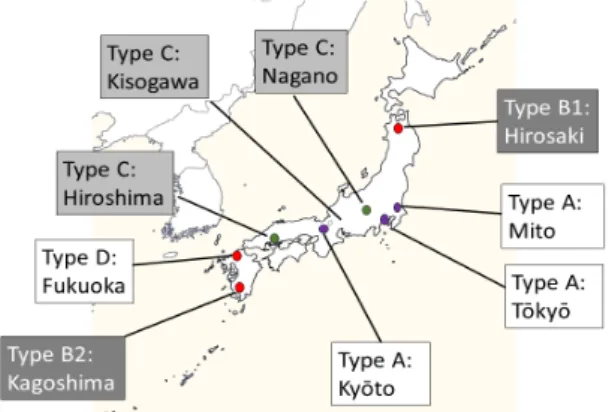
Type A: Rising tone <Tōkyō dialect>
Interrogative sentences are pronounced with a final rising tone, regardless of whether any interrogative word or interrogative final particle is used or not.
Type B1: Falling tone <Hirosaki dialect>
Interrogative sentences are pronounced with a falling tone, regardless of whether any interrogative word or interrogative final particle is used or not.
Type B2: Falling tone – final particle <Kagoshima dialect>
Interrogative sentences always contain an interrogative word form or interrogative final particle, and such sentences are pronounced with a final falling pitch.
Type C: Rising tone / falling tone < Hiroshima dialect>
Interrogative sentences with an interrogative word form are pronounced with a final falling pitch, and
sentences without an interrogative word form are pronounced with a final rising tone.
Type D: Gradual rising tone <Fukuoka dialect>
Interrogative sentences are pronounced with a gradual rise starting from an interrogative word at the beginning to the end of the sentence.
This report provides an overview of rising and falling tones at the end of interrogatives in Japanese dialects. We do not discuss Ryukyuan languages since further research is needed.
Figure 1: Sites where the data used in this report were collected
2. Data
The data of this article was obtained from recorded conversations in “Kakuchi Hōgen Shūshū Kinkyū Chōsa”
(Urgent surveys to collect data of dialects throughout the nation), which was led by the Agency for Cultural Affairs, Governments of Japan, and “Nihongo Onsei” (Japanese Prosody, JP), which stores recordings of Japanese dialects as audio DVDs (Grant-in-Aid for Scientific Research from 1989 to 1992). The recording of “Kakuchi Hōgen Shūshū Kinkyū Chōsa” was conducted from 1977 to 1985 at 224 sites throughout the nation (A part of the data is published
by Zenkoku Hōgen Danwa Dētabēsu: Nihonno Furusato Kotoba Shūsei vol.1 ~ vol.20 (Speech Database of Japanese Dialects: Collection of Japanese Dialects)). The data is currently stored at NINJAL and became searchable using the corpus COJADS (Corpus of Japanese Dialects), which we used for data extraction.
3. Analysis on final tones in Japanese dialects
3.1 Tōkyō and Mito Dialect (Type A)
Tōkyō and Mito dialects have a final rising tone both in wh-questions and yes/no questions. Examples in the following sections are such interrogative sentences. (The shaded part is an interrogative word form or an interrogative final particle. ↑ represents a rising tone, ↓ represents a fallig tone.)
3.1.1 Tōkyō dialect
The following are examples of the pitch patterns in interrogatives in the Tōkyō dialect. The sentence in (1a) is a wh-question, and the sentence in (1b) is a yes/no question, both of which are usually pronounced with a rising tone.
(1a) nani=ŋa hosii ↑ what= ACC want
“What do you want?”
(1b) nanika hosii ↑ anything want
“Do you want anything?”
Figure2:
“What do you want?” “Do you want anything?”
(from JP)
If the former sentence is pronounced with a falling pitch, as in (2a), it can be interpreted as a question with a modal meaning such as reproach or antipathy(Moriyama 1989).
For example, (2a) can convey impatience, implying “I bought this and that for you. What more do you want?” If the sentence in (1b) is pronounced with a falling pitch, as in (2b), it simply means “I (the speaker) want something.”
(2a) nani=ŋa hosii ↓ what= ACC want
“What do you want?”(with reproach or antipathy) (2b) nanika hosii ↓
anything want
“I want something.”
It is often said that the final particle =ka used in the Tōkyō dialect conveys an interrogative meaning. In reality, however, the final particle =ka can have an interrogative meaning only when it appears with a rising tone at the end of a sentence. If a sentence with the final particle =ka is pronounced with a final falling pitch, the sentence conveys the speaker’s acceptance of the fact stated in the sentence, as exemplified below:
(3a) hanako=to kjo:to=e it-ta=ka↑
Hanako=COMIT Kyōto=ALL go-PST=SFT.Q “Did you go to Kyōto with Hanako? ”
(3b) hanako=to kjo:to=e it-ta=ka↓
Hanako=COMIT Kyōto=ALL go-PST=SFP “You did go to Kyōto with Hanako.”
The sentence with a rising tone in (3a) is an interrogative sentence asking whether the addressee went to Kyōto with Hanako. Contrastively, the sentence with a final falling pitch in (3b) can be used in a case where the speaker mutters to himself/herself and reluctantly accepts the fact that the addressee went to Kyōto with Hanako. In the Tōkyō dialect, therefore, =ka is not necessarily used to convey an interrogative meaning. An interrogative sentence is made by adding a final rising intonation to =ka, rather than just by adding =ka at the end. Thus, in yes/no questions in the Tōkyō dialect, including sentences ending with =ka, an interrogative meaning can be conveyed only by a sentence-final rising tone.
The same applies to wh-questions. Having an interrogative word form in a wh-question clearly marks the sentence as interrogative. Therefore, such a sentence should not need to be pronounced with a final rising tone. (In English, a final falling pitch is used in wh-questions, like “What is this?”) In the Tōkyō dialect, however, a final rising tone is generally used in wh-questions. Thus, in this dialect, a final rising tone serves as an interrogative marker. Conversely, a sentence that is not pronounced with a final rising pitch is regard as a non-interrogative sentence or an interrogative with a special meaning as seen in (2a).
3.1.2 Mito dialect
Interrogatives in Mito dialect are pronounced with a rising tone in the same way as the Tōkyō dialect. The following examples show the pitch patterns in Mito dialect. The sentence in (4a) is a wh-question, and (4b) is a yes/no question, both of which are usually pronounced with a rising tone.
(4a) maa are nani=sa it-ta=ɴ=dak=ke ↑
FILL that what=ACC good-PST=NMLZ=COP=SFP.Q
“Well, what is that good for?”
(4b) are siɴkeetuu=ke↑
that neuralgia=SFP.Q
“Is thatneuralgia?”
Figure 3:
“Well, what is that good for?” “Is that neuralgia?”
(from COJADS)
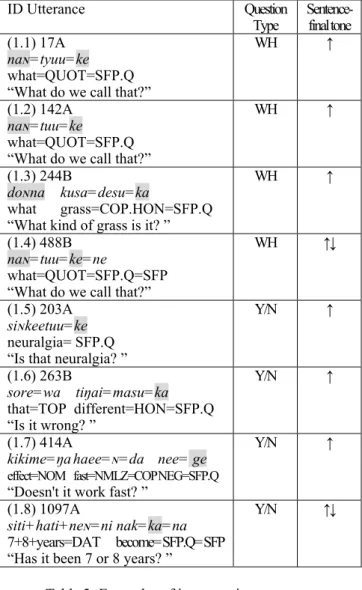
Tables 1 and 2 below show sentence-final pitch patterns of wh-questions and yes/no questions in Mito dialect in COJADS. “A” and “B” in the column “ID” represent individual speakers (A is male and B is female in this example. recording time: 38’50 ").
final tone total rising falling rising faling
WH 3 0 1 4
Y/N 4 0 0 4
Table 1: Number of pitch patterns (Mito dialect)
ID Utterance Question
Type Sentence- final tone (1.1) 17A
naɴ=tyuu=ke what=QUOT=SFP.Q
“What do we call that?”
WH ↑
(1.2) 142A naɴ=tuu=ke what=QUOT=SFP.Q
“What do we call that?”
WH ↑
(1.3) 244B
doɴna kusa=desu=ka
what grass=COP.HON=SFP.Q
“What kind of grass is it? ”
WH ↑
(1.4) 488B naɴ=tuu=ke=ne
what=QUOT=SFP.Q=SFP
“What do we call that?”
WH ↑↓
(1.5) 203A siɴkeetuu=ke neuralgia= SFP.Q
“Is that neuralgia? ”
Y/N ↑
(1.6) 263B
sore=wa tiŋai=masu=ka that=TOP different=HON=SFP.Q
“Is it wrong? ”
Y/N ↑
(1.7) 414A
kikime=ŋa haee=ɴ=da nee= ge effect=NOM fast=NMLZ=COP NEG=SFP.Q
“Doesn't it work fast? ”
Y/N ↑
(1.8) 1097A
siti+hati+neɴ=ni nak=ka=na 7+8+years=DAT become= SFP.Q= SFP
“Has it been 7 or 8 years? ”
Y/N ↑↓
Table 2: Examples of interrogative sentences (Mito dialect)
Table 2 shows that interrogatives in Mito dialect always has the sentence-final particle =ke and the =ke is always pronounced with a rising pitch. In addition, other particles can follow =ke , such as =ne (1.4) and =na (1.8) which are used to address listeners. In this case, =ne or =na is accompanied with a falling tone.
3.2 Hirosaki Dialect (Type B1)
The Hirosaki dialect has a final falling tone both in wh- questions and yes/no questions. The following are examples of such interrogative sentences.
(5a) doosute sono mada rosuya+zuɴ why FILL FILL Russian[NOM]
e-su-ta=ba ↓ be-HON-PST=SFP “Why was there a Russian?”
Figure 4: “Why was there a Russian?”
(from COJADS) (5b) beɴzya=sa tumakawa
clogs =ALL top.cover[NOM]
tude ae-su-ta=gaa↓
attach.SEQ be-HON-PST=SFP.Q
“Does the beɴzya (a kind of Japanese clogs with iron blades) have a top cover?”
Figure 5: “Does the beɴzya have a top cover?”
(from COJADS)
The sentence in (5a) is a wh-question, and (5b) is a yes/no question, both of which are usually pronounced with a falling tone. As discussed in Section 3.1, Tōkyō and Mito dialects always have a sentence-final rising tone in interrogatives; conversely, The Hirosaki dialect usually has a falling tone in interrogatives. Tables 3 and 4 show sentence-final pitch patterns of wh-questions and yes/no questions in the Hirosaki dialect in COJADS (A and B are male, and C is female. recording time: 36’26 ").
final tone total
rising falling
WH 1 3 4
Y/N 1 5 6
Table 3: Number of pitch patterns (Hirosaki dialect)
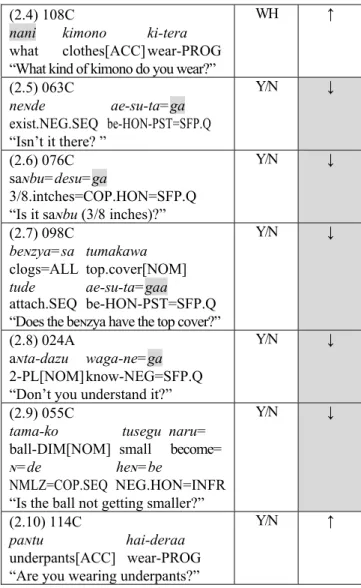
ID Utterance Question
Type Sentence- final tone (2.1) 011C
doosute sono mada rosuya+zuɴ why FILL FILL Russian[NOM]
e-su-ta=ba be-HON-PST=SFP
“Why was there a Russian?”
WH ↓
(2.2) 051B
doyate nomu=ɴ=zu how drink=NMLZ=SFP
“How do you drink it?”
WH ↓
(2.3) 036B
naɴ=te su-ta=moɴ=da=be what=QUOT say-PST=NMLZ=COP=INFR
“How would we say that?”
WH ↓
(2.4) 108C
nani kimono ki-tera what clothes[ACC] wear-PROG
“What kind of kimono do you wear?”
WH ↑
(2.5) 063C
neɴde ae-su-ta=ga
exist.NEG.SEQ be-HON-PST=SFP.Q
“Isn’t it there? ”
Y/N ↓
(2.6) 076C saɴbu=desu=ga
3/8.intches=COP.HON=SFP.Q
“Is it saɴbu (3/8 inches)?”
Y/N ↓
(2.7) 098C
beɴzya=sa tumakawa clogs=ALL top.cover[NOM]
tude ae-su-ta=gaa attach.SEQ be-HON-PST=SFP.Q
“Does the beɴzya have the top cover?”
Y/N ↓
(2.8) 024A
aɴta-dazu waga-ne=ga 2-PL[NOM] know-NEG=SFP.Q
“Don’t you understand it?”
Y/N ↓
(2.9) 055C
tama-ko tusegu naru=
ball-DIM[NOM] small become=
ɴ=de heɴ=be
NMLZ=COP.SEQ NEG.HON=INFR
“Is the ball not getting smaller?”
Y/N ↓
(2.10) 114C
paɴtu hai-deraa underpants[ACC] wear-PROG
“Are you wearing underpants?”
Y/N ↑
Table 4: Examples of interrogative sentences (Hirosaki dialect)
The sentence-final particle =ga (gaa) in examples (2.5) - (2.8) in Table 4 marks the sentences as interrogative. Table 4 indicates that, in the Hirosaki dialect, a wh-question contains a wh-phrase in a sentence, and a yes/no question is marked by the particle =ga (gaa), both of which are generally accompanied with a falling tone.
However, the examples (2.9) and (2.10) in Table 4 are interrogative without containing a wh-phrase or the particle
=ga (gaa) (The sentence-final particle =be in the example (2.9) indicates an assumption, and -deraa in the example (2.10) is a morpheme to express an aspect (progressive), and thus, neither of them does not mark a sentence as interrogative.) It suggests that these sentences are marked as interrogative by the final falling tone. (The example (2.10) is pronounced with a final rising tone. This sentence can be interpreted as a question with a modal meaning.) In the Hirosaki dialect, a declarative sentence is pronounced with falling tone too. How is a yes/no question distinguished from a declarative sentence in the Hirosaki dialect where both are pronounced with a falling pitch? The following sentence-final pitch patterns are identified from examining examples in COJADS:
(6) There is a difference in the pitch range of falling between wh-questions, yes/no questions, and
declarative sentences, whereby yes/no questions have the largest falling and declaratives have the smallest (Figure 6, 7, and 8).
Figure 6: Figure 7: Figure 8:
wh-question yes/no question declarative Table 5 shows the average pitch ranges as falling for each sentence type.
Sentence Type Average pitch range as falling (Hz/s)
wh-question 152.696
yes/no question 170.098
declarative 129.41
Table 5: Difference in the degree of falling between sentence types (Hirosaki dialect)
As Table 5 shows, yes/no questions have a large pitch fall in comparison to declarative sentences. We conducted a t- test in order to verify whether the difference is statistically significant. For the purpose of normalizing the difference between f0 values of the sentence types across speakers, we calculated z-scores of f0 values for each speaker, and then calculated the difference between the highest and lowest (z- scored) f0 values. The result of the t-test confirmed that there is a statistical significant difference in the z-scored pitch range between yes/no questions and declaratives with a significance level of 5% (p = 0.019). This result indicates that the Hirosaki dialect distinguishes interrogatives from declaratives by the pitch range.
Although the data is not abundant and conditions of examples found in a natural discourse are difficult to control, the current data from the COJADS indicates that the Hirosaki dialect distinguishes interrogatives and declaratives by the pitch range. Previous studies have reported that dialects in the Tohoku region use a final falling pitch for interrogatives (Yamaura 2000, Kibe 2010), but this is the first study that reveals the pitch range of falling in the Hirosaki dialect has a distinctive feature.
Further research is needed to identify where the falling pitch starts in interrogatives and conduct a quantitative analysis.
3.3 Kagoshima Dialect (Type B2)
In the Kagoshima dialect, both wh-questions and yes/no questions are pronounced with a falling pitch as shown in the following (Kibe 1997):
(7a) nai=ga hoɕika=ka↓
what= ACC want=SFP.Q
“What do you want? ” (7b) naika hoɕi=ka↓
anything want=SFP.Q
“Do you want anything? ”
Figure 9:
“What do you want?” “Do you want anything?”
(from JP)
(8a) dai=to kjo:to =i it-ta=ka:↓
who=COMIT Kyōto=ALL go-PST=SFP.Q
“Who did you go to Kyōto with?”
(8b) hanako=to kjo:to=i it-ta=to=ja↓
Hanako=COMIT Kyōto=ALL go-PST=NMLZ=SFP.Q
“Did you go to Kyōto with Hanako?”
Figure 10: “Who did you go to Kyōto with?”
(from JP)
Figure 11: “Did you go to Kyōto with Hanako?”
(from JP)
The sentences in (7a) and (8a) are wh-questions, and (7b) and (8b) are yes/no questions. The sentence-final particle
=ka in (7a), (7b), and (8a) and the particle =ja in (8b) mark the sentences as interrogative. These sentences are all pronounced with a final falling pitch.
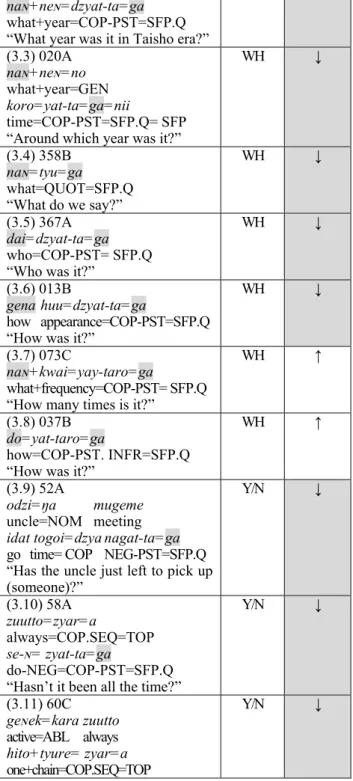
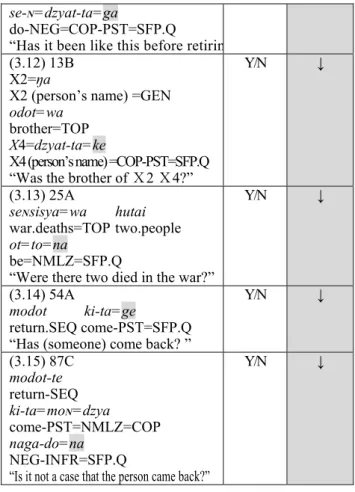
Tables 6 and 7 are lists of all wh-questions and yes/no questions in the Kagoshima dialect in COJADS (A and B are male, and C is female. recording time: 34’29 "), which show that the dialect always has an interrogative sentence- final particle (i.e. =ka (ga), =ke (ge), =na). A sentence without a sentence-final particle in interrogatives (e.g.
kjo:to↑ “Kyōto? ”, i ku↑ “You go”) is unnatural in this dialect. The different particles reflect a type of relationship between a speaker and a listener; =na is used when a listener is older than a speaker, =ke (ge) is used when a listener is younger than a speaker, and =ka (ga) can be used for any relationship.
Tables 6 and 7 shows that most of the sentences are pronounced with a final falling pitch.
final tone total
rising falling
WH 2 6 8
Y/N 0 7 7
Table 6: Number of pitch patterns (Kagoshima dialect)
ID Utterance Question
Type Sentence- final tone (3.1) 098A
naɴ+gak=ka what+month=SFP.Q
“What month?”
WH ↓
(3.2) 038A
taisyoo Taisho(the era name) naɴ+neɴ=dzyat-ta=ga what+year=COP-PST=SFP.Q
“What year was it in Taisho era?”
WH ↓
(3.3) 020A
naɴ+neɴ=no what+year=GEN
koro=yat-ta=ga=nii
time=COP-PST=SFP.Q= SFP
“Around which year was it?”
WH ↓
(3.4) 358B naɴ=tyu=ga
what=QUOT=SFP.Q
“What do we say?”
WH ↓
(3.5) 367A dai=dzyat-ta=ga who=COP-PST= SFP.Q
“Who was it?”
WH ↓
(3.6) 013B
gena huu=dzyat-ta=ga
how appearance=COP-PST=SFP.Q
“How was it?”
WH ↓
(3.7) 073C
naɴ+kwai=yay-taro=ga
what+frequency=COP-PST= SFP.Q
“How many times is it?”
WH ↑
(3.8) 037B do=yat-taro=ga
how=COP-PST. INFR=SFP.Q
“How was it?”
WH ↑
(3.9) 52A
odzi=ŋa mugeme uncle=NOM meeting idat togoi=dzya nagat-ta=ga go time= COP NEG-PST=SFP.Q
“Has the uncle just left to pick up (someone)?”
Y/N ↓
(3.10) 58A
zuutto=zyar=a always=COP.SEQ=TOP se-ɴ= zyat-ta=ga
do-NEG=COP-PST=SFP.Q
“Hasn’t it been all the time?”
Y/N ↓
(3.11) 60C
geɴek=kara zuutto active=ABL always hito+tyure= zyar=a one+chain=COP.SEQ=TOP
Y/N ↓
se-ɴ=dzyat-ta=ga
do-NEG=COP-PST=SFP.Q
“Has it been like this before retirin (3.12) 13B
X2=ŋa
X2 (person’s name) =GEN odot=wa
brother=TOP X4=dzyat-ta=ke
X4 (person’s name) =COP-PST=SFP.Q
“Was the brother of X2 X4?”
Y/N ↓
(3.13) 25A
seɴsisya=wa hutai war.deaths=TOP two.people ot=to=na
be=NMLZ=SFP.Q
“Were there two died in the war?”
Y/N ↓
(3.14) 54A
modot ki-ta=ge
return.SEQ come-PST=SFP.Q
“Has (someone) come back? ”
Y/N ↓
(3.15) 87C modot-te return-SEQ ki-ta=moɴ=dzya
come-PST=NMLZ=COP naga-do=na
NEG-INFR=SFP.Q
“Is it not a case that the person came back?”
Y/N ↓
Table 7:Examples of interrogative sentences (Kagoshima dialect)
3.4 Hiroshima Dialect (Type C)
Next, let’s look at another type of Japanese dialect, which has a different intonation pattern from those of Tōkyō, Hirosaki and Kagoshima dialects.
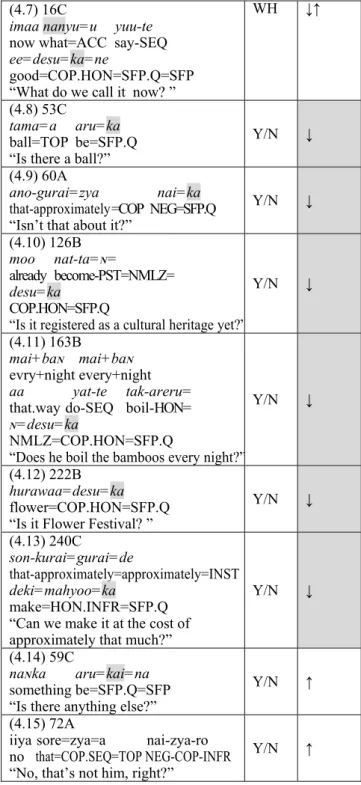
In the Hiroshima dialect, interrogative sentences that contain any interrogative word forms are pronounced with a final falling pitch, and those without interrogative word forms are pronounced with a final rising tone. Some examples are as follows.
(9a) dare=to kjo:to=e it-ta=ɴ↓ who=COMIT Kyōto=ALL go-PST=SFP “Who did you got to Kyoko with? ” (9b) hanako=to kjo:to=e it-ta=ɴ↑
Hanako=COMIT Kyōto=ALL go-PST=SFP “Did you go to Kyōto with Hanako? ”
Figure 12: “Who did you got to Kyoko with? ” (from JV)
Figure 13: “Did you go to Kyōto with Hanako? ” (from JP)
Please note that the final particle =ɴ at the end of the sentences does not convey an interrogative meaning.
Tables 8 and 9 show sentence-final pitch patterns of wh- questions and yes/no questions in the Hiroshima dialect (A is male, B and C are female, recording time: 38’08 ").
final tone total
rising falling rising falling
WH 1 5 1 7
Y/N 2 6 0 8
Table 8: Number of pitch patterns(Hiroshima dialect)
ID Utterance Questio
n Type Sentence- final tone (4.1) 11A
naɴbo naɴ=de nezir-yaa how.many what=INST twist-COND ee=ɴ=zya
good=NMLZ=COP
“How much should I twist it with what?”
WH ↓
(4.2) 2C
ar=yaa naɴ-gen that=TOP how.many-CLF aru=ɴ=desu=ka
be=NMLZ=COP.HON= SFP.Q
“How big is it?”
WH ↓
(4.3) 156C
otoosaɴ nani=i suru=ɴ father.VOC what=DAT do=NMLZ
“What do you use it for, Dad?”
WH ↓
(4.4) 65C
hiti+hati yuu-tara seven+eight say-COND doɴto=na=ɴ=desu=ka
what=COP=NMLZ=COP.HON= SFP.Q
“What is that hiti-hatilike?”
WH ↓
(4.5) 109C
naɴde ee=no ee=no why good=SFP good=SFP yuu-te tataki-yot-ta=ɴ=
say-SEQ crap-PROG-PST=NMLZ=
desu=ka=no COP.HON=SFP.Q=SFP
“I wonder why people say ‘good, good’ when they crap their hands.”
WH ↓
(4.6) 203C
ar=yaa dokoo=no that=TOP where=GEN miɴgee=desu=ka
folk.craft=COP.HON= SFP.Q
“Where do people make such folk crafts?”
WH ↑
(4.7) 16C
imaa nanyu=u yuu-te now what=ACC say-SEQ ee=desu=ka=ne
good=COP.HON=SFP.Q=SFP
“What do we call it now? ”
WH ↓↑
(4.8) 53C
tama=a aru=ka ball=TOP be=SFP.Q
“Is there a ball?”
Y/N ↓ (4.9) 60A
ano-gurai=zya nai=ka that-approximately=COP NEG=SFP.Q
“Isn’t that about it?”
Y/N ↓ (4.10) 126B
moo nat-ta=ɴ=
already become-PST=NMLZ=
desu=ka COP.HON=SFP.Q
“Is it registered as a cultural heritage yet?”
Y/N ↓
(4.11) 163B
mai+baɴ mai+baɴ evry+night every+night aa yat-te tak-areru=
that.way do-SEQ boil-HON=
ɴ=desu=ka
NMLZ=COP.HON=SFP.Q
“Does he boil the bamboos every night?”
Y/N ↓
(4.12) 222B hurawaa=desu=ka flower=COP.HON=SFP.Q
“Is it Flower Festival? ”
Y/N ↓ (4.13) 240C
son-kurai=gurai=de
that-approximately=approximately=INST deki=mahyoo=ka
make=HON.INFR=SFP.Q
“Can we make it at the cost of approximately that much?”
Y/N ↓
(4.14) 59C
naɴka aru=kai=na something be=SFP.Q=SFP
“Is there anything else?”
Y/N ↑ (4.15) 72A
iiya sore=zya=a nai-zya-ro no that=COP.SEQ=TOP NEG-COP-INFR
“No, that’s not him, right?”
Y/N ↑
Table 9: Examples of interrogative sentences (Hiroshima dialect)
The sentence-final particle =ka marks the sentences as interrogative. Table 9 indicates that, in the Hiroshima dialect, interrogative sentences that contain any interrogative word forms are pronounced with a final falling pitch, and those without interrogative word forms are pronounced with a final rising tone.
3.5 Fukuoka Dialect (Type D)
Interrogative sentences in the Fukuoka dialect are quite different in intonation patterns from those in the other Japanese dialects mentioned earlier. In the Fukuoka dialect, wh-questions have a gradual rising intonation, with an interrogative word placed at the beginning of a sentence
pronounced on a low tone and the tone gradually rising toward the end of the sentence. The accents of all the words contained in the sentence are canceled by this gradual rising intonation (Hayata1985, Kubo1990). The sentence in (10a) is a wh-question, and the sentence in (10b) is a yes/no question. Note that the final particle =na at the end of these sentences conveys an interrogative meaning.
(10a) nani=ga hoshi-ka=na what= ACC want-NPST=SFP.Q
“What do you want?”
(10b) naɴka hosi-ka=na↓
anything want-NPST=SFP.Q “Do you want anything?”
Figure 14:
“What do you want?” “Do you want anything?”
(from JP)
In the Fukuoka dialect, however, when a sentence without an interrogative final particle is pronounced with a final rising tone, the sentence conveys an interrogative meaning.
Take a look at the following examples. (Note that the final particle =to at the end of the sentence (11b) does not mark the sentence as interrogative.)
(11a) mizu=ba nomu=na↓
Water=ACC drink=SFP.Q “Do you drink water? ” (11b) mizu=ba nomu=to↑
Water=ACC drink=SFP “Do you drink water? ”
Figure 15: “Do you drink water? ” (from JP)
The Fukuoka dialect has the following feature as well as the above-mentioned feature; interrogative sentences that contain interrogative sentence-final particles are pronounced with a falling tone, and those with no interrogative sentence-final particles are pronounced with a rising tone.
4. List of Glosses
ACC: accusative HON: honorific ADD: additive INFR: inferential ADN: adnominal INST: instrumental ADV: adverbial LOC: locative ABL: ablative INST: instrumental ALL: allative NEG: negative CAUS: causative NMLZ: nominalizer CAUSL: causal NOM: nominative CLF : classifier OBLG: obligative COND: conditional PROH: prohibitive COMIT: comitative PROG: progressive COP: copula PST: past
DAT: dative PURP: purposive DIM: diminutive Q: question/ interrogative EVID: evidential QUOT: quotative FILL: filler SEQ: sequential FOC: focus SFP: sentence final particle GEN: genitive VOC : vocative
5. Acknowledgment
The work reported in this article was supported by the NINJAL collaborative research project ‘Endangered Languages and Dialects in Japan’, and the JSPS Grant-in- Aid for Scientific Research (B) 25284087 (2015~2017), and (A) 16H01933 (2018~2021).
6. Bibliographical References
Hayata, Teruhiro (1985) Hakata Hogen-no Akusento:
Keitairon [Accent in Hakata dialect: Morphology].
Fukuoka: Kyushu Daigaku Shuppankai.
Kibe, Nobuko (1997) Kagoshima hogen-no intoneishon [Intonation in Kagoshima dialect]. Shohogen-no Akusento-to Intoneishon [Accent and intonation in Japanese dialects]. Tōkyō : Sanseido.
Kibe, Nobuko (2010) Intoneishon-no chiikisa: Shitsumon- no intoneishon [Regional difference in intonation:
Intonation of question]. Hogen-no Hakken: Shirarezaru chiikisa-o shiru [Finding dialects: Detecting unknown regional difference]. Tōkyō : Hituji Syobo.
Kibe, Nobuko (2011) Intonation at the end of interrogative sentences in Japanese dialects, Presentation at ICPP, Kyōto University, 13.Dec.2011.
Kibe, Nobuko (2013) Soudattanda! Nihongo: Jadde hougen-na omoshitoka [Aha! Japanese: Dialect is interesting]. Tōkyō : Iwanami Shoten.
Kori, Shiro (2003) Intoneishon [Intonation]. Asakura Nihongo kouza 3: Onsei, On’in [Asakura Japanese course 3: Phonetics and phonology]. Tōkyō : Asakura Shoten.
Kubo, Tomoyuki (1990) Fukuokashihougen-no toikaeshigimonbun-no akusentogenshou [Accent of echo questions in Fukuoka dialect]. Nihongo Onsei: Kenkyu Houkoku [Spoken Japanese: research report] 3.
Moriyama, Takuro (1989) Bun-no imi-to intoneishon [Meaning and intonation of a sentence]. Kouza Nihongo- to Nihongo Kyouiku 1: Nihongogaku Gakusetsu [Course of Japanese and Japanese language education 1:
Overview of Japanese linguistics]. Tōkyō : Meiji Shoin.
Yamaura, Harutsugu. (2000) Kesen-go daijiten: Zyou [A dictionary of Kesen language: the first volume], Bunpouhen goihen [Grammar and vocabulary]. Sendai:
Mumyosha.
7. Language Resource References
Corpus of Japanese Dialects (COJADS). In preparation for release. NINJAL.
Kakuchi Hōgen Shūshū Kinkyū Chōsa (Urgent surveys to collect data of dialects throughout the nation) (1977- 1985). Speech database of Japanese dialects. Agency for Cultural Affairs, Governments of Japan.
Nihongo Onsei (Japanese Prosody, JP) (1989-1992).
Recordings of Japanese dialects as audio DVDs. Grant- in-Aid for Scientific Research from 1989 to 1992.
Zenkoku Hōgen Danwa Dēta bēse: Nihonno Furusato Kotoba Shūsei (Speech Database of Japanese Dialects:
Collection of Japanese Dialects) vol.1-vol.20 (2001- 2002). Tōkyō : Kokusho Kankō-kai.
![I, §3] that the Schur functionsλ(x1](data:image/gif;base64,R0lGODlhAQABAIAAAP///wAAACH5BAEAAAAALAAAAAABAAEAAAICRAEAOw==)