management program to promote psychological well‑being in a sample of white‑collar workers in Japan.
journal or
publication title
Industrial health
volume 48
number 3
page range 265‑274
year 2010
URL http://hdl.handle.net/10285/9273
Introduction
As awareness of the importance of workplace mental health issues increases, the importance of stress manage- ment programs and their integration in the workplace have become topics of international concern1). In Japan, where an increasing number of workers have recently shown symptoms of depression2), mental health-care is needed in the workplace. According to Murphy, such programs, commonly termed ‘stress management’, are individual- oriented and seek to educate workers about the nature of stress, teaching workers specific techniques to reduce the physiological and psychosomatic consequences of stress3).
Corporate expectations regarding the benefits of stress management interventions include enhanced productivity, lower medical and disability costs, and reduced absen- teeism and turnover4).
With computers and Internet access becoming ubiqui- tous, public interest in stress management programs using the World Wide Web has been increasing. Such programs are reported to be as effective as conventional programs provided directly by healthcare specialists or counselors5). Web-based programs are convenient for participants because they can be accessed 24 h a day, anytime and anywhere, and participants receive interactive feedback instantaneously6). Another reason why Web-based pro- grams are attracting public interest is that from the view- point of companies, they can be provided to employees at a low cost and can be useful to make up for the recent
Industrial Health 2010, 48, 265–274 Original Article
Process Evaluation of a Web-based Stress
Management Program to Promote Psychological Well-being in a Sample of White-collar Workers in Japan
Kaoru KAWAI1*, Yoshihiko YAMAZAKI1 and Kazuhiro NAKAYAMA2
1Department of Health Sociology, School of Health Sciences and Nursing, The University of Tokyo, 7–3–1 Hongo, Bunkyo-ku, Tokyo 113-0033, Japan
2St. Luke’s College of Nursing, 10–1 Akashi-cho, Chuou-ku, Tokyo 104-0044, Japan
Received October 31, 2009 and accepted April 5, 2010
Abstract: The purpose of this study was to conduct process evaluation of a web-based stress management program, which was designed to improve psychological well-being as a positive psy- chological function of humans. A total of 168 employees participated in the intervention. The pre-test was conducted at the time of registration and the post-test upon the completion of the program. Participants are requested to evaluate program sessions by answering four questions (informative, enjoyment, intention to act, self-efficacy belief). Participant evaluations of the ses- sions were also used as the mediating variable that influences program outcomes. For analysis, we built a model based on the program impact theory and conducted path analysis. Result revealed the majority of participants evaluated the program affirmatively in all sessions and the participant evaluations about the sessions directly predicted changes in psychological well-being (β=0.29, p<0.01), and changes in the psychological well-being predicted changes in the scores of CES-D (Center for Epidemiologic Studies Depression Rating Scale), which represent the level of depression (β=0.50, p<0.001). In conclusion, the program can be effective if the participants feel enjoyment, and increase their intention and self-efficacy belief to cope with stress.
Key words: Web, Stress management, Psychological well-being, Process evaluation
*To whom correspondence should be addressed.
E-mail: [email protected]
shortage of health-care specialists2).
Goldenhar et al. indicated that for a stress management program to be effective, it is important that the outcome of the program should be evaluated, and that the details of the program implementation process and its elements are examined7). Evaluating the process will help to resolve the black box of how the program operates and is expected to produce feedback that will enable its imple- mentation with greater performance8).
In the evaluation of the process, the variables mediat- ing the outcome are important. These variables, which include the proximal outcome and the change in direct response to exposure to the program and represent the fac- tors essential to clarifying the mechanism of the pro- gram’s effects9, 10). Known mediating variables, includ- ing psychological changes as positive intention obtained by participation in the program11), expectation from the effects of the program12), self-efficacy belief13, 14), and the acquisition of knowledge15). The formative evaluation implemented using a small sample group before the pre- sent study indicated that the participants who assessed the program as informative tended to enhance their self-effi- cacy beliefand intention to act, and that this enhancement influenced the program’s outcome16).
According to recent findings concerning the evaluation of a program’s effectiveness, it is important to show the program impact theory, which is causal theory, to sys- tematically evaluate it8). In the program impact theory, the outcome is expressed as a part of the logic ranging from the proximal outcome to the distal outcome; thus it is effective to examine the mechanism that produces either an outcome or no outcome17).
The purpose of this study was to evaluate its fidelity, in which the intervention was delivered as planned, of the Web-based stress management program created in the development phase by Kawai et al., and to clarify the mechanism of the program’s effect based on the program impact theory (Fig. 1).
Subjects and Methods
Design
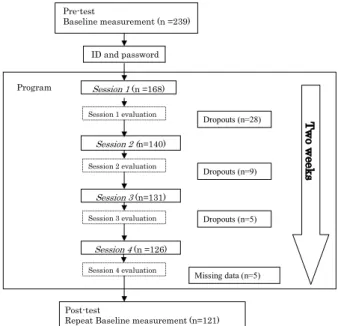
The design of this study was a single group pre-, post- test design. After completing the baseline questionnaire (pre-test), participants were given IDs and passwords and asked to access a website at their workplace or home, and to then carry out the programs of sessions 1 through 4 within two weeks (Fig. 2). The period of two weeks was determined based on the results of the development phase.
An evaluation questionnaire was given at the end of each session. A post-test was conducted approximately 2.5 wk after the pre-test. All measures and questionnaires were conducted on the web. The Research Ethics Committee
of the University of Tokyo reviewed and approved the study protocol.
Subjects
We recruited participants in cooperation with a busi- ness magazine, P, in March, April, and May 2006. We placed announcements on the magazine’s Web site, in its semimonthly issues, and in its e-mail messages, which are sent out twice monthly. Two hundred and fifty-one par- ticipants had access to the host server of the program and agreed to participate in the survey (Fig. 2). Of this num- ber, 239 completed the pre-test, 168 started on the pro- gram, 28 dropped out after session 1 (16.6% of those who started), 9 after session 2 (5.4%), and 5 after session 3 (3.0%). The number completing the program totaled 126 (75%). A total of 121 people completed the pos-test, or 72.0% of the number that started the program. Those who did not complete the program within the specified two weeks were regarded as dropouts, and were counted among the dropouts after the individual sessions they each had completed.
Program
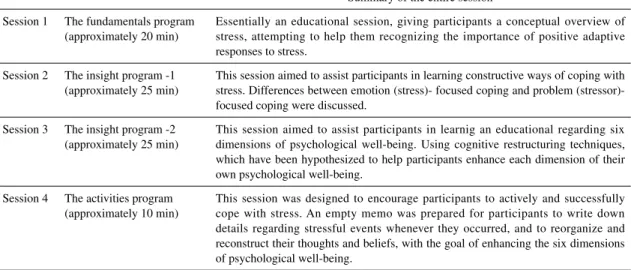
The program used in this study aimed to improve psy- chological well-being as a positive psychological function of humans18, 19) (Table 1). The program consisting of four sessions, provided with modifications, to incorporate the knowledge obtained in the development phase16). All sessions started with session’s objectives, and to gain the attention of the participant graphics and music were used.
The web pages also contained some quizzes to assess par- ticipant’s stress level. A part of this program used cog- nitive behavior therapy, and the results of the formative evaluation implemented in the development phase before this study confirmed the potential effectiveness of the pro- gram16).
Although well-being has conventionally expressed the feelings of happiness and satisfaction, it is known from previous studies that Ryff’s psychological well-being is a psychological function formed by the environmental fac- tors and experiences of the person and is useful in pre- dicting the mental and physical conditions of that per- son18). Measuring these parameters can be effective in understanding the resilience of a person encountering an adverse situation19) and a few researchers have reported the effectiveness of psychological well-being therapy that targeted people with mood and anxiety disorders20, 21). Measurement items
Basic attributes
Gender, age, educational background, occupation, size of employer, the frequency of using a personal comput- er, and whether stress has been experienced within the
past week.
Evaluation of the sessions
Because any Web-based program needs to be carried out alone, it is important to encourage participants to con- tinue the program. The present one was created after the ARCS model, which Keller called an indicator of how encouraging learning materials can be for those who use them22, 23). According to ARCS model, learning materi- al should be found interesting by the learner (attention), evaluated as useful for the learner’s life and as worth doing (relevance), increase the learner’s self-efficacy belief (confidence—“this can be done”), and provide the learner with the feeling that it is good that he or she has completed it (satisfaction). The ARCS evaluation factors are similar to the psychological changes identified as the mediating variables of a program outcome in previous studies, such as positive feelings obtained by participa- tion in the program (intention)24), hope regarding the
PROCESS EVALUATION OF A WEB-BASED SMP 267
Fig. 1. The Program Impact Theory (above) and Hypothetic model (below).
T1=pre-test.
The changes in psychological well-being were calculated by subtracting T1 points from T2 points (post-test).
Greater changes indicate a greater improvement. The changes in CES-D scores were obtained by subtracting T2 points from T1 points. The higher scores indicate a greater improvement in depression.
Fig. 2. Flow of the intervention.
effects of the program (expectation)12, 25), and feelings of self-efficacy (self-efficacy belief)14, 26).
Based on the above discussion, this study used the fol- lowing four items, as mediating variables, as well as for evaluation of the sessions. Responses were solicited on a five-point scale, ranging from “strongly agree” (5 points) to “strongly disagree” (1 point). The higher the score, the more positively the program was evaluated.
・Informative—Do you believe this session was useful to increase your stress-coping ability?
・Enjoyment—Did you enjoy working on this session?
・Intention to act—Did you feel like you wanted to increase your stress-coping ability by working on this session?
・Self-efficacy belief—Did you believe you could increase your stress-coping ability by working on this session?
Psychological well-being
Ryff’s PWB scale was used to measure psychological well-being18, 22). This is a self-rated 43 item inventory that covers six dimensions of well-being: Autonomy (8 items), Environment Mastery(6 items), Personal Growth (8 items), Positive Relations with Others (6 items), Purpose in Life(8 items), and Self-acceptance(7 items).
Responses were solicited on a five-point scale, ranging from ‘strongly disagree (1)’ to ‘strongly agree (6)’ (total score range =43–258).
Depression
We used the 13-item version of the Center for Epidemiologic Studies Depression Rating Scale (CES- D)23) (range = 0–39). This scale consists of the 12-item abridged version of the 20-item scale by Radloff27) and one positive item. We decided to use the 13-item ver-
sion because Kinoshita indicated that it was more desir- able after examining the reliability and validity of the 12- item version28).
Analysis method
For analysis, we used SPSSTM 12.0 for Windows in combination with AmosTM 5.0.
To statistically assess the average values of indepen- dent statistical populations, the χ2test was used when the variable was binary, and the Mann-Whitney U test was used when it was continuous. Wilcoxon matched-pairs signed-rank test was used to reflect the evaluation of the sessions by the participants. To compare the average val- ues of the pre-intervention and post-intervention program, paired t-test was used. To consider the possible mecha- nism of the intervention, which would reflect the causal relationship of program effects, we built a hypothetic model based on the program impact theory (Fig. 1) and conducted path analysis. This method was based upon a study conducted by Nowacek et al29). In this model, the sessions evaluation shows the total of the five-point scores of four questions of all sessions. The higher scores indi- cate that the participants were more affirmative. The changes in psychological well-being were calculated by subtracting T1 points (pre-test) from T2 points (post-test).
Greater changes indicate a greater improvement. The changes in CES-D scores were obtained by subtracting T2 points (post-test) from T1 points (pre-test). The high- er scores indicate a greater improvement in depression.
To test the goodness of fit of the model, we used the χ2 test, RMSEA (root mean square error of approximation, 0.05 or smaller), CFI (comparative fit index, 0.95 or greater), and NFI (normed fit index, 0.95 or greater).
Table 1. Summary of the program
Results
Basic attributes of program participants
Table 2 presents the basic attributes of the 168 people who started on the program. The average age was 39.3 ± 8.7 yr, most of whom were male. Of these, 93.5%
responded that they used personal computers every day, which indicated they had the equipment and skills to work on a Web-based program. A CES-D score was 10.3 ± 8.3, which was significantly lower than the 71 who answered the pre-test but did not participate in the program (p<0.05). We also found that 16.7% of the 168 who start- ed answered ‘yes’ to the experience of stress, was sig- nificantly less than the 36.6% who did not participate in the program (p<0.05).
Participant evaluations of the sessions
The observed evaluation score for each session are shown in Table 3. The median was 4 to 5 points and the interquartile range was 0.0 to 1.0 for all items (range=1–5). For the informative and self-efficacy belief dimension, the first quartile was 4 points in session 2, ses- sion 3 and session 4, and the observed evaluation score was statistically significant increased between session 1 and other sessions. For the item enjoyment, the first quar- tile was 3 points in session 2 and session 4, and the ses- sion 1 was evaluated most affirmatively by participants.
For the item intension to act, the first quartile was 4 points in all sessions and no significant differences were found between session 1 and other sessions. Additionally, mod- erate to large correlations according to Cohen’s criteria30) were found among all evaluation measures. No signifi- cant difference were found in the total scores of four ques- tions between session 1 and others.
Figure 3 presents the average values of psychological well-being and CES-D scores of the pre-, and post-test.
The psychological well-being scores showed positive and statistically significant increase (p=0.000). In terms of the CES-D scores, no significant differences were found between before and after intervention; however, the scores after intervention were lower than those before interven- tion.
The characteristics of the dropouts
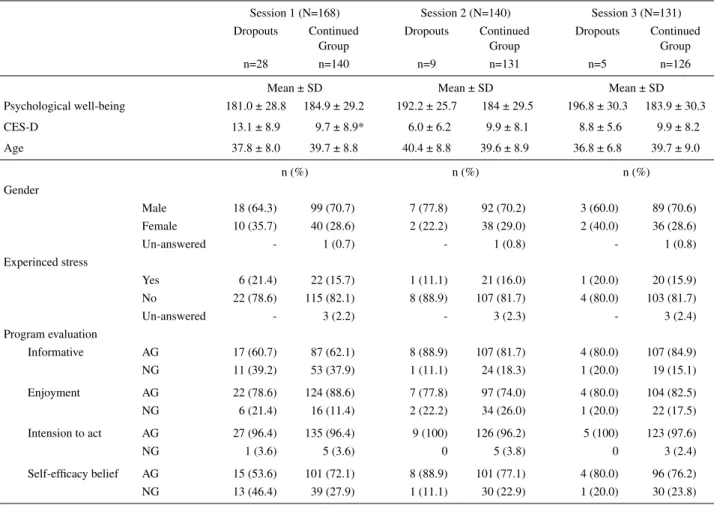
Those who dropped out after session 1 had an average CES-D score of 13.1 ± 8.9, which was significantly high- er than that of those who continued (Table 4). No dif- ferences were found between the dropout group and the group that continued the program in terms of participant attributes or their evaluations of the session after experi- encing session 2 and later sessions.
The mechanisms of program effect
The model depicted in Fig. 1 was tested and represented an acceptable, but not good, model-data fit (χ2(df)=0.758 (3), p=0.110, RMSEA=0.07, CFI=0.986, NFI=0.965).
The paths from before-intervention depression (CES-D) to participants’ evaluations about the session and changes in psychological well-being was not statistically signifi- cant, we fixed these paths zero and the model provided a better fit. Figure 4 represents the final results of the hypo- thetic model. The figure shows only the statistically sig-
PROCESS EVALUATION OF A WEB-BASED SMP 269
Table 2. Participants demographic characteristics (N=168)
nificant paths. Whether the participants had experienced stress produced no significant path and is not shown in this figure. The gender is not shown for the same rea- son. Based on the following figures, the goodness of fit of the model was satisfactory: χ2(df)=0.592 (4), p=0.441, RMSEA=0.000, CFI=1.00, NFI=0.998). Participant eval- uations about the sessions shows the total of the five-point scores of all sessions. Higher scores indicate that the par- ticipants were more affirmative (range=16–80). The changes in psychological well-being were calculated by subtracting the before-intervention points from the after- intervention points. Greater changes mean that the psy- chological well-being had greater improvement. The CES-D scores were obtained by subtracting the after- intervention points from the before-intervention points.
The higher scores indicate a greater improvement in depression.
Participants with higher psychological well-being before intervention, evaluated the sessions more positive- ly (β=0.41, p<0.001). No direct influence of depression
prior to intervention (CES-D T1) was found in the par- ticipant evaluations of the sessions and changes in psy- chological well-being. Participant evaluations of the ses- sions directly predicted changes in psychological well- being (β=0.29, p<0.01), and changes in the psychological well-being predicted changes in the CES-D (β=0.50, p<0.001).
Discussion
As a result of the evaluation of the process of a Web- based stress management program that is being imple- mented to improve psychological well-being, the fidelity and the mechanism of the program effect were confirmed.
Moreover, several important results were obtained to allow greater performance in implementation of the pro- gram. First, the majority of participants evaluated the pro- gram affirmatively after all sessions, and no significant differences were found in the evaluations between the dropout group and the group of those who continued the
Table 3. The sessions evaluation
Fig. 3. Pre- and post-intervention outcome measures.
N=121 Paired t-test.
Values are expressed as mean+SD.
program. These findings suggest that this program satis- fies the requirements as a self-study tool following the method of the ARCS model. The number of participants who evaluated the self-efficacy beliefpositively increased after session 1. This result might indicate that the nega- tive cognition of participants may have switched to pos- itive cognition as they proceeded with the program. High intension to act scores were reported by the majority of participants, suggesting that the program effectively moti- vated participants to take measures to improve their psy- chological well-being. As for the evaluation of the item enjoyment, session 1 was the most positively evaluated session. Previous studies indicated that enjoying the pro- gram can be a motivation factor to increase self-efficacy belief14). Therefore it is possible that the evaluation of enjoyment may trigger a rise in the evaluation of self-effi- cacy belief.
Second, participants who dropped out after session 1 had significantly higher depression score. This tendency
was also observed among participants who completed the pre-test but did not undertake the program. Previous stud- ies that implemented Web-based programs for those in depressive conditions indicated that a Web-based program had the benefit that it was easier for them to participate in than a face-to-face program31–33). However, the results of the present study indicate that participants in a depres- sive condition are easily discouraged from continuing the program, or they tend to feel confused about the program, despite the fact that they might be interested in it.
Furthermore, 25.0% of the participants dropped out before completing the program. In a Web-based antismoking program for college students, participants were recruited through magazines and street posters, and the program process was evaluated similarly. Of those participants, 57.1% dropped out before completing the program34). This suggests that although the dropout rate of the pre- sent program needs to be examined in the future, the rate of dropouts was not extremely high.
PROCESS EVALUATION OF A WEB-BASED SMP 271
Table 4. The characteristics of dropouts
As a result of path analysis, based on the impact the- ory, the path from the participants’ evaluation of the ses- sions to changes in psychological well-being was signif- icant, confirming that the evaluation of the program was a mediating variable of the outcome. This finding agrees with the knowledge obtained in previous studies that psy- chological changes and enjoyment are the mediating vari- ables of program effects11, 14, 16, 35). The path from depression before intervention was insignificant with regard to changes in participant evaluations of the ses- sions or psychological well-being. Previous studies indi- cated that the stress level before intervention could easi- ly influence the program effects. However, such knowl- edge must be used for outcome evaluation and examined in comparison with the control group. The path from changes in psychological well-being to changes in the CES-D was significant. This result reflects that psycho- logical well-being is an internal resistance resource to cope with stress, following the concept of salutogenesis developed by Antonovsky36).
It should be noted that this study has several limita- tions that must be discussed along with future directions.
First, the study implemented only quantitative examina- tions and did not interview participants. Therefore, we couldn’t know the real reasons why participant dropped out. When participants placed inquiries by e-mail, we handled them appropriately (for example, screens or sounds might not have started, depending on the system configuration of the personal computer). It is still possi-
ble that something unpredictable would occur before pro- gram implementation and that these factors were not suf- ficiently addressed, or that participants dropped out because of an unanticipated factor. It is desirable to send a simple questionnaire to dropouts where possible to obtain knowledge for the future, thus improving the pro- gram as much as possible. Second, we recruited partici- pants through a business magazine. Almost all of the par- ticipants were white-collar workers, relatively healthy and had high educational backgrounds, meaning that careful consideration is necessary before generalizing the results of this study. Third, of the 251 people who agreed to participate and registered in the program, only 121 (48.2%), fewer than half, completed the program up to the post-test. Those participants who were analyzed may represent a group with high interest in stress management or were more highly motivated among all those who reg- istered. Forth, this study was based on a single group pre-, post-test design, and there was no control group.
Therefore, no firm conclusions of the effectiveness of the program can be drawn from the results, and randomized controlled studies will be required to outcome evaluation to be conducted in the next stage.
Conclusion
This study has evaluated the process of implementing a Web-based program aiming to improve psychological well-being, originally developed by Kawai et al16). As a
Fig. 4. The mechanisms of program effect.
χ2(df)=0.592(4), p=0.441, RMSEA=0.000, CFI=1.000, NFI=0.998.
*p<0.05 **p<0.01 ***p<0.001.
The sessions evaluation shows the total of the five-point scores of four questions of all sessions. The higher scores indicate that the participants were more affirmative. The changes in psychological well- being were calculated by subtracting T1 points (pre-test) from T2 points (post-test). Greater changes indi- cate a greater improvement. The changes in CES-D scores were obtained by subtracting T2 points from T1 points. The higher scores indicate a greater improvement in depression.
result, it was found that the participants whose evaluation of the program sessions was more positive achieved greater psychological well-being improvement and relieved depression. More specifically, the program can be effective if the participants feel enjoyment, find the program informative to increase their ability to cope with stress, and increase their self-efficacy belief that they want to increase this ability and that the program will enable it.
Acknowledgements
This research was partially supported by Grant in Aid for Scientific Research for 2009: Foundation Research (Topic number 21243033) the Ministry of Education, Culture, Sports, Science and Technology.
References
1) Jones DL, Tanigawa T, Weiss SM (2003) Stress man- agement and workplace disability in the US, Europe and Japan. J Occup Health 45, 1–7.
2) The Ministry of Health, Labour and Welfare. Worker healthy situation investigation in 2002 fiscal year.
http://www.mhlw.go.jp/toukei/itiran/roudou/saigai/anzen/
kenkou02/index.html. Accessed June 1, 2006.
3) Murphy LR (1996) Stress management technique: sec- ondary prevention of stress. In: Handbook of work and health psychology, 427–44, John Wiley & Sons, New York.
4) Murphy LR (1984) Occupational stress management: a review and appraisal. J Occup Psychol 57, 1–15.
5) Dolezal-Wood S, Belar CD, Snibbe J (1998) A com- parison of computer-assisted psychotherapy and cogni- tive-behavioral therapy in groups. J Clin Psychol 5, 103–15.
6) Hasson D, Anderberg UM, Theorell T, Arnetz BB (2005) Psycho physiological effects of a web-based stress management system: a prospective, randomized controlled intervention study of IT and media workers.
BMC Pub Health 5, 1–14.
7) Goldenhar LM, Lamontagne A, Katz T, Heaney C, Landsbergis P (2001) The intervention research process in occupational safety and health: an overview from the national occupational research agenda intervention effectiveness team. J Occup Environ Med 43, 616–22.
8) Lavoie JP, Ducharme F, Levesque L, Herbert R, Vezina J, Gendron C, Preville M, St-Laurent C, Voyer L (2005) Understanding the outcomes of a psycho-educational group intervention for caregivers of persons with dementia living at home: A process evaluation. Aging Ment Health 9, 25–34.
9) Harachi TW (1999) Opening the black box: using process evaluation measures to assess implementation and theory building. Am J Com Psychol 27, 715–35.
10) Baranowski T, Anderson C, Carmack C (1998)
Mediating variable framework in physical activity inter- ventions: how might we do better? Am J Prev Med 15, 266–97.
11) Ajzen I, Fishbein M (1980) Understanding attitudes and predicting social behavior, Prentice Hall, Englewood Cliffs.
12) Bond FW, Bunce D (2000) Mediators of change in emo- tion-focused and problem-focused worksite stress man- agement interventions. J Occup Health Psychol 5, 156–63.
13) Dishman RK, Motl RW, Saunders R, Felton G, Ward DS, Dowda M, Pate RR (2004) Self-efficacy partially mediates the effect of a school-based physical-activity intervention among adolescent girls. Prev Med 38, 628–36.
14) Dishman RK, Motl RW, Saunders R, Felton G, Ward DS, Dowda M, Pate RR (2005) Enjoyment mediates effects of a school-based physical-activity intervention.
Med Sci Sports Exercise, 478–87.
15) Bunce D, West MA (1996) Stress management and innovation interventions at work. Hum Relations 49, 209–32.
16) Kawai K, Yamazaki Y, Nakayama K (2007) Development and formative evaluation of a Web-based stress management program to promote psychological well-being. J Health Hum Ecology 73, 137–51.
17) Rossi PH, Lipsey MW, Freeman HE (2004) Evaluation:
a systematic approach, 7th Ed., 133–68, Sage Publication, Thousand Oaks.
18) Ryff CD (1989) Happiness is everything, or is it?
Exploration on the meaning of psychological well- being. J Pers Soc Psychol 57, 1069–83.
19) Ryff CD, Singer B, Love GD, Essex MJ (1998) Resilience in adulthood and later life: defining features and dynamic processes. In: Handbook of aging and mental health: an integrative approach, Lomarnaz J (Ed.), 69–96, Plenum, New York.
20) Fava GA, Ruini C (2003) Development and character- istics of a well-being enhancing psychotherapeutic strat- egy: well-being therapy. J Behav Ther Exp Psychiatry 34, 45–63.
21) Fava GA, Ruini C, Rafanelli C, Finos L, Salmaso L, Mangelli L, Sirigatti S (2005) Well-being therapy of generalized anxiety disorder. Psychother Psychosom 74, 26–30.
22) Keller JM (1983) Motivational design of instruction. In:
Reigeluth CM (Ed.), Instructional-design theories and models: An overview of their current status, Lawrence Erlbaum Associates, New Jersey.
23) Keller JM, Suzuki K (1988) Use of the ARCS motiva- tion model in courseware design. In: Instructional- design for microcomputer courseware, Jonassen D (Ed.), Lawrence Erlbaum Associates, New Jersey.
24) Ajzen I (1991) The theory of planned behavior. Org Behav of Human Decision Processes 50, 179–211.
25) Bunce D (1997) What factors are associated with the outcome of individual-focused worksite stress manage-
PROCESS EVALUATION OF A WEB-BASED SMP 273
ment intervention? J Occup Org Psychol 70, 1–17.
26) Kelly RB, Zyzanski SJ, Alemago SA (1991) Prediction of motivation and behavior change following health pro- motion: role of health beliefs, social support, and self- efficacy. Soc Sci Med 32, 311–20.
27) Radloff LS (1977) The CES-D Scale. A self-report depression scale for research in the general population.
Appl Psychol Meas 1, 385–401.
28) Kinoshita E (2001) Examining 16 items short version CES-D Scale, 141–54, National Family Research, Tokyo.
29) Nowacek GA, O’Malley PM, Anderson RA, Richards FE (1990) Testing model of diabetes self-care manage- ment: a causal modelr analysis with LISREL. Eva Health Prof 13, 298–314.
30) Cohen J (1988) Statistical power analysis for the behav- ioral sciences, 2nd Ed., Lawrence Erlbaum Associates, New Jersey.
31) Tate DF, Zabinski MF (2004) Computer and internet
applications for psychological treatment: update for clin- icians. J Clin Psychol 60, 209–20.
32) White J, Jones R, McGarry E (2000) Cognitive behav- ioral computer therapy for the anxiety disorders: a pilot study. J Ment Health 9, 505–16.
33) Newman MG, Consli A, Barr Taylor C (1997) Computers in assessment and cognitive-behavioral treat- ment of clinical disorders: anxiety as a case in point.
Behav Ther 28, 211–35.
34) Escoffery C, McCormick L, Bateman K (2004) Development and process evaluation of a web-based smoking cessation program for college smokers: innov- ative tool for education. Patient Educ Couns 53, 217–25.
35) O’Leary A (1992) Self-efficacy and health: behavioral and stress-physiological mediation. Cognit Ther Res 16, 229–45.
36) Antonovsky A (1987) Unraveling the mystery of health, Jossey Bass, San Francisco.