
近畿大学学術情報リポジトリ
25
0
0
全文
(2) ft* • i-lififfft. —CV. proficiency (usually through gains in TOEIC scores) without providing more classroom contact hours with students, ER is certainly one means of doing this. Finally, ER is (by itself) a how-to in regards. to language learning. ER is an easy, low cost method for. students to learn language on their own, without the assistance of an instructor.. The Study's Inspiration Day and Bamford's. (1998) primary. goal for students. is to read as much as. possible, both in and outside of class. Yet what is a lot of reading and how can it be verified that students read as much as possible? Can a lot of reading be quantifiable as a reading goal for each student? And, if this is possible, how can the instructor help each student. reach his or her goal? It is these questions. that led to the action research. contained in this paper. The inspiration for the design of the action research was threefold: (1) over five years experience creating and modifying an extensive reading component, delving into the field of procrastination,. and (3) the bestseller,. (2) a study. Freakonomics.. What. follows is a brief explanation of each inspiration. Conducting a successful ER component is a process of trial and error. Over five years, with constant innovations, adjustments, as well as a few restrictions. placed upon. students, the ER component at a large Japanese university has evolved so that it could be expanded. from a few classes to an entire faculty. The initial innovation included. moving from books to word counts in order for students to fulfill the ER requirement. In year two, the Moodle Reader Module (MRM) was introduced feature to ascertain. whether. students. graded readers. Yet the MRM presented. were actually reading. as an accountability. and comprehending. the. two additional hurdles for the ER component.. One was teaching students how to create a Moodle Reader account and the second was training students how to use the computer program. In years restricting. three. and four, further. adjustments. acceptable publishers of graded readers. were made. These. included. (Cambridge, Cengage, MacMillan,. Penguin, and Oxford), restricting the graded reader levels that could be read (Starter, Level 1 and Level 2), and finally prohibiting students from reading graded readers that were also movies (i.e., Jumanji, Notting Hill, and Jurassic Park to name a few). It was discovered. that some students. were selecting. circumvent. the reading task. In year five, the present year, class sets of Oxford graded. — 248 —. movie graded. readers. in order. to.
(3) GoalSettingand Accountability readers. were purchased. Architecture component. so that eight first-year. could participate over. unacquainted. an entire. English classes. in the ER component.. faculty. required. a training. in the Faculty. This expansion session. of. of the ER. for all teachers. with ER as well as the MRM. In addition, close management was required. to ensure the ER component's success. ER was expanding to include more students yet a few nagging problems still persisted. Through many students semester.. in years one through. casual observation,. four were not reading. Instead, they were fulfilling the ER component. times during the semester.. it appeared that. throughout. the entire. in short bursts. at various. An even bigger problem concerned motivation. students were completing only the bare minimum ER requirement.. as many. These observations. led to two questions:. •. What mechanism(s). could be installed. in the ER program. to ensure. that. students read throughout the semester? •. How could students. set ER goals that were ambitious and what could be done. to assist students in reaching their goals?. To answer these questions, the (second) inspiration "P. rocrastination,. study, students. deadlines, and performance". came from a study entitled. (Ariely and Wertenbrock,. 2002). In this. in three sections of a large lecture class were required to write three. short papers for a semester-long executive-education. course at an American university.. Students in the Last-class section were told the deadline for all three papers was the last class meeting. Students. could turn the papers in earlier but there was no grade. benefit in doing so. Students in the No-choice section were given deadlines for each of the three papers; a paper due at the end of each third of the course. In the Free-choice section, students were allowed to set their own deadlines for each of the three papers. In other words, each student. was free to choose the dates that he or she wanted to. hand in the short papers. Once the dates were decided upon, the due dates were final and could not be changed. It was explained. to all sections that the due dates were. binding, and for each day of delay in submitting a paper, there would be a 1% penalty in the paper's overall grade. The rational course of action for the Free-choice section students. would be to. submit all three papers on the last possible day of the semester. By doing this, students. — 249 —.
(4) ft* • i-liftefft. –CV. would have the most time to work on their papers, and they could avoid penalties for late paper submissions. Carrying this line of thought even further, the students'. papers. should be of higher quality since they would have more time to explore the topic in depth and more time to put their thoughts and ideas on paper. In effect, students could budget. their own time accordingly. Interestingly,. and arrange. most of the Free-choice students. roughly one-third intervals throughout their own problems. What were the results. as they desired.. decided to space their papers out in. the course. It appears these students. with procrastination. themselves and their procrastinating. their workload. and set deadlines. in order. knew of. to control. behavior.. of the study?. The students. in the No-choice section. received the best overall grades for the three short papers. Next came the Free-choice section with the Last-class section pulling up the rear (i.e., worst performing The results. suggest. that students. do procrastinate,. Second, tightly controlling their freedom. section).. which is of no surprise. at all.. (i.e., due dates for papers that were equally. spaced across the course) is the best cure for procrastination. and likely ensures the. highest quality of work. Finally, allowing a mechanism for students to choose their own deadlines was beneficial in helping these same students Free-choice section outperformed. attain better. grades as the. the Last-class section.. In relation to the ER component and the questions raised previously, the results inspired this author. to replicate. Ariely &Wertenbrock's. study. (albeit in a slightly. modified form) to see if similar results could be found. Could Japanese students procrastination,. read extensively throughout. avoid. the semester and meet their reading goals. under similar conditions?. The third and final inspiration Freak. came from a short passage from the bestseller,. onomics (Levitt & Dubner, 2005). "E. conomics is, at root, the study of incentives: how people get what they want, or. need, especially when other people want or need the same thing. Economists love incentives. They love to dream them up and enact them, study them and tinker with them. The typical economist. believes. the world has not yet invented. a. problem that he cannot fix if given a free hand to design the proper incentive scheme. His solution may not always be pretty—it. — 250 —. may involve coercion. or.
(5) Goal Setting. exorbitant. penalties or the violation of civil liberties—but. the. rest assured, will be fixed. An incentive is a bullet, a lever, a. and Accountability. original key:. problem,. an often. tiny. object with astonishing power to change a situation." (p. 22). The passage provided. me with the key innovation for the ER component, that. being to provide both an incentive for the students to read a lot as well as a penalty if they fail to do so. The incentive in the ER component from the outset was to earn a high grade. Over the years, many students bought in to this incentive, reading a lot and earning a high grade. Yet there were always some students who failed to read to their potential; in short, a high grade didn't seem to interest them. For these students, doing the bare minimum and getting by was sufficient. Would a penalty for not reading work on these students Perhaps. to kick-start. them into reading. having both a positive and a negative. would entice those students force those students. more than the bare minimum?. incentive was needed. The incentive. who want a high grade to read a lot; the penalty would. who are not interested. in a high grade to read throughout. the. semester in order to avoid incurring the penalty. The three inspirations mentioned previously led to specific research questions: 1.. What ER word-count goals will students select for themselves? Will students be ambitious or will they take the easy route and shoot for the bare minimum?. 2.. Can students commit to an ER word-count goal and meet their goal?. 3. Is a penalty necessary to nudge students along? Or can students meet their goals with only a positive incentive? 4. Is it best for students to decide the amount of ER to be completed towards their goal as well as the due dates for when ER will be checked? Or, is it better for the reading amounts and the check dates to be decided by the instructor? 5. In selecting reading check dates and reading word-count amounts, what choices will students make? Will students opt for the most rational choice, choosing to have their reading checked in the last three class meetings of the semester?. — 251 —.
(6) ft* • 1-11fifflk STUDY: CAN STUDENTS TAKE MATTERS. INTO THEIR OWN HANDS?. Method Participants This study took place during a semester-long Japanese. university. were 114 first-year. first-year English course at a large. in the first semester. of the 2011-2012 academic year. Participants. university. The students. students.. intact classes, three from the Faculty Faculty of Architecture.. for this study came from four. of Science and Engineering,. and one from the. The course, a four-skills Oral English class, was identical across. the four intact classes in terms of textbook, instruction and assessment. Each of the four classes included an ER component, grade,. the other. performance. which accounted. 60% came from quizzes. for 40% of each student's. and tests. final. (40%) as well as classroom. (20%).. Procedure During the first-class meeting, the instructor went over the course syllabus, which included. detailed. instructions. meeting,. students. were shown data from the previous. students. concerning. students'. concerning. the ER component.. In the second-class. academic. year of first-year. actual ER word counts along with each student's. final. course grade (see Appendix A & B). This data came from two intact classes, one from the Faculty of Science and Engineering. and the other from the Faculty of Architecture.. Since this was most likely each student's. first exposure to ER, showing them actual. data from the previous year gave each student some perspective on the amount of ER that could be accomplished in one semester. Also, since the ER component is weighted highly in terms of a student's. final grade (40%), there is a very strong. correlation. between what a student reads and their actual final grade. In short, the ER data from the previous year demonstrated. quite clearly that the more a student reads, the higher. his or her final score will be. After explaining the ER word-count data, each student was required to commit to an ER goal for the semester. and write it on a slip of paper. (see Appendix C). This paper was then collected. Presumably, each student in the study could look at the ER word-count data and final grades from students. in the previous year's classes, and then make an informed. decision about an appropriate ER word-count goal. Before committing to the word-count goal, three of the four intact classes were warned that there would be a penalty for. — 252 —.
(7) Goal Setting. each student if their particular. and Accountability. goal could not be reached. (The fourth class, being the. control class, was not informed of the penalty. since it would not be used.) It was. explained that the penalty would be minus 0.5 words for each word they were short of their ER word-count goal. In other words, if a student's ER word-count goal was 25000 words but the student only read 20000 words, there would be a penalty of 2500 words ( (25000-20000) x 0.5). This student. would therefore. be awarded. 17500 words even. though 20000 words were actually read. Finally, once each student committed to a goal, that goal was binding and could not be changed.. The four intact classes were as follows: Free-choice: After committing to a word-count goal, students were told that their reading would be checked three times during the semester. course. Each student could. decide after which class meeting the instructor would check their ER, as well as how much of their ER goal would be completed by that date. If they failed to meet their stated goal on the date of the check, a penalty of 0.5 words would be assessed for each word short of their goal. No-choice: After committing to a word-count. goal, students. were told that their. reading would be checked three times during the semester course. The three dates for the ER were decided by the instructor. (roughly at the end of each third of the course).. In addition, one-third of their ER goal had to be completed by that date. If they failed to meet their goal on the date of the check, a penalty of 0.5 words would be assessed for each word short of their goal. Last-class: After committing to a word-count goal, students. were told that they. must reach their goal by the last class meeting of the semester. Their reading would be checked after the last class meeting of the semester for grading purposes. If they failed to meet their stated goal, a penalty of 0.5 words would be assessed for each word short of their goal. No-penalty: After committing to a word-count goal, students were told that they should try to reach their goal by the end of the semester. checked after the last class meeting of the semester. for grading. class, no penalty was assessed for not reaching their ER goal.. — 253 —. Their reading. would be. purposes. For this.
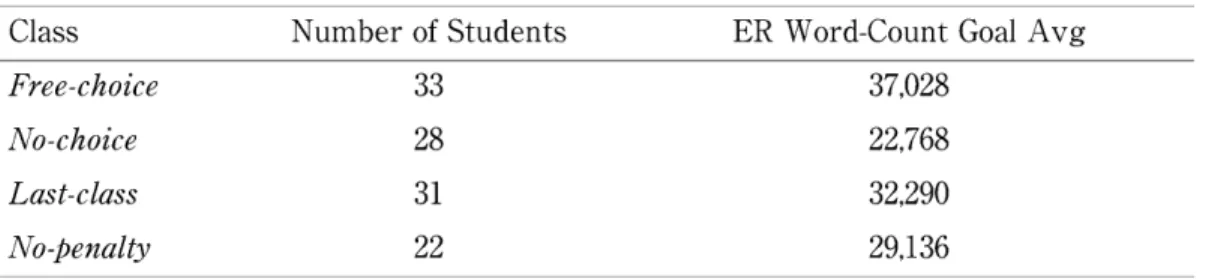
(8) ft*. • 1-111,11-ft. Table. 1. The. :/ 37—CV. four. classes. Class. Reading. Goal. Reading. Check. Word. Penalty. Free-choice. Decided. by student. No-choice. Decided. by student. Last-class. Decided. by student. 1 time,. semester. end. Yes. No-penalty. Decided. by student. 1 time,. semester. end. No. 3 times, 3 times,. decided decided. by student. Yes. by instructor. Yes. For the Free-choice and No-choice classes, a worksheet instructor could keep track of each student's ER performance. was created so that the (see Appendixes. D & E).. This worksheet was shown to each student following each of the three checks so that the student could be informed of his or her ER performance. The only difference in the worksheets. was the date and the reading amount. Again, in the Free-choice class, the. dates and the reading amount for each check were decided by the student. For the Nochoice class, the dates were predetermined. (May12, June 15, and July 21), and the. reading to be completed for each check had to be at least one-third of the student's total ER goal.. Results Three of the four classes had ambitious classified as moderately. reading. goals and one class could be. so (see Table 2). With 30000 words the amount needed to. reach full marks on the ER component. (i.e., 40 points), two class averages for reading. goals exceeded 30000 and one class averaged slightly over 29000 words. In effect, two classes (Free-choice & Last-class) were interested. in getting extra credit marks for the. ER component and one class (No-penalty) was interested The No-choice class was moderately. in getting nearly full marks.. ambitious with an average. word-count. goal of. nearly 23000 words. In terms of points towards their final course grade, reading 23000 words would give a student 34.4 out of a possible 40 points for the ER component, or an 86% completion rate.. — 254 —.
(9) Goal Setting. Table. 2. Average. word-count. Class. Number. goal. and Accountability. of 4 classes. of Students. ER Word-Count. Goal Avg. Free-choice. 33. 37,028. No-choice. 28. 22,768. Last-class. 31. 32,290. No-penalty. 22. 29,136. Turning our attention to the Free-choice class, the choices that the students made concerning. when their ER was to be checked were quite interesting. Over 80% of the Free-choice students the semester student. (see Table 3).. spaced their ER checks out evenly throughout. at roughly one-third semester. increments. (i.e., May, June, July). One. elected to have an early check with the final two checks at the end of the. semester. (May, July, July). Three students. into semester. chose to have the initial check two-thirds. with the final two checks at the end of the semester. (June, July, July).. And two students elected to have the ER checks in the final three class meetings (July, July, July).. Table 3. Free-choice students selections concerning 3 ER checks, (n=33) May/June/July Students. 27. May/July/July. June/July/July. 1. 3. The most rational choice for the Free-choice students. July/July/July 2. would be to have their ER. checked on the last three class meetings of the semester. By setting the check dates as late as possible, the students would have the most time to complete the ER without the possibility of incurring any word penalty. Surprisingly, only 2 of the 33 students elected to do so. The results indicate that students. prefer to self-impose deadlines. check dates) in order to overcome procrastination,. (i.e., ER. even though these deadlines may. prove to be costly. Students are willing to take the risk of losing words in ER (and thus potential points towards their final grade) in order to apply a self-control mechanism against procrastination. Let us now turn to the actual ER results from each of the four classes. Concerning the Free-choice class, the results can be seen in Table 4. Almost two-thirds of the Freechoice students were able to meet their ER goal by the end of the course (i.e., Check 3).. — 255 —.
(10) ft*. • 1-11111-1k. Yet the. Table. data. from. the Free-choice. 4. Free-choice. Check. Failed. goal to reach. goal. First, two students students. is a bit misleading.. data. n=33 Reached. class. 1. Check. Check. 23. 23. 21. 10. 10. 12. (8). (8). (10). picture. of what was going on in. of Table 4. As was discussed previously, of the 12 students. reach the final reading. 3. dropped out of the class in the early stages. Excluding these. from the data, you can see a better. parenthesis. 2. goal (i.e., Check 3), two students. dropped. who failed to. out and a third. student failed to read a single word after the first check. Like the two students. who. dropped the course, this student ended up with zero words toward his goal as he had incurred substantial penalties in checks 2 and 3. Three of the 12 students came very close to reaching their stated ER goal. These students. read substantially,. reading 32855, 33982 and 39637 words. They all received. full marks towards their final grade in the ER component, yet they didn't reach their stated ER goals. Perhaps their goals were too ambitious or, more likely, they realized that even with the word penalty in the third and final check, they still would receive full marks for the ER component.. In fact, only one student. in the Free-choice class. (excluding the two dropouts and the one who failed to read after the first check) read less than 10000 words. (the bare minimum). after penalties. Another student. cleared. 10000 words, but just barely. However, without word penalties, these two students read 14875 words and 20032 words respectively. The Free-choice. student's. overall. word-counts. were quite remarkable. (see. Appendix F). Out of 33 students, 25 (77%) completed the ER component to receive full marks. (i.e., reading more that 30000 words). Three students. count between. 20000 and 30000 words, two students. (9%) had a final word-. (6%) read between. 10000 and. 20000 words and three students ended up with zero words. Comparing. the Free-choice class to the two classes from the previous academic. year (see Appendixes. A, B, & F for data), the results show how well the Free-choice. class actually did. In the Free-choice class, 25 of 33 students. — 256 —. (76%) read over 30000.
(11) Goal Setting. and Accountability. words after word penalties, giving them full marks on the ER component and 26 did so (79%) if the word penalty is ignored. Compared to the previous academic year, only 17 of 28 (61%) in one class and 7 of 28 (25%) cleared the 30000-word hurdle. Turning to the No-choice class, these students did not perform as well as the Freechoice. As stated previously, this class was moderately. ambitious in regards to their ER. goal. Despite lower ER goals when compared to the Free-choice group, only 16 of 28 students. (57%) reached. their word-count. goal (see Table 5). Only seven students. (25%) completed the ER component, reading more that 30000 words. Six students read between 20000 and 30000 words, nine students and six students. read between 10000 and 20000 words,. read less than the bare minimum. Two of these six students. were. credited with zero words following the third and final check; one failed to read a single word and the other was heavily penalized leaving him with zero words.. Table. 5. No-choice. data. n=28. Check. Reached Failed. goal to reach. goal. Upon further. 1. Check. 2. Check. 16. 18. 16. 12. 10. 12. examination of the data, seven of the 28 students. 3. (an astonishing. 25%) were given penalties on each of the three checks. This is only speculation, but perhaps these students became demoralized with the penalty system and this might be the reason for their failure to reach their ER goal. Student 1 (see Table 6), for example, read over 10000 words yet due to penalties, his final word total was zero. Student 7 was also a procrastinator,. choosing to do the reading following checks 1 & 2. In the end,. though, this student read slightly more than 25000 words. Yet due to check 1 and check 2 penalties, his final word total was only 3163. Needless to say, it was hoped that the word penalty would be a motivating mechanism for students to stay current with their reading. For many, this was the case but for these seven students. (and perhaps a few. others), the exact opposite of what was intended may have occurred. The penalty may have demoralized. the students,. discouraging. them from doing ER as they became. buried in penalties. In a sense, the ER component may have been deemed a lost cause by these students due to substantial word penalties.. — 257 —.
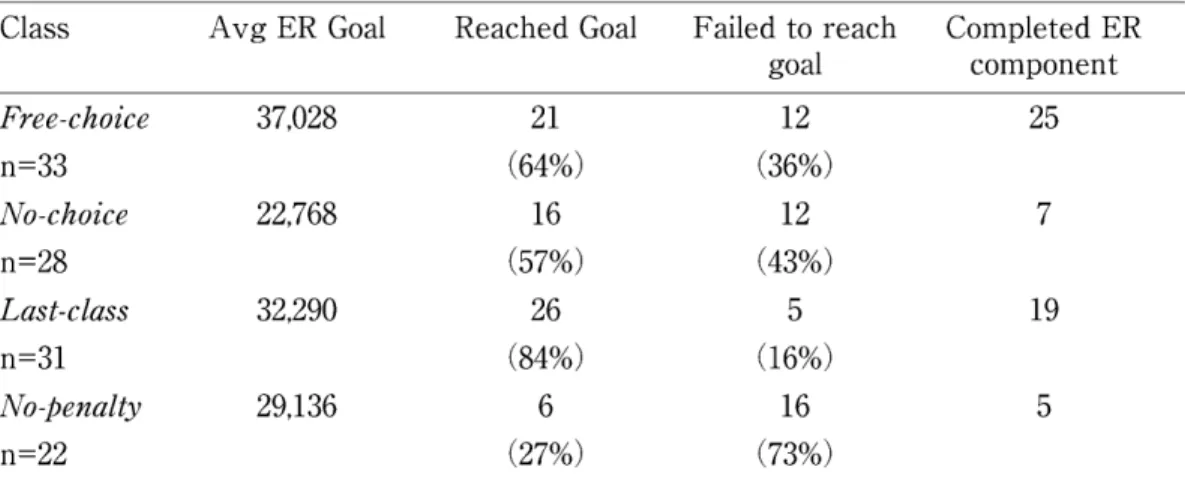
(12) Table. 6. No-choice. tudents. assessed. word. Check 1 Penalty. Check 2 Penalty. Check 3 Penalty. 1. 295. 5442. 2. 6500. 3. penalties. in all 3 checks. Total Penalty. Goal. 12614. 18351. 30000. 10214. 0. 2549. 7573. 16622. 40000. 27403. 17281. 2000. 5000. 8500. 15500. 12000. 0. 0. 4. 240. 3860. 2570. 6670. 20000. 18721. 12292. 5. 645. 2284. 8103. 11032. 30000. 16078. 5891. 6. 3334. 3611. 3679. 10624. 20000. 16253. 8963. 7. 5000. 9800. 10631. 25431. 35000. 23575. 3163. Finally, comparing. the No-choice students. academic year (see Appendixes word-count,. thus completing. Actual Words. to the students. Words. after. penalty. from the previous. A, B & G), only 25% (7 of 28) cleared the 30000 ER. the ER component. for full marks. The No-choice class. performance appears to be practically equivalent to one of the classes (see Appendix A data). from the previous. year when comparing. both those students. clearing. the. 30000-word mark as well as the class ER average. It is also apparent that the No-choice class underperformed. when compared to the other class of 2010-2011 (see Appendix B. data). Certainly, these were not the results that were hoped for when this study was undertaken. For the Last-class group, the final ER results were spectacular. Table. 7. Last-class. data. n=31. Last. Reached Failed. goal to reach. (see Table 7).. class. check. 26 goal. 84% of the students. 5. (26 of 31) met their goal with only 5 students. do so. Two students read over 500000 words (which translates 76 books for the other in only one semester),. (16%) failing to. to 75 books for one and. and four students read over 100000 words. (A fifth student nearly did so). Moreover, 17 of the 31 students read substantially than 30000 words, giving each student extra-credit Last-class group, only two of the five students. — 258 —. more. marks for the ER component. In the. who failed to meet their reading goal.
(13) GoalSettingand Accountability could be deemed failures. One student had a reading goal of 40000 words and ended up reading only 23191 words. After the word penalty, this student was awarded with 14787 words. The other student had a moderate ER goal of 20000 words, reading only slight more than half that (11670). After the word penalty, this student ended up with 7,505 words. The three others who failed to reach their goal came close. One had a very ambitious ER goal of 38000 words reading 37912. Another had a reading goal of 32000 words, reading 28164, and the third had a reading goal of 25000 words, reading 22069. In effect, these three came within one Level 1 graded reader of completing their goal— close but not quite there. When comparing the Last-class group to those from the previous academic year (see Appendixes. A, B, & H), 19 of 31 (61%) read 30000 words or more, thus receiving. full marks on the ER component. This percentage. is roughly the same as one of the. classes from 2010-2011 academic year and significantly better than the other (61% and 25% respectively). class students students. Due to two stellar students, the average word-count among the Last-. was slightly above 76000 words. Yet even when removing. from the mix, the average word count from the Last-class. these two. group was still. slightly more than 45000 words. When comparing the Last-class average (either with or without the two stellar students) class outperformed. to the two classes from the previous year, clearly this. the two 2010-2011 classes which averaged 38621 words on the high. end and 22768 on the low. The No penalty class, the fourth and final class in this study, had mixed results (see Table 8). This class acted as a control group, investigating penalty would be beneficial or not. It was anticipated their ER goal without. a penalty. whether or not the word. that few students. and this is exactly what occurred.. would reach. Only six of 22. students reached their ER goal for a success rate of only 27%. 73% failed to reach their ER goal (16 of 22). Moreover,. only five of 22 read more than 30000 words, thus. completing the ER component and receiving full marks. Six of 22 students between 20000 and 30000 words, and nine students. (27%) read. (41%) read between the 10000 and. 20000 word mark. Only one student failed to reach the bare minimum of 10000 words, falling short by a little over 200 words.. — 259 —.
(14) ft*. • 1-111fifilkil.-. Table. 8. No-penalty. data. n=22. Last. Reached Failed. the. goal goal. When. comparing. previous. year,. 16. the. was. were. motivated. word. penalty. less. performance. of the. that. No penalty. it appears. completed. average. check. 6. to reach. students. class. the than. ER. those. to read in effect,. the. component. few. reading. of 2010-2011. a lot in order students. No-penalty. classes.. to achieve had. any. class. students 30000. motivation. two. accomplished words. It appears a high. to the. grade.. far. and. that. classes. the. only. less.. Few. word-count. a few. In addition,. from. students. without. to achieve. their. stated. to reach. Completed component. the word. goal.. Discussion Table. 9. Reading. Class. data Avg. for all four ER Goal. classes Reached. Goal. Failed. goal. Free-choice. 37,028. 21. 12. 25. 22,768. (64%) 16. (36%) 12. 7. 32,290. (57%) 26. (43%) 5. 19. 29,136. (84%) 6. (16%) 16. 5. (27%). (73%). n=33 No-choice n=28 Last-class n=31 No-penalty n=22. In this section, each research. question. that was mentioned. previously. ER. will be. discussed. 1. What ER word-count goals will students select for themselves? Will students be ambitious or will they take the easy route and shoot for the bare minimum? As discussed previously, the students. in three of the four classes for this study. chose, on average, ambitious ER goals and the students in the fourth class chose more moderate. goals. It appears. academic goals for themselves,. that students,. when given data and are allowed to set. opt for fairly ambitious goals that will allow them to get. — 260 —.
(15) Goal Setting. and Accountability. a good grade. In short, the incentive given to the students to read a lot in order to be successful in the class seems to work. 2. Can students commit to an ER word-count goal and meet their goal? 3. Is a penalty necessary to nudge students along? Or can students meet their goals with only a positive incentive? To best answer the questions above, it's best to review the data again for each of the four classes (see Table 9). For the 3 classes that included the word-count penalty, more students were successful in reaching their goal than not. The same cannot be said for the one class in which there was no word penalty (No-penalty class). The numbers speak for themselves. with a success rate of 64%, 57%, and 84% compared. to a 27%. success rate for the No-penalty class. When combining the three classes with the wordcount penalty, the success rate was 68%. In short, more than two-thirds were successful in reaching their goal when their performance. of students. was closely monitored. and when a penalty was enforced. Yet when the word penalty was not in use, students appear to lack the motivation to reach their word-count incentive is not enough to motivate students. goal. It appears the positive. to reach their ER goals. Both the positive. incentive and the penalty are needed to maximize the number of students. who can. successfully reach their ER goal. 4. Is it best for students to decide the amount of ER to be completed towards their goal as well as the due dates for when ER will be checked? Or, is it better for the reading amounts and the check dates to be decided by the instructor? 5. In selecting reading check dates and reading word-count amounts, what choices will students make? Will students opt for the most rational choice, choosing to have their reading checked in the last three class meetings of the semester?. These questions deal with the Free-choice versus No-choice students. Since over 80% of the Free-choice students opted for 3 checks that were spaced out in roughly onethird semester. increments. (much like the students. questions seem a bit inconsequential. own procrastination. of the No-choice class), these. Students in the Free-choice class recognized their. habits and imposed deadlines on themselves to ensure that the ER. would get done. Only two students. in the Free-choice. opted to have their reading. checked on each of the last three class meetings. As was stated earlier, this is the most rational decision, as students. would have the most time to complete the ER without. — 261 —.
(16) incurring penalties. And only six of 33 students. (18%) chose reading check times that. were dissimilar to those in the No-choice class. Whether the teacher the ultimate recommended. dictates the due dates or the students. outcome appears. to be practically. even though. reading on various due dates throughout. these due dates were spaced in roughly one-third. increments. Perhaps pre-selecting Reminding students. decide the due dates. Certainly. reading in one sitting was easier and more efficient. than checking the Free-choice students' semester,. the same. For simplicity's sake, it is. for a task such as ER, that the teacher. checking the No-choice students'. choose themselves,. the. semester. due dates would be easier for the students. as well.. of set due dates is possible; the same cannot be said when due. dates are scattered at various times throughout. the semester.. Recommendation In conducting an ER component in an English as a foreign language course, the following is recommended. •. Have students commit to an ER goal .. •. Hold students. accountable for that goal . Reward students with high grades for. meeting their stated goals and doing a lot of ER. Conversely, penalize those students who fail to reach their goal and do little ER. •. Avoid excessive penalties as this can only demoralize students. Perhaps two checks is appropriate. and demotivate. some. in a semester course (This is also. a manageable workload for the instructor). •. Evaluate. each student's. ER performance. would act as a kind of warning,. at mid-semester . This evaluation. a wake-up call if you will, letting students. know how they are doing in regards to ER. If students. fail to meet half their. ER goal, a penalty should be incurred. •. At the end of the semester performance. If students. , do a final evaluation. of each student's. ER. fail to meet their ER goal, a final penalty should be. incurred.. Clearly, this study demonstrates. that most students. will commit to an ambitious. ER goal if that goal is clearly understood and within reach. Moreover, students need to be highly rewarded for their hard work (i.e., earn a high grade). Students also need to. — 262 —.
(17) GoalSettingand Accountability be held accountable for reaching their goals. Having a penalty for not reaching a goal is a strong incentive to stay the course, work hard, and complete what was agreed upon. Yet it is important. not to overly penalize students. Burying students. make successful completion might cause some students semester. in penalties can. of the task appear hopeless. This only demotivates. and. to throw in the towel and give up. Perhaps, giving a mid-. evaluation might be enough to nudge students. to do what we want them to. do. This evaluation would include a penalty. It would act as a kind of warning, letting the student. know what will happen if their goal is not met.. At semester's. end, if a. student still fails to reach his or her goal, a final penalty would be incurred. The above recommendation. allows for different learning styles, and it would not. overly penalize students who procrastinate promotes the idea of students Finally, there are incentives. or fail to understand. the ER task. Yet it still. setting their own goals and striving to reach that goal. (both positive and negative). to motivate the student. to. reach his or her goal, and thus succeed.. References Ariely, D. (2009). Predictably Irrational. (Revised and Expanded):. The Hidden Forces. That Shape Our Decisions. New York: HarperCollins. Ariely, D., and Wertenbroch, Self-control. K. (2002). Procrastination, by precommitment,. deadlines, and performance:. Psychological. Science, No. 13 (3),. 219-224. Cho, K., & Krashen, S. D. (1994). Acquisition of vocabulary from the Sweet Valley Kids series: Adult ESL acquisition. Journal of Reading, 37, 662-667. Cho, K.S. and Krashen, S. (1995). From Sweet Valley Kids to Harlequins. in one year.. California English 1,1: 18-19. Day, R. R., & Bamford, J. (1998). Extensive reading in the second language classroom. Cambridge: Cambridge University Press. Elley, W. B. (1991). Acquiring literacy in a second language: The effect of book-based programs. Language Learning, 41, 375-411. Elley, W. B., & Mangubhai, F. (1981). The impact of a book flood in Fiji primary schools. Wellington: New Zealand Council for Educational Research. Hafiz, F. M., & Tudor, I. (1990). Graded readers. — 263 —. as an input medium in L2 learning..
(18) ft* • 1-1111-fti. —CV System, I8, 31-42.. Levitt, S., & Dubner,. S. (2006) Freakonomics. [Revised and Expanded]:. Economist Explores the Hidden Side of Everything.. A Rogue. New York: William. Morrow. Mason, B., & Krashen, S. (1997). Can extensive reading help unmotivated. students. of. EFL improve? I. T.L. Review of Applied Linguistics, 117-118, 79-84. Nation, I.S.P. (1997) The language learning benefits of extensive reading. The Language Teacher 21, 5: 13-16. Nation, I.S.P. and Wang, K. (1999) Graded readers and vocabulary. Reading in a Foreign Language 12, 2: 355-380. Polak, J. & Krashen, S. (1988). Do we need to teach spelling? The relationship between spelling and voluntary reading among community college ESL students. TESOL Quarterly, 22(1), 141-146. Robb, T. N., & Susser, B. (1989). Extensive reading vs. skills building in an EFL context. Reading in a Foreign Language, 5, 239-251. Waring, R. (2009). The inescapable. case for extensive. Extensive reading in English. reading. In A. Cirocki (Ed.),. language teaching. Germany: Lincom.. — 264 —. (pp. 93-111). Munich,.
(19) Goal Setting and Accountability. Appendix. A. 2010-2011,. 2nd Period,. Student. Final. 1. 103. 51952. 2. 94. 34372. 3. 94. 42075. 4. 92. 35821. 5. 92. 34382. 6. 92. 35684. 7. 88. 33526. 8. 85. 26950. 9. 85. 25551. 10. 80. 25456. 11. 79. 25420. 12. 78. 19509. 13. 77. 24199. 14. 76. 21506. 15. 75. 29031. 16. 74. 10710. 17. 71. 20924. 18. 71. 16697. 19. 71. 21448. 20. 70. 20304. 21. 70. 11248. 22. 69. 17026. 23. 69. 10715. 24. 64. 10351. 25. 62. 11736. 26. 61. 10568. 27. 56. 10352. 28. 40. 0. Class. average:. Score. Wed. Words. Science. & Engineering. ER Data. Read. 90 or above. Average. Words. 39048. 80-89. Average. Words. 27871. 70-79. Average. Words. 20091. 60-69. Average. Words. 12079.2. 59 or below. Average. Words. 5176. 22768. — 265 —.
(20) ft*. • 1-111,11-ft. Appendix. :/ 37—CV. B. 2010-2011,. Student. Final. 1. 138. 93325. 2. 119. 70955. 3. 116. 56849. 4. 116. 64871. 5. 114. 61544. 6. 109. 63929. 7. 105. 51235. 8. 104. 53614. 9. 101. 38626. 10. 96. 52277. 11. 96. 35390. 12. 95. 37153. 13. 94. 36382. 14. 92. 41030. 15. 92. 32278. 16. 91. 35063. 17. 90. 31910. 18. 86. 26511. 19. 85. 23777. 20. 85. 17320. 21. 84. 25050. 22. 81. 25530. 23. 78. 21356. 24. 77. 22075. 25. 76. 14865. 26. 76. 14326. 27. 71. 28 Class. Grade. Thursday Words. 2nd. Period,. Architecture. ER Data. Read. Perfect. Average. Words. 61661. 90-99. Average. Words. 37685. 80-89. Average. Words. 23638. 18710. 70-79. Average. Words. 18266. 69. 15445. 60-69. Average. Words. 15445. average:. 38621. — 266 —.
(21) —. Goal Setting. Appendix. C. Student. Extensive. reading. goal. and Accountability. paper. Reading. Name: Number:. My. goal. Appendix. is to read D. Free-choice. Words class. ER worksheet Name:. Wednesday. Ealeasfrve Rending riNAJC crpylt. Nirrtier:. This is Cpecomp's copy! My goal deck. 3. Is to read. Words. 13EIGDad:. .2.111ELI MialiONIM. Weed&. rmaale. amois.. eck. 2. 131}G. •2 NEM. Wed. UIt Words. 3. (LIG Dal:. •. 11.1mld'0. %MA. It Words. Z. Nasky. 'MUMMA. Po ca. (Taal %Lugs laid (. —. Palk} 44F - {Dia. •3.1`rrnicaa. Pa ra. arrowWankVaal 021 — ). 44Y—4412. amis.. Check. *TaalWeeds LINA (.2. —. await. Pculle5-. Ward.hlaselmi For him'MEW ( — 4Word.hl ids For Hilllama (1.1 — 4- 15 F lad Wink Raid • CIO,. eiNIRM Words-113R Words —Monde Reeder Module Wards 4 Bock Rermri Words 13:IPeris1ty —(CDG•aell • cilTobk1Words Road) r 2. Appendix. E: No-choice. class. ER worksheet Name:. IThandayrramc Eileastre Reading copyll. Nimriher:. This is George coin! My goal Check. Is to read. Words {2.111U.1 Derrel.M.. fIDG rad:. 'Marla. egrrrpmaa. rc caly. &Tamil. Rid -. SI Paaidge —. Wadi. hlamels1 For Nr. amis.. May. 12 1141. Chea. 2 June. 111:IG pad:. ..2.1511•14411ErflatIPI. illrerdm. dlliTrroaa. Pec.ky. Samoa Waide •0•1 4121). SIB. - 11.102. Ward.Hauled For hid Oo. 16. 11 .461 .1111.. Ch ea. 3. f.ING Dad:. 11•1411rares111.1. efrrrroza. Arcaliy. max&. SITonl%Lodz 11:•si (al —III). ^21 CD-MEWlikrapds113RWords —Ma•odne Reeds. MI:Wok Words -I-Rook Report Words. aikertetty —(12:1Goel• ISYTablaWards Read) r 2 -. 267 -. a p., —€1.1o2. nal Wank Rawl I'D • .21.
(22) 1-111ffilk. Appendix Student. F. ER data. for Free-choice. Goal. , n=33 Total. Words Read. Words After Penalty. 1. 50000. 105024. 105024. 2. 70000. 76085. 76085. 3. 50000. 75712. 75712. 4. 65000. 67934. 67934. 5. 38000. 60465. 60465. 6. 55000. 55161. 55161. 7. 50000. 50464. 50464. 8. 30000. 43609. 43609. 9. 40000. 43580. 43580. 10. 40000. 41530. 41530. 11. 40000. 41471. 41471. 12. 40000. 40615. 40615. 13. 40000. 40165. 40165. 14. 40000. 39637. 39456. 15. 20000. 39105. 39105. 16. 30000. 38226. 35056. 17. 50000. 37225. 30838. 18. 35000. 36230. 36230. 19. 35000. 33982. 33143. 20. 30000. 32855. 27363. 21. 30000. 31985. 31985. 22. 30000. 31433. 31433. 23. 30000. 31258. 31258. 24. 30000. 30970. 30970. 25. 40000. 30764. 23370. 26. 30000. 30470. 30470. 27. 25000. 22960. 21940. 28. 30000. 22515. 18773. 29. 35000. 20032. 10243. 30. 23000. 14875. 8468. 31. 35000. 7700. 0. 32. 20000. 2070. 0. 33. 35000. 0. 0. Average. 37606. 38670. — 268 —. 37028.
(23) Goal Setting. Appendix Student. G. ER data. for No-choice,. Goal. n=28 Total. Words Read. Words After Penalty. 1. 40000. 57084. 54879. 2. 45000. 42490. 41235. 3. 15500. 40423. 40423. 4. 20000. 36709. 36709. 5. 30000. 34480. 34480. 6. 30000. 32970. 32970. 7. 20000. 32349. 32349. 8. 20000. 25048. 25048. 9. 40000. 27403. 17281. 10. 25000. 24517. 24276. 11. 20000. 20679. 20679. 12. 20000. 20676. 20602. 13. 20000. 20373. 20373. 14. 20000. 20287. 20287. 15. 18000. 19135. 19135. 16. 15000. 18824. 18824. 17. 25000. 18111. 14667. 18. 15000. 15404. 15404. 19. 20000. 18721. 12292. 20. 20000. 14546. 11819. 21. 30000. 16078. 5691. 22. 35000. 23575. 3163. 23. 20000. 16253. 8963. 24. 12000. 12538. 12538. 25. 10000. 10670. 10183. 26. 10000. 8287. 7431. 27. 30000. 10214. 0. 28. 12000. 0. 0. Average. 22768. 21698. — 269 —. 20061. and Accountability.
(24) :/ 37-CV. Rt. Appendix Student. H: ER data. for Last-class,. Goal. n=31 Total. Words Read. Words After Penalty. 1. 50000. 550,745. 550,745. 2. 50000. 500,864. 500,864. 3. 38000. 118,854. 118,854. 4. 40000. 101,607. 101,607. 5. 40000. 101,514. 101,514. 6. 30000. 100,353. 100,353. 7. 70000. 94,661. 94,661. 8. 20000. 62,155. 62,155. 9. 50000. 53,396. 53,396. 10. 40000. 52,411. 52,411. 11. 40000. 51,037. 51,037. 12. 35000. 45,411. 45,411. 13. 25000. 41,862. 41,862. 14. 20000. 41,552. 41,552. 15. 30000. 38,067. 38,067. 16. 38000. 37,912. 37,868. 17. 30000. 36,240. 36,240. 18. 30000. 30,233. 30,233. 19. 25000. 30,040. 30,040. 20. 25000. 29,597. 29,597. 21. 25000. 28,907. 28,907. 22. 32000. 28,164. 26,246. 23. 25000. 27,514. 27,514. 24. 25000. 25,903. 25,903. 25. 23000. 23,283. 23,283. 26. 40000. 23,191. 14,787. 27. 20000. 22,110. 22,110. 28. 25000. 22,069. 20,604. 29. 20000. 21,641. 21,641. 30. 20000. 20,290. 20,290. 31. 20000. 11,670. 7,505. Average. 32,290. 76,557. 76,041. -. 270 -.
(25) Goal Setting. Appendix Student. I: ER data. for No-penalty, Goal. n=22 Total. Words. 1. 40000. 40165. 2. 30000. 17853. 3. 25000. 25537. 4. 25000. 16541. 5. 23000. 25744. 6. 30000. 25275. 7. 20000. 18591. 8. 30000. 22986. 9. 23000. 15161. 10. 40000. 40534. 11. 35000. 22146. 12. 30000. 20316. 13. 35000. 13527. 14. 25000. 9785. 15. 25000. 13955. 16. 25000. 12425. 17. 30000. 30116. 18. 30000. 12231. 19. 25000. 16724. 20. 30000. 15224. 21. 40000. 30773. 22. 25000. 35380. Average. 29,136. 21,794. — 271 —. Read. and Accountability.
(26)
図



+2
関連したドキュメント
[11] Karsai J., On the asymptotic behaviour of solution of second order linear differential equations with small damping, Acta Math. 61
Our goal in this paper is to present a new approach to their basic results that we expect will lead to resolution of some of the remaining open questions in one-dimensional
Keywords: continuous time random walk, Brownian motion, collision time, skew Young tableaux, tandem queue.. AMS 2000 Subject Classification: Primary:
, 6, then L(7) 6= 0; the origin is a fine focus of maximum order seven, at most seven small amplitude limit cycles can be bifurcated from the origin.. Sufficient
This paper presents an investigation into the mechanics of this specific problem and develops an analytical approach that accounts for the effects of geometrical and material data on
While conducting an experiment regarding fetal move- ments as a result of Pulsed Wave Doppler (PWD) ultrasound, [8] we encountered the severe artifacts in the acquired image2.
The theory of log-links and log-shells, both of which are closely related to the lo- cal units of number fields under consideration (Section 5, Section 12), together with the
We relate group-theoretic constructions (´ etale-like objects) and Frobenioid-theoretic constructions (Frobenius-like objects) by transforming them into mono-theta environments (and
