JETRO and Japan's Postwar Export Promotion
System: Messages for Latin American Export
Promotion Agencies
著者
Sakurai Teiji
権利
Copyrights 日本貿易振興機構(ジェトロ)アジア
経済研究所 / Institute of Developing
Economies, Japan External Trade Organization
(IDE-JETRO) http://www.ide.go.jp
journal or
publication title
IDE Discussion Paper
volume
127
year
2007-10-01
INSTITUTE OF DEVELOPING ECONOMIES
IDE Discussion Papers are preliminary materials circulated to stimulate discussions and critical comments
Keywords: export promotion, investment promotion, TPO, Latin America, JETRO JEL classification: F13, F14, F18
* Auditor, Japan External Trade Organization email: [email protected]
This paper was prepared for the international conference entitled "Internationalization and Export Development: Japan's Experience," held on 26 September, 2007, Santiago, organized by United Nations Economic Commissions for Latin America and the Caribbean(ECLAC) and the Embassy of Japan in Chile in concert with the Institute of Developing Economies of the Japan External Trade Organization (IDE-JETRO) and the Research Institute for Economics and Business Administration (RIEB) of the University of Kobe.
IDE DISCUSSION PAPER No. 127
JETRO and Japan’s Postwar Export
Promotion System: Messages for
Latin American Export Promotion
Agencies
Teiji SAKURAI*
Abstract
This paper tries to explain how the Japanese postwar export promotion system worked and what kind of roles JETRO played in this system. Two case studies of JETRO’s successful export promotion activities were also introduced. The paper also points out the themes to be solved by the TPO (Trade Promotion Organizations). Finally the paper shows four advices for Latin American Export Promotion Agencies, based upon JETRO’s postwar experiences.
The Institute of Developing Economies (IDE) is a semigovernmental, nonpartisan, nonprofit research institute, founded in 1958. The Institute merged with the Japan External Trade Organization (JETRO) on July 1, 1998.
The Institute conducts basic and comprehensive studies on economic and related affairs in all developing countries and regions, including Asia, the Middle East, Africa, Latin America, Oceania, and Eastern Europe.
The views expressed in this publication are those of the author(s). Publication does not imply endorsement by the Institute of Developing Economies of any of the views expressed within.
INSTITUTE OF DEVELOPING ECONOMIES (IDE), JETRO 3-2-2, WAKABA,MIHAMA-KU,CHIBA-SHI
CHIBA 261-8545, JAPAN
JETRO and Japan's Postwar Export Promotion System
-Messages for Latin American Export Promotion Agencies
Teiji Sakurai
Part 1 Problems of Export Promotion Agencies
Today I am very happy to have been given the chance to talk about JETRO’s experiences at the Export Promotion Seminar hosted by ECLAC, the Japan Ministry of Foreign Affairs, and
・
JETRO IDE. I have worked over the past 40 years at JETRO on the promotion of trade and investment. During this time, we have engaged in promotion work in four areas: exports, imports, overseas investment by Japanese businesses, and investment in Japan by foreign businesses. Today I speak to you in plain terms, not as an academic or a researcher, but as a pragmatist who was directly engaged in trade promotion.
First, I will touch on the problems (the headache makers) that beset trade promotion agencies. These things apply to trade promotion agencies around the world, but especially to those of developing countries. I hope that you will gain an understanding of the various nagging concerns that we have.
The first type of headache is the question of how to find exportable goods. That is to say, there are few of them. I’m always repeatedly telling businesses and individuals that wanting to export and being able to export are two entirely different things. As you know, for a product to be exportable, it must: 1) be producible in quantities appropriate for export, 2) be of sufficient quality, 3) be appropriately priced, and 4) be deliverable in timely fashion. JETRO has assisted in promoting exports from developing countries for many years, and the most daunting challenge has been the ability to produce in appropriate amounts. Today, in order to expand exports of African products to Japan, we are developing a “One Village, One Product” campaign. This movement aims to have each village or town create at least one or more local product that can be sold both domestically and internationally. The greatest problem in this endeavor is the inability to produce in large enough quantities. The actual situation of Asian countries 30 years ago was one of a dearth of products that could be exported to developed countries, in terms of quality, delivery, and production volume. However, they gradually overcame these hurdles and now are exporting products that are outstanding in terms not only of quality, delivery, and production volume, but also price and design. A trade promotion agency can exist because it has exportable goods. A country’s industrial policies, small and medium enterprise (SME) promotion policies, and policies for attracting foreign investment are all linked to the building of systems and environments that support the production of exportable goods. Therefore, a trade promotion agency without exportable goods is akin to what Parkinson’s Law referred to as the Colonial Office without a colony. This point cannot be overemphasized enough. I’ll have a chance later on to talk about the case of Japan. We have announced a great number of economic development plans. Indeed, the Ministry of Economy, Trade and Industry (METI) has formulated an industrial policy vision every ten years since the 1960s. It has also introduced minutely detailed SME policies. Since then, export items have alternated dynamically and expansion has continued, although one cannot necessarily say these were direct results.
The second headache is that the main clients of trade promotion agencies are SME’s and craftsperson businesses (Artesana). Actually, it might be more appropriate to describe this
situation as a challenge rather than a headache. In the case of postwar Japan, JETRO had a great deal of room to offer assistance because for many years Japan’s large corporations were not accustomed to exporting and overseas expansion. However, as these large corporations accumulated overseas experience, they gradually became able to do business on their own. As for Latin America, businesses such as Brazil’s Petrobras, Vale Do Rio Doce, Embraer, Votorantin, and Sadia are carrying out overseas activities on their own, while Chile’s Codelco, Soquimich, Cap, Concha y Toro and other large corporations no longer need any government assistance. SME’s are dealing with the problems of insufficient personnel, funds, technology, experience and expertise. Therefore, there is a need for trade promotion agencies to assist with sympathy and care.
The third headache is the difficulty of achieving concrete results in a short period of time. Exporting is selling to a foreign country, and is accompanied by various difficulties that are different from those encountered in domestic sales. Thus, a business needs to have a strong exporting mind and be persistent, and trade promotion agencies must also assist them with dogged patience. Shared awareness and teamwork between businesses and trade promotion agencies are a must. This is an extremely important point. Top-level personnel at trade promotion agencies and related government ministers must have considerable patience. Since there is a high possibility that results won’t be enjoyed during one’s term in office, one must have the generous-hearted spirit to let one’s successor gain the glory. I’m sure all of us here know that few such fine people exist. Furthermore, evaluation of trade promotion agencies must be carried out over time.
The fourth headache is that, with very few exceptions, businesses that have received assistance from a trade promotion agency and have gone on to close deals and reap benefits do not accordingly send detailed reports on their transaction results, or send thank-you letters to said trade promotion agency. It is customary for businesses to immediately criticize a trade promotion agency if their business venture failed, but claim that it was their own doing if they succeeded, and the trade promotion agency had nothing to do with the good results.
The fifth headache is the emergence of trade promotion agency personnel who misunderstand the role of trade promotion. Since private businesses are the ones that actually carry out exporting, they are always the main actors. Trade promotion agencies are strictly supporting players whose role is to create an environment that makes exporting easier for the private businesses. However, this concept is often misunderstood. There are quite a few personnel who believe they themselves are the main players and are merely helping out private businesses.
Part 2 Trends in Major Exports and Industrial Policy in Postwar Japan
1.Transitions in Japan’s major exports
One dilemma of trade promotion agencies is the question of how to discover export goods. The greatest exports of Latin America include primary goods such as petroleum, natural gas and other energy resources; iron ore, copper ore, bauxite, gold, silver and other mineral resources; wheat, corn, sugarcane, fruits and other agricultural goods; beef, pork, cheese and other dairy goods; and fish, seaweed, and other fishery products. These goods cannot be considered stable exports because they have low added value and are easily affected by international prices. An easy-to-conceive method for countries possessing natural resources to expand their exports is to process their natural resources to add value to them. Thus, it is important for governments to raise the level of processing at private businesses as much as
possible and encourage the creation of added value. On the other hand, what should countries (like Japan) that are not rich in natural resources do? The answer is simple. Import them from other countries, process them, and export them back. That’s what Japan has done. When I was an elementary school student, my textbook read, “Japan is a country that is poor in natural resources. The only path for it to survive is to import resources, process them, export them, and earn profits from foreign currency.”
Now, let’s take a look at some interesting numbers.
Table 1. Trends in Japan’s Major Exports (Unit: millions of dollars)
Rank 1936~38 1950 1955 1960 1965
1 Cotton goods 182 Cotton goods 207 Cotton goods 252 Steel 388 Steel 1,290 2 Silk 123 Steel 72 Steel 167 Cotton goods 352 Ships 713
3 Seafood 83 Rayon fabrics 38 Seafood 74 Ships 288 Cotton goods 303
4 Rayon fabrics 48 Copper 36 Clothing 56 Clothing 218 Clothing 287
5 Steel 43 Clothing 30 Staple fiber 53 Radios 145 Automobiles 237
6 Silk fabrics 25 Ships 26 Ships 52 Staple fiber 118 Seafood 231
7 Wool fabrics 17 Silk fabrics 22 Rayon fabrics 50 Automobiles 96 Radios 216
8 Ceramics 14 Toys 12Chemical fertilizer 37 Toys 90 Synthetic fiber fabrics 186
9 Cotton 12 Staple fiber 11 Ceramics 35 Footwear 73 Optical equipment 179
10 Toys 10Textile machinery 10 Plywood 26 Ceramics 68 Toys 98 Total exports 932 Total exports 820 Total exports 2,011 Total exports 4,055 Total exports 8,452 (Source:White Paper on International Trade 20-Year History)
We can see a few interesting things here. The first big point is the more than tenfold increase in total exports over 15 years, from $820 million in 1950 to $8,452 million in 1965. The second point is the considerable changes that then occurred in the export rankings over each five-year period. In 1950, there were as many as six light industrial goods among the top 10 exports (cotton goods, rayon fabrics, clothing, silk fabrics, toys and staple fibers). However, these gradually were replaced by heavier industrial goods such as steel, ships, radios, automobiles and optical equipment, and by electronic and precision instruments. The third thing we can see is that, while, for example, the export of cotton products grew considerably in absolute amounts, its relative ranking continued to fall.
Let’s look at another table (Table 2) .
Here, we again can see that with each five years, the shares of light industrial goods are falling considerably, while those of heavy industrial goods, steel, machinery, and ships are increasing rapidly.
Table 2. Trends in Export Goods Composition Structural proportion (Unit:%)
1955 1960 1965
Total amount 100.0 100.0 100.0
Heavy/chemical industry goods 38.0 43.6 62.0
Metal goods 19.2 13.8 20.3
Steel 12.9 9.6 15.3
Machinery 13.7 25.3 35.2
Ships 3.9 7.1 8.8
Chemicals 5.1 4.5 6.5
Light industry products 52.0 47.5 31.8
Textiles 37.3 30.0 18.7
Nonmetallic minerals 4.9 4.4 3.1
Other 9.8 13.1 10.0
Raw fuels 6.3 2.2 1.5
Food goods 3.3 6.3 4.1
Source: White Paper on International Trade, 1986
Later numbers yielded the following results, although the statistics were arrived at differently. Table 3. Trends in Japan’s Major Exports
(Unit: millions of dollars)
1970 1975
Amount Share Amount Share
Total amount 19,318 100 55,753 100.0
Textiles & textile goods 2,408 12.5 3,719 6.7
Chemicals 1,235 6.4 3,889 7.0
Steel 2,844 14.7 10,176 18.3
Automobiles 1,337 6.9 6,190 11.1
Ships 1,410 7.3 5,998 10.8
Source: The Summary Report on Trade of Japan, Ministry of Finance.
Here, we can see that the shares of textiles and other light industrial goods fell further, and those of steel, automobiles, and ships continued to increase considerably.
2. Postwar economic development plans and industrial policy
Japan’s recovery began in 1945 after the end of the Second World War. A feature of the Japanese economy was that although it was a market economy, the government still formulated many economic plans. Starting with the 1949 program to revitalize the economy, a total of 12 economic plans were hammered out by the mid-1980s. The renowned economist Hisao Kanamori says that the economy never developed according to plan. As each new plan appeared, the Japanese economy would proceed to grow far beyond it. Ten-year plans were achieved in five years and five-year plans in three, as actual circumstances superseded each newly formulated plan. As a result, these economic plans are regarded poorly among Japanese economists. Even so, these economic plans did in own way serve several purposes, according to Mr. Kanamori. First, they did provide clear objectives. Japanese people will work incredibly hard when given a target to pursue. Second, they increased the people’s sense of participation. The economic plans were formulated by a public-private commission, an
immense organization of over 100 members that comprised a general committee, subcommittees, and special committees. They considered each completed plan as their own, and were ready to cooperate in the realization of future plans. Third, the plans were useful in making private sector economic activities more balanced. The existence of macroeconomic plans makes it possible to carry out various types of investment plans and production plans with consistent criteria. Fourth, the economic plans were helpful in discovering future problems and challenges. This is because in the process of creating a comprehensive plan, people with a degree of vision and insight will become aware of future problem points. Fifth, the economic plans of each government ministry can be formulated using the criteria of the comprehensive economic plan.
If private businesses do not have the competitiveness to promote exports, then it is necessary to have industrial measures from the national government to cultivate and expand exportable goods sectors. The job of the former Ministry of International Trade and Industry (MITI) (now the Ministry of Economy, Trade and Industry (METI)) was to draft individual industrial policies in line with the comprehensive plan. Since the 1960s, the ministry has formulated a Trade and Industrial Policy every 10 years, setting the basic guidelines for policy.
A look back at Japan’s postwar industrial policy reveals that the Japan immediately after its defeat in the war had no choice but to concentrate its limited natural resources and funds on coal, steel and other key sectors for economic revitalization, in order to pull out of the crisis facing the people’s lives.
From the 1960s, based on international demand, trade liberalization advanced, and it was necessary to strengthen competitiveness to a level that could withstand competition from imports. In 1963, MITI drew up a “Long-term Vision Concerning Industrial Structure” that promoted a shift to heavy and chemical industries and a strengthening of international competitiveness to make Japan more globally competitive. This led to the development of Japan’s prominent automobile, electronics, and parts industries.
“Vision of MITI Policies in the 1970s” was formulated in 1971. This report hammered out new knowledge-intensive proposals that shifted away from conventional heavy and chemical industries, and came up with a vision toward cultivating the computer, numerical control (NC) machine tool, and other sophisticated manufacturing industries, as well as the fashion industry. In addition, as a result of a series of court rulings on pollution, there was a shift toward industrialization centered on conservation of the natural environment. The oil shock of 1973 gave the impetus to corporations to place priority on the following as strategies for survival: 1) Energy and power conservation, 2) Thorough quality control, 3) Product upgrading and new product development suited toward diverse needs, 4) Corporate diversification to address changing industrial structure and entry into cutting-edge technological fields, and 5) Expansion of investment in research and development.
The vision for industrial structure in the 1980s introduced a “creative knowledge-intensive concept.” It was aimed at vitalizing the economy by advancing the development of knowledge-intensive industries centered on cutting-edge technology sectors as Japan’s leading industries, and advocating a knowledge-based approach to all industrial sectors and production processes. Among the specific business sectors involved were biotechnology, new materials, new energy technologies, and the development of fifth generation computers. The service industry also began to receive attention.
The “Vision of MITI Policies in the 1990s” cites three objectives: 1) Contributing to the international community and promoting self-reform, 2) Realizing comfortable and affluent lives, 3) Securing a long-term foundation for economic development. We can see the maturity
of the Japanese economy in the ways that this vision differs from those which preceded it. This series of MITI visions provided private businesses with significant guidelines for understanding industrial structure changes and direction.
Part 3 Specific Export Promotion Methods
Although I couldn’t find documents that minutely describe the export promotion policies taken up by postwar Japan, I can describe Japan’s postwar export promotion measures. They consisted of both direct and indirect export promotion measures.
Direct promotion measures
1) Export promotion tax system 2) Export finance
3) Export insurance Indirect promotion measures
1) Surveys, inquiries, exhibits, missions, publicity, public relations, and other general and broad-based promotion work
2) Supreme Export Council 3) Export promotion campaigns
4) Awards to businesses that contribute to exporting 5) Export inspections
6) Design promotion
I will now briefly describe each of these measures.
The export promotion tax system was begun in 1953, and ended around 1964 due to the General Agreement on Tariffs and Trade (GATT). Since under this system, income gained from exports was deducted from taxes, it gave exporting companies an incentive. Later incentive efforts included an additional depreciation system for companies with overseas transactions, and an overseas market development reserve, but these were both discontinued in 1969. This area was the job of the Ministry of Finance, which took care of tax affairs, and MITI, which was in charge of trade.
Export finances were a great help to businesses with cash flow problems because they could
obtain financing in advance and at low interest rates. The Export Bank of Japan (later the Export-Import Bank of Japan, and now the Japan Bank for International Cooperation (JBIC)) was founded in 1950 for the purpose of providing export finances. Export related financing was also carried out by the Bank of Japan, the Japan Development Bank (now the Development Bank of Japan), and the Japan Finance Corporation for Small and Medium Enterprises.
Export insurance is also important. Foreign trade involves many more risks than domestic
trade. These include possible wars, conflicts, lack of information about the trading partner, and insolvency. Exporting companies that paid insurance premiums could get back around 80% of the amount of damage to trade due to such causes. The Export Insurance Law was established in 1950 and its promise was gradually fulfilled. Originally, the export insurance system was under MITI’s direct jurisdiction. Now, it is overseen by the NEXI(Nippon Export & Investment Insurance))
General trade promotion work is also extremely important because it specifically assists
this area. JETRO was originally established in Osaka in 1951 as a private sector organization. Later, the government realized the importance of export promotion and transformed JETRO into a government agency in 1958. From the beginning, it has consistently carried out duties that include overseas market surveys, public relations, business matching, and exhibition projects. Later, JETRO expanded its work to include export promotion, encouragement to Japanese businesses to invest overseas, and aggressive development of import promotion. Today, JETRO’s priority is on carrying out promotion of investment in Japan and exporting by SME’s. I will elaborate on JETRO’s activities later.
The presence of the Supreme Export Council was also important. The establishment of an Export Council was very unique among Japan’s export promotion policies. It was set up in 1954, chaired by the Prime Minister, and comprised of relevant ministers, the governor of the Bank of Japan, the governor of the Export-Import Bank of Japan, and major organizations from private industry. The Council deliberated on export policy, export target figures, and other major items concerning exporting, as well as items necessary for joint surveys carried out in cooperation with relevant government agencies. Twelve industry-specific export committees were set up under the Council. Each of these committees also had its own set of special committees, in order to cover all major industries. Detailed export targets for specific business sectors and the various tasks for achieving them were discussed. Recommendations gradually trickled up to the organization’s upper levels, until the Supreme Export Council chaired by the Prime Minister finally decided on them. This was in every sense a national movement to promote exports, driven by both the public and private sectors. Later, this body’s name was changed to the “Trade Council.”
Award system for businesses that contribute to exporting. In order to cultivate the will to
promote exporting among Japanese businesses, in 1964 Japan inaugurated a system to recognize businesses contributing to exporting by conferring awards from the Prime Minister and other relevant ministers. I remember that after I joined JETRO 40 years ago, I would visit factories around the country and see the awards for contributions to exports framed in the entrance halls. The companies seemed to consider it a high honor to be awarded as a business contributing to exporting. These businesses contributing to exporting had more advantageous incentives in the area of export promotion tax system.
National export promotion campaigns were also significant in that they conveyed the
importance of export promotion to the people. National Trade Day is celebrated every year on June 28, with trade related seminars and other events held around the country. This date marks the anniversary of the abolition of Tokugawa shogunate’s policy of national isolation, and opening of Japan to free trade with the United States and four European countries on June 28th, 1859. The Japanese government declared this date National Trade Day in 1963. Import promotion campaigns are treated the same way. From 1983-84, I was the responsible JETRO representative, with the title of “Chief Promoter” of the Import Promotion Campaign.
The role of the export inspection system is to raise and guarantee the quality of exports. If confidence in goods that are “MADE IN JAPAN” is lost even once, it would take a huge amount of energy to get it back. Therefore, regarding specific products for export, MITI required export inspections, and conferred export approval only to those products that passed the inspections. The Export Inspection Law was enacted in 1957, and from that
year full-fledged export inspections began. A wide range of products were subject to inspection, including automobile parts, metal flatware, secondary steel products, machinery, metal toys, cotton and staple fiber fabrics, plywood, and ceramics, and inspecting organizations were established to handle the work. With the subsequent improvement of the quality of Japanese goods, this system gradually lost its significance.
Design promotion was every bit as important as export inspections. While price and quality
are essential, design is valuable because it attracts the consumer’s eye. In the 1950s, Japanese companies mimicked the products of the US and Europe, and subsequently received criticism from overseas. In response, in 1959 the government initiated design promotion measures in earnest when it enacted the Export Commodities Design Law, which established a legal system for preventing fraudulent imitation and set up a Design Promotion Council. In 1957, Japan started a system for selecting outstanding product designs, now called the G-Mark system, and in 1959 established the Japan Industrial Design Promotion Organization (JIDPO). JETRO has also contributed to design promotion by utilizing its showrooms in Japan and overseas to introduce Japanese products with outstanding designs.
Part 4 Case Study of JETRO’s Export Promotion Work (from 1958-1970)
In Part 3, I described methods of export promotion. In Part 4, I will explain the specific kinds of export promotion activities that JETRO engaged in from the time of its inception in 1958 until 1970. In this vein, I will talk about export promotion strategy and export assistance regarding the Soviet Union and the specific business sectors.
1. Strategy for Promotion of Exports to the Soviet Union
Since the former Soviet Union had a planned economy, its atmosphere was not one in which private businesses could conduct free exporting. Therefore, intergovernmental talks were held. Japan and the USSR agreed that in order to develop closer bilateral economic relations and expand the volume of trade, each country would host trade fairs. The Soviet side was represented from August 15-September 4, 1961, at the 1st Soviet Union Trade and Industry Fair held in Tokyo, and from October 15-26, 1966, at the 2nd Soviet Union Trade and Industry Fair held in Osaka.
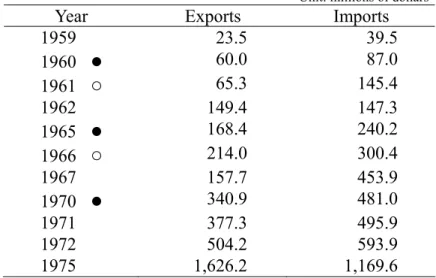
Meanwhile, in 1960, 1965, and 1970, JETRO held three large-scale Japan Industrial Trade Fairs in Moscow. To determine exhibits at the fairs, JETRO asked the government and businesses for detailed information on the kinds of items in which the Soviet side was interested. The three trade fairs (see overviews below) contributed to the expansion of machine-related exports, including machine tools, textile machinery, construction machinery, measuring instruments, and printing machinery. Transitions in USSR trade can be seen in the attached table. Japanese exports to the Soviet Union in 1959 were worth $23.5 million, increased by 21 times to reach $500 million in 1972, and continued to rise until 1975, when they reached an amount of $1,626.2 million, or a stunning 69 times over the 1959 figure. A secondary effect of this development was that Japanese businesses also set their sights on other communist bloc countries as export destinations and went on the offensive. These moves also bore fruit; while Japan sent a mere $73 million worth of exports to communist bloc countries in 1960, by just 10 years later in 1970 the number had jumped over 14 times to $1,045 million. By 1975, it had reached $4,683 million, or 64 times over the 1960 figure. Since JETRO did not have an office in Moscow at the time, it took major efforts to hold the three trade fairs. However, considering the difficulty of selling to the Soviet market, the energy was well utilized intensively and systematically. The result was the successful
holding three large-scale trade fairs. Exports did not immediately grow due to the trade fairs, but you can see that two to five years later, the numbers clearly began to reflect the results. After that, JETRO held comprehensive Japanese industry trade shows in Moscow in
October 1986 and after the collapse of the Soviet Union, in April 1992. Table 4. Trends in Japan-Soviet Union Trade
Unit: millions of dollars
Year Exports Imports
1959 23.5 39.5 1960
●
60.0 87.0 1961○
65.3 145.4 1962 149.4 147.3 1965●
168.4 240.2 1966○
214.0 300.4 1967 157.7 453.9 1970●
340.9 481.0 1971 377.3 495.9 1972 504.2 593.9 1975 1,626.2 1,169.6Source: Japan Association for Trade with the Soviet Union and Socialist Countries of Europe
Note: ● =Hosted by Japan, ○= Hosted by the USSR
The 1st Japan Industrial Trade Fair in Moscow Dates: August 16-September 5, 1960
Scale: 6,514m², 360 exhibition stands, 127 companies
Major exhibits: Textile machinery, electric machinery, construction machinery, etc. The 2nd Japan Industrial Trade Fair in Moscow
Dates: July 9-26, 1965
Scale: 10,966m², 420 companies
Major exhibits: Machine tools, textile machinery, etc. The 3rd Japan Industrial Trade Fair in Moscow
Dates: April 1-14, 1970
Scale: 11,038m², 600 companies
Major exhibits: Mainly machine tools and other machinery
2. Overview of JETRO’S Export Assistance in Specific Business Sectors (1958-1970)
JETRO became a government agency in 1958. From that year, it began to pour its energies into export assistance for specific business sectors. Beginning with agriculture and marine products and medical products, it gradually expanded to also assist the light machinery, general merchandise, small internal combustion engine for ships, movie, automobile parts, synthetic dye, chemicals, silk and silk fabrics, and textile sectors.
These programs in general would involve JETRO and a manufacturers association or export association in the relevant sector making an agreement, dispatching experts overseas, and jointly developing a variety of export promotion programs. These included the following. 1) Joint business office establishments and their locations
The following table lists joint business offices that were held within JETRO by various industries. In principle, the industry bore 50% of costs. As you can see, JETRO staff worked with people around the world. Some locations had only one staffer, while others, such as the light machinery center in New York, had as many as seven. Over the 13 years from 1958 through 1970, JETRO provided assistance worth 6.7 billion yen for this project. The dispatched personnel carried out a variety of export promotion work that was centered on their assigned country, but also included neighboring countries.
Table 5. Locations of Joint Business Offices
Business sector and year
established Overseas office location Agricultural and
marine products 1958 (year of project start)
Casablanca (tea), New York (canned goods), frozen foods (Long Beach, Venice, Puerto Rico. Samoa), Hong Kong (agricultural and marine products), New York (pearls), San Francisco (plywood), Ministry of Agriculture, Forestry, and Fisheries personnel dispatched (New York, Hamburg, Hong Kong, San Francisco, Paris, London, Toronto, Los Angeles, Chicago)
Medical products 1958 Hong Kong
Light machinery 1959 New York, Hamburg → Düsseldorf, Panama, Bangkok, London General merchandise
1959 (year of project start)
New York (general merchandise), Milan → Hamburg → Amsterdam (general merchandise), New York (ceramics), San Francisco → Los Angeles → Chicago (furniture), New York-Hamburg (smoking supplies), New York (metal flatware), Bangkok (construction material), New York (toys)
Small internal combustion
engines for Ships 1964 Bangkok, Sydney, New York, Rotterdam Movies 1964 Rome
Automobile parts 1965 Chicago Synthetic dyes 1968 Bandung
Chemicals 1969 Bangkok (paints)
Silk and silk fabrics 1969 New York (silk), Hamburg (textiles) Textiles, general
merchandise 1970 New York
In addition to the above business sectors, from 1965 saw the appearance of industrial associations that understood overseas markets through their own research and wanted to implement dispatch activities in foreign countries tailored to the actual conditions in each industry. MITI and JETRO addressed these industry needs by assisting in the establishment (cost borne fully by each industry) of overseas bases for these organizations within JETRO offices. Among the industries represented were: textiles (Hamburg), bicycles (Cairo→Beirut, New York, Los Angeles, Bangkok, Düsseldorf, Rio de Janeiro, Nairobi and Singapore), cameras (New York), industrial machinery (Bombay, Mexico, Bangkok, Sydney, Paris, Toronto, Vienna, and São Paolo), ships (London), metals (London), and the Japan Machinery Exporters Association (Bangkok and Sydney). After fulfilling their roles, nearly all of the joint offices were closed.
2) Business activities of joint offices
was in general not the same. However, in principle activities centered on market surveys, public relations and publicity, business matching, and participation in trade fairs. Some organizations also carried out inspections and weight measurement work. All expenses related to these activities were borne by the relevant industry.
a. Surveys and marketing research
Researchs for each relevant country and its neighboring countries, as well as global market surveys, were conducted. Researched countries and products were changed, and each year, information was provided to industry organizations and corporations. Here is a specific example. These are the FY1970 programs for agricultural and marine products. Other business sectors also worked this way, consistently carrying out surveys each year, changing the business areas and markets.
Table 6. Researches Concerning Agricultural and Marine Products, FY1970 Type US and Canadian markets European and other markets Marketing
research
Canned tuna, diet candy & luxury confectionary,
plywood, shiitake mushrooms
Frozen foods (UK, France, West Germany), instant noodles (West Germany),
citrus fruits and their juices (Italy, Spain), tomato processing (Portugal),
pearls (India), broadleaf tree lumber (Colombia)
Dynamic
research Canned tuna (New York, Boston) Consultant
research
Consumer protection Survey of new food development trends Tuna mercury poisoning problem
Canned mackerel (West Germany, France) Rainbow trout industry (Denmark)
b. Public relations and advertising
Similarly, I will narrow down my explanation to agricultural and marine products. While Japan possesses globally competitive and promising exportable goods among its agricultural and marine products, demand for some of them has been sluggish, due to lack of information and awareness about counterpart countries and lack of dissemination of cooking & tasting methods. We therefore decided to consult with each industry, use various PR methods, and conduct public relations and advertising campaigns. Following are some of the chief examples.
- Mandarin oranges: Newspaper and magazine advertisements; distribution of free samples for promotions at supermarkets, chain stores, and large food shops in major US cities. - Canned and frozen tuna: Newspaper and magazine advertisements; promotions during
International Tuna Week
- Cultured pearls: Production of PR films, Pearls of Japan, The Home of the Pearl, and Ocean’s Memory; newspaper and magazine advertisements; promotions at department stores; promotions at jewelry retailers; fashion shows and various contests; dispatch of and promotions involving Miss Pearl, etc.
- Shiitake mushrooms: Production of PR film, Japan’s Shiitake; participation in food exhibitions in major US and Asian cities; promotions at supermarkets; newspaper and magazine advertisements, etc.
- Saké: Advertisements in trade papers; mailing of recipes; organization of sake festivals; production of three types of pamphlet; organization of meetings for exchanges of opinions with importers, etc.
Similar activities were carried out for apples and other fresh fruits, Japanese tea, and dairy products. Similar work was also conducted around the world for other business sectors. c. Participation in trade fairs
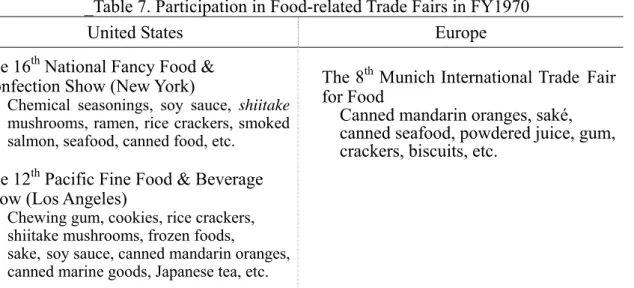
Each business sector uniquely carried out promotion of each export product and participated in exhibitions. Here are two examples of en masse participation by an industry in trade fairs in FY1970. The most effective method for promoting exports was to participate in overseas trade fairs and pitch products directly.
_Table 7. Participation in Food-related Trade Fairs in FY1970
United States Europe
The 16th National Fancy Food & Confection Show (New York)
Chemical seasonings, soy sauce, shiitake mushrooms, ramen, rice crackers, smoked salmon, seafood, canned food, etc.
The 12th Pacific Fine Food & Beverage Show (Los Angeles)
Chewing gum, cookies, rice crackers, shiitake mushrooms, frozen foods,
sake, soy sauce, canned mandarin oranges, canned marine goods, Japanese tea, etc.
The 8th Munich International Trade Fair for Food
Canned mandarin oranges, saké, canned seafood, powdered juice, gum, crackers, biscuits, etc.
3) Transitions in export amount in several business sectors (1958-1970)
Although it is difficult to strictly evaluate and analyze the degree of effect of export promotion assistance in the abovementioned specific business sectors, for reference we can look at transitions in export amounts in major products and sectors from 1960 to 1970 (Table 8).
From the figures above, we can see that the joint export promotion strategies of JETRO and industry organizations have produced considerable results. Since JETRO employees are engaged in general trade and investment work, they do not possess expertise regarding individual business sectors and products. These areas are where they made use of the specialized knowledge, experience and know-how of industry insiders.
Table 8. Transitions in export amount (1960-1970)
Unit: millions of dollars
Product or business 1960 1970 % growth multiple
All agricultural and
marine products 4.055 19,318 4.2 times
Canned tuna 25 80 3.2 Medicine 17 66 3.9 Binoculars 5 15 3.0 Clocks, watches 4 130 32.5 Radio receivers 139 695 5.0 Television receivers 3 384 111.3 Automobile parts 23 304 13.2 Ceramics 68 138 2.2
Ship machinery 26 billion yen 160.7 billion yen 6.2 Sources: JETRO, Ministry of Finance, industry organizations
Part 5 JETRO and the World’s Export Promotion Agencies
1. Classification of the world’s trade promotion agencies
There are various types of agencies for promoting trade and investment in the world. One way to divide them is to separate them into three types according to objective: 1) agencies specialized for trade, especially export promotion; 2) agencies specialized for inward investment; and 3) agencies that promote both trade and investment. A second way is to divide them according to the content of their activities. The world’s trade promotion agencies include: 1) those that are devoted to export promotion work; 2) those that additionally carry out trade financing; 3) those that are involved in trade policy and trade planning of export promotion; and 4) those that are engaged in trade negotiations. There are agencies that possess all of the above functions, agencies that carry out only promotion work (1)), and agencies that combine promotion functions (1)) and financing functions (2)). In many cases, a trade promotion agency of a given country is under the jurisdiction of some government ministry or agency. Sometimes they are related to a ministry of industry or trade, and sometimes they part of or under the supervision of a ministry of foreign affairs.
JETRO is an agency that carries out trade and investment promotion work under the jurisdiction of the Ministry of Economy, Trade and Industry (METI). The Japan Bank for International Cooperation (JBIC) takes care of financing functions, METI conducts trade policy planning, and either METI or the Ministry of Foreign Affairs (MOFA) carries out trade negotiations. Thus, it is necessary to understand that the work of a trade and investment agency varies depending on the country’s characteristics. The following chart lists today’s leading trade promotion agencies. As you can see, there is quite a bit of variety.
Table 9. Functions and Activities of the World’s Trade Promotion Agencies Trade promotion
agency promotion Trade Investment promotion Financing planning Policy Ministry or agency of jurisdiction
JETRO (Japan)
○
○
X X METIKOTRA (ROK)
○
○
X X Ministry of Commerce, Industry and EnergyTDC (Hong Kong)
○
X X X Hong Kong SARDEP (Thailand)
○
X X○
A Department of the Ministry of Commerce AUSTRADE(Australia)
○
X X XDepartment of Foreign Affairs and Trade ICE (Italy)
○
Δ
X X Ministry of Foreign Commerce ICEX (Spain)○
Δ
X X Ministerio de Industria, Turismo y Comercio APEX (Brazil)○
○
X X Desenvolvimento, Industria Ministerio doe Comercio Exterior
PROCHILE (Chile)
○
X X○
A department of the Ministry of Foreign Affairs PROEXPORT(Columbia)
○
○
X X Ministry of TradePROMEXICO
Therefore, in researching the ideal kind of trade promotion agency for Latin America, it is necessary for us to first check the types of functions carefully.
2. What makes JETRO original in the world?
JETRO was originally established in Japan’s No. 2 city Osaka in 1951. As you know, Japan had just been defeated in the Second World War and its national land was completely destroyed. With its production facilities also obliterated, Japan faced extremely difficult circumstances. Osaka had been famous from olden times as a city of traders, and JETRO was founded by a group of pioneering entrepreneurs. Later, the government began to recognize the importance of export promotion, and in 1958 JETRO was newly inaugurated as a government agency.
At present, JETRO has 73 overseas offices in 54 countries, and 37 domestic offices including the Tokyo headquarters, and employs about 1,200 personnel. The Japanese government subsidizes 24.4 billion yen (about $200 million) of its annual total budget of about 40 billion yen (about $330 million). JETRO has nine offices in Latin America. From north to south, the locations are: Mexico, San José (Costa Rica), Panama, Caracas, Bogotá, Lima, São Paolo, Santiago, and Buenos Aires. Their main activities are export and import assistance to SME’s, assistance toward investments both by Japanese corporations overseas and foreign corporations in Japan, and industrial development assistance to developing countries.
Now I’ll introduce some original distinctions that set JETRO apart from the world’s other trade promotion agencies.
Distinction #1: Serious dedication to import promotion activities make JETRO an extremely rare organization
Agencies for the purpose of promoting importing are extremely rare among so-called “trade promotion agencies,” even though the word “trade” is in their name. Nearly all such agencies are for the purpose of promoting export of their own country’s goods. JETRO’s import promotion work developed extensively from the 1980s for 20 years, to such an extent that the US and European countries started calling it “JITRO.” Imports from overseas grew considerably, to the point that its role was completed. Thus, today JETRO conducts very little import promotion activities. By developing import promotion activities, JETRO filled two roles. First, together with the export promotion agencies of foreign countries, they were able to consider and put into practice ways to carry out exporting to Japan. Second, they were later able to smoothly implement promotion activities for investment in Japan. This is because when you increase sales to the Japanese market, everyone will then think about setting up branch offices and headquarters in Japan. Investment was not necessarily always of the Green Field variety, but also in form of the establishment of branch offices and offices for dispatched personnel. Distinction #2: JETRO began working on official development assistance (ODA) programs
from 1966, and is developing a wide range of programs
JETRO prepares extremely elaborate programs for developing countries. JETRO began its ODA programs in 1966, starting with single-country exhibitions and programs inviting influential people, and later quickly dispatching and receiving experts, and dispatching and receiving missions. It targeted specific products and carried out programs aimed at exporting to Japan within several years, programs cultivating supporting industries, programs promoting SME’s, and human resources development programs in developing countries. JETRO cooperated in the establishment of Malaysia’s export promotion agency MATRADE, and continues today to cooperate with export promotion agencies in Egypt and Indonesia.
of trade promotion agencies from over 20 governments in the Asia-Pacific region get together regularly each year. The ATPF was inaugurated through a JETRO initiative, probably due to recognition of JETRO’s ODA program record to that point.
Distinction #3: JETRO puts priority on researchs of foreign countries and employs a great many research personnel. JETRO also attaches importance to the provision of information to Japanese businesses.
The third distinction is the great number of personnel engaged either directly or indirectly in researches. For example, in the Tokyo headquarters, which has a total of about 500 employees, the number of employees assigned to research departments is about 100, or 20%. Since its inception, JETRO has placed extremely high importance on research activities. This is because overseas researches form the foundation of all of its activities. The actual impetus for JETRO’s founding was to conduct researches on what was needed for exporting. The JETRO of the 1960s poured its energies into export marketing researches . These covered a wide range of items, including textiles, general merchandise, chemicals, metals, clocks and watches, cameras, and medicine. For each target market, JETRO carried out researches of products with potential for export. These researches established goals such as 1) Opening new export markets, 2) Increasing exports, and 3) Eliminating factors obstructing exports. This research-emphasized tradition is still alive today. At present, the Overseas Research Department conducts region-specific and theme-specific surveys.
JETRO uses numerous media to provide overseas information to Japanese businesses. One of them is JETRO’s daily newspaper JETRO Daily, which promptly delivers information sent from the 73 overseas offices to Japanese businesses. There are many other trade promotion agencies around the world, but I think hardly any of them are publishing their own newspapers. JETRO also publishes a monthly magazine and an annual White Paper on International Trade and Foreign Direct Investment.
In July 1998, JETRO consolidated with the Institute of Developing Economies (IDE), a think-tank that researches the politics , economies, and societies of developing countries, and employs 400 personnel. With this move, JETRO added research on developing countries to its activities portfolio.
Distinction #4: JETRO maintains close relations with the central government, regional governments, and industry organizations
JETRO’s fourth distinction is its human exchange with central government offices. A look at JETRO’s personnel residing overseas reveals many transferees from the national government, including METI, the Ministry of Finance, and the Ministry of Agriculture, Forestry and Fisheries, as well as from local governments and the industrial world. JETRO also has headquarters in both Tokyo and Osaka, and offices in 35 other cities in Japan. In principle, local governments pay half of all expenses (personnel costs, rental of building, and project costs) for the establishment of offices, and JETRO pays the remaining half.
3. Differences between Asian trade promotion agencies and Latin American trade promotion agencies
Here are my impressions of the differences between Asian trade promotion agencies and Latin American trade promotion agencies. The first point of difference is that in general, Asian trade promotion agencies are more passionate about and put forth more continual effort into export promotion than Latin American trade promotion agencies. The second point is that Asian organizations have sound financial bases. Each Asian government is keenly aware of the
importance of export promotion and there are relatively few occurrences of large budget increases or cuts dues to changes of government. For example, Hong Kong’s TDC is benefiting greatly from Hong Kong’s exhibition business. The third point is that competition among Asian countries is fierce. There is also competition among goods for export, and there is the feeling that the trade promotion agencies of Asian countries are contending with each other. The fourth point is that although there is competition, cooperation is also thriving. The aforementioned ATPF is one such example. At each country’s ATPF conference, opinions are exchanged regarding common issues at working level meetings and top-level meetings. In this way, smooth communication between top officials is achieved and the activities of the other agencies are well understood. It would be a wonderful thing if the top officials of Latin American trade promotion agencies had a yearly forum to get together and exchange views on regular basis.
Part 6 Advice to Latin America’s Export Promotion Agencies
I would like to point out a few issues concerning export promotion by Latin American countries, based on my 40 years of experience at JETRO and 10 years of experience in Latin America.
1. Is there a public-private consensus on export promotion?
The first thing is to determine whether there is agreement between the public and private sector, as well as a national consensus, on export promotion. As I mentioned earlier, the main actor in exporting is always private business, and the government builds the environment to facilitate exports by businesses. However, it is necessary to check and confirm whether this is sufficiently recognized and whether businesses are firmly incorporating exporting into their operations. Long ago, I used to see signs with slogans that read “EXPORT OR DIE(EXPORTAR O MORIR)” in Latin American countries. However, the question is, “Is there a consensus (consenso) regarding the need for export promotion among the president, ministers, government officials , the trade promotion agency, economic organizations, chambers of commerce, and businesses, and furthermore, will there be continuity (continuidad) and not transience in export promotion?” Things like Japan’s Export Council, award system for businesses that contribute to exporting, and national export promotion campaigns that I described earlier are very effective methods for forming public-private consensus.
2. Collaboration among the various organizations concerned in export promotion
The next point is whether the various organizations involved in exporting are working with each other well. In every country, there are many players involved either directly or indirectly in exporting, including government ministries and agencies, local governments, government organizations, chambers of commerce, and economic organizations. The question is whether these organizations are cooperating organically toward shared goals, and whether they are really being useful to, and building relationships of mutual trust with private sector businesses through intensive information provision. Collaboration(Colaboración) is crucial.
3. Drafting necessary industrial policies and SME policies
Do private businesses have the competitiveness to promote exports? If this ability is still undeveloped, then it becomes necessary to devise national industrial policies for cultivating and expanding exportable sectors. I have already explained that behind the great changes that occurred every five years with Japan’s postwar export items were various economic plans and MITI’s industrial vision. The problem for Latin American countries will likely be how to cultivate SME’s, which account for the overwhelming majority of businesses, and help them become able to export. Problems with SME’s include lacks of money, personnel, technology,
experience and know-how. An important task will be determining how to assist them. 4. How to attract foreign capital
At first glance, attraction of foreign capital and export promotion seem to have no relation, but they actually can be thought of as being the same thing. Why? Because foreign capital almost always comes in to export. It’s because each company devises export strategy in accordance with its global strategy. While China is increasing its exports with extreme momentum, over 60% of this is through foreign capital. Therefore, when conducting export promotion, it is desirable to always consider the attraction of foreign investment.
Powerful investment attracting organizations like Ireland’s IDA, the UK’s UK Trade & Investment, Malaysia’s MIDA, Thailand’s BOI, and the ROK’s KOTRA do not exist in Latin America. It is reccomendable to put more energy into attracting foreign investment.
Personal comments on Latin American trade promotion agencies
When I was stationed in São Paolo, Brazil from 2004 to 2006, I visited several Latin American trade promotion agencies to conduct interviews. These included Brazil’s Trade Promotion Department in the Ministry of External Relations and APEX, Mexico’s BANCOMEX, Costa Rica’s PROCOMER and CINDE, Colombia’s PROEXPORT, Peru’s PROMPEX, Chile’s PROCHILE, Argentina’s EXPORTAR, and Uruguay’s URUGUAY XXI. I was most impressed by Chile’s PROCHILE and Colombia’s PROEXPORT. They both gave me the impression of being extremely well organized, being highly conscious of cost performance, and developing activities that considered the standpoint of exporters.
I conclude my speech with the hope that the trade promotion agencies of Latin America will mutually exchange their experience and know-how, and that export promotion activities will be developed in consonance with actual conditions in Latin America. Thank you very much for your attention.