Radiological Survey in the Indian Ocean in
1961
著者
SAITO Kaname
journal or
publication title
鹿児島大学水産学部紀要=Memoirs of Faculty of
Fisheries Kagoshima University
volume
10
page range
9-14
別言語のタイトル
印度洋における放射能の検索
Kaname Saito
Abstract
Radioactivity of the sea water, plankton and fishes, obtained from the Indian Ocean in 1961 was inspected.
1) High radioactivity in the plankton was found in the area situated between about 4°N, 77°E and 4°S, 78°E. The half-life of radioactive elements in the plankton is about 15
days.
2) No radioactivity was detected from the sea water.
3) Radioactivity may be concentrated to liver, kidney and spleen in the fishes. The ac tivity in muscles was very poor, though the red muscle held always higher activity than the ordinary muscle of the same fish. The correlation between the stomach con tents and tissues in regard to strength of activity could not be made sure.
Introduction
The training ship "Kagoshima Maru" was sent out by the faculty of Fishe ries of Kagoshima University, for the purpose of Tuna Long-line fishing tests
INDIAN OCEAN
MADACASCAR
/
Fig. 1. The track of the Kagoshima Maru
:: Course line Q : Collecting stations of sea water and planktons fj : Fishing grounds
10 Mem. Fac. Fish. Kagoshima Univ., Vol. 10 (1961)
and scientific investigation in the Indian Ocean, dering the period from Oct. 1960 to Jan. 1961. The author was nominated as a member of the scientific corps of the expedition. The track of the "Kagoshima Maru" are shown in Fig. 1.
Radiological contamination of sea water, plankton and fishes obtained from the North Equatorial Current and the Kuroshio region, was already published1'. In the present paper, the author dealt with the radioactivity on the materials,
obtained from the Indian Ocean.
Measurement of radioactivity
It is very difficult to determine radioactivity precisely in any sample in its raw state due to so weak activity. For the more accurate measurement of activi ty, it is necessary to be conducted with ashed samples. Fishes were dissected carefully, and several tissues (liver, kidney, spleen, muscle etc) were obtained. These samples were weighed, dried on the hot-plate at 105°C. and ashed in a
muffle furnace at about 550°C. Thus ashed samples were placed in a dish of
stainless steel, each having a diameter of 2.5 cm. and an inside depth of 0.7 cm. The activity of samples was determined with Geiger-muller counter described
below.
Geiger-muller counter
(made by Scientific Research Institute LTD, Japan, Model-100)
Thickness of Mica
1.5mg/cm2.
Diameter of Mica 30mm.
Distance from the Sample to the Edge of CM. Tube 10mm.
Diameter of Dish 25mm.
Geometry 12.5 %
Each /jl/j,c per minute was calculated from the count of 10 minutes measure ment, subtracting the background of the same duration.
Results
Radioactivity in plankton
The plankton materials were collected through the Larva Net (calibre; 1.5 m) which was towed horizontally during about 15 minutes at a speed of 2 miles per 1 hour. Radioactivity of each ashed sample weighing 0.1 g. was measured
on the stainless steel dish. Results obtained are shown in Table 1.
It should be noticed that high radioactivity in plankton was found in the
area situated between about 4°N, 77°E and 4°S, 78°E. On the other hand, the
activity in the plankton collected from other area was very poor. It was observ ed that the activity in the former was several times high so that in the latter.
The reason of this distribution is not yet clarified.
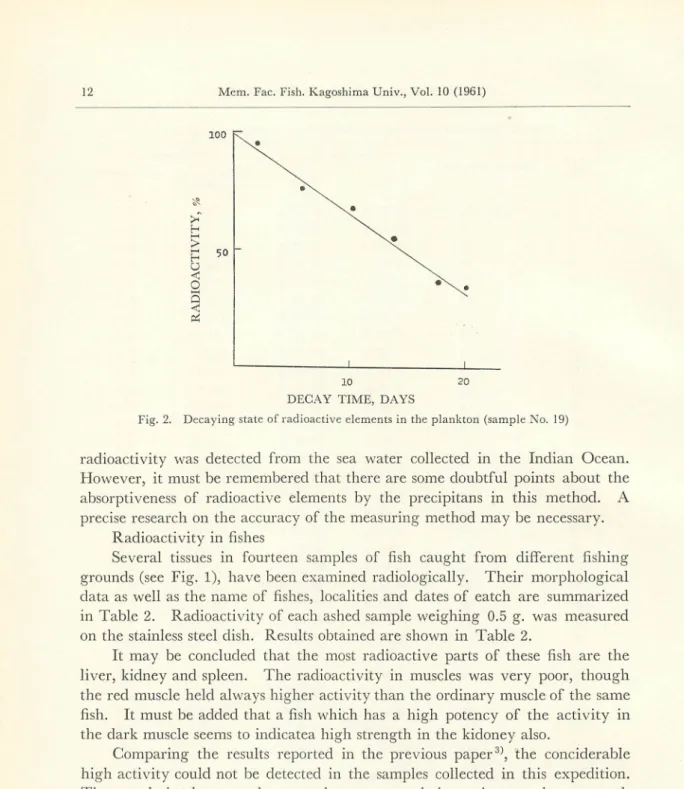
The decay of radioactivity was examined for a sample showing comparati vely high activity (No. 19), which was collected on Jan. 25. The result obtained
Table I. Results of inspection on radioactivity of sea water and planktons.
Sample
Date of collection
Collecting station Radioactivity
No.
Lat. Long. Plankton i Sea water**
/V.tc/lOOmg.* ,' Hfuc/l. 1 Dec. 22 27 =15'N 34=37'E 79. 1 3.7 2 23 23=55'N 36=57'E 0.0 1.9 3 24 19=58'N 39 =37' E 135.0 0.0 4 26 13=17'N 42=57'E 20.6 13. 1 5 27 12°11'N 48=30'E 36. 1 0.7 6 29 8=26'N 55=50'E 53.5 6.3 7 30 7-22'N 57=40'E 112.3 7.4 8 31 6=07'N 61=16'E 99.9 2.6 9 Jan. 1 5=07'N 64=37'E 262.6 3.0 10 3 4°32'N 65=50'E 210. 1 0.0 11 6 3°17'N 70=44'E 580.9 0.0 12 8 7°46'N 77=31'E 140. 1 0.0 13 9 7=39'N 77=48'E 103. 1 1.3 14 10 7=26'N 77 =57' E 143.2 3.4 15 12 7=40'N 77=31'E 120.6 0.0 16 20 4=52'N 78=10'E 422.3 0.0 17 22 1=00' s 77=55'E 226.6 0.0 18 24 4=06' S 77=59'E 533.5 4.4 19 25 4=32' S 78=00'E 704.5 16.9 20 26 3 =05' S 78=22'E 412.0 1.5 21 28 1=40' S 81=57'E 211. 1 0.0 22 29 4 =32' S 78=00'E 163.8 0.0 23 30 2=42'N 88=45'E 166.9 0.0 24 31 4=54'N 93=22'E 142. 1 8.3 25 Feb. 1 5°10'N 97=32'E 51.5 0.0 26 2 2 =52' N 100=57' E 0.0 1. 1 27 8 3=57'N 112=27' E 83.4 0.0 28 9 7=45'N 115=30' E 53.5 0.0 29 10 10=44'N 118=08'E 96.8 4.0 30 11 15=22'N 119=27'E 51.5 7. 1 31 12 20=05'N 120=50'E 0.0 3.0 * Ashed matter ** Surface water
are shown in Fig. 2. The half-life of radioactive elements in the plankton is
about 15 days. Classifying the contaminated plankton into each species, it was
found that Cavolinia sp. showed high radioactivity of 824 /^/jc/0.1g., Lepas and Phyllosoma 103~206 /^c/0.1g., and Jelly-fish showed about 51.5/^c/0.1g.
Radioactivity in sea water (surface water)
It is difficult to measure the radioactivity in sea water directly by a simple evaporation method owing to its high salinity. Therefor, the carrier method2' is
12 Mem. Fac. Fish. Kagoshima Univ., Vol. 10 (1961) 100 H
j>
H O < o 3 < 10 20DECAY TIME, DAYS
Fig. 2. Decaying state of radioactive elements in the plankton (sample No. 19)
radioactivity was detected from the sea water collected in the Indian Ocean. However, it must be remembered that there are some doubtful points about the absorptiveness of radioactive elements by the precipitans in this method. A precise research on the accuracy of the measuring method may be necessary.
Radioactivity in fishes
Several tissues in fourteen samples of fish caught from different fishing grounds (see Fig. 1), have been examined radiologically. Their morphological
data as well as the name of fishes, localities and dates of eatch are summarized
in Table 2. Radioactivity of each ashed sample weighing 0.5 g. was measured
on the stainless steel dish. Results obtained are shown in Table 2.
It may be concluded that the most radioactive parts of these fish are the liver, kidney and spleen. The radioactivity in muscles was very poor, though
the red muscle held always higher activity than the ordinary muscle of the same
fish. It must be added that a fish which has a high potency of the activity in
the dark muscle seems to indicatea high strength in the kidoney also.
Comparing the results reported in the previous paper35, the conciderable high activity could not be detected in the samples collected in this expedition.
The correlation between the stomach contents and tissues in regard to strength of radioactivity could not be made sure. In spite of the fact that the tissues was contaminated, the activity in the stomach contents was not detected. According
to the earlier conception45 on the radiological contamination of fish, ashes of fis sion products fell down into the sea, adhered to the planktons and came into fish bodies. However, radioactivity of the tissues may depend upon not only the
food which has been already contaminated, probably upon other routes of con
tamination such as gill and body surface, through which radioactive elements may be introduced. Because marine fish are capable of keeping their osmotic
Table 2. Radioactivity detected in various tissues and organs of fishes. Species Sample No. fishing station Date of catch Body length cm. Body weight kg-Sex Radioactivity, /.t/tc/500mg. (Ashed matter) Lat. Long. Heart Stomach Stomach content Intestine Liver Spleen Kidney Muscle Dark muscle I 14°N 65°EjJan. 4 141 58.5 * 12.3 32.9 21.6 37.0 105.6 138.0 273. 1 5. 1 80.3 Neolhunus 2 14° N 65° E 4 133 33.5 $ 30.9 40. 1 0.0 16.4 123.7 250.2 248. 2 23.6 37.0 macropterus 3 4"S 78= E 25 142 53.5 £ 0.0 17.5 30.9 0.0 53.5 110.2 85.4 31.9 49.4 4 4°S 78° E 25 138 64.5 -? 0.0 0.0 0.0 35.0 220. 4 83.4 200.8 44.2 63.8 1 14 = N 65° E 4 131 53.5 £ 20.6 2.0 0.0 47.3 260.5 429.5 154.5 0.0 53.5 Parathunus 2 14°N 65 "E 4 132 42.0 £ 0.0 23.6 21.6 0.0 234.8 107. 1 261.6 11.3 93.7 sibi 3 4=S 78=E 25 117 38.0 £ 16.4 0.0 24.7 13.3 136.9 150.3 184.3 26.7 70.0 4 4=S 78° E 25 115 33.0 «• 0.0 0.0 18.5 22.6 209.0 264.7 207.0 0.0 78.2 Makaira 1 14 = N 65° E 4 223 177.0 * 26.7 47.3 45.3 0.0 72. 1 92.7 172. 1 0.0 60.7 mazara 2 14°N 65= E 4 183 91.0 £ 5. 1 36.0 25.7 31.9 213.2 80.3 207.3 37.0 43.2 Istiophorus 1 14°N 65= E 5 198 49.5 £ 0.0 24.7 0.0 0.0 186.4 117.3 331.6 32.9 86.5 orientalis 2 14=N 65° E 5 175 42.0 £ 84.4 27.8 37.0 0.0 341.9 276.0 186.4 0.0 63.8 Adakaira 1 14=N 65= E 4 189 155.0 ¥ 35.0 25.7 0.0 40. 1 135.9 179.2 250.2 42.2 94.7 marlina 2 3=S 78° E 23 248 178.0 £ 29.8 0.0 15.4 20.6 109. 1 156.5 172.2 4. 1 39. 1
14 Mem. Fac. Fish. Kagoshima Univ., Vol. 10 (1961)
independence against sea water surrounding their bodies. Acknowledgment
The author wishes to express his thanks to Asst. professor T. Morita, the leader of scientific corps of this expedition, and the Captain S. Ueda and his crews of the "Kagoshima Maru", for their supports and useful help. The ex penses of this investigation were defrayed partly by a research fund granted from the Ministry of Education.
Reference
1) Saito. K and Sameshima, M. (1960): Studies on the Radiological Contamination of Fishes,
Sea Water and Planktons in the Westen Region of the North Equatorial Current during
the Period from 1958 to 1959, This Mem., 8, 181— 193. (in Japanese)
2) Miyake, Y., Sugiura, Y. and Kameta, K. (1954) : [U>n the Measurment of Radioactivity in the Sea Water], Kagaku, 24, 601—605. (in Japanese)
3) Saito, K. and Sameshima, M. (1956): Research in the Effects and Influences of the Nuclear Bomb Test, Vol 11, pp. 872—882. Tokyo, Japan Society for the Promotion Science. 4) Koga, F, Hoshino, F. and Matsumoto, K. (1956) : Studies on the Radiologically