An Electrode Respirometer for Planktonic
Organisms
著者
YAMASAKI Shigehisa, HIRATA Hachiro
journal or
publication title
鹿児島大学水産学部紀要=Memoirs of Faculty of
Fisheries Kagoshima University
volume
31
page range
141-144
別言語のタイトル
酸素電極法によるプランクトン用の呼吸測定装置
Vol. 31 pp. 141-144 (1982)
An Electrode Respirometer for
Planktonic Organisms
Shigehisa Yamasaki* and Hachiro Hirata*Abstract
In order to determine the respiration rates of planktonic organisms, an electrode respirometer was devised. The animal used in this experiment was the mixohaline rotifer, Brachionus plicatilis. The dissolved oxygen meter and penrecorder employed here were the YSI-57 and YEW-3046, respectively.
A 200 ml glass bottle was used as a respiration chamber. The bottle was horizontally set on a shaker which was rotated with a semi-circular motion, like an automobile wiper. The oxygen electrode and flow-through pipes were fixed on the neck of the chamber with a rubber stopper. Filtered water was poured into the respiratory chamber by a peristaltic pump, at a rate of 10 m/- min~l for 30 minutes; and stagnant status was maintained for another 80 minutes. This procedure was repeated every 110 minutes.
Apparent rate of oxygen consumption was observed by the difference of maximum and minimum amounts of oxygen content during the stagnant status. Blank test, without the animals in chamber, was also conducted. Actual rate of the oxygen consumption by the animals was then re-calculated by the balance of those two results. This apparatus could be applied for determination of respiration rate in planktonic organisms, fish eggs, larvae, and BOD in culture water.
Introduction
Animal respiration is one of the indispensable factors in the determination of energy budgets, from the point of view of biological economy in aquaculture. Many biologist have therefore
reported on the respiration of cultured fishes (Tamura, 1940; Yamamoto et al, 1981; Tanaka et
fl/.,1966; Hirata, 1973; Inoue and Sugimoto 1969; Megrey, 1981). In the case of planktonic organisms, however, the observation techniques are rather difficult due to their smaller body size.
Ito(1971) and Doohan (1973) reported on the respiration rates of the mixohaline rotifer,
Brachionus plicatilis, by the winkler's and cartesian diver methods, respectively. Those methods, however, need many hands and much time for their operation. Teal and Halcrow (1962) and Halcrow (1963) measured the oxygen consumption of marine copepods by an oxygen electrode method. Their methods, however, injured the organisms by utilizing a stirring spin in the respiratory system.
* Laboratory of Fish Cultivation Physiology, Faculty of Fisheries, Kagoshima University, Kagoshima, 890 Japan.
142 Mem. Fac. Fish., Kagoshima Univ. Vol. 31 (1982)
The present method was then devised for the observation of oxygen consumption in planktonic
organisms by using an oxygen meter coupled with a shaking method. Special precautions were
taken for minimization of disturbance to the animals and for simple operation of the apparatus. The techniques described below could be applied for cultivation control in planktonic organisms, fish eggs, and larvae.
Respiratory Apparatus
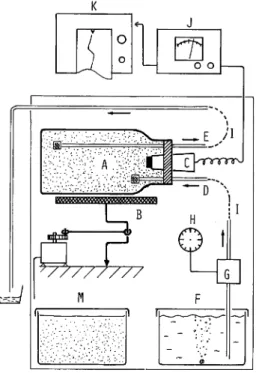
Schematic diagram of the respiratory apparatus is represented in Fig. 1. A 200 ml glass bottle was used as the respiratory chamber (A). The bottle was horizontally set on a shaker (B) which was rotated in a semi-circular motion, like an automobile wiper. Angle of the rotation was
adjusted to be about 90° by controling the cam diameter and shaft length. Speed of the motion
was regulated to be 30 rpm by sliding the electric current from 100 volt AC. The oxygen electrode (C), inflow pipe (D), and outflow pipe (E) were fixed on the neck of the chamber with a rubber stopper as shown in Fig. 1. A head and tail of each flow pipe was equipped with a small mesh strainer to prevent the animal's flight from the chamber.
U
- v — i
o
Fig. 1. Schematic diagram of the electroderespirometer for planktonic organisms. A; respiratory chamber, B; semi-circulatory shaker, C; oxygen electrode, D; inflow pipe, E; outflow pipe, F; filtered water, G; peristaltic pump, H; timer switch, I; fleshy silicon hose, J; dissolved oxygen meter, K; pen-recorder, L; incubator, M; rotifer culture tank.
Filtered water (F), with a strong aeration, was poured into the chamber with a peristaltic pump (G) at a rate of 10 m/-min_1 for 30 minutes, and stagnant status was maintained for another 80 minutes. This procedure was repeated every 110 minutes, regulating the time interval with timer switch (H) depending on the population density and water temperature in the chamber. Variation of oxygen consumption in the chamber was recorded by a pen-recorder (K), YEW-3043.
The apparatus except for the meter and recorder were set in a incubator (L), MIR-250, which regulated the temperature, light intensity, and photoperiod.
Example of the Record
Trials of the respiration recording were conducted to determine the oxygen consumption of the
rotifer, B. plicatilis, under the condition of 20°C, 200lx illumination, and about 25,000 specimens
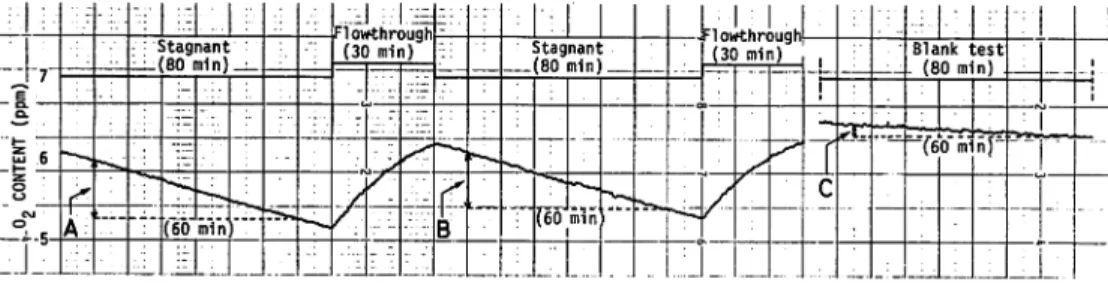
in the chamber. Fig. 2 shows an example of the records with 45% reduction from the original record. •: -T £::.. : Flowthrough (30 min) ": " Flowthrough (30 min) ,-i.: -"• Stagnant • : (80 m1n) •• -.': Stagnant(80 min) i Blank test . (80 min) 1 i , 1= 1 ;- - vir : : r r i a . ID o o c o
ZJ
•B ,':r •I-_i_. — _ . : _i
<rx^ : 1 6 "g **r ~(60 m •0-r" )""•^ — B L _ > T ^ — — c — — — . : MI
'.-. (60 min [60 minV"~Jl
. . . ''': 7 ZFig. 2. An example of the respiratory records obtained by the oxygen electrode method in the mix ohaline rotifer, B. plicatilis. Marks A and B in this figure indicate the determination of oxygen consumption rates at the first and second stagnant atatus, respectively. Marks C shows the rate in a blank test.
Rates of the oxygen consumption were obtained by direct observation of the declining amount of oxygen content during the period of stagnant status. The rates of oxygen consumption, for example, were 0.74 ppm«h_l in the first stagnant status (A), and 0.70 ppm-h"1 in the second status (B) as shown in Fig. 2. The average rate of consumption was then calculated to be 0.72 ppm^h-1.
In the blank test, however, the rate of oxygen consumption, without rotifers in the chamber, was observed at 0.13 ppm«h-1 (C, Fig. 2). Actual rate of the oxygen consumption by the aminals, therefore, is re-calculated to be 0.59 ppm-h"1-25,000 rotifers-1. This rate was also converted to 86 x 10"6 m/-ind~'-day_1, or about 1,180 m/-kg~,-h~l in wet body weight.
144 Mem. Fac. Fish., Kagoshima Univ. Vol. 31 (1982)
Discussion
The apparatus mentioned above consists essentially ofa respiratory chamber, semi-circulatory
shaker, peristaltic pump, DO meter, and pen-recorder. An advantage of this apparatus is the
employment of the circulatory shaker instead of a spinning magnetic stirrer in the respiratory
chamber. This shaker probably contributed less disturbance to the animals examined. The
peristaltic pump also serve for maintanance of a flow-through system for a long period under
normal conditions.Constructions of the apparatus is rather complicated and more expensive than that of the
Winkler's method (Ito, 1971) and cartesian diver method (Doohan, 1973). The operation
techniques of this apparatus, however, are quite simple with accurate results.
The apparatus
could be applied for obsevation ofoxygen consumption by planktonic animals, fish eggs, larvae,
and BOD in culture water.Acknowledgement
We wish to thank Mr. Warren Nagata, graduate student in Faculty of Fisheries, Hokkaido University, for help with the preparation of the manuscript.
References
DOOHAN, M. 1973: An energy budget for adult Brachionus plicatilis MtJLLER (Rotatoria). Oecologia, 13, 351-362.
Halcrow, K. 1963: Acclimation to temperature in the marine copepod, Calanus finmarchicus (Gunner). Limnol. Oceanogr., 8, 1-8.
HIRATA, H. 1973: Diurnal rhythm of metabolic and activity rates in juvenile atlantic salmon, Salmo salar Linnaeus. Mem. Fac. Fish., Kagoshima Univ., 22, 73-93.
Inoue, H. and J. Sugimoto, 1969: in "Hamachi-Kanpachi" (ed. by Y. Oshima and D. Inaba), Yogyo Koza, Vol. 4, Midorishobo, Tokyo, pp. 120-131.
ITO, T. 1971: Studies on the artificial production of "Ayu" fish seedling LXXX. On the oxygen consumption of brackish-water rotifer, Brachionus plicatilis O. F. MOLLER. Art. Prop. "Ayu" Fish, No. 1, 279-295.
MERGEY, P. A. 1981: Respiratory matabolism of gizzard shad. Trans. Amer. Fish, soc, 110, 51-55.
TAMURA, T. 1940: Influence of the variation of environmetal factors on fishes-II. The comparison of the fish respiratory'conditions between in winter and summer season. J. Fish'., 46, 56-66.
Tanaka, Y., H. Inoue, K. FUKUDA and T. Maekawa, 1966: Studies on the shallow-marine facilities for pisiculture. Water-exchange in the Megijima fish farm. Tech. Bull. Fac. Agr. Kagawa Univ., 18, 77-83. Teal, M.J. and K. HALCROW, 1962: A technique for measurement of respirationof singlecopepods at sea.y.
Cons. Perm. Int. Explor. mer., 27, 125-128.
Yamamoto, K., Y. Itazawa and H. Kobayashi, 1981: Gas exchange in the gills of yellowtail Seliola quinqueradiata under resting and normoxic condition. Bull. Japan. Soc. Sci. Fish., 47, 447-451.