Scattering Theory
for
Nonlinear
Klein-Gordon
Equation
with Sobolev Critical Power
東京大学大学院数理科学研究科 中西賢次 (Kenji Nakanishi)
1.
INTRODUCTION
In this note I would like to report my result
on
the scattering of largeenergy solutions to the nonlinear Klein-Gordon equation (NLKG) of the
following form:
$\ddot{u}-\Delta u+m^{2}u+|u|^{p-1}u=0$, (NLKG)
where $(t, x)\in \mathbb{R}^{1+n}$ with $n\geq 3$ and $m\geq 0$
.
We will consider thecase
$p=p^{*}:= \frac{n+2}{n-2}$.
Then $p^{*}+1=2n/(n+2)$ is the Sobolev critical exponent. This equation has the conserved energy:
$E(u;t):= \int_{\mathbb{R}^{n}}\frac{1}{2}(\dot{u}^{2}+|\nabla u|^{2}+(mu)2)+\frac{|u|^{p+1}}{p+1}d_{X=E}(u;0)$ .
Denote by $X$ the energy space:
$X:= \{(\varphi, \psi)|\int\psi^{2}+|\nabla\varphi|^{2}+|m\varphi|^{2}dX<\infty\}$ .
We consider the asymptotic behavior of solutions to (NLKG) with finite
energy,
as
$t$ tends to $\infty$, comparedwithsolutions tothelinearKlein-Gordon:$\ddot{v}-\triangle v+m^{2}v=0$
.
$(\mathrm{K}\mathrm{G})$We find $v$ from $u$ or $u$ from $v$, where $u$ is a solution of (NLKG) and $v$ is
a
solution of $(\mathrm{K}\mathrm{G})$, such that
$||(u(t),\dot{u}(t))-(v(t),\dot{v}(t))||x$
.
Then, the aim of this study is to show that
$(v(\mathrm{O}),\dot{v}(\mathrm{O}))\vdash+(u(\mathrm{O}),\dot{u}(\mathrm{o})):Xarrow X$ homeo. (S)
This
means
the asymptotic completeness of thewave
operators.Now I mention the known results
on
the scattering for (NLKG). First, forthe subcriticalcase, if$1+4/n<p<p^{*}$ and $m>0$, then (S) was obtainedby
Brenner [3] and Ginibre and Velo [5]. In the critical
case
$p=p^{*}$, therewere
2 results available. If the solutions
are
radially symmetric, the scattering(S)
can
be obtained easily from thea
priori estimate derived by Ginibre,Soffer and Velo [4]. If $m=0$, namely for the nonlinear wave, (S) easily
follows from the decay property of the solutions obtained by Bahouri and
Shatah [1].
But, in the
case
where $p$ is the critical power, the data is nonsymmetricand $m>0$,
none
of the arguments in the above results can be applied,so
the scattering (S) in this
case was
left open. I have proved the scattering in that case, which is the main result in this note:Theorem. Let $p=p^{*}$ and $m\geq 0$
.
Then we have (S).In the rest ofthis note, I describe the outline ofthe proof of this theorem.
For a
more
detailed, rigorous and general proof,see
[7].2.
OUTLINE
OF THE PROOFFor simplicity,
assume
that $n=3$ and $m=1$. Thenwe
have $p=5$. It is known that ifwe
have globala
priori estimates for certain space-time normsdepending only on the energy:
$||u||sT(\mathrm{R})<C(E)$, (G)
then
we
obtain the desired result (S). Hereafter, $‘ \mathrm{S}\mathrm{T}$’ denotesa
certainappropriate space-time norm, which is, in
our
context, $L_{t}^{8}(L_{x}^{8})$ norm, and$‘ E$ ’ denotes the energy of the solution $u$
.
So,our
aim is to derive the global(NLKG) for any initial data with finite energy such that the $\mathrm{S}\mathrm{T}$
-norm
of
the solution
on
any bounded time interval isfinite
(see, e.g., [6, 8]). But, itwas
not known that thereare
estimates for the $\mathrm{S}\mathrm{T}$-norm
depending onlyon
the energy. lt was unknown
even
on a
finite time interval. This isa
typicaldifficulty in the critical
case.
In order to prove the
a
priori estimate (G), first Iuse
Bourgain’s idea,which he used to solve the nonlinear Schr\"odinger equation with the critical
exponent in the radial
case
[2]. Roughly speaking, his idea is to relate the distribution of the $\mathrm{S}\mathrm{T}$-norm
in time with the distribution of the energy in
space-time. Remark that the $\mathrm{S}\mathrm{T}$
-norm
isa
Lebesguenorm
for $t$
.
At
first, wedo not know how large it is. But we
can
divide the time interval into smallsubintervals such that each subinterval contains the
same
small ST-norm,say, $\epsilon$. Then Bourgain’s lemma below tells us that in each subinterval,
somewhere in the space, there is
a
certain amount of localized energy. SeeFigure 1.
Lemma 1 (Bourgain). $Let||u||_{ST()}I=\epsilon<C(E)$ is sufficiently small. Then
we have
some
subinterval $J\subset I$ and some ball $D\subset \mathbb{R}^{n}$ such that diam$D<$$C(E, \epsilon)|J|$ and
for
any $t\in J_{f}$$\int_{D}|\nabla u|^{2}+u^{2}dx>\epsilon^{\alpha}$, $\int_{D}u^{6}dx>\epsilon^{\alpha}$,
So,
we
obtain suchan
energy lump in $J\cross D$ for each subintervals. If the $\mathrm{S}\mathrm{T}$-norm
is large, then the number of the subintervals is also large,and
we
obtaina
lot of energy lumps correspondingly. Thus, to estimate the $\mathrm{S}\mathrm{T}$-norm, it suffices to estimate the number of such energy lumps. Ifthe $\mathrm{S}\mathrm{T}$
-norm
ina
finite interval is very large, then many energy lumpsare
crowding there, and
so
gathering atsome
point in space-time, whichmeans
concen.tration
of the energy. I have obtaineda
new estimate to bound the number of such gathering energy lumps.Lemma 2. For any
finite
energy solution $u$of
(NLKG) and any $\lambda>0$,we
have
$\sum_{k\in \mathrm{N}}\sup_{<2^{-k}t<2^{-k+1}}\int_{|x|<\lambda t}u^{6}dX<c(E, \lambda)$. (N)
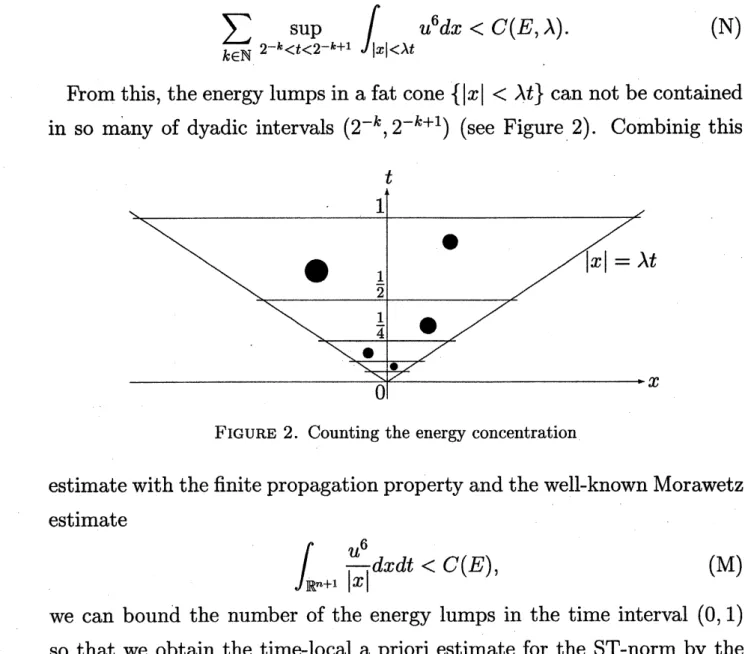
From this, the energy lumps in a fat
cone
$\{|x|<\lambda t\}$can
not be containedin
so
many of dyadic intervals $(2^{-}k, 2-k+1)$ (see Figure 2). Combinig thisFIGURE 2. Counting the energy concentration
estimate with the finite propagation property and the well-known Morawetz estimate
$\int_{\mathbb{R}^{n+1}}\frac{u^{6}}{|x|}dXdt<C(E)$, (M)
we
can
bound the number of the energy lumps in the time interval $(0,1)$energy:
$||u||sT(0,1)<o(E)$. (L)
In the massless
case
$m=0$, we obtain the global estimate (G) from thislocal estimate (L) by
a
simple scaling argument. However, in the massivecase
$m>0$, there isno
scaling which preserves the equationor
theenergy
space. Moreover,
we
do not know whether the global version of (N) holdsin the massive
case.
So, for the global estimate in the massive case,we
canuse only the Morawetz estimate (M), the finite propagation property and
the local estimate (L). Again consider the distributed energy lumps given
by Bourgain’s lemma.
$0=T_{0}<T_{1}<\cdots$ , $I_{j}:=(T_{j}, T_{j+1})$, $||u||_{S\tau(I_{j})}=\epsilon$,
$J_{j}\subset I_{j}$, $D_{j}$ : ball $\subset \mathbb{R}^{n}$,
$\int_{D_{\mathrm{j}}}u^{6}dX>\epsilon^{\alpha}$, $(t\in J_{j})$
.
Let $c_{j}$ and $R_{j}$ be the center and the radius of $D_{j}$, and let $t_{j}:=$ inf $J_{j}$
.
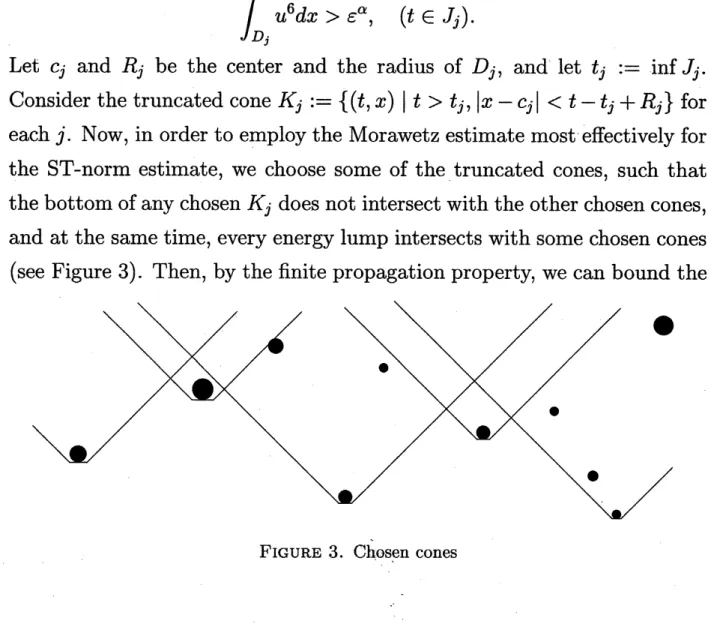
Consider the truncated
cone
$K_{j}:=\{(t, x)|t>t_{j}, |x-C_{j}|<t-t_{j}+R_{j}\}$ foreach$j$. Now, in order to employthe Morawetz estimate most effectively for
the $\mathrm{S}\mathrm{T}$-norm estimate, we choose some of the truncated cones, such
that
the bottom ofany chosen $K_{j}$ does not intersect with the other chosen cones,
and at the
same
time, every energy lump intersects withsome
chosencones
(see Figure 3). Then, by the finite propagation property,
we
can bound thenumber $N$ of the chosen
cones
by the total energy. Applying the Morawetzestimate (M) in eachchosen cone,
we
obtain $N$ inequalities. Then, summingthem up,
we
obtainan
estimateas
follows.$C(E, \epsilon)\geq c(E)N$
$\geq$ $\sum$
.
$\int\int\frac{u^{6}}{|x-c_{j}|}dxdt$
chosen$J$
$\geq\sum_{\mathrm{c}\mathrm{h}_{\mathrm{o}\mathrm{s}}\mathrm{e}\mathrm{n}j}j_{k}\mathrm{x}D_{k}\cap K_{j}\sum_{\emptyset\neq}\int_{J}k\int\frac{u^{6}}{|x-c_{j}|}dxdt$
$\geq\sum_{\mathrm{c}\mathrm{h}\mathrm{o}\mathrm{s}\mathrm{e}\mathrm{n}jJk\cross D_{k}}\sum_{\otimes\cap K_{j}\neq}\frac{\epsilon^{\alpha}|J_{k}|}{|t_{k}-t_{j}|+R_{k}+Rj}\geq^{c}(E, \epsilon)\sum_{1\mathrm{a}1k}\frac{R_{k}}{t_{k}+R_{k}}$.
If the $\mathrm{S}\mathrm{T}$
-norm
is very large, then thereare
plenty of energy lumps. So,to make the above quantity $\sum_{k}R_{k}/(t_{k}+R_{k})$ bounded, either $R_{k}$ becomes
very small
or
$I_{k}$ becomes very long. Thus, thereare
two possibilities. Thefirst
case
is that very highly concentrated energy lumps apper $(\varliminf R_{k}arrow 0)$.
Otherwise, very long intervals with small $\mathrm{S}\mathrm{T}$-norm appear $(\varlimsup|I_{k}|arrow\infty)$
.
In the latter case, we consider the interval$I_{k+1}$ just after such a longinterval
$I_{k}$
.
Let $v_{0}$ be the solution to $(\mathrm{K}\mathrm{G})$ withthesame
initial dataas
$u$. Sincewe
have global $\mathrm{S}\mathrm{T}$-estimate for
$v_{0}$ by the Strichartz estimate, if there are many
such long intervals $I_{k}$,
we
may chooseappropriate $I_{k}$ such that $||v\mathrm{o}||S\tau(I_{k+1})\ll$$\epsilon$
.
Thenwe use
the property ofthe Klein-Gordon that the lower frequencypart decays faster, to obtain the following lemma.
Lemma 3. Let
$0<T<U<V$
and $||u||ST(T,U)\leq||u||_{S}T(U,V)=\epsilon<C(E)$sufficiently small. Let $v_{0}$ be the solution to $(\mathrm{K}\mathrm{G})$ with the same initial data
as
$u$, andassume
$||v||_{s}T(U,V)<\epsilon/9$.
Thenfor
any $N>1$, there exists $L>0$depending
on
$E_{f}\epsilon$ and $N$, such that$if|T-U|>L$
, then we havewhere $\psi_{N}$ is a
cut-off function
in the frequency,defined
as
follows.
Let$\psi\in S(\mathbb{R}^{n})$ be a
function
such that its Fouriertransform
$\tilde{\psi}$satisfies
$\overline{\psi}(\xi)=$
Then we
define
$\overline{\psi}_{N}(\dot{\xi}):=\tilde{\psi}(\xi/N)$.Thus,
we
may deduce that the $\mathrm{S}\mathrm{T}$-norm in$I_{k+1}$
comes
mainly from thehigher frequency part.
Since
high frequencymeans
high concentration,we
get
a
highly concentrated energy lump in this interval $I_{k+1}$. Sowe
arrive atthe
same
situationas
in the forrnercase.
Now again we
use
an idea due to Bourgain. We have obtaineda
very highly concentrated energy lump. Consider the wave component $v$corre-sponding to the concentrated energy. Since $v$ is also very highly
concen-trated, it decays very
soon.
Then its interaction with the remaining part issmall,
so
that wecan
separate the concentratedwave
$v$ from the solution $u$,and estimate $u$ by the remaining part. More precisely,
we
have the followingperturbation lemma.
Lemma 4 (Bourgain). Let $u_{f}W$ be solutions
of
(NLKG), and let $v$ be asolution
of
$(\mathrm{K}\mathrm{G})$ with thesame
initial data as $u-W$. Let $E(u)\leq E_{f}$$E(v)\leq E$ and $||W||sT(0,\infty)=M<\infty$
.
Then, there exists $\kappa>0$ depending $E$ and $M_{f}$ such that $if||v||sT(0,\infty)<\kappa$ we have the estimate$||u||_{S}T(0,\infty)<c(E, M)$,
depending
on
$E$ and $M$.
Since the energy of the remaining part $E(W)$ is reduced by the separated
energy, repeating this argument, the problem comes down to the estimate
for small energy data.
Since
the global $\mathrm{S}\mathrm{T}$-estimate (G) is well-known forsmall energy data,
so
we obtain the desired estimate by the induction onFinally, I explain how
we can
extract the concentratedwave
$v$ in the aboveargument. The idea ofthe separation of the energy is due to Bourgain, but
the realization of the idea below is quite different from that in [2].
Bour-gain’s argument
uses
essentially the properties ofthe nonlinear Schr\"odinger,whereas my argument
uses
those of (NLKG). Herewe use
againan
estimate similar to (N):Lemma 5. For any
finite
energy solution $u$of
(NLKG) and any $\lambda>0_{f}$ wehave
$\sum_{k\in \mathrm{N}}<t<2\sup_{2^{-k}}-k+1\int_{|x|<\lambda}tdQ(u)X<c(E, \lambda)$, $(\mathrm{N}\mathrm{Q})$
where
we
denote$Q(u):=( \dot{u}+\frac{r}{t}ur+\frac{2}{t}u)^{2}+(\frac{r}{t}\dot{u}+ur)^{2}+(1+\frac{r^{2}}{t^{2}})(|u_{\theta}|^{22}+u)+\frac{u^{2}}{r^{2}}$,
$r=|x|$, $\theta=\frac{x}{r}$, $u_{r}=\theta\cdot\nabla u$, $u_{\theta}=\nabla u-\theta u_{r}$
.
In fact, the estimate (N)
can
be derived from $(\mathrm{N}\mathrm{Q})$ and the followingHardy-Sobolev type inequality:
$\int_{|x|<\lambda}tdu^{6}X<C(\lambda)||\nabla u||4L^{2}\int_{1}x|<\lambda tuQ()dX$. (H)
Now
we
set the space-time origin such thatwe
have the concentratedenergy in $\{(R, x)||x|<R\}$
.
We may assume that the radius of the energylump $R>0$ is very small. By $(\mathrm{N}\mathrm{Q})$, for any $\kappa>0$
we
havesome
time$T\in(R, c(\kappa, E)R)$ when $Q(u)$ in the fat
cone
$\{|x|<5t\}$ becomes small:$\int_{|x|<5}TQ(u;\tau)dx<\kappa$,
provided $C(\kappa, E)R<1$
.
On
the other hand, the energy in the lightcone
does not decrease. So, at this time $T$,
we
cut off the data bya
smoothcut-off function $\chi(x)$ which satisfies $\chi=1$ in the light cone and $\chi=0$ out
of the fat
cone.
Andwe
define $v$as
the solution of $(\mathrm{K}\mathrm{G})$ with the data$v$. Meanwhile, using the fact that
$\mathrm{s}\mathrm{u}\mathrm{p}\mathrm{p}v$ is contained in the fat
cone
and$\mathrm{s}\mathrm{u}\mathrm{p}\mathrm{p}v(T)$ is very small,
we can
deduce that $Q(v)$ remains small forever:Lemma
6. Let $v$ be a solution to $(\mathrm{K}\mathrm{G})$ satisfying$\mathrm{s}\mathrm{u}\mathrm{p}\mathrm{p}(v(\tau),\dot{v}(\tau))\subset\{X||x|<\tilde{T}\}$
for
some
$\tilde{T}\geq T>0$.
Thenwe
havefor
any $t>T_{f}$$\int Q(v;t)dX\leq\int Q(v;\tau)dX+C\tilde{T}^{2}E_{0}(v)$,
where $E_{0}(v)$ denotes the linear energy
of
$v$.By this lemma and the inequality (H), $||v(t)||L_{x}6$ remains small for $t>T$
.
Then, by the interpolation with the Strichartz estimate, it follows that
$||v||sT(T,\infty)$ is also small. Thus,
we
have succeeded in extracting theconcen-trated wave $v$
as
desired.REFERENCES
1. H. Bahouri and J. Shatah, Decay estimatesfor the critical semilinear wave equation,
Ann. Inst. H. Poincar\’e, Anal. Non Lin\’eaire 15 (1998), 783-789.
2. J. Bourgain, Global wellposedness ofdefocusing critical nonlinear Schr\"odingerequation in the radial case, J. Amer. Math. Soc. 12 (1999), no. 1, 145-171.
3. P. Brenner, On space-time means and everywhere defined scattering operatorsfor
non-linear Klein-Gordon equations, Math. Z. 186 (1984), 383-391.
4. J. Ginibre, A. Soffer, andG. Velo, The global Cauchyproblemforthe critical non-linear wave equation, J. Fhnct. Anal. 110 (1992), 96-130.
5. J. Ginibre and G. Velo, Time decay of
finite
energy solutions of the non linear Klein-Gordon and Schr\"odinger equations, Ann. Inst. Henri. Poincar\’e, 43 (1985), 399-442. 6. L. Kapitanski, Global anduni.q
ue weak solutionsof
nonlinear wave equations, Math.Res. Lett., 1 (1994), 211-223.
7. K. Nakanishi, Scattering theory for the nonlinear Klein-Gordon equation with Sobolev critical power, Internat. Math. Res. Notices 1999, no. 1, 31-60.
8. J. Shatah and M. Struwe, Well-posedness in the energy spacefor semilinearwave
equa-tions with critical growth, Internat. Math. Res. Notices 1994, no. 7, 303-309.
GRADUATE SCHOOL OF MATHEMATICAL SCIENCES, UNIVERSITY OF TOKYO, 3-8-1 KOMABA, MEGURO, TOKYO 153-8914, JAPAN
$E$-mail address: [email protected] $\backslash \cdot$jp