Japan Advanced Institute of Science and Technology
JAIST Repository
https://dspace.jaist.ac.jp/
Title
A Proposal of Integrating Personal and Community Support with Learning Environment for Group-based Software Engineering Course
Author(s)
Miura, Masato; Kobayashi, Yusuke; Shimada, Kazuyuki; Takahashi, Koichi; Seiki, Susumu; Hazeyama, Atsuo
Citation
Issue Date 2007-11
Type Conference Paper
Text version publisher
URL http://hdl.handle.net/10119/4090
Rights
Description
The original publication is available at JAIST Press http://www.jaist.ac.jp/library/jaist-press/index.html, KICSS 2007 : The Second International Conference on Knowledge, Information and Creativity Support Systems : PROCEEDINGS OF THE CONFERENCE, November 5-7, 2007, [Ishikawa High-Tech Conference Center, Nomi, Ishikawa, JAPAN]
A Proposal of Integrating Personal and Community Support with
Learning Environment for Group-based Software Engineering Course
Masato Miura
†Yusuke Kobayashi
†Kazuyuki Shimada
*Koichi Takahashi
*Susumu Seiki
***Atsuo Hazeyama
††
Graduate School of Education, Tokyo Gakugei University
*Department of Information Education, Tokyo Gakugei University
**[email protected]
Abstract
With the advancement of information and com-munication technologies, the needs for software development increase. Along this trend, training of human resources with high expertise is re-quired. Based on the background, we developed a support system for group-based software engi-neering project course and applied it to an actual university course. From its application, we found it was difficult to ascertain individual activities and activities beyond the group. This paper pro-poses a support system for group-based software engineering project course that supports indi-viduals and communities in addition to group activities.
Keywords: Group-based software engineering project course, Learning support system, Com-munity, personal support
1 Introduction
It is recently recognized practical software de-velopment education and training is important because of shortage of IT engineers, especially shortage of software engineers with high exper-tise in Japan [9, 11].Based on the recognition, we have been tackling group-based software engi-neering project course since 1997 [6]. In this course, developers who are undergraduate stu-dents complete a software development task via a software life cycle starting from requirement analysis, design, implementation, and testing. The goal of the course is that learners experience lots of activities in software development con-ducted in a real world as follows:
* they experience the software development process through practice
* software development is generally performed
by organizing a group by several persons, therefore they are required to experience social processes such as communication, collaboration, problem solving, and/or project management * they perform quality assurance activities such
as inspection and testing
The support environment is indispensable for this kind of course to be run in an effective and effi-cient manner, therefore, a lot of support envi-ronments have been constructed [2, 4, 7, 8, 10, 12, 13, 14]. These environments support group ac-tivities. However in practice, activities by indi-viduals should be ascertained from the viewpoint of group work and instructor. In addition, as in-formation sharing beyond group was observed in the course, we think such activities should be supported.
Software engineering environments that sup-port software development by team are provided. For example, SourceForge.net supports open source software development. It provides the following tools: CVS for source code control, mailing lists, and bug tracking [1]. However, artifacts managed by the tools are not in-ter-related. As an artifact has relationships with other artifacts and/or communication messages in software development, these relationships need to be managed by the environment.
We propose a learning environment for group-based software engineering project course integrating personal and community support.
The rest of this paper is organized as follows: section 2 describes some requirements for the environment. Section 3 presents a conceptual model for our learning support environment. Section 4 explains the environment. Finally we summarize this paper in section 5.
2 Requirements for a project course
sup-port environment
We identified the following three issues from applying our current environment to an actual project course.
2.1 Requirement to development support of individual
In software development, not only activities by group but also lots of activities by individual exist, for example, design document creation, implementation, testing, bug fixing, and so on for assigned usecases. However, traditional support environments mainly support activities by group such as project management, progress monitoring, and artifacts management [2, 4, 7, 8, 10, 12, 13, 14]. Activities by individual were not fully sup-ported, therefore, the following issues occurred. * When a learner was beyond the schedule, it is
difficult to grasp his/her situation.
* Responsibility of individuals was unclear. Therefore, for example, when a defect was de-tected, it was difficult to determine who was in charge of it.
In order to deal with these problems, the en-vironment needs to support development activi-ties of individuals.
2.2 Requirement to progress monitoring support for the instructor
It is difficult to ascertain activities of individuals in traditional environments. It is therefore diffi-cult to give feedbacks to learners and evaluate their activities.
Abilities and/or motivations that participants have vary in this course. Some learners have difficulty to catch up the project. Some slackers may appear [5]. The teaching staff therefore needs to pay attention to learners’ activities. To determine the grade of learners and to validate the instructional method, the instructor needs to evaluate activities of learners. Hayes et al. pro-posed five methods with respect to grading in group-based software engineering project course [5]. However they supposed to determine learn-ers’ grade by means of some sort of indirect data. We think the data that represent personal activi-ties in practice should also be used to determine it. The environment should support that purpose.
2.3 Requirement to support for informal col-laboration
We observed in practice of the project course that some learners conducted informal collaboration across group. A learner asked his/her friend for giving advice for the problem (s)he faced. Some other learners read design documents and/or source programs their friends created and imi-tated them. Traditional environments did not support such kind of activities across group. From the results, the following problems oc-curred:
* many learners encountered similar problems and/or defects and such problems and/or de-fects caused delay
* the teaching staff were asked similar questions from learners several times
In order to solve these problems, the envi-ronment should support the abovementioned informal collaboration. On the other hand, from the viewpoint of learning effectiveness, it is not desirable to give learners mere answer, because they do not learn a good learning style such as investigation. Therefore the environment should support informal collaboration over taking learning effectiveness into consideration.
3 Conceptual model for the support
envi-ronment
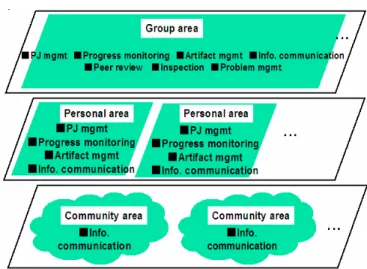
We propose a conceptual model for the learning environment as shown in Figure 1 to solve the abovementioned requirements. We classify the activities in group-based software engineering project course into those by group, those by in-dividual, and those beyond group. Each learner, group, and community is assigned its area for its activity. In the group area, the learners conduct group activities such as project management, progress monitoring, artifacts management, peer review, and so on. In the personal area, learners perform their personal activities such as creation of personal schedule, progress reporting, and artifacts management. In the community area, they make informal communication across group. Each area is related across the area. The links between the group area and the personal area, and between the community area and the personal area represent affiliation relationship. The links that connect the personal areas represent coop-eration relationship.
4 The support environment
This section describes our learning support en-vironment, which embodies the conceptual model we proposed in the previous section. In section 4.1, we describe overview of the func-tions the environment provides according to the model elements. In the subsequent subsections, we explain the functions in more detail.
Figure 1: Conceptual model for the support environ-ment
4.1 Overview of the environment
Figure 2 shows a set of functions our environ-ment provides.
Figure 2: Set of functions of the support environment
* Group area
This area supports development activities by
group comprehensively like traditional learning support environments. Those are project man-agement that defines a group’s development schedule and work assignment, progress moni-toring, management of artifacts that should be shared within a group, communication function that exchanges messages among group members and/or between the teaching staff and group members, functions that support quality assur-ance activities, such as peer review and inspec-tion, problem reports management. These func-tions are inter-related centered around artifact management. Communications in software de-velopment often relate to artifacts. Therefore users can access to artifacts from the communi-cation function (asynchronous communicommuni-cation support by BBS). The target artifacts for inspec-tion are those under artifact management. * Personal area
This area supports personal development activi-ties that are conducted based on the group schedule and assignment. We provide three functions: project management, which specifies personal schedule, personal progress monitoring based on the personal schedule, and artifacts management that manage the artifacts created by individuals.
* Community area
This area supports information sharing across group. For that purpose, some communication functions are provided.
4.2 Development support
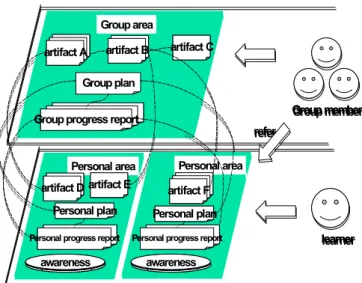
This environment supports group and personal activities by providing the group and personal area respectively. Figure 3 shows the data that are managed in each area and those across the areas. Figure 4 shows a screen shot of the personal area. In the group area, members decide the devel-opment plan and work assignment using the project management function. The assignment is reflected on project management function of personal area. Each learner makes his/her per-sonal schedule based on group development plan (Figure 4 (1)). When a personal schedule is reg-istered, it is notified of other group members (Figure 4(4)). That facilitates progress monitor-ing.
Group member
learner refer
Group area
Personal area Personal area Group plan
artifact B artifact C
Group progress report
アウェアネス アウェアネス
artifact A
artifact D artifact E artifact F
Personal progress report Personal progress report
Personal plan Personal plan
アウェアネス アウェアネス アウェアネスアウェアネスawareness アウェアネスアウェアネスawareness Group member Group member learner learner refer Group area
Personal area Personal area Group plan
artifact B artifact C
Group progress report
アウェアネス アウェアネス
artifact A
artifact D artifact E artifact F
Personal progress report Personal progress report
Personal plan Personal plan
アウェアネス アウェアネス アウェアネス アウェアネス アウェアネスawareness アウェアネスawareness Group area Group area Personal area
Personal area Personal areaPersonal area Group plan
artifact B
artifact B artifact Cartifact C
Group progress report Group progress report
アウェアネス アウェアネス
アウェアネス アウェアネス
artifact A artifact A
artifact D
artifact D artifact Eartifact E artifact Fartifact F
Personal progress report Personal progress report Personal progress report Personal progress report
Personal plan Personal plan Personal plan Personal plan
アウェアネス アウェアネス
アウェアネス アウェアネス
アウェアネス アウェアネス
アウェアネス アウェアネス
アウェアネス アウェアネス
アウェアネスawarenessawareness アウェアネスawarenessawareness
4.3 Progress monitoring support by the in-structor
In our environment, a personal area manages a personal plan, personal progress report, and ar-tifacts for a learner. The instructor can access to all of them from the instructor’s area.
When quality problem for artifacts or delay is found, the instructor can visit to the personal area for the learner and ascertain his/her plan, pro-gress and the artifacts (s)he created (Figure 4(1,2,and 3)). According to such observation, the instructor gives his/her advice or feedback if necessary. Once the instructor sends the learner a message for advice or feedback, it is notified of him/her (Figure 4(6)).
Figure 3: Support of development activities
After the project course, the instructor evalu-ates the artifacts that are stored in the group area and personal area. Evaluation for group is de-termined by the artifacts in the group area. Evaluation for personal is determined by the artifacts in the personal area. This function en-ables the teaching staff to give feedback and/or to evaluate learners’ activities, therefore, solve the requirement raised in section 2.2.
The progress data of personal and group are managed in the personal area and group area respectively (Figure 4(2)). The related data can be followed by links. Managing the progress data in each area allows the progress data to be ar-ranged. We can ascertain the progress on how a person participated in the group and the personal progress by traversing the group area and per-sonal area. When the progress data of group or personal is registered, it is notified of the personal area of the group members (Figure 4(4)).
4.4 Information sharing support across group Our environment provides two types of informa-tion sharing support, that is, by community from the viewpoint of problem solving, and by coop-eration relationship among learners from the viewpoint of quality according to the require-ments in section 2.3.
Outputs of development activities are managed as artifacts. This environment manages artifacts created by group in the group area and those created by personal in the personal area (Figure 4(3)). At this time, related artifacts are managed by links like progress monitoring. Once artifacts are registered, it is notified of the personal area of
the group members (Figure 4(4)). 4.4.1 Information sharing support by community Our environment supports project
manage-ment, progress monitoring, and artifact man-agement for not only groups but also personals. Personal areas are related with group area by affiliation relationship. By this relationship, when a member is beyond the schedule, the group members go to the personal area for the member and can ascertain the detailed progress. Since our environment manages development activities in each area, responsibility for activities becomes clear. For example, defects are detected in an artifact by peer review and/or inspection, the member who is in charge of it is specified. These features solve the requirements that were de-scribed in section 2.1.
Our environment supports to create a community area and communicate with peers in the area. This function enables to participate in a commu-nity a learner has interests and to share informa-tion. As such, our environment facilitates col-laborative information sharing among learners.
The abovementioned community may not fully support those who have some problems because social relationships in communities are loose and various types of communications are conducted, therefore turn around time for responses to a request is not always short.
Figure 4: Screen image of the personal area
We therefore provide a problem solving community that supports specific problem solv-ing in addition to a community of general pur-pose. We explain problem solving process using this community.
(i) Initial phase (Figure 5)
In this phase, a user creates a community, and calls for participation.
1) Creation of a problem solving community: a learner who encountered a problem creates a community to get advice from the whole class.
2) Calling for participation: the environment
informs the whole class of a notification that a learner encountered a problem. The notifi-cation message is shown in Figure 4(5). 3) Registration of participation for the problem
solving community: the learners who had in-terests in the problem register their participa-tion in the community. By the registraparticipa-tion, af-filiation relationship is established between them and the community. When the relation-ship is established, an icon to access the community will be shown in Figure 4(8).
Figure 5: Initial phase (ii) Activation process (Figure 6)
This is a phase participants in the community discuss to solve the problem.
4) Discussion: discussions on the problem are held centered around the person who asked for help. To facilitate discussions, awareness information is provided as shown in Figure 4(5) when messages are posted to the com-munity area. When the discussions are at a standstill, a function that asks the teaching staff for help is provided.
Figure 6: Activation phase (iii) Convergence phase (Figure 7)
This is a phase to terminate discussions in the corresponding community after the problem has fixed and a learner who asked for help registers the problem resolution information.
5) Registration of the problem resolution infor-mation: the learner who asked for help reg-isters the problem resolution information, i.e., cause and disposition of the problem, and the lessons learned from the problem resolution, after (s)he resolved it.
6) Notification of the problem resolution: the learners who possess the affiliation
relation-ship with the community receive a message that the problem has fixed. Learners who have a similar problem to this can utilize this community, i.e., they can refer stored infor-mation or pose questions to those who par-ticipate in the community.
・・・ OK ・・・ OK Personal space ・・・ ・・・ ・・・ 2 3 HELP Community space 1 ・・・ OK ・・・ OK Personal space ・・・ ・・・ ・・・ 2 3 HELP Community space
1 By providing the abovementioned two types
community area, our environment supports both loose information sharing and information shar-ing for specific problems. They facilitate com-munications across groups, therefore, we expect to improve efficiency of learners’ development. By sharing the problem resolution information for specific problems in the community, the teaching staff can avoid to have to answer du-plicate questions. Thus by supporting informal communication with community, we expect to solve the requirements in section 2.3.
・・・ OK ・・・ OK Personal space ・・・ ・・・ ・・・ 5 HELP Community space 6 ・・・ OK ・・・ OK Personal space ・・・ ・・・ ・・・ 5 HELP Community space 6 ・・・ OK ・・・ OK Personal space ・・・ ・・・ ・・・ 4 HELP community space ・・・ OK ・・・ OK Personal space ・・・ ・・・ ・・・ 4 HELP community space
Figure 7: Convergence phase
4.4.2 Information sharing support based on cooperation relationship
We observed some learners referred to artifacts their friends created. A learner X implemented a function that makes a user register “book” data from a web browser, uploads the data to a server, and then stores them into a database. Another learner Y, who is a friend of learner X, was in charge of a function that registered the user in-formation to a database in a server. Both func-tions were similar in that the data input via a web browser were uploaded to a server and then stored into a database. Learner Y referred to the source codes learner X created. The learner Y implemented his/her assigned function success-fully. By such cooperation, most of them could accomplish their assignment, even if they lack specific technical skills. Such actions are said to be effective in the field of learning theory [3]. Therefore we support information sharing among
individuals in our environment. Our environment opens the artifacts, which are stored in the per-sonal area to those who participated in the course. At this time, we introduce access control, that is, everyone can’t always access all artifacts. In this study, we call the relationship that opens the information each other cooperation relationship. The relationship is shown by icons in the per-sonal area like Figure 4(7). By selecting the icon, a learner can access to the personal area of the learner the icon represents. The cooperation re-lationship is established only among group members from the outset. However, by agree-ment among learners this relationship can be established at any time. We suppose this rela-tionship will be established by not only friend-ship in the real world but also by relationfriend-ship that was constructed in a community.
Thus by exchanging information between learners who established cooperation relationship, overall quality improvement will be expected. As the result, efficiency of development will im-prove, and the load of the teaching staff with respect to review will reduce. We think the re-quirement of section 2.3 will be solved by sup-porting the relationship for informal collabora-tion.
5. Summary and future work
This paper described the necessity for supporting not only group activities but also personal ac-tivities, for monitoring by the teaching staff, and information sharing across group in group-based software engineering project course. We pro-posed a conceptual model for the learning sup-port environment that includes personal area, group area, and community area. We also de-scribed some major functions for the environ-ment.
We will complete its implementation and ap-ply it to an actual course.
Acknowledgment
This study is supported by the Grant-in Aid for No. (C) 18500701 from The Ministry of Educa-tion, Science, Sports and Culture of Japan. References
[1] L. Augustin, D. Bressler, and G. Smith,
Ac-celarating software development through col-laboration, Proceedings of the 24th International
Conference on Software Engineering (ICSE2002), 559-563, ACM Press, 2002.
[2] K. Chiken, and A. Hazeyama, Awareness Support in Group-based Software Engineering Education System, Proceedings of the Tenth Asia-Pacific Software Engineering Conference (APSEC2003), 280-289, IEEE Computer Society Press, 2003.
[3] A. Collins, J. S. Brown, and S. Newman, Cognitive Apprenticeship: Teaching the Craft of reading, writing, and mathematics. In L. Resnick (ed.), Knowing, Learning, and Instruction: Es-says in Honor of Robert Glaser. Hillsdale, NJ: Lawrence Erlbaum, 1989.
[4] S. A. Drummond, and C. Boldyreff, The Development and Trial of SEGWorld: A Virtual Environment for Software Engineering Student Group Work, Proceedings of the IEEE 13th Conference on Software Engineering Education and Training (CSEET2000), 87-97, IEEE Com-puter Society Press, 2000.
[5] J. H. Hayes, T. C. Lethbridge, and D. Port, Evaluating Individual Contribution Toward Group Software Engineering Projects, Proceed-ings of the 25th International Conference on Software Engineering, 622-627, IEEE Computer Society Press, 2003.
[6] A. Hazeyama, An Education Class on Design And Implementation of an Information System in a University And Its Evaluation, Proceedings of the 24th Annual International Computer Soft-ware and Applications Conference (COMPSAC2000), IEEE Computer Society Press, 21-27, 2000.
[7] A. Hazeyama, K. Osada, Y. Miyadera, and S. Yokoyama, An Education Support System of Information System Design and Implementation, Proceedings of the 7th Asia-Pacific Software Engineering Conference (APSEC2000), IEEE Computer Society Press, 393-396, 2000.
[8] A. Hazeyama and A. Nakano, Communica-tion Support System for Software Engineering Education, Journal of IPSJ, Vol. 42, No. 11, pp. 2550-2561, 2001 (In Japanese).
[9]Keidanren (In Japanese), http://www.keidanren.or.jp/japanese/policy/2005
/039/honbun.pdf.
[10] N. Matsushita, S. Matsuura, and Y. Hayashi, Tool Support for Inspection on Group Work Software Development 3Z-3, Proceedings of the 67th IPSJ Congress, 2005 (In Japanese).
[11] Ministry of Education, Culture, Sports, Science and Technology, 2006 (In Japanese), http://www.mext.go.jp/a_menu/koutou/it/index. htm.
[12] S. Shoenig, Supporting a Software Engi-neering Course with Lotus Note, Proceedings of the International Conference on Software Engi-neering Education and Practice (SEEP1998), IEEE Computer Society Press, 1998.
[13] C. Steinfield, C.-Y. Jang, and B. Pfaff, Supporting Virtual Team Collaboration: the TeamSCOPE System, Proceedings of the Inter-national ACM SIGGROUP Conference on Supporting Group Work, 81-90, ACM Press, 1999.
[14] K. Yamashita, H. Hashiura, R. Chiba, Y. Inoue, S. Umebayashi, and S. Komiya, EtUDE: A Software Environment for Supporting Exercise in Software Development Conducted in Units of Groups -, IEICE Technical Report AI2006-62, 9-12, 2007 (In Japanese).