Japan Advanced Institute of Science and Technology
JAIST Repository
https://dspace.jaist.ac.jp/
Title
Evaluation of Characteristics of Word-of-Mouth Communication Forms for Predicting Information Propagation on the Internet
Author(s) Takeuchi, Susumu; Akiyoshi, Masanori; Komoda, Norihisa
Citation
Issue Date 2007-11
Type Conference Paper
Text version publisher
URL http://hdl.handle.net/10119/4144
Rights
Description
The original publication is available at JAIST Press http://www.jaist.ac.jp/library/jaist-press/index.html, Proceedings of KSS'2007 : The Eighth International Symposium on Knowledge and Systems Sciences : November 5-7, 2007, [Ishikawa High-Tech Conference Center, Nomi, Ishikawa, JAPAN], Organized by: Japan Advanced Institute of Science and Technology
Evaluation of Characteristics of Word-of-Mouth Communication Forms
for Predicting Information Propagation on the Internet
Susumu Takeuchi† Masanori Akiyoshi† Norihisa Komoda†
†Graduate School of Information Science and Technology, Osaka University
{stakeuti,akiyoshi,komoda}@ist.osaka-u.ac.jp
Abstract
Since information is easily and widely spread on the Internet recently, detecting undesired in-formation that affects many users prior to its propagation is necessary. By focusing on word-of-mouth communication forms of information, which are constructed by the users’ subjective impressions and actions, possibilities of predict-ing information propagation based on its forms are verified by performing an experiment with real users. As a result, the average number of users whom information passed through, i.e., propagation distance, of interesting or important information tends to larger. This result suggests that evaluating characteristics of information by its propagation forms may be possible.
Keywords: Information Propagation, Word-of-Mouth Communication, Average Propagation Distance
1 Introduction
Currently, users can obtain information by uti-lizing the devices that allow the users to connect to the Internet, e.g., personal computers, and cel-lular phones. Various kinds of services are also available on the Internet that enables the users to send information without difficulties. For ex-ample, blog (web log) encourages the users to publish their opinions about specific news or dairies without knowledge of HTML tags. Con-sequently, various kinds of information are sent by varieties of users, and such information tends to be propagated throughout the Internet.
Information, which is propagated to many users, sometimes includes criticisms, slanders, discriminatory comments, or leaked personal in-formation. Propagation of these kinds of infor-mation affects extremely the person or the com-pany concerned. Meanwhile, even if informa-tion is harmless by itself, propagainforma-tion sometimes causes a problem such as chain e-mail. There-fore, detecting information propagation without
considering the content of it prior to its propa-gation is significant for maintaining healthy and reliable communication on the Internet.
In this paper, by focusing on word-of-mouth communication forms of information, possibili-ties that estimating propagation by the traces of its circulation are estimated. For investigating the possibilities, an experiment based on word-of-mouth communication is performed by real users. When propagation can be estimated by its forms, undesired propagation may be detected independent of its content and is expected to be prevented.
The rest of the paper is organized as follows. Section 2 explains the features of information propagation on the Internet. In Section 3, a crite-rion is proposed to evaluate propagation forms. Section 4 describes the details of experimental environment and results of the evaluations. Fi-nally, Section 5 concludes the paper.
2 Information propagation on the Internet
2.1 Circulation features in existing communication systems
To address a detection or prediction of informa-tion propagainforma-tion, features of circulainforma-tion of infor-mation should be identified. Accordingly, com-munication systems which are used on the Inter-net is classified as shown in Table 1.
In case of general web site or community ser-vices such as BBS (Bulletin Board System), SNS (Social Networking Service), blog site, meta-verse the general public share the same “place” to communicate so that information sometimes propagates among many users. Estimating the number of users who receive such information is difficult because the number of receivers de-pends on the contents of information.
Meanwhile, in case of e-mail or instant mes-saging, information is transmitted to specified target users so that information does not
prop-Table 1. Classification of communication systems Target users are:
Number of target users Specified Unspecified
few E-mail, instant messaging
many Mailing list, groupware BBS, blog, metaverse
agate to outsiders. In case of a mailing list or a groupware, the users communicate with multiple users, but a community is closed so that informa-tion may not propagate to other users who do not join the community.
2.2 Features of problems of information propagation
In the systems which support communication be-tween specific users, information does not prop-agate directly to other users as described in Sec-tion 2.1. However, information is often for-warded by a user who is one of the limited users. Thus, information sometimes propagates among many users by word-of-mouth communication like chain e-mail. Meanwhile, even if infor-mation can be obtained by many users such as on the Web, which is a form of propagation, the propagation of information does not always cause a problem. Because the problem is oc-curred when a receiver is willing to take action on it, e.g., transmits it to other users with the receiver’s comment, according to its importance or interest. Obviously, this action is a basis of word-of-mouth communication.
Therefore, information propagation should fo-cus not on the number of receivers but on how the receivers feel and transmit the information. In other words, information can be considered to
propagate when circulations in word-of-mouth
communication are frequent. 2.3 Related Work
In order to identify information propagation, two approaches can be considered. One is “trend finding” approach which observes hot topics by counting the number of same word or similar contents ([1] etc). The analyzers may be possi-ble to identify undesired information from these topics, but it is too late to prevent its propagation because hot topics have already propagated.
The other is “web mining” approach which sets keywords, e.g., name of a product, company, or place, relates to information that specific
peo-ple do not desire to be propagated among many users, and collects the pages which contain such keywords ([2] etc). Consequently, the analyz-ers may be able to find undesired information that includes the keywords. In contrast to the trend finding approach, a gathering system may alert the analyzers when information, which in-cludes the keyword, is sent by someone prior to its propagation. However, when an abbreviation or euphemism is used instead of the specified keyword itself, detecting by the keyword may become difficult and force the analyzers to set multiple synonyms as keywords. Moreover, a provider, which serves a community service such as BBS, SNS, blog site, or metaverse, cannot as-sume a keyword which indicates undesired infor-mation in advance, because undesired keywords emerge day by day.
Besides, if specific information can be de-tected by the keyword, deleting such information has a risk to cause flaming. Thus, a deletion of undesired information should be based on the es-timation of information propagation, i.e., unde-sired information should be deleted when the in-formation is estimated to propagate among many users.
3 Predicting word-of-mouth propagation by its forms 3.1 Propagation of word-of-mouth
communication
As described in Section 2, word-of-mouth com-munication is significant for predicting informa-tion propagainforma-tion. The followings are considered natures of word-of-mouth communication on the Internet.
• Information is transmitted between the real
users.
• Receivers of information are indicated by a
sender or transmitter of the information.
• Contents of information are not easily
Figure 1. Example of a propagation tree of infor-mation in word-of-mouth communications
sometimes appended.
In word-of-mouth communication, informa-tion is transmitted and propagated only when a transmitter judges the information is worth to be shared with the receivers. From the social sci-ences point of view, information propagates by the subjective impressions of people in the real world, such as importance and vagueness of in-formation [3; 4], or uncertain of inin-formation [5]. Thus, if subjective impressions of the users can be obtained, predicting information propagation may be possible. However, the number of users and information is extremely huge, prediction based on subjective impressions of the users is impossible.
3.2 Word-of-mouth communication forms In word-of-mouth communication, a propaga-tion tree is constructed based on the relapropaga-tion of senders and receivers. Figure 1 shows an exam-ple of propagation tree. Each edge indicates the relationship between a sender and a receiver, and each node indicates a sender or a receiver. User forwards information when the user thinks it is worth to be shared, so the tree can be considered to include subjective impressions of the users. Thus, difference of the forms is expected to ex-press the difference of nature of information.
The parameters and the features of propaga-tion forms, which can be considered to obtain from a propagation tree, are the followings.
• Propagation distance of information
Information, which is forwarded by mul-tiple users, can be considered significant among the users. Thus, propagation dis-tance is considered to relate to subjective evaluations of the users.
• Number of propagated users
APD = 1.2 0 1 2 APD = 1.0 0 1 2
Figure 2. Correlation between Average Propaga-tion Distance and specificaPropaga-tions of propagaPropaga-tion forms
The number of propagated users from a spe-cific user may indicate how information is significant for the user. Thus, the number of propagated users is considered to relate to subjective evaluations of the user as well. 3.3 Average propagation distance
For evaluating the features of information based on the parameters described in Section 3.2, the measurement of Average Propagation Distance (APD) is proposed in [6]. The value of APD dicates the average number of users whom in-formation passed through. The APD of specific information i is calculated by
apd(i) =
∑
∀u∈Rl(i, u)
|R| (1)
where R indicates a set of users who receive i,
l(i, u) indicates a propagation distance (0 in case
of a sender) of i when a receiver u∈ R receives, and|R| indicates the number of receivers.
As shown in Figure 2, even if the number of receivers of specific information is the same, the value of APD differs based on its propagation forms. When the value of APD is large, infor-mation is significant among many users because the number of users who forward it is large. On the contrary, when the value of APD is small, in-formation is significant only for limited users. 4 Experimental results
4.1 Outline of the experiment
For evaluating a possibility of prediction of in-formation propagation, the traces of inin-formation circulation and subjective impressions of infor-mation, e.g., interest and importance, are should be investigated simultaneously. Since collect-ing logs of the communication systems such as
Database (store all comm. logs)
Web server (Java Servlet)
View and transmit a message Notification of a new message Web browser Notification Client User
Figure 3. Overview of the experimental system
SNS or BBS are insufficient to evaluate both of them, an information propagation support sys-tem that is based on word-of-mouth communi-cation is implemented, and the experiment was carried out by real users.
4.1.1 Experimental system
In order to collect the traces of information circulation, the system must gather contents of information and comments for the information, which propagates among users. Note that com-ments must be made at the time when a user for-wards it because the latest subjective impression affects the user’s activity, so the system must provide the user both of contents of information and a questionnaire form for it simultaneously.
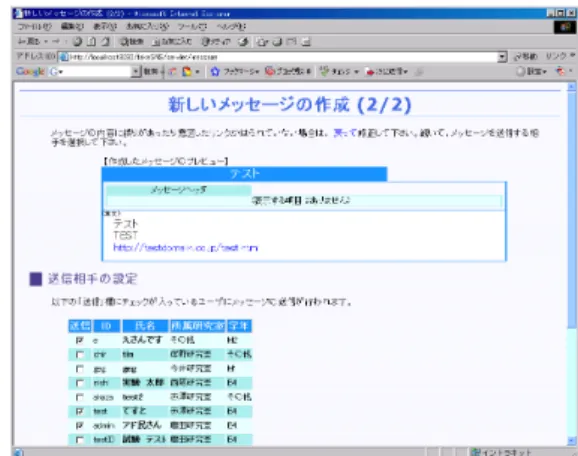
Therefore, the experimental system is imple-mented as a general web application based on Java servlet and MySQL database, as shown in Figure 3. When a user sends a message to oth-ers, the user is only forced to login the system, to write contents of the message, and to select tar-get users from the list of participated users. Fig-ure 4 depicts an example screenshot of the sys-tem. Consequently, the database of the system stores all of the contents and target users.
In contrast, when a user receives a message from other users, the user is lead to the system by notifying from the client application as shown in Figure 5. The user reads contents of the mes-sage, and judges the message is worth to be for-warded to other users. When the user wants to forward it, the user selects target users from the list of participated users. In addition, the system requests the user to answer questionnaires for the message even if the user does not forward it.
As a result, the traces of information circula-tion and subjective evaluacircula-tions by the users can be obtained through the database.
Figure 4. Screenshot of the server when a user sends a message
Figure 5. Screenshot of the notification client
4.1.2 Procedure of the experiment
The experiment was performed by 29 stu-dents. The participants freely send a message to others, and forwards it when the receiver thinks it is worth to be shared. Questionnaires that are filled by the receivers are organized as follows.
1. Accuracy
Do you think the message is accurate or not? (Yes / Maybe / Doubtful / No)
2. Interest
Do you think the message is interesting for you? (5 to 1; 5 indicates very interesting) 3. Importance
Do you think the message is important for you? (5 to 1; 5 indicates very important) 4.1.3 Overview of the experimental data
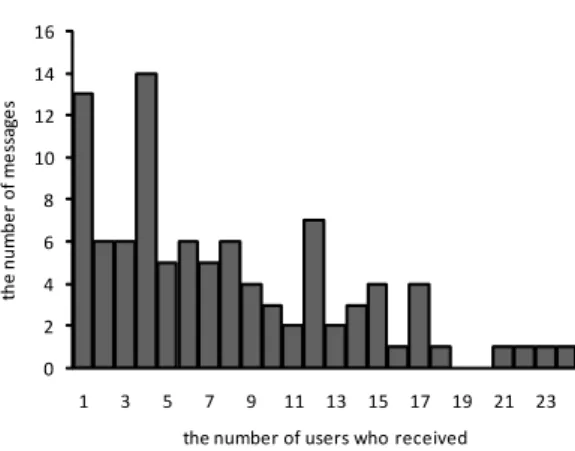
The number of messages sent during the pe-riod of the experiment is 96. Distribution of the number of users who receive messages and the number of messages corresponds to it is il-lustrated as Figure 6. Almost of the messages does not propagate, but some messages propa-gates among almost all of the users.
0 2 4 6 8 10 12 14 16 1 3 5 7 9 11 13 15 17 19 21 23 th e nu m be r o f m es sa ge s
the number of users who received
Figure 6. Distribution of the number of users who received the messages
4.2 Evaluations
4.2.1 Outline of the evaluations
The propagation trees of all the messages are constructed based on the propagation forms of them. The value of average propagation distance and the number of receivers are evaluated based on the trees. Moreover, subjective evaluations are obtained by analyzing the results of ques-tionnaires. Possibilities of prediction of infor-mation propagation based on the average propa-gation distance are evaluated by investigating the correlation between the forms and the question-naires.
Note that a user selects target users freely so that the user cannot identify who receives the same message. Thus, some user may receive the same message multiple times in this system as shown in Figure 7. When constructing a propa-gation tree, such a user and the downstream users are duplicated to all of the possible nodes. For instance, in case of user B forwards the message to user C in the figure, the propagation tree is constructed with user C’ and D’ and the value of average propagation distance is calculated with them. However, the number of users who receive the message is only counted the real receivers, i.e., C’ and D’ is ignored.
4.2.2 Correlation between the average propagation distance and subjective evaluations
The value of APD is affected by the number of receives, so the distribution of the number of re-ceives and the value of APD is evaluated and il-lustrated as Figure 8. Meanwhile, most
interest-A B
C D
C’ D’
Figure 7. Construction of a propagation tree when a certain user receives the same message multiple times 0 1 2 3 4 0 5 10 15 20 25 Av er ag e P ro pa ga tio n Di st an ce
The number of users who received the messages
Other messages Interesting messages Important messages
Figure 8. Correlation between the number of users who received the messages and average propagation distance
ing or important 20 messages are selected by the questionnaires, which indicate significant mes-sages by subjective evaluations.
The value of APD tends to increase as the number of receivers increases, but the value of APD is diverse at the same number of receivers. As described in Section 3.3, this difference may indicate the difference of nature of information.
To compare the difference, all the messages are classified into 2 groups which indicates the value of APD is larger or smaller than the linear regression form y = 0.115x + 0.6096, where y indicates the value of average propagation dis-tance and x indicates the number of receivers.
Consequently, although the number of re-ceivers does not relate to the interest or impor-tance of the messages, almost of the interesting and important messages are belong to the larger APD group. Thus, interesting or important infor-mation, which can be considered to have a po-tential to propagate among many users, may be identified by the value of APD.
The initial number of users who received the messages Av er ag e P ro pa ga tio n Di st an ce 1 2 3 4 5 10
The value of APD when the messages propagated:
longer shorter
Figure 9. Distribution of APD when the mes-sages propagated until a specific number of users
4.2.3 Differences of the beginning of information propagation
In order to detect information that is possible to propagate, differences between significant and ordinary information at the beginning of prop-agation should be investigated. Thus, first, all the messages are classified into 2 groups by the value of APD is larger than the linear regression form which is described in Section 4.2.2. Sec-ondly, the messages that propagate more than 5 or 10 users are selected. Thirdly, the value of APD is calculated only for first 5 or 10 receivers of each message. Lastly, distribution of the value of APD is illustrated as a box plot in Figure 9.
As shown in the figure, the value of APD of the messages which belong to the larger APD group tend to be larger than the messages which belong to shorter group at the beginning of prop-agation, which is verified by t-test. Therefore, significant information’s value of APD, which has a potential to propagate, tends to be larger from the beginning.
4.3 Discussions
From the results of evaluations, word-of-mouth communication forms may indicate significance of information. Since such information is considered to propagate, detecting propagation forms of information will enable us to predict un-desired information propagation. Although the forms must be obtained by collecting the traces of circulation of information, subjective impres-sions of the users are not required to predict.
5 Conclusion
In this paper, the average propagation distance was proposed to predict information propaga-tion on the Internet, which can be obtained by word-of-mouth communication. By performing the experiment with real users, the tendency that the average value of propagation distance of im-portant or interesting information is larger than ordinary information was revealed. Therefore, information propagation is expected to be predi-cated by examining word-of-mouth communica-tion forms.
As a future work, a further experiment is re-quired for validating the results obtained in this paper. In addition, how to apply to the real world such as blogs should be addressed.
Acknowledgement
This work was supported in part by the Re-search and Development Program of Ubiqui-tous Network Authentication and Agent (2003), The Ministry of Public Management, Home Af-fairs, Posts and Telecommunications (MPHPT), in Japan.
References
[1] H. Nanba, N. Okuda, and M. Okamura. Ex-traction and visualization of trend informa-tion from newspaper articles and blogs. In
Proceedings of the 6th NTCIR Workshop,
2007.
[2] TheWebWatcher.
http://www.thewebwatcher.com/.
[3] G. W. Allport and L. J. Postman. The
psy-chology of rumor. Holt, New York, 1947.
[4] R. L. Rosnow, J. L. Esposito, and L. Gibney.
Factors influencing rumor spreading: Repli-cation and extension. Language and
Com-munication, 1988.
[5] C. J. Walker and B. Blaine. The virulence
of dread rumors: A field experiment,
vol-ume 11. Language and Communication, 1991.
[6] S. Takeuchi, J. Kamahara, I. Saeki, S. Teraoka, R. Harada, S. Shimojo, and H. Miyahara. Evaluation of the propagation of information based on the results of the experiments using cellular phones. In
Proceedings of the 13th Data Engineering Workshop, 2002. (In Japanese).