On
the
convergence of
a
three-dimensional
crystalline
motion to
Gauss curvature flow
Takeo K.
Ushijimal
Hiroki
Yagisita2
Abstract
We consideranapproximation of theGauss curvatureflow in$\mathrm{R}^{3}$by
eo-called crystalline motion. Here, theGauss curvature flowmakesasmooth
strictly convec
surface
shrink with the outward normal velocity equalsto the Gauss curvature with negative sign. The crystalline motionwas
introduced byRylor [15] and Angenent&Gurtin [1] to analyze crystal
growth mathematically. The most typical crystalline motionofpolygon
in $\mathrm{R}^{2}$ makes each edge ofapolygon keep the same direction but move
with the norinalspeed inverselyproportiondto its length Although such
motion is veryrestrictiveat first glance, it is very usefulnot only in the
mathematicaltheoryofcrystal growth but alsoasa numericalmethod for
free boundary problems. In twodimensionalcase,therearealreadymany
researches on the relation between the crystalline motion of polygonal
curvesand the curvature driven motion ofcurves(e.g. [12]).
Weextend the moet typical twodimensionalcrystaUine motion$\sim \mathrm{t}\mathrm{o}$ a
threedimensionalone whoseWulffshape i8 aconvexpolyhedron $(W^{k})$
.
HeretheWulffshaperepresents theanisotropyofthe problem. This
mo-tion makeseachsideofa polyhedron
move
with thenormalfped inversely$\mathrm{P}$roportional to itsafea. We provethis crystallinemotion convergesto $\mathrm{t}_{\sim}\mathrm{h}\mathrm{e}$
Gauss curvature flowin$\mathrm{R}^{3}$underthe aesumptions that thepolyhedra$W^{k}$
convergestotheunitball$B^{S}$ intheHausdorffdistanceandaresymmetric
with respect to the origin.
K. Ishii and H.M. Soner[12] showed the convergence ofthe two
di-mensional crystalline motion to the curve shortening flow by a kind of
perturbed test function methods. Weemploy their method to proveour
result under aid from thetheory of Minkowskiproblem (e.g. [14]).
1
Introduction
In thispaper,
we
consider an approximation of threedimensional Gausscurva-ture flow ofsmooth
convex
surfacesby usingso-called crystalhine algorithm. Firstweexplain the crystalline algorithm. Toinvestigatethecrystalgrowth mathematically,Taylor[15] andAngenent&Gurtin[l]
introduced thecrystalline$\iota$
Department of Mathematics, Faculty of Science and Technology, Tokyo University of
Science, Chiba, Japan
curvature flow and the crystalline motion of specific kind of polygons which
gives the solutionto the crystalline curvatureflow. Crystalline algorithm is
an
approximation method for
some
kind of moving boundary problems by usingthis crystalline motionof thepolygons.
Let
us
explain the crystallinemean
curvatureflow ofclosed hypersurface8.Let $\gamma$ be
a
positive, continuous, and homogeneous of degree one functionon
$\mathbb{R}^{d}(d=\mathit{2},3)$, which is called surface energy density, and define the surface
energyofclosed hypersurface$S\subset \mathbb{R}^{d}$ by
$I(S)= \int_{S}\gamma(\nu)dS$
.
Here, $\nu$ denotes the unit normal vectorfleld on $S$
.
Then, thegradient flow of$I$is called anisotropic
mean
curvatureflow. And when$\gamma[p$) $=|p|$, this flow is nothing but theclassicalmean
curvatureflow. Letu8definetheWulff
shapefor$\gamma$ by
$\tilde{W}=\{x\in \mathbb{R}^{d}|\langle x,\nu\rangle\leq\gamma(\nu)\}$,
which represents the anisotropy of the problem. Here, (, $\rangle$ denotes the inner
product in $\mathbb{R}^{d}$
.
In the
case
where this shape isa convex
polygon, the energy$I$ is called crystalline
surface
energy and thegradient flow is called crystallinemean
cumatuoeflow.
Hereafter,
we
only deal with the case where the polygons and the closedcurves
are
all convex, for simplicity. Thesolution to thetwodimensionalcrys-tallinecurvature flow isgiven byso-calledcrystallinemotion. Thisisthe motion
of$\mathrm{a}\mathrm{d}\mathrm{m}\mathrm{i}\mathrm{s}8\mathrm{i}\mathrm{b}\mathrm{l}\mathrm{e}$polygons. A polygon is called admissible with
respecttotheWulff
shape $\tilde{W}$
if and only ifthe set of all outward unit normal vector of the poly-gon coincides with the
one
of $\tilde{W}$and each pair of normal vectors of adjacent edges ofthe polygon is adjacent in $\tilde{W}$
.
The crystalline motion which is$\mathrm{p}\mathrm{r}\triangleright$
posedby Tayloris the motion ofadmissiblepolygonswhosenormal velocity $v_{\mathrm{j}}$
isproportionalto
$\kappa_{j}=\frac{\tilde{L}_{\mathrm{j}}}{L_{\mathrm{j}}}$
.
Here,$v_{j}$ and$L_{j}$ arethe outward normal velocity and the lengthofthejthedge
ofthe admissiblepolygon, respectively, and $\tilde{L}_{j}$ is the length of thejth
edgeof the Wulffshape $\tilde{W}$, respectively.
And thequantity $\kappa_{j}$ is called the crystalline
curvature ofthe$j\mathrm{t}\mathrm{h}$ edge oftheadmissible polygon. We notethat during the
evolution the admissibility is $\mathrm{p}\mathrm{r}\mathrm{e}\Re \mathrm{r}\mathrm{v}\mathrm{e}\mathrm{d}$
.
Hence, this motion makes each edgeofapolygonkeep thesamedirectionbut movewith the nomalspeedinversely
proportionaltoitslength. Wealso notethatthismotion isgovemedby
a
systemof ordinarydifferentialequationsfor$L_{j}$
.
There
are
already many researcheson
the two dimensional crystallinemo-tion. It is known that
as
the number of edges of $\tilde{W}$ goesto infinity and $\tilde{W}$
converges to
a
circle, the two dimensional crystalline motionconverges
to thecurvature flow ofplane
curves
(see [5,9, 10, 6, 7, 12, 17]). Especially,in $[7, 12]$ theconvergence
betweencrystallinemotionandcurvature flow isproved inthecase
where thecurves
arenotnecessarilyconvex.
In otherwords,we
canapprox-imate the curvature flow by crystalline motion. Such
a
way of approximation is called crystalline algorithm. Numerical schemes basedon
this algorithmare
also studied and the class ofproblems which
can
be treated by this algorithmis extended ([17, 18], etc.).
Here,wewould liketosayabout agood nature of crystaUine algorithm
as
anumericalschemeformoving boundary problems. Generally speaking, to
com-pute thesolution for moving boundary problemI by discretizingthe boundary
curves
directly is not easy task, since it oftencauses
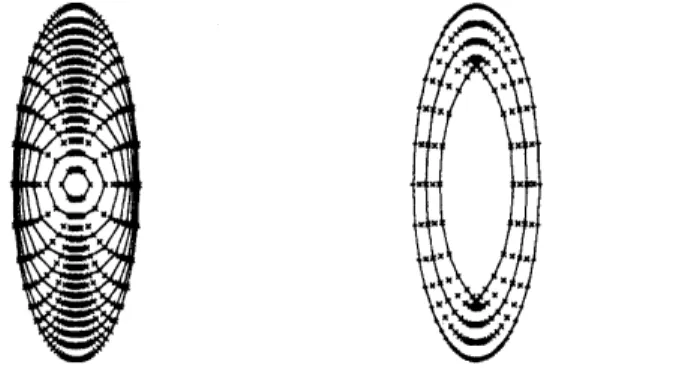
numerical instability like concentrationofthe points. In Fig.1,we
plot theresult ofcomputationfor free boundary problems whichare
governed bytheevolution law$v=-|H|^{a-1}H$bya
simplenumerical scheme. Here$v$and$H$are
theoutward normal velocity andthecurvature of thefreeboundary, respectively, and$\alpha$is
a
positive parameter.In this figure, the most outside curves
are
the initialcurves.
Wecan
observenumericalinstabilities which
we
mentioned. Althoughseveral methodsare
pro.posed preventing such instability, thesemethods often employ artificial tricks like distribution ofpoints.
We would like to claim that thecrystallinealgorithmis
a
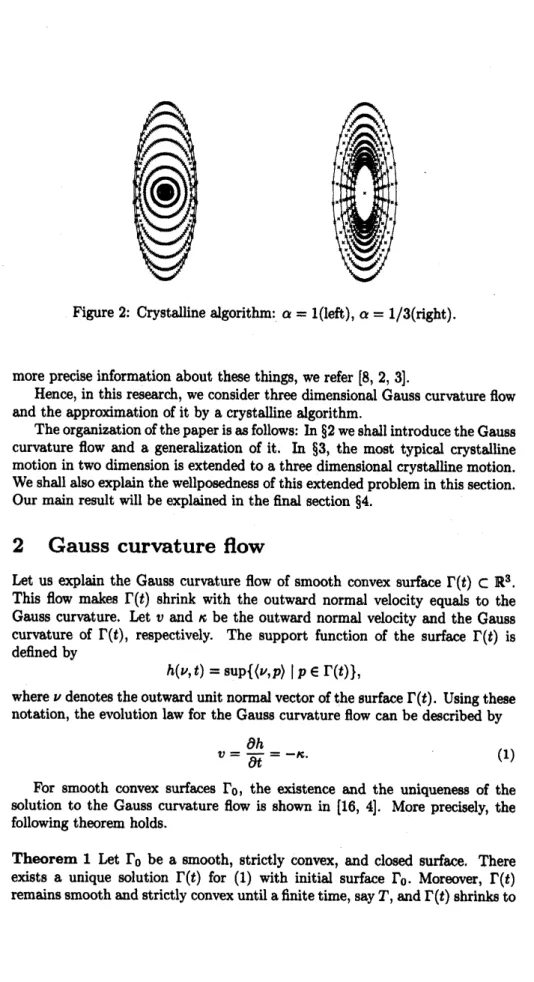
good method fromthis point of view. We plot the computationresults for the
sarne
problemas
Fig.1 by the crystalline algorithm in Fig.2. Here,
we
particularly note thatthe crystallinealgorithm donot need any artificialtechniquelike redistribution
of the partition points to prevent the instability and the convergence of the
algorithmis provedfor the problemof Fig.2$[17, 18]$
.
Figure 1: Asimple method: $\alpha=1(1\mathrm{e}\mathrm{R}),$$\alpha=1/3(\mathrm{r}\mathrm{i}\mathrm{g}\mathrm{h}\mathrm{t})$
.
It is
an
interesting questionthat whether the three dimensional version of crystalline algorithmcan
be constructed. However, crystalline dgorithm forhigher dimensional
mean
curvature flowisnotsuccess,yet. Inthreedimensionalcase, it is not clear that the crystalline
mean
curvature flowcan
be solved inthewhat class ofpolyhedra. Moreover, for the crystalline
mean
curvature flow,thecomparisonprinciple does not hold in general, while theconvergence results
Figure 2: Crystallinealgorithm: $\alpha=1(\mathrm{l}\mathrm{e}\mathrm{f}\mathrm{t}),$ $\alpha=1/3(\mathrm{r}\mathrm{i}\mathrm{g}\mathrm{h}\mathrm{t})$
.
more
preciseinformation about thesethings,we
refer[8, 2, 3].Hence, in this research,
we
consider three dimensional Gausscurvatureflowand theapproximationof it by
a
crystalline algorithm.Theorganizationof the paper isas follows: In
\S 2 we
shallintroduce theGausscurvature flow and
a
generalization of it. In \S 3, the most typical crystallinemotion in two dimension is extended to
a
three dimensionalcrystallinemotion. We shall alsoexplainthewellposednessof this extendedprobleminthis section. Our main result will be explainedin the final section \S 4.2
Gauss
curvature
flow
Let
us
explain the Gauss curvature flow ofsmoothconvex
surface $\Gamma(t)\subset \mathbb{R}^{3}$.
This flow makes $\Gamma(t)$ shrink with the outward normal velocity equals to the
Gauss curvature. Let $v$ and $\kappa$ be the outward normal velocity and the
Gauss
curvature of $\Gamma(t)$, respectively. The support function of the surface $\Gamma(t)$ is
definedby
$h( \nu,t)=\sup\{\langle\nu,p\rangle|p\in\Gamma(t)\}$,
where$\nu$denotes the outward unit normal vector ofthesurface$\Gamma(t)$
.
Using thesenotation, the evolution law for the Gauss curvature flow
can
be described by$v= \frac{\theta h}{\theta t}=-\kappa$
.
(1) For smoothconvex
surfaces $\Gamma_{0}$, the existence and the uniqueness of thesolution to the Gauss curvature flow is shown in $[16, 4]$
.
Moreprecisely, the followingtheoremholds.Theorem 1 Let $\Gamma_{0}$ be
a
smooth, strictly convex, and closed surface. Thereexists
a
unique solution $\Gamma(t)$ for (1) with initial surface $\Gamma_{0}$.
Moreover, $\Gamma(t)$ remains smoothand strictlyconvex
untila
finitetime,say$T$,and$\Gamma(t)$shrinks toapointatthis time
.
The extinction tirne is given by , where $\Omega_{0}$ is theset which isenclosed by$\Gamma_{0}$ and $V$ denotes the volume.Remark 1 We
can
also considera
generalization of(1):$v= \frac{\partial h}{\partial t}=-\kappa^{\alpha}$
.
(2)Here, $\alpha$ is a positiveconstant. For any $\alpha$ andany smooth
convex
surfaies $\Gamma_{0}$,the existence and the uniqueness of the solution to (2)
are
also established in[4]. Moreover, the solution surfacedisappearin finite time,sayT.
3
Three
dimensional crystalline
motion
Inthis section,
we
extend thecrystallinemotion ofconvexadmissible polygonsin the plane tothe
one
ofconvex
polyhedra. Ourthree dimensional crystallinemotion is defined
as
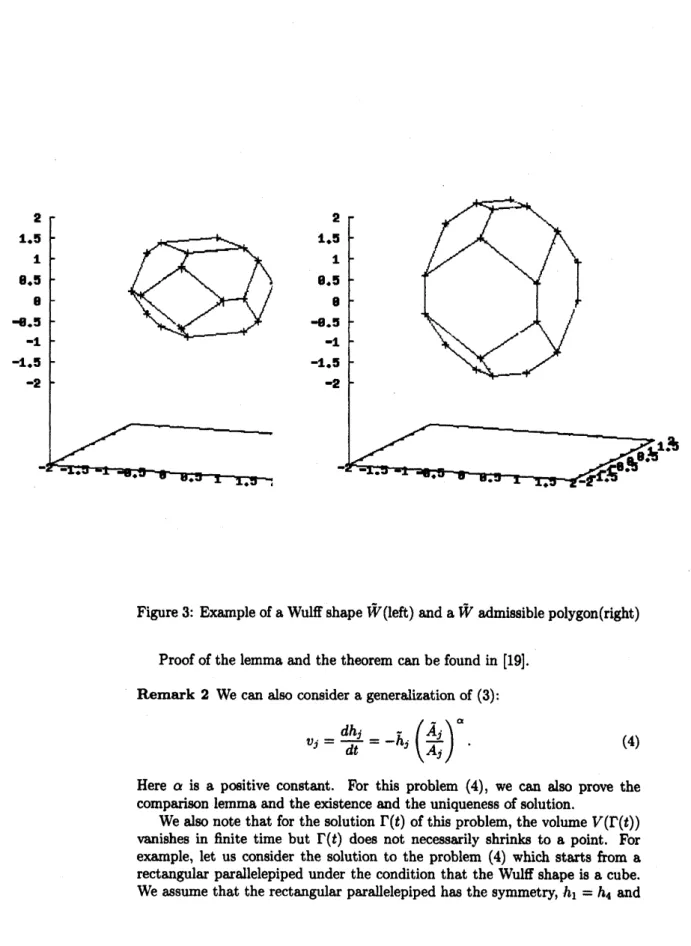
follows: Let theWulff
shape $\tilde{W}$ be an $N$ faceted convexpolyhedron. Let $\tilde{h}_{j},$
$\nu_{j}$, and
$\tilde{A}_{j}$ the support, the unit outward normal vector,
and the
area
of the$j\mathrm{t}\mathrm{h}$facet of$\tilde{W}$, respectively. Weset $\tilde{h}=(\tilde{h}_{j})_{\{1\leq j\leq N\}}$.
For this $\tilde{W}$, an$N$-facetedpolyhedronSt andits boundary $\Gamma$iscalled $\tilde{W}$-admissible
if andonly iftheoutward normalvector ofthe j-th facet, say $\Gamma_{j}$,of$\Gamma$ is
$\nu_{j}$ for
all$j$
.
See figure ??. The $\tilde{W}$-crystalline Gauss curvatureflow
is the motion ofthe $\tilde{W}$-admissible
$\Gamma(t)$, whichisthe boundary of$\tilde{W}$-admissiblepolyhedra$\Omega(t)$, whose evolution law is given by
$v_{j}= \frac{dh_{j}}{dt}=-\tilde{h}_{j^{\frac{\tilde{A}_{j}}{A_{j}}}}$
.
(3)Here,$h_{j},$ $A_{j}$, and$v_{j}$ denote thesupport, area, and the outward normal velocity
of thejth facet of$\Gamma(t)$
.
Although the comparison principle does not hold in general for the three dimensional crystalline
mean
curvatureflow,wecan
prove thisprinciplefor the$\tilde{W}$-crystalline Gauss curvature flow (3). This fact plays
an
important role inthe proofofourmain result.
Lemma 1 Let $\tilde{W}$ be a convex polyhedron in $\mathbb{R}^{3}$
including the origin
as
itsinterior point, and $\Gamma’(t)$ and$\Gamma(t)$ solutionsto$\tilde{W}$-crystallineflowfor $t\in[0,T)$
.
Then, $\Gamma’(0)\subset\Gamma(0)\cup\Omega(0)$ implies $\Gamma’(t)\subset\Gamma(t)\cup\Omega(t)$ for all $t\in[0,T)$
.
Here,$\Omega(t)$ is the openIet enclosed by$\Gamma(t)$
.
For this problem (3),
we
can
provethe following theorem.Theorem 2 Let $\Gamma_{0}$ be $\tilde{W}$-admissible
convex
$N$ faceted polyhedron, $\Omega_{0}$ theboundary of it. There exists unique solution to the problem (3) with initial
surface$\Gamma_{0}$
.
Moreover, $V(\Gamma(t))$ vanishes ata
finitetime, say$T$.
This$T$isgivenFigure3: Exampleof
a
Wulffshape$\dagger\tilde{V}$(left) and
a
$\tilde{W}$admissiblepolygon(right)
Proofofthelemmaand thetheorem
can
befound in [19].Remark 2 We
can
also consider ageneralizationof (3):$v_{j}= \frac{dh_{j}}{dt}=-\tilde{h}_{j}(\frac{\tilde{A}_{j}}{A_{j}})^{\alpha}$ $(4\rangle$
Here $\alpha$ is
a
positive constant. For this problem (4),we can
also prove thecomparison lemma and theexistence and theuniqueness of solution.
We also note that for the solution $\Gamma(t)$ ofthis problem, the volume$V(\Gamma(t))$
vanishes in finite time but $\Gamma(t)$ does not necessarily shrinks to
a
point. Forexample, let us consider the solution to the problem (4) which starts from
a
rectangular parallelepipedunder the condition that the Wulffshape is
a
cube. Weassume
that the rectangular parallelepiped has thesymmetry, $h_{1}=h_{4}$ and. Then the problem
can
be reduced to thefollowingsystemofordinary differentialequations:
$\frac{dh_{1}}{dt}$
$=-h_{2^{\alpha}}\sim^{1}$, $\frac{dh_{2}}{dt}$
$=-h_{1}^{\alpha}=^{1}h_{2}$
.
Since$h_{1}^{-\alpha}\dot{h}_{1}=h_{2}^{-\alpha}\dot{h}_{2}$ holds,
we
obtain$h_{1}^{1-}$’$(t)-h_{2}^{1-\alpha}(t)=h_{1}^{1-\alpha}(0)-h_{2}^{1-\alpha}(0)$,
where denotes the derivative with respect to time $t$
.
Hence, for $0<\alpha<1$,if$h_{1}^{1-\alpha}(0)-h_{2}^{1-a}(0)>0$then $\Gamma(t)$ Ihrinks to
a
line segment and if$h_{1}^{1-\alpha}(0)-$$h_{2}^{1-\alpha}(0)<0$then$\Gamma(t)$ shrinks toaplane segment.
Fortwodimensionalcrystalline motion,such degeneracy oftheextinction is
already known andextensively studiedin [13].
4
Main result
Now
we
consider the approximation oftheGausscurvatureflowbya
sequenceof the crystalline Gauss curvature flow. Hereafter, $k$ denotes the parameter
which indicates theapproximation, andthe larger $k$ corresponds to the better
approximation. Let $\tilde{W}^{k}$ be
an
$N^{k}$ facetedconvex
polyhedronwhich issymmet-ric with respect to the origin. For this $\tilde{W}^{k}$, we have
a
$\tilde{W}^{k}$-crystalline Gausscurvature flow. Let $\Gamma^{k}(t)$ be the solution of this flow with initial surface $\Gamma_{0}^{k}$
and$\Omega^{k}(t)$ the $\tilde{W}^{k}$-admissible
convex
$N^{k}$ faceted polyhedron which is enclosedby$\Gamma^{k}(t)$
.
Under several assumption, wecan
provetheconvergenceof$\Gamma^{k}(t)$ toa solution $\Gamma(t)$ of the Gauss curvature flow as $k$ goes to infinity. Let $B^{\theta}$ be
$\{P\in \mathbb{R}^{3}||P|\leq 1\}$ and $d_{H}$ theHaussdorff distance. We
assume
thefollowing four things.(A1) The
convex
$N^{k}$ faceted polyhedron $W^{k}$ is Iymmetric with respect totheorigin.
(A2) $\lim_{karrow\infty}d_{H}(\tilde{W}^{k}, B^{3})=0$
.
(A3) $\Gamma_{0}^{k}$ is$\tilde{W}^{k}$-admissible
convex
$N^{k}$ faceted polyhedron.(A4) $\lim_{karrow\infty}d_{H}(\Gamma_{0}^{k}, \Gamma_{0})=0$
.
Theorem 3 We
assume
$(\mathrm{A}1),(\mathrm{A}2),(\mathrm{A}3),(\mathrm{A}4)$.
Let $\Gamma(t)$ be the solutionto (1) with initial data $\Gamma_{0},$ $T$ its extinction time, $\Gamma^{k}(t)$ the solution to the $\overline{W}^{k}-$crystalline Gauss curvature flow with initial data $\Gamma_{0}^{k}$
.
Then for any $\epsilon>0$,wehave
We briefly comment on theproofof this result. Precise description will be found in [19]. By the aid from the theory of Minkowski problem ([14]), we can construct a nice sequence of $\tilde{W}^{k}$-admissible
polyhedra which
converges
toellipsoid.
Lemma 2 Forpositive numbers$a$and $b$, weset
$E=E(a, b)=\{(x,y, z)|ax^{2}+by^{2}+z^{2}\leq 1\}$
.
Forany$k\in \mathrm{N}$, thereuniquely exists
a
$\tilde{W}^{k}$-admissiblepolyhedron$E^{k}$ symmetricwith respect to the origin such that
$\kappa^{E}(\nu_{i}^{k})=\frac{\tilde{A}_{i}^{k}}{A_{i}^{E^{k}}}$ (5)
holds for all $1\leq i\leq N^{k}$
.
Moreover,$\lim_{karrow\infty}d_{H}(E^{k}, E)=0$ (6)
holds. Here,$\nu_{i}^{k}$denotes the outward normalvector
of the i-th side of$\tilde{W}^{k},$ $\kappa^{B}(\nu)$
Gausscurvatureof$E$atthe point where the outward normal vectoris $\nu,\tilde{A}^{k}|$’ the
area
of the i-th side of$\tilde{W}^{k},$$A_{\mathfrak{i}}^{E^{k}}$the
area
ofthei-th Iide of$E^{k}$, respectively. Using thissequence, we can prove that theupperand lowersemicontinuous envelopesof $\{\Omega^{k}(t)\}$ ,$\hat{\Omega}(t)=\bigcap_{e>0,N\in \mathrm{N}}$cl
$( \bigcup_{|\epsilon-t|\leq\epsilon,\epsilon\geq 0,k\geq N}(\Gamma^{k}(s)\cup\Omega^{k}(\epsilon)))$ ,
$\underline{\Omega}(t)=\bigcup_{e>0,N\in \mathrm{N}}$ int
$( \bigcap_{|s-t|\leq\epsilon,s\geq 0,k\geq N}\Omega^{k}(\epsilon))$ ,
are weaksub andsuper solutions in viscosity
sense.
Usinga
kind ofperturbedtest function methods, which is employed by K. IIhii and H.M. $\mathrm{S}\mathrm{o}\mathrm{n}\mathrm{e}\mathrm{r}[1\mathit{2}]$ to
prove the convergence of two dimensional crystalline algorithm,
we
can
obtain the result above.Remark 3 We can also prove theconvergence between (2) and (4) underthe
same
assumptions (A1) to(A4). Theproofisa
simplemodification ofproofofthemain result.
Acknowledgment
We thank the organizers for giving us the opportunity to talk about this
re-search. This workwaspartially supported by Grant-in-Aid for Encouragement
[1] Angenent, S. and Gurtin, M. E., Multiphase thermomechanics with
inter-facial
structure, 2. Evolutionof
an isothermal interface, Arch. RationalMech. Anal., 108 (1989), 323-391.
[2] G. Bellettini, M. Novaga, aiid M. Paolini, Facet-breaking
for
three-dimensional crystals evolning by mean curvature, Interfaces Free Bound.,
1 (1999),39-55.
[3] G.Bellettini,M. Novaga, andM. Paolini, Characterization
offacet
breakingfor
nonsmoothmean
curvaturefiow
in the convex case, Interfaces FreeBound., 3 (2001), 415-446.
[4] B. Chow, Deforming convex hypersurfaces by thenth root
of
the Gaussiancurvature, J. Differential Geometry, 22 (1985), 117-138.
[5] FUkui, T. and Giga, Y., Motion
of
agraph by nonsmoothweightedcurva-ture, World Congress of Nonlinear Analysis ‘92(ed. Lakshmikantham, V.),
Walterde Gruyter, Berlin (1996) 47-56.
[6] M.-H. Giga and Y. Giga, Stability
for
evolving graphs bynonlocalweightedcurvature, Commun. inPDE, 24 (1999), 109-184.
[7] Giga, M.-H.and Giga,Y., Generalizedmotion bynonlocal curvatureinthe
plane, Arch. Rational Mech. Anal., 159 (2001),295-333.
[8] Giga, Y., Gurtin, M. E., and Matias, J., On the dynamics
of
crystallinemotions, Japan J. Indust. Appl. Math., 15 (1998), 7-50.
[9] Girao, P. M., Convergence
of
a crystalline algorithmfor
the motionof
asimpleclosed convex curveby weighted curvature, IAM J. Numer.Anal. 32
(1995) 886-899.
[10] $\mathrm{G}\mathrm{i}\mathrm{r}\tilde{\mathrm{a}}0$, P.
M. and Kohn, R. V., Convergence
of
a
crystalline algorithmfor
the heat equation in one dimension andfor
the motionof
a graph byweighted curvature, Numer. Math. 67 (1994) 41-70.
[11] Girao, P.M. andKohn,R.V., The crystalline algorithm
for
computingmo-tion by curvature, Variational methods for discontinuous structures (eds.
Serapioni, Rand Tomarelli, F.), Birkh\"auser, Progressin Nonlinear Differ-entialEquationsandTheir Applications25 (1996), 7-18.
[12] Ishii,K.and Soner, H.M., Regularity andconvergence
of
crystallinemotion,SIAMJ. Math. Anal., 30 (1998), 19-37.
[13] Ishiswata, T. andYazaki, S., On theblow-uprate
for
fast
blow-upsolutionsarising in an anisotropic crystalline motion, J. Comp. App. Math., 159
[14] Schneider, R., Convex Bodies: the Brunn-Minkowski Theory, Cambridge
University Press, 1993.
[15] Taylor, J. E., Constructions andconjectures in crystalline
nondifferential
geometry, Proceedings ofthe Conference
on
Differential Geometry, Rio deJaneiro,Pitman Monographs SurveysPureAppl. Math. 52(1991)321-336,
PitmanLondon.
[16] K. Tso, Deforming a hypersurface by its Gauss-Kronecker curvature,
Comm. PureAppl. Math., 38 (1985), 867-882.
[17] Ushijima, T. K. and Yazaki, S., Convergence
of
a crystalline algorithmfor
the motionof
a
closed convex curve by a powerof
curvature V $=K^{a}$,SIAM J. Numer. Anal. 37 (2000) 500-522.
[18] Ushijima, T.K.andYazaki, S., Convergence
of
acrystalline approximationfor
an area-preservnng motion, J Comp. Appl. Math. 166 (2004) 427-452.[19] Ushijima, T.K. and Yagisita, H., Convergence
of
athree-dimensionalcrys-talline motion to Gauss curvature flow, JapanJ. Indust. Appl. Math. 22