The 28th Annual Conference of the Japanese Society for Artificial Intelligence, 2014
- 1 -
Analysis of Students' Thinking Process in a Problem-Posing Environment of
Arithmetical Word Problems
Nur Hasanah
*1Yusuke Hayashi
*1Tsukasa Hirashima
*1*1
Graduate School of Engineering, Hiroshima University
In this research, we have conducted analysis from the log data of university students using MONSAKUN to understand students’ thinking process while posing arithmetical word problems. Eleven university students were participated in the experiment. We analyzed the type of cards that student choose, the type of mistakes commonly made by students, and whether students able to learn from their mistakes and change strategies during the problem posing activity. We also consider students' thinking process from frequent paths taken by students in one of the problem to find out correct and mistake paths that commonly occurred.
1. Introduction
1.1 Background
Learning by problem-posing has been suggested as an important way in order to solve arithmetic word problems [Polya 1957, Silver 1996]. It requires the learner to have deeper understanding of the problem structure, not only by implicit assumption. However, it is difficult to teach problem structures of arithmetic word problems using problem-posing activity in a general way, for example, learners make problem statements and arithmetic equation freely, only problem statements for required arithmetic equation and so on. In such case, students can pose a large number of different problems while the teacher needs a lot of time and resource to evaluate them.
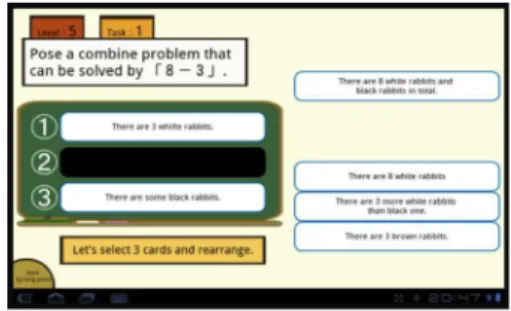
A computer-based learning environment has been developed to address this problem, so that the system can assess and give feedback to problems posed by students. This software, called MONSAKUN, provides support for learning by problem-posing in arithmetical word problems (addition and subtraction), and specifically developed to work in a tablet-based environment. MONSAKUN provides a learner with a set of simple sentences, then the learner is required to pose a problem by choosing appropriate sentences and ordering them accordingly. The system then evaluates combined cards and gives feedback to the learner. Figure 1 shows the interface of MONSAKUN.
This software has been put in practical use in elementary schools as well as evaluated in teacher group meeting. Based on previous researches, it has been confirmed that MONSAKUN was useful for problem-posing activity [Hirashima 2007].
1.2 Purpose
In previous researches, the usefulness of MONSAKUN was evaluated by pre-test and post-test, as well as questionnaire [Hirashima 2007, Hirashima 2011].
In this research, we conducted a deeper analysis of the log data to figure out the tendency of students’ thinking process while posing problems using MONSAKUN.
We aim to build a method to analyze thinking process of the students, in order to understand why students create such problem composition. By conducting this analysis, we also hoped to find the ideal behaviour and frequent wrong behaviour of the students.
2. Problem Posing Task in Monsakun Touch
2.1 Forward-thinking and Reverse-thinking Problem In learning of arithmetical word problems, there are two groups of problem: forward-thinking problem and reverse-thinking problem. In forward-reverse-thinking problem, a story represented in the problem has the same structure with the calculation to derive the answer, meanwhile in reverse-thinking problem, the story operation and the calculation operation structures are different [Hirashima 2011]. For example, in the following problem:
There are eight oranges. Several oranges were eaten. There are three oranges. How many oranges were eaten?
We can derive the story operation structure as “8-?=3”, and the calculation operation structure is “8-3=?”. Because the two structures are different, a learner is required not only to understand the story but also has to derive the calculation operation structure from the story. This type of problem is called “reverse-thinking problem”.
Contact: Nur Hasanah, Graduate School of Engineering, Hiroshima University, [email protected]
2I5-OS-08b-2
The 28th Annual Conference of the Japanese Society for Artificial Intelligence, 2014
- 2 - 2.2 Problem Levels
Arithmetical word problems of addition or subtraction are categorized into four types: 1) combine problem, 2) increase problem, 3) decrease problem, and 4) comparison problem [Hirashima 2011]. In MONSAKUN, the differences among these categories are defined as differences of composition of types of sentence. Sentences are divided into two major types: existence sentence and relational sentence. An existence sentence represents a number of single-species objects. Types of relational sentence correspond to types of problem mentioned above. An arithmetic word problem of binary operation can be composed of two existence sentences and one relational sentence. Especially, the category of a problem can be defined by the type of relational sentence used in the problem. An example of decrease problem composed of two existence sentences and one decrease type of relational sentence is as follows: a) There are eight oranges, b) Several oranges were eaten, c) There are three oranges.
In MONSAKUN Touch for addition and subtraction, there are six levels with increasing difficulties. From Level 1 until 4, the four categories of problems above are included with the forward-thinking problems type. In Level 5, reverse-forward-thinking problems are introduced.
The system evaluates combination of cards, then gives appropriate feedback regarding to types of mistake the learner made.
2.3 Types of Mistake
There are seven types of mistake in MONSAKUN addition and subtraction, as described in Table 1.
Table 1 Types of mistake in MONSAKUN
Code Type of Mistake
71 Story operation structure is different
72 Calculation operation structure is different
73 Story & calculation operation structure are different
74 Concept structure is different
75 Number structure is different
76 Concept & number structure are different
77 Story operation structure isn't built
3. Experimental Design
In this experiment, eleven undergraduate students from Faculty of Education used MONSAKUN. The students are firstly given explanation about the software, and then posed problems in a given time. The log data from each student are then translated into sequential data for further analysis.
Especially in this research, we focused to analyze students’ log data in Level 1 and Level 5. Each level consists of 12 problems that further divided into four types of problems: combine, increase, decrease, and comparison problem. Problems in Level 1 are forward-thinking problems, while problems in Level 5 are reverse-thinking problems. We would like to find out students’ performance in these particular levels, and whether they applied different strategies in tackling the different difficulties.
4. Analysis and Discussion
4.1 First Card Selection
The analysis result shows that not all the cards have the same probability to be selected as the first card. As described in Table 2, in Level 1, 91.8% of the students chose the card which contains the first number of the required equation in the problem, while in Level 5, only 58.7% of the students chose the card with the same condition.
For example, in the reverse-thinking problem “Pose a combination problem that can be solved by 8-3”, the number in the card firstly selected would be 8 and the number in the card secondly selected would be 3.
As shown in Table 2, there is a difference between Level 1 and Level 5. This is caused by the difference of thinking between forward-thinking and reverse-thinking problems. In forward thinking problem it is no problem to order cards following the order of numbers in the required equation. However, in reverse-thinking problem this is not a good strategy to pose the problem.
This finding shows that students relate the given problem with the set of cards before proceeding to choose the card. Thus, students do not randomly choose the cards, rather they are thinking of the appropriate cards to pose the right problem.
Table 2 Percentage of first card chosen by the students
First card chosen Level 1 (%) Level 5 (%)
First number 91.8 58.7
Second number 3.3 16.5
Question mark 4.9 24.8
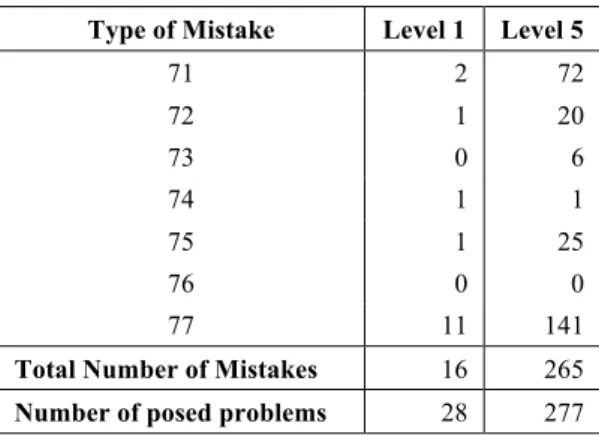
4.2 Type of Mistake (1): Story Structure Isn’t Built Table 3 shows the amount of mistakes made by students in Level 1 and Level 5. The biggest number of mistake is type 77 (story operation structure isn’t built), which shown that some students did not understand the correct composition of story operation structure.
According to Figure 2, 68% of mistakes made in Level 1 and 53% in Level 5 are type 77.
Table 3 Amount of mistakes made by students in Level 1 and Level 5
Type of Mistake Level 1 Level 5
71 2 72
72 1 20
73 0 6
74 1 1
75 1 25
76 0 0
77 11 141
Total Number of Mistakes 16 265
The 28th Annual Conference of the Japanese Society for Artificial Intelligence, 2014
- 3 - Fig 2 Percentage of mistakes in Level 1 and Level 5
For example, in Level 1 Problem 3, the problem given is a combination problem that can be solved by 4+5. The cards are:
1. There are 4 boys 2. There are 5 girls
3. There are ? boys and girls altogether 4. There are ? boys
5. There are 4 more boys than girls
Students made mistake type 77 by choosing cards 235. 2. There are 5 girls
3. There are ? boys and girls altogether 5. There are 4 more boys than girls
The selected cards consist of one existence sentence and two relational sentences, while to pose a problem, two existence sentences and one relational sentences are needed. Therefore, the story operation structure could not be built using cards 2, 3, and 5.
4.3 Type of Mistake (2): Confusing Story Structure and Calculation Operation
The second biggest number of mistakes according to Figure 2 is mistake type 71 (story operation structure is different). In other words, students tend to confuse story operation structure and calculation operation structure. There were 13% of Level 1 mistakes and 27% of Level 5 mistakes of type 71.
For example, in Level 5 Problem 4, the given problem is an increase problem which can be solved by 12-8. Here, the order of cards is important. The cards are:
1. There are ? sparrows 2. 8 more sparrows come 3. There are 12 sparrows 4. There are 8 sparrows
5. A number of ? sparrows fly away
Students made mistake type 71 chose cards 354: 3. There are 12 sparrows
5. A number of ? sparrows fly away 4. There are 8 sparrows
These cards have correct calculation operation, however the story structure operation is wrong. The problem asked for increase problem, however cards 354 is a decrease problem.
4.4 Students Learned from Mistake
From Table 2, it could be seen that the trend of first selected card is different between Level 5 and Level 1. In Level 1, most students chose card with first number in the problem. However in Level 5, students explored other options to pose problem by choosing card with question mark or second number. In fact, on Level 5 Problem 8 and 9, 73% of students chose the card with question mark as their first card.
From this finding, we can conclude that students were able to change strategy and learned from their mistakes from previous problems. Especially with regards to Level 5 which featured reverse-thinking problems, although the number of mistakes was significantly higher than Level 1, students also learned from their mistake by changing the type of the first card they chose.
4.5 Students Thinking Process from Log Data Why do students’ mistakes occur? Some mistakes seem like careless mistake or a result of just trial and error, others seem like a results of misunderstanding of the structure of arithmetic word problems. This study aims at clarifying relationship between mistakes and behavior of students from the analysis of log data.
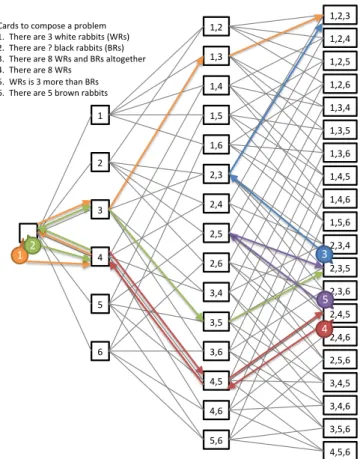
Fig.3 show five frequent paths taken by students in Level 5 Problem 1, where the problem given is a combination problem that can be solved by 8-3. The cards are:
1. There are 3 white rabbits 2. There are ? black rabbits
3. There are 8 white rabbits and black rabbits altogether 4. There are 8 white rabbits
5. There are 3 more white rabbits than black rabbits 6. There are 5 brown rabbits
The correct answer is the following combination of cards 123: 1. There are 3 white rabbits
2. There are ? black rabbits
3. There are 8 white rabbits and black rabbits altogether In Fig. 3 each node represents a combination of cards by the card numbers mentioned above. The leftmost node represents empty state (no card selected) and the rightmost cards represent a combination of three cards. Thick colored lines are paths frequently appeared in the log data, that is, frequent behavior of students in this problem.
The 28th Annual Conference of the Japanese Society for Artificial Intelligence, 2014
- 4 - students usually choose a card with the first number in the required equation.
Students who took path 2 firstly selected Card 4 (existence sentence), but then removed it and selected Card 3 (relational sentence) which is necessary for the correct answer. This is the same as path 1. However, the students then selected Card 5, which is also a relational sentence. Finally, Card 2 is selected, and the students arrived at the wrong answer 235. This choice has two relational sentence and only one existence sentence, which is the same type of mistake discussed in Section 4.2. This mistake is assumed to be caused by misunderstanding of basic structure, two existence sentences and one relational sentence; or confusion between existence and relational sentences.
Path 3 shows that students who chose wrong answer 235 could proceed to the correct answer 123 by omitting Card 5 (relational sentence) and choosing Card 1 (existence sentence). Students who took path 3 realized that one more existence sentence is needed to pose the correct problem.
Meanwhile, path 4 and 5 both started at the wrong answer 245: 2. There are ? black rabbits
4. There are 8 white rabbits
5. There are 3 more white rabbits than black rabbits
In this choice, the calculation operation is actually the same as given problem (8-3), however the problem type in answer 245 is comparison, while the given problem asked to pose a combination problem. This is the type of mistake discussed in Section 4.3. Student who took this path received feedback from the system which only tells them that the answer is incorrect. By such feedback, he or she is expected to be aware of the cause of the mistake and change his or her thought by himself.
Students who arrived at this type of wrong answer tend to have difficulties in finding the right answer, because they thought that their answer is already correct, as the calculation operation is the same as given problem. As seen in path 4, the students went back to choose Card 4 and once again arrived at the same wrong answer. Such students are assumed to only have naive understanding of the structure of arithmetic word problems such as that subtraction appear only in decrease and comparison problem, or just overlook the requirement of story type.
In path 5, the students arrived at another wrong answer of 235. Although this case is still wrong answer, they get an important step. He or she is supposed to be aware of that another relational sentence is necessary for the correct answer.
5. Conclusion
5.1 Conclusion
In this research, we have conducted analysis from the log data of university students using MONSAKUN to understand students’ thinking process while posing arithmetical word problems. We found out that students did not select the first card randomly, instead they related to given problem and mostly selected the card containing first number from the problem. Regarding the type of mistakes, students mostly made mistake of not building correct story operation structure or confusing story operation with calculation operation structure. Furthermore, we found out that students were able to learn from their mistakes by changing
Fig 3 Five frequent paths taken by students in Level 5 Problem 1
their strategy of selecting first card in Level 5 which featuring reverse-thinking problems. By analyzing the frequent path taken by students in one of the problem, we found out the common correct path and mistake paths. Most of them can be explained with reasons based on our proposed model.
5.2 Future Works
As future works, an automatic analyzer for MONSAKUN log data is needed to be built to process more log data from other experiments. Specifically, an algorithm is needed to verify our assumption towards the tendency of students’ thinking process when posing problem using MONSAKUN.
References
[Hirashima 2007] Hirashima, T. et al. Learning by Problem-Posing as Sentence-Integration and Experimental Use. Proc. of AIED2007, pp254-261 (2007)
[Hirashima 2011] Hirashima, T., Kurayama, M. Learning by Problem-Posing for Reverse-Thinking Problems, Proc. of AIED2011, pp.123-130 (2011)
[Polya 1957] Polya, G. How to solve it: A new aspect of mathematical method, Princeton University Press, (1957) [Silver 1996] Silver,E.A.,Cai,J. An Analysis of Arithmetic
Problem Posing by Middle School Students, Journal of Research in Mathematics Education,vol.27,No.5,pp521-539, (1996)
1"
2"
3"
4"
5"
6"
1,2,3"
1,3"
1,4"
1,5"
2,3"
2,4"
2,5" 1,6"
2,6"
3,4"
3,5"
3,6"
4,5"
4,6"
5,6"
1,2,4"
1,2,5"
1,2,6" 1,2"
1,3,4"
1,3,5"
1,3,6"
1,4,5"
1,4,6"
1,5,6"
2,3,4"
2,3,5"
2,3,6"
2,4,5"
2,4,6"
2,5,6"
3,4,5"
3,4,6"
3,5,6"
4,5,6" 3"
1"2" 3"
4" 5" Cards"to"compose"a"problem""
1. There"are"3"white"rabbits"(WRs)"
2. There"are"?"black"rabbits"(BRs)"
3. There"are"8"WRs"and"BRs"altogether"
4. There"are"8"WRs"
5. WRs"is"3"more"than"BRs"