Recommendation
Toward the Comprehensive Development of
Academic Research in the Arts and Sciences:
Proposals from the Humanities and Social Sciences
1 June 2017
Science Council of Japan
First Section
i
This recommendation is the public summary of the results of the deliberations of the Sub-committee on the Role of the Humanities and Social Sciences and Their Promotion conducted in collaboration with the Expanded Board of Directors of the First Section. For this translation, the Sub-committee greatly appreciates the effort and cooperation of Earl H. Kinmonth, Professor Emeritus of Taisho University, and Jeremy Rappleye, Associate Professor of Kyoto University.
Science Council of Japan, First Section
Sub-committee on the Role of the Humanities and Social Sciences and
Their Promotion
Committee Chairperson
SATO Manabu (Associate Member)
Professor, Gakushuin University Faculty of Letters Committee Vice-chairperson
TSUNEYOSHI Ryoko (First Section Member)
Professor, Tokyo University Graduate School of Education Secretary
KUBOTA Sachiko (First Section Member)
Professor, Kobe University Graduate School of Intercultural Studies MITSUNARI Miho (First Section Member)
Vice President, Nara Women's University
Professor, Division of Human Life and Environmental Science Member
INOSE Kumie (First Section Member)
Professor, Konan University Faculty of Letters IWAMOTO Yasushi (First Section Member)
Professor, Tokyo University Graduate School of Economics KANBAYASHI Norio (First Section Member)
Professor, Kobe University Graduate School of Business Administration KIBE Nobuko (First Section Member)
Deputy Director, General National Institute for the Humanities National Institute for Japanese Language and Linguistics
KURUSHIMA Noriko (First Section Member) Vice-president, Tokyo University;
Professor, Tokyo University Historiographical Institute KOMATSU Hisao (First Section Member)
Specially Appointed Professor, Tokyo University of Foreign Studies SUGITA Atsushi (First Section Member)
Professor, Hosei University Faculty of Law TODAYAMA Kazuhisa (First Section Member)
Professor, Nagoya University Graduate School of Information Science TOMOEDA Toshio (First Section Member)
Specially Appointed Professor, Osaka University Institute for Academic Initiatives NAKA Makiko (First Section Member)
ii
KOMORIDA Akio (Associate Member)
Distinguished Professor, Kanagawa University
Science Council of Japan, First Section
Expanded Board of Directors of the First Section
First Section Chairperson
SUGITA Atushi (First Section Member)
Professor, Hosei University Faculty of Law First Section Vice-Chairperson
MITSUNARI Miho (First Section Member) Vice President, Nara Women's University;
Professor, Division of Human Life and Environmental Science First Section Secretary
KOMATSU Hisao (First Section Member)
Specially Appointed Professor, Tokyo University of Foreign Studies FUJIWARA Satoko (First Section Member)
Professor, Tokyo University Graduate School of Humanities and Sociology Language / Literature Committee Chairperson
KAJI Shigeki (First Section Member)
Professor, Kyoto Sangyo University Faculty of Sociology Philosophy Committee Chairperson
TODAYAMA Kazuhisa (First Section Member)
Professor, Nagoya University Graduate School of Information Science Psychology / Education Committee Chairperson
KANEKO Motohisa (First Section Member) Specially Appointed Professor, Tsukuba University Sociology Committee Chairperson
ENDO Kaoru (First Section Member)
Professor, Gakushuin University Faculty of Law History / Archaeology Committee Chairperson
KUBO Toru (First Section Member)
Professor, Shinshu University Faculty of Arts Area Studies Committee Chairperson
MIYAZAKI Koji (First Section Member)
Professor Emeritus, Tokyo University of Foreign Studies Legal Studies Chairperson
MATSUMOTO Tsuneo (First Section Member) President, Consumer Affairs Center of Japan Political Science Committee Chairperson
KAWATA Junichi (First Section Member) Professor, Kobe Gakuin University Faculty of Law Economics Committee Chairperson
YANO Makoto (First Section Member)
iii
Business Administration Studies Committee Chairperson KAWAMOTO Akito (First Section Member)
Professor, Hiroshima University Faculty of Commercial Sciences Observer
Science Council of Japan Vice-President INOSE Kumie (First Section Member)
Professor, Konan University Faculty of Letters
In preparing recommendations and reference materials, we benefitted from the cooperation of the following people:
AOKI Reiko (Special Associate Member) Former Vice President, Kyushu University
The officials listed below were responsible for administrative matters related to the creation of this document.
INOUE Shimeon, Until March 2017 NISHIZAWA Tatsushi, From April 2017 WATANABE Hiromitsu, Until December 2016 SAITO Jitsuju, From January 2017
iv
Summary
1 Background to this Recommendation: a humanities and social science
perspective on the crisis in the academy
In response to the Notice issued by the Minister of Education, Culture, Sports, Science and Technology (hereafter MEXT) on June 8, 2015 (hereafter referred to as the “6.8 Notice”) to the national universities, the Executive Board of the Science Council of Japan twice issued statements. This proposal builds on those statements and the principles and guidelines previously enunciated by the Science Council of Japan. It confronts the numerous issues and urgent matters faced by the arts and sciences in Japan whilst exploring the role that the humanities and social sciences should play in the promotion of academic research.
The humanities and social sciences have the notable characteristic of combining time and space perspectives in a multi-dimensional, critical examination of various values. For the development of academic research in the context of a medium and long term response to social needs it is indispensable to make full use of the character of the humanities and social sciences. The humanities and social sciences must work together with the natural sciences to overcome the crisis in academy and to deal with the numerous problems confronting mankind.
2 The position of this Recommendation: carrying forward and developing the
Statements of 2001 and 2010
The Great East Japan Earthquake and the Fukushima Daiichi nuclear accident in 2011 reconfirmed that a comprehensive view of academic research is indispensable for the control of science and technology. Beginning in the year of the disaster, the 22nd Term of the Science Council of Japan (October 2011 – September 2014) set up a structure to take up the serious issues resulting from the Fukushima Daiichi nuclear accident and the associated reconstruction tasks. Building on this experience, this Recommendation carries on and is developed from two previous Science Council of Japan statements issued since the outset of 21st century: the “The Role of the Humanities and Social Sciences in the 21st Century and Their Importance” (hereafter the “2001 Statement”), the “The Outlook for Japan: Recommendations from the Humanities and the Social Sciences” (hereafter the “2010 Recommendation”). Once again this Recommendation discusses the issues with and the role of the humanities and the social sciences taking up five important points in this context.
3 Recommendations from the humanities and social sciences for the
comprehensive development of academic research
We propose the following five points from the standpoint of the humanities and social sciences with the aim of advancing the comprehensive development of academic research while simultaneously encouraging the self-reform of social science and humanities education and research.
v
Reforms in humanities and social science education have frequently proceeded in conjunction with liberal arts education reform. The results have been reflected in the humanities and social sciences program of the “Educational Good Practice (GP),” which include the introduction of student-driven classes and comprehensive English education based on studying abroad. In order to advance reform further in ways that builds on previous accomplishments, the following points are essential:
Increasing course offerings in English in order to respond to globalization; Enriching multilingual and multicultural education;
Implementing concrete “reference standards” for each field;
Striving to incorporate in the high school curriculum and in science and technology education the basic ability expected of citizens to think logically and critically and to be expressive;
Promoting the further education of teachers in accord with international standards;
Expanding the financial aid system for private university students in the humanities and social sciences.
(2) Reconstruct the evaluation criteria for research from the perspective of
raising research quality
In order to improve research quality in the humanities and social sciences it is necessary to formulate funding and evaluation policies that take into account the distinctive characteristics of humanities and social sciences. These characteristics include its diverse nature, the high degree of reliance on texts, the method of publishing results, and the fact that it is “slow science.” To that end, the humanities and social sciences must also make efforts to opening, sharing and improving the visibility of the research results and to establish evaluation indicators that reflect the characteristics of the field.
(3) Review university budgets and the way research is funded
Since the mid-1990s, Japan’s higher education policy has shifted the weight of research funds from basic expense funding to competitive funding. With the weight given to competitive funding and “fixed-term research projects,” it is impossible to prevent the weakening of the bases of longer term education and research. Stable funding is indispensable to developing and taking advantage of the distinctive characteristics of the humanities and social sciences where results often come from research conducted over the medium or long-term span. Further, even in the humanities and social sciences large scale funding is needed to deal with the contemporary world which is rapidly changing. Examples here would include the building of databases, creating an infrastructure for the digitization of documents, and planning and promoting common use systems, etc. The reduction of stable funding has seriously hurt universities that primarily serve populations in their immediate locale, i.e. those that recruit students largely from the surrounding region rather than nationwide. It is desirable that the government create a structure for the distribution of funding and staff that adequately recognizes the role of humanities and social science departments and programs as concentrations of professional expertise important to the preservation of regional culture and for the solution of regional social problems.
(4) Starting full-fledged support for young academics and female scholars
vi
adjunct lecturers needs to be seen as a problem to be overcome. It is necessary to strive to secure full-time posts and improve the conditions for part-full-time lecturers. The proportion of female academics in the humanities and social sciences is higher than in the natural sciences. As a result, support for female researchers tends to be biased towards the natural sciences and it becomes difficult to see the problems faced by female researchers in the humanities and social sciences. In the future, we should further strengthen comprehensive measures to support female researchers, especially to eliminate job gap disparities and raise the proportion of women in the leadership of academic associations.
(5) Establishment of a comprehensive policy for the arts and sciences
Contents
1 Background to this Recommendation: a humanities and social science perspective on the
crisis in the academy ... 1
(1) Rethinking the “6.8 Notice” ... 1
(2) The role of the humanities and social sciences within the academy ... 1
(3) The development of the arts and sciences utilizing the special attributes of the humanities and social sciences ... 2
(4) “Social demands” worthy of response ... 4
2 The position of this Recommendation: carrying forward and developing the Statements of 2001 and 2010 ... 5
3 Recommendations from the humanities and social sciences for the comprehensive development of academic research ... 8
(1) Improve higher education policy by recognizing the importance of improving education and focusing on the next generation. ... 8
ձ Responding to globalization ... 9
ղ Undergraduate education that is open to society ... 10
ճ Training advanced professional personnel ...11
մ The necessity of support for private universities ... 12
(2) Reconstruct the evaluation criteria for research from the perspective of raising research quality ... 13
ձ Improve research quality ... 13
ղ Improving the openness, sharing, and visibility of research results ... 14
ճ Establishment of evaluation criteria based on the characteristics of fields ... 15
(3) Review university budgets and the way research is funded ... 16
ձ The importance of stable funding: guaranteeing coverage of basic expenses to encourage continuing research ... 16
ղ The necessity of “large scale” funding: constructing a comprehensive base for academic research ... 17
(4) Starting full-fledged support for young academics and female scholars ... 21
ձ Support for young academics ... 21
ղ Support for female scholars ... 21
(5) Establishment of a comprehensive policy for the arts and sciences ... 23
ձ Creation and publication of a “White Paper on the Arts and Sciences” ... 23
ղ The promotion of a comprehensive policy for the arts and sciences and the codification its legal basis ... 24
1
1 Background to this Recommendation: a humanities and social science
perspective on the crisis in the academy
(1) Rethinking the “6.8 Notice”
The notification of the Minister of Education, Culture, Sports, Science and Technology (hereinafter referred to as the “6.8 Notice”) to the National University Corporations (hereafter national universities) on June 8, 2015 not only had a great impact on Japanese society but also invoked a variety of reactions from abroad. This is because it stated that “Universities will proactively make efforts to abolish structures or shift to areas of high social demand” in the context of reviewing the organization of faculties and graduate schools in the humanities and social sciences (Appendix 1).
The “6.8 Notice” explicitly addressed education and research in national universities. Nearly the same content and wording had been used in a MEXT statement made one year prior to the “6.8 Notice.”1 Nonetheless, the “6.8 Notice” called forth a substantial volume of criticism reflecting a
shared awareness of the negative aspects of science, technology and university policy over the past decade and the extreme position in which humanities and social sciences had been placed. Therefore, we think it significant to review the crisis in the academic world from the perspective of the humanities and social sciences and clarify the contribution to be made by education and research in the humanities and social sciences.
In response to the “6.8 Notice”, the Science Council of Japan published its views twice as Statements from the Executive Board, with Science Council of Japan acting in its capacity as an institution representing Japanese scholars in the humanities, social sciences, life sciences, physical sciences and engineering (Appendix 10&11). In this Recommendation, we build on those two statements by the Executive Board and relate them to the principles and guidelines previously issued by the Science Council of Japan, setting out the various aspects of the situation faced by Japanese scholars and the urgent issues in need of solution. As a component of this, we will attempt to reposition humanities and social science education and research. In addition, we will review the expected role of the humanities and social sciences and the structural changes needed for fulfilling that role. From there we proceed to an overall examination of academic practice in Japan and make concrete policy proposals.
(2) The role of the humanities and social sciences within the academy
Within all the “knowledge” (academic knowledge) that has been developed by human beings, the “humanities” covers human beings and the culture and ideas they have created. “Social science” is academic knowledge that elucidates the internal relations of human beings in groups or the mutual relationship between groups. It is based on the premise that humans are always social beings that function as part of collectives. Both the humanities and the social sciences have maintained a close mutual relation based upon their mutual object of human in the broad sense. At the same time, natural science knowledge is an indispensable element of scholarship and exists in an interdependent or mutually complementary relationship with the humanities and social sciences.
1 “Perspective on the General Review of the Organization and Operations of National University Corporations,” (Department of
2
Historically, the humanities, social sciences and natural sciences were originally integrated as the “liberal arts.”2 The separation between the two sides developed in modern society after
industrialization especially from the latter half of the 19th century. As a result of specialization and differentiation in the various fields of natural science, there has been a tendency for the distance between other disciplines and the humanities and social sciences to widen. This is especially true with respect to the engineering field that is focused on the practical application of specific technologies.3
However, even a cursory review at the various problems currently faced by mankind shows the necessity for collaboration among the sciences. Typical examples include the issue of labor market change that is deeply intertwined with the development of information technology such as artificial intelligence (AI) and problems that require global perspectives to bring to resolution such as environmental issues, military uses of science and technology and bioethical issues including genetic manipulation.
While the development of natural sciences brings great benefits to humanity, it has also unleashed energy that is difficult to control and led to unrecoverable destruction of the global environment. Traditionally humanities and social sciences have pressed for a rethinking from the viewpoint of “humanity” and “the social system” in the development of natural science and this role will be increasingly important in coming years. On the other hand, as is evident in issues pertaining to population and environment, the interests of so-called developed countries and developing countries can be quite different, and in order to “live together,” human beings must face diverse and multi-layered issues. The humanities and the social sciences have many responsibilities in this context, beginning with the rethinking of the main issues and the creation of sustainable structures. Indeed, the hopes potentially filled by these fields are high.
(3) The development of the arts and sciences utilizing the special attributes of
the humanities and social sciences
For the development of the academy as a whole, the humanities and social sciences should actively contribute by taking advantage of their special attributes. These are enumerated below.
ձ Leveraging the perspective of “history (time)” and “comparison (space)”
The humanities and social sciences take as their object human beings, their culture and their social interaction. Therefore, “history (time)” and “comparison (space)” are basic and essential components of a deeper analysis. How have humans confronted various problems in differing situations in the past including variations in the natural environment? Across all fields, only by pushing us to traverse the axes of time and space can we understand where we stand at present and begin to imagine where to set out for in the future.
2 Historically, the “liberal arts” refers to the “seven subjects of the free liberal arts (the seven free subjects)” originating in ancient Greece.
The “Seven subjects” consisted primarily of the “three studies” pertaining to language (grammar, rhetoric, dialectic law [logic science]) and the “four families” related to mathematics (arithmetic, geometry, astronomy, music). Philosophy was placed above these seven subjects and was supposed to supervise the whole. In medieval to modern European universities, the Department of Philosophy (Faculty of Arts and Sciences) was established under the special department of Theology, Law, and Medicine where the seven free courses were taught as the basis of a liberal education.
3 In fact, engineering cannot exist without an awareness of the problems associated with implementing science and technology in society,
3
ղ Critically contemplating “values” whilst forging “values common to humankind”
It is a distinctive characteristic of the humanities and social sciences that they deepen our consideration of “values.” As stipulated by the Universal Declaration of Human Rights (1948), everyone has the right to “life, liberty and security of person” (Article 3), and the right “to share in scientific advancement and its benefits” (Article 27). The “Pursuit of freedom, equality, safety, and happiness” is regarded as a universal human right that has been achieved but only at the expense of numerous bloody conflicts over differing values. Even today, there are severe conflicts over values in the international community in regards to the human rights of women, sexual minorities (LGBTI) and ethnic minorities. What matters is not to take for granted the values that are mainstream in a given society at a given point in time but rather to maintain critical distance by traversing the temporal and spatial axes yet never ceasing to advance “values common to humankind” such as “human dignity” and “peace.” This is the most important task for the humanities and the social sciences, work that becomes the link to domains of knowledge in other fields.
ճ Encouraging diverse approaches
Like the natural sciences, the character of humanities and social science is not one dimensional. There is fundamental research of an analytical character that probes the most basic aspects of humans and their society but there is also an applied type of research that aims at problem solving. In the case of problem solving there may be an “engineering” (design) role where the goal is to provide clear and concrete solutions to individual problems. Yet there are also “thought experiments” where the object is to reconsider the problem itself, restate the problem or to point out negative dimensions of currently accepted or proposed solutions that appear effective in the short term. The diversity of these approaches is a characteristic of the humanities and social sciences but it is also a perspective that can be applied in other areas of knowledge.
մ Focusing equally on the “global, national, and local” dimensions
Just as today people, funding and information move vigorously across national borders, the arts and sciences are required to cross borders in order to tackle issues common to humankind. In that process, nothing is more important than to understand and honor the diversity of people with different cultural backgrounds and for them to respect each other.4 At the same time, globalization
is causing serious problems such as intensified regional conflicts and widening disparities between the rich and poor. Meanwhile, globalization carries the danger of rapidly homogenizing culture on a global scale, unifying diverse values to the value standards of a specific culture, and bringing about the neglect of diverse values and cultures that have been developed over a long historical sweep. Without the involvement of the humanities and social sciences it will be impossible to solve the problems that occur under such circumstances.
Promoting the global exchange of knowledge while striking a balance with the national characteristics that have been born in the postmodern world, paying attention to things local that face oppression from things national and how to overcome gender bias – these are shared issues in 21st century society. It is the goal of international cooperation in academic endeavours to foster the
4 For example, global warming is a common problem for all of humankind. The serious crisis faced by the global environmental situation
4
development of the subjectivity of engaged citizens who blend a global, national, and local identity while transcending and relativizing thinking that is Western, Japanese, or East Asia centric.
յ Understanding the significance of languages and enriching the international dissemination of knowledge
Most human and social activities are mediated by languages with unique historical and cultural backgrounds. It is true that English is occupying an ever more important position as a common language of the academic world but the problems resulting from an excessive emphasis on English should not be overlooked. Depending on the research field, other languages (such as the languages used in cultures and societies that are the object of study) may be the language of mutual understanding. Meanwhile, the work of translation between different languages has a unique role in the mutual understanding of other cultures and societies. Dissemination of knowledge in a manner that is sensitive to this issue is required.
(4) “Social demands” worthy of response
Universities and scholar are inherently “in society and supported by society” and it is thus natural that they should be expected to respond to the demands of society. The issue is what those demands are, how to respond to them, and who is going to evaluate that response. For example, while referring to the “6.8 Notice,” the Japan Business Federation (Keidanren) stated that in addition to specialized knowledge and an understanding of social and cultural diversity through experiences such as study abroad, “Science and engineering students need to study subjects in a wide range of fields including humanities and social sciences, and students in the humanities and the social sciences need to have an understanding of advanced technology and acquire basic knowledge in mathematics and sciences.”5
The “social demands” gesture towards here that are to be met through education and research are none other than what the Science Council of Japan has stated: “the university needs to articulate knowledge that is based on a long-term perspective, bolster diversity, and nurture the foundation on which creativity can flourish”(Appendix 10).
Efforts to respond to “social demands” have also been promoted in the humanities and social sciences. For example, in formulating field-specific reference standards during the 22nd and 23rd terms of the Science Council of Japan, the issue of “cultivation for citizenship” was included in all fields upon the initiative of its members in the humanities and social sciences with the “needs of society” in mind. There was also a detailed analysis of the “needs of society” and what the appropriate response should be in the course of formulating the reference standards for each subject area in the humanities and the social sciences.6 The experience of the 2011 Great East Japan Earthquake showed
that historical studies are an indispensable part of disaster research. The humanities and the social sciences also responded proactively to “social demands” through international symposia and collaborative research on the environmental destruction resulting from the Fukushima nuclear plant failures. These fields also deepened discussion of the coexistence of humankind with science and
5 Japan Business Federation (Keidanren), “A View on National University Reform” (September 9, 2015).
http://www.keidanren.or.jp/policy/2015/076.html
6 In the humanities and social sciences, reference standards for philosophy, social welfare studies, psychology, sociology, cultural
5
technology through academic exchanges with citizens using philosophy cafes and other such approaches.
What is needed now is to analyse and determine the “social demands” that are to be met by university departments, research institutes, academic societies and individual scholars themselves across the humanities and social sciences over the medium and long term, as well as offer sufficient explanation to society of the issues involved and results.7 The evaluation of the outcomes must be
entrusted to current and future citizens. As for the concrete issues associated with these tasks, we can point out the following three.
(i) Use every opportunity to inform a wide range of people about the meaning and attractiveness of the humanities and the social sciences without resting comfortably in the traditional modes of each specialized field.
(ii) Implement practically in education and research major themes, those that are precisely and only the domain of the humanities and social sciences.8
(ჰ) It is especially important that universities consider the educational content and structures necessary for such practices.
In order to realize these three points a good relationship between academia and society must be established. To do so, the formation of “academic literacy” on the part of society is crucial. However, in reality, across contemporary Japanese society, calm discussion based on facts and logic is afforded little value. It must be recognized that there has been an impoverishment of language that makes it difficult to establish fruitful communication. It cannot be overlooked that policy makers do not value specialized knowledge and select only what is convenient for them. Society must function as a worthy critic of academic ways and activities but at the same time the academy must also be a good critic of the present state of “academic literacy” on the part of society at large. This is an essential condition for maintaining the health of democracy.
2 The position of this Recommendation: carrying forward and developing
the
Statements of 2001 and 2010
This proposal is based on two publications issued by the Science Council of Japan in the 21st century. One is the statement issued in the first year of the 21st century “The Role of the Humanities and Social Sciences in the 21st Century and Their Importance: Aiming at New Ways of Thinking about ‘Science and Technology’ Striving for a New Social and Cultural System”9 (hereafter referred
to as the “2001 Statement”) and the other is the proposal that originated as part of a full scale project
7 One way to make a response to “social demand” is to give a “practical answer” to solve a concrete problem. Yet it is also necessary to
be seeking “clues for the understanding” of the long-term changes and the social and historical background that will give rise to issues. To the degree that the present faces the “unknowable future” it is all the more important to recognize that society is always changing and with it the demands of society will change. That being the case it is the role of the humanities and the social sciences to be critical of claims that this or that represents the “needs of society.”
8 For example, “(Recommendation) The Outlook for Japan: Recommendations from the Humanities and Social Sciences” issued by the
Science Council of Japan in 2010 was a comprehensive design for a society facing a declining birth rate, an aging population and globalization. It pointed out the importance of contributions to the concept and development of social sustainability, pursuit of human dignity and subjective freedom based on social and cultural diversity, the possibilities opened by gender research, and the formation of civic culture in Japanese society. The importance of these tasks has only increased.
6
on “the outlook for Japan” entitled “The Outlook for Japan: Recommendations from the Humanities and Social Sciences”10(hereafter referred to as the “2010 Recommendation”).
The 2001 Statement emphasizes the importance of the role and responsibilities of humanities and social science in Japanese academic world while being sharply critical of the fact that the humanities and social sciences are “not properly positioned to fulfil their proper role in debate on national policy.” It observed that “we must disseminate a progressive vision that can serve as the basis for constructing a suitable relation between science and technology and society through an integration of arts and sciences. At the same time, the statement said that the humanities and social sciences “have not accepted responsibility for the ‘negative effects’ of science and technology” and “that it has been comfortable staying within existing boundaries and has been reluctant to create structures that would confront the issues that were in reality occurring.” These criticisms were offered as “points for reflection,” from which the statement called for the “improvement of the existing academic research structure,” “the recognition of research results and their verification through mutual interaction within and beyond domestic society,” and “the need for a new organization and a shift to thinking based on the fundamental idea of integrating and fusing arts and sciences (in education)” (2001 Statement, pp. 10-11).
Ten years later, the 2010 Recommendation stated that “in the face of the serious crisis in the global environment that is the very foundation of human existence, there must be a fundamental rethinking of the relation between nature and human beings” and “It is the role of the humanities and social sciences to break the vicious circle that is leading to a worsening of human welfare and even the conditions for its very existence by taking the lead in creating a new integration of human intellectual activities in order to create new relations.”11 The Recommendation also stated that, in order to fulfil
that function it is necessary to add the humanities and the social sciences which had been excluded from the concept of science and technology. This requires putting a broader conception of academic research at the centre of government policy. Further, in the Recommendation under the heading “What sort of development should we aim for in the humanities and the social sciences?” seven goals were offered. Among them were the realization of “functioning democracy” and the encouragement of “actors with a sense of world history.”
The Great East Japan Earthquake and the Fukushima Daiichi nuclear accident that occurred in the year following the publication of the 2010 Recommendation were reminders that the control of large scale science and technology “cannot be derived from science and technology alone.” In order to achieve control, there must be a holistic academic perspective that includes an enunciation of the prospects for the future of human society (for example, “sustainability”). “The people must control science and technology through the mediation of critical journalism and knowledge derived from the humanities and social sciences” (2010 Recommendation, p. 5). The 22nd term (2011 October to 2014 September) of the Science Council of Japan was devoted to solving the problems that appeared after the Fukushima Daiichi nuclear accident and in the reconstruction thereafter. Building on the debate
10 Committee on the Outlook for Japan, Humanities and Social Science Working Subcommittee, “The Outlook for Japan:
Recommendations from the Humanities and Social Sciences” (April 2010). http://www.scj.go.jp/ja/info/kohyo/pdf/kohyo-21-tsoukai-1.pdf
11 “2010 Recommendation,” pp. 19-26. The seven goals listed in the “2010 Recommendation” are as follows. (1) to enunciate a
7
during the 22nd term and the earlier 2001 Statement on “integration and fusion of arts and sciences” in conjunction with the 2010 Recommendation on “integrated intellectual activity” (2010 Recommendation), based on the “points for reflection” (2001 Statement) and issues (2010 Recommendation), this document will once again make clear the issues informing the comprehensive development of the arts and sciences and the role that the humanities and the social sciences should play in that development.
As a consequence of heightened awareness of these issues, there appeared in the late 1980s a movement to emphasize an interdisciplinary approach. This was reflected in the establishment of new academic societies12 that focused on environmental issues and bioethics. Meanwhile, within existing
societies in the humanities and social sciences a more interdisciplinary and social approach to such issues was affirmed. As a result of the Fukushima Daiichi nuclear power plant accident, there was a series of international symposia and publications that combined issues such as ownership rights (law) local government structure (governmental administration), bullying (education), family issues (sociology and gender research), health problems (medicine), sustainability (environmental studies), etc. In addition, funding was secured for regional studies covering Asia or Eurasia as well as for large scale international and comparative research13 which took up issues such as global migration and
disparity. As for urgent social issues such as the declining birth rate and the advancement of women, there were noteworthy gender studies that came out of the "Global COE” (Global Centres of Excellence) programs.14 One task for the future is to verify the results of these researches as part of
the quest for the overall development of the arts and sciences.
In the following section, we propose five issues to be addressed as part of the comprehensive development of the arts and sciences from the standpoint of the humanities and social sciences. These are (1) improvement in the quality of education and the reform of higher education policy, (2) improvement in research quality and the restructuring of the criteria used for evaluation, (3) a review of the funding of universities and research, (4) aid for women and young scholars, and (5) the formulation of a comprehensive academic policy. For this it is necessary that the national government, universities and research institutes, academic societies and individual scholars actively work towards solving these problems through mutual cooperation.
12 For example, the Japan Association on the Environmental Studies (reorganized in 1983), the Japan Association for Bioethics (founded
in 1988) consisting of medical, philosophy, law and religion studies, etc.
13 See the humanities and social sciences section of the “Cutting Edge Academic Research Tasks: Outline for the Selection of New Areas
and Large Subjects,” issued by Japan Society for the Promotion of Science. https://www.jsps.go.jp/j-grantsinaid/30_front/index.html
14 As an example of a global COE on gender research, “Global Reconstruction of the Gender Research Frontier: Women, Families,
8
3 Recommendations from the humanities and social sciences for the
comprehensive development of academic research
Promotion of humanities and social sciences is essential for the development of the academy as a whole. “It is the role of the humanities and social sciences to break the vicious circle that is leading to a worsening of human welfare and even the conditions for its very existence by taking the lead in creating a new integration of human intellectual activities” (2010 Recommendation). In order to achieve this stated goal, scholars in the humanities and social sciences should not be reticent about engaging in dialogue and cooperation with the natural sciences. In order to promote this “constructive dialogue” and information sharing between the humanities and social sciences and the hard sciences it is urgent that a “White Paper on the Arts and Sciences” (tentative) is produced and issued.
(1) Improve higher education policy by recognizing the importance of
improving education and focusing on the next generation.
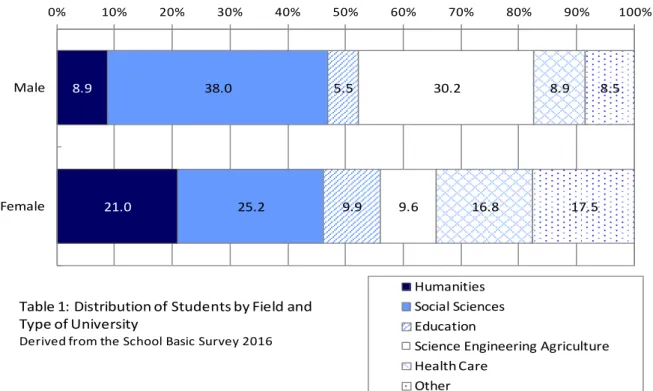
Nearly 50% of university students in Japan belong to the humanities and social sciences (or more than 50% if those in education with a humanities or social science emphasis are included). This is true for both males and females (Table 1). Education in the humanities and social sciences is the biggest point of contact between university education in Japan and Japanese society. Reflecting this fact, educational reform in the humanities and social sciences has often been promoted in combination with reform in general education. Achievements in this area include student-led courses, comprehensive English education with a study abroad component, and humanities and social science programs in/of “Educational GP (good practice).”15 Building on these achievements, in order to further ensure the
maintenance of quality the following five issues must be addressed.
15 Japan Society for the Promotion of Science, “Program for Promoting High-Quality University Education.”
http://www.jsps.go.jp/j-goodpractice/sentei_daigaku.html#01
8.9
21.0
38.0
25.2
5.5
9.9
30.2
9.6
8.9
16.8
8.5
17.5
0% 10% 20% 30% 40% 50% 60% 70% 80% 90% 100%
Male
Female
Humanities Social Sciences Education
Science Engineering Agriculture Health Care
Other
Table 1: Distribution of Students by Field and Type of University
9
ձ
Responding to globalization
The true meaning of globalization lies in the reality that the international community and Japanese society, workplace or local communities, and the lives of individuals cannot exist in isolation from one another. Given this, all youth are required to cultivate the ability to communicate richly while respecting diversity such as ethnicity and religion that are based on the various histories and cultures of human beings. Education in the humanities and the social sciences plays a major role in the following two areas in particular.
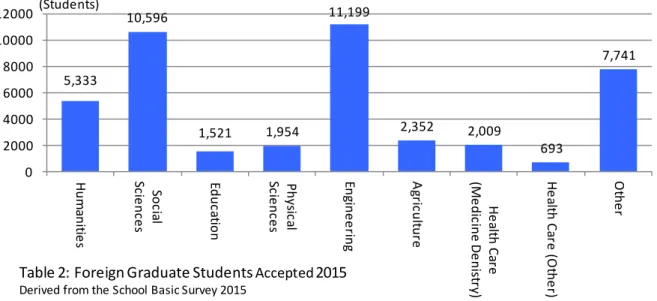
Firstly, maintaining and developing advanced levels of humanities and social sciences will greatly contribute to an increase in the number of international students. In recent years, internationalization of universities has been encouraged as a means of breaking out of the insularity of Japanese society. Programs such as the “300,000 International Students Plan,” the “Global 30” scheme, and the “Top Global University Japan” initiative have been put forward. In this environment foreign students have exhibited a high level of interest in the humanities and social sciences. Universities have a record of accepting a large number of humanities and social science students along with those in engineering (Table 2).
Secondly, the contribution of the humanities and social sciences has not stopped with language alone. The humanities and social sciences have carried out research and provided education that contributes to globalization in a true sense and it is necessary for this to continue in the future. The necessity of English as a language of international communication is high and even in the humanities and social sciences there should be no reluctance to proactively plan for an increasing number of courses to be offered in English. At the same time, as pointed out in 1- (3) - ⑤, most human social
activity is mediated by languages with a unique historical and cultural background. Even today, there are many people whose native language is other than English. For example, there are over 1 billion Chinese speakers, 400 million Spanish speakers, and 200 million Arabic speakers. According to a survey conducted of employed university graduates, in practice the proportion who “often” use English in their ordinary duties is only about 10% of the total.16 If only the necessity of English in the
workplace is considered, then it is only a small proportion of all students who will actually use
16 University of Tokyo Graduate School of Education, Graduate School Policy Research Center, “Survey of Employed Graduates”
(2007).
5,333
10,596
1,521 1,954
11,199
2,352 2,009
693 7,741 0 2000 4000 6000 8000 10000 12000 H u m a n iti e s S o c ia l S c ie n c e s E d u c a tio n P h y sic a l S c ie n c e s E n g in e e rin g A g ric u ltu re H e a lth C a re (M e d ic in e D e n is tr y ) H e a lth C a re (O th e r) O th e r
Table 2: Foreign Graduate Students Accepted2015
Derived from the School Basic Survey 2015
10
English17. Beside English, opportunities to acquire a variety of languages should be provided to
students, as well as ample opportunities secured to develop a heightened awareness of Japanese as their mother tongue.
ղ
Undergraduate education that is open to society
Traditionally, there has been a large disconnect between university education in the humanities and social sciences and the place and type of employment taken up after graduation. Companies have shown little interest in undergraduate courses and grades at universities and have chosen new graduates on the basis of abstract characteristics such as “growth potential” and superficial external criteria such as which university the students graduated from.
On the other hand, looking at the current situation surrounding young people, the instability of the employment environment is clearly evident in social trends such as the progress of globalization, changes in industrial and occupational structures, and in weakening of the long-term employment environment. In order to deal with this situation, there is a tendency to emphasize the role of vocational education and emphasis on “skills in hand,” but it is probable that an excessive emphasis on narrow and immediately useful skills will leave students unable to adapt to a changing environment. If they fail to acquire basic and general knowledge when they are young, their specialized knowledge will go out of date quickly in an era of rapid change in the nature of work and an overly specialized education may well be dysfunctional in occupational terms.
Studying the humanities and social sciences nurtures a deep insight into the way human beings interact with each other and encourages flexible thinking and analytical skills through multifaceted consideration of issues. Study of the humanities and social sciences is also indispensable for nurturing widely applicable skills such as logical thinking, writing ability, and spoken communication. In modern society where various values are intermingled, such abilities are required for students of the humanities and social sciences as well as students of the natural sciences. In particular, it is greatly expected that high level professionals have a communicative ability that transcends the boundaries of the arts and sciences.
In order to realize the creation and practice of a bachelor degree curriculum based on logic and grounds that can be explained to society in general, the Science Council of Japan publishes “Reference Standards for Quality Assurance in Structuring University Education by Field.”18 Whether the
various skills and knowledge enumerated there are meaningful to workers is a topic yet to be researched. Universities and academic groups should take note of these “Reference Standards” and collectively or independently create teaching materials making these available on the Internet as a positive contribution to educational reform.
In order to improve the quality of education, it is also indispensable for university faculty members to thoroughly understand the inherent role of the high school stage in the process of human formation and the problems that young people around the age of 18 today must face. To that end, it is necessary
17 In addition, with respect to concrete problems in English education, see The Science Council of Japan, Subcommittee on the Intersection
of Language and Literature, “(Recommendation) Efforts to Nurture an Active Attitude toward Words: Development of English Education in Elementary and Secondary Education” (November 2016). http://www.scj.go.jp/ja/info/kohyo/pdf/kohyo-23-t236.pdf
18Unlike the “Standards for Establishing Universities” and the “Certification Evaluation System” for university evaluation, the “Reference
11
to proactively promote multi-faceted collaboration between universities and high schools and to further dialogue between university faculty and high school teachers and staff. Such collaboration is also to be desired as a means of preparing high school students to be active citizens with a deep awareness of history and thus knowledge of society in an era of globalization. This is especially the case since eighteen year olds are now voters.19
ճ
Training advanced professional personnel
Graduate study in the humanities and social sciences, especially in doctoral programs, has been almost entirely limited to the training of future university teachers. However, with regard to at least the master's level courses, it is important that these are not just a stepping stone on the way to a doctoral course but can also connect to a career path for graduate students whose work as specialists20 will link
the academic world and society and in so doing be essential in supporting the motivation of young people to pursue such programs and careers (Appendix 3).
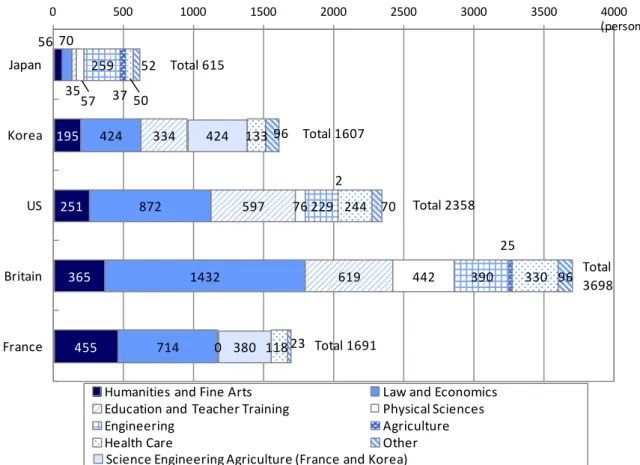
International society is increasingly requiring graduate school level specialized knowledge in both the public and private sector. In this area the gap between Japan and the foreign situation is quite large (Table 3). In order to overcome this, we need to explain the role of specialized professionals who enrich the intellectual soil of society. At the same time there must be a change to recognition of this on the part of Japanese society.
Furthermore, as the global standard of teacher education has shifted to the master's level, the educational attainment of primary and secondary education teachers in Japan appears remarkably low level in international terms and there is a pressing need to elevate teacher training from the undergraduate to the graduate level. In the future, in order to maintain world class primary and secondary education, it is necessary that there be an expansion of educational opportunities for in service teachers such that they can acquire further technological and intellectual knowledge while working through graduate level programs in education and graduate programs in general.21
19 Science Council of Japan, Committee on Psychology and Pedagogy, Subcommittee on Social Studies Education in High School from
the Viewpoint of Cultivation of Citizenship, “(Recommendation) For 18 Year Old Citizens: Reform of High School Civics Studies Directed at the Cultivation of Citizenship” (May 2016). http://www.scj.go.jp/ja/info/kohyo/pdf/kohyo-23-t228-3.pdf
Science Council of Japan, Committee on History, Subcommittee on High School History Education, “(Recommendation) What is to be Expected of ‘General History’” (May 2016). http://www.scj.go.jp/ja/info/kohyo/pdf/kohyo-23-t228-2.pdf
Science Council of Japan, Committee on Political Science, “(Recommendation) Looking to the New Course ‘The Public Realm’ (“Kōkyo,” whose direct translation is “public”): Proposals from Political Science” (February 2017).
http://www.scj.go.jp/ja/info/kohyo/pdf/kohyo-23-t239-2.pdf
20 For example, staff in charge of academic and cultural policy, national public officials and local government officials, curators of library
librarians and museums and museums. See “2010 Recommendation.” http://www.scj.go.jp/ja/info/kohyo/pdf/kohyo-21-tsoukai-1.pdf
21 Sato Manabu, Senmonka toshite kyōshi wo sodateru (Grand Design of Teacher Education Reform: Nurturing Teachers as Specialists)
12
մ
The necessity of support for private universities
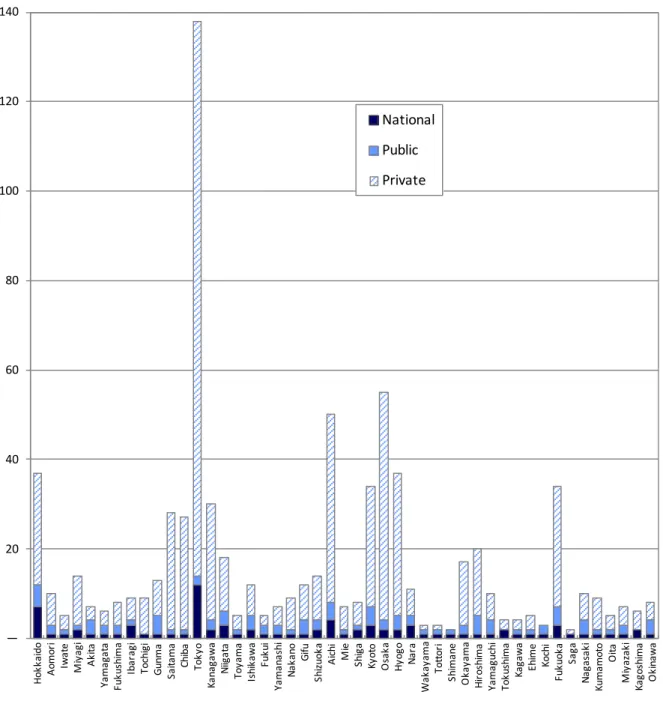
In considering the development of humanities and social sciences, policies that cover both public and private universities are needed. The overwhelming majority of those involved in humanities and social sciences research are affiliated with universities22 and a high proportion of all students and
researchers in the private sector (Appendix 4).23
Whereas the “reference standards” are mainly part of a quality assurance system related to educational content and curriculum development, improvement of the student-to-faculty ratio (STR) and reduction of the economic burden on students are also indispensable for improving the quality of education. Particularly, private universities that have predominated in expanding the opportunities of higher education require students to assume a heavy economic burden (Table 4) and the existence of impoverished students is a social problem. A high STR in private universities is a long standing problem (Table 5). An increase in financial aid that does not require repayment and the greater
22 In Japan 37.1% of researchers belong to universities and 58.4% belong to industries, but among researchers belonging to companies
etc., only 1.1% are in the humanities and social sciences fields [“Indicators of Science and Technology (2016)” The data is from 2015]. http://www.mext.go.jp/b_menu/toukei/006/006b/1377329.htm
23 In the humanities and social sciences, 22% of the teaching staff are in national universities and 72% is in private universities whereas
54% of the teaching staff in science and engineering is at national universities and 26% t private universities. n the humanities and social sciences, the weight of private universities is remarkably large [“Statistical Survey of School Teachers (2013)”].
http://www.mext.go.jp/b_menu/toukei/chousa01/kyouin/kekka/1268581.htm
In postgraduate doctoral program, 49% of the humanities and social science students are at national universities and 46% at private universities [“MEXT Science Indicators (2015)”]. http://www.mext.go.jp/b_menu/toukei/002/002b/1356065.htm
56 195 251 365 455 70 424 872 1432 714 35 334 597 619 0 57 424 76 442 380 259 229 390 37 2 25 50 133 244 330 118 52 96 70 96 23
0 500 1000 1500 2000 2500 3000 3500 4000
Japan
Korea
US
Britain
France
Humanities and Fine Arts Law and Economics Education and Teacher Training Physical Sciences
Engineering Agriculture
Health Care Other
Table 3: Masters Degrees per Million Population 2010
Derived from International Comparison of Education Indicators 2013, Educational Statistics of Foreign Countries, 2014.
(person)
13
provision of interest-free loans type are urgent measures required to prevent dropouts and undertaking extra years to complete degree courses due to adverse economic reasons.
Fiscal 2015 Private National Private:National
National Government Expenditure
Management Expense Supplements 315,300Myen
Management Expense Grants 1,100,600 Myen
1:3.5
Institutions 932 86 10.8:1
Grant per Institution 340 Myen 12800Myen 1:37.8
Student Number 2,226,367 610,802 3.6:1
Grant per Student 142Kyen 1802Kyen 1:12.7
Table 5: Disparity between the Management Supplements for Private Universities and Management Expense Grants for National Universities
Derived from School Basic Survey 2015, Main Items in MEXT Fiscal 2015 Budgetary Proposal
(2) Reconstruct the evaluation criteria for research from the perspective of
raising research quality
ձ
Improve research quality
The traditional research style in the humanities and social sciences has been to gather materials, read them, reflect on their content, and then write and publish. This has been an individual activity
5387
6923
8222
7925
25404
3740 8396
9751
11050
10752
29404
5227
0 5000 10000 15000 20000 25000 30000
National
Private Arts
Private Sciences
Private Home Economics
Private Medicine and Dentistry
Private Junior College
Table 4: Comparison of Expenses Required by University by Type and Field
Data from the Japan Institute of Life Insurance home page http://www.jili.or.jp/lifeplan/lifeevent/education/6.html
Kyen
Home䠄4 year䠅
Board 䠄4 year䠅
Home 䠄4 year䠅
Board䠄4 year䠅
Home䠄4 year䠅
Board䠄4 year䠅
Home䠄4 year䠅
Board䠄4 year䠅
Home䠄6 year䠅
Board䠄6 year䠅
Home䠄2 year䠅
Board䠄2 year䠅
14
rather like being self-employed. Collaborative research often takes the form of collating individual research results. In recent years, there has also been an increase in large scale research projects involving a large number of researchers, including research assistants. Working in teams, they collect empirical data jointly and publish co-authored research results. This is a pattern similar to what has been common in the natural sciences. In consideration of this diversification in research methodology, in promoting the humanities and social sciences, it is important that the national government and each research institution and researcher pay particular attention to the following three points in formulating policy.
(ხ) The national government should, rather than a “selection and concentration” approach that designates the priority areas for funding, instead adopt a broad pattern of funding that gives stable support to diversified social science and humanities research no matter how small in scale.
(ჯ) In many disciplines within the humanities and social sciences, the time required to bring out original research results is relatively long (“slow science”). The national government should develop ways to evaluate and allocate funds in consideration of this characteristic of humanities and social science research. At the same time researchers in the humanities and social sciences should not use “slow science” as an excuse for failing to make their research results available in a timely fashion.
(ჰ) Humanities and social science research institutions should create a structure that not only guarantees access to basic literature including domestic and overseas academic journals and the like as well as current historical materials but also accumulates and preserves items of historical significance that can be used by researchers anywhere.
ղ
Improving the openness, sharing, and visibility of research results
There should be a consolidation of the environment for sharing the results of humanities and social science research by further promoting the dissemination and review of research trends and open access to academic journals. This is because only when the humanities and social sciences widely disseminate the significance of their research, can they obtain understanding and support of society.
With the increasing segmentation of research in the humanities and the social sciences as in the natural sciences, there is growing need to be aware of the research trends and outcomes in related fields and to obtain an overall perspective. Especially today, online availability is one of the major factors in determining the openness, sharing, and accessibility of research papers. However, the status of online development varies widely among fields and development of infrastructure in the field of humanities and social sciences has been slow compared to the natural sciences.24
Many publications can still be viewed only on paper at present. In the humanities and social sciences there are many academic journals that are supported by membership fees. This may make it difficult to immediately shift to full open access but putting these journals on the Internet after a certain period of time has passed is certainly possible. In addition, it would be worthwhile to utilize institutional repositories, which is to promote the openness of in-campus research and research results, as a portal
24 For example, out of about 1.2 million papers published in the journals of Japanese academic societies from 2002 to 2013, over 70% are
thought to be available online in some form. Among them, the on-line provision rate of natural science fields such as physics and biology is in the 70 to 80% range but is only 51.5% in the social sciences and 43.7% in the humanities literature. The difference is clearly large. Sato Sho et al. "The Online Acquisition Environment for Articles Published in Japanese Academic Association Journals," Information
15
to disseminate articles originally published in journals owned by academic societies.25
ճ
Establishment of evaluation criteria based on the characteristics of fields
Objective evaluation standards should be established (evaluation criteria, evaluation methods) that reflect the characteristics of the humanities and social sciences in order to raise the overall standard of academic research. In the humanities and social sciences, the evaluation criteria and evaluation methods are different for each field; using the same criteria for all disciplines lacks fairness.26 As soon
as possible, the Science Council of Japan and the academic societies must cooperate to establish objective and reasonable evaluation indicators.27 It is desirable to establish evaluation indices based
on the agreement of scholars and reflect these evaluation indices in the allocation of research budgets and competitive funding. The following two points should be taken into consideration in this context. First, in the humanities and social sciences, it is highly regarded in the academic community both in Japan and abroad to cover expansive ground and to build overall knowledge. Rather than the frequent publication of short academic papers, a book every few years is the style of noted scholars in the humanities and social sciences. This is essentially the same overseas.
As a consequence, the humanities and social sciences have made a major quantitative contribution to the vigorous publishing culture in Japan. The proportion of all books that originate from the humanities and social sciences is quite large with social science, literature, and art being the three major genres (Appendix 5). This weight means that the humanities and social sciences are responsible for maintaining the quality of the publishing culture in Japan. That is why the publication of high standards of humanities and social science books is expected and many excellent academic works have been published. Because books are not subject to peer review as are academic journal articles some see books as not being properly vetted for quality but in Japan the publication of academic books is often the result of stiff competition prior to publication. It can be said that quality assurance for books comes through competition for publishing subsidies and for endorsement from academia at large.28 Without these it is impossible to publish and this competition provides quality control.
Second, uniform evaluation criteria based on the number of papers published in English does not fit the humanities and social sciences. Today, criteria heavily weighted to the number of published articles in English language journals are applied uniformly across various areas of research evaluation including competition for funding. This leads to various contradictions. In the case of humanities and social sciences, depending on the research field, it is necessary to exchange and accumulate research within each language sphere. In addition, even in fields where research presentation in English is the
25 As a prerequisite, it is recommended that academic societies formulate a policy that allows authors to register and open their own
publications in a repository of their own institution and by so doing promote broad open access. In addition, the University Library of Tsukuba is the center for the creation of an academic society copyright database (SCPJ). As of June 9, 2016, 2,612 academic societies had registered their policies in the SCPJ database and of these 1022 permitted accumulation in repositories and public access subject to conditions.
26 For example, in economics and psychology, it is common practice to send research results in English to international journals using
statistical data that can be compared internationally. Evaluation criteria similar to those of natural science are often applied in research fields where the boundaries between natural science and humanities are fluctuating such as natural geography and human geography, anthropology and cultural anthropology. In regional research and environmental research, interdisciplinary research is already to be seen. In contrast research is generally conducted in Japanese in various disciples such as Japanese literature, Japanese history, Japanese art history, etc. that are related to Japanese culture and in disciplines that analyse various phenomena in Japanese society such as law in practice.
27 Establishing evaluation criteria for the humanities and social sciences is an important issue that the First Section of the Science Council
of Japan should address in its upcoming 24th term.
28 To see how high the quality of the publications that have received the Grant-in-Aid for Scientific Research is, Sogo Tachibana, “The
16
norm, there is a duty to keep the citizenry informed by providing books with a structured view of knowledge in a particular area by disseminating results in Japanese.
(3) Review university budgets and the way research is funded
ձ
The importance of stable funding: guaranteeing coverage of basic
expenses to encourage continuing research
Since the mid-1990s, higher education policy in Japan has shifted the weight of research funding from basic expenses (Management Expense Grants for national universities and subsidies for private university operating expenses) to competitive funding. Under this policy, which aims to promote research through the creation of a competitive environment, the Management Expense Grants for national universities and subsidies for private universities have been gradually reduced. It has been widely pointed out that this lack of stable funding creates difficulties in sustaining education and research and that it has caused problems in basic research and a decline in research performance even in the natural sciences.29 In the humanities and social sciences, teaching posts have been eliminated
as personnel expenditures have been reduced with either successors not being appointed or by shifting to term contracts. Funds for maintaining the fundamental research environment have been reduced including the funds available for academic journal subscriptions. This has had an enormous impact on education and research.
Competitive funds such as the Grant-in-Aid for Scientific Research have an important role. However, with competitive funding that emphasizes “support for time-limited research projects” we cannot avoid the weakening of the long-term education and research infrastructure. In the case of the humanities and social sciences, most scholars belong to universities, and the possibility of obtaining external funds other than a Grant-in-Aid for Scientific Research is limited in relative terms. If the reduction of basic research funding for universities and the growing reliance on competitive funding and donations continues as at present the whole of humanities and social science research are likely to be in crisis.
An emphasis on basic funding does not mean simply “preserving” the existing composition of academic fields and their research environment. The structure of academic disciplines must be constantly reviewed from the viewpoint of enhancing education and advancing the arts and sciences. And, it is necessary to adapt and apply new technical possibilities such as digital technology in order to secure the research environment. However, such review and adaptation should be conducted based on a medium- to long-term perspective, the direction being taken by academic societies and the voluntary and autonomous considerations of the university.
The national government should be cautious about urging reorganization from a short-term perspective focused on budget allocation and evaluations.30 To that end, it is necessary to secure stable
funding from taxes. However, in a situation such as the present one of fiscal restraint, it is difficult see a way to guaranteed stable funding. Universities and research institutions must not only present an
29 For a recent example, see “Investing for the Future: Statement of National University Science Department Heads” (October 31 2016).
http://www.s.u-tokyo.ac.jp/ja/info/5092/
Again, this was a ringing warning that the reduction in management expense grants was leading not just to a reduction in posts but destroying the foundation supporting basic research. The situation is deteriorating in both the liberal arts and the physical sciences. See also the “Statement by the Science Technology Council Academic Science Subcommittee Head” (November 17 2016).
http://www.mext.go.jp/b_menu/shingi/gijyutu/gijyutu4/toushin/1379568.htm