Reaching higher, to the summit of the Q Series
Global Player
GLOBAL IMPACT OF
MITSUBISHI ELECTRIC
We bring together the best minds to
create the best technologies. At
Mitsubishi Electric, we understand
that technology is the driving force of
change in our lives. By bringing
great-er comfort to daily life, maximizing the
efficiency of businesses and keeping
things running across society, we
integrate technology and innovation to
bring changes for the better.
Mitsubishi Electric is involved in many areas including the following
Energy and Electric Systems
A wide range of power and electrical products from generators to large-scale displays.
Electronic Devices
A wide portfolio of cutting-edge semiconductor devices for systems and products.
Home Appliance
Dependable consumer products like air conditioners and home
entertain-ment systems.
Information and Communication Systems
Commercial and consumer-centric equipment, products and systems.
Industrial Automation Systems
Maximizing productivity and efficiency with cutting-edge automation technology.
Integrated
Engineering
Integrated
Netw
ork
Automation
Contr
oller
MES
ERP
Further reduce TCO while securing
your manufacturing assets
Automation Controller
Improve productivity and product
quality
1. High-speed system bus realizing
improved system performance
2. On-screen multi-touch control enabling
smooth GOT (HMI) operations
Integrated Network
Best-in-class integrated
network optimizing production
capabilities
1. CC-Link IE supporting 1 Gbps
high-speed communication
2. Seamless connectivity within all levels of
manufacturing with SLMP
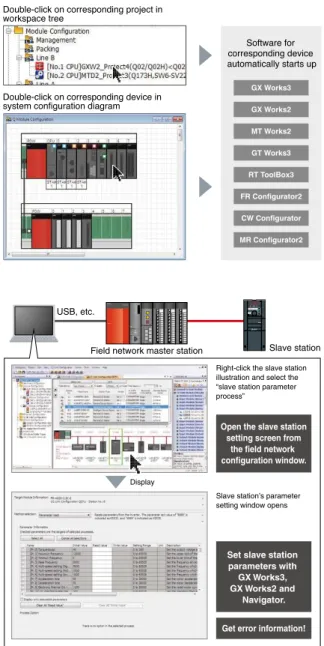
Centralized Engineering
Integrated engineering
environment with system level
features
1. Automatic generation of system
configuration
2. Share parameters across multiple
engineering software via MELSOFT
Navigator
3. Changes to system labels are reflected
between PAC and HMI
iQ Platform for maximum return on investment
Minimize TCO, Seamless integration, Maximize productivity, Transparent communications: these are common items
that highlight the benefits of the iQ Platform and e-F@ctory. The iQ Platform minimizes TCO at all phases of the
automation life cycle by improving development times, enhancing productivity, reducing maintenance costs, and
making information more easily accessible across the plant. Together with e-F@ctory, offering various best-in-class
solutions through its e-F@ctory alliance program, the capabilities of the manufacturing enterprise is enhanced even
further realizing the next level for future intelligent manufacturing plants.
ERP (Enterprise resource planning)
MES (Manufacturing execution system)
PAC & HMI
Integration of automation controller and HMI
Engineering
Centralized engineering environment
Network
Integrated network through seamless connectivity
iQ Platform
Current production requirements are calling for an increase in productivity and carrying out production processes even faster due to an increase in production information such as production results and traceability. The MELSEC-Q Series programmable controller “Universal model QnU” is a leader for these market needs. High-speed basic instruction processing on a micro scale dramatically increases your system and machine performance.
Inheriting the high robust and ease of use design of the Q Series, the MELSEC QnU programmable controller will open up new possibilities in automation solutions.
Performance on a different level brought to you
with the Programmable Controller
Continuously evolving
■ Support for shorter operation cycle times ■ Support for higher quality control requirements ■ Complex and large-scale equipment and systems
■ Expanding control and production control data ■ Shorter product cycles ■ Support for higher equipment operation rates
Customer experiences created this programmable controller
Improved
Productivity
More
User - Friendly
Easy
Maintenance
I N D E X
QnU CPU
...P.5
• Improved Productivity ...
P.7
• More User-Friendly ...
P.11
• Easy Maintenance ...
P.17
CPU Lineup
...P.19
Network
...P.23
Module Lineup
...P.37
Software
...P.49
Related Products
...P.59
Speciications
...P.64
Support
...P.72
Product List
...P.75
10K 15K 20K 30K 40K 60K 100K 130K 200K 260K 500K 1000K
20 40
60 80
120 9.5 1.9 Basic operation
processing speed (ns) Program capacity (step)
USB
Q00UJ Q00U
Q01U
Q02U
Q04UDEH
Q04UDH
Q06UDEH
Q06UDH
Q03UDE
Q03UD
Q10UDEH
Q10UDH
Q13UDEH
Q13UDH
Q20UDEH
Q20UDH
Q26UDEH
Q26UDH
Q100UDEH
Q50UDEH
Power supply and base unit (5 slots) integrated type
RS-232 USB
RS-232
USB
RS-232
Dedicated memory card
USB
Dedicated memory card
Ethernet
USB
SD memory card
Ethernet
USB
Dedicated memory card
RS-232
: Built-in Ethernet port QCPU : High-speed Universal model QCPU
: Built-in RS-232 port CPU
Q04UDVCPU Q06UDVCPU
Q03UDVCPU Q13UDVCPU Q26UDVCPU
Extended SRAM cassette
■
MELSEC-Q Series Universal model lineup
Reaching higher,
■
High-speed Universal model QCPU
CPU
Cassette port
Ethernet port USB port
SD memory card slot
Data logging function
Boot operation
Backup/Restore
Basic operation processing speed (LD instruction): 1.9 ns
Program capacity: maximum 260K steps
Fixed Scan interrupt program (minimum interval): 100 µs
Expand standard RAM (up to 8 MB)
Use simultaneously with SD memory card
Continuously access file registers Maximum of 32 character password is
supported.
A mix of alphanumeric and special characters (*, @, and & etc.) can be used further strengthening the security of the password. In addition, protection of intellectual property can be enhanced by blocking any unauthorized devices and only allowing registered devices to access the CPU.
Enhanced security functions
*: This CPU type is only supported by GX Works2 (not supported by GX Developer).
High-speed Universal model QCPU
Q03UDV, Q04UDV, Q06UDV, Q13UDV, Q26UDV
USB
SD memory
card slot
Extended
SRAM
cassette
Basic operationprocessing speed (LD instruction)
1.9 ns
Data logging
function
Program capacity
260K
steps
Security
Ethernet
Basic operation processing speed (LD instruction):
1.9 ns
I m p r o v e d P r o d u c t i v i t y
■
High-speed, high-accuracy machine control
To achieve high-speed synchronized control between multiple CPUs, a dedicated bus is used, independent of sequence
program operation. (0.88 ms operation cycle)*
1This multiple CPU high-speed communication is synchronized with motion control to maximize efficiency. Additionally, the
performance of the motion control CPU is twice as fast as the previous model, ensuring high-speed, high-accuracy machine
control.
SSCNET #/H
Multiple CPU high-speed bus
Q Series programmable controller system bus
Programmable controller I/O module
(Digital I/O)
Programmable controller intelligent function module
(A/D, D/A, etc.)
Motion modules (Proximity dog signal,
manual pulse input) Programmable controller CPU
Universal model Programmable controller
control processor
Device memory
Motion CPU
Motion control processor Device memory
Motor Servo amplifier
Multiple CPU high-speed communication memory
Multiple CPU high-speed communication memory
Multiple CPU high speed main base unit
Multiple CPU high-speed communication
Programmable controller CPU
Motion CPU
In-position response time
Fast in-position response time is realized between the motion CPU and programmable controller. The in-position signal is
triggered by the servo amplifier of the first axis, with the time taken between the second axis at start-up and the speed command
output of the programmable controller CPU.
■ Acceleration of in-position signal response time
■ Multiple CPU shared memory capacity
In-position signal response time Short Long
Capacity [K words] 0 4 8 12 16 14K words High-speed Universal model QCPU
+ Q173DSCPU
Universal model QCPU
High Performance model QCPU + Q173DSCPU
4K words
Approx.
3.5
times moreApprox.
2
times fasterHigh-speed Universal model QCPU
+ Q173DSCPU
Universal model QCPU
High Performance model QCPU + Q173DSCPU Program example
Measurement details
In-position response time
In-position signal Time
Motor speed In-position signal
Servo program start dedicated instruction
[K0: Real] 1 INC-1
Axis 1, 200 PLS Speed 10000 PLS/s Motion CPU
Programmable controller CPU
D(P).SVST
■
Improved production time with ultra-high-speed processing
Improved performance!As applications are getting larger and more complex
it is essential to shorten the system operation cycle
time. To achieve this, the ultra high-speed of 1.9 ns
(LD instruction) processing enables to realize shorter
operating cycles.
System performance can be improved by reducing
the overall scan time, preventing any variances
in performance. In addition to realization of
high-speed control which is normally associated with
microcomputer control.
■
High-speed, high-precision data processing
Improved performance!The floating point addition processing speed has
been increased to 0.014 µs to support high-speed,
high-precision operation processing. Also,
double-precision floating-point operation instruction
is included to simplify programming and reduce
calculation errors when implementing complex
equations.
■
Shorter fixed scan interrupt time realizing higher system accuracy
Improved performance!Reduced minimal fixed scan interrupt program time to 100 µs*
4.
High-speed I/O signals resulting in high-accuracy control system.
Input (detection) Output (process)
Example: High-speed position detection of film paper feed system
Input module + ABS
encoder accurately detect
variable high-speed I/P
signals.
Scan execution
1 scan
Constant cycle interrupt
Input signal
100 µs
*4: Only supported by High-speed Universal model QCPU.
CPU Addition (E+)
Single precision [µs]*2 Double precision [µs]*2
High-speed Universal model QCPU 0.014 1.8
Universal model QCPU 0.057 4.3
High Performance model QCPU 0.78 87*3
*2: Minimum value *3: Indicates internal double-precision operation processing speed. PC MIX value [instruction/µs]*1 0 10 20 60 220 230 240 250
227 instructions/µs 60 instructions/µs
10.3 instructions/µs High-speed Universal model QCPU
High Performance model QCPU Universal model QCPU
High-speed Universal model QCPU
High Performance model QCPU Universal model QCPU
0 5 10 15 20 25 30 35 40
1.9 ns 9.5 ns
34 ns
Basic operation processing speed (LD) [ns]
Approx.
17.9
times fasterApprox.
22
times faster*1: PC MIX value is the average number of instructions (basic instructions, data processing instructions, etc.) that can be executed in 1 ms. A larger value indicates a higher processing speed.
Floating point addition (single precision) instruction processing speed [µs]
0 0.1 0.2 0.3 0.4 0.5 0.6 0.7 0.8 0.9 0.014 µs
0.057 µs
0.78 µs Approx.
55.7
times fasterHigh-speed Universal model QCPU
High Performance model QCPU Universal model QCPU
■
Improved basic functions
Improved performance!The CPU’s built-in device memory capacity has been increased to a max. of 60K words*
1.
Support increasing control and quality data with high-speed processing.
CPU built-in device memory (M, D, W...)
Memory increased to max. 60K words*
1.
*1: Only for Q13UDVCPU and Q26UDVCPU.
■
Large data volume at high-speed
Improved performance!Conventionally, continuous access to the standard RAM and SRAM card’s file register area could
not be achieved which had to be reflected in the user program.
When an 8 MB extended SRAM cassette is installed in the High-speed Universal model QCPU,
the standard RAM can be as one continuous file register with up to 4736K words capacity,
simplifying the user program.
Even if the device memory is insufficient, the file register area can be expanded easily by installing
the extended SRAM cassette.
High-speed Universal model QCPU
Continuously access standard RAM and extended SRAM cassette!
Expansion D device image
Extended SRAM cassette
(File register, Expansion D/W)
(File register, Expansion D/W)
ZR 12200 ZR 12201 ZR 0
MOV K100 ZR12200
MOV K101 ZR12201 Standard RAM
Extended SRAM cassette
Program example
Access a max. 4736K
words device memory
as a continuous area
Standard RAM
*2: Only supported by High-speed Universal model QCPU.
◎File register capacity*3
Model Q03UDV Q04UDV Q06UDV Q13UDV Q26UDV
Extended SRAM cassette not installed (Standard RAM capacity)
96K words (192 KB)
128K words (256 KB)
384K words (768 KB)
512K words (1024 KB)
640K words (1280 KB) with Q4MCA-1MBS (1 MB)*4 608K words 640K words 896K words 1024K words 1152K words
with Q4MCA-2MBS (2 MB)*4 1120K words 1152K words 1408K words 1536K words 1664K words
with Q4MCA-4MBS (4 MB)*4 2144K words 2176K words 2432K words 2560K words 2688K words
with Q4MCA-8MBS (8 MB)*4 4192K words 4224K words 4480K words 4608K words 4736K words
*3: Maximum capacity when using extended SRAM cassette file as a file register. Total when CPU’s standard RAM and extended SRAM cassette are installed. *4: Only High-speed Universal model QCPU.
The index register has been extended to 32 bits to allow programming beyond the conventional
32K words and to enable use of the entire file register area.
The processing speed for indexing, which is essential for efficient operation of structured (array)
data, has been increased. The scan time can be shortened when indexing is used in repetitive
programs, such as FOR to NEXT instructions.
Standard RAM (with 8 MB extended SRAM cassette)
ZR0 ZR1 ZR4849663
Access the entire 4736K words area using indexing
High-speed Universal model QCPU
■
SD memory card
Improved functionality!SD memory card is supported by High-speed Universal model QCPU allowing easy data
exchange with a personal computer. The SD memory card and extended SRAM cassette can be
used at the same time allowing extension of file registers (with extended SRAM cassette), data file
logging, boot data, and storing of large comment data (SD memory card).
Extended SRAM cassette (max. 8 MB)
SD memory card (max. 16 GB) Device data
Easy data management between
extended SRAM cassette and SD memory card
Use simultaneously
Logging data Comment data
Boot data
■
Protect important data with enhanced security
Improved functionality!A max. 32-character file password can be set*
1.
Special characters (*, @, &, etc.) can be used in addition to alphanumeric characters making it
harder to compromise the password.
CPU module
File A
File B
File C
File D
Set a password
Set a password of up to 32 characters long!
Also use special characters (*, @, $, ¥, ?).
Programming tool
Also protection of valuable intellectual property can be enhanced by only allowing preregistered
devices to access the CPU, blocking out unauthorized users*
2.
Access blocked
Unauthorized PC
Registered PC
Access permitted
Program files, etc.
Security
Enhanced security features
to lock-out unauthorized PCs.
Security key
*1: Only supported by High-speed Universal model QCPU. Other models use 4 character password system. *2: Only supported by High-speed Universal model QCPU.
Display collected data on PC or GOT (HMI)
GOT log viewer function Logging data display and analysis tool
GX LogViewer
M o r e U s e r - F r i e n d l y
D a t a l o g g i n g f u n c t i o n
Improved functionality! Q03UDV, Q04UDV, Q06UDV, Q13UDV, Q26UDV■
Easy logging without a program
Save collected data in CSV format on a SD memory card just by completing easy settings with the dedicated
setting tool wizard. Various reference materials including daily reports, form creation and general reports can
be created easily within the saved CSV file. This data can be used for a wide variety of applications requiring
traceability, production data, etc.
Enter settings according to the wizard. Click “Next” button to complete! ■ Setting with Wizard screen
Select logging type
■
Logging of control data variances
Data is collected during each scan or within millisecond intervals allowing detection of control deviation even at
very high speeds. Therefore, identification of errors can be conducted faster and in more detail.
■ Q Series CPU data logging function is capable of sampling data at much higher intervals as to detect fast changing values.
0 100 200 300 Time [ms]
Measure value (Q Series) Measure value (PC)
Value deviation are detected and clearly identified. ■ Generic sample data from a PC or external device at 100 ms intervals
0 100 200 300 Time [ms]
Rapidly changing values result in undetected errors
Measure value (PC)
Abnormal range
■
Automatic logging just by using a SD memory card
Automatic data logging realized just by inserting the SD memory card into the CPU, which is achieved as the
memory card includes the logging configuration file. Instructing data logging remotely is also realized just by
sending the configuration file by e-mail and copying onto the SD memory card.
Example: Quickly setup for automatic data logging on-site
Copy the file
to SD Memory Card
Send the file
Begin data logging
Automatic data logging is started just by inserting the SD memory card. System manager
Internet
I'll send you the
logging setting file.
Thank you.
On-site manager
■
Automatically send logging files to FTP server
Data logging files stored on the SD memory card
can be sent to FTP server just by making a simple
setting with the Logging configuration tool.
As the logging server can handle multiple files,
management and maintenance tasks can be
reduced.
■
Quick troubleshooting response
Error causes and solutions can be quickly done as only the required data related to the problem is extracted,
without having to spend time on filtering large volumes of diagnostic data.
Before trigger
occurrence After triggeroccurrence Trigger occurrence
Data (Condition of equipment)
Time
Trigger occurrence Only logging data
just before and after the trigger occurrence is saved.
Efficient use of SD memory card space.
Only saving data necessary for analysis enables quick identification of the root cause and restoration to normal operation.
“GX LogViewer*
1” and “Logging configuration tool*
2” available for free
To obtain a copy of GX LogViewer and Logging configuration tool, please contact your local Mitsubishi Electric
representative.
*1: Refer to page 57 for details on GX LogViewer. *2: The logging configuration tool is enclosed with GX Works2. ■ File transfer feature
Send files to FTP server
for collective data management.
Ethernet Logging file is sent
FTP server
System 1 System 2 System 3
Easy logging
Automatically
transfer
■
Easily connect to CPUs via Ethernet
IP address settings are not required to connect to CPU modules directly (one-to-one connection)
using GX Works2 or GX Developer. Both straight and cross cables can be used, and are
automatically identified by the CPU module. Therefore this connection method is as easy as using
USB. Even operators who are not familiar with network settings can easily establish a connection.
IP address setting not required! Direct connection using straight or cross cable
Check "Ethernet port direct connection."
Ethernet
Programming tool
■
CC-Link IE Field Network Basic does not require network module
Improved functionality!
Programmable controller CPUs with an embedded Ethernet port can be used as a master
station*
1, eliminating the need for an additional network module. The network can be configured
with a minimum number of modules reducing space and hardware cost.
Seamless data coordination across
devices supporting
SLMP*2
GOT (HMI) Robot Remote maintenance based on status data from CC-Link IE Field Basic compatible devices
Standard Ethernet communication
(HTTP, FTP, etc) routerWi-Fi
Remote I/O
Cyclic communication
between master station and slave stations
Note: Some images are for illustrative purposes only.
Servo
amplifier Solenoidvalve*3 Standard managed switch
Ethernet
Inverter Label
printer Bar-code
reader In-line industrial weighing scale 3rd-party
partner product
*1: Only supported by High-speed Universal model QCPU. *2: SLMP:Seamless Message Protocol
*3: For further details regarding this product, please directly contact ‘CKD Corporation’, details can be found on their website at http://www.ckd.co.jp/english/glblinfo/global/
■
Easily connect to BACnet
®and MODBUS
®/TCP
Improved functionality!Ethernet realizes a high-speed connection, such as communication with external devices.
By using predefined protocol support function*
4, various devices that require open network
protocol support, such as BACnet
®and MODBUS
®/TCP are supported.
Simultaneous connection to various devices via an Ethernet hub.
Response Command
SLMP (MC protocol) Measuring devices,
vision sensor, etc.
Custom-built applications, etc. Predefined protocol support function
Various devices
MELSOFT connection Programming tool GOT
(HMI)
GT SoftGOT Easily communicate with target devices by
selecting a predefined protocol. The communication protocol library supports the SLMP, MODBUS®/TCP and BACnet®
client functions, for example.
*4: Only supported by High-speed Universal model QCPU.
Connect with
many different
devices
Easy
connection,
no parameter
settings
M o r e U s e r - F r i e n d l y
C P U m o d u l e s w i t h B u i l t - i n E t h e r n e t Po r t
Q03UDV, Q04UDV, Q06UDV, Q13UDV, Q26UDV■
Seamless communication across all layers
The Universal model QCPUs support a multitude of networking technologies including the
high-speed, high-capacity CC-Link IE Control Network and CC-Link IE Field Network. Along with
MELSECNET/H, Ethernet, and CC-Link, these networks may be accessed seamlessly beyond
network type or hierarchy. Each programmable controller on the network can be accessed
for programming and maintenance duties by using a personal computer with the appropriate
engineering tools connected via Ethernet.
E
n
terp
ri
se l
evel
n
et
w
o
rk
C
o
n
tro
l l
evel
n
et
w
o
rk
D
evi
ce l
evel
n
et
w
o
rk
S
en
so
r l
evel
n
et
w
o
rk
MELSECNET/H
Seamless
communication
Ethernet Programming tool
CL1PAD1 C L2Y 8-TP 1B 2
CL2X16-D1M1V
C L 1 X 2 - D 1 D 3 S
CL1PAD1
C L2Y 8-TP 1B 2
CL2X16-D1M1V
C L 1 X 2 - D 1 D 3 S
■
Accurate clock data
The CPU module’s clock is automatically corrected with the SNTP*
1clock synchronization
function. When CPU clock data is reliably synchronized between systems, any time-stamped
events or errors that involve more than one CPU can be easily understood in terms of their order
of occurrence and relationship.
*1: SNTP Simple Network Time Protocol
Process 1 error logs Clock data server
Ethernet
Process 2 error logs
Current time13:40 Current time13:40
Process 3 error logs
Current time13:40 XXXX Error 13:15
XXXX Error 13:22 XXXX Error 13:07 XXXX Error 13:10
Server error logs
It's easy to determine
how the problem spread.
XXXX Error 13:07 Process 2 XXXX Error 13:10 Process 3 XXXX Error 13:15 Process 1 XXXX Error 13:22 Process 1 The problem originated
in Process 2. Now I know where to focus.
Access
unrestricted by
hierarchy
Precise clock
synchronization
■
Save valuable time using the sampling trace function*
1The sampling trace function is a useful diagnostic tool for analyzing error data, and sequence
of events for program debug, etc. It can help reduce the overall time required for startup and
commissioning of equipment.
In the multiple CPU configuration it can help to determine the timing and transfer of data between
CPU modules. Collected data can be easily analyzed within the programming software tool with
differences in word device and bit device values conveniently shown in chart and graph form.
In addition, the results from sampling trace can be exported to GX LogViewer CSV file format for
analysis within the software.
Sampling Trace window: example results
Display in GX LogViewer
GX LogViewer screen
CSV
Configure when to capture the data
Sampling trace execution condition settings
Configure how much data to capture
Chart
Trend graph
Configuring
data collection
■
Simplify the debugging process
Universal model CPUs have the ability to use the "Executional conditioned device test" function,
which automatically sets device values to user specified values at any step during program
simulation. Traditionally, to simulate real I/O or other device value change, a separate program
would need to be written to perform debugging. By using the "Executional conditioned device test"
function, it is possible to debug even small portions of simple ladder programs without the need
to modify the program or add rungs of ladder. Therefore, debugging can be completed faster and
easier.
Configure the device setting by choosing the step No. and execution timing (before/after instruction execution).
Devices that have been added to the executional conditioned device test are highlighted by a pink box for easy identification.
A list of all devices being controlled by the function is automatically generated and can be saved and recalled for further debugging at a later time.
■
Improved flexibility of device point assignment
Extended range of bit devices
Bit devices, internal relay (M) and link relay (B), can now be assigned up to 60K
points each. Previous models are limited to 32K points.
The total number of device points remains the same, however greater flexibility
of device utilization and programming is achieved.
File register extended setting: data registers and link registers*
1The number of Data Register (D) and Link Register (W) device points of can be extended using
standard ROM or a memory card. Previous models only allow the extension of File Register
(R/ZR) device points. Using this setting, it is easy to create more data or link registers to
accommodate program changes, etc.
Extended range of bit devices
Internal relays (M) and link relays (B) can be assigned up to 60K points.
File register extended setting
For example, the 896K points of word devices in the standard ROM area of a Q100UDEHCPU can be divided as follows.
• File register (R): 512K points • Extended data register (D): 256K points • Extended link register (W): 128K points
*1: Not supported by Q00UJ.
No program
modifications
required
Expand bit and
word devices
■
Fully compatible with standard Q Series
Use existing Q Series modules
Conventional Q Series modules are compatible with the Universal model QCPU Series. Therefore,
when requiring an upgrade, system maintenance costs of existing systems can be kept to a
minimum with little disruption when changing over.
MELSEC-Q Series HMI
GOT2000 Series
Multiple CPU high speed main base unit
Programmable controller CPU
Power supply module
Programmable controller CPU
• Basic model (3 models*1)
• High Performance model (5 models) • Process CPU
(4 models) • High-Speed Universal
model QCPU (5 models) • Universal model QCPU
(20 models*1)
Other Q Series modules
Universal model Previous model
Main base unit
Common modules
*1: The Q00UJCPU and Q00JCPU are all-in-one type, with integrated power supply, 5-slot base unit, and CPU.
Use existing Q Series programs
Conventional QCPU programs can be used just by changing the PLC type*
2within the
programming tool, which enables easy upgrade to the Universal model Series with little
re-engineering required.
Q26UDVCPU Q25H
Read from PLC Change PLC type Write to PLC
Upgrading CPUs is accomplished easily by simply changing the PLC type.
Programming tool
E a s y M a i n t e n a n c e
■
Automatically backup critical data
Programs and parameter files are automatically backed up to the program memory (Flash ROM)
which does not require battery backup. This prevents loss of program and parameter data owing
to failure in battery replacement. Also, back-up of important data such as device data can be
registered to the standard ROM in order to prevent data loss due to a flat battery in case of
planned outage during consecutive holidays. The backup data is restored automatically when the
power is restored.
Programming tool
Latch data backup
file (Standard ROM) File register
(Standard RAM) Device data
Device memory
No battery backup needed! CPU built-in memory Program memory
(Flash ROM)
Program cache memory
(SRAM)
For program execution
Backup execution condition is
ON Write programs
■
Shorten system down recovery time
CPU module change function*
1The CPU module change function allows the user to create a comprehensive backup of all CPU
information to a memory card. In the unlikely event of a CPU failure or other catastrophic event,
the backup data can be used to quickly program a new CPU module.
Using this function, the system can rapidly be made operational and downtime can be minimized.
CPU built-in memory
Program memory
Standard ROM
Standard RAM
Device data (latch)
Error history
System data Programming
tool
Back up onto SD memory card or memory card GOT
(HMI)
Install the memory card and restore the data.
Insert a memory card into the desired CPU module and perform a backup operation.
STEP 1
When necessary, insert the memory card containing the backup information into a replacement CPU.
STEP 2
Execute the restore function using GX Developer or GX Works2 and reset the CPU.
STEP 3
*1: Not supported by Q00UJ, Q00U and Q01U.
■
Serial numbers are now printed on the front of modules
Serial numbers can be checked quickly without having to remove them from
the base unit (No interruption of operation is necessary).
Also, serial numbers may be checked using the "product information list"
feature included in GX Developer and GX Works2.
Serial numbers are located on the bottom front of modules
The serial numbers of connected modules appear in the Product Information List and can be exported in CSV format.
No battery
required for data
protection
Create full
backups of all
CPU data
Easily check
serial numbers
MELSEC process control is a flexible, highly reliable platform
with advanced functionality designed to cost-effectively meet
the needs of a wide range of industries.
HIGH PERFORMANCE MODELMOTION
MOTION
CPU
BASIC MODEL PROCESSPERSONAL COMPUTERW i d e r a n g e & M u l t i p l e a p p l i c a t i o n sHIGH PERFORMANCE MODEL BASIC MODEL
PROCESS
INFORMATION REDUNDANT SYSTEM
Q25PRH Q12PRH
C P U L i n e u p
The iQ Platform incorporates many different
CPU types to integrate multiple control
disciplines
The MELSEC-Q Series offers programmable controller, process, redundant, C language,
motion, robot and CNC CPUs to cover various different control requirements.
With the multiple CPU coniguration, a best-it control system can be realized. In addition,
high availability systems can be easily realized with the high-reliability redundant system
range.
Realize detailed instrument control to match the process state
●
Process CPU ···
Q02PHCPU, Q06PHCPU, Q12PHCPU, Q25PHCPU
Q Series process controllers offer features that rival those of costly DCS systems at a fraction of
the cost. A single CPU can control a large number of PID loops while simultaneously performing
standard sequence control. The process CPUs are complemented by a range of channel
isolated high resolution analog I/O modules with online change (hot-swap) capability, and the
function block programming and engineering software environment, PX Developer.
In addition, PX Developer now supports GX Works2 programming software.
With this connection between the two software, both sequence control and loop control
programs can be used in the process CPU.
Process CPU
Ethernet
GOT (HMI)
Monitoring station
Flow rate, pressure, concentration...
Sensor (i.e., limit switch)
Monitoring station
Redundancy to improve your system reliability
●
Redundant CPU ···
Q12PRHCPU, Q25PRHCPU
The redundant systems are designed to provide the users with systems that have
the properties of Q Series and are not affected by sudden failures. The basic system
including CPU module, power supply module, main base unit and network module
is redundant to prevent system down. Programming can be performed without
consciousness of redundancy.
In addition, PX Developer now supports GX Works2 programming software.
With this connection between the two software, both sequence control and loop control
programs can be used in the process CPU.
Redundant local I/O system
The CPU directly accesses I/O modules. Ideal for systems requiring high-speed response.
Ideal for distributed systems with multiple remote I/O stations.
Approximately 50 ms (Local I/O response time) · Standby CPU tracking data acquisition time
· CPU switching time: Min. 32 ms (without signal flow tracking)
Approximately 800 ms (Remote I/O response time) · Standby CPU tracking data acquisition time
· Output holding time of remote I/O station during control system switching: 700 to 800 ms · CPU switching time: Min. 21 ms (without signal flow tracking)
Redundant remote I/O system
System switching time (Reference) System switching time (Reference)
Monitoring station
Monitoring
station Monitoringstation
Switching hub Switching hub Monitoring station
Ethernet
Tracking cable Extension cable
Extension cable Redundant type
extension base unit
Redundant power extension base unit
Remote I/O station Remote I/O station
MELSECNET/H remote I/O network
GOT (HMI)
GOT (HMI)
MELSECNET/H controller network
or
MELSECNET/H controller network
or Monitoring station
Monitoring
station Monitoringstation
Switching hub Switching hub Monitoring station
Ethernet
Tracking cable
GOT (HMI) Control
system CPU Standby system CPU
Control
system CPU Standby system CPU
Mitsubishi Programmable Controllers
10 50 100
Number of PID loops (Reference)*1
Food processing equipment, semiconductor systems, air-conditioning equipment, industrial furnaces, etc.
Discrete process control
Chemical, steel, environmental and water treatment plants, DCS replacement, etc.
Continuous process control
Ideal for continuous process applications
Ideal for discrete process applications
Process CPU Redundant CPU
Q02PHCPU 28K steps28K steps
Q12PHCPU
Q12PRHCPU
Q25PHCPU
Q25PRHCPU
Q06PHCPU 60K steps60K steps
124K steps 124K steps
124K steps 124K steps
252K steps 252K steps
252K steps 252K steps
Program capacity
Small Large
*1: The number of PID loops may change if programs (other than loop control) are large. Refer to the PX Developer Version 1 Programming Manual or Process Technical Guide for details.
For further details, please refer to the "MELSEC PROCESS CONTROL/ REDUNDANT SYSTEM" catalog.
L(NA)08030E
New possibilities for pre-installed systems connected from the C Controller
●
C Controller CPU ···
Q24DHCCPU-V, Q24DHCCPU-VG*
1,
Q24DHCCPU-LS, Q26DHCCPU-LS, Q12DCCPU-V
The C Controller is a generic open platform controller that can execute C language type programs, based
on the MELSEC system architecture. It utilizes industrial performance such as long term parts supply, high
availability, and advanced functionality. The high-end model Q24DHCCPU-V/-VG comes pre-installed with
VxWorks
®, and supports advanced information processing and control system I/O. The standard model
Q12DCCPU-V is a space saving controller that realizes high-speed I/O control. The Q24DHCCPU-LS and
Q26DHCCPU-LS are OS independent controllers. Linux
®based control can be easily realized by installing
3rd Party partner OS, supporting advanced information processing with a user interface environment close
to conventional personal computers. Wide scope of applications are realized with the availability of these
4 C Controllers, used together with MELSEC-Q Series I/O modules, 3rd Party products, open source, and
customized applications/programs. Providing freedom with a robust, easier and high-performance system.
*1: Set product (Q24DHCCPU-VG-B000/B002) with GENWARE® 3-VG by International Laboratory Corporation.
Ideal for a diverse range of systems, based on a generic platform architecture
Leveraging the C Controller to realizing customized systems, by utilization of 3rd Party applications, installation of 3rd Party partner OS,
utilization of programs, and open source applications.
The C Controller overcomes the overheads associated with maintaining embedded PCs (micro boards, etc.)
and industrial PCs realizing a cost effective solution.
The C Controller platform is a solution that realizes personal computer level functionality without the burden of high maintenance
costs usually associated with personal computers. In addition, it includes a robust design that is ideal for industrial environments by
being based on the high quality MELSEC control system.
Common drawbacks associated with
embedded and industrial PCs
Merits of using MELSEC-Q Series hardware
Old Platform (Microcomputer/PC)
Short product life cycle
Discontinued production of boards & chips
Frequent maintenance required
Specialized, costly driver development
• Disrupted product supply due to discontinued production • Escalating management and maintenance costs
New Platform (MELSEC-Q)
• Stable product supply
• Lower maintenance and management costs allows resources to be focused on development
Reduced equipment size Significantly reduced
maintenance costs Highly reliable, long-term
stable supply
Large physical space required
Total solution provided by a large number of I/Os and seamless network access
Utilization of C language programs
Customize
Open Platform
Plug-in
Open Source
C Controller
CW Workbench
CW-Sim
C Controller
Setting & Monitoring Tool
MELSEC-Q Series
Device
OS
Application
System
Integrator
Partner Zone
Application
Development
For further details, please refer to the "iQ Platform C Controller" catalog.
Flexibly connecting with servo amplifiers and servo motors, etc., via SSCNET
#
/H
Automating production sites with robots
Integrating the high-performance CNC with high-speed PLC
●
Motion CPU ···
Q173DSCPU, Q172DSCPU
Each MELSEC-Q Series Motion controller is capable of high-speed control of up to 32 axes (96 axes when
using three CPUs together). Each Motion CPU is the same size as a standard Q Series programmable
controller. The new generation Motion controller is packed with advanced functions while saving space with
its smaller size.
Programmable controller CPU + Motion CPU
Servo motor Direct drive motor 3-axis
servo amplifier
Servo motor Linear servo motor
2-axis servo amplifier Servo
amplifier
Servo amplifier
SSCNET #/H (1 system)
SSCNET #/H (2 systems)
●
Robot controller ···
CR750-Q, CR751-Q
The iQ Platform compatible robot controller increases the speed
of data communications between CPUs and dramatically reduces
I/O processing times using a high-speed standard base between
multiple CPUs.
Slot in
MELSEC-Q Series
Drive unit
Robot controller
Drive unit
Robot controller
Robot CPU Robot CPU
RV-F
SERIES
RH-F
SERIES
●
CNCCPU ···
Q173NCCPU
This CNC controller is part of the Mitsubishi FA integration solution
“iQ Platform”.
The integration of the high-performance CNC and high-speed
programmable controller helps reduce the total operation cycle time.
Supporting a wide range of interface and I/O modules flexible to
many different applications.
iQ Platform makes it possible to structure optimum controllers for various lines.
Power train
assembly Welding Final assembly Power train
machining
PLC CNC HMI CNC Servo Drive CNC Spindle Drive
PLC Motion Controller
HMI Servo Drive
PLC HMI Servo Drive
PLC HMI Servo Drive
For further details, please refer to the "MITSUBISHI SERVO SYSTEM CONTROLLERS" catalog.
L(NA)03062
For further details, please refer to the "MITSUBISHI INDUSTRIAL ROBOT F Series" catalog.
For further details, please refer to the "Mitsubishi iQ Platform CNC C70 Series" catalog.
L(NA)-09067ENG BNP-A1214(ENG)
■
Network Configurations
Seamless data communicationEthernet
Programmable controllerMES (manufacturing execution system)
GOT
(HMI) PC interface board
SCADA Servo amplifier PC Vision sensor GOT (HMI) PC Remote I/O CC-Link CC-Link/LT bridge
Remote I/O Programmable controller Programmable controller Ethernet adapter PC interface board I/O module Remote I/O
Industrial switching hub Programmable
controller
Inverter
Remote I/O
Analog Input Analog Output Extension
module
High-speed counter modules Industrial switching hub
Programmable controller engineering software MELSOFT GX Works2
Laptop (built-in wireless LAN)
Wireless LAN Adapter (Access point)
GOT (HMI)
CC-Link IE Control Network
CC-Link IE Field Network
CC-Link - AnyWireASLINK Master Module
ASLINKER ASLINKAMP ASLINKSENSOR Inverter
Ethernet
Safety remote I/O Safety remote I/O Remote I/OEmergency stop Robot Warning light
Inverter Remote I/O Robot Label printer Bar-code reader Servo amplifier GOT (HMI) Programmable controller Simple motion modules
Safety programmable controller Remote I/O Servo amplifier Inverter CC-Link IE Field Network
Programmable controller
Ethernet
Wireless LAN Adapter (Station)Information system
Production site
E t h e r n e t M E L S E C N E T / H C C - L i n k C C - L i n k / L T
N e t w o r k E t h e r n e t M E L S E C N E T / H C C - L i n k C C - L i n k / L T S e r i a l c o m m u n i c a t i o n
S e c u r i t y H i g h t e c h n o l o g y
O p e n & S e a m l e s s
N e t w o r k
Seamless communication between
upper-level information systems and
lower-level field systems; scalable to fit any
application size
Ethernet
Ethernet
I/O control Motion control
Seamless data
coordination
Controller distributed control
Safety control
AnyWire
Information communication
Seamless communication
Seamless data communication through Ethernet, CC-Link IE, and CC-Link allow easy access to information, no matter where it resides on the network. Through this technology, it is possible to “drill down” from the Enterprise or IT layer through multiple networks accessing programming controllers using GX Works2 programming or other related software.
In addition, many devices supporting SLMP*1 such as vision sensors and
RFID controllers may be connected to the CC-Link IE.
*1: SLMP (SeamLess Message Protocol) is a protocol advocated by the CC-Link Partner Association.
CC-Link IE Control is a high-reliability distributed control network designed to handle very large data communications (128K word) over a high-speed (1 Gbps) dual loop optical cable topology.
*: Compatible modules: QJ71GP21-SX, QJ71GP21S-SX
CC-Link IE Field is an all-round versatile gigabit Ethernet based network integrating controller, I/O control, safety control, and motion control in a lexible wiring topology supporting star, ring, and line conigurations. *: Compatible modules: QJ71GF11-T2, QS0J71GF11-T2 (safety control), QD77GF4,
QD77GF8, QD77GF16 (motion control)
CC-Link Safety is a safety ield network that prevents risks on the shop loor. This realizes a highly-reliable and a high-speed communication with less wiring.
*: Compatible modules: QS0J61BT12
CC-Link is a high-speed and high-reliable deterministic I/O control network which realizes reduced wiring whilst offering multi-vendor compatible products. This open ield network is a global standard originating from Japan and Asia.
*: Compatible module: QJ61BT11N
SSCNETIII/H is a dedicated high-speed, high-performance, and highly reliable servo system control network which offers lexible long distance wiring capabilities based on optical iber cable topology.
*: Compatible modules: QD77MS2, QD77MS4, QD77MS16
BACnet
®This network supports the communication protocol standard BACnet®
client function. This network is mainly used to monitor and control air-conditioning, lighting and ire detection, etc. in building automation system applications.
*: Compatible modules: QnUDVCPU, QJ71E71-100 (client only)
CC-Link/LT is a wire-saving sensor level network which is designed for use in panels between simple discrete devices. Its wiring system is based on reducing incorrect wiring and is based on CC-Link realizing high-speed and robust noise resistance features.
*: Compatible module: QJ61CL12
MODBUS
®Q-Series is now supporting the MODBUS® protocol network, realizing easy
communication, with various MODBUS®
slave devices compatible with Ethernet MODBUS®/TCP or RS-232/422/485 serial communication. *: Module supporting MODBUS®
/TCP : QJ71MT91 (master/slave functions), QnUDVCPU, QJ71E71-100 (master only)
*: Modules supporting MODBUS®
: QJ71MB91 (master/slave functions), QJ71C24N (-R2/ R4) (master only)
Application Enterprise level network
Control level
network Device level network
Sensor level network
Network Information communication
Controller
distributed control I/O control Safety control Motion
control Control
Ethernet
CC-Link IE Control
CC-Link IE Field
CC-Link IE Field Network Basic
CC-Link
CC-Link Safety
CC-Link/LT
AnyWireASLINK
SSCNET#/H
BACnet®
MODBUS®/TCP
MODBUS®
For further details, please refer to the "Ethernet-based Open Network CC-Link IE Product Catalog" or "Open Field Network CC-Link Compatible Product Catalog".
L(NA)08111E L(NA)08038E
Open Field Network CC-Link Compatible Product Catalog
AnyWireASLINK makes it possible to centrally monitor (visibility) the state of all sensors from the programmable controller, by that improving productivity and reducing operation steps.
*: Modules supporting AnyWireASLINK: QJ51AW12AL, NZ2AW1C2AL
CC-Link IE Field Network Basic realizes easier network integration, as its cyclic communications stack is software-based, without requiring a dedicated ASIC helping to reduce implementation costs for device partners. CC-Link IE Field Network Basic, which is a part of CC-Link IE, realizes easier connection of Ethernet devices.
*: Compatible modules: QnUDVCPU, QnUDPVCPU
N e t w o r k
Highly reliable distributed control network designed for large bandwidth and high-speed
●
CC-Link IE Control Network module
Standard model ···
QJ71GP21-SX
With external power supply function···
QJ71GP21S-SX
»Commercially available Ethernet components can be used for signiicant cost savings over alternative networks.
»Deterministic, reliable performance helps to reduce operation cycle time. This cyclic data exchange is ixed and will not suffer from degraded performance even when large volumes of data are transferred.
»Share massive amounts of data between controllers. (Up to 256K bytes of network shared memory per station)
»The CC-Link IE Control Network modules, QJ71GP21-SX and QJ71GP21S-SX, may be conigured as normal stations, or the control station.
1
Gbps
Maximum total distance: 66 km
Maximum station-to-station distance: 550 m
QY42P QJ71C24-R2 QJ71GP21-SX QD81DL96 Q25HCPU USB PULL MODERUN ERRUSERBATBOOT PULL Q64P QY42P QJ71C24-R2 QJ71GP21-SX QD81DL96 Q25HCPU USB PULL MODERUN ERRUSERBATBOOT PULL Q64P QY42P QJ71C24-R2 QJ71GP21-SX QD81DL96 Q25HCPU USB PULL MODERUNERR USERBAT BOOT PULL Q64P QY42P QJ71C24-R2 QJ71GP21-SX QD81DL96 Q25HCPU USB PULL MODERUNERR USERBAT BOOT PULL Q64P QY42P QJ71C24-R2 QJ71GP21-SX QD81DL96 Q25HCPU USB PULL MODERUNERRUSERBAT BOOT PULL Q64P
■
Performance Speciications
*1Item Specification
Max. link points per network
LB (Basic model QCPU or safety CPU: 16K points (16384 points, 2 KB))32K points (32768 points, 4 KB)
LW (Basic model QCPU or safety CPU: 16K points (16384 points, 32 KB))128K points (131072 points, 256 KB)
LX 8K points (8192 points, 1 KB)
LY 8K points (8192 points, 1 KB)
Max. link points per station
Regular mode Extended mode*2
LB 16K points (16384 points, 2 KB) 32K points (32768 points, 4 KB)
LW 16K points (16384 points, 32 KB) 128K points (131072 points, 256 KB)
LX 8K points (8192 points, 1 KB) 8K points (8192 points, 1 KB)
LY 8K points (8192 points, 1 KB) 8K points (8192 points, 1 KB)
Communication speed 1 Gbps
Number of stations per network 120 (1 control station plus 119 normal stations)
Connection cable Optical fiber cable (Multi-mode fiber)
Overall cable distance 66000 m (When 120 stations are connected)
Station-to-station distance (Max.) 550 m (Core/Clad = 50/125 (m))
Max. number of networks 239
Max. number of groups 32
Network topology Ring
*1: When the control station is a Universal model QCPU.
*2: To use extended mode, (QJ71GP21(S)-SX) network modules and Universal model CPUs whose first five serial number digits are 12052 or later are required. All stations in the network must support the extended mode. Also, GX Works2 version 1.34 L or later is required.
Designed to continue functioning even in the worst possible scenarios
• The use of fiber optic cables which are completely immune to EMI and RFI noise allows the network to function in environments where other networks cannot. The dual loop design allows the network to continue functioning even if cables become damaged or the power is lost to a station. • Additionally, CC-Link IE stations can be powered using an external supply. That allows
communication to continue normally in the event of a loss of the primary power supply, without relying on the loop-back function.
The external power source allows communication to continue.
External power supply External power supply
Communication continues even though this station is between two stations that have lost primary power.
Power failure (2 stations) Power failure
Power failure to the PC
External power supply function
Communication is maintained by the loop-back function. Loopback function
Broken cable
Loopback
External power supply
External power supply External power supply External power supply
Visual display of network connection status
N e t w o r k
• In certain situations such as power loss, a station could be prevented from communicating. In a line network this can cause perfectly healthy stations can become separated from the network. In a ring network, only the faulty station is separated, thus increasing the system reliability.
Connect to remote I/O stations and other programmable controllers for high-speed distributed control with advanced functionality
●
CC-Link IE Field Network module ···
QJ71GF11-T2
»Tremendous speed and bandwidth using commercially available cables and connectors. The network design (topology) is highly lexible to it any layout.
»Operates as either a master or local station. Perfect for managing remote I/O control and distributed control.
»Devices from other stations can be accessed easily via transient communication using dedicated instructions.
»Function blocks for transient communication are available to further simplify messaging. »The network can ensure 32-bit data integrity using the station-based block data assurance
function. This forces pairs of word data to get updated together during link refresh. »The QJ71GF11-T2 CC-Link IE Field Network module can function as a slave or master
station.
[Line topology]
Maximum station-to-station distance: 100 m
Maximum total distance: 12 km
1
Gbps
This method of connecting stations has two endpoints where stations are directly connected to each other and no hubs are necessary.
Maximum total distance: 12.1 km
Maximum station-to-station distance: 100 m
1
Gbps
[Ring topology]
Ring networks have no end points and continue to function even if a connection becomes broken.
[Star topology]
1
Gbps
Maximum station-to-station distance: 100 m
Star networks are formed by connecting all stations to a hub.
QY42P QJ71C24-R2 QJ71GP21-SX QD81DL96 Q100UDEHCPU PULL Q64P USB PULL MODERUNERRUSERBATBOOT QY42P QJ71C24-R2 QJ71GP21-SX QD81DL96 Q100UDEHCPU PULL Q64P USB PULL MODERUNERRUSERBATBOOT QY42P QJ71C24-R2 QJ71GP21-SX QD81DL96 Q100UDEHCPU PULL Q64P USB PULL MODERUNERRUSERBATBOOT QY42P QJ71C24-R2 QJ71GP21-SX QD81DL96 Q100UDEHCPU PULL Q64P USB PULL MODERUNERR USERBAT BOOT QY42P QJ71C24-R2 QJ71GP21-SX QD81DL96 Q100UDEHCPU PULL Q64P USB PULL MODERUNERRUSERBATBOOT QY42P QJ71C24-R2 QJ71GP21-SX QD81DL96 Q100UDEHCPU PULL Q64P USB PULL MODERUNERRUSERBATBOOT QY42P QJ71C24-R2 QJ71GP21-SX QD81DL96 Q100UDEHCPU PULL Q64P USB PULL MODERUNERR USERBAT BOOT QY42P QJ71C24-R2 QJ71GP21-SX QD81DL96 Q100UDEHCPU PULL Q64P USB PULL MODERUNERRUSERBATBOOT QY42P QJ71C24-R2 QJ71GP21-SX QD81DL96 Q100UDEHCPU PULL Q64P USB PULL MODERUNERRUSERBATBOOT QY42P QJ71C24-R2 QJ71GP21-SX QD81DL96 Q100UDEHCPU PULL Q64P USB PULL MODERUNERRUSERBATBOOT QY42P QJ71C24-R2 QJ71GP21-SX QD81DL96 Q100UDEHCPU PULL Q64P USB PULL MODERUNERRUSERBATBOOT QY42P QJ71C24-R2 QJ71GP21-SX QD81DL96 Q100UDEHCPU PULL Q64P USB PULL MODERUNERRUSERBATBOOT QY42P QJ71C24-R2 QJ71GP21-SX QD81DL96 Q100UDEHCPU PULL Q64P USB PULL MODERUNERR USERBAT BOOT QY42P QJ71C24-R2 QJ71GP21-SX QD81DL96 Q100UDEHCPU PULL Q64P USB PULL MODERUNERRUSERBATBOOT
■
Performance Specifications
Item Specification
Max. link points per network
RX 16K points (16384 points, 2 KB) RY 16K points (16384 points, 2 KB) RWr 8K points (8192 points, 16 KB) RWw 8K points (8192 points, 16 KB)
Max. link points per station
RX 2K points (2048 points, 256 B) RY 2K points (2048 points, 256 B) RWr 1K points (1024 points, 2 KB) RWw 1K points (1024 points, 2 KB)
Communication speed 1 Gbps
Number of stations per network 121 (1 master plus 120 slave stations) Connection cable Ethernet cable (Category 5e or higher, double shielded/STP)
Maximum overall cable distance
Line topology 12 km (with 1 master and 120 slaves connected) Star topology Depends on the system configuration.*1
Ring topology 12.1 km (with 1 master and 120 slaves connected)
Max. station-to-station distance 100 m
Max. number of networks 239
Network topology Line, star, line and star mixed, or ring*2
*1: Up to 20 hubs can be connected per network.
*2: Ring networks may not be mixed with line or star networks. QJ71GF11-T2 network modules whose first five serial number digits are 12072 or later are required for ring networks. Additionally, GX Works2 version 1.34 L or later is required.
The network diagnostic tools in GX Works2*3 allow
problems to be identified rapidly. In addition to a visual overview of the network and several other tools, detailed monitoring of CPUs and modules from any station, to any station is possible.
*3: Not supported by GX Developer.
Visual display of network connection status
Master station (Station No. 0)
Master station (Station No. 0)
Line topology
Fault
Stations after the faulty station are disconnected.
Ring topology
Fault
Data link communications between healthy stations are unaffected.
Q100UDEHCPU
Q100UDEHCPU
Easy diagnosis functions
N e t w o r k
System configuration example
AnyWireASLINK master module AnyWireASLINK master module
Programmable controller
ASLINKAMP
2-wire type (non-insulated)
ASLINKER (cable type)
4-wire type (insulated) 2 1 2 1 2 1 2 1 2 1
LINK01 LINK01 ASLINKER
(cable type) ASLINKER(M12 connector type)
2-wire type (non-insulated) 2-wire type (non-insulated)
24 V DC
Dedicated flat cable (2-wire)
2 1 2 1
ASLINKAMP
ASLINKSENSOR Address writer
Address writer
2 1
2 1
2 1
2 1 2 1
Terminator (for transmission line) 2P link connector
Photoelectric sensor (transmission type)
2 1
Proximity sensor Using with one amplifier (only master)
Using with multiple amplifiers (master + slaves) General-purpose head (photoelectric, fiber) General-purpose head (photoelectric, fiber)
2 1
24 V DC
Dedicated flat cable (2-wire)
Dedicated flat cable (4-wire)
2-wire type (non-insulated)
3M
4 3 2 1
ASLINKTERMINAL B287PB-01U-C C-1 LINKOUT0ALM OUT0 3M
4 3 2 1
B287PB-01U-C C-1 LINKIN0OUT0ALM IN0OUT0 B287SB-01U-CC-1 LINKIN0ALM IN0
4P link connector
3M
4 3 2 1
3M
4 3 2 1
3M
4 3 2 1
24 V DC
Compact 8-point terminal ASLINKER (cable type)
Connection terminal (e-CON) Connection cable 4-wire type (insulated)
4-wire type (insulated) 2-wire type (non-insulated)
External power supply*
3M
4 3 2 1
Using with one amplifier (only master)
General-purpose head (photoelectric, fiber)
3M
4 3 2 1
ASLINKAMP
2-wire type (non-insulated)
3M
4 3 2 1
B287PB-01U-C C-1 LINKOUT0ALM OUT0 B287SB-01U-CC-1 LINKIN0ALM IN0 3M
4 3 2 1
ASLINKER (cable type)
4-wire type (insulated)
3M
4 3 2 1
3M
4 3 2 1
3M
4 3 2 1
Photo-interrupter
Terminator (for transmission line) Using with multiple amplifiers (master + slaves)
General-purpose head (photoelectric, fiber)
Connect only 2 wires
Connect only 2 wires
Basic configuration
Either the 2-wire type or 4-wire slave device can be selected according to the load current for AnyWireASLINK.
In addition to the 2-wire type, a 4-wire type can also be used by supplying the local power.
2-wire type
If the load current is low, 2-wire type (non-insulated)
slave devices can be used without an external
power supply.
4-wire type
The 4-wire type (insulated) slave devices require an external
24 V DC power supply to satisfy large load current
applications, for example.
Configuration with 2-wire/4-wire type (with local power feed)
Configuration with 2-wire type (with no local power feed)
* External power for 4-wire type wiring.