This document is downloaded at: 2018-03-23T18:11:33Z
Introduction
Obesity has recently become a serious, global medical and social issue. Because of the health-related damage caused by obesity, there is a need for psychosomatic treatment in general internal medicine. Obesity is a major cause of lifestyle-related diseases, such as diabetes, dyslipidemia, and hypertension, and it has been found to lead to heart diseases and stroke.1-2
The Japan Society of the Study of Obesity defined a body mass index (BMI) ≥25kg/m2 as a criterion for obesity, which
is considered to be excessive accumulation of adipose tissue.3
Psychosocial factors, which includes eating behavioral abnormalities and personality, is considered to be one of the causes of obesity. Previous studies have reported that obesity is associated with personality.4-5 Shim et al. examined the
association between BMI and personality in Korean men and women; the results showed that obese men exhibited higher scores on openness to experience and lower scores on conscientiousness, while obese women exhibited higher scores on agreeableness and lower scores on neuroticism and openness to experience, relative to their counterparts of normal weight.4 Kakizaki et al. examined the association
MS#AMN 07210
Type A Behavior Pattern and Obesity in Japanese Workers: A Cross-Sectional
Study
Sayaka Ogawa1, 2, Jun Tayama2, 3, Tatsuo Saigo1, 2, Atsushi Takeoka2, Masaki Hayashida1, 2, Hironori Yamasaki 4,
Yuji Shimizu 5, Susumu Shirabe1, 2
1 Unit of Preventive Medicine, Graduate School of Biomedical Sciences, Nagasaki University, Nagasaki, Japan
2 Center for Health and Community Medicine, Nagasaki University, Nagasaki, Japan
3 Graduate School of Education, Nagasaki University, Nagasaki, Japan
4 Department of Endocrinology, Diabetes and Metabolism, Sasebo City General Hospital, Sasebo, Japan
5 Department of Cardiovascular Disease Prevention, Osaka Center for Cancer and Cardiovascular Disease Prevention, Osaka, Japan
Obesity is associated with personality. The Type A behavior pattern (TABP), which is characterized by hostility and competitive behavior, is related to psychological stress. However, the relationship between obesity and the TABP has not been examined. This study aimed to examine the relationship between obesity and the Type A behavior pattern in 3,099 Japanese workers. The Type A behavior pattern was measured via the Maeda Type A Behavior Checklist. Data were analyzed using multivariate logistic regression adjusted for age, being current smokers, heavy drinker, lack of exercise, occupation, and rapid eating. The
multivariate odds ratio (95% conidence interval) for obesity associated with TABP was 1.55 (1.13 to 2.13) in men. Regarding
other variables, age, lack of exercise, and rapid eating were associated with obesity in men. The multivariate odds ratio (95%
conidence interval) for obesity associated with TABP was 1.27 (0.81 to 2.02) in women. Regarding other variables, age and rapid eating were associated with obesity in women. The indings suggest that the Type A behavior pattern was associated
with increased obesity prevalence in Japanese men. People with TABP tend to eat larger portions during mealtimes repeatedly by rapid eating; it is possible that eating large portions may lead to an increase weight in men with TABP.
ACTA MEDICA NAGASAKIENSIA 61: 105−110, 2017
Key words: obesity, Type A behavior pattern, eating behavior, psychological stress
Address correspondence: Jun TAYAMA, PhD
Graduate School of Education, Nagasaki University, Nagasaki-shi, Bunkyou 1-14, Nagasaki 852-8521, Japan. Tel.: +81-95-819-2397, Fax: +81-95-819-2397, Email: [email protected]
106 Jun Tayama et al.: Type A Behavior Pattern and Obesity
between obesity and personality in Japanese people aged 40–60 years.5 The results that showed extraversion and
psychoticism were significantly and positively associated with being overweight in both men and women.5
A previous study reported that people with the Type A behavior pattern (TABP) have high stress.6 The TABP has
been associated with drive, competitive behavior, hostility, time urgency, self-confidence, nervousness, scrupulosity, and aggression.7 According to a meta-analysis, the
relation-ships between TABP characteristics including hostility as a personality trait promoted metabolic syndrome;8 therefore,
the hostility component of the TABP is related to metabolic syndrome. Furthermore, hostility is associated with lifestyle traits such as sedentary behavior, smoking, and drinking.9
These behaviors increase the risk for the metabolic syndrome.10
In a survey of Japanese people living in Hawaii, the TABP was associated with BMI in men.11 However, no studies have
examined the association between the TABP and obesity in Japanese workers.
We conducted a cross-sectional study that aimed to examine the relationship between obesity and the TABP in Japanese workers. We hypothesized that the TABP would be associ-ated with increased obesity prevalence among Japanese workers.
Materials and methods
Participants and procedure
This cross-sectional study was conducted between August and September 2009. Employees of Nagasaki university who underwent a comprehensive health check-up were enrolled. In total, 3,099 potential participants were assessed for eligibility during periodical health examinations. Of these, 140 individuals with missing data were excluded. We therefore analyzed data from 2,959 participants (1,437 men, 1,522 women). The study was approved by the ethics com-mittee of Nagasaki University (No. 12053007). All partici-pants provided written informed consent to participate in the study. The dataset was anonymized appropriately prior to the initiation of the statistical analysis.
Measurements
Height and weight were measured by a nurse at a health checkup venue using height and weight measurement scales. Obesity was defined according to the definition provided by The Japan Society of the Study of Obesity, wherein individuals with a BMI ≥25 kg/m2 are considered obese.3
Questionnaires
Demographic variables. The questionnaire cover sheet contained items pertaining to participantsʼ demographic characteristics (i.e., age, sex, and occupation). Occupation was classified into three categories: (a) engineer, researcher, or teacher; (b) clerical staff; and (c) other. Those whose occupation was experimental assistant staff, clerical assistant staff, or service industry staff selected (c) “other”.
The TABP. The TABP was measured using the Maeda Type A Behavior Checklist,12 which comprises 12 items
(Table 1). The total score on this measurement tool was positively correlated with the Type A scale score on the Jenkins Activity Survey (r = 0.72).12 Furthermore, Kojima et
al. reported the scaleʼs Cronbachʼs α to be 0.80, demonstrating good internal consistency.13 For items 5, 6, and 9, responses
of “always,”“often,” and “never” were given four, two, and zero points, respectively. For the remaining items, responses of “always,”“often,” and “never” were given two, one, and zero points, respectively. The cutoff point was 17.
Lifestyle habits (drinking, smoking, and exercise hab-its). Participants were asked if they consume alcohol (every day, sometimes, hardly, or never). Further, the frequency of alcohol consumption (less than 20 g/day, 20-40 g/day, 40-60 g/day and more than 60 g/day).14 Heavy drinker was defined
as ethanol intake of at least 40 g/day in men and 20 g/day in women.15-17 Participants were also asked if they smoke
(habitually smoking/never) and if they exercise at least 30 minutes no more than twice per week(yes/no).14
Rapid eating. Participants were asked about their eating speed (slow, normal, or fast). Those who answered "fast" were considered to eat rapidly.14
Data Analysis
We used χ2 and t tests to examine the differences between
the obesity and non-obesity groups. The multivariate logistic regression was performed, with the presence or absence of obesity as the dependent variable and various psychological and behavioral variables as independent variables according to sex. In addition, we calculated the odds ratio (OR) and 95% confidence interval (Cl) for obesity. The analyses were performed to examine the following factors: age (≤29, 30– 39, 40–49, 50–59, and 60–69 years), being a current smoker (yes, no), heavy drinker (yes, no), lack of exercise (yes, no), occupation (engineer, researcher, or teacher; clerical staff; and other) and rapid eating (yes, no). Covariates included age,18-19 smoking habits,20-21 drinking habits,22-23 exercise
strongly related to obesity in the previous studies. In the univariate and multivariate logistic regression, we defined the group that answered “no” as a reference to the items of being a current smoker, heavy drinker, lack of exercise, and rapid eating. We set below the TABP cutoff score, under 29
years old, others in occupation as reference. All statistical analyses were performed using SPSS ver. 22.0 (IBM Institute Inc.), and p values of < 0.05 were considered statistically significant.
No Items
1
2
3
4
5
6
7
8
9
10
11
12
Do you have a busy daily life?
Do you feel being pressed for time in your daily life?
Do you easily become enthusiastic over your job or other things?
When you are absorbed in your job, do you find it difficult to change your mind? Are you a perfectionist?
Do you have confidence in yourself?
Do you easily feel tense?
Do you easily feel irritated or angry?
Are you punctual with everything?
Are you unyielding?
Do you have an intense temper?
Do you easily become competitive about job or other things?
Table 1. Items of Maeda Type A Behavior Checklist
Note. For items 5, 6, and 9, responses of “always,”“often,” and “never” were given four, two, and zero points,
respectively. For the remaining items, responses of “always,”“often,” and “never” were given two, one, and
zero points, respectively.
Variable All
(n = 2959)
Non-Obesity group
(n = 2408)
Obesity group
(n = 551) p value
BMI a
TABP b score
Age (Mean±SD)
Men/Women
Current smoker (%)
Heavy drinker (%) c
Lack of exercise (%) d
Occupation
Engineer, researcher
or teacher (%)
Clerical (%)
Other (%)
Rapid eating (%)
22.09 ± 3.48
11.79 ± 5.76
39.11 ± 11.20
1437/1522
14.80
6.42
78.67
35.69
13.11
51.20
28.89
20.83 ±2.16
11.58 ± 5.62
38.23 ±11.10
1028/1380
13.33
6.42
79.10
35.51
14.00
50.50
25.96
27.62 ± 2.68
12.72 ± 6.23
42.88 ± 10.84
409/142
21.23
6.80
76.77
36.48
9.26
54.26
41.74
< .0001
< .0001
< .0001
< .0001
< .0001
0.7777
0.2316
0.6677
< .001
0.1103
< .0001
Table 2. Demographic characteristics of the obesity and the non-obesity group
Note. a
body mass index; b
Type A behavior pattern; c
heavy drinking was defined as ethanol intake of at least 40 g/day in men and
20 g/day in women; d
108 Jun Tayama et al.: Type A Behavior Pattern and Obesity
Results
1. Demographic characteristics of the obesity and the
non- obesity group
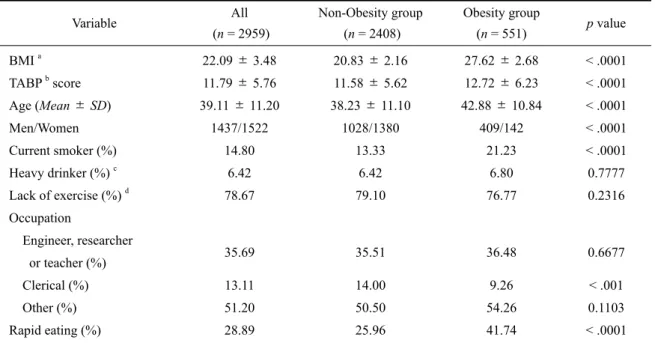
Table 2 shows the demographic characteristics of the obe-sity and the non-obeobe-sity groups as well as the results of the
χ2 and t tests, indicating differences between the groups.
The proportions of participants in the obesity group who reported BMI ≥ 25kg/m2, TABP score, age, being current
smoker, and rapid eating were significantly higher compared
to those observed in the non-obesity group (p < 0.0001). The number of participants in the obesity group who reported clerical staff as occupation was significantly lower compared to those observed in the non-obesity group (p < 0.001). The number of men was higher than women in the obesity group, while the number of men was lower than women in the non-obesity group (p < 0.001).
2. Relationship between obesity and the TABP
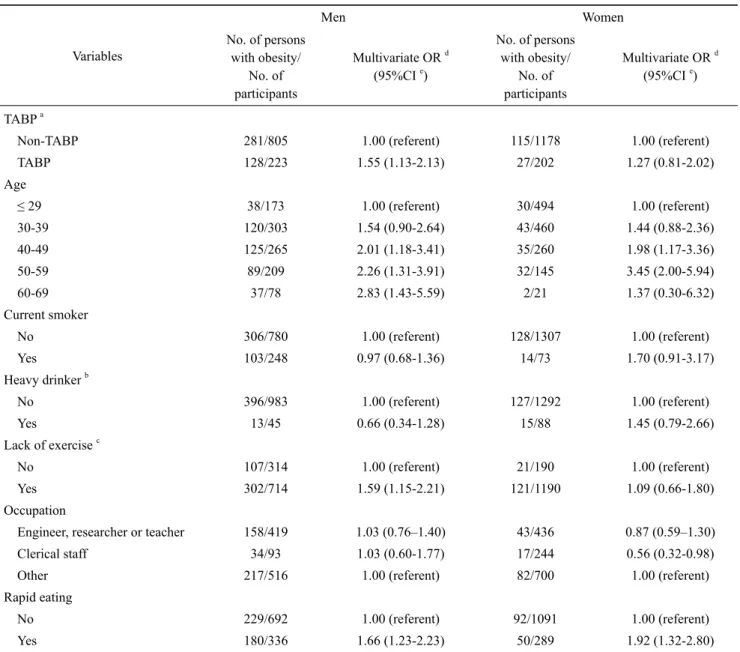
We examined the relationship between obesity and the TABP by multivariate analysis adjusted for age, being a
cur-Table 3. Multivariate analysis of the associations between obesity (body mass index of ≥ 25kg/m2) and demographic characteristics, drinking and smoking habits, exercise habits, and rapid eating
Variables
Men Women
No. of persons with obesity/
No. of participants
Multivariate OR d (95%CI e)
No. of persons with obesity/
No. of participants
Multivariate OR d (95%CI e)
TABP a
Non-TABP
TABP Age
≤29
30-39 40-49 50-59 60-69 Current smoker No Yes
Heavy drinker b
No
Yes
Lack of exercise c
No
Yes Occupation
Engineer, researcher or teacher
Clerical staff
Other Rapid eating No Yes 281/805 128/223 38/173 120/303 125/265 89/209 37/78 306/780 103/248 396/983 13/45 107/314 302/714 158/419 34/93 217/516 229/692 180/336 1.00 (referent) 1.55 (1.13-2.13) 1.00 (referent) 1.54 (0.90-2.64) 2.01 (1.18-3.41) 2.26 (1.31-3.91) 2.83 (1.43-5.59) 1.00 (referent) 0.97 (0.68-1.36) 1.00 (referent) 0.66 (0.34-1.28) 1.00 (referent) 1.59 (1.15-2.21) 1.03 (0.76–1.40) 1.03 (0.60-1.77) 1.00 (referent) 1.00 (referent) 1.66 (1.23-2.23) 115/1178 27/202 30/494 43/460 35/260 32/145 2/21 128/1307 14/73 127/1292 15/88 21/190 121/1190 43/436 17/244 82/700 92/1091 50/289 1.00 (referent) 1.27 (0.81-2.02) 1.00 (referent) 1.44 (0.88-2.36) 1.98 (1.17-3.36) 3.45 (2.00-5.94) 1.37 (0.30-6.32) 1.00 (referent) 1.70 (0.91-3.17) 1.00 (referent) 1.45 (0.79-2.66) 1.00 (referent) 1.09 (0.66-1.80) 0.87 (0.59–1.30) 0.56 (0.32-0.98) 1.00 (referent) 1.00 (referent) 1.92 (1.32-2.80)
Note. a Type A behavior pattern; b heavy drinking was defined as ethanol intake of at least 40 g/day in men and 20 g/day in women; c exercise of at least
rent smoker, heavy drinker, lack of exercise, occupation, and rapid eating. Tables 3 show the results of the multivariate analysis of the associations between obesity (BMI of ≥ 25kg/ m2) and demographic characteristics, drinking and smoking
habits, exercise habits, and eating behavior in men and women. The multivariate OR (95%CI) for obesity associated with TABP was 1.55 (1.13 to 2.13) in men. Other variables, associated with increased risk of obesity in men were 40-49 years (OR = 2.01, 95% CI = 1.18 to 3.41), 50-59 years (OR = 2.26, 95% CI = 1.31 to 3.91), 60-69 years (OR = 2.83, 95% CI = 1.43 to 5.59), lack of exercise (OR = 1.59, 95% CI = 1.15 to 2.21), and rapid eating (OR = 1.66, 95% CI = 1.23 to 2.23). The multivariate OR (95%CI) for obesity associated with TABP was 1.27 (0.81 to 2.02) in women. Other variables associated with an increased risk of obesity in women were 40-49 years (OR = 1.98, 95% CI = 1.17 to 3.36), 50-59 years (OR = 3.45, 95% CI = 2.00 to 5.94), and rapid eating (OR = 1.92, 95% CI = 1.32 to 2.80).
Discussion
The findings suggest that the TABP could be associated with increased obesity prevalence, particularly among men Japanese workers. However, the TABP was not associated with obesity in Japanese women. Therefore, the hypothesis that the TABP would increase the risk of obesity was partially supported. Moreover, in Japanese men, the factors related to obesity were found to be age, lack of exercise, and rapid eating. In Japanese women, the factors related to obesity were found to be age and rapid eating.
The TABP as a risk factor of obesity in men might be related to eating large portions of food rapidly. Previous studies have reported that rapid eating is associated with cur-rent obesity.27-29 In addition, rapid eating does not lead to a
feeling of satiety; 28 therefore, it is possible that the TABP in
men leads to overeating and increased risk of obesity. People with TABP tend to eat larger portions during mealtimes repeatedly by rapid eating; it is possible that eating large portions may lead to an increase weight in men with TABP.
In this study, the TABP was related to obesity in men; however, in women, there was no association between the TABP and obesity. The TABP in women may not increase eating portions by rapid eating. Moreover, in women, lack of exercise was not a risk of obesity. In this study, lack of exer-cise was observed in 71% of men and 86% of women (p < 0.0001); in this study, women tended to exercise less fre-quently. Since women have a low basal metabolism, it is considered that lack of exercise was not related to obesity in
women. In addition, the factors related to obesity in men were found to be age, lack of exercise, and rapid eating. The factors related to of obesity in women were found to be age and rapid eating. In the previous studies, age,18-19 exercise
habits,24-25 and eating behavior 27-28 were associated with
obesity, and similar results were observed in the Japanese workers in the current study. It is known that obesity in men and women is prevalent in the middle age. 18-19 Obesity in
women in their 40s to 50s is related to menopause.30 In this
study, the relationship between obesity and age were also similar.
This study involved four limitations. First, it was a cross-sectional study; therefore, we could not infer a causal rela-tionship between the TABP and obesity. Second, the research targeted workers from only one workplace; therefore, the results are not generalizable to all workers. Third, the TABP could not be accurately grasped because we used a self- re-port questionnaire; therefore, it is difficult to determine which elements of the TABP affected obesity. Fourth, endo-crine diseases including thyroid diseases,31-32 metabolic
diseases such as diabetes,33-34 diseases requiring steroids,35-36
psychiatric diseases37-38 are associated with obesity. However,
in this study, the participants were not inquired in detail regarding these diseases, and we did not exclude them from the analysis. Therefore, there is a limitation to the interpreta-tion of the result of this study. Fifth, this study was targeted at university staff; the university staffʼs specific stress may have influenced this outcome.
The study has two clinical implications. First, the identifi -cation of TABP as a risk factor for obesity could contribute to obesity prevention. Second, reducing the tendency to eat rapidly could increase the effectiveness of efforts to lose weight.
We plan to conduct a longitudinal study to determine whether the TABP is a risk factor for obesity. Moreover, it is necessary to examine weight-loss programs that focus on the TABP, to verify the effects observed in the present study.
Acknowledgments
110 Jun Tayama et al.: Type A Behavior Pattern and Obesity
References
1) Bray GA. Risks of obesity. Endocrinol Metab Clin North Am 32:
787-804, 2003
2) Rashid MN, Fuentes F, Touchon RC, Wehner PS. Obesity and the risk
for cardiovascular disease. Prev Cardiol 6: 42-47, 2003
3) Japan Society for the Study of Obesity. Guideline for the management
of Obesity disease 2016. Life science publication, 2016 (in Japanese)
4) Shim U, Kim HN, Roh SJ, et al. Personality traits and body mass
index in a Korean population. PLoS One 9: e90516, 2014
5) Kakizaki M, Kuriyama S, Sato Y, et al. Personality and body mass
index: A cross-sectional analysis from the Miyagi Cohort Study. J
Psychosom Res 64: 71-80, 2008
6) Shin ES, Shin TS, Cho YC. Relationship of type A behavior pattern and psychosocial stress with fatigue symptoms in manufacturing
workers. Indian Journal of Science and Technology 9: 103237, 2016
7) Friedman M, Rosenman RH. Association of specific overt behavior
pattern with blood and cardiovascular findings. JAMA 96: 1286-1296,
1959
8) Mommersteeg PMC, Pouwer F. Personality as a risk factor for the
metabolic syndrome: A systematic review. J Psychosom Res 73:
326-333, 2012
9) Pulkki L, Kivimäki M, Elovainio M, Viikari J, Keltikangas-Järvinen L. Contribution of socioeconomic status to the association between hostility and cardiovascular risk behaviors: a prospective cohort
study. Am J Epidemiol 158: 736-742, 2003
10) Grundy SM. Cardiovascular and metabolic risk factors: how can we
improve outcomes in the high-risk patient?. Am J Med 120: 3-8, 2007
11) Cohen JB, Reed D. The Type A behavior pattern and coronary heart
disease among Japanese men in Hawaii. J Behav Med 8: 343-352, 1985
12) Maeda S. A study on behavior pattern of patients with coronary heart
diseases: Application of brief questionnaire. Japanese Journal of
Psychosomatic Medicine 25: 297-306, 1985 (In Japanese with English abstract)
13) Kojima M, Nagaya T, Takahashi H, Kawai M, Tokudome S. A chron-ological decrease in Type A behavior patterns among Japanese male
workers in 1995–1999. J Occup Health 46: 171-174, 2004
14) Ministry of Health, Labour and Welfare. Standard specific health
checkups and specific health guidance program. Ministry of Health,
Labour and Welfare. [cited 2017/07/16]; Available from: http://www. mhlw.go.jp/seisakunitsuite/bunya/kenkou_iryou/kenkou/seikatsu/ dl/hoken-program2.pdf (in Japanese)
15) Higuchi S, et al. Alcohol Health Guidance Manual for Promotion of
Health Japan 21. Social Insurance Institute, 2003 (in Japanese)
16) Suzuki A, Sakurazawa H, Fujita T, Akamatsu R. Overeating at dinner time among Japanese workers: Is overeating related to stress response
and late dinner times?. Appetite 101: 8-14, 2016
17) Tayama J, Li J, Munakata M. Working long hours is associated with higher prevalence of diabetes in urban male Chinese workers: The
Rosai Karoshi Study. Stress Health 32: 84-87, 2016
18) Wang Y, Beydoun MA. The obesity epidemic in the United States– gender, age, socioeconomic, racial/ethnic, and geographic
character-istics: A systematic review and meta-regression analysis. Epidemiol
Rev 29: 6-28, 2007
19) Kuczmarski MF, Kuczmarski RJ, Najjar M. Effects of age on validity of self-reported height, weight, and body mass index: Findings from the third National Health and Nutrition Examination Survey, 1988–
1994. J Am Diet Assoc 101: 28-34, 2001
20) John U, Hanke M, Rumpf HJ, Thyrian JR. Smoking status, cigarettes per day, and their relationship to overweight and obesity among former
and current smokers in a national adult general population sample. Int
J Obes (Lond) 29: 1289-1294, 2005
21) Levine MD, Bush T, Magnusson B, Cheng Y, Chen X. Smoking-related weight concerns and obesity: Differences among normal weight, overweight, and obese smokers using a telephone tobacco quitline.
Nicotine Tob Res 15: 1136-1140, 2013
22) Arif AA, Rohrer JE. Patterns of alcohol drinking and its association with obesity: Data from the Third National Health and Nutrition
Examination Survey, 1988–1994. BMC Public Health 5: 126, 2005
23) Fan AZ, Russell M, Dorn J, Freudenheim JL, Nochajski T, Hovey K, Trevisan M. Lifetime alcohol drinking pattern is related to the preva-lence of metabolic syndrome. The Western New York Health Study
(WNYHS). Eur J Epidemiol 21: 129-138, 2006
24) Kahn HS, Tatham LM, Rodriguez C, Calle EE, Thun MJ, Heath CW Jr. Stable behaviors associated with adults' 10-year change in body
mass index and likelihood of gain at the waist. Am J Public Health 87:
747-754, 1997
25) Klesges RC, Klesges LM, Haddock CK, Eck LH. A longitudinal anal-ysis of the impact of dietary intake and physical activity on weight
change in adults. Am J Clin Nutr 55: 818-822, 1992
26) Chau JY, van der Ploeg HP, Merom D, Chey T, Bauman AE. Cross-sectional associations between occupational and leisure-time sitting,
physical activity and obesity in working adults. Prev Med 54:
195-200, 2012
27) Nagahama S, Kurotani K, Pham NM, et al. Self-reported eating rate and metabolic syndrome in Japanese people: Cross-sectional study.
BMJ Open 4: e005241, 2014
28) Maruyama K, Sato S, Ohira T, et al. The joint impact on being over-weight of self reported behaviours of eating quickly and eating until
full: Cross sectional survey. BMJ 337: a2002, 2008
29) Otsuka R, Tamakoshi K, Yatsuya H, et al. Eating fast leads to obesity: Findings based on self-administered questionnaires among
middle-aged Japanese men and women. J Epidemiol 16: 117-124, 2006
30) Kotani K, Tokunaga K, Fujioka S, et al. Sexual dimorphism of age-related changes in whole-body fat distribution in the obese. Int J Obes Relat Metab Disord 18: 207-212, 1994
31) Biondi B. Thyroid and obesity: an intriguing relationship. J Clin Endocrinol Metab 95: 3614-3617, 2010
32) Duntas LH, Biondi B. The interconnections between obesity, thyroid function, and autoimmunity: the multifold role of leptin. Thyroid 23: 646-653, 2013
33) Ohnishi H, Saitoh S, Takagi S, et al. Incidence of type 2 diabetes in individuals with central obesity in a rural Japanese population: The Tanno and Sobetsu study. Diabetes Care 29: 1129-1129, 2006 34) Kahn SE, Hull RL, Utzschneider KM. Mechanisms linking obesity to
insulin resistance and type 2 diabetes. Nature. 444: 840-846, 2006 35) Arnaldi G, Angeli A, Atkinson AB, et al. Diagnosis and
complica-tions of Cushing's syndrome: a consensus statement. J Clin Endocrinol Metab 88: 5593-5602. 2003
36) van den Ham EC, Kooman JP, Christiaans MH, Nieman FH, van Hooff JP. Weight changes after renal transplantation: a comparison between patients on 5-mg maintenance steroid therapy and those on steroid-free immunosuppressive therapy. Transpl Int 16: 300-306, 2003
37) Luppino FS, de Wit LM, Bouvy PF, et al. Overweight, obesity, and depression: a systematic review and meta-analysis of longitudinal studies. Arch Gen Psychiatry 67: 220-229, 2010
38) Correll CU. Balancing efficacy and safety in treatment with