Short-distance correlation functions and non-
perturbative renormalization of quark
currents in lattice QCD
Masaaki TOMII
Doctor of Philosophy
Department of Particle and Nuclear Physics
School of High Energy Accelerator Science
SOKENDAI (The Graduate University for
Advanced Studies)
定
SOKENDAI
(T HE G RADUATE U NIVERSITY FOR A DVANCED S TUDIES )
D
OCTORALT
HESISShort-distance correlation functions and
non-perturbative renormalization of quark
currents in lattice QCD
Author:
Masaaki TOMII
Supervisor: Prof. Shoji HASHIMOTO
A thesis submitted in fulfillment of the requirements for the degree of Doctor of Philosophy
in the
School of High Energy Accelerator Science Department or Particle and Nuclear Physics
iii
Abstract
Short-distance correlation functions and non-perturbative renormalization of quark currents in lattice QCD
by Masaaki TOMII
Precise predictions of the Standard Model (SM) are important for the search of new physics. Precision of the SM predictions needs to be improved for comparisons with forthcoming ex- periments. Uncertainty of the SM predictions mainly arises from the contribution of Quantum Chromodynamics (QCD), which is the theory of strong interaction of quarks, anti-quarks and gluons. This is because QCD cannot be treated by perturbation theory at low energies and the parameters of QCD such as the strong coupling constant have large uncertainty compared to other SM parameters.
Correlation functions of quark currents provide a rich source of information on the QCD vacuum at various scales ranging from perturbative to non-perturbative regions. At short dis- tances, they become mostly perturbative due to the asymptotic freedom of QCD. Using high order perturbation theory, they can be used to determine the strong coupling constant. At long distances, on the other hand, the correlation functions carry the information about hadron spec- trum and the low energy constants of QCD, which are the parameters in the chiral perturbation theory.
Correlation functions can be calculated from first principles using lattice QCD. In lattice QCD, the spacetime is discretized and compactified with some boundary conditions. Then, the degrees of freedom of the system in lattice QCD become finite and numerical path integral is feasible using the Monte Carlo method. Taking the infinite volume limit and the continuum limit for the correlation functions on the lattice, one can obtain the correlation functions in the continuum.
Comparison of the correlation functions in the continuum theory and on the lattice may determine fundamental quantities of QCD. In fact, lattice QCD is usually applied to calculate hadron masses and decay constants from the correlation functions at long distances. Similarly, the comparison at short distances can in principle provide a determination of the strong cou- pling constant. The comparison at short distances needs to be performed after eliminating lat- tice artifacts. The lattice calculation at short distances suffers from unphysical discretization effect which becomes more significant as the distance becomes small. A careful investigation of the discretization effect is, therefore, necessary for the precise determination of the strong coupling constant.
In this thesis, we analyze short-distance correlation functions both on the lattice and in the continuum, and investigate the region where the lattice results agree with the continuum theory after removing the lattice artifact. The lattice simulation is carried out on 14 gauge field ensem- bles generated by the JLQCD collaboration. The ensembles contain 2 + 1 flavors of sea quarks described by the Möbius domain-wall fermions, which realize precise chiral symmetry on the lattice. The pion masses on these ensembles are in the region 220–500 MeV. The lattice spacings are 0.044 fm, 0.055 fm, and 0.080 fm. We subtract the discretization effects within the mean field approximation. We extrapolate lattice results to the physical pion mass and the continuum limit.
Vector, axial-vector, scalar, pseudoscalar channels of the correlation functions in perturba- tion theory are available to the four-loop level. Using such well-advanced results, we investi- gate the convergence property of perturbative expansions. Slight deviation of the correlation functions at short distances from those in perturbation theory is explained by the Operator Product Expansion (OPE), which accommodates some non-perturbative effects in the correla- tion functions by expanding a product of operators into a series of composite operators.
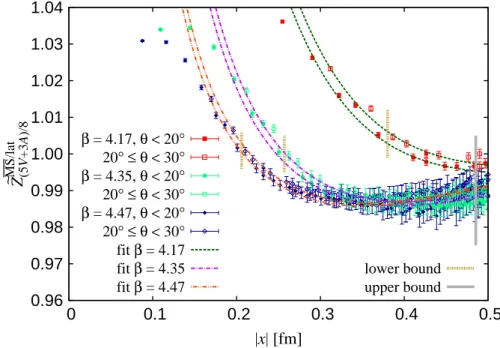
We utilize the correspondence of continuum and lattice correlation functions for the renor- malization of quark currents. It turns out that although the correlation functions on our lattice ensembles suffer from significant discretization effect in the perturbative region, the analysis in- cluding OPE allows us to determine the renormalization constants at slightly longer distances, where the discretization effects is well-managed. We obtain the renormalization constants of the vector current and the scalar density with the precision of O(1%) or less.
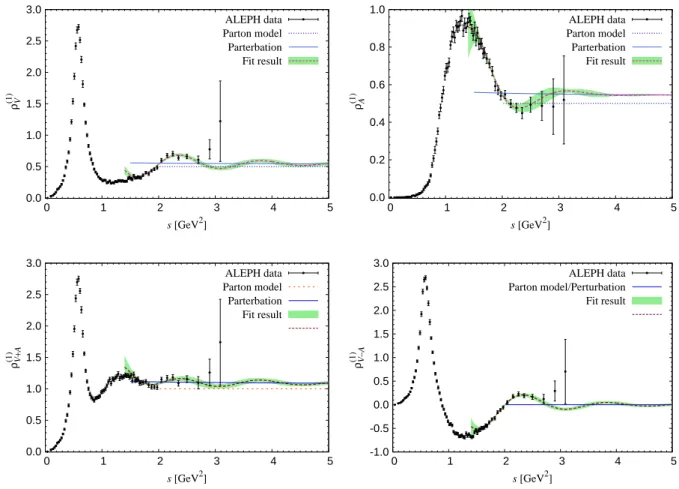
Using the result of the renormalization, we test the consistency between the correlation func- tions on the lattice and experiments. We calculate the vector and axial-vector correlation func- tions from the experimental results of spectral functions obtained through the hadronic tau decays by the ALEPH collaboration. We verify that the experimental correlation functions are in good agreement with our lattice results.
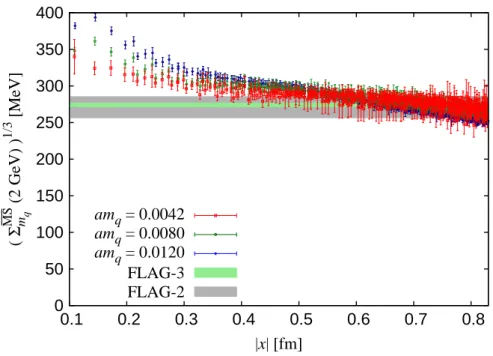
The result of the renormalization is also applied to an analysis of the chiral condensate, which is an order parameter of the spontaneous breaking of chiral symmetry in QCD and plays an important role in the chiral perturbation theory. We extract the chiral condensate from cur- rent correlators in the OPE regime. This result agrees with the world average of lattice calcula- tion of 2 + 1 flavors QCD.
v
Acknowledgements
First of all, I express my deep gratitude to Prof. Shoji Hashimoto, my supervisor, for his great advices, continuous regards, and many important discussions for three years even though he has been very busy with a hectic schedule. With out his supports, I could not have studied so far.
I also thank M. Hayakawa for teaching me a lot of important things as a researcher and showing me his attractive passion. I appreciate H. Matsufuru and T. Kaneko’s effort to secure large disk storages /xwork** and to create my account on the workstations scdl360d.kek.jp and scbc2fe.kek.jp. This study is done in the JLQCD collaboration. I thank H. Fukaya, J. Noaki, G. Cossu, B. Fahy, and all other JLQCD members for many discussion, comments, and teachings. I could have discussions with other professional researchers, F. Knechtli, P. Boyle, T. Izubuchi, C. Lehner, and H. Ohki, and many researchers in KEK. I thank all of these people.
My research activity is successful in virtue of several supportive programs and related peole. My trips to JPS meetings, lattice conferences and other workshops are aided by the Student Travel Reimbursement program managed by SOKENDAI and SH’s grant, the Grant-in-Aid of the Japanese of Educations No. 26247043. The trip to BNL is aided by The Short-Stay Abroad Program managed by SOKENDAI. I thank M. Oishi, a secretary of the lattice group in KEK Theory Center, and members of Postgraduate Education Unit in KEK for their help with the procedures for these trips. I was employed by KEK as a research assistant (RA). Numerical simulations are carried out on Hitachi SR 16000 and IBM System Blue Gene/Q (BGQ) at KEK under a support of its Large Scale Simulation Program (Nos. 13/14-04,14/15-10). The JLQCD collaboration thanks PB for the optimized code for BGQ.
Finally, I am grateful to my family for continuous encouragement and supports.
Masaaki Tomii
vii
Contents
Abstract iii
Acknowledgements v
1 Introduction 1
2 Correlation functions in QCD vacuum 7
2.1 Correlation functions in coordinate space . . . 7
2.2 Massless perturbation theory . . . 8
2.3 Momentum space correlators and dispersion relation . . . 17
2.4 Mass correction and OPE . . . 20
2.5 Quark-hadron duality violation . . . 24
2.6 Correlators converted from experiments . . . 28
3 Lattice calculation 33 3.1 Lattice correlators . . . 33
3.2 Lattice action and ensembles . . . 34
3.3 Reduction of discretization effect . . . 35
3.4 Subtraction of finite volume effect . . . 39
4 Non-perturbative renormalization of quark currents 45 4.1 Renormalization of composite operators on the lattice . . . 45
4.2 Renormalization by X-space method . . . 47
4.3 Determination of ZV . . . 47
4.4 Determination of ZS . . . 51
5 Validity of lattice calculation of current correlators 53 5.1 V + A and V − A from the spectral function of hadronic tau decays . . . 53
5.2 Chiral condensate from axial Ward identity . . . 56
6 Conclusion and discussion 63 A Euclidean formulation 65 B Scale setting of perturbative expansions 71 B.1 Renormalization group in perturbation theory . . . 71
B.2 Scale setting problem . . . 73
C Lattice action used in this work 75 C.1 Ginsparg-Wilson relation . . . 75
C.2 Domain-wall fermion . . . 76
C.3 Möbius Domain-wall fermion . . . 77
C.4 Stout smearing . . . 78
D Mean field approximation of correlators of domain-wall fermion 81 E Least squared method 85 E.1 Basics . . . 85
E.2 Case of linear parameters . . . 87
E.3 Case of non-linear parameters . . . 87
E.3.1 Steepest descent method . . . 88
E.3.2 Gauss-Newton method . . . 88
E.3.3 Levenberg-Marquardt method . . . 89
E.4 Generalization to global fit and example . . . 91
E.4.1 n = 0 with linear parameters . . . 93
E.4.2 n = 1 and m0 = 0 with non-linear parameters and correlated data . . . 93
E.4.3 n = 2 with linear parameters . . . 95
F Supplementary figures 99
ix
List of Figures
1.1 A sketch of current correlators. . . 2 2.1 Perturbative expansion of the vector correlator calculated with the coupling con-
stant as(1/|x|). . . 11 2.2 Perturbative expansion of the vector correlator calculated with the coupling con-
stant as(µBLMx ). . . 11 2.3 View of the convergence of the perturbative expansion of the vector correlator at
|x| = 0.2, 0.3, 0.4, 0.5 fm as functions of the scale µ∗xof the coupling constant. . . 12 2.4 Perturbative expansion of the vector correlator calculated with the coupling con-
stant as(µ∗,optx ) at the optimized scale. . . 13 2.5 Scalar correlator renormalized at 1/|x| in the MS scheme calculated by a pertur-
bative series of as(1/|x|). . . 15 2.6 Scalar correlator renormalized at 2 GeV in the MS scheme calculated by a pertur-
bative series of as(1/|x|). . . 15 2.7 Scalar correlator renormalized at 2 GeV in the MS scheme at the four-loop level
at|x| = 0.2, 0.3, 0.4, 0.5 fm as functions of µ∗xand µ′x. . . . 16 2.8 View of the convergence of the perturbative expansion of the scalar correlator
renormalized at 2 GeV in the MS scheme at|x| = 0.2, 0.3, 0.4, 0.46 fm as functions of the scale µ∗xof the coupling constant. . . 17 2.9 Scalar correlator renormalized at 2 GeV in the MS scheme calculated with the
optimized scales µ′x= µ′ optx and µ∗x= µ∗,optx . . . 18 2.10 Spectral functions measured by the ALEPH collaboration for four channels
V, A, V + A, V − A plotted with the fit result based on the resonance model. . . 27 2.11 Vector and axial-vector correlators calculated from the ALEPH spectral functions,
perturbation theory, and resonance based model. . . 29 2.12 Decomposition of the contribution of the spectral function to the vector correla-
tor. . . 30 2.13 Decomposition of the contribution of the spectral function to the axial-vector cor-
relator. . . 30 3.1 Pseudoscalar correlator without reducing the discretization effect, plotted with
the corresponding mean field approximation and its asymptotic behavior in the long distance limit. . . 36
3.2 Pseudoscalar correlator after subtracting the discretization effect in the mean
field level. . . 36
3.3 Separation of the pseudoscalar correlator into four regions of θ. . . 38
3.4 Same as Fig. 3.3 but for the vector channel. . . 38
3.5 Detailed view of Fig. 3.4 in 0◦ ≤ θ < 20◦and 20◦ ≤ θ < 30◦. . . . 39
3.6 Pseudoscalar and vector correlators divided by the tree level continuum correla- tor after applying the tree level correction by the multiplicative manner. . . 40
3.7 Pseudoscalar correlator in the time-direction (|x| = t) before and after subtract- ing the finite volume effects, plotted with the asymptotic form (3.12) in the long distance limit. . . 41
3.8 Pseudoscalar correlator before and after subtracting the finite volume effects. . . 42
4.1 ZeVMS/lat(a; x) and eZAMS/lat(a; x) at three different input masses. . . 48
4.2 Ze(5V +3A)/8MS/lat (a; x) calculated on the same ensembles as in Fig. 4.1. . . 48
4.3 Ze(5V +3A)/8MS/lat (a; x) at three different lattice spacing with Mπ ∼ 300 MeV. . . 49
4.4 Ze(S+P )/2+(V −A)/16MS (2 GeV, a; x) at three different lattice spacing with Mπ ∼ 300 MeV. . . . 52
5.1 RV +Acalculated at the same ensembles as in Fig. 4.2, plotted with the prediction of perturbation theory (dashed curve) and the result of the experiment (bands). 54 5.2 Same as Fig. 5.1 but calculated at the same ensembles as in Fig. 4.1. . . 54
5.3 Extrapolation of RV +Ato the physical point. . . 55
5.4 RV −A calculated at the same ensembles as in Fig. 4.2, plotted with result of the experiment with (hatched band) and without the duality violating term. . . 57
5.5 Same as Fig. 5.4 but calculated at the same ensembles as in Fig. 4.1. . . 57
5.6 Extrapolation of RV −Ato the physical point. . . 58
5.7 Chiral condensate calculated from the vector and axial-vector correlator at the same ensembles as in Fig. 4.1. . . 60
5.8 Same as Fig. 5.7 but the result at the same ensembles as in Fig. 4.3. . . 60
A.1 Wick’s rotation from the Minkowski to the Euclidean space in the momentum and coordinate spaces. . . 67
F.1 Same as Fig. 3.3 but for the scalar and axial-vector channels. . . 99
F.2 ZeS(x), eZP(x) and some combinations of them. . . 100
F.3 Same as Fig. 4.3 but the results at other ensembles. . . 101
F.4 Same as Fig. 4.4 but the results at other ensembles. . . 102
F.5 Same as Fig. 5.1 but the results at other ensembles. . . 103
F.6 Same as Fig. 5.5 but the results at other ensembles. . . 104
F.7 Same as Fig. 5.7 but the results at other ensembles. . . 105
xi
List of Tables
2.1 Some relations between the momentum formula and the coordinate formula through
Fourier transforms. . . 21
3.1 Lattice ensembles used in this work. . . 35
4.1 Result for the renormalization factor of the vector channel. . . 50
4.2 Result for the renormalization factor of the scalor channel. . . 52
5.1 Chiral condensate extracted from the global fit. . . 61
1
Chapter 1
Introduction
The Standard Model (SM) of elementary particles forms the basis for the progress in high energy physics. It describes the fundamental particles and their interactions. The formulation of the SM is completed in the 1970s and its validity has been supported by a lot of experiments. At the same time, several experiments have shown small but significant deviations from the SM, which can be understood as signs of new physics beyond the SM. Since these signs must play a key role in the progress in high energy physics, many high energy physicists concentrate their effort on testing the SM.
Recent activities of experimentalists aim at the SM tests by a drastic improvement in the precision in the next decade. For example, Belle II experiment is going to quantify the effects of CP violation focusing on the decay processes of B mesons. The groups at J-PARC and Fer- milab are going to measure the muon anomalous magnetic moment, which may show a sign of new physics, with the precision five times better than the previous experiment at BNL. These experiments are expected to produce results in early 2020s.
On the theory side, researchers are trying to provide SM predictions with the precision which competes with that of the forthcoming experiments. As well known, precise calcula- tions of the contribution of Quantum Chromodynamics (QCD) is the most difficult part in such efforts. The crucial origin of this difficulty is the spontaneous breaking of chiral symmetry in the QCD vacuum. At low energies (≲ 1 GeV), perturbation theory is no longer valid and there are a lot of unpredictable effects such as instanton interactions. At high energies (≫ 1 GeV), where perturbation theory is applicable, precise calculation of the QCD contribution is still dif- ficult because the uncertainty of the strong coupling constant (∼ 0.5%) is quite larger than that of other SM parameters such as the fine structure constant (∼ 2 × 10⁻⁸%). Therefore the under- standing of the vacuum structure and a precise determination of the strong coupling constant are important to achieve precise predictions of the SM.
Correlation functions of quark currents, or briefly current correlators, are useful tools to study these topics. They are defined as vacuum expectation values of a product of quark cur- rents placed at different positions. Figure 1.1 shows a sketch of current correlators with main particles which are related to them. Bullets correspond to the quark currents, which is con- nected with the black solid lines standing for valence quarks which are interacting with gluons
FIGURE1.1: A sketch of current correlators. Bullets, black solid lines, blue loops and curly lines correspond to quark currents, valence quarks, sea quarks and glu- ons, respectively.
shown by curly lines. Gluons interact with themselves and with sea quarks as shown by blue loops as well as with valence quarks. In addition to these particles, the photon and leptons are introduced if one takes into account the electromagnetic corrections. There are a number of channels of correlators, which represent the quantum numbers of the corresponding quark cur- rents. Scalar, pseudoscalar, vector and axial-vector channels are widely studied as the simplest cases. An extensive review of correlators was given by Shuryak [1].
Current correlators reflect the property of QCD at any scale region from low-energy to high- energy. At short distances (< 0.1 fm), or equivalently at large external momenta, correlators are mostly perturbative and therefore can be used to determine the strong coupling constant. In this region, the effect of the spontaneous chiral symmetry breaking is negligible and therefore some degeneracies of correlators, such as the vector and axial-vector ones, are realized. On the other hand, correlators at sufficiently long distances (> 1 fm) or small momenta are well described by chiral perturbation theory and carry the information about the low energy constants and the hadron spectroscopy, reflecting the characteristics of the corresponding channels.
Correlators at the middle distances are more complicated. From the viewpoint of perturba- tion theory, the strong coupling constant blows up and the effect of the spontaneous chiral sym- metry breaking contributes significantly as the distance of correlators approaches the typical scale Λ−1QCDof QCD. From the viewpoint of the hadronic picture, on the other hand, correlators at the middle involve the effects of many excited states. Thus, current correlators may allow us to investigate such non-perturbative properties of QCD as well as the fundamental parameters such as the strong coupling constant and the low-energy constants.
Chapter 1. Introduction 3
An attempt to understand current correlators at longer distances beyond perturbation the- ory is based on the Operator Product Expansion (OPE), which was firstly introduced by Wil- son [2,3] and well formulated by Shifman-Vainstein-Zakharov [4–6] for QCD. OPE accommo- dates some non-perturbative effects by expanding a product of operators into a series of com- posite operators. Wilson coefficients of OPE, which are the coefficients of the composite op- erators in the series, are usually calculated perturbatively as a series of the strong coupling constant.
Although OPE is widely used to investigate QCD, it was suggested [7] that OPE does not work well in some cases. For example, the correlator of the scalar or pseudoscalar channel considerably deviates from the prediction of OPE. This fact was verified by phenomenological test [1] and lattice calculations [8,9]. These disagreements are qualitatively understood as the effects of the instanton-induced ’t Hooft interactions [10]. Although some models have been proposed for the quantitative understandings of the inconsistencies [11,12], no definite expla- nation based on the first principle of QCD has been obtained.
There is another approach to understand current correlators in the non-perturbative regime. The non-perturbative property of current correlators is encoded in the spectral functions, which are obtained from e+e−hadronic annihilations or hadronic decays of the τ lepton. The exper- imental data of the hadronic τ decays by the ALEPH collaboration [13] were used to obtain the correlators [14]. Indeed the sum rule approach is widely used for the determination of the strong coupling constant [13,15–19], the gluon condensate [19,20], and so on.
The sum rule approach is limited because the experimental data of spectral functions are measured for a limited region of the invariant mass, which is below the mass of the τ lepton for the experiment of hadronic τ decays. In the region without experimental data, the spectral function used to be calculated by using perturbation theory or OPE until the violation of the quark-hadron duality was suggested [21–24]. The essence of the duality violation is that a spectral function calculated perturbatively (or using OPE) may and actually does disagree with experimentally measured one beyond the uncertainty caused by truncations of perturbative expansion (and OPE) in the Minkowski space. After the suggestion of the duality violation, the treatment of the spectral function in the region where experimental data are not available was shifted from perturbative methods to model-based ones [23–30]. Since such analyses are based on models, more reliable treatment of the spectral function such as lattice QCD is desired.
The seminal work on the investigation of current correlators by lattice simulations was done [31] by using a quenched simulation with Wilson fermions for valence quarks. They showed an agreement between the lattice results and the phenomenological analyses with ex- perimental data. Another group [32] performed a similar analysis and their results are roughly consistent with [31]. Several years later, a quenched simulation with the overlap valence quarks was performed for the calculation of correlators [8,9]. In virtue of the exact chiral symmetry of
overlap fermions, they were able to investigate some combinations of correlators of two chan- nels, e.g. the average V + A or the difference V − A of the vector and axial-vector channels. The former channel V +A is free from the effect of the spontaneous chiral symmetry breaking, while the latter V − A reflects the effect of it. Their lattice result of the V − A channel agreed with the sum rule approach [14] from the hadronic τ decays, while the V + A channel did not agree well. Several years later, the strong coupling constant was determined using the vector and axial- vector correlator in the momentum space calculated with dynamical overlap fermions [33,34]. These previous works are all with one finite lattice spacing and no one has taken the continuum limit.
These comparisons of lattice results and phenomenological ones are achieved by matching the renormalization schemes and scales. In general, renormalization of lattice operators is a necessary step for the lattice QCD calculations of scheme dependent quantities such as the ma- trix elements of the weak scattering and decay processes. Current correlators themselves are applicable to renormalization of quark currents. This renormalization procedure was proposed by [35] and applied to a quenched simulation [36] and a dynamical simulation [37]. Since the conventional scheme of a quantity is usually the MS scheme, the renormalization need pertur- bative calculations. The perturbative calculations of the (pseudo)scalar and (axial-)vector cor- relators are nowadays available up to the four-loop calculation [38] except for the quark mass corrections and therefore renormalization to the MS scheme by this method can minimize the uncertainty of perturbative calculations.
In this thesis, we investigate the possibility that current correlators play an important role in understandings of QCD. For example, lattice calculation of current correlators may provide important quantities of QCD such as the strong coupling constant. The determinations, which are achieved by comparing the lattice result with the continuum calculation, need a region of x in which the correlators on the lattice and in the continuum are both precisely calculated. For the determination of the strong coupling constant, for example, the discretization effects on the correlators in the region where the perturbative calculation or the OPE is sufficiently precise need to be under controlled. Therefore, we investigate the presence of the window where both the lattice and continuum calculations are applicable without large uncertainty. The analyses for the following topics are all aimed at this purposes.
At first, we renormalize the quark currents based on the method using the current corre- lators [35–37]. In this method, the renormalization window, which is the region of x where both the lattice and perturbative calculations are reliable, is needed for a precise renormaliza- tion. With careful investigations and managements of discretization effects on the lattice and the convergence of the perturbative calculations, the window is produced and the renormal- ization factors are determined with the competing precision (≲ 1%) with results from other renormalization methods.
Chapter 1. Introduction 5
Next, we use the results of the renormalization to compare the lattice result of the current correlators with the phenomenological correlators converted from the latest ALEPH spectral functions [39]. In the calculation of the experimental correlators, we adopt some assumptions to evaluate the spectral function above the mass of the τ lepton, where the experimental data do not exist. We find a good agreement between the lattice calculation and the experiments.
The result of the renormalization is also applied to an analysis of the chiral condensate, which is an order parameter of the spontaneous breaking of chiral symmetry in QCD and plays an important role in chiral perturbation theory. We extract the chiral condensate from the lon- gitudinal component of the axial-vector current correlator. This analysis needs the off-diagonal components of the axial-vector correlator with respect to the Lorentz indices, whose lattice in- vestigation is done for the first time by this work.
The numerical simulation is carried out on the gauge ensembles with 2 + 1-flavor dynami- cal Möbius domain-wall fermions [40,41] generated by the JLQCD collaboration [42]. Möbius domain-wall fermion, which is an improved implementation of the domain-wall fermion [43, 44], has precise chiral symmetry on the lattice. The chiral symmetry on the lattice is defined by the Ginsparg-Wilson relation [45] and the magnitude of its violation is quantified by the resid- ual mass, which is at the order of 1 MeV or less on our ensembles. The lattice spacings are 0.0439 fm, 0.0547 fm, and 0.0804 fm. The pion masses are in the region 220–500 MeV.
This thesis is organized as follows. In Chapter 2, we give the definitions and summarize the topics of correlation functions in the continuum theory, which are the bases of this study. In Chapter 3, we take account of several lattice artifacts appearing in the correlators. In Chapter 4, we show the results of the renormalization of the vector current and scalar density. In Chapter 5, we discuss the consistency between the lattice calculation and the phenomenological approach and calculate the chiral condensate.
7
Chapter 2
Correlation functions in QCD vacuum
2.1 Correlation functions in coordinate space
In this work, we investigate the four channels of point-to-point correlation functions, which are defined as the vacuum expectation value of the product of a couple of the corresponding quark currents with finite separation x,
ΠS(x) = ⟨S(x)S(0)†⟩, ΠP(x) = ⟨P (x)P (0)†⟩,
ΠV,µν(x) = ⟨Vµ(x)Vν(0)†⟩, ΠA,µν(x) = ⟨Aµ(x)Aν(0)†⟩, (2.1) where each operator is defined by
S(x) = ¯ud(x), P (x) = ¯uiγ5d(x),
Vµ(x) = ¯uγµd(x), Aµ(x) = ¯uγµγ5d(x). (2.2) Here, the source point is fixed to zero with the assumption of translational invariance. The correlation functions are usually called by a brief name, the correlators.
These correlators are in the four dimensional Euclidean space, i.e. points are separated in the space-like direction. The Euclidean correlators are related to the Minkowski ones by the analytic continuation. The Euclidean correlators dump exponentially at long distances unlike those in the Minkowski space, which show the oscillatory behavior. In the Euclidean space, the time-ordered product for two operators at 0 and x is not needed. The connection of the field theory in the Euclidean and Minkowski spaces is reviewed in Appendix A.
The Study of the correlators in the coordinate space rather than in the momentum space is convenient because those in the coordinate space contain the unphysical contact term only at x = 0 as ∝ δ(x), while contact terms in the momentum are proportional to ∝ 1, q2, q4. . .. Since we do not use the correlator at x = 0, we omit this contact term.
For the vector and axial-vector channels, we analyze not only the Lorentz diagonal compo- nents but also the off-diagonal ones, which had never been investigated by lattice simulations so far. A combination of the diagonal and off-diagonal parts may provide an important quan- tity. As an example, we try to extract the chiral condensate through the axial Ward-Takahashi identity (see Sections 2.4, 5.2).
If one focuses on the diagonal components, the trace ΠV /A(x) =∑
µ
ΠV /A,µµ(x) (2.3)
is usually employed. This quantity is Lorentz scalar and its treatment is simple. We call the trace the scalar-contracted (axial-)vector correlator or simply the (axial-)vector correlator.
2.2 Massless perturbation theory
In this section, we discuss the convergence of the perturbative expansion of the massless cor- relators. Since the scalar and pseudoscalar correlators, as well as the vector and axial-vector correlators, degenerate in the massless perturbation theory, i.e. ΠS = ΠP and ΠV = ΠA, we consider only the two channels ΠS and ΠV.
The perturbative expansion of the vector correlator is written as
ΠMSV (x) = 6 π4x6
( 1 +
∑∞ i=1
CiVas(µx)i )
, (2.4)
with perturbative coefficients CiV. Here, as(µx) = αs(µx)/π is the strong coupling constant and its scale µxis set as
µx= 1
|x|. (2.5)
One can reorganize the perturbative series using the renormalization group to another scale µ∗x, i.e.
ΠMSV (x) = 6 π4x6
( 1 +
∑∞ i=1
CiV(µ∗x)as(µ∗x)i )
, (2.6)
which is exact when the perturbative series includes all orders, provided that the coefficients CiV(µ∗x) are converted appropriately. The conversion formula of the coupling constants is avail- able to four-loop level [46].
Chetyrkin and Maier [38] wrote the perturbative coefficients up to O(a4s) at the renormal- ization scale µx in the gMS scheme, which is the same as the MS scheme at a scale 2e−γEµx ≃ 1.123/|x|. Here, γE ≃ 0.5772 is Euler’s constant. In our notation, these coefficients correspond to CiV(2e−γEµx).
Since the perturbative expansion truncated at a finite order may depend on µ∗x, there is an optimal choice for the scale that leads to the best convergence. One possible recipe to choose the optimal scale µ∗xis the Brodsky-Lepage-Mackenzie (BLM) approach [47], which is motivated by an idea of absorbing the higher order contributions of gluon vacuum polarization into the coupling constant. The scale is chosen such that the perturbative coefficient at a2s becomes independent of the number of flavors nf. This BLM scale µBLMx of the vector correlator thus
2.2. Massless perturbation theory 9
determined is1
µBLMx = 2 exp [1
2(4ζ3− 3 − 2γE) ]
µx ≃ 2.7733
|x| , (2.7)
where ζ3 ≃ 1.202 is the Riemann zeta function at the argument 3.
Using the result of [38] and [46], we obtain the perturbative coefficients CiV(µx), CiV(2e−γEµx), and CiV(µBLMx ) as
C1V(µx) = 1,
C2V(µx) = −5.5269 + 0.34002nf,
C3V(µx) = 10.415 − 3.2912nf+ 0.12602n2f,
C4V(µx) = 28.928 + 30.966nf− 2.6652n2f + 0.064007n3f, (2.8)
C1V(2e−γEµx) = 1,
C2V(2e−γEµx) = −4.8893 + 0.30137nf,
C3V(2e−γEµx) = 5.2517 − 2.6633nf + 0.10124n2f,
C4V(2e−γEµx) = 33.562 + 26.233nf − 2.2001n2f + 0.050863n3f, (2.9)
C1V(µBLMx ) = 1,
C2V(µBLMx ) = 0.083333,
C3V(µBLMx ) = −7.1191 − 1.1478nf+ 0.010414n2f,
C4V(µBLMx ) = −56.886 + 12.283nf− 0.58326n2f + 0.014075n3f. (2.10) For nf = 3, the corresponding perturbative expansion becomes
ΠMSV (x)
nf=3 =
6 π4x6
(1 + as(µx) − 4.5069as(µx)2
+ 1.6758as(µx)3+ 99.567as(µx)4+ O(a5s)), (2.11)
ΠMSV (x)
nf=3 =
6 π4x6
(
1+as(2e−γEµx) − 3.9852as(2e−γEµx)2
−1.8270as(2e−γEµx)3+ 93.835as(2e−γEµx)4+ O(a5s)
)
, (2.12)
1To be more precise, the BLM scale (2.7) eliminates the nf-dependence on the perturbative coefficient at two- loop. In fact, the coefficients at three- and four-loop levels in (2.10) depend on nf. Although generalization of the BLM scale setting to any finite order expansions are investigated [48–50], we do not apply it because we vary the scale µ∗xfor the error estimation as discussed below.
ΠMSV (x)
nf=3 =
6 π4x6
(1+as(µBLMx ) + 0.083333as(µBLMx )2
−10.469as(µBLMx )3− 24.907as(µBLMx )4+ O(a5s)
). (2.13)
Figure 2.1 shows the vector correlator calculated with (2.11). It is normalized by the tree- level correlator ΠfreeV (x) = 6/π4x6. A reasonable convergence is observed only below |x| ∼ 0.15 fm, which is not so large compared to our lattice spacings a = 0.044–0.080 fm. It implies that there is no renormalization window satisfying the condition that the perturbative calculation is convergent and the discretization effects are sufficiently small. The result of the perturbative series (2.12) is similar to that of (2.11). On the other hand, the result of (2.13) shows much better convergence as plotted in Fig. 2.2, implying that the convergence of the perturbative series is actually improved by tuning the renormalization scale µ∗x.
In order to choose the optimal scale and estimate the uncertainty of the higher order correc- tions, we investigate the µ∗x-dependence of the perturbative calculation. The µ∗x-dependence of the vector correlator is shown in Fig. 2.3 for several distances in the range 0.2–0.5 fm. Since the all-order calculation has to be independent of µ∗x, we determine the optimal scale µ∗,optx as the value which minimizes the µ∗x-derivative of the four-loop correlator,
µ∗,optx = e1.7µx≃ 5.5
|x|. (2.14)
The uncertainty of the higher order corrections to the vector correlator is estimated by varying µ∗xin the region [12µ∗,optx , 2µ∗,optx ], which is shown in Fig. 2.3 by the gray band.
The expansion at the scale µ∗,optx reads
ΠMSV (x)
nf=3
= 6
π4x6
(1 + as(µ∗,optx ) + 3.1431as(µ∗,optx )2
+ 4.8432as(µ∗,optx )3− 33.819as(µ∗,optx )4+ O(a5s)). (2.15) As shown in Fig. 2.4, the choice of µ∗,optx shows better convergence. The gray region in the figure represents the higher order uncertainty, which is estimated by the maximum difference between the correlator at µ∗x = µ∗,optx and those at µ∗xin [12µ∗,optx , 2µ∗,optx ].
Next, we consider the scalar correlator. The scalar channel is more complicated due to the scale dependence of the scalar operator S(x). We start from the perturbative series
ΠMSS (µx; x) = 3 π4x6
( 1 +
∑∞ i=1
CiSas(µx)i )
. (2.16)
Here, both the scales of the operator itself and the coupling constant are set to µx = 1/|x|,
which eliminates the logarithmic terms from the expression. Using the beta function [46] and
2.2. Massless perturbation theory 11
0.0 0.5 1.0 1.5 2.0
0 0.05 0.1 0.15 0.2 0.25 0.3 0.35 0.4 ΠVMS /ΠVfree
|x| [fm] free
1-loop 2-loop 3-loop 4-loop
FIGURE2.1: Perturbative expansion of the vector correlator renormalized in the MS scheme with nf = 3. The results of (2.11) truncated at a0s (fine-dotted), as
(dotted), a2s(dashed double-dotted), a3s(dashed dotted), and a4s(solid) are plotted as functions of|x|.
0.0 0.5 1.0 1.5 2.0
0 0.05 0.1 0.15 0.2 0.25 0.3 0.35 0.4 ΠVMS /ΠVfree
|x| [fm] free
1-loop 2-loop 3-loop 4-loop
FIGURE2.2: Perturbative expansion of the vector correlator renormalized in the MS scheme with nf = 3. The results of the perturbative series (2.13) at the BLM scale truncated at a0s (fine-dotted), as(dotted), a2s (dashed double-dotted), a3s(dashed dotted), and a4s(solid) are plotted as functions of|x|.
µx* [GeV]
ΠVMS (|x| = 0.2 fm) / ΠVfree (|x| = 0.2 fm) estimation range
BLM scale 1-loop 2-loop 3-loop 4-loop
1.05 1.06 1.07 1.08 1.09 1.10
1 2 4 8 16
µx* [GeV]
ΠVMS (|x| = 0.3 fm) / ΠVfree (|x| = 0.3 fm) estimation range
BLM scale 1-loop 2-loop 3-loop 4-loop
1.07 1.08 1.09 1.10 1.11
1 2 4 8 16
µx* [GeV]
ΠVMS (|x| = 0.4 fm) / ΠVfree (|x| = 0.4 fm) estimation range
BLM scale 1-loop 2-loop 3-loop 4-loop
1.07 1.08 1.09 1.10 1.11 1.12 1.13 1.14
0.5 1 2 4 8
µx* [GeV]
ΠVMS (|x| = 0.5 fm) / ΠVfree (|x| = 0.5 fm) estimation range
BLM scale 1-loop 2-loop 3-loop 4-loop
1.07 1.08 1.09 1.10 1.11 1.12 1.13 1.14 1.15 1.16 1.17
0.5 1 2 4 8
FIGURE2.3: Vector correlator renormalized in the MS scheme at the specific dis- tances 0.2 fm (top/left), 0.3 fm (top/right), 0.4 fm (bottom/left), and 0.5 fm (bot- tom/right) as functions of µ∗x. The results truncated at as (dotted), a2s (dashed double-dotted), a3s (dashed dotted), and a4s (solid) are plotted. The gray band represents the region in which we estimate the uncertainty of the higher order corrections. The vertical bold line near the lower end of the gray band stands for the BLM scale (2.7).
the anomalous dimension [51,52], one can also write a more general expression
ΠMSS (µ′x; x) = 3 π4x6
( 1 +
∑∞ i=1
CiS(µ∗x, µ′x)as(µ∗x)i )
, (2.17)
where the first argument µ∗x of the perturbative coefficients is the renormalization scale of the strong coupling constant in the perturbative series and the second µ′x is the renormalization scale of the scalar operator.
Chetyrkin and Maier [38] gave the perturbative coefficients of correlators at the renormal- ization scale µx∗ = µ′x= 2e−γEµx, which is CiS(2e−γEµx, 2e−γEµx) in our notation.
2.2. Massless perturbation theory 13
0.85 0.90 0.95 1.00 1.05 1.10 1.15
0 0.1 0.2 0.3 0.4 0.5
ΠVMS / ΠVfree
|x| [fm]
free 1-loop 2-loop 3-loop 4-loop uncertainty
FIGURE2.4: Perturbative expansion of the vector correlator renormalized in the MS scheme with nf = 3. The results of the perturbative series (2.15) at the optimal scale µ∗,optx truncated at a0s(fine-dotted), as(dotted), a2s(dashed double-dotted), a3s(dashed dotted), and a4s(solid) are plotted as functions of|x|.
Numerically, the perturbative coefficients CiS(µx, µx) and CiS(2e−γEµx, 2e−γEµx) are obtained as
C1S(µx, µx) = 0.20294,
C2S(µx, µx) = −20.197 + 0.56314nf,
C3S(µx, µx) = 7.8854 − 7.5318nf + 0.37635n2f,
C4S(µx, µx) = 500.95 + 40.402nf − 5.3403n2f+ 0.18479n3f, (2.18)
C1S(2e−γEµx, 2e−γEµx) = 2 3,
C2S(2e−γEµx, 2e−γEµx) = −17.766 + 0.48193nf,
C3S(2e−γEµx, 2e−γEµx) = −14.656 − 6.3172nf + 0.32333n2f,
C4S(2e−γEµx, 2e−γEµx) = 450.45 + 25.502nf − 3.8057n2f+ 0.14697n3f. (2.19) For nf = 3, they are
ΠMSS (µx; x)
nf=3=
3 π4x6
(1 + 0.20294as(µx) − 18.507as(µx)2
− 11.323as(µx)3+ 579.08as(µx)4+ O(a5s)
), (2.20)
ΠMSS (2e−γEµx; x)
nf=3=
3 π4x6
(1 + 0.66667as(2e−γEµx) − 16.321as(2e−γEµx)2
−30.698as(2e−γEµx)3+ 496.67as(2e−γEµx)4+ O(a5s)
). (2.21)
Figure 2.5 shows the convergence of (2.20). The correlator in the figure is normalized by the tree-level one, ΠfreeS (x) = 3/π4x6. The scalar channel also shows poor convergence. The BLM scale is not directly applicable for scale dependent quantities. In fact, the BLM scale of the scalar correlator renormalized at µx is unstable, i.e. µBLMx ≃ 8.8µx for ΠMSS (2e−γEµx; x) while µBLMx ≃ 4 × 10³µxfor ΠMSS (µx; x).
Since the purpose of this work is to determine the renormalization constant at 2 GeV in the MS scheme, we perform the scale evolution of the scalar correlator (2.17) from µ′x to 2 GeV by a numerical integral of the mass anomalous dimension [51,52]. Figure 2.6 shows the scalar correlator calculated from the perturbative series (2.20) and the scale evolution. This calculation is convergent only below|x| ∼ 0.06 fm. Such a poor convergence comes from large perturbative coefficients and the large coupling constant as(µx) in (2.20).
Although the scalar correlator ΠMSS (2 GeV; x) after the scale evolution has to be independent of both the scales µ∗xand µ′x, finite order calculations may depend on them. Figure 2.7 shows the dependences on µ∗xand µ′xof the four-loop results at four representative distances renormalized at 2 GeV in the MS scheme. To choose optimal values of µ∗xand µ′x, we focus on the region with mild dependence of the correlator. We choose the optimal values of µ′x(= µ′ optx ) as indicated by the dashed lines in Fig. 2.7. On these lines, the correlator depends on µ∗x mildly and the dependence on µ′xis also relatively small. Numerically, the choice is
µ′ optx = e0.8µx≃ 2.2
x . (2.22)
The detailed dependence of the scalar correlator on µ∗xat µ′x = µ′ optx is shown in Fig. 2.8 for several distances in 0.2–0.46 fm, where we determine the renormalization factor of the scalar operator. These figures show results at each loop order up to the four-loop level. We then choose the optimal value µ∗,optx of the scale µ∗xas the value which minimizes the dependence on µ∗x,
µ∗,optx = e1.05µx≃ 2.9
x . (2.23)
We estimate the uncertainty by varying µ∗xin a region including µ∗,optx in the middle as we did for the vector channel. Since the coupling constant blows up as µ∗x approaches ΛQCD, we need to avoid too small µ∗x. Therefore, our choice is [1.61 µ∗,optx , 1.6µ∗,optx ] in order not to use the coupling constant at the scale smaller than 0.75 GeV. The region is shown by the gray band in Fig. 2.8.
2.2. Massless perturbation theory 15
0.0 0.5 1.0 1.5 2.0
0 0.05 0.1 0.15 0.2 0.25 0.3 0.35 0.4 ΠSMS (µx) / ΠSfree
|x| [fm] free
1-loop 2-loop 3-loop 4-loop
FIGURE2.5: Scalar correlator renormalized at µx in the MS scheme for nf = 3. The results of (2.20) truncated at a0s(fine-dotted), as(dotted), a2s(dashed double- dotted), a3s(dashed dotted), and a4s(solid) are plotted.
0.0 0.5 1.0 1.5 2.0 2.5 3.0 3.5
0 0.05 0.1 0.15 0.2 0.25 0.3 0.35 0.4 ΠSMS (2 GeV) / ΠSfree
|x| [fm] free
1-loop 2-loop 3-loop 4-loop
FIGURE2.6: Scalar correlator renormalized at 2 GeV in MS scheme for nf = 3, which is calculated from the perturbative series (2.20) and the scale evolution. The results truncated at a0s(fine-dotted), as(dotted), a2s(dashed double-dotted), a3s(dashed dotted), and a4s(solid) are plotted.
|x| = 0.2 fm
1 2 4
µx* [GeV] 1
2 4
µ′ x [GeV]
1.23 1.24 1.25 1.26 1.27 1.28 1.29 1.30
1.31 |x| = 0.3 fm
1 2
µx* [GeV] 1
2
µ′ x [GeV]
1.65 1.70 1.75 1.80 1.85 1.90 1.95
|x| = 0.4 fm
0.5 1 2
µx* [GeV] 0.5
1 2
µ′ x [GeV]
2.2 2.3 2.4 2.5 2.6 2.7 2.8 2.9
3.0 |x| = 0.5 fm
0.5 1 2
µx* [GeV] 0.5
1 2
µ′ x [GeV]
3.0 3.2 3.4 3.6 3.8 4.0 4.2 4.4 4.6 4.8 5.0
FIGURE2.7: ΠMSS (2 GeV; x)/ΠfreeS (x) at the four-loop level at nf = 3. The results at the specific distances 0.2 fm (top/left), 0.3 fm (top/right), 0.4 fm (bottom/left), and 0.5 fm (bottom/right) are shown as functions of µ∗xand µ′x. The dashed lines stand for our choice of µ′x, where the correlator shows small sensitivity to µ′xand µ∗x.
Setting µ′xand µ∗xby (2.22) and (2.23), we obtain the following numerical expansion at nf =
3,
ΠMSS (µ′ optx ; x)
nf=3=
3 π4x6
(1 + 3.4029as(µ∗,optx ) + 9.7142as(µ∗,optx )2
+ 1.7011as(µ∗,optx )3+ 26.366as(µ∗,optx )4+ O(a5s)), (2.24) whose coefficients are smaller than those in the expansion (2.20), (2.21) especially for the coeffi- cients of O(a4s). Evolving the renormalization scale of the correlator to 2 GeV, we obtain a well