ASEAN+3 BOND
MARKET GUIDE
2017
LAO PEOPLE’S
DEMOCRATIC REPUBLIC
ASEAN+3 BOND
MARKET GUIDE
2017
LAO PEOPLE’S
DEMOCRATIC REPUBLIC
Creative Commons Attribution 3.0 IGO license (CC BY 3.0 IGO)
© 2017 Asian Development Bank
6 ADB Avenue, Mandaluyong City, 1550 Metro Manila, Philippines Tel +63 2 632 4444; Fax +63 2 636 2444
www.adb.org
Some rights reserved. Published in 2017.
ISBN 978-92-9257-953-1 (Print), 978-92-9257-954-8 (e-ISBN) Publication Stock No. TCS179039-2
DOI: http://dx.doi.org/10.22617/TCS179039-2
The views expressed in this publication are those of the authors and do not necessarily reflect the views and policies of the Asian Development Bank (ADB) or its Board of Governors or the governments they represent.
ADB does not guarantee the accuracy of the data included in this publication and accepts no responsibility for any consequence of their use. The mention of specific companies or products of manufacturers does not imply that they are endorsed or recommended by ADB in preference to others of a similar nature that are not mentioned.
By making any designation of or reference to a particular territory or geographic area, or by using the term “country” in this document, ADB does not intend to make any judgments as to the legal or other status of any territory or area. This work is available under the Creative Commons Attribution 3.0 IGO license (CC BY 3.0 IGO)
https://creativecommons.org/licenses/by/3.0/igo/ By using the content of this publication, you agree to be bound by the terms of this license. For attribution, translations, adaptations, and permissions, please read the provisions and terms of use at https://www.adb.org/terms-use#openaccess
This CC license does not apply to non-ADB copyright materials in this publication. If the material is attributed to another source, please contact the copyright owner or publisher of that source for permission to reproduce it. ADB cannot be held liable for any claims that arise as a result of your use of the material.
Please contact [email protected] if you have questions or comments with respect to content, or if you wish to obtain copyright permission for your intended use that does not fall within these terms, or for permission to use the ADB logo.
Notes:
Corrigenda to ADB publications may be found at http://www.adb.org/publications/corrigenda
ADB recognizes “Laos” and “Lao” as the Lao People’s Democratic Republic, and “Korea” as the Republic of Korea. In this report, international standards for naming conventions—International Organization for Standardization (ISO) 3166 for country codes and ISO 4217 for currency codes—are used to reflect the discussions of the ASEAN+3 Bond Market Forum to promote and support implementation of international standards in financial
transactions in the region. ASEAN+3 comprises the Association of Southeast Asian Nations (ASEAN) plus the People’s Republic of China, Japan, and the Republic of Korea.
The economies of ASEAN+3 as defined in ISO 3166 include Brunei Darussalam (BN; BRN); Cambodia (KH; KHM); the People’s Republic of China (CH; CHN); Hong Kong, China (HK; HKG); Indonesia (ID; IDN); Japan (JP; JPN); the Republic of Korea (KR; KOR); the Lao People’s Democratic Republic (LA; LAO); Malaysia (MY; MYS); Myanmar (MM; MMR); the Philippines (PH; PHL); Singapore (SG; SGP); Thailand (TH; THA); and Viet Nam (VN; VNM). The currencies of ASEAN+3 as defined in ISO 4217 include the Brunei dollar (BND), Cambodian riel (KHR), Chinese renminbi (CNY), Hong Kong dollar (HKD), Indonesian rupiah (IDR), Japanese yen (JPY), Korean won (KRW), Lao kip (LAK), Malaysian ringgit (MYR), Myanmar kyat (MMK), Philippine peso (PHP), Singapore dollar (SGD), Thai baht (THB), and Vietnamese dong (VND).
Contents
Tables and Figures v
Foreword vi
Acknowledgments vii
Abbreviations viii
I. Overview 1
A. Introduction 1
B. The 8th Five-Year National Socio-Economic Development Plan, 2016–2020 2
C. Cooperation within the ASEAN Framework 3
II. Legal and Regulatory Framework 4
A. Legal Tradition 4
B. English Translation 4
C. Legislative Structure 4
D. Lao PDR Bond Market Regulatory Structure 7
E. Regulatory Framework for Debt Securities 12
F. Debt Securities Issuance Regulatory Processes 12
G.Disclosure Requirements in the Lao PDR Bond Market 18 H. Self-Regulatory Organizations in the Lao PDR Bond Market 20
I.
Licensing of Market Participants 20
J. The Lao Securities Exchange Regulations on Bond Listing, Disclosure, and
Trading 20
K. Market Entry Requirements (Nonresidents) 22
L. Market Exit Requirements (Nonresidents) 23
M.Regulations and Limitations Relevant for Nonresidents 24
N. Regulations on Credit Rating Agencies 25
III. Characteristics of the Lao PDR Bond Market 26
A. Definition of Securities 26
B. Definition of Bonds and Corporate of Bonds 27
C. Types of Bonds and Notes 28
D. Money Market Instruments 29
E. Methods of Issuing Bonds and Notes (Primary Market) 31 F. Governing Law and Jurisdiction (Bond and Note Issuance) 36
G.Language of Documentation and Disclosure Items 36
H. Registration of Debt Securities 36
I.
Listing of Debt Securities 36
J. Methods of Trading Bonds and Notes (Secondary Market) 38
K. Bond and Note Pricing 39
L. Transfers of Interest in Bonds and Notes 40
M.Market Participants 41
N. Definition of Investors 45
O.Credit Rating Requirements or Use of Guarantor 46
P. Market Features for Investor Protection 46
Q. Bondholders’ Representative/Trustee Function in the Lao PDR Bond Market 47
R. Bankruptcy and Insolvency Provisions 47
S. Event of Default and Cross-Default 48
IV. Bond and Note Transactions and Trading Market Infrastructure 49
A. Trading of Bonds and Notes 49
B. Trading Platforms 50
C. Mandatory Trade Reporting 51
D. Market Monitoring and Surveillance in the Secondary Market 51
E. Bond Information Services 51
F. Yields, Yield Curves, and Bond Indices 52
G.Repurchase Market 52
H. Securities Borrowing and Lending 52
V. Description of the Securities Settlement System 53
VI. Bond Market Costs and Taxation 54
A. Costs Associated with Corporate Bond Issuance 54
B. Ongoing Costs for Issuers of Corporate Bonds and Notes 56
C. Costs for Listing of Debt Securities 56
C. Costs for Deposit and Withdrawal of Bonds and Notes 57 D. Costs for Account Maintenance at Securities Depositories in the Lao PDR 57
E. Costs Associated with Securities Trading 57
F. Costs for Settlement and Transfer of Bonds and Notes 58
G.Taxation Framework and Requirements 58
H. Tax Incentives 60
VII. Market Size and Statistics 61
VIII.Presence of an Islamic Bond Market 62
IX. Lao PDR Bond Market Challenges and Opportunities 63
A. Challenges in the Lao PDR Bond Market 63
B. Opportunities in the Lao PDR Bond Market 65
X. Recent Developments and Future Direction 66
A. Recent Major Developments 66
B. Future Direction 66
Appendixes
1 Practical References 68
2 List of Laws and Regulations 69
3 Glossary of Technical Terms 71
Tables and Figures
Tables
2.1 Examples of Securities Market Legislation by Legislative Tier ... 5
2.2 Authorities Involved in Regulatory Processes by Issuer Type ...13
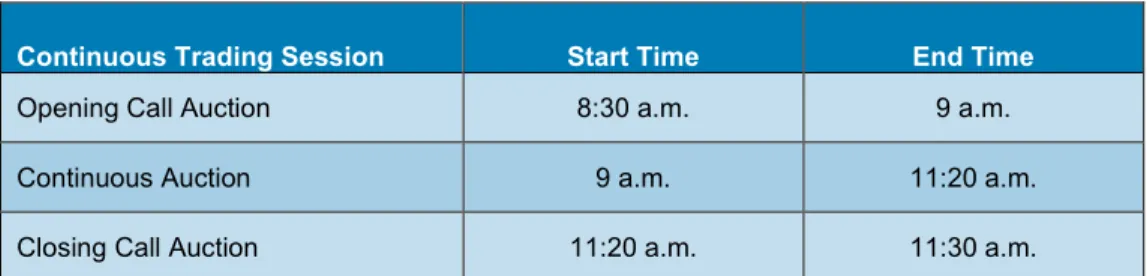
4.1 Lao Securities Exchange—Trading Hours ...50
6.1 Duties and Taxes on Fixed-Income Securities in the Lao PDR ...59
Figures 2.1 Regulatory Process Map—Bond and Note Issuance in the Lao PDR ...14
2.2 Lao Securities Exchange Regulations on its Website ...21
3.1 Treasury Bill Auction Process Flow ...32
3.2 Corporate Bond Issuance Practices in the Lao PDR ...34
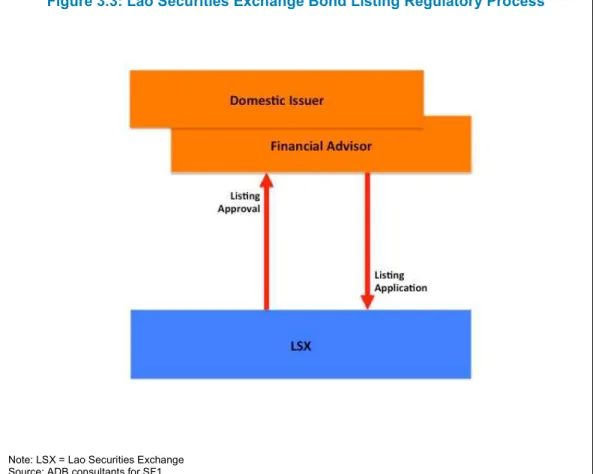
3.3 Lao Securities Exchange Bond Listing Regulatory Process ...37
3.4 Daily Securities Prices on the Lao Securities Exchange Website ...39
Foreword
The Asian Development Bank (ADB) is working closely with the Association of Southeast Asian Nations (ASEAN) and the People’s Republic of China, Japan, and the Republic of Korea—collectively known as ASEAN+3—to develop local currency bond markets and facilitate regional bond market integration under the Asian Bond Markets Initiative to strengthen the resilience of the region’s financial systems. Thanks to the efforts of member governments, local currency bond markets in ASEAN, the People’s Republic of China, and the Republic of Korea have grown rapidly, with the total outstanding amount of bonds reaching more than USD10 trillion in 2016. Despite this remarkable development, intraregional investment in bond markets has remained subdued. As ADB has estimated that developing Asia will need to invest USD26 trillion from 2016 to 2030 (or USD1.7 trillion per year) in infrastructure for its continued growth, it is critical to mobilize the region’s vast savings for the enormous investment needs. As an essential platform for such resource mobilization, the financial markets in ASEAN+3 need to be more harmonized and integrated. Also, the regional efforts should support the developing member countries at early stages of market development.
The ASEAN+3 Bond Market Forum (ABMF) was established with the endorsement of the ASEAN+3 finance ministers in 2010 as a common platform to foster the
standardization of market practices and harmonization of regulations relating to cross- border bond transactions in the region. As an initial step, ABMF published the
ASEAN+3 Bond Market Guide in 2012, which was welcomed as the first official information source offering a comprehensive explanation of the region’s bond markets.
Since publication of the ASEAN+3 Bond Market Guide, bond markets in the region have continued to develop. ABMF recognizes the need for revisions to the guide to reflect these changes, though it is never an easy task to keep up with rapid changes in the markets. This report is an outcome of the strong support and kind contributions of ABMF members and experts, particularly from the Lao People’s Democratic Republic. The report should be recognized as a collective good to support bond market
development among ASEAN+3 members. It is our hope that the revised
ASEAN+3 Bond Market Guide will facilitate further development of the region’s bond markets, contribute to increased intraregional bond transactions, and promote efficient allocation of capital within the region.
Yasuyuki Sawada
Chief Economist and Director General
Economic Research and Regional Cooperation Department
Acknowledgments
The ASEAN+3 Bond Market Guide was first published in 2012 as the initial output of Phase 1 of the ASEAN+3 Bond Market Forum (ABMF).1 Across the region, economies with nascent domestic bond markets, such as the Lao People’s Democratic Republic (Lao PDR), have experienced tremendous development over the past 5 years. Now in Phase 3, ABMF would like to share, in the public domain, information on these developments by publishing an update to the Lao PDR Bond Market Guide. The ABMF Sub-Forum 1 team—comprising Satoru Yamadera (Principal Financial Sector Specialist, Asian Development Bank, Economic Research and Regional Cooperation Department); Kosintr Puongsophol (Financial Sector Specialist, Asian Development Bank, Economic Research and Regional Cooperation Department); and Asian Development Bank consultants Shigehito Inukai and Matthias Schmidt—would like to stress the significance and magnitude of the contributions made by the ABMF national members for the Lao PDR, including the Ministry of Finance, the Bank of the Lao PDR, and the Lao Securities Commission Office. These policy bodies and regulatory authorities generously gave their time for market visit meetings,
discussions, and follow-up. They have also reviewed and provided inputs on the draft Lao PDR Bond Market Guide over the course of ABMF Phase 3.
No part of this report represents the official views or opinions of any institution that participated in this activity as an ABMF member, observer, or expert. The ABMF Sub- Forum 1 team bears sole responsibility for the contents of this report.
August 2017
ASEAN+3 Bond Market Forum
1 ASEAN+3 refers to the 10 members of the Association of Southeast Asian Nations (ASEAN) plus the People’s Republic of China, Japan, and the Republic of Korea.
Abbreviations
ABMF ASEAN+3 Bond Market Forum ADB Asian Development Bank
AMBIF ASEAN+3 Multi-Currency Bond Issuance Framework ASEAN Association of Southeast Asian Nations
ASEAN+3 Association of Southeast Asian Nations plus the People’s Republic of China, Japan, and the Republic of Korea BOL Bank of the Lao PDR
CSD central securities depository
IFRS International Financial Reporting Standards IPD Investment Promotion Department
LAK Lao kip (ISO code)
Lao PDR Lao People’s Democratic Republic LSC Lao Securities Commission LSCO Lao Securities Commission Office LSX Lao Securities Exchange
MOF Ministry of Finance, Lao PDR
MTN medium-term note
NSEDP National Socio-Economic Development Plan OTC over-the-counter
SF1 Sub-Forum 1 of ABMF
SF2 Sub-Forum 2 of ABMF
SOE state-owned enterprise SRO self-regulatory organization T-bill Treasury bill
USD United States dollar (ISO code)
USD1 = LAK8,269 as of 31 July 2017 (BOL Reference Rate)
Overview
A. Introduction
The purpose of this Bond Market Guide is to provide an update to current and future domestic, regional, and international market participants on the tremendous
developments in the Lao People’s Democratic Republic (Lao PDR) securities market. The bond market of the Lao PDR was constituted in 1994 when the Government of the Lao PDR issued Treasury bills for the first time to help finance the annual budget deficit. The issuance of Treasury bills continues on a regular basis with the primary objectives of financing the budget deficit and repaying public debt. Treasury bills have been issued into the primary market through an auction channel and through the so- called “over-the-counter method,” which is distinct from the typical over-the-counter (OTC) secondary market (see also Chapter IV). The primary participants are commercial banks.
The central bank, the Bank of the Lao PDR (BOL), began issuing BOL bills and bonds in 1992 with the objectives of carrying out monetary policy and managing the
exchange rate. BOL bills and bonds are sold to central bank constituents, such as commercial banks and other financial institutions, and may be bought and sold in the secondary market among constituents. In addition, BOL conducts open market operations through its Banking Operations Department on a manual basis, using written contracts for three types of transactions: (i) repurchase (repo) agreement, (ii) discount, and (iii) collateralized lending.
In the context of the objectives of the 6th Five-Year National Socio-Economic Development Plan, 2006–2010—which were to promote economic development, increase competitiveness, utilize comparative advantages, and strengthen the positive linkages between economic growth and social development—the Lao Securities Exchange (LSX) was formally established on 10 October 2010 and launched on 11 January 2011. The launching of the LSX was a historic milestone for the capital market in the Lao PDR. The LSX is expected to help attract the huge amount of capital
necessary to develop the country, raise the long-term funds needed by companies, and promote the integrity of the Lao PDR’s financial markets.
As for the legislative and regulatory framework, the Law on Securities was approved by the National Assembly in 2012 and introduced into the market in 2013. Pursuant to the Law on Securities, other decrees and subsidiary regulations were improved or created. With regard to the bond market, the Lao Securities Commission (LSC) introduced the Corporate Bond Regulation in 2014 and subsequently issued the Decision on Issuance of Corporate Bonds Abroad in 2016. For government bonds, the Ministry of Finance, Lao PDR (MOF) led the drafting of the Decree on Government Bonds, which was released in March 2017; these new government bonds will be listed on and traded at the LSX. Correspondingly, the LSX is developing a dedicated bond listing and trading platform, and will be amending the existing Regulation on Bond Listing after enactment of the new decree.
To support sustainable economic development in the country, and capital market development in particular, the Government of the Lao PDR has approved the Strategic Plan on the Lao Capital Market Development, 2016–2025 that focuses on eight objectives:
1. create all necessary and favorable conditions for enterprises to raise funds through the capital market to increase the quality and quantity of products and services;
2. have market instruments and mechanisms ready to support the reform of enterprises;
3. have a comprehensive regulatory framework in compliance with the Lao PDR’s current conditions and international standards;
4. ensure that the exchange, central securities depository (CSD), and securities intermediaries are operated smoothly with limited risks, and that they can integrate with regional and global markets;
5. ensure that information and communications technology development is suitable for the size of capital market expansion and up-to-date;
6. increase public participation, the investor base, and the balance between individual and institutional investor involvement;
7. have adequate capital market regulators, experts, and professionals in terms of both quality and quantity; and
8. enable the Lao PDR capital market to integrate with regional and global markets.
B. The 8th Five-Year National Socio-Economic Development
Plan, 2016–2020
The 8th Five-Year National Socio-Economic Development Plan, 2016–2020, which is also referred to as the 8th NSEDP, is a means of implementing the National Strategy on Socio-Economic Development until 2025 and the Government of the Lao PDR’s Vision 2030.1
According to statements contained in the Public Finance, Banking, and Capital Market (Finance) section of the 8th NSEDP, significant efforts have been made in the area of domestic debt service, including discount and bond issuance, of which LAK5,379 billion was in the form of discount, and LAK3,872 billion was in the form of 2-year and 3-year bonds. These efforts have contributed significantly to the reduction of the government’s debt service and the creation of a smooth environment for business enterprises.
In the Implementation and Financing Plan section, the 8th NSEDP identifies capital requirements of LAK232 trillion for developments during the 2016–2020 period, of which
(i) public investment accounts for 24%–28%, investment from the state budget accounts for 9%–11%, and investment from grants and loans accounts for 15%–17% of the total envisaged investment;
(ii) private domestic and foreign investments account for 55%–57% of the total envisaged investment; and
(iii) money market (bank credit) and capital market investments account for 17%–19% of the total envisaged investment.
1 See http://la.one.un.org/images/publications/8th_NSEDP_2016-2020.pdf (Final version. Officially approved at the 8th National Assembly’s Inaugural Session. 20–23 April 2016. Vientiane).
C. Cooperation within the ASEAN Framework
The Lao PDR continues to participate in the activities and initiatives of the Association of Southeast Asian Nations (ASEAN), including preparations for integrating into the ASEAN Economic Community. Details on the Lao PDR’s participation are also contained in the 8th NSEDP.
In addition, the Lao PDR participates in regional initiatives under the Asian Bond Market Initiative such as the ASEAN+3 Bond Market Forum (ABMF).
Legal and Regulatory Framework
A. Legal Tradition
The legal system in the Lao PDR follows the civil law tradition. Many of the relevant laws and regulations for the securities market have been in place since the late 1990s and continue to be revised and adjusted to the requirements of modern financial and capital markets, with significant revisions and additions, particularly since 2010.
B. English Translation
There is no legal or other requirement in the Lao PDR to provide official translations of laws, decrees, and regulations. Translations are often carried out by law firms or international organizations but may not always reflect all significant aspects of the laws and regulations as originally intended, particularly when it comes to the finer points of specialist legislation or regulations such as for the securities market.
As such, the unofficial translations by the governmental bodies and regulatory authorities of the Lao PDR are practical resources for the study of the securities market. Although these unofficial translations typically state that every effort has been made to convey the meaning and effect of each provision of the original Lao language version as accurately as possible, these English translations do not carry any legal authority. Only the original Lao text has legal force and, hence, the English translation and the citations in this Bond Market Guide are strictly for reference only.
C. Legislative Structure
As is evident in most jurisdictions in ASEAN+3, the legislative structure of the Lao PDR comprises a number of tiers that each are designed to structure and define the roles, functions, rights, obligations, practices, and activities of institutions and individuals under their respective purview in increasing detail. The overall legislation and activities of the government, regulatory authorities, and participants is guided by the Constitution of the Lao PDR.
[1st tier] Constitution of the Lao PDR
[2nd tier] Laws representing both fundamental and key legislation
[3rd tier] Decrees intended to promulgate and detail laws for particular legislation such as securities market-related implementation rules and regulations
[4th tier] Regulations issued by regulatory authorities or market institutions under delegation to provide further detailed prescriptions on market activities, institutions, and participants under the respective laws and decrees
[5th tier] Additional instructions or agreements issued by regulatory authorities that represent additional detailed prescriptions for market activities, institutions, and participants under the respective laws and decrees
For further illustration, Table 2.1 applies the prevalent legislation to the individual tiers of the legislative structure for the securities market mentioned above.
Table 2.1: Examples of Securities Market Legislation by Legislative Tier
Legislative Tier Content or Significant Examples
Constitution of the Lao PDR Principles, Rights, and Obligations Fundamental legislation (laws)
and key legislation (laws) for the securities market
• Law on Promotion of Foreign Investment, No. 02/NA (2009)
• Law on the Bank of the Lao PDR, No. 05/NA (1999)
• Law on Securities, No. 21/NA (2012)
• Law on Enterprises, No. 46/NA (2013)
• Law on Accounting, No. 47/NA (2013)
Decrees • Decree on Organization and Activities of the Bank of the Lao PDR, No. 40/PM (2000)
• Decree on Securities and Securities Exchange, No. 255/PM (2010)
• Decree on Organization and Operation of the Lao Securities Commission, No. 188/PM (2013)
• Decree on Government Bonds, No. 101/PM (2017) Decisions and subsidiary
regulations •
Regulation on Organization and Operation of the Lao Securities Commission Office, No. 013/LSC (2013)
• Decision on Issuance of Corporate Bonds Abroad, No. 0022/LSC (2016)
• Decision on Fees for Issuance of Corporate Bonds Abroad, No. 011/LSC (2014)
• Regulation on Incorporation and Operation of Securities Companies, No. 002/LSC (Update 2013)
• Regulation on Issuance of Corporate Bonds, No. 019/ LSC (2014)
• Regulation on Government Bond Issuance (2008)
• Regulation on Management of Share Trading of Foreign Investor, No. 005/LSC (2015)
• Regulation on Registration of Foreign Credit Rating Agency, No. 002/LSC (2015)
• Regulation on Repo and Outright Interest Rate Determination, No. 478/BOL (2008)
• Regulation on Open Market Operation, No. 05 (2007)
• Regulation on Treasury Bond Auction, No. 03/BOL (1995)
• Regulation on Bond Listing, No. 006/LSX (2015) (Additional) instructions and
agreements •
Instruction on the Implementation of Regulation on Net Capital Ratio of Securities Companies, No. 281/LSCO (2014)
• Instruction on the Request for the Grant to Establish Securities Companies, No. 482/LSCO (2012)
• Instruction on Shareholders’ Meeting of Listed Companies, No. 0001/LSCO (2016)
LSX = Lao Securities Exchange.
Source: Compiled by ADB consultants for SF 1 and based on publicly available information.
1. Fundamental or Key Legislation
Fundamental legislation consists of basic laws that govern business principles, contracts, rights, and obligations, as well as the functions of key regulators and the basic roles and responsibilities of financial and securities market institutions and market participants. Key legislation is the summary term for those laws aimed at a certain market or specific activities, such as the bond market, or at the securities market in general.
These laws are created by the Ministry of Justice in consultation with the ministry responsible for the law’s subject(s). They are submitted to the National Assembly Standing Committee and adopted by the National Assembly, and signed into law and promulgated by the President before taking effect.3 All promulgated legislation of general application at the national, provincial, and capital levels comes into legal force only after 60 days from the publication date in the Official Gazette.
The Lao PDR’s fundamental legislation with relevance for the bond, securities, and capital markets at large is the Enterprise Law, which allowed private enterprises to issue securities, and the Investment Promotion Law, which prescribed the abilities for domestic and foreign entities to invest in the market or market segments of the Lao PDR economy.
Key legislation in the Lao PDR for the bond, securities, and capital markets at large primarily consists of the Law on Securities, which was promulgated in 2013 via presidential decree.4 The law confirmed the role and responsibilities of the Lao Securities Commission Office (LSCO), stipulated the setting up of the exchange, the types of securities market intermediaries, and their qualifications and business operations. The law also contains provisions for credit rating agencies and securities business associations, defines securities issuance types and the eligibility of issuers, and introduces key disclosure documents such as the prospectus. In addition, the law establishes the concept of a public fund (mutual fund). The issuance of the Law on Securities resulted in the revision of subsidiary legislation and regulations and the substitution of earlier decisions or regulations issued with regard to the securities market and its institutions.
The contents and relevance of the fundamental and key legislation is further referenced in the appropriate context in this Bond Market Guide.
2. Decrees
In the Lao PDR legislative context, decrees fulfill the function of promulgating the actual laws and serve as implementation rules and regulations, effectively further defining and interpreting the underlying laws. Decrees may detail the general provisions in the corresponding laws, often with a focus on a particular area, in this context market institutions or market segments. A decree is signed by the President of the Lao PDR.
The most significant decrees for the securities market have been the Decree on the Promulgation of the Law on Securities and the Decree on Securities and Securities Exchange; the latter was originally promulgated in 2010 and was eventually replaced by the Law on Securities.
3 For a detailed description of the legislative process in the Lao PDR, please see the website of the National Assembly of the Lao PDR at
http://www.na.gov.la/index.php?option=com_content&view=article&id=92%3Athe-legislative- process&catid=37%3Athe-legislative-process&Itemid=161&lang=en
4 An unofficial English translation of the Law on Securities is available at http://www.lsx.com.la/rules/laws/listPosts.do?lang=en
3. Decisions and Regulations
Decisions represent ministerial decision(s) signed by the minister overseeing the respective activities to be governed. Regulations represent the further detailing of laws and decrees by the regulatory authorities for areas under their respective purview, or under the authority delegated to the market institutions. Regulations define specific market activities and the actions of its participants.
A key decision in recent years was the appointment of the LSCO. Significant regulations that have been issued by the LSCO and the LSX are listed in Table 2.1 and Appendix 2. The contents and relevance of these decisions and regulations are further explained in the appropriate context in this Bond Market Guide.
4. Instructions and Agreements
Instructions issued by the head of relevant governmental authorities prescribe the implementation of the 8th NSEDP; the state budget plan; laws; and other legislation, plans, or activities. Instructions identify concepts, methods, procedures, and the timeframe for implementation. Agreements, on the other hand, are issued to perform the rights and duties of regulatory authorities or further prescribe and implement the respective legislation of higher authorities.
D. Lao PDR Bond Market Regulatory Structure
The MOF, BOL, and LSCO—which is presently still embedded at the BOL—are the policy bodies and regulatory authorities that govern the bond market and the capital market in the Lao PDR at large. In addition, the Investment Promotion Department (IPD) of the Ministry of Planning and Investment plays a significant role in formulating, implementing, and promoting the rules and regulations for investment in the Lao PDR capital market.
The MOF and BOL regularly cooperate on capital market initiatives. As an example, the BOL monitors the economy and monetary conditions, and advises the MOF on the ceiling rate at which Treasury bills should be auctioned.
1. Ministry of Finance, Lao PDR
Under the Decree on the Organization and Activities of the Ministry of Finance, the MOF is the authority responsible for any matter relating to the financial sector as provided in Articles 2.10 and 2.11. The MOF directly oversees the insurance business, lottery business, and accountingand auditing businesses.
For the roles and responsibilities of the MOF in the context of issuance and issuance methods of government securities, please see Chapter III.
2. Bank of the Lao PDR
The BOL is the financial institution of the state and the central bank of the Lao PDR, having the status of an independent legal entity. As the central bank, the BOL has regulatory authority to license and control commercial banks, the banking system, the money supply, and foreign currency exchange. It is responsible for issuing licenses to establish banks and other financial institutions. The BOL also has the authority to issue bills and bonds to manage the exchange rate and liquidity in the economy. The Law on the Bank of the Lao PDR and the Decree on the Organization and Activities of the Bank of Lao PDR assigned the BOL the duties and authority “to
establish and improve the state and commercial banking system for sustainable growth” and “to manage and inspect the activities of all banks and financial institutions under the authority in order to ensure the stability and expansion of the banking system and the financial institutions.”
Article 4 in Part II of the Law on the Bank of the Lao PDR defines the scope of rights and duties of the BOL as listed below.
The Bank of the Lao PDR shall have the following rights:
i. the sole right to issue notes and coins with the approval of the
Government of the Lao PDR, and manage the currency circulation within the country;
ii. administer the macro monetary policy and shall be the bank of the
commercial banks and financial institutions under its supervision, and shall be the final lender to such commercial banks and financial institutions with the objective to implement the monetary policy;
iii. implement the policy on foreign currency control and the exchange rate; iv. issue its own bonds with the objective to carry out monetary policy, buy
and sell bonds directly with other commercial banks and financial institutions; and
v. authorize the establishment of branches of the Bank of the Lao PDR and the establishment of local commercial banks, foreign commercial banks, and financial institutions under its supervision based on approval of the Government of the Lao PDR.
3. Investment Promotion Department
The IPD, operating under the Ministry of Planning and Investment and formerly known as the Department for Promotion and Management of Domestic and Foreign
Investment between 2004 and 2007, administers the foreign investment system and reviews investment applications in accordance with the Investment Promotion Law.5 Its primary functions include promoting the Lao PDR as an investment destination,
screening investment proposals, offering investment incentives, and facilitating foreign investment.6
To support and encourage investment, the government offers incentives to investors in various forms, including reduced corporate profit taxes, reduced duties and turnover taxes on imported capital equipment and inputs to production, and investment permissions and guarantees. The main laws governing the promotion of investment are the Law on Promotion of Foreign Investment, Law on Enterprises, Law on Labor, Law on Customs, and Law on Taxes. The IPD is designed to offer a one-stop service to foreign investors by providing information and assistance during the investment process. At the time of the compilation of this Bond Market Guide, the government was in the process of putting the draft Investment Promotion Law through the legislative process.
4. Lao Securities Commission and Lao Securities Commission Office The LSC is the governing body of the securities market regulator in Lao PDR, with the LSCO acting as the executing agency of the governing body.
5 The text (in Lao and English) of the Investment Promotion Law, 2009 is available at http://www.investlaos.gov.la/images/sampledata/pdf_sample/IPLaw2009_Lao-English.pdf
6 For more information on the IPD, please see http://www.investlaos.gov.la/index.php/about-ipd
Lao Securities Commission
The LSC received its present official name and status pursuant to the Decree on Organization and Operation of the Lao Securities Commission, which was issued on 24 July 2013. The LSCO started operation on 2 July 2009, pursuant to the Decision on Appointment of the Securities and Exchange Commission, which was published on 25 May 2009. It replaced in name the Securities Market Establishment Committee, previously charged with creating and supervising a securities market, and absorbed the committee’s staff.
The LSC acts as a secretariat to the Government of the Lao PDR in the management of securities activities at a macro and centralized level in the Lao PDR.7 The LSC consists of 13 commissioners—including the chairman, the deputy chairmen, and the secretary of the LSCO—who are appointed or dismissed by the Prime Minister. The Deputy Prime Minister is the designated LSC chairman, with the chairman of the BOL and the Minister of Finance designated as first and second deputy chairmen,
respectively. The commissioners represent a number of government ministries at the deputy minister level.
The primary rights and duties of the LSC, as defined in the Decree on Organization and Operation of the Lao Securities Commission, are to
i. formulate and amend necessary strategic plans, policies, and laws relating to securities activities as recommended by the LSCO in order to propose to the Government of the Lao PDR for consideration;
ii. approve project and work plans, operating plans, recruiting and capacity building plans, and budget plans, including plans on the development of infrastructure and the purchase of technical equipment of the LSCO;
iii. approve the regulations relating to securities activities proposed by the LSCO; iv. grant an approval for establishment or dissolution of securities intermediaries,
and issuance of securities proposed by the LSCO;
v. study and propose the establishment and dissolution of a securities exchange to the government for consideration as recommended by the LSCO;
vi. lead the LSCO in implementing the supervision of securities activities and support related parties to provide training and education to the public concerning securities activities;
vii. collaborate with foreign countries and international organizations in
exchanging information and seeking technical assistance regarding securities activities;
viii. promote and encourage persons, juristic persons, and organizations to contribute to the development of securities activities, especially by encouraging companies in all business sectors to list with the LSX; and ix. summarize and report its operations to the government regularly. Lao Securities Commission Office
The Law on Securities firmly established the LSCO as the regulatory authority for the securities market, having direct responsibility to supervise, monitor, and inspect securities activities based on coordination with other relevant sectors and local authorities when necessary.
The LSCO governs the issuance, trading, and post-trade activities of securities in the Lao PDR capital market. It compiles and proposes securities market-related laws and decrees to the LSC, and sets regulations for the securities market at large, including the bond market. The LSCO also licenses market participants and accredits other
7 Descriptions adapted in part from LSC. 2013. Annual Report 2013.
http://www.lsc.gov.la/declaration_index/Annual%20Report%202013%20(Eng)_dff%20clean%20version.pdf
professional firms servicing the securities market.
At present, the LSCO’s staff and budget are embedded in the structure and budget of the BOL. The LSCO is expected to become an autonomous government agency and the sole regulatory authority of the securities market in the Lao PDR in the course of the implementation of the 8th NSEDP.
Article 152 of the Law on Securities details the rights and responsibilities of the LSCO as follows:
i. study, create, and improve strategic plans, policies, and laws relating to securities to propose to the Government of the Lao PDR for consideration; ii. determine programs and action plans for each time period;
iii. issue regulations relating to securities activities;
iv. advertise, disseminate, and educate the public relating to securities activities; v. supervise, monitor, and inspect securities activities;
vi. collect fees and service fees as prescribed by the relevant laws and regulations;
vii. grant approval for the establishment and dissolution of the securities exchange as approved by the government;
viii. temporarily suspend the activities of the securities exchange in case of irregular fluctuation of securities trading or when the socioeconomic situation is not appropriate for the operation of the securities exchange;
ix. grant approval for establishment, suspension, and dissolution of securities companies, asset management companies, domestic securities companies, and branches and service centers of domestic securities companies; x. approve, suspend, and revoke an approval of audit companies, credit rating
agencies, custodian banks, and the securities business association; xi. approve, suspend, and revoke issuance of securities;
xii. grant an approval for establishment and dissolution of public funds; xiii. investigate cases relating to securities;
xiv. suspend operation of securities accounts or cash accounts relating to operation of securities activities when there is any violation of the laws and regulations;
xv. apply administrative measures to persons and juristic persons who violate this law or other relevant laws and regulations;
xvi. resolve any disputes relating to securities activities;
xvii. prepare a case file to forward to the people’s prosecutor for prosecution pursuant to the relevant judicial procedures;
xviii. collaborate with foreign countries and international organizations in relation to the supervision and development of securities activities;
xix. summarize and report its activities to the government regularly; and
xx. exercise other rights and perform other duties as assigned by the government. Organizationally, the LSCO consists of six divisions:
i. Personnel and Administration Division, ii. Securities Issuance Supervision Division, iii. Securities Intermediaries Supervision Division, iv. Market Supervision Division,
v. Legal Division, and
vi. Training and Education Division.
5. Lao Securities Exchange
In the regulatory framework of the Lao PDR, the LSX is referred to as a Relevant Institution under the leadership of the Bank of the Lao PDR. Its activities are regulated and overseen by the LSCO.
The LSX operates, manages, and supervises the listing, trading, clearing, and settlement and depository operations under its purview.
The LSX can issue regulations and rules under its own name and uses this power to prescribe, administer, and monitor listing, trading, and post-trade activities on its markets, and to govern its members and participants.
Most recently, the LSX issued regulations for the listing and trading of corporate bonds on its markets.
According to the Law on Securities, the securities exchange shall have the following rights and duties:
i. study and issue regulations on listing, trading, membership, clearing and depository of securities, and other relevant regulations to propose to the SC for consideration;
ii. approve listing and delisting of securities;
iii. approve or cancel membership in the securities exchange or the securities depository;
iv. provide the services of listed securities trading, clearing, and settlement of securities transactions;
v. suspend, cease, or cancel any of the listed securities trading, if necessary; vi. display warning symbols on any securities in case a listed company does not
comply with the relevant laws and regulations;
vii. manage, monitor, and inspect operation of its members and members of the securities depository and listed companies;
viii. conduct listed securities trading surveillance;
ix. create, develop, and maintain an appropriate and modern securities trading system, securities transaction clearing, market surveillance, securities trading database, and network system;
x. protect customers’ confidential information;
xi. cooperate and provide information to the inspection committee, investigating officers, and other relevant authorities;
xii. advertise, disseminate, and organize trainings relating to securities activities for its members, listed companies, investors, and the general public;
xiii. take responsibility for damage caused by its own fault from its operation, except for damage caused by force majeure;
xiv. cooperate with foreign securities exchanges and other organizations in relation to securities exchange activities;
xv. report and disclose information as prescribed by the relevant laws and regulations; and
xvi. exercise other rights and perform other duties as prescribed in the relevant laws and regulations.
Organizationally, the LSX consists of five departments: i. Management and Administration Department, ii. Market Operation and Surveillance Department, iii. Listing and Disclosure Department,
iv. Settlement and Depository Department, and v. IT Department.
For detailed information on the regulations issued by the LSX and its functions as an exchange market, please also refer to Chapter IV and other relevant sections in this chapter.8
E. Regulatory Framework for Debt Securities
The regulatory framework for debt securities is defined through the Law on Securities and subsidiary regulations—specifically the Regulation on Issuance of Corporate Bonds, Decision on Issuance of Corporate Bonds Abroad, and Decision on Fees for Issuance of Corporate Bonds Abroad for the primary market—as well as the LSX Regulation on Bond Listing and Regulation on Market Operation with regard to provisions for the exchange market.
F. Debt Securities Issuance Regulatory Processes
Issuances of corporate bonds in the Lao PDR bond market require the approval of the LSCO, regardless of whether the bonds are to be issued via public offer or private placement.9 Issuers will need to fulfil certain requirements to be able to issue corporate bonds and are required to appoint a number of service providers fulfilling specific functions in the context of a corporate bond issuance and further throughout the life cycle of the bond. Corporate bonds may be issued in Lao kip or in foreign currencies as approved by the LSCO. At present, there are no regulations that support the issuance of debt securities by nonresident (foreign) issuers.
Corporate bonds may be listed on the LSX, subject to its approval and as governed by the LSX Regulation on Bond Listing issued in 2015
The current existing legislation or regulations do not contain specific provisions for the issuance by financial institutions. In fact, the Regulation on Issuance of Corporate Bonds does not differentiate between types of issuers and their circumstances. This regulation only requires that issuers shall be public companies or limited companies but not sole limited companies.
1. Regulatory Processes by Issuer Type
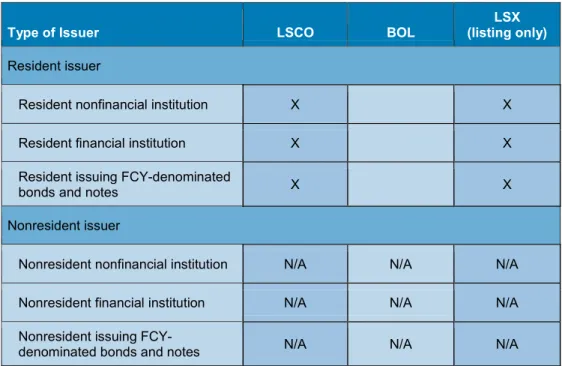
Table 2.2 provides an overview of these regulatory processes by corporate issuer type and identifies which regulatory authority or market institution is involved. To make the issuance processes by issuer type more comparable across ASEAN+3 markets, the table features common issuer type distinctions that are evident in regional markets. Not all markets will distinguish all such issuer types or prescribe approvals. Sovereign issuers are typically exempt from corporate issuance approvals but, at the same time, may be subject to different regulatory processes.
8 An unofficial translation of LSX Regulations are available at http://www.lsx.com.la/rules/regulations/listPosts.do?lang=en
9 Please see Chapter III.E for an explanation of what constitutes a public offer or a private placement in the Lao PDR market.
Table 2.2: Authorities Involved in Regulatory Processes by Issuer Type
Type of Issuer LSCO BOL
LSX (listing only) Resident issuer
Resident nonfinancial institution X X
Resident financial institution X X
Resident issuing FCY-denominated
bonds and notes X X
Nonresident issuer
Nonresident nonfinancial institution N/A N/A N/A
Nonresident financial institution N/A N/A N/A
Nonresident issuing FCY-
denominated bonds and notes N/A N/A N/A
BOL = Bank of the Lao PDR, FCY = foreign currency, LSCO = Lao Securities Commission Office, LSX = Lao Securities Exchange, N/A = not applicable.
Note: X indicates approval is required. Source: ADB consultants for SF1.
Currently, there is no legislation or regulation that supports the need for the BOL to approve the issuance of bonds and notes in foreign currency. However, it is expected in the near future that approval from the Monetary Policy Department of the BOL shall be required for issuing foreign-currency-denominated bonds and notes.
At present, all regulatory processes are geared toward the issuance of bonds and notes via public offers, and these processes do not differentiate between issuer types. However, nonresident issuers are presently not able to participate in the Lao PDR bond market, pending relevant regulations.
2. Overview and Details of Regulatory Processes
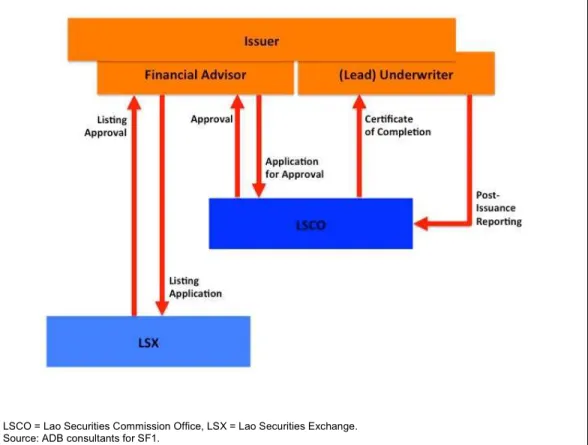
All issuances of corporate bonds require the approval of the LSCO. There is presently no distinction in the regulatory process for the issuance of corporate bonds in Lao kip or in foreign currency. Nonresident issuers are not (yet) able to issue bonds and notes in the Lao PDR, regardless of issuance currency. A listing on the LSX is optional and subject to the approval of the LSX; the related processes are described in Chapter III.I. The regulatory process map shown in Figure 2.1 provides an overview of the
regulatory processes applicable in the Lao PDR.
Figure 2.1: Regulatory Process Map—Bond and Note Issuance in the Lao PDR
LSCO = Lao Securities Commission Office, LSX = Lao Securities Exchange. Source: ADB consultants for SF1.
The individual regulatory processes are explained in subsequent sections. 3. Regulatory Process in Case of a Nonresident Issuer
At present, no legislation or regulation contains provisions for the issuance of debt securities by nonresident (foreign) issuers. As such, nonresident issuers are not yet able to access the Lao PDR bond market.
4. Regulatory Process for Public Offers of Corporate Bonds
The issuance of corporate bonds in the Lao PDR requires the approval of the LSCO. The approval process and the requirements for the application for approval are laid out in the Regulation on Issuance of Corporate Bonds published by the LSCO in
December 2014.
Issuers are required to appoint a Financial Advisor, one or more underwriters (with a designated lead underwriter in the case of two or more providers), and a custodian bank prior to the application for approval from the LSCO since the contracts with these providers and/or their opinions form part of the submission to the LSCO. For a
description of the roles and functions of these intermediaries, please refer to Chapter III.M.
The following steps describe the actions to be undertaken by the relevant parties in the course of the issuance application and approval process for a corporate bond to be offered to the public.
Step 1—Submission of Application for Approval to the Lao Securities Commission Office
A company wishing to issue a corporate bond to the public shall submit its application documents to the LSCO, together with a number of prescribed documents, as follows:
i. an application for issuance of a corporate bond as prescribed by the LSCO;
ii. a copy of the enterprise registration certificate and a copy of a
concession license (in case the issuer operates a concession business); iii. a copy of a taxpayer identity card;
iv. a copy of the issuing company’s bylaws;
v. resolutions of the shareholders’ meeting concerning the approval of a corporate bond issuance;
vi. a list of names of shareholders holding at least 1% of shares;
vii. a confirmation letter on the readiness of a corporate bond issuance from a Financial Advisor and an underwriter;
viii. an asset valuation report certified by an asset valuer;
ix. financial statements for the most recent financial year preceding the submission of application documents;
x. documents relating to principal and interest repayment plan, including an illustration of sources of financing for such repayment;
xi. a prospectus;
xii. an underwriting contract between the issuer and an underwriter; xiii. a contract with a custodian bank to perform monitoring and custodian
functions to protect the interests of corporate bondholders;
xiv. a credit rating report from a credit rating agency (if the issuer is rated BBB or above);
xv. a contract with a guarantor (if an issuer is not rated or the rating is below BBB); and
xvi. other documents as stipulated by the LSCO.
The regulation states that the issuer is required to work together with the Financial Advisor on the compilation of the application documents. At the same time, the other intermediaries are required to contribute to the documents, as indicated in the above list.
For a description of the prospectus requirements and the expected content of the financial statements, please refer to section G (Disclosure Requirements in the Lao PDR Bond Market) in this chapter. If an issuer wishes to apply for issuance after 30 June of a given year, the LSCO requires the submission of a semiannual financial statement reviewed by an audit company.
When an important event occurred after the date of the most recent financial statements submitted to the LSCO, the issuer has to file an additional report of such event with the LSCO in writing and disclose such an event in its
prospectus.
While the issuance documentation and supporting documents for the application to the LSCO have to be in Lao, the issuer may choose to also publish a prospectus in English.
Step 2—Review and Approval of Application by the Lao Securities Commission Office The LSCO will review the application for issuance of a corporate bond and communicate a decision to the issuer within a period of 45 days from the date of receiving complete and accurate application documents. In the event that the application is denied, the LSCO will provide reasons for this decision in writing. During the review, the LSCO has the right to request additional documents and information from the issuer and the audit company and may invite the issuer, the Financial Advisor, and the underwriter or other relevant parties to discuss matters concerning the application and information contained therein. The LSCO may visit the issuer and collect other relevant information, as may be necessary. The parties involved in the issuance are required to give the LSCO full cooperation in these endeavors.
If the application is successful, the LSCO will provide a confirmation letter to the issuer.
The LSCO charges a number of fees for the application review and upon successful completion of the application (please see Chapter VI for details). The issuance of corporate bonds via a public offer is to be carried out within 90 days from the LSCO granting the certificate of authorization and may be extended for no more than 30 days.
Additional steps are to be carried out before the issuance is considered complete and before the underwriter may transfer the proceeds from the issuance to the issuer and before the use of those proceeds by the issuer. (Please refer to section 6 for details.)
5. Regulatory Process for Bonds and Notes Issued via Private Placement
The regulatory process for private placements, as described in Chapter III.B.2 concerning the Regulation on Issuance of Corporate Bonds, closely follows the prescriptions for public offers, including the need for LSCO approval and the submission of a prospectus. (Please refer to section 4 for details.) The distinctions between the two offering methods are limited to the types of investors and their participation in the offer, as well as advertising and marketing procedures.
A company wishing to conduct a private placement of a corporate bond shall satisfy the requirements as prescribed in Article 8 (except Clause 2) of the Regulation on Issuance of Corporate Bonds and shall fulfill additional requirements including having its operation and business established for at least 1 year. As stated in the Law on Securities, it defines the term institutional investor rather than using the term
professional investor. For more details on the definition of institutional investor, please see Chapter III.N.
6. Obligations after Approval and after Issuance
Upon approval from the LSCO, the issuer may proceed with the issuance of corporate bonds to the market, either via a public offer or a private placement. Once the
issuance has taken place, a number of obligations are to be met by the issuer and its service providers, as described below.
7. Issuance of Corporate Bond Certificates
The LSCO stipulates that the (lead) underwriter shall issue the corporate bond certificates to the corporate bond purchasers within 5 business days from the date of completion of the issuance. If a corporate bond is to be listed on the LSX, a
consolidated corporate bond certificate (global certificate) shall be deposited in the LSX depository center within that period.
Securities certificates, whether consolidated or individual, shall include the name of the issuer of a corporate bond; reference number of the enterprise registration certificate of the issuer of a corporate bond; reference number of the corporate bond certificate; registration date of the corporate bond certificate with a securities depository center (if so applicable); type of corporate bond; terms and date of maturity of the corporate bond; returns; face value of the corporate bond certificate; aggregate value of the corporate bond in total; method, place, and time for repayment of the corporate bond’s principal and interest; signature of an authorized person; and seal of the issuer of the corporate bond as well as the rights of the corporate bondholders.
8. Report on the Issuance of Corporate Bonds
After the completion of the auction (see Chapter III.E for details), the issuer— jointly with the (lead) underwriter—needs to report the result of the issuance to the LSCO in writing within 5 business days from the date of completion of the issuance.
One prerequisite for the report to be sent to the LSCO is that the corporate bond certificates have been successfully issued.
Once the issuance of the (global or individual) certificates is complete and the report of the issuer and (lead) underwriter has been sent to the LSCO, the LSCO will confirm the completion of the issuance within 5 business days from the receipt of the report. This “certificate of completion” is a prerequisite before the (lead) underwriter is able to transfer the proceeds from the issuance to a specially designated bank account of the issuer, and before the issuer may be able to use the proceeds in line with the purpose stated in the issuance application.
At the same time, the certificate of completion is also required to complete the final listing application to the LSX in the event a listing of a corporate bond is planned. Chapter III.I contains more details on the listing of debt securities.
9. Issuance Process Specific for a Domestic Financial Institution No fundamental or key legislation or regulation contains specific provisions for the issuance of debt securities by financial institutions. The applicable Regulation on the Issuance of Corporate Bonds does not differentiate between issuer types and their circumstances. As such, there are no specific regulatory requirements for financial institutions as issuers of debt securities.
10. Regulatory Process for Foreign-Currency-Denominated Debt Instruments
Currently, there is no legislation or regulation that supports the need for BOL to approve the issuance of bonds and notes in foreign currency. The issuance of corporate bonds denominated in a foreign currency shall be approved by the LSCO, and follows the regulatory process outlined in section 4.
At the same time, the LSX is able to list debt securities issued in foreign currency on its market.
G. Disclosure Requirements in the Lao PDR Bond Market
The LSCO’s Regulation on Issuance of Corporate Bonds also prescribes the initial and continuous disclosure requirements for issuers of corporate bonds and obligations for their appointed service providers. While the requirements for public offers and private placements are stated in separate chapters of the regulation, the obligations on the issuer and service providers are nearly identical at this point in time.
1. Public Offers
One of the key documents to be submitted at the time of issuance application to the LSCO, and for the general information for investors throughout the life cycle of the corporate bond, is the prospectus. A prospectus for the issuance of a corporate bond to the public shall contain
i. information on a company such as risk factors, incorporation, and business operation history;
ii. information on members of the board of directors, internal audit committee, and executives;
iii. information on a corporate bond such as characteristics, method of offer for sale, quantity, face value, price, projected period of offer for sale, and transfer requirements;
iv. sources of funds for principal and interest repayment;
v. a returns and redemption plan when the corporate bond is due; vi. a plan on the use of proceeds and business operating plan; vii. a list of names of controlling persons;
viii. information on legal inconsistency and related party transactions; ix. name and address of an audit company, a legal advisor, a securities
company (underwriter), and other parties involved in the proposed issuance; and
x. information on the financial status of the issuer, which is audited by the audit company.
Complete financial statements are not a prescribed part of the prospectus but instead are to be submitted separately for the issuance application to the LSCO, and are to be updated regularly during the lifetime of the corporate bond.
Financial statements of the issuer are to include a balance sheet, an income statement, a consolidated cash flow statement, a statement of changes in owners’ equity, an explanation of the applied accounting principles and methods used, and other relevant details. Financial statements are to be audited by an audit company before submission.
If, during the life cycle of a corporate bond, an important event occurs, the issuer has to file a report of such an event with the LSCO in writing.
2. Private Placements
The initial and continuous disclosure requirements for private placements are virtually identical to those imposed on public offers. Private placements are distinguished only by some of the eligibility criteria to be fulfilled by the issuer and the types and
composition of the investors.
Please refer to section 1 for details on the disclosure requirements imposed by the LSCO.
3. Corporate Bonds Listed on the Lao Securities Exchange In its Regulation on Bond Listing, the LSX stipulates a number of numerical and nonnumerical (official definitions under Article 3) disclosure requirements to be fulfilled by the issuer. In addition, the LSX requires the securities company acting as the (lead) underwriter to submit a Due Diligence Report (Article 3 [7]), which contains the
findings, after verifying the information provided by the issuer in its disclosure documents.
Article 7 of the Regulation on Bond Listing stipulates that the bond listing applicant shall disclose company information in the designated timeframe and use an approved method.
Article 29 of the Disclosure Regulation defines the material business details to be reported as follows:
i. In cases when a bond-listed corporation, which has also listed its stock on the LSX, has disclosed a matter specific to its stock, it shall be deemed that such a bond-listed corporation has made a disclosure.
ii. Where any one of the following incidents has occurred, a bond-listed
corporation shall report such fact or details of any related decision made to the LSX on the same day the incidence has occurred:
a. where a bill or cheque issued was dishonored or a transaction with a bank has been suspended or prohibited;
b. where the business operation, in part or whole, has been suspended; c. where a cause for the dissolution of the company has occurred; d. where the decision on a merger with another company, a business
transfer or acquisition, a split-off, or a merger after split-off has been made;
e. where a lawsuit that will have material influence on the listed bonds has been launched; or
f. where the auditor’s opinion in the external certified audit report is qualified, adverse, or contains a disclaimer of opinion.
iii. Where any one of the following incidents has occurred, the bond-listed corporation shall report such facts or details of any related decision made to the LSX by the next day after the occurrence of the cause:
a. where the bond should be redeemed before its maturity;
b. where the notification of calling for a meeting of bondholders has been sent;
c. where the decisions made at the meeting of bondholders have been notified;
d. where the principal of a listed bond has not been redeemed; or
e. where significant events relating to the rights, yields, or handling of a listed bond have occurred.
The disclosure information submitted by listed companies is available as a PDF file— typically in both Lao and English—for download from the LSX website.10 At the same time, due to the limited number of listed companies at present, and a corresponding lack of material events, the information typically disclosed by listed companies relates to the normal governance activities of a listed company, such as shareholders’ meetings, resolutions of such shareholders’ meeting, and reports on its financial performance.
10 Please see the Listed Companies and Disclosure web page on the Lao Securities Exchange website at http://www.lsx.com.la/info/stock/listedCompany.do?lang=en
H. Self-Regulatory Organizations in the Lao PDR Bond Market
The Law on Securities provides for the concept of a Securities Business Association in the Lao PDR capital market, which in concept is similar to a self-regulatory
organization (SRO).
However, at the time of the compilation of this Bond Market Guide, there was no SRO in existence in the Lao PDR capital market.
The LSX is not considered an SRO by the regulatory authorities. Instead, LSX draws the ability to make rules and publish regulations on its members and markets, which are subject to review and approval by the LSCO, directly from the relevant provisions on the securities exchange in the Law on Securities.
For details on the listing, disclosure, and trading rules of LSX and their underlying regulations, please refer to section J in this chapter.
I. Licensing of Market Participants
All bond market participants, including the entities involved in the issuance of
corporate bonds in the Lao PDR other than the issuer and its legal counsel, need to be licensed by the LSCO, pursuant to the Law on Securities and in accordance with the LSCO’s own regulations.
Professional firms, such as accounting and audit firms, need to be accredited with the LSCO to provide services to issuers and bond market institutions.
Details on individual licensing requirements for market participants can be found in Chapter III.M.
J. The Lao Securities Exchange Regulations on Bond Listing,
Disclosure, and Trading
The LSX issues its own rules with regard to listing and disclosure requirements and trading activities as part of its functions as a securities exchange pursuant to the Law on Securities and LSCO regulations. The LSX is, however, not considered an SRO by regulatory authorities.
LSX rules need to be approved by the LSCO before they may be signed and
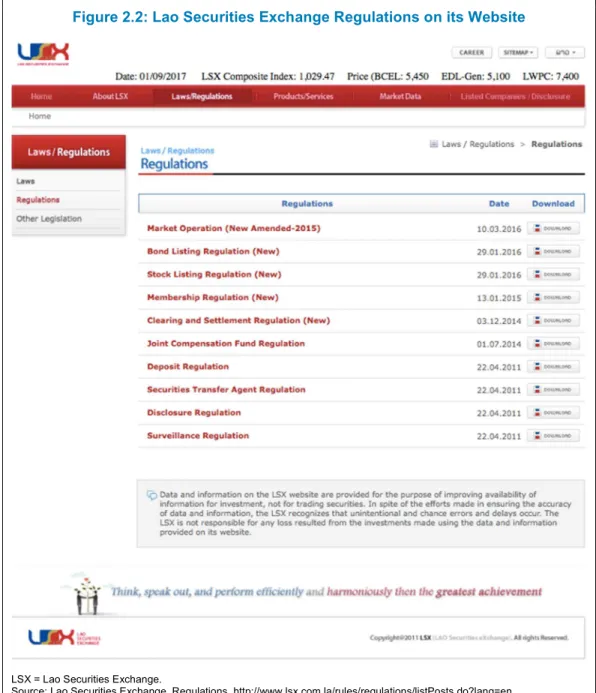
published. The provisions are issued as (and have the characteristics of) regulations. A list of the relevant LSX regulations is shown in Figure 2.2.
Figure 2.2: Lao Securities Exchange Regulations on its Website
LSX = Lao Securities Exchange.
Source: Lao Securities Exchange. Regulations. http://www.lsx.com.la/rules/regulations/listPosts.do?lang=en
Individual LSX regulations are further detailed in the relevant sections of this Bond Market Guide.
a. Listed and Traded (Debt) Securities
The LSX Regulation on Bond Listing stipulates the principles, criteria, and procedures for bond listing on the LSX, including the need for a listing eligibility review, details of bond listing application criteria, and other listing
considerations.
LSX members can trade in government bonds, corporate bonds issued by listed companies, and listed bonds other than those issued by stock-listed companies. Activities on the LSX are subject to its Regulation on Market Operation (as amended from time to time).