Knowledge Awareness Filtering toward Efficient Collaborative Learning
Hiroaki OGATA and Yoneo YANO
Dept. of Information Science and Intelligent Systems, Faculty of Engineering, Tokushima University, 2-1, Minami Josanjima, Tokushima 770 Japan
E-mail: {ogata, yano}@is.tokushima-u.ac.jp URL: http://www-yano.is.tokushima-u.ac.jp/ ABSTRACT
Knowledge awareness (KA) has been proposed for increasing collaboration opportunities in an open ended and collaborative learning environment. To enhance the opportunities of collaboration in this situation, an individual user’s agent called KA-Agent autonomously informs the learner up-to-minute other learners’ activities. For instance, the messages are
“someone is looking at the same knowledge that you are looking at.”, “someone discussed the knowledge which you have inputted”. Those messages are called active KA ,which are very useful to create real-time collaboration within the shared knowledge space. The spontaneous collaboration which is created by these messages, facilitates the refinement and evolution of the learners’ knowledge. Sharlok (sharing, linking and looking-for knowledge) has been developed as a testbed of the KA. We reached the following conclusion by the test use of Sharlok:
(1) In order to stabilize learners’ knowledge, it is very important for learners to discuss with each other;
(2) Active KA is very effective for encouraging collaboration between learners; and (3) KA supports learners to realize real-time collaboration.
However, many messages of active KA are provided at the same time because several learners use some knowledge in a shared knowledge space. Such a big amount of massages are often inadequate to confuse learners and to disturb their learning. The problem is to define how KA-Agent should give a priority to the messages. Therefore, the agent has to have an information filtering facility to inform a learner only the important part of KA. This paper describes filtering awareness so that awareness should not disturb to engage in learning. To reduce information overload, the technologies of information filtering are mainly used in reading E-mail or NetNews. In this paper, we propose KA filtering based on some educational strategies toward efficient collaborative learning. KA-Agent has two strategies based on the following criteria:
(1) whether or not the messages of KA disturb to engages in learning; and (2) whether or not the messages of KA can create effective collaboration.
The first is used for displaying KA according to learner’s action, and the second is used for giving a priority to the messages of KA by the statistical values. Sharlok is extended to realize reducing information overload by KA-Agent. We test and verify the effectiveness of the KA-Agent through its use.
KEYWORD
Computer supported collaborative learning, awareness, agent, information filtering.
1.Introduction
Recently, researchers in educational systems area attempt to provide technological support for cooperative and collaborative learning advocated by educational theories (O’Malley, 1994). For example, collaborative learning is supported by knowledge building tools and collaborative interface tools. We focus on an open ended and collaborative learning environment by integrating those tools. For this situation, CoVis(Edelson, Pea & Gomez, 1996), KIE (Linn, 1996), and CSILE (Scardamalia & Bereiter, 1996) have been proposed. CoVis focus on making a collaboration process visible. KIE succeeds by helping students link, connect, distinguish, compare, and analyze their repertoire of ideas. Moreover, CSILE supports knowledge building for the creation of knowledge. In such environments, the learner actively provides his/her own knowledge into the system.
Knowledge acquisition type and open ended CAI systems have been proposed and it facilitated to enhance and keep learners’ motivation (Yamamoto et al., 1989; Yano et al., 1992). Especially, when learners acquire knowledge in the context of an open-ended activities, they are more likely to use that knowledge later. Similarly, in collaborative learning, distributed expertise and multiple perspectives enable learners to accomplish tasks and develop understandings beyond what any could achieve alone. Therefore, it is very important for learners to collaborate with each other. However, little attention has been given to the technical support for inducing collaboration.
In computer supported cooperative work (CSCW), a collaboration process is lead from four processes (Malone, et al. 1994); co-presence, awareness, communication, and collaboration. Co-presence gives the feeling that the user is in a shared work space with someone at the same time. Awareness is a process where users recognize each other’s activities on the premise of co-presence. In the next process, the user collaborates on the specific task with other users and accomplishes the task and common goals. To increase communication opportunities, awareness is one of the most interesting topics (Matsushita & Okada, 1995). For example, awareness informs; “what are they doing?”, “where are they working?”. To provide such information in a distributed work group, Dourish & Bly (1992) developed Portholes. They argued that awareness was an important process to realize communication.
In computer supported collaborative learning (CSCL), awareness is also essential to create efficient collaboration. Goldman (1992) identified three types of student awareness: social, task, and conceptual and Gutwin et al. (1995) proposed workspace awareness. Social awareness provides information on social relationships within the group to carry out the task, for example, the role in the group. Task awareness shows how the learners accomplish the task. Concept awareness is the awareness of how a particular activity or knowledge fits into the learner’s existing knowledge or completes the task. Workspace awareness is the up-to-the-minute knowledge about other learners’ interactions within shared workspace. Gutwin et al. implemented this awareness using GroupKit (Roseman & Greenberg, 1992). Goldman’s awareness is required in the beginning of a collaboration and workspace awareness is essential in the middle of the collaboration. However, these systems have not yet provided awareness for inducing collaboration in a shared knowledge space.
We have proposed knowledge awareness (KA) to bridge learners who are interested in the same knowledge and to create effective collaboration in an open ended environment (Ogata,
1996). KA gives the learner the information about other learners’ activities in shared knowledge space. Its messages are, for instance, “someone is looking at the same knowledge that you are looking at.”, “someone changed the knowledge which you have inputted.” These messages of KA encourage collaboration by exciting learner’s curiosity and they faster to active learning.
Sharlok (sharing, linking and looking-for knowledge) has been developed as a testbed of the KA. Sharlok is an open-ended and collaborative learning environment, and it integrates a knowledge building tool with a collaborative interface tool. Sharlok allows learners: (1) to share their respective knowledge in its shared knowledge space, to explore it freely, (2) to make hypertext links between relevant knowledge, and (3) to collaborate about the knowledge in an ad hoc group at real time. We reached the following conclusion by the test use of Sharlok:
(1) In order to stabilize learners’ knowledge, it is very important for learners to discuss with each other;
(2) Active KA is very effective for induce collaboration between learners; and (3) KA supports learners to realize real-time collaboration.
In Sharlok, an individual user’s agent called KA-Agent autonomously informs the learner the up-to-minute activities of other learners by comparing the learner’s actions with the other learners’ actions. Those messages are called active KA, and they are very useful to create real-time collaboration. However, many messages of active KA are provided at the same time because several learners use some knowledge in shared knowledge space. Such a big amount of massages are inadequate because of disturbing their learning. In this way, information filtering is an very important technology for engaging in working. Therefore, the agent has to have the information filtering facility to inform a learner only about the most relevant KA messages.
To reduce information overload, the technologies of information filtering are mainly used in reading E-mail or NetNews (Maes, 1996). Malone et al. (1992) have proposed Oval that allows users to sift out information, based on rule-based agent. In the semi-structured approach, each user has to give some adequate rules to his/her agent. On the other hand, Maes has proposed Maxims which is a semi-autonomous interface agent for filtering e-mail. Maxims learns user’s actions and preferences based on memory-based reasoning. In this paper, we propose KA filtering based on some educational strategies toward efficient collaborative learning.
We firsts describe and design KA in sec. 2. Section 3 propose active KA and its intelligent information filtering. Overview of Sharlok and its interface are summarized in sec. 4, and the next section describes how active KA can be implemented in order to support collaborative learning. Moreover, we describe the experimental results of active KA in sec. 6. Finally, the concluding remarks are given in sec. 7.
2.Knowledge Awareness
2.1.What is knowledge awareness ?
We assume that KA is the information for enhancing collaboration opportunities in a shared knowledge space and makes possible to shift from a personal learning environment to a collaborative one. Its messages are about the other learners’ real-time or past-time actions,
that have something to do with knowledge on which a learner is doing or had already done. KA makes a learner be aware of someone: (1) who has the same problem or knowledge as the learner, (2) who has the different view about the problem or knowledge, and (3) who has potential to assist solving the problem. This information does not force the learner to establish any collaboration, based on learner-centered design. While the four awareness (social, task, concept, workspace) is needed after the beginning of the collaboration, KA is required before collaboration. Therefore, the characteristics of KA are (1) collaboration starts based on the motivation of learners; (2) its participants are ad hoc; and (3) its tasks are also unscheduled.
2.2.Monitoring learner’s actions
We divide learners activities into “looking at”, “changing”, and “discussing”. Sharlok monitors and records these three activities. For instance, “changing” includes creating, updating and deleting knowledge or links. By watching these actions, Sharlok informs the learner if someone has updated the knowledge which he/she has offered. This information supports him/her to become aware of someone who has a different aspect from him/her. 2.3.Time and knowledge proximity
We consider two dimensions of messages for KA: time and knowledge separation (see Table 1). KA of type same time (ST) informs the learner that other learners are doing something at the same time that the learner is using the system. By using learners’ past actions, KA of type different time (DT) provides the encounters beyond time. KA of type same knowledge (SK) is a message about other learners’ activities to the same knowledge that the learner is looking at, discussing, or changing. This type is available for learners to find partners who have the same problem or knowledge. KA of type different knowledge (DK) enhances collaboration possibility with another learner (1) who has had something to do with the learner’s interests; or (2) who has different expertise from the learner’s interests.
Table 1: Message types of knowledge awareness.
For example, the message of type STSK, “Who is looking at the knowledge?” shows the existence of learners who are looking at the knowledge that the user is looking at. By this message, the user may start to discuss on the knowledge. Likewise, the message of type DTSK “Who changed the knowledge since I have last looked at?” facilitates to start discussion on the changing of the knowledge. Moreover, the message of type STDK
“What knowledge are they discussing?” is useful to enter the discussion which interests the learner.
2.4.Knowledge awareness and curiosity
KA has a close relation with learner’s curiosity. Hatano & Inagaki (1973) identified curiosity into two types; particular curiosity (PC) and extensive curiosity (EC). EC is occurred by the desire of learning and it makes learner’s stock of knowledge well-balanced by widening learner’s interests. On the other hand, PC is generated for the lack of sufficient knowledge, and it is very useful so that the leaner can acquire detailed knowledge. KA of type SK excites PC, and KA of type DK satisfies EC. For example, the message of type STDK stirs up the learner’s EC for attracting the learner to the particular knowledge by when the learner focuses on nothing. Moreover, the message of type STDK about the knowledge leads the learner to collaboration by arousing the learner’s PC. In this way, KA induces collaboration by exciting learner’s curiosity.
2.5.Passive and active knowledge awareness
There are two types for providing KA: “passive awareness” and “active awareness”. In the passive type, the system does not show awareness information until the learner requests it. In contrast, active awareness is autonomously informed to the learner. Sharlok induces spontaneous collaboration between learners using active awareness. For instance, User A may start to collaborate with User B by active KA which informs that User B has updated the User A’s knowledge. However, it is necessary to inform a learner only the important part of KA instead of all of KA.
3.Filtering Knowledge Awareness
Since learners simultaneously use some knowledge in shared knowledge space, many messages of active KA are provided at the same time. Such messages are often overload for learners. Therefore, a software agent, called KA-Agent, has to filter them to provide only the appropriate message. We propose a method of filtering KA according to learner’s interests and their activities. KA-Agent has two strategies based on the following criteria: (1) whether or not the messages of KA disturb to engages in learning;
(2) whether or not the messages of KA can create effective collaboration.
3.1.Strategy for displaying KA
When a learner engages in learning (e.g., discussion), the messages of active KA may disturb him/her. We identify the way to provide KA into two kinds: direct and indirect (see Table 2). If a learner is looking at or changing knowledge and another learner focuses on the same knowledge, KA-Agent directly shows the learner KA of type SK by using a dialogue. If the learner concentrates on learning and another learner approaches the other knowledge, KA-Agent had better not display KA of type DK directly to bother the learning. Likewise, KA should indirectly be provided when the learner engages in discussion. The learner can see KA after finishing the discussion if he/he wants. Otherwise the learner does nothing (i.e., idle), KA-Agent informs him/her KA directly to recognize which knowledge other learners are interested in.
Table 2: Strategy for providing KA according to learner’s action.
3.2.Strategy for giving a priority to KA
Since KA-Agent does not know which message of KA the learner prefers to create collaboration, it is necessary for KA-Agent to evaluate the effectiveness of the message and to change itself. Then, the problem is to define how KA-Agent should give a priority to the KA messages by referring to each learner’s actions. We propose a simple method to do that in this situation. The method uses the following statistical equation, based on the combination between the learner’s action and another learner’s action.
Table 3 shows an example of the statistic values based on the above equation. For example, the rate is 83 % when the learner is looking at the knowledge and another learner is changing the same knowledge. If the message can create collaboration, the rate of the message will arise. KA-Agent sorts the messages of KA according to these rates and it displays them based on the strategy of Table 2.
Table 3: Success rate of KA in each learner’s actions.
4.Sharlok
Sharlok has an open ended and collaborative learning environment connected via Internet. The characteristics of Sharlok are the following:
(1) Since Sharlok allows learners to share their respective knowledge, they can cover the lack of mutual knowledge each other.
(2) Learners can explore in shared knowledge space according to their interests.
(3) Learners can link between relevant knowledge as a hypertext link. By using this shared knowledge space, they can learn covering the multi-domain.
(4) By creating or joining collaboration on the knowledge during its use, learners can confirm or correct the knowledge. This process supports practical learning.
4.1.Personal learning environment
The personal learning environment of Sharlok has the following functions: (1) the definition of a class;
(2) the creation of an instance object of a class; (3) browsing search for objects;
(4) the authoring of links between heterogeneous objects; and (5) the navigation of objects.
Sharlok enables learners to create and define a new class. Learners can create objects and input their knowledge by using pairs of attributes and values, texts and figures. They can start collaboration by asking question. Sharlok invites learners to the collaboration. If the learner agrees with that, the learner becomes a participant of the collaboration.
4.2.Collaborative learning environment
Sharlok allows learners to communicate and collaborate in a collaboration object which includes a text chat tool, and a group drawing tool. In the text tool, the participants can write their respective idea. Moreover, the drawing tool shows their mouse pointers and it allows them to draw figures at real time. Sharlok records the processes of the collaboration and it makes them retrievable and accessible for all the learners.
5.Implementation of Knowledge Awareness
5.1.Architecture
Based on the architecture in Figure 1, we developed KA. The server has a shared database and a history database of learners’ actions. We developed these databases by using TRIAS (Yamamoto et al., 1989) which allows users to add, delete or change attributes or values at any time during its use. TRIAS represents data with triplets of small grain size elements as (object, attribute, value). It automatically links triplets which have the same element. A client consists of student monitoring, passive KA, KA-Agent and user interface modules. Sharlok monitors the learners’ activities in the shared knowledge space and it stores them into the history database. There are two kinds of KA message in Sharlok: passive and active. Passive KA is displayed through fetching the learners’ history when the learner requests it. In contrast, an active KA is generated by KA generator through checking periodically the history database. KA filtering module filters and displays KA messages by referring the KA strategies. KA monitoring module watches whether or not the learner creates collaboration by the message, and it modifies the KA strategies.
Fig. 1: Architecture of active knowledge awareness. 5.2.Recording learner’s actions
Learners’ history is represented by “Who”, “When”, “What”, and “How” attributes of triplets. “Who” is a learner’s name that is doing or did actions; “What” is the object;
“When” is the time and date of the action; and “How” is the learner’s action. These histories are recorded after operating Sharlok interface. For example, “changing” action is stored by pushing the save button.
5.3. Interface of passive knowledge awareness
Learners can obtain the KA through the two pull-down menus in Fig. 2 (a) and (b). The KA of type DK is given by (a), and the KA type SK is (b). When a learner requests KA by selecting the menu, Sharlok tells him/her the information by querying the history database, as shown in Fig. 2 (e). This window shows the object names, the beginning time of the respective conferences, and its participants. The learner can start or join the collaboration by selecting the collaboration button. In this case, Sharlok displays the result of “What knowledge did they look at?”.
5.4. Interface of active knowledge awareness
Based on the strategies for active KA, KA-Agent autonomously displays the message either in a dialogue (see Fig. 3(d)) or in a icon (see Fig. 3(c)). By pushing icon in Fig. 3 (c), the learner can obtain all of the sorted KA in Fig. 3 (e). The learner can start or join the discussion by selecting the “collaboration” button. For example, a learner will be able to collaborate about “problem on triangles” with “ogata” by the message of Fig. 3 (d). In this way, KA bridges each learner to create collaboration.
5.5.Implementation status
Sharlok is implemented in Tcl 7.4jp and Tk 4.0jp on Sun UNIX Workstations. As of this writing, various versions of this system have been used intermittently by more than seven people in our laboratory over a period of one year. Over 30 copies of the software have distributed to other researchers and developers for demonstration purposes. For further information, our home page (http: www-yano.is.tokushima-u.ac.jp/ research/ sharlok/ sharlok.html) is available.
tsutsum i shao (a)
Problem on triangles
(d)
Problem on triangles
(b)
Japanese K anji L unar calendar
W rite the readings of these K anjis A uthor
E xam ple
A nsw er
Q uestion
(c)
(e)
Fig. 2: Screen of knowledge Awareness in Sharlok. 6. Experimental Results
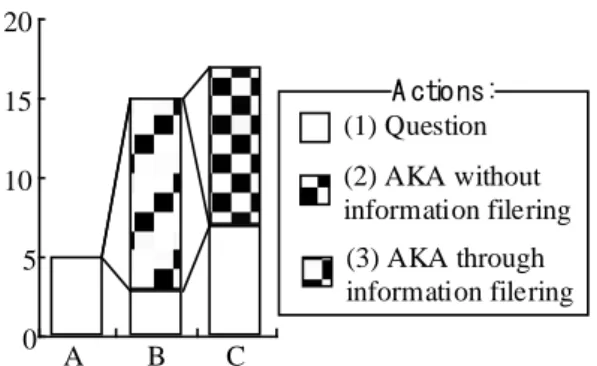
To evaluate the effectiveness of active KA, filtering KA and prioritization of KA, we integrated a group of nine master course students. They had been using Sharlok during more than three hours. We divided the group into the three; the first (group A) is not provided KA, the second (group B) can use passive and active KA without information filtering, the third (group C) is given KA through information filtering. The respective user explored into the shared database and discussed with each other. KA-Agent directly provided first, second, and third ranked messages of KA in dialogues. Most of the learners learned actively through real-time collaboration with each other, and they felt satisfaction and attainment of learning after the test use.
6.1.Active KA
During the use, the learner could start collaboration by question or by active KA. Figure 3 shows the total of requested collaboration in each group. Group B and C that are provide active KA required more collaboration than group A by three times. This histogram tells us clearly that active KA plays a very important role to create collaboration. Moreover, group C requested more collaboration than group B. The reason is that question increased because KA-Agent reduced information overload. As a result, the rate of question and active KA is nearly equal. On the other hand, some of learners reflexively began to collaborate with each other by active KA. Though they had no problem to discuss at the beginning of the collaboration, they found some problems after a while and discussed about the problems.
0 5 10 15 20
A B C
(3) AKA through information filering (2) AKA without information filering (1) Question
A ctions:
Fig. 3: Total of requested collaboration in each group. 6.2.Filtering KA
We propose the requested collaboration rate (RC rate) to evaluate the effectiveness of filtering KA . The rate between the useful messages for creating collaboration and the useless messages is given by the following equation.
The rate of group B is 7 %, and that of group C is 27 %. The maximum of group C’s rate is 33% , because KA-Agent provided three messages. In this way, RC rate rose from 7% to 27% by filtering KA. Therefore, KA-Agent succeeded to induce increase the opportunities of real-time collaboration without bothering learning.
6.3.Giving a priority to KA
We evaluated the effectiveness of giving a priority to the messages of KA. Figure 4 shows the rate of requested collaboration in each rank of KA messages. According to this, it was successful for KA-Agent to sort the messages of KA by using the priority. However, it is necessary for us to consider the following points in the future research, because our method for filtering is simple.
(1) close relevant knowledge from the knowledge that the learner did some actions; (2) common knowledge that other learners often accessed.
Fig. 4: Requested collaboration rate in each ranked KA. 7. CONCLUSION
In this paper, we proposed the new method for filtering KA toward efficient collaborative learning. We reached the following conclusion by the test use of Sharlok:
(1) Active KA is very effective for induce collaboration between learners; and
(2) By KA filtering, KA-Agent realized real-time collaboration without bothering learning. In the future, we will continue to use and evaluate Sharlok and KA-Agent.
ACKNOWLEDGMENT
This research was supported in part by the Grant for Scientific Research (A) No. 07308016 from the Ministry of Education in Japan.
REFERENCES
Dourish, P. & Bly, S. (1992). Portholes: Supporting awareness in a distributed work group, Proc. of CHI ‘92, 541-548.
Edelson, D., Pea, R., & Gomez, L. (1996). The collaboratory notebook, Comm. of ACM, Vol. 39, No. 4, 32-33.
Glenn, P., Koschmann, T. & Conlee, M (1995). Theory sequence of a problem-based learning group: A case study, Proc. of CSCL ‘95.
Goldman, S. V. (1992). Computer resources for supporting student conversations about science concepts, SIGCUE Outlook, Vol. 21, No. 3, 4-7.
Gutwin, C., Stark, G., & Greenberg, S. (1995). Support for workspace awareness in educational groupware, Proc. CSCL ‘95 http: //www.cpsc.ucalgary.ca/ projects/ grouplab/ home.html.
Hatano, G. & Inagaki, K. (1973). Intellectual curiousity, Chuo Koronsya, (in Japanese). Linn, M. (1996). Key to the information highway, Comm. of ACM, Vol. 39, No. 4, 34-35. Maes, P. (1994) Agents that reduce work and information overload, Comm. of ACM, Vol. 37,
31-40.
Malone, T., Lai, K. & Fry, C. (1992). Experiments with Oval: A radically tailorable tool for cooperative work, Proc. of CSCW ‘92, 289-297.
Malone, T. et al. (1994). The interdisciplinary study of coordination, ACM Computing Surveys, Vol. 26, No. 1.
Matsushita, Y. & Okada, K. Ed. (1995). Collaboration and communication, Distributed collaborative media series 3, Kyoritsu Press (in Japanese).
Ogata, H., Matsuura, K. & Yano, Y. (1996). Knowledge awareness: Bridging between shared knowledge space and collaboration in Sharlok, Proc. of Educational Telecommunications ‘96, 232-237, Boston, MA, USA
Ogata, H., Matsuura, K. & Yano, Y. (1996). Sharlok: Bridging learners through active knowledge awareness, Proc. of IEEE SMC ‘96, Vol.1, 601 - 601, Beijin, China.
O’Malley, C. (1994). Computer supported collaborative learning, NATO ASI Series, F: Computer & Systems Sciences, Vol. 128.
Roseman, M. & Greenberg, S. (1992). GroupKit: A groupware toolkit for building real-time conferencing applications, Proc. of CSCW ‘92, 43-50.
Scardamalia, M., & Bereiter, C. (1996). Student communications for the advancement of knowledge, Comm. of ACM, Vol. 39, No. 4, 36-37.
Yamamoto, Y. et al. (1989). A tool for construction of personal database : TRIAS, Trans. Information Processing Society of Japan,, Vol.30, No. 6, 733-742 (in Japanese).
Yamamoto, Y. & Kashihara, A. (1989). A modeling of knowledge stability in open structured CAI, Trans. of Institute of Electronics, Information and Communication Engineers, D-II,Vol. J72-D-II, No. 9, 1459-1471 (in Japanese).
Yano, Y., Kahishara, A. & McMichael, W. (1992). Stabilizing student knowledge in open structured CAI, Int. J. Man-Machine Studies, 37, 595-612.