Hiroshi Noji
)octor of Philosophy
)epartment of Informatics
School of 2ultidisciplinary Sciences
SO0EN)AI (The Graduate University for
Advanced Studies)
A dissertation
submitted in partial fulfillment of the requirements for the degree of
Doctor of Philosophy in
Informatics of SOKENDAI
Graduate University for Advanced Studies
Hiroshi Noji 2016
ii
Explaining the syntactic variation and universals including the constraints on that variation across languages in the world is essential both from a theoretical and practical point of view. It is in fact one of the main goals in linguistics. In computational linguistics, these kinds of syntactic regularities and constraints could be utilized as prior knowledge about grammars, which would be valuable for improving the performance of various syntax-oriented systems such as parsers or grammar induction systems. This thesis is about such syntactic universals.
The primary goal in this thesis is to identify better syntactic constraint or bias, that is language independent but also efficiently exploitable during sentence processing. We focus on a particular syntactic construction called center-embedding, which is well studied in psycholinguistics and noted to cause particular difficulty for comprehension. Since people use language as a tool for communi- cation, one expects such complex constructions to be avoided for communication efficiency. From a computational perspective, center-embedding is closely relevant to a left-corner parsing algorithm, which can capture the degree of center-embedding of a parse tree being constructed. This con- nection suggests left-corner methods can be a tool to exploit the universal syntactic constraint that people avoid generating center-embedded structures. We explore such utilities of center-embedding as well as left-corner methods extensively through several theoretical and empirical examinations.
We base our analysis on dependency syntax. This is because our focus in this thesis is the language universality. Now the number of available dependency treebanks are growing rapidly compared to the treebanks of phrase-structure grammars thanks to the recent standardization efforts of dependency treebanks across languages, such as the Universal Dependencies project. We use these resources, consisting of more than 20 treebanks, which enable us to examine the universality of particular language phenomena, as we pursue in this thesis.
First, we quantitatively examine the universality of center-embedding avoidance using a collec- tion of dependency treebanks. Previous studies on center-embedding in psycholinguistics have been limited to behavioral studies focusing on particular languages or sentences. Our study contrasts with these previous studies, and provides the first quantitative results on center-embedding avoidance. Along with these experiments, we provide a parser that can capture the degree of center-embedding of a dependency tree being built, by extending a left-corner parsing algorithm for dependency gram- mars. The main empirical finding in this study is that center-embedding is in fact a rare phenomenon across languages. This result also suggests a left-corner parser could be utilized as a tool exploiting the universal syntactic constraints in languages.
We then explore such utility of a left-corner parser in the application of unsupervised gram- mar induction. In this task, the input to the algorithm is a collection of sentences, from which the
iii
the left-corner parsing algorithm for efficiently tabulating the search space except those involving center-embedding up to a specific degree. Again, we examine the effectiveness of our approach on many treebanks, and demonstrate that often our constraint leads to better parsing performance. We thus conclude that left-corner methods are particularly useful for syntax-oriented systems, as it can exploit efficiently the inherent universal constraints in languages.
iv
I could not have finished writing this thesis without the support of many people.
I am greatly indebted to my advisor, Professor Yusuke Miyao for his continuous help and sup- port throughout my PhD. He was always giving me many constructive and encouraging suggestions when I had trouble in writing a paper, preparing presentation slides, interpreting experimental re- sults, and so on, which cannot be listed in this space. He is arguably the best advisor I have met so far, and also is an excellent research role model for me.
I would like to thank my thesis committee, Professor Hiroshi Nakagawa, Professor Edson Miyamoto, Professor Makoto Kanazawa, and Professor Daichi Mochihashi. They all have different backgrounds, and gave me very valuable and insightful comments from their own perspectives. Pro- fessor Daichi Mochihashi guided me in my masters into the research field of unsupervised learning, which was my starting point of this work focusing on unsupervised grammar induction.
My first advisor in my masters in University of Tokyo, Professor Kumiko Tanaka-Ishii, intro- duced me to the research filed of computational linguistics. Though I could not interact with her in the last three years in my PhD, her advices to me had great impacts on my thinking on research. The fundamental idea behind this thesis, exploring the universal property of language from a computa- tional perspective, was arguably the one inspired by her philosophy on computational linguistics.
I am grateful to Mark Johnson for hosting me in total three times (!) as a visitor in Macquarie University. Regular meetings with him were always exciting, and have sharpen my thinking on the tasks of unsupervised learning. It was really my fortunate to have collaboration with a great researcher as you during my PhD.
As a member in Miyao lab, I had opportunities to interact with many great researchers in NII. Special thanks to Takuya Matsuzaki, who was always welcoming informal discussion in his room, and I remember that the core research idea on this thesis, left-corner parsing, has been came up with during a conversation with him. Pascual Martínez-Gómez, Yuka Tateishi, and Sumire Uematsu always gave me many constructive comments especially in my practices on presentations. I am grateful to Bevan Johns, who proofread a part of my first draft of this thesis, and to Pontus Stenetorp, who carefully read and gave comments on my draft of the COLING paper.
I am also grateful to my lab mates, especially Han Dan and Sho Hoshino, as well as intern students to NII: Ying Xu, who always cheered me up, encouraged me to come to the lab early in every morning, and also helped me a lot in Beijing during ACL conference; and Le Quang Thang, whom I really enjoyed mentoring in our supervised parsing works.
During my research life in NII, the secretaries in Miyao lab, Keiko Kigoshi and Yuki Amano, not only greatly help in many office works, but also are a few connection to the outside of the
v
you, with which I was able to stay sane without a lot of stress in my first long-term stay abroad. I am also indebted to John Pate, who helps me a lot at the beginning of my study on unsupervised grammar induction.
Finally, I would like to thank my parents, my sister, and my brother. Thank you for your infinite supports through my life, and thank you for making me who I am.
vi
Abstract iii
Acknowledgments v
1 Introduction 1
1.1 Tasks and Motivations . . . 3
1.1.1 Examining language universality of center-embedding avoidance . . . 3
1.1.2 Unsupervised grammar induction . . . 3
1.2 What this thesis is not about . . . 5
1.3 Contributions . . . 5
1.4 Organization of the thesis . . . 6
2 Background 7 2.1 Syntax Representation . . . 7
2.1.1 Context-free grammars . . . 7
2.1.2 Constituency . . . 9
2.1.3 Dependency grammars . . . 9
2.1.4 CFGs for dependency grammars and spurious ambiguity . . . 10
2.1.5 Projectivity . . . 11
2.2 Left-corner Parsing . . . 13
2.2.1 Center-embedding . . . 13
2.2.2 Left-corner parsing strategy . . . 16
2.2.3 Push-down automata . . . 17
2.2.4 Properties of the left-corner PDA . . . 19
2.2.5 Another variant . . . 21
2.2.6 Psycholinguistic motivation and limitation . . . 24
2.3 Learning Dependency Grammars . . . 28
2.3.1 Probabilistic context-free grammars . . . 28
2.3.2 CKY Algorithm . . . 29
2.3.3 Learning parameters with EM algorithm . . . 30
2.3.4 When the algorithms work? . . . 33
2.3.5 Split bilexical grammars . . . 34
2.3.6 Dependency model with valence . . . 39 vii
2.4.2 Constituent structure induction . . . 42
2.4.3 Dependency grammar induction . . . 43
2.4.4 Other approaches . . . 46
2.4.5 Summary . . . 47
3 Multilingual Dependency Corpora 49 3.1 Heads in Dependency Grammars . . . 50
3.2 CoNLL Shared Tasks Dataset . . . 52
3.3 Universal Dependencies . . . 54
3.4 Google Universal Treebanks . . . 55
4 Left-corner Transition-based Dependency Parsing 56 4.1 Notations . . . 58
4.2 Stack Depth of Existing Transition Systems . . . 59
4.2.1 Arc-standard . . . 59
4.2.2 Arc-eager . . . 60
4.2.3 Other systems . . . 61
4.3 Left-corner Dependency Parsing . . . 62
4.3.1 Dummy node . . . 62
4.3.2 Transition system . . . 62
4.3.3 Oracle and spurious ambiguity . . . 66
4.3.4 Stack depth of the transition system . . . 69
4.4 Empirical Stack Depth Analysis . . . 70
4.4.1 Settings . . . 71
4.4.2 Stack depth for general sentences . . . 71
4.4.3 Comparing with randomized sentences . . . 72
4.4.4 Token-level and sentence-level coverage results . . . 72
4.4.5 Results on UD . . . 76
4.4.6 Relaxing the definition of center-embedding . . . 76
4.5 Parsing Experiment . . . 78
4.5.1 Feature . . . 80
4.5.2 Settings . . . 81
4.5.3 Results on the English Development Set . . . 82
4.5.4 Result on CoNLL dataset . . . 84
4.5.5 Result on UD . . . 87
4.6 Discussion and Related Work . . . 91
viii
5.1.2 Learning Structure-Constrained Models . . . 95
5.2 Simulating split-bilexical grammars with a left-corner strategy . . . 96
5.2.1 Handling of dummy nodes . . . 97
5.2.2 Head-outward and head-inward . . . 97
5.2.3 Algorithm . . . 98
5.2.4 Spurious ambiguity and stack depth . . . 103
5.2.5 Relaxing the definition of center-embedding . . . 103
5.3 Experimental Setup . . . 104
5.3.1 Datasets . . . 104
5.3.2 Baseline model . . . 105
5.3.3 Evaluation . . . 106
5.3.4 Parameter-based Constraints . . . 107
5.3.5 Structural Constraints . . . 109
5.3.6 Other Settings . . . 110
5.4 Empirical Analysis . . . 110
5.4.1 Universal Dependencies . . . 110
5.4.2 Qualitative analysis . . . 113
5.4.3 Google Universal Dependency Treebanks . . . 119
5.5 Discussion . . . 120
5.6 Conclusion . . . 121
6 Conclusions 122
A Analysis of Left-corner PDA 124
B Part-of-speech tagset in Universal Dependencies 128
ix
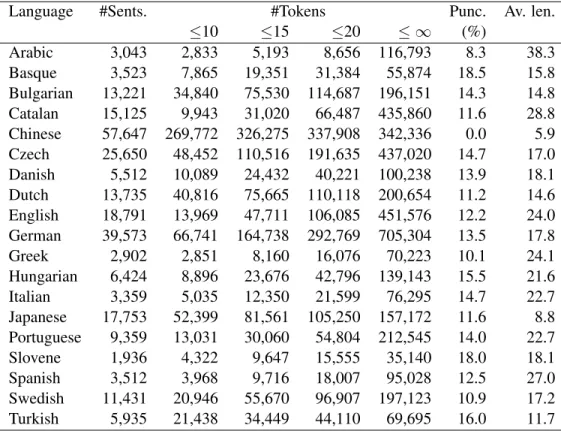
3.1 Overview of CoNLL dataset (mix of training and test sets). Punc. is the ratio of punctuation tokens in a whole corpus. Av. len. is the average length of a sentence. . 53 3.2 Overview of UD dataset (mix of train/dev/test sets). Punc. is the ratio of punctuation
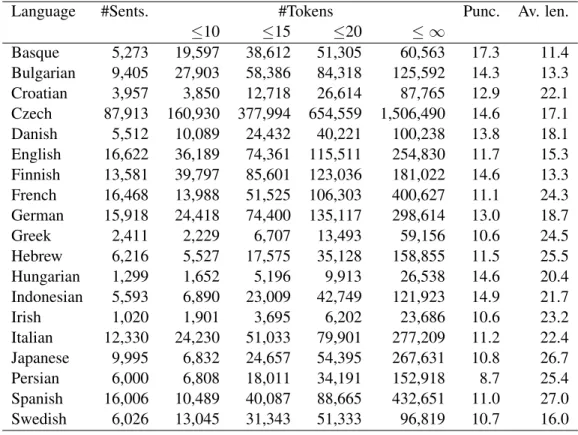
tokens in a whole corpus. Av. len. is the average length of a sentence. . . 55 4.1 Order of required stack depth for each structure for each transition system. O(1 ∼
n) means that it recognizes a subset of structures within a constant stack depth but demands linear stack depth for the other structures. . . 61 4.2 Token-level and sentence-level coverage results of left-corner oracles with depthre.
Here, the right-hand numbers in each column are calculated from corpora that ex- clude all punctuation, e.g., 92% of tokens in Arabic are covered within a stack depth
≤ 3, while the number increases to 94.1 when punctuation is removed. Further, 57.6% of sentences (61.6% without punctuation) can be parsed within a maximum depthre of three, i.e., the maximum degree of center-embedding is at most two in 57.6% of sentences. Av. len. indicates the average number of words in a sentence. . 75 4.3 Feature templates used in both full and restricted feature sets, with t representing
POS tag and w indicating the word form, e.g., s0.l.t refers to the POS tag of the leftmost child of s0. ◦ means concatenation. . . 81 4.4 Additional feature templates only used in the full feature model. . . 81 4.5 Parsing results on CoNLL X and 2007 test sets with no stack depth bound (unlabeled
attachment scores). . . 86 5.1 Statistics on UD15 (after stripping off punctuations). Av. len. is the average length.
Test ratio is the token ratio of the test set. . . 105 5.2 Statistics on Google trebanks (maximum length = 10). . . 106 5.3 Accuracy comparison on UD15 for selected configurations including harmonic ini-
tialization (Harmonic). Unif. is a baseline model without structural constraints. C is the allowed constituent length when the maximum stack depth is one. βlen is strength of the length bias. . . 112 5.4 Accuracy comparison on UD15 for selected configurations with the hard constraints
on possible root POS tags. . . 113 5.5 Ratio of function words in the training corpora of UD (sentences of length 15 or less).119
x
Grave15 = also relies on the syntactic rules but is trained discriminatively (Grave and Elhadad, 2015). . . 120
xi
2.1 A set of rules in a CFG in which N = {S, NP, VP, VBD, DT, NN}, Σ = {Mary,
met, the, senator }, and S = S (the start symbol). . . 8
2.2 A parse tree with the CFG in Figure 2.1. . . 8
2.3 Example of labelled projective dependency tree. . . 9
2.4 Example of unlabelled projective dependency tree. . . 9
2.5 A set of template rules for converting dependency grammars into CFGs. a and b are lexical tokens (words) in the input sentence. X[a] is a nonterminal symbol indicating the head of the corresponding span is a. . . . 10
2.6 A CFG parse that corresponds to the dependency tree in Figure 2.4. . . 11
2.7 Another CFG parse that corresponds to the dependency tree in Figure 2.4. . . 11
2.8 Example of non-projective dependency tree. . . 12
2.9 The result of pseudo projectivization to the tree in Figure 2.8. . . 12
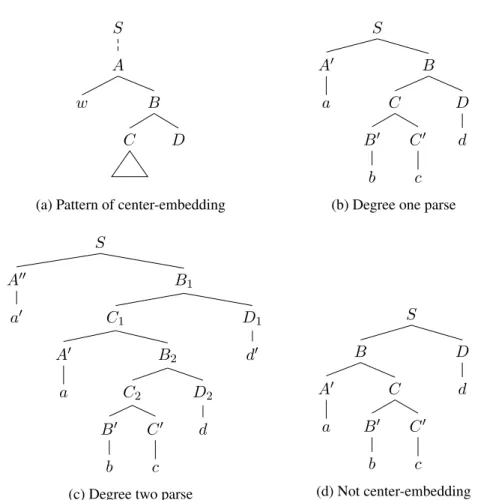
2.10 A parse involves center-embedding if the pattern in (a) is found in it. (b) and (c) are the minimal patterns with degree one and two respectively. (d) is the symmetry of (b) but we regard this as not center-embedding. . . 15
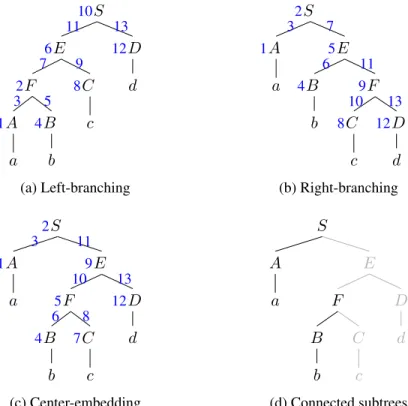
2.11 (a)–(c) Three kinds of branching structures with numbers on symbols and arcs show- ing the order of recognition with a left-corner strategy. (d) a partial parse of (c) us- ing a left-corner strategy just after reading symbol b, with gray edges and symbols showing elements not yet recognized; The number of connected subtrees here is 2. 16 2.12 The set of transitions in a push-down automaton that parses a CFG (N, Σ, P, S) with the left-corner strategy. a ∈ Σ; A, B, C, D ∈ N. The initial stack symbol qinit is the start symbol of the CFG S, while the final stack symbol qf inal is an empty stack symbol ε. . . 18
2.13 Graphical representations of inferences rules of PREDICTION and COMPOSITION defined in Figure 2.12. An underlined symbol indicates that the symbol is predicted top-down. . . 18
2.14 An example of parsing process by the left-corner PDA to recover the parse in Figure 2.10(b) given an input sentence a b c d. It is step 4 that occurs stack depth two after a reduce transition. . . 19
2.15 A CFG that is parsed with the process in Figure 2.14. . . 19
2.16 A set of transitions in another variant of the left-corner PDA appeared in Resnik (1992). a ∈ Σ; A, B, C, D ∈ N. Differently from the PDA in Figiure 2.12, the initial stack symbol qinitis S while qf inalis an empty stack symbol ε. . . 21
xii
dominates a larger subtree. . . 21 2.18 Parsing process of the PDA in Figure 2.16 to recover the parse in Figure 2.10(b)
given the CFG in Figure 2.15 and an input sentence a b c d. The stack depth keeps one in every step after a shift transition. . . 22 2.19 Parsing process of the PDA in Figure 2.16 to recover the parse in Figure 2.10(d).
The stack depth after a shift transition increases at step 3. . . 23 2.20 The parse of the sentence (2a). . . 25 2.21 The parse of the sentence (5). . . 26 2.22 Inference rules of the CKY algorithm. TERMINALrules correspond to the terminal
expansion in line 8 of the Algorithm 1; BINARYrules correspond to the one in line 10. Each rule specifies how an analysis of a larger span (below —) is derived from the analyses of smaller spans (above —) provided that the input and grammar satisfy the side conditions in the right of —. . . 31 2.23 Example of a projective dependency tree generated by a SBG. $ is always placed at
the end of a sentence, which has only one dependent in the left direction. . . 34 2.24 Binary inference rules in the naive CFG conversion. F means the state is a final
state in that direction. Both left and right consequent items (below —) have the same item but from different derivations, suggesting 1) the weighted grammar is not a PCFG; and 2) there is the spurious ambiguity. . . 36 2.25 An algorithm for parsing SBGs in O(n3) given a length n sentence. The n + 1-th
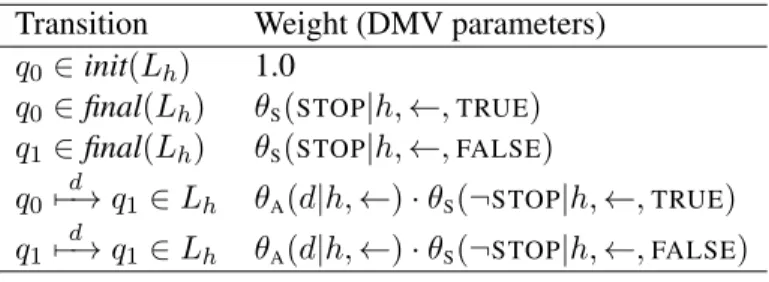
token is a dummy root token $, which only has one left dependent (sentence root). i, j, h, and h′are index of a token in the given sentence while q, r, and F are states. Lh and Rh are left and right FSA of the h-th token in the sentence. Each item as well as a statement about a state (e.g., r ∈ final(Lp)) has a weight and the weight of a consequent item (below —) is obtained by the product of the weights of its antecedent items (above —). . . 37 2.26 Mappings between FSA transitions of SBGs and the weights to achieve DMV. θs
and θaare parameters of DMV described in the body. The right cases (e.g., q0 ∈
init(Ra)) are omitted but defined similary. h and d are both word types, not indexes in a sentence (contrary to Figure 2.25). . . 39 2.27 An example of bootstrapping process for assigning category candidates in CCG
induction borrowed from Bisk and Hockenmaier (2013). DT, NNS, VBD, and RB
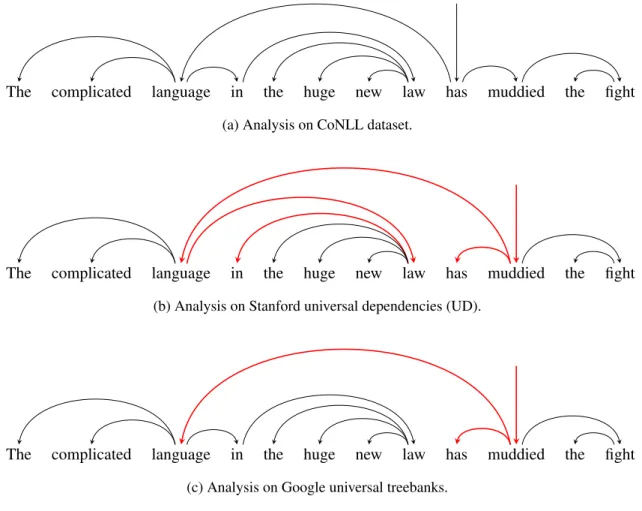
are POS tags. Bold categories are the initial seed knowledge, which is expanded by allowing the neighbor token to be a modifier. . . 47 3.1 Each dataset that we use employs the different kind of annotation style. Bold arcs
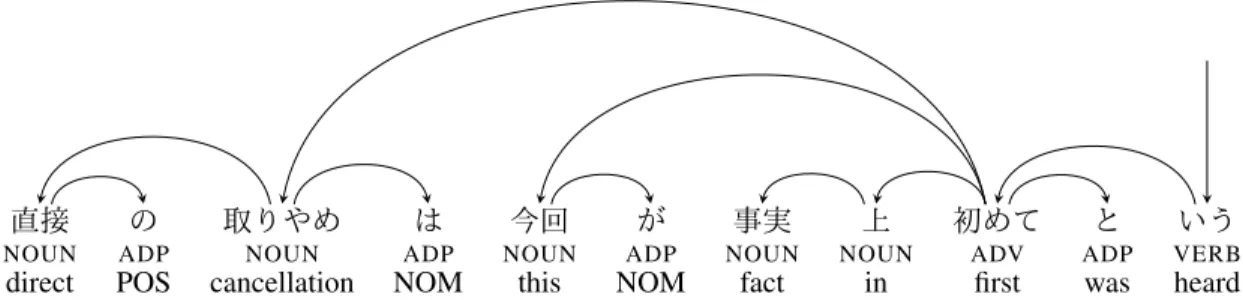
are ones that do not exist in the CoNLL style tree (a). . . 50 3.2 A dependency tree in the Japanese UD. NOUN,ADV,VERB, andADPare assigned
POS tags. . . 51 3.3 Four styles of annotation for coordination. . . 51
xiii
CFG parse. . . 60 4.3 Example configuration of a left-corner transition system. . . 63 4.4 Actions of the left-corner transition system including two shift operations (top) and
reduce operations (bottom). . . 63 4.5 Correspondences of reduce actions between dependency and CFG. We only show
minimal example subtrees for simplicity. However, a can have an arbitrary number of children, so can b or x, provided x is on a right spine and has no right children. . 64 4.6 An example parsing process of the left-corner transition system. . . 65 4.7 Implicit binarization process of the oracle described in the body. . . 68 4.8 Center-embedded dependency trees and zig-zag patterns observed in the implicit
CFG parses: (a)–(b) depth one, (c)–(d) depth two, (e) CFG parse for (a) and (b), and (f) CFG parse for (c) and (d). . . 70 4.9 Crosslinguistic comparison of the cumulative frequencies of stack depth during or-
acle transitions. . . 73 4.10 Stack depth results in corpora with punctuation removed; the dashed lines show
results on randomly reordered sentences. . . 74 4.11 Stack depth results in UD. . . 77 4.12 Following Definition 2.2, this tree is recognized as singly center-embedded while
is not center-embedded if “the senator” is replaced by one word. Bold arcs are the cause of center-embedding (zig-zag pattern). . . 78 4.13 Stack depth results in UD with a left-corner system (depthre) when the definition
of center-embedding is relaxed. The parenthesized numbers indicate the size of allowed constituents at the bottom of embedding. For example (2) next to 2 indicates we allow depth = 3 if the size of subtree on the top of the stack is 1 or 2. Len. is the maximum sentence length. . . 79 4.14 (Left) Elementary features extracted from an incomplete and complete node, and
(Right) how feature extraction is changed depending on whether the next step is shift or reduce. . . 80 4.15 Accuracy vs. stack depth bound at decoding for several beam sizes (b). . . 83 4.16 Accuracy vs. beam size for each system on the English Penn Treebank develop-
ment set. Left-corner (full) is the model with the full feature set, while Left-corner (limited) is the model with the limited feature set. . . 84 4.17 Accuracy vs. stack depth bound in CoNLL dataset. . . 85 4.18 (a)-(b) Example of a parse error by the left-corner parser that may be saved with
external syntactic knowledge (limited features and beam size 8). (c) Two corre- sponding configuration paths: the left path leads to (a) and the right path leads to (b). . . 88 4.19 Accuracy vs. stack depth bound in UD. . . 89 4.20 Accuracy vs. stack depth bound with left-corner parsers on UD with different max-
imum length of test sentences. . . 90
xiv
filled with an actual token, which leads to an exponential complexity. We instead abstract trees in a different way as depicted in (c) by not abstracting the predicted node p but filling with the actual word (p points to some index in a sentence such that j < p ≤ n). If i = 1, j = 3, this representation abstracts both tree forms of (a) and (b) with some fixed x (corresponding to p). . . 98 5.2 An algorithm for parsing SBGs with a left-corner strategy in O(n4) given a sentence
of length n, except the composition rules which are summarized in Figure 5.3. The n+1-th token is a dummy root token $, which only has one left dependent (sentence root). i, j, h, p are indices of tokens. The index of a head which is still collecting its dependents is decorated with a state (e.g., q). Lhand Rhare left and right FSAs of SBGs given a head index h, respectively; we reverse the proces of Lh to start
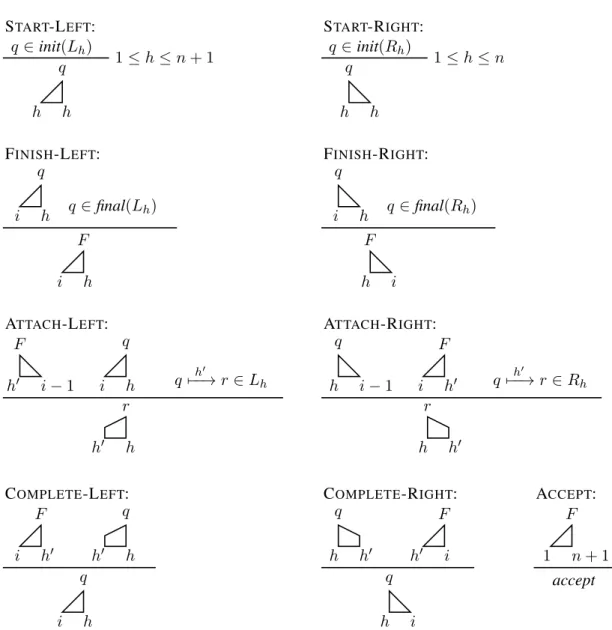
with q ∈ final(Lh) and finish with q ∈ init(Lh) (see the body). Each item is also decorated with depth d that corresponds to the stack depth incurred when building the corresponding tree with left-corner parsing. Since an item with larger depth is only required for composition rules, the depth is unchanged with the rules above, except SHIFT-*, which corresponds to SHIFTtransition and can be instantiated with arbitrary depth. Note that ACCEPTis only applicable for an item with depth 1, which guarantees that the successful parsing process remains a single tree on the stack. Each item as well as a statement about a state (e.g., r ∈ final(Lp)) has a weight and the weight of a consequence item is obtained by the product of the weights of its antecedent items. . . 99 5.3 The composition rules that are not listed in Figure 5.2. LEFTCOMPis devided into
two cases, LEFTCOMP-L-* and LEFTCOMP-R-* depending on the position of the dummy (predicted) node on the left antecedent item (corresponding to the second top element on the stack). They are further divided into two processes, 1 and 2 for achieving head-splitting. b is an additional annotation on an intermediate item for correct depth computation in LEFTCOMP. . . 100 5.4 We decompose the LEFTCOMP action defined for the transition system into two
phases, LEFTCOMP-L-1 and LEFTCOMP-L-2, each of which collects only left or right half constituent of a subtree on the top of the stack. A number above each stack element is the stack depth decorated on the corresponding chart item. . . 101 5.5 Attachment accuracies on UD15 with the function word constraint and structural
constrains. The numbers in parentheses are the maximum length of a constituent allowed to be embedded. For example (3) means a part of center-embedding of depth two, in which the length of embedded constituent ≤ 3, is allowed. . . 111 5.6 Comparison of output parses of several models on a sentence in English UD. The
outputs of C = 2 and C = 3 do not change with the root POS constraint, while the output of βlen = 0.1 changes to the same one of the uniform model with the root POS constraint. Colored arcs indicate the wrong predictions. Note surface forms are not observed by the models (only POS tags are). . . 115
xv
errors by C = 3 are at local attachments (first-order). For example it consistently recognizes a noun is a head of a verb, and a noun is a sentence root. Note an error on “power → purposes” is an example of PP attachment errors, which may not be solved under the current problem setting receiving only a POS tag sequence. . . . 116 A.1 Three types of realizations of Eq. A.1. Dashed edges may consist of more than one
edge (see Figure A.2 for example) while dotted edges may not exist (or consist of more than one edge). (a) E is a right child of Cme and thus the degree of center- embedding is me. (b) E is a left child of Bme (i.e., Cme = E) and the degree is me − 1; when m = 1, C1 = E and thus no center-embedding occurs. (c) Bme = Cme = E; note this happens only when me = 1 (see body). . . 125 A.2 (a) Example of realization of a path between A and B1 in Figure A.1. (b) The one
between B1and C1. . . 126
xvi
Introduction
Explaining the syntactic variation and universals including the constraints on that variation across languages in the world is essential both from a theoretical and practical point of view. It is in fact one of the main goals in linguistics (Greenberg, 1963; Dryer, 1992; Evans and Levinson, 2009). In computational linguistics, these kinds of syntactic regularities and constraints could be utilized as prior knowledge about grammars, which would be valuable for improving the performance of vari- ous syntax-oriented systems such as parsers or grammar induction systems, e..g, by being encoded as features in a system (Collins, 1999; McDonald et al., 2005). This thesis is about such syntactic universals.
Our goal in this thesis is to identify a good syntactic constraint that fits well to the natural language sentences and thus could be exploited to improve the performance of syntax-oriented systems such as parsers. For this end, we pick up a well known linguistic phenomenon that might be universal across languages, empirically examine its language universality across diverse languages using cross-linguistic datasets, and present computational experiments to demonstrate its utility in a real application. Along with this, we also define several computational algorithms that efficiently exploit the constraint during sentence processing. For an application, we show that our constraint will help in the task of unsupervised syntactic parsing, or grammar induction where the goal is to find salient syntactic patterns without explicit supervision about grammars.
In linguistics, one pervasive hypothesis about the origin of such syntactic constraints is that they come from the limitations on the human cognitive mechanism and pressures associated with language acquisition and use (Jaeger and Tily, 2011; Fedzechkina et al., 2012). In other words, since the language is a tool for communication, it is natural to assume that its shape has been formed to increase the daily communication efficiency or the learnability for language learners. The underlying commonalities in diverse languages are then understood as the outcome of such pressures that every language user might naturally suffer from. Our focused constraint in this thesis also has its origin in the restriction of the human ability of comprehension observed in several psycholinguistic experiments, which we introduce next.
Center-embedding It is well known in the psycholinguistic literature that a nested, or center- embedded structure is particularly difficult for compherension:
1
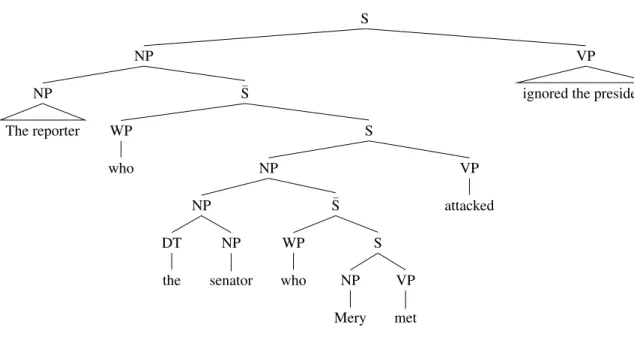
(1) # The reporter [who the senator [who Mary met attacked] ignored] the president.
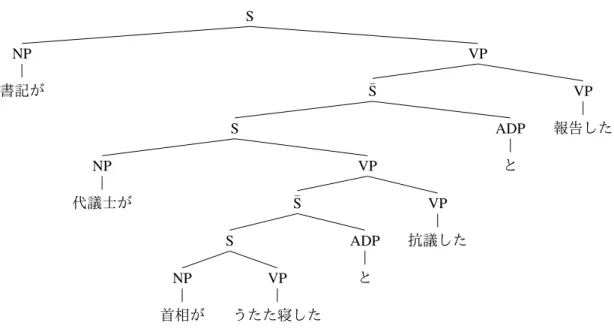
This sentence is called center-embedding by its syntactic construction indicated with brackets. This observation will be the starting point of the current study. The difficulty of center-embedded struc- tures has been testified across a number of languages including English (Gibson, 2000; Chen et al., 2005) and Japanese (Nakatani and Gibson, 2010). Compared to these behavioral studies, the current study aims to characterize the phenomenon of center-embedding from computational and quantitative perspectives. For instance, one significance of the current study is to show that center- embedding is in fact a rarely observed syntactic phenomenon across a variety of languages. We verify this fact using syntactically annotated corpora, i.e., treebanks of more than 20 languages. Left-corner Another important concept in this thesis is left-corner parsing. A left-corner parser parses an input sentence on a stack; the distinguished property of it is that its stack depth increases only when generating, or accepting center-embedded structures. These formal properties of left- corner parsers were studied more than 20 years ago (Abney and Johnson, 1991; Resnik, 1992) although until now there exists little study concerning its empirical behaviors as well as its potential for a device to exploit syntactic regularities of languages as we investigate in this thesis. One previous attempt for utilizing a left-corner parser in a practical application is Johnson’s linear-time tabular parsing by approximating the state space of a parser by a finite state machine. However, this trial was not successful (Johnson, 1998a).1
Dependency Our empirical examinations listed above will be based on the syntactic represen- tation called dependency structures. In computational linguistics, constituent structures have long played a central role as a representation of natural language syntax (Stolcke, 1995; Collins, 1997; Johnson, 1998b; Klein and Manning, 2003) although this situation has been changed and the recent trend in the parsing community has favored dependency-based representations, which are conceptu- ally simpler and thus often lead to more efficient algorithms (Nivre, 2003; Yamada and Matsumoto, 2003; McDonald et al., 2005; Goldberg and Nivre, 2013). Another important reason for us to focus on this representation is that its unsupervised induction is more tractable than the constituent repre- sentation, such as phrase-structure grammars. In fact, significant research on unsupervised parsing has been done in this decade though much of it assumes dependency trees as the underlying struc- ture (Klein and Manning, 2004; Smith and Eisner, 2006; Berg-Kirkpatrick et al., 2010; Mareˇcek and Žabokrtský, 2012; Spitkovsky et al., 2013). We discuss this computational issue more in the next chapter (Section 2.4).
The last, and perhaps the most essential advantage of a dependency representation is its cross- linguistic suitability. For studying the empirical behavior of some system across a variety of lan- guages, the resources for those languages are essential. Compared to constituent structures, depen- dency annotations are available in many corpora covering more than 20 languages across diverse language families. Each treebank typically contains thousands of sentences with manually parsed
1The idea is that since a left-corner parser can recognize most of (English) sentences within a limited stack depth bound, e.g., 3, the number of possible stack configurations will be constant and we may construct a finite state machine for a given context-free grammar. However in practice, the grammar constant for this algorithm gets much larger, leading to O(n3) asymptotic runtime, the same as the ordinary parsing method, e.g., CKY.
syntactic trees. We use such large datasets to examine our hypotheses about universal properties of languages. Though the concepts introduced above, center-embedding and left-corner parsing, are both originally defined on constituent structures, we describe in this thesis a method by which they can be extended to dependency structures via a close connection between two representations.
1.1 Tasks and Motivations
More specifically, the tasks we tackle in this thesis can be divided into the following two categories, each of which is based on specific motivations.
1.1.1 Examining language universality of center-embedding avoidance
We first examine the hypothesis that center-embedding is a language phenomenon that every lan- guage user tries to avoid regardless of language. The quantitative study for this question across diverse languages has not yet been performed. Two motivations exist for this analysis: One is rather scientific: we examine the explanatory power of center-embedding avoidance as a universal gram- matical constraint. This is ambitious though we put more weight on the second, rather practical motivation: the possibility that avoidance of center-embedding is a good syntactic bias to restrict the space of possible tree structures of natural language sentences. These analyses are the main topic of Chapter 4.
1.1.2 Unsupervised grammar induction
We then consider applying the constraint with center-embedding into the application of unsuper- vised grammar induction. In this task, the input to the algorithm is a collection of sentences, from which the model tries to extract the salient patterns as a grammar. This setting contrasts with the more familiar supervised parsing task in which typically some machine learning algorithm learns the mapping from a sentence to the syntactic tree based on the training examples, i.e., sentences paired with their corresponding parse trees. In the unsupervised setting, our goal is to obtain a model that can parse a sentence without access to the correct trees for training sentences. This is a particularly hard problem though we expect the universal syntactic constraint may help in improving the performance since it can effectively restrict the possible search space for the model.
Motivations A typical reason to tackle this task is a purely engineering one: Although the number of languages that we can access to the resource (i.e., treebank) increases, there are still so many languages in the world for which little to no resources are available since the creation of a new treebank from scratch is still very hard and time consuming. Unsupervised learning of grammars would be helpful for this situation, as it provides a cheap solution without requiring the manual efforts of linguistic experts. A more realistic setting might be to use the output of an unsupervised system as the initial annotation, which could then be corrected by experts later. In short, a better unsupervised system can reduce the effort of experts in preparing new treebanks. This motivation can be held in any efforts of unsupervised grammar induction.
However, as we do in this thesis, the grammar induction with particular syntactic biases or constraintes would also be appealing for the following reasons as well:
• We can regard this task as a typical example of more broad problems of learning syntax without explicit supervision. An example of such problem is a grounding task, in which the learner induces the model of (intermediate) tree structures that bridge an input sentence and its semantics, which may be represented in one of several different forms, depending on the task and corpus, e.g., the logical expression (Zettlemoyer and Collins, 2005; Kwiatkowksi et al., 2010) and the answer to the given question (Liang et al., 2011; Berant et al., 2013; Kwiatkowski et al., 2013; Kushman et al., 2014). In these tasks, though some implicit super- vision is provided, the search space is typically still very large. Obtaining a positive result for the current unsupervised learning, we argue, would present an important starting point for ex- tending the current idea into such related grammar induction tasks. What type of supervision we should give for those tasks is also still an open problem; one possibility is that a good prior for general natural language syntax, as we investigate here, would reduce the amount of su- pervision necessary for successful learning. Finally, we claim that although the current study focuses on inducing dependency structures, the presented idea, avoiding center-embedding during learning, is general enough and not necessarily restricted to the dependency induction tasks. The main reason why we focus on dependency structures is rather computational (see Section 2.4), but it may not hold in the grounded learning tasks in the previous works cited above. Moreover, recently more sophisticated grammars such as combinatory categorical grammars (CCGs) are shown to be learnable when appropriate light supervision is given as seed knowledge (Bisk and Hockenmaier, 2013; Bisk and Hockenmaier, 2015; Garrette et al., 2015). We thus believe that the lesson from the current study will also shed light on those related learning tasks that do not assume dependency trees as the underlying structures.
• The final motivation is in the relevance to understanding of child language acquisition. Com- putational modeling of the language acquisition process, in particular using probabilistic mod- els, has gained much attention in recent years (Goldwater et al., 2009; Kwiatkowski et al., 2012; Johnson et al., 2012; Doyle and Levy, 2013). Although many of those works cited above focus on modeling of relatively early acquisition problems, e.g., word segmentation from phonological inputs, some initial studies regarding acquisition mechanism of grammar also exist (Pate and Goldwater, 2013).
We argue here that our central motivation is not to get insights into the language acquisi- tion mechanism although the structural constraint that we consider in this thesis (i.e., center- embedding) originally comes from observation of human sentence processing. This is be- cause our problem setting is far from the real language acquisition scenario that a child may undergo. There exist many discrepancies between them; the most problematic one is found in the input to the learning algorithm. For resource reasons, the input sentences to our learn- ing algorithm are largely written texts for adults, e.g, newswires, novels, and blogs. This contrasts with the relevant studies cited above on word segmentation in which the input for training is phonological forms of child directed speech, which is, however, available in only a few languages such as English. This poses a problem since our interest in this thesis is the
language universality of the constraint, which needs many language treebanks to be evalu- ated. Another limitation of the current approach is that every model in this thesis assumes the part-of-speech (POS) of words in a sentence as its input rather than the surface form. This simplification makes the problem much simpler and is employed in most previous studies (Klein and Manning, 2004; Smith and Eisner, 2006; Berg-Kirkpatrick et al., 2010; Bisk and Hockenmaier, 2013; Grave and Elhadad, 2015), but it is of course an unrealistic assumption about inputs that children receive.
Our main claim in this direction is that the success of the current approach would lead to the further study about the connection between the child language acquisition and computational modeling of the acquisition process. We leave the remaining discussion about this topic in the conclusion of this thesis.
1.2 What this thesis is not about
This thesis is not about psycholinguistic study, i.e., we do not attempt to reveal the mechanism of human sentence processing. Our main purpose in referring to the literature in psycholinguistics is to get insights for the syntactic patterns that every language might share to some extent and thus could be exploited from a system of computational linguistics. We would be pleased if our findings about the universal constraint affect the thinking of psycholinguists but this is not the main goal of the current thesis.
1.3 Contributions
Our contributions can be divided into the following four parts. The first two are our conceptual, or algorithmic contributions while the latter two are the contributions of our empirical study.
Left-corner dependency parsing algorithm We show how the idea of left-corner parsing, which was originally developed for recognizing constituent structures, can be extended to depen- dency structures. We formalize this algorithm in the framework of transition-based parsing, a similar device to the pushdown automata often used to describe the parsing algorithm for dependency structures. The resulting algorithm has the property that its stack depth captures the degree of center-embedding of the recognizing structure.
Efficient dynamic programming We extend this algorithm into the tabular method, i.e., chart parsing, which is necessary to combine the ideas of left-corner parsing and unsupervised grammar induction. In particular, we describe how the idea of head splitting (Eisner and Satta, 1999; Eisner, 2000), a technique to reduce the time complexity of chart-based depen- dency parsing, can be applied in the current setting.
Evidence on the universality of center-embedding avoidance We show that center-embedding is a rare construction across languages using treebanks of more than 20 languages. Such large- scale investigation has not been performed before in the literature. Our experiment is com- posed of two types of complementary analyses: a static, counting-based analysis of treebanks
and a supervised parsing experiment to see the effect of the constraint when some amount of parse errors occurs.
Unsupervised parsing experiments with structural constraints We finally show that our con- straint does improve the performance of unsupervised induction of dependency grammars in many languages.
1.4 Organization of the thesis
The following chapters are organized as follows.
• In Chapter 2, we summarize the backgrounds necessary to understand the following chap- ters of the thesis including several syntactic representations, the EM algorithm for acquiring grammars, and left-corner parsing.
• In Chapter 3, we summarize the multilingual corpora we use in our experiments in the fol- lowing chapters.
• Chapter 4 covers the topics of the first and third contributions in the previous section. We first define a tool, i.e., a left-corner parsing algorithm for dependency structures, for our corpus analysis in the remainder of the chapter.
• Chapter 5 covers the remaining, second and fourth contributions in the previous section. Our experiments on unsupervised parsing require the formulation of the EM algorithm, which relies on chart parsing for calculating sufficient statistics. We thus first develop a new dynamic programming algorithm and then apply it to the unsupervised learning task.
• Finally, in Chapter 6, we summarize the results obtained in this research and give directions for future studies.
Background
The topics covered in this chapter can be largely divided into four parts. Section 2.1 defines several important concepts for representing syntax, such as constituency and dependency, which become the basis of all topics discussed in this thesis. We then discuss left-corner parsing and related issues in Section 2.2, such as the formal definition of center-embedding, which are in particular important to understand the contents in Chapter 4. The following two sections are more relevant to our application of unsupervised grammar induction discussed in Chapter 5. In Section 2.3, we describe the basis of learning probabilistic grammars, such as the EM algorithm. Finally in Section 2.4, we provide the thorough survey of the unsupervised grammar induction, and make clear our motivation and standpoint for this task.
2.1 Syntax Representation
This section introduces several representations to describe the natural language syntax appearing in this thesis, namely context-free grammars, constituency, and dependency grammars, and discuss the connection between them. Though our focused representation in this thesis is dependency, the concepts of context-free grammars and constituency are also essential for us. For example, context- free grammars provide the basis for probabilistic modeling of tree structures as well as parameter estimation for it; We discuss how our dependency-based model can be represented as an instance of context-free grammars in Section 2.3. The connection between constituency and dependency appears many times in this thesis. For instance, the concept of center-embedding (Section 2.2) is more naturally understood with constituency rather than with dependency.
This section is about syntax representation or grammars and we do not discuss parsing but to see how the analysis with a grammar looks like, we mention a parse or a parse tree, which is the result of parsing for an input string (sentence).
2.1.1 Context-free grammars
A context-free grammar (CFG) is a useful model to describe the hierarchical syntactic structure of an input string (sentence). Formally a CFG is a quadruple G = (N, Σ, P, S) where N and Σ are disjoint finite set of symbols called nonterminal and terminal symbols respectively. Terminal
7
S → NP VP VP → VBD NP NP → DT NN NP → Mary VBD → met
DT → the NN → senator
Figure 2.1: A set of rules in a CFG in which N = {S, NP, VP, VBD, DT, NN}, Σ = {Mary, met, the, senator }, and S = S (the start symbol).
S
VP NP
NN senator DT
the VBD
met NP
Mary
Figure 2.2: A parse tree with the CFG in Figure 2.1.
symbols are symbols that appear at leaf positions of a tree while nonterminal symbols appear at internal positions. S ∈ N is the start symbol. P is the set of rules of the form A → β where A ∈ N and β ∈ (N ∪ Σ)∗.
Figure 2.1 shows an example of a CFG while Figure 2.2 shows an example of a parse with that CFG. On a parse tree terminal nodes refer to the nodes with terminal symbols (at leaf positions) while nonterminal nodes refer to other internal nodes with nonterminal symbols. Preterminal nodes are nodes that appear just above terminal nodes (e.g., VBD in Figure 2.2).
This model is useful because there is a well-known polynomial (cubic) time algorithm for pars- ing an input string with it, which also provides the basis for parameters estimation when we develop probabilistic models on CFGs (see Section 2.3.3).
Chomsky normal form A CFG is said to be in Chomsky normal form (CNF) if every rule in P has the form A → B C or A → a where A, B, C ∈ N and a ∈ Σ; that is, every rule is a binary rule or a unary rule and a unary rule is only allowed on a preterminal node. The CFG in Figure 2.1 is in CNF. We often restrict our attention to CNF as it is closely related to projective dependency grammars, our focused representation described in Section 2.1.3.
Mary met the senator
sbj
obj nmod root
Figure 2.3: Example of labelled projective dependency tree.
Mary met the senator
Figure 2.4: Example of unlabelled projective dependency tree.
2.1.2 Constituency
The parse in Figure 2.2 also describes the constituent structure of the sentence. Each constituent is a group of consecutive words that function as a single cohesive unit. In the case of tree in Figure 2.2, each constituent is a phrase spanned by some nonterminal symbol (e.g., “the senator” or “met the senator”).
We can see that the rules in Figure 2.1 define how a smaller constituents combine to form a larger constituent. This grammar is an example of phrase-structure grammars, in which each nonterminal symbol such as NP and VP describes the syntactic role of the constituent spanned by that nonterminal. For example, NP means the constituent is a noun phrase while VP means the one is a verb phrase. The phrase-structure grammar is often contrasted with dependency grammars, but we note that the concept of constituency is not restricted to phrase-structure grammars and plays an important role in dependency grammars as well, as we describe next.
2.1.3 Dependency grammars
Dependency grammars analyze the syntactic structure of a sentence as a directed tree of word-to- word dependencies. Each dependency is represented as a directed arc from a head to a dependent, which is argument or adjunct and is modifying the head syntactically or semantically. Figure 2.3 shows an example of an analysis with a dependency grammar. We call these directed trees depen- dency trees.
The question of what is the head is a matter of debate in linguistics. In many cases this decision is generally agreed but the analysis of certain cases is not settled, in particular those around function words (Zwicky, 1993). For example although “senator” is the head of the dependency between
“the” and “senator” in Figure 2.3 some linguists argue “the” should be the head (Abney, 1987). We discuss this problem more in Chapter 3 where we describe the assumed linguistic theory in each treebank used in our experiments. See also Section 5.3.3 where we discuss that such discrepancies in head definitions cause a problem in evaluation for unsupervised systems (and our solution for that).
Rewrite rule Semantics
S → X[a] Select a as the root word. X[a] → X[a] X[b] Select b as a right modifier of a. X[a] → X[b] X[a] Select b as a left modifier of a. X[a] → a Generate a terminal symbol.
Figure 2.5: A set of template rules for converting dependency grammars into CFGs. a and b are lexical tokens (words) in the input sentence. X[a] is a nonterminal symbol indicating the head of the corresponding span is a.
Labelled and unlabelled tree If each dependency arc in a dependency tree is annotated with a label describing the syntactic role between two words as in Figure 2.3, that tree is called a labeled de- pendency tree. For example the sbj label between “Mary” and “met” describes the subject-predicate relationship. A tree is called unlabeled if those labels are omitted, as in Figure 2.4.
In the remainder of this thesis, we only focus on unlabeled dependency trees although now most existing dependency-based treebanks provide labeled annotations of dependency trees. For our purpose, dependency labels do not play the essential role. For example, our analyses in Chapter 4 are based only on the tree shape of dependency trees, which can be discussed with unlabeled trees. In the task of unsupervised grammar induction, our goal is to induce the unlabeled dependency structures as we discuss in detail in Section 2.4.
Constituents in dependency trees The idea of constituency (Section 2.1.2) is not limited to phrase-structure grammars and we can identify the constituents in dependency trees as well. In de- pendency trees, a constituent is a phrase that comprises of a head and its descendants. For example,
“met the senator” in Figure 2.4 is a constituent as it comprises of a head “met” and its descendants
“the senator”. Constituents in dependency trees may be more directly understood by considering a CFG for dependency grammars and the parses with it, which we describe in the following.
2.1.4 CFGs for dependency grammars and spurious ambiguity
Figure 2.6 shows an example of a CFG parse, which corresponds to the dependency tree in Figure 2.4 but looks very much like the constituent structure in Figure 2.2. With this representation, it is very clear that the senator or met the senator is a constituent in the tree. We often rewrite an original dependency tree in this CFG form to represent the underlying constituents explicitly, in particular when discussing the extension of the concept of center-embedding and left-corner algorithm, which have originally assumed (phrase-structure-like) constituent structure, to dependency.
In this parse, every rewrite rule has one of the forms in Figure 2.5. Each rule specifies one depen- dency arc between a head and a dependent. For example, the rule X[senator] → X[the] X[senator] means that “senator” takes “the” as its left dependent.
Spurious ambiguity On the tree in Figure 2.4, we can identify “’Mary met” is also a constituent, which is although not a constituent in the parses in Figure 2.6 and Figure 2.5. This divergence is
S X[met]
X[met]
X[senator] X[senator]
senator X[the]
the X[met]
met X[Mary]
Mary
Figure 2.6: A CFG parse that corresponds to the dependency tree in Figure 2.4. S
X[met]
X[senator] X[senator]
senator X[the]
the X[met]
X[met] met X[Mary]
Mary
Figure 2.7: Another CFG parse that corresponds to the dependency tree in Figure 2.4.
related to the problem of spurious ambiguity, which indicates each dependency tree may correspond to more than one CFG parse. In fact, we can also build a CFG parse corresponding to Figure 2.4, in which contrary to Figure 2.2 the constituent of “Mary met” is explicitly represented with the nonterminal X[met] dominating “Mary met”.
This ambiguity becomes the problem when we analyze the type of structure for a given depen- dency tree, e.g., whether a tree contains any center-embedded constructions.We will see the details and our solution for this problem later in Sections 4.3.3 and 4.3.4. Another related issue with this ambiguity is that it prevents us to use the EM algorithm for learning of the models built on this CFG, which we discuss in detail in Section 2.3.5.
2.1.5 Projectivity
A dependency tree is called projective if the tree does not contain any crossing dependencies. Every dependency tree appeared so far is projective. An example of non-projective tree is shown in Figure
Mary met the senator yesterday who attacked the reporter Figure 2.8: Example of non-projective dependency tree.
Mary met the senator yesterday who attacked the reporter
Figure 2.9: The result of pseudo projectivization to the tree in Figure 2.8.
2.8. Though we have not mentioned explicitly, the conversion method above can only handle pro- jective dependency trees. If we allow non-projective structures in our analysis, then the model or the algorithm typically gets much more complex (McDonald and Satta, 2007; Gómez-Rodríguez et al., 2011; Kuhlmann, 2013; Pitler et al., 2013).1
Non-projective constructions are known to be relatively rare cross-linguistically (Nivre et al., 2007a; Kuhlmann, 2013). Thus, along with the mathematical difficulty for handling them, often the dependency parsing algorithm is restricted to deal with only projective structures. For example, as we describe in Section 2.4, most existing systems of unsupervised dependency induction restrict their attention only on projective structures. Note that existing treebanks contain non-projective structures in varying degree so the convention is to restrict the model to generate only projective trees and to evaluate its quality against the (possibly) non-projective gold trees. We follow this convention in our experiments in Chapter 5 and generally focus only on projective dependency trees in other chapters as well, if not mentioned explicitly.
Pseudo-projectivity There is a known technique called pseudo-projectivization (Nivre and Nils- son, 2005), which converts any non-projective dependency trees into some projective trees with minimal modifications. The tree in Figure 2.9 shows the result of this procedure into the non- projective tree in Figure 2.8.2 We perform this conversion on every tree when we analyze the
1 The maximum spanning tree (MST) algorithm (McDonald et al., 2005) enables non-projective parsing in time complexity O(n2), which is more efficient than the ordinary CKY-based algorithm (Eisner and Satta, 1999) though the model form (i.e., features or conditioning contexts) is restricted to be quite simple.
2In the original formalization, pseudo-projectivization also performs label conversions. That is, the label on a (mod- ified) dependency arc is changed for memorizing the performed operations; With this memorization, the converted tree does not loose the information. Nivre and Nilsson (2005) show that non-projective dependency parsing is possible with this conversion and parsing algorithms that assume projectivity, by training and decoding with the converted forms and recovering the non-projective trees from the labeled (projective) outputs. Since our focus in basically only unlabeled
structural properties of dependency trees in existing corpora in Chapter 4. See Section 4.4.1 for details.
2.2 Left-corner Parsing
In this section we describe left-corner parsing and summarize related issues, e.g., its relevance to psycholinguistic studies. Previous studies on left-corner parsing have focused only on a (probabilis- tic) CFG; We will extend the discussion in this section for dependency grammars in later chapters. In Chapter 4, we extend the idea into transition-based dependency parsing while in Chapter 5, we further extend the algorithm with efficient tabulation (dynamic programming).
A somewhat confusing fact about left-corner parsing is that there exist two variants of very different algorithms, called arc-standard and arc-eager algorithms. The arc-standard left-corner parsing has been appeared first in the programming language literature (Rosenkrantz and Lewis, 1970; Aho and Ullman, 1972) and later extended for natural language parsing for improving ef- ficiency (Nederhof, 1993) or expanding contexts captured by the model (Manning and Carpenter, 2000; Henderson, 2004). In the following we do not discuss these arc-standard algorithms, and only focus on the arc-eager algorithm, which has its origin in psycholinguistics (Johnson-Laird, 1983; Abney and Johnson, 1991)3rather than in computer science.
Left-corner parsing is closely relevant to the notion of center-embedding, a kind of branching pattern, which we characterize formally in Section 2.2.1. We then introduce the idea of left-corner parsing through a parsing strategy in Section 2.2.2 for getting intuition into parser behavior. During Sections 2.2.3 – 2.2.5, we discuss the push-down automata (PDAs), a way for implementing the strategy as a parsing algorithm. While previous studies on the arc-eager left-corner PDAs pay less attention on its theoretical properties beyond its asymptotic behavior, in Section 2.2.4, we present a detailed, thorough analysis on the properties of the presented PDA as it plays an essential role in our exploration in the following chapters. Although we carefully design the left-corner PDA as the realization of the presented strategy, as we see later, this algorithm differs from the one previously explained as the left-corner PDAs in the literature (Resnik, 1992; Johnson, 1998a). This difference is important for us. In Section 2.2.5 we discuss why this discrepancy occurs, as well as why we do not take the standard formalization. Finally in Section 2.2.6 we summarize the psycholinguistic relevance of the presented algorithms.
2.2.1 Center-embedding
We first define some additional notations related to CFGs that we introduced in Section 2.1.1. Let us assume a CFG G = (N, Σ, P, S). Then each symbol used below has the following meaning:
• A, B, C, · · · are nonterminal symbols;
• v, w, x, · · · are strings of terminal symbols, e.g., v ∈ Σ∗;
trees, we ignore those labels in Figure 2.9.
3Johnson-Laird (1983) introduced his left-corner parser as a cognitively plausible human parser but it has been pointed out that his parser is actually not arc-eager but arc-standard (Resnik, 1992), which is (at least) not relevant to a human parser.
• α, β, γ, · · · are strings of terminal or nonterminal symbols, e.g., α ∈ (N ∪ Σ)∗.
In the following, we define the notion of center-embedding using left-most derives relation ⇒lm
though it is also possible to define with right-most one. ⇒∗lm denotes derivation in zero ore more steps while ⇒+lmdenotes derivation in one or more steps. α ⇒∗lm β means β can be derived from α by applying a list of rules in left-most order (always expanding the current left-most nonterminal). In this order, the derivation with nonterminal symbols followed by terminal symbols, i.e., S ⇒+lm αAv does not appear.
For simplicity, we assume the CFG is in CNF. It is possible to define center-embedding for general CFGs but notations are more involved, and it is sufficient for discussing our extension for dependency grammars.
Center-embedding can be characterized by the specific branching pattern found in a CFG parse, which we define precisely below. We note that the notion of center-embedding could be defined in a different way. In fact, as we describe later, the existence of several variants of arc-eager left- corner parsers is relevant to this arbitrariness for the definition of center-embedding. We postpone the discussion of this issue until Section 2.2.5.
Definition 2.1. A CFG parse involves center-embedding if the following derivation is found in it: S ⇒∗lm vAα ⇒+lmvwBα ⇒lmvwCDα ⇒+lm vwxDα; |x| ≥ 2,
where the underlined symbol indicates that that symbol is expanded by the following⇒. The con- dition|x| ≥ 2 means the constituent rooted at C must comprise of more than one word.
Figure 2.10(a) shows an example of the branching pattern. The pattern always begins with right branching edges, which are indicated by vAβ ⇒+lm vwBβ. Then the center-embedding is detected if some B is found which has a left child that constitutes a span larger than one word (e.g., C). The final condition of the span length means the embedded subtree (rooted at C) has a right child. This right→ left → right pattern is the distinguished branching pattern in center-embedding.
By detecting a series of these zig-zag patterns recursively, we can measure the degree of center- embedding in a given parse. Formally,
Definition 2.2. If the following derivation is found in a CFG parse: S ⇒∗lm vAα ⇒+lm vw1B1α ⇒+lmvw1C1β1α
⇒+lm vw1w2B2β1α ⇒+lmvw1w2C2β2β1α
⇒+lm · · · (2.1)
⇒+lm vw1· · · wm′Bm′βm′−1· · · β1α ⇒lm+ vw1· · · wm′Cm′βm′βm′−1· · · β1α
⇒+lm vw1· · · wm′xβm′βm′−1· · · β1α; |x| ≥ 2.,
the degree of center-embedding in it is the maximum valuem among all possible values of m′ (i.e., m ≥ m′).
Each line in Eq. 2.1 corresponds to the detection of additional embedding, except the last line that checks the length of the most embedded constituent. Figures 2.10(b) and 2.10(c) show examples
S A
B D C w
(a) Pattern of center-embedding
S
B D
d C
C′ c B′
b A′
a
(b) Degree one parse
S
B1
D1 d′ C1
B2 D2
d C2
C′ c B′
b A′
a A′′
a′
(c) Degree two parse
S
D d B
C C′
c B′
b A′
a
(d) Not center-embedding
Figure 2.10: A parse involves center-embedding if the pattern in (a) is found in it. (b) and (c) are the minimal patterns with degree one and two respectively. (d) is the symmetry of (b) but we regard this as not center-embedding.
of degree one and two parses, respectively. These are the minimal parses for each degree, meaning that degree two occurs only when the sentence length ≥ 6. Note that the form of the last transform in the first line (i.e., vw1B1α ⇒+lm vw1C1β1α) does not match to the one in Definition 2.1 (i.e., vwBα ⇒lm vwCDα). This modification is necessary because the first left descendant of B1 in
Eq. 2.1 is not always the starting point of further center-embedding. Other notes about center-embedding are summarized as follows:
• It is possible to calculate the depth m by just traversing every node in a parse once in a left- to-right, depth-first manner. The important observation for this algorithm is that the value m′ in Eq. 2.1 is deterministic for each node, suggesting that we can fill the depth of each node top-down. We then pick up the maximum depth m among the values found at terminal nodes.
• In the definitions above, the pattern of center-embedding always starts with a right directed edge. This means the similar, but opposite pattern found in Figure 2.10(d) is not center- embedding. Left-corner parsing that we will introduce next also distinguish only the pattern
10S 12D
d 6E
8C c 2F
4B b 1A
a
3 5
7 9
11 13
(a) Left-branching
2S 5E
9F 12D
d 8C
c 10 13 4B
b
6 11
1A a
3 7
(b) Right-branching
2S 9E
12D d 5F
7C c 4B
b
6 8
10 13
1A a
3 11
(c) Center-embedding
S E
D d F
C c B
b A
a
(d) Connected subtrees
Figure 2.11: (a)–(c) Three kinds of branching structures with numbers on symbols and arcs showing the order of recognition with a left-corner strategy. (d) a partial parse of (c) using a left-corner strat- egy just after reading symbol b, with gray edges and symbols showing elements not yet recognized; The number of connected subtrees here is 2.
in Figure 2.10(b), not Figure 2.10(d). 2.2.2 Left-corner parsing strategy
A parsing strategy is a useful abstract notion for characterizing the properties of a parser and gaining intuition into parser behavior. Formally, it can be understood as a particular mapping from a CFG to the push-down automata that generate the same language (Nederhof and Satta, 2004a). Here we follow Abney and Johnson (1991) and consider a parsing strategy as a specification of the order that each node and arc on a parse is recognized during parsing. The corresponding push-down automata can then be understood as the device that provides the operational specification to realize such specific order of recognition, as we describe in Section 2.2.3.
We first characterize left-corner parsing with a parsing strategy to discuss its notable behavior for center-embedded structures. The left-corner parsing strategy is defined by the following order of recognizing nodes and arcs on a parse tree:
1. A node is recognized when the subtree of its first (left most) child has been recognized. 2. An arc is recognized when two nodes it connects have been recognized.