60 61
・ 時間
時刻:アムハラと同じシステム
我々の午前6時=エチオピアでの0時、我々の午後6時=エチオピアでの0時 、 我々の正午=エチオピアでの6時 、我々の午後9時=エチオピアでの3時 月と年:ほとんどの場合、アムハラと同じシステム
1年=13ヶ月(30日×12ヶ月+5/6日 ×1ヶ月) 新年は9月11日に始まる。
年は西暦よりも7年遅れ( 9月11日∼12月31日 )または
8年遅れ( 1月∼9月10日 )
西暦2011年1月∼9月10日 = エチオピアでは2003年 西暦2011年9月11日∼12月31日 = エチオピアでは2004年 日と週: 多くの地域で1週間=7日
しかし、Sidaama Zone の多くの地域では、月が照る日と照らない日の区別に基づく カレンダー(年によって、8∼10月の新月の日の一つが元旦)を使い、 Sidaama Zone のいくつかの地域では伝統的な Sidaama のシステム
(1週間 = 4日)を使っている。
時間の感覚 待ち合わせの約束を守るという感覚がない人がほとんどである。
62
・マーケット
伝統的な Sidaama の週のシステム(1週間=4日: deela, dikko, k’awaado, k’awallanka)に基づいて、場所によって4日に一度のサイクルで行われる。 エチオピアの通貨ブル(birr)(birra or birre in Sidaama) が使われる。 物々交換は行われていない。
・食べ物と飲み物
Waasa, 牛肉、鶏肉、羊肉、山羊肉
高地の村では、結婚式、出産、新年などで牛、羊、山羊が 殺される。 豆や青野菜
乳製品 特にバターは重要:食べるためだけでなく、髪や肌の乾燥を防ぐ 軟膏としても使われる。
Hawassa などの町にはエチオピア料理、イタリア(風)料理も作るレスト ランがある。
飲み水 多くの場所で、泉からの水を使う。 場所によっては、川・湖・ 井戸の水、雨水。
町には水道水がある。
牛乳、コーヒ、ビール、蜂蜜の酒、ジンなど 63
Goat meat with engera
64Engera
6566
・家族
父系(patrilineal)社会。
家長は父親で、息子だけが財産を相続できる。
結婚すると、男性の両親の近くに住む。(両親と一緒には住まない。) 女性一人につき平均8人以上の子供を産む。
・結婚
一夫多妻 村では普通。町ではまれ。
妻の数=男性の経済力の評価基準の一つと考えられている。
一夫多妻の場合 妻をランク付けする。
より最近妻になった女性がもっと前に妻になって女性よりも高いランクに
なる傾向があり、さらに初めて結婚する女性(seemo)が、以前結婚した
ことがある女性(gursumeette)よりも 高いランクになる傾向がある。
Gaduuda, one of his children, one of his wives, Amalo, and Dangura in č’affe kotte ǰaweessa village
67
some of Gaduuda’s children 68 69
既婚女性の義理の父親との関係
決して顔を合わせることはできない。ballišša: 義理の父親の名前の最初の音と同じ単語を発することはできない。 特別な語を使う。
e.g. father-in-law’s name normal word ballišša word
hailu hakk’e ‘wood’ —> k’anančo
dangura doobiččo ‘lion’ —> heek’iččo
amalo ado ‘milk’ —> gurda
garsamo gagaso ‘chest’ —> sagaso 結婚の5つの方法(より頻繁なものから順番に)
(i) 両者の同意(この方法のみ伝統的ではない)
(ii) aduulša :男性または男性の家族の一員が女性を説得する。 (iii) diira: 男性または男性側の誰かが女性を連れ去る。 (ii) に女性が応じな
い時に使われることがある。
(iv) ragi’ra: 夫が死亡した場合に女性が夫の兄弟か親類と結婚する。 (v) addawana (棒を家に投げ入れることによるプロポーズ)女性が男性の
家の中に棒を投げ、男性がプロポーズを受け入れるかどうか決める。受 け入れる場合、男性の母親または姉か妹が女性を受け入れる。
・名前
他のエチオピアの文化においてと同じように、名のみを使い、姓は使わな
い。しかし Sidaama の場合、たいてい一人につきいくつかの名前があり、場面
によって使い分ける。 例:leggese の場合
bakk’ala 女性 yohanesi 教会の友人 ayyuama 村の男性
・宗教
大きな山、大きな木、川などを崇拝する伝統的な Sidaama の宗教は保たれ
ている。しかし、近年キリスト教が急速に広まっている。
宗教にかかわりなく、 Sidaama 族の人々の道徳観は halaale ‘truth’ に基づい ている。
72
・服装
最近では、伝統的な服を着るのは非常にまれ。
Gaduuda in goonfa
7374 75
・教育
初等教育:7-14歳
二つの段階juvenile primary school (first-fourth grades)
senior primary school (= secondary school) (fifth-eighth grades)
高等教育 (ninth-tenth grades)
Tenth grades の後の教育の3つのオプション:
1) 全国試験である程度以上の成績を収めた場合、preparatory school に行っ て、大学への準備をする。 (eleventh-twelfth grades)
2) 個別の入学試験を受けて3年制の college に行く。 (Sidaama Zone だけで約20の college がある。) 3) Vocational school に行く。
76
Sidaama Zone の学校に関するデータ
number of schools no kindergarten
(1) Primary schools (grades 1-4) 250 (2) Secondary (senior primary) schools (grades 5-8) ?
(3) High schools (grades 9-10) 21
(4) Preparatory schools (grades 11-12) (for university) about 4
(5) Colleges about 20
(6) University Hawassa University
number of students number of classes
per class per grade
(1) Primary 60-80 2-3
(2) Secondary (senior primary) more than 80 7 or more
(3) High 60-70 6-7
(4) Prep. 70-80 5-6
(5) College depends on the class
(6) University depends on the class
77
教育の言語
公立の場合
前期初等教育に使われる言語:
1992年までアムハラ語。1992年以降 Sidaama 語。
1992年エチオピア政府が教育に local languages を使うことを許可した。 後期初等教育(中等教育)、高等教育、 preparatory school で使われる言語: 英語
アムハラ語は一つの教科としてアムハラ語を使って教育。 生徒はクラスの外では Sidaama 語を使う。
College で使われる言語: 英語。
しかし実際には、板書は英語でも、教員がアムハラ語を話すということが多い。 大学で使われる言語:
英語のみ。 私立の場合
初等教育:アムハラ語と英語
78
年度は、9月に始まり、6月に終わる。
休み:
二つの学期の間、1月に2週間。
7月と8月に雨季の休み。
10 12月
換金作物(特に、コーヒーと c’at という麻薬)の地域( lowland
areas)の小学生と中学生は収穫のため学校に行かない。
University of Hawassa
(2006 年まで“Debub University”と呼ばれた。) 学生数420名。10名はオロモ語のネイティヴ・スピーカーだが、残りは全員 Sidaama 語のネイティヴ・スピーカーで、互いに Sidaama 語を使ってコミュニケーションして いる。教員7名(2006年までは1名しかいなかった。)
全員 Sidaama 語のネイティヴ・スピーカー。主に英語、ときにアムハラ語を使って コミュニケーションしている。クラスでは英語のみを使う。
Sidaama 語のクラスはないが、 Sidaama の文化や歴史の科目がある。
79
80
・その他
携帯電話電気が通っている町ではかなり普及している。 プリペイド・カードを使う。
中毒者が多い。話の途中でも使う。
テキストメッセージには主に英語を使う。 Sidaama 語もたまに使う。
インターネット
Hawassa にはインターネット・カフェが3店ある。 町では中国人によって建物の建築が進められている。
81
・ クシ語族
( アフロ・アジア大語族の一つ)
2 . Sidaama 語について
82 Afro‐Asia*c
language phylum
Ancient Berber OmoAc Cushi*c Chadic SemiAc 83
83 エチオピアでは 80 を超える言語が話されている。
84 Hudson (2006)
75 Ethiopian Languages:
19 Cushitic, 20 Nilosaharan, 23 Omotic, 12 Semitic, and 1 Unclassified
85
86 87
• クシ語族のハイランド・イースト・クシ語派に属する。
Afro‐Asia*c language phylum
Ancient Berber OmoAc Cushi*c Chadic SemiAc EgypAan (Amazigh)
Hausa ... Arabic Amharic ... North South East Central
Somali Oromo Highland Saho‐Afar Western .... Omo‐Tana
Alaba Haddiyya Gedeo Sidaama Kambaata Burji Libido (Darasa) (K’aabena) (Maraqo)
88
HEC languagesの文法:
Moreno (1940), Tucker & Bryan (1964), Grover Hudson (1976), Teferra (2000), Kawachi (2007), Treis (2008)
話者という点からは、 Sidaama 語 はエチオピアで5番目。
(数字は1994年のデータ)
1) Amharic (Semitic) 約 1740 万人
2) Oromo (Cushitic) 約 1680万人
3) Tigrinya (Semitic) 約 320万人
4) Somali (Cushitic) 約 320 万人
民族としては、エチオピアで6番目。
(数字は1994年のデータ)
1) Oromo (Cushitic) 約 1700 万人
2) Amara (Semitic) 約 1600万人
3) Tigraway (Semitic) 約 330万人
4) Somali (Cushitic) 約 310 万人
5) Gurage (Semitic) 約 230 万人
(Gurage は5言語 (Soddo (Kestane), Chaha, Inor, Silte, and Zay)を話す。)
・Sidaama 語の母語話者:約 290 万人 (2005年)
そのうち 約250万人 がモノリンガル
89
1994 年のデータによると、 Sidaama 語の母語話者:約 188 万人
そのうち
モノリンガル約163万人
約23万人が第2言語を話す。
1) Amharic 20万人(かなりの数が話せなくても理解できる。) 2) Oromo 1.7万人
3) Wolayta 3,500人
中等教育から英語が使われているが、英語ができる人を探すのは非
常に困難である。
90
・ Sidaama 語の書き言葉の体系
Sidaama 語は基本的に話し言葉である。
読み書きができる人はほとんどゼロ。
(アムハラ語の読み書きができる人の方が圧倒的に多い。)
しかし書き言葉は取り入れられている。
1970年半ば 1991年 エチオピア中央政府のリタラシー・キャンペー
ン:エチオピアのすべての言語において、ゲエズ語をもとにしたエチ
オピア文字の導入を進める。
1992 年 新エチオピア中央政府(現在の政府)がセミティックでない言
語に独自の書き言葉の体系を作ることを許可。
Sidaama 語のために、ラテンのアルファベットをもとにした書き言葉
の体系が作られ、初等教育で使われている。
ところが、 literacy rate は非常に低い。
91
Literacy rate が非常に低い理由として考えられる事柄
(コンサルタントの意見):
- Sidaama 語 よりもアムハラ語で書くのにより興味を持っている人が多
い。
- Sidaama 語の書き言葉は高等教育では使われない。
- 初等教育では読み書きよりも「話す聴く」をより重視する。
- 教育を受けた親は子供を地元の学校ではなく町(特に Hawassa)の
私立学校に入れ、アムハラ語と英語で教育を受けさせる。
- 初等教育で使われる教科書を除いては、新聞や小説など書かれたも
のがほとんどない。
92
・ Sidaama 語の方言
Highland dialects
South-east dialects: bansa, arooreesa, arbaɡoona, hula, č’irre, bursa North-east dialects: wonšo, ɡorčee, malɡa, wondo ɡannate, lakku Lowland dialects
North-west dialects: doore baafanno, borričča/yaanase, lokka abbaayya Central-south dialects: č’uukko, aletta wondo, irɡaalame
Others: daara, boona
Highland dialects がより伝統的な Sidaama 語であり、Lowland
dialects (特に町で話されているもの)はアムハラ語に影響を受け
たモダンな Sidaama 語 と考えられている。
Hudson (1976: 233)
“[Sidaama is] little differentiated into dialects”
“speakers of the different centers and Sidamo clans are identifiable by speech, but the differences are minimal”
ところが、以下の方言が存在し、特に Highland dialects と
Lowland dialects の差は大きい。
93
Highland dialects と Lowland dialects の主な違い
1) 語彙の違い
2) Implosive /ɗ/ (Highland) vs. /t’/ (Lowland)
e.g.
Highland Lowlandbaɗɗeessa ‘rainy season’ batt’eessa
ɗiw-an-t-ino. t’iw-an-t-ino.
cause.sickness-PASS-3SG.F-PERF.3
‘She is sick.’
3) 母音の長さ: Lowlandは Highlandよりも長い傾向がある。
• 語順は基本的に SOV
(1) beett-u saá la’-ø-ino.
child-NOM.M cow.ACC see-3SG.M-DISTANT.PERF.3
‘The boy saw the cow.’
(2) (ise) (isó) sunk’-i-t-ino-si.
3SG.F.NOM 3SG.M.ACC kiss-EP-3SG.F-DISTANT.PERF.3-3SG.M
‘She kissed him.’
• 代名詞は省略可能
• 対格型の格の標示 ( 有標主格型であると言われるが ...)
• 接尾辞を多く使う。
Sidaama 語の音素
子音
Bilabial Labio-dental Dental Alveolar Palatal Velar Glottal Plosive
Stop Ejective
Implosive b p’
t d t’ ɗ
k ɡ k’
’
Affricate
Ejective
č ǰ č’
Fricative f s z š h
Nasal m n ñ
Tap/Flap r
Lateral Approximant l
Approximant w y
母音 i, e, a, o, u, ii, ee, aa, oo, uu
96• ピッチ (名詞・形容詞の最後の母音のセグメントに起
る高いピッチ)による格の標示
• ストレスによる定性(definiteness)の標示 (?)
Sidaama 語の suprasegmentals による文法的区別
97
• ピッチ
名詞と形容詞の高いピッチの場所は予測可能(引用形式では後ろから 2番目の母音のセグメント)。
高いピッチは母音の長さとは無関係。 引用形の例:
(3) míne ‘house’ uddáno ‘cloth, clothes’ baiččo ‘place’ beétto ‘child’ sáa ‘cow rodóo ‘sibling’ busúle ‘smart’ šiíma ‘small’
引用形は、述語として使われるときに(名詞の場合、修飾されていな い場合)に使われる。
(4) tii’i sáa=te.
that.F.NOM cow=NPC.F.PRED
‘That is a cow.’
98
主格の(修飾されていない)名詞・形容詞にも、高いピッチは後ろから2番目の母 音のセグメントに起る。
(5) bune dan&urá sunk’-i-t-ino. Bune.NOM.F Dangura.ACC kiss-EP-3SG.F-PERF.3
‘Bune kissed Dangura.’ (/búne/)
高いピッチは、対格・斜格と属格の(修飾されていない)名詞・形容詞には、その最 後の母音のセグメントに超分節接辞(suprafix)として起る。
(6) buné ama dan&urá lekká
Bune.GEN mother(NOM) Dangura.ACC leg.OBL hiikk’-i-t-ino.
break-EP-3SG.F-PERF.3
‘Bune’s mother broke Dangura’s leg.’
(lit. ‘Bune’s mother broke Dangura with respect to the leg.’)
99
• Suffixes
Verb suffixes
DerivaAonal verb suffixes:
verbalizing suffixes,causaAve suffix, double‐causaAve suffix, passive voice suffix, middle voice suffix, reciprocal suffix
InflecAonal verb suffixes:
aspectual suffixes,
subject person and number suffixes, subject gender suffixes,
object person and number suffix, connecAve (converb) suffix, infiniAve suffix,
mood suffixes,
subordinaAng suffixes (‘if’, ‘because’), negaAve suffixes (only for non‐finite verb forms)
100
• Order of verb suffixes
DerivaAonal verb suffixes
ROOT – MIDDLE 1/VERBALIZING – PASSIVE – CAUSATIVE RECIPROCAL DOUBLE CAUSATIVE
MIDDLE 2
InflecAonal verb suffixes (At least one of them has to occur.)
Main verb form
1SG, 2SG: VERB.STEM – ASPECT – SUBJ.PERS/NUM – SUBJ.GENDER e.g. haišš-oo-mm-a
wash-DISTANT.PERF.1-1SG-F 3SG, 2PL: VERB.STEM – SUBJ.PERS/NUM – ASPECT
e.g. haišš-i-t-ino
wash-EP-3SG.F-DISTANT.PERF.3
1PL: VERB.STEM – SUBJ.PERS/NUM – ASPECT – SUBJ.PERS/NUM e.g. haišš-i-n-oo-mmo
wash-EP-1PL-DISTANT.PERF.1-1PL
101
• Aspectually different verb classes:
acAon verbs and state‐change verbs
AcAon verbs (manners of moAon, self‐contained moAon, percepAon,
various types of acAviAes, etc.):
dod- ‘to run’, buub- ‘to fly’, milli milli y- ‘to move around’ loos- ‘to work’, huučč’- ‘to pray’, wi’l- ‘to cry’, ɡodo’l- ‘to play’, sirb- ‘to sing and dance’, haišš- ‘to wash’, it- ‘to eat’, š- ‘to kill’, la’- ‘to see, look’, hasab- ‘to speak’, ɡan- ‘to hit’, heeɗ- ‘to live’
State‐change verbs (posture changes, translaAonal moAon, mental
state‐changes including emoAons, physical state‐changes, etc.):
uurr- ‘to stand up’, ub- ‘to fall down’, e’- ‘to enter’, iill- ‘to arrive’, dirr- ‘to descend’, du’m- ‘to gain weight’, ra’- ‘to become cooked’, eɡenn- ‘to get to know’, daafur- ‘to get tired’, k’iid- ‘to become cold’, haɡiiɗ- ‘to become happy’, maala’l- ‘to become surprised’
102
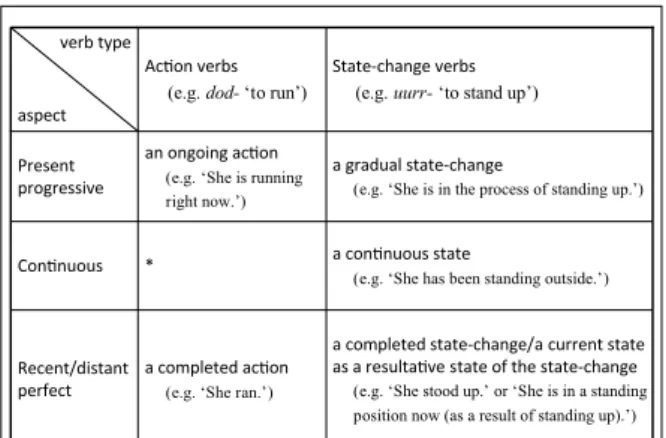
Table 1: Aspectual Behaviors of Two Types of Verbs in Sidaama
103 a completed state‐change/a current state as a resultaAve state of the state‐change (e.g. ‘She stood up.’ or ‘She is in a standing position now (as a result of standing up).’) a completed acAon(e.g. ‘She ran.’) Recent/distant
perfect
a conAnuous state
(e.g. ‘She has been standing outside.’)
* ConAnuous
a gradual state‐change
(e.g. ‘She is in the process of standing up.’) an ongoing acAon
(e.g. ‘She is running right now.’) Present
progressive
State‐change verbs (e.g. uurr- ‘to stand up’) AcAon verbs
(e.g. dod- ‘to run’) verb type
aspect
民話を語る女性 104 なぞなぞをする男たち 105
調査許可について
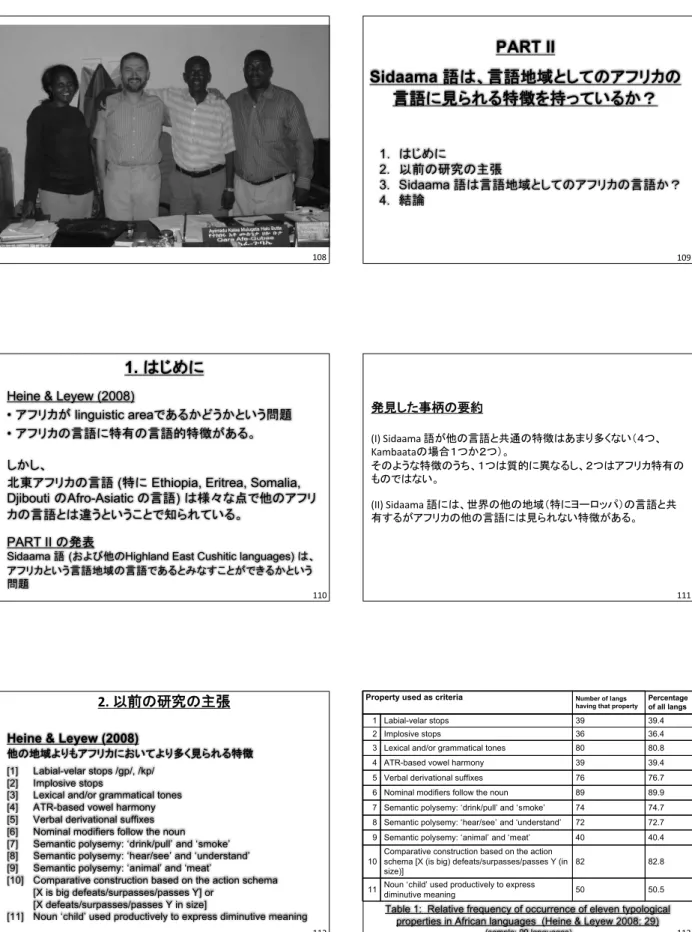
108
PART II
Sidaama 語は、言語地域としてのアフリカの
言語に見られる特徴を持っているか?
1. はじめに
2. 以前の研究の主張
3. Sidaama 語は言語地域としてのアフリカの言語か?
4. 結論
109
1. はじめに
Heine & Leyew (2008)
• アフリカが linguistic area であるかどうかという問題
• アフリカの言語に特有の言語的特徴がある。
しかし、
北東アフリカの言語 ( 特に Ethiopia, Eritrea, Somalia,
Djibouti の Afro-Asiatic の言語 ) は様々な点で他のアフリ
カの言語とは違うということで知られている。
PART II の発表
Sidaama 語 ( および他の Highland East Cushitic languages) は、
アフリカという言語地域の言語であるとみなすことができるかという
問題
110
発見した事柄の要約
(I) Sidaama 語が他の言語と共通の特徴はあまり多くない(4つ、
Kambaata の場合1つか2つ)。
そのような特徴のうち、1つは質的に異なるし、2つはアフリカ特有の
ものではない。
(II) Sidaama 語には、世界の他の地域(特にヨーロッパ)の言語と共
有するがアフリカの他の言語には見られない特徴がある。
111
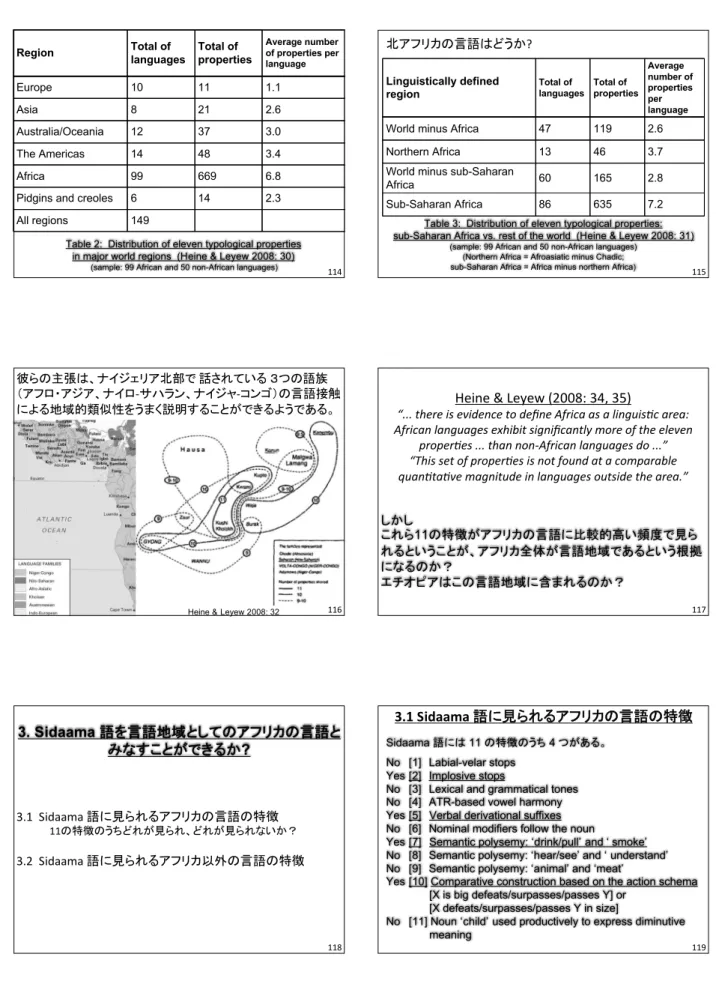
Heine & Leyew (2008)
他の地域よりもアフリカにおいてより多く見られる特徴
[1] Labial-velar stops /gp/, /kp/[2] Implosive stops
[3] Lexical and/or grammatical tones [4] ATR-based vowel harmony [5] Verbal derivational suffixes [6] Nominal modifiers follow the noun [7] Semantic polysemy: ‘drink/pull’ and ‘smoke’ [8] Semantic polysemy: ‘hear/see’ and ‘understand’ [9] Semantic polysemy: ‘animal’ and ‘meat’
[10] Comparative construction based on the action schema [X is big defeats/surpasses/passes Y] or
[X defeats/surpasses/passes Y in size]
[11] Noun ‘child’ used productively to express diminutive meaning
2. 以前の研究の主張
112
Table 1: Relative frequency of occurrence of eleven typological properties in African languages (Heine & Leyew 2008: 29)
(sample: 99 languages)
Property used as criteria Number of langs having that property
Percentage of all langs
1 Labial-velar stops 39 39.4
2 Implosive stops 36 36.4
3 Lexical and/or grammatical tones 80 80.8
4 ATR-based vowel harmony 39 39.4
5 Verbal derivational suffixes 76 76.7
6 Nominal modifiers follow the noun 89 89.9
7 Semantic polysemy: ‘drink/pull’ and ‘smoke’ 74 74.7 8 Semantic polysemy: ‘hear/see’ and ‘understand’ 72 72.7
9 Semantic polysemy: ‘animal’ and ‘meat’ 40 40.4
10
Comparative construction based on the action schema [X (is big) defeats/surpasses/passes Y (in size)]
82 82.8
11 Noun ‘child’ used productively to express
diminutive meaning 50 50.5
113
Table 2: Distribution of eleven typological properties in major world regions (Heine & Leyew 2008: 30)
(sample: 99 African and 50 non-African languages)
Region Total of
languages
Total of properties
Average number of properties per language
Europe 10 11 1.1
Asia 8 21 2.6
Australia/Oceania 12 37 3.0
The Americas 14 48 3.4
Africa 99 669 6.8
Pidgins and creoles 6 14 2.3
All regions 149
114
Table 3: Distribution of eleven typological properties: sub-Saharan Africa vs. rest of the world (Heine & Leyew 2008: 31)
(sample: 99 African and 50 non-African languages) (Northern Africa = Afroasiatic minus Chadic; sub-Saharan Africa = Africa minus northern Africa)
Linguistically defined region
Total of languages
Total of properties
Average number of properties per language
World minus Africa 47 119 2.6
Northern Africa 13 46 3.7
World minus sub-Saharan
Africa 60 165 2.8
Sub-Saharan Africa 86 635 7.2
北アフリカの言語はどうか ?
115
彼らの主張は、ナイジェリア北部で 話されている 3つの語族
(アフロ・アジア、ナイロ ‐ サハラン、ナイジャ ‐ コンゴ)の言語接触
による地域的類似性をうまく説明することができるようである。
Heine & Leyew 2008: 32 116
しかし
これら 11 の特徴がアフリカの言語に比較的高い頻度で見ら
れるということが、アフリカ全体が言語地域であるという根拠
になるのか?
エチオピアはこの言語地域に含まれるのか?
Heine & Leyew (2008: 34, 35)
“... there is evidence to define Africa as a linguis6c area:
African languages exhibit significantly more of the eleven
proper6es ... than non‐African languages do ...”
“This set of proper6es is not found at a comparable
quan6ta6ve magnitude in languages outside the area.”
117
3. Sidaama 語を言語地域としてのアフリカの言語と
みなすことができるか ?
3.1 Sidaama 語に見られるアフリカの言語の特徴
11 の特徴のうちどれが見られ、どれが見られないか?
3.2 Sidaama 語に見られるアフリカ以外の言語の特徴
Sidaama 語には 11 の特徴のうち 4 つがある。
No [1] Labial-velar stops
Yes [2] Implosive stops
No [3] Lexical and grammatical tones
No [4] ATR-based vowel harmony
Yes [5] Verbal derivational suffixes
No [6] Nominal modifiers follow the noun
Yes [7] Semantic polysemy: ‘drink/pull’ and ‘ smoke’
No [8] Semantic polysemy: ‘hear/see’ and ‘ understand’
No [9] Semantic polysemy: ‘animal’ and ‘meat’
Yes [10] Comparative construction based on the action schema
[X is big defeats/surpasses/passes Y] or
[X defeats/surpasses/passes Y in size]
No [11] Noun ‘child’ used productively to express diminutive
meaning
3.1 Sidaama 語に見られるアフリカの言語の特徴
3.1.1 Sidaama 語にはないアフリカの言語の特徴
[1] NO Labial-velar stops
[3] Lexical and grammatical tones
[4] NO ATR-based vowel harmony
[8] NO Semantic polysemy: ‘hear/see’ and ‘understand’
[9] NO Semantic polysemy: ‘animal’ and ‘meat’
[11] The nouns for ‘child’ are NOT used to express any
diminutive meaning.
[6] Nominal modifiers do NOT follow the noun,
but PRECEDE the noun.
120
名詞の修飾語句は名詞句の中で以下の順番に従う。
( 関係節 ) ( 指示詞 ) ( 数詞 ) ( 形容詞 ) ( 属格の名詞句 ) 名詞
(以下で、 (Rel) (Dem) (Num) (Adj) (Gen) N の略号を使う)
(7) (a)形容詞 dančullé
good.PL.ACC (b)指示詞 hatteenneé
ise that.F.ACC
3SG.F.NOM (c)数詞 lamé
two.ACC
(d)関係節 ani la’-o-mm-o
1SG.NOM see-PERF.1-1SG-M
uddanna dar-t-ino.
clothes.PL(ACC) tear-3SG.F-PERF.3
‘She tore (a) good clothes/(b) those clothes/(c) two pieces of clothes/ (d) the clothes I (MASC) saw.’
[6] Nominal modifiers PRECEDE the noun.
121
Dryer (1988, 1991, 1992, 2005 in Haspelmath 2005, 2007, etc.)
名詞修飾語句(Rel, Dem, Num, Adj, Gen)のうち、
GenN と OV は相関関係がある。
RelN と OV 、 DemN と OV 、 AdjN と OV は相関関係がない。
(NRel と VO は相関関係がある。)
したがって、Sidaama 語では、
RelN,
DemN,
NumN,
AdjN,
GenN
の順序
122
( OV の語順と無関係な) 名詞とその修飾語句の順序
(i) AdjN: different from languages in many other places of Africa (similar
to languages in southwest Europe, in the Middle East, and in
many parts of Asia) (Dryer 2005a: Chapter 87)
(i’) AdjN and OV: different from OV languages in Africa (AdjN is common
among OV languages only in Eurasia) (Dryer 2005b: Chapter
97)
(ii) DemN: different from languages in many other places of Africa
(similar to languages in most parts of Europe and Asia) (Dryer
2005c: Chapter 88)
(iii) NumN: different from languages in many other places of Africa
(similar to languages in most parts of Europe, Asia, and the
Americas) (Dryer 2005d: Chapter 89)
(iv) RelN: different from many other OV languages in Africa (similar to
many OV languages in Asia) (Dryer 2005e: Chapter 96)
123Chapter 87: Order of AdjecAve and Noun Manhew S. Dryer
(i) AdjN: different from many other places in Africa (similar to
languages in southwest Europe, in the Middle East,
and many parts of Asia) (Dryer 2005a: Chapter 87)
124
(i’) AdjN and OV: different from OV languages in Africa (AdjN
is common among OV languages only in Eurasia) (Dryer
2005b: Chapter 97)
Chapter 97: RelaAonship between the Order of Object and Verb and the Order of AdjecAve and Noun
Manhew S. Dryer 125
Chapter 88: Order of DemonstraAve and Noun Manhew S. Dryer
(ii) Dem‐N: different from many other places in Africa (similar
to languages in most parts of Europe and Asia)
(Dryer 2005c: Chapter 88)
126
Chapter 89: Order of Numeral and Noun Manhew S. Dryer
(iii) Num‐N: different from many other places in Africa
(similar to languages in most parts of Europe, Asia,
and the Americas) (Dryer 2005d: Chapter 89)
127
Chapter 96: RelaAonship between the Order of Object and Verb and the Order of RelaAve Clause and Noun
Manhew S. Dryer
(iv) RelN: different from many other OV languages in Africa
(similar to many OV languages in Asia) (Dryer 2005e:
Chapter 96)
128
3.1.2 Sidaama 語 に見られるアフリカの言語の特徴
[2] Implosive stops
[5] Verbal derivational suffixes
[7] Semantic polysemy: ‘drink/pull’ and ‘smoke’
[10] Comparative construction based on the action schema:
[X is big defeats/surpasses/passes Y] or
[X defeats/surpasses/passes Y in size]
129
[2] Implosive stops
A language with only one implosive usually has the bilabial /ɓ/,
but HEC languages (and other Eastern Cushitic languages) are
unusual in that although they each have only one implosive, that
implosive is the dental /ɗ/, rather than /ɓ/ (Greenberg 1970).
Lowland dialects of Sidaama (considered to be less authentic)
replace /ɗ/ by /t’/.
[5] Verbal derivational suffixes
1. Verbalizing suffixes (suffixes that verbalize nouns and
suffixes that verbalize adjectives)
2. Causative and double-causative suffixes
3. Voice suffixes (passive voice and middle voice suffixes)
4. Reciprocal suffix
But
verbal derivational suffixes seem to be very common all over
the world. (e.g. causative suffix: Song Chap.111 of WALS)
It is not clear whether verbal derivational suffixes can serve as
a criterion for any linguistic area.
[7] Semantic polysemy: ‘drink/pull’ and ‘smoke’
• aɡ- ‘drink’
(also in Haddiyya and Kambaata; Burji: ɗuɡ-, Gedeo: ha’w-)
• wiliišš- ‘smoke (a cigarette)’
(causative of the intransitive verb wiliil- ‘emit smoke’)
(also in Gedeo, Haddiyya, and Kambaata; Burji: hiliil-)
(8) isi ɡayyá aɡ-ø-ino.
3SG.M.NOM cigarette.ACC drink-3SG.M-PERF.3
‘He smoked a cigarette.
しかし、これは他の地域の言語(例:New Guinea; see Aikhenvald
2009:102-106)にもよく見られる現象であり、本当にアフリカの言語
を特徴づけるようなものであるか疑わしい。
132[10] Comparative construction based on the action schema:
[X is big defeats/surpasses/passes Y] or [X defeats/surpasses/passes Y in size](Heine 1994, Leyew & Heine (2003), Leyew & Heine 2003)
Leyew & Heine (2003): Ethiopian languages can use either the
action schema or the source schema or both for comparative
constructions
1) a result of language contact
2) Ethiopia as an overlapping zone between Asia and Africa
Sidaama can also use either the action schema or the source
schema or both for comparative constructions.
When a comparison of actions and states/state changes is made with an action or state-change verb, constructions with roor- ‘exceed’, the ablative suffix -nni, and their combinations are possible.
(11a) and (12a) seem to be considered to be the most traditional and authentic Sidaama construction.
(11a)-(11f) and (12a)-(12f) each are in the order of traditionalness/authenticity. 133
Comparative constructions (actions)
(9a) ise isó/isí-nni-i waá daah-a-te-nni roor-t-anno.3SG.F.NOM 3SG.M.ACC/3SG.M.GEN-ABL-LVwater.OBL swim-INF-GEN.F-LOCexceed-3SG.F-IMPERF.3
(9b) ise isó/isí-nni-i roor-s-i-t-e waá 3SG.F.NOM 3SG.M.ACC/3SG.M.GEN-ABL-LV exceed-CAUS-EP-3SG.F-CON water.OBL daak-k-anno.
swim-3SG.F-IMPERF.3
(9c) ise isó/isí-nni-i roore waá daak-k-anno.
3SG.F.NOM 3SG.M.ACC/3SG.M.GEN-ABL-LV exceedingly water.OBL swim-3SG.F-IMPERF.3
(9d) ise isí ale-e-nni waá daak-k-anno. 3SG.F.NOM 3SG.M.GEN aboveness-LV-LOC water.OBL swim-3SG.F-IMPERF.3
(9e) ise isí-nni-i ale-e waá daak-k-anno 3SG.F.NOM 3SG.M.GEN-ABL-LV aboveness-LV water.OBL swim-3SG.F-IMPERF.3
(9f) ise isí-nni-i waá daak-k-anno. 3SG.F.NOM 3SG.M.GEN-ABL-LV water.OBL swim-3SG.F-IMPERF.3
‘She swims better than him.’
134
Comparative constructions (states/state changes)
(10a) ise isó/isí-nni-i busulle-te-nni roor-t-anno.3SG.F.NOM 3SG.M.ACC/3SG.M.GEN-ABL-LV smartness-GEN.F-LOC exceed-3SG.F-IMPERF.3
(10b) ise isó/isí-nni-i roor-t-e busul-t-anno. 3SG.F.NOM 3SG.M.ACC/3SG.M.GEN-ABL-LV exceed-3SG.F-CONbecome.smart-3SG.F-IMPERF.3
(10c) ise isó/isí-nni-i roore busul-t-anno. 3SG.F.NOM 3SG.M.ACC/3SG.M.GEN-ABL-LV exceedingly become.smart-3SG.F-IMPERF.3
(10d) ise isí ale-e-nni busul-t-anno. 3SG.F.NOM 3SG.M.GEN aboveness-LV-LOC become.smart-3SG.F-IMPERF.3
(10e) ise isí-nni-i ale-e busul-t-anno. 3SG.F.NOM 3SG.M.GEN-ABL-LV aboveness-LV become.smart-3SG.F-IMPERF.3
(10f) ise isí-nni-i busul-t-anno. 3SG.F.NOM 3SG.M.GEN-ABL-LV become.smart-3SG.F-IMPERF.3
‘She is smarter than him.’
135
Comparative constructions
(state expressed by a predicative adjective)The following constructions are all common.
It is not clear whether they differ in traditionalness/authenticity.
(11a) ise isí-nni-i (la’-n-i-ro) busule=te.3SG.F.NOM 3SG.M.GEN-ABL-LV see-1PL-?-if smart=NPC.F.PRED (‘if we compare’)
(11b) ise isí ale-e-nni busule=te. 3SG.F.NOM 3SG.M.GEN aboveness-LV-LOC smart=NPC.F.PRED
(11c) ise isí-nni-i ale-e busule=te. 3SG.F.NOM 3SG.M.GEN-ABL-LV aboveness-LV smart=NPC.F.PRED
(11d) ise isí-nni-i roore busule=te. 3SG.F.NOM 3SG.M.GEN-ABL-LV exceedingly smart=NPC.F.PRED
‘She is smarter than him.’
136
As shown by Leyew
& Heine (2003), Ethiopian languages including HEC languages can use either the acAon schema or the source schema or both for comparaAve construcAons.
Leyew & Heine
(2003: 61)
137
3.2 Sidaama 語に見られるアフリカ以外の言語の特徴
(i) Dative external possessor constructions
(Kawachi in press a, b)(ii) Modification within NPs
(Kawachi & Tekleselassie in press)(iii) Self-benefactive use of the middle voice suffix
(Kawachi 2008)(iv) Ethic construction (?) with the “object” pronominal suffix
(i): found only in European languages (Haspelmath 1999, 2001) (ii) : only in Semitic and Indo-European languages?(but in fact, the notion of Modification is somewhat different from the notion of modification in the Semitic construct state and that in the Ezafe construction in Persian languages)
(iii): only in Indo-European languages? (iv): found mainly in European languages?
138
(i) DaAve external possessor construcAons (daAve EPCs)
In EPCs, the possessor is expressed in a consAtuent external
to the possessum NP.
The daAve EPC marks the possessor NP with the daAve, and
the possessum NP is in the same syntacAc status as in the
IPC (internal possessor construcAon) counterpart.
According to Haspelmath (1999, 2001), the daAve EPC is one
property of “standard average European” that cannot be
found outside Europe.
(Kawachi in press a, b)
139
Haspelmath (1999: 116)
140
Dative external possessor constructions in Sidaama
Possessor: DAT, Possessed: obj of transitive verb
(12) ise isí-ra uddanó
3SG.F.NOM 3SG.M.GEN-DAT clothes.ACC
dar-t-ino(-si).
tear-3SG.F-PERF.3(-3SG.M)
‘She tore his clothes.’ (lit. ‘She tore the clothes to him.’)
Possessor: DAT, Possessed: subj of intransitive verb
(13) isí-ra uddano t’ur-t-ino(-si).
3SG.M.GEN-DAT
clothes.NOM.F
become.dirty-3SG.F-PERF.3(-3SG.M)‘The clothes are dirty for him.’ (lit., ‘The clothes are dirty to him.’)
141Possessor: DAT, Possessed: location noun
(14) ise mine-ho ɡura-a-nni no.
3SG.F.NOM house-DAT.M left-LV-LOC
came.to.exist.3‘She is on the left of the house.’ (lit. ‘She came to exist on the left
to the house.’)
Possessor: DAT, Possessed: predicate noun
(15) ise isí-ra rodoo=te.
3SG.F.NOM 3SG.M.GEN-DAT sibling=NPC.F.PRED
‘She is his sister.’ (lit., ‘She is a sister to him.’)
Predicate possession construction in Sidaama (a type of EPC?)
Possessor: DAT, Possessed: subj. of existential verb
(16) isí-ra min-u no(-si).
3SG.M.GEN-DAT house-NOM.M came.to.exist.3(-3SG.M)
‘He has a house.’ (lit., ‘A house came to exist to him.’)
(ii) Modification within NPs
Sidaama makes a grammatical distinction in several
places of grammar in terms of whether or not a noun
is “Modified” (morphologically or syntactically
“Modified”) by the possessive pronominal suffix, as
well as a syntactic modifier (an adjective, a numeral,
an adnominal demonstrative, an adnominal
interrogative, a genitive noun phrase, or a relative
clause), though there are a few cases where
modification in its ordinary sense, which is syntactic,
is relevant.
(Kawachi & Tekleselassie in press)
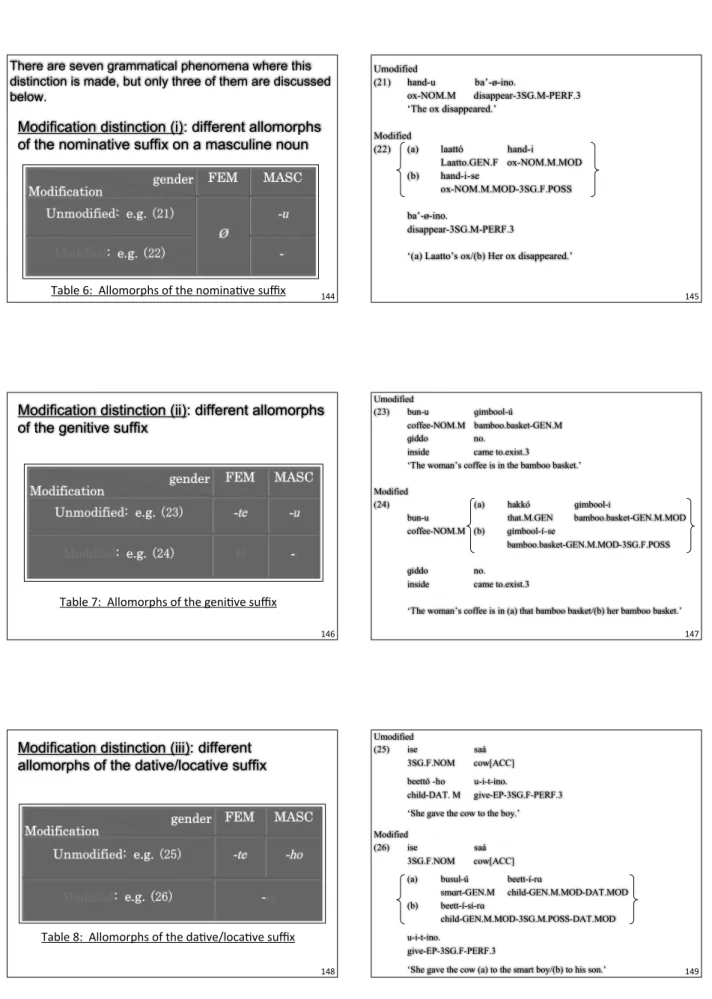
There are seven grammatical phenomena where this
distinction is made, but only three of them are discussed
below.
Modification distinction (i): different allomorphs
of the nominative suffix on a masculine noun
Table 6: Allomorphs of the nominaAve suffix
144Umodified
(21) hand-u ba’-ø-ino.
ox-NOM.M disappear-3SG.M-PERF.3
‘The ox disappeared.’
Modified
(22) (a) laattó hand-i Laatto.GEN.F ox-NOM.M.MOD (b) hand-i-se
ox-NOM.M.MOD-3SG.F.POSS
ba’-ø-ino.
disappear-3SG.M-PERF.3
‘(a) Laatto’s ox/(b) Her ox disappeared.’
145
Modification distinction (ii): different allomorphs
of the genitive suffix
Table 7: Allomorphs of the geniAve suffix
146
Umodified
(23) bun-u ɡimbool-ú coffee-NOM.M bamboo.basket-GEN.M
ɡiddo no.
inside came to.exist.3
‘The woman’s coffee is in the bamboo basket.’
Modified
(24) (a) hakkó ɡimbool-i
bun-u that.M.GEN bamboo.basket-GEN.M.MOD coffee-NOM.M (b) ɡimbool-í-se
bamboo.basket-GEN.M.MOD-3SG.F.POSS
ɡiddo no.
inside came to.exist.3
‘The woman’s coffee is in (a) that bamboo basket/(b) her bamboo basket.’ 147
Modification distinction (iii): different
allomorphs of the dative/locative suffix
Table 8: Allomorphs of the daAve/locaAve suffix
148
Umodified
(25) ise saá
3SG.F.NOM cow[ACC] beettó -ho u-i-t-ino.
child-DAT. M give-EP-3SG.F-PERF.3
‘She gave the cow to the boy.’ Modified
(26) ise saá
3SG.F.NOM cow[ACC] (a) busul-ú beett-í-r(
sm(rt-GEN.M child-GEN.M.MOD-DAT.MOD (b) beett-í-si-r(
child-GEN.M.MOD-3SG.M.POSS-DAT.MOD u-i-t-ino.
give-EP-3SG.F-PERF.3
‘She gave the cow (a) to the smart boy/(b) to his son.’ 149
Modification distinction (iv): different forms of
noun-phrase clitic that attaches to a predicate
noun
Table 7: Different forms of the noun‐phrase cliAc
anaching to a predicate noun
150
Umodified
(29) tii’i midaano=te.
that.F.NOM clay.container=NPC.PRED. F
‘That one (FEM) is a clay container.’
Modified (30) tii’i
that.F.NOM
(a) isi seekk-ø-ino midaano=ti.
3SG.M.NOM repair-3SG.M-PERF.3 clay.container=NPC.PRED.MOD (b) midaano-se=ti.
clay.container-3SG.F.POSS=NPC.PRED.MOD
‘That one (FEM) is (a) the clay container that he repaired/(b) her clay container.’
151
(iii) Self-benefactive use of the middle voice suffix
(Kawachi 2008)
grooming middle
(31) ise anɡá haišš-i-ɗ-ɗ-ino.
3SG.F.NOM hand.ACC wash-EP-MID-3SG.F-PERF.3
‘She washed her hands.’
self-benefactive (also called auto-benefactive): ‘for the benefit of oneself’
(32) ise waalčó fa-’-n-i-t-ino.3SG.F.NOM door.ACC open-MID-open-EP-3SG.F-PERF.3
‘She opened the door for herself.’
(active: fan-t-ino [open-3SG.F-PERF.3] ‘She opened the door.’) (33) ise loos-i-ɗ-ɗ-ino.
3SG.F.NOM work-EP-MID-3SG.F-PERF.3
‘She worked for herself.’
(active: loos-s-ino [work-3SG.F-PERF.3] ‘She worked.’) 152
(iv) Ethic construction (?) with the “object” pronominal suffix
pronoun pronominal suffix
NOM ACC DAT subject “object”
1SG ani ané ané-ra -mm -’e
2SG ati até até-ra -tt -he
3SG.F ise isé isé-ra -t -se
3SG.M isi isó isí-ra -ø -si
1PL ninke ninké ninké-ra -n -mmo -nke
2PL ki’ne ki’né ki’né-ra -tin -’ne
3PL insa insá insá-ra -t -nsa
Table 8: Pronouns and pronominal suffixes in Sidaama HEC languages have (opAonal) “object” pronominal suffixes as well as (obligatory) subject pronominal suffixes.
Like pronouns, the “object” pronominal suffixes are used only for humans.
153
ɡ#n- ‘hit’ hit (PERF)
1SG.F ɡan-oo-mm-a(-nsa) [hit-PERF-1SG-F(-3PL)] ‘I (FEM) hit (them).’ 1SG.M ɡan-oo-mm-o(-nsa) [hit-PERF-1SG-M(-3PL)] ‘I (MASC) hit (them).’ 2SG.F ɡan-oo-tt-a(-nsa) [hit-PERF-2SG-F(-3PL)] ‘You (SG.FEM) hit (them).’ 2SG.M ɡan-oo-tt-o(-nsa) [hit-PERF-2SG-M(-3PL)] ‘You (SG.MASC) hit (them).’ 3SG.F/3PL ɡan-t-ino(-nsa) [hit-3SG.F/3PL-PERF(-3PL)] ‘She/Theyi hit (themj).’
3SG.M ɡan-ø-ino(-nsa) [hit-3SG.M-PERF(-3PL)] ‘He hit (them).’ 1PL ɡan-n-oo-mmo(-nsa) [hit-1PL-PERF-1PL(-3PL)] ‘We hit (them).’ 2PL ɡan-tin-oonni(-nsa) [hit-2PL-PERF(-3PL)] ‘You (PL) hit (them).’
Table 9: One of the perfecAve forms of ‘hit’ in Sidaama
Like other African languages (Creissels 2005), the “object”
pronominal suffix appears to express the primary object (P or T).
• used for P (the object of a monotransitive verb)
(34) ise isó sunk’-i-t-ino(-si).
3SG.F.NOM 3SG.M.ACC kiss-EP-3SG.F-PERF.3(-3SG.M)
‘She kissed him.’
• used for T (the theme of a ditransitive verb)
(35) ise wot’é isí-ra u-i-t-ino(-si).
3SG.F.NOM money.ACC 3SG.M.GEN-DAT give-EP-3SG.F-PERF.3(-3SG.M)
‘She gave money to him.’
But the “object” pronominal suffix is not restricted to the primary
object.
• a dative-marked beneficiary or a person because of whom an action is
performed
(36) ise isí-ra (y-i-t-e)
3SG.F.NOM 3SG.M.GEN-DAT say-EP-3SG.F-CON saɡalé ra’is-s-ino(-si).
food.ACC cook-3SG.F-PERF.3(-3SG.M) without y-i-t-e: ‘She cooked food for the benefit of him.’ with y-i-t-e: ‘She cooked food because of him.’
• a dative-marked possessor in the dative possessor constructions or the
predicate possession construction
(37) isí-ra lekka daafur-t-ino(-si).
3SG.M.GEN-DAT leg.NOM.F become.tired-3SG.F-PERF.3(-3SG.M)
‘His legs got/are tired.’ (lit. ‘To him, the legs got tired.’) 156
• a dative-marked NP in the judicantis dative construction
(36) isí-ra uddano t’ur-t-ino(-si).3SG.M.GEN-DAT clothes.NOM.F become.dirty-3SG.F-PERF.3(-3SG.M)
‘The clothes are dirty for him.’
(also EPC interpretation: ‘His clothes are dirty.’ ) (lit., ‘The clothes became/are dirty to him.’)
• a dative-marked NP in the construction with ba’- ‘lit. to disappear’ for
a bad event
(37) isé-ra hakku manč-i re-ø-e
3SG.F.GEN-DAT that.M.NOM person-NOM.M die-3SG.M-CON ba’-ø-ino(-se).
diasppear-3SG.M-PERF.3(-3SG.F)
‘That man died to her detriment.’ (lit. ‘That man died, and disappeared to her.’)
157
The “object” pronominal suffix may appear to be used for the
primary object or a dative-marked NP.
But it is usually used for the most affected person in the
context.
(38) ise isó ninké-nni ins)-r(
3SG.F.NOM 3SG.M.ACC 1PL.GEN-INST 3PL.GEN-DAT udd(nó h(išš-i-šiiš-š-ino(-si/-ns(/*-nke).
clothes.ACC wash-EP-DBL.CAUS-3SG.F-PERF.3(-3SG.M/-3PL/-1PL)
‘She had us make him wash the clothes for them.’
(39) insa isé isí-ra
3PL.NOM 3SG.F.ACC 3SG.M.GEN-DAT (a) leell-i-š-š-ino(-si/-se).
become.visible-EP-CAUS-3PL-PERF.3(-3SG.M/-3SG.F) (b) u-i-t-ino(-si/-se).
give-EP-3PL-PERF.3(-3SG.M/-3SG.F)
‘They (a) showed her to him/(b) let him marry/adopt her.’ 158
(40) ise isó sunk’-i-t-ino(-si).
3SG.F.NOM 3SG.M.ACC kiss-EP-3SG.F-PERF.3(-3SG.M)
‘She kissed him.’ with -si: SP’s emotion
(41) ise isó ɡan-t-ino(-si).
3SG.F.NOM 3SG.M.ACC hit-3SG.F-PERF.3(-3SG.M)
‘She hit him.’ with -si: SP’s emotion
(Probably) unlike bound pronominal markers in other African
languages, the “object” pronominal suffix in HEC languages is
usually used to express the subject’s emoAon toward the
event (e.g. joy, sympathy).
159
4. Discussion and Conclusion
以下は、G etnet Fetnet (Amharic) 、 Abebayehu A. Tekleselassie ( Amharic) 、 Yvonne Tries (Kambaata) 、若狭基道氏(Wolaytta, Amharic)の協力による。
結論
Sidaama 語(及び他のHEC languages、エチオピアの言語?)
は他のアフリカの言語と大きく異なり、ヨーロッパと西アジア
の言語といくつかの特徴を共有している。
160PART II
Sidaama 語は、
「する」的言語か「なる」的言語か?
1. はじめに
2. 池上の主張
3. Sidaama 語 のデータ
4. 結論
161
1. はじめに
PART III の発表 :
・ Sidaama 語が Ikegami (1981, 1991) の「する」と「なる」の
言語類型論にどのようにあてはまるか?
( 「する」型:英語、「なる」型:日本語)
・ この類型論が意味類型論の一般的枠組みとして妥当かど
うかという問題
162
2. 池上 (1981, 1991) の「する」と「なる」の類型論
DO-language (English)
BECOME-language (Japanese)
event ‘someone doing something’
‘the whole scene changing into another state’
Table 1: Different ways of expressing events
in DO‐ and BECOME‐languages
池上の仮説 :
2つの対照的な言語のタイプ
「する」 型 (英語型)と「なる」型 (日本語型)
163
「なる」型の言語としての日本語
・ 文学作品からの例
(1) 国境の長いトンネルを抜けると雪国であった。
Kunizakai no nagai tonneru o nukeru to,
border of long tunnel OBJ pass when
yukiguni de atta.
snow.country was (Kawabata (Ikegami 1991:288))
・ 慣用表現
(2) 春めく haru-meku [spring-become] ‘spring comes’
(3) 夕されば yu-sare-ba [evening-come-when] ‘when the evening comes’
・ 移動のイヴェント
a change in state of the whole scene (a moving entity assuming
successively different forms and postures),
rather than a change in locus of a moving entity
164 Table 2: Summary of (4) and (5)
DO-language BECOME-language
event ‘someone doing
something’
‘the whole scene changing into another state’
(I) Individuum vs. event focus on an individuum focus on the event as a whole (II-i) human being focused suppressed
(II-ii) agent focused suppressed
(4) A DO‐language singles out and focuses on an individuum,
whereas a BECOME‐language focuses on the event as a
whole, with the individua submerged in it.
(5) A DO‐language focuses on a human being (especially, as an
agent), and tends to give linguisAc prominence to the noAon
(by themaAzing/subjecAvizing or obligatorily selecAng a
linguisAc item for a human referent), whereas a BECOME‐
language tends to suppress the noAon of the human being.
165
DO-language BECOME-language (I) Individuum vs. event individuum event as a whole
(A) preference for mono (concrete objects) type expressions or koto (circumstances) type expressions
mono type (e.g. subject raising, tough construction)
koto type
(e.g. internally-headed relative clauses) (B) discreteness distinction with
number and/or definiteness markings
yes no
(C) vague expressions for specific
referents no
yes
(e.g. ‘about two’ for
‘two’)
Table 3: Means of focusing on an individuum/the event as a whole
in DO‐/BECOME‐languages
DO-language BECOME-language (II-i) human being focused suppressed
(A) possession
HAVE-language (a verb of possession)
BE-language (a verb of existence as well as a verb of possession)
(B) explicitness in expressing a human referent in some expressions
direct reference to a human referent
no mention of a human referent;
backgrounding a human referent;
use of koto ‘thing’, etc.
Table 4: Means of focusing on/suppressing a human being
in DO‐/BECOME‐languages
DO-language BECOME-language
(II-ii) agent focused suppressed
(A) degree of agentivity in causative expressions
higher (make construction)
lower (sase construction)
(B) different complementation patterns
yes (inf. and that for report/ask)
no
(C) transitivity of verbs that are primary transitive intransitive (D) rhetorical figure of personification used not used (E) event realization: the implication of the
achievement of the goal more likely less likely
(F) interpretation of causer in some grooming/
body-care expressions (e.g. ‘I cut my hair.’) direct causer direct or indirect causer
(G) various means of suppressing/back- grounding the notion of an agent no
yes (honored person as location; topic-comment; reru/rareru; naru; intransitive rather than passive construction)
Table 5: Means of focusing on/suppressing an agent
in DO‐/BECOME‐languages 168
問 題
1. 二 つ の タ イ プ の 言 語 の そ れ ぞ れ の 特 徴 は ど の よ う な 関
係があるのか?
2. 個々の特徴は 二つのタイプの言語においてどの程度浸
透しているのか?
3. 二つの言語をもとにして類型論的枠組みを構築できる
か?
4. 議論の根拠 ? トップダウンではないか?
169
3. Sidaama 語は「する」型か「なる」型か ?
Sidaama 語が
(I) Individuum vs. event
(II-i) human being
(II-ii) agent
をどのように表すかを見てみる。
170
(I) Expressions of an individuum vs. the whole event
DO-language Sidaama BECOME- language (I) Individuum vs. event individuum ? event as a whole
(A) preference for mono (concrete objects) type expressions or koto (circumstances) type expressions
mono type ? koto type
(B) discreteness distinction with number and/or definiteness markings
yes
number mark- ings; definiteness markings only in limited contexts
no
(C) vague expressions
for specific referents no yes yes
Table 3’: Means of focusing on an individuum/the event as a whole
in DO‐/BECOME‐languages and Sidaama
171(C) Vague expressions for specific referents
used when the speaker wants to sound modest or polite in
his/her request or offer
(9) lamé burtukaané ɡeešša aɗ-a
two(GEN.F) orange(GEN.F) degree(ACC) take-INF dand-ee-mm-o ?
can-IMPERF.1-1SG-MASC
‘Can I (MASC) take about two oranges?’ (lit. ‘Can I (MASC) take the degree of two oranges?’)
(10) bun-ú-ɡede re aɗ-a
coffee-GEN.M-like things(ACC) take-INF hasi’r-a-tt-a ?
come.to.want-IMPERF.2SG-2SG-F
‘Do you (SG.FEM) want to drink things like coffee?’
172
(II-i) Expressions of a human being
DO-language Sidaama BECOME-language (II-i) human being focused ? suppressed
(A) possession HAVE-language BE-language BE-language
(B) explicitness in expressing a human referent in some expressions
direct reference to a human referent
sometimes direct, and sometimes not direct
no mention of a human referent; backgrounding a human referent; use of koto ‘thing’, etc.
Table 4’: Means of focusing on/suppressing a human being
in DO‐/BECOME‐languages and Sidaama
173
(A) Possession
HAVE-language type expression:
a construction with the verb of possession
(11) ise miné a*ɗ-ɗ-ino.
3SG.F.NOM house(ACC) get-3SG.F-PERF.3
‘She has a house.’ (lit. ‘She got a house.’)
BE-language type expression:
predicate possession construction (a construction with
the existential verb)
(12) isé-ra min-u no.
3SG.F.GEN-DAT house-NOM.M come.to.exist.PERF.3
‘She has a house.’ (lit. ‘To her, a house came to exist.’)
174
(B) Explicitness in expressing a human referent in some
expressions
direct reference
(13) ani iibbillé a*’r-oo-mm-o. 1SG.NOM fever(ACC) get-PERF.1-1SG-M
‘I (MASC) have a fever.’ (lit. ‘I (MASC) got a fever.’)
(13’) ani iibbabb-oo-mm-o.
1SG.NOM become.feverish-PERF.1-1SG-M
‘I (MASC) have a fever.’ (lit. ‘I (MASC) became feverish.’)
(14) ninke mat’ineé-nke ɡu-n-d-oo-mmo.
1PL.NOM salt(ACC)-1PL.POSS finish-1PL-finish-PERF.1-1PL
‘We are/ran out of salt.’ (lit. ‘We finished our salt.’)
175
indirect reference
(15) ise y-i-t-ino ri
3SG.F.NOM say-EP-3SG.F-PERF.3 things.NOM.M halaale=ho.
truth=NPC.PRED.M
‘The things that she said are the truth.’ (*lit. ‘She is right.’)
(16) ati y-oo-tt-o ri
2SG.NOM say-PERF.2SG-2SG-M things.NOM.M di=leell-ø-ino-’e.
NEG=become.visible-3SG.M-PERF.3-1SG
‘I don’t understand the things that you (SG.MASC) said.’
(lit. ‘The things that you (SG.MASC) said did not become visible to me.’) (*lit. ‘I don’t understand you.’)
176
(II-ii) Expressions of an agent
DO-
language Sidaama
BECOME- language
(II-ii) agent focused ? suppressed
(A) degree of agentivity in causative
expressions higher higher lower
(B) different complementation patterns yes yes no (C) transitivity of verbs that are primary transitive intransitive? intransitive (D) rhetorical figure of personification used not used not used (E) event realization: the implication of the
achievement of the goal more likely less likely less likely (F) interpretation of causer in some
grooming/body-care expressions
direct causer
direct or in- direct causer
direct or in- direct causer (G) various means of suppressing/back-
grounding the notion of an agent no
(somewhat)
yes yes
Table 5’: Means of focusing on/suppressing an agent
in DO‐/BECOME‐languages and Sidaama
177(B) Different complementation patterns
(17)ise 3SG.F.NOM
(a) ha’r-a-mm-o-ra go-INF-1SG-M-DAT
(b) ha’r-a hasis-ø-anno-’e y-i-t-e
go-INF become.necessary-3SG.M-PERF.3-1SG say-EP-3SG.F-CNN (c) ha’r-i y-i-t-e
go-IMP.2SG say-EP-3SG.F-CNN (d) ani ha’r-ee-mm-o-ɡede
1SG.NOM go-IMPERF.1-1SG-M-so.that
ɡiddees-s-ino-’e.
try.to.force-3SG.F-PERF.3-1SG
‘She tried to force me (MASC in (a) and (d)) to go.’
(lit. (b) ‘saying, “You must go (Your going is necessary)”’/(c) ‘saying, “Go!”’)
(F) Interpretation of a causer in some grooming/body-
care expressions
either direct or indirect causer interpretation
(18) ise dan(nčó(-se) muɗ-ɗ-i-t-ino.
3SG.F.NOM hair(ACC)(-3SG.F.POSS) cut-MID-EP-3SG.F-PERF.3
‘She cut her own hair.’ or ‘She had someone cut her hair.’
(G) Various means of suppressing the notion of an agent
(but different from those in Japanese)
Some uses of the middle construction (Kawachi 2008) e.g. (18)
Adversative middle construction
(19) ise middanó hiikk’-i-ɗ-ɗ-ino.
3SG.F.NOM clay.pot(ACC) break-EP-MID-3SG.F-PERF.3
‘Her clay pot got broken to her detriment.’ (There may or may not be an agent.
If there is one, the agent may or may not be her.)
Impersonal construction
(13’’) (ané) iibbabb-i-š-ø-ino-’e.
1SG.ACC become.feverish-EP-CAUS-3SG.M-PERF.3-1SG
‘I have a fever.’
(lit. ‘(IMPERS.3SG.M) caused me to become feverish.’)
Passive construction: the agent is usually not expressed
180
4. ディスカッション
Sidaama has some features of the DO-language type and
some features of the BECOME-language type (Tables 3’-5’).
Although Sidaama has a number of features in common with
Japanese, there seems to be no clear case where Sidaama
expresses an event as the whole scene changing into another
state.
It remains to be investigated whether the features of the two
types of languages reflect their difference in the expression of
events by examining many more languages.
181
Possible interpretations of the findings of
the present study
1. Sidaama can be placed somewhere between English and
Japanese (but I have not come across any BECOME-language
type expressions that actually exist in Sidaama).
2. Sidaama is one of a few languages that cannot fit into Ikegami’s
typology.
3. There is no correlation between the DO- and BECOME-
language types and their features (Tables 3-5).
4. Sidaama is a DO-language. Some of the features of the DO-
and BECOME-language types are irrelevant.
182
5. 結論
Sidaama seems to bear characteristics of both DO-
and BECOME-language types.
Research on many additional languages needs to be
conducted.
183
Thank you.
184
ABL: ablative LV: lengthened vowel
ALL: allative MOD: Modified
CON: converb (connective) NPC: noun-phrase clitic EP: epenthesis
185 Abbreviations
References
・ Creissels, Denis (2005) A typology of subject and object markers in African languages. In Voeltz, F. K. Erhard (ed.) Studies in African Linguistic Typology, 43-70. John Benjamins.
・ Dryer, Matthew S. (1988) Object-verb order and adjective-noun order: Dispelling a myth. Lingua, 74, 185-217.
・ Dryer, Matthew S. (1991) SVO languages and the OV/VO typology. Journal of Linguistics, 27, 443-482.
・ Dryer, Matthew S. (1992) The Greenbergian word order correlations. Language, 68, 81-138.
・ Dryer, Matthew S. (2007) Word order. In T. Shopen (ed.) Clause Structure, Language Typology and Syntactic Description, Vol. 1, Second Edition. Cambridge University Press 2007, 61-131.
・ Haspelmath, Martin (1999) External possession in a European areal perspective. In Payne, Doris L., and Immanuel Barshi. (eds.) External Possession, 109-135. Philadelphia: John Benjamins.