Reproductive Skew in Vertebrates (eds. Hager and Jones)
1 2 3
4 5 6 7 8 9 10 11 12 13 14 15 16 17 18 19
The Causes and Consequences of Reproductive Skew
in Male Primates
Nobuyuki Kutsukake (1, 2) and Charles L Nunn (3, 4)
(1) Department of Biological Sciences, Graduate School of Sciences, The University of Tokyo
(2) Laboratory for Biolinguistics, RIKEN Brain Science Institute
(3) Max Planck Institute for Evolutionary Anthropology, Leipzig, Germany (4) Department of Integrative Biology, University of California, Berkeley
Address: Nobuyuki Kutsukake - Laboratory for Biolinguistics, Brain Science Institute, RIKEN, 2-1 Hirosawa, Wako-shi, Saitama, 351-0198, JAPAN
Tel: +81-48-462-1111-6823, fax: +81-48-467-7503
E-mail: [email protected]
INTRODUCTION 20
21 22 23 24 25 26 27 28 29 30 31 32 33 34 35 36 37 38 39 40 41 42 43 44
Reproductive skew theory attempts to explain the uneven distribution of reproductive success among same-sexed group members by multiple social, ecological, and genetic factors (Fig. 1; reviewed in Johnstone 2000). Reproductive skew theory has often been divided into two broad categories known as transactional and compromise frameworks. These frameworks differ according to the assumptions that each of them make. In a version of the transactional framework known as the concession model, the dominant individual controls the reproduction of subordinates and allows them to reproduce in return for the subordinate staying in the group (i.e., the dominant offers a
“staying incentive”; Vehrencamp 1983a, b; Keller and Reeve 1994; Clutton-Brock 1998; Johnstone 2000). Retaining the subordinate is assumed to increase group productivity (i.e., total reproductive output of a group) and fitness benefits of a dominant, relative to the alternative of the subordinate leaving the group. In contrast, the tug-of-war model, which is part of the compromise framework, suggests that the dominant individual is unable to control the reproduction of subordinates completely (Reeve et al. 1998; Cant 1998; Clutton-Brock 1998); the division of reproduction is therefore determined by competition between a dominant and subordinate (Reeve et al. 1998; Cant 1998; Clutton-Brock 1998), which is assumed to decrease group productivity. These models can be expanded into systems with more than two individuals competing for reproduction (Johnstone et al 1999; Reeve and Emlen 2000), including queuing systems (i.e., a subordinate acquiring a higher dominance position in the future: Kokko & Johnstone, 1999; Ragsdale 1999; Mesterton-Gibbons et al. 2006).
In this chapter, we consider the causes and the consequences of skew in male primates. Although recent research has synthesized the transactional and compromise frameworks into single conceptual models (Johnstone 2000; Reeve and Shen 2006), the
classic dichotomy of the transactional (concession model) and compromise frameworks (tug-of-war model) provides a useful starting point for investigating reproductive skew in primates and will therefore be used here. Social primates live in relatively stable social groups. In these groups, males can exhibit considerable variation in the degree to which reproduction or matings are skewed (Cowlishaw and Dunbar 1991; Bulger 1993; Kutsukake and Nunn 2006). Although inter-individual variation in male reproductive success has been a central topic in primate research (e.g., Cowlishaw & Dunbar 1991; Bulger 1993; Alberts et al. 2003; van Noordwijk and van Schaik, 2004), only recently have researchers applied the theoretical frameworks of reproductive skew to investigate patterns of mating and reproduction in male primates (Hager 2003; Widdig et al. 2004; Bradley et al. 2005; Kutsukake and Nunn 2006).
45 46 47 48 49 50 51 52 53 54 55 56 57 58 59 60 61 62 63 64 65 66 67 68 69
Figure 1 provides an overview of the topics covered in this chapter. First we focus on the causes of skew, starting with an explanation of the POA model and how this model corresponds to the newer theoretical frameworks for understanding reproductive skew. In this first section, we also discuss the assumptions and predictions of the tug-of-war and concession models, we review four case studies that have explicitly introduced and used paternity data to investigate predictions of skew models in primates, and we discuss a new research direction to examine predictions from skew theory using phylogenetic comparative methods (Kutsukake and Nunn 2006).
In the second part of this chapter, we discuss another new research direction: investigating the consequences of reproductive skew on other biological traits (Fig. 1). We focus on two examples. The first involves the effects of skew on relatedness within groups, and the other considers how patterns of skew might influence the spread of sexually transmitted diseases. We conclude by identifying several areas for future
research, including comparative studies.
70 71 72 73 74 75 76 77 78 79 80 81 82 83 84 85 86 87 88 89 90 91 92 93 94
THE CAUSES OF REPRODUCTIVE SKEW The priority-of-access (POA) model
The POA model (Altmann, 1962) has been the most influential framework used to explain variation in reproduction among male primates (Altmann, 1962; Altmann et al. 1996; Boesch et al. 2006). The model predicts that the dominant male monopolizes reproduction within a group. However, the degree to which the dominant male succeeds in this goal is affected by the number of oestrous females in the group. When two or more females are in oestrus at the same time, the dominant male is unable to mate guard all of them effectively, thus providing an opportunity for subordinate males to mate. The model therefore makes predictions for the distribution of matings within groups, with the dominant male obtaining the largest share, and subordinates obtaining lesser amounts in proportion to their ranks.
Empirical studies provide evidence for the dominant male’s advantages in both mating (Cowlishaw and Dunbar, 1991; Bulger, 1993; Ellis 1995; Alberts et al., 2003; Kutsukake and Nunn 2006) and paternity success (van Noordwijk and van Schaik 2004). In addition, some studies have investigated the effect of oestrous synchrony on the distribution of matings, reproductive success and the number of males in a group (e.g., Bulger, 1993; Paul 1997; Nunn 1999a; Soltis et al. 2001; Takahashi 2004; van Noordwijk and van Schaik 2004; Boesch et al 2006; Alberts et al 2006). In general, these studies have shown that when more females are in oestrus, the ability of a dominant male to control access to females is more limited. The effect of oestrous synchrony has also been demonstrated in studies of non-primates (e.g., domestic cats, Felis catus: Say et al. 2001).
The POA model has contributed greatly to primate research, but studies on primates have produced variable results (Dunbar 1988; Cowlishaw and Dunbar 1991; Bulger 1993; van Noordwijk and van Schaik 2004; Kutsukake and Nunn 2006). In some cases, researchers have uncovered the biological reasons for departures from the POA model. For example, mate choice by females also can impact the distribution of reproduction in ways that differ from predictions of POA (Dunbar 1988; Soltis 2004). Females may confuse paternity by mating promiscuously and concealing ovulation – both of which should decrease skew – or females may increase skew by copulating with the dominant male during periods in which the probability of fertilization is high (van Schaik et al. 1999, 2000; Nunn 1999b; van Noordwijk and van Schaik 2004).
95 96 97 98 99 100 101 102 103 104 105 106 107 108 109 110 111 112 113 114 115 116 117 118 119
Some researchers have incorporated the effect of the number of males in evaluating the POA model (e.g., Alberts et al. 2003; 2006; Boesch et al. 2006), based on the reasoning that it should be more difficult for a dominant male to monopolize females when there are more males in the group who are competing for females (Cowlishaw and Dunbar 1991). Our comparative work – discussed below – provides evidence for this effect in analyses that control for phylogeny, suggesting that male number is the primary factor that affects skew in social primates. Because the number of males was not explicitly considered by Altmann (1962), here we call this framework the extended-POA model, in order to separate it from the original POA model.
The POA and skew models are not fundamentally different in their goals of explaining the distribution of reproduction within groups. Relative to the POA model, however, the reproductive skew framework provides a richer set of variables to consider, potentially explaining more variation in male mating success. For example, skew models take into account the possibilities for males to leave the group and either attempt to breed on their own or join another group where their fitness would be greater, and
thus also the need for dominant males to provide staying incentives. The concession model from the transactional framework also makes explicit assumptions about the degree of control that dominant males have over reproduction, with the tug-of-war models explicitly challenging the assumption of the dominant’s complete control of subordinate reproduction. Skew models make use of data on relationships among males, with greater skew predicted under the concession model when males are more closely related. In addition to male reproductive success, they can be applied to investigate female reproductive success.
120 121 122 123 124 125 126 127 128 129 130 131 132 133 134 135 136 137 138
Testing the reproductive skew frameworks
Evaluating whether a particular skew model applies to a species requires information on multiple parameters. Quantification of these parameters is difficult in any species, including primates. Moreover, experiments common in other empirical studies of skew, such as in Hymenoptera, are difficult or unethical to attempt in primates, in part because most primates have long lifespans and many are highly threatened. Here we discuss two approaches: first to investigate the assumptions of different skew models (Johnstone 2000; Magrath et al 2004), and second to test specific predictions in observational and comparative studies.
Testing assumptions of different skew models
139 140 141 142 143 144
The first assumption of the transactional framework is that the presence of subordinates increases productivity and the fitness benefits of the dominant individual. Positive relationships between male number and group productivity (or efficiency of defense against extra-group males) have been reported in male primates (Wrangham 1999; Treves 2001). In wild chimpanzees, for example, intergroup aggression is mainly
conducted by males (Wrangham 1999), and the number of offspring and probability of infant survival increases with the number of males (Boesch et al. 2006). This pattern could occur through the combined effects of attracting females to the group and better defense of the territory or offspring. In another population, at Mahale, researchers documented that a decrease in the number of males in a small group, possibly caused by intergroup killing by the larger neighboring group, resulted in the transfer of females to the larger group (Nishida et al., 1985). Thus, this assumption that subordinates provide fitness benefits and higher group productivity could be met in species where males defend a territory or a group of females, and in other situations in which dominant males benefit from membership in multimale groups.
145 146 147 148 149 150 151 152 153 154 155 156 157 158 159 160 161 162 163 164 165 166 167 168 169
A key assumption of the concession model within the transactional framework is that the dominant individual has complete control over reproduction by subordinates. Field studies provide weak support for this assumption. In most species of social primates, for example, the presence of a dominant individual does not suppress the reproductive states of subordinates (see Carlson and Young, this volume), and complete control must be difficult if there are too many rivals in a group. A dominant male can often interrupt mating by subordinates, but in many cases he is ineffective in completely preventing copulations by subordinate males (Soltis 2004). Various studies have further shown that the degree to which the alpha male succeeds in reproduction decreases as the number of rivals increases (van Noordwijk and van Schaik 2004). Finally, complete control should be especially difficult in species living in fission-fusion societies (Dunbar 1988), where subdivision of the group into foraging parties should make it more difficult for males to monitor mating attempts by other males. These species include chimpanzees (Pan troglodytes), bonobos (Pan paniscus) and spider monkeys (Ateles spp.).
An important assumption of the compromise framework is that group productivity decreases as a result of competition between the dominant and subordinate. Infanticide by males is widely observed in primates (van Schaik and Janson 2001) and reduces group productivity. Correlational studies showed that groups with multiple males are less productive than single-male groups (black-and-white colobus, Colobus guereza: Dunbar 1987; Hanuman langurs, Semnopithecus entellus: Srivastava and Dunbar, 1996), although the behavioral mechanism for how the presence of multiple males affects male-male competition – and ultimately group productivity – is largely unknown. Moreover, some studies reported positive effects of subordinate males on group productivity (red howler monkeys, Alouatta seniculus: Crockett & Janson 2000; mountain gorillas, Gorilla gorilla: Watts 2000). These results suggest that the links between the number of subordinate males in a group and competition among males or group productivity is not universal. Future studies should test this assumption more broadly across species, including species living in multimale groups.
170 171 172 173 174 175 176 177 178 179 180 181 182 183 184 185 186 187 188 189 190 191 192 193 194
This brief summary suggests that males are unlikely to have complete control over reproduction (as assumed in the concession model), and that group productivity can either increase or decrease with the number of males and the intensity of competitions among dominant and subordinate males (as predicted by transactional and compromise frameworks, respectively). Thus, a particular skew model could be appropriate for some species but not others, and quantitative testing of the assumptions could help to disentangle which models should be investigated in different species. Other models (and extensions of these models, such as social queuing or models that incorporate multiple individuals) make additional assumptions (Kokko & Johnstone, 1999; Johnstone et al 1999; Reeve and Emlen 2000) that would be worth investigating as skew frameworks are applied to primate mating systems.
195
Testing specific predictions of skew models
196 197 198 199 200 201 202 203 204 205 206 207 208 209 210 211 212 213 214 215 216 217 218 219
Reproductive skew models also make different predictions for the effects of demographic variables (number of males and females), female reproductive traits (oestrous synchrony), and relatedness among males on patterns of reproductive skew (Table 1). The tug-of-war model and the extended POA model predict that skew decreases as the number of males in a group increases, based on the reasoning that it will be difficult for a dominant male to control or monitor reproductive attempts by other males when more rivals are present (Cowlishaw and Dunbar 1991; van Noordwijk and van Schaik 2004). Similarly, increases in the number of females in a group should decrease skew if this provides more mating opportunities for subordinate males (Altmann 1962; Cowlishaw and Dunbar 1991; Bulger 1993; van Noordwijk and van Schaik 2004).
Another prediction from the tug-of-war model and the POA model involve female oestrous overlap (Table 1). Increased oestrous overlap, which results from a long mating season, a long oestrous duration, or socially mediated synchrony, should make it more difficult for a dominant male to monopolize a receptive female, thus decreasing skew among males (Ridley 1986; Cowlishaw and Dunbar 1991; Paul 1997; Shuster and Wade 2003). Similar effects can arise if the costs of guarding are high, causing dominant males to guard females over only part of their cycles (Packer 1979; Bercovitch 1983; Alberts et al. 1996). Few mathematical or empirical models of reproductive skew among males have considered the influence of female reproduction and behavior; exceptions include the female control model, developed by Cant and Reeve (2002), and studies of acorn woodpeckers (Melanerpes formicivorus, Haydock and Koenig 2002), brown jays (Cyanocorax morio, Williams 2004), and some studies of
primates (e.g., Soltis et al. 2001; Charpentier et al 2005a; Boesch et al. 2006). Many of these exceptions involve female effects on male monopolization, and therefore address assumptions of the tug-of-war model. Because the primate socioecological model focuses explicitly on female reproductive strategies as influencing male behaviour (Dunbar 1988; Nunn 1999a; van Schaik et al. 1999), this is an area where primatology has the potential to contribute to further development of skew models.
220 221 222 223 224 225 226 227 228 229 230 231 232 233 234 235 236 237 238 239 240 241 242 243 244
Finally, the tug-of-war model predicts no relationship between male relatedness and skew (Table 1). This relationship could even be negative in circumstances in which males exert weaker control over close relatives (Reeve et al. 1998). In some circumstances, for example, dominants could increase their inclusive fitness by exerting fewer restrictions on mating by related subordinates, thus generating a negative association between relatedness and skew.
The concession model predicts no association between demographic factors or oestrous synchrony and skew (Table 1). Instead, this model predicts that relatedness will impact patterns of skew, with high relatedness associated with high skew, due to the expectation that related subordinate males can receive their “staying incentive” in the form of inclusive fitness benefits (Keller and Reeve 1994; Johnstone 2000).
Case studies of the causes of reproductive skew
Data on patterns of reproductive success are steadily growing in primates (van Noordwijk and van Schaik 2004), offering potential for investigating whether compromise or transactional frameworks are more appropriate for studying skew in male primates (Widdig et al. 2004; Setchell et al. 2005; Charpentier et al. 2005a; Bradley et al. 2005; Boesch et al. 2006). As reviewed below, the compromise framework appears to offer a better fit for primate males, and the extended POA model
may be equally powerful in explaining patterns of reproductive skew among male primates. Even so, we should not let this blind us to the possibility that transactional frameworks could account for additional variation in male skew, particularly when males defend territories, as this is one way that group productivity can increase with the number of males (see above).
245 246 247 248 249 250 251 252 253 254 255 256
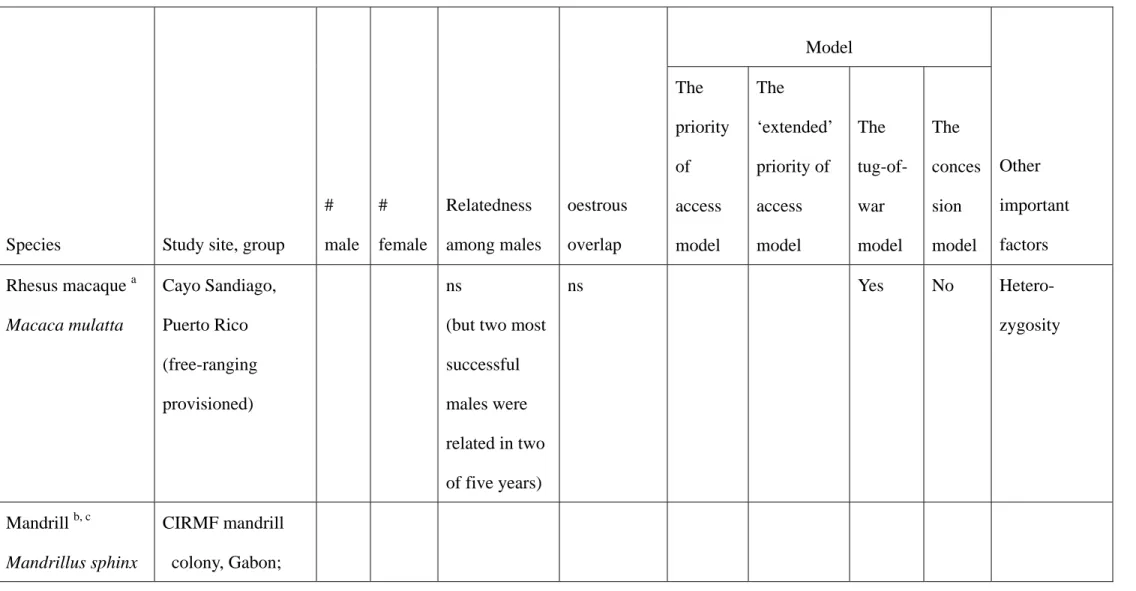
In what follows, we review four case studies of male skew in multimale-multifemale primate groups (Table 2). These examples are not meant to be exhaustive; rather we use selected examples to reveal how skew theory provides new insights to variation in male reproductive success in primates. We conclude this section with a summary, and then present comparative evidence in the following section.
Rhesus macaques
257 258 259 260 261 262 263 264 265 266 267 268 269
In rhesus macaques, males disperse from their natal groups, while females remain in the group in which they were born. Widdig et al (2004) investigated reproductive skew in a population on Cayo Santiago and found that the top-sire fathered between 19 and 30% of the offspring per year over a six-year period, while 69 to 79% of males sired no infants at all. In terms of specific tests, the authors showed that (1) males exhibited significant variation in skew, with a measure of skew (the B-index, Nonacs 2000) significantly different from zero in most tests; (2) the B index was not significantly associated with either average pairwise relatedness among males nor female synchrony (estimated indirectly from births); (3) heterozygosity of MHC genes predicted male reproductive success, highlighting the potential role of female choice. The authors concluded that their results support the compromise framework, as the concession model would predict few effects of female choice, a lower level of
relatedness among breeders, and stronger control of group reproduction by resident (dominant) males.
270 271 272
Mandrill
273 274 275 276 277 278 279 280 281 282 283 284 285 286 287 288 289 290 291 292 293 294
In the wild, mandrills (Mandrillus sphinx) live in groups of up to several hundred individuals (Abernethy et al 2002). Behaviour in these groups has not been investigated, largely due to the difficulties of habituating and observing behavior of mandrills in their natural habitat. Important information on this species has been provided by research from a semi-free-ranging captive colony (CIRMF Mandrill Colony, Gabon). In this population, only the alpha male exhibits the distinctive secondary sexual traits (e.g., bright colour of the face) characteristic of this extremely sexually dimorphic species. Although multiple males are present in the colony, paternity analyses have shown that the alpha male fathers 69% of offspring, indicating extreme reproductive skew among males (Setchell et al 2005).
Two studies have investigated different aspects of reproductive skew in this colony. Although these authors studied the same groups, some results differed between the studies, in part due to differences in the specific aims of each study, in samples collected and variables that were analyzed, and in statistical approaches. In one of these studies, Setchell et al (2005) investigated deviations in the alpha male’s reproductive success from the expected value based on the POA model. The authors showed that departures from the POA model increased as the number of males in a group increased (Table 2), which fits predictions from the extended POA and the tug-of-war models. By comparison, Charpentier et al. (2005a) studied factors affecting the failure of alpha males to sire offspring. These authors reported that relatedness among males, female oestrous synchrony, relatedness between the dominant male and females, and the
number of males affected paternity of the dominant male. Specifically, (1) the dominant male’s reproduction decreased as relatedness among males increased; (2) oestrous overlap decreased reproduction by the dominant male; (3) relatedness between the dominant male and females negatively affected reproduction by the alpha male. Although the behavioural mechanism for this result is unknown, incest avoidance may have played a role because the degree of heterozygosity correlated positively with individual reproductive success (Charpentier et al. 2005b). (4) Counter to predictions from the tug of war model and patterns found by Setchell et al. (2005) and more
generally in primates (van Noordwijk and van Schaik 2004; Kutsukake and Nunn 2006), the number of males correlated positively with the proportion of offspring that the alpha male sires (Charpentier et al, 2005a). To explain this result, Charpentier et al. (2005a) suggested that competition among subordinates increased as the number of males increases, deflecting competition away from the dominant male.
295 296 297 298 299 300 301 302 303 304 305 306 307 308 309 310 311 312 313
Although the effect of male number differed between the studies, both Setchell et al. (2005) and Charpentier et al (2005a) concluded that the limited control model best characterized this species; predictions of the concession model were never supported. Setchell et al. (2005) also noted that conditions in wild mandrills might produce weaker patterns of control than those found in the colony studied by these authors.
Mountain gorilla
314 315 316 317 318 319
There is variation in the number of males in groups of mountain gorillas (Gorilla gorilla) in the Virunga mountains, with multimale groups representing 40% of the groups in the population (Robbins et al 2001). Female reproductive cycles are short and it is rare that the receptive periods of two or more females overlap. The lack of overlap should tend to enable the dominant male to monopolize reproduction within a
group. However, paternity analyses have shown that subordinates also reproduce to some extent (about 15%), suggesting that the reproductive skew (estimated by the B index) is high but not complete (Bradley et al 2005).
320 321 322 323 324 325 326 327 328 329 330 331 332
In another study, Robbins and Robbins (2005) used an individual-based simulation model with demographic parameters from the same population studied by Bradley et al. (2005) to investigate the expected reproductive success of subordinates that remain in their group. The model revealed that remaining in a group benefits a subordinate more than dispersing. However, the model revealed that the dominant does not benefit from retention of subordinates, suggesting that dominant males do not concede reproduction. Thus, both Bradley et al. (2005) and Robbins and Robbins (2005) concluded that reproductive skew in this population corresponds better to predictions from the tug-of-war model than the concession model.
Chimpanzees
333 334 335 336 337 338 339 340 341 342 343
In chimpanzees, males remain in their natal group and exhibit a high degree of a fission-fusion sociality. Females develop sexual swellings when they are in oestrus, with synchronous oestrous relatively common. The dominant male has higher reproductive success, but subordinate males also reproduce (Constable et al. 2001). Boesch et al (2006) investigated paternity in chimpanzees of Taï National Park in Cote d’Ivoire using long-term records. They found that the proportion of reproduction by the alpha male decreased as the number of males increased and when female oestrous overlap increased. These results therefore agree with predictions from both the extended POA model and the tug-of-war model.
Summary of Case Studies
344
Overall, these studies suggest that limited control is a characteristic of male behaviour in primates (Table 2) and that the tug-of-war model or the extended POA model can explain variation in skew among male primates. However, these studies do not completely reject the concession model for the following reasons. First, empirical studies mainly tested predictions from mathematical models that were designed for systems other than primates, often assuming that the group contains only two individuals – a dominant and a subordinate. In contrast, mathematical models that incorporate more realistic parameters, such as three or more group members or the possibility of social queuing by subordinates, predict a reduced necessity of offering incentives by a dominant individual to a subordinate (in particular to a unrelated subordinate) relative to the two-player models (Kokko & Johnstone, 1999; Ragsdale 1999; Johnstone et al 1999; Reeve and Emlen 2000; Reeve and Shen, 2006). This makes it difficult to draw firm predictions for how relatedness should correlate with patterns of skew. Second, no studies in primates have succeeded in accurately quantifying parameters that are necessary to test the skew model, in large part because it is difficult to conduct experimental manipulations in primates. Crucially, these parameters include the probability of solitary reproduction by subordinates, fitness benefit of the dominant male when there are no subordinate males, and the effects of subordinate males’ presence on group productivity. Finally, the concession and tug-of-war models are not mutually exclusive, and can in fact coexist within a single framework (Johnstone 2000; Reeve and Shen, 2006).
345 346 347 348 349 350 351 352 353 354 355 356 357 358 359 360 361 362 363 364 365 366 367 368 369
Phylogenetic comparative analyses
Skew models have been regarded as a unifying framework for understanding the diversity of social systems seen in animals (Keller and Reeve 1994; Sherman et al.
1995), but surprisingly few studies have examined broad evolutionary patterns of skew within one clade of either vertebrates or invertebrates (Boomsma and Sundström 1998; Duffy et al. 2000; Faulkes et al. 1997). Such comparative perspectives are important in reproductive skew research for at least four reasons. First, comparative studies provide a means to understand the factors generating broad evolutionary patterns of skew (Nonacs 2000) and therefore can assess the generality of a pattern across species, leading to greater unification of models of social evolution. Second, comparative approaches offer an opportunity to test assumptions and predictions of skew models from an evolutionary perspective, and they can be used to test assumptions or predictions of skew models. Third, by identifying differences among species, comparative results can point to new variables to investigate in future field or laboratory research. Finally, comparative research can be used to generate new hypotheses, which can then be tested in the field or laboratory, or refined through theoretical models.
370 371 372 373 374 375 376 377 378 379 380 381 382 383 384 385 386 387 388 389 390 391 392 393 394
In previous primate research, cross-species comparisons have been conducted to examine the effects of seasonality on variance in mating or reproductive success (Cowlishaw and Dunbar 1991; Paul 1997). We conducted a phylogenetic comparative analysis on the determinants of “mating” skew in male primates, based on a database of species in multimale primate groups (in total from 84 studies representing 31 species in 17 genera, Kutsukake and Nunn 2006). Since few studies have investigated the distribution of paternity for a sufficient number of primate species, we investigated mating distribution. While many studies have shown that mating frequency predicts reproductive success (e.g., Smith 1981; Pope 1990; Ohsawa et al. 1993; de Ruiter et al. 1994; Paul and Kuester 1996; Soltis et al. 1997; Alberts et al. 2006), other studies failed to find such links (e.g., Curie-Cohen et al. 1983; Shively and Smith 1985; Inoue et al. 1991, 1993), possibly because many matings in primates are likely to be
non-reproductive (Soltis 2004). To deal with this problem, we used data that are most tightly linked to male reproductive success whenever possible; specifically, we preferred data on ejaculation frequency more than copulation frequencies, and copulation data at times when conception was most likely to take place (Kutsukake and Nunn 2006). Genetic information on actual reproduction in groups would clarify these issues and allow skew to be examined more directly, but such data are not yet sufficiently available to test the predictions in a comparative context.
395 396 397 398 399 400 401 402 403 404 405 406 407 408 409 410 411 412 413 414 415 416 417 418 419
In quantifying the magnitude of mating skew, we focus here on results using the “maximum mating proportion” (Bulger 1993), which is the proportion of mating by the most successful male. We also examined other skew indices, including the B index (Nonacs, 2000) and lambda (Kokko and Lindström, 1997). We investigated the effects of three variables: demographic factors (the number of males or females in a group), female reproductive factors that are related to the difficulties of monopolizing oestrous females (i.e., duration of the breeding season, duration of oestrus, and measures of oestrous overlap), and male dispersal pattern (categorized as male philopatry or male dispersal). Regarding male dispersal pattern, the concession model predicts high skew in male philopatric species relative to species in which males disperse because there is (1) a high probability that a dominant male has a brother within a group and (2) a lower probability that subordinates will disperse. Taken together, these factors reduce the need for the dominant male to provide a staying incentive.
The main results of our study (Kutsukake and Nunn 2006) can be summarized as follows. First, based on Nonac’s B, mating was significantly skewed among males in 75.4% of cases (43 / 57 cases), and the alpha male or resident male tended to mate more frequently. Second, using the independent contrasts method (Felsenstein 1985) and stepwise multiple regression, we found that only male number correlated with mating
skew (P<0.001), with the proportion of mating by the most successful male falling as the number of males in a group increases (Fig. 2). Finally, neither female reproductive proxies nor male dispersal pattern affected mating skew. Overall, these results are most consistent with the tug-of-war model and partially consistent with the extended POA model (in the sense that the number of males negatively affected skew).
420 421 422 423 424 425 426 427 428 429 430 431 432 433 434 435 436 437 438 439 440 441 442 443 444
This result raises the possibility that the effects of oestrous synchrony are not universal to all primate species, its effects are weak, or synchrony is difficult to quantify, all of which would limit our ability to detect a significant association in comparative analyses given existing data. Although the intensity of the correlation between dominance rank and reproductive success was affected by seasonality (Paul 1997), up to now, few studies have investigated paternity among males in relation to oestrous synchrony (Setchell et al 2005; Charpentier et al, 2005a; Boesch et al 2006).
One could argue that the concession model also predicts that mating skew should decrease as the number of males increases, specifically if the dominant male needs to pay staying incentives to each subordinate male. However, we also found a similar negative relationship in an intraspecific analysis of wild chimpanzees (Kutsukake and Nunn 2006). The negative relationship is not expected in a male philopatric species, such as the chimpanzee, because subordinate males have few opportunities for reproduction outside of their natal communities, and therefore do not need an incentive to stay.
Even with this intraspecific analysis, however, we cannot firmly reject the concession model. For example, a negative relationship between the number of males and mating skew can also be explained by the concession model because reproductive skew may decrease when the power difference between a dominant and subordinate is small (e.g., in a group with many males; Cowlishaw and Dunbar 1991); therefore, the
dominant may concede the reproduction as a ‘peaceful’ incentive to avoid a risky fight with powerful rival males (Reeve and Ratnieks 1993). Indeed, the power differences may be smaller in a group with a large number of males because one would expect that males are, on average, more similar in age (and therefore competitive ability). This idea needs further testing, but this example highlights the difficulty of testing between the different skew models, even in well-studied mammalian species.
445 446 447 448 449 450 451 452 453 454 455 456 457 458 459 460 461 462 463 464 465 466 467 468 469
In addition, our comparative study does not reject the possibility that the concession model applies to particular primate species, even if it is not a general explanation for patterns of skew across primates. As is shown by a recent synthetic model, the transactional framework and compromise framework are not mutually exclusive (Johnstone 2000; Reeve and Shen 2006). So, one model may fit one species but not others, or in certain demographic or ecological situations but not in others within a species. For example, even within a species, the dominant male may be able to exert complete control in a small group in which there is only one subordinate, but not in a large group with multiple subordinates. This possibility can be tested by investigating how the effects of relatedness on reproductive skew vary according to the number of subordinate males in groups.
Although our approach focused on males in short time intervals, such as a single breeding season, this approach can be used to examine complex life history trajectories (patterns of lifetime reproductive success). In addition, this approach could be applied to both sexes. For example, reproductive success among female primates can be estimated using long-term data. Finally, it would be interesting to apply this approach to other clades in which data on reproduction and phylogeny are widely available, such as birds, social insects, and in other well-studied mammalian groups, such as rodents, ungulates and carnivores.
470 471 472 473 474 475 476 477 478 479 480 481 482 483 484 485 486 487 488 489 490 491 492 493 494
Applying comparative approaches to other biological systems
Comparative tests can focus on either the predictions or the assumptions of skew models, and testing is possible if researchers have quantitative data for the distribution of reproduction or mating among group males. Here, in an attempt to stimulate further comparative research in other clades of animals, we list several methodological practices for conducting comparative tests of predictions related to reproductive skew models.
1) Carefully choose the hypotheses, predictions or assumptions to be tested. Within the framework of the models and the biology of the organisms, the researcher needs to consider alternative explanations and how different parameters might influence the predictions of a skew model. It is also important to incorporate the characteristics that are specific to the study animals because some parameters are difficult to quantify in some clades.
2) Collect data on mating or reproductive skew and other important variables such as group composition (e.g., number of males and females), relatedness, female behaviors, and reproductive biology. Data on reproduction are available in many non-primates (e.g., Ellis 1995), which could be used for comparative analyses. It is also important to obtain a phylogeny for the group of species being studied. “Supertrees” and other large-scale, dated phylogenies are now available for many species (Bininda-Emonds 2004), making this process easier than in the past.
3) Quantify the distribution of reproduction using several skew proxies (Nonacs 2003). Many studies will not provide these measures directly, and may not even provide information for the comparative biologist to calculate the measures. Thus, it might be necessary to use a simple index that maximizes sample size (in terms
of the number of species).
495 496 497 498 499 500 501 502 503 504 505 506 507 508 509 510 511 512 513 514 515 516 517 518 519
4) Test the hypotheses using phylogenetic comparative methods, such as independent contrasts (Felsenstein 1985; Harvey and Pagel 1991; Nunn and Barton 2001). It is important to check whether the data show phylogenetic signal (Blomberg and Garland 2002), to test the statistical and evolutionary assumptions, and to determine whether the results are robust to alternative assumptions.
CONSEQUENCES OF REPORDUCTIVE SKEW
Previous studies mainly investigated the causes of the skew and tested specific models. An important new direction in skew research is to consider the consequences of reproductive skew on other biological traits, including social structure and individual social strategies (Fig. 1; Heinze 1995; Widdig et al. 2001; Cant & English 2006). For example, in some systems, the number of breeders and characteristics of the breeding queue could influence optimal group size (Cant and English 2006). With the goal of developing new questions for future studies, we briefly discuss two consequences of reproductive skew in male primates: effects on within-group relatedness and the spread of disease.
Reproductive skew and within-group relatedness
In species characterized by high skew, infants born in a short period are more likely to be paternally related. For example, Widdig et al. (2004) found that in a high-skew rhesus macaque troop at Cayo Santiago, 74% of the infants had at least one paternal sibling in the group, and individuals had almost four times as many paternal as maternal siblings. In contrast, infants in low skew societies are more likely to be fathered by different males, thus tending to reduce the level of relatedness at the group
level. The paternal relatedness among group members should have a major impact on a wide range of social behaviours, including affiliation, cooperation, competition and mate choice (Hamilton 1964, Chapais and Berman, 2003).
520 521 522 523 524 525 526 527 528 529 530 531 532 533 534 535 536 537 538 539 540 541 542 543 544
Several studies have suggested that individuals recognize paternal relationships and adjust their behaviour accordingly. For example, skew is high in male western gorillas, and the silverbacks of different groups are closely related (Bradley et al. 2004). This result may explain the occurrence of non-agonistic encounters between groups observed in this species, which might be unexpected in such a sexually dimorphic species in which male-male competition is likely to be especially intense. Paternal half-siblings are more affiliative with one another than unrelated individuals in rhesus macaques (Widdig et al. 2001) and in savanna baboons (Smith et al. 2003; see also Silk et al. 2006). Also in baboons, paternal half-siblings showed less affiliative and sexual behaviour during consortships than did unrelated pairs (Alberts 1999). As a final example, infants were supported by a biological father (Buchan et al. 2003) or were not the target of infanticide by the biological father in species living in multimale groups (Borris et al 1999a,b; Soltis et al. 2000).
When reproductive skew is high and the dominant male’s tenure is long enough for his female offspring to mature sexually, it could be adaptive for the dominant male to discriminate the paternity of the offspring and avoid mating with his daughters. In wild white-faced capuchin monkeys (Cebus capucinus), for example, the probability of reproduction by the alpha male varied with whether or not a female was a daughter of the alpha male, with a lower probability of reproduction between the alpha male and his daughter (Muniz et al. 2006). It would be interesting to investigate whether such incest avoidance mechanisms are common in primates, because some studies have found evidence for incest avoidance (Table 2), while others have not (Constable et al. 2001). If
incest avoidance is an important selective force, strong skew combined with long male tenures could reduce future opportunity for the alpha male to reproduce within a group, thus creating an incentive for secondary dispersal.
545 546 547 548 549 550 551 552 553 554 555 556 557 558 559 560 561 562 563 564 565 566 567 568 569
As discussed above, the degree to which paternal relatedness affects individual behaviour and social structure represent important areas for future research. In addition, it will be important to uncover the proximate mechanisms responsible for identifying paternal kin (Rendall 2004). It is possible, for example, that dominant males make use of their information on the monopolization of receptive females as a proximate cue to assess the probability that they are fathers of the offspring. Similarly, for human observers, it may be possible to estimate the magnitude of reproductive skew a posteriori from the genetic relatedness among infants and juveniles in a group.
Reproductive skew and the spread of infectious disease
Reproductive skew also can have consequences for patterns of social contact within social units, thus impacting the spread of disease within primate groups (Nunn and Altizer 2006). In a high skew primate group under the tug-of-war model, for example, one or a few males will gain access to the vast majority of mating opportunities. Thus, there is likely to be intense competition among males as they fight to improve or maintain their dominance ranks. This fighting causes wounds for males by biting and scratching and can result in the spread of disease, as demonstrated in the case of retroviruses (SIV and STLV) in a semi-free-ranging colony of mandrills (Nerrienet et al. 1998). In addition to being involved in male intrasexual competition, a high-ranking male in a high skew society also has better access to mates, resulting in higher rates of sexual contact. Thus, such a male can act as a contact point for sexually transmitted diseases (STDs; Graves and Duvall 1995), potentially even
selecting for reduced skew (Thrall et al. 2000; Kokko et al. 2002). If a female is already infected with an STD at the time that a new male rises in rank, this male is likely to become infected shortly after he attains high rank; he can thus serve as the source of infection for the many females that he mates with during his tenure as the alpha male.
570 571 572 573 574 575 576 577 578 579 580 581 582 583 584 585 586 587 588 589 590 591 592 593 594
A number of models have investigated the epidemiology of STDs in both human (Anderson and May 1991) and non-human systems (Thrall et al. 1997; Boots and Knell 2002; Kokko et al. 2002). In the context of variance in male mating skew, for example, Thrall et al. (2000) developed an individual based model to explore how variance in mating success, patterns of female dispersal and mortality rates of both sexes influence the spread of STDs. Given that the simulated population had an equal number of males and females, every male would have one female if there was no skew (equivalent to monogamy); each additional female assigned to a male means one less female for another male, resulting in increased reproductive skew. The simulations revealed that the prevalence of STDs is higher as the degree of polygyny (reproductive skew) increases.
A challenge in applying these concepts to generate testable predictions is that low skew in multimale-multifemale primates groups can also favour the spread of an STD. Thus, if males have relatively equal access to females, this could result in a higher rate of mating with more males throughout the female’s cycle, possibly as a strategy to reduce the risk of infanticide (Hrdy and Whitten 1987; van Schaik et al. 1999). And of course, increased promiscuity should increase the spread of an STD (Anderson and May 1991). This promiscuity is likely to increase the prevalence to even higher levels than revealed by models of STD spread under skew, such as the Thrall et al. (2000) study, especially if most subordinates have some mating success.
Thrall et al.’s (2000) STD model provides a way out of this conundrum, however, because output from the model also predicts a higher prevalence of infection in females than in males as reproductive skew increases, i.e., a sex difference is predicted. Kokko et al. (2002), in a different modeling approach, confirmed that female choice for a particular (presumably high-ranking) male can also lead to higher prevalence of infection in females. Thus, a critical prediction is that higher skew will produce not only high prevalence (relative to, say, monogamy); increasing skew should also produce a sex difference in the prevalence of an STD, with higher prevalence in females than in males. This prediction has been tested and supported using data on STDs in primates (Nunn and Altizer 2004). A next step is to examine whether sex-differences also correlate with skew and other variables that influence the establishment of an STD, including mortality rates, dispersal, and differences in transmission probabilities between the sexes (e.g., with females potentially being more susceptible to an STD). In addition, it will be important to bring queuing or life history (age dependency) into the STD models, because if most individual males have some mating opportunities over their lifetimes, the difference in STD exposure between the sexes may become more narrow.
595 596 597 598 599 600 601 602 603 604 605 606 607 608 609 610 611 612 613 614 615 616 617 618 619
CONCLUSIONS
This chapter discussed the causes and consequences of reproductive skew in male primates. Several studies have investigated the assumptions of the transactional framework in primates in order to test skew theory. Empirical studies showed that the tug-of-war model may explain the pattern of skew among males better than the concession model. Our comparative studies revealed a negative association between the number of males in a group and skew, which agrees with previous findings in primates
(Setchell et al. 2005; Boesch et al. 2006; reviewed in van Noordwijk and van Schaik 2004) and also agrees with predictions from the tug-of-war model. Therefore, we tentatively conclude that incomplete control is a general characteristic of male primates, but more studies are needed to test the assumptions or predictions of the concession model.
620 621 622 623 624 625 626 627 628 629 630 631 632 633 634 635 636 637 638 639 640 641 642 643 644
The priority-of-access (POA) model (Altmann 1962) has had a major impact in studies of male reproductive success in primates. This model highlighted the effect of oestrous overlap on the distribution of reproduction among males in multi-male multi-female groups, including non-primates. A major conclusion of our chapter is that the POA model – especially an extended version that incorporates the number of males – is almost indistinguishable from the compromise framework. This is particularly true with regard to the predictions, where only one prediction differs (Table 1). It might therefore seem that the skew framework represents “new wine in an old bottle.” This would be misleading, however, as the skew framework is actually much broader than the previous POA model. For example, it builds significantly on POA by encapsulating factors involving relatedness, breeding opportunities and costs of dispersal.
Several challenges remain for the future. First, the present mathematical models of reproductive skew are not designed to apply to primate social systems. In particular, it would be worthwhile to develop skew models that incorporate three or more players (Johnstone et al 1999; Reeve and Emlen 2000), social queuing (Kokko & Johnstone, 1999; Ragsdale 1999; Mesterton-Gibbons et al. 2006), female influences such as incest avoidance (Cant & Reeve, 2002; Johnstone, 2000), and female choice for males with particular biological traits (“good genes” or high dominance rank). Recent mathematical models in which one individual adjusts behaviour in response to the
behaviour of the other individual (negotiation game: McNamara et al. 1999; Cant and Shen 2006) may be more appropriate in primates, because social interactions in primates change temporally according to the strategy of opponents. Also, an individual-based model based on empirical demographic parameters would be a useful tool for generating more refined predictions for patterns of skew in primates (e.g., Robbins and Robbins 2005).
645 646 647 648 649 650 651 652 653 654 655 656 657 658 659 660 661 662 663 664 665 666 667 668 669
Second, no empirical studies of primates have successfully estimated the parameters that are needed to distinguish among the different skew models. These parameters include the links between competition within groups and group productivity and ecological constraint that determines the probability of solitary reproduction. This may represent a limitation of skew theory, with very few predictions distinguishing the different models. Nonetheless, experimental studies, including manipulating group composition, would help to more formally test skew theory in primates. Such tests could be conducted in semi-free-ranging groups.
Third, most of the studies in primates estimate skew in a relatively short time period. Thus, it is unknown how short-term skew is associated with long-term (i.e., lifespan) reproductive success (Altmann et al. 1996).
The consequences of reproductive skew have been largely unexplored, yet these topics offer great opportunities for future research in primates. Irrespective of causes of skew, how a given magnitude of skew affects social structure, individual decision-making, and other biological traits that relate to reproduction is a promising area for both empirical and theoretical research. For example, investigating the relationship between skew and the prevalence of STDs could have important implications for conservation biology, given that STDs often cause sterility (Canfield et al. 1991; Lockhart et al. 1996).
In conclusion, bringing the skew paradigm to primatology may yield new perspectives for understanding primate behaviour, specifically by integrating more diverse factors that are relevant to male and female decisions on group formation, interactions within groups, and reproductive strategies. Thus, skew models could play a major role in developing an integrative model of primate socioecology. Key future directions will involve developing skew models that are more appropriate for primates, collecting data to test the assumptions and predictions of these models, and investigating the consequences of reproductive skew for primate behavior. Moreover, a primate perspective on reproductive skew should help to ground models of skew more firmly, specifically in the context of multiple competitors and queuing within groups.
670 671 672 673 674 675 676 677 678 679 680 681 682 683 684 685 686 687 688 689 690 691 692 693 694
SUMMARY
In this chapter, we considered the causes and consequences of skew in male primates. Although our understanding of the causes of skew is still in its infancy, empirical studies thus far support the compromise framework (tug-of-war model) rather than the concession model. Our assessment of the different models also suggests that the priority of access (POA) model makes predictions that are very similar to the compromise framework, but that skew models expand significantly on the POA model by including additional factors that relate to patterns of reproduction within groups. Our phylogenetic comparative analyses on mating skew in male primates also provided supporting data for the tug-of-war model because mating skew decreased as the number of males increased, suggesting that monopolization of females becomes more difficult when there are more rivals. However, there have been no studies that represent strong tests of skew models, possibly because of difficulties in estimating parameters that are necessary for quantitative analyses. Future research could help to clarify the causes of
skew, including development of mathematical models that are more suitable to primate societies, empirical studies based on paternity tests, and comparative approaches to investigate interspecific patterns of skew in other biological systems.
695 696 697 698 699 700 701 702 703 704 705 706 707 708 709 710 711 712 713 714 715 716 717 718 719
Previous studies commonly investigated the causes of skew, but fewer have considered the consequences of skew on other physiological and social parameters. We discussed two examples of how the magnitude of reproductive skew affects other biological traits of interest to behavioral ecologists, focusing on within-group relatedness and sexual transmitted diseases. Of these, it appears that effects on within-group relatedness could have the largest effects on patterns of primate sociality. The introduction of reproductive skew models into primate research is likely to provide new insights to primate social and reproductive behaviour in the future, while a primate perspective is likely to stimulate new skew models.
ACKNOWLEDGEMENTS
We thank Reinmar Hager and Clara Jones for their invitation to contribute this chapter, and we thank Mike Cant, Sarah Hodge, Kavita Isvaran, Jo Setchell and two anonymous reviewers for helpful comments and discussion. This study was supported by JSPS Research Fellowships, RIKEN Special Post-Doctoral Researchers Program, financed by JSPS core-to-core program HOPE (to NK) and the Max Planck Society (to CN).
REFERENCES
Abernethy, K.A., White, L.J.T. & Wickings, E.J (2002). Hordes of mandrills (Mandrillus sphinx): extreme group size and seasonal male presence. Journal of Zoology, London, 258, 131-137.
Alberts, S.C. (1999). Paternal kin discrimination in wild baboons. Proceedings of the Royal Society of London, Series B, 266, 1501-1506.
720 721 722 723 724 725 726 727 728 729 730 731 732 733 734 735 736 737 738 739 740 741 742 743 744
Alberts, S. C., Buchan, J. C. & Altmann, J. (2006). Sexual selection in wild baboons: from mating opportunities to paternity success. Animal Behaviour, 72:1177–1196
Alberts, S.C., Altmann, J. & Wilson, M. L. (1996). Mate guarding constrains foraging activity of male baboons. Animal Behaviour, 51:1269–1277
Alberts, S.C., Watts, H.E. & Altmann, J. (2003). Queuing and queue-jumping: long-term patterns of reproductive skew in male savannah baboons: Papio cynocephalus. Animal Behaviour, 65, 821–840.
Altmann, S.A. (1962). A field study of the sociobiology of the rhesus monkey, Macaca mulatta. Annals of the New York Academy of Sciences, 102, 338–435
Altmann, J., Alberts, S.C., Haines, S.A., Dubach, J., Muruthi, P., Coote, T., Geffen, E., Cheesman, D.J., Mututua, R.S., Saiyalel, S.N., Wayne, R.K., Lacy, R.C. & Bruford, M.W. (1996). Behavior predicts genetic structure in a wild primate group. Proceedings of the National Academy of Sciences of the United States of America, 93, 5797-5801.
Anderson, R.M. & May, R.M. (1991). Infectious diseases of humans: dynamics and control. Oxford University Press.
Bercovitch, F.B. (1983). Time budgets and consortships in olive baboons (Papio anubis). Folia Primatologica 41, 180–190.
Bininda-Emonds, O.R.P. (ed.) 2004. Phylogenetic Supertrees: Combining Information to Reveal the Tree of Life. Kluwer Academic Publishers, Dordrecht, The Netherlands.
Blomberg, S. P., and T. Garland Jr. 2002. Tempo and mode in evolution: phylogenetic
inertia, adaptation and comparative methods. Journal of Evolutionary Biology 15, 899-910.
745 746 747 748 749 750 751 752 753 754
755 756 757 758 759 760 761 762 763 764 765 766 767 768
Boesch, C., Kohou, G., Nene, H. & Vigilant, L. (2006). Male competition and paternity in wild chimpanzees of the Tai forest. American Journal Physical
Anthropology, 130, 103-115.
Boomsma, J. J. & Sundström, L. (1998). Patterns of paternity skew in Formica ants. Behavioral Ecology and Sociobiology, 42, 85-92.
Boots, M. & Knell, R.J. (2002). The evolution of risky behaviour in the presence of a sexually transmitted disease. Proceedings of the Royal Society of London, Series B, 269, 585-589.
Borries, C.K.L., Epplen, C., Epplen J.T. & Winkler, P. (1999a). Males as infant protectors in Hanuman langurs (Presbytis entellus) living in multimale groups- defense pattern, paternity and sexual behavior. Behavioral Ecology and Sociobiology, 46, 350-356.
Borries, C., Launhardt, K., Epplen, C., Epplen, J.T. & Winkler, P. (1999b). DNA analyses support the hypothesis that infanticide is adaptive in langur monkeys. Proceedings of the Royal Society of London, Series B, 266, 901-904.
Bradley, B.J., Doran-Sheehy, D.M., Lukas, D., Boesch, C. & Vigilant, L. (2004). Dispersed male networks in western gorillas. Current Biology, 14, 510-513. Bradley, B.J., Robbins, M.M., Williamson, E.A., Steklis, H.D., Steklis, N.G., Eckhardt,
N., Boesch, C. & Vigilant, L. (2005). Mountain gorilla tug-of-war: silverbacks have limited control over reproduction in multimale groups. Proceedings of the National Academy of Sciences of the United States of America, 102, 9418-9423