The 28th Annual Conference of the Japanese Society for Artificial Intelligence, 2014
4C1-3
Fully Automated Cyclic Planning for Large-Scale Manufacturing Domains
Masataro Asai
Alex Fukunaga
Department of General Systems Studies
Graduate School of Arts and Sciences
The University of Tokyo
In domains such as factory assembly, it is necessary to assemble many identical instances of a particular product. While modern planners can generate assembly plans for single instances of a complex product, generating plans to manufacture many instances of a product is beyond the capabilities of standard planners. We propose ACP, a system which, given a model of a single instance of a product, automatically reformulates and solves the problem as a cyclic planning problem.
1.
Introduction
Domain-independent planning is a promising technology for assembly planning in complex, modern robotic cell-assembly systems consisting of multiple robot arms and specialized devices that cooperate to assemble products [Ochi 13]. In a small-scale, feasibility study, Ochi et al showed that although standard domain-independent plan-ners were capable of generating plans for assembling a single instance of a complex product, generating plans for assem-bling multiple instances of a product was quite challenging. For example, generating plans to assemble 4-6 instances of a relatively simple product in a 2-arm cell assembly system pushed the limits of state-of-the-art domain-independent planners. However, real-world cell-assembly applications re-quire mass production of hundreds/thousands of instances of a product.
Ochi et al proposed a (cyclic) “steady-state” (SS) model, where the problem of generating a plan to manufacture many instances of a product is reformulated as a cyclic planning problem. In an instance of the general cyclic plan-ning/scheduling problem [Draper 99], the start and end states of the planning instance correspond to a “step for-ward” in an assembly line, where partial products start at some location/machine, and at the end of this “step”, (1) all of the partial products have advanced forward in the as-sembly line (2) one completed product exits the line, and (3) assembly of a new, partial product has begun. Ochi et al showed that when an appropriate, manually generated, start/end state for this cyclic planning instance was pro-vided to a planner, the resulting manufacturing process was competitive with a human-generated, cyclic assembly plan. However, identification of the “steady-state”, the crucial component of this approach, was an entirely manual pro-cess – the planner was only responsible for computing paths between the cycle start/end points, so the overall process was far from automated. This paper∗1 proposes ACP
(Au-Contact: [email protected]
∗1 Note that this is an extended abstract of an international conference paper [Asai 14]. Since much of the details are omit-ted due to space, please refer to the original paper for more information. The camera-ready copy is going to be public at
http://guicho271828.github.io/publications.
図1: ExampleCELL-ASSEMBLYinstance: model2a.
tomated Cyclic Planner), which fully automates the cyclic scheduling process for “mass manufacturing”, e.g., cell as-sembly.
2.
CELL-ASSEMBLY Domain
CELL-ASSEMBLYis a PDDL domain with STRIPS-style actions, negative-preconditions, action costs, and a hierar-chical type structure.
In theCELL-ASSEMBLYdomain, the task is to complete many products on an assembly line with robot arms. There are a number of assembly tables and machines that per-form specific jobs such as painting a product or tighten-ing a screw. In each assembly table, various kinds ofparts
are attached to abase, the core component of the prod-uct. For example, a problem requires two kinds of parts,
part-a,part-b, to be attached to each one ofbase0,base1. The final products look like base0/part-a/part-b and
base1/part-a/part-b.
Since the job dependencies (encoded as preconditions on sequencing operators) specify the ordering of the assembly process, planning the efficient movement of the robot arms that move bases/parts through the assembly process is the primary task left to the planner [Ochi 13].
3.
Overview of ACP
ACP takes as input amanufacturing order, which consists of a PDDL domain, a name of a single instance of aproduct, a typed PDDL problem file specifying amodel for it, and
N, the number of instances of the product to manufacture. Currently, we support STRIPS-style actions, negative
The 28th Annual Conference of the Japanese Society for Artificial Intelligence, 2014
conditions and action costs. The output of ACP is a plan for manufacturingN instances of the product.
ACP currently assumes the following:
• Single Product Type per Order:As an input, ACP takes the order to assembleNinstances of a particular prod-uct. It does not handle the mixed orders in which mul-tiple types of products are assembled simultaneously.
• Uniform Manufacturing Process: To fulfill the order, all instances of product must be assembled in the exact same order using the exact same machines.
• Indistinguishable Parts: Suppose a widget can be as-sembled from a base and two parts, part1and part2. ACP assumes thatinstancesof all components are in-distinguishable, i.e., all the bases are identical to each other, and all instances ofpart1are identical to all other instances ofpart1.
At a high level, ACP performs the following steps:
1. A standard domain-independent planner is used to find a plan for manufacturing a single instance of the prod-uct. This is thetemplate planwhich is used as the basis for the cyclic plan.
2. ACP analyzes the template plan using the name of the product as well as the original input PDDL. It extracts the structures that are necessary in order to specify start/end points for cyclic plans.
3. Based on the analysis in the previous step, a set of candidate steady-state start/end points for cyclic plan-ning are constructed. This large set of candidates are pruned to a manageable number using some filtering heuristics.
4. Each remaining candidate steady-state is evaluated by solving a temporal problem called1-cycle PDDL prob-lem, which corresponds to 1 iteration of the cyclic plan, with a standard temporal planner. The steady-state resulting in the minimal makespan plan is saved.
5. A plan to generateN instances of the product is gen-erated by sequencing (a) a path from the initial state to the beginning of the first cycle (setup phase), (b)
N unrolled iterations of the best cyclic plan, and (c) a path from the end of the last cycle to the final state where all products have exited (cleanup phase).
3.1 Difficulties in Identifying Steady States
A candidate steady-state (SS) for cyclic plans in the CELL-ASSEMBLYdomain can be described in terms of the current state of a set of (partially processed) bases e.g. “there are three bases at a table, painter and machine, and the second one has been painted.” The corresponding SS,
Si, is a set of partially grounded state variables, e.g., {(at
bi+2table), (atbi+1painter), (paintedbi+1), (atbimachine)}.Si corresponds to a 1-cycle PDDL problem Π(Si), where the initial state and the goal condition includes Si and Si+1,
respectively.
Given such a representation, identifying agood SS is re-duced to systematically enumerating and evaluating candi-date statesS, based on the quality (e.g. minimal makespan) of the plan of Π(S). However, finding the best plan is not trivial because both too large and too small number of prod-ucts in the system results in inefficiency. Finding the candi-date SS’s is also difficult. In principle, we could enumerate all states reachable from some initial state and test whether each such state is a feasible SS, but this is clearly imprac-tical for any nontrivial problem instance.
3.2 Typed Predicates
In describing our methods, we use the following notation ofTyped Predicates. In PDDL domains with:typing require-ments, a type can be assigned to each object. If no type is specified, it is defaulted to a predefined typeobject, which we abbreviate as * (don’t-care). We denote type(o) = τ
whenois of typeτ, whereois either an object or a param-eter (of predicates and actions). Types can have a hierar-chy, such as “typeAis asubtype of B”, which we denote byA≤τ B. In turn, B is asupertypeof A. Also, we write
o1 ≤τ o2 , when type(o1) ≤τ type(o2) for objects o1 and
o2. Atyped predicate is a predicate whose parameters are
specialized to some type, including *. We distinguish be-tween two typed predicates which have the same name but are specialized to the different types. For two typed predi-catesp1 andp2 with the same name, we sayp1 completely
specializesp2 when:
k= 1 or 2,⟨vki⟩=params(pk),∀i;v1i≤τ v2i whereparams(p) is a parameters of a predicatep, and we denote this byp1≤τ p2. Note that we also useparams(a) to
suggest the parameters of an actiona. Also,(pred a b)means an ungrounded typed predicate with parameters specialized to typea,b.
3.3 Building and Analyzing a Plan Template
As stated in Sec. 3., ACP takes a PDDL domain, a type
τ, a number N and a problem. The problem may contain
n≥1 instances of a single product, butnshould be small so that a good plan is obtained. We solve the problem with a standard planner and get a planP, which we call as a “plan template”. We arbitrarily choose one objectb0 of typeτ in
the problem. The first major step is here: we identify the “processing steps” ofb0. This is formally defined as follows:
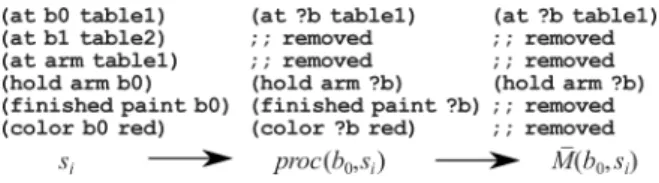
Definition 1 (Process). proc(b0, si), the /process/ for a productb0ini-th statesithat appears during the execution ofPis the subset of propositions{f∈si|b0∈params(f)}
insi such that every occurrence of b0 has been replaced
with a variableb.
Definition 2 (Whole Processes). The Whole Processes, proc∗(b
0), of a productb0inPis the sequence ofproc(b0, si) for all statesi inP.
For example, the first step of Fig. 2 gives an example of computingproc(b0, si) from some si. In effect,proc(b0, si) removes all propositions fromsithat do not involveb0. By
applying this procedure to every step of the plan template,
The 28th Annual Conference of the Japanese Society for Artificial Intelligence, 2014
図2:A state, its correspondingprocessandmovement
we extract proc∗(b
0), which captures the flow of a base as
it progresses through the plan.
The next major step is to automatically extract things that correspond to “places” and “movements”. In Fig. 2, ACP must correctly automatically infer that “table1” is a place, but “red” is not, but without access to human-level understanding of natural language and commonsense knowledge.
3.3.1 Owner/Lock Predicates
The key difference between “place” and “non-place” is the implication of (or lack thereof) a particular kind of mutual exclusion relationship. Note that(atb1 table1)is not just a
statement about the location ofb1. It also implies something
about the occupancy oftable1, i.e., ifb1is attable1, then it is
occupied byb1. In this case, it is a resource with capacity 1,
and can be treated as a mutex resource.If all “places” have unit capacity, any time a product moves into a “place”, it must grab a lock on that place.Otherwise, the model would allow multiple products to occupy a single place.
Suppose we model a 2-D grid of cells that can be occupied by objects. We need to infer that (2d x b y)with types(2d coord base coord)and(occupied x y)with(occupied coord coord) is a lock/owner pair (coord means “coordinate”.) Though much of the detail is omitted here, essentially we checks if (2d x b y)implies (occupied x y). It requires the following conditions to hold in any actions:
1. When occupying a place, ensure the place is not in use, and acquire the lock.
2. When leaving the place, release the lock.
For example, we check for any action such that (1) if it adds (2d x b y), it has(not (occupied x y))in the precondition and it adds(occupied x y)at the same time, and (2) if it deletes (2d x b y), it also deletes(occupied x y).
We formalize the above notion as follows. First, we as-sume:negative-preconditions, because it makes the definitions of “locks” and “owners” straightforward. Let the domain
D =⟨
Pτ,A
⟩
where Pτ is the set of typed predicates and
Athe operator set. Also,o, µ∈ Pτ ,o=params(o) =⟨oi⟩ and m=params(µ) =⟨mj⟩ . Assume|o| ≥ |m|. Also, let
pxmean an application of a predicatepto parametersx.
Definition 3 (Mapping of Parameters). ⟨o, µ⟩has a map-ping of parameters π when it is a one-to-one projection
π:j7→is.t.∀mj∈m;i=π(j) ⇒ oi≤τ mj.
Definition 4 (Matching Criteria in Action Definition). Assume ⟨o, µ⟩ has a mapping π. Let a an action, where params(a)⊇x⊇y. Then⟨ox, µy⟩/match/⟨o, µ, π⟩when:
∀j; (yj=xπ(j))∧(yj≤τ µj) and ∀i;xi≤τ oi.
Definition 5 (Owner-Lock relationship). We sayoandµ
are in aOwner-Lock relationshipwhen⟨o, µ⟩has a mapping
π and, ∀a ∈ A, when ⟨ox, µy⟩ match ⟨o, µ, π⟩, both the followings hold:
ox∈e
+(a)⇒µ
y∈e
+(a)∧µ˜
y∈precond(a)
ox∈e
−(a)⇒µ y∈e
−(a)
wheree+(a),e−(a) andprecond(a) is the add effect, delete effect and precondition ofa, and ˜µis a negative precondition (notµ).
3.3.2 Movement
Returning to Fig. 2, we finally have a method to extract only the “change of the place” orMovement inproc∗(b) by filtering the owners in eachproc(b, si) and remove the un-changed (set-equal) part. The figure shows that our method correctly filters “non-places” out, such as finish and color. The formal definition follows:
Definition 6(Movement). LetObe the set of owner pred-icates. For a productbin a template plan, fori-th statesi that appears during the execution ofP, Movement ¯M(b, si) is:
¯
M(b, si) ={f∈proc(b, si)| ∃o∈O;f≤τ o}
Definition 7(Whole Movements). We formWhole Move-mentsM¯∗(b) by enumerating all ¯M(b, s
i) in a template plan
P and iteratively removing one of each pair of movements that are adjacent and set-equal to each other.
The fact that(hold arm ?b)in Fig. 2 is a “location” may be confusing: what happens if the arm moves? Would this not imply that the position of?bis also changed? The answer is no – what matters is theresource usagein the system, and notwhere the spatial location of the resource, e.g., changing the arm position does not affect whether the gripper on the arm is occupied by a base or not.
3.4 Enumerating and Filtering the Steady States
Based on a sequence of Movements ¯M∗, we can represent a candidate SS as a set of indices{i0, i1, . . . ik−1}(See Fig. 3) wherekis a number of partial products in a cycle. Each number represents which set of owners in ¯M∗a partial prod-uct has at the beginning of a cycle. Note that the indices
i0= 0 andik−1= M¯∗
represent the states “not yet in the
system” and “already out of the system”, respectively, and the corresponding partial products occupy no locks. We call this representation an MS3, which stands for “Movements-Simplified Steady States”. We enumerate all feasible MS3 which satisfy the mutex constraints by adding a new num-ber to the already checked MS3, initially {0}. There are potentially 2|M¯∗|−1
candidate SS’s (the first elementi0= 0
is fixed).
Brute-force evaluation of all candidates to identify the best SS is impractical, both because the difficulty of each 1-cycle problem increases withkand because large 2|M¯∗|−1 can be intractable. Therefore we applied some filtering methods on these candidates.
The 28th Annual Conference of the Japanese Society for Artificial Intelligence, 2014
図3:Example “Movements-Simplified Steady States”(MS3)
3.4.1 Mutex Focused Planning
Our main filtering method is calledMutex Focused Plan-ning which removes all candidate steady-states from which there is no path (plan) to the beginning of the next cycle, due to unsatisfiable mutex constraints (e.g., deadlocks, re-source starvation). For example, in the CELL-ASSEMBLY domain, consider a candidate MS3 which puts products on
all possible locations. This results in deadlock, because all arms, tables and machines are occupied and no base can move.
There might be various methods to detect such dead-locks but we chose a simple Dijkstra search to reduce the implementation effort. In this search, each state is a MS3, e.g., {0,2,5}. Its successor states can be obtained by incrementing one of the elements of the MS3, i.e.,
{1,2,5},{0,3,5},{0,2,6}. However, some of these succes-sor states may violate the mutex constraints and they should be discarded.
When a SS is represented by MS3 {0, i
1, . . . , ik−1} and it has a path to{
i1, . . . ik−1,
M¯∗
}
in the search space de-scribed above, then we say that it has amutex-feasible path (MFP). We remove all SS’s with no MFP.
3.4.2 Filtering Heuristics
Even after eliminating all candidate SS’s without MFP, we further reduce the set of candidates, based on the fact that any point on a cyclic path can be a start of the path. We instantiate and fully evaluate only the first instance of such a group, discarding the rest of the members.
3.5 Planning the Cycles Based on Steady States
After reducing the number of SS’s, we build and solve a corresponding 1-cycle PDDL problemΠ(S) for each SSS. The initial state of Π(S) consists of predicates that either (1) describe the initial state of each partial product in SS, or (2) describe the global initial state. To construct (1), we find corresponding proc(b, si) for eachj in MS3 {. . . j . . .} and ground it with a product of an arbitrary name. (2) is excerpted from the initial state of the template problem – only those predicates that do not have a product in its arguments such as(at arm table1)are chosen. Additionally, (3) appropriate lock predicates are added, such as (occu-pied table1),(holding arm). The goal state construction is sim-ilar and straightforward. We solve each Π(S) with a stan-dard domain-independent planner, currently Fast Down-ward [Helmert 06] with the LAMA2011 emulation config-uration. We choose the minimal makespan plan, store the corresponding SS and unroll the plan for an arbitrary num-ber of productsN.
In addition to the 1-cycle problem, we also need to plan the setup that takes us from the initial state to the begin-ning of the cycle, and a cleanup that takes us from the end
of the last cycle to the final state. These are straightforward and not described here due to space. Finally, we concate-nate them and get the whole solution ofN products.
4.
Conclusions
We described ACP, a domain-independent system for generating cyclic plans for “manufacturing” domains where the requirement is to generate many instances (up to thou-sands of units) of a single product. Generating more than a handful of instances of a product is beyond the capability of standard domain-independent planners. ACP overcomes this limitation with a novel, static domain analysis system which performs fully automatic generation of a cyclic plan for assembling many instances of a single product.
While motivated by a factory cell-assembly application, ACP is domain-independent. Based on static analysis of the input PDDL model and a plan template for assembling 1 instance of a product (generated using a standard domain-independent planner), ACP automatically extracts all of the required structure. Other than the product’s name in the template problem, no labels/annotation to the PDDL model are required, and no assumptions are made about the names of the types or other objects. ACP automatically in-fers how a (partially processed) product progresses through the system, and how viable candidates for the start/end states for cyclic planning can be generated.
Currently, there are significant constraints on the kinds of cyclic plans that can be generated by ACP. ACP assumes that all instances of the product progressing through the manufacturing plant will be processed in the exact same way, i.e., in the cyclic plan, each product instance is pro-cessed in the exact same order and manner. In addition, ACP currently does not allow mixed orders, e.g., “assemble
N1 instances of product P1 and N2 instances of product
P2”. Relaxing these restrictions could enable more efficient
usage of available resources and also make ACP applicable to a broader class of applications, as well as allow further exploitation of parallel actions.
参考文献
[Asai 14] Asai, M. and Fukunaga, A.: Fully Automated Cyclic Planning for Large-Scale Manufacturing Domains, inInternational Conference on Automated Planning and Scheduling(2014)
[Draper 99] Draper, D., Jonsson, A., Clements, D., and Joslin, D.: Cyclic Scheduling, inProc. IJCAI(1999) [Helmert 06] Helmert, M.: The Fast Downward Planning
System., J. Artif. Intell. Res.(JAIR), Vol. 26, pp. 191– 246 (2006)
[Ochi 13] Ochi, K., Fukunaga, A., Kondo, C., Maeda, M., Hasegawa, F., and Kawano, Y.: A Steady-State Model for Automated Sequence Generation in a Robotic Assembly System,SPARK 2013(2013)