Sub-Forum 2- Information on
Transaction Flows and
Settlement Infrastructures
i
Statement from SF2 Chairs
T
he Chair and Vice-chairs express their heartfelt gratitude to members and experts of the ABMF SF2 for their contributions to make this initiative fruitful. The Chair and Vice-chairs also hope to have the continuous support of the members and experts for this initiative since this report is only the first step to bring to fruition the objectives of ABMF. Last but not least, the Chair and Vice-chairs are grateful to the ADB secretariat and the SF2 team, particularly the ADB consultant for SF2, for drafting this report.February 2012
Mr. Jong-Hyung Lee Chair of the ABMF SF2
Ms. Margeret Mutiara Tang Mr. Hiroshi Ikegami Vice-chair of the ABMF SF2 Vice-chair of the ABMF SF2
iii
Contents
Statement from SF2 Chairs ...i
Preface ...1
executive Summary of SF2 ...3
member list of SF2 ...7
A. National Members and Experts...7
B. International Experts...8
C. Observing Authorities ...8
D. ADB Secretariat and Consultants ...8
1
Preface
T
he Association of Southeast Asian Nations plus People’s Republic of China, Japan, and Republic of Korea (ASEAN+3) established a forum called ASEAN+3 Bond Market Forum (ABMF) in September 2010 as a common platform to foster standardization of market practices and harmonization of regulations relating to cross-border trades in the region. ABMF reports its activities to the Task Force 3 (TF3) of the Asian Bond Markets Initiative (ABMI) under the institutional framework of the ASEAN+3 Finance Ministers Meeting. ABMF consists of two sub-forums— Sub-Forum 1 (SF1) and Sub-Forum 2 (SF2). SF1 collates and compares regulations and market practices in the region, while SF2 looks to harmonize transaction procedures and bond messages with a view to cut the costs of cross-border deals. This report focuses on the activities of SF2.Members and experts participating in the ABMF SF2 have conducted a survey on bond markets and their infrastructures in ASEAN+3 with tremendous support from the Asian Development Bank (ADB) secretariat and consultants. The survey looked into making possible cross-border straight-through processing of bond transactions to encourage investment of ASEAN+3 monies in the region. The participants have contributed through fruitful discussions and compiled this report to be submitted to the Task Force 3 (TF3) of ABMI.
There are 13 countries and 14 economies in the ASEAN+3 including Brunei Darussalam (Brunei, BRU), the Kingdom of Cambodia (Cambodia, CAM), People’s Republic of China (China, PRC), Hong Kong Special Administrative Region (Hong Kong, HKG), Republic of Indonesia (Indonesia, INO), Japan (Japan, JPN), Republic of Korea (Korea, KOR), Lao People’s Democratic Republic (Lao PDR, LAO), Malaysia (Malaysia, MAL), Union of Myanmar (Myanmar, MYA), Republic of the Philippines (Philippines, PHI), Republic of Singapore (Singapore, SIN), Kingdom of Thailand (Thailand, THA), and Social Republic of Viet Nam (Viet Nam, VIE).
Ten economies out of 14 have already developed sound and robust bond markets, while four economies are planning to or are in the process of developing their markets. This report mainly discusses the harmonization and standardization of the 10 economies
with existing bond markets. Other important issues of ABMF SF2 include planning, developing and fostering the bond markets of the four economies, which are creating sound and robust bond markets in their respective countries.
This report is a preliminary result of the ABMF SF2 and consists of three parts. Part 1 provides an overview of the bond markets and their infrastructures in ASEAN+3. Part 2 reports on the issues of economies with bond markets in the region. Part 3 contains the bond-market infrastructure diagrams, domestic bond transaction flows, and cross-border bond transaction flows. Contents of the report are as follows: Overview of Sub-Forum 2
Part 1: Bond Markets and Their Infrastructure in ASEAN+3 Part 2: Bond Markets and Their Infrastructures in Each Economy
Part 3: Bond Market Infrastructure Diagrams, Domestic Bond Transaction Flows, and Cross-border Bond Transaction Flows
3
Executive Summary of SF2
T
he Joint Ministerial Statement of the 13th Association of Southeast Asian Nations, the People’s Republic of China, Japan, and the Republic of Korea (ASEAN+3) Finance Ministers’ Meeting, which was held on 2 May 2010 in Tashkent, Uzbekistan, endorsed the establishment of the ASEAN+3 Bond Market Forum (ABMF) as a common platform to foster standardization of market practices and harmonization of regulations relating to cross-border bond transactions in the region. The ABMF aims to discuss various bond market issues in order to enhance the mobilization of regional savings for regional investments and to improve information flow in the markets. The ABMF consists of two forums: Sub- Forum 1 (SF1) and Sub-Forum 2 (SF2). The objective of SF1 is to close the information gap in regulations, market practices, and other areas in the region’s bond markets. SF2 focuses to enhance regional straight-through processing (STP) by harmonization of transaction procedures and standardization of messages. This paper is the report about the activities of SF2 from September 2010 to December 2011.The ABMF SF2 members and experts (ABMF SF2) discussed how to enhance regional STP of government bond transactions from trade to settlement, and conducted a survey on government bond settlement-related infrastructures, domestic bond transaction flows, and cross-border bond transaction flows. The ABMF SF2 chose delivery versus payment (DVP) as a typical transaction type to be surveyed.
Below is an overview of government bond markets in ASEAN+3.
Volume 2 | overview of SF2
Trade
Trade matching
CCP
Settlement matching
Bond settlement
Cash settlement
Viet Nam OTC
VSD KSD CCDC
CSDCC
PDTC
PDEx Ross STP
Facility
BT BTr-ROSS PDEx
eDvP
JASDEC PSMS JASDEC
PSMS CFETS
HKMA CMU
TCH PTI
TSD PTI HNX
BIDV Commercial
Bank
BOT BAHTNET
MAS MEPS+
RTGS
BSP PhilPass
BOK BOK-Wire+
BOJ BOJ-NET
BI BI-RTGS
HKMA CHATS
PBOC HVPS CNAPS BOJ
BOJ-NET
BNM RENTAS-
IFTS TCH
PTI
BMS ETP
Tokyo OTC Manila
OTC
OTC Inter-bank Bond Market Thailand
OTC
Indonesia OTC Malaysia
OTC
MAS MEPS+ SGS
BNM
RENTAS-SSDS
BI
BI-SSSS
HKMA
CMU
Hong Kong OTC Seoul
OTC
KRX SSE
and SZSE Brunei
Darussalam Cambodia
Lao PDR Myanmar
(Netting)
Note: Exchange Market Direct intersystem connection
Central Bank Indirect connection. Trade data (bond settlement instructions) are entered to CSD by agent custodians. Commercial Bank
Source: ABMF SF2.
KRX JGBCC
PDEx Singapore PDEx
OTC
The ABMF SF2 also surveyed on matching, settlement cycle, and other issues including numbering and coding such as international securities identification number (ISIN), business identifier code (BIC), securities account number, and character code.
The ABMF SF2 compiled and discussed the survey results from the viewpoint of enhancing cross-border STP and standardization of the messages, including numbering and coding.
The following are preliminary conclusions of the discussions:
1. Robust and sound bond infrastructures. Each market in ASEAN+3 has its own robust and sound infrastructures. Operational risks associated with the systems are comparable with those of developed markets. Each market in ASEAN+3 has its own robust and sound infrastructures.
2. Listed at exchanges and traded in over-the-counter (OTC) markets. Bonds are listed at stock exchanges in many markets; however, these are mostly traded over the phone or through other communication tools by negotiation among brokers and dealers. Bond markets in the region are generally OTC markets. This is common elsewhere since bond trade is mainly quote-driven where brokers and dealers need to negotiate the price. In contrast, exchange trade is order-driven where all orders of buyers and sellers can be seen and matched by systems. 3. Connection between trade system and central securities depository (CSD).
In some markets in ASEAN+3, trade data are directly transmitted to CSD from the trade system to be used for bond settlement, which is efficient and effective from an STP perspective. In order to enhance STP in the region, each market is expected to automate and connect systems between trade system and book-entry system of the CSD.
4. Cross-border STP. There are still comparatively few cross-border bond transactions. Almost all trade data are entered in the CSD within the borders of markets. Both trade and book-entry systems are expected to be connected multilaterally to enhance cross-border bond transactions.
5. Cross-border DVP. In order to enhance cross-border STP in ASEAN+3, increasing liquidity of government bonds and currencies in the region is essential. From this perspective, ABMF SF2 members and experts are expected to further discuss fit-and-gap analysis of cross-border DVP transactions.
6. Matching. All markets have a matching at a trade or settlement level, and even at both levels. Some markets adopted central matching and others local matching. In some markets, both central matching and local matching are used. Also, matching with additional features such as reduction of input workloads is implemented. Functions such as input of post-dated transaction for bond settlement book- entry systems and automated pre-settlement matching systems are expected to be implemented since manual pre-matching through facsimile and/or telephone in the region remains to be the mode of matching.
7. Settlement cycle. Settlement cycles for local bond transactions in many markets are already realized at trade date + 1 (T+1), but market practices of cross-border bond transactions depend on each market player which seem to be more than T+2 and negotiable. As such, there is no standard settlement cycle in ASEAN+3. A settlement cycle, which is a rule for all market participants to observe, is expected, though not stipulated in regulation or law.
8. Harmonization of terminologies and definitions. Terminologies need to be standardized before harmonizing systems and messaging in the region.
9. Institutional Framework. Fostering a mutual relationship among market actors and stakeholders is important to implement a cross-border bond trade and settlement facility. To this end, there is a need to establish an institutional framework involving authorities and experts in the fields of policy, payment, information technology, and business operations to facilitate efficient communication, especially in emergencies such as [system] failures and disasters. 10. Reporting facility. Most markets in ASEAN+3 are developing and improving
the reporting facility of trade data to authorities including self-regulatory organizations (SROs). A data collection scheme will be very important for the entire ASEAN+3 to make markets more sound and transparent. Also, this kind of initiative may be coordinated with the activities of the ASEAN+3 Macro-economic Research Office (AMRO).
11. Monitoring new issues. New issues such as new technologies and new standards including Legal Entity Identifier will be monitored to understand market trends and possible breakthrough practices.
Based on these conclusions, possible activities of the next phase of ABMF SF2, as agreed, are listed below.
1. Continuing survey of bond transaction flows, messaging, and market practices; 2. Conduct ISO 20022 fit-and-gap analysis for government bond DVP transaction; 3. Propose a possible roadmap to standardize and harmonize bond markets in
ASEAN+3;
4. Prepare detailed government bond transaction flows of economies that can possibly be connected bilaterally; and
5. Provide technical assistance to economies planning to develop bond markets in ASEAN+3.
7
Member List of SF2
A. National Members and Experts
Economy Membership Institution
Brunei Darussalam National Member Monetary Authority of Brunei Darussalam Cambodia National Member Securities and Exchange Commission of Cambodia China, People’s Rep. of National Member People’s Bank of China
China, People’s Rep. of National Member China Security Regulatory Commission
China, People’s Rep. of National Expert China Securities Depository and Clearing Corporation Limited China, People’s Rep. of National Expert China Central Depository and Clearing Co., Ltd. (CCDC) China, People’s Rep. of National Expert Shanghai Clearing House (SHCH)
China, People’s Rep. of National Expert China Foreign Exchange Trade System (CFETS)/National Interbank Funding Center (NIFC) Hong Kong, China National Member Hong Kong Monetary Authority
Indonesia National Member Ministry of Finance
Indonesia National Member Indonesian Capital Market and Financial Institutions Supervisory Agency (Bapepam-LK) Indonesia National Member PT Kustodian Sentral Efek Indonesia (KSEI)/ Indonesian Central Securities Depository
Indonesia National Member Indonesia Stock Exchange (IDX)
Japan National Member Japan Securities Depository Center, Inc. (JASDEC)
Japan National Expert Mizuho Corporate Bank, Ltd.
Korea, Rep. of National Member Korea Securities Depository (KSD) Korea, Rep. of National Expert Korea Capital Market Institute (KCMI)
Lao PDR National Member Ministry of Finance
Lao PDR National Member Securities and Exchange Commission Office, Bank of Lao PDR
Myanmar National Member Central Bank of Myanmar
Philippines National Member Philippine Dealing System Holdings Corp (PDS Group) Philippines National Member Bankers Association of the Philippines (BAP)
Thailand National Member The Stock Exchange of Thailand (SET)
Viet Nam National Member Vietnam Securities Depository (VSD)
Viet Nam National Member Hanoi Stock Exchange
B. International Experts
Institution Name Position
Citibank Rudy Ingkiriwang Director, Regional Network Management, Global Transaction Services Deutsche Bank AG Celia D. Orbeta Direct Securities Services, Global Transaction Banking
HSBC Securities Services Patrick Edmond Cichy Senior Business Consultant
J.P. Morgan Masayuki Tagai Executive Director, Global Market Infrastructures State Street Bank and Trust Jonathan Rodda (1) Director, Securities Market Practice Group
(2) Vice President, State Street Bank and Trust Company State Street Global Advisors Hon Cheung Regional Director - Asia, Official Institutions Group
SWIFT Adam Wilson Director, Securities Markets, Asia Pacific
Alexandre Kech Securities Standards Development The Bank of Tokyo Mitsubishi UFJ Ltd Taketoshi Mori (1) Director, Securities Market Practice Group
(2) Head of Securities Market Infrastructure
C. Observing Authorities
Economy Institution Economy Institution
Cambodia Ministry of Economy and Finance Malaysia Securities Commission Malaysia
Cambodia National Bank of Cambodia Philippines Department of Finance
China, People’s Rep. of Ministry of Finance Philippines Bangko Sentral ng Pilipinas
Indonesia Bank Indonesia Singapore Ministry of Finance
Japan Ministry of Finance Singapore Monetary Authority of Singapore
Japan Bank of Japan Thailand Ministry of Finance
Korea, Rep. of Ministry of Strategy and Finance Thailand Bank of Thailand
Korea, Rep. of Bank of Korea Viet Nam Ministry of Finance of Viet Nam
Malaysia Bank Negara Malaysia Viet Nam State Bank of Viet Nam
D. ADB Secretariat and Consultants
Institution Name Position
ADB Secretariat Satoru Yamadera Economist, Office of Regional Economic Integration (–Sept. 2011) (currently Bank of Japan)
Seung Jae Lee Principal Financial Sector Specialist (June 2011–) Shinji Kawai Senior Financial Sector Specialist (Banking) (Sept. 2011–) ADB Consultant for SF1 Shigehito Inukai Professor, Faculty of Law, Waseda University
ADB Consultant for SF2 Taiji Inui Senior Manager, NTT DATA Corporation
ADB Consultant Matthias Schmidt Custody Business Specialist
Part 1
Bond Markets and Their
Infrastructures in ASEAN+3
Contents
1. Introduction ...1
1.1 Purpose of the ASeAN+3 Bond market Forum ... 1
1.2 organizational Structure and Governance ... 1
1.3 ASeAN+3 Bond market Forum Sub-Forum 2... 2
1.4 membership and Participants ... 3
1.5 Work Steps of Sub-Forum 2 ... 4
1.6 Schedule of Sub-Forum 2 ... 5
2. methodology and Approach of the Survey ...6
2.1 Possible Goals of Sub Forum 2 ... 6
2.2 methodology overview ... 7
2.3 Settlement Barriers Based on the Survey on the Group of experts Report ... 7
2.4 Survey Questionnaire ... 9
2.5 Fit-and-Gap Analysis ... 9
3. overview of the ASeAN +3 Bond markets and Infrastructures ...10
3.1 overview of ASeAN+3 Government Bond markets ... 10
3.2 General observations on ASeAN+3 Bond market Infrastructures ... 13
4. Domestic Bond Transaction Flow ...13
4.1 model Domestic Bond Transaction Flow ... 13
4.2 Categorization of Domestic Government Bond Transaction Flow ... 14
4.3 Settlement Instruction and Confirmation of Bond and Cash ... 16
4.4 Communication Protocol and message Format ... 18
4.5 Reporting to Self-Regulatory organizations for Trade Transparency ... 19
5. Cross-Border Bond Transaction Flow ...20
5.1 Possible Channels of Cross-Border Bond Transaction Flow ... 20
5.2 model Cross-Border Bond Transaction Flow ... 21
5.3 Some Issues on Cross-Border Bond Transactions in ASeAN+3 ... 22
6. matching ...24
6.1 matching Categorization ... 24
6.2 matching in each market in ASeAN+3 ... 25
7. Settlement Cycles and operating Hours 7.1 Settlement Cycles in ASeAN+3 ... 26
7.2 Settlement Cycle as a market Rule ... 27
7.3 operating Hours ... 28
8. Standards on Numbering and Coding ...28
8.1 General 28 8.2 Securities Numbering ... 30
8.3 Party Identification and Account ... 31
8.4 Safekeeping (Securities) Account Identification ... 31
8.5 Character Code and language ... 32
9. Possible Next Steps ...33
9.1 overview of Possible Next Steps for the ASeAN+3 Bond market Forum SF2 ... 33
9.2 Scope of Fit-and-Gap Analysis ... 33
9.3 Drafting Roadmaps ... 36
9.4 Detailed Government Bond Transaction Flow ... 37
9.5 Technical Assistance... 39
10. Conclusion...39
11. Acknowledgement ...40
Figures and Tables
Figures Figure 1.1 Organizational Structure of the ASEAN+3 Bond Market Forum ...2Figure 2.1 Possible Goals of Sub-Forum 2 ...6
Figure 2.2 Contribution of ASEAN+3 to International Standard ...6
Figure 2.3 Methodology... ... 7
Figure 2.4 Barriers Related to Sub-Forum 2 in the ASEAN+3 Bond Markets ...7
Figure 2.5 ISO20022 and Central Securities Depository Messages ...10
Figure 3.1 ASEAN+3 Government Bond Market Infrastructure Diagram ...11
Figure 4.1 Model Domestic Bond Transaction Flow (1) ...14
Figure 4.2 Model Domestic Bond Transaction Flow (2) ...15
Figure 4.3 Model Domestic Bond Transaction Flow (3) ...16
Figure 4.4 Network Between Market Participants ...19
Figure 5.1 Possible Channels of Bond Transaction Flow ...20
Figure 5.2 An Overview of Custodian Model ...21
Figure 6.1 Trade Matching and Settlement Matching Processes ...24
Figure 8.1 Standard of Numbering and Coding ...29
Figure 8.2 ISIN Code Structure of Government Bonds (example) ...30
Figure 8.3 Code Structure of ISO 9362 ...31
Figure 8.4 Safekeeping Account (example) ...32
Figure 8.5 Sample Character Code and Language in ASEAN+3 ...32
Figure 9.1 Conversion at Local Custodian ...34
Figure 9.2 Scope of Standardization ...34
Figure 9.3 No Conversion ...35
Figure 9.4 Mapping ISO20022 with Conventional Local Standard ...35
Figure 9.5 Roadmap (Master Plan) Image ...36
Figure 9.6 Future Image of Regional Settlement Intermediaries ...37
Figure 9.7 Example of Detailed Bond Transaction Flow ...38
Figure A1.1 Model Cross-Border Bond Flow ...54
Tables Table 1.1 Schedule of Sub-Forum 2 ...5
Table 4.1 Settlement Instruction and Confirmation of Bond and Cash ...16
Table 4.2 Protocols and Message Formats in ASEAN+3 Bond Markets ...18
Table 4.3 Reporting Rules in ASEAN+3 Markets ...19
Table 6.1 Matching Types in ASEAN+3 Markets ...25
Table 7.1 Settlement Cycles in ASEAN+3 (based on each market practice and definitions) ...26
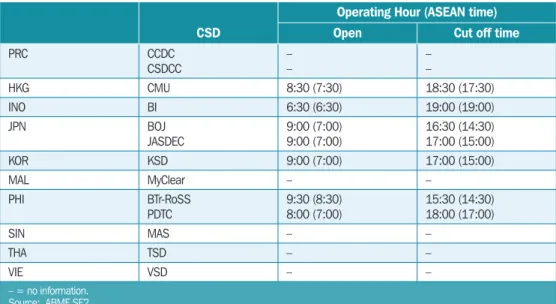
Table 7.2 Operating Hours in ASEAN+3 ...28
Table 8.1 Numbers and Codes in ASEAN+3 Markets ...29
Table 8.2 ANNA Members in ASEAN+3 ...30
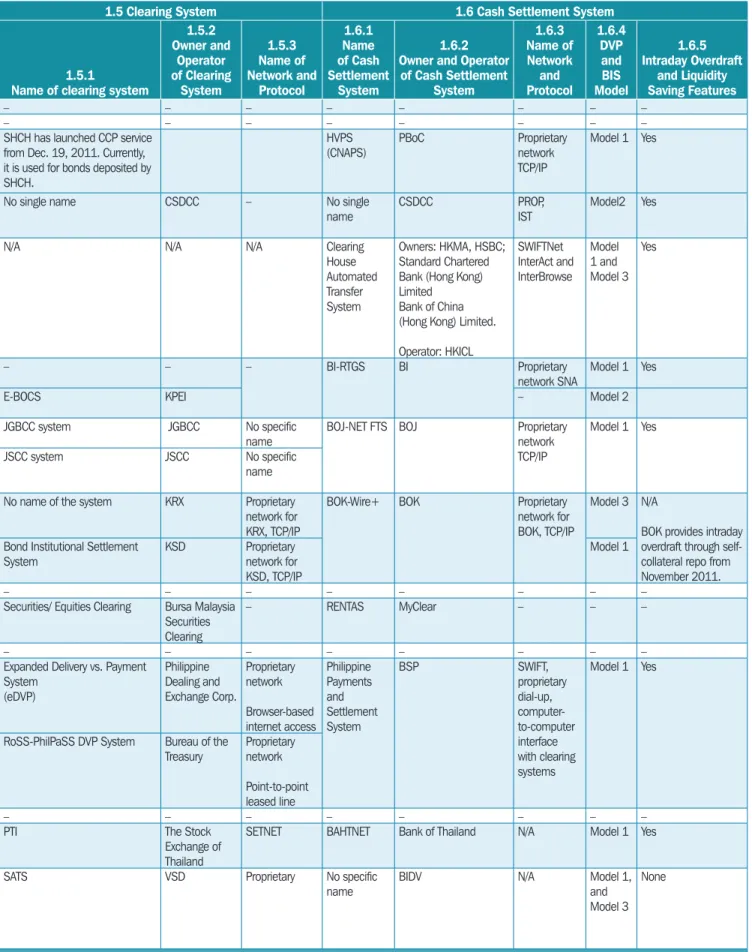
Table A1.1 Bond Market Infrastructures in ASEAN+3 ...48
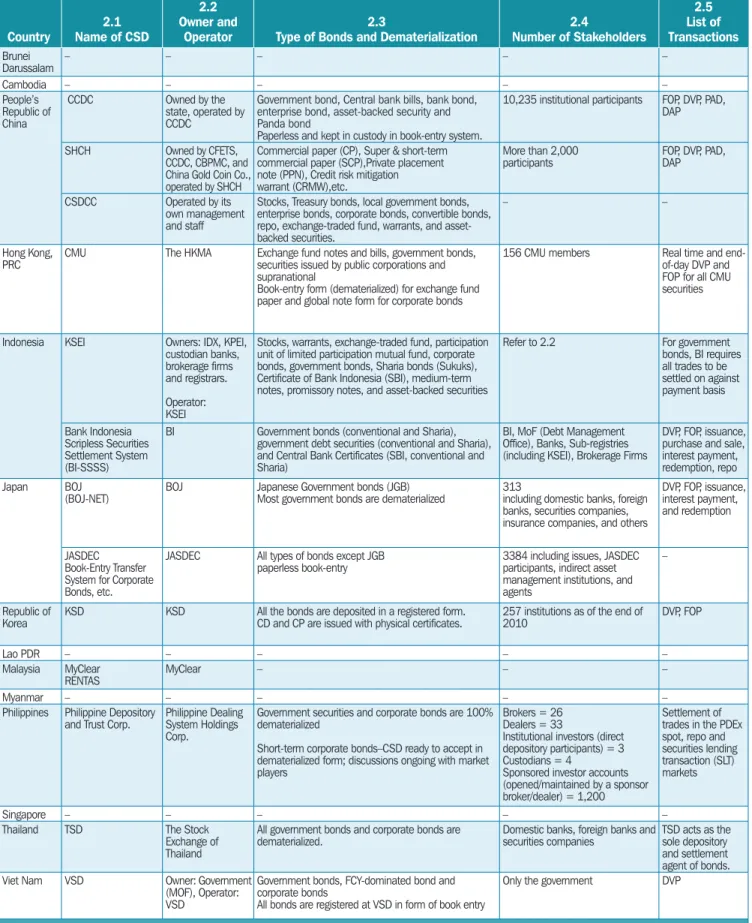
Table A1.2 Central Securities Depositories in ASEAN+3 ...50
Table A1.3 Standards Including Numbering and Coding in ASEAN+3 ...52
1. Introduction
1.1 Purpose of the ASeAN+3 Bond market Forum
The ASEAN+3 Bond Market Forum (ABMF) was established in September 2010 based on the endorsement of the ASEAN+3 Finance Ministers’ Meeting1 as a common platform to foster standardization of market practices and harmonization of regulations relating to cross-border bond transaction in the region.
The ABMF is expected to discuss various bond market issues to further develop liquid and well-functioning bond markets to make cross-border bond investment and settlement both smoother and cheaper; hence, the region’s abundant savings are channeled more effectively into the region’s increasing investment needs.
The ABMF aims to: (i) assess the existing regulatory frameworks and identify recommendations on how to foster harmonization of regulations and market practices that facilitate cross-border bond transactions in the region; (ii) enhance dialogue between the private sector and ASEAN+3 officials to develop bond markets in the region and promote harmonization, standardization, and integration; and (iii) provide opportunities to exchange knowledge, expertise, and experience between the private and public sectors in the region.
The ABMF takes stock of the Group of Experts (GoE) report, which recommends improving information flows to foreign investors to narrow the information gap by facilitating access to information on regulations.2 The GoE also proposes to start discussions on the settlement barriers among private sector experts.
1.2 organizational Structure and Governance
The ABMF is organized under Task Force 3 (TF3) of the Asian Bond Markets Initiative (ABMI). The ABMF consults with the co-chairs of TF3 occasionally in undertaking any regional activities, and reports to TF3 on a regular basis regarding the progress of its activities. The organizational structure of ABMF is shown as follows.
1 The Joint Ministerial Statement of the 13th ASEAN+3 Finance Ministers’ Meeting, 2 May 2010, Tashkent, Uzbekistan states that: “We [ASEAN+3 Finance Ministers] took note of the Group of Experts’ findings and suggestions on facilitating cross-border bond transactions and settlement, and welcomed the establishment of the technical working group on Regional Settlement Intermediary (RSI) to further evaluate the policy recommendations. We endorsed the establishment of ASEAN+3 Bond Market Forum (ABMF) as a common platform to foster standardization of market practices and harmonization of regulations relating to cross-border bond transactions in the region.”
2 ASEAN+3 Asian Bond Markets Initiatives (ABMI) Task Force 4–Group of Experts. http://asean3goe. adb.org
Figure 1.1 Organizational Structure of the ASEAN+3 Bond Market Forum
ASEAN+3 Finance Ministers
ASEAN+3 Deputy Finance Ministers
ABMI Steering Group
TF1
TASK FORCE
Promoting Issuance of Local Currency Denominated Bonds
• Credit guarantee and investment mechanism
• Promotion of Asian Currency Note Programme
• Promoting issuance of structured finance instrument
Facilitating the Demand of Local Currency- Denominated Bonds
• Development of investment for institutional investors
• Develpment of repo markets
• Enhancing cross-border transactions
Improving Regulatory Framework
• Strengthening regulatory and supervisory framework for securities
• Facilitating collaboration among SROs in the region
• Improving bankruptcy procedures related to bond transaction
• Promoting application of international accounting and auditing standard
Improving Related Infrastructure for the Bond Market
• Infrastructure for securities settlement
• Increasing liquidity of bond markets
• Fostering credit culture
• Developing professional services
Meet annually
Meet semi-annually
Monitor progress and coordinate future plans
Technical Assistance TF3
ABMF
GOE (Group of Experts)
SF1 SF2
TACT
TF2 TF4 Working
Team
Source: ADB.
The ABMF consists of two sub-forums: Sub-Forum 1 (SF1) and Sub-Forum 2 (SF2). The objective of SF1 is to close the information gap in regulations, market practices and other areas in the region’s bond markets. SF2 focuses on enhancing straight through processing (STP) in ASEAN+3. This report is about SF2.
1.3 ASeAN+3 Bond market Forum Sub-Forum 2
The GoE report identified various settlement barriers related to messaging formats, securities numbering, matching, and settlement cycle. Thus, the ABMF SF2 addresses these problems to enhance regional STP by harmonization of transaction procedures and standardization of messages.
It is desirable to execute cross-border transaction without any manual processes or data conversion among market infrastructures in the region. This ideal situation can be realized if all transactions are operated through a system using common standards and consistent messaging. This is not currently possible because individual countries have their own practices and standards, which is inevitable because certain transaction procedures follow national requirements to account for unique circumstances. In addition, some segments of a market may prefer ways of handling transactions, which creates differences in transaction procedures, hence, requiring additional conversion to international practices. Furthermore, differences in language remain a significant barrier as some ASEAN+3 countries use their own characters for payment systems and communication. Adopting international standards frameworks such as ISO20022 can mitigate impediments and barriers, which will enhance interoperability in ASEAN+3 bond markets.3
ABMF SF2 has mainly discussed business flows by focusing on government bond transactions, which are larger and relatively simpler compared to corporate bond transactions. Then, the discussion can be elevated to include corporate bonds, which often involve various corporate actions and other complex procedures. Transaction procedures of securities can be divided into five categories: issuances, investor registration, trades and settlements, interest payments, and redemptions. The sub- forum mainly identifies and standardizes the procedures in trades and settlements, particularly Delivery versus Payment (DVP) of government bonds. In addition, the ABMF SF2 discusses other settlement-related barriers such as securities numbering, settlement cycles, and matching to improve settlement procedures.
1.4 membership and Participants
The ABMF consists of (i) national members, (ii) national experts, and (iii) international experts. Members and experts were selected based on issues adopted by TF3, and must have extensive knowledge of and expertise in the relevant issues. Members and experts were selected from among those actively involved in bond markets in the region including, but not limited to:
(i) financial industry associations such as bankers’ associations, securities dealers’ associations, and self-regulatory organizations (SROs);
(ii) institutional investors such as pension services, fund managers, and insurance companies;
(iii) commercial banks and brokers;
(iv) custodians and central securities depositories (CSDs); (v) rating agencies;
(vi) financial services providers, including information technology vendors; (vii) financial regulators, including securities commissions;
(viii) central banks; (ix) law firms; and (x) academics.
3 The International Standard Organization (ISO) is a worldwide federation of national standards bodies. ISO20022 provides the financial industry with a common platform for the development of messages in a standardized Extensible Markup Language (XML) syntax.
• National Members
The national members were nominated by each member country of TF3. In principle, the number of national members was limited to one or two persons from each country for effective communication. National members represented the opinions of their respective home markets, as opposed to the opinions of the institution to which they belong. National members were encouraged to form a preparatory working group within their respective markets.
• National Experts
With the consent of other national members and the endorsement of TF3, a national member nominated national experts as participants. The national experts provide insight on specific issues related to their respective markets.
• International Experts
With the consent of other national members and the endorsement of TF3, a national member nominates international experts as participants in the ABMF. The international experts contribute to discussions related to cross-border transactions in the region.
• ASEAN+3 Officials
ASEAN+3 officials participated in any ABMF meeting as an observer. The Chairpersons of the ABMF also invited ASEAN+3 officials from finance ministries, regulatory agencies, security commissions, central banks, and debt management offices and/or relevant sections for issuing public debts, if necessary.
• Asian Development Bank
The Asian Development Bank is a member of the ABMF as the Secretariat. 1.5 Work Steps of Sub-Forum 2
In order to enhance STP, SF2 aims to clarify transaction procedures involved in cross- border government bond transactions from one end-user to another. In addition, members identify messaging standards for bond settlement. The work processes of SF2 is provided as follows.
• STEP 1:
SF2 members agreed on the scope of the survey. SF2 mainly covered market infrastructures and transaction procedures of government bonds, particularly DVP. In addition, SF2 members agreed on the processes in collecting and sharing information on cross-border transactions.
• STEP 2:
The ADB consultant drafted the survey questionnaire for each region, which sought to clarify bond settlement-related infrastructures, transaction procedures, matching, settlement cycles, and other areas in the region’s bond markets. It was then distributed to national members and experts for their responses.
• STEP3:
ADB secretariat and consultants visited each economy to validate information and data. During such visits, discussions with experts were held to collect more
information. Technical assistance was also provided to Brunei Darussalam and Lao PDR, whose bond markets are still being developed.
• STEP4:
The ADB consultant drafted the SF2 report using information from the questionnaire and outputs of the country visits. The report clarified infrastructures and cross-border transaction flows of government bonds, and identified similarities and differences in transaction procedures to discuss how to standardize infrastructures, transaction flows, code scheme, and other related matters.
• STEP5:
SF2 members came up with the report on cross-border transaction procedures of ASEAN+3 markets, which will serve as the basis of the succeeding steps for the SF2. 1.6 Schedule of Sub-Forum 2
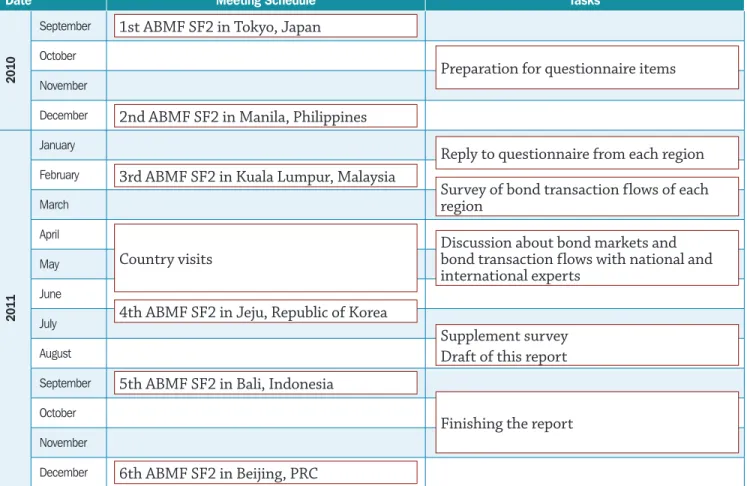
Members and experts, including ADB consultants, discussed issues of cross-border bond transactions on ABMF meetings, which were held six times from September 2010 through December 2011. The schedule of the SF2 is shown as follows.
Table 1.1 Schedule of Sub-Forum 2
Date Meeting Schedule Tasks
2010
September October November December
2011
January February March April May June July August September October November December Source: ABMF.
1st ABMF SF2 in Tokyo, Japan
Preparation for questionnaire items
Reply to questionnaire from each region Survey of bond transaction flows of each region
Discussion about bond markets and bond transaction flows with national and international experts
Supplement survey Draft of this report
Finishing the report 2nd ABMF SF2 in Manila, Philippines
3rd ABMF SF2 in Kuala Lumpur, Malaysia
4th ABMF SF2 in Jeju, Republic of Korea
5th ABMF SF2 in Bali, Indonesia
6th ABMF SF2 in Beijing, PRC Country visits
2. methodology and Approach of the Survey
2.1 Possible Goals of Sub Forum 2
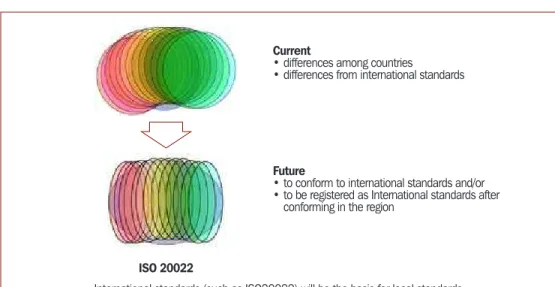
ASEAN+3 proprietary practices (local standards) demonstrate differences from international standards, including ISO 20022. Also, proprietary practices of ASEAN+3 are different from country to country and market to market.
Figure 2.1 Possible Goals of Sub-Forum 2
ISO 20022
International standards (such as ISO20022) will be the basis for local standards. Current
• differences among countries
• differences from international standards
Future
• to conform to international standards and/or
• to be registered as International standards after conforming in the region
Source: ABMF SF2.
Therefore, proprietary practices of ASEAN+3 could be changed to meet international standards. It is important to harmonize practices in the region to make the differences narrower. International standards (such as ISO 20022) should form the basis of local standards to make harmonization a reality. Also, practices in the ASEAN+3 that have been identified as at par with international standards should be considered as a benchmark as well.
In other words, ASEAN+3 should engage more discussions in international forums on standard setting.
Figure 2.2 Contribution of ASEAN+3 to International Standard
International Standards and
Practices
Local Standards
and Practices Local Standards and Practices
Regional Standards and Practices International
Standards and Practices
International standards (such as ISO20022) will be the focal point and hub of local standards. Source: ABMF SF2.
2.2 methodology overview
Figure 2.3 Methodology
A) Clarify Settlement Barriers (from the survey of GoE Report
B) Possible Roadmap for Harmonizing ASEAN +3 Bond Markets
Major Tasks of Sub Forum 2 C) Fact Findings of Each Market
D) Fit and Gap Analysis between International standards and local practices
Source: ABMF SF2.
To facilitate the discussion on STP in ASEAN+3, a survey was conducted to examine the current status of government bond markets and their infrastructures. The SF2 conducted the survey based on the output of the GoE Report. As such, the major tasks of the forum included taking stock of government bond-related matters in each market, specifically on related stakeholders, and domestic and cross-border transaction flows. Fit-and-gap analysis between international standards and local practices had to be carried out to actually implement STP in the region.
2.3 Settlement Barriers Based on the Survey on the Group of experts Report
The GoE Report pointed out the barriers to implement STP in bond markets in ASEAN+3, which is shown in Figure 2.4.
Figure 2.4 Barriers Related to Sub-Forum 2 in the ASEAN+3 Bond Markets
Source: ABMI GoE report.
Private sector
FewerMore
Public sector Area of influence
Number of markets involved
Barriers related to SF2 Barriers related to SF1
Messaging format Pre-matching
Securities numbering
Settlement Cycle
Physical certificates
Taxes
Investor registration Omnibus accounts
Quotas Cash controls
credit balances, overdrafts
FX controls conversion, repatriation
Settlement-related barriers, including messaging standards, pre-matching, securities numbering, settlement cycle, and physical certificates, are discussed in the succeeding section of this report.
1) Messaging Standards
Messaging standards refer to the use (or non-use) of international standards for securities messaging in a local market. International standards, such as ISO20022, are regarded as necessary for enabling STP in securities post-trade processing. Where local proprietary practices are implemented, this revealed the need for interface and translation either at the level of the global custodian or the local custodian. This came with associated costs of development and maintenance, as well as greater risk of error. In some cases, the local CSD does not use ISO messaging standards.
2) Trade and Settlement Matching
This refers to the matching of trade details between counterparties. Matching may take two forms: trade matching and settlement matching.
a) Trade matching. Details of the trade are compared between the counterparties to ensure that there is no misunderstanding of the terms of the trade. This should be performed as soon as after the trade is executed, and, in any event, before the end of the business day. With automated trading systems (e.g., exchange systems or electronic OTC systems) matching is done at the time of trade, so there is no need for subsequent trade matching. However, many bond trades are done by telephone.
b) Settlement matching. Details of the agreed trade are compared between the counterparties’ settlement agents (e.g., local custodian and local broker) to ensure that all information needed for settlement is in place.
Most markets in ASEAN+3 operate some form of automated matching systems but some do not. The absence of automated matching is likely to lead to increased settlement failures and make it more difficult to shorten the settlement cycle.
3) Securities Numbering
This refers to the use (or non-use) of International Securities Identification Number (ISIN) in accordance with ISO 6166 for securities numbering in a local market. As with securities messaging, non-use of ISIN makes STP more difficult and increases the risk of error. Most ASEAN+3 markets now have established local agencies for issuing and administering ISIN for locally issued securities. The limitations may be as follows:
a) ISINs are not available on the issue date of the bonds, making trading and settlement more difficult.
b) ISINs are not widely used by local market participants.
c) ISINs are not used by local CSDs, instead local securities codes are widely used. 4) Settlement Cycle
This refers to the number of days between trade date and settlement date. Most markets operate on a standard settlement cycle. Typically this is trade date plus 1 (T+1) for government bonds, and T+2 or T+3 for corporate bonds (and equities). A short settlement cycle is better for local market participants, as it reduces counterparty risk.
However, non-resident investors may find it difficult to settle on T+1 if they or their global custodian are located in a different time zone. For this reason, such investors look for the ability to negotiate a longer settlement period (T+2 or T+3 is the favored cycle). Settlement cycle as a market rule in the region is yet to be established.
5) Physical Certificates
Most bonds today are in dematerialized form held in book-entry at the local securities depository or central bank system. Some bonds are still in paper certificate form. The disadvantage of physical certificates are obvious—the need for manual examination, risk of loss, damage or forgery, and cost of storage. Typically, these remaining physical bonds are not of great interest to cross-border investors, and are unlikely to be traded at all. The ideal situation, clearly, is dematerialization. An intermediate step is to hold physical certificates, where they exist, in vaults of local securities depository for immobilization.
2.4 Survey Questionnaire
In order to try to reach its goals, SF2 conducted a survey on the issues related to barriers by sending a questionnaire to national members and international experts. The following are the primary categories of the questionnaire:
a) Bond market infrastructures b) CSDs in each country c) Typical business flowchart d) Matching
e) Settlement cycles
f) Standards, including numbering and coding g) ISO and local practices
h) Transaction costs
i) Medium- to long-term strategy j) Any other information
The detailed questionnaire is shown in Appendix 1.
The SF2 survey revealed not only message formats but also business processes, such as message transactions and message flows, that need to be integrated in the survey. Preliminary answers for bond market infrastructures, CSDs in each country, and standards including numbering and coding are shown in Appendix 2. Survey results on typical business flowchart, matching, and settlement cycles are discussed later. ISO and the local practices, transaction costs, and medium- to long-term strategy will be discussed in the next phase of the survey.
2.5 Fit-and-Gap Analysis
2.5.1 Background on Fit-and-Gap Analysis of Bond Transactions
Interoperability among bond trade, settlement systems, and infrastructures are very important to bring to fruition STP of bond transactions. In fact, some CSDs in ASEAN+3 have already adopted the ISO standard as their message standard when they reconstruct or upgrade their bond settlement infrastructures. However, not all CSDs and
bond trade and settlement-related infrastructures are compliant with the international standard yet. Also, there remain some differences between infrastructures, which have already adopted the ISO standard for their message format.
Figure 2.5 ISO20022 and Central Securities Depository Messages
ISO20022 messages ISO20022 messages mandatory items
CSD messages
CSD messages mandatory items
Source: ABMF SF2.
As such, there are some differences in proprietary CSD messages and ISO 20022 messages in some markets that do not follow the international standard. Also, bond trade and settlement-related infrastructures, including CSDs that have already implemented the ISO standards as their message standard, may still have their own proprietary flows and processes, which may be better than the ISO standards.
Therefore, a fit-and-gap analysis between bond transactions of each market and international standards is one of the most important steps to harmonize bond markets in ASEAN+3.
2.5.2 Scope of Fit-and-Gap Analysis
There are some levels in doing the fit-and-gap analysis of messages. A fundamental level is to check whether or not the business flow requiring a specific message exists. More specifically, it checks whether basic messages, such as bond settlement instructions and confirmation, need to be compared. Another important part of the analysis is to compare bond transaction flows. After conducting the basic fit-and- gap analysis, message items and formats may be compared and analyzed.
As a preliminary stage of the survey, a fit-and-gap analysis of messages and their flow were conducted. In order to do that, cross-border bond transaction flows and domestic bond transaction flows were surveyed.
3. overview of the ASeAN +3 Bond markets and Infrastructures
3.1 overview of ASeAN+3 Government Bond markets
This section discusses the ASEAN+3 government bond markets and their infrastructures. An overview of the markets is shown in Figure 3.1.
11
ASeAN+3 Bond market Guide | Volume 2 | Part 1Trade matching
CCP
Settlement matching
Bond settlement
Cash settlement
VSD KSD CCDC
CSDCC
PDTC
PDEx Ross STP
Facility
BT BTr-ROSS PDEx
eDVP
JASDEC PSMS JASDEC
PSMS CFETS
HKMA CMU
TCH PTI
TSD PTI HNX
BIDV Commercial
Bank
BOT BAHTNET
MAS MEPS+
RTGS
BSP PhilPass
BOK BOK-Wire+
BOJ BOJ-NET
BI BI-RTGS
HKMA CHATS
PBOC HVPS CNAPS BOJ
BOJ-NET
BNM RENTAS-
IFTS TCH
PTI
BMS ETP
Bond Market
MAS MEPS+ SGS
BNM
RENTAS-SSDS
BI
BI-SSSS
HKMA
CMU
Lao PDR Myanmar
(Netting)
Note: Exchange Market Direct intersystem connection
Central Bank Indirect connection. Trade data (bond settlement instructions) are entered to CSD by agent custodians. Commercial Bank
Source: ABMF SF2.
KRX JGBCC
PDEx
In the ASEAN+3, most countries have already developed their respective government bond markets, with the exception of Brunei Darussalam, Cambodia, Lao PDR, and Myanmar. In all the countries and economies with developed bond markets, government bonds are mainly traded in over-the-counter (OTC) markets. In a few countries including Korea and the Philippines, significant volume and value of government bonds are traded on exchanges. In China, only a small percentage of government bonds are traded on exchanges, and non-residents, known as Qualified Foreign Institutional Investors (QFII), have access to the Shanghai Stock Exchange and Shenzhen Stock Exchange.
In China, Hong Kong, Japan, Malaysia, the Philippines, Thailand, and Viet Nam, traded data are entered into trade or post-trade infrastructures such as trade- matching systems.4 Data entered into these trade-related infrastructures are transmitted to CSDs in China, Hong Kong, Korea (in the KRX), the Philippines, Thailand, and Viet Nam.
Two economies—Korea (KRX) and Japan (Japan Government Bond Clearing Corporation [JGBCC])—have established a central counterparty (CCP) for bond trades in ASEAN+3. A new CCP has started its operation in December 2011 in China (through the Shanghai Clearing House [SHCH]). However, the CCP is utilized only for domestic transactions in each region.
In Hong Kong, Indonesia, Japan, Malaysia, and Singapore, central banks operate the CSD. Cash settlement of government bond delivery-versus-payment (DVP) transactions is provided by central banks, except for Viet Nam.
In the region, almost all bond transactions practically stay within the economies and not reach other markets outside the country’s borders. This means there are still comparatively small cross-border transactions in the region.
Generally, bond settlement systems and cash settlement systems are connected directly for the sake of DVP settlement. In the Philippines, there is unique system structure where the Philippine Dealing and Exchange Corporation (PDEx) controls all DVP settlement processes; therefore, the system structure is different from that of other markets. All markets, except for Viet Nam, provide real-time gross settlements for government bonds by using central bank money in the form of DVP Model 1 as defined by the Bank for International Settlements (BIS).5 In Viet Nam, all trades are settled by using commercial bank money after netting. Currently, it is planning to reconstruct its bond market infrastructures.
4 In general, only domestic transactions use the trade-matching system. Therefore, cross-border bond transaction go directly to the settlement-matching system or CSD.
5 Model 1 is defined as system that settles transfer instructions for both securities and funds on a trade-by-trade (gross) basis, with final (unconditional) transfer of securities from the seller to the buyer (delivery) occurring at the same time as final transfer of funds from the buyer to the seller (payment); Model 2 is defined as the system that settles securities transfer instructions on a gross basis with final transfer of securities from the seller to the buyer (delivery) occurring throughout the processing cycle, but settle funds transfer instructions on a net basis, with final transfer of funds from the buyer to the seller (payment) occurring at the end of the processing cycle; and Model 3 is the system that settles transfer instructions for both securities and funds on a net basis, with final transfers of both securities and funds occurring at the end of the processing cycle.
3.2 General observations on ASeAN+3 Bond market Infrastructures
a) Robust and sound bond infrastructures. Each market in ASEAN+3 has its own robust and sound infrastructures. Operational risk associated with the systems is comparable with those of developed markets.
b) Listed at exchanges and traded in OTC markets. Bonds are listed at stock exchanges; however, these are mostly traded over the phone or through other communication tools by negotiation among brokers and dealers. Bond markets in the region are generally OTC markets. This is also common elsewhere since bond trade is normally quote driven where dealers need to negotiate the price. In contrast, exchange trade is order-driven where all orders of buyers and sellers can be seen and matched by the system. Korea and the Philippines are the only exception, where the exchange has a substantial market share because benchmark bonds are mostly traded at the exchange. In China, bond trades at the stock exchanges are very limited; foreign investors, who are classified as QFII, can trade bonds at the exchanges.
c) Central counterparty. A central counterparty (CCP) for bond trades does not exist in many markets. However, this is understandable because transaction volume is still limited in these markets. As trade volume increases, it is expected that CCP will be introduced into the markets when needed.
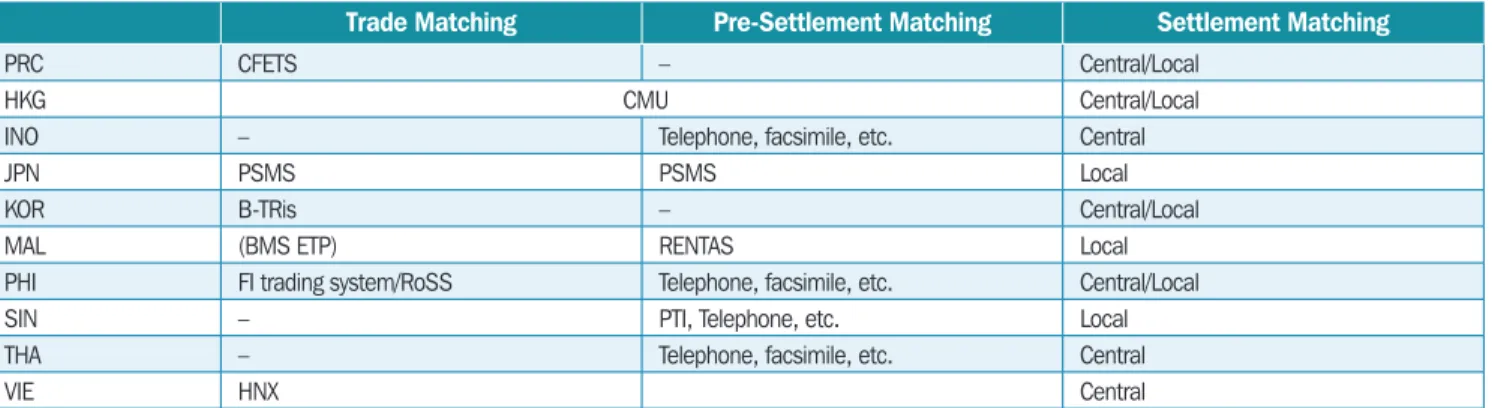
d) Matching. All markets have a concept of matching at a trade or settlement level, or even at both levels. Some markets adopt central matching while others do local matching. Also, matching with additional features, such as reduction of input workloads, is implemented in some markets. However, there is a need to automate manual pre-matching.
e) Settlement cycle. Settlement cycles for domestic bond transactions in many markets are already realized at T+1, but market practices of cross-border bond transactions depend on each market player, which are more than T+2 and negotiable. Settlement cycle as a market rule still needs to be discussed.
f) Cash settlement by central bank money. With exception of Viet Nam, all markets use central bank money to settle cash component of bond trades. In some countries, cash may be settled directly through accounts of individual financial institutions while, in the other countries, the CSD has an account with the central bank and cash is settled through the account.
g) Harmonization of terminologies and definitions. Technical terminologies need to be standardized before harmonizing systems and messaging in the region.
4. Domestic Bond Transaction Flow
4.1 model Domestic Bond Transaction Flow
This section of the report discusses the government bond transaction flows in each ASEAN+3 economy from the perspective of STP. In many markets in ASEAN+3, government bonds are mostly traded through DVP in OTC markets.6 A model transaction flow is chosen from among the most prevailing transaction flow, and is used as a point of comparison for the transaction flows in the different markets in the region, as demonstrated in Figure 4.1.
6 See Part 2 of this report.
Figure 4.1 Model Domestic Bond Transaction Flow (1)
Bond Settlement Entity (CSD)
Cash Settlement Entity (Central Bank) 2. Bond settlement
instruction
2. Bond settlement instruction
4. Settlement instruction matching notice
4. Settlement instruction matching notice
9. Bond settlement confirmation
7. Cash settlement confirmation
9. Bond settlement confirmation
7. Cash settlement confirmation 8. Bond settlement
1. Trade
3. Settlement instruction matching
6. Cash settlement Delivering
party
Receiving party
Source: ABMF SF2.
5. Settlement data and instruction
7. Report of cash settlement
In this typical flow, market participants (seller and buyer)7 trade bonds by telephone, email, or other means. Then, they input the settlement instructions to the CSD directly. The CSD executes matching processes with the data sent by the seller and buyer. The results of settlement matching are sent back to the seller and buyer from the CSD. If the data are matched, the CSD continues the process and starts the DVP settlement processes. Under a DVP process, the CSD and cash settlement entity (mostly central bank in each country) execute the bond settlement if, only if, cash settlement is completed. Settlement data are sent to a cash settlement entity from the CSD, while the seller and buyer do not give instructions to the cash settlement entity directly. After the settlements are completed, the CSD and cash settlement entities send the settlement confirmation to the seller and buyer.
4.2 Categorization of Domestic Government Bond Transaction Flow 1) Model Flow
Government bond transaction flows in Hong Kong, Indonesia, Korea (OTC), and Thailand fall into the model flow.
7 Seller means delivering party of the bond. Buyer means receiving party of the bond.
2) Transmitting Trade Data from the Trade System to the Central Securities Depository
China’s OTC market is similar to the model, but has STP function transmitting trade data directly from the trade platform of the China Foreign Exchange Trade System (CFETS) to the China Central Depository and Clearing Corporation (CCDC), which is a CSD as shown in Figure 4.2. The Philippines and Viet Nam are similar to in terms of trade data transmission from a trade platform to a CSD. In the Philippines, PDEx facilitates (controls) all transactions to CSDs. In Viet Nam, most of the bonds are traded in the OTC market, and trade data are entered to the Hanoi Exchange (HNX). This process is similar to that of China’s and Korea’s exchanges.
Figure 4.2 Model Domestic Bond Transaction Flow (2)
Bond Settlement Entity (CSD) Trading System
Cash Settlement Entity (Central Bank)
Trade data Trade data
2. Affirmation settlement instruction
2. Affirmation settlement instruction
9. Bond settlement confirmation 4. Settlement instruction
matching notice
7. Cash settlement confirmation
9. Bond settlement confirmation 4. Settlement instruction
matching notice
7. Cash settlement confirmation 8. Bond settlement
1. Trade
3. Settlement instruction matching
6. Cash settlement Delivering
party
Receiving party
Source: ABMF SF2.
5. Settlement data and instruction
7. Report of cash settlement Trade data
3) Local Matching and Tight Connection between Central Securities Depository and Real-Time Gross Settlement
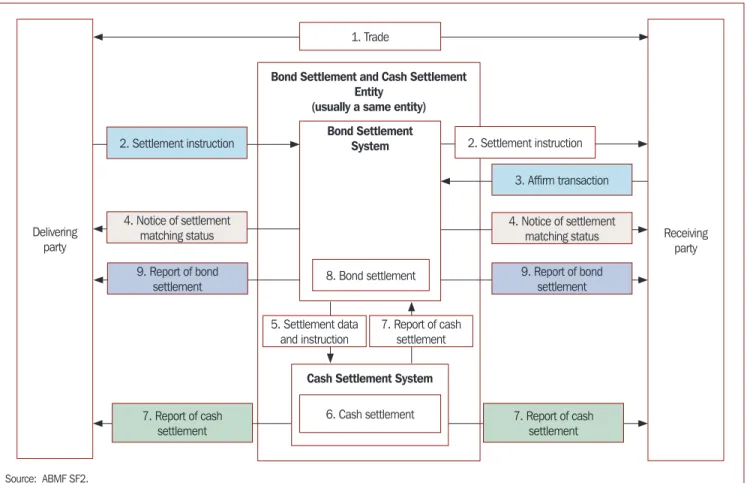
Another variant is that the central bank owns and operates the CSD and real-time gross settlement (RTGS) systems in Japan, Malaysia, and Singapore. Either seller or buyer enters the trade data (bond settlement instruction) to the CSD, which is classified as local settlement matching as shown in Figure 4.3.
Figure 4.3 Model Domestic Bond Transaction Flow (3)
Bond Settlement and Cash Settlement Entity
(usually a same entity)
Cash Settlement System
2. Settlement instruction 2. Settlement instruction
4. Notice of settlement matching status
3. Affirm transaction
7. Report of cash settlement
9. Report of bond settlement 9. Report of bond
settlement
4. Notice of settlement matching status
7. Report of cash settlement Bond Settlement
System
6. Cash settlement Delivering
party
Receiving party
Source: ABMF SF2.
5. Settlement data and instruction
7. Report of cash settlement 1. Trade
8. Bond settlement
4.3 Settlement Instruction and Confirmation of Bond and Cash
Table 4.1 shows (i) transmission of trade data from trade-related platform (trading system) to the CSD, (ii) bond settlement instruction from the seller or buyer to the CSD, (iii) bond settlement confirmation from the CSD to the seller and buyer, (iv) cash settlement instruction from the buyer to the CSD, and (v) cash settlement confirmation from the CSD to the seller and buyer, in each economy by comparing the bond transaction flow with the model flow.
Table 4.1 Settlement Instruction and Confirmation of Bond and Cash
Economy Market
Transmission of Trade Data before
the Settlement
Instruction Bond Settlement Instruction
Bond Settlement Confirmation
Cash Settlement Instruction
Cash Settlement Confirmation
PRC OTC • From the trading
system
• From seller and buyer 1
• Affirmation of the settlement • From CSD to seller and buyer
• From CSD • From Central Bank to seller and buyer Exchange • From the trading
system
• From seller and buyer
• Affirmation of the settlement • From CSD to seller and buyer
• From CSD • From CSD and Payment Banks to seller and buyer
HKG OTC • None • From seller and buyer
• Settlement Data and instruction • From CSD to seller and buyer
• From CSD • From Central Bank to seller and buyer
INO OTC • None • From seller and buyer
• Settlement Data and instruction • From CSD to seller and buyer
• From CSD • From Central Bank to seller and buyer continued on next page