Company Name :
Leopalace21 Corporation
Head Ofice :
2-54-11 Honcho, Nakano-ku, Tokyo
TEL: +81-3-5350-0001 (Main Line)
President and CEO :
Yoshiteru Kitagawa
Established :
August 17, 1973
Common Stock :
¥ 55,640.66 million
Number of Shares Outstanding :
159.54 million shares
Operations :
Construction, leasing, and sales of apartments, condominiums,
and residential housing; development and operation of resort
facilities; hotel business; broadband business; Silver business, etc.
Number of Employees :
9,926 (Consolidated basis) 9,017 (Non-consolidated basis)
Building lots and buildings transaction business license :
Minister of Land, Infrastructure and Transport Permit (9) No. 2846
Construction business permit :
Minister of Land, Infrastructure and Transport Permit (Special-20) No. 11502
Registration of Class-1 architect ofice :
Tokyo Governor Registration 36122
Loan business registration :
Kanto Finance Bureau Chief Registration (8) No. 00581
Memberships:
Japan Association of Home Suppliers
Japan Financial Services Association
Japan Prefabricated Construction and Manufacturers Association
President and CEO
Senior Managing
Director
Executive Director
of Management
Director
Director
Director
Director
Director
Director
Director
Standing Auditor
Standing Auditor
Auditor
Auditor
Yoshiteru Kitagawa
Eisei Miyama
Tadahiro Miyama
Hiroyuki Miyata
Yoshikazu Miike
Kou Kimura
Yousuke Kitagawa
Satoshi Abe
Hiroshi Takeda
Naomichi Mochida
Yoshinori Uehara
Shinya Watanabe
Masami Matsushita
Koichi Fujiwara
Leopalace21 Corporation
2-54-11 Honcho, Nakano-ku, Tokyo 164-8622
TEL: +81-3-5350-0001 (Main Line) FAX: +81-3-5350-0058
Yusuke Miyama
Name of shareholder No. of shares outstanding % of shares
21,251,774
8,165,714
7,228,400
6,245,800
6,157,793
6,105,200
2,745,900
2,437,395
2,350,000
1,952,349
13.32%
5.12%
4.53%
3.91%
3.86%
3.83%
1.72%
1.53%
1.47%
1.22% Leopalace21 Corporation
Japan Trustee Service Bank, Ltd. (for trust 4G)
Japan Trustee Service Bank, Ltd. (for trust) State Street Bank and Trust Company 505223 Standing Proxy, Mizuho Corporate Bank, Ltd. The Master Trust of Japan, Ltd. (Trust Account)
Toyo Kanetsu K.K.
The Chase Manhattan Bank, N.A. London SL Omnibus Account Standing Proxy, Mizuho Corporate Bank, Ltd.
MDI Corporation
Mellon Bank, N.A. as Agent for its Client Mellon Omnibus US Pension Standing Proxy, Mizuho Corporate Bank, Ltd.
(50% )
(100% )
Note 1: Numbers within parentheses represent equity stakes held by Leopalace21. Note 2: Apart from the companies listed above, there are two companies (100% owned indirectly by Leopalace21) with operational permits
Foreign Corporations 62,832 thousand shares 39.38%
Individuals and Other
48,477 thousand shares 30.38% Financial Institutions
30,038 thousand shares 18.83% Business Corporations and other legal entities
8,310 thousand shares 5.21%
Securities Companies 1,719 thousand shares 1.08% Treasury Stocks
8,165 thousand shares 5.12%
Leopalace Leasing Corporation
(Company housing agency and real estate agency) Toyo Miyama Kogyo Co., Ltd.
(Manufacturing and Sales of Housing Materials)
Corporation Information
Corporate Data
(As of March 31, 2009)Members of Board of Directors
(As of June 29, 2009)
Corporate Structure
(As of March 31, 2009)Shareholder Composition
(As of March 31, 2009)Major Shareholders (Top 10)
(As of March 31, 2009)Apartment Construction Subcontracting Division
Leasing Division
Hotel and Resort Division
(100% ) LEOPALACE GUAM CORPORATION
(Hotel/resort operations in Guam)
(100% ) Leopalace Travel, Ltd.
(Travel Agency)
Other Business
(100% ) Leopalace Finance Co., Ltd.
(Financial Business)
(100% ) Leopalace Insurance Co., Ltd.
Domestic Consolidated Subsidiary Foreign Consolidated Subsidiary Equity-method afiliates
Leopalace21 Corporation
Investors Guide
For the year ended March 2009
Leopalace21 Corporation
Code No. 8848
01
The selection and concentration of our
business operations have been clariied and
our “New Medium-term Management Plan:
Change for NEXT” has been established to cope
with the current global economic recession.
In December 2006, we at Leopalace21 announced our “Medium-term
Management Plan: United Spirit” with a prospective outlook for the following
ive years. We were, however, greatly impacted by the trends arising from
the global economic downturn that was triggered by the collapse of Lehman
Brothers in the United States during September of last year. In order to deal
with the changing situation, we needed to drastically review our
“Medium-term Management Plan: United Spirit” as we approach the March 2010 iscal
year (our 37th term), and therefore we have formulated a new plan, the “New
Medium-term Management Plan: Change for NEXT”. Quantitative agendas
targeted by the previous medium-term management plan were converted
into qualitative agendas. Furthermore, the apartment business, our core
enterprise, was once again designated as the business operation for which
effort must be concentrated. We intend to focus our management resources
into the apartment business in order to accelerate its sustained growth.
Furthermore, our critical agenda will continue to be “to participate in society
as a Corporate Citizen”, as well as “to sustain the growth of our business
through support obtained from society”, as cited in our Corporate Vision,
or, in other words, to be evaluated favorably as a business that fulills social
responsibilities (CSR management).
Obviously, attaining the targets set by our newly established
management plan, the “New Medium-term Management Plan: Change
for NEXT”, is a matter of course, but more speciically we recognize our
corporate philosophy of “Creation of New Values” as the social responsibility
(CSR management) of our business, as we strive to fulill our agendas in this
current global economic crisis. Therefore, we believe that it is quite important
to shape up the foundation of our business and to work proactively towards
broadening the range of our business dealings. The newly formulated
corporate slogan, “Change for NEXT” was established as our expression of
this objective.
As a representative oficer of Leopalace21, it is my intention to overcome
the global economic crisis by following our corporate philosophy and our
new corporate slogan in the pursuit of our “Creation of New Values”, always
staying a step ahead of the times and promoting our CSR management to
create a “Corporate Quality” and “Corporate Brand" that can respond to our
“Corporate Social Responsibility” (CSR) as a “Corporate Citizen”, as indicated
by our corporate vision statement.
We would like to ask all our stakeholders for their continued support and
patronage.
President and CEO
Yoshiteru Kitagawa
We aim to create
new value through
housing
We view the apartment business
as a social undertaking, which
realizes the effective use of land and
supply of high-quality housing
(CSR
management)
.
We believe that successful leasing
operations are our top priority
in the apartment business.
We develop and introduce unique
products based on a pioneering spirit.
We pursue client-irst marketing
approaches as well as prompt and
systematic proactive operations.
1.
2.
3.
4.
We strive to become a Total Support Enterprise,
providing a diverse range of products and services in
accordance with solutions relating to "Effective Use of
Land" and "High Quality Housing," as well as market
needs.
We will make work operations and inancial content
those of a market leader, form a "Corporate Quality"
that responds to the social responsibility of the
Company as a "Corporate Citizen" and build a
"Corporate Brand" deserving of trust and appreciation.
1.
2.
In terms of management, organizational reforms and further enhancement of governance are required, as is a drastic
review of cost structure, in order to promote our return to the starting point of a “
Motazaru keiei
”
*financial structure.
In business terms, we aim to realize “Unified Management for Construction Subcontracting and Leasing Businesses”.
Management resources will be concentrated into our core businesses, while the priorities of related businesses are
clarified according to the relevance to (synergy with) the core businesses, and their continuous monitoring will be
enhanced.
For overall strategies for the core businesses, we intend to establish a new profit structure by inducing the flow of
new tenants away from studios into large studios and family units, through the implementation of new proposals that
serve as our “One-stop Strategy”.
■ Apartment construction subcontracting business: We intend to expand the areas in which properties are supplied. ■ Leasing business: We intend to expand the scope of our prospective tenants.
1.
2.
3.
02
May 2009: The “New Medium-term Management Plan: Change for NEXT” announced
The new slogan “Change for NEXT” formulated
Message from President
Medium-term Management Plan-1
Basic Policies
Corporate Philosophy
Corporate Slogan
Corporate Vision
Course of Action for the Medium-term Management Plan
Medium-term Management Strategy
2007/3
2008/3
2009/3
2010/3
2011/3
Management Base
Establishing Phase
Business S
tructur
e
Transformation Phase
December 2006: The “Medium-term Management Plan: United Spirit” announced
June 2006: The new slogan “United Spirit” formulated
2012/3
End March 2009:Number of apartment units under management exceeded half a million!
Previous Medium-term Management Plan
(iscal year ending March 2007 to March 2009/First Phase)
New Medium-term Management Plan
(iscal year ending March 2010 to March 2012)In our previous Medium-term Management Plan (First Phase) we set as our primary target the establishment of our management base, in order to seek the transformation of our business into a “Stock-Emphasized Business Model”. Quantitative increases and qualitative improvements were promoted for apartment units under our management (our stocks).
Our management resources are concentrated into our core businesses according to our new Medium-term Management Plan, in order to accelerate the transformation of our business structure into a full-scale “Stock-Emphasized Business Model”.
Our New Medium-term Management Plan was reformulated with new conditions for the second phase, in order to take into account and cope with a business environment that drastically changed following the September 2008 inancial crisis. Leopalace21 is currently transitioning into its next stage. In
order to respond to a year of drastic changes and turmoil, we aim to establish a framework for a robust business structure that does not rely on market conditions, while we concentrate our efforts into the apartment construction subcontracting and leasing businesses, which are our starting points. We will unite all our capabilities to respond to the needs of each and every one of our customers and to raise our corporate value.
3,001 3,982 248
7,231
3,002 4,333
7,511
15.0
10.0
5.0
0
8,000
,000
6,000
5,000
4,000
3,000
2,000
1,000
0
Consolidated operating income rate (%)
Consolidated net sales (¥100 million)
2007/3
(record)
3,161 2,864 291
6,316
2008/3
(record)
3,275 3,136 318
6,729
2009/3
(record)
3,591 3,461
280 176
7,332
2010/3
(plan)
3,002 3,611 394
7,007
2011/3
(plan) 2012/3(plan)
Related businesses (all non-core businesses) Leasing business
Apartment construction subcontracting business Consolidated operating income rate
Core businesses
12.0
10.6
6.8
3.1
4.7
6.2
Previous Medium-term Management Plan
Management Base
stablishing Phase
New Medium-term Management Plan
Business Structure
ransformation Phase
Transition of net sales and operating income rate for the “New Medium-term Management Plan: Change for NEXT” by business division (planned)
【Overall Image of Medium-term Management Plan】
As with our previous Medium-term Management Plan, the “New Medium-term Management
Plan: Change for NEXT” enables strategies with a superior sense of orientation over the medium
term through the incorporation of “Demographic Dynamics” and “Demographic Shifts” into the
background of the plan’s formulation.
Strategies based on “Demographic Shifts”
Strategies based on “Demographic Dynamics”
Region Total number of migrants City name Total number of migrants %
1 2 3 4 5 6 7 8 9 10
Tokyo Block
Tokyo Metropolis
Osaka Block
Kanagawa Prefecture
Nagoya Block
Osaka Prefecture
Saitama Prefecture
Chiba Prefecture
Aichi Prefecture
Fukuoka Prefecture
1,835,554 768,322 696,367 437,586 370,689 326,746 320,376 309,270 242,355 211,242
1,218,807 644,146 237,160 398,815 163,058 186,742 98,664 77,182 163,058 141,683
Urban areas of Tokyo Block Special wards of Tokyo Metropolis Osaka City & Sakai City
Yokohama City & Kawasaki City
Nagoya City
Osaka City
Saitama City
Chiba City
Nagoya City
Fukuoka City
66.4 83.8 34.1 91.1 44.0 57.2 30.8 25.0 67.3 67.1
Source: "Report on Migratory Movements Based on Basic Resident Register" of the Ministry of Public Management, Home Affairs, Posts and Telecommunications (issued January 30, 2009). Note: Excerpted from the National Census from Ministry of Public Management, Home Affairs, Posts and
Telecommunications for iscal 2005 and the Number of Households and Future Estimates of iscal 2008 from the Institute of Population Problems.
● Estimates for single person households in the future
The “Demographic Dynamics” mentioned indicate signiicant trends for “Declining Birth Rates” and the “Aging Population”. In the midst of such movements the index data relating to “housing”, in which we must focus, is the “Number of Single-Person Households”. Our future estimates indicate that the number of single-person households will continue to grow at the current rate and the igure is expected to exceed 15 million households by the year 2010.
For many years the “Demographic Shift” in Japan has been concentrated in urban areas, and this trend has been strengthening in recent years. As shown in the table, the demographic shift in the year 2008 indicated that the top nine regions with increases are in the Kanto, Kinki, and Chubu blocks, with the tenth region a location in the Kita-Kyushu block, which has the fourth-largest population concentration in Japan.
The number of single-person households comprising persons under the age of 35 is expected to decrease due to “Declining Birth Rates”, though we will see the emergence of new demand from single men and women aged 35 or older. Furthermore, the number of single-person households comprising persons aged 65 or older is on the rise due to the “Aging Population”.
Our new Medium-term Management Plan takes this rapidly changing business environment into account and promotes the implementation of strategies that incorporate the intake of new groups such as the following:
● The low of tenants is induced away from studio units to large studios and family units based on the “One-stop Strategy” and the acquisition of new demand from the 35 and older group is promoted in the core business segment, where management resources are concentrated. ● Provisions for expanding the Silver Business and Real Estate Business
are frozen for the time being in consideration of the business environment. Our focus is concentrated on improving the proit structures of related businesses for which monitoring will be enhanced, even though demand for these businesses is expected to recover and expand over the medium term.
● Top ten regions with highest demographic shift in 2008
The demand for “Housing” is more concentrated in regions where an inlux of a large number of residents occurs, causing a population concentration in the region. The basic characteristic of such regions is that more people reside on the outskirts of cities and towns, rather than in the cities and towns themselves. We are promoting the following activities intended to expand our areas of business:
● Large studios and family units are to be aggressively supplied in the core business to expand serviced areas from existing urban areas to suburbs (such as commuter neighborhoods and regional cities and towns).
● Discovery of new demand in urban areas is also promoted through proposals for residences with attached rental units.
● Business operations by Leopalace Leasing Corporation and Leopalace Insurance Co., Ltd., which are strongly relevant to core businesses, are linked up with core business operations to expand synergic effects.
(Thousands of households)
4,185
16,563
5,621
6,757
4,185 5,621
6,757
3,890
17,334
6,311
7,134
3,890 6,311
7,134
3,662
17,922
6,729
7,531
3,662 6,729
7,531
3,402
18,237
7,173
7,662
3,402 7,173
7,662
(39.3%)
(39.3%)
(18.7%)
(18.7%)
5,302 3,032
12,911
4,577
5,302 4,577 3,032
(23.5%)
(41.1%)
(23.5%)
(41.1%)
20,000
16,000
12,000
8,000
4,000
0
4,701 4,655
6,351
4,701 4,655
6,351 15,707
Our share
14,457
5,148 5,444 3,865
(35.6%)5,148
5,444 3,865
(26.7%)
(26.7%)
(35.6%)
2.7% 6.5%
2000/10 2005/10 2010
(Projected) (Projected)2015 (Projected)2020 (Projected)2025 (Projected)2030 Under 35 years 35 years to 64 years 65 years and over
Medium-term Management Plan-2
The market strategies for the “New Medium-term Management Plan: Change for NEXT” have been formulated with “Household Dynamics” and “Demographic Shifts” in the same way as the previous Medium-term Management Plan. The “Household Dynamics” and “Demographic Shifts” are indices that do not cause signiicant variations in short-term forecasts or in medium-term forecasts. Use of such indicators to formulate fundamental business strategies is a crucial concept for ensuring that deviations do not occur with regard to a sense of orientation and paths to be taken for business tactics and strategies over the short to medium term.
Basis of igures calculated for leasing business
Basis of igures calculated for plans in apartment
construction subcontracting business
●Sales coverage areas are expanded through the enhancement of product lines, while the framework for expanding sales is enhanced to cope with the current severe business environment and to sustain the level of orders received at ¥300 billion.
●Sales capabilities are enhanced according to regional strategies, and the locations of sales ofices are reviewed while sales administrative expenses are reduced.
●Increases in sales are calculated according to the volume of newly supplied properties (planned) in the apartment construction subcontracting business.
●Allowances for vacancy losses arising from a more conservative review are incorporated into accounting, and a drastic reduction in the administrative expenses of sales is implemented (to be completed in March 2010).
Core Businesses
Our core businesses are redeined as “businesses for generating earnings with our apartment stock as the foundation”, where the “apartment construction subcontracting business” and the “leasing business” are considered to be our two core businesses.
Our broadband business draws from a primary market of apartment units under our management, which fall under the category of our leasing business. We incorporated the broadband business into our leasing business, as we determined that management, operation, and extension, as a single business, would lead to a more eficient business expansion.
Related Businesses
In order to further clarify the management policy for the selection of core businesses and concentration of management resources, all non-core businesses are initially lumped together as “Related Businesses”, for which continuous monitoring is enhanced and reforms based on proitability are to be implemented.
We aim to promote strategies that have the priority of these businesses clariied with an emphasis on their relevance to the core businesses at the same time.
We have also integrated our residential business and strategic real estate development business into our real estate business, as well as integrated our domestic hotel business with our overseas resort business as our hotel and resort business to improve management eficiency.
05 06
Medium-term Management Strategy-1
【Overall Strategy】
Create a robust business foundation using our core businesses as the backbone and with a meticulous
selection of business domains, with management resources concentrated in these segments.
At Leopalace21 we are aiming to complete our new business model according to the “New Medium-term Management Plan: Change for NEXT” through a meticulous “selection” of business domains and a “concentration” in management resources. We intend to implement reforms in our core businesses to transform the framework of our business into one that can sustain continued growth and provide stable earnings. At the same time, the relevance with core businesses is emphasized for all other businesses not considered to be core businesses, their priorities are clariied to re-establish our “Business Portfolio”, and strategies will be implemented to synergize business divisions, including the core businesses. All business divisions of all business units will be striving to enhance the synergic effects of their regional strategies, product strategies, and leasing service strategies, with synergic effects between the core businesses and individual related businesses as the pivotal force.
【Change of Business Segments
(beginning in the iscal year ending March 2010)
】
Build a cornerstone for the foundation of our business model within three years, fortifying our
organization for management operations
The “New Medium-term Management Plan: Change for NEXT” concentrates management resources in the two core businesses (the apartment construction subcontracting business and the leasing business), while the relevance with the core businesses are emphasized in clarifying the priorities of businesses categorized as related businesses (non-core businesses; includes businesses that involve subsidiaries).
For the purpose of information disclosure, we therefore decided to change our business segments to be in line with the concept of our New Medium-term Management Plan so that we can disclose information in a more accurate manner, starting from the iscal year ending March 2010.
Changes pertaining to the core businesses include the incorporation of the broadband business into the leasing business, since the broadband business is an extension of the leasing business. The domestic hotel business, on the other hand, which used to be a part of the leasing business segment until the iscal year ending March 2009, was removed from the leasing business segment and combined with the resort business, which shares a similar management mode, to create a new business hotel and resort business segment.
Core Businesses
Concentrate management resources on
core businesses and intensify sales activities
Apartment Construction Subcontracting
Business
Related Businesses
Implementation of strategies based on priorities
that emphasize the relevance to core businesses
Domestic Hotel Business
Resort
Business Real EstateBusiness BusinessSilver Leasing Business
Broadband Business
Subcontracting leasing under unified
management
Creation of new business model with our core businesses
as the backbone
Leopalace Leasing Corporation
Leopalace Insurance Co., Ltd.
Leopalace Finance Co., Ltd.
Segment name Corresponding businesses
Construction subcontracting business
segment
Fiscal year ending March 2009 From iscal year ending March 2010
Leasing business segment
Hotel and resort business segment
Other businesses segment
During the irst year of the New Medium-term Management Plan, we aim to build a new business structure by pursuing two major themes: the implementation of responsive strategies for the business environment that has been experiencing cataclysmic changes since the latter part of last year (2008) and the implementation of strategies to match the status of our business model as it goes through its evolution. We will proactively implement new action, with the former theme involving a concentration of management resources in the core businesses; implementation of emergency strategies, such as special discounts (see page 8); and the promotion of management rationalization. The latter theme entails the pursuit of a new business model that is built around a full line of products in the core businesses.
ACTION
P L A N
(Ending March 2010)First Year
Transform business structure to make it capable of responding to rapid
changes in business environment
1
Organizational reform
●Start “Uniied Management for Construction Subcontracting and Leasing Businesses”
● Enhance management organizations for related businesses; installation of review committees for individual management issues
●Enhance governance
2
Core businesses: Implementation of aggressive sales
●Substantiate stock variations through sale of studio, large studio and family units
● Review “Organizational Structure” and “Earnings Structure” in leasing business
●Secure adequate amount of orders for construction subcontracting projects
● Improve balance of revenue and expenditure for leasing business
3
Related businesses: Enhancement of monitoring
● Ascertain businesses for prioritized implementation of endeavors to consider redistribution of invested management resources
●Concentrate implementation of management resources into core businesses
4
Promotion of management rationalization
●Reduce “operating expenses” and “ixed expenses” ●Drastically review cost structure
● Objective (effect) ●
During the second year, we will promote improvement strategies that focus on the “proitability” of each individual business. We will enhance activities intended to break early from habitual deicit conditions, particularly in the leasing business. Our earnings performance will also be increased in the related businesses by focusing on businesses in which we want to concentrate our efforts.
ACTION
P L A N
(Ending March 2011)Second Year
Improve proitability in implementing various individual business
strategies
1
Core businesses
● Supply wide range of products by making full line of offerings available and secure new tenants
●Improve proitability for leasing business
2
Related businesses
● Implement strategies for utilizing external resources through business collaborations
and subcontract to external entities ●Narrow down related businesses
● Objective (effect) ●
During the third year we intend to raise the level of completion for our business structure, with increased profitability for each individual business and with attention already on our next growth stage. We will accelerate even further “Unified Management for Construction Subcontracting and Leasing Businesses” in our efforts to enhance our business structure built around our core businesses.
ACTION
P L A N
(Ending March 2012)Third Year
Next growth stage through completion of building business structure
1
Core businesses
● Sustain and accelerate "Uniied Management for Construction Subcontracting and
leasing Businesses" ●Restore proitable leasing business
● Objective (effect) ● Construction Subcontracting
Division
Leasing Division
Domestic Hotel Division
Construction Subcontracting Division
Leasing Division
Broadband Division
Leopalace Guam Division
Leopalace Guam Division Hotel Sales Department (organizational name change)
Silver Business Division Residential Business Division
Leopalace Leasing Corporation Broadband Business Division
Leopalace Insurance Co., Ltd.
Leopalace Finance Co., Ltd.
Medium-term Management Strategy-2
【Strategies for Core Businesses】
Build new business structure for core businesses based on our endeavors in “Uniied Management
for Construction Subcontracting and Leasing Businesses”
1
Apartment Construction Subcontracting Business
Product strategies and regional strategies
From specializing in studios to offering full product line
Our conventional studio units Leopalace21 series 「Con Grazia」
(19.87 to 23.18 square meters)
(Living area: 7.5 mats*) *1mat=3.3 square meters
Residences with attached rental units LEO NEXT series
「Lavo cerna」
(21.65 to 56.04 square meters)
(Living area total: 20 mats)
NEW
Large studio units LEO NEXT series
「LEPIDO」
(26.08 to 37.26 square meters)
(Living area: 12.2 mats)
NEW
Family type units LEO NEXT series
「Lavo vita」
(67.49 to 77.77 square meters)
(Living area total: 31.5 mats)
NEW
Central region
(urban areas, commercial districts)
(commuter neighborhoods, regional cities and towns)
Suburbs
Enhancement of supply to areas with high demand Upgraded studio units Family use
Expansion of targeted tenants by incorporating new stocks
In the past we implemented products by targeting primarily younger people, living on their own, in studio units in urban areas. In the future, however, it will be possible for us to offer a one-stop acquisition of new customer groups, such as adults in general, DINKs (double income, no kids), and families, through our efforts in the acquisition of demand arising from the change in lifestyle that results from tenants moving out of studio units, and implementing larger studio units and family-type units as well as residences with attached rental units (responding to the need to rebuild in urban areas). Through this “One-stop Strategy”, we are aiming to secure orders and expand serviced areas (urban and suburban areas) in the apartment construction subcontracting business, by promoting the uniied management of the apartment construction subcontracting business and leasing business.
Enhancement of new order
taking
It will become possible to acquire new owner groups from customers in the suburbs through the enhancement of our order-taking capabilities for large studio units and family-type units, while taking in new owners in urban areas by enhancing our proposals for residences with attached rental units. We will also be holding various seminars in a proactive manner to accelerate the acquisition of these new apartment owner groups.
Enhancement of linkups with
apartment unit owners
We aim to acquire repeat customers among the existing apartment unit owners, as well as new customers through introductions, and to enhance our linkups with apartment unit owners. We will implement a variety of meticulous strategies to build a relationship with customers based on trust through such efforts as substantiating offerings of the “Class-L” membership services for apartment unit owners and sponsor peer gatherings, while continuing with our follow-up services.
Stabilization of loan
acquisitions
We will implement strategies with considerations that include even fund acquisition concerns for apartment unit owners in order to secure stable sales. We will aggressively utilize such means as using public inancing services such as the “Japan Housing Finance Agency” or “Afiliated Loans”, for example, or limiting the amount of investments by reducing the scale of the properties (thereby stabilizing the loan executions) to stabilize loan acquisitions.
1
Leasing Business
Sales strategies (tenancy securing measures)
In the leasing business, we will secure more tenants by proactively responding to the demand to relocate for our existing studio unit tenants, and to the potential demand of corporate customers, by supplying larger studio units, family-type units, and residences with attached rental units as new lease properties in addition to our existing studio units, through the “One-stop Strategy”. Furthermore, improvements will be made in terms of proits through the rise in the price range of leasing and renting rates.
Leasing ALM system
Enhancement of linkups with
real estate agents
We have been striving to expand our own sales ofices (Leopalace Centers) as our primary locations for recruiting tenants. In the future, however, we will enhance our linkups with real estate agents, which number in excess of 300,000, to increase the number of tenancy contracts signed through this channel and reduce the burden on our own sales ofices, thereby allowing
us to signiicantly integrate, discontinue, and merge to reduce administrative expenses.
Further increases to corporate
customers
The acquisition of corporate demand, which we passed up in the past, will become possible by offering a full line of properties, including family-type units. For this purpose, we will increase our direct contracts with corporations in the future. Sales organizations that were established at individual sales ofices in the past will be transformed, and a uniied corporate sales organization will
be established at our head ofice, thereby enhancing its sales capabilities.
Implementation of special discounts
As an emergency strategy to deal with the rapid drop in demand, we will implement discounts to the rent of leased properties for periodic leasing contracts. This has already been employed since January 2009, with evidence of tenancy promotion effects. It is therefore our policy to implement special discounts in a lexible manner during the iscal year ending March 2010 as well. This is of course a strategy that can be employed for sub-leased properties. Furthermore, special discounts are terminated at the end of tenancy terms in order to sequentially improve rental revenue.
● Image of ordinary rental revenue ● Image of rental revenue with special discounts
Rent
Vacancy arises
Balance of rental income improves as
economy recovers
Term
Rent Vacancy arises
Balance of rental income improves as
contracts reach full term
Promotion of tenancy through
discounts
Term Web site dedicated to real estate agents Web site dedicated to corporate customers
Property
owners Liabilities Leopalace21 Assets Tenants
●Total maximization of proits between unit contracts and leasing
●Best balance between rental revenue and leasing rental costs
●Lease price setting for maximizing lease prices x number of tenants
●Reduce life cycle costs for properties
Assortment of managed properties, as well as
strategies for maximizing rental revenue from
leasing properties and securing tenants
Existing properties (primarily studio units)
〔Regional towns〕 〔Urban areas〕
Maximize rental revenue from
leasing by optimizing leasing prices. Sequential review of leasing pricesin areas with high demand
Enhance utilization of real estate agents
Increase corporate customers
Tenancies can be secured with relative ease
Average rent for studio units: Approx.
¥50,000
Supply of new properties from March 2010 onwards
Studio unitsImprovements to revenue due to rise in leasing price range Large studio units Family-type units 〔Ordinance
designated cities〕
〔Nationwide〕
Average rent for larger studio units: Approx.
¥60,000
Average rent for family- type units: Approx.
¥70,000
Supply of studio units to be terminated in all areas other than
ordinance designated cities
Potential demand of corporate customers/Relocation of existing studio unit tenants
The creation of the “Leasing ALM System”, promoted by the previous Medium-term Management Plan as a means to optimize operations of expanding property assets (apartment unit stocks), is scheduled to begin operating from iscal 2010. The operation of this system will provide a mechanism for maximizing the proits of property owners and our company.
2
Apartment Construction Subcontracting Business
Orders and sales strategies
2
09 10
Medium-term Management Strategy-3
【Strategies for Related Businesses】
Concentration of management resources in core businesses is prioritized, while monitoring is
enhanced for related businesses
Strengthening our corporate value for the future, by building a robust business structure capable of securing proits even in a rapidly deteriorating business environment, is the chief objective of the New Medium-term Management Plan. We have therefore made the decision to prioritize the creation of a robust business structure foundation by once again concentrating our management resources into our core businesses. With regard to related businesses, we will enhance continuous monitoring and establish business domains for concentrating efforts based on the priorities assigned according to their relevance to core businesses.
Leopalace Leasing
Corporation
Leopalace Insurance
Co., Ltd.
Silver Business
Resort Business
Domestic Hotel
Business
Real Estate Business
Leopalace Finance
Co., Ltd.
Real Estate Business
We will concentrate on the disposal of sales inventory for the time being
and place the utmost priority on improving proit structure
Our core target for the sale of residential buildings, in terms of demographic dynamics, is the “Baby-boomer Junior” generation (born between 1971 and 1975), as over 60% of this population is concentrated in the three major metropolitan areas. The target areas for the real estate business for the time being, therefore, will remain these three major metropolitan areas.
In terms of the market situation, however, the real estate market started to show some sluggishness in the second half of 2007, and with deterioration driving the market in 2008 and with the inancial crisis occurring in September 2008, the situation is becoming increasingly worse.
The current real estate market has deteriorated signiicantly and demand is expected to remain sluggish for the foreseeable future. The stocking of new properties, therefore, is suspended and efforts are concentrated on disposing of existing sales stock as priority is placed on improving the environment for the restoration of proit structure for the real estate business unit.
Furthermore, with the existing “Strategic Real Estate Development Business”, our ongoing real estate investments, with an outlook of improving and expanding business infrastructures, are also suspended for the time being in order to concentrate management resources into the core businesses.
Silver Business
Efforts are concentrated on improving operating rate of existing facilities and priority
placed on improving proitability in operating business unit
The increasing trend in the number of people in the “Silver Generation” (age 65 or older) is continuing as the aging of Japanese society progresses. Just under 60% of this population is concentrated in the three major metropolitan areas, and the target areas for the Silver Business for the time being will therefore remain in these areas.
Since no signiicant solutions have been found for the qualitative and quantitative issues of nursing care personnel, which is on the agenda for our entire industry, the environment is still too severe to secure proitability in the business.
Orders for the construction of new facilities have been
suspended amidst this economic downturn, which was triggered, among other factors, by the inancial crisis, and it is our policy to concentrate our efforts on improving the operating rates of existing facilities to prioritize the improvement of proitability in the operating business unit.
We believe that by dedicating effort to the operating business unit, we will be able to raise the level of know-how for the operation of facilities, including strategies for securing tenants, which will lead to the creation of a robust business base to transition to the next stage of growth.
Broadband Business
Expansion of business is promoted based on new positioning as core business
The broadband business has been redeined as a core business because of its utilization of apartment stocks, which are created through the apartment construction subcontracting and leasing businesses, and because it is a “business that creates revenue with the apartment stock as a base”.
We have been promoting the installation of STB units (LEO-NET terminals) for our unique broadband service (Leopalace BB), which we have been providing to tenants who reside primarily in apartment units under our management. We will further expand the scale of this business as the number of units under our management increases and installation rates of STB units improve. Furthermore, we intend to introduce the service to our silver business facilities and to offer the system to external facilities such as hotels and hospitals.
00
600
500
400
300
200
100
0
(thousands of units & thousands of subscribers)
345
Number of units with which terminal service is available Number of subscribers
412
2007/3
(record)(record)2008/3(record)2009/3 2010/3(plan) 2011/3(plan) Previous Medium-term
Management Plan New Medium-termManagement Plan
2012/3
(plan)
302
362
404
480
523
567
611
454
504
545
● Transition in number of units with which terminal service is available and number of subscribers (planned)Primary properties comprise studio units and there is no differentiation from other companies with regard to properties presented to family groups.
Efforts will be made to start offering properties intended for families and a foundation for acquiring corporate customers will be established.
It will be possible to expand the business base linked with the leasing business and to secure a stable cash low.
The current condition is sustained with regard to sales organization, with the aim of increasing proitability at the earliest possible time.
The operating rate of facilities is low, with the proitability of the operating business unit in decline.
Orders for the construction of new facilities have been terminated to increase the operating rates of existing facilities.
The number of people visiting Guam has dropped since October 2008 due to the economic downturn.
Our sales capabilities are enhanced through the utilization of comprehensive resort facilities and implementation of cost reductions.
The business environment for the overall hotel industry has deteriorated, due to the economic downturn and decreased corporate demand.
Efforts are being made to improve operating rates and to reduce costs.
Land prices are in a correction phase but demand is expected to remain sluggish for the foreseeable future, although government economic stimulus strategies can be expected.
Sales inventories are to be disposed of and the acquisition of new land will be discontinued.
Bad debts are on the rise due to deterioration in the market environment for secured loans provided to real estate agents.
Credit management has been thoroughly implemented with a rigorous evaluation of collateral and the implementation of “Bridging Loans” for the construction of apartment buildings.
Status analysis Future strategies
Business name
Set Top Box (STB)
Leopalace Residential Center Owners Salon Living space (B-type) Flat Kumamoto
Medium-term Management Strategy-4
【Strategies for Related Businesses】
【CSR Strategies】
Promote CSR management to contribute as corporate citizen, creating sustainable society
Leopalace21 considers contributions towards the creation of a sustainable society a critical management mission, in response to the expectations of all of our stakeholders through action taken based on our corporate philosophy of “New Value Creation” and by being aware of our status as a corporate citizen.
In order for us to pursue this mission, we are promoting aggressive CSR management according to the following four policies:
Domestic Hotel Business
Improve operating rate, while striving to reduce costs
Domestic hotel business services, with “Hotel Leopalace”, are provided at eight locations nationwide. These are primarily in major cities, from Asahikawa (Hokkaido) in the north to Hakata (Kyushu) in the south. These provide not only ordinary hotel stays but our core business sales ofices are also located at these hotels, playing a role in the sales locations for these areas.
Individual private customers as well as corporate customers declined in number with the drastic economic downturn, and the business environment for the entire hotel industry is deteriorating. Hotels under our management are no exception, with reductions in the operating rate starting to become more apparent.
Marketing and sales activities suitable for the characteristics of each area, where our eight hotels are located nationwide, are carried out with the utmost priority placed on improving the operating rate through multifaceted action to stir up short-term, long-short-term, and corporate demand. Concentrated efforts are also being made to reduce costs at each location to push down the break-even point and to strive for improvements in proitability.
Resort Business
Aggressively implement sales activities that take full advantage of our strength in providing
comprehensive resort services
Comprehensive resort facilities equipped with sports and other facilities are being offered under two brands, “Leopalace Resort” and “Westin Resort”, through LEOPALACE GUAM CORPORATION, our wholly owned subsidiary.
A series of infrastructure improvements were completed and various customer drawing facilities were implemented in recent years as the business started to get back on track. Due to the impact of the simultaneous global downturn, however, the number of people visiting the island of Guam has been declining since October 2008.
Although we ind ourselves in a severe environment, our resort business has the major strength of providing a “comprehensive resort facility” and we intend to restore its operating rate by implementing sales activities that maximize the beneits of this strength. In addition, we will strive to reduce costs and attain improvements to proitability.
our Basic
Policies
Services of
superior quality and
bountiful living
Contributions to local society
Favorable work environments
Realization of society
considerate of
global environment
Sound and highly transparent
business activities
● Various plans that suit lifestyles
● Around-the-clock reception for apartment unit
management
A product line that meets a diverse range of tenants’ needs is being offered in terms of products and effort made for the development of products that cater to the needs of a wide range of land owners from the perspective of CSR management through actual business activities. We are also operating around-the-clock phone support to provide a comfortable lifestyle for our tenants. In December 2008, our head ofice and all branch ofices were simultaneously certiied in the ISO 9001 quality standard (latest version issued in 2008).
● Aggressive investor relations activities
● Establishment of compliance structure
We are thoroughly and strictly observing laws and regulations, as well as social ethics, though the establishment of the “Charter of Corporate Ethics” in our business implementation processes. We established our Compliance Hotline and distributed our Compliance Manual to all personnel throughout the company, and we continuously implement training seminars to thoroughly instill compliance. Furthermore, in order to secure transparency of the company and to disclose information in a timely manner, we issue various investor-relations tools, convene various IR events, and maintain an IR web site on our aggressive IR activities.
● Charitable contributions and relief fund-raising activities
● Creation of vigorous work environments
● Clean Campaign ● Promotion of sports
● Kids Emergency Number (Kids Dial 110)
● Collaborative action for blood donations
We are proactively involved in contributing to local societies through such activities as charitable contributions and relief fund-raising activities for disaster-stricken areas both inside and outside Japan, clean-up activities sponsored in collaboration with apartment unit owners at local communities, and the registration of Leopalace Centers nationwide in the “Kids Emergency Number” program, offering our cooperation in providing safety and peace of mind to local communities. We are also endeavoring to create favorable work environments through the implementation of support for child birth and child rearing, as well as proactive employment for physically disabled persons and seniors.
● Participation in the “Team Minus 6% ” program
● Participation in the Eco Cap program
● Implementation of tests on solar power generation panels
on our model buildings and condominium buildings
We take part in the “Team Minus 6% ” program, a national project intended to reduce greenhouse gases, and we carry out six activities including regulation of temperature and putting into effect proper methods for the consumption of water supplied by the water service. Among these efforts is the installation of a device that automatically shuts off power to air conditioners, installed in apartment units under our management, after three hours of operation, as well as calling on our customers to save energy.
Other than these, we are spreading the range of our activities through such efforts as our participation in the Eco Cap program, and with the installation of solar power generation panels on our model buildings and condominium buildings on a trial basis.
Westin Resort Leopalace Resort
Track and soccer ield
Competition-sized pool Hotel Leopalace Hakata
Okayama
Yokkaichi (Opened September 2003)
Hakata (Opened April 2007)
Niigata
(Opened September 2002) Sapporo (Opened November 2002)
Asahikawa (Opened August 2003)
(Opened February 2003) Nagoya (Opened May 2002)
Sendai (Opened April 2003)
13 14
Outline-1:
Company History
86
Growth Period
Bubble Period
Post-Bubble
Period
80.6
%2.1
%11.3
%6.0
%●
Leopalace 21 Villa Colonna Series wins the 1998 Good Design Award
●
Launch of
Monthly Leopalace
service
●
Launch of Leopalace Fraternity
●
Launch of
Leopalace REIT,
a real estate securitization product
(● All events illustrated in the timeline occurred in respective calendar years, while all operational data in charts represent respective iscal year igures.)
●
Capital increases to ¥30.52 billion following third-party allotment of new shares
●
Change company name to “Leopalace 21 Corporation”
86
87
88
89
90
91
92
93
94
95
96
97
98
99
00
01
02
03
04
05
47.2
% Leasing business49.0
%Apartment construction subcontracting business
3.8
% Related businesses06
07
08
09
Worldwide
recession
●
Formulation of the “New Medium-term Management Plan: Change for NEXT”.
Apartment development/
sales business
●
Opening of Leopalace Center Taipei and Leopalace Center Pusan
●
Formulation of the “Medium-term Management Plan: United Spirit”.
Business model
transition
Return to earnings growth
●
Listed on over-the-counter market
(JASDAQ)
● Sales breakdown by division for FY ended March 1991 (consolidated)
Apartment development/sales Construction
Division Leasing Division
Other Divisions
●
Listed on 1
stSection of Tokyo Stock Exchange
●
Capital increase by public offering, capital increase to ¥55.64 billion
●
Opening of Leopalace Center Shanghai
●
Number of managed properties increased to 300,000
●
Start of Residential and Silver Businesses
●
Launch of
Monthly Leopalace Flat
service
●
Opening of Leopalace Center Seoul
●
Beginning broadband business
●
Launch of
Leopalace REIT II and III,
a series of real estate securitization products
●
Capital increases to ¥37.24 billion following public offering of new shares (¥37.56 billion in 2003)
(in the iscal year ended March 1996) (in the iscal year ended March 1997)
(in iscal year ended March 2001)
Return to profitability at operating level
Return to profitability at net level
Net worth turns positive on a consolidated basis
Establishment of
New Business Model
Synergies from Construction and Leasing start to be felt in earnest
full-operation
Developer
Construction
Subcontracting
● Sales breakdown by division for FY ended March 2009 (consolidated)
8,000 ,000 6,000 5,000 4,000 3,000 2,000 1,000
0 87/3 88/3
1,168
89/3 1,445
90/3 1,918
91/3 2,205
92/3 1,073
93/3 94/3 95/3 96/3 1,055
97/3 1,371
98/3 99/3 1,915
00/3 2,062
01/3 1,873
02/3 2,976
03/3 04/3 4,222
49 54 19 3
1,049 54 4 1
1,265 34 109 3
1,632 45 180 61
1, 46 250 132
53 8 349 110
183 85 390 85
26 13 364 108
18 224 3 116
5 531 431 88
1 60 519 91
12 915 618 125
2 1,040
28 120
44 1,0 3 841 104
3 63 1,082
118 1 1,544 1,268 14
0 1,902 1,628 4
0 2,250 1,889 83
05/3 06/3
0 2,480 2,166 116
0 1,952 2,49
205
07/3 6,316
0 3,161 2, 2 383
0 3,2 5 3,02
42
08/3 3,604
4,763 4,654
744 635 736
1,670
572
6,730
0 3,592 3,346 395
09/3 7,332
Real Estate Construction Leasing Other
(¥100million)
Net Sales by Division (consolidated)
37
65
800 600 400 200 0 -100
87/3 78
88/3 89/3 90/3 211
91/3 92/3 93/3 -10
94/3 -22
95/3 -6
96/3 97/3 102
98/3 99/3 00/3 01/3 02/3 346
03/3 445
04/3 517
05/3 06/3 408
07/3 08/3
760 714
09/3 502
169 167
158
340
171 144 154
547 (¥100million)
Recurring Proit (consolidated)
97/3 98/3 99/3 00/3 01/3 02/3 03/3 04/3
600,000
500,000
400,000
300,000
200,000
100,000
0
83,176 100,035
117,273 136,755
152,351 181,484
216,463 259,221
05/3 304,111
06/3 07/3 08/3 442,025
09/3 506,742
344,045 388,500
Number of Apartment Units under Management
98/4 98/12 99/12 00/12 01/12 02/12
30,000
25,000
20,000
15,000
10,000
5,000
0
1,897 2,991
4,397 7,115
9,128
03/12 11,594
04/12 14,218
05/12 17,107
06/12 20,258
07/12 22,568 22,627
25,114
08/3 09/3 5,517
Transition in Number of Owners
(or Number of People Who are Members of Leopalace Fraternity)
*Figures from March 2008 onwards represent the number of owners (igures obtained from the end of iscal year calculations), whereas those up to and including December 2007 represent the number of people who are members of the Leopalace Fraternity (igures obtained from the end of year calculations). (The Leopalace Fraternity has been transferred into Class-L as of the end of December 2007.)
Building a unique business model with
the fusion of construction business and
leasing business based on the concept
that "apartment management exists
only because of leasing"
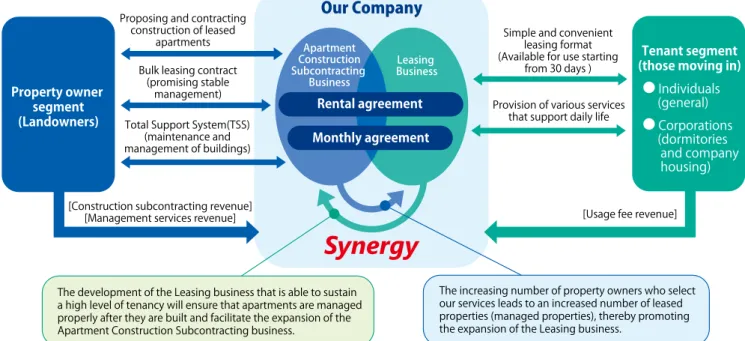
We are building our business based on the basic policy that states "Apartment Management Exists Only Because of Leasing" and with our belief that apartment building construction and leased property management are inseparable businesses. From the perspective of property owners, the biggest concern regarding their decision to build an apartment building is "whether it would be possible to continue securing an adequate number of tenants throughout the years". Consequently, we provide a "Bulk Leasing System" to the property owners by conducting the Leasing business on our own and by building an organization that can sustain a high rate of tenancy. We resolve the concerns regarding apartment building management for property owners and provide them with a mechanism that makes it possible to commission us with the construction of an apartment building by realizing a "Model of Synergies between Construction and Leasing".
By owning such a unique synergy between Construction and Leasing, we are able to realize extremely high stability in our business operations.
Exhibiting an extremely strong
competitiveness in the industry by
facilitating compatibility between
beneits for property owners and
beneits for tenants
Our customers are from both the property owner base, owners of the real property, as well as tenants, who wish to move into leased properties. The strength of the "Model of Synergies between Construction and Leasing" is born out of various mechanisms that maximize the beneits for both parties.
We established a "Total System for Apartment Operations" that not only offers the members of the property owner base recruitment and management of tenants, through a bulk property leasing system and cooperative system, but also includes maintenance and management of the buildings through the provision of comprehensive support.
Furthermore, to the members of the tenant base, we provide not only the development and provision of leased properties that feature superior designs and functionality, but also units furnished with consumer electronics by providing leasing formats (such as Rental agreement and Monthly agreement) to respond to the diverse life styles of modern times.
Our business model that offers signiicant beneits to both parties exhibits an extremely strong competitiveness.
Expansion of student’s rental market
through business collaboration;
improved occupancy rates through
improved corporate sales
By actively developing expansion for new demand, we have been successful in further improving our occupancy rates in this particular sector.
With the original intention of retaining existing student tenants from 2005 we concluded an agreement with companies that have a large number of students in their correspondence study businesses. We also established a new payment option that allows for monthly payments for the use of Monthly agreement, providing the possibility of making payments necessary to move into the leased properties as if they were being paid as rent on a monthly basis through a business alliance with credit card companies. This has expanded demand and developed a structure that eases the burden on students starting a new life.
We also intend to expand corporate trading even further, by utilizing as leverage our extended product lineup that incorporates larger studio units and family-type units. What used to be regional corporate sales business units located at individual sales ofices were integrated into a single corporate sales organization based at our head ofice in April 2009. This ofice will be directing sales to the head ofice functions of other corporate groups.
Our Company
Property owner
segment
(Landowners)
Rental agreement
Monthly agreement
Tenant segment
(those moving in)
Proposing and contracting construction of leased
apartments
Bulk leasing contract (promising stable
management)
Total Support System(TSS) (maintenance and management of buildings)
Construction subcontracting revenue
Management services revenue Usage fee revenue
Apartment Construction Subcontracting
Business
Leasing Business
Simple and convenient leasing format (Available for use starting
from 30 days )
Provision of various services that support daily life
● Individuals
(general)
● Corporations
(dormitories
and company
housing)
Synergy
The development of the Leasing business that is able to sustain a high level of tenancy will ensure that apartments are managed properly after they are built and facilitate the expansion of the Apartment Construction Subcontracting business.
The increasing number of property owners who select our services leads to an increased number of leased properties (managed properties), thereby promoting the expansion of the Leasing business.
Studios (less than 30m
2): Construction
Division's main product
In the apartment business, accurately assessing the changing needs of speciic customer groups over the next 20-30 years is essential. In this context, we have developed products primarily targeting single individuals, who account for the majority of apartment tenants. Thus, we offer studio units (single room with kitchen, less than 30 square meters) as our main product. In addition, we are offering a new lineup that includes larger studio units and family-type units, as well as residences with attached rental units to target new tenants to improve occupancy rates and to create new demand. Indeed, proposals we submit to owners are for the construction of apartment buildings located in areas where we expect large lease demand based on detailed analysis of the market.
Rental agreement for long-term
occupancy and Monthly agreement for
short-term stays: the Leasing Division's
two main products
The Leasing Division offers products designed for long-term occupancy and short-term stays. The former responds to a long-term occupancy through a “Rental Agreement” with monthly payments and without agent fees, whereas the latter is suitable for a temporary tenancy as it offers a “Monthly Agreement” that includes furniture, consumer electronics, and utility expenses, and requires an advanced payment in a single lump sum.
Monthly Leopalace Flat has multiple
functions
In recent years, Monthly Leopalace Flat has been employed by a diverse group of tenants. Simply put, long-term occupancy tenants account for some 60% of Monthly Leopalace Flat tenants and short-term tenants make up the remaining 40% . Long-term occupancy functions include ordinary residential use, company and school dormitories, and housing for job transferees away from families. Meanwhile, reasons for short-term stays include business trips (mainstay), job training, entrance examinations and lectures, temporary housing during moves and home renovation, and sightseeing. As mentioned earlier, the success of the Monthly Leopalace Flat service owes to our accurate response to diverse customer needs.
"Leopalace21 Series" exterior view "Leopalace21 Series" Interior view
Kitchen with an electrical cooking facility
Microwave oven
Refrigerator
Bed
Table and chair (table is collapsible) *Includes currently unfurnished/
uninstalled properties Intercom equipped with monitor
Card key Security windows (irst loor only)
Security Installations
Unit bath comes equipped with convenient bathroom dryer features
Television also offers broadband services
Air-conditioner
Facility with Pet Accommodating
Speciications (some available)
Leash hook Western door with pet access
Automatically locking gate
Outline-2:
Core Business
【Core Business Model】
Further evolution of our basic strength, "Model of Synergies between Construction and Leasing".
The “Model of Synergies between Construction and Leasing” development, which was intended for the organic consolidation of real property utilities, has after a twenty-year history been converted into “High Revenue Generating Asset Management” and transformed our business model into one that can maximize the beneits from the scale of our stock business.