A Scheduling Method in High-Level Synthesis
for Acyclic Partial Scan Design
Tomoo Inoue†, Tomokazu Miura†, Akio Tamura†, and Hideo Fujiwara‡
†Faculty of Information Sciences, Hiroshima City University
3-4-1 Ozukahigashi, Asaminami, Hiroshima 731-3194, Japan, Ph./Fax:+81-82-830-1575
‡Graduate School of Information Science, Nara Institute of Science and Technology 8916-5 Takayama, Ikoma, Nara 630-0101, Japan, Ph.:+81-743-72-5220, Fax:+81-743-72-5229
tomoo,tamura @im.hiroshima-cu.ac.jp, [email protected]
Abstract. Acyclic partial scan design is an efficient DFT method. This paper presents a scheduling method for re- ducing the number of scan registers for acyclic structure. In order to estimate the number of scan registers during scheduling, we propose provisional binding of operational units, and show a force-directed scheduling algorithm with the provisional binding. Experimental results show that the number of scan registers in the resulting RTL datapaths can be reduced by our method combined with the binding algo- rithm for acyclic partial scan.
1 Introduction
Design-for-testability (DFT) at register-transfer level (RTL) is an important approach to the reduction of testing cost. RTL DFT is suitable for today’s VLSI design style
— The design modification for testability is transparent for RTL designers, and the area/delay penalty by the DFT is alleviated by logic synthesis.
Acyclic partial scan designis an efficient DFT method. In this DFT, some of flip-flops in a sequential circuit are re- placed by scan flip-flops so that the resultant kernel circuit becomes acyclic. Test generation for an acyclic sequential circuit can be performed by applying a combinational test generation algorithm to its time-expansion model [1], and hence a complete test set for an acyclic sequential circuit can be obtained efficiently. Such structure-based DFTs [1]- [4] can be applied to RTL designs since structural properties in RTL designs are generally succeeded to logic level cir- cuits by logic synthesis. An efficient algorithm for finding a minimum set of scan registers that break all feedback loops in a circuit has been proposed in [5]. Thus, we can obtain testable circuits with low hardware overhead efficiently.
High-level synthesis refers to transforming an abstract behavioral description into an RTL circuit. Taking DFTs
He is currently with Matsushita Electric Industrial Co., Ltd., Japan.
applied to the resultant RTL circuits into account during high-level synthesis, i.e., high-level synthesis for testability can reduce the area/delay penalty, and bring out the effect of the RTL DFTs [6]. Many techniques on high-level syn- thesis for partial scan design have been proposed [7]-[12].
In this paper, we consider a method of high-level syn- thesis for acyclic partial scan design. High-level synthe- sis mainly consists of two tasks: scheduling and binding. Takasaki et al. [12] proposed a binding algorithm for mini- mizing the number of scan registers so as to make the kernel acyclic for a given scheduled data flow graph (DFG) or be- havior description while keeping the area/performance op- timality. Experimental results in [12] show that the bind- ing method can minimize the number of scan registers for many scheduled DFGs. In this paper, we propose a schedul- ing method for reducing the number of scan registers for acyclic structure. In order to estimate the number of scan registers during scheduling, we propose provisional bind- ingof operational units, and show a force-directed schedul- ing algorithm [13] with the provisional binding. Experi- mental results show that the combination of the scheduling algorithm with the provisional binding and the binding al- gorithm [12] can further reduce the number of scan regis- ters for acyclic structure compared to that of the scheduling algorithm without the provisional binding and the binding algorithm for some example DFGs.
2 High-Level Synthesis for Acyclic Structure 2.1 High-level synthesis flow
High-level synthesis (HLS) transforms a behavioral in- formation, which is represented by a data flow graph (DFG) (Fig. 1(a)), into a register-transfer level (RTL) design (Fig. 1(c)). In a DFG, a vertex represents an operation with a type (adder, multiplier, and so forth), and an edge represents a variable. Our HLS system derives an optimal RTL datap- ath in which the number of resources (operational units and IEEE the 11th Asian Test Symposium (ATS'02), pp. 128-133, Nov. 2002.
PI
+2 +1
* Const.
+3 PI
+4
PO x
u
v
w d1
y d2
PI
+2 +1
* Const.
+3 PI
+4
PO x
u
v
w d1
y d2
0
1
2
3
4
5 * + +
Const PO
PI
(a) Data flow graph: GD (b) Scheduled DFG: GsD (c) RTL datapath for GD
Figure 1. Input and output of high level synthesis.
registers) are minimum for a given DFG with a latency con- straint, which is an upper bound of the execution time. In addition, it aims to minimize the number of scan registers required for cycle breaking in the resultant RTL circuits.
HLS mainly consists of two tasks: scheduling and bind- ing. The former, scheduling, is to minimize the upper bound of the number of operational units for each operation type (adder, multiplier, and so on) under a latency constraint by assigning each operation to an appropriate control step. The result of the scheduling is represented by a scheduled DFG (Fig. 1(b)).
The latter binding procedure is further divided into oper- ational unit binding and register binding. Here we consider that operational unit binding is followed by register binding. In these procedures, each operation (variable) in the DFG scheduledby the above procedure is assigned to an opera- tional unit (register) in the resultant RTL datapath, i.e., the binding determines which each operation (variable) shares an operational unit (register) with. As a result, an optimal datapath with minimum numbers of operational units and registers is obtained (Fig. 1(c)).
2.2 Binding algorithm
The optimal operational unit binding problem is reduced to the minimum clique partitioning problem for a compati- bility graphof operations. In a compatibility graph GC(Fig. 2) for a scheduled DFG GsD, a vertex corresponds to an op- eration, and an edge v1 v2 denotes that operations v1and v2 are compatible, i.e., they can share an identical opera- tion. Note that two operations v1, v2 are compatible when they are assigned to different control steps in the scheduled DFG GsD. A clique in compatibility graph GCmeans that all the operations in the clique can share one identical op- erations, and hence the goal of binding is to partition the compatibility graph with a minimum number of cliques. An efficient heuristic algorithm for the minimum clique parti- tioning problem has been proposed [14].
Recall that our goal is to minimize the number of scan registers for acyclic partial scan while minimizing the num- ber of resources under a given latency constraint. In or- der to take the number of scan registers into account during the above-mentioned minimum clique partitioning, by fo- cusing on the fact that sharing may cause a loop, Takasaki et al.[12] represented the strength or possibility of the re- quirement for scan registers as a weight on an edge in the compatibility graph, and presented an algorithm for finding a minimum weighted clique partitioning.
In [12], edges v1 v2 in compatibility graph GCare clas- sified into three cases based on the relation of two opera- tions v1and v2in the scheduled DFG GsD, and accordingly edges are weighted as follows1.
v1and v2are adjacent. The sharing must make a self- loop. A self-loop must need a scan register, and there- fore the weight is large.
v1and v2are not adjacent, but reachable. This makes a (global) feedback loop. There must exist at least one scan register on a path between v1and v2. This, how- ever, implies that an assignment of some variable on the path to a scan register is sufficient. Hence, the weight is relatively small.
There is no path between v1and v2. In this case, no loop is made, and hence the weight is zero.
Based on the above weighting, the weight of a clique is defined as the sum of weights of edges in the clique. A heavy clique is regarded as a sharing that requires scan reg- isters strongly. Thus, the problem (minimizing the number of scan registers with the minimum number of resources) is solved by finding a minimum clique partitioning such that the sum of weights of the cliques is minimum.
1In [12], the weight is specified in more detail according to the sched- uled control steps of operations and the number of variables between them. However, we need not such a specified weight in the following discussion,
+2 +1
+4
+3
+2 +1
+4
+3 10
100 100
10 10
(a) Compatibility (b) Minimum weighted graph GC. partitioning. Figure 2. Compatibility graph: GC for adders in GD.
Example 1: Fig. 2(a) shows the compatibility graph GC
for adders in the scheduled DFG GsD. Fig. 2(b) shows the weights of edges and the optimal clique partitioning. In this example, large and small weights are given by 100 and 10, respectively, for the simplicity. The number of cliques is two, and hence, the number of adders in the resultant RTL circuits becomes two. The sum of weights of cliques is 10 10 20, which is the minimum. Note that the weight of any other clique partitioning whose number of cliques is also two is larger than 20 (e.g., 1 2 3 4 derives weight 200).
Similarly, register binding is performed, and thus an op- timal RTL datapath can be obtained.
3 Scheduling Algorithm with Provisional Binding
Recall that the goal of our HLS is to reduce the number of scan registers without obstructing the resource minimiza- tion. Hence, when the scheduling algorithm finds more than one candidates of operation assignment for the resource minimization, it must select the best for scan register reduc- tion of all the candidates. It is, however, difficult to know the accurate number of scan registers for acyclic structure during scheduling since the specific structure of resultant RTL circuits is determined after the completion of the bind- ing procedure, which succeeds the scheduling. Therefore, as a method for estimation of the number of scan registers during the schedule algorithm, we propose provisional op- erational binding.
In the following discussion, as an example of the appli- cations of provisional binding, we present a force directed scheduling algorithm [13] with our provisional binding. This provisional binding can be applied to other schedul- ing algorithms.
3.1 Force-directed scheduling
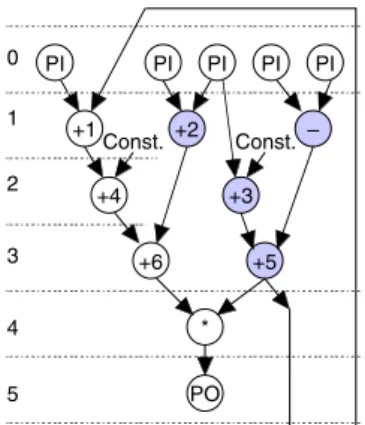
In the scheduling procedure, some operations are as- signed to control steps uniquely due to a latency constraint. For example, when a latency constraint for DFG GD1(Fig.
and hence the precise definition is omitted here.
PI
+2 +1Const.
+3 +4
PO 0
1
2
3
4
5
PI PI PI PI
+5 +6
* Const.–
Figure 3. Data flow graph: GD1.
3) is 5, operations 1 4 6 and are uniquely assigned to steps 1 2 3 and 4, respectively. On the other hand, the remaining operations (highlighted in Fig. 3) still have flex- ibilities on control steps to be scheduled. For example, op- eration 2 can be assigned to either step 1 or step 2. The difference te tste 2 ts 1 of the start and end of the time interval ts te where an operation v can be scheduled is said to be the mobility of v. In this case, the mobility of 2 in Fig. 3 is 1. Note that the mobility of a scheduled opera- tion is zero. Thus, the scheduling procedure is to determine appropriate control steps for all the operations whose mo- bilities are not zero.
The force-directed scheduling (FDS) algorithm [13] is known to be an efficient algorithm for finding an optimal scheduling. In this algorithm, it is supposed that operations are connected to one another by a spring, and some force is exerted on them. The force changes according to the assign- ment of operation to control steps2, and a balanced status (i.e., a case where the whole force is minimum) is regarded as an optimal scheduling.
The sketch of the FDS algorithm is as follows.
For all operations v whose mobilities are not zero, force f v t is calculated for all steps t ts te where v can be scheduled. The method for precise calculation of forces is omitted here (See [13]). If a control step t is crowded by the operations whose type is the same as v (i.e., the probability that many operations are assigned to t is high), the force f v t becomes large, and accord- ingly operation v will push out of step t. Otherwise, i.e., when step t is not crowed, f v t becomes small, and consequently operation v will be pull into step t. Select a minimum force f v t , and operation v is as- signed to step t.
2Although the force of the original FDS algorithm can take various factors in optimization (e.g., the number of registers) into account, here we make the force represent only the factor concerned with the number of operational units, for the sake of simplicity.
PI
+2 +1Const.
+3 +4
PO 0
1
2
3
4
5
PI PI PI PI
+5 +6
*
– Const.
Figure 4. Partially-scheduled DFG: GsD1.
According to the assignment, update the mobility of each operation that is not assigned to any control step, and repeat the above procedures until all operations are scheduled.
Example 2: Consider DFG GD1in Fig. 3. At the beginning of the FDS, operations 2 3 5 and all have mobility 1, and they have not been scheduled. Note that the con- trol steps of the other operations are uniquely determined. Forces f 2 and f 5 3 are the minimum for all time steps of all the unscheduled operations, and the FDS algo- rithm chooses either of them. For example, if the former
2 is selected, operation is assigned to step 2. 3.2 FDS with provisional binding
As mentioned above, each operation is assigned to an appropriate control step at every iteration in the FDS al- gorithm. Here, suppose that a partially-scheduled DFG GsD1 shown in Fig.4 is obtained in the progress of FDS. In GsD1, operations 2 and 3, which are highlighted, are not scheduled, and they both have mobility 1. The forces f 2 1 f 2 2 f 3 1 and f 3 2 are all the same and minimum. In such a case, i.e., when there exist two or more candidates for the best assignment with forces, we apply the provisional binding to the candidates to break the tie.
Let A be a set of assignments v t whose force f v t are minimum in a partially-scheduled DFG GsD. For each assignment v t A, the weight wp v t is calculated by the followings.
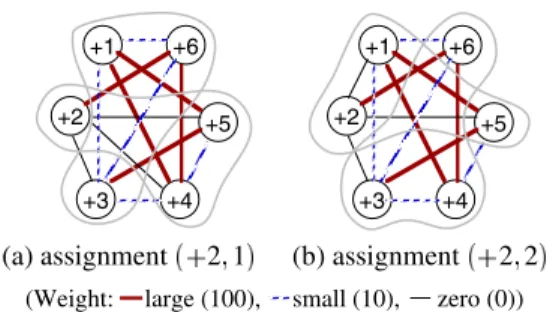
Make a provisional compatibility graph GC GsD v t for another partially-scheduled DFG GsD v t obtained by applying assignment v t to GsD. In GC GsD v t , a vertex corresponds to an operation, and an edge v1 v2
denotes that operations v1and v2are compatible provi- sionally. Here, two operations v1 and v2 are regarded as (provisionally) compatible not only when they are as- signed to different control steps, but also when either
+2 +1
+3 +4
+5 +6
+2 +1
+3 +4
+5 +6
(a) assignment 2 1 (b) assignment 2 2 (Weight: large (100), small (10), zero (0))
Figure 5. Provisional compatibility graphs for GsD1.
of two operations has non-zero mobility (or is unsched- uled). This is because an operation v1whose mobility is not zero can share an operational unit with the other v2
by assigning v1to step t1which is different from step t2
where v2is assigned.
Each edge in GC GsD v t is weighted in the same way as the binding method of [12] provided that the specific weight is omitted as explained in the previous section since the specification of weights is not possible before the completion of scheduling, and such a rough weight- ing is considered to be sufficient for estimating scan re- quirement.
According to the above-mentioned weighting, the mini- mum weighted clique partitioning problem is solved by the method [12], and let weight wp v t for the assign- ment v t in partially-scheduled DFG GsDbe the weight of the clique partitioning (the sum of clique weights). We choose an assignment v t whose weight wp v t is a minimum based on the above calculation as a solution for breaking the tie of the minimum force selection.
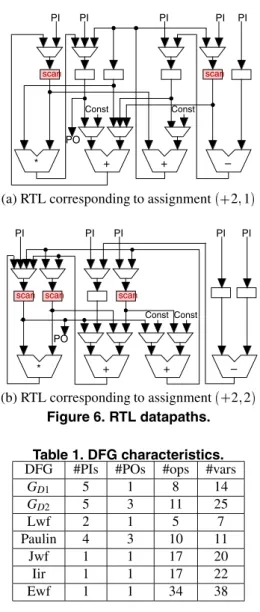
Example 3: Figs. 5 (a) and (b) show the provisional com- patibility graph GC GsD1 2 1 and GC GsD1 2 2 for assignments 2 1 and 2 2 in GsD1, respectively. The wights wp 2 1 and wp 2 2 are 40 and 220, respec- tively. Similarly, the others wp 3 1 and wp 3 2 are 230 and 40, respectively. Assignments 2 1 and 3 2 are minimum, and hence assignment 2 1 is selected here. Then, operation 2 is scheduled at step 1 by force- directed scheduling. Note that assignment 3 2 results in the same scheduling as 2 1 . After updating mobilities and forces, the remaining unscheduled operation is 3 only, and accordingly 3 is assigned to step 2 with minimum force. As a result, a (completely) scheduled DFG GsD1 is obtained. By applying the binding algorithm [12] to GsD1, we can obtain an RTL datapath shown in Fig. 6(a), which requires two scan registers for acyclic structure. Fig. 6(b) shows an RTL datapath obtained by assignment 2 2 in- stead of 2 1 mentioned above and applying the same
* + + PO
Const PI
– scan
Const scan
PI PI PI PI
(a) RTL corresponding to assignment 2 1
* + +
PO
Const PI
– scan
scan
PI PI PI
Const scan
PI
(b) RTL corresponding to assignment 2 2 Figure 6. RTL datapaths.
Table 1. DFG characteristics. DFG #PIs #POs #ops #vars
GD1 5 1 8 14
GD2 5 3 11 25
Lwf 2 1 5 7
Paulin 4 3 10 11
Jwf 1 1 17 20
Iir 1 1 17 22
Ewf 1 1 34 38
binding algorithm. The RTL datapath corresponding to 2 2 requires three scan registers for acyclic structure. Thus, we can reduce the number of scan registers for acyclic structure by scheduling with provisional binding.
4 Experimental Results
A force-directed scheduling algorithm in which our pro- visional binding is embedded was implemented, and ap- plied to several benchmark DFGs. For the experiments, a workstation SUN Ultra 10 (UltraSPARC-IIi 440MHz, 1GB Memory) was used. Table 1 shows the characteristics of benchmark DFGs. Columns #PIs, #POs, #ops and #vars denote the numbers of operations, primary inputs, primary outputs and variables, respectively. The first DFG GD1cor- responds to the example used in the pervious section (Fig. 3).
In order to analyze the effect of our method, we used
not only (SS) our proposed scheduling algorithm (force- directed scheduling algorithm with the provisional binding, i.e., minimum clique partitioning with minimum weight), but also (S) the force-directed scheduling algorithm with minimum clique partitioning whose weight is maximum. The latter scheduling (S) is considered to aim to raise the number of scan registers obtained by the succeeding bind- ing algorithm. In the same way as the previous section, in the schedulings (SS) and (S), only the basic core of under- lying force-directed scheduling algorithm is used, i.e., the force represents the factor concerned with only the number of operational units. Further, we used two binding algo- rithms: (SB) the binding algorithm [12] for acyclic par- tial scan (mentioned in Sect. 2.2, i.e., minimum clique partitioning with minimum weight) and (B) the binding al- gorithm by minimum clique partitioning with maximum weight. Thus, we applied all the combinations (SS+SB), (SS+B), (S+SB) and (S+B) to the benchmark DFGs, and calculated the minimum number of scan registers that are required for acyclic structure (i.e., for breaking all feedback loops) in the resultant RTL circuits.
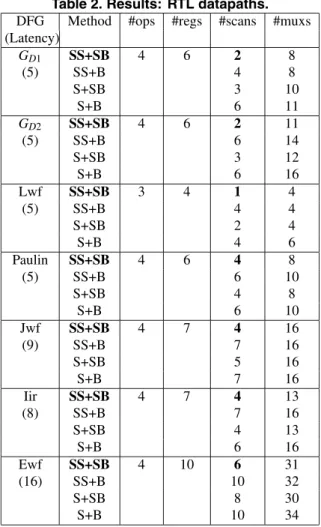
Table 2 shows the resulting RTL datapaths obtained by the combinations of scheduling and binding algorithms. The number Latency under each DFG name denotes a given latency constraint, which is minimum for the DFG. Columns #ops, #regs, #scans and #muxs denote the num- bers of operational units and registers, the minimum num- ber of scan registers for acyclic structure and the number of two-input multiplexors, respectively. The numbers of oper- ational units and registers are minimum under the latency constraint for all DFGs. The computation time required for scheduling is small: the time required by SS for Ewf was about 0.3 second, which is the largest of all the schedulings. From this table we can see that, by comparing SS+SB (our method) to S+SB, our scheduling method with the pro- visional binding reduces the number of scan registers. Fur- thermore, the number of scan registers by SS+SB is the smallest of all the algorithms. On the other hand, the num- ber of scan registers by SS+B is not smaller than that by S+SB for any DFG, i.e., our scheduling method without the binding algorithm [12] for acyclic partial scan is not effective. This is because our scheduling with provisional binding performs on the premise that the following binding algorithm aims to the reduction in scan registers.
Note that the number of multiplexors in a resultant RTL circuit is important for area/ performance as well as the number of scan registers. Hence, we pursued the number of multiplexors as shown in the rightmost column of Table 2. From these results, we can see that our synthesis method SS+SB can also reduce the number of multiplexors while reducing the number of scan registers for acyclic structure, even though neither SS nor SB takes the number of multi- plexors into account. Recall that both of our scheduling SS
Table 2. Results: RTL datapaths. DFG Method #ops #regs #scans #muxs (Latency)
GD1 SS+SB 4 6 2 8
(5) SS+B 4 8
S+SB 3 10
S+B 6 11
GD2 SS+SB 4 6 2 11
(5) SS+B 6 14
S+SB 3 12
S+B 6 16
Lwf SS+SB 3 4 1 4
(5) SS+B 4 4
S+SB 2 4
S+B 4 6
Paulin SS+SB 4 6 4 8
(5) SS+B 6 10
S+SB 4 8
S+B 6 10
Jwf SS+SB 4 7 4 16
(9) SS+B 7 16
S+SB 5 16
S+B 7 16
Iir SS+SB 4 7 4 13
(8) SS+B 7 16
S+SB 4 13
S+B 6 16
Ewf SS+SB 4 10 6 31
(16) SS+B 10 32
S+SB 8 30
S+B 10 34
and binding SB aim to reduce feedback loops by sharing operational units and registers appropriately. Accordingly we can consider that many paths that make loops share one path, and consequently the number of paths coming into a resource (operational unit or register) decreases success- fully. It is a future work to analyze this phenomenon in more detail.
Thus, the combination of SS+SB results in the most ef- fective in reducing scan registers for acyclic structure.
5 Conclusions
In this paper, we presented a scheduling algorithm for reducing the number of scan registers for acyclic struc- ture. In order to estimate the number of scan registers dur- ing scheduling, we proposed provisional binding of opera- tional units. Experimental results show that a force-directed scheduling algorithm in which our provisional binding is embedded can reduce the number of acyclic scan registers while keeping the area/performance optimality.
Acknowledgments Authors would like to thank Profs. Yoshinori Matsuura and Hideyuki Ichihara of Hiroshima City University for their helpful disscussions. This work was supported in part by Hiroshima City University under the HCU Grant for Special Academic Research (General Studies) and by Foundation of Nara Institute of Science and Technology under the Grant for Activity of Education and Research.
References
[1] T. Inoue, D. K. Das, C. Sano, T. Mihara, and H. Fujiwara,
“Test generation for acyclic sequential circuits with hold reg- isters,” IEEE/ACM Proc. Int’l Conf. on Computer Aided De- sign, 2000, pp.550-556.
[2] R. Gupta, R. Gupta and M. A. Breuer, “The BALLAST methodology for structured partial scan design,” IEEE Trans. on Comput., Vol.39, No.4, pp.538-544, April 1990. [3] R. Gupta and M. A. Breuer, “Partial scan design of register-
transfer level circuits,” Journal of Electronic Testing: Theory and Applications, Vol.7, pp.25-46, 1995.
[4] T. Inoue, T. Hosokawa, T. Mihara, and H. Fujiwara, “An optimal time expansion model based on combinational test generation for RT level circuits,” Proc. IEEE Asian Test Symp., 1998, pp.190-197.
[5] S. T. Chakradhar, A. Balakrishman, and V. D. Agrawal, “An exact algorithm for selecting partial scan design,” Proc. De- sign Automation Conf., 1994, pp.81-86.
[6] M. Inoue and H. Fujiwara, “An approach to test synthesis from higher level,” Integration, the VLSI journal 26, pp.101- 116, 1998.
[7] T. C. Lee, N. K. Jha, and W. H. Wolf, “Behavioral syn- thesis of highly testable data paths under the non-scan and partial scan environments,” Proc. Design Automation Conf., pp.292-297, 1993.
[8] M. Potkonjak, S. Dey, and R. K. Roy, “Behavioral synthe- sis of area-efficient testable designs using interaction be- tween hardware sharing and partial scan,” IEEE Trans. on Computer-Aided Design of Integrated Circuits and Systems, Vol. 14, No. 9, pp.1141-1154, 1995.
[9] A. Mujumdar, R. Jain, and K. Saluja, “Behavioral synthe- sis of testable designs,” Proc. IEEE Int’l. Symp. on Fault- Tolerant Computing, pp. 436-445, 1994.
[10] V. Fernandez and P. Sanchez, “Partial scan high-level syn- thesis,” Proc. European Design and Test Conf., pp.481-485, 1996.
[11] M. L. Flottes, R. Pires, B. Rouzeyre and L. Volpe, “Low cost partial scan design: a high level synthesis approach,” IEEE Proc. VLSI Test Symp., pp.332-340, 1998.
[12] T. Takasaki, T. Inoue, and H. Fujiwara, “A high-level syn- thesis approach to partial scan design based on acyclic struc- ture,” IEEE Proc. Asian Test Symp., 1999, pp.309-314. [13] P. G. Paulin and J. P. Knight, “Force-directed schedul-
ing for the behavioral synthesis of ASIC’s,” IEEE Trans. on Computer-Aided Design, Vol.8, No.6, pp.661-679, June 1989.
[14] G. De Micheli, Synthesis and optimization of digital circuits, McGraw-Hill, 1994.