Ogata, H. et al. (Eds.) (2015). Proceedings of the 23rd International Conference on Computers in Education. China: Asia-Pacific Society for Computers in Education
Recommendation Method in the Context of
Real-world Language Learning
Kousuke Mouri 1, Hiroaki Ogata2 , Noriko Uosaki3
1,2Faculty of Arts and Science and the Graduate School of Information Science and Electrical Engineering, University of Kyushu, Japan
3Center for International Education and Exchange, Osaka University, Japan
*{mourikousuke, hiroaki.ogata, n.uosaki}@gmail.com
Abstract: This paper explores a recommendation method in the context of real-world language learning based on ubiquitous learning logs. Ubiquitous learning log stands for a digital record of what they have learned in the daily life using ubiquitous technologies. One of the issues of ubiquitous learning analytics is how we should detect or mine effective and efficient learning patterns from many learning data accumulated in a ubiquitous learning system. To tackle this issues, this paper proposes a visualization and analysis system called VASCORLL (Visualization and Analysis system for COnnecting Relationships of Learning Logs) in order to link learners in the real world and learning logs that are accumulated in a cyber space by a ubiquitous learning system called SCROLL (System for Capturing and Reminding of Learning Log). Using VASCORLL, learners can predict their next learning steps and then find learning patterns related to their current learning situation. The initial evaluation was conducted to measure whether VASCORLL can increase learners’ learning opportunities and whether the recommended learning patterns are appropriate for learners or not. In this evaluation, we found important criteria for recommending appropriate learning patterns for learners in the real-world language learning. In addition, VASCORLL succeeded in increasing learners’ learning opportunities.
Keywords: ubiquitous learning log, association analysis, spatio-temporal data mining
1. Introduction
Ubiquitous learning has been paid attentions in educational research over the world. For example, CSUL or u-learning has been constructed using ubiquitous technologies such as mobile devices, RFID tags, QR codes and wireless networks (Ogata et al., 2004; Hwang et al., 2008; Yin et al., 2010). These types of learning take place not only in-class learning but also in a variety of out-class learning spaces such as homes, libraries and museums.
Ogata et al. (2011) developed a ubiquitous learning system called SCROLL (System for Capturing and Reminding of Learning Log). The system allows learners to share them by recording on the web or mobile devices what they have learned in their daily lives. Numerous data has been accumulated on the cyber space from 2011 to 2015 (Ogata et al., 2014a). SCROLL has supported various fields of learning such as language learning, science communicator and career support for international students (Mouri et al., 2012, 2013; Ogata et al., 2014b; Uosaki et al., 2015).
These learning log accumulated in the cyber space include spatiotemporal data such as location and time information. In the research studies on spatiotemporal data mining, they explore many challenges in representing, processing, analyzing and mining of dataset in spite of complex structures of spatiotemporal objects and the relationships among them (Rao et al., 2011, 2012).
Similarly, Mouri et al (2014, 2015). proposed an innovative visualization system for analyzing learning logs in order to reveal relationships between learners in the real world and learning logs in the cyber space. However, the objective of their studies was visualization of the collected data and they did not analyze nor mine their data. Therefore it is yet to be realized to recommend proper learning logs in accordance with learners' learning situation in the real world. In addition, it is necessary to examine whether learning logs recommended from the analysis are appropriate for them so that their learning opportunities have been increased.
This paper proposes a visualization and analysis system called VASCORLL (Visualization and Analysis system for Connecting Relationships of Learning Log) for recommending appropriate learning patterns in the real-world language learning. VASCORLL works in a cyber-physical setting to link learners in the real world and learning logs that are accumulated in cyber spaces by using a ubiquitous learning system called SCROLL. Our main objective in this research is to reveal the following issues.
(1) How we can detect or mine effective and efficient learning patterns from complex relationships between learners in the real world and learning logs in the cyber space.
(2) Whether their learning opportunities are increased by recommending appropriate learning logs based on their learning patterns.
(3) Whether learning logs that are recommended from the analysis results are appropriate for learners. This paper aims to describe how to detect or mine effective and efficient learning experiences accumulated in the cyber spaces, using association analysis. The “effective” means that VASCORLL can increase their learning opportunities by recommending and detecting learning logs similar to their own from past learning histories accumulated in the cyber spaces. The evaluation was conducted to examine whether the recommended learning patterns are appropriate for learners or not.
2. Related Works
2.1 Ubiquitous Learning Log and SCROLL
In this paper, Ubiquitous Learning Log (ULL) is defined as a digital record of what learners have learned in the daily life using ubiquitous technologies (Ogata et al., 2011). As shown in Figure 1, learners can record a ubiquitous learning log with photo, audios, videos, location, QR-code, RFID tag, and sensor data using desktop PC or mobile device and SCROLL. Figure 2 shows a ubiquitous learning log recorded by SCROLL. Learners can reflect what they have learned using this interface anytime and anywhere. To date, there are 27866 learning contents (cumulative total), 1770 users, 19 native languages (Chinese, Japanese etc.) and 30 place elements (Supermarket, post office etc.).
Figure 1. Adding ULL Figure 2. A ubiquitous learning log 2.2 Spatio-temporal Data Mining
The research studies in the spatio-temporal data mining proposed many analysis approaches to reveal the links and the shifts among the objects on spatial and temporal dimension (Rao et al., 2011, 2012). The researches mainly analyze data to predict disaster, weather and animal actions. For the example in disaster, there is such hurricane. It occurs in different places at various times, and the prediction is made possible by revealing cause-and-effect links behind the disaster.
For the research studies in the spatio-temporal data mining, the relationships between event such as disaster and weather and location or time are importation information. However, for learners in the real-world language learning it is also important to grasp information such as other learners’ age, gender, nationalities, learning place and time related to what they have learned. This paper uses spatio-temporal association analysis (Agrawal et al., 1993) in order to detect or mine learning patterns or rules related to what they have learned.
Our proposed VASCROLL implements a recommendation method based on association analysis. By this, VASCORLL can discover learning patterns of what kind of learners learned what kind of knowledge in what kind of place and what kind of occasion.
3. System Design 3.1 Design
Figure 3 shows the workflow to feedback them after visualizing and analyzing ULLs by VASCORLL in a cyber-physical setting.
Figure 3. How SCROLL and VASCORLL works The workflow shows the following four steps:
Step1. Learners can save their experiences as ULLs with photos and videos using mobile device or desktop PC and SCROLL. The ULL includes the author name, language, time of creation, location (latitude and longitude), learning place and tags. For example, if a learner learns a natto at the supermarket, the saved ULL will be accumulated into the cyber space.
Step2. Learners do not have means to know whether their knowledge can be applied to other learning environments or not. VASCORLL allows learners to find knowledge that can be applied into different contexts, by visualizing and analyzing a large amount of ULLs that are accumulated in the cyber space.
Step3. VASCORLL feedbacks important relationships such as the most frequently learned place and time zone from the results of step 2.
Step4. It is important to recognize who is learning what, and when, where and how, so that learners can understand how their own knowledge is used in other contexts. Therefore, VASCORLL supports learners to apply their own experiences to other contexts.
All the above workflow can be supported by SCROLL and VASCORLL. 3.2 LKPTE model
To visualize and analyze several relationships between the learners and ULLs, Mouri et al. (2014 & 2015) uniquely defined them in a three-layer s structure.
This paper proposes an analysis model called LKPTE
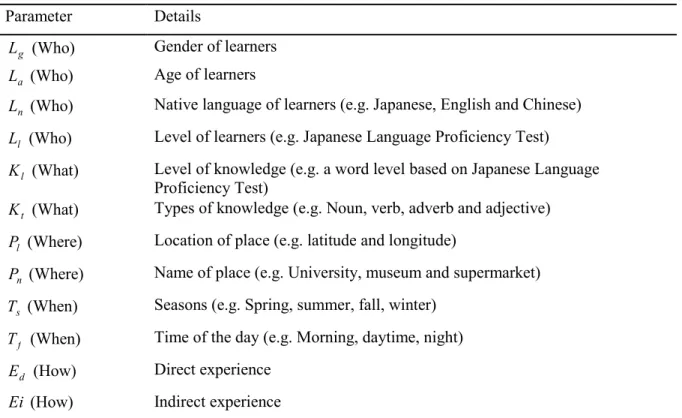
(Learner-Knowledge-Place-Time-Experiences) based on Three-layer structures and LKPTE parameters in Table 1. Using this model, VASCORLL can find the most important relationships between learners in the real world and ULLs that are accumulated in the cyber space. Table 1 shows parameters of the LKPTE model.
Table 1: LKPTE parameters
Parameter Details
Lg (Who) Gender of learners L (Who)a Age of learners
L (Who)n Native language of learners (e.g. Japanese, English and Chinese) L (Who)l Level of learners (e.g. Japanese Language Proficiency Test)
K (What)l Level of knowledge (e.g. a word level based on Japanese Language Proficiency Test)
K (What)t Types of knowledge (e.g. Noun, verb, adverb and adjective) P (Where)l Location of place (e.g. latitude and longitude)
P (Where)n Name of place (e.g. University, museum and supermarket) T (When)s Seasons (e.g. Spring, summer, fall, winter)
T (When)f Time of the day (e.g. Morning, daytime, night) E (How) d Direct experience
Ei (How) Indirect experience
Learners' parameter L (Who) shows their gender (L ), age (g L ), native language (a L ) and n Japanese Language Proficiency Test level (JLPT) of learners ( L ). Using these parameters, l VASCORLL can find other learners similar to the learner.
Knowledge parameter K (What) shows the level of words (K ) decided by JLPT and l knowledge types (K ) such as noun, verb, adverb and adjective. Parameter K is to decide whether they t fit learners' level when learning other learners' experiences..
Parameter P (Where) shows location (P ) and place name (l P ). For example, there is a n possibility that ULLs in same location contain different place names such as university and restaurant. Also, there is a possibility that same place names contain different location. Parameter P distinguishes ULLs in different contexts, so that VASCORLL can detect learner contexts in the real world and ULLs in cyber space.
Parameter T (When) shows the seasons (T ) and the time zone (s T ). For example, the most f learners have learned morning glory flowers in the morning. But, a learner has learned a morning glory
flower in the daytime. Generally, most people regard morning glories as flowers which bloom in the morning, but there are kinds of morning glories which are in bloom until the daytime actually. Therefore, VASCORLL will detect relationships between knowledge and place in different times. By providing their relationships, learners can grasp information regarding time of other experiences.
Parameter E (How) shows direct experiences (E ) and indirect experiences ( Ei ). Direct d experience (E ) denotes experience gained through sense perception. Indirect experience ( Ei ) denotes d experience gained through others. Learners can save others’ indirect experiences as “Relog” using SCROLL. According to Kolb (1984), he described that it is important to directly experience. By revealing relationships between direct experiences and indirect experiences, VASCORLL can change learners from watcher to doer by using a learning system based on task-based learning (Mouri et al., 2013).
To reveal the distance between learners and ULLs, this paper measures them using cosine similarity. This paper defines the following vectors V (1) based on the parameters of LKPTE model. i
Vi={Lg,L , a L , n L , l K , l K , t P , l P , n T , s Tf, E , Eid } (1) 3.3 Recommendation based on Association Analysis
To detect learners’ learning patterns, trends and other yet-to-be-known learning style, this paper uses association analysis with the appriori algorithm. The analysis was conducted the following those criteria shown below.
1. Suppose ≧ 0.01, Confidence ≧ 0.05, The number of detected rules is 1000, Attributes {gender, age, native language, knowledge, place, time, experience type}
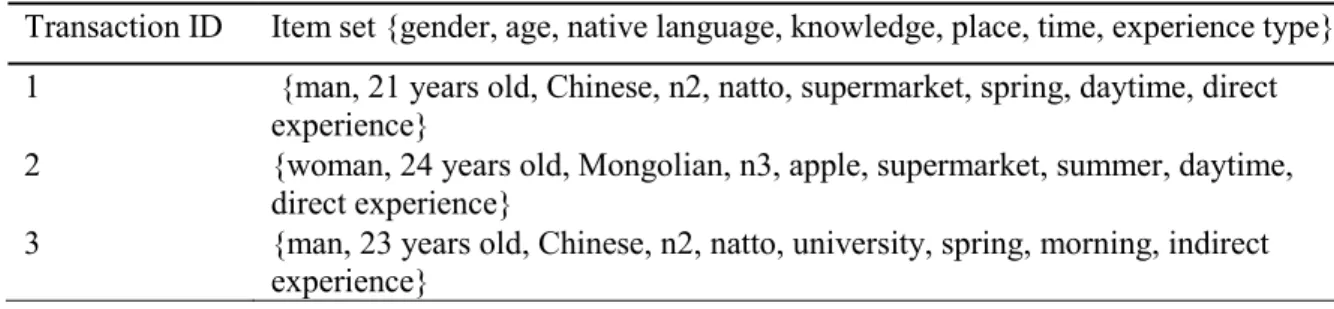
In order to detect association rules, we set the suppose value more than 0.01, and the confidence value more than 0.05. Table 2 shows some samples of items of ULLs. This paper analyzes to detect or mine association rules based on items in Table 2.
Table 2: The part of items of ULLs
Transaction ID Item set {gender, age, native language, knowledge, place, time, experience type} 1 {man, 21 years old, Chinese, n2, natto, supermarket, spring, daytime, direct
experience}
2 {woman, 24 years old, Mongolian, n3, apple, supermarket, summer, daytime, direct experience}
3 {man, 23 years old, Chinese, n2, natto, university, spring, morning, indirect experience}
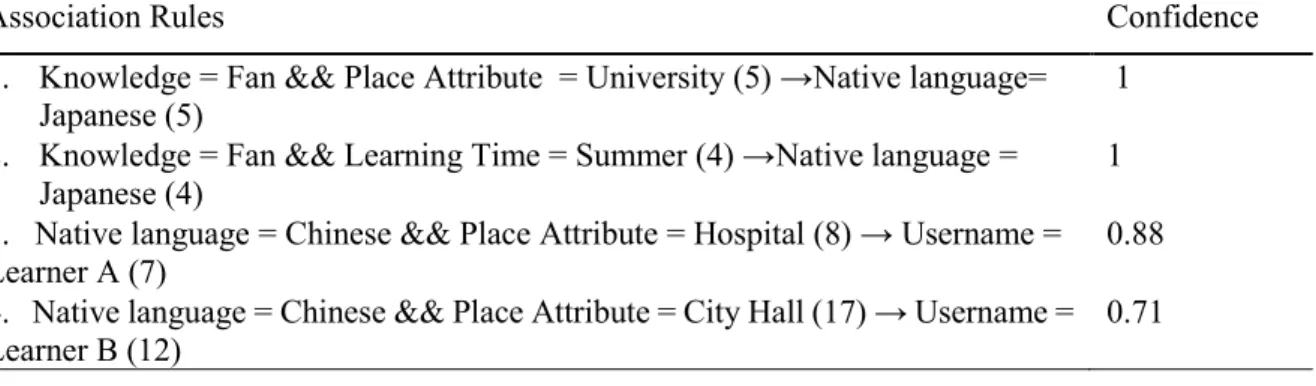
Table 3 shows the part of the detected association rules. The Rule 1 shows that the learning place of five “fan” words is “university”, and that nationality of the learners is all Japanese. This implicates that Japanese learners are likely to learn “fan” at the university. The Rule 2 shows that the learning time of four “fan” words is “Summer”, and that native language of learners is all Japanese. This implicates that four Japanese students are likely to learn a “fan” in summer. By mining these rules, it will be revealed their learning trends. For example, if a learner is at the university, system can show him/her the learning trends such as “who (Japanese) is learning what (fan), when (summer) and where (university)” to learner.
The Rule 3 shows that learner A learned 7 learning logs out of 8 logs with the attributes: Chinese (native language) and hospital (place). From this result, it can be predicted that whose learning logs to refer to when in hospital. For example, when a Chinese learner visits a hospital, he can learn the knowledge and events that might possibly happen at the hospital in advance by referring to learner A’s logs which he/she learned at the hospital in the past. Similarly, the Rule 4 shows that learner B learned 12 learning logs out of 17 with attributes: Chinese (native language) and city hall (place). The confidence value of Rule 3 is higher than that of Rule 4. That means that its relevance is higher. When the system recommends them to learners in real world, the confidence values can be important criteria of the recommendation.
Table 3: The part of the detected association rules
Association Rules Confidence
1. Knowledge = Fan && Place Attribute = University (5) →Native language= Japanese (5)
1 2. Knowledge = Fan && Learning Time = Summer (4) →Native language =
Japanese (4)
1 3. Native language = Chinese && Place Attribute = Hospital (8) → Username = Learner A (7)
0.88 4. Native language = Chinese && Place Attribute = City Hall (17) → Username = Learner B (12)
0.71
4. Implementation
This section describes ways of the implementation of VASCORLL. 4.1 Analysis interface
To find ULLs by location information (P and l P of LKPTE model), firstly, it is necessary to get n learners’ current location and place information where they are studying. Green marker on map of the interface shows learner’ current positions, and red maker shows the names of learning place near her/him. Using web interface in shown in Figure 4, learners can check in location information.
Figure 4. web interface of Checking in learners’ current location
Figure 5 shows recommendation interface that are calculated based on LKPTE model. It consists of the following components:
1. Association rules: With understanding association rules, learners can predict their next learning steps. For example, if they are at the restaurant and daytime, the system will recommend knowledge (Case in the Figure 5 is “ramen”) related to them based on association analysis. Therefore, the system can recommend appropriate knowledge at appropriate learning place in appropriate learning time.
2. Evaluation of recommendation: To evaluate whether association rules recommended by system are appropriate for learners, learners will be asked some questions such as “Is this recommendation useful for learning?”, “Is this recommendation appropriate level for you?” and “Do you feel that this log is interesting to learn?”. In the section 6.1, this paper evaluates whether the system was able to recommend appropriate learning patterns in accordance with their learning situations.
Figure 5. Recommendation interface based on association analysis 5. Evaluation
10 international students (5 Mongolians and 5 Chinese) who are studying at the University of Tokushima and Kyushu University participated in the evaluation experiment. They were from China and Mongolia aged between 21 and 34. Their length of stay is from 1 month to 5 years.
5.1 Method
Before the evaluation started, we explained how to use SCROLL and our proposed VASCORLL. They learned vocabularies in their daily lives for one day. The mobile devices used in the evaluation experiment were three iPhone 4s, five iPhone 5s, and two Samsung Galaxy Note 3s. The objective of this evaluation was to examine whether VASCORLL system can increase students’ learning opportunities and whether the recommended learning experiences are appropriate for learners or not. Table 4. Question on the recommendation
Question on the recommendation interface 1. Is this recommendation useful for learning?? 2. Is this recommendation appropriate level for you? 3. Do you feel that this log is interesting to learn?
After the evaluation, the participants were asked to complete a five-point-scale questionnaire, in which they evaluated its performance, and usability, as well as the ease of understanding and discovery of ULL by using VASCORLL system. In addition, the participants evaluated whether the system’s association rules are appropriate or not, using recommendation form in Table 4.
5.2 Result and discussion
The questionnaire result is shown in Table 5. The highest mean score was 4.28 when the subjects were asked whether VASCORLL was useful for discovering relationships among ULLs. The response to Q1 indicates that they were able to discover relationships among ULLs. Also, some students commented that VASCORLL was helpful to find relationships among some words in different contexts. The response to Q2 to Q3 indicate that students were able to share them and discovering something to learn by using VASCORLL.
Table 5: Result of the five-point-scale questionnaire
Question Mean SD
1. Was VASCORLL system useful for discovering relationships among ULLs? 4.28 0.98 2. Were you able to discover something to learn by using VASCORLL? 3.85 1.12 3. Did you think you were able to share other ULLs by using VASCORLL? 4.14 1.03
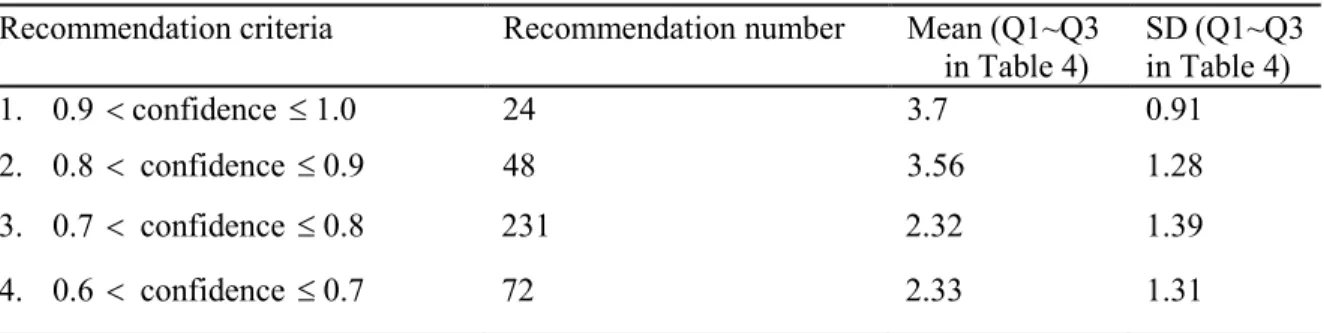
Table 6 presents the number of recommendation that the system recommended appropriate ULLs in accordance with each recommendation criteria, and the subjects learned them. In total, they learned 375 ULLs after receiving association rules. This means that their learning opportunities are increased by using VASCROLL.
As shown in Table 6, the system was able to recommend appropriate association rules because the mean is higher if confidence value is more than 0.8.
However, it shows that the system was not able to recommend appropriate association rules for learner if confidence value is less than 0.8. This means that learners disliked association rules if confidence value is less than 0.8. In this evaluation, we found important criteria for recommending appropriate association rules for learners in the real-world language learning. In addition, the recommendation system based on our association rules with high confidence value is expected to keep learners from decreasing their motivation. This is because learners felt that association rules with the high confidence value are interesting and useful for learning. As our future work, we consider this issue. Table 6. The recommendation based on association analysis
Recommendation criteria Recommendation number Mean (Q1~Q3 in Table 4)
SD (Q1~Q3 in Table 4)
1. 0.9 confidence 1.0 24 3.7 0.91
2. 0.8 confidence 0.9 48 3.56 1.28
3. 0.7 confidence 0.8 231 2.32 1.39
4. 0.6 confidence 0.7 72 2.33 1.31
6. Conclusion
In order to link learners in the real world and learning logs accumulated in cyber space by a ubiquitous learning system called SCROLL, this paper proposes a visualization and analysis system called VASCORLL. VASCORLL will find learning patterns and relationships between learners' contexts in real world and past learners' contexts in cyber space, and then recommend knowledge that can be
applied into other contexts to learners in the real world. According to the initial experiment, VASCORLL was effective for finding other contexts which can be applied to their own learning experiences. In addition, the system enabled learners to find learning patterns similar to their current learning situation, using association analysis. Consequently, VASCORLL succeeded in increasing learners’ learning opportunities.
In the future, the use and evaluation of VASCORLL will continue. Our next consideration is to support international students who aim to take JLPT and to enhance their Japanese language skills by using VASCORLL. Also, we will apply not only life-long learning but also other mobile learning domains, e.g. CSCL (Computer Supported Collaborative Learning) and Seamless learning.
Acknowledgements
This part of this research work was supported by the Grant-in-Aid for Scientific Research No.25282059, No.26560122, No.25540091 and No.26350319 from the Ministry of Education, Culture, Sports, Science and Technology (MEXT) in Japan. The research results have been partly achieved by
“Research and Development on Fundamental and Utilization Technologies for Social Big Data” (178A03), the Commissioned Research of National Institute of Information and Communications Technology (NICT), Japan.
References
Agrawal, R., Imielinski, T. and Swami, A. (1993). Mining association rules between sets of items in large databases, Proceeding of the 1993 ACM SIGMOD international conference on Management of data, 207-216.
Hwang, G. J., Tsai, C. C. & Yang, S. J. H. (2008). Criteria, strategies and research issues of context-aware ubiquitous Learning, Educational Technology and Society, 11(2), 81-91.
Kolb, D. A. (1984). Experiential learning: Experience as the source of learning and development, vol. 1. Englewood Cliffs, NJ: Prentice-Hall.
Mouri, K., Ogata, H., Li, M., Hou, B. and Uosaki, N. (2012). Learning Log Navigator: Augmented awareness past learning experiences, proceedings of 2012 IIAI International Conference, 159-162.
Mouri, K., Ogata, H., Li, M., Hou, B., Uosaki, N., & Liu, S.(2013). Learning Log Navigator: Supporting Task-based Learning Using Ubiquitous Learning Logs, Journal of Research and Practice on Technology Enhanced Learning (RPTEL), 8(1), pp.117-128.
Mouri, K., Ogata, H., Uosaki, N. and Liu, S. (2014). Visualizaiton for analyzing Ubiquitous Learning Logs, Proceedings of the 22nd International Conference on Computers in Education (ICCE 2014), 461-470. Mouri, K., Ogata, H. and Uosaki, N. (2015). Ubiquitous Learning Analytics in the Context of Real-world
Language Learning, International conference on Learning Analytics and Knowledge (LAK 2015) ACM, 378-382.
Ogata, H. & Yano, Y. (2004). Context-aware support for computer-supported ubiquitous learning, IEEE International Workshop on Wireless and Mobile Technologies in Education, 27-34.
Ogata, H., Li, M., Bin, H., Uosaki, N., El-Bishoutly, M., & Yano, Y. (2011). SCROLL: Supporting to share and reuse ubiquitous learning logs in the context of language learning, Research and Practice on Technology Enhanced Learning, 6(3), 69-82.
Ogata, H., Hou, B., Li, M., Uosaki, N., Mouri, K & Liu, S. (2014a). Ubiquitous Learning Project Using Life-logging Technology in Japan, Educational Technology and Society Journal, 17(2), 85-100.
Ogata, H., Mouri, K., Bono, M., Joh, A., Takanashi, K., Osaki, A. and Ochiai, H. (2014b) Supporting Science Communication in aMuseum using Ubiquitous Learning Logs, Prof of Workshop on Computational Approaches to Connecting Levels of Analysis in Networked Learning Communities, Lak 2014, USA. Rao, K.V., Govardhan, Dr.A. & Rao, Dr.K.V. (2011). Discovering Spatiotemporal Topological Relationships,
Advances in Computing and Information Technology Communications in Computer and Information Science, 19(8), 507-516.
Rao, K.V. & Govardhan, Dr.A. (2012). Spatiotemporal data mining: Issues, Task and Applications, International Journal of Computer Science and Engineering Survey, 3(1), 39-52.
Uosaki, N., Ogata, H., Mouri, K. and Lkhagvasuren, E. Career Support for International Students in Japan Using Ubiquitous Learning Logs System, Proceedings of the 15th IEEE International Conference on Advanced Technologies (ICALT 2015), Taiwan,78-82.
Yin, C., Ogata, H., Tabata, Y. and Yano, Y. (2010) Supporting the acquisition of Japanese polite expressions in context-aware ubiquitous learning, International journal of Mobile Learning and Organization, 4(2), 214-234.