II
.素粒子実験グループ
教 授 金 信弘,受川 史彦
准教授 原 和彦
講 師 武内 勇司,佐藤構二
助 教 大川 英希
研究科特別研究員 武政 健一
大学院生 20名
素粒子実験グループは高エネルギー粒子加速器を用いた素粒子物理学実験CDF,ATLAS,
およびILCの研究を行っている。CDFは2011年度に運転終了,ATLASは2009年秋より
衝突実験を開始,ILCは技術設計中の実験である。本年度もそれぞれにおいて様々な研究活
動が行われた。また,宇宙背景ニュートリノの崩壊探索を目的とした高分解能光検出器STJ
の開発,宇宙線ミュー粒子を用いた大規模構造物の透視を行っている。
【
1
】
陽子・反陽子衝突実験
CDF
CDF実験は,米国フェルミ国立加速器研究所のテバトロン加速器を用いた陽子・反陽子
衝突実験であり,日本をはじめアジア,北米,欧州の計14ヶ国の研究機関・大学からなる国
際協力により行なわれている。1996年の物理実験Run Iの終了後CDF検出器およびテバト
ロン加速器は,1996年の物理実験Run Iの終了後の大幅な増強を経て2001年度よりRun II
実験が遂行されてきたが,2011年9月30日に加速器・検出器ともにその運転が終了した。
最終的にCDF検出器により記録されたデータ量は約10 fb−1である。この全データを用い
た物理解析も多くが終了し,最終結果を論文として公表する段階にある。2014年には19篇
の原著論文が公表された。以下に2014年度の成果について主なものを記す。
CDF実験による1995年のトップクォーク発見からおよそ20年が経過し,Run II実験に
おいては高統計のトップクォーク事象を用いてその様々な性質が詳細に研究されている。テ バトロンでのトップクォーク生成は,クォーク・反クォーク対を始状態とする対生成が主で ある。
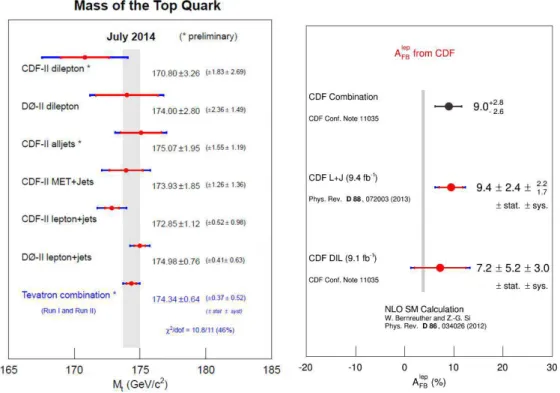
その質量は多くの終状態を用いて測定されている。2014年には,CDF実験とD0実験の
測定を総合したRun-II実験の最終結果がmtop= 174.34±0.37±0.52 GeV/c2 と得られた (図1(左))。
また,トップクォーク対の生成機構の研究を継続して行った。t¯t対の前後方非対称度に着
目し,2010年度には5.1 fb−1相当のデータを用いてdileptonチャンネルにおける初めての
測定を行った。2014年度には,論文発表に向け,全データを用いたdileptonチャンネルの
解析を継続した。
【
2
】
LHC ATLAS
実験
欧州セルン研究所のLHC加速器 (Large Hadron Collider)は,2012年までのRUN-1を
図1: (左):CDFおよびD0実験によるトップクォークの質量の測定。(右):CDF実験で のトップクォーク対崩壊による荷電レプトンの前後方非対称度。
年度からはRUN-2が始まる。重心系エネルギーが上がることにより,ヒッグス粒子の生成
断面積が増大し,より統計精度をあげた測定が期待できる。
ATLAS実験グループはこの間にヒッグス粒子の様々な粒子への崩壊断面積の測定を完了
した。本グループはbクォーク対に崩壊するモードに対し,測定感度を上げた解析を実施し
た。また,2023年以降は,LHCは設計値を超えた高輝度実験,HL-LHC加速器に増強され
る予定である。放射線レベルも現在の検出器設計の10倍に達するため,それに伴う新しい
内部飛跡検出器の開発研究も継続している。
(1) ヒッグス粒子の崩壊と結合定数
質量の起源とされるヒッグス粒子は2012年末に発見された。現在は,精密測定を通して,
標準模型の枠組みどおりヒッグス粒子はすべての素粒子に質量を与えるのか,他にヒッグス 粒子はあるのかについての研究を進めている。
ATLAS実験による様々な粒子対へのヒッグス生成断面積の最新結果を図2にまとめる。
W/Zゲージ粒子に質量を与えることはヒッグスの発見により確立したが,今年度は初めて
レプトン(τ)に対しても高い精度で質量を与えることが判明し,また,b対に崩壊する解析
に重要な進展が得られた。クォーク(b)に質量を与えるかに関しては,測定された中心値が
図2: ATLASによるヒッグス粒子の様々な 粒子対への崩壊断面積測定の最新結果。値は 標準模型での予想値で規格化したもの。
(S / B) 10 log
-4 -3 -2 -1 0 1
Events / bin
1 10 2 10 3 10 4 10 ATLAS -1 , 20.3 fb
= 8 TeV
s
-1 , 4.5 fb
= 7 TeV
s τ τ → H Data =1.4) µ Background ( =0) µ Background ( =1.4) µ ( τ τ → (125) H =1) µ ( τ τ → (125) H
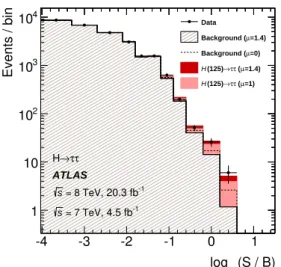
図3: H→τ+τ−
候補事象数を多変数解析に おける信号期待量とバックグランド量の比の 関数として示す。信号が期待できる正の領域 でバックグラウンドのみより有意に多い事象 数を示している。この新しい解析で統計的に 4.5σの有意度でH→τ+τ−
が観測された。
(2) ヒッグスのフェルミオンとの結合
ヒッグスがW/Z粒子に質量を与えることはヒッグスの定義であるが,湯川結合によりフェ
ルミ粒子にも質量を与えるかは標準模型の検証において最も重要なステップである。
レプトンに関する測定として,H → τ+τ−
モードの測定感度を図3に示す。多変数解析
による解析法の最適化により2014年度にこのモードでバックグランドを超過する有意な信
号が得られた。生成断面積は,標準模型の生成断面積で規格化してµ= 1.43+0.43
−0.37である。こ
れは統計的に4.5σの有意度であり,τ 粒子に対してヒッグスが質量を与える重要な証拠で
あると見なせる。
クォークに対してはbが最も観測できる可能性が高い。QCDのバックグランドが多いた
め,H → b¯b単独ではなく,W/Z 粒子が随伴されるモードでW やZが崩壊して発生する
高運動量のレプトンをトリガーにすることで探索した。このチャンネルでも多変数解析で信
号/バックグラウンド比を最適化する解析法を用いた。図4は,この解析法でH →b¯bが存
在しない場合に,生成断面積に対してどの程度の制限を与えられるかを,期待値(破線)お
よびその精度を1σ,2σの帯として示している。点線は標準模型のH→b¯bが存在する場合
である。データはその中間(黒点)に位置し,H →b¯bが存在するという統計的な有意度は
125.36 GeV/c2の質量では1.4σである。これは標準模型での期待値2.6σを下回り,実際に
H→ b¯b生成断面積は標準模型で規格化してµ= 0.52±0.32(stat)±0.24(syst)にとどまっ
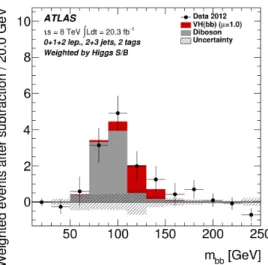
た。標準模型とは統計的に矛盾しないが,明らかな生成の証拠とは言えない。図5はb¯b候補
事象の不変質量分布を,ボゾン対(W W,W Z,ZZ) 生成と標準模型から期待される分布と
比較したものである。これは8 TeVでの衝突データであり一致度は良いが,7 TeVのデータ
図4: H → b¯b生成が存在しない場合の期待
される生成断面積の上限値(破線および1σ,
2σの領域)。標準模型(点線)の期待に対し
て,測定値(黒点)は中間に位置した。
図5: H →b¯b探索のために,ボゾン対生成
以外のバックグラウンドを差し引いたb¯b質
量の分布と8 TeVでのデータの比較。赤は
標準模型で期待されるH→b¯b分布。
(3) ヒッグス粒子の質量
ヒッグス粒子の質量や生成断面積は標準模型の検証および標準模型を超える物理を示唆
する場合に重要なパラメータとなる。ヒッグス粒子の質量についてATLASとCMSを統合
した測定を図6に示す。この質量の測定ではニュートリノ発生に伴う消失エネルギーのない
H →γγ とH → Z0Z0
→4ℓの崩壊モードだけに限って解析に用いた。ヒッグスの質量と
生成断面積には相関があるため,図7には生成断面積の測定への依存性も示している。2つ
の解析モードの生成断面積の標準模型との比は共通であると仮定して,これらの質量値を同
時にフィットした結果は125.09±0.24 GeV/c2である。評価に用いた両グループの両モード
での値はこの統合値に統計的に矛盾しない。
[GeV]
H
m
123 124 125 126 127 128 129
Total Stat. Syst.
CMS and ATLAS
Run 1
LHC Total Stat. Syst.
l +4 γ γ CMS +
ATLAS 125.09 ± 0.24 ( ± 0.21 ± 0.11) GeV l
4
CMS
+
ATLAS 125.15 ± 0.40 ( ± 0.37 ± 0.15) GeV
γ γ
CMS
+
ATLAS 125.07 ± 0.29 ( ± 0.25 ± 0.14) GeV l 4 → ZZ → H
CMS 125.59 ± 0.45 ( ± 0.42 ± 0.17) GeV
l 4 → ZZ → H
ATLAS 124.51 ± 0.52 ( ± 0.52 ± 0.04) GeV
γ γ →
H
CMS 124.70 ± 0.34 ( ± 0.31 ± 0.15) GeV
γ γ →
H
ATLAS 126.02 ± 0.51 ( ± 0.43 ± 0.27) GeV
図 6: ATLASとCMSによるヒッグス粒子 質量の測定とその総合値。生成断面積は、標 準模型との比が共通であると仮定している。
[GeV]
H
m
124 124.5 125 125.5 126 126.5 127
)
µ
Signal strength (
0.5 1 1.5 2 2.5 3 CMS and ATLAS Run 1 LHC γ γ → H ATLAS l 4 → ZZ → H ATLAS γ γ → H CMS l 4 → ZZ → H CMS All combined Best fit 68% CL
(4) ヒッグス以外の物理
超対称性粒子や標準模型を超える物理結果の重要なアップデートはない。トップ質量の測
定結果に関してATLASは統合値を発表した。トップクォークはW +bに崩壊するが,質量
値は,W の崩壊モード毎に質量を直接測定したもの,生成断面積から間接測定したものに
分類されるが,これらをまとめると172.99±0.91 GeV/c2を得た。Tevatronでの測定値は
174.34±0.64 GeV/c2であり,中心値の差異に矛盾はなく,また,ATLASは比較できる程 度の測定精度を達成していると言える。
(5) HL-LHCに用いるp型シリコン検出器の開発
図8: 通過するβ線で評価した収集電荷量の
電圧依存性。1 MeV中性子に換算した粒子
数1015/cm2での損傷を与えたサンプル。
図 9: 電極間抵抗の照射量(中性子数換算)
依存性。バイアス電圧は1000 V。
LHC加速器は,継続して最大限の物理成果を生み出すために,2023年から当初設計値を
超え,年間200-250 fb−1の衝突をめざす高輝度LHC (HL-LHC)加速器に増強される。放射
線レベルも現在の検出器設計を超え,また,粒子数密度も増大するため,シリコン半導体検 出器による新しい内部飛跡検出器の開発研究を継続して行った。
HL-LHCでも使用可能な高放射線耐性のセンサーとしてn型電極,p型基板を用いたセン サー(n+-on-p)の開発を継続して行い,実際に陽子線や中性子を照射し,HL-LHCの高放 射線線量でも使用可能な設計をしている。
最内層は電極サイズが50 µm×250 µmのピクセル型,外層は,74 µm × (2.4または
4.8) cmのストリップ型で,それぞれ最大2×1016,1×10151-MeV n
eq/cm2を受けても使 用可能であると証明した。
図8は東北大学CYRICの70 MeV陽子ビームをストリップ型サンプルに照射して貫通
するβ線に対して収集できる電荷量を評価したものである。サンプルは旧設計(ATLAS07),
新設計(ATLAS12A,M)にかかわらず,ウェハの初期抵抗で振舞いに違いがあるが,電圧
を上げることで収集電荷量は増加する。ノイズは500電子程度であるので,最大照射量を浴
びても充分な電荷を収集できる。収集電荷量の減少は,損傷によりキャリアのトラッブが増
えるためであるが,移動度の高い電子を収集するp型基板ではこの影響が少ないことが利点
として挙げられる。
バルク基板の損傷に対して表面の損傷は様々な影響を与える。例えば電極間抵抗が低下す
る。照射量とともに劣化が見られるが,クロストークの基準を決めるバイアス抵抗(1.5 MΩ) と比較して充分に高いので問題はない。電極間抵抗は測定温度やバイアス電圧により変わる が,変化の主要因は,バルク損傷による暗電流の増加であることを明らかにした。これによ り,センサーの表面自体に電極間抵抗を変化させる損傷が発生するのはなく,測定方法に起 因する影響と理解できる。しかしながら暗電流の影響により実効的な抵抗が低下するため に,運転温度に対する要求などを明確にしていく必要がある。
p型基板を用いたピクセル型センサーも試作し,DESYの電子ビームを用いて性能評価を
継続した。
【
3
】
SOI
技術を用いた読み出し回路一体型ピクセル検出器
図 10: ガンマ線照射中にSOI2層へ0 V,5 Vの電圧をかけた場合のFET閾値電圧の照
射前からの変動。横軸は照射後のFET評価時に加えたSOI2電圧の値。(左) NMOS,(右)
PMOS。
Silicon-On-Insulator(SOI)は,埋め込み酸化膜(BOX)層をシリコン基板中に形成し,
表層の薄いシリコン層に電子回路を作製した素子である。BOX層下のシリコン基板を高抵
抗の粒子検出部とした読み出し回路一体型ピクセルセンサーを実現する全く新しいタイプの
検出器である。我々はLapisセミコンダクター社の0.20µm SOIプロセスを用いてKEKの
先端検出器開発室と共同で,将来の加速器実験に用いることのできるピクセル検出器の開発 研究を行っている。
SOIはトランジスタ各素子が酸化膜で覆われているために,漏れ電流が少なく高速応答が
期待できるが,一方,正孔を酸化膜に蓄積しやすく,電離性放射線線量(TID)が増えると 蓄積電荷の影響を受けて近傍のトランジスタ特性が大きく変化することを明らかにしてき
た。そこでSOIの素粒子実験への適用を可能にするため,埋め込み酸化膜2層からなる2重
SOI基板を世界で初めて製作し,評価を継続している。粒子センサー基板の上に2重の埋め
込み酸化膜層を形成し,その中間シリコン層(SOI2)にTID損傷による劣化に応じて負の電
トランジスタに60Coのγ 線を照射して,トランジスタ特性変化の線量依存性を測定し,
SOI2に適切な負の電圧を加えることで原理的にSOIセンサーを1 MGyを越えて作動させ
られることを初めて示した。2014年度は,特に照射中のSOI2への電圧の有無による劣化
の差異を評価した。図10は照射中にSOI2に0 Vまたは-5 Vを印可して100 kGyの照射を
行った後に,SOI2に0 Vから-5 Vを加えながらトランジスタの閾値電圧を測定したもので
ある。SOI2に電圧を加えながら照射した場合の方が閾値の変動がNMOS,PMOSともに
低減されることが分かる。
ピクセル回路には,様々なタイプのトランジスタが使われているので,個別にSOI2電圧
を調整するのでなければ,依存性の大小に応じてグループ分けをして調整することは現実的
である。2014年度までに作成したものはすべて単一のSOI2電圧設定をするものであり,完
全なTID補償が達成できず,センサーの作動点が変化しながらも未照射と同レベルの応答
を示すことが分かってきた。
図11は積分型ピクセルセンサーINTPIXh2のあるピクセル中央に焦点をあてて入射した
赤外レーザーの応答を測定したものである。クロストークにより隣接ピクセルに信号が漏れ,
その効果はセンサーが空乏化していない低バイアス電圧で顕著である。照射後にはSOI2に
電圧を加える(加えないと信号は見られない)と低バイアスでのクロストークは低減してい
る。これはピクセル間の酸化膜に正孔が蓄積され直下に電子層が形成されp型のピクセル端
子間の抵抗を高くしたものと解釈できる。
図11: ある(235番目)ピクセル中央に赤外レーザーを入射した場合の隣接ピクセルからの
応答(2重SOI,100µm厚)。バイアス電圧を変化させて測定している。(左) 未照射,(右) 100 kGy照射(−10 VのSOI2電圧)。
また,図12はレーザーの時間応答を測定することで,INTPIXh2回路の時間応答を初め
て測定したものである。レーザーの約50 nsの信号幅に対して150 nsの応答が得られ,ピー
ク位置も約40 nsで充分に速い。
電荷積分に波形整形回路を通したピクセル(PIXOR)に対し,照射により各部分の応答が
図12: 信号幅が約50 nsのレーザーパルスに
対する積分型センサーの応答。ピークは40 ns
であり充分に速い信号処理が可能である。
図 13: 2 重 SOI電荷積分+波高整形回路 の出力幅を整形回路帰還電流を変えて測定。 100 kGy照射を受けても帰還電流を調整する ことで速い信号幅を維持できる。
回路を通した信号幅を,帰還電流を変えて測定したものである。帰還電流を増やすことで回
路応答は速くなり,100 kGy照射後でも未照射に近い高速応答性を示すことが明らかにされ
た。この素子はBELL-2実験を想定した素子であるが,初めてSOI素子がその放射線環境
でも作動することを実証した。
この経験を受けて国際リニア衝突器ILCに使用できる素子の開発を継続している。これ
は新学術科研費の資金を使用し2017年までに完成させる計画で進めている。
【
4
】
ILC
実験
Tungsten
Scintillator
図14: ILC (ILD)検出器の電磁カロリメータ候補の一つ。カロリメータは,吸収体とシン チレータ層をもつサンプリングカロリメータとなっており,シンチレータ層は,シンチレー
タストリップ(43.5 mm × 5 mm ×2 mm)を横方向と縦方向を交差させ並べた構造になっ
ている。
次世代のエネルギーフロンティアにおける素粒子実験を遂行するため,重心系エネルギー
500 GeVの電子・陽電子衝突型線形加速器を建設する計画が提案されている。素粒子であ
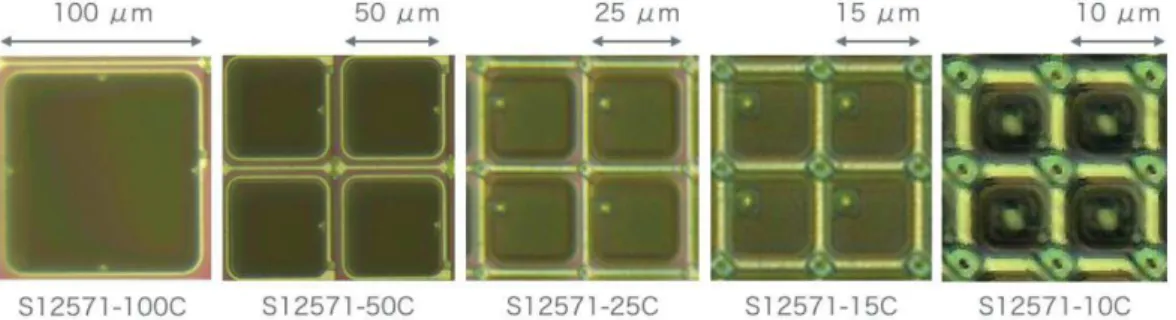
図15: さまざまなピクセル数を持つ新型MPPCの写真。
た背景事象の少ない環境での精密測定や新粒子探索が可能となる。国際協力により進めら
れているこの計画はILC計画と名付けられ,参加各国の大学や研究機関で精力的に加速器
や測定器の研究・開発が行われている。計画では,その第一期において,重心系エネルギー 250 GeVからスタートし,500 GeVまで増強する。そして,第二期において重心系エネル ギー 1 TeVまでの加速器増強が想定されている。
図16: 新型のMPPCの出力応答の入射光量依存性。(上):MPPC単体にレーザー光を照射
したもの。(下):MPPCとシンチレータを組み合わせ,レーザー光を照射したもの。ピク
セル数の増加に伴い,応答範囲が大きく向上している。
ILC実験では,ゲージボソンやトップクォーク,ヒッグス粒子などの崩壊により発生する
多数のジェットのエネルギーを精密に測定することが非常に重要となる。ジェットに対する エネルギー分解能は,σ(E)/E = 0.3/√
図17: 新型MPPCの写真。トレンチ構造を持たないもの(左)と持つもの(右)。ピクセ ル境界部の黒く見える部分がトレンチ。
ため,Particle Flow Algorithmと呼ばれるジェット再構成/エネルギー測定方法が提唱され
ている。この方法を用いるには,カロリメータは単一の入射粒子に対する優れたエネルギー 分解能に加え,非常に細かいセルに分割された構造を有することが要求される。
現在筑波大学グループでは,信州大,九州大,新潟大等と共同で,ILC実験において検
討される検出器候補のひとつILD検出器のうち,電磁カロリメータ(ECal)の研究開発を行
なっている。ILDの電磁カロリメータでは,候補の一つとしてシンチレータとタングステン
板を積層構造にしたサンプリング型のものが考えられている(図14)。
シンチレータは非常に細かいセル構造を持つため,読み出しチャンネル数が膨大となり, また磁場中に設置されることから,光センサーは非常にコンパクト且つ低コストで磁場の影 響を受けないという特徴を持つ必要がある。これを充たすのは,現状では新しいタイプの半
導体光検出器MPPC (Multi-Pixel Photon Counter)がほぼ唯一の解である。
カロリメータの性能としてエネルギー分解能が重要であるが,それを決める要因に光セン
サーの検出効率と線形応答性がある。我々は,これまで,様々な仕様のMPPCを用い,さ
まざまな特性の測定・評価を行ってきた。2014年度には,前年度から継続して,浜松ホト
ニクスにより開発された新型のMPPCの性能を評価した。この新型MPPCでは,クエンチ
ング抵抗をポリシリコンから金属に変更することによってより微細な加工が可能となり,不
感領域の減少とピクセルサイズの微小化,それに伴うピクセル数の増加(最大10,000ピク
セル)を実現している(図15)。これらは,検出効率と応答線形性の向上につながると期待
されるが,実際に測定を行い評価した。ピクセル数100,400,1600,4489,10000を持つ
新型MPPCの線形応答性を図16(上)に示す。これはMPPC単体に速いパルスレーザー
光を照射したものである。より実際の検出器に近づけた形として,シンチレータとMPPC
を組み合わせたものにレーザー光を照射した場合の応答が図16(下)である。いずれの場
合もピクセル数の増加により応答範囲が拡大していることが判る。また,シンチレータ光の 場合には,範囲はさらに拡大している。
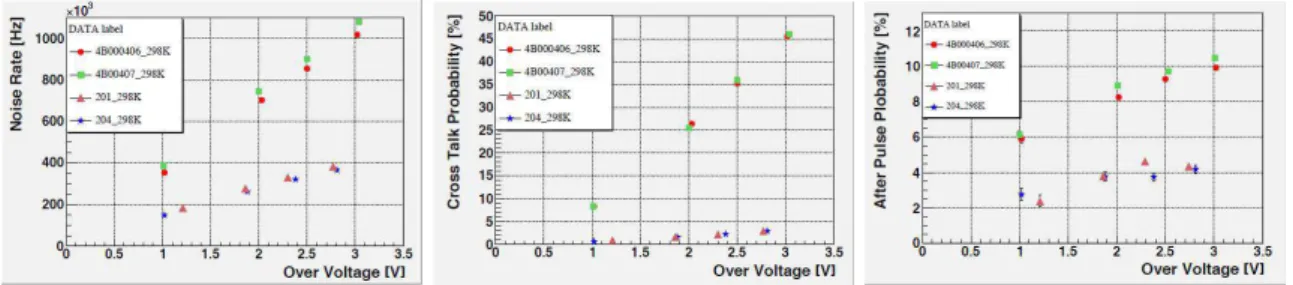
新型MPPCは,さらなる改良として,ピクセル間にトレンチと呼ばれる構造体を導入し
たものが開発された(図17)。これにより,チャンネル間のクロストーク,ノイズ発生率,
アフターパルスなどが減少すると期待される。実際に測定すると,これらが大幅に改善して
いることが判った(図18)。特に,クロストークは,ほぼ無視できるレベルになっている。
また,これらの基礎データをもとにしてシンチレータストリップの形状,MPPC の仕様
図18: 新型MPPCのトレンチ構造の有無による特性の比較。(左):ノイズ発生率,(中):
クロストーク率,(右):アフターパルス率。いずれもトレンチの導入により大幅に向上して
いる。
【
5
】
超伝導体赤外線検出器の開発
)
2
(meV/c
3
m
50 55 60 65 70 75
yrs)
14
(103
ν
τ
95% CL Limit on
0 2 4 6 8 10 12 14
σ
1
±
Expected Limit
σ
2
±
Expected Limit
図19: シミュレーションによる宇宙背景
ニュートリノ崩壊探索実験で期待される ニュートリノ寿命下限値の分布。仮定し たニュートリノ質量の関数としてあたえ
られている。直径15 cm,焦点距離1 m
の主鏡,および100µm×100µm×8 の 受光面積の検出器を焦点位置に備えたロ
ケット実験で200秒の測定を仮定。
図20: STJ の光パルス応答を電荷積分型 アンプで読み出す回路。室温に置かれた 電荷積分型プリアンプおよびシェーパー アンプからなる。
過去10数年間に超伝導トンネル接合素子STJ (Superconducting Tunnel Junction )を用
いた光検出器の開発研究が世界でひろく行われてきた。これは超伝導体が半導体と比較して はるかに小さいエネルギーバンドギャップを有することを利用して,半導体検出器などの既 存の光検出器に比べてエネルギー分解能がはるかに高い光検出器を原理的に実現できること が強い動機となっている。このことから,高エネルギー分解能のX線検出器や赤外線検出器 への応用を目指して開発が進められてきた。
本開発研究では,ニュートリノ崩壊探索実験に用いることを目標として従来用いられてい るNb (超伝導ギャップエネルギー ∆ = 1.55 meV,Tc= 9.23 K) を用いたNb/Al-STJ やさ
らに∆の小さいHf (∆ = 0.020 meV,Tc = 0.165 K) を超伝導素材として用い,遠赤外線
領域(Eγ ∼数10 meV)の一光子ごとのエネルギーを数%の精度で測定するための超伝導体
図 21: 産総研の CRAVITYで作製され た100µm角のNb/Al-STJの光パルス応
答。光パルスは,可視光(465 nm)のレー
ザーを用いた。STJでレーザートリガー
位置に検出された応答は,およそ4光子
程度に相当。
図22: 産総研のCRAVITYで作製された 50 µm 角のNb/Al-STJの漏れ電流の温 度依存性。
宇宙論により存在が予言されている宇宙背景ニュートリノが崩壊する際に発生する光子は,
例えば重いニュートリノ(ν3)の質量を∼50 meV と仮定すると波長が50 µm (エネルギー
25 meV)となる。我々は,宇宙背景ニュートリノの輻射崩壊のシミュレーションの結果か
ら波長50 µmの光子一つ一つに対してエネルギー分光が可能な光検出器を用いてロケット
実験により宇宙空間において200秒の測定で,現在のニュートリノ寿命下限値3×10¹² 年
を二桁改善できる可能性を示した(図19)。
2007年1月よりKEK測定器開発室のプログラムの一つとして筑波大学,KEK,理研の
共同研究によって,Hf-STJ開発を進めてきた。これまで,Hf成膜,Hf膜のパターン加工
方法の確立を行い,2010年度には,Hf-HfOx-HfによるSIS構造の作成に成功し,ジョセフ
ソン電流を確認,2012年度にHf-STJ試作サンプルでの可視光入射に対する応答(トンネル
電流増加)を確認している。現在は,可視パルス光入射に対するパルス応答の確認,および
リーク電流の改善が課題である。
Hf-STJ開発と並行して,既に作成方法の確立しているNb/Al-STJを用いた一光子分光検
出器の開発も行っている。Nb/Al-STJ単体では,25 meVの光子に対して十分なエネルギー
分解能は期待できないが,一光子計数が実現できれば回折格子と組み合わせてNb/Al-STJの
ピクセルをアレイ状並べることでエネルギー分光能力を得ることが可能となる。Nb/Al-STJ
では,室温アンプを用いた読み出しにおいて可視光∼近赤外までの一光子検出,一光子分光 の報告例がある。我々も,過去の年次報告で述べてきたように,これまでに室温アンプを用 いた読み出しを試み,電荷積分型アンプでの可視光数光子の読み出しまでは達成している
(図20,図21)が,読み出し系のノイズ,およびNb/Al-STJの漏れ電流等の要因により,一
光子検出には至っていない。
これらの問題を解決するために,産総研との共同研究による産総研CRAVITYで作製さ
れた漏れ電流の少ないNb/Al-STJ の開発,並びにNb/Al-STJ 極低ノイズ読み出し系とし
て,極低温で動作するSOI (Silicon On Insulator) プロセスによるアンプおよび,SOI上に
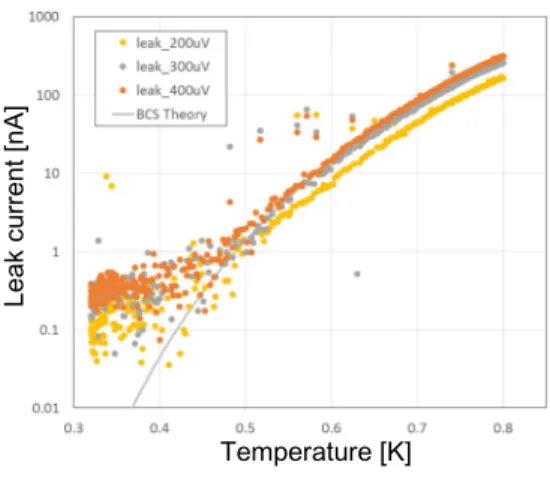
直接STJを形成するSOI-STJ の開発も行っている。CRAVITYで作製された50 µm角の
Nb/Al-STJサンプルでは,300mKにおいて漏れ電流200pAを示した(図22)。我々の要求
する性能は,25 meV の一光子を30 Hz 以下のダークカウントレートで計数することであ
るが,そのために漏れ電流は,100 pA 以下である必要がある。漏れ電流がトンネル接合面
よる読み出し回路に関しては,SOI上のMOSFET がSTJの動作温度においてトランジス タとして機能することが確認されたことは,既に昨年度において報告した。現在は,実際の
STJの信号読み出しに使用可能な高速,且つ低消費電力の電荷積分アンプを設計中である。
【
6
】
ミューオンラジオグラフィによる大規模構造体の内部構造透視
図23: 測定セットアップの概略図。地下
に設置された検出器(ピンク)から地上 の鉄ブロック標的(青)を測定すること により,ミューオンが地中を長く通る条 件で測定を行った。
図 24: 通過した物質量に対するミューオ
ン透過率の依存性。物質量が4,000 kg/m2
から18,000 kg/m2の範囲では透過率は指 数関数で減少し,一つの吸収係数で表さ れる。
宇宙線µ粒子を使って,原子炉などの大規模構造体内部構造の透視の研究を行った。こ
れは福島の原子炉事故を受けて,高エネルギー加速器研究機構らと協力して,2011年秋か
ら準備を始めたものである。2012年3月には1 m×1 mの有感面積をもつシンチレータ面
(1 cm幅のシンチレータバーを縦横に100本ずつ並べたもの)4セットからなる検出器を実
際の原子炉に設置して実証実験を開始した。シンチレータ光を波長変換ファイバーで取り出
しMPPCで読み出す方式は,本研究室が開発してきた技術であり,FPGAによる読み出し
回路の構成など高エネルギー実験の技術を応用している。
2013年12月まで炉心から64 m離れた3地点で測定を行い,このデータを用い,位置と大
きさの特定された使用済み燃料プールの場所と,核燃料,および原子炉格納容器の外形形状
を18度ごとの異なった視点で再構成した結果,核燃料と考えられる重い物質,使用済み燃
料プール及び格納容器に対応するイメージを得た。この結果についてはPTEP論文(2013
年7月)で報告し,さらに2014年1月に全データ解析の結果を公表するプレスリリースを
行い,新聞各紙(朝日,毎日,日経等)で報道された。
2014年度には,福島第一原子力発電所で,実際に原子炉において炉心融解が起こったと
きに燃料が溶け落ちていることを想定し,ミューオン透過法検出器を地下に設置し,地中を
通った場合でも,物体の位置,密度の見積もりが可能かどうか検証した。2014年8月25日
から2014年12月15日の間,高エネルギー加速器研究機構のAR南実験棟に検出器と鉄ブ
ロック標的を図23のように,ミューオンが地中を多く通るように設置し,標的の位置,大
きさ,種類を変えて測定を行なった。
さx,密度ρの物質を通過するミューオンのレートN(x)はρxの指数関数で減少する場合,
吸収係数µを用いてN(x) =N0exp(−µρx)と表される。測定結果は 図24のように,物質
量ρxが4,000 kg/m2(厚さ2.2 mの土に相当)と18,000 kg/m2(厚さ10 mの土に相当)
の範囲では,透過率 N(x)/N0 は指数的に減少し,一つの吸収係数µで表されることがわ
かり,µ = (1.09±0.04)×10−5 m2/kg が得られた。鉄ブロック標的を、この範囲に置い
て測定を行った結果,図25に示す通り, 鉄ブロック標的を通過するときの、通過した鉄の
物質量に対するミューオン透過率の依存性が得られた。 この測定の結果,鉄の比重として
ρ= 8.3±1.0 g/cm3が得られ,これより30日間の測定で鉄の比重を12%の精度で測定でき ることを検証した。
図25: 鉄ブロック標的を通過するときの、通過した鉄の物質量に対するミューオン透過率
【
7
】
外部資金
1. 科学研究費 新学術領域研究「ニュートリノフロンティアの融合と進化」2013 – 2017
年度
計画研究B02:「宇宙背景ニュートリノの崩壊探索に用いる超伝導赤外線検出器の開
発」,研究代表者:金 信弘,研究分担者:武内勇司
14,950千円(直接経費11,500千円,間接経費3,450千円) (2014年度)
2. 科学研究費 基盤研究(C)「ハドロン衝突における重いクォーク生成の研究」 2013
– 2015年度,研究代表者:受川 史彦
1,690千円(直接経費1,300千円,間接経費390千円)(2014年度)
3. 科学研究費 基盤研究(C)「アトラス実験でのヒッグス湯川結合の測定」2013 – 2015
年度,研究代表者:原 和彦
1,174千円(直接経費904千円,間接経費270千円)(2014年度)
4. 科学研究費 新学術領域研究 「先端加速器LHCが切り拓くテラスケールの素粒子物
理学∼真空と時空への新たな挑戦」2011 – 2015年度
計画研究A01:「ヒッグス粒子の発見による素粒子の質量起源の解明」,研究分担者:
受川 史彦
10,000千円(直接経費:10,000千円,間接経費:3,000千円)(2014年度)
5. 科学研究費 新学術領域研究「3次元半導体検出器で切り拓く新たな量子イメージン
グの展開」 2013 – 2017年度
計画研究C01:「高輝度加速器実験のための素粒子イメージング」,研究分担者:原
和彦
8,190千円(直接経費6,300千円,間接経費1,890千円)(2014年度)
6. 日米科学技術協力事業「ニュートリノ崩壊探索」
共同研究(日本側参加機関:筑波大物理,宇宙航空研究開発機構,高エネルギー加速 器研究機構,岡山大理,理化学研究所,福井大工,近畿大理工
日本側研究代表者:金 信弘)
物件費:3,000千円,旅費:1,000千円
7. KEK大学等連携支援事業「筑波大 – KEK連携を核としたつくば教育研究拠点の構築 に向けて」
共同代表者:守友 浩,金 信弘,末木啓介
物件費:650千円(STJプロジェクト向け配分額)
物件費:350千円(SOIプロジェクト向け配分額)
【
8
】
研究発表
(1) 原著論文
1. T. A. Aaltonen, K. Hara, S.H. Kim, K. Sato, Y. Takeuchi, F. Ukegawaet al. [CDF
“Measurement of indirect CP-violating asymmetries in D0
→ K+K−
and D0
→
π+π−
decays at CDF,”
Phys. Rev. D 90, no. 11, 111103 (2014) [arXiv:1410.5435 [hep-ex]].
2. T. A. Aaltonen, K. Hara, S.H. Kim, K. Sato, Y. Takeuchi, F. Ukegawaet al. [CDF
Collaboration],
“Measurement of the Top-Quark Mass in the All-Hadronic Channel using the full CDF data set,”
Phys. Rev. D 90, no. 9, 091101 (2014) [arXiv:1409.4906 [hep-ex]].
3. T. A. Aaltonen, K. Hara, S.H. Kim, K. Sato, Y. Takeuchi, F. Ukegawaet al. [CDF
Collaboration],
“Measurement of the Single Top Quark Production Cross Section and|Vtb|in Events with One Charged Lepton, Large Missing Transverse Energy, and Jets at CDF,” Phys. Rev. Lett. 113, no. 26, 261804 (2014) [arXiv:1407.4031 [hep-ex]].
4. T. A. Aaltonen, K. Hara, S.H. Kim, K. Sato, Y. Takeuchi, F. Ukegawaet al. [CDF
Collaboration],
“Measurement of the inclusive leptonic asymmetry in top-quark pairs that decay to two charged leptons at CDF,”
Phys. Rev. Lett. 113, 042001 (2014) [arXiv:1404.3698 [hep-ex]].
5. T. A. Aaltonen, K. Hara, S.H. Kim, K. Sato, Y. Takeuchi, F. Ukegawaet al. [CDF
Collaboration],
“Measurement ofB(t→W b)/B(t→W q) in Top-Quark-Pair Decays Using Dilepton Events and the Full CDF Run II Data Set,”
Phys. Rev. Lett. 112, no. 22, 221801 (2014) [arXiv:1404.3392 [hep-ex]].
6. T. A. Aaltonen, K. Hara, S.H. Kim, K. Sato, Y. Takeuchi, F. Ukegawaet al. [CDF
Collaboration],
“Mass and lifetime measurements of bottom and charm baryons in pp¯collisions at
√s= 1.96 TeV,”
Phys. Rev. D 89, no. 7, 072014 (2014) [arXiv:1403.8126 [hep-ex]].
7. T. A. Aaltonen, K. Hara, S.H. Kim, K. Sato, Y. Takeuchi, F. Ukegawaet al. [CDF
Collaboration],
“Measurements of Direct CP -Violating Asymmetries in Charmless Decays of Bottom Baryons,”
Phys. Rev. Lett. 113, no. 24, 242001 (2014) [arXiv:1403.5586 [hep-ex]].
8. T. A. Aaltonen, K. Hara, S.H. Kim, K. Sato, Y. Takeuchi, F. Ukegawaet al. [CDF
Collaboration],
“Measurement of the ZZ production cross section using the full CDF II data set,” Phys. Rev. D 89, no. 11, 112001 (2014) [arXiv:1403.2300 [hep-ex]].
9. T. Aaltonen, K. Hara, S.H. Kim, K. Sato, Y. Takeuchi, F. Ukegawa et al. [CDF
“Invariant-mass distribution of jet pairs produced in association with a W boson in
pp¯collisions at √s= 1.96 TeV using the full CDF Run II data set,” Phys. Rev. D 89, no. 9, 092001 (2014) [arXiv:1402.7044 [hep-ex]].
10. T. A. Aaltonen, K. Hara, S.H. Kim, K. Sato, Y. Takeuchi, F. Ukegawa et al. [CDF
Collaboration],
“Study of Top-Quark Production and Decays involving a Tau Lepton at CDF and Limits on a Charged-Higgs Boson Contribution,”
Phys. Rev. D 89, no. 9, 091101 (2014) [arXiv:1402.6728 [hep-ex]].
11. T. A. Aaltonen, K. Hara, S.H. Kim, K. Sato, Y. Takeuchi, F. Ukegawa et al. [CDF
and D0 Collaborations], “Observation of s-channel production of single top quarks at the Tevatron,”
Phys. Rev. Lett. 112, 231803 (2014) [arXiv:1402.5126 [hep-ex]].
12. T. A. Aaltonen, K. Hara, S.H. Kim, K. Sato, Y. Takeuchi, F. Ukegawa et al. [CDF
Collaboration],
“Search fors-Channel Single-Top-Quark Production in Events with Missing Energy Plus Jets in pp¯Collisions at √s=1.96??TeV,”
Phys. Rev. Lett. 112, no. 23, 231805 (2014) [arXiv:1402.3756 [hep-ex]].
13. T. A. Aaltonen, K. Hara, S.H. Kim, K. Sato, Y. Takeuchi, F. Ukegawa et al. [CDF
Collaboration],
“Indirect measurement of sin2θ
W (or MW) using µ+µ− pairs from γ∗/Z bosons
produced in pp¯collisions at a center-of-momentum energy of 1.96 TeV,” Phys. Rev. D 89, no. 7, 072005 (2014) [arXiv:1402.2239 [hep-ex]].
14. T. A. Aaltonen, K. Hara, S.H. Kim, K. Sato, Y. Takeuchi, F. Ukegawa et al. [CDF
Collaboration],
“Evidence for s-channel Single-Top-Quark Production in Events with one Charged Lepton and two Jets at CDF,”
Phys. Rev. Lett. 112, 231804 (2014) [arXiv:1402.0484 [hep-ex]].
15. T. A. Aaltonen, K. Hara, S.H. Kim, K. Sato, Y. Takeuchi, F. Ukegawa et al. [CDF
Collaboration],
“First Search for Exotic Z Boson Decays into Photons and Neutral Pions in Hadron Collisions,”
Phys. Rev. Lett. 112, 111803 (2014) [arXiv:1311.3282 [hep-ex]].
16. T. A. Aaltonen, K. Hara, S.H. Kim, K. Sato, Y. Takeuchi, F. Ukegawa et al. [CDF
Collaboration],
“Precise measurement of the W -boson mass with the Collider Detector at Fermilab,” Phys. Rev. D 89, no. 7, 072003 (2014) [arXiv:1311.0894 [hep-ex]].
17. T. A. Aaltonen, K. Hara, S.H. Kim, K. Sato, Y. Takeuchi, F. Ukegawa et al. [CDF
and D0 Collaborations], “Combination of measurements of the top-quark pair pro-duction cross section from the Tevatron Collider,”
18. T. A. Aaltonen, K. Hara, S.H. Kim, K. Sato, Y. Takeuchi, F. Ukegawa et al. [CDF
Collaboration],
“Search for new physics in trilepton events and limits on the associated chargino-neutralino production at CDF,”
Phys. Rev. D 90, no. 1, 012011 (2014) [arXiv:1309.7509 [hep-ex]].
19. T. A. Aaltonen, K. Hara, S.H. Kim, K. Sato, Y. Takeuchi, F. Ukegawa et al. [CDF
Collaboration],
“Study of orbitally excited B mesons and evidence for a newBπ resonance,” Phys. Rev. D 90, no. 1, 012013 (2014) [arXiv:1309.5961 [hep-ex]].
20. G. Aad, K. Hara, S.H. Kim, H. Okawa, F. Ukegawa et al. [ATLAS Collaboration],
“Search for neutral Higgs bosons of the minimal supersymmetric standard model in
pp collisions at √s= 8 TeV with the ATLAS detector,” JHEP 1411, 056 (2014) [arXiv:1409.6064 [hep-ex]].
21. G. Aad, K. Hara, S.H. Kim, H. Okawa, F. Ukegawa et al. [ATLAS Collaboration],
“Search for nonpointing and delayed photons in the diphoton and missing transverse momentum final state in 8 TeVppcollisions at the LHC using the ATLAS detector,” Phys. Rev. D 90, 112005 (2014) [arXiv:1409.5542 [hep-ex]].
22. G. Aad, K. Hara, S.H. Kim, H. Okawa, F. Ukegawa et al. [ATLAS Collaboration],
“Search for pair and single production of new heavy quarks that decay to a Z boson and a third-generation quark in pp collisions at √s = 8 TeV with the ATLAS detector,”
JHEP 1411, 104 (2014) [arXiv:1409.5500 [hep-ex]].
23. G. Aad, K. Hara, S.H. Kim, H. Okawa, F. Ukegawa et al. [ATLAS Collaboration],
“Measurement of distributions sensitive to the underlying event in inclusiveZ-boson production in pp collisions at√s= 7 TeV with the ATLAS detector,”
Eur. Phys. J. C 74, 3195 (2014) [arXiv:1409.3433 [hep-ex]].
24. G. Aad, K. Hara, S.H. Kim, H. Okawa, F. Ukegawa et al. [ATLAS Collaboration],
“Measurement of long-range pseudorapidity correlations and azimuthal harmonics in √sN N = 5.02 TeV proton-lead collisions with the ATLAS detector,”
Phys. Rev. C 90, 044906 (2014) [arXiv:1409.1792 [hep-ex]].
25. G. Aad, K. Hara, S.H. Kim, H. Okawa, F. Ukegawa et al. [ATLAS Collaboration],
“Search for long-lived neutral particles decaying into lepton jets in proton-proton collisions at √s= 8 TeV with the ATLAS detector,”
JHEP 1411, 088 (2014) [arXiv:1409.0746 [hep-ex]].
26. G. Aad, K. Hara, S.H. Kim, H. Okawa, F. Ukegawa et al. [ATLAS Collaboration],
“Measurement of Higgs boson production in the diphoton decay channel in pp colli-sions at center-of-mass energies of 7 and 8 TeV with the ATLAS detector,”
27. G. Aad, K. Hara, S.H. Kim, H. Okawa, F. Ukegawa et al. [ATLAS Collaboration],
“A measurement of the ratio of the production cross sections for W and Z bosons in association with jets with the ATLAS detector,”
Eur. Phys. J. C 74, 3168 (2014) [arXiv:1408.6510 [hep-ex]].
28. G. Aad, K. Hara, S.H. Kim, H. Okawa, F. Ukegawa et al. [ATLAS Collaboration],
“Measurement of the total cross section from elastic scattering in pp collisions at
√s= 7 TeV with the ATLAS detector,”
Nucl. Phys. B 889, 486 (2014) [arXiv:1408.5778 [hep-ex]].
29. G. Aad, K. Hara, S.H. Kim, H. Okawa, F. Ukegawa et al. [ATLAS Collaboration],
“Search for the lepton flavor violating decay Z →eµinpp collisions at√s= 8 TeV with the ATLAS detector,”
Phys. Rev. D 90, 072010 (2014) [arXiv:1408.5774 [hep-ex]].
30. G. Aad, K. Hara, S.H. Kim, H. Okawa, F. Ukegawa et al. [ATLAS Collaboration],
“Measurement of flow harmonics with multi-particle cumulants in Pb+Pb collisions at√sNN= 2.76 TeV with the ATLAS detector,”
Eur. Phys. J. C 74, 3157 (2014) [arXiv:1408.4342 [hep-ex]].
31. G. Aad, K. Hara, S.H. Kim, H. Okawa, F. Ukegawa et al. [ATLAS Collaboration],
“Fiducial and differential cross sections of Higgs boson production measured in the four-lepton decay channel inppcollisions at√s= 8 TeV with the ATLAS detector,” Phys. Lett. B 738, 234 (2014) [arXiv:1408.3226 [hep-ex]].
32. G. Aad, K. Hara, S.H. Kim, H. Okawa, F. Ukegawa et al. [ATLAS Collaboration],
“Search for new resonances inW γ andZγfinal states inppcollisions at√s= 8 TeV with the ATLAS detector,”
Phys. Lett. B 738, 428 (2014) [arXiv:1407.8150 [hep-ex]].
33. G. Aad, K. Hara, S.H. Kim, H. Okawa, F. Ukegawa et al. [ATLAS Collaboration],
“Search for new particles in events with one lepton and missing transverse momen-tum in pp collisions at√s= 8 TeV with the ATLAS detector,”
JHEP 1409, 037 (2014) [arXiv:1407.7494 [hep-ex]].
34. G. Aad, K. Hara, S.H. Kim, H. Okawa, F. Ukegawa et al. [ATLAS Collaboration],
“Search for Scalar Diphoton Resonances in the Mass Range 65−600 GeV with the ATLAS Detector in pp Collision Data at√s= 8 TeV,”
Phys. Rev. Lett. 113, 171801 (2014) [arXiv:1407.6583 [hep-ex]].
35. G. Aad, K. Hara, S.H. Kim, H. Okawa, F. Ukegawa et al. [ATLAS Collaboration],
“Measurements of jet vetoes and azimuthal decorrelations in dijet events produced in ppcollisions at √s= 7 TeV using the ATLAS detector,”
Eur. Phys. J. C 74, 3117 (2014) [arXiv:1407.5756 [hep-ex]].
36. G. Aad, K. Hara, S.H. Kim, H. Okawa, F. Ukegawa et al. [ATLAS Collaboration],
“Measurement of the production cross-section of ψ(2S)→J/ψ(→µ+µ−
pp collisions at √s= 7 TeV at ATLAS,”
JHEP 1409, 79 (2014) [arXiv:1407.5532 [hep-ex]].
37. G. Aad, K. Hara, S.H. Kim, H. Okawa, F. Ukegawa et al. [ATLAS Collaboration],
“Electron and photon energy calibration with the ATLAS detector using LHC Run 1 data,”
Eur. Phys. J. C 74, 3071 (2014) [arXiv:1407.5063 [hep-ex]].
38. G. Aad, K. Hara, S.H. Kim, H. Okawa, F. Ukegawa et al. [ATLAS Collaboration],
“Measurements of spin correlation in top-antitop quark events from proton-proton collisions at √s= 7 TeV using the ATLAS detector,”
Phys. Rev. D 90, 112016 (2014) [arXiv:1407.4314 [hep-ex]].
39. G. Aad, K. Hara, S.H. Kim, H. Okawa, F. Ukegawa et al. [ATLAS Collaboration],
“Measurements of fiducial and differential cross sections for Higgs boson production in the diphoton decay channel at √s= 8 TeV with ATLAS,”
JHEP 1409, 112 (2014) [arXiv:1407.4222 [hep-ex]].
40. G. Aad, K. Hara, S.H. Kim, H. Okawa, F. Ukegawa et al. [ATLAS Collaboration],
“Measurement of the muon reconstruction performance of the ATLAS detector using 2011 and 2012 LHC proton-proton collision data,”
Eur. Phys. J. C 74, 3130 (2014) [arXiv:1407.3935 [hep-ex]].
41. G. Aad, K. Hara, S.H. Kim, H. Okawa, F. Ukegawa et al. [ATLAS Collaboration],
“Measurement of differential production cross-sections for a Z boson in association with b-jets in 7 TeV proton-proton collisions with the ATLAS detector,”
JHEP 1410, 141 (2014) [arXiv:1407.3643 [hep-ex]].
42. G. Aad, K. Hara, S.H. Kim, H. Okawa, F. Ukegawa et al. [ATLAS Collaboration],
“Search for contact interactions and large extra dimensions in the dilepton channel using proton-proton collisions at √s= 8 TeV with the ATLAS detector,”
Eur. Phys. J. C 74, 3134 (2014) [arXiv:1407.2410 [hep-ex]].
43. G. Aad, K. Hara, S.H. Kim, H. Okawa, F. Ukegawa et al. [ATLAS Collaboration],
“Flavor tagged time-dependent angular analysis of the Bs → J/ψϕ decay and
ex-traction of ∆Γs and the weak phase ϕs in ATLAS,”
Phys. Rev. D 90, 052007 (2014) [arXiv:1407.1796 [hep-ex]].
44. G. Aad, K. Hara, S.H. Kim, H. Okawa, F. Ukegawa et al. [ATLAS Collaboration],
“Observation of an Excited B±
c Meson State with the ATLAS Detector,”
Phys. Rev. Lett. 113, 212004 (2014) [arXiv:1407.1032 [hep-ex]].
45. G. Aad, K. Hara, S.H. Kim, H. Okawa, F. Ukegawa et al. [ATLAS Collaboration],
“Measurement of the cross-section of high transverse momentum vector bosons re-constructed as single jets and studies of jet substructure in pp collisions at √s = 7 TeV with the ATLAS detector,”
46. G. Aad, K. Hara, S.H. Kim, H. Okawa, F. Ukegawa et al. [ATLAS Collaboration],
“Search for pair-produced third-generation squarks decaying via charm quarks or in compressed supersymmetric scenarios in pp collisions at √s = 8 TeV with the ATLAS detector,”
Phys. Rev. D 90, 052008 (2014) [arXiv:1407.0608 [hep-ex]].
47. G. Aad, K. Hara, S.H. Kim, H. Okawa, F. Ukegawa et al. [ATLAS Collaboration],
“Search for supersymmetry in events with large missing transverse momentum, jets, and at least one tau lepton in 20 fb−1 of √s= 8 TeV proton-proton collision data with the ATLAS detector,”
JHEP 1409, 103 (2014) [arXiv:1407.0603 [hep-ex]].
48. G. Aad, K. Hara, S.H. Kim, H. Okawa, F. Ukegawa et al. [ATLAS Collaboration],
“Search for strong production of supersymmetric particles in final states with miss-ing transverse momentum and at least three b-jets at √s = 8 TeV proton-proton collisions with the ATLAS detector,”
JHEP 1410, 24 (2014) [arXiv:1407.0600 [hep-ex]].
49. G. Aad, K. Hara, S.H. Kim, H. Okawa, F. Ukegawa et al. [ATLAS Collaboration],
“Search for top squark pair production in final states with one isolated lepton, jets, and missing transverse momentum in √s = 8 TeV pp collisions with the ATLAS detector,”
JHEP 1411, 118 (2014) [arXiv:1407.0583 [hep-ex]].
50. G. Aad, K. Hara, S.H. Kim, H. Okawa, F. Ukegawa et al. [ATLAS Collaboration],
“Measurements of normalized differential cross sections for t¯t production in pp col-lisions at √s= 7 TeV using the ATLAS detector,”
Phys. Rev. D 90, 072004 (2014) [arXiv:1407.0371 [hep-ex]].
51. G. Aad, K. Hara, S.H. Kim, H. Okawa, F. Ukegawa et al. [ATLAS Collaboration],
“Search for the direct production of charginos, neutralinos and staus in final states with at least two hadronically decaying taus and missing transverse momentum in
pp collisions at √s= 8 TeV with the ATLAS detector,” JHEP 1410, 96 (2014) [arXiv:1407.0350 [hep-ex]].
52. G. Aad, K. Hara, S.H. Kim, H. Okawa, F. Ukegawa et al. [ATLAS Collaboration],
“Comprehensive measurements of t-channel single top-quark production cross sec-tions at √s= 7 TeV with the ATLAS detector,”
Phys. Rev. D 90, 112006 (2014) [arXiv:1406.7844 [hep-ex]].
53. G. Aad, K. Hara, S.H. Kim, H. Okawa, F. Ukegawa et al. [ATLAS Collaboration],
“A neural network clustering algorithm for the ATLAS silicon pixel detector,” JINST 9, P09009 (2014) [arXiv:1406.7690 [hep-ex]].
54. G. Aad, K. Hara, S.H. Kim, H. Okawa, F. Ukegawa et al. [ATLAS Collaboration],
“Search for the Standard Model Higgs boson decay to µ+µ−
with the ATLAS de-tector,”
55. G. Aad, K. Hara, S.H. Kim, H. Okawa, F. Ukegawa et al. [ATLAS Collaboration],
“Measurement of the ttproduction cross-section usingeµ events withb-tagged jets in ppcollisions at √s= 7 and 8 TeV with the ATLAS detector,”
Eur. Phys. J. C 74, 3109 (2014) [arXiv:1406.5375 [hep-ex]].
56. G. Aad, K. Hara, S.H. Kim, H. Okawa, F. Ukegawa et al. [ATLAS Collaboration],
“Search forW Z resonances in the fully leptonic channel usingpp collisions at√s= 8 TeV with the ATLAS detector,”
Phys. Lett. B 737, 223 (2014) [arXiv:1406.4456 [hep-ex]].
57. G. Aad, K. Hara, S.H. Kim, H. Okawa, F. Ukegawa et al. [ATLAS Collaboration],
“Measurement of the Higgs boson mass from the H → γγ and H → ZZ∗
→ 4ℓ
channels with the ATLAS detector using 25 fb−1 ofpp collision data,” Phys. Rev. D 90, 052004 (2014) [arXiv:1406.3827 [hep-ex]].
58. G. Aad, K. Hara, S.H. Kim, H. Okawa, F. Ukegawa et al. [ATLAS Collaboration],
“Measurement of theZ/γ∗
boson transverse momentum distribution inpp collisions at√s= 7 TeV with the ATLAS detector,”
JHEP 1409, 145 (2014) [arXiv:1406.3660 [hep-ex]].
59. G. Aad, K. Hara, S.H. Kim, H. Okawa, F. Ukegawa et al. [ATLAS Collaboration],
“Measurement of inclusive jet charged-particle fragmentation functions in Pb+Pb collisions at √sN N = 2.76 TeV with the ATLAS detector,”
Phys. Lett. B 739, 320 (2014) [arXiv:1406.2979 [hep-ex]].
60. G. Aad, K. Hara, S.H. Kim, H. Okawa, F. Ukegawa et al. [ATLAS Collaboration],
“Search for direct pair production of the top squark in all-hadronic final states in proton-proton collisions at √s= 8 TeV with the ATLAS detector,”
JHEP 1409, 015 (2014) [arXiv:1406.1122 [hep-ex]].
61. G. Aad, K. Hara, S.H. Kim, H. Okawa, F. Ukegawa et al. [ATLAS Collaboration],
“Measurement of the underlying event in jet events from 7 TeV proton-proton col-lisions with the ATLAS detector,”
Eur. Phys. J. C 74, 2965 (2014) [arXiv:1406.0392 [hep-ex]].
62. G. Aad, K. Hara, S.H. Kim, H. Okawa, F. Ukegawa et al. [ATLAS Collaboration],
“Search for squarks and gluinos with the ATLAS detector in final states with jets and missing transverse momentum using√s= 8 TeV proton–proton collision data,” JHEP 1409, 176 (2014) [arXiv:1405.7875 [hep-ex]].
63. G. Aad, K. Hara, S.H. Kim, H. Okawa, F. Ukegawa et al. [ATLAS Collaboration],
“Light-quark and gluon jet discrimination in pp collisions at √s = 7 TeV with the ATLAS detector,”
Eur. Phys. J. C 74, 3023 (2014) [arXiv:1405.6583 [hep-ex]].
64. G. Aad, K. Hara, S.H. Kim, H. Okawa, F. Ukegawa et al. [ATLAS Collaboration],
“Evidence for Electroweak Production of W±
W±
with the ATLAS Detector,”
Phys. Rev. Lett. 113, 141803 (2014) [arXiv:1405.6241 [hep-ex]].
65. G. Aad, K. Hara, S.H. Kim, H. Okawa, F. Ukegawa et al. [ATLAS Collaboration],
“Search for supersymmetry in events with four or more leptons in √s= 8 TeV pp
collisions with the ATLAS detector,”
Phys. Rev. D 90, 052001 (2014) [arXiv:1405.5086 [hep-ex]].
66. G. Aad, K. Hara, S.H. Kim, H. Okawa, F. Ukegawa et al. [ATLAS Collaboration],
“Search for microscopic black holes and string balls in final states with leptons and jets with the ATLAS detector at √s= 8 TeV,”
JHEP 1408, 103 (2014) [arXiv:1405.4254 [hep-ex]].
67. G. Aad, K. Hara, S.H. Kim, H. Okawa, F. Ukegawa et al. [ATLAS Collaboration],
“Search for high-mass dilepton resonances in pp collisions at √s= 8 TeV with the ATLAS detector,”
Phys. Rev. D 90, 052005 (2014) [arXiv:1405.4123 [hep-ex]].
68. G. Aad, K. Hara, S.H. Kim, H. Okawa, F. Ukegawa et al. [ATLAS Collaboration],
“Measurement of the centrality and pseudorapidity dependence of the integrated elliptic flow in lead-lead collisions at √sNN= 2.76 TeV with the ATLAS detector,” Eur. Phys. J. C 74, 2982 (2014) [arXiv:1405.3936 [hep-ex]].
69. G. Aad, K. Hara, S.H. Kim, H. Okawa, F. Ukegawa et al. [ATLAS Collaboration],
“Monitoring and data quality assessment of the ATLAS liquid argon calorimeter,” JINST 9, P07024 (2014) [arXiv:1405.3768 [hep-ex]].
70. G. Aad, K. Hara, S.H. Kim, H. Okawa, F. Ukegawa et al. [ATLAS Collaboration],
“Operation and performance of the ATLAS semiconductor tracker,” JINST 9, P08009 (2014) [arXiv:1404.7473 [hep-ex]].
71. G. Aad, K. Hara, S.H. Kim, H. Okawa, F. Ukegawa et al. [ATLAS Collaboration],
“Measurement of the cross section of high transverse momentumZ →b¯bproduction in proton–proton collisions at √s= 8T eV with the ATLAS Detector,”
Phys. Lett. B 738, 25 (2014) [arXiv:1404.7042 [hep-ex]].
72. G. Aad, K. Hara, S.H. Kim, H. Okawa, F. Ukegawa et al. [ATLAS Collaboration],
“Measurement ofχc1 andχc2production with√s= 7 TeVppcollisions at ATLAS,” JHEP 1407, 154 (2014) [arXiv:1404.7035 [hep-ex]].
73. G. Aad, K. Hara, S.H. Kim, H. Okawa, F. Ukegawa et al. [ATLAS Collaboration],
“Muon reconstruction efficiency and momentum resolution of the ATLAS experiment in proton-proton collisions at √s= 7 TeV in 2010,”
Eur. Phys. J. C 74, 3034 (2014) [arXiv:1404.4562 [hep-ex]].
74. G. Aad, K. Hara, S.H. Kim, H. Okawa, F. Ukegawa et al. [ATLAS Collaboration],
“Search for supersymmetry at √s = 8 TeV in final states with jets and two same-sign leptons or three leptons with the ATLAS detector,”
75. G. Aad, K. Hara, S.H. Kim, H. Okawa, F. Ukegawa et al. [ATLAS Collaboration],
“Electron reconstruction and identification efficiency measurements with the ATLAS detector using the 2011 LHC proton-proton collision data,”
Eur. Phys. J. C 74, 2941 (2014) [arXiv:1404.2240 [hep-ex]].
76. G. Aad, K. Hara, S.H. Kim, H. Okawa, F. Ukegawa et al. [ATLAS Collaboration],
“Measurement of the low-mass Drell-Yan differential cross section at √s = 7 TeV using the ATLAS detector,”
JHEP 1406, 112 (2014) [arXiv:1404.1212 [hep-ex]].
77. G. Aad, K. Hara, S.H. Kim, H. Okawa, F. Ukegawa et al. [ATLAS Collaboration],
“Measurement of the parity-violating asymmetry parameter αb and the helicity
am-plitudes for the decay Λ0
b →J/ψ+ Λ
0 with the ATLAS detector,”
Phys. Rev. D 89, 092009 (2014) [arXiv:1404.1071 [hep-ex]].
78. G. Aad, K. Hara, S.H. Kim, H. Okawa, F. Ukegawa et al. [ATLAS Collaboration],
“Search for dark matter in events with a Z boson and missing transverse momentum in pp collisions at√s= 8 TeV with the ATLAS detector,”
Phys. Rev. D 90, 012004 (2014) [arXiv:1404.0051 [hep-ex]].
79. G. Aad, K. Hara, S.H. Kim, H. Okawa, F. Ukegawa et al. [ATLAS Collaboration],
“Search for top quark decays t→qH withH →γγ using the ATLAS detector,” JHEP 1406, 008 (2014) [arXiv:1403.6293 [hep-ex]].
80. G. Aad, K. Hara, S.H. Kim, H. Okawa, F. Ukegawa et al. [ATLAS Collaboration],
“Measurements of Four-Lepton Production at the Z Resonance in pp Collisions at
√
s= 7and8 TeV with ATLAS,”
Phys. Rev. Lett. 112, 231806 (2014) [arXiv:1403.5657 [hep-ex]].
81. G. Aad, K. Hara, S.H. Kim, H. Okawa, F. Ukegawa et al. [ATLAS Collaboration],
“Search for direct production of charginos, neutralinos and sleptons in final states with two leptons and missing transverse momentum in pp collisions at√s= 8 TeV with the ATLAS detector,”
JHEP 1405, 071 (2014) [arXiv:1403.5294 [hep-ex]].
82. G. Aad, K. Hara, S.H. Kim, H. Okawa, F. Ukegawa et al. [ATLAS Collaboration],
“Search for direct top squark pair production in events with a Z boson, b-jets and missing transverse momentum in √s= 8 TeV pp collisions with the ATLAS detec-tor,”
Eur. Phys. J. C 74, 2883 (2014) [arXiv:1403.5222 [hep-ex]].
83. G. Aad, K. Hara, S.H. Kim, H. Okawa, F. Ukegawa et al. [ATLAS Collaboration],
“Search for direct top-squark pair production in final states with two leptons in pp
collisions at √s= 8 TeV with the ATLAS detector,” JHEP 1406, 124 (2014) [arXiv:1403.4853 [hep-ex]].
84. G. Aad, K. Hara, S.H. Kim, H. Okawa, F. Ukegawa et al. [ATLAS Collaboration],
with the ATLAS detector,”
Phys. Rev. C 90, 024905 (2014) [arXiv:1403.0489 [hep-ex]].
85. G. Aad, K. Hara, S.H. Kim, H. Okawa, F. Ukegawa et al. [ATLAS Collaboration],
“Search for direct production of charginos and neutralinos in events with three lep-tons and missing transverse momentum in√s= 8TeVppcollisions with the ATLAS detector,”
JHEP 1404, 169 (2014) [arXiv:1402.7029 [hep-ex]].
86. G. Aad, K. Hara, S.H. Kim, H. Okawa, F. Ukegawa et al. [ATLAS Collaboration],
“Measurement of the production of a W boson in association with a charm quark in
pp collisions at √s= 7 TeV with the ATLAS detector,” JHEP 1405, 068 (2014) [arXiv:1402.6263 [hep-ex]].
87. G. Aad, K. Hara, S.H. Kim, H. Okawa, F. Ukegawa et al. [ATLAS Collaboration],
“The differential production cross section of the ϕ(1020) meson in √s= 7 TeV pp
collisions measured with the ATLAS detector,”
Eur. Phys. J. C 74, 2895 (2014) [arXiv:1402.6162 [hep-ex]].
88. G. Aad, K. Hara, S.H. Kim, H. Okawa, F. Ukegawa et al. [ATLAS Collaboration],
“Search for Invisible Decays of a Higgs Boson Produced in Association with a Z
Boson in ATLAS,”
Phys. Rev. Lett. 112, 201802 (2014) [arXiv:1402.3244 [hep-ex]].
89. G. Aad, K. Hara, S.H. Kim, H. Okawa, F. Ukegawa et al. [ATLAS Collaboration],
“Search for Higgs boson decays to a photon and aZ boson inppcollisions at√s= 7 and 8 TeV with the ATLAS detector,”
Phys. Lett. B 732, 8 (2014) [arXiv:1402.3051 [hep-ex]].
90. G. Aad, K. Hara, S.H. Kim, H. Okawa, F. Ukegawa et al. [ATLAS Collaboration],
“Measurement of the electroweak production of dijets in association with aZ-boson and distributions sensitive to vector boson fusion in proton-proton collisions at√s= 8 TeV using the ATLAS detector,”
JHEP 1404, 031 (2014) [arXiv:1401.7610 [hep-ex]].
91. G. Aad, K. Hara, S.H. Kim, H. Okawa, F. Ukegawa et al. [ATLAS Collaboration],
“Measurement of the production cross section of prompt J/ψmesons in association with a W±
boson inpp collisions at√s= 7 TeV with the ATLAS detector,” JHEP 1404, 172 (2014) [arXiv:1401.2831 [hep-ex]].
92. G. Aad, K. Hara, S.H. Kim, H. Okawa, F. Ukegawa et al. [ATLAS Collaboration],
“Measurement of dijet cross sections in ppcollisions at 7 TeV centre-of-mass energy using the ATLAS detector,”
JHEP 1405, 059 (2014) [arXiv:1312.3524 [hep-ex]].
93. G. Aad, K. Hara, S.H. Kim, H. Okawa, F. Ukegawa et al. [ATLAS Collaboration],
“Search for a multi-Higgs-boson cascade in W+W−
de-tector in pp collisions at√s= 8 TeV,”
Phys. Rev. D 89, 032002 (2014) [arXiv:1312.1956 [hep-ex]].
94. G. Aad, K. Hara, S.H. Kim, H. Okawa, F. Ukegawa et al. [ATLAS Collaboration],
“Standalone vertex finding in the ATLAS muon spectrometer,” JINST 9, P02001 (2014) [arXiv:1311.7070 [physics.ins-det]].
95. G. Aad, K. Hara, S.H. Kim, H. Okawa, F. Ukegawa et al. [ATLAS Collaboration],
“Measurement of the top quark pair production charge asymmetry in proton-proton collisions at √s = 7 TeV using the ATLAS detector,”
JHEP 1402, 107 (2014) [arXiv:1311.6724 [hep-ex]].
96. G. Aad, K. Hara, S.H. Kim, H. Okawa, F. Ukegawa et al. [ATLAS Collaboration],
“Search for Quantum Black Hole Production in High-Invariant-Mass Lepton + Jet Final States Using pp Collisions at √s= 8 TeV and the ATLAS Detector,”
Phys. Rev. Lett. 112, 091804 (2014) [arXiv:1311.2006 [hep-ex]].
97. G. Aad, K. Hara, S.H. Kim, H. Okawa, F. Ukegawa et al. [ATLAS Collaboration],
“Measurement of the inclusive isolated prompt photons cross section inpp collisions at√s= 7 TeV with the ATLAS detector using 4.6 fb−1,”
Phys. Rev. D 89, 052004 (2014) [arXiv:1311.1440 [hep-ex]].
98. G. Aad, K. Hara, S.H. Kim, H. Okawa, F. Ukegawa et al. [ATLAS Collaboration],
“Measurement of the mass difference between top and anti-top quarks inppcollisions at√s= 7 TeV using the ATLAS detector,”
Phys. Lett. B 728, 363 (2014) [arXiv:1310.6527 [hep-ex]].
99. G. Aad, K. Hara, S.H. Kim, H. Okawa, F. Ukegawa et al. [ATLAS Collaboration],
“Search for dark matter in events with a hadronically decaying W or Z boson and missing transverse momentum in pp collisions at √s = 8 TeV with the ATLAS detector,”
Phys. Rev. Lett. 112, 041802 (2014) [arXiv:1309.4017 [hep-ex]].
100. G. Aad, K. Hara, S.H. Kim, H. Okawa, F. Ukegawa et al. [ATLAS Collaboration],
“Search for new phenomena in photon+jet events collected in proton-proton colli-sions at √s= 8 TeV with the ATLAS detector,”
Phys. Lett. B 728, 562 (2014) [arXiv:1309.3230 [hep-ex]].
101. G. Aad, K. Hara, S.H. Kim, H. Okawa, F. Ukegawa et al. [ATLAS Collaboration],
“Search for new phenomena in final states with large jet multiplicities and missing transverse momentum at √s = 8 TeV proton-proton collisions using the ATLAS experiment,”
JHEP 1310, 130 (2013) [JHEP1401, 109 (2014)] [arXiv:1308.1841 [hep-ex]].
102. G. Aad, K. Hara, S.H. Kim, H. Okawa, F. Ukegawa et al. [ATLAS Collaboration],
Phys. Lett. B726, 88 (2013) [Phys. Lett. B 734, 406 (2014)] [arXiv:1307.1427
[hep-ex]].
103. G. Aad, K. Hara, S.H. Kim, H. Okawa, F. Ukegawa et al. [ATLAS Collaboration],
“Study of heavy-flavor quarks produced in association with top-quark pairs at√s= 7 TeV using the ATLAS detector,”
Phys. Rev. D 89, 072012 (2014) [arXiv:1304.6386 [hep-ex]].
104. K. Motohashi, M. Hagihawa, K. Hara, J. Usui et al.,
“Evaluation of KEK n-in-p planar pixel sensor structures for very high radiation environments with testbeam”,
Nucl. Instrum. Methods Phys. Res. A765, 125 (2014).
105. Y. Unno, K. Hara, M. Hagihawaet al.,
“Development of n+-in-p large-area silicon microstrip sensors for very high radiation environments - ATLAS12 design and initial results”,
Nucl. Instrum. Methods Phys. Res. A765, 80 (2014).
(2) 学会・研究会での講演(国内)
1. 受川史彦:宇宙史国際研究拠点,
数理物質融合科学センター発足式(2014年9月1日),筑波大学.
2. 萩原睦人: ATLAS検出器アップグレードに向けたシリコンマイクロストリップセン サーの放射線影響の評価
日本物理学会2014年秋季大会(2014年9月18日–21日),佐賀大学本庄キャンパス.
3. 臼井純哉: ATLAS実験内部飛跡検出器のアップグレードに向けたプラナーピクセル検 出器の性能評価
日本物理学会2014年秋季大会(2014年9月18日–21日),佐賀大学本庄キャンパス.
4. 渕遼亮: LHC-ATLAS実験におけるH→hh→bbτ τ崩壊チャンネルでのHeavy Higgs の探索
日本物理学会2014年秋季大会(2014年9月18日–21日),佐賀大学本庄キャンパス.
5. 木内健司: LHC-ATLAS実験におけるbクォーク対に崩壊する標準模型ヒッグス粒子 の探索
日本物理学会2014年秋季大会(2014年9月18日–21日),佐賀大学本庄キャンパス.
6. 大川英希: LHC-ATLAS実験におけるZHチャンネルを用いたヒッグス粒子のインビ
ジブル崩壊の探索
日本物理学会2014年秋季大会(2014年9月18日–21日),佐賀大学本庄キャンパス.
7. 飛田尚志: SOIピクセル検出器の放射線損傷による回路特性の変動の評価
日本物理学会2014年秋季大会(2014年9月18日–21日),佐賀大学本庄キャンパス.
8. 浅野麻莉: 高エネルギー実験のための2層埋込酸化膜構造をもつSOIピクセル検出器
の特性評価