はしがき
ISO
ISO
ISO . .
EU
1.研究の背景と目的
%
%
% . .
2.各年度の研究成果の概要
2-1.2004年度の研究実施内容
EU
EU
ISO
EU
ISO
ISO
EU ELV RoHS
ISO
①国際標準規格ISO14001認証取得 ②国内版規格の認証取得
③取引先企業の
環境保全ガイドライン遵守 ④取引先企業による環境影響評価 ⑤化学物質の使用に関する調査 ⑥製品安全データシート(MSDS)
の提出 環境マネジメント
システム(EMS) 関連
2-2.2005年度の研究実施内容
EU ˆ
The Fourth International Workshop on Agent-based Approaches in Economic and Social Complex Systems AESCS
EMS
EMS
EMS
EMS
2-5.2008年度
3.研究成果の公表
pp. - .
pp. - .
pp. - . Zaima, Keiko Effects of the Greening Pressure on the Environmental Behavior of the Small and Medium-sized Enterprise: Agent-Based Simulation, Proceedings of The Fourth International Workshop on Agent-based Approaches in Economic and Social Complex Systems
AESCS , pp. - , Pacific Asian Association for Agent Based Social Sciences, July - , Tokyo Institute of Technology, Japan, .
pp.
-.
Zaima, Keiko
Effects of the Greening Pressure on the Environmental Behavior of the Small and Medium-sized Enterprise: Agent-Based Simulation,
The Fourth International Workshop on Agent-based Approaches in Economic and Social Complex Systems AESCS , Pacific Asian Association for Agent Based Social Sciences, July - , Tokyo Institute of Technology, Japan, .
.
ABM
.
.
.
.
1.本研究の背景と目的
ISO
ISOISO . . . .
ISO
ISO
ISO
EU
ELV EU
RoHS
EU ELV
RoHS
RoHS
ISO
2.調査企業の概要
EU
A G
3.取引先企業からの要求への対応
% F D ISO ISO D F A
B C E G
A 社 B 社 C 社 D 社 E 社 F 社 G 社
調査日 2004.9.8 2004.9.8 2004.9.8 2004.10.29 2004.10.29 2004.11.4 2004.11.5
主な事業
主な事業 2000万円 ―――― 1000万円 2134万円 1500万円 6000万円 ――――
従業員数 166名 25名 12名 120名 60名 32名 15名
平均年齢 40歳代後半 41歳 54歳 43歳 32歳 ―――― 48歳
2003年の
売上 51億円 13億円 5800万円 20億円 8億円 8億円 4億円
・電動リール (自社開発) ・軽量鋼管 ・ソーラーパ
ネルの架台 ・照明器具の
かさ
高速道路用 トンネル灯の 製造
プレス金型 設計製作
・自社設計開 発機械 (OEM) ・自社開発製
品モーター (自社ブラ
ンド) ・機械組立て
加工
・受配電盤の 製造・販売 ・パソコン搭 載検査装置 ・電子電機機 器部品の組 立・加工
・自社開発製 品(超小型 3軸角度セ ンサ、セイ フティレコ ーダなど) の設計・開 発・販売 ・受託開発
3.1 取引先のガイドラインの遵守:B社のケース B J J J B J J B J ~
% B J
J B J B B J J ISO J
主な下請け事業と取引先 各事業の売上に占
めるシェア 取引先からの環境配慮要求
A 社
・軽量鋼管:H社の請負事業 ・ソーラーパネルの架台:1社向け ・照明器具のかさ:1社向け
50% 20% 2%弱
H社請負事業の一部ISO14001認証取得。 他については要求なし。
B 社
C 社
・高速道路用トンネル灯の製造:J社向け ・プレス金型設計製作:主要取引先K社の
関連会社8社、他に2社
100%
100%
取引先のガイドラインを遵守。
取引先の監査や環境影響評価に対応。
D 社
E 社
・機械組立加工:I社など
・受配電盤の製造・販売:主に2社 ・パソコン搭載検査装置:主に2社
・電子電機機器部品の組立・加工:主に1社
非公開 30% 30%
ISO14001認証取得済み
F 社 なし
・電子機器部品コネクターの金具・端子の メッキ:主要取引先5社
2%弱
100% (主要5社で80%)
取引先からの調査に対応。取引先の要請 によりKES KESのstep1を取得済みで、 step2の取得作業中。
G 社
なし
J
B J
J
B
B
B
MSDS
B J
B
B
3.2 取引先からの環境影響評価への対応:C社 のケース
C
K K K
K
C
C
C
C
K
C
K ISO
C ,
C
C
K
C
C
C
3.3 取引先の要請に応じてKES認証取得:E 社のケース
E
E
I
E
E
E
E
E E E E E E E ISO KES E KES KES KES E E ISO ISO KES ISO E KES KES ISO KES KES ISO E E E E I E
E KES ISO
KES
E EU
E
3.4 取引先の求める鉛フリー対策への取り組 み:G社のケース
G
G
G
G
E
E
G
%
G
G
MSDS G
G
ISO ISO ISO
ISO
ISO E
3.5 この節のまとめ:製品単価引き下げと環境 対応を迫られる中小企業
ISO
EU
4.自社開発製品の市場と環境対策の有無
% F A
F A
4.1 F社のケース
F
F F F F F EU
4.2 A社のケース
A
自社開発製品・部品 売上に占めるシェア 環境対策の有無
A 社
釣り用電動リール、
ゴルフ用のビデオアナライザーやゴルフク
ラブのテスト用ショットロボットなど 10%
自社開発部門ではなし請負事業の一 部にあり
B 社 C 社
なし なし
あり あり
D 社
E 社
・モーター(自社ブランド)
・靴下加工機、自動高速封入封緘機など
(OEM) 非公開
あり
F 社
・超小型3軸角度センサ、セイフティレコ ーダなど自社ブランド製品・部品
・受託開発の製品・部品 なし(開発は子会社)
なし
100% (受託開発を含む)
あり
G 社
なし
ISO
A % H
H H A H H H H ISO A ISO A
4.3 この節のまとめ:自社開発製品の市場要求
F
A
5.ISO14001認証取得の背景とメリット:D社 のケース
ISO D D OEM D D I I ISO I D ISO D ISO
5.1 取引先企業I社との関わり
D I D
I
I I
I
I
OEM
5.2 取引先企業I社の勉強会・セミナーの活用
D ISO I ISO
I I
ISO
ISO
KES
I
ISO
ISO
ISO
D
ISO
5.3 経営者の品質や環境への取り組みの意欲
D ISO
ISO I
D
I ISO
D ISO D
I ISO
ISO ISO ISO . . . . . . . . D
5.4 認証取得の経済的効果
D L OEM
L D ISO ISO D L ISO ISO L ISO ISO ISO D L OEM
5.5 環境マネジメントシステム運用の課題
5.6 この節のまとめ:ISO14001認証取得のメ リットと運用の課題
D
ISO ISO
I
D ISO
Hitchens, et al. EU
ISO
ISO I
6.総括と今後の課題
ISO
ISO
Hitchens, et al.
ISO
Hitchens, et al. EU
Gege
H
ISO .
Gege, von Maximilian Kosten senken durch
Umweltmanagement, Verlag Franz Vahlen GmbH.
.
Hitchens, David M.W.N., Trainor, M., Clausen, J. et al.
eds. , Small and Medium Sized Companies
in Europe: Environmental Performance,
Competitiveness and Management: International EU
Case Studies, Springer, GW
ISO
-1.研究の背景と目的
ISO
ISO . .
ISO
EU
ISO
ISO
2.基本モデル
2.1 社 会
nS L Si i Lj j
2.2 大企業の部品調達条件と行動
Lj
E^
PLj t
CL
QLj t
sLj t
2.3 中小企業の行動
Si
2.3.1 環境マネジメントレベルの決定ルール
Si eSi t E^
eavr
t-w
dSi t
2.3.2 入札価格の決定ルール
mSi t
Si rSi t
pavr
t-rSi t
w
2.3.3 入札企業の決定ルール
w
2.3.4 利得関数
Lj
DT,Si t PSj t qSi t DT,Si t
DT,Si t =
PSj t pSj t
DE,Si t
CE
2.3.5 エージェント集団間の学習
Z
3 競争条件と中小企業の環境対応
4.環境マネジメント向上のコストの影響
Hitchens et al
謝辞
pp. - .
ISO .
Hitchens, David M.W.N., Trainor, M., Clausen, J. et al.
eds. , Small and Medium Sized Companies
in Europe: Environmental Performance,
Competitiveness and Management: International EU
1.研究の背景と本論文の目的
EU ELV EU RoHS
EU
ISO . . ELV
RoHS
ISO . .
EU
MSDS
ISO
. . ISO
ISO
EU
Meritt
SAS
2.アンケート調査の方法
2.1 調査対象
2.2 抽出方法 2.3 調査手法
母集団数 抽出した調査名簿数 調査サンプル数
東京墨田区 639 400 100
川崎市 3,262 600 100
大阪市 4,085 400 100
京都市 918 400 100
名古屋市 2,438 300 50
浜松市 803 200 50
2.4 調査実施期間
2.5 調査項目
WTP
%
ISO
WTP
ISO
~
. % . %
. %
4.グリーン圧力の実態:中小企業が受けてい る取引先から環境配慮要求
ISO
ISO
ISO
5.グリーン圧力が中小企業の環境活動に及ぼ す影響
5.2 環境マネジメントシステム認証取得による 効果
ISO
WTP . .
.
. .
6.1 環境総合指標に影響を及ぼす要因
Cp
P . %
VIF
Hitchens, et al. EU
R&D
EU
6.2 環境保全に対するWTPに影響を及ぼす要因
WTP
Cp
Cp
WTP
WTP
. % . %
. % . %
%
WTP
. % WTP
WTP
7.中小企業が求める環境情報サポート
7.1 中小企業へのサポート体制
. %
EMS
. %
ISO EMS
. %
. %
8.結果の総括と今後の研究課題
Zaima
http://www.env.go.jp/policy/j-hiroba/kigyo/h /index.html
Hitchens, David M.W.N., Trainor, M., Clausen, J. et al. eds.
, Small and Medium Sized Companies in
Europe: Environmental Performance, Competitiveness
and Management: International EU Case Studies,
Springer, GW
ISO
Meritt, J. Quentin , EM into SME won't go?
Attitudes, Awareness and Practices in the London
Borough of Croydon, Business Strategy and the
Environment,Vol. , pp. - .
- pp.
-pp. - .
Zaima, Keiko Effects of the Greening Pressure on
the Environmental Behavior of the Small and
Medium-sized Enterprise: Agent-Based Simulation,
Proceedings of The Fourth International Workshop on
Agent-based Approaches in Economic and Social
Complex Systems AESCS , pp. - , Pacific
Asian Association for Agent Based Social Sciences, July
1. Introduction
In recent years, the public’s concern for environ-mental issues have risen in the world, and subse-quently an increasing number of companies have adopted environmental measures in response to leg-islative pressures and increased public awareness. However, it is chiefly the big enterprise that it works on environmental management and has acquired comparative advantage through the environmental marketing and business. As for the small and
medi-um-sized enterprise (SME), the environmental regu-lations threaten its continuity because knowledge and the source concerning environmental measures are insufficient (Patton & Worthington (2003)). Environmental good practice and environmental improvement don’t mean the chance to obtain com-petitive advantage but mean the cost for SME (Simpson et al (2004)).
Some literatures show that it is not possible for SME to execute environmental actions actually because of various restrictions though many of SME
Abstract
Recently, environmental measures have been advanced in the industrial world, but it is mainly around the big enterprise (BE). The small and medium-sized enterprise can t execute environmental measures because of various restrictions, though they are aware of the importance of environmental issues. It is the greening pressure to the small and medium-sized enterprise (SME) by BE that is expected to improve environmental performance of SME. The movement of greening the supply chain and the green procurement has been gradually increasing.
In this paper we analyzed the effects of the greening pressure, using agent-based simulation models. We constructed a simple basic model which focuses on price competition and greening condition of business. The results showed that the effect of voluntary greening pressure by BE is limited and that the policy mix of legislative greening action of BE and sanction to SME is effective for the diffusion of environmental behaviors. The important effect of policy mix is to give SME an incentive for voluntary improvement. Our results indicated that large sanction with weak regulation to SME and enough greening regulation to BE could induce SME to improve environmental management voluntarily.
Key Words
want to be advancing environmental measures (Patton & Worthington (2003), Meritt (1998), Petts (2000)). Such a problem is called the gap between attitude and action concerning environmental issues.
The movement of greening the supply chain, which requires the environmental good practices and the construction of the environmental manage-ment system as one of the conditions of business making, has been advancing around the big enter-prise. Another movement of green procurement to purchase environmentally conscious raw material, parts, goods and services by priority has also expanded mainly the big enterprise. In 4.4.6 oper-ation” in the standard text of the international stan-dard of environmental management system, ISO14001, the environmental audit of suppliers is required. The big enterprises that acquired ISO14001 certification are advancing the supply chain’s greening and the green procurement based on this standard text. According to the report of the Japan’s Ministry of the Environment, more than half of the listed companies take the supply chain’s greening into account and about 30% is executing green procurement (Ministry of the Environment (2004)).
Zaima (2005a) shows that 1/4 of SME of Japan’s machine and metal industry has received such a greening pressure. Meritt (1998) points out, howev-er, that the pressure of greening the supply chain doesn’t become a factor to promote environmental measures of SME. Only few empirical studies have so far been at the impacts that the pressure of green-ing the supply chain and the green procurement give to environmental measures of SME, and there is no theoretical analysis at all.
In this paper we analyze the effects of greening the supply chain and the green procurement to the small and medium-sized enterprise (SME) by the big enterprise (BE), using agent-based simulation
mod-els. The reason to use ABM is that the model of learning agents can be designed in consideration of the gap between attitude and action. Zaima (2004, 2005b) construct an agent based model, based on the psychological scheme of Hirose (1995) concerning the environmental conscious attitude and action. By using ABM, we can introduce psychological factors into economic models easily though economic theo-retical models exclude internal or psychological fac-tors of individual agents.
Zaima’s questionnaire survey (2005a) shows that 46.8% of SME answered that unit prices of the prod-uct and parts they produced had been falling and that 63.0% answered that the purchase prices of the raw material and parts had been rising. Zaima (2005c) points out that SME under the greening pres-sure is also exposed to severe price competition between SME, through factory site visits and inter-views. Considering such a situation around SME, in this paper, our model focuses on price competition among SME and greening condition of business by BE.
The plan of this paper is following. In the next section, we show a conceptual model of agent, based on Zaima (2004, 2005b), which takes psycho-logical Hirose (1995) scheme into account. Section 3 describes a simple basic model and section 4 shows simulation results of the basic model and discuss the effects of the voluntary greening pressure by BE. In section 5 we examine additional policies and discuss the availability of mixed policies. Section 6 con-cludes the paper.
2. Conceptual Model of Agent
as shown Fig. 1.
Based on Hirose (1995), it is necessary of an indi-vidual agent to evaluate three factors on the environ-mental conscious action in the process of action for-mation,. They are “available action,” “cost-benefit,” and “social norm”. The evaluation of available action means that an individual agent understands which action can be available and practicable to solve the environmental problem. The evaluation of cost-benefit means that an individual agent consid-ers whether the benefit of an action exceeds the cost of the action. The evaluation of social norm means that an individual agent considers whether others in the society take the same action or not.
In the process of action formation, the agent refers the society and decides action variable by its own rules. Agent evaluates its action using objective function. From this scheme, we can consider a learning process among agents. Agents refer inter-nal models each other and learn more profitable rules.
3. The Basic Model
3.1 Society
Consider a society, consisting of two classes of autonomous agents. One class is the small and medium-sized enterprise’ and the other is the big
enterprise’. The numbers of SME agents and BE agents are nS and nB, respectively. Subscripts “si” and “bj” represent the i-th SME and the j-th BE, respectively.
In this model, the transaction between SME and BE is focused on only one kind of products, for sim-plicity. SME supply the products and BE demand them for the construction of other products like big machines. The transaction process is described in the following section.
3.2 Transaction between SME and BE
Fig. 2 shows outlines of SME and BE behaviors. Each SME agent decides the extent of implemen-tation of environmental management at every time. In this model, the extent of implementation of envi-ronmental management is called “envienvi-ronmental management level (EM Level)”.
Each BE agent also decides “greening condition level (GC Level)” every time. The “greening condi-tion level” means the minimum environmental man-agement level that SME must satisfy as the condition of business. Any BE trades only SME with not less than its own greening condition level.
levels are zero or positive integer not exceeding E^. That is, 0 < Esi(t), Ebj(t) < E^. Every agent of SME and BE adjusts and decides his level with his own adjusting level rules, described next section.
Each SME agent searches BE whose greening con-dition level he satisfies. When he finds plural BE, he chooses one BE with his own rule set concerning BE selection. Each SME decides bid price with his own rules.
Each BE selects SME as subcontractors according to the selecting SME rule. Each BE refers bid prices of SME who tendered. Every BE agent selects SME with the lowest bid price among the tendered SME. This process of selecting SME by BE is a model of the electronic bidding which has been spreading in recent years. In the interview-based survey of Zaima (2005c), some directors of SME actually said that only the company tendered by a lower price than they assumed could acquire work because the order became electronic tender. At time t, the bid price of si SME agent and the selected price of bj BE agent are Psi(t)and Pbj(t), respectively.
In the transaction, there are cases in which SME can’t find BE to satisfy the level or in which SME is not selected as a subcontractor because his bid price is too high. There also exist cases in which BE can’t find any entered SME because his level is too high for SME to enter.
3.3 Rule Sets for Decision Making
As described above, each BE agent has one rule set concerning the adjustment of greening condition levels. And each SME agent has three rule sets con-cerning the adjustment of environmental manage-ment levels, selection of BE, and decision of bid price.
3.3.1 Rule Set of Adjusting Levels
Rules of adjusting levels are based on the social norm factor of Hirose (1995) scheme, as shown in Fig. 1.
In our model, other agents’ action of social norm factor is represented as the average value of action variables of agents. It is assumed that every SME agent knows the average value of environmental management levels of the entire SME agents and that every BE agent knows the average value of greening condition levels of the entire BE agents. At time t, these average values are ES,avr(t) and EB,avr(t), respectively.
Each agent recognizes the difference between his level and the mean value of the same class as about “It is very large”, “ large”, “almost the same”, “ small”, and “ very small” according to the value of the expression (1).
The relation between the ranges of and the recognitions of category is shown as Table 1.
There are three ways to adjust levels. They are “to raise one level”, “to keep the same level” and “to lower one level”. The change values of levels are 1, 0, and -1, respectively.
One rule of adjusting levels is composed of “the conditional part”, “the action part”, and “the evalua-tion value” as shown in Fig. 3. The condievalua-tional part is a category that shows the level of the value of the
expression (1), and the action part is an action value.
Each agent recognizes the category of ∆ and the condition he faces. Among plural rules with the same condition, each agent selects one rule accord-ing to the roulette selection based on the evaluation values of rules. The evaluation value of each rule is defined as a mean value of profits acquired using its rule.
Each agent sets his change value of levels accord-ing to the selected rule. We describe change values of each agent at time t as Lsi(t)and Lbj(t),
respec-tively. And the levels are adjusted as following (2).
(2)
3.3.2 Rule Set of Deciding Bid Prices
The subcontractor is informed of the assessed price to be decided to trade after the decision mak-ing of the parent company (Zaima (2005c)). Considering such a fact, in this model it is assumed that every SME agent knows the average value of bid prices of the entire SME agents as the assessed price of parent company. At time t, the average value of bid prices is described as PS,avr(t).
Each SME agent recognizes the difference between his level and the mean value of SME as about “It is very large”, “ large”, “almost the same”, “ small”, and “ very small” according to the value of the expression (3). The relation between the ranges of ∆and the recognitions of category is the same as rule sets of adjusting levels for simplicity, shown in Table 1
(3)
One rule of deciding bid prices is also composed of “the conditional part”, “the action part”, and “the evaluation value” as shown in Fig. 4. The
condition-al part is a category that shows the level of the vcondition-alue of the expression (3), and the action part is an index value of margin. The index value of margin is a posi-tive integer from 0 to 9. Fig. 4 shows one example of rules of deciding bid prices.
Each SME agent recognizes the category of ∆and the condition he faces. Among plural rules with the same condition, each SME agent selects one rule according to the roulette selection based on the eval-uation values of rules. The evaleval-uation value of each rule is defined as a mean value of profits acquired using its rule.
Each SME agent sets his index value of margin according to the selected rule. The index value of si SME agent at time t is Msi(t). And the bid price of si SME agent is defined as the following (4).
(4)
Here, the parameter cvis the variable cost of pro-duction. This parameter is positive real number.
3.3.3 Rule Set for Selecting BE
As described above, each SME agent searches BE whose greening condition level he satisfies. When he finds plural BE, for simplicity, it is assumed that SME agent chooses one BE with his own rule con-cerning BE selection. In order to simplify the model,
the process of selecting BE is as follows.
3.4 Profit Function of BE
Any BE agent has the capital restriction to pur-chase the products. The capital for the procurement of the products is described as cBand is positive real
number and constant.
The total volume that bj BE agent purchases is
Qbj(t)and it is defined by the following expression.
(5)
Here, the parameter e0 is a positive real number and it means a unit cost of environmental audit for greening SME. We assume that the auditing cost becomes larger as the greening condition level is high.
When the number of SME which bid the lowest price is not zero, the number is represented as sbj(t) and the volume of each SME, qbj(t), is calculated as the following (6).
(6)
We define the profit function of bj BE agent at time t, Rbj(t), as follows.
, if transaction is done and
, if transaction is not done. (7)
3.5 Profit Function of SME
The profit function of si SME agent is defined by the expression (8).
, if transaction is done and
,
if transaction is not done. (8) Here Qsi(t) is the volume of supply informed by the BE. The parameter cE is positive real number
and means the price of environmental equipments. In our model, any SME agents should pay costs to introduce environmental equipments when he
improves environmental management level. And any SME agent can sell the environmental equipments and acquire capital by sales when he lowers environ-mental management level.
The parameter e1is a positive real number and means a unit cost of implementation of environmen-tal management. We assume that the implementa-tion cost becomes larger as the management level is high. The unit cost of the parameter e1is assumed to be much smaller than the equipment cost of the parameter cE.
3.6 Fitness Function of Learning between
Agents of Each Class
At every time, each agent makes decision on his transaction using his own rule sets and does rein-forcement learning of rules. Each agent refers each other among agents of his class, learns more prof-itable rule sets and revises his rule sets to new ones. That is, our model involves double loop learning.
The fitness functions of si SME agent and bj BE agent are aggregated profits of z terns written by the following (9).
3.7 Values of Parameters
The basic values of parameters used in the simulations are shown in Table 2.
4. Results of the Basic Model
In this section, we show some results of the basic model described above. We test some cases of ini-tial conditions and cost parameters to examine sen-sitivity of our model.
4.1 Initial Condition
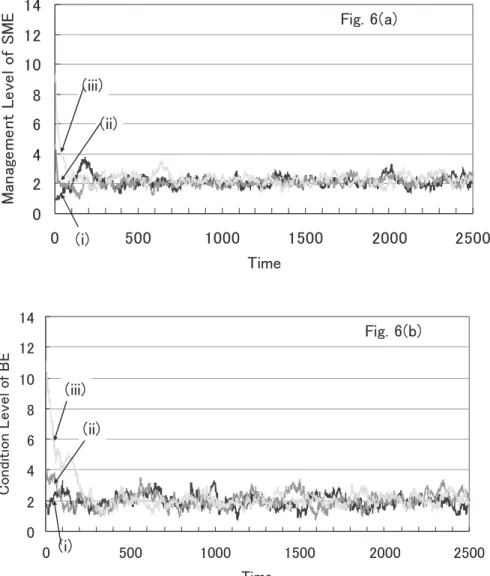
In the simulations, SME and BE agents are given initial environmental management levels and initial greening condition levels randomly at the initial time. We tested some cases of maximum initial lev-els. Fig. 6 shows results of the following three cases. In the case (i), initial conditions are the same as the basic values shown in Table 2, that is, the maximum level of SME is 3 and that of BE is 5. In the case (ii) both maximum levels of SME and BE are 10. And in the case (iii) both levels are 20. Fig. 6(a) shows the change of SME average value of environmental man-agement levels. Fig. 6(b) shows the change of BE average value of greening condition levels. In the figures, the horizontal axis is time and the vertical
axis is level.
In this paper, we carried out three times per each case, and every simulation result shown in this paper is the average of three runs.
In all cases of three initial conditions, the average values of both agents converged at the same level 2.
We use the initial condition of the case (i) as a blank case for comparison. The reason is that envi-ronmental management levels and greening condi-tion levels are not high actually.
4.2 Parameters of Price of Environmental
Equipments
As described in the section 3, in our model, any SME agents should pay costs to introduce environ-mental equipments when he improves environenviron-mental management level. And any SME agent can sell the environmental equipments and acquire capital by sales when he lowers environmental management level.
expression (8).
Fig. 7 shows three cases of parameters of environ-mental equipment costs, cE = 50, 100, 200. In the blank case, its value is 100. This figure shows the time change of average values of environmental management levels of SME. In the case of cE=200, the average level converges lower level 1 and in the
case of cE = 50, it converges higher level 4. Compared the three cases, it is clear that lower costs rise management levels. But the changes are not large.
In all cases of Fig.7, the average values of greening condition levels of BE converged at the same value of the blank case. The results are omitted here.
Fig. 6 (a) shows the change of SME average value of environmental management levels. Fig. 6 (b) shows the change of BE average value of greening condition levels.
4.3 Parameters of Environmental Audit Costs
of BE
As described above, in our model, BE agents need costs of environmental audit for the greening of
SME. In this section we examine the effects of the cost parameter of environmental audit, e0 in the expression (5).
Cases (i), (ii) and (iii) are cE= 50, 100, 200, respectively.
Cases (i), (ii) and (iii) are e0= 3, 10, 30, respectively.
Fig. 8 shows three cases of parameters of audit costs, e0= 3, 10, 30. In the blank case, its value is 30. This figure shows the time change of average values of greening condition levels of BE. In all cases, the average levels converged at the same level 2 as the
blank case.
Fig. 9(a) shows the change of BE average value. Fig. 9(b) shows the change of SME average value. Case (i) EB=3, Case (ii) EB=10, and Case (iii) blank.
4.4 Discussion: Limits of Voluntary Greening by
BE
The results of the basic model show that greening condition levels of BE are not improved by cost reduction. The main reason is that BE agent can’t get enough number of tendered SME when he takes the initiative in improving condition level rapidly. BE agent doesn’t has much incentive to rise level.
The results of the basic model also show that environmental management levels of SME are improved by cost reduction but that the extent of improvement is small. The main reason is that SME
agent doesn’t has much incentive to rise level when BE agent stays at low level.
5. Effects of Additional Policies
In the previous section, it is clear that voluntary implementation of greening SME doesn’t have much effect on the diffusion of environmental behavior. It is desirable that both SME and BE agents take envi-ronmental activities to higher extent as a whole soci-ety. In this section we examine some cases with additional policies.
5.1 Legislative Greening Action
This section examines a legislative scheme of greening action by BE. In the applied model, any BE agent should rise one level of greening condition at the next time when his level is lower than the regu-lated level EB.
Fig. 9 shows two cases of EB=3 and 10. Fig. 9(a) shows the changes of average values of BE greening condition levels. Fig. 9(b) shows the changes of
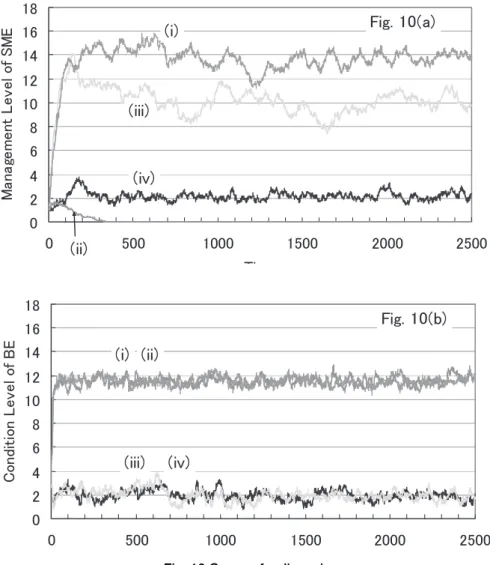
Fig. 10(a) shows the change of SME average value of environmental management levels. Fig. 10(b) shows the change of BE average value of greening condition levels.
Case (i) policy mix of legislative greening by BE and sanction to SME Case (ii) only legislative greening by BE
average values of SME environmental management levels.
Naturally, the averages levels of greening condi-tion converges higher levels when the regulated lev-els become high.
In the case of EB =10, the average levels of BE reaches around the level 12, but the average levels of SME converges the lowest level 0. This is because the transaction between SME and BE is not feasible.
In the case of EB=3, the average levels of BE con-verges at level 4, but the average levels of SME envi-ronmental management converges at the same level 2 as the blank case.
5.2 Policy Mix with Sanction to SME
In this section, besides of the legislative greening by BE described above, we introduce additional poli-cy of sanction to SME.
In the applied model, any SME agent acquired reward when his level is higher than the certain reg-ulated level ESand he graded up his level. Any SME agent, oppositely, is given penalty when his level is lower than the regulated level ES and he lowered his level. The reward means positive sanction which such a SME agent receives as subsidies for introduce of environmental equipments. The penalty means negative sanction which such a SME agent is imposed tax for sales of environmental equipments. In the model, the positive sanction is and the neg-ative sanction is – .
Fig.10 shows the case of ES=3 and =100. Fig.10(a) shows the changes of average values of SME environmental management levels. Fig.10(b) shows the changes of average values of BE greening condition levels. For the comparison, we show three other cases, that is, the blank case, only sanc-tion case and only legislative greening case.
In the policy mix case, the average level of BE greening condition converges at level 12 and the
average level of SME environmental management converges at level 14. From this result, we can say that policy mix is available for the diffusion of envi-ronmental behavior of both classes of agents.
5.3 Effects of Policy Mix
We also examined the following cases in order to confirm the effects of policy mix. The cases are (i)
EB=10, ES=3, =100, (ii) EB=5, ES =3, =100, (iii)
EB=15, ES =3, =100, (iv) EB=10, ES=3, =50, (v)
EB =10, ES =3, =200, and (vi) EB =10, ES =5, =100. Fig.11 shows the changes of average values of SME environmental management levels.
Compared with the cases (i), (ii) and (iii), as the regulated level of legislative greening by BE becomes higher, the effect of improving levels of SME becomes larger. This result shows that SME should improve management level voluntarily to acquire transaction when legislative scheme of greening by BE is introduced.
Compared with the cases (i), (iv) and (v), when sanction to SME is too small as the case (iv), we can find no effects. But when sanction is enough large as the case (v), the effect is large.
5.4 Discussion; Effects of Policy Mix
In the section 4, it is shown that the effect of vol-untary greening is limited. In this section we consid-er policy mixed case. It is clear that policy mix is available for the improvement of environmental behavior of SME and BE.
The significant effect of additional policies is to give incentive of voluntary improvement to SME. From our results, there are three conditions for the effect of voluntary improvement of SME. One condi-tion is that the regulated level of greening condicondi-tion of BE is high. The second is that the size of subsidy and penalty to SME is enough large. The third is that the regulated level of environmental management of SME is small.
To be summarized, our results don’t support the voluntary greening action by BE but support the leg-islative approach. It is also shown that large sanc-tion with weak regulasanc-tion is effective for SME to improve their management voluntarily.
6. Conclusions
Recently, greening pressure to the small and medi-um-sized enterprise (SME) by the big enterprise (BE) has been gradually increasing. The movement of greening the supply chain and the green procure-ment has been observed actually.
In this paper we analyzed the effects of greening pressure, using agent-based simulation models. We constructed a simple basic model which focuses on price competition and greening condition of busi-ness. From the simulation of the basic modes and applied models, we obtained three results.
One is that voluntary greening by BE has shown limited effects on the diffusion of environmental behavior. In the standard text of ISO14001, the green procurement of subcontractors is required, but the contents and extents are voluntary. Our results don’t support such a voluntary scheme.
The second is that policy mix of legislative green-ing by BE and sanction to SME is necessary for the diffusion of environmental behavior. The important
Case (i) EB=10, ES=3, τ=100, Case (ii) EB=5, ES=3, τ=100, Case (iii) EB=15, EB=3, τ=100,
effect of policy mix is to give incentive of voluntary improvement to SME.
The third result is that the conditions to induce SME’s voluntarily improvement are large sanction with weak regulation to SME and enough legislative greening by BE.
As further researches, we mention the following two problems. One is to examine the effect of micro-macro link in the society of the model. The method is to introduce macro indexes of the envi-ronment and the economy of the society into the basic model, as shown in Zaima (2004). The other is to confirm our results with other approaches, for example, statistical analysis and gaming simulation based on social dilemmas with hetero agents.
Acknowledgement
I would like to thank Prof. H. Matsui, Dr. H. Lee and anonymous three referees for helpful comments on an earlier draft of this paper. This study was sup-ported by a grant from “SMEs and Industrial Development in Asian Countries” project of “Open Research Center” project for Private Universities: matching fund subsidy from MEXT ((Ministry of Education, Culture, Sports, Science and Technology), 2004-2008).
References
Hirose, Yukio (1995) Social Psychology on the Environment and Consumption (Kankyou to
Shouhi no Shakai-Shinrigaku), Nagoya
University Press.
Meritt, J. Quentin (1998), “EM into SME won’t go? Attitudes, Awareness and Practices in the London Borough of Croydon,” Business Strategy and the Environment, Vol. 7, pp. 90-100.
Ministry of the Environment (2004)
http://www.env.go.jp/policy/j-hiroba/kigyo/h15/index.html
Patton, Dean and Ian Worthington (2003), “SMEs and Environmental Regulations: A Study of the UK Screen-printing Sector,” Environment and Planning C: Government and Policy, vol. 21, pp. 549-566.
Petts, Judith (2000), “The Regulator ? Regulated Relationship and Environmental Protection: Perceptions in Small and Medium-sized Enterprises,” Environment and Planning C: Government and Policy, Vol. 18, pp. 191-206. Simpson, Mike, et al. (2004), “Environmental
Responsibility in SMEs: Does it Deliver Competitive Advantage?” Business Strategy and the Environment, vol. 13, pp. 156-171. Zaima, Keiko (2004), “Effects of Structural and
Behavioral Strategies toward the Environmentally Conscious Society: Agent-Based Approach,” Proceedings of The Third International Workshop on AESCS’04, pp. 277-284, Pacific Asian Association for Agent Based Social Sciences, May 27-29, Kyoto University, Kyoto, 2004.
Zaima, Keiko (2005a), “Effects of Greening Pressure on SME’s Environmental and Economic Performances: Questionnaire-based Analysis for the Machine and Metal Industry in Japan,” mimeo.
Zaima, Keiko (2005b), “Effects of Structural and Behavioral Strategies toward the Environmentally Conscious Society: Agent-Based Approach,”in Post-proceedings of AESCS’04, Springer-Verlag, forthcoming. Zaima, Keiko (2005c), “Environmental
Management of Small and Medium Sized Companies: Case Studies,” The Shogaku Kenku-Nempo (The Annual Bulletin of Commercial
2004年度 機械・金属
2006年度 機械・金属
2006年度 プラスチック
1.研究の背景と本論文の目的
EU ELV RoHS ISO
a SAS
2.アンケート調査方法の概要
東京都 100 101 101
川崎市 100
大阪市 100 100 100
京都市 100
名古屋市 50
浜松市 50
a
・企業の属性・形態
・経済性・競争力・市場環境など経済活動 ・環境活動の内容
・取引先からの環境配慮要求 ・環境情報サポート
・環境活動に関する支払い意思額(WTP) ・環境関連の認証取得
3.環境配慮要求の業種間比較と経年比較
b
EMS
環境マネジメント システム(EMS) 関連
化学物質 関連
①国際標準規格ISO14001認証取得 ②国内版規格の認証取得
③取引先企業の環境保全ガイドライン遵守 ④取引先企業による環境影響評価
⑤化学物質の使用に関する調査
.
. %
EMS
EMS
EMS
EMS
EMS
EMS /
EMS
EMS EMS
4.環境活動指標の業種間比較と経年比較
a
4.1 環境配慮要求と環境活動指標
EMS認証取得 全 体
67 402
EMS認証取得要求あり 44 83
EMS関連要求あり 59 189
EMS/化学物質関連要求あり 64 274
4.2 業種間比較
4.4 認証取得企業の環境活動指標
EMS
EMS
4.5 環境配慮要求と環境活動指標に関する結果 のまとめ
EMS
ISO14001取得 国内版EMS取得
61 19
取引先が増えた 4 1
取引先に変化はないが
信頼が高まった 38 12
EMS
EMS
5.環境総合指標に影響を及ぼす要因
EMS
説明変数 パラメータ推定値 標準誤差 p値
定数項 9.26729 1.5013 <.0001
調査年 2006 0.07924 0.07295 0.278
機械・金属業 -0.0293 0.03852 0.4472
従業員平均年齢 -0.0486 0.02733 0.076
自社ブランド比率 0.01494 0.00246 <.0001
納品社数 0.00292 0.00187 0.12
最大納品先売上比率 -0.00447 0.00473 0.3446
加工技術開発 2.94123 0.77762 0.0002
品質強み 1.31078 0.73772 0.0762
販売力強み -0.19309 0.21781 0.3758
情報力強み 0.06688 0.10166 0.5109
間接輸出 2.15788 0.77268 0.0054
EMS関連要求 5.6318 0.75955 <.0001
化学物質関連要求 -0.33332 0.04555 <.0001
EMS認証取得 0.00055474 0.00119 0.6405
経営者意識 0.0054 0.00221 0.0151
従業員数 0.00121 0.0003574 0.0007
総当り法で抽出されたもの
6.中小企業の環境経営の課題
6.1 人材・資金面の課題
/ /
EMS
EMS
EMS認証取得企業
0万円 11
1∼29万円 12
30∼99万円 14
100∼299万円 9
300万円以上 9
%
%
EMS
6.2 環境情報サポートの課題
EMS
%
EMS
化学物質関連要求あり 243
取引先のセミナー・勉強会に参加 60
取引先のアドバイスを受けた 85
EMS関連要求あり 189
取引先のセミナー・勉強会に参加 62
6.3 中小企業の環境経営促進の課題
EMS
/
7.結果の総括と今後の研究課題
EMS
/
ELV EU RoHS
EU ELV
RoHS
ISO . .
a
pp. - .
b
●目的変数:環境総合指標(表1参照)
●説明変数
(A) 経済的側面に関するもの (1)属性
①調査年:ダミー変数 2006年度が1 ②業種:ダミー変数 機械・金属業が1 ③経営者年齢:実数
④操業年数:実数 調査年−創業年(質問項目) ⑤従業員平均年齢:実数
(2)形態
⑥自社ブランド比率:実数(%) ⑦下請け比率:実数(%)
*アンケートでは下記5項目の売上に占める割合を%で回答してもらう形式で、 ⑥は(i)で、⑦は(iii)と(iv)の合計で表した。
(i)自社ブランド製品を生産
(ii)納入先企業・顧客の依頼に基づき企画した製品を生産 (iii)納入先企業が企画した完成品を受託生産
(iv)納入先企業が企画した素材・部品・部分品の受託生産や受託加工 (v)その他
⑧納品社数:実数
⑨売上の一番多い納入先の売上に占める比率:実数(%) (3)経済性
⑩年商:実数 調査の前年度
⑪年商成長率:3年前からの成長率 実数(%) ⑫従業員数:実数 調査の前年度
⑬従業員数成長率:3年前からの増加率 実数(%) ⑭従業員一人当たり年間現金給与:実数
(4)競争力
⑮価格決定力:各ダミー変数 価格はおおむね自社の希望通りになる 価格は販売先の意向に左右される 競合他社の価格に左右される
⑯技術開発:各ダミー変数 加工技術の開発を行なっている:ダミー変数 製品開発を行なっている:ダミー変数 ⑰設備年数:実数
⑱輸出:各ダミー変数 直接輸出している
納入先または商社を通じて輸出している
⑲強み:各ダミー変数 コスト 品質 短納期 加工技術力 製品開発力 販売力 情報力
(5)競争環境
⑳製品・部品の販売単価の変化:各ダミー変数 下がっている 上がっている 原材料購入価格の変化:各ダミー変数 上がっている 下がっている
(B)環境的側面に関するもの
①環境配慮要求の有無:各ダミー変数 EMS関連要求 化学物質関連要求 ②環境マネジメントシステム認証取得の有無:ダミー変数
要旨
1.研究の背景と目的
CSR
,
2.基本モデル
Zaima Zaima
Zaima, a,b
n
2.1 企業行動
t j
L
Lmax
Fj t = Fj t =
t
y D d= D= D= c
j Z
R
2.2 消費者行動
i
J
J i
I
uT, uS, uE E t
,
i Z
3.基本モデルのシミュレーション結果
4.消費者の選択行動の変化による影響
5.企業へのサンクションの影響
DEj=
DEj=
iii iv v
, ,
.
, pp. - , .
, ,
, Vol. No. , pp. - .
Zaima, K. , Effects of Structural and Behavioral
Strategies toward the Environmentally Conscious
Society: Agent-Based Approach, in T. Terano, H. Kita,
T. Kaneda, K. Arai, H. Deguchi eds. , Agent-Based
Simulation From Modeling Methodologies to
Real-World Applications, pp. - , Springer-Verlag Tokyo.
Zaima, K. , Agent-Based Simulation on the
Diffusion of Research and Development for
Environmentally Conscious Products, in K. Arai, H.
Deguchi, H. Matsui eds. , Agent-Based Modeling
Meets Gaming Simulation, pp. - , Springer-Verlag
1.研究の背景と本論文の目的
日本の製造業において、全企業数のうち中小企業
の占める割合は約99%であり、付加価値の割合では
約55%を占めている1)。近年、大企業を中心に環境
経営が進んでいるが、中小企業の環境経営も重要な 課題である。
中小企業に対する政策は主に産業政策であるが、 産業公害問題や地球環境問題への対策も講じられて
きた2)。平成10年版の中小企業白書には、平成9年度
に実施された経営実態調査をもとに、環境保全側面 での今後の支援策が提示されている。平成11年版以 降では、中小企業施策として環境・エネルギー問題 への対策として、補助金や情報提供などが挙げられ ている。また、それを受けて、最近の地方自治体で は、中小企業への環境保全側面の支援が増えつつあ る。しかし、環境保全に関する対策に関して、中小 企業の認知や利用が十分でないことが指摘されてい る3)。
他方、環境政策は、1993年の環境基本法から新た な体系に移行して以来、それまでの公害対策を中心 とする時代とは、内容が大きく変化している。中小 企業にとっては、自社に関わる法規制や条例の把握
が難しいという現状がある4)。
このような中で、中小企業の環境対応に影響を及 ぼしているのは、大企業による取引先への環境配慮 要求である。本研究では、機械・金属業およびプラ スチック加工業の中小企業に対して、ヒアリング調
査とアンケート調査を実施した。在間(2005a,b,
2007)は、それらの調査を通して、中小企業が受け ている環境配慮要求の実態、環境配慮要求が中小企 業の環境活動に与える影響、中小企業の環境経営推 進のための経営資源の課題と情報サポートの課題に ついて整理している。
本論文の目的は、アンケート調査データの統計解 析から、環境配慮要求に加えて、中小企業の形態や 経済性、直面する市場環境など、中小企業の内部と 外部の両者の要因から、中小企業の環境経営を推進 する条件を明らかにすることである。以下、第2節 では本研究の既存研究との相違を述べ、第3節では アンケート調査の概要を示す。第4節では分析モデ ルを提示し、第5節では分析結果をまとめる。第6 節は結果から中小企業の環境経営推進の条件を考察 する。第7節は総括である。
2.本調査研究の特徴
これまでに実施された日本の中小企業の環境経営 に関する調査分析には、まず、環境マネジメントシ
ステムの国際標準規格ISO14001認証取得による影
響や課題を分析した、中小企業研究センター(編) (2002)、遠藤(2006)、(財)広域関東圏産業活性化
センター(2005)がある。また、(財)機械振興協 会経済研究所(2000)は、環境ビジネス参入の現状 と課題を分析しているが、調査対象が1000名以下の 企業であり、回答企業の特性が明らかにされていな いので、必ずしも中小企業の特徴とは言えない面が ある。また、例えば、大阪府(2000)では、中小企
−91−
中小企業の環境経営推進の条件に関する実証分析:
機械・金属業とプラスチック加工業のケース
キーワード:中小企業、環境経営、環境配慮要求、環境パフォーマンス、競争力
業と大企業の環境への取り組みの相違を示してい る。
本研究とこれらの研究の相違点は、取引先からの 環境配慮要求について具体的内容とその実態を把握 していること、環境活動の内容を指標化しているこ と、中小企業の事業形態や競争環境、情報サポート との関連も含めていることがある。これらの点から、 より詳細な環境性と経済性の分析が可能になること が特徴である。
中小企業の競争力と環境性に関する調査分析とし
ては、例えば、Hichens, et al (2003)では、両者
の間には明確な関係が示されていない。
3.アンケート調査の概要と環境経営の定義
本研究では、400社の中小企業に対して、面接方 式によるアンケート調査を実施した。調査地域・対 象は表1のとおりである。調査期間は2006年6月か ら7月である。本研究では、調査地域や対象が広範 囲にわたるため、調査対象の抽出、訪問・記入、デ ータ入力については調査会社(有限会社ブレーン・ ネットワーク)に委託した。調査票は、表2に示す 7つのパートで12ページの質問項目を作成した。
本研究では、アンケートの具体的な環境活動に関 する質問項目について、選択肢をもとに点数付けを 行い、表3に示すように、具体的な個別の環境活動
指標を作成している5)。また、アンケート調査での、
企業の属性や形態、経済的側面や市場環境側面に関 する指標を、表4に示す。
本研究では、環境経営を、「環境理念や環境憲章 を組織に位置づけ、企業活動に環境配慮を組み込み、 環境性と経済性を向上させるために、コンプライア
ンスに加えて、自主的活動を実施していること」と
定義する6)。
企業の環境保全には、①工場など事業プロセス での環境配慮、②製品・サービスでの環境配慮、③ 経営資源を生かした社会貢献の3つの領域がある。 表3に示す環境指標の環境経営推進における意味 を、表5に示す。分析では、各項目の点数が高いほ ど、また、表5の下の項目へいくほど、環境経営が 進んでいることを意味する。
−92−
表1 調査地域とサンプル数
2006年度 機械・金属
2006年度 プラスチック
東京都 101 101
大阪市 100 100
合計 201 201
表2 調査票の概要
・企業の属性・形態
・経済性・競争力・市場環境など経済活動 ・環境活動の内容
・取引先からの環境配慮要求 ・環境情報サポート
各項目の環境活動の現状については、在間(2007) を参照されたい。以下の分析では、表3での環境総 合指標を用いる。
4.分析モデル
分析するモデルを図1に示す。
在間(2005b, 2007)で示したように、取引先か
らの環境配慮要求や、環境マネジメントシステムの 認証取得、情報利用が、中小企業の環境活動推進の 要因となっていると考えられる。環境パフォーマン スと、環境配慮要求要因、経済性要因、制度要因、 および、情報的要因の関わりを分析する。経済性の
指標は、表4の年商を用いる。
環境配慮要求は、在間(2005a)に示唆されるよ
うに、規模、企業形態、取引先との関係、市場環境 に影響されると考えられる。また、経済パフォーマ ンスは、企業規模、企業の競争力、中小企業のタイ プ、製品や原材料の市場環境により影響を受ける。
−93−
表5 環境指標の環境経営における意味
これらのことから、環境配慮要求の程度、経済パフ ォーマンスを被説明変数とし、規模、形態や競争力 などの企業内部の要因と、製品や原材料の市場環境 要因との関わりの分析を行う。
図1のモデルは、企業の形態、規模や競争力とい った企業内部の要因、および、製品市場や原材料市 場の競争環境といった市場環境要因が、環境配慮要 求の大きさや経済パフォーマンスに影響を及ぼし、 環境パフォーマンスは、それらと環境マネジメント システム認証取得、および、情報利用が影響を及ぼ す、ということを示している。環境配慮要求は、6 つの調査項目について「ある」の回答の合計を、強 さの指標として用いる。
4−1.環境配慮要求が大きい要因の仮説
環境配慮要求が大きい企業の内部要因として、企 業規模・自社ブランド比率・納品社数・輸出(直接、 間接)を考える。
市場環境要因としては、製品市場競争環境の厳し
さが考えられる。在間(2005a)で指摘されている
が、中小企業は納入製品のコスト低下要求と合わせ て環境配慮要求を受けている。ここでは、製品価格 の低下の有無を考慮する。
4−2.経済パフォーマンスを高める要因の仮説
経済パフォーマンスは、表4の年商の自然対数を 用いる。
経済パフォーマンスを高める企業の内部要因とし て、企業規模・従業員平均年齢・自社ブランド比 率・輸出(直接、間接)・最大納入先販売額の全売 上に占める比率・開発費用の全費用に占める比率・ 強みがあること(コスト、品質、納期、販売力、情 報力)を考える。
企業規模(従業員数)、従業員平均年齢は、企業 の属性要因である。自社ブランド比率、最大納入先 販売額の全売上に占める比率は、取引形態の要因で ある。開発費用の全費用に占める比率、強みは、競 争力要因、輸出の有無は輸出要因として、以下で分 析する。
市場環境要因として、製品販売価格の低下の有無、 原材料購入価格の上昇の有無を考慮する。
4−3.環境パフォーマンスを高める要因の仮説
環境パフォーマンス向上の要因として、上述のよ うに、経済パフォーマンス、環境配慮要求の強さ、
E M S認証取得の有無、取引先・中小企業関連団
体・認証機関・自治体からの情報サポートの有無の 4つの要因を検討する。
5.分析結果
5−1.環境配慮要求の強さの要因分析
多項プロビットモデルの回帰分析結果を表6に示 す。
−94−
納品社数以外の変数は、すべて5%水準で有意で
あった。従業員数が大きいほど、自社ブランド比率 が小さいほど、また、輸出をしている企業、販売価 格低下に直面している企業で、環境配慮要求を大き く受けている。
企業規模(従業員数)が大きい中小企業ほど、よ り大手の企業を取引する機会が多いため、環境配慮 要求を強く受けると考えられる。また、自社ブラン ド比率が小さい企業は、独立型ではなく下請け型で あり、親会社からの環境配慮要求を受けやすいと考 えられる。
大手企業が取引先の中小企業への環境配慮を要求 する背景として、EUなど外国市場での取引による 環境規制の影響もあることから、直接・間接とも輸 出している中小企業は環境配慮要求を受けやすい。 さらに、製品の販売価格低下の要因が有意である ことから、厳しい市場競争環境で、環境配慮要求が 中小企業選別の手段となっている可能性があること が示唆される。
5−2.経済パフォーマンス向上の要因分析
回帰分析結果を表7に示す。
企業の属性要因では、企業規模(従業員数)が大 きいほど、従業員平均年齢が若いほど、経済パフォ ーマンスが高くなる。従業員平均年齢は設備年数と 相関があり、平均年齢が若いことは設備が新しいこ とと関連がある。
取引形態の要因では、最大納入先販売額シェアが 小さいほど、経済性向上につながる。最大納入先販 売額シェアが小さいことは、1つの取引先への依存 型でなく、複数の企業と取引を行なうバランス型で あることを意味している。
競争力の要因では、開発費用の全費用に占める比
率が小さいほど、経済パフォーマンスが高くなる。 開発費用シェアの小ささは資金面での余裕があるこ とを示していると考えられる。また、コスト・品 質・納期・販売力・情報力で強みでは、販売力の強 みが有意であった。
輸出要因では、間接輸出が5%水準で有意である。
市場環境要因では、原材料購入価格が上昇してい ない企業の方が、経済パフォーマンスが高いことを 示している。原材料購入価格が上昇していない場合 は、取引先からのコスト削減要求にも応えやすく、 経済性に結びつくと考えられる。
−95−
5−3.環境パフォーマンス向上の要因分析
回帰分析結果を表8に示す。
経済パフォーマンスが大きいほど、環境配慮要求 が強いほど、また、環境マネジメントシステム認証 取得をしている企業で、環境パフォーマンスは高く なる。
また、情報利用要因では、取引先と認証機関の情 報利用が有意であった。このことから、情報利用の メリットが示唆される。
6.環境経営推進の条件
前節の分析結果は、図2のようにまとめることが できる。
−96−
表8 環境パフォーマンス向上の要因