Content-Oriented Approaches for Efficient Data Transmission
in Future Internet
Saran Tarnoi
A dissertation submitted to the Department of Informatics
School of Multidisciplinary Sciences
in partial fulfillment for the degree of
Doctor of Philosophy
at
The Graduate University for Advanced Studies (SOKENDAI)
2015c
To my beloved family
Abstract
This dissertation presents several content-oriented approaches for efficient data transmis- sion in the future Internet. These approaches leverage known properties of contents in various aspects to facilitate content delivery. Our proposed approaches are grounded in two main techniques: 1) Content-Centric Networking (CCN) architecture and 2) QoS- aware routing with network coding. They are used to address problems in particular parts of the Internet, which can be categorized by location into the core and edge areas.
An increasing amount of content retrieval traffic raises concern about network conges- tion in the core area of the modern Internet. An effective solution to network congestion is network caching, whose basic principle is to store some contents in the storage close to content requesters so that some requests can be solved locally. Available implementation of network caching is often unnecessarily complicated. It requires complex middleware for content-to-location translation since contents are not natively identifiable to the data plane of routers. Content-Centric Networking (CCN), which is also called Named Data Networking (NDN), is a new architecture for the future Internet that solves this issue by substituting host addresses in packets with content names and using caches of routers as in-network caches. One of major challenges in CCN is how to efficiently utilize the in-network caches which have limited storage. We address this challenge with two ap- proaches: an Optimal Cooperative Routing Protocol (OCRP) and a probabilistic caching scheme.
The OCRP is an intra-domain routing protocol that utilizes the content retrieval statis- tics offered by CCN routers to adjust transmission routes. The OCRP consists of three main processes: (1) Prefix Popularity Observation; (2) Prefix Group (Un)Subscription; and (3) Forwarding Information Base (FIB) Reconstruction. In Prefix Popularity Ob- servation, each CCN router observes popularly cited prefixes to activate Prefix Group (Un)Subscription. Prefix Group (Un)Subscription notifies a central routing controller that which CCN router wants to join or leave which prefix group. A prefix group is the group of the CCN routers that frequently forward requests for the same contents. Based on prefix groups, a central routing controller computes an optimal cooperative path by
solving an integer linear programming. Finally, FIB Reconstruction adjusts the routes by updating the routing tables of the CCN routers involved in a newly computed opti- mal cooperative path. Simulation results show that the OCRP offers better reduction of server load and round-trip hop distance than the shortest path routing. In addition to the routing scheme, we investigate cache management for CCN because it is another important factor that affects the utilization of in-network caches. The cache management schemes of interest to us are combinations of a probabilistic caching scheme and differ- ent cache replacement policies. The cache replacement policies include Least Frequently Used (LFU), Least Recently Used (LRU), Random Replacement (RR), and First In First Out (FIFO) policies. Computer simulations are organized to evaluate the performance of the cache management schemes by using several network topologies. Simulation results show that the performance of in-network caches can be improved by using a probabilis- tic caching scheme along with LRU. Furthermore, we develop a new analytical model to gain deeper understanding of a probabilistic caching scheme. By using this model, several important properties of the probabilistic caching scheme are established as a function of cache replacement policies and network topologies. We have found that a combination of a probabilistic caching scheme and LRU offers the best performance among considering cache management schemes. However, if a CCN router cannot afford LRU due to a com- plexity constraint, RR is preferred to FIFO since the former yields better performance than the latter.
We proceed to address data transmission problems in the edge area of the Internet. Specifically, we facilitate reliable data transmission in multi-hop wireless networks, which are increasingly often the front-end accesses to the Internet. Contents can be encoded into multiple data layers to support heterogeneous users’ demands, devices, and network capacities. For acceptable qualities of contents at end-users, data transmission requires quality-of-service (QoS) such as a data rate and a tolerable packet loss rate. Achieving QoS in multi-hop wireless networks is challenging due to unreliable wireless links and scarce link bandwidth. To address the challenge, we introduce QoS-aware routing schemes for unicast and multicast transmissions, with the help of network coding techniques.
We propose a new QoS-aware routing scheme to enable QoS guarantee for unicast transmission in multi-hop wireless networks. This scheme employs cooperative network
coding (CNC) to improve wireless channel usage and consists of two main steps. First, this scheme uses an integer linear optimization to obtain optimal routes of all unicast flows. The constraints of this optimization problem, such as the transmission rate and tolerable error rate of each data layer, are derived for QoS guarantee. Second, the scheme decides whether or not CNC will be applied to different unicast flows at intermediate nodes. The decision criteria are based on the network topology and QoS requirements. In addition to the unicast transmission, we propose a new QoS-aware routing scheme for reliable multicast transmission in multi-hop wireless networks. This scheme solves an integer linear optimization problem for an optimal route of multicast transmission. When packet loss rates of wireless links are high, a multi-source technique is exploited to enable path diversity which improves the reliability of transmitted data. Furthermore, inter- source network decoding is utilized to improve an achievable data rate at client, where a data layer can be recovered by using network-coded data that are not necessarily from the same source. Simulation results show that both of the proposed schemes yield better reliability of data transmission in multi-hop wireless networks than several QoS-oblivious routing schemes.
Acknowledgements
I would like to express my deepest appreciation to my advisor Prof. Yusheng Ji for her guidance, carefulness, patience, and profound vision regarding the research and my future career. Her supervision has allowed me to learn being an independent researcher. I would also like to thank Prof. Shigeki Yamada, Assoc. Prof. Shunji Abe, Assoc. Prof. Kensuke Fukuda, Assoc. Prof. Michihiro Koibuchi, and Asst. Prof. Celimuge Wu for their valuable comments on this research and suggestions for the development of this work.
My sincere thanks are given to Assoc. Prof. Wuttipong Kumwilaisuk from King Mongkut’s University of Technology Thonburi, Assoc. Prof. Poompat Saengudomlert from Bangkok University, and Prof. C.-C. Jay Kuo from University of Southern California for their continuous supports. Their expertise, attitude, and intelligence have contributed to the deepness and thoroughness of this work. Moreover, I would like to thank Dr. Kalika Suksoomboon from KDDI R&D Laboratories Inc., Asst. Prof. Vorapong Suppakitpaisarn from The University of Tokyo, and Dr. Kriangkrai Limthong from Bangkok University for their countless pieces of advice on research methodology and analytical techniques. I would also like to thank students, researchers, and internship students at National Institute of Informatics (NII) for their helpful comments on this work.
My appreciation is also given to NII and the Japan Student Services Organization (JASSO) for their scholarships and research funding. I would also like to thank the secretaries of Klab, the administration staff members of NII, and those of The Graduate University for Advanced Studies (SOKENDAI) for their supports.
Last but not least, my special thanks are given to my family and friends. They gave me spiritual power and encouragement when I struggled with hard problems. I obtained from them many precious things that I hardly find elsewhere.
Contents
Contents i
List of Figures iv
List of Tables vii
1 Introduction 1
1.1 Motivation . . . 1
1.2 Contributions . . . 8
1.2.1 Routing and Caching Schemes for Content-Centric Networking . . . 8
1.2.2 QoS-aware Routing with Network Coding in Multi-hop Wireless Networks . . . 9
1.3 Dissertation Organization . . . 10
2 Background 11 2.1 Content-Centric Networking . . . 11
2.1.1 Routing Schemes for Content-Centric Networking . . . 14
2.1.2 Cache Management for Content-Centric Networking . . . 15
2.1.3 Performance Analysis of Probabilistic Caching Systems . . . 16
2.2 Network Coding . . . 18
2.2.1 Unicast Transmission with Cooperative Network Coding . . . 20
2.2.2 Multicast Transmission with Network Coding . . . 23
3 Cooperative Routing for Content-Centric Networking 26 3.1 Introduction . . . 26
3.2 Optimal Cooperative Routing Protocol . . . 27
3.2.1 Prefix Popularity Observation . . . 31
3.2.2 Prefix Group (Un)Subscription . . . 32
3.2.3 FIB Reconstruction . . . 34
3.3 Optimal Cooperative Path Selection . . . 36
3.3.1 Network Model . . . 36
3.3.2 Objective Function . . . 36
3.3.3 Flow Conservation Constraint . . . 38
3.3.4 Cache Contention Mitigating Constraint . . . 38
3.3.5 Path Length Constraint . . . 39
3.3.6 Problem Formulation . . . 39
3.4 Performance Evaluation . . . 41
3.4.1 Simulation Set-up . . . 41
3.4.2 Effects of Caching and Cache Replacement Policies . . . 43
3.4.3 Effects of the Number of Prefix Groups . . . 45
3.4.4 Effects of the Number of Requester Routers in Prefix Group . . . . 47
3.4.5 Effects of Content Popularity Distribution and the CS Size of CCN Router . . . 47
3.4.6 Effects of Node Degree . . . 50
3.4.7 Computational Complexity . . . 52
3.5 Conclusion . . . 54
4 Cache Management in Content-Centric Networks 55 4.1 Introduction . . . 55
4.2 Cache Management Schemes . . . 57
4.2.1 Caching Schemes . . . 57
4.2.2 Cache Replacement Policies . . . 59
4.3 Comparative Study of Cache Management Schemes . . . 60
4.3.1 Simulation Set-up . . . 60
4.3.2 Evaluation Metrics . . . 61
4.3.3 Network Topologies . . . 61
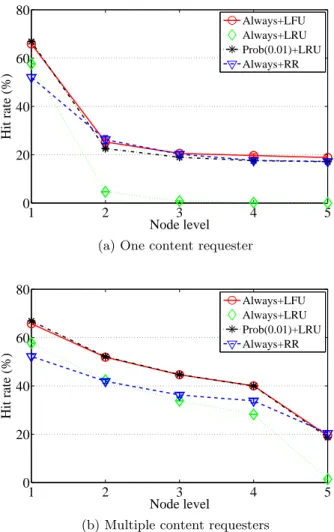
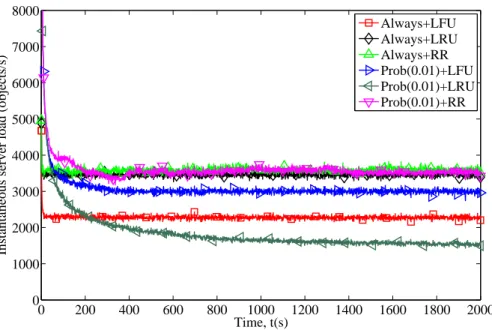
4.3.4 Results and Discussions . . . 63
4.4 Conclusion . . . 73
5 Performance Analysis of Probabilistic Caching Scheme 74 5.1 Introduction . . . 74
5.2 System Model and Assumptions . . . 75
5.2.1 Caching Scheme and Cache Replacement Policies . . . 76
5.2.2 Request Traffic Model . . . 77
5.2.3 Ergodicity of Markov Chains . . . 77
5.3 Performance Analysis of Probabilistic Caching Scheme and Random Re- placement Policy . . . 78
5.4 Performance Analysis of Probabilistic Caching Scheme and First In First Out Policy . . . 83
5.5 Performance Analysis of Probabilistic Caching Scheme and Least Recently Used Policy . . . 90
5.6 Experimental Results . . . 93
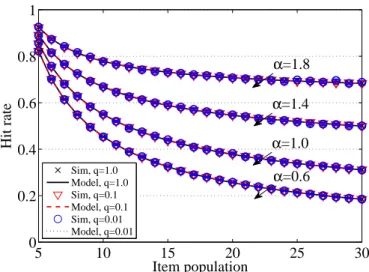
5.6.1 Model Validation and Insights . . . 93
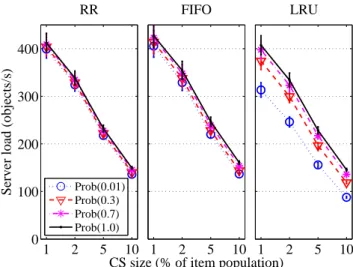
5.6.2 Experiments with Real Internet Topologies . . . 95
5.7 Conclusion . . . 97
6 Content Importance-based Routing Using Cooperative Network Cod- ing 99 6.1 Introduction . . . 99
6.2 System Model and Problem Description . . . 100
6.2.1 Network Model . . . 100
6.2.2 QoS Guarantee . . . 102
6.3 Optimal Path Selection for Layered Unicast . . . 103
6.3.1 Objective Function . . . 103
6.3.2 Flow Conservation Constraint . . . 106
6.3.3 Reliability Constraint . . . 107
6.3.4 Wireless Link Scheduling Constraint . . . 107
6.3.5 Problem Formulation: A Summary . . . 109
6.4 QoS-Aware CNC for Layered Unicasts . . . 111
6.4.1 Three Basic Local Structures . . . 111
6.4.2 Coding Rules and Opportunities . . . 112
6.4.3 Reliability Computation . . . 113
6.4.4 CNCE Protocol . . . 116
6.5 Experimental Results . . . 118
6.5.1 Experimental Set-Up . . . 119
6.5.2 Effects of Link Transmission Probabilities . . . 120
6.5.3 Effects of Node Densities . . . 125
6.5.4 Effects of Traffic Demands . . . 125
6.5.5 Effects of Wireless Interference: A Case of Single Wireless Channel 129 6.6 Conclusion . . . 131
7 Content Importance-based Multicast Using Inter-source Network Cod- ing 133 7.1 Introduction . . . 133
7.2 System Model and Problem Description . . . 136
7.2.1 Scalable Video Coding . . . 136
7.2.2 Network Model . . . 137
7.2.3 QoS Guarantee . . . 138
7.2.4 Optimum Path Selection for Layered Multicast . . . 138
7.2.5 Objective Function . . . 139
7.2.6 Problem Formulation . . . 141
7.3 Reliable Layered Multicast with Multiple Sources and Network Coding . . 143
7.3.1 Transmission Reliability of Layered Multicast with Multi-Source . . 143
7.3.2 QoS-aware Multicast with Multiple Sources and Network Coding . 144 7.3.3 Inter-source Network Decoding . . . 149
7.4 Experimental Results . . . 151
7.4.1 Comparison of Achievable Data Rate and Reliability . . . 154
7.4.2 Comparison of Objective and Subjective Qualities . . . 157
7.5 Conclusion . . . 159
8 Conclusion 162 8.1 Discussion . . . 162
8.2 Conclusion . . . 165
8.3 Future Work . . . 166
8.3.1 Network Coding in Content-Centric Networks . . . 166
8.3.2 Scalable Video Streaming in Content-Centric Networks . . . 168
8.3.3 Cache Management Schemes for Video Workloads . . . 169
Bibliography 170
A Publication List 179
List of Figures
1.1 The network core and wireless access networks in the Internet. . . 3
2.1 Packets types of CCN. . . 12
2.2 Components of CCN router. . . 12
2.3 Data transmissions in a butterfly network. . . 18
2.4 Data transmissions in a wireless network. . . 20
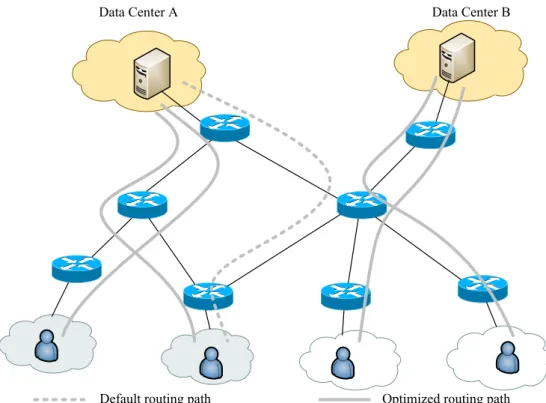
3.1 Routing path selection for multiple flows of Interest packets based on coop- erative routing for CCN. . . 28
3.2 The overview of OCRP. . . 29
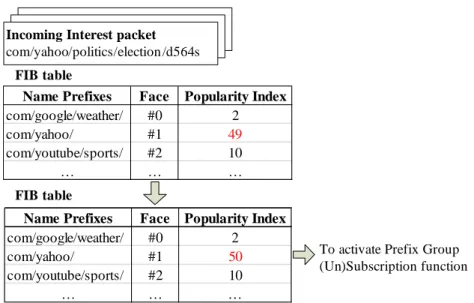
3.3 Process of handling Interest packets and tracking of popularity of each FIB entry. . . 33
3.4 Format of each signaling packet. . . 34
3.5 FIB reconstruction process of involved CCN router. . . 35
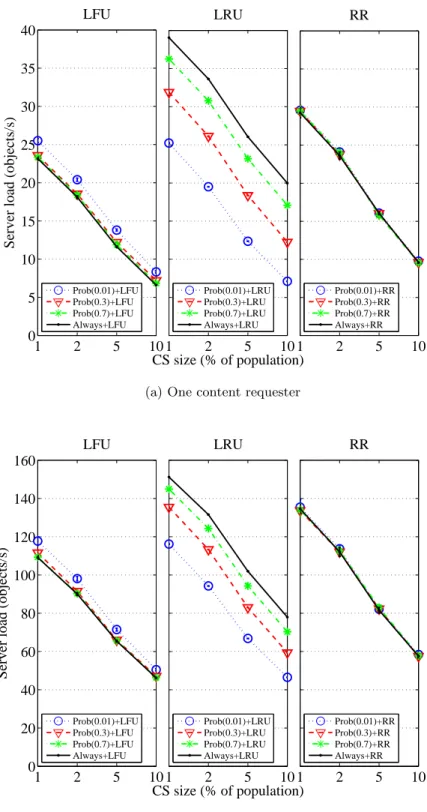
3.6 Impact of the caching and cache replacement policies. . . 44
3.7 Impact of the number of prefix groups. . . 46
3.8 Impact of the number of requester routers in each prefix group. . . 48
3.9 Impact of content popularity distribution. . . 49
3.10 Impact of node degree. . . 51
3.11 Computational time for the optimal cooperative path. . . 53
3.12 Example of multiple areas in an OCRP network. . . 54
4.1 Cascading network used in our simulations. . . 62
4.2 The network topology of SINET4. . . 63
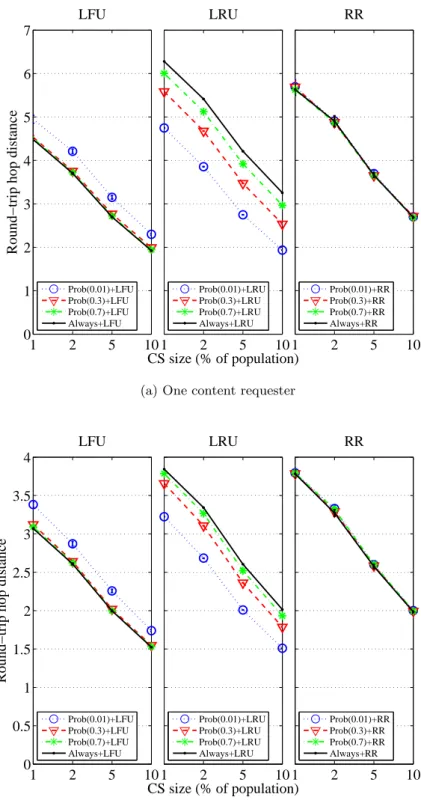
4.3 The server load for different CS sizes in the cascading network. . . 64
4.4 The round-trip hop distance for different CS sizes in the cascading network. 66 4.5 Hit rate with respect to the node level in the cascading network. . . 67
4.6 Instantaneous behavior of different caching schemes and replacement poli- cies in the cascading network. . . 69
4.7 The server load for different CS sizes in SINET4. . . 70
4.8 The round-trip hop distance for different CS sizes in SINET4. . . 71
4.9 Hit rate towards the node level in SINET4. . . 71
4.10 Instantaneous behavior of different caching schemes and replacement poli- cies in SINET4. . . 72
5.1 State transition probability in the Markov chain for a discrete cache whose cache management is a combination of P rob(q) and RR. . . 79
5.2 A content-centric network forming a two-level caching hierarchy. . . 81
5.3 State transition probability in the Markov chain of a discrete cache whose cache management is a combination of P rob(q) and FIFO. . . 84
5.4 State transition probability in the Markov chain of a discrete cache whose cache management is a combination of P rob(q) and LRU. . . 90 5.5 Hit rate versus item population for the discrete cache controlled by RR. . . 93 5.6 Hit rate versus item population for the discrete cache controlled by FIFO. 94 5.7 Hit rate versus item population of the discrete cache controlled by LRU. . 94 5.8 Miss rate of a cache network in Figure 5.2 versus a caching probability. . . 95 5.9 Server load versus the cache size in the SINET4 topology. . . 96 5.10 Server load versus the cache size in the G`EANT topology. . . 96 5.11 Server load versus the cache size in the Internet2 topology. . . 97 6.1 An example of defining the information value of each sublayer based on its
original layer. . . 104 6.2 An exemplary wireless network. . . 109 6.3 Coding rules with XOR (⊕) operation. . . 112 6.4 An extended A-B structure which has more than one intermediate node. . 115 6.5 Three basic local structures for the CNCE protocol: (a) the A-B structure,
(b) the Y structure and (c) the X structure. The dashed and regular arrows represent the overhearing and direct transmissions, respectively. . . 116 6.6 Comparison of the throughput for various link qualities in the networks
having 15 nodes. . . 121 6.7 Comparison of the number of channel uses for various link qualities in the
networks having 15 nodes. . . 121 6.8 Comparison of the throughput per channel use for various link qualities in
the networks having 15 nodes. . . 122 6.9 Comparison of the throughput for various link qualities in the networks
having 20 nodes. . . 122 6.10 Comparison of the number of channel uses for various link qualities in the
networks having 20 nodes. . . 123 6.11 Comparison of the throughput per channel use for various link qualities in
the networks having 20 nodes. . . 123 6.12 Comparison of the throughput for different routing schemes as a function
of node density. . . 126 6.13 Comparison of the number of channel uses for different routing schemes as
a function of node density. . . 126 6.14 Comparison of the throughput per channel use for different routing schemes
as a function of node density. . . 127 6.15 Comparison of the throughput for different routing schemes as a function
of the number of s-d pairs in each network. . . 127 6.16 Comparison of the number of channel uses for different routing schemes as
a function of the number of s-d pairs in each network. . . 128 6.17 Comparison of the throughput per channel use for different routing schemes
as a function of the number of s-d pairs in each network. . . 128 6.18 Comparison of the throughput for various link qualities in single-channel
networks having 15 nodes. . . 130 6.19 Comparison of the number of channel uses for various link qualities in sin-
gle-channel networks having 15 nodes. . . 130 6.20 Comparison of the throughput per channel use for various link qualities in
single-channel networks having 15 nodes. . . 131 7.1 Layered multicast with multiple sources and inter-source network decoding. 134
7.2 Different bitstreams enabling different spatial, temporal, and SNR scalabil- ities. . . 137 7.3 A flowchart demonstrating the QoS-aware multicast with multiple sources
and network coding. . . 145 7.4 A network with two source nodes. . . 146 7.5 A set of paths for each destination obtained from the primary source node
S2: (a) a set of paths for destination node 3, (b) a set of paths for destination node 4, and (c) a set of paths for destination node 5. . . 147 7.6 The network when a set of links has been removed in Step 3. . . 148 7.7 A set of paths for each destination obtained from the secondary source
node S1: (a) a set of paths for destination node 3 and (b) a set of paths for destination node 5. . . 148 7.8 A set of paths from multiple sources. . . 149 7.9 An example network using inter-source network coding. . . 150 7.10 Comparison of achievable data rate of all layers for various link conditions. 153 7.11 Comparison of reliability of data transmission of layer 0 for various link
conditions. . . 154 7.12 Comparison of reliability of data transmission of layer 1 for various link
conditions. . . 155 7.13 Comparison of reliability of data transmission of layer 2 for various link
conditions. . . 155 7.14 Comparison of the number of links used for each transmission scheme. . . 156 7.15 Comparison of the average PSNR of video sequence “Paris” for various link
conditions. . . 157 7.16 Comparison of the average PSNR of video sequence “Bus” for various link
conditions. . . 158 7.17 Comparison of the average PSNR of video sequence “Football” for various
link conditions. . . 158 7.18 Comparison of the average PSNR of video sequence “Mobile” for various
link conditions. . . 159 7.19 Visual example selected from video sequence “Paris” from various routing
schemes : (a) Original, (b) QoS-aware w/ inter-source ND and multiple sources, and (c) QoS-oblivious w/o NC. . . 159 7.20 Visual example selected from video sequence “Bus” from various routing
schemes: (a) Original, (b) QoS-aware w/ inter-source ND and multiple sources, and (c) QoS-oblivious w/o NC. . . 160 7.21 Visual example selected from video sequence “Football” from various rout-
ing schemes: (a) Original, (b) QoS-aware w/ inter-source ND and multiple sources, and (c) QoS-oblivious w/o NC. . . 160 7.22 Visual example selected from video sequence “Mobile” from various routing
schemes: (a) Original, (b) QoS-aware w/ inter-source ND and multiple sources, and (c) QoS-oblivious w/o NC. . . 160 8.1 Example of network coding in a content-centric network. . . 167 8.2 RTT variability of scalable video transmissions in a content-centric network. 168
List of Tables
5.1 Summary of notations in our analytical model for cache analysis . . . 78 5.2 Topological properties of the considered networks . . . 95 6.1 Summary of notations for QoS-aware routing in multi-hop wireless networks 101 6.2 Distance thresholds for different transmission data rates. . . 119 7.1 Summary of notations for the optimal path selection for layered multicast . 139 7.2 Summary of notations for QoS-aware multicast with multiple sources and
network coding . . . 144 7.3 Comparison of the reliability obtained by single source and multi-source
multicast. . . 149 7.4 Distance thresholds for different transmission data rates . . . 153
Chapter 1
Introduction
This chapter provides the research motivation which is based on problems as- sociated with data transmission in the Internet. The contributions of this dissertation are summarized and the dissertation organization is given at the end of chapter.
1.1 Motivation
Overlooking properties of transmitted data could lead to inefficient data transmission in the Internet. The cause of this issue is rooted in a conflict between a host-to-host communication model of the Internet and what it is used for. The principles of data transmission in the current Internet are based on an architecture which mainly relies on communication between two distant nodes. Data transmission aims to send a bunch of data from one place to another place in a fast, reliable, and secure manner. To achieve the goal, many techniques were implemented on top of the host-to-host communication model. While being effective nowadays, the add-on techniques inevitably impose difficulties of implementation and maintenance, leading to excessive overheads and costs. Properties of data, including the relation between them, are not often taken into account when they are transmitted. The forwarding engine of a router, which is key equipment used in data transmission, merely treats the carriers of data as anonymous packets. It mostly pays attention to only the destination addresses of packets, even though exception holds for some mechanisms that can roughly prioritize packet forwarding based on the data types.
In fact, the data being delivered in the Internet are partly meaningful by themselves. They are often a part of content having some specific properties. In some cases, these properties are highly useful for data transmission.
For instance, data can belong to chunks of a video. If the video is encoded by using a hierarchically structured coding, different pieces of the data may differently contribute to video quality at a client. When network resources are so limited that all data cannot be transmitted to destination equally well, their transmissions should be provided with different priorities based on their importance. In addition, when the video is public and accessible from a group of clients, it may become popular and is accordingly watched by many clients in the group. When a host-to-host communication model is used, the same data are repeatedly transmitted from a video server to these clients one after another, resulting in a large amount of redundant traffic in networks. It is so because the data plane does not realize that it repeats data transmission for the same content. On the other hand, if packets are identifiable by the content names, the data plane will recognize data and could manipulate them more precisely. Network caching could become an inherent part of data transmission, as the individual data can be cached and discoverable to associated content requests directly on the data plane. This approach simplifies a content delivery process and efficiently eliminates redundant traffic. From the above example, we can see that many new opportunities will be open for more efficient data transmission when the properties of content are taken into account.
In this dissertation, we propose several content-oriented approaches for efficient data transmission in the future Internet, by leveraging some known properties of content in various aspects. Our approaches are grounded in two main techniques: 1) Content-Centric Networking (CCN) architecture and 2) QoS-aware routing with network coding. We use them to solve data transmission problems in particular parts of the Internet, which can be categorized by location into the core and edge areas.
In the first half of the dissertation, we address inefficient data transmission in the core area of the Internet. The majority of traffic in the Internet is from content retrieval [1, 2, 3, 4, 5]. Content retrieval broadly denotes activities pertaining to downloading contents on the Internet. Contents are pieces of information stored in various electronic forms such as web objects, documents, images, audio and video files. An increasing amount
Netw ork c
ore
Wireless networks Content server
Local ISP
Global ISP
Netw ork e
dge
Wired networks
Figure 1.1: The network core and wireless access networks in the Internet.
of content retrieval traffic raises concern about network congestion, especially at fragile interconnection points between multiple networks as shown in Figure 1.1. When content consumers heavily retrieve contents from a content server, the demand for traffic on a link between networks may exceed the link capacity and network congestion would occur. Network congestion is a main cause of undesired effects such as delay, packet drops, and connection blocking. An overloaded content server could also develop the similar effects.
Provisioning the entire links in the Internet with redundant capacities is an ideal solution to network congestion. However, this approach is impractical, considering the gigantic scale and complexity of the Internet. In content retrieval paths, data often travel across multiple networks. While ones do their best to ensure sufficient network capacity, network congestion would still occur if others do not.
A practical solution to this problem is network caching. Network caching reduces the traffic in networks by fulfilling the requests of content locally. This approach makes use of a fact that many end-users often retrieve the same contents from the Internet.
To enable network caching, in-network caches are placed in networks close to end-users. In-network caches are responsible to temporarily storage, keeping the content that has recently traversed the networks. When clients demand a content recently requested by others, they can retrieve this content from in-network caches, instead of distant original content servers. Efficient in-network caches can reduce not only the traffic in networks, but also the content retrieval time and the content server load.
Existing systems of in-network caches include Web caches (also called proxy servers) and Content Delivery Networks (CDNs) [6]. They have been playing an important role in delivering contents on the Internet to end-users [5]. Nevertheless, their usage is typically restricted to a handful of applications. They also require complicated implementation that involves large infrastructure, middleware for content-to-location translation, and engines for intercepting and redirecting content requests. Importantly, their protocols are based on the application layer, thus causing considerable overheads and latencies. These factors unnecessarily complicate the processes of content retrieval [7, 8].
In this work, we consider Content-Centric Networking (CCN) architecture [7], which is a new architecture for the future Internet, to be a new solution to data transmission in the core area area. CCN is a root of a more recent project called Named Data Networking (NDN)[9]. Hence the terms CCN and NDN are used interchangeably. In CCN, packets are distinguished by unique names and the caches of routers are used as in-network caches. CCN data plane uses the names of packets in packet forwarding and network caching. From a content retrieval point of view, CCN is more efficient than existing host-centric communication model, as the network caching is performed directly in the network layer. However, the caches of CCN routers tend to be small in comparison to the amount of contents on the Internet [10]. Efficient utilization of the in-network caches is therefore a key to efficient data transmission in content-centric networks.
We see opportunities to improve the cache utilization of CCN from the routing and caching points of view, through deliberating over some properties of content retrieval.
CCN packets are typically forwarded in the shortest-path basis [11, 12], which may not fully exploit the caching benefits of CCN routers. Different CCN routers may use disjoint paths to forward their packets, even though these packets contain the same content. In this case, each CCN router would benefit from the cached content that are subject to only
its previously transmitted data. Moreover, when many unique contents arrive at a CCN router, the cache of the CCN router must handle these diverse contents. The contents may be so many that the cache cannot manage them efficiently and would result in poor caching performance. To solve the problem, we introduce cooperative routing scheme for CCN. The CCN routers frequently forwarding requests for the same set contents can cooperatively share a common path. The contents cached by the CCN router on this path are not only useful for a given CCN router but all the participants. In addition, the CCN routers may frequently forward requests of content from the same content publisher. Some contents requested by a CCN router have a high probability that they would be requested by the other CCN routers. In practice, this scenario occurs when a group of end-users tries to access the same website, such as YouTube [4]. Once a popular content is viewed by a client, it is often viewed again by other clients who regularly access the considering website.
Cache management also contributes to the cache utilization. CCN suggests caching all contents that traverse a CCN router, which is called a universal caching scheme, so that the cached contents will fulfill some future requests. Nevertheless, the universal caching scheme does not work well in CCN, as it causes many redundant copies of the same content in networks [13, 14, 15, 16, 17]. Several sophisticated caching schemes are proposed to replace the universal caching scheme [13, 18, 19, 20, 21]. Unfortunately, they often add complexity and overheads to caching systems, which are not suitable for high-speed CCN routers. Among available caching schemes, we observe that randomly caching contents at a certain probability, which is called a probabilistic caching scheme, can overcome some main drawbacks of the universal caching scheme. The probabilistic caching scheme was used as a benchmark policy by several works in literature [13, 14, 15]. However, the insights into the behavior of the probabilistic caching scheme have never been studied. It has been roughly evaluated when it is used with a cache replacement policy, i.e., Least Recently Used (LRU). There has never been a criterion that suggests a decent value of a caching probability as well as its practical limitation. Therefore, we investigate the behavior of the probabilistic caching scheme, aiming to justify the feasibility of using it in cache management for CCN.
In the second half of the dissertation, we focus on data transmission in the edge of
the Internet. In a content retrieval path, content is delivered to end-users through the edge area of the Internet, where wireless networks have become common. This scenario is illustrated in Figure 1.1. Among available wireless networks, our interest is centered in multi-hop wireless networks [22], such as wireless mesh networks [23]. Multi-hop wireless networks offer a multi-hop wireless backbone that interconnects isolated local area net- works (LANs) and extends backhaul access to the users who are out of the range of typical access points. Nodes in multi-hop wireless networks are usually stationary and can be per- manently power-supplied. Consequently, the main factors affecting data transmission are the quality and capacity of wireless links.
Transmitting data in multi-hop wireless networks without considering the properties of contents may cause end-users dissatisfaction and frustration. Contents can be encoded with layered coding to serve heterogeneous users’ needs, device capabilities, and network capacities. In layered coding, a content is encoded into multiple data layers with different data rates. The quality of content at a client increases with the number of data layers received. Due to the hierarchical structure of layered coding, a lower data layer is more important to decoder than a higher layer data. Decoding of a higher data layer requires that the entire lower data layers must be correctly received [24]. Therefore, quality-of- service (QoS) for layered data transmission is required to ensure acceptable quality of content at a client. QoS can be a combination of the data rate and tolerable packet loss rate of each data layer. However, achieving QoS in multi-hop wireless networks is a daunting task, considering unreliable quality and limited bandwidth of wireless links [25]. Forward Error Correction (FEC) [26, 27] is a coding technique performed by sources to control errors of data transmission over noisy channels. In FEC, a source transmits data encoded with an error-correcting code (ECC) to a destination. The encoded data are larger than the original data as a result of additional redundant bits. The redundant bits allow for a recovery of the original data from received data, whose parts may be lost or corrupted during data transmission. More redundant bits are added when the channel quality becomes worse to guarantee certain data reliability. Therefore, FEC may not be suitable for QoS-sensitive data transmission over unreliable wireless links with limited bandwidth.
On the other hand, QoS-aware routing can be used for providing QoS guarantee to data
transmission. QoS-aware routing, which is also called content importance-based routing from now, considers the importance of contents when it selects transmission routes. This approach rather selects a more reliable route for data transmission that demands stricter QoS, instead of sending data with redundant bits over arbitrary routes. Furthermore, network coding can be employed to improve the utilization of network resources [28]. In this work, we utilize both QoS-aware routing and network coding to achieve QoS guarantee for unicast and multicast transmissions in multi-hop wireless networks.
Efficient unicast transmission in wireless networks can be achieved by leveraging wire- less broadcast and cooperative network coding (CNC) [29, 30]. When multiple unicast flows are delivered in a multi-hop wireless networks, CNC can be used to improve the channel utilization and total network throughput. Depending on the network topology, CNC is applied to unicast flows at intermediate nodes in multi-hop wireless networks. However, performing CNC may affect the QoS of data in each unicast flow. This is because the success of a unicast session depends on the other unicast session involved in CNC. Encoding and decoding nodes require that all CNC packets must be delivered successfully. Therefore, achieving high network throughput, data quality guarantee, and efficient channel utilization under unreliable wireless links is challenging.
For reliable multicast transmission, when there is more than one source, data from multiple sources can be used to improve the reliability of transmitted data at terminal nodes. However, if this approach is directly applied to multi-hop wireless networks, it may affect the efficiency of network resource usage. This is because network resource consumption increases with the number of sources participating in the multicast trans- mission. Network coding can be used to enable inter-source network decoding for more efficient network resource utilization. Inter-source network decoding allows each client to use network-coded packets from multiple sources to recover the original data. The targets of multicast transmission include videos encoded with scalable video coding (SVC) [24]. By using layer coding, SVC encodes a video into a base layer and several enhancement layers [31] to enable scalability for heterogeneous users, devices, and networks. Data of a lower layer contribute to the end-quality of a video more than those of a higher layer. In multi-hop wireless networks, available network resources may not meet the QoS require- ments of all data layers. Therefore, prioritizing transmission based on the importance of
data layers is essential.
1.2 Contributions
We propose several content-oriented approaches for efficient data transmission in the core and edge areas of the Internet. Specifically, CCN is used to enable network caching, aiming to eliminate redundant traffic caused by content retrieval in the core area. In the edge area, QoS-aware routing is used along with network coding techniques to enable reliable and efficient data transmission in multi-hop wireless networks. Our main contributions are as follows.
1.2.1 Routing and Caching Schemes for Content-Centric Networking
We introduce a new cooperative routing scheme and a probabilistic caching scheme for CCN. Our ultimate goal is to improve the utilization of in-network caches in content-centric networks.
Cooperative Routing Scheme
We propose a cooperative routing scheme for CCN, focusing on a route optimization based on content retrieval statistics. This routing scheme selectively aggregates multiple data flows onto the same path with a goal to improve the utilization of in-network caches while mitigating cache contention of the CCN routers. We propose an Optimal Cooperative Routing Protocol (OCRP) to sketch an implementation of the cooperative routing scheme on the control plane of CCN. Moreover, we provides a new method for content popularity observation at CCN routers, leveraging a fact that CCN names packets with hierarchical prefix names. An integer linear optimization problem is formulated for calculating an optimal cooperative path for OCRP. Computer simulation is organized to evaluate the performance of OCRP with regard to the reductions of server load and round-trip hop distance, when it is used in mesh network topologies.
Probabilistic Caching Scheme
We propose to use a probabilistic caching scheme in cache management for CCN. We evaluate the performance of probabilistic caching systems with various cache replacement policies by means of computer simulation and mathematical analysis. The cache replace- ment policies consist of Random Replacement (RR), First In First Out (FIFO), Least Recently Used (LRU), and Least Frequently Used (LFU) policies. Computer simulation is conducted by using network topologies derived from several real academic networks and various parameters which include the cache size, content population, and content pop- ularity distribution. We develop a new analytical model to mathematically analyze the probabilistic caching scheme. This model is based on Markov chains under Independent Reference Model (IRM) and Zero Download Delay (ZDD) assumption. By analyzing the results from the computer simulation and the analytical model, we can establish several im- portant properties of a probabilistic caching scheme, drawing up guidelines for lightweight and efficient cache management for CCN.
1.2.2 QoS-aware Routing with Network Coding in Multi-hop Wireless Networks
We propose novel QoS-aware routing schemes for unicast and multicast transmissions in multi-hop wireless networks. Network coding is utilized in these routing schemes to improve the utilization of wireless channels while retaining QoS of data transmission.
Unicast Transmission
We propose a QoS-aware routing scheme for efficient unicast transmission in multi-hop wireless networks with cooperative network coding. We formulate an integer linear op- timization problem for calculating an optimal route for all unicast flows based on QoS requirements. We investigate the effects of performing CNC in lossy wireless networks on the reliability of data transmission. A Cooperative Network Coding Establishment (CNCE) algorithm is proposed for selectively applying CNC to particular unicast flows without QoS violation. We conduct computer simulation to evaluate this routing scheme in terms of throughput and channel utilization, when it is used in different network topologies
and various parameters.
Multicast Transmission
We propose a QoS-aware routing scheme for scalable video multicast in multi-hop wireless networks. The routing scheme selects an optimal path for scalable video multicast trans- mission based on QoS requirements of each data layers and network resources. Random linear network coding is applied at intermediate nodes for efficient channel utilization. In addition, we propose a more robust and efficient multicast transmission by using source diversity and inter-source network decoding technique. The multiple sources and inter- source network decoding are employed when the reliability of data obtained from the optimal path does not meet QoS requirement. Computer simulation is organized to eval- uate the routing scheme in terms of the achievable data rate as well as the objective and subjective qualities of scalable videos at clients.
1.3 Dissertation Organization
The rest of the dissertation is organized as follows. Chapter 2 gives some background of architectures and techniques used in this dissertation. The introduction to the Content- Centric Networking (CCN) architecture and network coding techniques is provided along with related work. Chapter 3 presents a cooperative routing scheme and the details of an Optimal Cooperative Routing Protocol (OCRP) for CCN. Chapter 4 presents a compara- tive study of cache management schemes for content-centric networks. Chapter 5 presents a performance analysis of a probabilistic caching scheme. Chapter 6 presents content importance-based routing in multi-hop wireless networks using cooperative network cod- ing. Chapter 7 presents a framework for robust scalable video multicast transmission in multi-hop wireless networks using inter-source network coding. We provide discussion, conclusion, and future work in Chapter 8.
Chapter 2
Background
This chapter gives some background knowledge about the Content-Centric Net- working architecture and network coding. The related work is also provided.
2.1 Content-Centric Networking
Content-Centric Networking (CCN) [7] is a new architecture for the Internet. It is one of the information-centric networking (ICN) architectures [32, 33, 34] proposed for tailoring the Internet to meet requirements of modern applications emerging on the Internet. Note that Named Data Networking (NDN) architecture [9] is a derivative work of CCN and shares the same communication model. For generality, the terms NDN and CCN are used interchangeably in this dissertation.
CCN communication model is centered around the content rather than the locations of hosts. CCN identifies and routes packets with unique and hierarchical prefix names. The prefix name can be based on the Uniform Resource Identifier (URI) Representation [7, 11, 12]. There are two types of CCN packets, Interest and Data. Figure 2.1 shows the formats of Interest and Data packets. An Interest packet contains Content Name, Selector, and Nonce. Content Name is the name of a desired content object. Selector is an optional field for selecting a correct version of interested content object. Nonce is a random number that is used with Content Name to detect looping Interest packets. A Data packet contains Content Name, Signature, Signed Info, and Data. Content Name is the name of Data which is the requested content object. Signature and Signed Info
Content Name Selector
(order preference, publisher filter, scope, ...) Nonce
Content Name Signature
(digest algorithm, witness, ...)
Data (content object)
Signed Info
(publisher ID, key locator, stale time, ...)
Interest packet Data packet
Figure 2.1: Packets types of CCN.
Name
/yya.com/Sample.264/Vlow/s1
Data ...
Name
/yya.com/Sample.264/Vlow/s1
Requesting Face
#2
Prefix /yya.com
Face
#0 Cotent Store (CS)
Pending Interest Table (PIT)
Forwarding Information Base (FIB)
Ptr Data
C...
P... F...
Router’s memory
Face #0
Face #1
Face #2
Face #3
Figure 2.2: Components of CCN router.
are security information used for data validation. Having these components in the Data packet, the protection and trust of communication in CCN are the properties of content itself, not the connections on which it travels.
The architecture of a CCN router can be described as follows. Figure 2.2 shows three data structures maintained by a CCN router. The data structures consist of: Forwarding Information Base (FIB), Content Store (CS), and Pending Interest Table (PIT).
• FIB of a CCN router is partly similar to the routing table of a conventional IP router whose destination field is changed into the prefix field of content names. It is used
for determining where an Interest packets is forwarded to.
• CS of a CCN router is similar to the buffer memory of an IP router but has different objective. It is used for caching content objects carried by arriving Data packets so that the CCN router can satisfy some successive Interest packets.
• PIT is responsible for tracking the pending Interest packets that have been forwarded toward content sources. It collects the breadcrumbs left by forwarded Interest pack- ets in a form of PIT entries. The PIT entries give breadcrumb trials for Data packets to reach all of concerning content requesters.
Communication in CCN is driven by exchange of Interest and Data packets. It is initiated by a content requester inserting an Interest packet into a content-centric network. Upon an arrival of the Interest packet at a CCN router, the CCN router searches it CS for Data matching the Content Name of the Interest packet. If there is a matching Data, the CCN router will send a Data packet containing the Data to the content requester. Otherwise, the CCN router checks its PIT whether any Interest packet having the same Content Name has been forwarded. If so, a “Face” where the Interest packet arrives on, denoted by a requesting face, is appended to an existing PIT entry in the PIT. The Face broadly denotes a hardware interface or an application process within a machine. Otherwise, a longest prefix math is performed in FIB to determine where to forward the Interest packet. Then, the CCN router forwards the Interest packet to the next hop and inserts a new PIT entry with the Content Name and the requesting face into its PIT.
When the Interest packet meets a matching Data, in either a CCN router or a content server, a Data packet will be sent to the content requester in a reverse path of the Interest packet. This path is pointed by PITs of the CCN routers involved in transmission of the Interest packet. When the Data packet arrives at a CCN router, the CCN router forwards the Data packet to the next hop through recoded requesting face(s). The associated PIT entry is also erased to indicate that the pending Interest packet has been satisfied. The Data in the Data packet can be stored in the CS of each CCN router that it traverses, depending on a caching scheme. When the CS is in a full state, a cache replace policy selects a content object currently in the CS to be replaced by an arriving one.
A few works comparing CCN to existing content delivery approach are present in
literature [8, 35]. Carofiglio et al. [8] gave a comparison between ICN architectures and Content-Delivery Networks (CDN). The comparison is based on the following metrics: heterogeneity, efficiency, reactivity, and granularity. This work points out that ICN offers many new opportunities of doing more efficient content delivery than CDN, since the limitations of CDN in the mentioned metrics does not apply to ICN architectures. A comparative study of the performance of content-centric and content-delivery networks was carried out by Mangili et al. [35]. This study focuses on the performance in terms of a reduction of the total bandwidth consumed in networks. Interestingly, the study results show that CDN provides slightly better performance than CCN, even though CDN in practice requires a much higher degree of complexity in operation and management than CCN.
2.1.1 Routing Schemes for Content-Centric Networking
Several shortest-path routing schemes for CCN were proposed in [36, 37, 38]. By using different techniques, these routing schemes try to route each content request to a closest content repository in the shortest path basis while addressing the scalability and overhead issues in CCN. They all succeed in offering a robust and efficient mechanism for the shortest path discovery. However, the in-network cache utilization is not considered by these routing schemes.
A popularity-based routing scheme for CCN has been recently proposed in [39]. This routing scheme performs load balancing based on the popularity of the content retrieval. This approach categorizes content objects with their popularity and lets CCN routers implement different cache replacement policies for different content categories. This rout- ing scheme improves the cache utilization but it requires a system resource to observe the popularity of all content objects in a real-time basis, which may not be applicable in practice.
The other work that uses content retrieval statistics in a routing scheme was presented in [12]. In the first step, this scheme lets each CCN router broadcast arriving Interest packets to all faces and wait for corresponding Data packets from a CCN router connected to a content provider, which is called a provider router from now. This process continues for a period of time. In the second step, after the provider router has learned the content
popularity, it floods the prefix announcement messages in the considering content-centric network to construct the FIB tables of other CCN routers. This method effectively ad- dresses a problem of FIB explosion since only the popular prefixes are maintained by FIBs. Nevertheless, the scheme ignores the caching functionality in the CCN architecture.
2.1.2 Cache Management for Content-Centric Networking
Evaluation of caching schemes and replacement policies has been extensively studied in literature. However, caching and replacement methods, which cooperatively manage a caching system, were often evaluated as separate studies.
A number of caching strategies for content-centric networks were proposed in [18, 19, 13, 20, 21, 40]. A content-popularity-based caching scheme was presented in [18]. In this scheme, each node maintains the local content popularity by counting the number of received requests for each content names. When the number of received requests for a content name at a node reaches a threshold, this content is considered a popular content, and this node suggests to neighbor nodes that they should cache the popular content. This scheme has been shown to be more efficient than a universal caching scheme in terms of cache hit rate and content diversity in network. However, this scheme requires that each CCN router maintains the popularity indexes of all contents, introducing large overheads and complexity.
A number of cooperative caching strategies were presented in [19, 13, 20, 21]. In these strategies, the entire nodes in a content-centric network maintain the information of content popularity through synchronization and make a cooperative caching decision based on this information. While being efficient, these sophisticated caching schemes can be hardly implemented in practice because of the large scale of networks, link latency, and communication overheads.
Chai et al. [40] proposed a centrality-based caching algorithm whose caching decision is based on the concept of betweenness centrality. The performance of their caching method was well supported by simulation results but it was evaluated only with a cache replacement policy (LRU).
2.1.3 Performance Analysis of Probabilistic Caching Systems
There are a number of analytical models for performance evaluation of caching systems in literature. King [41] used Markov chains to model caching systems with LRU and FIFO policies. They derived the steady-state performance of the caching systems from the Markov chains. Markov chains were also used by Gelenbe [42] to model caching systems with RR policy. He used his model to show that RR and FIFO policies yield that same steady-state performance of caching systems for an IRM request traffic. By using the Markov chain-based approaches, the performance of caching systems are evaluated at a computational cost that grows exponentially with the cache size and item population. To improve the scalability of the analytical model proposed by [41], Dan and Towsley [43] proposed an approximate analysis for LRU and FIFO policies. Their approach offers accurate estimations of caching performance at an affordable computational cost.
Garcia-Reinoso et al. [44] used Markov chains to model the behavior of a discrete cache running a probabilistic caching scheme and LRU policy. They developed an iterative algorithm to be used for estimating the cache hit ratio for each item. They showed that a cache hit ratio for most popular items can be improved by decreasing a caching probability. Unlike ours, this analytical model did not address the impacts of a caching probability on RR and FIFO policies.
The in-network caches of content-centric networks can be viewed as cache networks, which are constituted by the caching systems of interconnected CCN routers. Therefore, investigation of the cache networks’ behaviors is useful and necessary. In [45], an algorithm for multi-cache approximation, named as a-NET, was proposed to investigate the behavior of cache networks. The a-NET algorithm is based on a single cache approximation for LRU policy, which was proposed by Dan and Towsley [43]. Nevertheless, the results obtained from empha-NET exhibit nontrivial errors (almost 16%). Authors have concluded that these errors are caused by non-IRM miss streams between caches. Wang et al. [46] developed a multi-cache with aggregation approximation (MCAA) algorithm to obtain the cache miss rate and virtual routing-trip time (VRTT) in content-centric networks. The MCAA algorithm considers the effects of Interest packet aggregations in content- centric networks and offers more accurate results than a-NET. However, both a-NET and
MCAA do not take into account the impacts of a probabilistic caching scheme.
By using Markov chains, Resensweig et al. [47] carried out a study of the ergidicity of cache networks. They pointed out that the steady-state performance of a caching system depends on the initial state of the system for some cache replacement policies such as FIFO policy. The findings address a question of whether or not ones must vary the initial state of the caching systems in their experiments for a valid evaluation.
In addition to the approaches based on Markov chains, other analytical modelling techniques have been proposed for evaluating caching systems. Che et al. [48] developed an analytical model for characterizing an uncooperative two-level hierarchical caching system, where each cache locally and independently runs LRU policy. This analytical model is later regarded as Che’s approximation. In the Che’s approximation, the cache miss rate of a caching system can be estimated by assuming exponential sojourn times of items in the caching system. Despite several assumptions, the Che’s approximation can accurately predict the performance of caching systems. Fricker et al. [49] provided a mathematical explanation for the success of the Che’s approximation and derived an approximate model for caching systems with RR policy. However, none of these models consider the caching systems that run a probabilistic caching scheme.
By extending the Che’s approximation, Martina et al. [50] proposed a unified approach to performance analysis of caching systems. Several combinations of caching schemes and cache replacement policies are considered by using this approach. Importantly, the approach can be used to accurately approximate the performance of caching systems with a probabilistic caching scheme and LRU policy. Unfortunately, this work did not address the interplay between a probabilistic caching scheme and other cache replacement policies such as RR and FIFO.
Another work closely related to performance evaluation of probabilistic caching systems was carried out by Bianchi et al. [51]. In this work, a new analytical model is developed to evaluate the performance of caching systems that randomly cache just a fraction of content objects arriving at CCN routers. The motivation of this work is grounded in a security point of view in the CCN architecture. To ensure that CCN routers store only valid content object, content integrity and provenance verification is required. The speed of this verification might be much slower than the data forwarding speed of CCN routers,
1
2
T1
T2
3 4
S
1
1
1 1
1
1
1
1 1
(a) A butterfly network
1
2
T1
T2
3 4
S
a b
a
b b
a
b
a| a |b b a |
(b) Traditional data transmission
1
2
T1
T2
3 4
S
a a⊕b
b
a
b b
a
a⊕b a⊕b
(c) Data transmission using network cod- ing
Figure 2.3: Data transmissions in a butterfly network.
thus limiting caching verified content object to a fraction of forwarded ones. They pointed out that a reduction of caching probability may increase or decrease the cache hit rate depending on the amount of temporal locality of the requests. Nevertheless, this analysis focuses only on the caching systems with LRU policy, whereas RR and FIFO policies are out of their study scope.
2.2 Network Coding
Network coding was introduced along with max-flow min-cut theorem [28] as a new ap- proach to perform data transmissions in modern computer networks. Many studies have been conducted in various directions to extend this seminal work. The term network cod- ing in this dissertation refers to random linear network coding [52], which is a randomized coding method that maintains a vector of coding coefficients for each of the packets sent from sources. The vector of coding coefficients is updated by each coding node along transmission paths. An example of a vector of coefficients is a vector containing 0’s and 1’s elements, which represent an XOR operation of inputs.
Consider a butterfly network in Figure 2.3(a). Each communication link of the network
can accommodate a packet per transmission time slot. Source node S wants to multicast two packets, a and b, to terminal nodes T1 and T2. With traditional transmission scheme in Figure 2.3(b), nodes 3 and 4 must transmit either packet a or packet b to node T1 or node T2 per transmission time slot, as a result of a bottleneck link between nodes 3 and 4. Figure 2.3(c) demonstrates data transmission using network coding. Node 3 produces a new packet by taking an XOR (⊕) operation of packets a and b and transmits the new packet to both terminals through node 4. Taking an XOR operation, node T1 decodes packet a ⊕ b using packet b to obtain packet a. With the same method, T2 can obtain packet b. This example shows an advantage of the network coding technique in terms of throughput improvement. In addition, network coding can be used to improve the robustness to packet losses and link failures, as well as the security of data transmissions [53, 52]. In Chapter 7, we exploit the network coding technique to improve the robustness of multimedia transmissions in multi-hop wireless networks.
Moreover, network coding can be used along with broadcast nature of wireless signal transmitters to improve channel utilization. Katti et al. [29] proposed COPE, which is also regarded as cooperative network coding (CNC) [30], to demonstrate a new concept for utilizing network coding in wireless networks. The design of CNC is based on the theory of network coding, focusing on taking the XOR operation of multiple independent data in certain network topologies. An example of CNC is shown in Figure 2.4. The considering network consists of three wireless nodes, where all nodes have the same transmission range. Specifically, nodes R1 and R3 are in the transmission range of node R2 but node R1 is out of the transmission range of node R3. Node R1 wishes to send packet a to node R3 while node R3 wishes to transmit packet b to node R1. Packets a and b are the same in terms of size.
Define Ri
→ Rx j as a broadcast transmission of packet x from Ri to Rj. With a traditional transmission scheme shown in Figure 2.4(a), the two packets are relayed and forwarded to the next terminals by router R2. In other words, we need four broadcast transmissions: R1 → Ra 2, R3 → Rb 2, R2 → Ra 3, and R2 → Rb 1. To reduce the number of transmissions, we can employ CNC at node R2 as in Figure 2.4(b). That is, node R2 performs an XOR operation of packets a and b to produce packet a ⊕ b. Packet a ⊕ b can be transmitted to nodes R1 and R3 with a single broadcast transmission because
R2
R1 R3
a
b
b
a
(a) Traditional data transmission
R2
R1 R3
a b
b a⊕
(b) Data transmission using CNC
Figure 2.4: Data transmissions in a wireless network.
both nodes R1 and R3 are in the transmission range of R2. Nodes R1 and R3 decode their received packets to obtain packets b and a, respectively, by using an XOR operation. We can achieve the same goal with just three transmissions: R1 → Ra 2, R3 → Rb 2, and R2 a⊕b→ R1, R3. In this example, CNC reduces the total number of transmissions in the network from four to three, producing a coding gain of 4/3 = 1.33 [29]. This CNC topology is called an A-B structure.
In addition to the A-B structure shown in this example, there are other topologies in which CNC can be used, such as X, Cross, and Wheel structures [29]. In Chapter 6, we carry out an investigation of the interplay between the reliability of data encoded with CNC and packet loss ratio of lossy channels.
2.2.1 Unicast Transmission with Cooperative Network Coding
A number of studies were carried out to show the benefits of network coding in unicast transmissions over wireless channels. Traskov et al. [54] studied network coding for mul- tiple unicast sessions. They proposed code construction techniques for certain connection points that are feasible with a network coding technique called the poison-antidote con- cept. Li et al. [55] investigated the benefit of network coding in the routing of multiple independent unicast transmissions. They pointed out that the coding advantage is not finitely bounded in directed networks. In undirected networks, they showed that the po- tential for network coding to increase achievable throughput is equivalent to its potential to increase bandwidth efficiency.
Based on COPE introduced by [29], a study on network coding-aware routing for unicast sessions in wireless networks was carried out by Sengupta et al. [56, 57]. They demonstrated that network coding-aware routing yields better throughput than network
coding-oblivious routing. In [30], a study on CNC-aware routing in multi-rate networks was carried out. This work extends COPE by exploiting spatial diversity in packet routing to improve the opportunity for using CNC. The bound on the throughput gain of network coding and broadcasting in wireless networks was studied in [58]. The authors showed analytically that the benefit was upper bounded by a constant for both the protocol model and the physical model of wireless transmissions. Wei et al. [59] proposed a network- coding-aware routing protocol in lossy wireless networks. This method offers throughput improvement via the structure selection of CNC.
All of the aforementioned studies use optimization problems to obtain their routing solutions. However, they do not consider QoS guarantee for layered data transmissions.
Due to the limited transmission range of a wireless node, it is typical for a source node to transmit data to a destination node by going through several intermediate nodes. Layered video transmission in wireless networks using relay nodes was proposed by Alay et al. [60]. Layered video transmission employs successive refinement of information or scalable coding was considered in [31]. Video streaming using network coding over wireless networks was proposed by Seferoglu et al. [61]. The proposed video-aware opportunistic network coding scheme considers the decodability of network codes by multiple receivers as well as the relative importance and delay of video packets. However, the QoS guarantee issue has not yet been examined in depth in these papers.
Mahapatra et al. [62] proposed a QoS-and-energy-aware routing scheme for real-time traffic in wireless sensor networks. The scheme employs an adaptive prioritized Medium Access Control (MAC) to provide a differentiated service model for real-time packets. However, network coding was not considered in [62]. More recently, Supittayapornpong et al. [63] proposed a framework of layered data multicasting with QoS guarantee, which includes network code assignment to each node in the network. In addition, a practical algorithm which calculates the optimal network code length providing QoS guarantee for wireless multicast was proposed in [64]. However, their framework did not address the issue of network contention due to the co-existence of multiple unicast video streams.
Greco et al. [65] proposed a framework for reliable video streaming in lossy wireless net- works using Expanding Window Network Coding (EWNC), Multiple Description Coding (MDC), and a novel Rate-Distortion Optimised (RDO) scheduling algorithm. However,
they assumed that multiple sources transmit the same video to a single receiver. In addi- tion, their framework cannot be applied to the streaming of layered videos. Oh et al. [66] proposed a practical online scheduling algorithm for mobile video streaming to multiple clients. In their work, an access point (AP) constructs and broadcasts the best network code, which is based on the packets of I-frames with high Peak Signal-to-Noise Ratio (PSNR) during a Group of Picture (GoP), to all clients. Their framework well addressed a problem of single-hop video transmissions from an access point to mobile users in lossy wireless networks. However, they did not consider multi-hop transmissions in multi-hop wireless networks.
Yang et al. [67, 68] proposed a network coding-based multipath routing (NCMR) scheme for wireless sensor networks. They used random linear network coding to improve the reliability of the data transmission on braided multiple paths. Their approach was proven to be efficient in terms of energy consumption, which can be shown by a reduced number of transmissions in wireless sensor networks. Nevertheless, the QoS requirement and transmission rate were not primarily considered in their works.
Ning et al. [69] studied the relation between network coding and spatial reuse in wireless mesh network. They pointed out that greedy network coding (i.e., establishing network coding as much as possible) may reduce network throughput because of a de- crease in spectrum spatial reuse. To solve the problem, they proposed an optimal network coding-aware scheduling scheme which includes a power control mechanism, taking into account both adaptive relaying method selection and spatial reuse. They formulated an integer linear programming to solve the link scheduling problem. An adaptive power con- trol method with a network coding-aware link scheduling scheme was developed to further improve wireless spectrum utilization. Even though their proposed scheme offers a signif- icant improvement in network throughput, the importance of transmitted data and QoS guarantee were out of their study scope.
Uddin et al. [70] carried out a study of a cross-layer design in random-access-based fixed wireless multihop networks with a physical interference model. They considered ALOHA medium access control protocol for link-layer operation. An optimization problem was formulated for obtaining the maximal throughput, which is provided by an optimal con- figuration of the routing, access probability, and transmission rate in a slotted ALOHA