A New Class of Easily Testable Assignment Decision Diagrams
Norlina Binti Paraman1, Chia Yee Ooi1, Ahmad Zuri Bin Sha’ameri1 and Hideo Fujiwara2
1Faculty of Electrical Engineering University of Technology Malaysia
81300 Skudai Johor, Malaysia {norlina, ooichiayee. zuri}@fke.utm.my
Abstract — This paper introduces a new class of Decision Diagrams (ADD) called thru-testable ADD based on R-graph representation. This class of ADD is introduced functional Register Transfer Level (RTL). We also define a design-for-testability (DFT) method to augment a given ADD with thru functions so that the ADD becomes thru-testable. The expected result show the comparison of our DFT method with original circuits and conventional full scan technique circuits in terms of fault efficiency, area overhead, test generation time and test application time.
Keywords — thru-testable ADD, R-graph, assignment decision diagrams
1. Introduction
DFT is important to reduce the complexity of the test generation for a circuit [1]-[2]. Various DFT methods have been proposed to augment a given circuit to become more easily testable. The most commonly used DFT method is scan technique (full or partial)[3]-[5] and built-in self test (BIST) [6]. However the hardware of full scan technique is large because all flip-flops are augmented and chained together into a scan path. Due to the area overhead, partial scan technique has been proposed in which only a subset of the flip-flops is included in the scan path. It can save area overhead but maintaining a high fault coverage. BIST is a technique of designing additional hardware features into integrated circuits to allow them to perform self testing. Since the need for external automated test equipment (ATE) will be reduced, speed timing will be increased and lower cost of testing.
Scan technique and BIST have been proposed at gate level and high level. However, conventional scan techniques at gate-level which have long test application time due to scan in and scan out process. Therefore by applying DFT method at high-level for example which is at RTL, the number of primitive elements to be dealt in the circuit is reduced [7]. Thus the test generation time is also reduced. At RTL, various DFT methods that have been proposed are integrated automatic test pattern generation (ATPG) and DFT insertion technique using BIST [8]-[9], scan design [10]-[12] and test multiplexers [13]-[14]. DFT at high level can be applied in the early design phase to improve the effectiveness of high-level ATPG. Moreover high level design can be described using an assignment decision diagrams (ADD)[15]. ADD is used in high level testing because it is easy for
2Graduate School of Information Science Nara Institute of Science and Technology Kansai Science City, Nara, 630-0192 Japan
representing the RTL descriptions into its ADD model. Then the DFT method will be introduced to ADD.
In this work we introduced a special class of ADD called thru-testable ADD. The new class of ADD is introduced at functional RTL based on the previous work that has been done in [16]. Thru-testable ADD is a class of ADD which is easily testable. We also introduce a DFT method to augment a given ADD with thru functions so that the ADD becomes thru-testable.
This paper is organized as follows. In section 2, we define a representation of ADD called R-graph and new concepts of ADD called thru-testable ADD. In Section 3 we present the extraction of thru functions from a given ADD. In Section 4, we also present the DFT method to augment a given ADD with thru functions so that the ADD becomes thru-testable. Conclusions and future works are included in Section 5.
2. Preliminaries
This section introduces an ADD representation called R-graph and new concepts of special class of ADD called thru-testable ADD.
2.1 R-graph
R-graph is defined as an ADD representation by using read nodes as input and write nodes as output. The R-graph includes ADD properties of thru function, thru tree and input dependency. Based on these properties, the class of thru-testable ADD is defined.
Definition 1. Let X, Y and Z be a set of variables respectively in ADD where X∩Z=∅ and Y∩Z=∅. A thru function tX
ÆY is a
logic, equality, relational and arithmetic operations such that i. the operations connectives of the function consist of
(AND), (OR) and ¬(NOT), < (LESS THAN),
> (MORE THAN) and = (EQUAL);
ii. the operation variables Z of the function and X consist of read nodes while Y consists of write nodes;
iii. the signals at X transfer to Y if Z has an assignment that makes the thru function ‘true’ or active ( tXÆY=1).
Note that X and Y may have the same variables that make the thru function transfers the signal from one variable to the same variable. This thru function is called self thru function. In other words, thru function is a logic that transfers the same
9th IEEE Workshop on RTL and High Level Testing (WRTLT'08), pp. 51-56, Nov. 2008.
signals from the input to the output if the thru function is active. The bit width of the input and output are equal. Fig.1 shows two examples of thru functions. Two thru functions are independent if they cannot be active at the same time. Fig. 1(a) shows that thru functions tAÆB and tCÆB are dependent. Dependent thru functions transfer signal at the same time and activated by same variable. In this case, signals from A and C are transferred to B at the same time when a1 is true. Fig. 1(b) shows that thru functions, tAÆB and tCÆB are independent. This means data transfer from A to B cannot happen at the same time when data transfer from C to B. The former takes place when a1 is true.
Fig. 1 Thru functions
To facilitate the implementation of our DFT method, we introduce a graph representation called R-graph which contains the information of connectivity, thru function of an ADD.
Definition 2. An R-graph of an ADD is a directed graph G=(V,A,w,,t) that has the following properties.
i. v∈V is a read node or write node. If a read node and a write node correspond to the same variable, they are represented by the same vertex; ii. (vi, vj)∈A denotes an arc if there exists a path from
the read node vi to the write node vj;
iii. w:V→Z+ (the set of positive integers) defines the size of read or write node corresponding to a vertex in V;
iv. t:A→T∪{0,1} (T is a set of thru functions) where t(u,v)=0 if there is no thru function for (u,v)∈A and t(u,v) is a thru function that transfers signals from the read node u to the write node v. If t(u,v)=1 (also called identity thru function), the signal values are transferred from u to v directly. Note that identity thru function is always active.
2.2 Thru Testability
Thru-testable ADD is a class of ADD which is easily testable. Its read nodes are easily observable and its write nodes are easily controllable. The class of thru-testable ADD is defined in the following text.
Using R-graph representation, we visualize a certain set of thru functions as a thru tree, which is defined as follow.
Definition 3. A thru tree is a sub graph of the R-graph such that
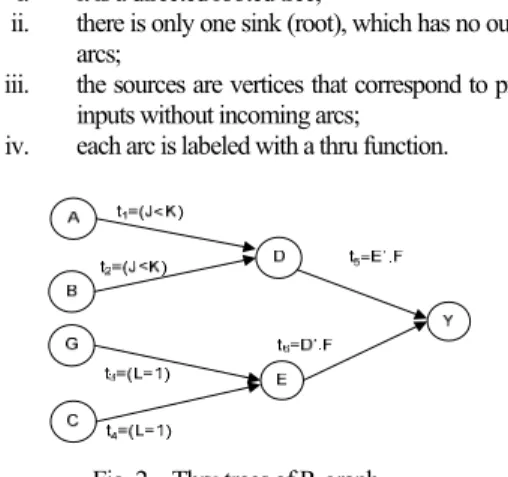
i. it is a directed rooted tree;
ii. there is only one sink (root), which has no outgoing arcs;
iii. the sources are vertices that correspond to primary inputs without incoming arcs;
iv. each arc is labeled with a thru function.
Fig. 2 Thru trees of R-graph
Example 2. Fig. 2 shows a thru trees of the R-graph. Each arc is labeled with a thru function. The sources are represented by vertices that correspond to primary inputs without incoming arcs.
Definition 4. If Vti is a set of vertices that activate a thru function ti in a thru tree Tj, Tj is said to be dependent on Vti. Furthermore, if Vti includes a vertex in a thru tree Tk, Tj is said to be dependent on Tk.
Definition 5. Let G be the R-graph of ADD S, and let B be a set of thru trees in G. Let (u,v) be a set of all paths starting at u and ending at v. Two distinct paths p1,p2∈(u,v) have input dependency if the following conditions are satisfied.
i. the first arc of one of the paths is different from the first arc of another path;
ii. the first arc of at least one of the paths is labeled with a thru function in a thru tree in B;
iii. each path contains at most one cycle; iv. p1 and p2 have the same length.
Input dependency can be resolved by self thru function.
Using the newly defined concepts of thru tree and thru function, we can identify whether an ADD of an R-graph is thru-testable or not.
Definition 6. An ADD is called to be thru-testable if the R-graph of the ADD contains a set of disjoint thru trees such that the following conditions are satisfied.
i. The thru trees cover all the vertices of a feedback vertex set.
ii. For any thru tree Ti, Ti is not dependent on itself. iii. For any pair Ti, Tj of the thru trees, if Ti (resp. Tj) is
dependent on Tj (resp.Ti),Tj (resp.Ti) is not dependent on Ti (resp. Tj).
iv. For each pair of reconvergent paths p1 and p2, p1
and p2 does not have input dependency.
The thru tree that does not depend on any vertex in any thru tree to become active is called independent thru tree. C
a1
a2
a1
(a) (b)
A C
A J I
B B
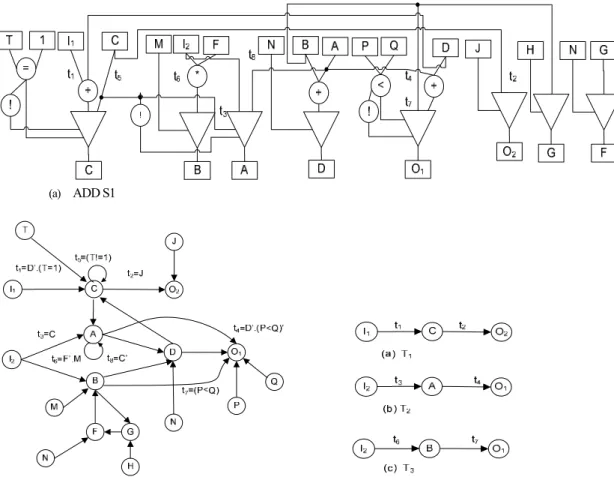
(a) ADD S1
(b) R-graph of ADD S1 (c)Thru trees (T1, T2 and T3) for ADD S1 Fig. 3 R-graph of thru-testable ADD S1
Example 3. Fig. 3(b) shows the R-graph of the ADD S1. Thru functions t3=C is activated by C. S1 is a thru-testable circuit because there are three thru trees, namely T1, T2 and T3
(shown in Fig. 3(c)) that contain C,B and A which are the vertices in the feedback vertex set (FVS). Moreover, each variable that activate the thru functions in each thru tree is not a vertex in the thru tree. T2 is dependent on T1 because thru function t3 in T2 is activated vertex by C in T1. But thru functions in T1 do not depend on any vertex in T2. There is also no input dependency in S1. Note that node C forms a self loop. Other loops are combination of nodes C, A and D and combination of nodes B, G and F.
3. Extract Thru Functions
Definition 7. Let A be a read node and B be a write node. A connects to data input of an ADN and B connects from the output of the ADN. If data transfer is allowed from path A to B then A is called on-path input.
Definition 8. Let A and B be read nodes and C be a write node. A and B connect to data input of the ADN and C
connects from the output of the ADN. If data transfer is allowed from path A to C then B is called off-path input. Thru functions are extracted from a given ADD and included in R-graph. The procedure consists of the following steps.
Step 1: Identify a set of ADD paths where each path contains one or more of the following
1.1 any input of addition node 1.2 the first input of subtractions node 1.3 any input of multiplication node 1.4 the first input of division node 1.5 any data input of ADN.
Step 2: Compute the symbolic operations for each line in assignment value part and assignment condition part in terms of variable of read nodes. This is to obtain operational expression for each line. After the symbolic operation of addition in Fig. 4(a), the operational expression for line a is (L+M). Step 3: For each operation node (resp. ADN) on each ADD
path, identify the logic, equality, relational and arithmetic operations or any combination of the
operations that allows the data transfer from the input (resp. data input) of the operation node (resp.ADN) to its output.
3.1 For addition node and subtraction node, the conditions are inversion of the operational expression of the off-path input. For example in Fig. 4(a), in addition node in data of L is transferred to line a when the off-path input M is 0. (M’). In subtraction node, data of line a is transferred to line b when the off-path input N is 0 (N’).
3.2 For multiplication node and division node, the conditions are the operational expression of the off-path input. In multiplication node in Fig. 4(a), data of read node N is transferred to line c when the off-path input F is 1 (F).
3.3 For ADN, the condition is the operational expression of the condition input that corresponds to the on-path input. For example in Fig. 4(a), data of line b is transferred to write node N when H is 1. Step 4: Given a path from a read node to a write node, obtain the thru function by ANDing all the conditions that allow data transfer along the path. In Fig. 4(a), thru function tL
ÆN = M’.N’.H.
(a) ADD S2
(b) R-graph for ADD S2 Fig. 4 Thru functions extraction for ADD S2
4. DFT Method
Definition 9. Let A be an input vertex and B be an output vertex. Let C be a vertex which activates a thru function tAÆB, C is called an activator.
If the ADD of the R-graph is not thru-testable, we can augment the R-graph using our DFT method by adding
minimum number of edges with thru functions into the R-graph. Therefore, the R-graph becomes thru-testable. Steps for DFT method are taken as follows:
Step 1 Using depth first search, traverse from an input vertex to the output vertex without considering whether the outgoing arc has a thru function or not. If the vertex is visited for second time, then the vertex is included in the feedback vertex set (FVS). Step 2 For each vertex, choose the outgoing arc that has a
thru function to continue the traversing. Otherwise the traversing is stopped.
Step 3 Group each thru function (TF) in the R-graph into set called TF1, TF2, TF3 and onwards as follows 3.1 Initially include the first thru function into TF1.
3.2 For any i, include the current thru function into TFi if the following conditions i&iii or conditions ii&iii are satisfied
i. its input (resp. output) of the current thru function is same with the output (resp. input) of any thru function in TFi.
ii. its output of the current thru function is same with the output of any thru function in TFi and the activators of the two thru functions are the same. iii. its activator is different from any
input or output of the thru functions in TFi.
3.3 Create a new TFj (j≠i) if necessary.
Step 4 Check whether all the vertices in feedback vertex set (FVS) are covered by the generated thru function set. If not, group those vertices into FVS’.
Step 5 For each vertex of FVS’, add a new thru function so that the output (resp. input) of the new thru function is the vertex of FVS’ and input (resp. output) of the new thru function is one of the vertex of any existing thru function sets such that the output (resp. input) is not an activator for any thru function in the set.
Step 6 Repeat step 5 until all vertices in FVS’ are covered by the generated thru function set. If FVS’ is not empty, link the vertices with thru function such that a new thru function is formed.
Step 7 Check whether each thru function set has a primary input and primary output vertex or not. Otherwise, one primary input vertex (resp. primary output vertex) in the R-graph is included into the set. If R-graph does not have one, a new vertex is added into the set.
Step 8 Add a new thru function so that the input (resp. output of the new thru function is the added new input (resp. output) vertex and the output (resp. input) of the new thru function is one of the vertices of any existing thru function sets.
(a) ADD S3
(b) R-graph of ADD S3
TF1
TF2
TF3
(c) Set of thru function (TF1, TF2 and TF3)
Fig. 5 Thru functions that make S3 thru-testable
Example 4. Fig. 5 shows the thru functions that are introduced to make ADD S3 thru-testable. Vertices C, D and H are included in the feedback vertex set (FVS). 3 set of thru function (TF), i.e.TF1 ={tA
ÆC, tBÆC}, TF2 = {tCÆD, tDÆE}
and TF3 = {tBÆG} have been generated. A new output vertex O2 and a new thru function tnew1 are added into R-graph of set TF1. Set of TF2 hasalso two new thru functions tnew2 and tnew3 which are connected to vertex M and new output vertex O3. TF3 are added with new thru functions tnew4 and tnew5. Vertex H is included in set of FVS’ because vertex H is not included in any generated thru function set. It is connected with vertex G and new output O4 with new thru functions.
5. Conclusion and Future Works In conclusion, the new class of ADD called thru-testable
ADD has been introduced. The DFT method has also been introduced to augment a given ADD with minimum thru
function so that the ADD becomes thru-testable. We expect our proposed DFT method will achieve complete fault efficiency, lower area overhead, less test generation time and less test application time.
As future works, we are going to describe the test generation model for thru-testable ADD. Test generation model is described based on time expansion model in previous work [16]. ITC’99 benchmarks circuits described at RTL are used for the experiments. For experimental results, we will show the comparison of our DFT method with original circuits and conventional full scan technique circuits in terms of fault efficiency, area overhead, test generation time and test application time. We expect our proposed DFT method will obtain complete fault efficiency. We expect the area overhead of the circuit with our DFT will be higher than that of the original circuit but same with the full scan circuit. Less test generation time is expected in circuit
with our DFT compared to the original circuit and full scan circuit. For test application time, it is less than the full scan circuit but not so more than the original circuit.
References
[1] H. Fujiwara, “Logic Testing and Design for Testability,” MIT Press, 1985. [2] M. Abramovici, M. A. Breuer, and A. D. Friedman, “Digital Systems
Testing and Testable Design,” IEEE Press, 1990.
[3] K. T. Cheng and V. D. Agrarwal, “A Partial scan method for sequential circuits with Feedback,” IEEE Transaction Computer, vol. 39, pp. 544-548.
[4] R. Gupta and M. A. Breuer, “ The BALLAST methodology for structured partial scan design,” IEEE Trans. Comput, vol. 39, no. 4, pp. 538-544, April 1990.
[5] V. Chickermane and S. M. Reddy, “An Optimization based approach to the partial scan design problem,” in Proceeding International Test Conference, pp. 377-386, 1990. [6] S. S. K. Chiu and C. Papachristou, “A Built-In-Self-Testing
Approach for Minimizing Hardware Overhead,” in Proceeding International Test Conference, pp. 282-285, 1991.
[7] I. Ghosh, and M. Fujita, “Automatic test pattern generation for functional register-transfer level circuits using assignment decision diagrams,” IEEE Trans. Computer-Aided Design, Vol. 20, No. 3, pp. 402-415, March 2001.
[8] J.E. Carletta and C.Papachristou, “Testability analysis and insertion of RTL circuits based on pseudorandom BIST,” in Proc. Int Conf. Computer Design, Nov 1995, pp. 162-167. [9] I.Ghosh, N.K. Jha, and S. Bhawmik, “A BIST scheme for RTL
controller/data paths based on symbolic testability analysis,” in Proc. Design Automation Conf, June 1998, pp. 554-559
[10] F. F. Hsu and J. H. Patel, “ High level variable selection for partial scan implementation,” in Proc. Int. Conf. Computer-Aided Design , Nov 1998, pp. 79-84.
[11] Y. Huang, Chien-Chung Tsai, Nilanjan Mukarjee, Omer Samman, Dan Devries, Wu-Tung Cheng, Sudhakar M.Reddy,
“On RTL scan design,” International Test Conference, pp. 728-737, 2001.
[12] Hiroki Wada, Toshimitsu Masuzawa, Kewal K. Saluja and Hideo Fujiwara, “Design for strong testability of RTL data paths to provide complete fault efficiency, ” Proc. of 13th International Conf. on VLSI Design, pp. 300-305, Jan. 2000.
[13] S. Dey and M. Potkonjak, “ Nonscan design-for-testability of RT-level data paths,” in Proc. Int. Conf. Computer-Aided Design, Nov 1994, pp. 640-645.
[14] Satoshi Ohtake, Hiroki Wada, Toshimitsu Masuzawa and Hideo Fujiwara, “A non-scan DFT method at register-transfer level to achieve complete fault efficiency,” Proc. of Asia and South Pacific Design Automation 2000, pp. 599-604, Jan. 2000. [15]Viraphol Chaiyakul and Daniel D. Gajski, “Assignment
Decision Diagram for High Level Synthesis,” Technical Report, pp. 5-50, 1992.
[16] Chia Yee Ooi and Hideo Fujiwara, “A new class of sequential circuits with acyclic test generation complexity,” 24th IEEE International Conference on Computer Design, pp. 425-431, October 2006.
[17] Hiroyuki Iwata, Tomokazu Yoneda, and Hideo Fujiwara, “A DFT method for the time expansion model at the register transfer level,” 44th Design Automation Conference, pp. 682-687, June, 2007.
[18] H. Fujiwara, “A new class of sequential circuits with combinational test generation complexity,” IEEE Trans. Comput., vol. 49, no. 9, pp. 895-905, Sept. 2000.