UWB Body Area Network to Medical Vital Sensing in hospital, homes
·
and combined Satellite Communication
Kotaro Yamasue 1•2,_Kenichi Takizawa 3, Chika Sugimoto2, Fujinobu Takahashi 2, and Ryuji Kohno 2•
1
Yokohama City University, Yokohama, Japan ,
2
Yokohama National University Medical ICT Center, Yokohama, Japan
3
Nationallnstitute oflnformation and. Communications Technology, Yokosuka, Japan
Abstract
We investigated advantages and drawbacks of wireless BAN (Body Area network) ウケセエ・ュウ@ using UWB(Ultra Wide Band) wireless technology that are expected robustness against inteJference, low power consumption, and little inte1ference to a body for healthcare. Two types of low and high frequency bands for ·uws were examined .using various vital sensors for hospital and home bedside monitoring. The high band UWB BAN system with TDMA protocol in MAC worked well to prevent inteJference. The most important drawbacks was shadowing problem when changing the position of body on the bed. We confirmed by experiments that shadowing can be prevented by selecting proper antenna and setting a coordinator near the ceiling and another coordinator under the bed. We also examined the combined high band prototype of UWB-BAN with WINDS satellite communication link to perform real transmission of
C/WB-BAN vital data and DICOM CT slice image, assuming the case of disaster セMyィ・ョ@ the land communication ゥ セ@
damaged. No packet loss was experienced during two hours. Round trip time from KASHIMA to YRP (Yokosuka) was 61 Omsec with processing delay that is 。ャセッキ。「ャ・@ for vital data.
Keywords: BAN, UWB, healthcare, satellite communication
Introduction
A wireless body area network HwbaャセGI@ is a technology that provides short range, low power, and reliable wireless communication for use in close proximity to or inside a body.
Wireless 420-450MHz Telemeter has been used in Japanese hospital for the management of medical vital sensing, but it has been restricted to a part pf heavy sick pati{(nt as for the high cost and the restriction of channel.
In operation room, vital data are sent to a ·monitor by wire and then sent to nurse room or the center of the hospital by wireless LAN.
In general sick room, vital data is written by hand and wireless management is hoped to report ·the emergency call.
To prevent the Interference by electronic machine and other communication system is essential. UWB is a promising technology for WBAN, セウー・」ゥ。ャャケ@ for transmission of both low and high data rates with excellent energy efficiency and lower interference.
Thus, we investigated the advantages and drawbacks 'of BAN systems using UWB under the IEEE802.15.6 standardization [1]. There are manY reports examined the characterization of a UWB channel for BAN. However, most of them were examined using vector or spectrum network analyzer. We evaluated UWB BAN system using a consumer
61
use low band UWB system and a prototype high band UWB system which was co-developed with NICT and Japan GIT. We applied UWB-BAN in hospital sick room and toilet room and bed room at home, because toilet room and bed 'room give accurate daily vital information.
Moreover, we examined satellite communication combin,ed with UWB-BAN to get real time patient's vital information from a remote hospital assuming the shut-down of land communication by a big. disaster such as a great east Japan earthquake.
Material and Methods
Experiment of UWB BAN system
We compared two types of UWB system, i.e. high and low band UWB systems. Packet loss less than 0.1 (1 %) is assumed to be allowable using reference [2]
I. Low band UWB 1
receiver side of UWB wireless link; a UWB dongle is employed to connect PC in order to collect and precede vital data remotely. The center frequency was 4.488 GHz and frequency bandwidth was 528 MHz
2 .High band UWB
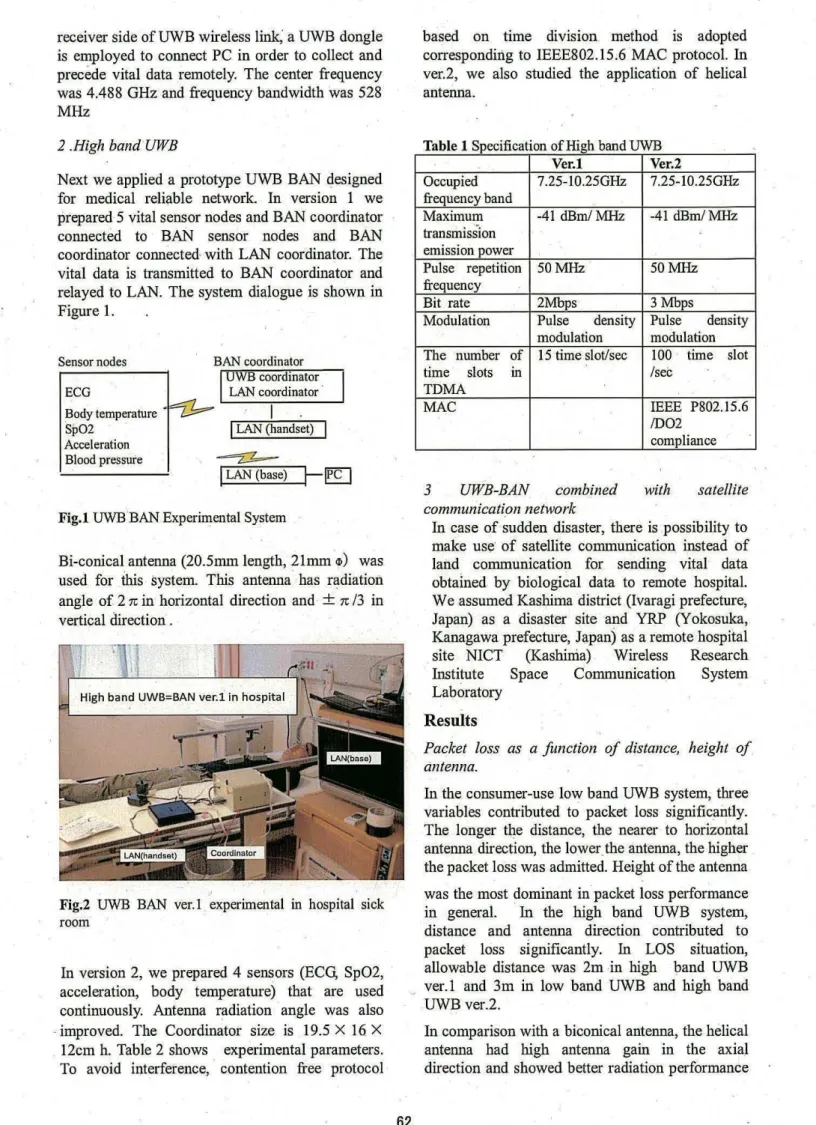
Next we applied a prototype UWB BAN qesigned for medical reliable network. In version 1 we prepared 5 vital sensor nodes and BAN coordinator connected to BAN sensor nodes and BAN coordinator connected with LAN coordinator. The vital data is transmitted to BAN coordinator and relayed to LAN. The system dialogue is shown in Figure 1.
Sensor nodes
ECG
Body temperature Sp02 . Acceleration Blood pressure
BAN coordinator UWB coordinator
LAN coordinator ·
I
.
I
LAN (handset)I
-=z:l=-1 LAN (base) イセ@
Fig.l UWB'BAN Experimental System
Bi-conical antenna (20.5mm length, 21mm ᄋセI@ was used for this system. This antenna· has radiation angle of 2 n in horizontal direction and·
±
n 13 in vertical direction .)
Fig.2 UWB BAN ver.l experimental in hospital sick room
In version 2, we prepared 4 sensors (ECG, Sp02, acceleration, body temperature) that are used continuously. Antenna radiation angle was also ·· improved. The Coordinator size is 19.5 X 16 X
12cm h. Table 2 shows experimental parameters. To avoid interference, contention free protocol
based on time division method is adopted corresponding to IEEE802.15.6 MAC protocol. In ver.2, we also studied the application of helical antenna.
Table 1 Specification ofHigh band UWB Vcr.l Vcr.2
Occupied 7.25-l0.25GHz 7.25-10.25GHz frequency band
Maximum -41 dBm/MHz -41 dBm/MHz transmission
emission power
Pulse repetition 50MHz 50MHz frequency
Bit rate 2Mbps 3Mbps
Modulation Pulse density Pulse density modulation modulation The number of 15 time slot/sec 100 time slot time slots in /sec
TDMA
MAC IEEE P802.15.6
/D02 compliance
3 UWB-BAN combined with satellite
communication network
In case of sudden disaster, there is possibility to make use of satellite communication instead of land communication for sending vital· data obtained by biological data to remote hospital. We assumed Kashima district (Ivaragi prefecture, Japan) as a disaster site and YRP (Yokosuka, Kanagawa prefecture, Japan) as a remote hospital site NICT (Kashima) Wireless Research Institute Space Communicatiqn System Laboratory
-Results
Packet loss as a function of distance, height of antenna.
In the consumer-use low band UWB system, three variables contributed to packet loss significantly. The longer the distance, the nearer to horizontal antenna direction, the lower. the antenna, the higher the packet loss was admitted. Height of the antenna
was the most dominant in packet loss performance in general. · In the high band UWB system, distance and antenna direction contributed to packet loss significantly. In LOS situation, allowable distance was 2m in high band UWB セ@ ver.l and 3m in low band UWB and high band
UWB ver.2.
62
and less dependence on the angle direction of the sensor node.
Interference of UWB system
· When the low band UWB cqnsumer-use system is located near another same type of low band UWB system, communication was shut down because of mutua[ interference, but no interference between high band UWB BAN system and wireless LAN (frequency band 2.4GHz) because of no overlaid band. ·In high band UWB BAN system, there was no interferenc;e near the same type of UWB BAN system because of wider range of bandwidth and TDMA type of contention free protocol iri MAC layer.
Experiments results in the hospital sick room and home bed room
In both system, packet loss less than 1% was observed in LOS situation during ten minute. In case of lying face up on a ,bed, it was no problen1: by setting coordinator on high position such
as
ceiling but .packet loss occurred when the patient changed the position of figure and covered the sensor node. We confirmed that setting a coordinator near the ceiling and another coordinator under the bed and applying a helical antenna to coordinator was one of the best . .measures to shadowing problem· on the bed [3].
UWB-BAN combined with satellite communication network
UWB-BAN ver.l had no problem in the delay test. We employed four vital sensor nodes (Cardiograph, Sp02, Acceleration and Temperature). The distance between coordinator and the set;lSor nodes was 50cm-70cm. Data was transmitted to UWB-BAN- LAN coordinator. The received data was transferred to net frame data and connected to IDU (in door unit) LAN of WINDS. UWB-
VAN
vital data was also sent with· CT slice image of DICOM server. Round trip time from KASHIMA to.YRP (Yokosuka) was 610msec with . processing delay that is allowable for vital data.Discussion
Radio キ。セ・@ of UWB, especially high band UWB has higher frequency and セィッイエ・イ@ wave lengths than conventional bed side monitor. As the results, it cannot easily pass through a human body. So it is essential to have measures to shadowing.
.
. .We found the radio wave of UWB passed through bed, although it is NLOS situation. The reason communication link could be established from one side of bed to the floor under the bed is assumed to be that radio waves were propagated through the
63
bed mattresses and the many holes for ventilation in the metal plate.
One of the reason that the helical antenna showed better radiation performance when- applied to coordinator is estimated that the helical antenna is directional antenna , while the biconical antenna is omnidirectional, and has a possibility to mitigate the effects ofmultipath propagation in a bed room.
Conclusions
High band prototype UWB-BAN system with TDMA pr_otocol worked well to prevent interference. Packet loss dependent on shadowing due to human body was a major problem in this system. We confirmed by experiments that setting a coordinator near the ceiling and another coordinator under the bed is one of the best measures to prevent the shadowing problem. Helical antenna used in the coordinator ィ・ャーセ、@ less dependence on the angle direction than did biconical antenna.
We examined the combi.ned our designed high band prototype UWB-BAN with. WINDS satellite communication link to perform both real time transmis.sion of both UWB-BAN vital data and DICOM CT slice image.
References
[I] http:/ /ieee802. org/15/pu b/TG6.html [2]IEEE11073-00101-2008 health
informatics,"Guidelines· for the use of Wireless technology,"2008.
[3] Proceeding of2013 7th Intemati.onal sセーッウゥオュ@ on Medical infqrmation and Communication
Technology (ISMICT).
Acknowledgements
The part of this work was supported by Yokohama-National Uniyersity GCOE program. We ·also express our deepest gratitude to Japan GIT Members for useful suggestion and NIGT(KASHIMA) members for the cooperation For the. satellite communication test with UWB-BAN.
Author's Address
Kotara Yamasue
Yokohama City University Graduate School of Medicine
Yokohama National University Medical ICT Center
[email protected] http://www.yokohama-cu.ac.jp/med/
http://www.mict.ynu.ac.jp/