取平年年取 取
Annual Report of Pro Natura Fund Vol.18 2009
Structure, dynamics and conservation strategies of the remnant evergreen
broad-leaved forests in Chongqing metropolis, China
Yongchuan Yang
1The remnant natural evergreen broad-leaved forests EBLFs on Mt. Gele GL , Mt. Tieshanping TSP and Mt. Jinyun JY at differnt sites from inner city to outskirts, in Chongqing metropolis, Southwest China were studied with reference to species composition, biodiversity, population structure and dynamics, and the effectts on the restoration of artificial pine forests. The remnant EBLFs at the three sites displayed a gradient of disturbance of the community structure; JY being least disturbed and GL most disturbed. The 2 endpoints of the disturbance gradient showed higher biodiversity, with richer heliophytes, including invasive horticultural species, in the inner city, and shade-tolerant species in the distant outskirts. The growth in height of the canopy species was restricted along an inverse gradient from outskirts to inner city. Differences in life history strategies were also exhibited, including stump sprouting of Castanopsis carlesii var. spinusa, the signature tree of remnant EBLFs.
Seeds from the remnant EBLF naturally facilitate the restoration process of artificial Pinus massoniana forests near it on TSP. The biodiversity index and similarity of species composition decreased between the artificial Pinus massoniana forests and the remnant EBLF as the distance increased. Castanopsis carlesii var. spinusa was the dominant species in the ground vegetation, shrub layer and sub-tree layer of the Pinus massoniana forests near the remnant EBLF. However, the natural restoration processes of those farther away from the remnant EBLF were restricted for the absence of seed source of the inherent components of the EBLF.
Urbanization is a global phenomenon. Cities are growing in number, size, and population throughout the world, particularly in developing countries United Nations 2004, McKinney 2006 . Climate, soils, hydrology, disturbance regime, and land management practices are all strongly affected by urbanization. In turn, changes in these environmental factors profoundly affect urban biodiversity Sukopp 2004 . Urbanization is a huge challenge to the conservation of biodiversity and has therefore become a hot topic of concern McKinney 2002, Chocholou-kova and Py-ek 2003, Sukopp, 2004, McKinney 2006 .
Patches of remnant natural vegetation in urban areas are significant components of biodiversity and provide habitats for both vertebrate and invertebrate animals. In addition to these biological values, urban patches of native vegetation hold social values. They provide educational resources for the display of natural communities that previously covered the landscape Willison 1996 , and in this way they represent an historical phase in the development of urban land uses Maurer et al. 2000, Stenhouse 2004 . Natural patches of vegetation also provide opportunities for monitoring environmental changes, and act as nuclei from which native plants and animals can recolonize urban environments
Stenhouse 2004, Murakami et al. 2005, Yang et al. 2007 .
1 Key Lab of Three Gorges Reservoir Region s Eco-Environment Ministry of Education / Faculty of Urban Construction and Environmental Engineering Chongqing University Chongqing 400045, China
取平年ィ取 取
Hydro-electric development on the Changjiang Yangtze River at the Three Gorges’ Project led to the creation of the Municipality of Chongqing in 1997. The Municipality of Chongqing is predominantly rural, having a total area of 82,400km2. Within this municipality there are many towns and cities, of which the largest is Chongqing metropolis also called urban area of Chongqing . In 2008 the metropolitan area covered 5,473km2. As a result of central planning associated with the Three Gorges’ Project, Chongqing metropolis has experienced intense urban development since 1997. The built-up area of the city was 300km2 in 1996, but had grown to more than 700km2 by 2006, and it will reach more than 2,500km2 by 2020 according to the urban planning Yang et al. 2007 .
Chongqing metropolis is often described as “the mountain city”. It lies across 4 parallel mountain folds and includes many small hills. These upland areas provide habitats for forest vegetation. Locally-specific types of evergreen broad-leaved forests EBLFs are the characteristic climax vegetation, but these natural forests have been damaged severely by urban expansion, and only a few patches remain around the tops of the mountains. EBLFs are landscape and vegetation types that are special to East Asia, and those of sub-tropical China are particularly notable. Located in the center of sub-tropical China, Chongqing metropolis and its surrounding areas lie at the core of the regions in which EBLFs are distributed. Of further significance, the EBLFs in Chongqing metropolis are a unique formation in the classification system of the EBLFs of China. The dominant signature species, Castanopsis carlesii var. spinusa is found only in a narrow range Zhen 1985, Song 2004 . To preserve those patches and make use of them for the restoration of the surrounding artificially pure forests and the secondary forests, especially the pine forests affected by pine wilt disease, it’s exigent to record their current status, predict their dynamics and work out special conservation strategies to preserve them from the pressure from the rapid urbanization. Otherwise, they are excellent subjects for research on the ecological effects of urbanization because the mountains have experienced different urbanization impacts and thereby provide indicators of an urban-rural gradient. So, the research presented in this report focuses on the remnant EBLFs on Mt. Gele, Mt. Tieshanping and Mt. Jinyun along an urbanization gradient from the inner city to outskirt and mainly aims at community characteristics, dynamic processes, impacts of urbanization and the seed source effects.
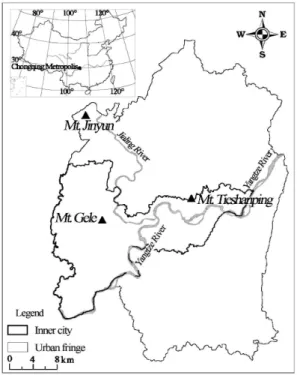
Remnant patches of natural EBLFs in Chongqing metropolis remain only on Mt. Gele GL, N29°34’, E106°25’ , Mt. Tieshanping TSP, N29°37’, E106°41’ and Mt. Jinyun JY, N29°50’, E106°22’ Fig1 . These three mountains are parts of the four unusual mountain folds that are characteristic of the physical geography of Chongqing. Temperatures and precipitation on these mountains are suitable for the development of EBLFs. Heights of the mountains are listed in Table1 along with summary climate data from the nearest meteorological stations Table1 . Climate data for the mountain tops themselves are not available.
GL is a national forest park in the inner city that is widely used for recreation such as hiking and strolling. It is only 3km away from Shapingba, the second largest business district of the metropolis. The natural vegetation of GL has been damaged significantly by three intense sets of disturbances that have taken place since the 1930’s: construction of the chief officers’ villa during the Provisional Capital period from 1937 to 1946; selective cutting of big trees in the 1950s during a period of primary industrial development, and construction and use of a sports establishment from 2002 to the present. Consequently, there are only 5 small remnant patches of EBLFs scattered near the peak, each with an area of about 400m2.
TSP is a national forest park located at the boundary between the inner city and the urban fringe, lying 27km from the urban core of the metropolis. There is only 1 remnant patch of EBLF at TSP, having an area of about 3,000m2 on the flat crest of the mountain. The patch may have been preserved for geomantic reasons i.e. for spiritual reasons related to
取平年イ取 取
Fig1取 The location of the study sites
geography that are of special significance in China; usually transliterated as ‘fengshui’ in view of the presence of a grand tomb within it. Up until 20 years ago the residents of nearby villages cut only small trees or the branches of big trees for use as fuel. Since then, cutting has diminished due to improved economic conditions. Farmland tourism has been flourishing since the late 1990’s and many visitors from the inner city come to spend their weekends at the farmland hotels near the remnant EBLF patch.
JY, located at the boundary between urban fringe and rural area, is a national nature reserve created in 2001 to protect the extensive subtropical forests on its slopes and peak. It is the highest of the 3 mountains and is 60km from the urban core of Chongqing metropolis. About 200 years ago a severe fire burned almost all the forest at JY. This severe disturbance took place when local wealthy people constructed fortresses
to try to evade the persecutions of followers of the Bailian Religion. In the 1950’s many EBLFs on the mountain were converted to plantations of Phyllostachys heterocycla and Cunninghamia lanceolata for economic reasons. The remnant EBLFs remain on the upper slopes of the mountain and in steep valleys that are difficult to reach.
On GL, the remnant patches of natural EBLFs are surrounded by artificial Pinus mossoniana forests and constructions, and on TSP, those patches are surrounded by artificial Pinus mossoniana forests, Phyllostachys heterocycla forests and roads for tourism, while on JY, they are surrounded by artificial Phyllostachys heterocycla forests and Cunninghamia lanceolata forests .
Table1取 Environmental characteristics of the study sites, GL, TSP and JY
*The climate data for each site are from the nearest meteorological stations: Shapingba, Yubei and Beibei, respectively. GL: Mt. Gele; TSP: Mt.Tieshanping; JY: Mt. Jinyun.
取平年ゥ取 取 取
Field surveys were carried out in 2007 and 2008. For the remnant EBLFs, 5 plots, each of 400m2 were set up and were divided into 4 meshes of 100m2 10m×10m for each site. To study the effects of the remnant EBLFs on the restoration of the surrounding pine forests, another 9 plots were set up surrounding the remnant EBLF on TSP with each three plots as a group and the intervals were 50m, 250m and 500m, and the size of each plot at different interval was 20m×20m 50m, divided into 4 meshes of 10m×10m , 10m×10m 250m and 10m×10m 500m for the difference of structure of the forests. An inventory was carried out for all individual trees taller than 1.5m woody vegetation . The species name, its vital status
living or dead , diameter at breast height DBH in cm, including all the stump sprouts , and tree height H, in m were recorded. Meanwhile, the maximal natural height cm and the ground cover % for each vascular plant species less than 1.5m in height ground vegetation were measured.
取
All species were categorized into 8 life-forms based on the life-form system of Vegetation in China Wu 1980 , namely: evergreen conifers, evergreen broad-leaved trees, evergreen broad-leaved subtrees and shrubs, deciduous broad-leaved trees, deciduous broad-leaved subtrees and shrubs, lianas, perennial herbs, and annual herbs. Additionally, 2 groups: unique species and common species were distinguished for remnant EBLFs according to their distribution. Species recorded at just 1 site were defined as unique species and those at more than 1 site were defined as common species.
The presence-absence data for woody vegetation and ground vegetation of each plot were combined and classified by two-way analysis using TWINSPAN Hill 1979 .
The relative dominance of the species of woody vegetation was expressed as the relative basal area RBA, % obtained by calculating the relative proportion of each woody species’ basal area BA from DBH data of all the individual trees of each species. The relative dominance of ground vegetation was estimated by measuring the relative volume equivalent-value RVEV, % , which is the relative proportion of the volume equivalent-value of each species obtained by multiplying the maximal plant height and coverage % in each plot. Dominant species were identified by dominance analysis Ohsawa 1984 . The diversity indices were calculated using Shannon-Wiener index H’ , Evenness index J’
Pielou 1969 and Gleason index Ma, et al. 1995 for each plot.
For the scaling of tree dimensions, the expanded allometry equation was used to describe the relationship between DBH and tree height and to obtain an estimate of the potential tree height Ogawa 1969 . The equation was applied both to all the individuals as a whole in each plot and to the characteristic species, Castanopsis carlesii var. spinusa, at each site for EBLFs.
取
In the 15 plots on the three sites, a total of 141 vascular plant species from 64 families were recorded. In order of the number of species per family, they were mainly Theaceae 12spp. and Lauraceae 8spp. , followed by Symplocaceae, Myrsinaceae, Gramineae, Liliaceae, Rosaceae, Fagaceae, Aquifoliaceae, and others represented by fewer species. Theaceae, Lauraceae and Myrsinaceae were among the most numerous families at all three sites Table2 .
The total number of species was 93, 58 and 76 for GL, TSP and JY, respectively. However, the numbers of unique species were 39, 16, and 25 for the three sites, and the corresponding numbers of common species were 54, 32, and 51.
取平年ウ取 取
Table2取 Constituent species of those plant families that contain more than 4 species in the remnant evergreen broad-leaved forests, as a whole and by site
Numbers indicate the number of plant species and their rank as a whole and at each site. GL: Mt. Gele; TSP: Mt.Tieshanping; JY: Mt. Jinyun.
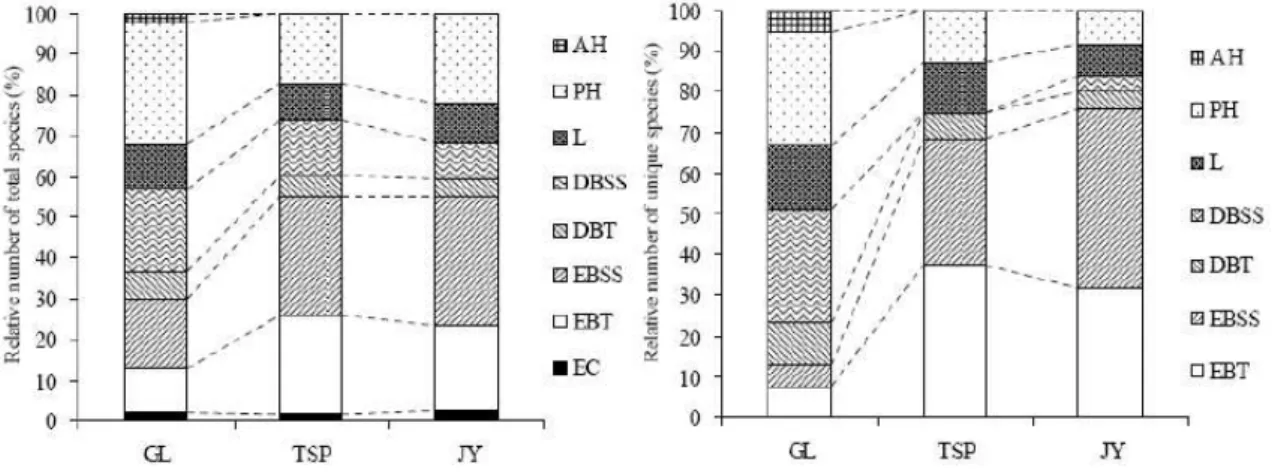
The life-form composition of the species at the three sites is shown in Fig2. The number of species of evergreen trees EBT and EBSS, see Fig2 on GL was the smallest among the three sites. By contrast, the number of deciduous tree species DBT and DBSS, see Fig2 decreased from GL to JY, the trend of DBSS being more obvious. The number of PH on GL was the largest among the three sites and AH only appeared on GL. Most unique species of GL were deciduous trees and herbs PH and AH , while the unique species of TSP and JY were evergreen trees EBT and EBSS . Nine out of 39 unique species on GL were escaped horticultural ornamentals; by contrast, none of the unique species on TSP and JY were escapes.
TWINSPAN classification clearly distinguished three community types A, B, and C at the division level 2 Fig3 , coinciding with the three sites, GL, TSP and JY. JY was the most different of the three sites, while GL and TSP were closer in species composition. The similarity of species composition decreased, from GL to JY.
In the 15 plots at the three sites, a total of 10 species dominated the woody vegetation and 39 species dominated ground vegetation at least once. The number of dominant species of ground vegetation was always larger than that of woody vegetation at the same site. Among the three sites, the number of dominant species of woody vegetation at JY was significantly higher than at the other two sites P < 0.05 . The numbers of species of ground vegetation displayed an increasing trend from GL to JY, although the trend was not statistically significant according to Tukey’s Post Hoc HSD test
Fig4 .
At the site level, 5 species dominated the woody vegetation and 19 species dominated the ground vegetation in at least 1 site Table3 . The number of dominant species of woody vegetation of GL, TSP and JY were 3, 1 and 3, respectively. Castanopsis carlesii var. spinusa was the sole species that dominated at all three sites, while the other dominants were different: Pinus massoniana and Cinnamomum camphora at GL, Machilus pingii and Castanopsis fargesii at JY. Compared with the woody layer, the numbers of dominant species of ground vegetation of GL, TSP and JY were far larger, being 7, 9 and 9, respectively. TSP and JY were dominated by quite similar life-forms, but notably, dwarf bamboo, Pseudosasa victorialis and planted non-indigenous species, Schima superba dominated at TSP, while GL revealed a lack of evergreen broad-leaved trees and lianas.
取平年ェ取 取 Fig2取 Life-form composition of the species at the three sites
GL: Mt. Gele; TSP: Mt.Tieshanping; JY: Mt. Jinyun. EC: Evergreen conifers; EBT: Evergreen broad-leaved trees; EBSS: Evergreen broad-leaved subtrees and shrubs; DBT: Deciduous broad-leaved trees; DBSS: Deciduous broad-leaved subtrees and shrubs; L: Lianas; PH: Perennial herbs; AH: Annual herbs.
Fig3取 TWINSPAN classification of community types for the 15 plots
GL: Mt. Gele; TSP: Mt.Tieshanping; JY: Mt. Jinyun.
Fig4取 Numbers of dominant species in the plots at the three sites
Means ± SE n = 5 that have the same letter are not significantly different using Tukey’s Post Hoc HSD tests P < 0.05 .GL: Mt. Gele; TSP: Mt.Tieshanping; JY: Mt. Jinyun.
取 取 取 取 取 取 取 取 取 取 取 取 取 取 取 取 取 取 取 取 取 取 取 取 取 取 取 取 取 取 取 取 取 取 取 取 取
取平年エ取 取 Table3取 Frequency of species that dominated in at least 1 site
The numbers indicate the numbers of plots in which each species was dominant and the numbers of plots in which each species occurred i.e. frequency of dominance/frequency of occurrence . ※ planted species.
* dominated in the site. GL: Mt. Gele; TSP: Mt.Tieshanping; JY: Mt. Jinyun. 取
取 取 取 取 取 取
取平ィ0取 取 Fig5取 Biodiversity index of the three sites
Means ± SE n = 5 that have the same letter are not significantly different using Tukey’s Post Hoc HSD tests P < 0.05 . GL: Mt. Gele; TSP: Mt.Tieshanping; JY: Mt. Jinyun.
Fig6取 Dominance-diversity curves for each site
a. Woody vegetation; b. Ground vegetation. GL: Mt. Gele; TSP: Mt.Tieshanping; JY: Mt. Jinyun.
( )
For woody vegetation, TSP had the lowest species richness, Shannon Weiner’s index and Pielou’s index among the three sites. Species richness and Shannon Wiener’s index of TSP were significantly lower than those of GL and JY P < 0.5 . Between GL and JY, the former had the higher species richness, but its Shannon Weiner’s index and Pielou’s index were significantly lower than those of the latter. For ground vegetation, the species richness of TSP was significantly lower than those of the other 2 sites P < 0.5 , while Shannon Weiner’s and Pielou’s indices were almost the same among the three sites Fig5 .
The dominance-diversity curves for all the plots at the three sites clearly indicated some differences in the allotments of relative dominance among the various species Fig6 . For woody vegetation, the TSP plots exhibited steep geometric curves because there are relatively few species, and most have a relatively low level of dominance. However, the other 2 sites GL and JY have dominance-diversity curves that approach the typical log-normal type. JY had somewhat more species with a larger relative dominance, and so the curves decay with respect to dominance less quickly initially than those of GL and TSP. For ground vegetation, all the dominance-diversity curves tended towards log-normal form and showed fairly similar allotments of relative dominance.
取平ィ干取 取 Fig7取 Stand characteristics for each site
Means ± SE n = 5 that have the same letter are not significantly different using Tukey’s Post Hoc HSD tests P < 0.05 . GL: Mt. Gele; TSP: Mt.Tieshanping; JY: Mt. Jinyun.
As seen in Fig7, the stem density of GL was found to be significantly larger than those of the other 2 sites P < 0.5 , with the differences in sprouting stems contributing much to the differences among the three sites. Estimates of basal areas BA revealed no significant differences among the three sites, although JY appeared to have the largest trees as shown by significantly greater maximum DBH. With respect to stratum structures, the maximal height and potential height increased significantly P < 0.5 from GL to TSP and JY.
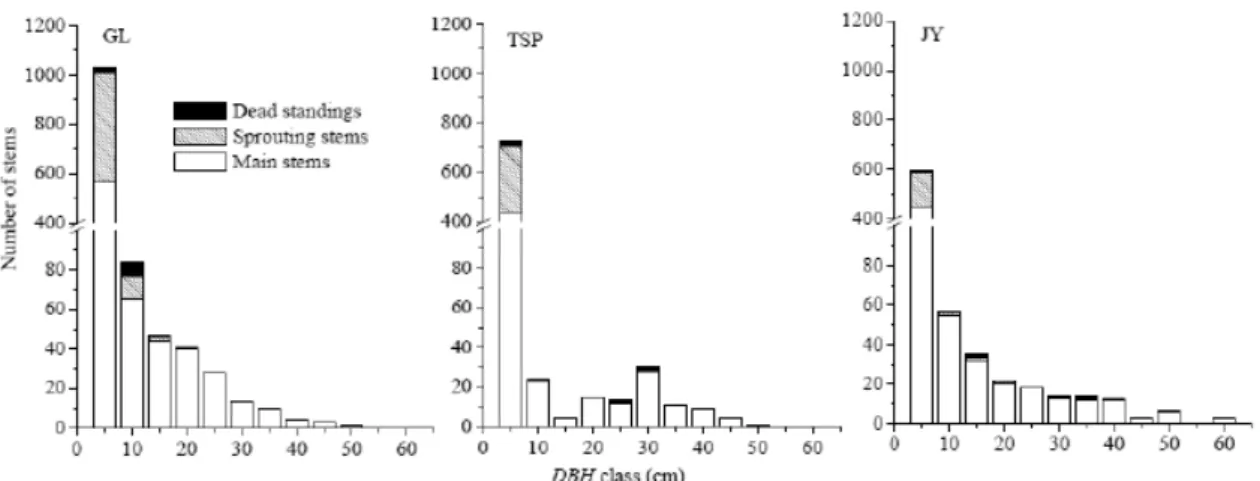
The DBH size-class distribution pattern of all stems at TSP was quite different from that at the other 2 sites Fig8 . As the size class increased, the number of stems decreased gradually in GL and JY, while stems from 5 to 20cm were relatively rare in TSP. Similarly, TSP was abnormal in having an excess of 30cm stems relative to their neighboring size classes. In addition, the three sites showed obvious differences in the number of saplings DBH < 5cm , with the largest number at GL and the smallest at JY. Sproutings were concentrated in small size classes at the three sites, the number decreasing from GL to TSP and JY. Larger trees, with DBH>35cm, were more prevalent at JY and the only trees with DBH in the 60cm size class were found there.
As the most dominant species and main component of the canopy at the three sites, Castanopsis carlesii var. spinusa controlled the structure of the communities. As seen in Fig9, the height of individuals having the same DBH increased from GL to TSP and JY, most notably with respect to larger individuals. On GL, growth in height relative to DBH appears to have been suppressed in trees with larger DBH. The trees at JY showed less scatter with respect to height in relation to DBH, suggesting that the environment is more uniform and less stressful than at the other two sites.
取平ィ平取 取
Fig8取 DBH class frequency distribution of the whole stems at the three sites GL: Mt. Gele; TSP: Mt.Tieshanping; JY: Mt. Jinyun.
Fig9取 Scaling of tree height and DBH for the dominant species, Castanopsis carlesii var. spinusa at the three sites The curves were drawn by using the expanded allometric equation of Ogawa 1969 . GL: Mt. Gele; TSP: Mt.Tieshanping; JY: Mt. Jinyun.
Among the dominant species of evergreen broad-leaved trees, Castanopsis carlesii var. spinusa, Cinnamormum camphora, Machilus pingii, Elaeocarpus sylvestris and C. fargesii all showed inverse-J shaped or sporadic distribution with large numbers of small stems as indicated by DBH Fig10 , displaying regeneration by means of seedlings and sproutings. Although the modes of the DBH of the conifer Pinus massoniana at GL and TSP were unimodal, however, there was evidence of regeneration in the form of small stems at GL, suggesting changes of forest environment not so long ago. Sprouting stems of Castanopsis carlesii var. spinusa decreased in number and proportion from GL to TSP and JY Fig10 .
取平ィ年取 取
Fig10取 DBH class distribution for the main dominant species of each site: GL; TSP; JY
*Indicates non-dominant species, but those had RBA of about 10% at TSP. GL: Mt. Gele; TSP: Mt.Tieshanping; JY: Mt. Jinyun.
取 取 取 取
取平ィィ取 取
Fig11取 TWINSPAN classification of community types for the 9 plots of Pinus massoniana forests and 5 plots of remnant evergreen broad-leaved forest on Mt.Tieshanping
Table4取 Jaccard’s coefficients of similarity among the groups of plots of Pinus massoniana forests and remnant evergreen broad-leaved forests on TSP
TWINSPAN classification clearly distinguished four community types A, B, C and D at the division level 2, coinciding with the distance to the remnant EBLF Fig11 . The remnant EBLF and Pinus massoniana forests closest to it were closer in species composition, while the latter farther away were similar. The similarity of species composition decreased as the distance increased Table4 .
For woody vegetation and ground vegetation, species richness Gleason index , Shannon Weiner’s index and Pielou’s index, almost all showed the trend increasing from the farthest group to the closest to the remnant EBLF. All indices weren’t significantly different between the remnant EBLF and its nearest Pinus massoniana forests. By contrast, all indices for the woody vegetation showed significant difference between the Pinus massoniana forests farthest and closest to the remnant EBLF.
At the group level, only 1 species, Pinus massoniana, dominated the woody vegetation and 17 species dominated the ground vegetation in at least 1 group of Pinus massoniana forests Table5 . The remnant EBLF and its nearest Pinus massoniana forests shared some dominant species for ground vegetation, notably Castanopsis carlesii var. spinusa was one of the main dominate species of the latter. However, 2 groups farther away dominated by quite similar life-forms and species, especially perennial herbs, such as Miscanthus sinensis, Pteridium aquilinum, Dicranopteris pedata etc.
The height frequency distribution pattern of all trees of the group of Pinus massoniana forests closest to the remnant EBLF was quite different from those farther away Fig13 . Castanopsis carlesii var. spinusa and other evergreen trees were the main components of the stratum under the canopy layer and Castanopsis carlesii var. spinusa formed the sub-tree layer for the group closest to the remnant EBLF, while deciduous trees were the main components of the other 2 groups. As the distance to the remnant EBLF increased, the number of evergreen trees decreased, on the contrary, that of deciduous trees increased.
取平ィイ取 取
Fig12取 Biodiversity index of the groups of plots of Pinus massoniana forests and remnant evergreen broad-leaved forest
Means ± SE that have the same letter are not significantly different using Tukey’s Post Hoc HSD tests P < 0.05 . S4, S3, S2 and S1 indicate the groups of plots of remnant evergreen broad-leaved forest and Pinus massoniana forests at the interval of 50m, 250m and 500m to it, respectively.
Fig13取 Height frequency distribution of trees taller than 1.5m of the groups of plots of Pinus massoniana forests and remnant evergreen broad-leaved forest
S4, S3, S2 and S1 indicate the groups of plots of remnant evergreen broad-leaved forest and Pinus massoniana forests at the interval of 50m, 250m and 500m to it.
取平ィゥ取 取
Table5取 Frequency of species that dominated at least once for Pinus massoniana forests and remnant evergreen broad-leaved forest at group level
The numbers indicate the numbers of plots in which each species was dominant and the numbers of plots in which each species occurred i.e. frequency of dominant/frequency of occurrence . Encircled number indicates the sequence of the dominate species for each group of plots. ※ planted species.
取平ィウ取 取
取
Different intensities of disturbance and processes of fragmentation have led to differences in species composition and diversity of the remnant EBLFs patches at the three sites examined. Nevertheless, these plant communities have retained the essential floristic composition that is characteristic of the EBLFs of mid-subtropical China, having trees of Theaceae, Lauraceae, Symplocaceae and other characteristic families as their main components Song 2004, Yang et al. 2007 . The species composition of JY most closely resembled that of an unmodified primary EBLF, while the species composition of GL was least similar. This is probably because fragmentation of the remnant patches at GL has led to local extinctions as well as colonization by invading species, such as horticultural ornamentals, leading to a higher occurrence of unique species Grashof-Bokdam 1997, Kitazawa and Ohsawa 2002 . As shown in Fig2, most of the unique species of JY and TSP are evergreen trees, while those of GL are deciduous trees and herbs, suggesting a trend of decreasing richness of shade-tolerant species and increasing richness of heliophytes. As forest fragmentation has progressively increased, it appears that the area of the patches has gradually decreased, interior forest environments have been lost, and the smallest patches have become wholly forest edges Murcia 1995 . We conclude therefore that the series JY, TSP, GL represents 3 steps in a gradient of forest disturbance which probably results from the effects of urbanization.
Forest edges are dynamic environments. These boundaries play significant ecological roles as transition zones between different habitats Murcia 1995, Fry and Sarlov-Herlin 1997, Fujihara et al. 2005 and are easily invaded by light-demanding species such as deciduous trees and annual herbs Fujihara et al. 2002, McKinney 2006 . In addition to boundary effects themselves, the biodiversity of fragmented forests are also affected by the characters of the surrounding ecosystems. Urban habitats are a mosaic of land uses with varying extents of disturbance in time and space, leading to diversity of habitats and biotic communities Sukopp 2004, McKinney 2006 . Such habitats are seed sources for those deciduous trees and ruderals that rely on disturbance to sustain their populations Luken 1997 . Many studies have found that the number or proportion of escapes from cultivation tends to increase along the rural-urban gradient McKinney 2002, Sukopp 2004 , as was found for GL in this study.
Among the three sites, GL and JY are the extremity of disturbances with TSP in the intermediate. But the plant diversity are umbilicate and that doesn’t support the intermediate disturbance hypothesis that suggests the number of species in relation to impacts has been hypothesized to be highest at intermediate levels of disturbance and lowest under conditions of both high and low disturbances Connell 1979 . GL have many heliophytes while JY support more inherent components of zonal vegetation. On the contrary, inherent components of zonal vegetation and heliophytes are both less on TSP. In fact, the intermediate disturbance hypothesis maybe is less valid in the urban area. In other words, only the natives support the general theory Sukopp 2004 . So, dividing the species reveals 2 contrary trends: the highest numbers of inherent components of zonal vegetation are found in lowly influenced vegetation and maximal species diversity in heliophytes, however, exists in vegetation obviously more strongly by human influences.
取
取
Regarding the structural characteristics of the stands stem density, BA, maximal DBH and height , only height varied remarkably Fig7 . The decreasing height from JY to GL indicates that the growth of trees is progressively restricted from the urban outskirts to the inner city. The same restriction holds for the characteristic species Castanopsis carlesii var. spinusa Fig9 . Among the possible causes for this pattern is the local climate and atmospheric quality. As shown in Table 1, there were 57.2, 40 and 16.4 foggy days near GL, TSP and JY, respectively. For the year 2005, the Chongqing Center of
取平ィェ取 取
Environmental Monitoring and the Chongqing Bureau of Environmental Protection reported similar gradients of air pollution SO2 was 0.084, 0.049, and 0.047mg/m3; NO2 was 0.047, 0.031and 0.030mg/m3 near GL, TSP and JY respectively . It has been reported in many studies that acid rain has caused decline of forests in Europe, North America and South China Tomlinson 1983, Feng 2000, Zhao et al. 2002 . Acid rain and acid fog, particularly the latter, directly affect the forest canopy, causing canopy die-back and loss of height Hileman 1983, Bredemeier 1988, Zhao et al. 2002 . The data for height in relation to DBH for Castanopsis carlesii var. spinusa indicates that this signature species is also affected Fig9 . Forest fragmentation also opens the forest to wind disturbance, thereby adding to the damage Laurance et al. 2002 . Further investigations and experiments are therefore required in order for the loss of tree height and its potential impacts on seeds production to be fully understood and suitable forest management measures put in place.
Sprouting is a common response among broad-leaved trees to disturbance, and disturbance frequency and severity are important determinants of the relative frequency of sprouting at a community level Bellingham et al. 1994, Bond and Midgley 2001 . As shown in Fig7, GL had the largest number of sproutings and appears to be the most disturbed of the three sites. Sprouting is an important survival strategy Bellingham 2000 and is common for most Castanopsis species Miura and Yamamoto 2003, Nanami et al. 2004, Yang et al. 2007 . This is specially true for Castanopsis carlesii var. spinusa, as shown by the many previous big trees of this species on GL which have lost their canopies and have responded by sprouting from their stumps Fig9 and Fig10 . Once the main stem dies, the tree can survive for a while by means of this sprouting behavior and the population can be maintained.
取
As a typical subtropical mountainous region, the location of Chongqing metropolis would have been covered by EBLFs before human settlement began, but most of the natural forests have now been converted to other semi-natural or artificial landscape types Yang et al. 2007 . The remnant EBLFs are therefore rare indicators and representatives of this regional natural feature, being relicts of historical and botanical heritage Maurer et al. 2000 . Stenhouse 2004 concluded that remnant patches of natural vegetation are important both for preserving the vegetation communities that once existed in the area and also for their value to city residents as areas of natural beauty and recreation. Urban people should experience not only man-made parks but also value and appreciate natural areas that are characteristic of their own region Willison 1996, Maurer et al. 2000, McKinney 2006 .
Larger patches of remnant natural vegetation play important roles in the maintenance of regional biodiversity. They are the core areas of biodiversity in the urban environment and many of the species in the remnant communities are plants that adapt poorly to urban conditions Oshawa and Da 1987, Yang et al. 2007 . Functionally, the populations of these species in remnant communities are seed sources for restoration of degraded vegetation at the local scale. There are 3 means by which this can occur. Seeds from the remnant EBLFs can naturally facilitate the restoration process of degraded vegetation near them Ito et al. 2003, Yang et al. 2007 . As the research we conducted on TSP, the biodiversity index and similarity of species composition decreased between the artificial Pinus massoniana forests and the remnant EBLF as the distance increased Fig11, Fig12, and Table4 . The climax species, Castanopsis carlesii var. spinusa, was the dominant species for the ground vegetation, shrub layer and sub-tree layer of the Pinus massoniana forests close to the remnant EBLF. However, the natural restoration processes of those farther away from the remnant EBLF were restricted for the absence of seed source of the inherent components of the EBLF Fig13 and Table5 , for most of the evergreen trees have lower dispersal capacity and they depend on dispersal by animals with small home ranges and use corridors, or on wind-dispersal of seeds with lower dispersal distances Yang et al. 2005 , and that suggest it’s hard to restore evergreen broad-leaved forests
取平ィエ取 取
themselves spontaneously once they are destroyed. Secondarily, seeds of the remnant EBLFs can be collected for artificial restoration. For artificial restoration of semi-natural plant communities, it is preferable to obtain seeds from local sources given the higher probability that these will be genetically adapted to local conditions. Finally, the remnant EBLFs are the sound model for the rebuilding of local vegetation following ‘close-to-nature’ or ‘back-to-nature’ approaches Gamborg and Larsen 2003, Miyawaki 2004 . The essential of those approaches is to restore natural vegetation of combined native species in accordance with the potential abilities of the habitat, and to try to restore the whole ecosystem specific to a region Miyawaki 1992 . Accordingly, the structures and systems of indigenous forests are the foundation. Many cases by those approaches have been conducted worldwide, such as in Japan, China, South-east Asia, Europe, Australia, and South America Miyawaki 2004, Da et al. 2004 .
As the crowns of many large trees of Castanopsis carlesii var. spinusa, the signature tree of the remnant EBLFs in Chongqing metropolis, have been damaged on GL Fig9 , sustainable efforts should be taken to improve the environmental qualities in the inner city, especially the atmosphere quality. Also, as the size of the patches is small about 400m2 each , artificial facilities should be prevented away from the patches and the connective among the patches should be improved on GL. For the patch on TSP, it’s better to enclose the patch preventing the disturbance form the tourists’ walking and playing in the forest There are 3 stone tables, some stone chairs and 1 path nearly 1 m wide in the forest and it’s urgent to stop the plantation of the non- indigenous species, Schima superba and control the extension of dwarf bamboo, Pseudosasa victorialis, the most dominant species for the ground vegetation at TSP Table3 and Table5 and Phyllostachys heterocycla. For the patches on JY, the natural conditions should be maintained and the number of tourists should be controlled more than 340,000 in 2005 to the EBLFs .
Bellingham P.J. 2000. Resprouting as a life history strategy in woody plant communities. Oikos, 89; 409-416.
Bellingham, P.J., Tanner E.V.J. and Healey J.R. 1994. Sprouting of trees in Jamaican montane forest, after a hurricane. Journal of Ecology, 81: 747-758.
Bond, W.J. and Midgley J.J. 2001. Ecology of sprouting in woody plants: the persistence niche. Trends in Ecology and Evolution, 16: 45-51.
Bredemeier, B. 1988. Forest canopy transformation of atmospheric deposition. Water Air & Soil Pollution, 40: 120-138.
Chocholou kova, Z. and Py-ek, P. 2003. Changes in composition and structure of urban flora over 120 years: a case study of the city of Plze. Flora, 198: 366-376.
Connell, J.H. 1979. Tropical rain forests and coral reefs as open non-equilibrium systems. In: Anderson, R.M., Turner, B.D. and Taylor, L.R. eds , Population Dynamics. Blackwell, Oxford, pp.141-163.
Da, L.J., Yang, Y.C. and Chen, M. 2004. The method of ecological greening and its application in the construction of the approaching nature plant community in Shanghai. Chinese Landscape Architecture, 3: 38-40.
Feng, Z.W. 2000. Impacts and control strategies of acid deposition on terrestrial ecosystems in China. Engineering Science, 2 9 : 5-11.
Fry, G. and Sarlov-Herlin, L. 1997. The ecological and amenity functions of woodland edges in the agricultural landscape: a basis for design and management. Landscape and Urban Planning, 37: 45-55.
取平イ0取 取
Fujihara, M., Hara K. and Short, K. 2005. Changes in landscape of “yatsu” valleys: a typical Japanese urban fringe landscape. Landscape and Urban Planning, 70: 261-270.
Gamborg, C. and Larsen, J. 2003. ‘Back to nature’- a sustainable future for forestry? Forest Ecology and Management, 179: 559-571.
Grashof-Bokdam, C. 1997. Forest species in an agricultural landscape in the Netherlands: effects of habitat fragmentation. Journal of Vegetation Sciense, 8: 21-28.
Hileman, B. 1983. Acid fog. Environmental Science and Technology, 17 3 : 172-200.
Hill, H.O. 1979. TWINSPAN-A FORTRAN Program for Arranging Multivariate Attributes. Cornell University, New York.
Ito, S., Nakagawa, M., Buckley, G. P., et al. 2003. Species richness in sugi Cryptomeria japonica D. DON plantations in southeastern Kyushu, Japan: the effects of stand type and age on understory trees and shrubs. Journal of Forest Research, 8: 49-57.
Kitazawa, T. and Ohsawa, M. 2002. Patterns of species diversity in rural herbaceous communities under different management regimes, Chiba, central Japan. Biological Conservation, 104: 239-249.
Laurance, W.F., Lovejoy T.E. and Vasconcelos H.L. 2002. Ecosystem decay of Amazonian forest fragments: a 22-Year investigation. Conservation Biology, 16: 605-618.
Luken, J.O. 1997. Conservation in the context of non-indigenous species. In: Schwarz, M.W., eds , Conservation in Highly Fragmented Landscapes. Chapman and Hill, London, pp. 107-116.
Ma, K.P., Huang, J.H., Yu, S.L., et al. 1995. Plant community diversity in Dongling Mountain, Beijing, China. l. species richness, evenness and species diversity. Acta Ecologica Sinica, 15: 268-277.
Maurer, U., Peschel, T. and Schmitz. 2000. The flora of selected urban land-use types in Berlin and Potsdam regard to nature conservation in cities. Landscape and Urban Planning, 46: 209-215.
McKinney, M.L. 2002. Urbanization, biodiversity, and conservation. Bioscience, 52: 883-890.
McKinney, M.L. 2006. Urbanization as a major cause of biotic homogenization. Biological Conservation, 127: 247-260.
Miura, M. and Yamamoto, S.I. 2003. Structure and dynamics of a Castanopsis cuspidata var. siebolsii population in an old-growth, evergreen, broad-leaved forest: The importance of sprout regeneration. Ecological Research, 18: 115-129.
Miyawaki, A. 1992. Restoration of evergreen broad-leaved forests in Pacific region. In: Wali M.K. eds , Ecosystem Rehabilitation vol. 2 . SPB Academic Publishing, The Hague, pp. 233-245.
Miyawaki, A. 2004. Restoration of living environment based on vegetation ecology: theory and practice. Ecological Research, 19: 83-90.
Murakami, K., Maenaka, H. and Morimoto, Y. 2005. Factors influencing species diversity of ferns and fern allies in fragmented forest patches in the Kyoto city area. Landscape and Urban Planning, 70: 221-229.
Murcia, C. 1995. Edge effects in fragmented forests: implications for conservation. Trends in Ecology and Evolution, 10: 58-62.
Nanami, S., Kawaguchi, H., Tateno, R., et al. 2004. Sprouting traits and population structure of co-occurring Castabopsis species in an evergreen broad-leaved forest in southern China. Ecological Research, 19: 341-348.
Ogawa, H. 1969. An attempt at classifying forest types based on the tree height-DBH relationship. In: Kira T. Eds. , Comparative Study of Primary Productivity in Forest Ecosystems. JIBP-PT-F Progress Reports for 1968, pp. 3-17.
Ohsawa, M. 1984. Difference of vegetation zones and species strategies in the subalpine region of Mt. Fuji. Vegetatio,
取平イ干取 取 57: 15-52.
Ohsawa, M. and Da, L. 1987. Urbanization and landscape in a watershed of the Miyako river, Chiba, Japan. In: Obara, H. Ed. , Integrated Studies in Urban Ecosystem as the Basis of Urban Planning II . Kagawa Nutrition College, Japan, pp. 187-197.
Pielou, E. C. 1969. An Introduction to Mathematical Ecology. John Wiley & Sons, New York.
Song Y.C. 2004. Tentative classification scheme of evergreen broad-leaved forests of China. Acta Phytoecologica Sinica, 28: 435-448.
Stenhouse, R. 2004. Fragmentation and internal disturbance of native vegetation reserves in the Perth metropolitan area, Western Australia. Landscape and Urban Planning, 68: 389-401.
Sukopp, H. 2004. Human-caused impact on preserved vegetation. Landscape and Urban Planning, 68: 347-355. Tomlinson G.H. 1983. Air pollution and forest decline. Environmental Science and Technology, 17: 246-256. United Nations. 2004. World Urbanization Prospects. U.N. Department of Economic and Social Affairs, New York. Willison, M. 1996. The urban forest as an educational resource. Forest Forum, Special Issue 10, :51-54, Canadian Forestry Association, Ottawa.
Wu, Z.Y. 1980. Vegetation in China. Science Press, Beijing.
Yang, Y.C., Yuan, X.Z., Li, B.Z., et al. 2007. Characteristics and significance of the remnant evergreen broad-leaved forest in the urban area of Chongqing, China. Biodiversity Science, 15: 247-256.
Yang, Y.C., Da, L.J. and You, W.H. 2005. Vegetation structure in relation to micro-landform in Tiantong National Forest Park, Zhejiang, China. Acta Ecologica Sinica, 25: 2830-2840.
Zhao, D.W., Larssen, T., Zhang, DB., et al. 2002. Acid deposition and acidification of soil and water in the Tie Shan Ping Area, Chongqing, China. Water, Air, and Soil Pollution, 130: 1733-1738.
Zhen, W.J. 1985. Records of Chinese Trees. China Forestry Publishing House, Beijing.
取平イ平取 取
ハュンヂダゝヴメンネ゙ンチ第18期 助成成果報告書 2009
要約
慶都 域 る残存常緑広葉樹林
構造ン動態 よび保全戦略
楊 永
はじめに
生 物 多 様 性 都 よ り 多 大 影 響 を
り 生物多様性 都 関 解明 要課題
いる 都 域 る残存自然植生 ドセス
生物多様性 要 要素 ある 動物群
集 生息場を供給 る 残存自然植生 ドセス
れら生物多様性 価値 加え れ 優占
自然群集 そ 都 的土地利用 発
いう歴史的段階を示 教育的資源
社会的価値を持 自然植生 残存ドセス 環
境 変 ペ ッ シ モ ン エ 機 会 を 提 供 る
自 然 立 地 分 る 動 植 物 都 環 境 再 移
る
長江中流域 慶 1997 直轄 り
峡ジヘハュグゟェダ よる急激 都 著
行 4 山塊 存在 常緑広葉樹自然
林 分 る 山頂近 小面積ドセス 残存
る いる 曓研究 れら 残存ドセ
スを保全 隣接 る 林 自然再生 利用 る
都 ら異 る距離 置 る残存常緑広葉
樹林 る群集 特質 動態 種子源 効果 都
影響 解明を行
調査地
Mt. Gele GL 慶 中心 ら3km 置 都
域 内 自 然 公 園 デ ゜ ゥ ン エ モ ェ ヤ ヴ ク
ョン 利用 れ いる GL 自然植生 首都施設
建設 1937~1946 以降3度 大規模撹乱 を
400m2程度 小面積常緑広葉樹林 山頂近 残存
る ある Mt. Tieshanping TSP 慶 中心
ら27km 置 る国立公園 ある 約3,000m
2
常 緑 広 葉 樹 林 山 地 緩 や 尾 残 存 る
1990 代 以 降 残 存 常 緑 広 葉 樹 林 近 ホ ゾ ャ
曒を過 都 民 多 訪れる Mt. Jinyun JY
2001 国立自然保護区 設定 れ 3 山
塊 暷 標 高 高 慶 中 心 よ り60km離 れ
いる 1950 代 多 常緑広葉樹林 植林
り 常緑広葉樹林 斜面 部及び急傾斜 谷部 残
存 る
調査方法
各 調 査 地 残 存 常 緑 広 葉 樹 林 い 400m
2
20m×20m 調査区を5個設定 TSP い
残 存 常 緑 広 葉 樹 林 周 ブ ゼ 林 動 態 え る
影響を明ら る 常緑広葉樹林 ら50m
250m 500m離れ ブゼ林内 各3個 計9個 調
査区を設定 樹高1.5m以 全 木曓個体
い 毎木調査を行 樹種 生死 別 胸高
直径 萌芽を含 樹高を記録 1.5m以 維
管束植物 い 種 暷大植物体高 被度を測定
結果および考察
常緑広葉樹残存林 GL TSP JY 都
よる退行過程 経度 沿 置 い 都
域 暷 近 い 調 査 地 要 求 度 高 い 種 分
取平イ年取 取
より 都 域 ら暷 離れ 調査区 耐陰性
高い種 分 より 高い生物多様性を示
林冠構成種 樹高 周辺部 ら都 中心部
置 る 大 気 環 境 変 関 連 減 少
い
TSP い 植栽ブゼ林 残存常緑広葉樹林
距離 増 れ 生物多様性 指標 構成 る種
類 似 度 減 少 極 相 種 あ るCastanopsis
carlesii var. spinusa 残 存 常緑 広 葉 樹 林 隣 接
ブゼ林 草曓層 木層 よび亜高木層 優占
い 残存常緑広葉樹林 ら離れ 森林
い 極 相 種 種 子 源 存 在 自 然 林 再
生 限定的 い
慶 都 域 い 大面積 常緑広葉樹林ド
セス 分断 れ 種組成 生物多様性 構造 変
い 残存常緑広葉樹林 ら 種子 退行
植生 再生を り 常緑広葉樹林ドセス
維持 そ 要 ある 考えられ
都 内 大気環境 改善 要 ある GL い
残 存 ド セ ス 間 連 性 を 増 必 要 あ る 考 え
られ TSP い 残存ドセス 保全を り
地域内 自然分 いSchima superba 植林を
や キキ類やPhyllostachys heterocycla 拡大を 御
る 望 い JY い 観 客数 限
必要 ある 考えられ
推薦者:藤原 郎