ANNUAL REPORT
December, 2015
Aquatic Invasive Species
Prevention Program
T. WARD
Introduction………. 3
Program Development……… 4
Watercraft Inspection Program………. 5
Lake Whatcom……….. 7
Lake Samish………. 9
Wire Seal Program………. 10
On-Site Watercraft Inspections………. 11
Watercraft Inspection Training……….. 12
Early Detection and Monitoring……… 13
Education and Outreach………... 14
Regional Collaboration, Partnerships, and Information Sharing………. 16
2015 Program Expenditures and Revenues………... 17
Lake Whatcom Management Program lakewhatcom.whatcomcounty.org
The Lake Whatcom Management Program completed the fourth season of its watercraft inspection program in 2015, which required all watercraft to be inspected and permitted prior to launching or operating on Lake Whatcom or Lake Samish. Aquatic Invasive Species Check Stations were located at the Bloedel Donovan Park boat launch, the South Bay Washington Department of Fish and Wildlife (WDFW) launch, and the Lake Samish WDFW launch. Additional inspections were conducted at Sudden Valley, at the Sudden Valley Marina and AM/PM Beach, as well as at private residences in the Lake Whatcom and Lake Samish watersheds. In 2015, aquatic invasive species inspectors conducted over 8,900 inspections at Lake Whatcom and Lake Samish.
In August, 2015, aquatic invasive species inspectors conducted shoreline surveys at Lake Whatcom and Lake Samish to monitor for new aquatic invasive species infestations. As a result of this survey effort, four additional Asian clam colonies were discovered at Lake Whatcom. No Asian clams were discovered at Lake Samish in 2015.
This report highlights prevention program achievements for 2015 and includes updates on early detection and monitoring, as well as education and outreach efforts.
A. KINGSLIEN
The Lake Whatcom Management Program began implementing its watercraft inspection program in 2012 to prevent the introduction of zebra and quagga mussels, and other aquatic invasive species, to Whatcom County waters. To date, the program has conducted over 20,000 inspections and has intercepted one boat transporting quagga mussels, 390 boats transporting vegetation, and another 408 boats that were either wet or were found to be transporting standing water. These boats were of particular concern given the potential for standing water to act as a vector for the transport of microscopic life stages of aquatic invasive species, such as mussel larvae. The program has not only helped to prevent the spread of additional aquatic invasive species to local waters, it has also helped to increase community awareness regarding the threats that aquatic invasive species pose to Washington waters and how to prevent their spread.
DATA SOURCE: Whatcom Boat Inspection Program inspection data from 20132015. Figure 1 | Annual total number of watercraft inspections conducted by
Aquatic Invasive Species Program 20132015
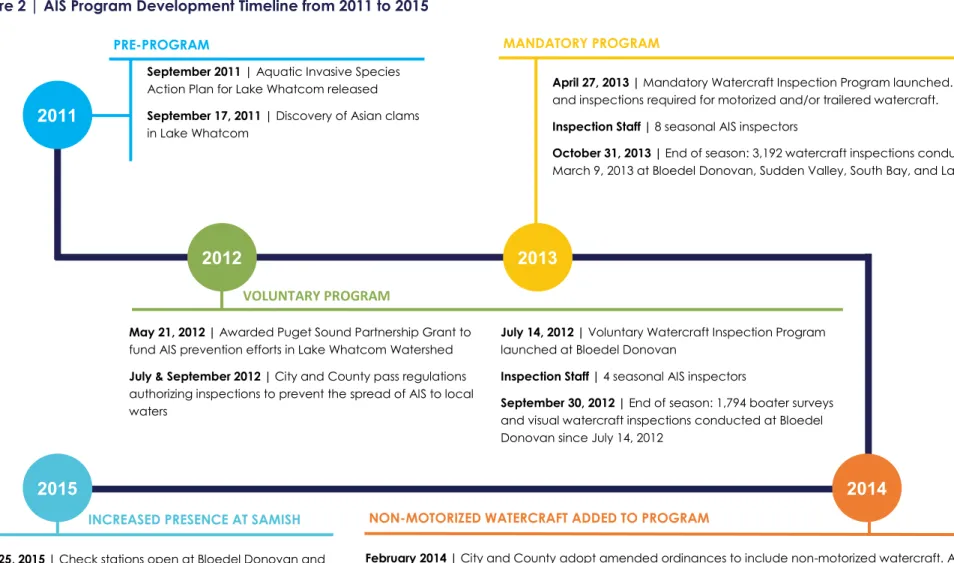
2011
2012
September 2011 | Aquatic Invasive Species Action Plan for Lake Whatcom released September 17, 2011 | Discovery of Asian clams in Lake Whatcom
2013
PRE-PROGRAM
VOLUNTARY PROGRAM
May 21, 2012 | Awarded Puget Sound Partnership Grant to fund AIS prevention efforts in Lake Whatcom Watershed July & September 2012 | City and County pass regulations authorizing inspections to prevent the spread of AIS to local waters
2015
July 14, 2012 | Voluntary Watercraft Inspection Program launched at Bloedel Donovan
Inspection Staff | 4 seasonal AIS inspectors
September 30, 2012 | End of season: 1,794 boater surveys and visual watercraft inspections conducted at Bloedel Donovan since July 14, 2012
2014
MANDATORY PROGRAM
April 27, 2013 | Mandatory Watercraft Inspection Program launched. AIS Permits and inspections required for motorized and/or trailered watercraft.
Inspection Staff | 8 seasonal AIS inspectors
October 31, 2013 | End of season: 3,192 watercraft inspections conducted since March 9, 2013 at Bloedel Donovan, Sudden Valley, South Bay, and Lake Samish.
February 2014 | City and County adopt amended ordinances to include non-motorized watercraft. AIS Permits and inspections required for all watercraft.
April 2014 | Launch of Whatcom Boat Inspections website and online AIS Awareness Course and Discount Program
Inspection Staff | 1215 seasonal AIS inspectors
April 26, 2014 | Check stations open at Bloedel Donovan and Lake Samish
June 14, 2014 | Boat with quagga mussels intercepted and decontaminated at Bloedel Donovan
September 30, 2014 | End of season: 7,859 watercraft inspections conducted since April 1, 2014 at Lake Whatcom and Lake Samish.
April 25, 2015 | Check stations open at Bloedel Donovan and Lake Samish. AIS Permits and inspections required for all watercraft (including seaplanes).
May 9, 2015 | Check station opens at South Bay Inspection Staff | 1315 seasonal AIS inspectors
Hours of Operation | Increased hours of operation at Lake Samish and South Bay
September 30, 2015 | End of season: 8,949 watercraft inspections conducted since March 13, 2015 at Lake Whatcom and Lake Samish.
INCREASED PRESENCE AT SAMISH NON-MOTORIZED WATERCRAFT ADDED TO PROGRAM Figure 2 | AIS Program Development Timeline from 2011 to 2015
SUDDEN VALLEY MARINA 154 INSPECTIONS
SOUTH BAY 268 INSPECTIONS LAKE SAMISH
1,628 INSPECTIONS
INSPECTORS
— AT —
LAUNCHES
INSPECTED
BOATS CARRIED
that had to be drained
BOATS CARRIED
that had to be removed
VISITORS
In 2015, aquatic invasive species inspectors conducted 8,949 inspections at Lake Whatcom and Lake Samish in an effort to prevent the spread of aquatic invasive species. While the majority of these inspections took place at Bloedel Donovan, additional check stations were operated at the Lake Samish and South Bay Washington Department of Fish and Wildlife (WDFW) launches throughout the season. Over 1,400 inspections were also conducted at private residences in the Lake Whatcom and Lake Samish watersheds for boats that could not be trailered to a check station or at residences with multiple watercraft.
Aquatic invasive species inspectors had an additional 7,420 interactions with boaters throughout the season as a result of the Wire Seal Program that provided staff with further opportunities to engage boaters in the program. Over 2,800 visitors also stopped by the aquatic invasive species check stations to ask questions about the program and to pick up outreach materials.
All of these interactions have helped to increase awareness in our community about aquatic invasive species and the threats they pose to our local waters.
BLOEDEL DONOVAN 5,446 INSPECTIONS
Figure 3 | Whatcom Boat Inspection Program highlights, 2015
DATA SOURCE: Whatcom Boat Inspection Program inspections and interactions with visitors at Lake Whatcom and Lake Samish launches between March 13 and September 30, 2015. Map includes inspections that were conducted at 2200 Nevada Street prior to the start of the season (13), on-site inspections conducted at private residences in the Lake Whatcom and Lake Samish watersheds throughout the season (1,440), and inspections conducted at Bloedel Donovan (5,446), Sudden Valley Marina (154), South Bay (268), and Lake Samish (1,628).
PUBLIC WORKS | 2200 Nevada Street 13 INSPECTIONS
PRIVATE RESIDENCES 1,440 INSPECTIONS
R. GARCIA
Some Potential Invaders:
Asian Clam Eurasian watermilfoil New Zealand
mudsnail Brazilian elodea Flowering rush Relative number of vessels
TOP 10 FRESHWATER BODIES
PRIOR TO LAUNCHING AT LAKE WHATCOM OR LAKE SAMISH
DATA SOURCE: Inspection data collected from surveys in 2015. Includes some AIS already present in top 10 freshwater bodies. Note: Most frequent freshwater bodies visited prior to launching at Lake Whatcom or Lake Samish were Lake Whatcom, Lake Samish, and Lake Padden (not included above). Map
Credit: C. BEHEE 1 — Vessels — 500+
Figure 4 | Previous water bodies visited by vessels launching at Lake Whatcom or Lake Samish, 2015 Boater survey information was also collected
during each watercraft inspection to provide information on usage patterns, traffic flow, and to assess the level of risk an individual watercraft may have posed to our local lakes. While the majority of boats inspected had originated in Whatcom County, boats had previously visited 639 different waterbodies in 33 different states/provinces at some point in the past including nine mussel-infested waters.
The top ten freshwater bodies most recently visited are all in Washington with Baker Lake being the most frequently visited waterbody just prior to launching at Lake Whatcom or Lake Samish. While none of these waterbodies are infested with invasive
mussels, some are home to potential invaders that pose a risk to our local waters. These boater survey results underscore the importance of our inspection efforts in the prevention of aquatic invasive species both to and within Washington State.
33 639
STATES + PROVINCES
WATER BODIES
In 2015, the Lake Whatcom Management Program operated two Aquatic Invasive Species Check Stations at Lake Whatcom: one at Bloedel Donovan Park and the other at the South Bay WDFW Launch. Additional inspections were also conducted at the Sudden Valley Marina and at private lake residences. The Bloedel Donovan Check Station opened on April 25, 2015 and operated from dawn to dusk, 7 days a week, through September 29. A total of 5,446 inspections were conducted at the Bloedel Donovan Check Station in 2015. This number accounts for approximately 60 percent of all inspections conducted during the 2015 season.
The day with the highest boat traffic at the Bloedel Donovan Check Station was July 19 with 209 boats (including 110 inspections and 99 sealed boats being checked in). This day was also one of the hottest days at Bloedel Donovan with a maximum air temperature of 87°F.
Similarly to previous years, high boat traffic days appear to be associated with high temperatures.
T. WARD
Figure 5 | Number of boats launching at Bloedel Donovan with temperature, 2015
DATA SOURCE: Whatcom Boat Inspection Program inspections and sealed boat data collected at the Bloedel Donovan Aquatic Invasive Species Check Station between April 25 and September 29, 2015. Temperature data is based on maximum air temperature recorded at the Bellingham International Airport and compiled by the National Climatic Data Center—Global Surface Summary of Day.
What did we find?
Four percent of all boats inspected at Lake
Whatcom required additional attention
because they were not cleaned, drained,
or dry and were at risk for transporting
aquatic invasive species.
Particular attention was paid to boats that
had standing water on board that could
be harboring microscopic life stages of
aquatic invasive species, such as zebra or
quagga mussels, Asian clams, or small
invasive plant fragments.
Standing water/wet: 147 boats
Vegetation: 140 boats
Other organisms: 1 boat
The South Bay Check Station opened on May 9, 2015 and operated from 10:00 a.m. to 5:00 p.m., primarily on weekends and holidays, through September 19. This launch is used by boaters coming up from Skagit and Snohomish counties, and also by many residents along South Bay Drive. A total of 268 inspections were conducted at the South Bay Check Station during the 2015 season; a 19 percent increase when compared to the 2014 season.
The day with the highest boat traffic was July 4 with a total of 31 boats being inspected at the Check Station.
R. LEWIS
Invasive American Bullfrog tadpole found in a live well on a boat launching at Bloedel Donovan Park, 2015
The Lake Whatcom Management Program also hosted two Sudden Valley Inspection Days at the Sudden Valley Marina and at AM/PM Beach. The first Inspection Day was held on April 18 as a training opportunity for new aquatic invasive species inspectors prior to the start of the season. An additional Inspection Day was held on June 27 for residents planning on launching their boats prior to the Canada Day (July 1) and Independence Day holidays. This day also served as a training day for three new inspectors that were hired at the end of June. A total of 154 inspections were conducted at the Sudden Valley Marina and AM/PM Beach either at these Inspection Days or by appointment throughout the season.
An additional 1,033 on-site inspections were also conducted at private residences on Lake Whatcom for boats that could not be trailered to a Check Station or for people with multiple watercraft requiring inspection.
AIS STAFF
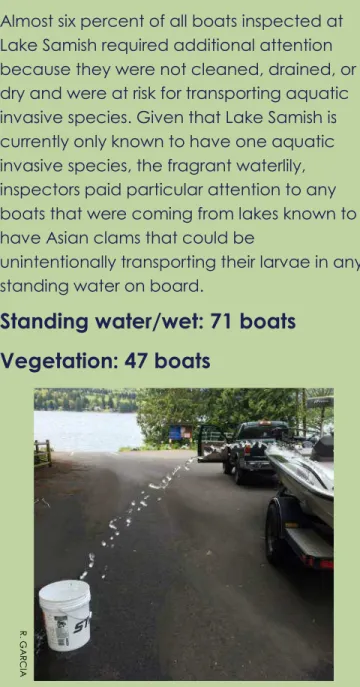
What did we find?
Almost six percent of all boats inspected at
Lake Samish required additional attention
because they were not cleaned, drained, or
dry and were at risk for transporting aquatic
invasive species. Given that Lake Samish is
currently only known to have one aquatic
invasive species, the fragrant waterlily,
inspectors paid particular attention to any
boats that were coming from lakes known to
have Asian clams that could be
unintentionally transporting their larvae in any
standing water on board.
Standing water/wet: 71 boats
Vegetation: 47 boats
The Lake Samish Check Station also opened on April 25, 2015, and operated from dawn to dusk, most Wednesdays through Sundays, through September 27. A total of 1,622 inspections were conducted at the Lake Samish Check Station in 2015a 99 percent increase when compared to the 2014 season. This increase can be attributed to our increased days and hours of operation at the site in 2015.
The day with the highest boat traffic at the Lake Samish Check Station was June 6 with 74 boats (including 67 inspections and 7 sealed boats being checked in). This day was also one of the hottest days at Lake Samish with a maximum air temperature of 77°F. An additional 407 on-site inspections were conducted by appointment at residential properties around Lake Samish in 2015.
Figure 6 | Number of boats launching at Lake Samish WDFW Launch by month, 20142015
Boat from Lake Whatcom draining live well into bucket prior to launching at Lake Samish, 2015 DATA SOURCE: Whatcom Boat Inspection Program inspections conducted at the Lake Samish WDFW launch by
month in 2014 and 2015 seasons. The Lake Samish Check Station was restricted during July 2014 pending permit approval by the Washington Department of Fish and Wildlife. The permit was re-negotiated in 2015 to increase site safety and to allow for increased hours of operation at the site.
R. GARCIA
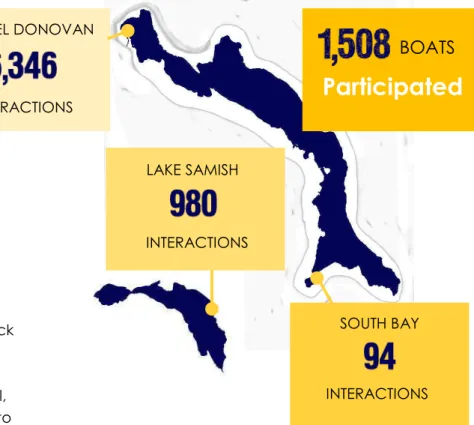
BOATS
Participated
INTERACTIONS BLOEDEL DONOVAN
SOUTH BAY LAKE SAMISH
INTERACTIONS INTERACTIONS
Boaters that plan on returning to a location with an Aquatic Invasive Species Check Station on their next visit can participate in the Wire Seal Program and have their boats sealed to their trailers as they exit the launch. Wire is threaded through the eyebolt on the bow of the boat and the trailer and then threaded through a small, plastic, plunger seal. Once the plunger has been pushed in, the wire must be cut to be broken. Boats returning with intact wire seals go through an expedited process when returning to launch helping to alleviate any traffic build-up, and frustration that could result on hot, busy days.
In 2015, the Wire Seal Program was offered at the Bloedel Donovan Check Station, the South Bay Check Station, and the Lake Samish Check Station. Different colored seals were used to distinguish between boats exiting from Lake Whatcom (blue) or Lake Samish (yellow) to prevent the spread of aquatic invasive species between the two lakes.
A total of 1,508 boats participated in the Wire Seal Program at Lake Whatcom and Lake Samisha 35 percent increase when compared to the 2014 season. In 2015, the number of boats participating in the Wire Seal Program at Bloedel Donovan and Lake Samish was 1,189 and 396, respectively. As a result of the Wire Seal Program, aquatic invasive species inspectors had an additional 7,420 interactions with boaters while sealing/unsealing boats that provided staff with the opportunity to further engage these boaters in the program.
Figure 7 | Number of Wire Seal Program interactions with boaters by launch site, 2015
Wire seals act like an express pass for boats returning to the same lake. Boats with intact wire seals do not need to be re-inspected when they return to the lake—making their re-entry process much faster than for boats originating from out of the area. The Wire Seal Program also provides AIS inspectors with additional opportunities to interact with boaters: to provide program information and to answer any questions the boaters may have.
What is the Wire Seal Program?
T. WARD
R. GARCIA
In 2015, inspections were also offered at private residences for watercraft that could not be trailered to an inspection station or for people who had multiple watercraft requiring inspection. A total of 1,440 boats were inspected at on-site appointments in 2015 (approximately 16 percent of all inspections). These inspections were conducted at 314 locations including: private residences, camps, university facilities, and outdoor/sporting goods stores. In many instances, boat owners were able to coordinate with their neighbors to get all of their watercraft inspected at a single appointment. The larger green circles represent between 1971 boats being inspected at a single location and include inspections conducted at Western Washington University’s Lakewood Facility, Camp Firwood, Lutherwood Camp and Retreat Center, and the Bellingham Canoe Kayak Sprint Team at Lake Padden. Additional group inspection days were organized for residents of the Geneva neighborhood, Whatcom Meadows, Wildwood, West Lake Samish Drive, Shallow Shore Road, and Calmor Cove. These group inspection days were often organized with help from lake residents.
DATA SOURCE: Distribution of on-site inspections conducted in Whatcom County in 2015 by Whatcom Boat Inspection Program. Larger green circles represent between 1971 boats being inspected at a single location. Map does not include inspections conducted outside of the Lake Whatcom and Lake Samish watersheds. Map Credit: F. WANG Figure 8 | Distribution of on-site inspections
conducted in the Lake Whatcom and Lake Samish watersheds, 2015
-
T. WARD
BOATS
INSPECTED
APPOINTMENTS
ON-SITE
Legend:
# of inspections 1 - 3 4 - 7 8 - 18 19 - 36 37 - 77
Before the start of the inspection season, prospective aquatic invasive species inspectors received inspection training based on the regional training received by senior aquatic invasive species staff at Lake Mead. Through lectures and hands-on exercises, candidates became proficient in basic aquatic invasive species biology, watercraft anatomy, and inspection and decontamination protocols. At the end of the training period, candidates had to receive a passing score on a final written exam before being issued their certificate authorizing them as inspectors.
Inspectors received additional training on the City’s policies and public service competencies, safety protocols, data collection and entry protocols, financial policies, and the use of online applications for scheduling and payment collection. An inspection training day was held at the Sudden Valley Marina on April 18, 2015, for inspectors to practice inspecting boats and filling out inspection forms prior to the start of the season.
AIS inspectors search for stickers (mussels) on a boat during training, 2015
R. GARCIA
In March, 2015, the aquatic invasive species program coordinator and a lead inspector participated in a regional watercraft inspection and decontamination training at Lake Mead. This two-day training is certified by the Pacific States Marine Fisheries Commission, the Western Regional Panel on Aquatic Nuisance Species, and the 100th Meridian Initiative with their state and federal partners. The training includes hands-on inspection and decontamination of various types of watercraft and is followed up by a final written exam. This training provided our staff with an opportunity to collaborate with representatives from other agencies, organizations, and businesses who are also implementing inspection and decontamination programs throughout North America.
D. DAVIST. WARD
Legend:
Asian clams established Asian clams present— additional monitoring needed to confirm extent Asian clams absent
Figure 9 | Aquatic invasive species monitoring locations and results, 2015 In August 2015, aquatic invasive species inspectors conducted shoreline
surveys for Asian clams and other aquatic invasive species at several public access points at Lake Whatcom and Lake Samish. Several sites had already been identified as having established populations of Asian clams during survey work conducted in 2011 and 2012 including Bloedel Donovan, Western Washington University’s Lakewood Facility, Sudden Valley - Sofield Park, Wildwood, and Lake Padden. These sites were used to train the new staff on invasive species identification and monitoring and equipment decontamination protocols prior to the surveys. As a result of this monitoring effort, four additional Asian clam colonies were discovered at Lake Whatcom at Britton Road/N Shore Beach, Sunrise Bay, Lake Whatcom Park, and the Morgan Street Beach. Asian clam specimens and/or shells were also discovered at an additional five sites but established populations have not yet been confirmed. In addition to recording Asian clam presence/absence, aquatic invasive species inspectors also recorded and identified any other species present in the area including frogs, tadpoles, snails, and other aquatic plants.
No Asian clams were discovered during the surveys at Lake Samish at Lutherwood, Lake Samish Park, and the Lake Samish WDFW launch; however, two invasive aquatic plants, yellow flag iris and fragrant water lily were observed at the survey locations along with extensive patches of non-native, water celery.
Fragrant water lily, L. Samish, T. WARD Yellow flag iris, L. Samish, T. WARD Asian clams, L. Whatcom, R. GARCIA Asian clam, L. Whatcom, T. WARD
In 2015, the Lake Whatcom Management Program continued to increase community awareness about aquatic invasive species and the Whatcom Boat Inspection Program via newspaper and magazine advertisements, the creation and dissemination of postcards and brochures, the AIS Awareness Course and Whatcom Boat Inspections website, by hosting information sessions, and by talking with boaters and park users at the Aquatic Invasive Species Check Stations.
In addition to placing advertisements in local magazines and newspapers, the Lake Whatcom Management Program also placed advertisements on buses operated by the Whatcom Transportation Authority in 2015. Additionally, the Sanitary Service Company Inc. (SSC), donated an advertisement on one of their trucks as another means for conducting education and outreach in our community. In June of 2015, the Lake Whatcom Management Program partnered with the Washington Invasive Species Council and the Washington Department of Fish and Wildlife to paint stencils with the “Clean, Drain, Dry” message at the Bloedel Donovan and Lake Samish launches as part of a regional pilot project. The goal of the project is to have the message painted at launches throughout Washington state to educate our boating community. These stencils also provide us with an additional tool to remind boaters to clean, drain, and dry their boats to stop the spread of invasive species even when inspectors are not present at the launch.
T. WARD
T. WARD
In April of 2014, the Lake Whatcom Management Program launched the Whatcom Boat Inspections website: whatcomboatinspections.com. This website acts as a central location for information regarding the boat inspection program, including program updates, fees, inspection locations, AIS prevention information, as well as a link to the AIS Awareness Course. The site was visited by over 5,800 unique users in 2015 with several visitors returning to the site on more than one occasion.
In 2015, a pop-up survey was used to determine how people found out about the website as an indicator of the effectiveness of our various outreach methods. Over 700 responses to the survey were received between April and October of 2015. Survey responses indicate that the majority of responders heard about our website via a neighbor/family member, followed by an informational postcard or brochure, the Whatcom Boat Inspection Hotline, newspaper/magazine ads, a water bill insert, and bus ads. Many other responders mentioned they heard about the website after talking with an aquatic invasive species inspector at one of the launches. Survey results will be used to prioritize outreach efforts in 2016.
The online AIS Awareness Course can be found on the Whatcom Boat Inspections website. The course takes around 30 minutes to complete and aims to educate participants about AIS prevention and boat inspection practices to help stop the spread of AIS to Whatcom County waters. Successful completion of the online course entitles participants to a $10 discount that can be applied to each annual permit being purchased.
The AIS Awareness Course has been passed successfully 2,837 times since it was launched in April of 2014. In 2015, discounts were applied to approximately 30 percent of all annual motorized permits sold and 77 percent of all non-motorized permits sold.
Many course participants have commented on how the course significantly increased their awareness of aquatic invasive species issues and how to prevent their spread. When engaging with people who have already passed the online course, aquatic invasive species inspectors can focus more of their time and energy on conducting boat inspections and answering
questions, rather than providing baseline aquatic invasive species education. This has led to our inspections being conducted much more efficiently.
Visit our website for more information:
The initial success of the Whatcom Boat Inspection Program could not have been possible without the support of our partners at the local, state, and regional levels. These partnerships have fostered the sharing of news, information, training, and resources that have been essential to the development of this program. Additionally, these partnerships have provided local staff with the opportunity to participate in regional collaborative efforts to prevent the spread of aquatic invasive species in the Pacific Northwest.
Aquatic invasive species staff participated in the 100th Meridian Initiative - Columbia River Basin Team meeting in Portland in October 2015 and in the 7th Annual National New Zealand Mudsnail Conference in Seattle in June 2015. These meetings provided staff with additional opportunities to learn from aquatic invasive species prevention and management efforts occurring at the local, state, and regional scales while also being able to offer some perspective to our regional partners on aquatic invasive species efforts and challenges occurring locally.
Additionally, aquatic invasive species staff were able to share ideas and program updates with aquatic invasive species program representatives from Wyoming, Arizona, and Alberta at the Watercraft Inspection and Decontamination Training at Lake Mead in March 2015. Information on the Whatcom Boat Inspection Program and AIS Awareness Course were provided as a case study at the Pacific Northwest Economic Region Summit in Big Sky, Montana in July 2015. Successes and challenges faced by the Whatcom Boat Inspection Program were also shared at the Aquatic Invaders Summit in Minnesota in January 2015 as an example for local programs becoming established across Minnesota.
The City of Bellingham is also an active participant in the Washington Aquatic Invasive Species Funding Advisory Committee that is tasked with developing recommendations for long-term funding strategies for aquatic invasive species prevention and management in Washington State.
The Whatcom Boat Inspection Program continues to look for new ways to highlight program achievements and to increase awareness about aquatic invasive species prevention and management efforts at the local and regional levels. In 2015, inspection results and boater zip codes have been made available to the public using an online, interactive mapping application called Story Map (powered by Esri): whatcomboatinspections.com/2015-story-map.
View the Whatcom Boat Inspections 2015
Story Map here:
R. GARCIA
Program Characteristic Expenditures for 2015 ($)
AIS Inspection Staff 317,027
Equipment/Supplies 30,359
Education and Outreach 7,209
Total 354,596
Type of Permit/Pass Price ($) # Passes/Permits Sold Total Revenue ($)
Annual Permit 50 1,839 91,950
Annual Permit (Discounted) 40 799 31,960
3-Day Pass 20 388 7,680
Non-Motorized Permit 10 546 5,460
Non-Motorized Permit (Discounted) 0 1,857 0
Total 5,429 137,050*
*Electronic transaction fees (totaling $3,382) not subtracted from total. Does not include revenues collected from event or business permit fees. Permit fee revenues collected by the program are used to fund the AIS Program. This funding is supplemented by funding provided by Whatcom County, the City of Bellingham, and the Lake Whatcom Water and Sewer District. The tables below outline program expenditures and revenues collected from fees in 2015.
FEE REVENUES COLLECTED IN 2015 2015 PROGRAM EXPENDITURES
Jurisdiction Contribution ($)
Whatcom County 87,450
City of Bellingham 87,450
Lake Whatcom Water and Sewer District 46,026
Total 220,926
CONTRIBUTION BY JURISDICTION