Enhanced Linked Data
RAHOMAN Md Mizanur
Doctor of Philosophy
Department of Informatics
School of Multidisciplinary Sciences
SOKENDAI (The Graduate University for
Advanced Studies)
定
Retrieval over Enhanced Linked
Data
Author:
RAHOMAN Md Mizanur
Supervisor:
Ryutaro Ichise
Doctor of Philosophy
September 2016
School of Multidisciplinary Sciences,
SOKENDAI (The Graduate University for Advanced Studies) in partial fulfillment of the requirements for the degree of
Doctor of Philosophy
Advisory Committee Assoc. Prof. Ryutaro Ichise SOKENDAI
Prof. Seiji Yamada SOKENDAI Prof. Hideaki Takeda SOKENDAI Assoc. Prof. Yusuke Miyao SOKENDAI
Dr. Tetsuya Nasukawa IBM Research − Tokyo
Linked Data are inference-enable, interlinked network data. They store knowledge with rich semantics. Currently Linked Data hold vast amount of knowledge, which are also growing rapidly. Success of these contemporary data depends on how effectively they can be used by the users and applications. Like other data, usage of these data primarily relies upon how easily they can be accessed, and how good the data are i.e., the quality of data. A good number of researches have been conducted to investigate these two issues, however, contemporary systems are still not good to tackle them effectively.
Considering that keyword-based query is an easy-to-use information access op- tion, we find that contemporary systems are not effective to handle Linked Data’s structural complexities. There are also very few systems that can handle specific semantics like “temporal semantics” − time and event related queries, however capturing them can leverage Linked Data usability. Since the contemporary sys- tems suffer on handling those issues together, we propose Linked Data information access frameworks that are easy-to-use, effective to handle structural complexities, and facilitated to capture temporal semantics. We analyze structure of Linked Data and propose some defined templates for keywords, and their management to retrieve Linked Data information. While we capture temporal semantics by text analysis. On the other hand, we do not find many Linked Data quality assessment frameworks that can automatically identify all possible types of errors. Since man- ual quality assessment over Linked Data is not a feasible choice and data can hold different types of errors, an automatic quality assessment frameworks is a require- ment. We adapt a novel unsupervised nearest-neighbor based outlier detection technique which is automatic, not susceptible to particular types of errors.
The proposed systems are easy to use and effective in their operations. They can support in leveraging Linked Data success.
I would like to express my sincere gratitude to my supervisor Professor Ryutaro Ichise for the continuous support of my study and research, for his patience, mo- tivation, and immense knowledge. Without his guidance and persistent help this thesis would not have been possible. I appreciate all his contributions of time, ideas, and supervision to make my research experience productive and stimulat- ing.
I would like to thank my committee members, Prof. Seiji Yamada, Prof. Hideaki Takeda, Assoc. Prof. Yusuke Miyao, and Dr. Tetsuya Nasukawa for their encour- aging, insightful, and constructive comments.
I appreciate my lab members, Khai, Ball, Ebitsu, Lankesh, Lihua, Raul, and all the internship students, who supported me and helped me in my research.
Most importantly, none of this would have been possible without the love and patience of my wife - Silvia Islam and my son - Intishar Rahman. I would like to express my heart-felt gratitude to my parents, sisters who have been a constant source of love, concern, and support all these years.
Lastly, I thank the financial and educational support from Ministry of Education, Culture, Sports, Science & Technology (MEXT) and the Graduate University for Advanced Studies (SOKENDAI) during my studies. I appreciate all the incredible opportunities and memorable experience they offered so far.
Abstract ii
1 Introduction 1
1.1 Background . . . 2
1.2 Motivation . . . 4
1.2.1 Information Access over Linked Data . . . 4
1.2.2 Assessment of Linked Data Quality . . . 8
1.3 Contributions . . . 9
1.3.1 Information Access over Linked Data . . . 10
1.3.2 Linked Data Quality Assessment . . . 12
1.4 Outline. . . 12
2 Background 14 2.1 Linked Data Technologies . . . 15
2.1.1 Linked Data . . . 15
2.1.2 Data Model . . . 16
2.1.3 Data schema and Ontology. . . 17
2.1.4 Query . . . 18
2.2 Information Access over Linked Data . . . 18
2.2.1 Related Works . . . 20
2.2.2 Unsolved Issue . . . 28
2.2.3 Our Proposal . . . 31
2.3 Assessment of Linked Data Quality . . . 34
2.3.1 Related Works . . . 34
2.3.2 Unsolved Issue . . . 37
2.3.3 Our Proposal . . . 38
2.4 Summary . . . 39
3 BoTRet: The Basic Information Access Framework 40 3.1 Introduction . . . 41
3.1.1 Motivation. . . 41
3.1.2 Contributions . . . 44
3.2 Two-keyword-based Linked Data Information Access . . . 45
3.2.1 Resource Manager . . . 46
3.2.2 Template Constructor . . . 47
3.2.2.1 Selection criterion of triple-pattern relatedness. . . 48
3.2.2.2 Selection of the perfect template . . . 50
3.3 More-than-two-keyword-based Linked Data Information Access. . . 50
3.3.1 Template constructor . . . 51
3.3.2 Comparator . . . 52
3.3.3 Refiner . . . 52
3.3.4 Merger . . . 54
3.3.4.1 Triple-pattern connector priorities . . . 54
3.3.4.2 Merging of triple-patterns . . . 55
3.4 Experiment . . . 56
3.4.1 Experiment 1 . . . 58
3.4.2 Experiment 2 . . . 59
3.4.3 Experiment 3 . . . 61
3.5 Discussion . . . 63
3.5.1 Consideration of Use of BoTLRet . . . 63
3.5.2 BoTLRet Addressed Research Challenges. . . 64
3.6 Summary . . . 67
4 TLDRet: A Temporal Extension of BoTLRet 68 4.1 Introduction . . . 69
4.1.1 Motivation. . . 69
4.1.2 Contributions . . . 70
4.2 Time & Event in Query . . . 71
4.2.1 Types of temporal keywords . . . 72
4.2.2 Technical basis of identifying temporal keywords . . . 73
4.3 TLDRet: Linked Data Retrieval Framework with Temporal Semantics 74 4.3.1 Phase 1: Query text processing . . . 75
4.3.1.1 The input divider process . . . 75
4.3.1.2 The Q-RKS time converter process . . . 76
4.3.2 Phase 2: Semantic query . . . 79
4.3.2.1 Step 1 . . . 81
4.3.2.2 Step 2 . . . 81
4.3.2.3 Step 3 . . . 81
4.4 Experiment . . . 84
4.4.1 Performance over the QALD temporal questions . . . 85
4.4.1.1 Question set performance . . . 85
4.4.1.2 Performance of each type of temporal keyword ques- tion answering . . . 87
4.4.2 Efficiency comparison with other systems . . . 88
4.4.2.1 Comparison with other systems . . . 88
4.4.2.2 Comparison for different types of temporal keyword questions . . . 90
4.5 Discussion . . . 91
4.6 Summary . . . 92
5 LiCord: A Machine Learning-based Keyword Segmenter 93 5.1 Introduction . . . 94
5.1.1 Motivation. . . 94
5.2 Language independent Content Word Segmenter (LiCord) . . . 96
5.2.1 NGram Constructor . . . 97
5.2.2 Function Word Decider . . . 98
5.2.3 Feature Value Calculator . . . 99
5.2.4 Classifier Learner . . . 99
5.3 Experiment . . . 101
5.3.1 Experiment 1 . . . 103
5.3.1.1 The Named Entities (NEs) . . . 103
5.3.1.2 The Parts of Speech . . . 104
5.3.2 Experiment 2 . . . 105
5.4 Vocabulary Specific Keyword Linker . . . 107
5.5 Summary . . . 108
6 ALDErrD: An Information Assessment Framework over Linked Data 109 6.1 Introduction . . . 110
6.1.1 Motivation. . . 110
6.1.2 Contributions . . . 112
6.2 Basic Idea . . . 112
6.3 Framework Details . . . 114
6.3.1 Attribute Based Error Detection. . . 115
6.3.1.1 Data Collector . . . 116
6.3.1.2 Grouper . . . 119
6.3.1.3 P1 Error Detector . . . 119
6.3.2 Value Pattern Based Error Detection . . . 122
6.3.2.1 Value Pattern Collector . . . 122
6.3.2.2 P2 Error Detector . . . 123
6.4 Experiment . . . 125
6.4.1 Experiment 1 . . . 126
6.4.2 Experiment 2 . . . 129
6.5 Discussion . . . 131
6.6 Summary . . . 133
7 Discussion 134 7.1 Discussion . . . 135
7.2 Future Work . . . 136
7.3 Summary . . . 138
8 Conclusion 139
Bibliography 141
Appendix A. Question Answering over Linked Data (QALD) Ques-
tions 154
1.1 Example of Linked Data and SPARQL query. . . 4
1.2 Basic difference between information access over document-based data and information access over Linked Data . . . 6
1.3 Big picture of contributions. The “Green” parts are specific contri- butions. . . 12
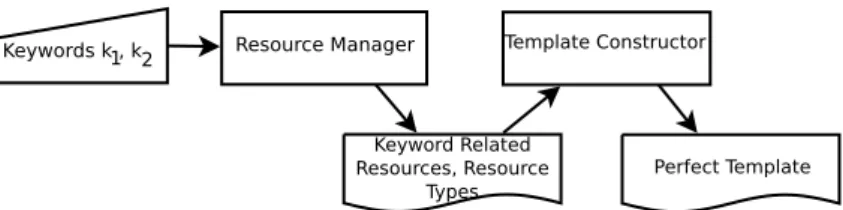
3.1 Template selection process flow for two-keyword query questions . . 45
3.2 Template selection process flow for query question with more than two keywords . . . 51
4.1 Types and sub-types of the temporal keyword . . . 73
4.2 Overall work flow of our proposed method . . . 75
5.1 Work-flow of LiCord classification learning . . . 97
6.1 Work-flow of Proposed Framework ALDErrD. . . 115
1.1 Exemplary Erroneous Entries over DBpedia 3.8 Dataset. . . 9
3.1 Templates for r1 ∈ RR(k1) and r2 ∈ RR(k2) . . . 48
3.2 Modified templates for single resource r ∈RR(k) . . . 53
3.3 BoTLRet Recall, precision, and F1 measure grouped by number of keywords for the DBpedia and MusicBrainz questions . . . 59
3.4 Comparison between MTS and BoTLRet systems in terms of num- ber of triple-patterns used and computational cost . . . 60
3.5 Completeness comparison between MTS and BoTLRet . . . 60
3.6 Execution cost (in milliseconds) for QALD-2 DBpedia test questions 61 3.7 Performance comparison between GoRelations and our system for QALD-1 DBpedia test questions . . . 62
3.8 Performance comparison between QALD-2 challenge participant systems and BoTLRet for DBpedia test questions . . . 63
4.1 Example questions and their corresponding comma-separated key- words . . . 71
4.2 Example of signal words and ordering keys . . . 80
4.3 Ordering keys and their temporal picking points . . . 83
4.4 Semantic query scenario for Q#1 (Example Question #1) . . . 84
4.5 QALD-1 and QALD-2 temporal question answering performance by TLDRet . . . 86
4.6 Type-wise question answering performance for QALD-1 and QALD- 2 temporal questions by the TLDRet. . . 88
4.7 Performance comparison among the TLDRet, the QALD-2 open challenge participant systems, and the TLDRet old for the temporal feature related DBpedia QALD-2 test questions . . . 89
4.8 Performance of each temporal keyword type of question for the Sem- SeK, the MHE, the TLDRet old, and the TLDRet systems. . . 90
5.1 Variable length n-grams and their frequencies for an exemplary cor- pus T- = “Japan is an Asian country. Japan is a peaceful country”.. 97
5.2 Features and their calculations. . . 100
5.3 Statistics of corpus and corresponding n-grams . . . 102
5.4 Comparison for LiCord with Wikifier . . . 104
5.5 Comparison for LiCord with Spotlight . . . 104
5.6 Comparison for LiCord with Parser . . . 105
5.7 CW finding classification accuracy % in test . . . 106 5.8 Newly discovered CWs finding accuracy % for non-accurate classi-
fied test n-grams of Table 5.7 . . . 107 6.1 Examples of attribute values for different Ss (or Os) for the Linked
Data resource res:Tom Cruise. . . 118 6.2 Exemplary [S-O] pair groups divided by the horizontal double lines
in the table. . . 119 6.3 Error candidate detection at Phase 1 and 2 and their detection
classification, precision and recall . . . 128 6.4 Erroneous RDF triple finding performance comparison between ALDErrD and the ruled based system. . . 130 1 Question Answering over Linked Data 1 (QALD-1) DBpedia Ques-
tions . . . 154 2 Question Answering over Linked Data 1 (QALD-1) DBpedia Ques-
tions Corresponding Keywords . . . 156 3 Question Answering over Linked Data 2 (QALD-2) DBpedia Ques-
tions . . . 158 4 Question Answering over Linked Data 2 (QALD-2) DBpedia Ques-
tions Corresponding Keywords . . . 162 5 Question Answering over Linked Data 1 (QALD-1) MusicBrainz
Questions . . . 166 6 Question Answering over Linked Data 1 (QALD-1) MusicBrainz
Questions Corresponding Keywords . . . 168 7 Question Answering over Linked Data 2 (QALD-2) MusicBrainz
Questions . . . 170 8 Question Answering over Linked Data 2 (QALD-2) MusicBrainz
Questions Corresponding Keywords . . . 172
Introduction
In this chapter, we briefly introduce background of our study (Section 1.1). Then we present motivation of this thesis, where we discuss problems or challenges (Section 1.2). We briefly introduce contributions of this thesis in Section 1.3. In the last Section, we outline each chapter of this thesis.
1.1 Background
Linked Data store knowledge in a network-like structure. Such structure can be compared with graph. Therefore, Linked Data are considered as semi-structure data [14]. Usually these data are presented with a machine understandable way. It significantly improves access and integration of such data. The inclusion of schema information or ontology information of data makes the Linked Data ma- chine understandable, while the network-like structure of data helps to find poten- tial link identification among various data, and construction of data links. Over any dataset, data schema usually describes data about data − meta data. In Linked Data perspective, this schema information is further extended to maintain relationship among the data or incorporate semantics over data which is called as data ontology. So, apart from describing meta data information, Linked Data ontology facilitates inference-enable data structure. Therefore, because of the inference-enable data structure of Linked Data, and their capability on data shar- ing, exposing, and connecting, Linked Data are consider as Semantic Web data [11] which Tim Berners-Lee, the visionary of Semantic Web, indicated as machine understandable data.
Usually, Linked Data are generated by two different methods. In first method, domain experts of a particular domain e.g., biology domain, medical domain, law domain etc. craft this kind of Linked Data, which heavily depend on manual ac- tivities. The example of such Linked Data are DrugBank1, PubMed2. Because of manual intervention or expert intervention, this type of Linked Data are generally clean, but less frequent. In second method, pattern-based mapping, or rule-based mapping of source data extract Linked Data, which are generated either by au- tomatic or semi-automatic Linked Data generation procedures. The example of source data could be Wikipedia text, automatically generated Sensor Data etc. On the other hand, the example of the Linked Data could be DBpedia3, Free- base4, LinkedSensorData5 etc. Because of automatic generation of data, this type of Linked Data are more common, but potential to hold less cleaner data than manually generated Linked Data.
1https://datahub.io/dataset/fu-berlin-drugbank
2http://bio2rdf.org/
3http://dbpedia.org/About
4https://www.freebase.com/
5http://wiki.knoesis.org/index.php/LinkedSensorData
By principle, Linked Data adapt easy and simple data publishing strategies [10] − (1.) use Uniform Resource Identifiers (URIs) to denote things, (2.) use Hypertext Transfer Protocol (HTTP) URIs so that these things can be referred to and looked up (“dereferenced”) by people and machine agents, (3.) provide useful information about the thing when its URI is dereferenced, leveraging the data query, and (4.) include links to other URIs, so that they can discover more things. By following the above strategies, Linked Data allow data publishers to publish their data with their own ontology. Although publishing data with publishers’ own ontology per- petuates data heterogeneity, because of easy and simple data publishing strategies we see that Linked Data are growing rapidly. For example, rapid growth of Linked Open Data6 can show this growing trend. While as of September 2011, Linked Open Data used to hold 295 datasets consisting of over 31 billion entries on var- ious domains7, and just within the next two and half years, as of April 2014, the datasets got increased to more than three folds and reached to 1014 datasets8. Therefore, we can assume that the Linked Data are growing rapidly. It indicates that currently Linked Data hold vast amounts of knowledge.
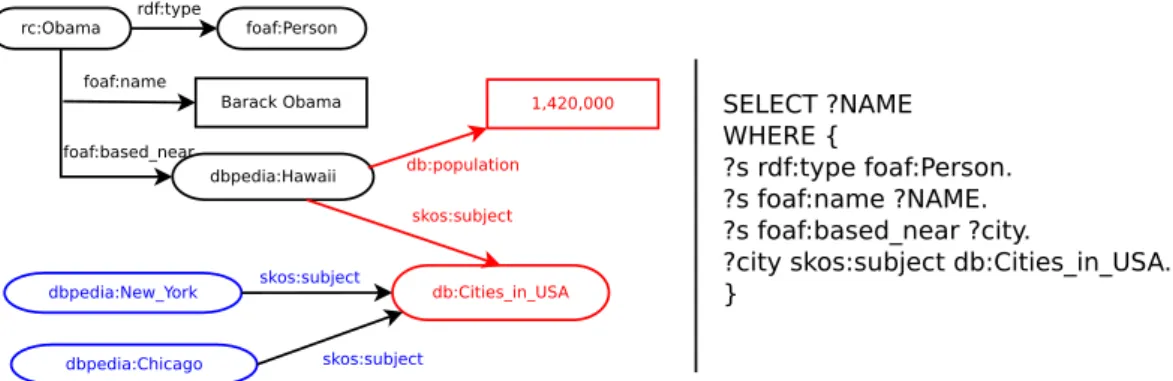
To access particular knowledge over the Linked Data, there exists some query frameworks such as SPARQL, RDQL etc. SPARQL is a structured query language (SQL) type expressive query (RQL, RDQL, or SPARQL [81]). However, data users need to know the data structure, the ontology and the query. Figure 1.1 shows example of Linked Data and SPARQL Query. The data part is shown on the left side while the query part is shown on the right side. The Linked Data adapt a graph-based model where each two nodes of data are connected with an edge or relation. The data are embedded with schema or ontology, e.g., “rdf:type” information is embedded for instance “rc:Obama”. The SPARQL query shows that how we can query people (e.g., “Barack Obama”) who live in “US Cities”. More detail description of data, query etc. will be described in the following chapters.
6subset of Linked Data that are openly available to use
7http://www4.wiwiss.fu-berlin.de/lodcloud/state/
8http://linkeddatacatalog.dws.informatik.uni-mannheim.de/state/
db:Cities_in_USA 1,420,000
dbpedia:Hawaii
rc:Obama foaf:Person
Barack Obama
dbpedia:New_York
dbpedia:Chicago
skos:subject
skos:subject foaf:name
foaf:based_near rdf:type
skos:subject db:population
SELECT ?NAME WHERE {
?s rdf:type foaf:Person.
?s foaf:name ?NAME.
?s foaf:based_near ?city.
?city skos:subject db:Cities_in_USA. }
Figure 1.1: Example of Linked Data and SPARQL query
1.2 Motivation
Linked Data currently hold a vast amount of knowledge. Therefore, the knowledge contained in Linked Data is worthy to investigate. We investigated Linked Data for two primary issues, which we understand that are crucial for Linked Data success [8]. They are:
(I.) How Linked Data can be accessed in an easy and effective way by the general-purpose data users?
(II.) How Linked Data quality can be assessed automatically, irrespec- tive of their error types, over a large Linked Dataset?
Although there are ample amount of researches have been conducted over these two, we find that they are still open to do further researches. The below we describe motivational factors for both the issues in more details, respectively.
1.2.1 Information Access over Linked Data
The knowledge contained in Linked Data makes efficient data access options a necessity. However, information access over Linked Data is different from infor- mation access over other data. It is different from information access over tradi- tional document-based data. It is also different from information access over usual graph-based data.
Comparing information access over Linked Data and document-based data, we find that while an information access over Linked Data system considers a query
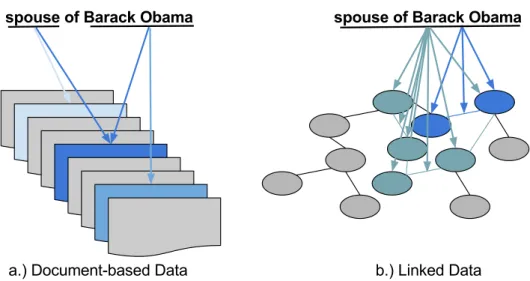
holistically, a traditional document-based information access system considers a query individually. That is why, an information access over Linked Data system needs to put all keywords of a query, in a semantic order, together so that it can retrieve more exact pitch of information that the query is searching for [7,14]. On the other hand, a traditional document-based information access system retrieves relevant documents among the other documents, considering individual keywords of the query. In such a case, a document-based information access system might not need to consider the entire query, rather a part of the query can also produce re- quired information need. Figure1.2shows information access comparison between over document-based data and Linked Data. It shows that the document-based information access system retrieves documents with different number of keywords (a.)), while the Linked Data information access system usually retrieves data for the entire query (b.)). In the figure, we see that both queries are posed to access information for keywords “spouse” and “Barack Obama”. In a.), we find that the document-based information access system points individual document for each of the keywords. In this kind of access system, we generally can assume that a ranked list of such documents (shown in “dark blue” to “light blue”) can pro- vide us the required information need better, although there is possibility that any of them can serve the required information need. On the other hand, in b.), we find that the information access over Linked Data handles it differently. The information access over Linked Data system points Linked Data resources for all keywords of the query together. Although information access over Linked Data also ranks output of its query (shown in “dark blue” and “light blue”), we see that the information access over Linked Data always consider its query for all of the keywords holistically. So, we understand that simple use of document-based information access system will not fit over Linked Data.
Moreover, the information access over Linked Data is also different than the usual graph search because the traditional graph search may not be able to capture the rich semantics of Linked Data, that are presented with schema and ontologies. Therefore, to access information over Linked Data for a query, a framework needs to find keywords. The keywords are important part of the query which hold query intension and can be linked to Linked Dataset. After finding the keywords, it needs to arrange keywords holistically so that the arrangement can simultaneously replicate subgraph of Linked Data graph and retrieve require information need.
Figure 1.2: Basic difference between information access over document-based data and information access over Linked Data
We have found that information access over Linked Data is still an open research filed, because contemporary information access frameworks are still not effective. The below we outline some challenges / problems that motivated us to do our research.
1. Complex Competency − The information access over Linked Data requires complex user competency, from data modeling to data queries. For example, data users need to know the data structure, their vocabularies, data ontology, and SPARQL queries etc. These complexities get increased further because of Linked Data’s data heterogeneity. For example, in Figure1.1Linked Data, we find that the data entries are described in three different vocabularies: foaf9, db10, skos11. Because of the heterogeneous nature of Linked Data, it is time consuming and practically infeasible to learn all them manually. As a result, accessing Linked Data is often not easy, especially for general-purpose users who have very little knowledge about the internal structure of Linked Data.
2. Costly Links − Information access over a Linked Data network requires following links [2, 5, 6, 42, 119]. However, simply following links over a large graph is costly, at least within a reasonable cost [2]. This is because, the link following can be considered as sub-graph searching, and searching a subgraph over a large graph is a subgraph isomorphism problem and is a
9http://www.foaf-project.org/
10http://dbpedia.org/ontology/
11https://www.w3.org/2009/08/skos-reference/skos.rdf
classical NP-complete problem. Most of the recent algorithms proposed to solve this problem apply structural features of graph and construct index, such as path, tree and subgraph. However, there is no solid theory foundation of which structure is the best one to construct the index. What is more, the cost of mining these structures is rather expensive [119, 120].
On the other hand, “templates” are investigated to search subgraphs over Linked Data graphs [95, 107]. The intuition behind the template use is that it would introduce a defined subgraph that supports finding of links and Linked Data endpoints over the Linked Data’s big graph. However, the template-based Linked Data information retrieval studies have yet to provide concrete guidelines for template construction, ranking, and merging, all of which are required for effective adaptation of templates to Linked Data retrieval. For example, one recent research trend employed parse tree- based template construction [30, 31, 66, 107]. But the parser tree-based templates are not stable, and depending upon the language parser, we get multiple such trees, and wrong selection of tree lead to wrong or empty results. On the other hand, selection of all such possibilities are not be an efficient technique for retrieval of data from a large dataset [95]. Therefore, only linking of keywords towards the dataset is not enough to retrieve Linked Data information because keywords further need to fit into some structure or templates so that they can follow the Linked Data graph and retrieve the require information.
3. Temporal Lacking − The current information access framework over Linked Data lack of embedding temporal semantics [85]. However, temporal feature related information, such as a date and time or a time-specific event, is helpful for finding an appropriate result or for discovering a new relation [69, 93]. The temporal features filter out unnecessary data. For example,
“US President during World War I” filter out all other US Presidents than
“Woodrow Wilson”.
Though extraction of temporal feature related information of typical document- based data has quite a long history of research, the same kind of research for Linked Data has been comparatively less pursued [85].
Considering the above challenges, we find that information access over Linked Data often difficult, especially for general-purpose users who have very little knowl- edge about the internal structure of Linked Data, such as schema information
or SPARQL query. Moreover, efficient query building technique over Linked Data graph is still not solved, because they require to follow the data links which are ex- ponential in number. Therefore, we are motivated that an easy and efficient to use information access framework will exploit Linked Data that are growing rapidly. Thereby we can get closer towards the vision of Linked Data that machine and human both can access semantically aware information with lower complexity [8].
1.2.2 Assessment of Linked Data Quality
To use Linked Data effectively, Linked Data users commonly expect to use of high-quality data. This brings the need to identify erroneous data in the Linked Data. The below we outline the problem that motivated us to do the data quality assessment research.
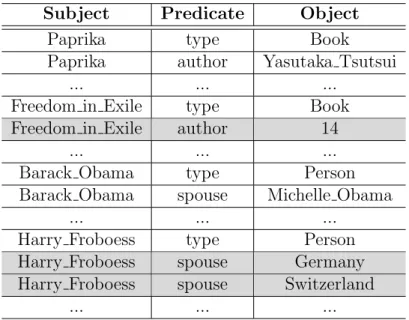
1. Wrong Entries − The existing Linked Datasets are not always clean. Both Linked Data generation methods described in Section 1.1 can generate un- clean data. In manually generated Linked Data, the erroneous data entries could be generated because of human errors. Moreover, data could be gen- erated from multiple sources which sometime differ from one another. On the other hand, in automatically generated Linked Data, erroneous data en- tries could be extracted because of the wrong contents in source data. For example, Wikipedia contents could be wrong as they are built on people’s mass contributions, who are not expert always. Furthermore, erroneous data entries could also be extracted because of wrong source-data mapping. For example, wrong InfoBox12 mapping of Wikipedia contents extracts wrong entries. For both cases, DBpedia, which is extracted from Wikipedia text, data entries will contain wrong entries. For example, Table 1.1 shows some exemplary erroneous entries over DBpedia 3.8 dataset. The shaded rows hold erroneous entries.
Although we do not have exact statistics that how good or bad the current Linked Datasets are, we show DBpedia statistics to get a rough idea of data. For example, Acosta et.al., and Zaveri et. al. calculated that DBpedia entries hold some kind of errors between 6.15% and 11.93% [1, 116]. These errors cover wide spectrum of error types such as value error, data type error,
12technique that is how Wikipedia keeps its data in some structure
Table 1.1: Exemplary Erroneous Entries over DBpedia 3.8 Dataset
Subject Predicate Object
Paprika type Book
Paprika author Yasutaka Tsutsui
... ... ...
Freedom in Exile type Book
Freedom in Exile author 14
... ... ...
Barack Obama type Person
Barack Obama spouse Michelle Obama
... ... ...
Harry Froboess type Person
Harry Froboess spouse Germany Harry Froboess spouse Switzerland
... ... ...
class error etc. [1]. Likewise, Mendes et.al., has showed that at least 37% English DBpedia is not complete [74, 79].
Therefore, Linked Data are potential to contain errors [58,87]. Because of Linked Data generation methods − both manual or automatic −, these errors can be any type of errors. However, currently we do not find any Linked Data quality assess- ment framework that can automatically assess the data for any error possibilities. This problem / challenge motivated us to investigate Linked Data for automatic quality assessment.
1.3 Contributions
In this thesis, we propose four frameworks BoTLRet (Binary Progressive Template Paradigm over Linked Data Retrieval) [83, 84, 86], TLDRet (Temporal Linked Data Retrieval framework) [85], LiCord (Language independent Content Word Segmenter), and ALDErrD (Auto Linked Data Error Detector) [87] that help general-purpose users of Linked Data to access the information and assess the data quality.
To access Linked Data information, we proposed frameworks BoTLRet and TL- DRet. BoTLRet is the basic framework, while TLDRet is an extension of BoTL- Ret to capture the temporal semantics. For a query, BoTLRet and TLDRet take
keywords and extract required information need. The input keywords can be gen- erated manually or automatically. In manual case, users craft keyword-based query by knowing the datasets’ vocabularies. While, in automatic case, users can pose queries like natural language queries, later, the vocabulary specific keyword-based query can be constructed using state-of-the art tools such as language parser (e.g., Stanford Parser13), or machine learning-based keyword segmenter (e.g., LiCord [88]), and entity linker between keywords and vocabularies (e.g., [38]).
In this thesis, keywords are word segments that represent important sense of the sentence or query. In linguistics, such important word segments are mentioned as Content Words (CWs), and usually belong to nouns, most verbs, adjectives, and adverbs and refer to some object, action, or characteristic [112]. We define keywords that hold following properties i.e., the keywords
• contain one or more text segments with their word boundaries
• represent the natural language query intuitively
For example, for a natural language query “Who is Barack Obama is married to?”, the keywords are {“Barack Obama” and “married”}. This is because, the impor- tant part of the query is “Barack Obama” and “married” and other parts “Who”
“is” and “to” are not important because they are frequently used words which do not carry any special meaning. Therefore, “Barack Obama” and “married” intuitively mean the query.
On the other hand, to assess errors of Linked Data, we proposed Linked Data framework ALDErrD. In the below we describe our contribution for each of them, respectively.
1.3.1 Information Access over Linked Data
• Proposal of a keyword-based information access framework over Linked Data
– contribution in brief − the proposal is a general-purpose information access framework over Linked Data that takes input as keywords, use
13http://nlp.stanford.edu/software/lex-parser.shtml
some templates to retrieve Linked Data information. The keywords are made out of natural language query, and they are posed according to the word-order of the query. To retrieve information over Linked Data, it needs to perform three tasks
(i.) decide keywords i.e., identification of important sense or part of (natural language) query called as CWs (Content Words)
(ii.) link keywords to datasets’ vocabularies, which are data labels (iii.) fit keywords to templates that retrieve the information
In this thesis, we contribute for tasks (i.) and (iii.) and keep task (ii.) as out-of-scope, which can be achieved by the state-of-the-art entity linking facilitates such as [38].
We contribute task (i.) by framework called LiCord that can identify CWs for the query. We describe it in Chapter 5.
On the other hand, we contribute task (iii.) by frameworks BoTLRet and TLDRet. The proposed frameworks addresse first two challenges on information access over Linked Data that is stated in Section1.2.1by providing a keyword-based information access facility. The framework uses some templates to retrieve Linked Data information. The template facilitated framework hides Linked Data’s data structure complexities. It automatically embeds Linked Data schema, ontology etc, that usually lack in on a keyword-based Linked Data information accessing frame- work. Moreover, the templates support finding of links and Linked Data endpoints over the Linked Data’s big graph, which is complex to fol- low. With the proposed framework, we provide concrete guidelines for template construction, ranking, and merging, all of which are required for effective adaptation of templates to Linked Data retrieval.
We describe them in Chapter3 and 4, respectively.
• Proposal of temporal feature related information access
– contribution in brief − the proposal is an extension of previous framework BoTLRet that facilitates temporal feature related informa- tion access over Linked Data. It addresses the third challenge on infor- mation access over Linked Data that we described in Section1.2.1. The proposed framework is TLDRet. We describe it in Chapter4.
Figure 1.3: Big picture of contributions. The “Green” parts are specific con- tributions.
1.3.2 Linked Data Quality Assessment
• Proposal of an information assessment framework over Linked Data – contribution in brief − the proposal is a framework to identify pos- sible candidate of erroneous data over the type-annotated Linked Data. It addresses the problem on quality assessment over Linked Data that we described in Section1.2.2.
The proposed framework is ALDErrD. We describe it in Chapter 6.
Figure1.3 shows “Big Picture” of our contribution. It shows that we contributed for two primary issues, keyword-based information access over Linked Data, and automatic Linked Data assessment. The “Green” parts are our contributions. In automatic keyword generation, we contributed part of it i.e., the CWs finding (by the framework LiCord), which is shown in dotted mark.
1.4 Outline
The remainder of this paper is divided as follows: In Chapter 2, we describe more detail background that are essential for this thesis, followed by works related to
our study. In Chapter3, we describe the basic information access framework over Linked Data. In Chapter 4, we extend the basic framework to capture temporal feature related Linked Data information. In Chapter 5, we show a technique that can be used to automatically devise keywords for the query. In Chapter 6, we describe the Linked Data quality assessment framework. In Chapter7, we discuss on our contributions. Finally, Chapter 8concludes our work.
Background
In this chapter, we introduce more detail background knowledge on Linked Data and their technologies (Section 2.1). Later we discuss on information access re- search and their related works (Section2.2). Next, like information access research, we discuss on data quality assessment and their related works (Section 2.3). For both research topics, we list some unsolved problems or challenges in the related works that we will solve in this thesis. Finally we summarize this chapter.
2.1 Linked Data Technologies
In this section, we will describe Linked Data and their associated technologies. It includes Linked Data, Linked Data vision, data publishing principles, data model, data schema, ontologies, data query etc. The background knowledge on Linked Data will help us to go through with this thesis.
2.1.1 Linked Data
Linked Data are data that published on the Web in such a way that they are linked by network links, preserved by their inference-enable meanings, readable and explorable by machines, and can in turn be linked to from external data sets [14]. Tim Berners-Lee, the visionary of Linked Data, indicated that Linked Data should be presented with a machine understandable manner. He predicated that it significantly will improve Linked Data access and their integration. Therefore, the Linked Data initiative has opened new opportunities in data usage, where this network-like structure of the data are considered as potential for link construction and identification among various data [14, 98].
Tim Berners-Lee, also the inventor of the World Wide Web, introduced the Linked Data principles [10]. He suggested to adapt Linked Data with three major tech- nologies: Uniform Resource Identifier (URI), which is a generic means to identify entities or concepts in the world; Hypertext Transfer Protocol (HTTP), which is a simple yet universal mechanism for retrieving resources or descriptions of resources, and; Resource Description Framework (RDF), which is a generic graph- based data model for structuring and linking data that describe things in the world. According to Tim Berners-Lee, the best practices of Linked Data handling are [46]:
• Use URIs to denote things.
• Use HTTP URIs so that these things can be referred to and looked up (“dereferenced”) by people and user agents.
• Provide useful information about the thing when its URI is dereferenced, leveraging standards such as RDF* and SPARQL.
• Include links to other URIs, so that they can discover more things.
Figure 1.1 shows example of Linked Data and the SPARQL query code snippet that how data can be queried. We will describe the Figure more details in the following sections.
2.1.2 Data Model
The data model that Linked Data adapts is called Resource Description Framework (RDF). It is used to interchange data on the Web. According to World Wide Web organization1, RDF supports in data merging even if the underlying schema differ. Therefore, the data consumers of Linked Data do not need to change their data, even the RDF schema get evolved over the period.
RDF data model extends the Web linking structure. Its basic constituent is re- ferred to as a “triple” which consists of two ends of the link, connected from source node to the destination node. In a triple, the two nodes are considered as “sub- ject” and “object”, and the link or edge is considered as “predicate”, therefore, triples are form with <subject, predicate, object> expressions [14].
The linking structure of RDF forms a directed, labeled graph. In RDF data model, the edges represent the named link between two resources, represented by the graph nodes. Therefore, the RDF data model can be visualized with the graph view of network-data. This is the easiest possible mental model for RDF. It allows storing both structured and semi-structured data. RDF data model facilitates data mixing , data exposing, and data sharing across different applications, which is primary vision Linked Data or Semantic Web data [11]. So, the network-like structure of Linked Data opens the potentiality of new data discovery because they can be accessed by following the network links [5, 6, 42].
Figure 1.1 visualizes Linked Data on the left side. We see that the Linked Data adapt a graph-based model where each two nodes i.e., subject or object (as an instance or a literal value) of data are connected with an edge or relation or pred- icate. We also see that Linked Data keep data in more details and more linked ways. For example, instance “rc:Obama” in Figure1.1explicitly keep three triples:
<rc:Obama, rdf:type, foaf:Person>, <rc:Obama, foaf:name, Barack Obama>, and
<rc:Obama, foaf:based near, dbpedia:Hawaii>, which are more detail representa- tion of data than that of usual document-based data. We also see that resource
1https://www.w3.org/RDF/
“db:Cities in USA” is connected to three different datasets, considering the three different color datasets are coming from three different data sources, which are not common in document-based data. The more linked and more detail presentation of Linked Data support machines to explore the data efficiently.
On the other hand, in Linked Data the storage paradigm deviates from traditional repository-centric infrastructures to an open publishing model that allows other applications to access and interpret stored data. Unlike other constraint-based data such as relational data, data publishing over Linked Data is rather easy, because, by maintaining Linked Data principles, individual data publishers can publish their data with their own data schema without knowing other publishers’ data schema. Thus, either the same data publishers or another group of publishers can connect published data and construct global data.
2.1.3 Data schema and Ontology
Linked Data are usually published with schema or ontology. Over any database, data schema usually describes data about data − the meta data − which defines data structure. In Linked Data perspective, this schema information is further ex- tended to maintain relationship among the data or incorporating semantics over data which is called as data ontology. So, apart from describing meta data infor- mation, Linked Data ontology facilitates inference-enable data structure − using classes and properties − which supports automatic reasoning. As mentioned be- fore, data publishing over Linked Data is maintained by individual data publishers which advocates that there is no need to use any specific ontology. Although it is good practice to use already established ontology since it gives easy integra- tion opportunity [10, 46], practically Linked Data adapt this loose data publish- ing strategy to foster the rapid population of data considering that data will be self-describing, and thereby they can be looked up and reused. In Linked Data population, allowing data publishers to use their own ontology perpetuates data heterogeneity. However, it boots data generation of Linked Data. With this con- sequence we see that Linked Data cloud, as of September 2011, used to hold 295 datasets consisting of over 31 billion resource document framework (RDF) triples on various domains which have become interlinked by around 504 million RDF links2. While within the next two and half years the datasets got increased to
2http://www4.wiwiss.fu-berlin.de/lodcloud/state/
more than three folds, and, as of April 2014, it reached to 1014 datasets3. So, these days such Linked Data hold vast amounts of knowledge. Figure 1.1 shows how we embed schema or ontology on Linked Data. For example, “rdf:type” in- formation is embedded for instance “rc:Obama”, by which it is understood that
“rc:Obama” is a “Person”.
2.1.4 Query
Usually Linked Data framework offers SPARQL Protocol and RDF Query Lan- guage (SPARQL), which is a powerful RDF query language that enables data users to access to Linked Data [46]. SPARQL can be used to express queries across di- verse data sources, where the data is stored natively as RDF or viewed as RDF via middle-ware [41]. Usually the users of Linked Data require to know the data model, the data ontology and the structured query language (SQL) type expres- sive queries (RQL, RDQL, or SPARQL [81]) For example, Figure1.1 shows on its right side that how SPARQL query can generate people (e.g., “Barack Obama”) who live in “US Cities”.
2.2 Information Access over Linked Data
Linked Data currently hold a vast amount of knowledge, which is also growing rapidly. Therefore, the knowledge contained in Linked Data is worthy to inves- tigate. As mentioned in Chapter 1, we investigate Linked Data for two primary issues, (1.) Information Access, and (2.) Data Quality Assessment. These two issues are crucial for success of Linked Data [8]. Here we will briefly outline about information access technique, its contemporary systems and current challenges and their possible solutions. The same will be outlined for quality assessment in next Section (2.3) .
In Chapter 1, we already discussed that information access over Linked Data is different from information access over usual document-based data. While an information access over Linked Data system considers a query holistically, a tra- ditional document-based information access system considers a query individually (described in Section 1.2.1). Therefore, a simple replacement of document-based
3http://linkeddatacatalog.dws.informatik.uni-mannheim.de/state/
information access system does fit for Linked Data information access. On the other hand, as discussed earlier in this Chapter, since Linked Data is a graph- based data, we generally can think that traditional graph-search can access the data. However, because of Linked Data’s rich semantics, that are often hidden in the complex structure and attributes in the form of Linked Data schema, ontol- ogy, vocabularies etc., the traditional graph-search is not well fit for Linked Data information access [52].
Usually, a Linked Data information access framework needs to find keywords for the query. As we defined the keywords in Chapter1Section1.3, the keywords are important part of the query which hold query intension and can be used to link the Linked Dataset. Then, we arrange keywords holistically so that the arrangement can replicate subgraph of Linked Data graph according to Linked Data semantics and retrieve the require information need.
Lately there proposed multiple graph-search algorithms that are focused to capture complex structure and attributes of a graph, which Khan et. al. [52] categorized into three different graph-search algorithms:
(a.) Mining Query Algorithms, which are to find all frequent subgraphs and pat- terns from a large scale graph or a set of graphs. For example, gSpan [114], AGM [48], graph pattern matching algorithms like [23, 24, 60], or, top-k proximity pattern mining [53] etc. belong to this category.
(b.) Matching Query Algorithms, which are to find a given query graph or pattern from a target network. For example, graph pattern matching algorithms like [18,24, 26, 101] etc. belong to this category.
(c.) Selection Query Algorithms. which are to identify the top-k nodes in a target network based on various input criteria. For example, ranked keyword-based graph search algorithms [12,44,100] or, skyline [15], SimRank [65] etc. belong to this category.
The basic difference between the Matching Query Algorithms and Selection Query Algorithms is that, the Matching Query Algorithms have explicit struc- tures (e.g. query graphs); whereas the structure is implicit in the Selection Query Algorithms (e.g. keyword search).
Our literature review on Linked Data information access showed that some of the contemporary systems, not all, utilized those graph-search algorithms to capture
the semantics, but they are still expensive [119, 120]. The below we outline the related works on information access over Linked Data, and show, if appropriate, which graph-search algorithms they used from the above category. The literature review will reveal the exact challenges that the contemporary Linked Data infor- mation access systems still suffer, as “unsolved issues”. Later, we briefly outline our proposed solutions to solve the unsolved issues. The detail description of our proposal are described in Chapter 3and 4.
2.2.1 Related Works
To address the challenge of Linked Data information access (stated in Chapter 1 Section 1.2.1) we review the contemporary systems that deal with Linked Data information access. With our literature review, we categorize them into six cat- egories: (1.) Look-up-based Systems, (2.) Easy Query Building or Visualizing Systems, (3.) Supervised Machine Learning-based Systems, (4.) Template-based Systems, (5.) Pivot Point-based Systems and (6.) Temporal Information Access Systems.
The Look-up-based Systems are similar to traditional document-based informa- tion access systems. On the other hand, the Easy Query Building or Visualizing Systems and the Pivot Point-based Systems hold some information access sys- tems that users need to construct their queries or guide for the queries. We review them to address the easy information access challenge. The Supervised Machine Learning-based Systems use some training examples to construct the query. While the Template-based Systems are language tool-based systems that use some kind of template to access information, which usually are automatic or semi-automatic. The Template-based Systems, by introducing the templates, try to minimize Linked Data’s structure-related complexity such as data link following, ontology understanding etc. We review them to address the effective information access that can hide Linked Data complexity. Finally, the Temporal Information Access Systems are used to retrieve temporal feature related information. We re- view them to address the temporal semantics embedding challenge. The below we discuss them more details.
(1.) Look-up-based Systems − look-up, index or crawl for RDF resources either for one data source or heterogeneous data source. Systems like Sindice [106]
Falcon [25], Swoogle [33] etc. belong to this category. These are the early Linked Data information access systems.
The below we briefly discuss them.
• Sindice [106] is a lookup-based information access system that construct index over resources, crawl on the Semantic Web. It consists of several independent components which are pipe-lined to get crawling, indexing, and querying. The crawler autonomously extracts RDF data from the Web data. Then, it adds to a indexing queue. The index allows applica- tions to automatically retrieve sources with information about a given re- source. It also allows resource retrieval through inverse-functional prop- erties, which also offers full-text search and index SPARQL endpoints. Therefore, Sindice only acts as locator of RDF resources, returning point- ers to remote data sources, and not as a query engine.
Sindice actually is not an end-user application. However, its service can be used by any decentralized Semantic Web client application. It facil- itates to locate relevant data sources. Therefore, Sindice is more close to standard Web search engines. However, it focus is specific towards Semantic Web concepts, procedures and metrics, rather than to Seman- tic Web search engines. Therefore, Sindice is not an information access system over Linked Data or Semantic Web data that retrieves it data holistically, rather it retrieves data much like document-based informa- tion access. So, we can say that Sindice aims at providing general query capabilities over the collections of all the Semantic Web data or Linked Data.
• Falcon [25] supports users with the option of accessing Web Resources for objects, concepts and documents. It provides very simple query capabilities. The object search is fitted to look for concrete items like people, places etc. The concept search is related to search for classes and properties that are available in ontologies published on the Web. The document search feature is suited a more traditional search engine experience, where search results point to RDF resources that contain the specified search terms.
It is to be mentioned that, in Falcon RDF resources may be considered as distinct entities. While, the document Web and the data Web form one connected, navigable information space. In this way, Falcon gives,
a navigation opportunity. For example, a user may perform a search in the existing document Web, follow a link from an HTML document into the Web of Data, navigate this space for some time, and then follow a link to a different HTML document, and so on.
Therefore, Falcon fits more towards traditional search engine-like infor- mation access, than the Linked Data required holistic data search.
• Swoogle [33] is also crawler based information access system. It index the Semantic Web data and retrieve them with the index. Swoogle also store meta-data of Semantic Web data, and calculate relationships between the documents. The retrieval input either character N-Gram or URI.
Therefore, Swoogle also fits more towards traditional search engine-like information access, than the Linked Data required holistic data search. (2.) Easy Query Building or Visualizing Systems − propose easy query
building techniques that produce required information need or visualize the data. Systems like GoRelations [40], SPARQL Views [27], DERI Pipes [80], KOIOS [13], Hermes [104] etc. belong to this category. This category of systems still require know-how of Linked Data basics, sometime even in-depth knowledge of one of more datasets e.g., in Hermes.
This kind of systems utilize the Match Query Algorithms or Selection Query Algorithms to find the subgraph over Linked Data graph.
The below we briefly describe two of them.
• GoRelations [40] offers a query building technique that users need to devise to retrieve data from Linked Data graph. GoRelations (Graph of Relations) is an open domain question answering system, which authors claim is easy to learn and use.
GoRelations consists of two components: a semantic graph interface (SGI) and an automatic translator mapping. With SGI, user can con- struct an intuitive query. In query, user needs to define relational part, and instance and concept part of the query. Then it automatically builds a semantic graph by connecting relations with instances and concepts. On the other hand, the automatic translator mapping find each entity by
name or value and its concept in the query context. Thereby, GoRela- tions maps input query terms in the semantic graph which fits ontology terms. Finally, it generates a SPARQL query from the mappings.
• DERI Pipes [80] supports in Semantic Web data mash-ups. It can pre- serve desirable properties of data. Example of such properties are ab- straction, encapsulation, component-orientation, code re-usability and maintainability etc.
In DERI Pipes, it extracts data by using several pipes or filters. The filtered data are retrieved from existing Web contents
(3.) Supervised Machine Learning-based Systems − take supervised train- ing data, and use user feedback to refine the Linked Data query. Systems like MQLOD [72], AutoSPARQL [62], [103] etc belong to this category. These cat- egory of systems depends upon machine learning outputs which are heavily depends upon training data. In real world case, accumulating these training data is not easy.
The below we briefly describe one of them.
• AutoSPARQL [62] uses supervised machine learning in its query mod- eling. In training, it allows users to ask queries without knowing the schema of the underlying knowledge base and without being expert in the SPARQL query. That is, it engages users in active supervised ma- chine learning to generate a SPARQL query. The positive training ex- amples are generated for resources that should be found for SPARQL query, and the negative training examples are generated for resources that should not be found for a SPARQL query.
The user can either start with a question as like other QA systems. Or, by directly searching for a relevant resource as directory search, where each search results generates two sets of resources, positive resources and negative resources. For example, user searches for “Berlin”, s/he then selects an appropriate result, which becomes the first positive example. After that, s/he is asked a series of questions on whether a resource, e.g.
“Paris”, should also be contained in the result set. These questions are answered by “yes” or “no”. This feedback allows the supervised learning method to gradually learn which query the user is likely interested in.
(4.) Template-based Systems − use templates to fit in some part of Linked Data graphs. Systems like PowerAqua [66], TBSL [107], FREyA [30, 31], SemSek [4], CASIA [45], DEQA [63] GraphPattern [95] etc. belong to this category. Various techniques are used to create the templates. One technique is using of natural language tools such as language parser over the input query. In this technique, the parser outputs, which generally are parse trees, which are considered as templates and are used to predict the possible subgraph (over Linked Data graph). A parse tree is a tree with annotated4 part of input query. Therefore, the templates are considered as subgraph of Linked Data graph. However, when templates are constructed for input keywords, the contemporary systems fail to manage them effectively because most of them used language-based tools such as language parser which are not stable, and are not well defined [30, 31, 66, 107]. As a consequence, the contempo- rary systems sometime construct wrong templates which eventually generate wrong or empty results. On the other hand, selection of all such possibilities are not be an efficient technique for retrieval of data over a large dataset [95]. This kind of systems utilize the Match Query Algorithms or Selection Query Algorithms to find the subgraph over Linked Data graph.
This category Linked information access is popular with natural language or keyword-based query [77, 91]. Moreover, the template can easily capture the Linked Data semantics. Since this technique is popular recently and we also will use templates in our proposal, we briefly discuss five of them from this category.
• PowerAqua [66] performs question answering over structured data on the fly. It is an open domain question answering system, which is agnostic towards particular vocabulary or structure of the dataset.
PowerAqua follows a pipeline architecture. Here input query is first transformed into query triples of the form subject, property and object by means language parser. Then, suitable query triples are mapped that identifies Linked Data resources. In mapping, it uses various lan- guage resources such as a WordNet search in order to find synonyms, hypernyms, derived words and meronyms. With the mapping, a set of ontology triples that jointly cover the user query is derived. Finally,
4annotation could be POS tagging, NER tagging etc.
since it could be happened that resulting triples may lead to only partial answers, all results are combined into a complete answer.
The performance of PowerAqua heavily depends on accuracy of language processing tools.
• FREyA [30,31] allows users to enter queries in keyword-based query or natural language-based query. FREyA adapts a semi-supervised query technique.
Like PowerAqua[66], it also follows a pipeline architecture, and gener- ates query outputs. At first, it generates a syntactic parse tree in order to identify the answer type. Then, it starts with a lookup, annotating query terms with ontology concepts. If the lookup finds ambiguous an- notations, the user is engaged to clarify the correct annotation. In such a case, the user’s selections are saved and used for training the system. It improves system’s performance over the time. Next, on the basis of the ontological mappings, system generates triples. Generation of triples are considered with domain and range of the properties. Finally the resulting triples are combined to generate a SPARQL query.
The performance of FREyA is also heavily depends on accuracy of lan- guage processing tools. Moreover, it performs as a semi-supervised sys- tem.
• QAKiS [20] is a question answering system over DBpedia. Its main technique relies on filling the gap between natural language text and labels of ontology concepts. To fill the gap, it uses WikiFramework repository. The WikiFramework repository is automatically built by ex- tracting relational patterns from Wikipedia free text. Authors specified WikiFramework for properties of DBpedia ontology. For example, a nat- ural language pattern that expresses the relation birthDate is born on. QAKiS mainly focuses simple questions that contain one named entity and is connected to the answer via one relation. We see that QAKiS first determines the answer type as well as the type of the named entity, and next matches the resulting typed question with the patterns in the WikiFramework repository, and finds the most likely relations, which is then used to build a SPARQL query.
The building of WikiFramework repository heavily depends on language processing tools. Therefore, the performance of QAKiS heavily depends on quality of WikiFramework repository.
• SemSek [4] is a question answering system that focuses on matching natural language expressions to ontology concepts.
SemSek has three steps: linguistic analysis, query annotation, and a se- mantic similarity measure. The query annotation step mainly looks for entities and classes in a DBpedia index that match the expressions occur- ring in the natural language question. The natural expression matching part is guided by the syntactic parse tree, provided by the linguistic tools like language parser. SemSek retrieves a ranked list of terms following the dependency tree. In order to match these terms to DBpedia con- cepts, SemSek uses two semantic similarity measures, first one is explicit semantic analysis based on Wikipedia, and the second one is semantic relatedness measure based on WordNet structures.
Therefore, we see that the performance SemSek thus mainly relies on semantic relatedness of query.
• TBSL [107] is a question answering system that focuses on transforming natural language questions into SPARQL queries.
It first parsed natural language questions with language parser, which generates several parsed trees. Among the parsed trees, it tries to find the best best representation of the semantic structure of the query question. These trees are considered as templates for the query.
Therefore, TBSL first produces parser output-based templates that tries to understand the internal structure of the question. Then these tem- plates are mapped with Linked data RDF resources. The mapping is done with the help of statistical entity identification and predicate de- tection. Finally, the templates are converted to SPARQL queries. Template creation of TBSL is based on natural language tools. There- fore, performance of TBSL heavily rely upon the performance of the tools.
(5.) Pivot Point-based Systems − track a “pivot point” (i.e., particular part or point of input query) and explore the remaining points, and thereby deter- mine all required points (i.e., subgraph) of Linked Data graph. Systems like Treo [35], NLP-Reduce[51], QUICK [117] belong to this category of systems.
Here systems use single pivot point which leads next exploration points. How- ever, inappropriate selection of pivot point will affect system’s performance. Moreover, this approach also could miss contextual information attachments among the points, or could predict a subgraph that generates empty result. Dynamic programming based subgraph prediction, which was investigated in Treo, could be a possible workaround. However, in such a case, backtracking and picking of another point increases the data access complexity. This is because, if such approach is adapted, each of this backtracking needs to check for all the instances that correspond to the point. Furthermore, in real world scenario, every point (i.e., keyword) corresponds to multiple instances. For example, with exact string matching, keyword “Germany” has at least 22 in- stances over DBpedia 3.8. This also increases data links following complexity. Here, all require points retrieve subgraph over Linked Data graph. Therefore, most of the cases, the subgraph finding belong to Selection Query Algorithms. The below we briefly discuss two of them.
• QUICK [117] works on pre-defined domain specific ontologies. It works as exploring Linked Data resource by pivoting some resources.
In QUICK, user needs to put her or his query in keywords. The system then guides the user through an incremental construction process. This incremental process ultimately leads the user to the desired semantic query. Here QUICK considers that user possesses basic domain knowl- edge, although it does not need to know specific details of the ontology, or proficiency in a query language. In this way, QUICK combines the fa- miliar keyword-based query towards the semantic queries i.e., the holistic query.
• Treo [35] adapts a kind of on-line navigation-based graph-search which traverses dereferenced URIs to navigate the Linked Data graph. It also works as exploring Linked Data resource by pivoting some resources. The query processing is stated by determining pivot entities in the nat- ural language question. The pivot entities can be mapped to instances or classes. We can consider them as an entry point, from where next navigation will be populated to search in the remaining query. Starting from these pivot points, Treo navigates through the neighboring nodes, computing the semantic relatedness between query terms and vocabulary terms, which ultimately lead the the exploration process. By this way,
it returns a set of ranked triple paths from the pivot point to the final resource representing the answer. Here ranking is done by the average of the relatedness scores over each triple path.
Since pivot point give next exploration points, the performance of Treo heavily depends on correct identification of pivot point.
(6.) Temporal Information Access Systems − Temporal information access systems are relatively less in practice. In 2011, a study by Vandenbussche et al. at the Detection, Representation, and Exploitation of Events in the Semantic Web (DeRiVE) workshop advocated an initiative regarding the ex- traction of temporal feature related Linked Data ([109]). The study by Van- denbussche et al. [109] focused primarily on image extraction. Khrouf et al. and Troncy et al. both showed event related ontology integration, i.e., what (event), when (date/time), where (geo) and who (participant of an event). But these studies considered that Linked Data would be presented with a fixed ontology (namely, LODE) and they ignored the possibility of accessing other temporal ontologies ([54, 105]).
To our knowledge, no information access system over Linked Data that can retrieve Linked Data information for rich temporal semantics, such as those given in natural language query or keyword query. We understand that the natural language query can include rich temporal semantics. We will propose such system in this thesis.
2.2.2 Unsolved Issue
To access information over Linked Data, in Section 1.2.1, we addressed three different challenges or problems − (1.) Complex Competency, (2.) Costly Links and (3.) Temporal Lacking. In our literature review, we already have noticed that the contemporary systems are not able address those challenges. The below we explain them in details, respectively.
(1.) easy-to-use information access system for general purpose users − here we outline the first challenge.
The literature review shows that systems like GoRelations [40], KOIOS [13], Hermes [104] etc. provide easy-to-use query technique. However, we under- stand that those systems still require some know-how of query building. For
example in GoRelations, users need to know relations and concepts of the query, and then follow special techniques to construct a Linked Data query. On the other hand, in QUICK [117], Treo [35] users need to guide the query. Likewise, guidance is also required in AutoSPARQL [62], where feedback of users are used by machine learning tool to generate the SPARQL query. Therefore, the above mentioned systems are still not easy for general-purpose users who do not have enough know-how of Linked Data and its associated technologies. Even knowing of dataset vocabularies does not suffice to retrieve the required information, which impose burden to users to learn the Linked Data structure, query development, feedback giving etc.
Therefore, because of users’ familiarity and comfortability towards keyword- based or natural language-based information accessed systems [77,91], keyword- based query should be easy to use. In Linked Data information access, the keywords are made from the natural language input query, and they are posed according to the word-order of input query. The keywords directly relate label information of data. Usually users can learn such labels by observing Linked Dataset. Or, data labels can be extracted using state-of-the art entity linking [38].
(2.) effective information access framework that hides Linked Data in- formation access complexity − here we outline the second two challenge. The literature review shows that most of the contemporary systems Power- Aqua [66], QAKiS [20], SemSek [4], TBSL [107] etc. use keyword-based or natural language-based information access over Linked Data because of their easy usage [77, 91]. On the other hand, those systems need to find a way so that they can follow Linked Data links. But mere keywords does not contain required semantics that is necessary to follow the links. Therefore, we see that information access systems use language tools to extract some seman- tics, which could be used to find the links. However, performance of those systems rely upon the performance of those language tools. Moreover, those systems can not provide a defined guide-line that what should be effective way to use those language tools.
For example, we find that the contemporary systems use language tools to generate Linked Data templates [95, 107], which later are converted to SPARQL queries. Usually the Linked Data templates provide a specific pat- tern or link following path at the time of query, therefore, they are potential