Factored Translation Models
Philipp Koehn and Hieu Hoang
[email protected], [email protected] School of Informatics
University of Edinburgh
2 Buccleuch Place, Edinburgh EH8 9LW Scotland, United Kingdom
Abstract
We present an extension of phrase-based statistical machine translation models that enables the straight-forward integration of additional annotation at the word-level — may it be linguistic markup or automati-cally generated word classes. In a num-ber of experiments we show that factored translation models lead to better transla-tion performance, both in terms of auto-matic scores, as well as more gramauto-matical coherence.
1 Introduction
The current state-of-the-art approach to statistical machine translation, so-called phrase-based models, is limited to the mapping of small text chunks with-out any explicit use of linguistic information, may it be morphological, syntactic, or semantic. Such additional information has been demonstrated to be valuable by integrating it in pre-processing or post-processing steps.
However, a tighter integration of linguistic infor-mation into the translation model is desirable for two reasons:
• Translation models that operate on more gen-eral representations, such as lemmas instead of surface forms of words, can draw on richer statistics and overcome the data sparseness problems caused by limited training data.
• Many aspects of translation can be best ex-plained on a morphological, syntactic, or se-mantic level. Having such information avail-able to the translation model allows the direct modeling of these aspects. For instance: re-ordering at the sentence level is mostly driven
word word
part-of-speech
Output Input
morphology part-of-speech
morphology
word class lemma
word class lemma
... ...
Figure 1: Factored representations of input and out-put words incorporate additional annotation into the statistical translation model.
by general syntactic principles, local agreement constraints show up in morphology, etc.
Therefore, we extended the phrase-based ap-proach to statistical translation to tightly integrate additional information. The new approach allows additional annotation at the word level. A word in our framework is not only a token, but a vector of factors that represent different levels of annotation (see Figure 1).
We report on experiments with factors such as surface form, lemma, part-of-speech, morphologi-cal features such as gender, count and case, auto-matic word classes, true case forms of words, shal-low syntactic tags, as well as dedicated factors to en-sure agreement between syntactically related items.
This paper describes the motivation, the modeling aspects and the computationally efficient decoding methods of factored translation models. We present briefly results for a number of language pairs. How-ever, the focus of this paper is the description of the approach. Detailed experimental results will be de-scribed in forthcoming papers.
2 Related Work
Many attempts have been made to add richer in-formation to statistical machine translation models. Most of these focus on the pre-processing of the in-put to the statistical system, or the post-processing of its output. Our framework is more general and goes beyond recent work on models that back off to representations with richer statistics (Nießen and Ney, 2001; Yang and Kirchhoff, 2006; Talbot and Osborne, 2006) by keeping a more complex repre-sentation throughout the translation process.
Rich morphology often poses a challenge to sta-tistical machine translation, since a multitude of word forms derived from the same lemma fragment the data and lead to sparse data problems. If the in-put language is morphologically richer than the out-put language, it helps to stem or segment the inout-put in a pre-processing step, before passing it on to the translation system (Lee, 2004; Sadat and Habash, 2006).
Structural problems have also been addressed by pre-processing: Collins et al. (2005) reorder the in-put to a statistical system to closer match the word order of the output language.
On the other end of the translation pipeline, addi-tional information has been used in post-processing. Och et al. (2004) report minor improvements with linguistic features on a Chinese-English task, Koehn and Knight (2003) show some success in re-ranking noun phrases for German-English. In their ap-proaches, first, an n-best list with the best transla-tions is generated for each input sentence. Then, the n-best list is enriched with additional features, for instance by syntactically parsing each candidate translation and adding a parse score. The additional features are used to rescore the n-best list, resulting possibly in a better best translation for the sentence. The goal of integrating syntactic information into the translation model has prompted many re-searchers to pursue tree-based transfer models (Wu, 1997; Alshawi et al., 1998; Yamada and Knight, 2001; Melamed, 2004; Menezes and Quirk, 2005; Galley et al., 2006), with increasingly encouraging results. Our goal is complementary to these efforts: we are less interested in recursive syntactic struc-ture, but in richer annotation at the word level. In future work, these approaches may be combined.
lemma lemma
part-of-speech
Output Input
morphology part-of-speech
word word
morphology
Figure 2: Example factored model: morphologi-cal analysis and generation, decomposed into three mapping steps (translation of lemmas, translation of part-of-speech and morphological information, gen-eration of surface forms).
3 Motivating Example: Morphology
One example to illustrate the short-comings of the traditional surface word approach in statistical ma-chine translation is the poor handling of morphol-ogy. Each word form is treated as a token in it-self. This means that the translation model treats, say, the wordhouse completely independent of the wordhouses. Any instance ofhousein the training data does not add any knowledge to the translation ofhouses.
In the extreme case, while the translation ofhouse may be known to the model, the wordhousesmay be unknown and the system will not be able to translate it. While this problem does not show up as strongly in English — due to the very limited morphologi-cal inflection in English — it does constitute a sig-nificant problem for morphologically rich languages such as Arabic, German, Czech, etc.
Thus, it may be preferably to model translation between morphologically rich languages on the level of lemmas, and thus pooling the evidence for differ-ent word forms that derive from a common lemma. In such a model, we would want to translate lemma and morphological information separately, and com-bine this information on the output side to ultimately generate the output surface words.
Such a model can be defined straight-forward as a factored translation model. See Figure 2 for an illustration of this model in our framework.
example, our framework also applies to models that incorporate statistically defined word classes, or any other annotation.
4 Decomposition of Factored Translation
The translation of factored representations of in-put words into the factored representations of out-put words is broken up into a sequence ofmapping stepsthat eithertranslateinput factors into output factors, or generate additional output factors from existing output factors.
Recall the example of a factored model motivated by morphological analysis and generation. In this model the translation process is broken up into the following three mapping steps:
1. Translateinput lemmas into output lemmas
2. Translatemorphological and POS factors
3. Generatesurface forms given the lemma and linguistic factors
Factored translation models build on the phrase-based approach (Koehn et al., 2003) that breaks up the translation of a sentence into the translation of small text chunks (so-called phrases). This approach implicitly defines a segmentation of the input and output sentences into phrases. See an example in Figure 3.
Our current implementation of factored transla-tion models follows strictly the phrase-based ap-proach, with the additional decomposition of phrase translation into a sequence of mapping steps. Trans-lation steps map factors in input phrases to factors in output phrases. Generation steps map output factors within individual output words. To reiter-ate: all translation steps operate on the phrase level, while all generation steps operate on the word level. Since all mapping steps operate on the same phrase segmentation of the input and output sentence into phrase pairs, we call these synchronous factored models.
Let us now take a closer look at one example, the translation of the one-word phrase h¨auserinto En-glish. The representation of h¨auserin German is: surface-form h¨auser|lemmahaus |part-of-speech NN|countplural|casenominative|genderneutral.
neue häuser werden gebaut
new houses are built
Figure 3: Example sentence translation by a stan-dard phrase model. Factored models extend this ap-proach.
The three mapping steps in our morphological analysis and generation model may provide the fol-lowing applicable mappings:
1. Translation:Mapping lemmas
• haus→house, home, building, shell
2. Translation:Mapping morphology
• NN|plural-nominative-neutral→
NN|plural, NN|singular
3. Generation:Generating surface forms
• house|NN|plural→houses
• house|NN|singular→house
• home|NN|plural→homes
• ...
We call the application of these mapping steps to an input phrase expansion. Given the multi-ple choices for each step (reflecting the ambigu-ity in translation), each input phrase may be ex-panded into a list of translation options. The German h¨auser|haus|NN|plural-nominative-neutral may be expanded as follows:
1. Translation:Mapping lemmas
{?|house|?|?, ?|home|?|?, ?|building|?|?, ?|shell|?|? }
2. Translation:Mapping morphology
{ ?|house|NN|plural, ?|home|NN|plural, ?|building|NN|plural, ?|shell|NN|plural, ?|house|NN|singular, ...}
3. Generation:Generating surface forms
{ houses|house|NN|plural, homes|home|NN|plural, buildings|building|NN|plural, shells|shell|NN|plural,
5 Statistical Model
Factored translation models follow closely the sta-tistical modeling approach of phrase-based models (in fact, phrase-based models are a special case of factored models). The main difference lies in the preparation of the training data and the type of mod-els learned from the data.
5.1 Training
The training data (a parallel corpus) has to be anno-tated with the additional factors. For instance, if we want to add part-of-speech information on the input and output side, we need to obtain part-of-speech tagged training data. Typically this involves running automatic tools on the corpus, since manually anno-tated corpora are rare and expensive to produce.
Next, we need to establish a word-alignment for all the sentences in the parallel training cor-pus. Here, we use the same methodology as in phrase-based models (typically symmetrized GIZA++ alignments). The word alignment methods may operate on the surface forms of words, or on any of the other factors. In fact, some preliminary ex-periments have shown that word alignment based on lemmas or stems yields improved alignment quality. Each mapping step forms a component of the overall model. From a training point of view this means that we need to learn translation and gener-ation tables from the word-aligned parallel corpus and define scoring methods that help us to choose between ambiguous mappings.
Phrase-based translation models are acquired from a word-aligned parallel corpus by extracting all phrase-pairs that are consistent with the word align-ment. Given the set of extracted phrase pairs with counts, various scoring functions are estimated, such as conditional phrase translation probabilities based on relative frequency estimation or lexical translation probabilities based on the words in the phrases.
In our approach, the models for the translation steps are acquired in the same manner from a word-aligned parallel corpus. For the specified factors in the input and output, phrase mappings are extracted. The set of phrase mappings (now over factored rep-resentations) is scored based on relative counts and word-based translation probabilities.
The generation distributions are estimated on the output side only. The word alignment plays no role here. In fact, additional monolingual data may be used. The generation model is learned on a word-for-word basis. For instance, for a genera-tion step that maps surface forms to part-of-speech, a table with entries such as(fish,NN)is constructed. One or more scoring functions may be defined over this table, in our experiments we used both condi-tional probability distributions, e.g.,p(fish|NN)and
p(NN|fish), obtained by maximum likelihood esti-mation.
An important component of statistical machine translation is the language model, typically an n-gram model over surface forms of words. In the framework of factored translation models, such se-quence models may be defined over any factor, or any set of factors. For factors such as part-of-speech tags, building and using higher order n-gram models (7-gram, 9-gram) is straight-forward.
5.2 Combination of Components
As in phrase-based models, factored translation models can be seen as the combination of several components (language model, reordering model, translation steps, generation steps). These compo-nents define one or more feature functions that are combined in a log-linear model:
p(e|f) = 1
Z exp
n X
i=1
λihi(e,f) (1)
Z is a normalization constant that is ignored in practice. To compute the probability of a translation
egiven an input sentencef, we have to evaluate each feature function hi. For instance, the feature func-tion for a bigram language model component is (m
is the number of wordseiin the sentencee):
hLM(e,f) =pLM(e)
=p(e1)p(e2|e1)..p(em|em−1) (2)
Let us now consider the feature functions intro-duced by the translation and generation steps of fac-tored translation models. The translation of the input sentencefinto the output sentenceebreaks down to a set of phrase translations{( ¯fj,e¯j)}.
given a scoring functionτ:
hT(e,f) =X j
τ( ¯fj,e¯j) (3)
For a generation step component, each feature function hG given a scoring function γ is defined over the output wordsekonly:
hG(e,f) =X k
γ(ek) (4)
The feature functions follow from the scoring functions (τ, γ) acquired during the training of translation and generation tables. For instance, re-call our earlier example: a scoring function for a generation model component that is a conditional probability distribution between input and output factors, e.g.,γ(fish,NN,singular) =p(NN|fish).
The feature weights λi in the log-linear model are determined using a minimum error rate training method, typically Powell’s method (Och, 2003).
5.3 Efficient Decoding
Compared to phrase-based models, the decomposi-tion of phrase transladecomposi-tion into several mapping steps creates additional computational complexity. In-stead of a simple table look-up to obtain the possible translations for an input phrase, now multiple tables have to be consulted and their content combined.
In phrase-based models it is easy to identify the entries in the phrase table that may be used for a specific input sentence. These are calledtranslation options. We usually limit ourselves to the top 20 translation options for each input phrase.
The beam search decoding algorithm starts with an empty hypothesis. Then new hypotheses are gen-erated by using all applicable translation options. These hypotheses are used to generate further potheses in the same manner, and so on, until hy-potheses are created that cover the full input sen-tence. The highest scoring complete hypothesis in-dicates the best translation according to the model.
How do we adapt this algorithm for factored translation models? Since all mapping steps operate on the same phrase segmentation, theexpansionsof these mapping steps can be efficiently pre-computed prior to the heuristic beam search, and stored as translation options. For a given input phrase, all pos-sible translation options are thus computed before
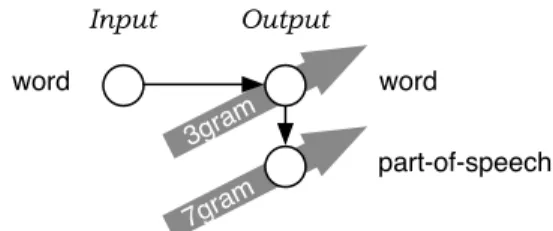
word word
part-of-speech
Output Input
3g ram
7gram
Figure 4: Syntactically enriched output: By gener-ating additional linguistic factors on the output side, high-order sequence models over these factors sup-port syntactical coherence of the output.
decoding (recall the example in Section 4, where we carried out the expansion for one input phrase). This means that the fundamental search algorithm does not change.
However, we need to be careful about combina-torial explosion of the number of translation options given a sequence of mapping steps. In other words, the expansion may create too many translation op-tions to handle. If one or many mapping steps result in a vast increase of (intermediate) expansions, this may be become unmanageable. We currently ad-dress this problem by early pruning of expansions, and limiting the number of translation options per input phrase to a maximum number, by default 50. This is, however, not a perfect solution. We are cur-rently working on a more efficient search for the top 50 translation options to replace the current brute-force approach.
6 Experiments
We carried out a number of experiments using the factored translation model framework, incorporating both linguistic information and automatically gener-ated word classes.
This work is implemented as part of the open source Moses1system (Koehn et al., 2007). We used the default settings for this system.
6.1 Syntactically Enriched Output
In the first set of experiments, we translate surface forms of words and generate additional output fac-tors from them (see Figure 4 for an illustration). By adding morphological and shallow syntactic
infor-1
English–German
Model BLEU
best published result 18.15% baseline (surface) 18.04%
surface + POS 18.15%
surface + POS + morph 18.22%
English–Spanish
Model BLEU
baseline (surface) 23.41%
surface + morph 24.66%
surface + POS + morph 24.25%
English–Czech
Model BLEU
baseline (surface) 25.82%
surface + all morph 27.04%
surface + case/number/gender 27.45% surface + CNG/verb/prepositions 27.62%
Table 1: Experimental results with syntactically en-riched output (part of speech, morphology)
mation, we are able to use high-order sequence mod-els (just like n-gram language modmod-els over words) in order to support syntactic coherence of the output. Table 1 summarizes the experimental results.
The English–German systems were trained on the full 751,088 sentence Europarl corpus and evaluated on the WMT 2006 test set (Koehn and Monz, 2006). Adding part-of-speech and morphological factors on the output side and exploiting them with 7-gram sequence models results in minor improvements in BLEU. The model that incorporates both POS and morphology (18.22% BLEU vs. baseline 18.04% BLEU) ensures better local grammatical coherence. The baseline system produces often phrases such as zur(to) zwischenstaatlichen(inter-governmental) methoden(methods), with a mismatch between the determiner (singular) and the noun (plural), while the adjective is ambiguous. In a manual evaluation of intra-NP agreement we found that the factored model reduced the disagreement error within noun phrases of length≥3from 15% to 4%.
English–Spanish systems were trained on a 40,000 sentence subset of the Europarl corpus. Here, we also used morphological and part-of-speech
fac-tors on the output side with an 7-gram sequence model, resulting in absolute improvements of 1.25% (only morph) and 0.84% (morph+POS). Improve-ments on the full Europarl corpus are smaller.
English-Czech systems were trained on a 20,000 sentence Wall Street Journal corpus. Morphologi-cal features were exploited with a 7-gram language model. Experimentation suggests that it is benefi-cial to carefully consider which morphological fea-tures to be used. Adding all features results in lower performance (27.04% BLEU), than consider-ing only case, number and gender (27.45% BLEU) or additionally verbial (person, tense, and aspect) and prepositional (lemma and case) morphology (27.62% BLEU). All these models score well above the baseline of 25.82% BLEU.
An extended description of these experiments is in the JHU workshop report (Koehn et al., 2006).
6.2 Morphological Analysis and Generation
The next model is the one described in our motivat-ing example in Section 4 (see also Figure 2). Instead of translating surface forms of words, we translate word lemma and morphology separately, and gener-ate the surface form of the word on the output side.
We carried out experiments for the language pair German–English, using the 52,185 sentence News Commentary corpus2. We report results on the de-velopment test set, which is also the out-of-domain test set of the WMT06 workshop shared task (Koehn and Monz, 2006). German morphological analysis and POS tagging was done using LoPar Schmidt and Schulte im Walde (2000), English POS tagging was done with Brill’s tagger (Brill, 1995), followed by a simple lemmatizer based on tagging results.
Experimental results are summarized in Table 2. For this data set, we also see an improvement when using a part-of-speech language model — the BLEU score increases from 18.19% to 19.05% — consis-tent with the results reported in the previous section. However, moving from a surface word translation mapping to a lemma/morphology mapping leads to a deterioration of performance to a BLEU score of 14.46%.
Note that this model completely ignores the sur-face forms of input words and only relies on the
2
Made available for the WMT07 workshop shared task
German–English
Model BLEU
baseline (surface) 18.19%
+ POS LM 19.05%
pure lemma/morph model 14.46% backoff lemma/morph model 19.47%
Table 2: Experimental results with morphological analysis and generation model (Figure 2), using News Commentary corpus
more general lemma and morphology information. While this allows the translation of word forms with known lemma and unknown surface form, on bal-ance it seems to be disadvantage to throw away sur-face form information.
To overcome this problem, we introduce an al-ternative path model: Translation options in this model may come either from the surface form model or from the lemma/morphology model we just de-scribed. For surface forms with rich evidence in the training data, we prefer surface form mappings, and for surface forms with poor or no evidence in the training data we decompose surface forms into lemma and morphology information and map these separately. The different translation tables form dif-ferent components in the log-linear model, whose weights are set using standard minimum error rate training methods.
The alternative path model outperforms the sur-face form model with POS LM, with an BLEUscore of 19.47% vs. 19.05%. The test set has 3276 un-known word forms vs 2589 unun-known lemmas (out of 26,898 words). Hence, the lemma/morph model is able to translate 687 additional words.
6.3 Use of Automatic Word Classes
Finally, we went beyond linguistically motivated factors and carried out experiments with automati-cally trained word classes. By clustering words to-gether by their contextual similarity, we are able to find statistically similarities that may lead to more generalized and robust models.
We trained models on the IWSLT 2006 task (39,953 sentences). Compared to a baseline English–Chinese system, adding word classes on the output side as additional factors (in a model as
pre-English–Chinese
Model BLEU
baseline (surface) 19.54% surface + word class 21.10%
Table 3: Experimental result with automatic word classes obtained by word clustering
Chinese–English
Recase Method BLEU
Standard two-pass: SMT + recase 20.65% Integrated factored model (optimized) 21.08%
Output Input
mixed-cased
lower-cased lower-cased
Table 4: Experimental result with integrated recas-ing (IWSLT 2006 task)
viously illustrated in Figure 4) to be exploited by a 7-gram sequence model, we observe a gain 1.5% BLEU absolute. For more on this experiment, see (Shen et al., 2006).
6.4 Integrated Recasing
To demonstrate the versatility of the factored trans-lation model approach, consider the task of recas-ing (Lita et al., 2003; Wang et al., 2006). Typically in statistical machine translation, the training data is lowercased to generalize over differently cased sur-face forms — say, the, The, THE — which neces-sitates a post-processing step to restore case in the output.
6.5 Additional Experiments
Factored translation models have also been used for the integration of CCG supertags (Birch et al., 2007), domain adaptation (Koehn and Schroeder, 2007) and for the improvement of English-Czech translation (Bojar, 2007).
7 Conclusion and Future Work
We presented an extension of the state-of-the-art phrase-based approach to statistical machine trans-lation that allows the straight-forward integration of additional information, may it come from linguistic tools or automatically acquired word classes.
We reported on experiments that showed gains over standard phrase-based models, both in terms of automatic scores (gains of up to 2% BLEU), as well as a measure of grammatical coherence. These experiments demonstrate that within the framework of factored translation models additional informa-tion can be successfully exploited to overcome some short-comings of the currently dominant phrase-based statistical approach.
The framework of factored translation models is very general. Many more models that incorporate different factors can be quickly built using the ex-isting implementation. We are currently exploring these possibilities, for instance use of syntactic in-formation in reordering and models with augmented input information.
We have not addressed all computational prob-lems of factored translation models. In fact, compu-tational problems hold back experiments with more complex factored models that are theoretically pos-sible but too computationally expensive to carry out. Our current focus is to develop a more efficient im-plementation that will enable these experiments.
Moreover, we expect to overcome the constraints of the currently implemented synchronousfactored models by developing a more generalasynchronous framework, where multiple translation steps may operate on different phrase segmentations (for in-stance a part-of-speech model for large scale re-ordering).
Acknowledgments
This work was supported in part under the GALE program of the Defense Advanced Research Projects
Agency, Contract No NR0011-06-C-0022 and in part under the EuroMatrix project funded by the Eu-ropean Commission (6th Framework Programme).
We also benefited greatly from a 2006 sum-mer workshop hosted by the Johns Hopkins Uni-versity and would like thank the other workshop participants for their support and insights, namely Nicola Bertoldi, Ondrej Bojar, Chris Callison-Burch, Alexandra Constantin, Brooke Cowan, Chris Dyer, Marcello Federico, Evan Herbst Christine Moran, Wade Shen, and Richard Zens.
References
Alshawi, H., Bangalore, S., and Douglas, S. (1998). Automatic acquisition of hierarchical transduction models for machine translation. InProceedings of the 36th Annual Meeting of the Association of Computational Linguistics (ACL). Birch, A., Osborne, M., and Koehn, P. (2007). CCG supertags
in factored statistical machine translation. InProceedings of the Second Workshop on Statistical Machine Translation, pages 9–16, Prague, Czech Republic. Association for Com-putational Linguistics.
Bojar, O. (2007). English-to-Czech factored machine transla-tion. InProceedings of the Second Workshop on Statistical Machine Translation, pages 232–239, Prague, Czech Repub-lic. Association for Computational Linguistics.
Brill, E. (1995). Transformation-based error-driven learning and natural language processing: A case study in part of speech tagging.Computational Linguistics, 21(4).
Collins, M., Koehn, P., and Kucerova, I. (2005). Clause re-structuring for statistical machine translation. In Proceed-ings of the 43rd Annual Meeting of the Association for Com-putational Linguistics (ACL’05), pages 531–540, Ann Arbor, Michigan. Association for Computational Linguistics. Galley, M., Graehl, J., Knight, K., Marcu, D., DeNeefe, S.,
Wang, W., and Thayer, I. (2006). Scalable inference and training of context-rich syntactic translation models. In Pro-ceedings of the 21st International Conference on Computa-tional Linguistics and 44th Annual Meeting of the Associa-tion for ComputaAssocia-tional Linguistics, pages 961–968, Sydney, Australia. Association for Computational Linguistics. Koehn, P., Federico, M., Shen, W., Bertoldi, N., Hoang, H.,
Callison-Burch, C., Cowan, B., Zens, R., Dyer, C., Bojar, O., Moran, C., Constantin, A., and Herbst, E. (2006). Open source toolkit for statistical machine translation: Factored translation models and confusion network decoding. Tech-nical report, John Hopkins University Summer Workshop. Koehn, P., Hoang, H., Birch, A., Callison-Burch, C., Federico,
M., Bertoldi, N., Cowan, B., Shen, W., Moran, C., Zens, R., Dyer, C., Bojar, O., Constantin, A., and Herbst, E. (2007). Moses: Open source toolkit for statistical machine transla-tion. InProceedings of the Annual Meeting of the Associa-tion for ComputaAssocia-tional Linguistics, demonstaAssocia-tion session. Koehn, P. and Knight, K. (2003). Feature-rich translation of
Koehn, P. and Monz, C. (2006). Manual and automatic evalua-tion of machine translaevalua-tion between European languages. In
Proceedings on the Workshop on Statistical Machine Trans-lation, pages 102–121, New York City. Association for Com-putational Linguistics.
Koehn, P., Och, F. J., and Marcu, D. (2003). Statistical phrase based translation. InProceedings of the Joint Conference on Human Language Technologies and the Annual Meeting of the North American Chapter of the Association of Computa-tional Linguistics (HLT-NAACL).
Koehn, P. and Schroeder, J. (2007). Experiments in domain adaptation for statistical machine translation. In Proceed-ings of the Second Workshop on Statistical Machine Trans-lation, pages 224–227, Prague, Czech Republic. Association for Computational Linguistics.
Lee, Y.-S. (2004). Morphological analysis for statistical ma-chine translation. InProceedings of the Joint Conference on Human Language Technologies and the Annual Meeting of the North American Chapter of the Association of Computa-tional Linguistics (HLT-NAACL).
Lita, L. V., Ittycheriah, A., Roukos, S., and Kambhatla, N. (2003). tRuEcasIng. In Hinrichs, E. and Roth, D., editors,
Proceedings of the 41st Annual Meeting of the Association for Computational Linguistics, pages 152–159.
Melamed, I. D. (2004). Statistical machine translation by pars-ing. In Proceedings of the 42nd Meeting of the Associa-tion for ComputaAssocia-tional Linguistics (ACL’04), Main Volume, pages 653–660, Barcelona, Spain.
Menezes, A. and Quirk, C. (2005). Microsoft research treelet translation system: IWSLT evaluation. InProc. of the Inter-national Workshop on Spoken Language Translation. Nießen, S. and Ney, H. (2001). Toward hierarchical models
for statistical machine translation of inflected languages. In
Workshop on Data-Driven Machine Translation at 39th An-nual Meeting of the Association of Computational Linguis-tics (ACL), pages 47–54.
Och, F. J. (2003). Minimum error rate training for statistical ma-chine translation. InProceedings of the 41st Annual Meeting of the Association of Computational Linguistics (ACL). Och, F. J., Gildea, D., Khudanpur, S., Sarkar, A., Yamada, K.,
Fraser, A., Kumar, S., Shen, L., Smith, D., Eng, K., Jain, V., Jin, Z., and Radev, D. (2004). A smorgasbord of fea-tures for statistical machine translation. InProceedings of the Joint Conference on Human Language Technologies and the Annual Meeting of the North American Chapter of the Association of Computational Linguistics (HLT-NAACL). Sadat, F. and Habash, N. (2006). Combination of arabic
pre-processing schemes for statistical machine translation. In
Proceedings of the 21st International Conference on Com-putational Linguistics and 44th Annual Meeting of the As-sociation for Computational Linguistics, pages 1–8, Sydney, Australia. Association for Computational Linguistics. Schmidt, H. and Schulte im Walde, S. (2000). Robust German
noun chunking with a probabilistic context-free grammar. In
Proceedings of the International Conference on Computa-tional Linguistics (COLING).
Shen, W., Zens, R., Bertoldi, N., and Federico, M. (2006). The JHU Workshop 2006 IWSLT System. InProc. of the Inter-national Workshop on Spoken Language Translation, pages 59–63, Kyoto, Japan.
Talbot, D. and Osborne, M. (2006). Modelling lexical redun-dancy for machine translation. InProceedings of the 21st International Conference on Computational Linguistics and 44th Annual Meeting of the Association for Computational Linguistics, pages 969–976, Sydney, Australia. Association for Computational Linguistics.
Wang, W., Knight, K., and Marcu, D. (2006). Capitalizing ma-chine translation. InProceedings of the Joint Conference on Human Language Technologies and the Annual Meeting of the North American Chapter of the Association of Computa-tional Linguistics (HLT-NAACL).
Wu, D. (1997). Stochastic inversion transduction grammars and bilingual parsing of parallel corpora. Computational Lin-guistics, 23(3).
Yamada, K. and Knight, K. (2001). A syntax-based statistical translation model. InProceedings of the 39th Annual Meet-ing of the Association of Computational LMeet-inguistics (ACL). Yang, M. and Kirchhoff, K. (2006). Phrase-based backoff
mod-els for machine translation of highly inflected languages. In