Dynamic Adaptation for Distributed Systems
Jingtao Sun
Doctor of Philosophy
Department of Informatics
School of Multidisciplinary Sciences
SOKENDAI (The Graduate University for
Advanced Studies)
Dynamic Adaptation for
Distributed Systems
Jingtao Sun
A dissertation submitted to the Department of Informatics
School of Multidisciplinary Sciences
(SOKENDAI)The Graduate University for Advanced Studies
in partial fulfillment of the requirements for the degree of
Doctor of Philosophy
September 2016
Advisory Committee:
Ichiro Satoh (Supervisor, National Institute of Informatics) Shin Nakajima (National Institute of Informatics)
Kento Aida (National Institute of Informatics) Asanobu Kitamoto (National Institute of Informatics)
Tatsuo Nakajima (Weseda University) Copyright c 2016 by
Jingtao Sun All rights reserved.
Acknowledgements
First, I would like to express my deep-felt gratitude to my supervisor, Professor Ichiro Satoh of the Information Systems Architecture Research Division at the National Institute of Informatics (also the Department of Informatics at the Graduate University for Advanced Studies) for his constant support and mentoring. His serious and responsible work style in academia had a very deep impact on me. He guided me not only in my work and research but also in the course of my life. I have also been extremely fortunate to have been able to work so closely with him. I also wish to thank my advisers professor Shin Nakajima, professor Kento Aida, associate professor Asanobu Kitamoto of the National Institute of Informatics, and professor Tatsuo Nakajima of Waseda University, who provided many insightful comments and suggestions on my work and dis- sertation. It has been a pleasure to work with them.
Further, I am lucky to have worked closely with Dr.Sisi Duan of the com- putational data analysis group at Oak Ridge National Laboratory. She gave me a lot of astute help in our collaborative researches. I greatly appreciate her help, especially when we discussed our researches during what was my day and her night.
Above all, I want to thank my dear friend, Mingqing Wu. Especially when I lost myself in despair, thank you for your concern about me, and thank you for the dinner you cooked for me. Thanks also go to my parents, Xiangfeng Sun and Yanqiu Li, and my collaborators Kai Xu of Wayne State University, USA, Yuan Yuan of the University of Alberta, Canada, secretary Hiroko Maruyama of National Institute of Informatics, profes- sor Kazuya Tago, assistant professor Chihiro Shibata, and messrs. Zhan Jin and Ruhui Ye of the Tokyo University of Technology. Without their supports, I could not imagine how I could have written my dissertation throughout the whole process.
Abstract
Applications are typically executed on fixed distributed system architec- tures, and they merely interconnect a huge number of software components through networks. However, the complexity and dynamism of distributed systems are beyond our ability to build and manage such systems through conventional approaches, such as centralized and top-down architectures. On the other hand, the requirements of applications or the structure of systems change from time to time. For instance, software components that applications consist of may be dynamically added to or removed from dis- tributed systems, and networks between computers may be rapidly discon- nected and reconnected. Therefore, modern distributed systems demand availability, dependability, and reliability to adapt themselves to various changes, even dynamically, to self-adapt their architectures.
This dissertation first presents the requirements and proposed approaches. The key idea behind the proposed approaches are to introduce the reloca- tion of software components, which define functions, between computers as a basic mechanism for adaptation. Second, it introduces the design of Mimosa, which is an adaptive and reliable middleware that adapts to various changes through relocation of software components in distributed systems. Third, a policy-based language is described for specifying, and analyzing user-defined adaptations. Since the language is defined on a theoretical function, it enables the results of conflicts and divergences from adaptions to be to analyzed sequentially. Although the proposed approaches are based on adaptive deployments of software components but not on those of adaptive functions inside any software components. Therefore, my proposal can more effectively adapt to types of change be- tween distributed systems and applications, even change the fixed system architectures. This is because user-definitions of policies were separated from software components, and then the software components could be invoked from different computers.
This dissertation describes the design and implementation of the ap- proaches with five distributed applications, and experiments were run on my system with the proposed applications over a distributed system.
Contents
Contents i
List of Figures iv
List of Tables vi
1 Introduction 1
1.1 Motivation . . . 2
1.2 Requirement . . . 3
1.3 Challenge . . . 4
1.4 Contribution . . . 5
1.5 Organization . . . 7
2 Related Work 8 2.1 Parameter-level Adaptation . . . 9
2.2 Coordination-level Adaptation . . . 10
2.3 Software-level Adaptation . . . 18
2.4 Other Approaches . . . 20
2.4.1 Architecture Approach . . . 20
2.4.2 Location Approach . . . 24
2.5 Discussion . . . 28
2.6 Summary . . . 30
3 Proposed Approach 32 3.1 Overview . . . 33
3.2 Scenarios . . . 33
3.3 Approach . . . 40
3.4 Discussion . . . 42
3.5 Summary . . . 44
4 Mimosa: a Dynamic Adaptation Middleware through Relocation of
Software Components for Distributed Systems 45
4.1 Strong and Weak Relocation . . . 46
4.2 System Model . . . 46
4.3 Approach: Dynamic Adaptation for Distributed Systems . . . 48
4.3.1 Software Components . . . 48
4.3.2 Adaptation Policy . . . 49
4.4 Mimosa: System Design . . . 50
4.4.1 Adaptive System Architecture . . . 50
4.4.2 Component Runtime System . . . 51
4.4.2.1 Component Marshaling . . . 53
4.4.2.2 Dynamic methods Invocation . . . 54
4.4.3 Adaptation Manager . . . 54
4.5 Benefits . . . 56
4.6 Discussion . . . 56
4.7 Summary . . . 57
5 A Policy-based Language for Specifying Adaptation 58 5.1 Overview . . . 59
5.2 Language Requirement . . . 59
5.2.1 Problem statements . . . 59
5.2.2 Requirements for language . . . 60
5.2.3 Advantages . . . 61
5.3 Approach: Policy-based Specification Language . . . 61
5.3.1 Policy Expression . . . 62
5.3.2 Policy Conditional Functions . . . 63
5.3.3 Control Structures . . . 64
5.4 Design of Policy Formats . . . 64
5.4.1 Attraction Policy . . . 64
5.4.2 Spreading Policy . . . 65
5.4.3 Repulsion Policy . . . 65
5.4.4 Evaporation Policy . . . 66
5.4.5 Time-To-Live Policy . . . 66
5.5 Policy Conflict and Divergence . . . 66
5.5.1 Conflict . . . 66
5.5.2 Divergence . . . 69
5.6 Discussion . . . 70
5.7 Summary . . . 70
6 Adaptive Applications on Distributed Systems 72 6.1 Remote Information Retrieval . . . 73
6.2 Primary-back up and Chain Replication . . . 74
6.3 Spreading Components for Sensor Nodes . . . 79
6.4 Distributed Model-View-Control application . . . 80
6.5 Reliable Publish/Subscribe System . . . 84
6.6 Summary . . . 86
7 Implementation and Evaluations 87 7.1 Implementation of Mimosa Middleware . . . 88
7.1.1 Experiments and Evaluations . . . 91
7.1.2 Discussion . . . 95
7.2 Implementation of Policy-based Language . . . 95
7.2.1 Experiments and Evaluations . . . 98
7.2.2 Discussion . . . 99
7.3 Summary . . . 99
8 Conclusion and Future Work 101 8.1 Overview of Dissertation . . . 102
8.2 Conclusion . . . 103
8.3 Future Work . . . 104
Bibliography 106
References 106
List of Figures
2.1 Obligation policies . . . 13
2.2 RELAX process . . . 14
2.3 Example of stitch language . . . 16
2.4 Architectural model . . . 23
2.5 Architectural framework . . . 24
3.1 Adaptive system architecture . . . 34
3.2 Adaptive addition & deletion of computers . . . 35
3.3 Adaptive network environment . . . 38
3.4 Adaptive resource management . . . 39
3.5 Adaptive events of publish/subscribe system . . . 40
3.6 Approach solutions . . . 41
4.1 Adaptive model . . . 47
4.2 Mimosa system architecture . . . 52
4.3 Marshaling of component . . . 53
4.4 Relocation of component between computers . . . 53
4.5 Policy for relocation . . . 55
5.1 Policy formats . . . 65
5.2 Local conflict . . . 67
5.3 Global conflict . . . 68
5.4 Divergence . . . 70
6.1 Adaptive remote information retrieval . . . 74
6.2 Adaptive consistency for data replication . . . 75
6.3 Primary-backup change to Chain . . . 77
6.4 Chain change to Primary-backup . . . 78
6.5 Adaptive sensor networks . . . 81
6.6 Adaptive model-view-control application . . . 83
6.7 Adaptive pub/sub system . . . 85
7.1 Mimosa middleware graphical user interface . . . 90
7.2 Applications running on mimosa system . . . 91
7.3 Experiment of receive model . . . 92
7.4 Experiment of send model . . . 93
7.5 Experiment of start component . . . 93
7.6 Experiment of relocated component . . . 94
7.7 Experiment of received component . . . 94
List of Tables
2.1 Comparison with existing language. . . 17
2.2 Comparison with existing adaptation researches. . . 29
5.1 Notations. . . 61
5.2 Policy expressions. . . 62
7.1 Execution of mimosa system. . . 90
7.2 Experiment environment. . . 92
7.3 Expression notation. . . 96
7.4 Mainly key words. . . 97
7.5 Operators. . . 97
7.6 Performance. . . 98
Chapter 1
Introduction
Computer systems are currently undergoing a revolution. Two advanced technologies began to change the situation. The first involved the invention of powerful micro- processors and memory chips and the second involved the invention of high-speed computer networks. These technologies were not only feasible, but also made it easy to connect a large numbers of computers into systems through high-speed networks, which are called distributed systems.
Distributed systems have been widely used in various fields of computing, such as artificial intelligence, cloud computing, ubiquitous computing, mobile computing, disaggregated computing, big data, machine learning, the Internet of Things (IoTs), and machine to machine (M2M) [10] [3] [57] [28] [75] [13] [58] [94] [25]. Distributed systems are complicated and dynamic by nature because their structures, and the applications running on them tend to change dynamically. For instance, applications running on computers or software components may be added to or removed from dis- tributed systems, and networks between computers may be frequently disconnected and reconnected. Existing distributed systems should have the capabilities to adapt themselves to such changes, and even dynamically change their architectures to sup- port their business targets and behaviors.
How to build adaptive distributed systems has become one of the foremost chal- lenges for researchers. This chapter first introduces the motivation for my research. It then describes the requirements and challenges to dynamically achieve adaptive dis- tributed systems. Finally, the main contributions of this dissertation are presented.
1.1 Motivation
Distributed systems need to support availability, adaptability, and dependability, be- cause they are often used for mission-critical purposes. However, the configurations of particular systems have currently been built and operated with specific architectures. Specific architectures have lost their effectiveness with the expanded scale and use of distributed systems. Distributed applications, on the other hand, have been imple- mented for multiple purposes and multiple users with various requirements that have changed dynamically. Therefore, software running on distributed systems should be resilient so that the systems can adapt software to various changes at runtime, and even change the architecture of existing distributed systems to support their busi- ness targets and behaviors. Software running on distributed systems should also be reuseable so that it can adapt to various changes in different distributed systems.
Adaptation is an effective way of resolving dynamic changes between distributed systems and applications. Many researchers have focused on dynamic adaptation for distributed systems through a variety of approaches [89] [8] [17] [21] [90] [29] [20]. However, adaptation is not only needed to avoid harmful effects, but also to reap the benefits of potentially favorable effects. Therefore, relocation of software components is focused on in this dissertation between computers for adaptation on distributed systems. Although it seems very simple, it can provide very strong adaptability in both general-purpose applications and existing distributed systems. Conversely, al- though the conditions of adaptation written inside software programs is a solution, such programs are difficult to maintain, and it is not easy for junior developers to develop efficient adaptation programs. Therefore, it is believed that adaptation pro- grams should be separated from business logic. Adaptation from business logic is distinguished in this dissertation by using the principle of separation of concerns, so that developers can concentrate on business logic rather than adaptation programs as much as possible.
Based on these motivations, this dissertation addresses a policy-based middleware to adapt to various changes in existing distributed systems. It was assumed that distributed applications would consist of one or more software components, which might have been running on different computers through networks. The proposed approach incorporates two key ideas:
• The proposed adaptation does not cause unnecessary failures, and supports a wide variety of changes on existing distributed systems. It focuses on the
relocation of software components between computers as a basic adaptation mechanism (The details are presented in Chapter 4).
• A policy-based language needs to be designed for developers to define nature- inspired relocation policies for describing application-specific adaptations to dis- tinguish adaptation concerns from software components on distributed systems (The details are presented in Chapter 5).
Based on these two ideas, when changes occur and their defined conditions of poli- cies are satisfied, software components are automatically relocated, duplicated then re- located, between computers or removed from computers to adapt themselves to changes on distributed systems.
1.2 Requirement
Distributed systems are used for multiple purposes and need capabilities to adapt themselves to various changes in results from their dynamic properties [93]. Therefore, seven requirements were first defined for distributed systems, and my approach should meet all of these requirements.
• Self-adaptability: Software components may be running on different computers. Therefore, software components should coordinate themselves to support their applications with partial knowledge about other computers.
• On-demand deployment of software: Computers may have limited resources so that they cannot support software for various applications beforehand. Software for the applications needs to be dynamically deployed at appropriate computers to coordinate multiple computers for individual applications.
• Separation of concerns: All software components should be defined indepen- dently of the proposed adaptation mechanism as much as possible. As a result, developers should be able to concentrate on their own application-specific pro- cessing.
• Availability: System failures are inevitable since numerous software components run on distributed systems. The proposed adaptation should not only avoid causing more system failures, but also needs to adapt to them as well as provide a non-stop distributed system when these failures occur. Therefore, an effective solution is to relocate software components between computers. This is because
it just changes the location of software components instead of changing their functions. Furthermore, it also enable applications to remain available after their adaptations in distributed systems.
• Reusability: There have been many attempts to provide adaptive distributed systems. However, as the approaches and parameters in most of them have strictly and statically depended on their target systems, they have needed to be re-defined overall for reuse in other distributed systems. The proposed adap- tation should be abstracted away from the underlying systems for reasons of reusability.
• Non-centralized management: There is no central entity to control and coor- dinate computers. The proposed adaptation should be managed without any centralized management for reasons of avoiding any single points of failures and performance bottlenecks to attain availability and scalability.
• General-purpose and adaptation independence: There are various applications running on distributed systems. Therefore, the approach should be implemented as a practical middleware to support general-purpose applications. All software components should be defined independently of the proposed adaptation mech- anism as much as possible. As a result, developers should be able to concentrate on their own application-specific processing.
Computers on distributed systems may have limited resources, for instance, pro- cessing, and storage resources. On the other hand, the bandwidths of networks on several distributed systems tend to be narrow and their latency cannot be neglected. Therefore, the proposed approach should be available with such limited resources and such networks, whereas many existing adaptation approaches explicitly or implicitly assume that their target distributed systems have enriched resources.
1.3 Challenge
There are a few challenges on be confronted in designing adaptive distributed systems. Depending on the structure of distributed systems and the requirements of applica- tions, software components should be flexible and adaptable. These challenges can be tackled in four steps:
• A middleware system needs to be designed and implemented to support adap- tation in both systems and applications so that it does not rely on different execution environments. This middleware system needs the capability to man- age and relocate software components between computers and determine which software component should be relocated to where. The methods of relocating software components should be dynamically invocated at destination computers through the middleware system.
• A policy-based language needs to be designed and implemented for users so that they can easily define their requirements as polices, such as the requirements of applications or the structures of system changes or network states. These policies need to include a pair of condition and action parts. If the condition part can be satisfied, software components should be relocated to the destination computer and then their operations need to be restarted.
• A policy interpreter needs to be designed and implemented in our middleware system for executing user-defined policies. Because the interpreter does not need to generate intermediate object code and memory requirements are much less, it is very consistent with the designed middleware system.
• Several applications also need to be developed to verify the performance and effectivity of the proposed middleware systems and policy language, and even import the necessary mechanism to analyze the conflicts and divergences be- tween user-defined policies.
Many researchers have proposed various approaches for adaptation on distributed systems [89] [44] [43] [23] [68] [14] [21]. They have focused on changing parameters, coordination of functions or modify software for adaptation, instead of focusing on the relocation of software components between computers for adaptation. Their ap- proaches have been effective, but they may create unnecessary failures in existing distributed systems, thereby causing distributed systems to stop and reduce avail- ability and reusability.
1.4 Contribution
This dissertation describes how I hoped to tackle these challenges to provide a general- proposed approach to adapt components themselves to changes by relocating software components for distributed systems and applications. Several applications were used
to overcome the challenges and test the proposed approach to validate its feasibility. The six key contributions of the research described in this dissertation are below:
• A middleware called Mimosa was designed and implemented (explained in Chapter 4), which allows software components to self-adaptively relocate or duplicate/relocate or remove themselves from destination computers when the structure of distributed systems or the requirements of applications are changed.
• The Mimosa system not only relocates the software components in distributed computers, but it can also relocate their states of software components to des- tination computers. It can make the relocated software components continue their operations at the destination computer by dynamically invoking their life- cycle methods.
• A dynamic method invocation (DMI) mechanism was also developed, in which the common object request broker architecture (CORBA) [79] was studied, so that our mechanism could easily hide differences between the interface of objects at the original computer and others.
• A policy-based language was designed for users who need to define their re- quirements as policies throuth process calculus [61]. It is basically defined as a pair of information items on where and when the software components are deployed.
• Each application-specific component can have one or more policies, therefore user-defined policies may cause various conflict or divergence, so that the adap- tation mechanism need to be able to analyze them through the properties of software component descriptions with the proposed policy-based language, and provide the necessary modified proposal to policy-makers.
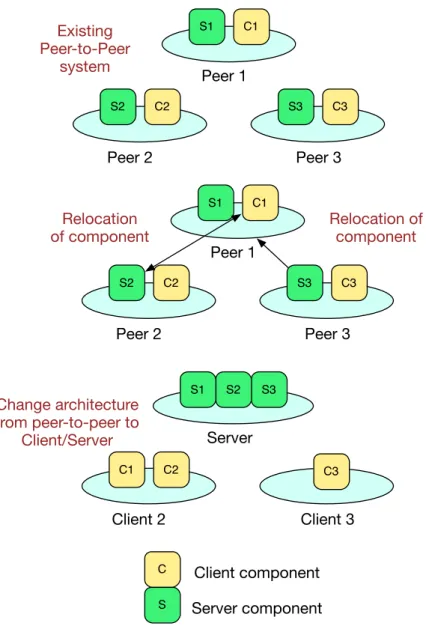
• Distributed applications are formed by different software components. There- fore, through the relocation of software components between computers, the architectures of existing distributed systems can be dynamically changed. For instance, the system architectures can also be dynamically changed in both the directions of the Client/Server and Peer-to-Peer.
Application developers no longer need to write complex and adaptive code in- side their programs with the proposed developer-friendly adaptation middleware and policy-based language, then developers just need to focus on their own work. In
addition, general-purposed distributed applications can run on the middleware sys- tem and they do not need to do anything for adaptation. When changes occur, the middleware system can determine where software components are relocated so that they can dynamically adapt themselves to various changes, according to user-defined policies.
1.5 Organization
This dissertation is organized into eight chapters, which include the introduction, rrevious studies are described in Chapter 2, which are separated into three types, and two applicated approaches are then compared with my proposed approach. The six remaining chapters can be divided into three parts.
The first part (Chapter 3) introduces the underlying concept behind the research, and why I chose to relocate software components for adaptation on distributed sys- tems. Some scenarios are presented in this chapter. I will describe the validity of the proposed approach in contrast with existing studies, and why it can solve problems that existing research cannot.
The second part (Chapters 4 and 5) introduces a reliable middleware, called Mi- mosa (Chapter 4), including its specific structure, and how it can adapt to various changes in distributed systems through relocating software components between com- puters. As the Mimosa middleware system does not depend on the execution envi- ronment, it can run on all operating systems. Next, a policy-based language for users is presented to define functions as policies for relocating software components. As it was designed based on theoretical foundations, it enables the effects of adaptations to be analyzed. Both the software and adaptation can be reused in different distributed systems because adaptation is separate from application-specific software concerns.
Five generally proposed distributed applications are introduced (Chapter 6) based on the approaches to demonstrate the relocation of software components for adap- tation on a distributed system, according to user-defined policies. Implementations, evaluations, and conclusions are covered in the third and last part (Chapters 7 and 8). Chapter 7 explains the implementations and evaluations of the Mimosa middle- ware system and our policy-based language with the five distributed applications. A summary of this dissertation and an outline of future work are given in Chapter 8.
Chapter 2
Related Work
This chapter provides an introduction to research areas with which this dissertation is concerned. The following sections describe the backgrounds and explain the most influential researches in the area of adaptation on distributed systems.
Previous studies on adaptation areas can be classified into three types. The first has focused on parameter-level adaptation for distributed systems. It modifies pro- gram variables that determine behavior. The second has focused on coordination- level adaptation for distributed systems. It provides adaptation through dynamic changes in the coordination of different software components within a computer. The third has involved software-level approaches to adaptation, e.g., the genetic algorithm (GA), genetic programming, and swarm intelligence. It provides adaptation through a dynamic redefinition of software.
Based on the three technologies, there are two applicated approaches for adap- tation. Architecture approaches enables existing system structures from one type to change to another type to provide adaptation. Location approaches have used Mobile agents to adapt agents to changes in their system environment, and it can change locations by migrating agents to dynamically adapt to their behaviors on distributed systems.
The next section surveys existing studies on how to provide adaptation on dis- tributed systems.
2.1 Parameter-level Adaptation
The first type is parameter-level adaptation for distributed systems. An often-cited example, the Internet’s Transmission Control Protocol (TCP) [69] allows its behavior by changing values which could control window management. It also adjusts retrans- missions in response to apparent network congestion.
In dynamic environments, the value of parameters may change over time. Epifani et al. presented a framework, called KAMI [24]. They provided a solution by changing the parameters on a runtime system. The updated model that provided for software engineers have advantages and disadvantage. Before the software engineers build their systems, they should give full consideration to all requirements. Once their original systems are constructed, parameter adaptation does not allow new algorithms and software components to be added to applications. It can tune parameters or direct an application to use a different existing strategy, however it cannot adopt new strategies.
Herrera and Lozano proposed an approach to adaptive parameters, in which their approach was based on the use of fuzzy logic controllers [33] through which the param- eters dynamically changed to provide adaptation for distributed systems. Programs could be rewritten in their research; however, they could not adapt themselves to changes inside systems, and the software components could not be reused.
Chang et al., [14] present an adaptation approach for distributed applications to adapt to changing resource characteristics. Their approach modify program variables that determine behavior. However, It does not allow new algorithms and components to be added to an application after the original design and construction.
Blair et al. explored the role of the Aster framework in supporting dynamic adap- tation within the context of the Open-ORB middleware platform [8]. Following a detailed examination of adaptation, I concluded that Aster [37] could usefully be ex- tended to meet my requirements. The key extensions to Aster included the incorpora- tion of weakest properties and environmental parameters in architectural descriptions to accommodate re-configurations due to changing non-functional parameters in the former and environmental conditions in the latter. However, when changes occurred in their research project, the defined configurations or re-configurations were difficult to reuse.
A model-driven middleware was presented in [45]. They focused on component- based parameter adaptation to adapt changes for applications at a runtime system. They designed their user interface for implementing components with a number of dif- ferent variants, e.g., OneWayUI, TwoWayUI, PlayBackUI. However, their approach has an inherent weakness. Changes in the environment can not only from the ap- plications, but also may come from their system itself or the networks. Therefore, adaptive behaviors are limited in parameter-level adaptation.
Ting Liu and Margaret Martonosi presented a non-VM-based middleware system for managing distribuetd sensor systems, called Impala [53]. It allows software up- dates to be received through the transceiver of nodes, and to be applied to the running system dynamically. However, they defined a set of application parameters and sys- tem parameters to represent at runtime. However, adaptive behaviors are limited in their researches, it does not allow new algorithms to be added to applications, and does not allow software components to be relocated between computers.
2.2 Coordination-level Adaptation
The second type is coordination-level adaptation for distributed systems. These ap- proaches can be divided into two categories.
The first changes the coordination of programs for adaptation, such as [89] [44] [43] [23].
Uribarren et al. presented a context-based coordination-level middleware plat- form, which was a configurable, adaptable, heterogeneous, and interoperable middle- ware that was abbreviated to CAHIM. CAHIM provides interoperable mechanisms of communication between applications and devices [89]. Like mine, their middleware platform provided good portability, and was independent of the underlying hardware, operating system, and of the application itself. CAHIM can be simply summed up as the collection, distribution, transformation and inference of generic information. For instance, one of the main scopes of CAHIM is to communicate context information, and it focuses on how to make software components run on different devices, and then to become aware of their network and related resources. However, CAHIM can adapt and provide pervasive services to distributed applications. Although CAHIM based on contexts and generic information can change the coordination of software
components, CAHIM middleware does not support the relocation of software compo- nents for adaptation and it needs more computing resources for generic information than my approach. In addition, CAHIM cannot change fixed system architectures to provide various adaptations to distributed systems.
Keeney and Cahill presented a context-aware policy-based dynamic adaptation framework, called Chisel [44] [43]. Chisel is based on decomposing the particular aspects of service objects and using meta-types, but it does not provide core func- tionality to the multiple behaviors of components. When the context of users or applications changes, service objects are driven by a human-readable adaptation pol- icy to adapt themselves to different behaviors as the execution environment. If an application needs to adapt in Chisel [43], it is usually the non-functional requirements or behaviors of some objects contained in this application that need to be changed, rather than the domain of the application that needs to be changed. Therefore, ap- plications running on Chisel can be adapted by changing these behaviors without changing the applications themselves. Like the one proposed here, Chisel separates policy and service objects. However, unlike the one proposed here, they did not rise the approach to the level of language, they used the concept of meta-types and re- flection to implement the adaptation mechanism, and the one proposed here uses policies to define the relocation of software components for adaptation. Policies in Chisel make it difficult to describe complex changes to users, and it is difficult to solve conflicts in user-defined policies. Unlike the system proposed here, their system is built on a fixed architecture, and therefore, unlike that proposed here, their ap- proach can not dynamically change the system architecture to provide adaptability to applications to adapt themselves to changes on distributed systems.
Rouvoy et al. presented a component-based middleware, i.e., for mobile users in ubiquitous computing environments that was abbreviated as MUSIC, for adapting to changes in ubiquitous and service-oriented environments [71] [72]. The MUSIC project focused on various changes from service providers. Services functionalities could be dynamically changed to adapt to changes through coordination-level adap- tation of software components. Their research was like mine in that they separated adaptation concerns from business logic concerns, and designed their middleware for complex distributed environments and various generic applications. They offered adaptivity through given changes in execution contexts. Software components that
defined service functionalities could be dynamically configured with conforming com- ponents by coordinating adaptation processes. Their approach essentially had limi- tations in adaptation. For instance, their approach could not dynamically increase or decrease or duplicate functions of components for adaptation. In addition, although their proposed approach could change the coordination of components, it required system resources to optimize the context for adaptation and it could not dynamically correspond to changes from distributed systems themselves.
Mirkoet Morandini et al., presents a goal-oriented approach to specify variability in system requirements which is called Tropos4AS (Tropos for self-adaptive systems) [63]. Tropos4AS tries to capture already at design time the information needed for autonomous decision making in self-adaptive systems, allowing designers to model features such as the ability to select among different alternatives depending on the environmental context, user’s preferences, and system failures to be prevented. How- ever, this research focus on the coordination-level, but they don’t separate the adap- tation concern from the business logic concern like mine.
Brian et al., presented a simple high-level directives and a sophisticated runtime algorithm for coordinating adaptation approach [23]. Application developers can describe when an adaptation must happen, as a functions of the relative computa- tional progress of the affected processes and then scheduled automatically by runtime system. However, they just can change the cooperation of processes, therefore the adaptive behaviors is limited, unlike mine. For instance, this approach can not dy- namically add or delete processes on various computers.
The second uses Policy-based language [20] [97] [42] [16] [17] to separate adaptive behaviors from bussiness logic for adaptation, and it is an ideal mechanism to drive general-purpose dynamic adaptation framework/middleware [59], since the adapta- tion mechanism can be completely decoupled from adaptation management. Several research groups have theoretically designed and implemented Policy-based languages for adaptation on distributed systems.
Lymberopoulos et al. [56] proposed an object-oriented declarative framework for adaptations based on their policy specification language that was called Ponder[20]. However, the Ponder language focused on specifying management and security poli- cies.
inst oblig policyName “{”
subject [<type>] domain-Scope-Expression ;
[ target [<type>] domain-Scope-Expression ;]
on event-specification ;
do obligation-action-list ;
[ catch exception-specification ; ]
[ when constraint-Expression ; ] “}”
Figure 2.1: Obligation policies
Unlike my research, they used an obligation policies format to specify the actions of components in coordination-level adaptation. When changes occurred, the Ponder language manager was run to provide capabilities for action for themselves to respond to the changing circumstances. The definition of obligation policies is given in Figure 2.1. I can see from the figure that Obligation is an event-triggered condition-action rule, which explicitly identifies the subjects that are responsible for running the man- agement actions on target objects. Both subject and target objects are specified in terms of domain scopes, which are a method of grouping objects which the policies define, such as timer events and external events. These Internal Events are collected and distributed by Ponder’s monitoring services. In addition, composite events can be specified by using event composition operators that Ponder language supports [20]. When the defined policies are sent to Differentiated Services (DiffServ) elements, the policy actions dynamically change the parameters and reconfigure the policy objects, and then the behaviors of objects are modified.
Remark The user-defined policies that were defined by Ponder language just change the coordination of the components; they cannot dynamically add/remove functions to/from their systems. Moreover, as Ponder language is dependent on the domain scope, the biggest difference is that it cannot provide functions that automat- ically select the destination by themselves, and it does not support dynamic changes to system architectures to adapt to various changes on distributed systems.
Whittle et al.fs research was different to that of Lymberopoulos et al. and they pre- sented RELAX [97] [15], i.e., a new specification language to develop the engineering language requirements of dynamically adaptive systems (DASs), while demonstra- tively addressing factoring uncertainty in requirements and processes. RELAX uses a variation of threat modeling to determine where the requirements need to be updated
for adaptation. Typically, RELAX use a modal verb, such as SHALL (or WILL) that defines actions or functions inside software components to provide adaptation on the prescribed behaviors of textual requirements.
For each SHALL statement DO the
following
1. Must SHALL stmt always be
satisfied?
3. Must SHALL statement be RELAX-ed to handle Uncertainty factors?
2. Identify Uncertainty
factors
4. Introduce RELAX operator(s) INVARIANT
requirement
RELAXed requirement
No
No Yes
Yes
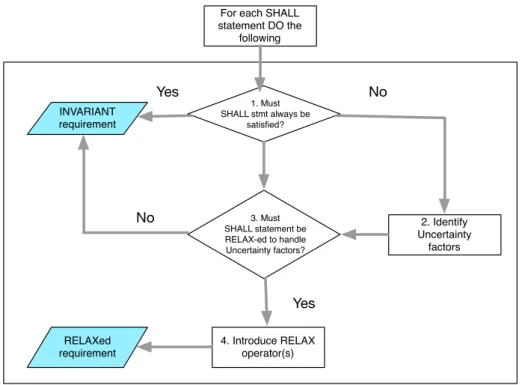
Figure 2.2: RELAX process
The core of the RELAX language [97] [98] is the operators, which are designed to enable system administrators to identify requirements that could temporarily change under user-defined certain conditions. Figure2.2 shows how the steps of the process translate traditional requirements into RELAX-ing requirements. The set of RELAX operators can be organized into modal, temporal, and ordinal operators, and uncer- tainty factors (The details are provided in Subsection 2.1 of [97]). Each relaxation operator defines constraints on how a requirement is relaxed at system runtime by using these user-defined conditions to adapt components to changes. In addition, un- certainty factors, such as, MON (monitor), ENV (environment), REL (relationship), and DEP (dependency), ensure requirements are relaxed, which require adaptive be- haviors.
Remark Although RELAX can adapt to changes through transferring text to requirements, and then these SHALL statements can be relaxed, however the deci- sion of whether a requirement is invariant is an issue for the system stakeholders, aided by the requirements engineer. As same as Ponder language, RELAX language
also cannot provide the adaptive functions to automatically select the destination for components, conflicts in RELAX-defined rules may occur, and existing systems may stop working: RELAX does not provide specific solutions. Moreover, RELAX does not support dynamic changes to system architectures to adapt to various changes on existing systems.
Kagal et al. [42] proposed a policy language called Rei [42]. Based on deonic concepts and grounded, Rei was designed for pervasive computing applications. It supports unanticipated dynamic adaptation, but must be used in conjunction with a separate adaptation mechanism. Refrains in Ponder, Rei policy language is mostly focused towards security policies. There were four basic policy types in Rei, such as rights, prohibitions, obligations and dispensations that was correspond to positive and negative authorizations, and obligations. These constructs denoted by PolicyObject are represented as
PolicyObject(Action, Conditions)
where, Action is a domain dependent action and Conditions are constraints on the actor, action and environment. A set of rules can be associated with a managed domain entity, and any time of an action was to be performed on that entity. For instance, a rule that states that all employees of ’UMBC’ can perform printAction1 is represented as the follows:
has(Variable, right(printAction1, (employee(Variable, ’UMBC’)))) Remark Rei language was requested to verify that the action, and was provided a mechanism to define actions that can be used in obligation rules. In addtion, Rei provided the ability to reason about rules and respond to queries but does not provide a mechanism to enforce policy rules or perform actions. Therefore, the adaptability of Rei supported is limited than mine, and it does not support duplication of software components for adaptive changes for their systems. More over, it cannot allows dy- namic changes to be adapted to various changes through system architectures changed in distributed systems.
Cheng et al. [16] proposed a language called Stitch. It is responsible for repair- ing strategies within the context of an architecture-based self-adaptation framework Rainbow [17]. The Stitch language supports definition of the adaptation strategies through a control-theoretic point of view in which systems and dynamic models. In
addtion, Stitch also represents uncertainties in adaptation outcome and timing delays. The follwing example shows how to use the Stitch language to adapt to response time 2.3.
Figure 2.3: Example of stitch language
Remark Unlike mine, Stitch used an architecture evaluator to detect when a target-system is in a state suitable for repair when the conditions of applicability are satisfied. It also cannot provide functions that automatically relocate to the desti- nation by themselves or make duplications of functions to be relocated to where the computers need. In addtion, the policies which defined by Stitch have to complies and executes repairs, but my research implemented as interpreter, and my research supports relocation of software components for adaptation, unlike Stitch. Further- more, my research supports conflict and divergence of user-defined policies. It is not available in Stitch language.
Joonseon et al.,[1] proposed a high-level policy description language for ubiqui- tous environment. The programming environment contains a high-level ubiquitous programming framework, a run-time system, and programming support tools for pro- gram analysis and monitoring. By using the policy description language, programmers can describe a high level specification on context space, context-based security, and context-based adaptation for ubiquitous applications. The syntax of adaptation rules of the proposed policy language is described as follows:
Remark Unlike mine, the proposed approach does not focus on components in- stead of context for adapt to changes, although it can describe the adaptive condi- tions and actions as policies, but it does not support the relocation or duplication of software components for adaptation and allow new software components to be dy- namically added to their systems. In addtion, There is no way to provide a solution for conflict and divergence of user-defined policies.
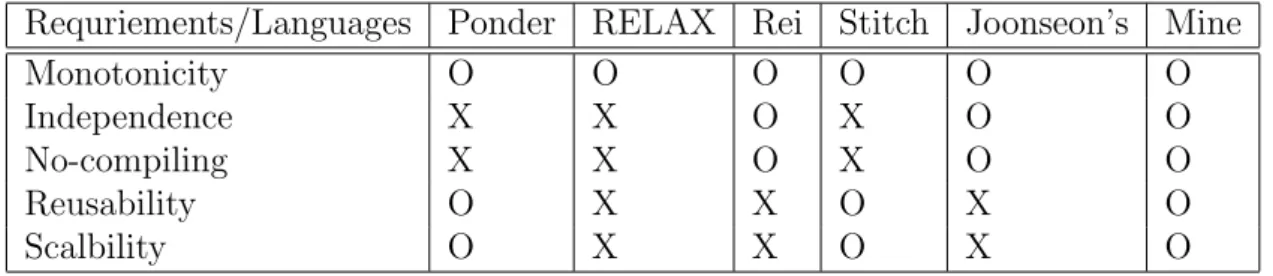
Based on the requirements of my policy language (in chapter 5.2.2), the Table 2.1 shows the differences of the existing adaptation languages. To compared with mine, Ponder language can define the adaptive conditions, but it do not support relocation of software components for adaptation. However, Ponder language provides a policy compiler to resolve the different types of constraints at compile time, not like mine. Although RELAX language supports monotonicity as other languages, but it does not separate the concerns for adaptation developers, and the developed programs have to be compiled. However, RELAX language does not support reusability and scalability([97]). Rei language and Joonseon’s proposed policy language separated conditions and actions for adaptations like mine. However, both of them does not support relocation of software components as actions, they focus on variables, and the adaptive programs does not support reusability and scalability. Not like mine, Stitch language is a compiled language instead of interpreted languages, therefore the adaptive programs need to be compiled and create a middle code. Stitch also does not separate adaptive conditions and actions from their programs.
Table 2.1: Comparison with existing language.
Requriements/Languages Ponder RELAX Rei Stitch Joonseon’s Mine
Monotonicity O O O O O O
Independence X X O X O O
No-compiling X X O X O O
Reusability O X X O X O
Scalbility O X X O X O
However, I defined the policy language is an interpreted language, and separa- tion of concerns of adaptation. In addition, the condition part and action part are
separated in mine for describing adaptations. The former is written in a first-order predicate logic-like notation, where predicates reflect information about the system and applications. The latter is a specified action which responsible for relocation of software components for adaptation on distributed systems. Furthermore, I proposed the policy language support reusability and scalability for developers.
2.3 Software-level Adaptation
The third type is software-level adaptation. Common approaches to software-level adaptation enables software to be dynamically modified in accordance with environ- ment changes.
Genetic programming (GP) [47] [48][33] is an automated method of creating a working computer program from a high-level problem statement of a problem. Ge- netic programming starts from a high-level statement of what needs to be done and it automatically creates a computer program for adaptation. Therefore, applica- tions which implemented by GP, it can adopt new algorithms for addressing concerns when unforeseen during development. However, it cannot predict adaptability on a distributed system. It also needs a large number of computing resources for adapta- tion. In addition, genetic programs cannot support reuse, and they do not support the relocation of software components. Therefore, developers find it difficult to define the destination of the software components.
Computational reflection aspect oriented programming (AOP) [46] enables soft- ware to be open to dynamically defining itself without compromising portability or exposing parts unnecessarily, where the software implementing a crosscutting con- cern, called an aspect, is developed separately from other parts of the system and woven with the business logic at compile- or run-time. Many researchers have in- troduced AOP into adaptive distributed systems. For instance, McKinley et al., [68] proposed a middleware system with compositional adaptation by using AOP. They can modify parts of programs running on single computers but do not support dis- tributed systems themselves. Satoh et al., [75] proposed a bio-inspired adaptation by introducing the notion of cellular-differentiation into distributed systems to change available functions in accordance with the frequency of invoking the functions from the external system; however the adaptation cannot migrate any functions between computers.
Bonabeau et al. provided a detailed look at models of social insect behavior and how to apply these models to the design of complex systems [9]. They demonstrated how these models replaced emphasis on control, preprogramming, and centraliza- tion with designs featuring autonomy, emergence, and distributed functioning. These designs proved to be immensely flexible and robust, able to adapt quickly to chang- ing environments, and to continue functioning even when individual elements failed. However, most swarm intelligence approaches have only focused on their target prob- lems or applications but they are not general purpose, whereas distributed systems are. Software adaptation approaches should be independent of applications. In addi- tion, computers in real distributed systems have no such room to execute such large numbers of computations and analyses.
Ji Zhang et al., proposed an approach to create formal models for the behaviors of adaptive programs [101]. Their approach separates the adaptation behaviors and non-adaptive behaviors from the specifications of adaptive programs. In addtion, their approach also presented a process to construct adaptation models that auto- matically generate adaptive programs from the models, and verify and validate them. The proposed approach focused on the behavior of adaptive programs not on reloca- tion like mine. The quiescent states (e.g., states in which adaptations may be safely performed) of an adaptive program can be defined in the specific adaptation context which includs the program behavior before, during, and after adaptation, the require- ments for the adaptive program, and the adaptation mechanism. Behaviors of the programs can be changed when adaptation, however, it is difficult for users to define where and how adapt to such changes for developers. Moveover, the proposed ap- proach just require invocating the methods of the adaptive programs, but they don’t support relocation of software components for adaptation and the fixed architecture can not be dynamically adapt to the changes from existing distributed systems.
Christos et al., present a middleware platform, and a policy language that has been designed and implemented for adaptive changes in mobile applications [22]. Based on Event Calculus [78], the policy language described that handles adaptation allows the dynamic modification of the adaptive behaviors in order to overcome potential conflicts and satisfy the user requirements. In addtion, their approach allows sharing of application status information among all applications running on the system. Like mine, the proposed approach rise adaptation to the language-level, however, they
need to modify the behaviors for adaptation, therefore the proposed approach is dif- ficult to dynamically add/remove components to/on existing systems, unlike mine.
2.4 Other Approaches
Based on the above three adaptation technologies, there are two applicated ap- proaches for adaptation.
2.4.1 Architecture Approach
Architecture approach was presented in previous work [80] [26] [30] [17] [65][18] [87] [8] to adapt to various changes by changing their system architecture styles for adaptation on distributed systems.
Danny et al., presented a comprehensive reference model, named Formal Refer- ence Model for Self-adaptation (FORMS) [96]. FORMS supports a small number of formally specified modeling elements which is correspond to the key concerns for self-adaptive software systems, and a set of relationships which is guided to the compo- sition of the proposed approach. On the other hand, based on documenting, FORMS gives us a potential reusable architectural solution to adapt to changes through change the parameter’s invocation by they defined interface. Like mine, FORMS not only adapt to environment changes, but also change the architectures. e.g., the model of self-adaptive system is desributed as follows:
However, when the execution of systems changes to complex and dynamic, the proposed approach is not sample for adaptive changes between different models, and change back the model is also a different task. Compared with their model, my ap- proch support the relocation of software component, therefore, the fixed and complex architectures of distributed systems can be dynamically adapted in both directions.
Jacqueline Floch’s group proposed a middleware system, called MADAM (mo- bility and adaptation-enabling middleware), the aims of their approach dynamically adapt to various changes of applications for mobile computing [26]. MADAM sup- ports adaptability of applications, and it allows services to be composed in a flexible manner through parameter’s changes. In the proposed approach, they use a UML profile to self-adapt changes on systems, which the architect will use to model the architecture. I also have a try to use UML format to define requirements of appli- cations for adaptive distributed systems [40]. However, to execute UML need cost
computing resource more than a interpreter type language. In their research, they need centralized management, and do not support relocation of software components.
Moreira et al., proposed an architecture, called FORMAware. Based on reflec- tion 1, the proposed approach blends run-time architectural representation with a reflective programming model to address coordination-level adaptation [64]. It opens up composition architecture through a replaceable default style manager that per- mits to execute architecture reconfigurations. This manager enforces the structural integrity of the architecture through a set of style rules that developers may change to meet other architectural strategies. Each reconfiguration runs in the scope of a transaction that I may commit or rollback. In addition, FORMAware prescribes a method to formally carry out architecture constrain verifications whenever architec- tural adaptation (e.g. add, plug, unplug, remove, replace components) is required, since the architecture structure is opened up and maintained by the reflective com- ponent model approach.
Remark FORMAware is similar with mine, the difference is that they do not upgrade to the definition of adaptations into language-level, they through reconfigu- rations to change the architecture style, and I use relocating software components for adaptation on architecture-level.
1Reflection technology is be used for invoke methods from objects for adaptation.
Garlan et al. presented a framework, called Rainbow [29] for specifying architecture- based self-adaptation. The aims of the proposed approach focused on reduce the cost and improve the reliability of making changes to complex systems through change the coordination of the adaptive programs. Although Rainbow supports automated, dynamic system adaptation via architectural models, however their approach was not solely aimed at distributed systems, it supports adaptive connections between oper- ators of components, which might be running on different computers.
Yang’s [100] group presents an architecture-based software adaptation through coordination of agents on their systems. On the basis of explicating and reasoning about architectural knowledge, they are mainly to automate the software adaptation in running system. The proposed architectures themselves can also be introspected and altered at runtime, to control the adaptation. They use the architectural re- flection to observe and control the system architecture, while use the architectural style to ensure the consistency and correctness of the architecture reconfiguration. In addition, the proposed approach not only forms an adaptation feedback loop onto the running system, but also it separates the concerns among the architectural model, the target system and the facilities use for adaptation. However, they did not specify how to define the conditions of adaptation to change their structure style, therefore, it is difficult to dynamically adapt to frequent changes in existing systems.
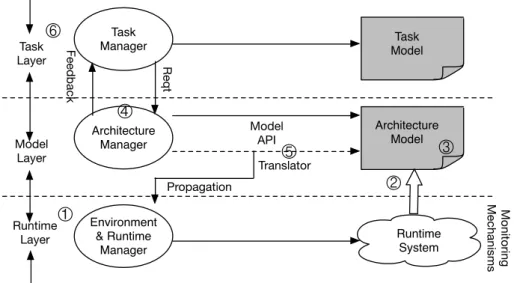
Shang-Wen Cheng et al., described an approach for dynamic adaptation, which is supported by the use of software architectural models to monitor an application, and guide dynamic changes to it [18]. The use of externalized models permits one to make reconfiguration decisions based on a global perspective of the running system, apply analytic models to determine correct repair strategies, and gauge the effectiveness of repair through continuous system monitoring. Their approach is based on the 3-layer view illustrated in Figure 2.4.
The Runtime Layer is responsible for observing a system’s runtime properties and performing low-level operations to adapt the system. It consists of the system it- self, together with its operating environment (e.g., networks, processors, I/O devices, communications links, etc.) The Model Layer is responsible for interpreting observed system behavior in terms of higher-level, and more easily analyzed, properties. The Task Layer is responsible for determining the quality of service requirements for the tasks. In their system each architecture is identified with a particular architectural
Task Manager
Architecture Manager
Environment
& Runtime Manager
Runtime System Task
Layer
Model Layer
Runtime Layer
Model API Translator Propagation
!
"
#
Architecture Model
Task Model
$
%
&
Feedback Reqt MonitoringMechanisms
Figure 2.4: Architectural model
style. An architectural style defines a set of types for components, connectors, inter- faces, and properties together with a set of rules that govern how elements of those types may be composed. However, in their proposed approach, their middleware doesn’t support the relocation of software components, and the rules is difficult for defining by developers. Once the change in system configuration, how to change it back to the original structure it is not easy thing.
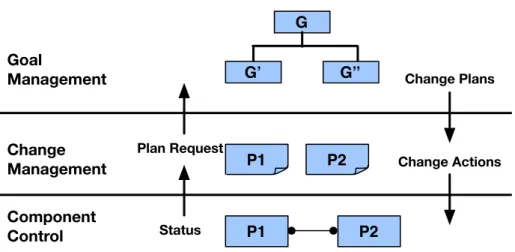
Jeff Kramer and Jeff Magee proposed an architectural approach for self-managed systems [49]. The architectural provided the required level of abstraction, and gen- erality to deal with the challenges. In the proposed approach, the vision of self- management at the architectural level are described, where a self-managed software architecture is one in which components automatically configure their interaction for adaptation as software-level adaptation.
Figure 2.5 described a three layer reference model. It is that consist of component control, change management, and goal management. The proposed approach pro- vided a context for discussing the main research challenges. At the component layer, the main challenge is responsible for providing change management which reconfig- ures the software components, ensures application consistency, and avoids undesirable transient behaviors. At the change management layer, decentralized configuration management is required which can tolerate consistent views of the system state, but still converge to a satisfactory stable state. At the goal management layer, some form of on-line planning is required. However, the adaptation concerns is written inside of
G
G’ G’’
P1 P2
P1 P2
Change Plans
Change Actions
Status Plan Request Goal
Management
Change Management
Component Control
Figure 2.5: Architectural framework
components for adaptive changes in distributed systems. Unlike mine, the adaptation in their approach can’t be reused. When environment changes frequently occurred in such system, their research can’t be suited well.
2.4.2 Location Approach
There have been a few attempts to introduce to the location approach for adaptation [6] [35] [38] [88] [101] [66] [12] [92] [70] [32] [54] [76] [97] [63] [73] [49] [96] [95].
Israsel Ben-Shaul’s group introduced two middleware systems in location approach [6][5][34][7] [35][36]. One of the middleware system is named Hadas, it focused on intra-component self adaptability. Another middleware system is named FarGo, it focused on inter-component self adaptability. Both of their systems were fully imple- mented, and by migrating the code of software components between computers for self-adaptation.
The FarGo system [35][36] focus on dynamic inter-component structure. It pro- posed a dynamic mechanism which laid out in a no-centralized manner between dis- tributed systems and applications. The mechanism of FarGo system provides mobility of software components to adapt themselves to changes for self-adaptation. It is at- tachment the remote components into the same address, and then detachment the co-located components into different addresses. FarGo system provides an interface named reference, it can make duplications of the target components which follows the source code to destination computers.
FarGo system proposed two levels of adaptation for distributed applications.
• The dynamic relocation of software components may be viewed as an adaptation of distributed system architecture.
• Evolved the semantics of inter-component reference dynamically for adaptation. Unlike the FarGo system, Ben-Shaul et al. proposed another system called Hadas [5][34][7]. It was designed to adapt to changes in distributed applications. Adaptation is a major element of Hadas and it dynamically supports the deployment of existing software components and autonomously addresses sites.
In particular, 1) Each software component in Hadas can be defined by users. 2) As each component is mutable, it extends a special class of adaptive objects termed Ambassadors, which can dynamically be deployed to the remote side of computers. 3) Each software component has an interface consisting of methods and data members, which can be evolved at runtime. 4) Each component contains two sections, the first is a fixed section, and the second is an extensible section. The data items and methods of the components are defined in the former as class-based items that may not be changed during their lifetimes. The latter comprises the mutable portion of the components through their structures and behaviors to dynamically adapt to changes. For instance, new/old items (data, objects, or methods) can be dynamically added/removed or changed for components on-the-fly. 5) Through Hadas’s built-in meta-methods, which are responsible for structural and behavioral changes, individual components adapt themselves to changes in distributed applications. Readers can find detailed samples in their previous work [5][34][7].
Both of their approaches provided migration of software components for adap- tation from the adaptability perspective. Their major distinction was the FarGo systemfs focus on reference as the subject of adaptability; whereas, Hadasf focus was on the definition of software components.
These studies represented two location research projects for adaptation, and they were very similar to my research. I also used the relocation of software components to adapt themselves to changes on distributed systems. However, their research and mine had two major distinctions. First, I not only migrated the source code, but also migrated the state of software components to destination computers for adap- tation. However, their research just migrated source code for adaptation. When changes occurred, the software components could not be restarted to immediately deal with their tasks, whereas those in my research could. Second, Hadas compo- nents could define changes by users inside of components; however, I distinguished adaptation concerns from business logic concerns for adaptation. As Hadas provided
meta-methods embedded into components, neither of the components nor adaptive functions could be reused, whereas my research not only provided software compo- nents, but also user-defined adaptive programs that could be reused. I promoted these adaptive definitions to language level.
Suda and Suzuki [83] proposed a bio-inspired middleware system, called Bio- Networking, for disseminating network services in dynamic and large-scale networks that have large numbers of decentralized data and services. The system provides reusable software components for developing, deploying and executing cyber-entities (CEs). Low-level operating and networking details can be embedded in CEs, and high-level runtime services provided to adaptability to their services and behaviors. In addtion, the system enables CEs to be replicated, moved, and deleted, like mine does. However, [83]’s policies for migration and duplication of agents has already been decided beforehand, and the users cannot define that in Bio-Networking middleware system. Conversely, mine proposal provides policy language to define adaptive con- ditions and behaviors for their systems to adapt to various changes. Furthermore, unlike mine system, Bio-Networking’s target is a large number of homologous com- puters, and the destinations of agent migrations depended on the number of service requests in addition to the locations of clients.
Wu et. al, and Fok et. al [99] [27] are focus on sensor networks. Wu’s group present a simplified analytical model for a distributed sensor network by using mobile agents. They formulate the route computation problem in terms of maximizing an objective function, which is directly proportional to the received signal strength and inversely proportional to the path loss and energy consumption [99], and Fok’s group presents a mobile agent middleware for self-adaptive applications in wireless sensor networks [27], called Agilla. It provides a programming model in which applications consist of evolving communities of agents that share a wireless sensor network. The agents can dynamically enter and exit a network and can autonomously clone and migrate themselves in response to environmental changes like mine. However, these approaches do not separate the adaptation from agents, therefore, their adaptation can’t be reused, and their proposals can not dynamically change the fixed system architectures.
Paolo et. al [4], and Gray et. al [31] proposed agent-based middleware for mo- bile computing. Such middleware facilitates service-specific optimization and allows
users to adapt to local resources. Mobile users can change locations and dynamically adaptive mobility-enabled applications to the properties and characteristics of their network connections and hardware devices. In addition, mobile agents simplifies dy- namic personalization by following user movements and tailoring service depending on personal preferences. Gray’s group described a mobile agent system Agent Tcl [31] that is under development at Dartmouth College. They present a system to support agents that provide network sensing and routing services. It support agents allow an agent to transparently migrate between a mobile computer and a permanently con- nected machine or between one mobile computer and another regardless of, when the mobile computers connect to the network. However, both of them did not separate the adaptation from agents, therefore, their adaptation can’t be reused.
Radu et al., presents a framework, called DACIA, for building adaptive distributed applications [52]. In DACIA, distributed applications are viewed as consisting of con- nected components that typically implement data streaming, processing, and filtering functions. It also provides mechanisms for runtime reconfiguration of applications to allow them to adapt to the changing of operating environments. The key contribution of DACIA supports migration of components from original host to different host dur- ing execution, while maintaining communication connectivity with other components. The proposed approach is similar with mine, however the runtime reconfiguration of applications are difficult to be reused. Once the software components is relocated, the new reconfiguration could cause conflicts, in their paper, they did not consider this issue.
Ito et. al., [39] presents a communication infrastructure of agent-based middle- ware for ubiquitous computing environments. The proposed approach provide an adaptive communication mechanism that can select communication schemes flexibly, according to the properties of inter-agent communication, and resource status. In addtion, this mechanism enables the agent platform to adapt to various inter-agent communication requirements in a ubiquitous computing environment with limited resources. However, the proposed middleware doesn’t separate the adaptation from agents.
2.5 Discussion
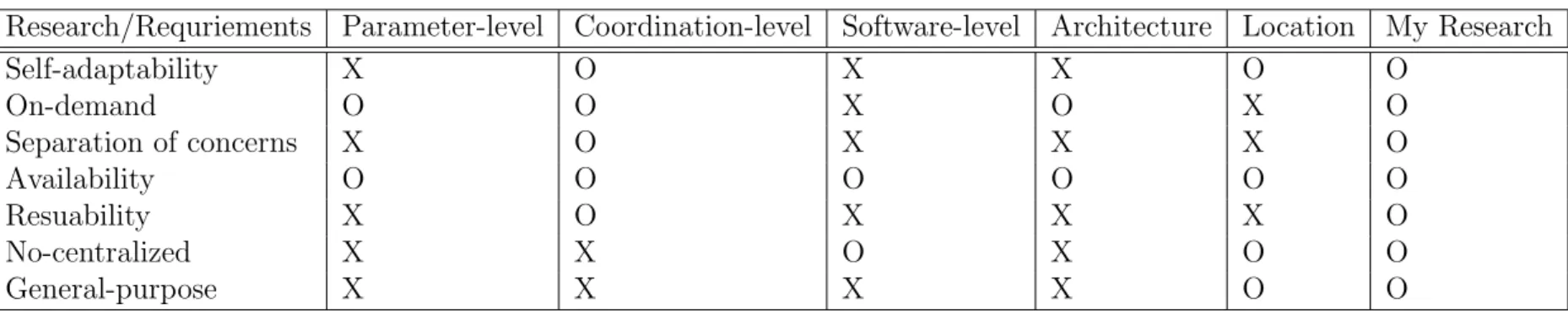
The existing studies have been proposed various approaches through different cases for adaptation. However, to satisfy I defined requirements (in Chapter 1), they all have some issues remain unresolved. The Table 2.2 shows the differents between existing research and mine. Parameter-level adaptation has inherent weakness, such researches cannot dynamically allow new components to be added into their systems, but mine reserach can solve this problem throuth relocation of software components between computers. To compared with coordination-level adaptation, there are two important differents with mine. Such researches can coordinate functions between computers to provide adaptability, but the function can not be relocated to destination computer to execute, network environment restricts the effect of those approaches. In addition, some policy language was presented in those approaches, but almost all languages only can describe the adaptive conditions. It was not specifically designed for relocation of software components, therefore, almost all languages do not support migration for adaptation in distributed systems. It is why I designed a policy language to this dissertation. In addition, software-level approaches were support modification for adaptation in single computer. For distributed systems which was composed of a large number of computers, the adaptive behaviors ware limited than mine.
Architecture and location approaches also were presented, and mine approach have distinguished between the two proposals. Compared to the former, users do not need to describe the styles of their architecture. Only through the relocation of software components, the system architectures can be dynamically changed in distributed systems. Compared to the latter, users can define their requirements as policies, and then mine proposal can automatically relocate the specified software component to the destination computers for adaptation.
Table 2.2: Comparison with existing adaptation researches.
Research/Requriements Parameter-level Coordination-level Software-level Architecture Location My Research
Self-adaptability X O X X O O
On-demand O O X O X O
Separation of concerns X O X X X O
Availability O O O O O O
Resuability X O X X X O
No-centralized X X O X O O
General-purpose X X X X O O
29