
Development of Aquacatalytic Systems Based on
the Self-Assembly of Amphiphilic Pincer Palladium
Complexes
Fumie Sakurai
2015
Contents
General Introduction 1
Chapter 1 Synthesis of Amphiphilic NNC-Pincer Palladium Complexes 14
Introduction 15
Results and Discussion 20
Design of amphiphilic phenanthroline ligands 20
Retrosyntheses of amphiphilic phenanthroline ligands 20
Syntheses of amphiphilic phenanthroline ligands 22
Complexation of amphiphilic phenanthroline ligands with palladium 25
Summary 30
Experimental Section 31
References 42
Chapter 2 Catalytic Activity of an NNC-Pincer Palladium Complex 44
Introduction 45
Results and Discussion 50
Allylic arylation of allyl acetates with sodium tetraarylborates 50 Investigation of the reaction pathway of the allylic arylation 55
Summary 58
Experimental Section 59
References 76
Chapter 3 Formation of Vesicles by Self-Assembly of Amphiphilic NNC-Pincer Palladium Complexes in Water 80 Introduction 81
Results and Discussion 84 Self-assembly of amphiphilic NNC-pincer palladium complexes 84 Characterization of self-assembled complexes 85
Summary 90 Experimental Section 91
References 95
Chapter 4 Application of Amphiphilic NNC-Pincer Palladium Complexes to Catalytic Reactions in Water 96
Introduction 97
Results and Discussion 102
Allylic arylation with amphiphilic NNC-pincer palladium complexes 102
Cu-free Sonogashira coupling with amphiphilic NNC-pincer palladium complexes 108
Summary 113
Experimental Section 114
References 124
General Conclusion 127
Acknowledgements 129
1
General Introduction
2
Self-assembled architectures (vesicles, micelles, nanotubes, and so on) have attracted much attention from a wide range of scientists due to their unique morphologies, physical and chemical properties, and potential applications in various areas such as chemistry, physics, biology, and materials science.1 During the past few decades, the understanding of the architectures have advanced significantly. Vesicles are dynamic self-assembled architectures which consist of a molecular layer that encapsulates a small amount of water. Bilayer vesicles are closely related to liposomes and biological membranes. Most molecules that form bilayer vesicles in water are amphiphilic: they have a hydrophobic as well as a hydrophilic part. The hydrophilic part of the molecule interacts favorably with the surrounding water, while the hydrophobic part minimizes its exposure to water. Hence, the amphiphiles arrange in a bilayer and the formation of vesicles is driven primarily by hydrophobic interaction.2
In 1977, Kunitake et al. gave the first example of vesicle formation by the self-assembly of didodecyldimethylammonium bromide (DDDAB) (1) as a synthetic amphiphile in water (Figure 1).3
Figure 1. Formation of bilayer vesicles from DDDAB (1)
In 1988, Fuhrhop et al. showed that amphiphilic macrocyclic ethers 2 and sulfide 3 self-assembled in water to give monolayer and bilayer vesicles, respectively (Figure 2).4 Since then, number of reports on artificial vesicles has increased dramatically.5
3
Figure 2. Formation of vesicles from amphiphilic macrocyclic ethers 2 and sulfide 3
Vesicles are of great interest due to their practical applications in drug delivery, cosmetics, nanosensors and so on.2,6,7 They also serve as nanoreactors because they offer boundaries that separate the reaction space from the external environment.7 Several research groups have reported the application of vesicles to catalytic reactions so far.8,9 Nolte et al. developed a bimetallic membrane-bound cytochrome P450 mimic which catalyzed the epoxidation of alkenes
with molecular oxygen (Figure 3).9ad
Figure 3. Epoxidation of alkenes 4 using a cytochrome P-450 mimic catalytic system
4
The amphiphilic rhodium complex 8 acted as an efficient catalyst for the reduction of the manganese porphyrin complex 7 with sodium formate. The reduced manganese porphyrin complex 6 catalyzed the epoxidation of alkenes.
Groves and Neumann reported that iron(III) tetra(o-cholenylamidophenyl)porphyrin (Fe(ChP)Cl) incorporated in the membrane of dimyristoylphosphocholine (DMPC) vesicles catalyzed oxidation reactions in the presence of iodosobenzene as an oxidant (Figure 4).
Figure 4. Epoxidation of desmosterol (9) using vesicles including Fe(ChP)Cl and DMPC
5
In the system built from DMPC vesicles, high regioselectivity was obtained in the epoxidation of steroids and polyunsaturated fatty acids.9e For example, when the epoxidation of desmosterol (9) with iodosobenzene (10) was performed using the system built from DMPC vesicles, the alkenyl group at 24 position of steroid 9 was epoxidized regioselectively to give epoxide 11 without epoxidation of the alkenyl group at 5 position of 9.
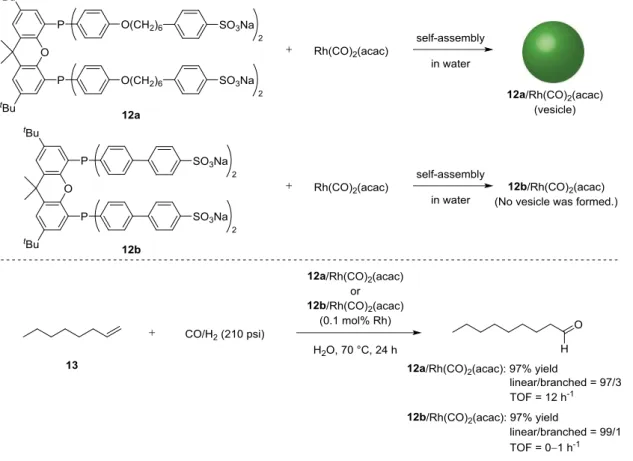
In 2000, van Leeuwen et al. reported the aggregation behavior of amphiphilic Xantphos derivatives (12a and 12b) and their rhodium complexes. They also investigated the catalytic activities of these rhodium complexes in the hydroformylation of 1-octene in water (Figure 5).9f The observed turnover frequency (TOF) in the hydroformylation using ligand 12a which form vesicles (TOF = 12 h-1) was higher than that using ligand 12b which did not form vesicles (TOF =
01 h-1). The formation of vesicles led to an increased solubility of organic substrates in the aqueous solution of containing the amphiphilic rhodium complexes, which increased the reaction rate of the hydroformylation.
Zhang and Liu et al. reported that compressed carbon dioxide induces the formation of vesicles by self-assembly of amphiphilic L-proline derivative (PTC12) in water (Figure 6).9i The PTC12 vesicles catalyzed the asymmetric aldol reaction of cyclohexanone (14) with 4-nitrobenzaldehyde (15) in water at 25 °C for 15 hours to give the aldol adduct 16 in 99% yield with 93% ee. The pressure of carbon dioxide controlled the size of these vesicles, which regulated the catalytic activity and the selectivity of the reaction.
6
Figure 5. Rh-catalyzed hydroformylation of 1-octene (13) with 12a or 12b/Rh(CO)2(acac)
Figure 6. Asymmetric aldol reaction using PTC12 vesicles
Vesicles which are formed by self-assembly of amphiphilic transition-metal complexes themselves are expected to exhibit higher catalytic activities. Uozumi et al. recently developed a new aquacatalytic system using vesicles which were obtained by self-assembly of amphiphilic
7
NCN-pincer palladium complexes.10 Thus, they designed and synthesized new amphiphilic
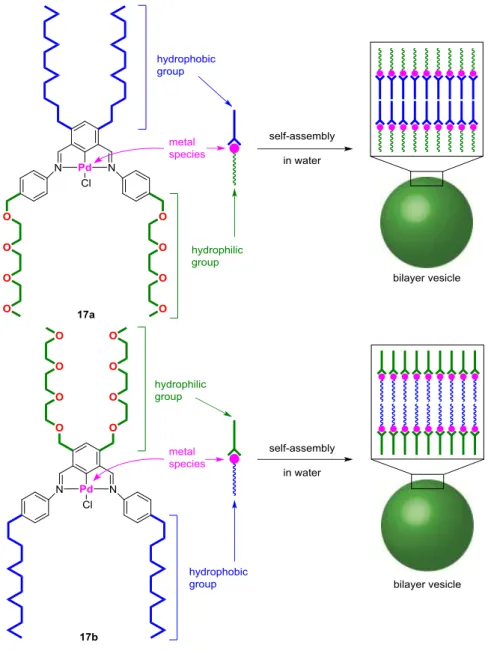
NCN-pincer palladium complexes 17a and 17b (Figure 7).10ab
Figure 7. Amphiphilic NCN-pincer palladium complexes 17
The prepared complexes self-assembled in aqueous solutions to form bilayer vesicles 17avscl and
17bvscl. Vesicles 17avscl catalyzed the MiyauraMichael reaction of cyclohexenone (18) with sodium tetraphenylborate (19) in water to give 1,4-adduct 20 in 83% yield (Figure 8). In contrast, amorphous complex 17aamps gave product 20 in only 7% yield. The formation of vesicles 17avscl
was shown to be essential to accelerate the reaction. The reaction was also carried out in the presence of vesicles 17bvscl, affording product 20 in 19% yield. When the amorphous complex 17bamps was used as the catalyst, 5% yield of the product was obtained. The formation of vesicles 17bvscl slightly improved the yield of the product. The directions of the hydrophilic and
8
hydrophobic groups on the pincer backbone were critical for an efficient promotion of this reaction.
Figure 8. MiyauraMichael reaction of cyclohexenone (18) with NaBPh4 (19) using amphiphilic NCN-pincer palladium complexes 17
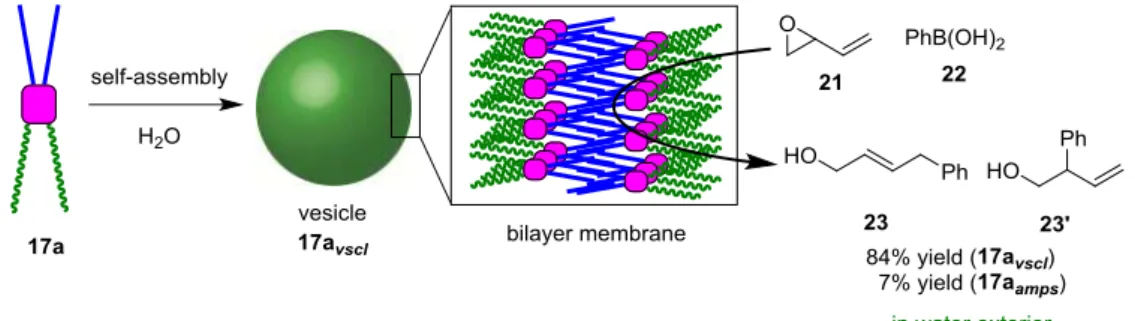
The catalytic activity of 17avscl was also investigated in the ring-opening of vinyl epoxide (21) with phenylboronic acid (22) in water (Figure 9). The reaction in the presence of 17avscl took place to provide an 84% yield of the arylated product 23 along with its regioisomer 23’. However, the reaction with 17aamps did not proceed efficiently.
Figure 9. Ring-opening of vinylepoxide (21) with phenylboronic acid (22) using amphiphilic NCN-pincer palladium complexes 17
The catalytic system was also applied to the cyclization of alkynoic acids in water (Figure 10).10c Vesicles 17avscl catalyzed the cyclization of 5-[4-(trifluoromethyl)phenyl]pent-4-ynoic acid (24) to
9
afford desired γ-lactone 25 in 16% yield. The reaction of alkynoic acid 24 in the presence of amorphous complex 17aamps gave product 25 in 10% yield. Therefore, self-assembly of complex 17a resulted in only a slight promotion of the cyclization in water. When vesicles 17bvscl was
used as the catalyst, the reaction proceeded smoothly to provide product 25 in 61% yield. In contrast, when alkynoic acid 24 was cyclized in the presence of 17bamps, only a 9% yield of 25 was obtained. The formation of vesicles 17avscl was essential for efficient promotion of this reaction. In addition, the directions of the hydrophilic chains and the hydrophobic chains attached to the pincer backbone therefore influenced the catalytic activity.
Figure 10. Cyclization of 5-[4-(trifluoromethyl)phenyl]pent-4-ynoic acid (24) using amphiphilic NCN-pincer palladium complexes 17
The promotion of these reactions through the formation of vesicles is explained as follows. The organic substrates are concentrated within the hydrophobic region of the bilayer membrane as a result of hydrophobic interaction, producing high concentrations of the substrate near the catalytic center and, consequently, giving rise to rapid reactions (Figure 11). The author believes that this concept can provide new guidance for the development of new aquacatalytic systems. Herein, the author developed an aquacatalytic system based on the self-assembly of amphiphilic transition-metal complexes for expansion of the range and usefulness of this concept.
10
Figure 11. Concept of organic transformation within a bilayer membrane
This thesis is composed of Chapter 14 and General Conclusion.
In Chapter 1, the synthesis of new amphiphilic palladium NNC-pincer complexes is described. In Chapter 2, the investigation of the catalytic activity of a palladium NNC-pincer complex for the allylic arylation is described.
In Chapter 3, the vesicle formation by the self-assembly of the prepared amphiphilic palladium NNC-pincer complexes in water is described.
In Chapter 4, the application of the obtained vesicles to the allylic arylation and copper-free Sonogashira coupling in water is described.
Finally, the author mentions General Conclusion of this thesis.
11
References
(1) (a) Dujardin, E.; Mann, S. Adv. Mater. 2002, 14, 775788. (b) Whitesides, G. M.; Boncheva, M. Proc. Natl. Acad. Sci. USA 2002, 99, 47694774. (c) Park, S.; Lim, J.-H.; Chung, S.-W.; Mirkin, C. A. Science 2004, 303, 348351. (d) Cao, A.-M.; Hu, J.-S.; Liang, H.-P.; Wan, L.-J. Angew. Chem. Int. Ed. 2005, 44, 43914395. (e) Hu, J.-S.; Guo, Y.-G.; Liang, H.-P.; Wan, L.-J.; Jiang, L. J. Am. Chem. Soc. 2005, 127, 1709017095. (f) Zhong, L.-S.; Hu, J.-S.; Liang, H.-P.; Cao, A.-M.; Song, W.-G.; Wan, L.-J. Adv. Mater. 2006, 18, 24262431. (g) Busseron, E.; Ruff, Y.; Moulin, E.; Giuseppone, N. Nanoscale 2013, 5, 70987140.
(2) Ravoo, B. J. Vesicles in Supramolecular Chemistry; Supramolecular Chemistry: From
Molecules to Nanomaterials; Wiley, Chichester, West Sussex, 2012.
(3) (a) Kunitake, T.; Okahata, Y. J. Am. Chem. Soc. 1977, 99, 38603861. (b) Kunitake, T. Angew. Chem. Int. Ed. Engl. 1992, 31, 709726.
(4) Fuhrhop, J.-H.; Liman, U.; Koesling, V. J. Am. Chem. Soc. 1988, 110, 68606864.
(5) (a) Sakai, N.; Matile, S. Nature Chem. 2009, 1, 599600. (b) Xing, P.; Sun, T.; Hao, A. RSC Adv. 2013, 3, 2477624793.
(6) (a) Lasic, D. D. Biochem. J. 1988, 256, 111. (b) Lasic, D. D. Trends in Biotechnology 1998, 16, 307321. (b) Lasic, D. D.; Papahadjopoulos Science 1995, 267, 12751276.
(7) (a) Kim, K. T.; Meeuwissen, S. A.; Nolte, R. J. M. van Hest, J. C. M. Nanoscale 2010, 2,
844858. (b) Palivan, C. G.; Fischer-Onaca, O.; Delcea, M.; Itel, F.; Meier, W. Chem. Soc. Rev. 2012, 41, 28002823. (c) Qin, L.; Zhang, L.; Jin, Q.; Zhang, J.; Han, B.; Liu, M. Angew. Chem. Int. Ed. 2013, 52, 77617765.
12
(8) For a review on the applications of vesicles to catalytic reactions, see: Vriezema, D. M. Aragonès, M. C.; Elemans, J. A. A. W.; Cornelissen, J. L. M.; Rowan, A. E.; Nolte, R. J. M.
Chem. Rev. 2005, 105, 14451489. (b) Raynal, M.; Ballester, P.; Vidal-Ferran, A.; van Leeuwen, P. W. N. M. Chem. Soc. Rev. 2014, 43, 17341787. (c) Walde, P.; Umakoshi, H.; Stano, P.; Mavelli, F. Chem. Commun. 2014, 1017710197.
(9) (a) van Esch, J.; Roks, M. F. M.; Nolte, R. J. M. J. Am. Chem. Soc. 1986, 108, 60936094. (b) Schenning, A. P. H. J.; Hubert, D. H. W.; van Esch, J. H.; Feiters, M. C.; Nolte, R. J. M.
Angew. Chem. Int. Ed. Engl. 1994, 33, 24682470. (c) Schenning, A. P. H. J.; Spelberg, J. H. L.; Driessen, M. C. P. F.; Hauser, M. J. B.; Feiters, M. C.; Nolte, R. J. M. J. Am. Chem. Soc.
1995, 117, 1265512656. (d) Schenning, A. P. H. J.; Spelberg, J. H. L.; Hubert, D. H. W.; Feiters, M. C.; Nolte, R. J. M. Chem. Eur. J. 1998, 4, 871880. (e) Groves, J. T.; Neumann, R. J. Am. Chem. Soc. 1987, 109, 50455047. (f) Goedheijt, M. S.; Hanson, B. E.; Reek, J. N. H.; Kamer, P. C. J.; van Leeuwen, P. W. N. M. J. Am. Chem. Soc. 2000, 122, 16501657. (g) Vriezema, D. M.; Garcia, P. M. L.; Oltra, N. S.; Hatzakis, N. S.; Kuiper, S. M.; Nolte, R. J.
M.; Rowan, A. E.; van Hest, J. C. M. Angew. Chem. Int. Ed. 2007, 46, 73787382. (h) Delaittre, G.; Reynhout, I. C.; Cornelissen, J. J. L. M.; Nolte, R. J. M. Chem. Eur. J. 2009, 15,
1260012603. (i) Qin, L.; Zhang, L.; Jin, Q.; Zhang, J.; Han, B.; Liu, M. Angew. Chem. Int. Ed. 2013, 52, 77617765. (j) van Oers, M. C. M.; Abdelmohsen, L. K. E. A.; Rutjes, F. P. J.; van Hest, J. C. M. Chem. Commun. 2014, 50, 40404043.
13
(10) (a) Hamasaka, G.; Muto, T.; Uozumi, Y. Angew. Chem. Int. Ed. 2011, 50, 48764878. (b) Hamasaka, G.; Muto, T.; Uozumi, Y. Dalton Trans. 2011, 40, 88598868. (c) Hamasaka, G.; Uozumi, Y. Chem. Commun. 2014, 50, 1451614518.
14
Chapter 1
Synthesis of Amphiphilic NNC-Pincer Palladium
Complexes
Sakurai, F.; Hamasaka, G.; Uozumi, Y. Dalton Trans. 2015, 44, 78287834.
15
Introduction
The construction of bilayer architectures by self-assembly of amphiphiles having a rigid planar backbone has recently attracted considerable attention due to their potential application as electronic devices and soft materials.1 Aida et al. reported that the self-assembly of amphiphilic hexa-peri-hexabenzocoronene (HBC) 26 bearing both hydrophilic triethylene glycol (TEG) chains and hydrophobic dodecyl groups in THF and THF/water gave nanotubes and helical coils having bilayer membranes, respectively (Figure 1).1b
Figure 1. Self-assembly of amphiphilic hexa-peri-benzocoronene 26
Several other researchers also realized the construction of bilayer architectures by self-assembly of amphiphiles having a rigid planar backbone. Würthner et al. reported that amphiphilic perylene bisimides (PBIs) 27 and 28 self-assembled in water/THF to form bilayer vesicles (Figure 2).2 PBIs (27 and 28) have both hydrophilic TEG chains and hydrophobic methacryloylhexyl
16
groups. Hollow vesicles were observed for the co-self-assembled system of PBI 27 and PBI 28 ([PBI 27]/[PBI 28] = 8/1 in molar ratio) in THF-containing water. The average diameter of the vesicles was 94 nm. For the co-self-assembled system with higher PBI 28 content ([PBI 27]/[PBI 28] = 4/1 in molar ratio), bilayer vesicles were observed with a larger average diameter of 133 nm
in THF-containing water.
Figure 2. Construction of vesicles by self-assembly of amphiphilic perylene bisimides 27 and 28
Furthermore, George et al. reported the synthesis of an amphiphilic coronene bisimide (Amph-CBI) 29 bearing a hydrophobic dodecyl group and a hydrophilic tetraethylene glycol chain
and its self-assembly in THF/water through ππ stacking and hydrophobic interactions (Figure 3).3 They showed that the morphology of self-assembled Amph-CBI architectures was controlled by the solvent composition. Nanotubes were formed by the self-assembly of Amph-CBI 29 in
17
THF/water (3:97). On the other hand, Amph-CBI 29 self-assembled in THF/water (1:1) to form nanotapes.
Figure 3. Construction of nanotubes and nanotapes by self-assembly of amphiphilic CBI 29
These amphiphilic molecules which form bilayer membranes as shown in Figures 13 have rigid planar backbones with both hydrophilic and hydrophobic chains. If hydrophilic and hydrophobic chains are incorporated onto rigid planar transition-metal complexes, the resulting amphiphilic complexes can self-assemble to form bilayer architectures that show catalytic activities. Efficient organic transformations catalyzed by the self-assembled architectures can be realized in water. Uozumi et al. recently reported a new aquacatalytic system based on self-assembly of amphiphilic NCN-pincer palladium complexes.4 Thus, amphiphilic NCN-pincer palladium complexes 17a and 17b were designed and synthesized (Figure 4). Complexes 17a and 17b self-assembled in water to form bilayer vesicles. These vesicles efficiently catalyzed the ring-opening of vinyl
epoxides, the MiyauraMichael reaction, and the cyclization of alkynoic acids in water. The formation of bilayer vesicles was shown to be necessary for efficient promotion of these reactions.
18
Figure 4. Amphiphilic NCN-pincer palladium complexes 17
The promotion of these reactions through the formation of vesicles is explained as follows. The organic substrates are concentrated within the hydrophobic region of the bilayer membrane as a result of hydrophobic interactions, producing high concentrations of the substrate near the catalytic center and, consequently, giving rise to rapid reactions. It is interesting to expand to the versatility of the aquacatalytic system. Only amphiphilic NCN-pincer palladium complexes 17 have been used to develop the aquacatalytic system. However, metal species which can be introduced to the NCN-pincer metal complexes are limited to group 10 elements. Therefore, the
19
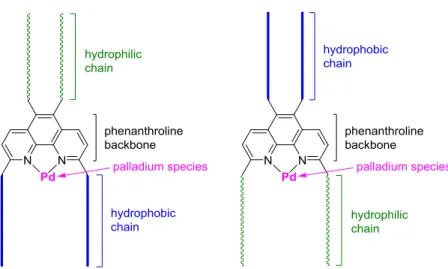
construction of bilayer architectures by self-assembly of new amphiphilic metal complexes where various metal species can be easily introduced is desirable to expand the versatility of the aquacatalytic system. The author envisaged the formation of bilayer architectures in water by self-assembly of amphiphilic metal complexes having a rigid planar phenanthroline backbone with both hydrophilic and hydrophobic chains (Figure 5). The phenanthroline backbone has two nitrogen atoms which can be coordinated to metal species. Amphiphilic phenanthroline metal complexes can be obtained by the complexation of amphiphilic phenanthroline ligands with various metal species such as palladium, rhodium, ruthenium, copper, and iron.5 Therefore, the aquacatalytic system using self-assembled architectures made of amphiphilic phenanthroline metal complexes will enable the author to perform various organic transformations in water efficiently. Herein, the author describes the design and synthesis of amphiphilic 2,9-diphenyl-1,10-phenanthroline ligands bearing both hydrophilic chains and hydrophobic chains to expand of the range and usefulness of an aquacatalytic system. Furthermore, the complexation of the synthesized amphiphilic ligands with palladium species was also examined.
Figure 5. Amphiphilic phenanthroline palladium complexes
20
Results and Discussion
Design of amphiphilic phenanthroline ligands
The author designed amphiphilic 2,9-diphenyl-1,10-phenanthroline ligands 30a and 30b bearing hydrophilic TEG chains and hydrophobic dodecyl groups for the development of new aquacatalytic systems (Figure 6). The complexation of ligands 30a and 30b with metal species would provide amphiphilic phenanthroline metal complexes with a rigid planar backbone. The obtained amphiphilic metal complexes could self-assemble in water to form bilayer architectures with catalytic activity.
Figure 6. Design of amphiphilic phenanthroline ligands 30
21
Retrosyntheses of amphiphilic phenanthroline ligands
The author proposed retrosyntheses of the amphiphilic phenanthroline ligands 30a and 30b as shown in Scheme 1. Ligands 30a and 30b could be obtained by the introduction of aryl groups bearing hydrophobic dodecyl chains and hydrophilic TEG chains at the 2,9-positions of phenanthroline derivatives 31 and 33, respectively.6 Introduction of hydrophilic TEG chains and hydrophobic dodecyl chains at the hydroxyl groups of 1,10-phenanthroline-5,6-diol (32) would give phenanthroline derivatives 31 and 33.
Scheme 1. Retrosyntheses of amphiphilic phenanthroline ligands 30a (a) and 30b (b)
22 Syntheses of amphiphilic phenanthroline ligands
Based on the retrosynthetic analysis, ligand 30a was synthesized from 1,10-phenanthroline-5,6-diol (32) in 3 steps (Scheme 2). Hydrophilic methoxy[tri(ethylene glycol)] [MeO(CH2CH2O)3OH; MeOTEG] chains were incorporated at the hydroxy groups of 1,10-phenanthroline-5,6-diol (32) to give 5,6-bis(MeOTEG)-1,10-phenanthroline (31) in 55% yield. 2-Monoarylated phenanthroline 34 was prepared by the reaction of the hydrophilic phenanthroline 31 with p-dodecylphenyllithium, which was prepared by treatment of 4-bromo-1-dodecylbenzene with n-BuLi at 10 °C, followed by hydrolysis and subsequent rearomatization with MnO2. The p-dodecylphenyl group was introduced at the 9-position of phenanthroline 34 using the similar procedure to that of the preparation of 34 from 5,6-bis(MeOTEG)-1,10-phenanthroline (31) to afford the desired amphiphilic phenanthroline ligand 30a in 52% yield.
23
Scheme 2. Preparation of ligand 30a
Ligand 30b bearing hydrophilic and hydrophobic groups in the opposite orientation to those of ligand 30a was also prepared from 1,10-phenanthroline-5,6-diol (32) in 3 steps (Scheme 3). Hydrophobic p-dodecyl groups were introduced at the hydroxy groups of 1,10-phenanthroline-5,6-diol (32) to give 5,6-bis(dodecyloxy)-1,10-phenanthroline (33) in 72% yield. Para-(MeOTEG)-phenyllithium reacted with the hydrophobic phenanthroline 33 in the similar procedure to that of the preparation of ligand 30a from 5,6-bis(MeOTEG)-1,10-phenanthroline (32) to give the desired amphiphilic ligand 30b.
24
Scheme 3. Preparation of ligand 30b
25
Complexation of amphiphilic phenanthroline ligands with palladium
With amphiphilic ligands 30a and 30b in hand, the author next examined the complexation of these ligands with a palladium source. Ligands 30a and 30b were treated with dichlorobis(acetonitrile)palladium(II) in methanol at 50 °C to afford amphiphilic NNC-pincer palladium complexes 36a and 36b in 79 and 84% yield, respectively (Scheme 4). The resulting complexes were characterized by 1H-NMR, 13C-NMR, IR, ESI-TOF mass, and elemental analyses.
Scheme 4. Complexation of ligands 30a and 30b with PdCl2(MeCN)2
The 1H-NMR spectra of ligand 30a and NNC-pincer palladium complex 36a are shown in Figure 7. After the complexation of 30a, 1H-NMR analysis revealed that all protons of the phenanthroline ring (3-H, 4-H, 7-H, and 8-H) were non-equivalent (Figure 7(b)). In the one benzene ring attached to the phenanthroline, an ortho proton disappeared after the complexation, and three protons of the benzene ring (m’’-H, o’-H, and m’-H) were non-equivalent. In the other
26
benzene ring, the peaks corresponding to two ortho protons and two meta protons (o-H and m-H) showed the coupling pattern of a para-disubstituted benzene structure. These results suggest the formation of complex 36a.
Figure 7. 1H-NMR spectra of ligand 30a (a) and complex 36a (b)
The 1H-NMR spectra of ligand 30b and NNC-pincer palladium complex 36b are shown in Figure 8. After the complexation of 30b, 1H-NMR analysis demonstrated that all protons of the phenanthroline ring (3-H, 4-H, 7-H, and 8-H) were non-equivalent (Figure 8(b)). In the one benzene ring attached to the phenanthroline, an ortho proton disappeared after the complexation, and three protons of the benzene ring (m’’-H, o’-H, and m’-H) were non-equivalent. In the other benzene ring, the peaks corresponding to two ortho protons and two meta protons (o-H and m-H) showed the coupling pattern of a para-disubstituted benzene structure. These results suggest the formation of complex 36b.
27
Figure 8. 1H-NMR spectra of ligand 30b (a) and complex 36b (b)
The calculated ESI mass spectrum of [36a-Cl]+ and the observed ESI-TOF mass spectrum of the product obtained by the complexation of ligand 30a are shown in Figure 9. In the observed ESI-TOF mass spectrum, a peak observed at m/z = 1098 corresponded to [M-Cl]+ of complex 36a. The isotope pattern of the observed mass spectrum was consistent with that of the calculated mass spectrum of [36a-Cl]+. These results support the structure of complex 36a.
Figure 9. Calculated (left) and observed (right) ESI-TOF mass spectra of [36a-Cl]+
28
The calculated ESI mass spectrum of complex [36b-Cl]+ and the observed ESI-TOF mass spectrum of the product obtained by the complexation of ligand 30b are shown in Figure 10. In the observed ESI-TOF mass spectrum, a peak corresponding to [M-Cl]+ was observed at m/z = 1130. The ESI mass spectrum of the product was consistent with the calculated mass spectrum of [36b-Cl]+. The structure of complex 36b is supported by these results.
Figure 10. Calculated (left) and observed (right) ESI-TOF mass spectra of [36b-Cl]+
Elemental analysis of the product obtained by the complexation of ligand 30a was also conducted. The composition ratios of the product were C, 65.28%, H, 8.03%, and N, 2.50% (Table 1). These composition ratios were consistent with the calculated composition ratios of complex 36a. This result supports the component of complex 36a.
Table 1. Elemental analysis of amphiphilic NNC-pincer palladium complex 36a
29
The composition ratios of the product obtained by the complexation of ligand 30b are shown in Table 2. The composition ratios were C, 63.05%, H, 7.75%, and N, 2.41%, and consistent with the calculated composition ratios of complex 36b•H2O. The component of complex 36b is supported by elemental analysis. These analyses confirmed the structures of amphiphilic NNC-pincer palladium complexes 36a and 36b.
Table 2. Elemental analysis of amphiphilic NNC-pincer palladium complex 36b
30
Summary
In summary, the author designed and synthesized amphiphilic phenanthroline ligands 30a and 30b bearing both hydrophilic tri(ethylene glycol) chains and hydrophobic dodecyl chains. The
complexation of amphiphilic ligands 30a and 30b with dichlorobis(acetonitrile)palladium(II) was also examined to give amphiphilic NNC-pincer palladium complexes 36a and 36b, respectively. The formation of these complexes was confirmed by 1H-NMR, 13C-NMR, IR, ESI-MS, and elemental analyses.
31
Experimental Section
General Information
When manipulations were performed under a nitrogen atmosphere, nitrogen gas was dried by passage through P2O5. Commercially available chemicals (purchased from Sigma-Aldrich, TCI, Kanto chemical, Wako Pure Chemical Industries, Nacalai tesque, and Merck) are used without further purification unless otherwise noted. Silica gel was purchased from Kanto chemical (Silica gel 60N, spherical neutral, particle size 40-50μm) or Yamazen corporation (Hi-FlashTM Column Silica gel 40 mm 60 Å). Aluminium oxide was purchased from Merck (Aluminium oxide active basic, particle size 0.063-0.200 mm). TLC plates were purchased from Merck (TLC Silica gel 60 F254 and TLC Aluminium oxide 150 F254). NMR spectra were recorded on a JEOL JNM A-500 spectrometer (500 MHz for 1H, 125 MHz for 13C) or a JEOL JNM ECS-400
spectrometer (396 MHz for 1H, 100 MHz for 13C). Chemical shifts are reported in (ppm) referenced to an internal tetramethylsilane standard for 1H NMR. Chemical shifts of 13C NMR
are given related to CDCl3 as an internal standard ( 77.0). 1H and 13C NMR spectra were recorded in CDCl3 at 25 °C. ESI mass spectra (LRMS and HRMS) were recorded on a JEOL JMS-T100LC spectrometer. Elemental analyses were performed on a J-SCIENCE LAB MICRO CORDER JM10. Melting points were determined using a Yanaco micro melting point apparatus MP-J3 and were uncorrected. IR spectra were obtained using a JASCO FT/IR-460plus spectrometer in ATR mode. 1,10-Phenanthroline-5,6-diol (32)8,
p-bromo-[2-{2-(2-methoxyethoxy)ethoxy}ethoxy]benzene9 were prepared by literature methods.
32
Experimental Procedure and Characterization of the Products
5,6-Bis[2-[2-(2-methoxyethoxy)ethoxy]ethoxy]-1,10-phenanthroline (31).
Under a nitrogen atmosphere, to a mixture of 1,10-phenanthroline-5,6-diol (32) (1.72 g, 8.10 mmol) and sodium hydride (712.0 mg, 17.8 mmol, 60% oil) was added anhydrous DMF (70 mL) at 0 °C. After being stirred at 25 °C for 25 min, [2-[2-(2-methoxyethoxy)ethoxy]ethoxy] p-toluenesulfonate (5.7 g, 17.8 mmol) was slowly added at 0 °C. The reaction mixture was stirred at 80 °C for 24 h and
quenched with water (100 mL). The resulting mixture was extracted with dichloromethane (20 mL, 3 times). The combined organic layer was washed with water (20 mL) and brine (20 mL), and dried over Na2SO4. After removal of the solvent, the resulting residue was chromatographed on aluminium oxide (eluent 1% MeOH/CHCl3) to give 31 (2.3 g, 4.60 mmol, 55% yield) as brown oil. 1H-NMR (500 MHz, CDCl3): δ 9.12 (dd, J = 1.8, 4.3 Hz, 2H, phen 2,9-H), 8.73 (dd, J = 1.8, 8.5 Hz, 2H, phen 4,7-H), 7.64 (dd, J = 4.3, 8.5 Hz, 2H, phen 3,8-H), 4.454.47 (m, 4H, -OCH2CH2(OCH2CH2)2OCH3), 3.843.86 (m, 4H, -C2H4O-), 3.643.72 (m, 12H, -C2H4O-), 3.543.55 (m, 4H, -C2H4O-), 3.38 (s, 6H, -OCH3). 13C-NMR (125 MHz, CDCl3): δ 149.06, 144.08, 141.83, 130.68, 126.04, 122.73, 72.46, 71.73, 70.48, 70.41, 70.39, 58.80. IR (ATR): 2872, 1612, 1457, 1425, 1322, 1104, 1070, 1029, 810, 744 cm-1. ESI-TOF-MS m/z 527 ([M+Na]
+), 505 ([M+1] +). HRMS calcd for C26H37N2O8m/z 505.2550, found 505.2552.
33
2-(4-Dodecylphenyl)-5,6-bis[2-[2-(2-methoxyethoxy)ethoxy]ethoxy]-1,10-phenanthroline (34).
Under a nitrogen atmosphere, 0.49 mL (1.1 mmol) of 2.3 M n-BuLi in hexane was slowly added to a degassed solution of 4-bromododecylbenzene (357.9 mg, 1.10 mmol) in anhydrous diethyl ether (8 mL) at -10 °C. After being stirred at -10 °C for 2 h, the solution was added dropwise to a degassed solution of 31 (504.6 mg, 1.00 mmol) in anhydrous toluene (20 mL). The reaction mixture was stirred at
-10 °C for 30 min and quenched with water (1 mL). The resulting mixture was extracted with dichloromethane (20 mL, 3 times). The combined organic layer was dried over Na2SO4 and concentrated under reduced pressure. The resulting residue was dissolved in dichloromethane (30 mL). Activated MnO2 (Merck, catalog No. 8.05958.0100, 1.5 g, 17.3 mmol) was added to the solution. After being stirred at 25 °C for 1 h, the reaction mixture was filtered through Celite and eluted with dichloromethane. The filtrate was concentrated under reduced pressure. The resulting residue was chromatographed on silica gel (eluent 0-3% MeOH/EtOAc) to give 34 (399.1 mg, 0.533 mmol, 55% yield) as light brown oil. 1H-NMR (396 MHz, CDCl3): δ 9.16 (dd, J = 1.4, 4.5 Hz, 1H, phen 9-H), 8.76 (d, J = 8.9 Hz, 2H, phen 4-H), 8.73 (dd, J = 1.4, 8.1 Hz, 1H, phen 7-H), 8.24 (d, J = 8.2 Hz, 2H, o-H), 8.10 (d, J = 8.9 Hz, 1H, phen 3-H), 7.63 (dd, J = 4.5, 8.1
Hz, 1H, phen 8-H), 7.34 (d, J = 8.2 Hz, 2H, m-H), 4.454.49 (m, 4H, -OCH2CH2(OCH2CH2)2OCH3), 3.853.88 (m, 4H, -C2H4O-), 3.653.71 (m, 12H, -C2H4O-), 3.543.56 (m, 4H, -C2H4O-), 3.38 (s, 3H, -OCH3), 3.37 (s, 3H, -OCH3), 2.69 (t, J = 7.7 Hz, 2H, -CH2C11H23), 1.631.70 (m, 2H, -CH2CH2C10H21), 1.271.37 (m, 18 H, -CH2CH2(CH2)9CH3),
34
0.88 (t, J = 6.7 Hz, 3H, -(CH2)11CH3). 13C-NMR (96 MHz, CDCl3): δ 156.75, 149.35, 144.45, 144.29, 144.18, 142.21, 141.59, 137.09, 131.64, 130.89, 128.87, 127.78, 126.55, 124.85, 122.72, 120.43, 71.97, 70.72, 70.65, 70.36, 59.06, 35.80, 31.93, 31.45, 29.69, 29.66, 29.64, 29.56, 29.37, 29.30, 22.71, 14.14. IR (ATR): 2923, 2853, 1614, 1453, 1323, 1108, 1071, 1030, 819, 762 cm-1. ESI-MS m/z 527 ([M+Na] +), 749 ([M+H] +). Anal. Calcd for C44H64N2O8: C, 70.56; H, 8.61; N, 3.74; Found: C, 70.20; H, 8.60; N, 3.59.
2,9-Bis(4-dodecylphenyl)-5,6-bis[2-[2-(2-methoxyethoxy)ethoxy]ethoxy]-1,10-phenanthroline
(30a).
Under a nitrogen atmosphere, 64.2 L (0.165 mmol) of 2.6 M n-BuLi in hexane was slowly added to a degassed solution of 4-bromododecylbenzene (53.7 mg, 0.165 mmol) in anhydrous diethyl ether (1.6 mL) at -10 °C. After being stirred at -10 °C for 1 h, the resulting solution was added dropwise to a degassed solution of 34 (112.3 mg, 0.150 mmol) in anhydrous toluene (5
mL). The reaction mixture was stirred at -10 °C for 1 h and quenched with water (1 mL). The resulting mixture was extracted with dichloromethane (5 mL, 3 times). The combined organic layer was dried over Na2SO4 and concentrated under reduced pressure. The resulting residue was dissolved in dichloromethane (15 mL). Activated MnO2 (Merck, catalog No. 8.05958.0100, 1.5 g, 17.3 mmol) was added to the solution. After being stirred at 25 °C for 11 h, the reaction mixture was filtered through Celite and eluted with dichloromethane. The filtrate was
35
concentrated under reduced pressure. The resulting residue was chromatographed on silica gel
(eluent 5-10% MeOH/EtOAc) to give 30a (71.1 mg, 0.0716 mmol, 52% yield) as yellow oil.
1H-NMR (500 MHz, CDCl3): δ 8.74 (d, J = 8.5 Hz, 2H, phen 4-H and 7-H), 8.37 (d, J = 8.5 Hz,
4H, o-H), 8.13 (d, J = 8.5 Hz, 2H, phen 3-H and 8-H), 7.39 (d, J = 8.5 Hz, 4H, m-H), 4.474.49 (m, 4H, -OCH2CH2(OCH2CH2)2OCH3), 3.873.86 (m, 4H, -C2H4O-), 3.733.66 (m, 12H, -C2H4O-), 3.573.55 (m, 4H, -C2H4O-), 3.37 (s, 6H, -OCH3), 2.71 (t, J = 7.4 Hz, 4H, -CH2C11H23), 1.721.67 (m, 4H, -CH2CH2C10H21), 1.401.27 (m, 36 H, -CH2CH2(CH2)9CH3), 0.88 (t, J = 7.3 Hz, 6H, -(CH2)11CH3). 13C-NMR (125 MHz, CDCl3): δ 155.88, 144.29, 144.21, 141.80, 136.97, 131.59, 128.85, 127.45, 125.06, 119.64, 72.61, 71.96, 70.72, 70.64, 70.63, 70.36, 70.13, 59.03, 35.82, 31.90, 31.81, 29.66, 29.62, 29.60, 29.54, 29.33, 29.31, 22.66, 14.09. IR (ATR): 2923,
2852, 1615, 1488, 1464, 1329, 1188, 1100, 1078, 1038, 830, 771 cm-1. ESI-MS m/z 994 ([M+H]
+). Anal. Calcd for C62H92N2O8·0.5H2O: C, 74.29; H, 9.35; N, 2.79; Found: C, 74.46; H, 9.33; N,
2.87.
5,6-Bis(dodecyloxy)-1,10-phenanthroline (33).
Under a nitrogen atmosphere, to a mixture of 1,10-phenanthroline-5,6-diol (32) (1.73 g, 8.20 mmol) and sodium hydride (716.0 mg, 17.9 mmol, 60% oil)
was added anhydrous DMF (70 mL) at 0 °C. After being stirred at 25 °C for 2.5 h, 1-bromododecane (4.46 g, 17.9 mmol) was slowly added. The reaction mixture was stirred at 80 °C for 15 h and quenched with water (100 mL). The resulting mixture was extracted with dichloromethane (20 mL, 3 times). The combined organic layer was washed with water (20 mL)
36
and brine (20 mL), and dried over Na2SO4. After removal of the solvent, the resulting residue
was chromatographed on aluminium oxide (eluent 05% MeOH/EtOAc) to give 33 (3.2 g, 5.83 mmol, 72% yield) as brown solids. Mp. 54-55 °C. 1H-NMR (500 MHz, CDCl3): δ 9.11 (dd, J = 1.8, 4.3 Hz, 2H, phen 2,9-H), 8.56 (dd, J = 1.8, 8.2 Hz, 2H, phen 4,7-H), 7.63 (dd, J = 4.3, 8.2 Hz,
2H, phen 3,8-H), 4.24 (t, J = 6.7 Hz, 4H, -OCH2C11H23), 1.871.92 (m, 4H, -OCH2CH2(CH2)9CH3), 1.52 (m, 4H, -OCH2CH2(CH2)9CH3), 1.27 (m, 32H, -OCH2CH2(CH2)9CH3), 0.88 (t, J = 7.0 Hz, 3H, -O(CH2)11CH3). 13C-NMR (125 MHz, CDCl3): δ 149.06, 144.26, 142.20, 130.30, 126.30, 122.84, 73.92, 31.88, 30.35, 29.64, 29.61, 29.60, 29.59, 29.46, 29.32, 26.16, 22.65, 14.07. IR (ATR): 2915, 2849, 1613, 1463, 1427, 1398, 1322, 1110, 1075, 1065, 1025, 804, 740, 720 cm-1. ESI-TOF-MS m/z 571 ([M+Na] +), 549 ([M+H] +). HRMS calcd for C36H58N2O2m/z 549.4420, found 549.44241.
5,6-Bis(dodecyloxy)-2-[4-[2-[2-(2-methoxyethoxy)ethoxy]ethoxy]phenyl]-1,10-phenanthroline
(35).
Under a nitrogen atmosphere, 1.16 mL (1.97 mmol) of 1.7 M n-BuLi in hexane was slowly added to a degassed solution of
p-bromo-[2-{2-(2-methoxyethoxy)ethoxy}ethoxy]benzene (628.8 mg, 1.97 mmol) in anhydrous diethyl ether (10 mL) at -10 °C. After being stirred at 0 °C for 1 h, to the solution was added dropwise a degassed solution of 33 (900 mg, 1.64 mmol) in anhydrous toluene (10 mL). The reaction mixture
was stirred at 0 °C for 30 min and quenched with water (5 mL). The resulting mixture was
37
extracted with dichloromethane (20 mL, 3 times). The combined organic layer was dried over Na2SO4 and concentrated under reduced pressure. The resulting residue was dissolved in dichloromethane (40 mL) and activated MnO2 (Merck, catalog No. 8.05958.0100, 2.0 g, 23.0 mmol) was added. After being stirred at 25 °C for 1 h, the reaction mixture was filtered through Celite and eluted with dichloromethane. The filtrate was concentrated under reduced pressure. The resulting residue was chromatographed on silica gel (eluent 70-100% EtOAc/hexane) to give 35 (745.3 mg, 0.920 mmol, 58% yield) as brown solids. Mp. 38-39 °C. 1H-NMR (500 MHz, CDCl3): δ 9.14 (dd, J = 1.6, 4.1 Hz, 1H, phen 9-H), 8.58 (d, J = 8.8 Hz, 1H, phen 4-H), 8.57 (dd, J
= 1.6, 8.2 Hz, 1H, phen 7-H), 8.30 (d, J = 8.8 Hz, 2H, o-H), 8.05 (d, J = 8.8 Hz, 1H, phen 3-H),
7.62 (dd, J = 4.1, 8.2 Hz, 1H, phen 8-H), 7.07 (d, J = 8.8 Hz, 2H, m-H), 4.224.27 (m, 6H, -OCH2C11H23, -OC2H4O-), 3.903.92 (m, 2H, -OC2H4O-), 3.773.78 (m, 2H, -OC2H4O-), 3.673.72 (m, 4H, -OC2H4O-), 3.563.58 (m, 2H, -OC2H4O-), 3.11 (s, 3H, -O(C2H4O)3CH3), 1.871.94 (m, 4H, -OCH2CH2(CH2)9CH3), 1.53 (m, 4H, -OCH2CH2(CH2)9CH3), 1.27 (m, 32H, -OCH2CH2(CH2)9CH3), 0.88 (t, J = 7.0 Hz, 3H, -O(CH2)11CH3). 13C-NMR (125 MHz, CDCl3): δ 159.87, 155.84, 148.93, 144.26, 143.98, 142.37, 141.59, 132.30, 131.03, 130.30, 129.02, 126.56, 124.59, 122.55, 119.78, 114.71, 73.85, 71.85, 70.79, 70.58, 70.49, 69.65, 67.40, 58.93, 31.83, 30.33, 29.60, 29.55, 29.42, 29.28, 26.13, 22.60, 14.03. IR (ATR): 2922, 2852, 1611, 1453, 1382, 1324, 1250, 1174, 1110, 1083, 1066, 1026, 830, 820, 764, 722 cm-1. ESI-TOF-MS m/z 810 ([M+Na] +). Anal. Calcd for C49H74N2O6·H2O: C, 73.10; H, 9.51; N, 3.48; Found: C, 73.46; H, 9.53; N, 3.37.
38
5,6-Bis(dodecyloxy)-2,9-bis[4-[2-[2-(2-methoxyethoxy)ethoxy]ethoxy]phenyl]-1,10-phenanthr
oline (30b).
Under a nitrogen atmosphere, 0.30 mL (0.56 mmol) of 1.9 M n-BuLi in hexane was slowly added to a degassed solution of p-bromo(2-(2-(2-methoxyethoxy)ethoxy)ethoxy)benzene (178.7 mg, 0.560 mmol) in anhydrous THF (6 mL) at -78 °C. After being stirred at -78 °C for 1.5 h, to the solution was added dropwise a degassed solution of 35 (220.0 mg, 0.280 mmol) in anhydrous THF (1 mL).
The reaction mixture was stirred at -78 °C for 1 h and quenched with water (1 mL). The resulting mixture was extracted with dichloromethane (10 mL, 3 times). The combined organic layer was dried over Na2SO4 and concentrated under reduced pressure. The resulting residue was dissolved in dichloromethane (20 mL) and activated MnO2 (Merck, catalog No. 8.05958.0100, 1.0 g, 11.5 mmol) was added. After being stirred at 25 °C for 11 h, the reaction mixture was filtered through Celite and eluted with dichloromethane. The filtrate was concentrated under reduced pressure. The resulting residue was chromatographed on silica gel (eluent 5% acetone/ CH2Cl2) to give 30b (78.8 mg, 0.0769 mmol, 27% yield) as yellow solids. Mp. 40-41 °C. 1H-NMR (500 MHz, CDCl3): δ 8.57 (d, J = 8.5 Hz, 2H, phen 4,7-H), 8.40 (d, J = 9.3 Hz, 4H, o-H), 8.07 (d, J = 8.5 Hz, 2H, phen 3,8-H), 7.12 (d, J = 9.3 Hz, 4H, m-H), 4.244.27 (m, 8H, -OCH2C11H23, -OC2H4O-), 3.923.94 (m, 4H, -OC2H4O-), 3.783.80 (m, 4H, -OC2H4O-), 3.683.73 (m, 8H, -OC2H4O-), 3.573.58 (m, 4H, -OC2H4O-), 3.39 (s, 6H, -O(C2H4O)3CH3), 1.91 (t, J = 7.5 Hz, -OCH2CH2(CH2)9CH3), 1.54 (m, 4H, -OCH2CH2(CH2)9CH3), 1.27 (m, 32H,
39
-OCH2CH2(CH2)9CH3), 0.88 (t, J = 7.0 Hz, 6H, -O(CH2)11CH3). 13C-NMR (125 MHz, CDCl3): δ 159.90, 155.13, 143.98, 141.90, 132.26, 131.09, 128.73, 124.84, 119.16, 114.77, 73.86, 71.87, 70.82, 70.61, 70.51, 69.69, 67.43, 58.97, 31.86, 30.37, 29.63, 29.60, 29.58, 29.46, 29.30, 26.17, 22.62, 14.06. IR (ATR): 2920, 2850, 1610, 1572, 1487, 1329, 1251, 1185, 1129, 1111, 1078, 950, 826, 771, 721 cm-1. ESI-TOF-MS m/z 1048 ([M+Na] +). Anal. Calcd for C62H92N2O10·H2O: C, 71.37; H, 9.08; N, 2.68; Found: C, 71.58; H, 9.08; N, 2.65.
Chloro-[5-dodecyl-2-{9-(4-dodecylphenyl)-5,6-bis(2-(2-(2-methoxyethoxy)ethoxy)ethoxy)-1,1
0-phenanthrolin-2-yl}phenyl]palladium (36a).
To a solution of 30a (49.7 mg, 0.050 mmol) in methanol (1.5 mL) was added PdCl2(MeCN)2 (13.0 mg, 0.0501 mmol), and the reaction mixture was stirred at 50 °C for 6 h. After removal of the solvent, the residue was chromatographed on aluminium oxide (eluent: 20% acetone/CH2Cl2) to give 36a (44.9 mg, 0.0396 mmol,
79%) as yellow oil. 1H-NMR (396 MHz, CDCl3) 8.79 (d, J =
8.6 Hz, 1H, phen 4-H), 8.74 (d, J = 8.6 Hz, 1H, phen 7-H), 7.89 (d, J = 8.6 Hz, 1H, phen 8-H), 7.85 (d, J = 8.6 Hz, 1H, phen 3-H), 7.80 (d, J = 8.2 Hz, 2H, o-H), 7.75 (d, J = 1.6 Hz, 1H, m’’-H), 7.38 (d, J = 8.0 Hz, 1H, o’-H), 7.37 (d, J = 8.2 Hz, 2H, m-H), 6.92 (dd, J = 1.6, 8.0 Hz, 1H, m’-H), 4.504.46 (m, 4H, -OCH2CH2(OC2H4)2OCH3), 3.853.82 (m, 4H, -(OC2H4)3OCH3), 3.723.64 (m, 12H, -(OC2H4)3OCH3), 3.583.53 (m, 4H, -(OC2H4)3OCH3), 3.38 (s, 3H, -OCH3), 3.34 (s, 3H, -OCH3), 2.72 (t, J = 7.9 Hz, 2H, -CH2C11H23), 2.55 (t, J = 7.9 Hz, 2H, -CH2C11H23), 1.70 (quint, J
40
= 7.7 Hz, 2H, -CH2CH2C10H21), 1.631.58 (m, 2H, -CH2CH2C10H21), 1.411.25 (m, 36H, -CH2CH2(CH2)9CH3), 0.900.86 (m, 6H, -(CH2)11CH3). 13C-NMR (100 MHz, CDCl3) 162.39, 161.71, 151.01, 146.36, 144.92, 144.71, 144.34, 142.76, 142.52, 142.34, 137.51, 135.47, 132.85, 132.66, 129.81, 128.29, 127.02, 126.07, 124.88, 124.29, 124.15, 118.15, 73.07, 71.96, 71.90, 70.69, 70.63, 70.59, 70.11, 59.06, 59.03, 36.63, 35.97, 31.93, 31.40, 29.71, 29.68, 29.65, 29.57, 29.49, 29.36, 22.70, 14.15. IR (ATR): 2922, 2852, 1615, 1581, 1448, 1335, 1103, 1083, 1051, 836, 816 cm-1. ESI-TOF-MS m/z 1098 ([M-Cl]+). Anal. Calcd for C62H91ClN2O8Pd: C, 65.65: H, 8.09; N, 2.47%. Found: C, 65.28: H, 8.03: N, 2.50%.
Chloro-[2-[5,6-bis(dodecyloxy)-9-{4-(2-(2-(2-methoxyethoxy)ethoxy)ethoxy)phenyl}-1,10-phe
nanthrolin-2-yl]-5-(2-(2-(2-methoxyethoxy)ethoxy)ethoxy)phenyl]palladium (36b).
To a solution of 30b (20.5 mg, 0.0191 mmol) in methanol (1.0 mL) was added PdCl2(MeCN)2 (5.2 mg, 0.0200 mmol), and the reaction mixture was stirred at 50 °C for 6 h. After removal of the solvent, the residue was washed with hexane to afford 36b (20.2 mg, 0.0173 mmol, 87%)
as yellow solids. Mp. 70-71 °C. 1H-NMR (396 MHz, CDCl3) 8.55 (d, J = 8.6 Hz, 1H, phen 4-H), 8.48 (d, J = 8.6 Hz, 1H, phen 7-H), 7.83
(d, J = 8.6 Hz, 1H, phen 8-H), 7.81 (d, J = 8.5 Hz, 2H, o-H), 7.71 (d, J = 8.6 Hz, 1H, phen 3-H), 7.51 (d, J = 2.4 Hz, 1H, m’’-H), 7.36 (d, J = 8.6 Hz, 1 H, o’-H), 7.08 (d, J = 8.5 Hz, 2H, m-H), 6.67 (dd, J = 2.4, 8.6 Hz, 1H, m’-H), 4.294.20 (m, 8H, -OCH2C11H23, -OC2H4O-), 3.923.65 (m, 16H, -OC2H4O-), 3.603.55 (m, 4H, -OC2H4O-), 3.40 (s, 3H, -OCH3), 3.38 (s, 3H, -OCH3),
41
1.931.86 (m, 4H, -OCH2CH2C10H21), 1.581.51 (m, 4H, -O(CH2)2CH2C9H19), 1.421.27 (m, 32H, -O(CH2)3(CH2)8CH3), 0.900.87 (m, 6H, -OC11H22CH3). 13C-NMR (100 MHz, CDCl3) 161.88, 161.01, 160.26, 159.25, 153.27, 144.17, 142.65, 142.13, 139.82, 132.05, 131.83, 131.33, 130.88, 126.75 125.87, 125.27, 123.73, 121.34, 117.78, 114.38, 112.71, 71.89, 71.88, 70.81, 70.70, 70.61, 70.57, 70.52, 70.51, 69.63, 69.59, 67.40, 67.30, 59.02, 31,88, 30.28, 29.64, 29.62, 29.59, 29.43, 29.33, 26.11, 22.65, 14.10. IR (ATR): 2922, 2852, 1613, 1577, 1449, 1421, 1337, 1245, 1129, 1102, 1082, 1060, 1044, 950, 850, 830 cm-1. ESI-TOF-MS m/z 1130 ([M-Cl]+). Anal. Calcd for C62H91ClN2O10Pd·H2O: C, 62.88: H, 7.92; N, 2.37%. Found: C, 63.05: H, 7.75: N, 2.41%.
42
References
(1) (a) Maeda, H.; Ito, Y.; Haketa, Y.; Eifuku, N.; Lee, E.; Lee, M.; Hashishin, T.; Kaneko, K.
Chem. Eur. J. 2009, 15, 3706-3719. (b) Hill, J. P.; Jin, W.; Kosaka, A.; Fukushima, T.; Ichihara, H.; Shimomura, T.; Ito, K.; Hashizume, T.; Ishii, N.; Aida, T. Science 2004, 304, 1481-1483.
(2) Zhang, X.; Chen, Z.; Würthner, F. J. Am. Chem. Soc. 2007, 129, 4886-4887. (3) Rao, K. V.; George, S. J. Org. Lett. 2010, 12, 2656-2659.
(4) (a) Hamasaka, G.; Muto, T.; Uozumi, Y. Angew. Chem. Int. Ed. 2011, 50, 4876-4878. (b) Hamasaka, G.; Muto, T.; Uozumi, Y. Dalton Trans. 2011, 40, 8859-8868. (c) Hamasaka, G.; Uozumi, Y. Chem. Commun. 2014, 50, 14516-14518.
(5) Representative examples of introduction of metal species to phenanthroline ligands, see: (a) Brandt, W. W.; Dwyer, F. P.; Gyarfas, E. D. Chem. Rev. 1954, 54, 959-1017. (b) Plowman, R. A.; Power, L. F. Aust. J. Chem. 1971, 24, 303-308. (c) Cheng, C. P.; Plankey, B.; Rund, J. V.; Brown, T. L. J. Am. Chem. Soc. 1977, 99, 8413-8417. (d) Pasternak, H.; Pruchnik, F. P.; Transition Met. Chem. 1996, 21, 305-308. (e) Collin, J. P.; Sauvage, J. P. Inorg. Chem. 1986,
25, 135-141. (f) Pallenberg, A. J.; Koenig, K. S.; Barnhart, D. M. Inorg. Chem. 1995, 34,
2833-2840. (g) Yang, P.; Yang, X. -J.; Wu, B. Eur. J. Org. Chem. 2009, 2951-2958. (i) Broomhead, J. A.; Dwyer, F. P. Aust. J. Chem. 1961, 14, 250-252.
(6) (a) Dietrich-Buchecker, C.; Marnot, P. A.; Sauvage, J.-P. Tetrahedron Lett. 1982, 23, 5291-5294. (b) Dietrch-Buchecker, C.; Jiménez, M. C.; Sauvage, J.-P. Tetrahedron Lett. 1999,
40, 3395-3396.
43
(7) Kuritani, M.; Tashiro, S.; Shionoya, M. Chem. Asian. J. 2013, 8, 1368-1371. (8) Ettedgui, J.; Neumann, R. J. Am. Chem. Soc. 2009, 131, 4-5.
(9) Maeda, H.; Ito, Y.; Haketa, Y.; Eifuku, N.; Lee, E.; Lee, M.; Hashishin, T.; Kaneko, K. Chem.
Eur. J. 2009, 15, 3706-3719.
44
Chapter 2
Catalytic Activity of an NNC-Pincer Palladium
Complex
Hamasaka, G.; Sakurai, F.; Uozumi, Y. Chem. Commun. 2015, 51, 3886-3888.
45
Introduction
The development of highly active transition-metal catalysts is an important topic in organic syntheses and chemical processing, because it permits the use of reduced amounts of toxic or expensive transition metals. Recently, pincer-type transition-metal complexes composed of an anionic carbon atom and two mutually trans-chelating donor sites at 2,6-positions of the aromatic ring have received much attention as catalysts in synthetic chemistry because such complexes often exhibit high catalytic activities in various organic transformations.1 In particular, palladium pincer complexes have been intensively studied as catalysts.2 For example, low loadings of
palladium pincer complexes efficiently catalyze the MizorokiHeck reaction.3
NNC-pincer palladium complexes have also been recently investigated as catalysts. Nvarro and Urriolabeitia et al. reported the synthesis of NNC-pincer palladium complex 37 and its application
to the MizorokiHeck reaction of iodobenzene with methyl acrylate (Scheme 1).4a The reaction in the presence of 0.0001 mol% of complex 37 gave the desired coupling product in 84.7% yield. The turnover number (TON) of the catalyst was 847,000.
Scheme 1. The MizorokiHeck reaction of iodobenzene with methyl acrylate catalyzed by NNC-pincer palladium complex 37
Chen et al. synthesized NNC-pincer palladium complex 38 with an azetidine ring and
demonstrated its catalytic activity toward the MizorokiHeck reaction (Scheme 2).4b The
46
reaction of 4-bromoacetophenone with styrene proceeded in the presence of 0.001 mol% of complex 38 to afford the coupling product in 88% yield.
Scheme 2. The MizorokiHeck reaction 4-bromoacetophenone with styrene using NNC-pincer palladium complex 38
Oberhauser et al. reported the SuzukiMiyaura coupling reaction catalyzed by cationic NNC-pincer palladium complex 39 bearing a phosphine ligand (Scheme 3).4c The TON of 39 was 9,700 in the reaction of 4-bromoacetophenone with phenylboronic acid. 4-Chloroacetophenone also underwent the reaction in the presence of 1 mol% of 39.
Scheme 3. The SuzukiMiyaura coupling of 4-bromoacetophenone with phenylboronic acid catalyzed by cationic NNC-pincer palladium complex 39
Chen et al. synthesized cationic NNC-pincer palladium complex 40 containing 3-butyl-1-(1,10-phenanthrolin-2-yl)imidazolylidene (Scheme 4).4d Single-crystal X-ray analysis
47
of complex 40 revealed the square planar structure. This complex catalyzed the copper-free Sonogashira coupling of aryl bromides with terminal alkynes in water at 80 °C, giving the
corresponding coupling products in 65100% yield.
Scheme 4. Copper-free Sonogashira coupling of aryl bromides with alkynes catalyzed by cationic NNC-pincer palladium complex 40
Gong and Song et al. reported the synthesis of NNC-pincer palladium complexes 41ac (Scheme 5)4e. Complexes 41ac promoted the allylation of aldehydes with allyltributyltin to give the homoallyl alcohols in 4099% yield. Complex 41c was also applied to the three-component reaction of aldehydes, anilines, and allyltributyltin, affording the amine product in 4892% yield.
Scheme 5. Allylation of aldehydes with tributyltin and three-component allylation of aldehydes with aniline and allyltributyltin using NNC-pincer palladium complexes 41ac
48
As shown in Chapter 1, the author synthesized amphiphilic NNC-pincer palladium complexes 36a and 36b (Figure 1). These complexes have a 2,9-diphenyl-1,10-phenanthroline palladium
backbone. Shionoya et al. recently synthesized NNC-pincer palladium complex 42, which is a core structure of complexes 36a and 36b, to investigate the structure of the palladium center of macrocyclic complexes trans-43 and cis-43 (Figure 2).5 Single-crystal X-ray analysis of complex 42 demonstrated that 42 had a square planar structure. However, the catalytic activity of this complex has not been studied so far.
Figure 1. Amphiphilic NNC-pincer palladium complexes 36
49
Figure 2. Synthesis of NNC-pincer palladium (II) complex 42
The allylic substitution reaction, sometimes known as the TsujiTrost reaction, has been recognized as a useful method in the synthesis of natural compounds and pharmaceuticals.6 While a variety of efficient catalysts for the allylic arylation with arylboron reagents has been
developed,79 the reaction often requires relatively high temperature and a large catalyst loading (110 mol%). Therefore, the development of a highly active catalyst for the allylic arylation with boron reagents is highly desirable.
To investigate the catalytic activity of NNC-pincer palladium complex 42, this complex was applied to the allylic arylation. The author found that extremely small amounts (1 ppb to 1 ppm molar) of complex 42 effciently catalyze the allylic arylation of aromatic and aliphatic allyl acetates with sodium tetraarylborates in methanol.
50
Results and Discussion
Allylic arylation of allyl acetates with sodium tetraarylborates
Initially, the author examined the allylic arylation of cinnamyl acetate (44a) with sodium tetraphenylborate (45a) in the presence of 0.1 mol% of NNC-pincer palladium complex 42 in methanol at 50 °C (Table 1, entry 1). The reaction was completed within 1 hour and gave 1,1’-[(1E)-prop-1-ene-1,3-diyl]dibenzene (46aa) in 91% isolated yield. Next, the author examined the reaction with 1 mol ppm of catalyst 42. The reaction of acetate 44a with borate 45a in the presence of 1 mol ppm of 42 at 50 °C for 24 hours in methanol gave the desired arylated
products 46aa in 87% yield (entry 2). In this reaction, the turnover number (TON) was 870,000 and the turnover frequency (TOF) was 36,250 h-1. No reaction occurred in the absence of complex 42 (entry 3). The author also carried out the reaction in the presence of 1 mol ppm of complexes 47 and 48 to give the desired product 46aa in 16 and 45% yield, respectively (entries 4 and 5).
Table 1. Allylic arylation of cinnamyl acetate (44a) with sodium tetraphenylborate (45a)
![Figure 10. Cyclization of 5-[4-(trifluoromethyl)phenyl]pent-4-ynoic acid (24) using amphiphilic](https://thumb-ap.123doks.com/thumbv2/123deta/6165892.104848/13.892.113.772.534.703/figure-cyclization-trifluoromethyl-phenyl-pent-ynoic-using-amphiphilic.webp)



![Figure 9. Calculated (left) and observed (right) ESI-TOF mass spectra of [36a-Cl] +](https://thumb-ap.123doks.com/thumbv2/123deta/6165892.104848/31.892.181.718.865.1107/figure-calculated-left-observed-right-esi-tof-spectra.webp)
