ISSN 2434-6071
RYUKYU MATHEMATICAL JOURNAL
VOL. 32
2019
DEPARTMENT OF MATHEMATICAL SCIENCES, FACULTY OF SCIENCE
The bottom line shaking up studying the basic noncommutative geometry,
towards understanding group C ∗ -algebras and more ahead
Takahiro Sudo
Abstract
We would like to review and study the basic noncommutative geometry by Khalkhali, but only partially as contained in the first chapter.
MSC 2010: Primary 46L05, 46L06, 46L08, 46L55, 46L60, 46L80, 46L85, 46L87.
Keywords: group algebra, C*-algebra, group C*-algebra, Hopf algebra, quan- tum group.
1 Introduction
As a back fire to the past, for a return sparkle to the future, we as beginers would like to review and study the basic noncommutative geometry by Masoud Khalkhali [41], but not totally, to be partially selected, extended, modified, or edited by our taste, in a suitable order. For this, as nothing but a running com- mentary, we made some considerable effort to read and understand the texts and approximately half the contents thoroughly, to some extent, to be self-contained or not, at the basic level, within time and space limited for publication. The rest untouchable at this moment may be considered in the possible next time if any chance.
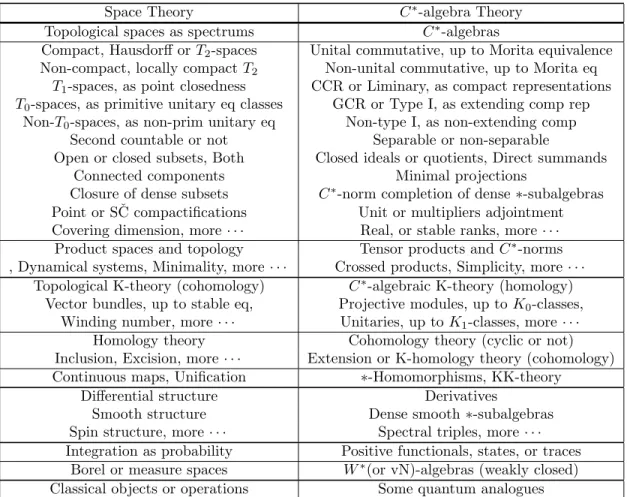
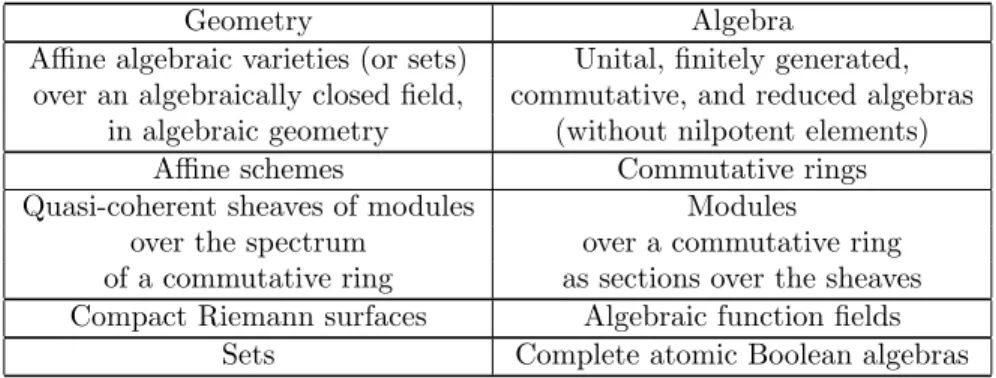
This paper is organized as follows. In Section 2, we look at the Space- C∗-algebra and Geometry-Algebra Tables as Dictionary of a couple of types, the first of which is the Space-C∗-algebra Table 2 as a part of Dictionary, well known to C∗-algebra experts. Given in the table 2 are the correspondences of general properties of spaces and C∗-algebras, and the correspondence in their homology and cohomology theories as K-theory or KK-theory, and more struc- tures. We also consider both the geometric part and the algebraic part in the
Received November 30, 2019.
Ryukyu Math. J., 32(2019), 1-78
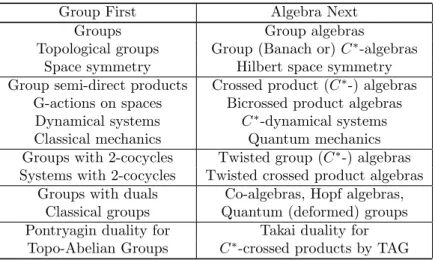
Geometry-Algebra Table 3. In Section 3, as given in the Group-Algebra Ta- ble 4, we consider group∗-algebras of discrete or locally compact groups with convolution and involution and their groupC∗-algebras, in some details. More- over, we consider twisted group ∗-algebras and twisted group C∗-algebras as well, and twisted or not crossed product C∗-algebras, but somewhat limited.
As well, noncommutative tori as motivated typical and important examples in noncommutative geometry are considered to some limited extent. In Section 4, we consider Hopf algebras equipped with additional co-algebraic structures to- beyond usual algebras and also do quantum (classical) groups as in the quantum Lie theory, also as in the context of noncommutative geometry.
Note that some notations are slightly changed by our taste from the original ones in [41].
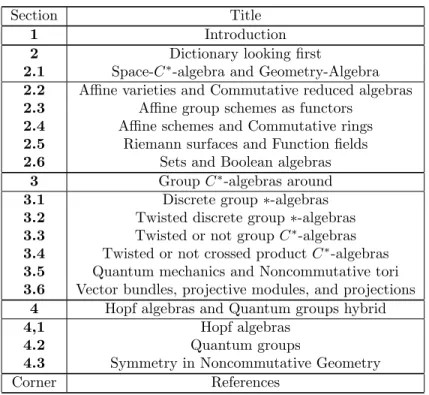
First of all, let us look at the following table of the contents of this paper.
It just looks like drawing a (deformed) portrait of a beauty, as does a kid.
Table 1: Contents
Section Title
1 Introduction
2 Dictionary looking first
2.1 Space-C∗-algebra and Geometry-Algebra 2.2 Affine varieties and Commutative reduced algebras 2.3 Affine group schemes as functors
2.4 Affine schemes and Commutative rings 2.5 Riemann surfaces and Function fields
2.6 Sets and Boolean algebras
3 GroupC∗-algebras around
3.1 Discrete group ∗-algebras
3.2 Twisted discrete group∗-algebras 3.3 Twisted or not groupC∗-algebras 3.4 Twisted or not crossed productC∗-algebras 3.5 Quantum mechanics and Noncommutative tori 3.6 Vector bundles, projective modules, and projections
4 Hopf algebras and Quantum groups hybrid
4,1 Hopf algebras
4.2 Quantum groups
4.3 Symmetry in Noncommutative Geometry
Corner References
Do you like this shape? Yes, we do.
Items cited in the references of this paper are only a part of those of [41]
related to the contents and some additional items, collected by us. The details may be checked sometime later, probably,· · ·.
2 Dictionary looking first
2.1 Space- C
∗-algebra and Geometry-Algebra
First of all, let us look at the following table as a part of Dictionary.
Table 2: An overview on spaces andC∗-algebras
Space Theory C∗-algebra Theory
Topological spaces as spectrums C∗-algebras
Compact, Hausdorff orT2-spaces Unital commutative, up to Morita equivalence Non-compact, locally compactT2 Non-unital commutative, up to Morita eq
T1-spaces, as point closedness CCR or Liminary, as compact representations T0-spaces, as primitive unitary eq classes GCR or Type I, as extending comp rep
Non-T0-spaces, as non-prim unitary eq Non-type I, as non-extending comp Second countable or not Separable or non-separable
Open or closed subsets, Both Closed ideals or quotients, Direct summands
Connected components Minimal projections
Closure of dense subsets C∗-norm completion of dense∗-subalgebras Point or S ˇC compactifications Unit or multipliers adjointment Covering dimension, more· · · Real, or stable ranks, more· · ·
Product spaces and topology Tensor products andC∗-norms , Dynamical systems, Minimality, more· · · Crossed products, Simplicity, more· · ·
Topological K-theory (cohomology) C∗-algebraic K-theory (homology) Vector bundles, up to stable eq, Projective modules, up toK0-classes,
Winding number, more· · · Unitaries, up toK1-classes, more · · · Homology theory Cohomology theory (cyclic or not) Inclusion, Excision, more· · · Extension or K-homology theory (cohomology) Continuous maps, Unification ∗-Homomorphisms, KK-theory
Differential structure Derivatives
Smooth structure Dense smooth∗-subalgebras
Spin structure, more· · · Spectral triples, more· · · Integration as probability Positive functionals, states, or traces
Borel or measure spaces W∗(or vN)-algebras (weakly closed) Classical objects or operations Some quantum analogues
May recall that aC∗-algebra is defined to an algebraA over the complex field C, equipped with involution as an anti-linear ∗-algebra map from A to A denoted as a∗ for a ∈ A, and the submultiplicative norm · satisfying
Space Theory C∗-algebra Theory
Topological spaces as spectrums C∗-algebras
Compact, Hausdorff orT2-spaces Unital commutative, up to Morita equivalence Non-compact, locally compactT2 Non-unital commutative, up to Morita eq
T1-spaces, as point closedness CCR or Liminary, as compact representations T0-spaces, as primitive unitary eq classes GCR or Type I, as extending comp rep
Non-T0-spaces, as non-prim unitary eq Non-type I, as non-extending comp Second countable or not Separable or non-separable
Open or closed subsets, Both Closed ideals or quotients, Direct summands
Connected components Minimal projections
Closure of dense subsets C∗-norm completion of dense∗-subalgebras Point or S ˇC compactifications Unit or multipliers adjointment Covering dimension, more· · · Real, or stable ranks, more· · ·
Product spaces and topology Tensor products andC∗-norms , Dynamical systems, Minimality, more· · · Crossed products, Simplicity, more· · ·
Topological K-theory (cohomology) C∗-algebraic K-theory (homology) Vector bundles, up to stable eq, Projective modules, up toK0-classes,
Winding number, more· · · Unitaries, up toK1-classes, more· · · Homology theory Cohomology theory (cyclic or not) Inclusion, Excision, more· · · Extension or K-homology theory (cohomology) Continuous maps, Unification ∗-Homomorphisms, KK-theory
Differential structure Derivatives
Smooth structure Dense smooth∗-subalgebras
Spin structure, more· · · Spectral triples, more· · · Integration as probability Positive functionals, states, or traces
Borel or measure spaces W∗(or vN)-algebras (weakly closed) Classical objects or operations Some quantum analogues
ab ≤ ab for a, b ∈ A, and the C∗-norm condition asa∗a = a2, so that a2 =a∗a ≤ a∗aand hencea ≤ a∗ ≤ (a∗)∗ with (a∗)∗ =a, such thatAis a Banach space with respect to the norm.
Theorem 2.1.1. (Gelfand-Naimark), (cf. [55]). AnyC∗-algebra is isomorphic to a closed ∗-subalgebra of the von Neumann C∗-algebra B(H) of all bounded operators on a Hilbert spaceH.
Any unital commutative C∗-algebra is isomorphic to the C∗-algebra C(X) of all continuous, C-valued functions on a compact Hausdorff spaceX.
Any commutativeC∗-algebra is isomorphic to C0(X) the C∗-algebra of all continuos,C-valued functions on a locally compact Hausdorff spaceX vanishing at infinity.
The spectrum of a C∗-algebra A is the space A∧ of equivalence classes of irreducible representations of Awith the hull-kenel topology. Those class defi- nitions ofC∗-algebras, such as being liminary, and of type I, are given by the separation axioms for their spectrums (cf. [29], [55], [57]).
In particular, the spectrum of C(X) is identified with X, which is also the same as the space of maximal ideals of C(X) with the Jacobson topol- ogy. Namely, a point xofX is identified with the evaluation map πx at xon C(X) as a character, defined asπx(f) =f(x) forf ∈C(X), and with the kernel ofπxas a maximal ideal ofC(X), under the Gelfand transform (cf. [55]).
The category CH of compact Hausdorff spaces with continuous maps is equivalent to the category U CC of unital commutative C∗-algebras with uni- tal ∗-homomorphisms. Namely, the functor C = C(·) is defined by pullback diagram as
X −−−−→ϕ Y
C(·)
⏐⏐
⏐⏐C(·) C(X) ←−−−−ϕ∗ C(Y)
ϕ∗(f) =f◦ϕ, f∈C(Y).
As well, the categoryLCH of locally compact Hausdorff spaces with contin- uous proper maps is equivalent to the categoryCC of commutativeC∗-algebras with proper∗-homomorphisms.
Note that a continuous mapϕ:X →Y of locally compact spaces is defined to be properif the inverse image ϕ−1(K) is compact for any compact subset K ofY.
As well, a ∗-homomorphism ρ : A → B of C∗-algebras is defined to be properif the image of any approximate identity forAunderρis an approximate identity for B. Equivalently, for any nonzero irreducible representationπofB as a non-zero class of B∧, the compositeπ◦ρis not zero as inA∧. Also,ρ is proper if and only if ρ(A)Bis dense in B. Note that an approximate identify for a C∗-algebra A is a net of elements ej of A such that limjaej = a and limjeja=afor anya∈A(cf. [55], [57]).
Example 2.1.2. LetXbe a locally compact Hausdoff space andX+=X∪{∞}
be the one-point compactfication ofXby adding∞. ThenC(X+) is isomorphic
to the unitizationC0(X)+=C0(X)⊕C1 ofC0(X), as aC∗-algebra (cf. [74]).
Example 2.1.3. Let Cb(X) be the C∗-algebra of all bounded, continuous functions on a locally compact Hausforff space X. Then Cb(X) is isomor- phic toC(βX) with βXthe Stone- ˇCech compactification ofX, identified with Cb(X)∧ the spectrum. Also, Cb(X) is isomorphic to the multiplierC∗-algebra M(C0(X)) as the largest unitization ofC0(X) (cf. [74]).
Example 2.1.4. LetX be a locally compact Hausdorff space andUbe an open subset of X with K the complement of U in X. Then there is the following short exact sequence ofC∗-algebras:
0→C0(U) −−−−→i C0(X) −−−−→q C0(K)→0
withC0(U) a closed ideal of C0(X) andC0(K) as a quotient, where the map i is the canonical inclusion map by defining values onK to be zero, andqis the restriction map toK.
Example 2.1.5. LetX×Y be the product space of locally compact Hausdorff spacesXandY. ThenC(X⊗Y) is isomorphic to the tensor productC∗-algebra C(X)⊗C(Y). For some details about theC∗-norms for tensor products ofC∗- algebras, may refer to [55] or [68].
Table 3: Functorial correspondences between geometry and algebra
Geometry Algebra
Affine algebraic varieties (or sets) Unital, finitely generated, over an algebraically closed field, commutative, and reduced algebras
in algebraic geometry (without nilpotent elements)
Affine schemes Commutative rings
Quasi-coherent sheaves of modules Modules
over the spectrum over a commutative ring of a commutative ring as sections over the sheaves Compact Riemann surfaces Algebraic function fields
Sets Complete atomic Boolean algebras
The correspondences are considered in the next subsections.
2.2 Affine varieties and Commutative reduced algebras
May refer to [35] and [8].
An affine algebraic variety, also called an (irreducible) algebraic (sub)set (of F), over an algebraically closed field F (with the induced Z topology) is a subsetV of the affine spaceFn as the set of alln-tuples of elements ofF, which
is the set of common zeros of a collectionP of polynomials innvariables over F, that is,
V =V(P) =Z(P) ={z= (z1,· · · , zn)∈Fn|p(z) = 0, p∈P}.
Without loss of generality, we may assume thatPis an ideal of the polynomial ringF[x1,· · ·, xn] innvariables overF.
In fact, any element f = f(x) = f(x1,· · ·, xn) ∈ F[x1,· · ·, xn] is viewed as a function from Fn to F, by sending z ∈ Fn to f(z) ∈ F. Then define V(f) =Z(f) ={z∈Fn|f(z) = 0}. For anyP⊂F[x1,· · ·, xn], letI(P) denote the ideal ofF[x1,· · ·, xn] generated byP. Then it holds thatV(P) =V(I(P)).
Also, since F[x1,· · ·, xn] is a Noetherian ring, any its ideal, and in particular V(P), has a finite set of generators.
The set of allV(P)⊂Fn for anyP⊂F[x1,· · ·, xn] is closed under taking finite unions and arbitrary intersections. As well, the empty set ∅ and Fn are assumed to be algebraic sets.
For instance, iff(z) =z1· · ·zn−1 andg(z) =z1· · ·znforz= (z1,· · ·, zn)∈ Fn, then V({f, g}) = V(f)∩V(g) = ∅. As well, if h(z) = f(z)g(z), then V(h) =V(f)∪V(g) which is not irreducible, but algebraic. Also, iff(z) = 0 forz∈Fn, thenV(f) =Fn.
Therefore, the Zariski (Z) topology forFnis defined by defining open subsets ofFn to be the complements of algebraic subsets ofFn.
Example 2.2.1. Letn= 1. The affine line overF isF. Every ideal ofF[x] is principal. Thus, every algebraic subset ofFis the setZ(f) of zeros of a single polynomial f = f(x) ∈ F[x]. Since F is algebraically closed, every nonzero polynomial f(x) ∈ F[x] can be decomposed as c(x−a1)· · ·(x−al) for some c, a1,· · · , al ∈ F and l ≥ 1. Then Z(f) = {a1,· · · , an}. Thus, the set of algebraic subsets ofFis equal to the set of all finite subsets ofF, together with the empty set andF. In particular, the Zariski (Z) topology is not Hausdorff.
Hence,Fcan not be finite.
For an affine algebraic varietyV(P)⊂Fn, an open subset ofV(P) with the induced topology is said to be a quasi-affine variety.
Amorphism between affine varieties V ⊂Fn and W ⊂Fm is given by a map f :V →W, which is the restriction of a polynomial map (?) from Fn to Fm (cf. The definitions below). Then the categoryAff-Alg-Var=AAVof affine varieties with morphisms is formed.
Definition 2.2.2. LetY be a quasi-affine variety ofFn. A functionf :Y →F is said to be regularat a point y∈Y if there is an open subset U ofY, with y ∈ U, and polynomials g(x), h(x) ∈ F[x1,· · ·, xn] such that f(z) = hg((zz)) for z∈U, withhnowhere zero onU. Say thatf is regular onY if it is regular at every point ofY.
Definition 2.2.3. LetX, Y be affine, or quasi-affine varieties over F. Amor- phismϕ:X →Y is a Z continuous map such that for every open subsetW ⊂Y and for every regular functionf :W →F, the functionf◦ϕ:V =ϕ−1(W)→F
is regular. Namely, for some g, h ∈ F[x1,· · ·, xm] and g∼, h∼ ∈ F[x1,· · ·, xn] locally existed,
Fn⊃X ⊃V =ϕ−1(W) −−−−→ϕ W ⊂Y ⊂Fm
f◦ϕ=g∼h∼
⏐⏐
⏐⏐f=gh
F F.
Areducedalgebra is defined to be an algebra with no nilpotent elements.
Namely, for an elementxin such a algebra, ifxn = 0 for somen, as nilpotenty, thenx= 0. Consider the categoryComm-Red-Alg=CRAof unital, finitely gen- erated, commutative, and reduced algebras with unital algebra homomorphisms.
There is the opposite equivalence between the two categories Aff-Alg-Var =AAV∼=op Comm-Red-Alg =CRA.
The equivalence functor associates to an affine varietyV ⊂Fn its coordinate ringO[V] defined by
O[V] = Reg(V,F)∼=F[x1,· · · , xn]/I(V) =F[x1,· · ·, xn](V)
(corrected), where O[V] = Reg(V,F) is the ring of all regular functions on Y, andI(V) is the vanishing ideal ofV defined by
I(V) ={p∈F[x1,· · · , xn]|p(V) = 0}.
Then, O[V] is unital, finitely generated,commutative, and reduced. Moreover, given a morphism of varietiesf :V →W, its pullback defines a unital algebra homomorphismf∗:O[W]→ O[V]. Namely,
V −−−−→f W
ϕ◦f∈ O[V]
⏐⏐
⏐⏐ϕ∈O[W]
F F
ϕ∈Hom(V, W)
f∗
⏐⏐ pullback
f∗(ϕ) =ϕ◦f ∈Hom(O[W],O[V]).
Hence, the contravariant functorO:AAV →CRA is defined asV → O[V].
A finitely generated, unital commutative algebra A with n generators can be written as a quotient F[x1,· · ·, xn]/J by some idealJ. Moreover, such an algebraAis a reduced algebra, so that it has no nilpotent elements, if and only if the idealJ is a radical ideal in the sense that if xn ∈J, thenx∈J. In this case, as one of the classical forms of the Hilbert Nullstellensatz (HN),Acan be recovered as the coordinate ring O[V] of an affine varietyV
It then follows that the coordinate ring functorO is essentially surjective, as the main step in the opposite equivalence, and moreover, the functor is full and faithful, easily deduced.
As in the Gelfand-Naimark (GN) correspondence, under the Hilbert N (HN) correspondenceO, geometric constructions in algebraic geometry can be trans- lated into algebraic terms and vise-versa. For instance, disjoint union and direct product of affine varietiesV1 andV2 are done
O[V1V2]∼=O[V1]⊕ O[V2], O[V1×V2]∼=O[V1]⊗ O[V2],
andV is irreducible if and only ifO[V] is an integral domain.
Theorem 2.2.4. ([35]). There is the arrow-reversing equivalence functor be- tween the category AAV of affine algebraic varieties V overF and the category FID of finitely generated integral domains O[V] overF.
Theorem 2.2.5. (Hilbert Nullstellensats [35]). Let I be an ideal of A = F[x1,· · · , xn]andf ∈Athat vanishes onZ(I). Then there is a positive integer r >0 such that fr∈I. Namely, f is contained in the radical ofI:
f ∈√
I ={f ∈A|fr∈I for somer >0}=I(Z(I)).
Then there is the1-1inclusion reversing, correspondence between algebraic sub- sets ofFn and radical ideals ofA, soI=√
I, given as Fn⊃V =V(I(P))→I(V(I(P))) =
I(P) =
I(P)⊂A, Fn⊃V2(I2)⊃V1(I1)→I(V2(I2)) =
I2 ⊂I(V1(I1)) = I1 ⊂A, A⊃I=√
I→V(I) =Z(I)⊂Fn, A⊃I2⊃I1→Z(I2)⊂Z(I1)⊂Fn, with Z(I(V)) = V = V and I(V(I)) = √
I =I. Furthermore, an algebraic subset ofFn is irreducible if and only if its radical ideal is a prime ideal.
Note that in general, iff ∈√
I, thenf =f1 ∈√
I. Hence, √
I ⊂√ I. Conversely, if g ∈√
I, then gr ∈√
I for some r >0. Thus, (gr)r ∈I for some r>0. Hence,√
I⊂√ I.
Proof. Given is the proof of only the last part. Suppose that V is irreducible.
If f g ∈ I(V), thenf g(V) = 0 and Z(f g) = Z(f)∪Z(g) ⊂ Fn. Hence V = (V∩Z(f))∪(V∩Z(g)) as a union of closed subsets ofV. SinceV is irreducible, we have eitherV =V∩Z(f) orV =V∩Z(g), and thusV ⊂Z(f) orV ⊂Z(g).
Hence eitherf(V) = 0 org(V) = 0, and thusf ∈I(V) org∈I(V).
Conversely, letP be a prime ideal ofA, and suppose thatV(P) =V1∩V2as a union of closed subsets. Then P =I(V1∩V2) =I(V1)∩I(V2), so that either P =I(V1) orP =I(V2). Therefore,Z(P) =V1 orV2.
There are also various equivalent ways of characterizing smooth (or non- singular) varieties in terms of their coordinate rings.
Unlike the GN correspondence, the HN correspondence does not seem to indicate what is the notion of a noncommutaive affine variety, or noncommuta- tive (affine) algebraic geometry, in general. There seems to be a lot to be done remained in this area. But a possible approach has been pursued at least in the smooth case.
As a particularly important characterization of non-singularity, that lends itself to noncommutative generalization, is the following result of Grothendieck (cf. [48]).
Theorem 2.2.6. A varietyV is smooth if and only if its coordinate ringO[V] has the lifting property with respect to nilpotent extensions, in the sense that for any unital commutative algebra A and a nilpotent ideal I of A, the following map induced by taking the quotientA/I is surjective:
Hom(O[V], A)→Hom(O[V], A/I)→1.
Motivated by that characterization for smoothness of varieties, an algebraB overC, not necessarily commutative, is defined to be NC smooth (or quasi-free) (NCS) if the above lifting property holds by replacing O[V] with B, for any algebraA, by Cuntz and Quillen [25].
A free algebra, also known as tensor algebra, or algebra of noncommutative polynomials, is smooth in that sense. But commutative algebras which are smooth need not be smooth in that sense. In fact, it is shown that an algebra is NC smooth if and only if it has Hochschild cohomological dimension 1 ([25]). In particular, the algebras of polynomials in more than 1 variables and in general, the coordinate rings of smooth varieties of dimension more than 1 are not NC smooth. Nevertheless, that notion of NCS has played an important role in the development of a version of NC algebraic geometry (cf. [44], [47]).
An alternative approach to NC algebraic geometry is proposed by [1]. As one of the underlying ideas, the projective Nullstellensatz theorem (cf. [35]) characterizes the graded coordinate ring of a projective variety defined as sec- tions of powers of an ample line bundle over the variety. Thus, in this approach, a noncommutative variety is represented by some noncommutative graded ring.
Now recall from [35] that the projective n-space Pn = Pn(F) is the set of equivalence classes of elements of (Fn+1)∗ =Fn+1\0 under the equivalence relation given that for (zj),(wj)∈(Fn+1)∗, (zj)∼(wj) if there isλ∈F∗ such thatλ(zj) = (λzj) = (wj).
A gradedring is a ring R with a decomposition R =⊕d≥0Rd as a direct sum of abelian groups Rd (of homogeneous elements of degree d) such that for any d1, d2 ≥ 0, Rd1Rd2 ⊂ Rd1+d2. An ideal I of R is homogeneous if I=⊕d≥0(I∩Rd). An ideal ofRis homogeneous if and only if it is generated by homogeneous elements. The set of homogeneous ideals is stable under taking direct sum, direct product, intersection, and radical√
·. A homogeneous ideal I is prime if for homogeneous elementsf, g∈I,f g∈Iimpliesf ∈I org∈I.
The polynomial ringR=F[x0, x1,· · ·, xn] becomes a graded ring by taking Rd to be the subspace ofR generated by monomials of degreedin x0,· · ·, xn. Then note that for f ∈ Rd, f(λz0,· · ·, λzn) = λdf(z0,· · ·, zn). Hence, the being zero or not off depends only on the equivalence class [(zj)]∈Pn. Thus, forf ∈Rd, there is a function f∼:Pn → {0,1}defined as
f∼([(zj)]) =
0 iff(z0,· · ·, zn) = 0, 1 iff(z0,· · ·, zn)= 0.
For any subsetH of some homogeneous elements ofR, define the zeroset ofH to be
Z(H) ={p∈Pn| f∼(p) = 0 for anyf ∈H}.
IfI is a homogeneous ideal ofR, then defineZ(I) to beZ(H), whereH is the set of all homogeneous elements of I. Since R is a Noetherian ring, for any subset H of homogeneous elements of R, there is a finite subset F ofH such thatZ(H) =Z(F).
There are more theories that parallel to the unprojective theories, to be continued.
2.3 Affine group schemes as functors
May refer to [73].
For any unital commutative ringR, there are corresponding then×nspecial or general linear groups SLn(R) or GLn(R) with determinant 1 or non-zero, respectively. In particular,GL1(R) =R∗is the multiplicative group ofR. Also, Ris the additive groupR+=R. Letμn(R) ={x∈R|xn= 1}be then-th roots of unity inR, as a group under multiplication. Letαp(R) ={x∈R|xp = 0} as a group under addition.
Letk be a base ring or a field, such asZand so on.
Theorem 2.3.1. Let F be a functor fromk-algebrasR to sets. If the elements of F(R) correspond to solutions in R of some family of equations, then there is ak-algebraA and a natural correspondence betweenF(R)and Homk(A, R).
The converse also holds.
Proof. Suppose we have some family of polynomial equations {pl}l∈L over k, with respect to some {aj}j∈J of R. Then take the polynomial ring P = k[{xj}j∈J] over k, with each indeterminate xj as each variableaj in the equa- tions. Divide it by the ideal I generated by the relations defined as all the equations, to obtain the quotient algebraA=P/I.
LetF(R) be given by the solutions of the equations pl inR. Anyk-algebra homomorphismϕ:A→Rtakes general solutions to a solution ofRcorrespond- ing to an element ofF(R). Sinceϕis determined by sending the indeterminates, we have an injection from Homk(A, R) into F(R). This is actually bijective by generality of solutions.
Anyk-algebra B arises in this way from some family of equations. Indeed, let{bj}j∈J be the set of generators ofB. There is the ring homomorphism from P =k[{xj}j∈J] ontoBby sendingxj tobj. Choose polynomials generating the kernelI. ThenB∼=A=P/I.
Such a functorF is said to berepresentablebyA. An affine group scheme overkis defined to be a representable functor fromk-algebras to groups.
Example 2.3.2. Let k =Z and R =R. Let F(R) = GL1(R) =R∗ ={x∈ R|x= 0} as a group. Then A =R[1]∼=R=R. And Homk(A, R) =R since any element of which is determined by sending 1 to an element ofR. Therefore, identified with areF(R) and Homk(A, R)−1 of invertible maps.
Example 2.3.3. The determinant map det :GL2→GL1of groups as functors is natural in the sense that for any algebra homomorphism ρ : R → R, the following commutes:
R −−−−→GL2 GL2(R) −−−−→det GL1(R)
ρ
⏐⏐
⏐⏐(ρ◦(·))ij ⏐⏐ρ◦(·) R −−−−→GL2 GL2(R) −−−−→det GL1(R).
Theorem 2.3.4. (The Yoneda Lemma). Let F1 andF2 be (set-valued) func- tors from k-algebras R, represented by k-algebras A1 and A2, as Fj(R) = Homk(Aj, R) for j = 1,2. The natural maps Φ from F1 to F2 correspond to k-algebra homomorphismsϕfrom A2 toA1.
Proof. Letϕ:A2→A1be given. For anyψ∈F1(R) = Homk(A1, R), the com- positionψ◦ϕbelongs toF2(R) = Homk(A2, R). Then for any homomorphism ρ:R→R, the following diagram commutes:
R −−−−→F1 F1(R) = Homk(A1, R) −−−−→(·)◦ϕ F2(R) = Homk(A2, R)
ρ
⏐⏐
⏐⏐ρ◦(·) ⏐⏐ρ◦(·) R −−−−→F1 F1(R) = Homk(A1, R) −−−−→(·)◦ϕ F2(R) = Homk(A2, R) and let Φ = (·)◦ϕ.
Conversely, let Φ :F1→F2 be a natural map. SinceFj(R) = Homk(Aj, R), then for anyρ∈F1(R) = Homk(A1, R), the diagram
F1(A1) = Homk(A1, A1) −−−−→ρ◦(·) F1(R) = Homk(A1, R)
Φ
⏐⏐
⏐⏐Φ
F2(A1) = Homk(A2, A1) −−−−→ρ◦(·) F2(R) = Homk(A2, R)
commutes. In particular, letϕ= Φ(idA1) :A2→A1, where idA1 :A1→A1 is the identity map. Then for anyρ∈F1(R), we have
Φ(ρ) = Φ(ρ◦idA1) =ρ◦ϕ and hence Φ = (·)◦ϕ.
Such a natural functor Φ :F1 →F2 is said to be a natural correspondence ifF1(R)→F2(R) is bijective for anyR.
Corollary 2.3.5. A natural functorΦ :F1→F2 represented by A1 and A2 is a natural correspondence if and only if the corresponding ϕ : A2 → A1 is an isomorphism.
2.4 Affine schemes and Commutative rings
Let A be a unital commutative ring. The (prime) spectrum of A is defined to be a pair (Sp(A),OA), also called a ringed space, where Sp(A) also called the spectrum of A, as a set consists of all prime ideals of A, with the Zariski topology, and OA is the sheaf of rings on Sp(A), both defined below.
Note that an idealIofAis said to beprimeifI=Aand for anya, b∈A, ab∈I(corrected fromA) implies that eithera∈Iorb∈I. Given an idealIof A, letV(I) denote the set of all prime ideals ofAwhich containI. TheZariski topology on Sp(A) is defined by assuming that any V(I) is a closed subset of Sp(A). Indeed, for idealsI, J,IjofA, we haveV(IJ) =V(I)∪V(J) (corrected from the intersection) andV(
jIj) =∩V(Ij). Note thatV({0}) = Sp(A) and V(A) =∅.
Check that ifIJ⊂K∈Sp(A), thenI⊂Kor J ⊂K. If not so, thenIJ is not contained inK. Conversely, note thatIJ ⊂I andIJ ⊂J. Check also that if
jIj⊂K∈Sp(A), thenIj ⊂Kfor anyj. Its converse also holds.
As well,IJ ⊂I∩J, but the equality does not hold in general. However, if A=I+J, then the equality does hold (cf. [54]).
May check that the space Sp(A) is compact but non-Housdorff in general.
For each prime idealP ofA, denote byAP =A/PcthelocalizationofAat P, wherePcis the complement ofPinA, which is a multiplicative closed subset of A. For an open subset U of Sp(A), letOA(U) be the set of all continuous sections from U to∪P∈UAP, where such a section is said to becontinuous if locally around any pointP ∈U, it is of the form fg withg∈P. May check that OA is a sheaf of commutative rings on Sp(A).
The spectrum functor Sp is defined by sendingA to (Sp(A),OA).
Anaffine schemeis a ringed space (X,O) such thatX is homeomorphic to Sp(A) for a commutative ringAandO is isomorphic toOA.
The spectrum functor Sp defines an equivalence between the categoryAS of affine schemes with continuous maps and the category CR of commutative rings with unital ring homomorphisms, as
Sp :CR→AS, A→Sp(A) =X andOA=O, so that
A −−−−→f B
Sp
⏐⏐
⏐⏐Sp Sp(A) ←−−−−f∗ Sp(B)
where f∗(Q) = f−1(Q) for any Q∈Sp(B). Note that for a maximal ideal of B, the inverse imagef−1(B) is not necessarily maximal. This is the reason to consider the prime spectrum for an arbitrary ring, not the maximal spectrum.
The inverse equivalence for Sp above is given by the global section functor Γ that sends an affine scheme X to the ring ΓX of its global sections.
In the same vein, the categoriesM Rof modules over a ring can be identified with the categoriesSM S of sheaves of modules over the spectrum of the ring.
LetAbe a commutative ring and leftM be anA-module. Define asheafM of modules over Sp(A) as follows. For each prime idealP ofA, letMP denote the localization of M at P. For any open subsetU of Sp(A), letM(U) denote the set of continuous sections from U to ∪PMP, where such a section has the form of a fraction mf locally form∈M andf ∈AP. ThenM is recovered from Mby showing thatM ∼= ΓMthe space of global sections ofM.
Sheaves ofOA-modules on Sp(A) obtained in that way is said to bequasi- coherent sheaves, which are local models for a more general notion of quasi- coherent sheaves on arbitrary schemes.
The functorsShsendingM toMand Γ sendingMto ΓMdefine an equiv- alence of theM RoverAand the quasi-coherentSM S of Sp(M). Namely,
Sh:M R→SM S and Γ :SM S →M R.
Based on this correspondence, given an algebraA, not necessarily commu- tative, the category ofA-modules may be replaced with the categrory of quasi- coherent sheaves over the noncommutative space as Sp(A). This is a nice idea in the development of the subject of noncommutative algebraic geometry, about which nothing is considered here (cf. [1], [44], [47]).
Recall from [52] the following. LetX be a topological space. Apresheaf on X is defined to be a system (or functor) F that for any open subset U of X, there is an abelian groupF(U) such that for any inclusionU ⊂V of open subsets ofX, there is a homomorphismϕU V :F(V)→F(U) satisfying that the following commutes:
∅ ←−−−−⊂ U −−−−→⊂ V −−−−→⊂ W −−−−→⊂ X
F
⏐⏐
⏐⏐F ⏐⏐F ⏐⏐F ⏐⏐F F(∅) ={0} ←−−−−ϕ∅U F(U) ←−−−−ϕU V F(V) ←−−−−ϕV W F(W) ←−−−−ϕW X F(X) such asϕU V◦ϕV W =ϕU W, withϕU U :F(U)→F(U) the identity map for any open U of X. A homomorphismψ of presheaves F andG onX is defined as that for any openU ⊂V ofX, there are homomorphismsϕ(U) :F(U)→G(U) such that the following commutes:
F(V) −−−−→ψ(V) G(V)
ϕU V
⏐⏐
⏐⏐ϕU V F(U) −−−−→ψ(U) G(U).
A presheafF onX is defined to be asheafonX if, as the local condition, for any openU ofX and its open coveringU ⊂ ∪jUj inX, there issj ∈F(Uj) for eachjsuch that for anyi, j, the restricionsionUi∩Uj, that isϕUi∩Uj,Ui(si), is equal tosj onUi∩Uj, then there iss∈F(U) uniquely such thatsonUj is equal tosj for everyj.
By replacing the abelian groups such as F(U) with groups or rings or so, sheaves of those are obtained.
Example 2.4.1. LetX be a topological space andGbe a group (or ring) with the discrete topology. Then the direct productX×Gbecomes a sheaf. This is called a constant or trivial sheaf. Note thatF(U) =Gfor any openU ⊂X.
Example 2.4.2. Let X be a tological space and Y be a topological abelian group such asRn or Cn. For any openU ⊂X, defineF(U) to beC(U, Y) the set (or additive group, or ring forn= 1) of continuous maps fromU toY. For open subsetsU ⊂V ofX, letϕV U :C(U, Y)→C(V, Y) be the restriction map.
Then the sheafC(·, Y) of continuous functions overX is obtained, so that the diagram commutes
∅ ←−−−−⊂ U −−−−→⊂ V −−−−→⊂ W −−−−→⊂ X
⏐⏐
C(·,Y) ⏐⏐C(·,Y) ⏐⏐C(·,Y) ⏐⏐C(·,Y) C(·,Y)⏐⏐ C(∅, Y) ={0} ←−−−−ϕ∅U C(U, Y) ←−−−−ϕU V C(V, Y) ←−−−−ϕV W C(W, Y) ←−−−−ϕW X C(X, Y).
2.5 Riemann surfaces and Function fields
It is shown that the category RSc of compact Riemann surfaces is equivalent to the categoryF Fa of algebraic function fields. For this correspondence, may refer to [32].
A Riemann surface is defined to be a complex manifold of complex di- mension 1. A morphism between Riemann surfaces X and Y is given by a holomorphic mapf :X →Y.
An algebraicfunction field is defined to be a finite extension of the field C(x) of rational functions in one variable x. A morphism of function fields is given by an algebra map.
To a compact Riemann surfaceX, accociated is the fieldM(X) of meromor- phic functions onX. For example, the fieldM(S2) of meromorphic functions of the Riemann sphereS2 ≈C∪ {∞}, with no holes, is the field C(x) of rational functions.
To a finite extension of C(x), associated is the compact Riemann surface of the algebraic function p(z, w) = 0, wherew is a generator of the field over C(x). This correspondence is essentially due to Riemann. Despite its depth and beauty, this correspondence so far may not be revealed by any way of the noncommutative analogue of complex geometry.
Another possible approach to the complex structures in noncommutative geometry may be based on the notion of a positive Hochschild cocycle on an involutive algebra, as defined in [11]. As an other contribution, noncommutative complex structures motivated by the Dolbeault complex is introduced in [42], and as well, a detailed study of holomorphic structures on noncommutative tori and holomorphic vector bundles on noncommutative 2-tori is carried out in [59].
It is shown in [10] that positive Hochschild cocycles on the algebra of smooth functions on a compact oriented 2-dimensional manifold encode the information for defining a holomorphic structure on the surface, which suggests that the p-H cocycles may be used in a possible framework for holomorphic noncommutative
structures. The corresponding problem of characterizing holomophic structures on general dimensional manifolds by using positive Hochschild cocyles may be still open. In the case of noncommutative 2-tori, a positve Hochschild 2-cocycle on the non-com 2-torus can be defined as complex structures. As well, a natural complex structure on the Podl´e qunatum 2-sphere is defined in [42]. With this additional structure, the quantum 2-sphere is said to be the quantum projective line as CPq1, which resembles the classical Riemann sphere in several suitable ways.
2.6 Sets and Boolean algebras
The set theory can be regarded as the geometrization of logic. There is a duality or correspondence between the categorySetof sets with (set) maps and the categoryBooof complete atomic Boolean algebras (cf. [2]).
ABooleanalgebra is defined to be a unital ringBsuch that any elementxof B satisfies the equationx2=x. A Boolean algebra is necessarily commutative.
Indeed, for anyx, y∈B, letc=xy−yx. Then
c=c2= (xy−yx)2=xyxy−xy2x−yx2y+yxyx=xy−xyx−yxy+yx, which implies thatxyx= 2yx−yxy andyxy= 2yx−xyx. Therefore, we have
xy=xyxy= (2yx−yxy)y= 2yxy−yxy=yxy, xy=xyxy=x(2yx−xyx) = 2xyx−xyx=xyx, so thatyx=yxyx=y(2yx−yxy) =yxy=xy.
Define a partialorder relationx≤y forx, y∈B if there is any ∈B such thatx=yy.
Check thatx≤xsincex=x1 with 1∈B. Ifx≤yandy≤z, thenx=yy andy=zz for somey, z∈B. Thenx=zzy withzy ∈B. Hencex≤z. If x≤yandy≤x, thenx=yy andy=xx for some y, x∈B. Then
x=yy=y2y =yx=xy=x2x=xx=y.
Anatom of a Boolean algebra B is defined to be an elementx∈ B such that there is no y ∈ B with 0 < y < x. A Boolean algebra B is said to be atomic if every element x∈B is the supremum of all the atomsy ∈ B with y < x. A Boolean algebra B is said to be complete if every subset ofB has its supremum and infimum inB. A morphism of complete Boolean algebras is given by a unital ring map which preserves infimums and supremums.
Example 2.6.1. LetS be a set. Let B =BS = 2S ={f :S → {0,1} =Z2} the set of all functions fromSto the two points set. ThenB= 2S is a complete atomic Boolean algebra.
Indeed, for anyf ∈B, we have f2 =f sincef(s)2 =f(s) for anys ∈ S, because of 02 = 0 and 12 = 1. The constant map 1 = 1(s) = 1 for anys∈ S is the unit for B. It is clear that B is commutative. Define a partial order
relation f ≤ g for f, g ∈ B if f(s) ≤ g(s) for every s ∈ B. If f ≤ g in this sense, then f = f g. Hence f ≤g in that sense. Conversely, iff ≤g in that sense so thatf =gh for someh∈B, thenf =gh≤1g=g in this sense. An atom ofB is given by a characteristic functionχtat an elementt∈Ssuch that χt(s) = 0 fors=tandχt(t) = 1. Also, any f ∈B is written as the supremum supnn
j=1χtj withtj ∈S with f(tj) = 1 for somen finite or unbounded. As well, for any subsetC ofB, supC is given as supnn
j=1χtj such that there is f ∈C with f(tj) = 1, and infC is given as supnn
j=1χtj such that f(tj) = 1 for anyf ∈C.
Any mapϕ:S→T of setsS andT defines amorphismof the associated complete atomic Boolean algebrasBS, BT by pull-back as
S −−−−→ϕ T
2
⏐⏐
B 2⏐⏐B 2S =BS f ◦ϕ ←−−−−ϕ∗ f ∈2T =BT.
This system is a contravariant functor from the category Set to the category Boo.
As for the opposite direction, given a Boolean algebraB, define its spec- trum B∧ to be HomBoo(B,{0,1}) the set of all Boolean algebra homomor- phisms fromB to a two points set as{0,1}, viewed as the Boolean algebra of two elements 0 and 1. Any Boolean algebra mapψ:B→C induces a set map ψ∧ :C∧ →B∧ defined as ψ∧ =ψ∗ the pull-back ofψ, so thatψ∧(f) = f◦ψ forf ∈C∧. Namely,
B −−−−→ψ C
Hom(·,Z2)
⏐⏐
⏐⏐Hom(·,Z2) B∧ ←−−−−−ψ∧=ψ∗ C∧
This system is a contravariant functor from the category Boo to he category Set.
This and that functors give anti-equivalences of the categories, quasi-inverse to each other. Thus, we have a duality between the category of sets as geometric objects and the category of commutative algebras as complete atomic Boolean algebras. This result is a special case of the Stone duality between Boolean algebras and a certain class of topological spaces (cf. [38]).
Example 2.6.2. Let S = Z2 as a set. Then BS = 2S is generated by the characteristic functions χ0 and χ1 for 0,1 ∈ Z2. Hence, BS = {0, χ0, χ1,1 = χ0+χ1}, whichi is isomorphic toZ2×Z2 as a ring. Therefore,
BZ∧2 = Hom(BZ2,Z2)∼= Hom(Z2×Z2,Z2)
∼= Hom(Z2,Z2)×Hom(Z2,Z2)∼=Z2×Z2.
There may not be the notion of some kind of noncommutative sets, obtained as quantizing the set theory by noncommutative Boolean algebras if any or not.