Miyazaki International College Writing Handbook
2014 First Edition
A Note to Students
This handbook contains information to help you improve your academic writing skills. You can use it as a study guide, reviewing each section until you understand and are able to use the main points. You can also use it as a reference any time you have to write a paper for a class or have questions about some aspect of writing.
Finally, this handbook will be useful when writing your senior thesis.
In short, you can use this handbook throughout your four years at MIC to improve your writing skills. We hope you do!
A Note to Faculty
This handbook is the result of ideas discussed at a meeting of the MIC English faculty in the spring of 2010. The English faculty wanted to provide students with uniform guidelines for academic writing in all of their
coursework at MIC and in the writing of their senior thesis. We felt such uniformity would facilitate learning of academic writing skills and minimize misunderstanding. We agreed that a handbook, similar to those created and used in Japanese universities and intensive English programs abroad but tailored to the needs of our students, would be valuable to both students and faculty.
From its inception, this handbook was not intended as a textbook. There are no practice exercises or questions at the end of each chapter. There are already numerous high-quality academic writing textbooks available online and in bookstores across Japan. More importantly, a handbook for students – rather than a classroom textbook – is much less likely to limit teacher autonomy or creativity when it comes to the teaching of writing.
Instead, our goal was to inform at a level appropriate for students at MIC. The first three chapters provide an overview of academic writing style (as compared to other forms of writing), suggestions for each step in the process of writing, and guidelines for formatting papers in the academic context. Chapters four and five give an overview of paragraph and short essay writing, and chapter six offers a comprehensive review of sentence structure.
This handbook has numerous gaps and many places in need of improvement, and we already have a long wish list for next year. It also contains information that some faculty members may disagree with; faculty members at MIC and grammarians around the globe have differing definitions for what constitutes a clause, for example.
With never enough time to fully consult more than a few of our MIC colleagues, we ended up presenting information as we have found it in the majority of print and online sources.
We ask, therefore, that you accept this work as a first step rather than a destination. We look forward to your feedback and your many suggestions for improvement.
Sincerely,
Phil Bennett Tim Stoeckel
Contents
A Note to Students ... 2
A Note to Faculty ... 2
Academic Writing Style ... 6
1.1 Written and Spoken English ... 7
1.2 Different Kinds of Writing ... 8
1.3 Academic Writing ... 9
1.3.1 Gender Reference ... 10
1.3.2 Use of I and You ... 11
1.3.3 Use of Questions ... 12
1.3.4 Use of Phrasal Verbs ... 13
1.3.5 Use of Contracted Forms ... 14
The Writing Process ... 15
2.1 Selecting Your Topic ... 16
2.2 Narrowing Your Topic ... 16
2.3 Brainstorming... 17
2.3.1 Listing ... 18
2.3.2 Free Writing ... 19
2.3.3 Mind Mapping ... 20
2.4 Organizing Your Ideas ... 21
2.5 Drafting ... 23
2.6 Revising and Editing ... 24
Formatting an Academic Paper ... 25
3.1 Formatting a Short Academic Paper ... 26
3.2 Example Paragraph Written by Hand ... 28
4.4 Concluding Sentence ... 36
4.5 Paragraph Unity ... 38
4.6 Paragraph Cohesion ... 39
4.7 Paragraph Coherence ... 42
4.7.1 Logical Order ... 42
4.7.2 Transition Signals ... 47
Writing Good Essays ... 50
5.1 From Paragraphs to Essays ... 51
5.2 Introduction ... 54
5.2.1 Thesis Statements ... 55
5.2.2 Listing Subtopics in the Thesis Statement ... 56
5.3 Introduction Styles ... 57
5.3.1 General to Specific Introductions ... 58
5.3.2 Historical Introductions ... 59
5.3.3 Anecdotal Introductions ... 60
5.3.4 Surprising Introductions with Facts or Statistics ... 62
5.4 Body ... 63
5.4.1 Transition Sentences ... 64
5.4.2 Supporting Information ... 65
5.5 Conclusion ... 66
5.5.1 Signaling a Conclusion ... 67
5.5.2 Reviewing Main Points ... 68
5.5.3 Final Comments ... 69
Sentence Structure ... 70
6.1 Clauses ... 71
6.1.1 Multiple Subjects and Verbs in a Clause ... 72
6.1.2 Independent and Dependent Clauses ... 73
6.2 Sentences ... 74
6.3 Compound Sentences ... 75
6.3.1 Compound Sentences with Coordinators ... 76
6.3.2 Compound Sentences with Semicolons ... 78
6.3.3 Compound Sentences with Sentence Connectors ... 79
6.4 Complex Sentences ... 80
6.4.1 Noun Clauses... 81
6.4.2 Adverb Clauses ... 85
6.4.3 Adjective Clauses ... 93
6.5 Compound-Complex Sentences ... 101
6.6 Basic Sentence Patterns ... 102
Appendix A: Writing Titles ... 106
A.1 The Mechanics of Writing a Title ... 107
A.2 Writing an Effective Title ... 109
Appendix B: Avoiding Plagiarism ... 111
B.1 Plagiarism ... 112
B.2 Proper Use of Outside Sources ... 112
B.2.1 Direct Quotes ... 113
B.2.2 Indirect Quotes ... 115
B.2.3 Paraphrases ... 117
B.2.4 Summaries ... 119
B.3 Citations and References ... 121
MIC Writing Correction Code ... 122
Part 1
Academic Writing Style
Here at MIC, you will often be asked to produce written work. This will include sentences, paragraphs, essays, and the senior thesis that you complete in your third and fourth years.
Writing is necessary not only to improve your English abilities, but also to practice expressing your ideas clearly and to help you think more deeply about the topics you study. These are skills that will be useful after you graduate and begin working.
In this section:
1.1 Written and Spoken English 1.2 Different Kinds of Writing 1.3 Academic Writing
1.3.1 Gender Reference 1.3.2 Use of I and You 1.3.3 Use of Questions 1.3.4 Use of Phrasal Verbs 1.3.5 Use of Contracted Forms
The Endangered Polar Bear
The polar bear, one of the Earth’s most beautiful creatures, is in danger of disappearing in the next 100 years. One reason for this is hunting. In some areas, hunting is a tradition, and the bear is killed to provide food and clothing. However, there are also people who shoot polar bears simply for sport. Another problem polar bears face is global warming. Because the sea temperatures are rising, sea ice is melting faster. This means that polar bears cannot use the ice for catching their food. It is clear that humans must change some of their habits if the polar bear is to be saved.
1.1 Written and Spoken English
Written and spoken English have many differences. When you speak, you can use gestures, ask questions, and signal to your partners when you do not understand.
When you are writing, you are alone, so it is important to explain your message clearly and carefully.
Let’s look at some of the differences between written and spoken English.
Written English
Spoken English
• Written English usually uses complete sentences with a subject and a verb.
• It uses frequent signal words such as however and because.
• It is clearly organized. Phrases such as one reason or another problem show this
organization.
• It is clear and precise.
• It does not usually use contracted forms such as there’re or it’s.
A: I watched a really shocking program last night.
B: Really? What about?
A: Polar bears. You know, they’re dying out so fast.
B: Mm [NODS HEAD]. What’s causing it?
Hunting?
Spoken English does not always use complete sentences.
It often uses informal, casual language such as really shocking, you know, and too
1.2 Different Kinds of Writing
There are many kinds of writing, each with its own rules and styles. For example:
Casual Email or Letters
Texting
Literature
Journalism
These are messages between two people.
These usually use an informal style, with words and phrases such as hi and no problem.
These are often short and direct.
Texting is the exchange of messages on a cell phone.
It uses a very casual style.
It uses many shortened forms (u = you,
@ = at, lol = laugh out loud, gr8 = great, cu = see you).
Literature is writing that tells a story.
It often causes emotions in the reader such as shock, happiness, sadness, anger, or fear.
It uses either first-person voice (I), or third-person voice (she, he, Tom).
Journalism is writing about events in the news.
It includes facts but may also try to cause emotions in readers.
It usually uses complete sentences.
It usually uses third-person voice (An American).
Hi Bob, thanks for the files you sent.
Friday’s no problem for the meeting – I’ll be in the head office until 12, any time after then is OK.
Mike
saw the photos of u @ the wedding – lol!
u looked gr8!
cu saturday
Across the bay the white palaces of fashionable East Egg shone along the water. The history of the summer really begins on the day I drove over there to have dinner with Tom and Daisy
Buchanan. Daisy was a distant relative of mine, and I’d known Tom in college. And just after the war I spent two days with them in Chicago.
From The Great Gatsby by F. Scott Fitzgerald, 1926.
Sick Worker Airlifted from Antarctica A medical flight left Antarctica for New Zealand on Tuesday to evacuate an American worker in serious medical condition, after blizzard conditions eased enough to allow for the landing.
The man’s identity and condition have not been disclosed. Few winter evacuations….
From the Ventura County Star, September 13, 2010.
1.3 Academic Writing
Academic writing is the kind of writing produced in schools, colleges, or universities.
Paragraphs, essays, and the final thesis at MIC are all examples of academic writing.
In any kind of writing, audience, tone, and purpose for writing are important.
Audience
The audience is the person or people you are writing for. In emails or letters, this may be a friend, and in literary writing it may be many people you don’t know. In academic writing, your audience may be your professor or instructor, or other people interested in your topic.
Tone
Tone refers to the level of formality. Letters and emails to friends are often casual and may be funny. Academic writing is usually formal and serious.
Purpose
The purpose is the reason for writing. People write for many reasons – to entertain, to ask for information, to show support or anger etc. The purpose of academic writing is to show knowledge of a topic and to explain ideas clearly.
Whenever you are writing, think about your audience, tone, and purpose.
Academic Writing Style
Because academic writing is formal and serious, you should think carefully about the language that you use. Using the wrong style may give a poor impression to the reader.
However, it is important to understand that style is different from rules. Native English speakers do not always agree on correct style, so sometimes your teachers may have different opinions about what is best.
It is best to follow the advice of each teacher until your English reaches the level where you can decide about style for yourself.
1.3.1 Gender Reference
Gender reference means talking about people as male or female.
People in General
In modern English, when we write about people in general, we should use gender-neutral words.
For example, instead of using man or mankind to talk about humans, it is better to use people, humanity, or the human race.
Poor: Better:
A Person of Unknown Gender
Similarly, when we write about a person of unknown gender, the use of he is old-fashioned.
Instead, it is possible to use he or she, s/he, or they.
Poor: Better Options:
However, some people believe it is best to reword the sentence so that all of these options can be avoided.
A man should care about his friends and family.
Global warming is a terrible problem for mankind.
People should care about their friends and family.
Global warming is a terrible problem for humanity.
If a student passes a test, he will feel happy.
If a student passes a test, he or she will feel happy.
If a student passes a test, s/he will feel happy.
If a student passes a test, they will feel happy.
A student who passes a test will feel happy.
1.3.2 Use of I and You
Academic writing is not usually written in a personal way. For this reason, some people try not to use I or you in academic writing.
The Use of I
Below, the example on the left is grammatically correct, but I have heard and I think are personal. The style on the right is better.
Poor: Better:
However, when writing about a personal experience, it may be appropriate to use I.
The Use of You
The example on the left sounds like spoken English. The one on the right is less direct and more academic.
Poor: Better:
More and more people are becoming victims of street crime. For example, on a trip to Spain last year, I had my wallet and camera stolen.
Have you eaten natto? If you haven’t, you should try some.
Natto is a healthy food that everyone should try.
I have heard that many people lost their homes when a typhoon hit an island in the Philippines. I think this is very sad.
In August 2009, thousands of people lost their homes when a typhoon hit an island in the Philippines. This was a terrible event that received a lot of attention around the world.
1.3.3 Use of Questions
Using questions in your writing can help the reader think about the topic. However, the reason for writing a paragraph or essay is usually to show what you know, not to ask the reader questions.
For this reason, you should be careful about using questions in academic writing. Some of your instructors might prefer you not to use them at all.
Sentences containing questions can usually be rewritten.
Poor: Better:
The damage to the environment that plastic causes is well-known, so why is this material still used so often?
Since the harmful effects of plastic in the environment are well-known, it is necessary to question its continued use.
What is etiquette? Etiquette is the rules of polite behavior in a society.
Etiquette is the rules of polite behavior in a society.
1.3.4 Use of Phrasal Verbs
Phrasal verbs are a kind of idiom that has a verb followed by a short word, or particle. Some examples are: take off (remove), carry on (continue), and go in/into (enter).
In academic writing, phrasal verbs are sometimes used, but less than in spoken English or informal writing. It is generally better to use another verb. For example:
Poor: Better:
• look into
The purpose of this study is to look into the reasons for the Great Depression.
• investigate
The purpose of this study is to investigate the reasons for the Great Depression.
• get rid of
Some nutritionists suggest we get rid of all simple sugar in our diet.
• eliminate, discard
Some nutritionists suggest we eliminate all simple sugar from our diet.
• find out
Through our research, we found out three interesting aspects of Einstein’s life.
• discover, learn, establish
Through our research, we discovered three interesting aspects of Einstein’s life.
• go up
The world population is rapidly going up.
• increase
The world population is rapidly increasing.
• go down
The population of Japan is going down.
• decrease
The population of Japan is decreasing.
• think about
Before making an important decision, we should carefully think about each choice.
• consider
Before making an important decision, we should carefully consider each choice.
• cut down
The government will cut down on
• reduce
The government will reduce spending.
1.3.5 Use of Contracted Forms
Contracted forms are shortened forms that are common in informal English. Because academic writing is formal, contracted forms are rarely used. You should write the full words.
Poor: Better:
• it’s • it is
• can’t • cannot / can not
• won’t • will not
• we’re • we are
• they’ll • they will
• should’ve • should have
• could’ve • could have
• would’ve • would have
Part 2
The Writing Process
To create a quality paragraph or essay, you must carefully plan and organize your ideas before you begin writing. After you write, you should check your work and look for ways to improve it. This is called the writing process. This chapter provides information about each step in this process.
In this section:
2.1 Selecting Your Topic 2.2 Narrowing Your Topic 2.3 Brainstorming
2.3.1 Listing 2.3.2 Free Writing 2.3.3 Mind Mapping
2.1 Selecting Your Topic
The first step in the writing process is selecting your topic. In some cases, your topic may be chosen for you. For example, your teacher may tell you the topic, or you may have to respond to an examination question.
In other cases, you may be free to choose your own topic. At MIC, students are free to choose the topic of their senior thesis, for example. It is important to consider your interests and choose a topic you are passionate about.
2.2 Narrowing Your Topic
The first step in the writing process is narrowing your topic. You should make sure your topic is focused enough so that you can discuss it completely in a paragraph or essay.
For example, technology is too broad a topic to discuss in a short academic paper. The narrower topic, uses of the Internet for college students, is much more appropriate:
If you fail to narrow your topic sufficiently, it will be difficult for you to focus your thoughts or to write an interesting paper.
technology
computer technology
Internet
Uses of the Internet for college students
2.3 Brainstorming
The second step in the writing process is brainstorming. The goal of brainstorming is to generate a lot of ideas about your topic, without worrying about whether those ideas are appropriate or not.
When you brainstorm, the following points are important:
• Work quickly and steadily, without pausing to judge your ideas.
• Do not worry about spelling, grammar, or other mistakes.
• Do not use your dictionary. Use your native language if you do not know a word in English.
• Do not worry about the organization of your ideas.
When you finish brainstorming, you should have a large number of ideas about your topic.
Later you can carefully organize these ideas. In the following pages, you can find information about three different brainstorming techniques:
• Listing (page 18)
• Free Writing (page 19)
• Mind Mapping (page 20)
Uses of the Internet for college students - social networking
- facebook - wikipedia - email - ERIC
- Online dictionaries - Research topic for a class - Moodle
- Class websites - Online class readings - Online exercises - Mixi
- Get news and current events - Check blogs
- Write blogs
- Online dictionaries - You tube
- Practice foreign language skills - Online games
- Music - Banking - Job hunting - Find apartment - Shopping - Access library - Find internships - Information!!
- Watch videos - Get movie times - Get bus times
2.3.1 Listing
Listing is the first brainstorming technique. Begin with a blank sheet of paper and make a list of ideas related to your topic. Each item on your list should be a word or a short phrase.
(Remember to consider the points in the box on page 17.)
Here is an example brainstorming list for the topic uses of the Internet for college students:
Uses of the Internet for College Students
College students use the Internet for all sorts of things. They use it, first of all, to communicate with friends and family, and to maintain a social life. There are lots of resources on the Internet for students to take
advantage of for this: email, social networking sites like facebook or
ミクシ
イ, blogs; instant messaging services like Twitter… This is probably one of the most important functions of the Internet for students. Because social connectiosn are so important at t to young people.The Internet is also very useful for studying. Sudents can research almost any topic online. We can use wikipedia to get a general idea about a topic. We can use Google Scholar to find scholarly information about topics. We can use ERIC, too. We can also just do a regular web search to gather information bout a topuc. This is especially useful for getting current news because almost all news sources (TV, radio,
newspapers, magazines) also have websites with lots of information. My favorites are the BBC, the Japan Times, and Yahoo News.
The Internet has other resources we can use for our studies. There are online dictionairies, and there are many online exercises for practicing English, checking grammar, studying grammar, preparing for the TOEIC, ect. Some of my favorite sites for this sort of thing include popjisyo.com (Dictionary), sharedtalk…
College kids use the Internet for play, too. There are a lot of online games
2.3.2 Free Writing
Free writing is the second brainstorming technique. Write about your topic for at least ten minutes, without stopping. Write in phrases, sentences, and paragraphs, and try to fill at least one page. (Remember to consider the points in the box on page 17.)
Here is an example of free writing about the topic uses of the Internet for college students:
2.3.3 Mind Mapping
The last brainstorming technique is mind mapping.
• Begin by writing the main topic in the middle of a sheet of paper.
• Add supporting ideas to your mind map by drawing lines out from the main topic, like spokes in a bicycle wheel.
• Add more detailed information to any concept in a mind map in a similar way.
(Remember to consider the points in the box on page 17.)
Here is an example mind map for the topic uses of the Internet for college students:
You can find many more example mind maps on the Internet by searching Google images.
2.4 Organizing Your Ideas
The third step in the writing process is organizing your ideas. Carefully review your brainstorm and ask yourself these questions:
• Which ideas belong together?
After you brainstorm, it is often possible to put ideas together into several small groups, and to give each of these small groups a title.
• Should I eliminate any ideas?
You should eliminate ideas that do not fit your topic. You may also eliminate some ideas if you have too many to include in your paragraph or essay.
• Can I add any new ideas?
You may also think of more ideas to include in your writing. This is a natural and important step.
Here is an example for the topic, uses of the Internet for college students:
Uses of the Internet for college students 1) For school
a) Research topic for a class i) Access library
ii)ERIC
b) Moodle
i) Check grades
ii)Online class readings
iii) Practice foreign language skills (1)Online exercises
c) Register for class
2)social networking a) facebook b) email c) Mixi
How are my ideas related to each other?
It is best to outline your ideas. An outline has different levels and shows which ideas are the main points, and which ideas support the main points.
Here is an example outline for the topic uses of the Internet for college students. Note that some of the ideas from the example brainstorms on pages 18, 19, and 20 have been eliminated, and several new ideas have been added.
Uses of the Internet for College Students
College students use the Internet for several reasons. First, many college students the Internet for school. They may access the library online or use ERIC to research topics for class. Other classes have Moodle site where students can check grades, complete online readings, and do other exercises to practice their foreign language skills. Students can also use the Internet in some universities to register for class. The second most popular use of the Internet for college students in social networking. Many students stay in touch with friends and family with Facebook, basic email, or Mixi. Other students have their own blogs, where they can share information about their lives with friends. Of course students can read their friend’s blogs, too. It is hard to image life as a
2.5 Drafting
The next step in the writing process is drafting. This means putting your ideas on paper without worrying about mistakes. A first draft will not be perfect.
• Use your outline to guide the organization of your paper.
• Use your own words. Do not copy long phrases or sentences from books, journals, the Internet, or elsewhere. (See page 111 for more information on using outside sources of information.)
• Look up unknown words in your dictionary. Read each dictionary entry carefully so that you choose the English word that best fits the context.
• Do not use software or Internet sites to translate sentences and paragraphs. These tools produce poor, unnatural English and do not help you improve your writing skills.
Here is an example first draft:
Uses of the Internet for College Students
College students use the Internet for several reasons. First, many college students the Internet for school. They may access the library online or use ERIC to research topics for class. Other classes have Moodle site where students can check grades, complete online readings, and do other exercises to practice their foreign language skills. Students can also use the Internet in some universities to register for class. The second most popular use of the Internet for college students in social networking. Many students stay in touch with friends and family with Facebook, basic email, or Mixi. Other students have their own blogs, where they can share information about their lives with friends. Of course students can read their friend’s blogs, too. It is hard to image life as a college student in the 21th century without the Internet, it has become a basic part of our dairy lives.
2.6 Revising and Editing
The final step in the writing process is revising and editing1. In this step, you find ways to improve your paper. You should:
• Make sure you have included all of the important ideas and that the ideas are well organized.
• Make sure your writing is clear and easy to understand.
• Make sure the transitions between ideas are clear and appropriate. See the sections on cohesion (page 39) and coherence (page 42) for more information on transitions.
• Check for errors in grammar, spelling, and punctuation.
Here is an example of what this step looks like:
After you revise and edit (at least twice), make sure to rewrite your paragraph or essay on a clean piece of paper before submitting it. Part 3 explains how to properly format your paper.
1 MIC faculty members will give you feedback on how to revise and edit your writing with the MIC correction code on page 123.
many , but two are most important
XXXX use
a
In some universities
XXXXX
XXXXXXX
share information about themselves on their own blogs XXXXXXXXXXXXXXXXXXXXXXXXXXXXXXXXX
and keep up to date on friends’ lives by reading their blogs.
Part 3
Formatting an Academic Paper
College and university students should format their papers a certain way. This section provides basic information for formatting academic papers. You should follow the guidelines here unless your teachers tell you otherwise.
In this section:
3.1 Formatting a Short Academic Paper
3.2 Example Paragraph Written by Hand
3.3 Example Paragraph Done on Computer
3.1 Formatting a Short Academic Paper
Below are some important guidelines for formatting paragraphs and essays. Begin with a clean piece of paper with no writing on either side.
1. If you are using loose leaf paper, align the holes on the left side of the first page.
incorrect correct
2. Write your full name, the class name or class code, and the date in the top left-hand corner of your paper.
3. Put the title of your paper on the first line, in the center. (You can find guidelines for writing titles in Appendix A, page 106.)
Computer Tip: Always automatically center the title with this icon:
4. Do not write in the margins of your paper. Margins are the spaces around the edge of your paper.
For A4 size paper, the left-hand margin should be about 1.25 inches (30 mm), and the other margins should be 1 inch (25 mm). For B5 size paper, the margins can be slightly smaller.
Computer Tip: You can set the margins in “Page Setup,” under “File”.
Use a left justified margin throughout your paper. This means the left margin should be straight. The right margin is not. On loose leaf paper, if a word is too long to fit inside the right margin, just write it on the next line.
Computer Tip: Always automatically set the margins with this icon:
5. Indent the first line of each paragraph. This means the first sentence of each paragraph begins a little to the right of the left-hand margin.
Computer Tip: Do not use the space bar to indent. Instead, set the indentation with the ruler by dragging the top marker to the right:
If you don’t see the ruler, click ruler in the view menu.
6. Within a paragraph, begin each new sentence at the end of the previous sentence. Don’t start each new sentence on a new line.
7. Double space throughout the paper.
Computer Tip: Always automatically double space. You can do that with this
3.2 Example Paragraph Written by Hand
The example below shows how to format a short academic paper that is written by hand:
Akiko Yamada, SS 152 May 8, 2011
Exercise for Weight Control
Exercise is important for maintaining a proper
body weight. When we exercise, we burn calories that are
stored in the fat of our body. Active sports like
basketball or tennis can easily burn over 500 calories
per hour, while even moderate activities like walking or
housework use around 200 calories each hour. In
addition to burning fat, exercise builds muscle. This
is useful for maintaining a healthy body weight
because muscle burns more calories, even when we are
resting, than non-muscle. In short, a regular exercise
routine is important for keeping a trim, healthy body.
1) Align holes on
the left.
2) Put your name, the class code, and the date in top left. corner.
3) Put the title in the center of the top line.
4) Don’t write in the margins.
5) Indent the first line of a
paragraph.
6) Begin each new sentence in a paragraph
immediately after the previous one.
7) Double space your paper.
Akiko Yamada, SS 152 May 8, 2011
Exercise for Weight Control
Exercise is important for maintaining a proper body weight. When we exercise, we burn calories that are stored in the fat of our body. Active sports like basketball or tennis can easily burn over 500 calories per hour, while even moderate activities like walking or housework use around 200 calories each hour. In addition to burning fat, exercise builds muscle.
This is useful for maintaining a healthy body weight because muscle burns more calories, even when we are resting, than non-muscle. In short, a regular exercise routine is important for keeping a trim, healthy body.
3.3 Example Paragraph Done on Computer
The example below shows how to format a short academic paper that is done on computer:
3) Put the title in the center of the top line.
2) Put your name, the class code, and the date in top left corner.
4) Don’t write in the margins.
5) Indent the first line of a paragraph.
7) Begin each new sentence of a paragraph
immediately after the previous one.
6) Double space your paper.
Part 4
Writing Good Paragraphs
A paragraph is a group of sentences about one topic. A paragraph can stand by itself, or it can be a part of a larger essay. This chapter explains how to write good paragraphs, which is an essential skill for college students.
In this section:
4.1 Paragraph Structure 4.2 Topic Sentence
4.3 Supporting Sentences 4.4 Concluding Sentence 4.5 Paragraph Unity 4.6 Paragraph Cohesion 4.7 Paragraph Coherence
4.7.1 Logical Order 4.7.2 Transition Signals
Akiko Yamada – English 1-2 May 8, 2009
Creation Myths
Creation myths can be found in almost every culture.
One Native American tribe, the Kwakiutl, tells of how the earth was created by a raven which needed a place to land.
Similarly, in the Japanese creation myth, two heavenly spirits, Izanagi and Izanami, create the islands of Japan.
Finally, in the classical Greek myth of Hesiod, the Earth Mother, Gaia, and her son, Kronos, create the first mortal beings in the world. There is a remarkable similarity in the creation stories of major religions and in the myths and legends of ethnic groups, such as Native Australians and Native Americans.
4.1 Paragraph Structure
A paragraph is a group of sentences about one topic. Paragraphs have three parts:
• topic sentence
This sentence introduces the main idea of the paragraph. (See page 32.)
• supporting sentences
These sentences provide more information about the topic. They explain and provide examples, facts, and details to support the topic sentence. (See page 34.)
• concluding sentence
This sentence may repeat the idea expressed in the topic sentence, summarize the main points of the paragraph, or offer a final thought on the topic. (See page 36.)
The example below shows these three parts of a paragraph:
concluding sentence topic sentence
supporting sentences
Akiko Yamada – English 1-2 May 8, 2011
Tourist Attractions in New York City New York City is a popular tourist
destination. The famous Statue of Liberty is perhaps the most recognized attraction, with about 15,000 people from around the world visiting this landmark each day.
Another magnet for travelers is the Empire State Building, which was the tallest building in the world for over 40 years and has been featured in many movies.
More than three million people visit this historic
building’s observation deck each year. Central Park, with its festivals and live performances year round, is a third popular tourist destination, drawing over 25 million people annually. All told, more than 40 million visitors pour into New York City to visit these and dozens of other sites each year.
4.2 Topic Sentence
The topic sentence is the most important sentence in a paragraph. It is usually the first sentence in the paragraph. The topic sentence has two parts: the topic and the controlling idea.
The topic tells what the paragraph is about. It is usually a noun or noun phrase1.
The controlling idea is a specific comment about the topic. This limits the information in the paragraph to just this one aspect of the topic.
Example topic sentences:
• New York City is a popular tourist destination.
topic controlling idea
• New York City has a rich history of professional baseball.
topic controlling idea
The examples above have the same topic, New York City. However, the controlling idea is different in each sentence, so the information that follows each of these topic sentences should also differ. The two paragraphs below show this:
Paragraph 1:
1 noun phrase = 名詞句
Akiko Yamada – English 1-2 May 8, 2011
Professional Baseball in New York City New York City has a rich history of professional baseball. Some of the best players of all time, like Babe Ruth, Joe DiMaggio and Willie Mays, all played for New York teams. Similarly, Jackie Robinson, the man who broke the color barrier and opened the doors for other men of color to play major league baseball, played for the Brooklyn Dodgers. Some of the best teams in history come from New York as well. New York teams have won 36 World Series, with the Yankees claiming an amazing 29 of them. New York City has been an exciting hotspot of professional baseball for over 100 years.
Paragraph 2:
The topic sentence is useful for both the writer and the reader because:
• It helps the writer decide which information to include and which information not to include in a paragraph.
• It tells the reader what the paragraph is going to be about. This prepares the reader to better understand the content of the paragraph.
For each paragraph you write, you should take great care in writing a topic sentence that (a) states the topic of the paragraph and (b) has a controlling idea that focuses on just one aspect of the topic.
Akiko Yamada – English 1-2 May 8, 2011
The Global Housing Crisis
In many places around the world, there is a severe shortage of suitable housing. In Dharavi, India, for example, over 600,000 people survive in simple huts with no sewage or running water. Worldwide, roughly one billion people live in slums like Dharavi. According to the United Nations Housing Settlement Program, this number will grow to nearly three billion people over the next 20 years, both in developing and developed nations.
To avoid this, experts believe 96,150 new housing units per day for the next 25 years are required. It is clear that if something is not done about this crisis, the number of people living in unsuitable housing will increase dramatically.
4.3 Supporting Sentences
The topic sentence of a paragraph often expresses a view that requires additional
information in order to be convincing. The supporting sentences provide this information.
There are many ways to support a topic sentence. The most common are specific examples or details, statistics, and expert views.
The paragraph below contains all three:
• Dharavi, India is a specific example of a place with a housing shortage.
• The number of people living in Dhavavi is a statistic.
• The number of people living in slums world- wide is a statistic.
• The number of people expected to be living in slums in 20 years is a statistic and an expert view.
• The number of required new housing units is a statistic.
Akiko Yamada – English 1-2 May 8, 2009
The Global Housing Crisis
In many places around the world, there is a severe shortage of suitable housing. This was apparent to me when I visited Osaka last year and saw dozens of homeless people living in cardboard boxes near Tennoji Zoo. In Dharavi, India, over 600,000 people survive in simple huts with no sewage or running water.
Worldwide, roughly one billion people live in slums like Dharavi. According to the United Nations Housing Settlement Program, this number will grow to nearly three billion people over the next 20 years, both in developing and developed nations. To avoid this, 96,150 new housing units per day for the next 25 years are required. It is clear that if something is not done about this crisis, the number of people living in unsuitable housing will increase dramatically.
Personal opinions, experiences, and anecdotes are considered weak support but can be effective if combined with specific examples, statistics, or expert views.
In the example below, a personal experience has been added to the paragraph from the previous page.
personal experience
Akiko Yamada – English 1-2 May 8, 2011
Television Not for Babies
Babies should not spend much time in front of the television. First, television is harmful for the development of good vision. During the first year of life, babies need a lot of 3-dimensional stimulation to develop their eyesight. The 2-dimensional TV screen doesn't allow babies' vision to fully develop. Second, for verbal development, babies need to hear a lot of short, simple sentences about the things around them. Most TV shows are too abstract to help their language development. Instead of listening to TV, babies benefit more from hearing simple messages from their parents. Finally, time in front of the television doe nothing to help babies develop interpersonal relationships. Babies need to interact with others in order to become socially competent adults. In short, watching television is not an appropriate activity for babies.
In brief, television is harmful for the development of babies' vision, language, and social skills.
Thus, instead of turning on the TV, it is better to offer babies stimulating toys; let them explore their worlds; or engage them in simple games, song, and conversation.
4.4 Concluding Sentence
The concluding sentence is the final sentence in a paragraph, and it is a signal that the paragraph is finishing. A concluding sentence can be written in three different ways. It can:
• repeat the idea expressed in the topic sentence
• summarize the main ideas in the supporting sentences
• offer a final thought on the topic
Here is an example paragraph with the first kind of concluding sentence:
Here are two more example concluding sentences for the paragraph above.
This concluding sentence repeats the idea expressed in the topic sentence of the
paragraph.
This concluding sentence summarizes the supporting
sentences.
This concluding sentence expresses a final thought on
the topic.
A concluding sentence is not absolutely necessary. In multi-paragraph essays, concluding sentences at the end of each paragraph are somewhat unusual. Similarly, a concluding sentence is not necessary in a very short paragraph.
However, for most paragraphs, a concluding sentence often functions as an important signal to the reader that the paragraph is finished.
Below are some words and phrases commonly used at the beginning of a concluding sentence.
Phrases Used at the Beginning of a Concluding Sentence
Type of Concluding Sentence
Repeat the idea expressed in the topic sentence Summarize the main ideas in the supporting sentences Offer a final, important thought
These are followed by a comma:
In conclusion,
In summary,
In brief,
In short,
Therefore,
Thus,
As a result,
Indeed,
These are not followed by a comma:
We can see that
It is clear that
These examples show that
Akiko Yamada – English 1-2 May 8, 20xx
Medical Technologists
Medical technologists play a key role in the field of medicine. First, they help physicians identify a patient's illness and decide the best treatment. To do this, medical technologists perform tasks like x-raying and blood work.
X-rays produce radiation which can be harmful in high quantities. Second, medical technologists aid in medical research. Their skill with laboratory equipment enables them to help researchers answer key questions about health and disease. Indeed, medical technologists provide an important service to humankind.
4.5 Paragraph Unity
Good paragraphs have unity. This means that each supporting sentence directly supports the idea expressed in the topic sentence. In other words, all of the sentences in a paragraph are about just one topic.
If any sentence fails to support the topic sentence, it is said to be irrelevant and should be removed.
In the example paragraph below, one sentence should be removed to improve unity:
Writers should carefully check for unity in their work and remove any irrelevant sentences.
This sentence is irrelevant because it is not about the topic, medical
technologists. Instead, it is about x-rays and should be removed.
Akiko Yamada – English 1-2 May 8, 2009
Medical Technologists
Medical technologists play a key role in the field of medicine. First, they help physicians identify a patient's illness and decide the best treatment. To do this, medical technologists perform tasks like x-raying and blood work.
Second, medical technologists aid in medical research.
Their skill with sophisticated laboratory equipment enables them to help researchers answer key questions about health and disease. Indeed, medical technologists provide an important service to humankind.
4.6 Paragraph Cohesion
Good paragraphs have cohesion. This means all of the sentences in the paragraph flow smoothly from one to the next. There are no sudden jumps. Below are several ways to improve cohesion.
Using Pronouns
Pronouns which refer to something mentioned in a previous sentence also improve cohesion. We can see an effective use of pronouns in the example paragraph:
Be careful to use pronouns consistently. Some writers change between you and they, for example. This can confuse the reader.
They refers to medical technologists, which was mentioned in the previous
sentence.
Their and them also refer to medical technologists.
Successful language learners have several good study habits that they use regularly. First of all, it is important that you do not worry about making mistakes. Learners who are scared of being told they are wrong will not be able to practice using new language and will stay at the same level.
This is confusing because the writer uses they, then you, and finally they again.
Akiko Yamada – English 1-2 May 8, 2009
Medical Technologists
Medical technologists play a key role in the field of medicine. First, they help physicians identify a patient's illness and decide the best treatment. To do this, medical technologists perform tasks like x-raying and blood work.
Second, medical technologists aid in medical research.
Their skill with sophisticated laboratory equipment enables them to help researchers answer key questions about health and disease. Indeed, medical technologists provide an important service to humankind.
Akiko Yamada – English 1-2 May 8, 2009
Medical Technologists
Medical technologists play a key role in the field of medicine. First, they help physicians identify a patient's illness and decide the best treatment. To do this, medical technologists perform tasks like x-raying and blood work..
Second, medical technologists aid in medical research.
Their skill with sophisticated laboratory equipment enables them to help researchers answer key questions about health and disease. Indeed, medical researchers provide an important service to humankind.
Repeating Key Nouns
Repeating key nouns can also improve cohesion. In the example below, the topic of the paragraph, medical technologists, appears four times:
Writers must be careful when repeating key nouns because if the technique is overused, the writing will sound repetitive and boring.
Using Synonyms
Synonyms can sometimes be used, instead of repeating key nouns, to avoid sounding repetitive. In the example below, instead of repeating the word illness, the word disease is used.
Akiko Yamada – English 1-2 May 8, 2009
Medical Technologists
Medical technologists play a key role in the field of medicine. First, they help physicians identify a patient's illness and decide the best treatment. To do this, medical technologists perform tasks like x-raying and blood work.
Second, medical technologists aid in medical research.
Their skill with sophisticated laboratory equipment enables them to help researchers answer key questions about health and disease. Indeed, medical technologists provide an important service to humankind.
Using Transition Signals
Transition signals improve cohesion because they act as bridges from one idea to the next.
In the paragraph about Medical Technologists below, the words first, second, and indeed are transitions that add cohesion.
See page 47 for more information on transition signals.
4.7 Paragraph Coherence
Good writing needs to have coherence. Coherence means that the ideas are explained clearly and logically. There are several ways to produce coherent writing.
4.7.1 Logical Order
One way to improve coherence is to write your ideas in a logical order. This means that information should be presented so that it is easy for the reader to follow. The best way to do this depends on the type of writing:
1. Chronological (Time) Order
Processes or historical events are usually written about in time order. That is, the events are described in the order that they happened.
Below is an example of chronological order in a paragraph about the history of the Olympic Games:
Akiko Yamada – English 1-2 May 8, 2009
The History of the Olympic Games The Olympic Games have had a long and varied history.
Records suggest that the first games were held in 776 BC in Olympia, Greece. At that time, no women were allowed to compete, athletes were usually naked, and the winners received only olive wreaths. After more than 1,000 years of competition, the Olympics were cancelled by the Roman Emperor Theodosius I. The modern Olympic Games began in 1896, when Greece was again chosen to be the host country. Later games have been held in different cities around the world. The modern Olympics have changed remarkably – from 214 athletes in 1896 to about 10,500 in Beijing in 2008. However, with this growth have come several problems, including using drugs to cheat, boycotts, and terrorism. Despite these difficulties, the Olympic Games remain among the most popular events in the world.
The Olympics began in 776 BC.
They were cancelled 1,000 years later.
They started again in 1896.
The latest Olympics were in 2008.
2. Classifying Ideas
One of the most common ways to organize information is to classify ideas. This means to put related ideas into groups or categories. Each group can then be described in turn.
The example paragraph below classifies three kinds of problems with the modern Olympics:
Akiko Yamada – English 1-2 May 8, 2009
Problems with the Modern Olympic Games The modern Olympics have been affected by three major problems. The first of these has been boycotts. The most famous boycotts were when 64 countries stayed away from the Moscow Olympics in 1980, and the Soviet Union and its allies replied by missing the Los Angeles Olympics four years later. Another problem has been terrorism. In 1972, eleven Israeli athletes were killed by terrorists in Munich, and in 1996 a bomb killed two people in Atlanta.
Perhaps the most serious problem for the future of the Olympics is drug abuse by athletes. In their efforts to achieve fame and fortune, some athletes have used chemicals to improve their performances. Now, people are beginning to wonder whether the Olympics have lost their ideals.
The first kind of problem is boycotts.
The second kind is terrorism.
The third kind is drug cheats.
3. Comparison / Contrast
In academic writing, it is very common to write about the similarities and differences between two things. This is known as comparing and contrasting.
For this kind of writing, it is best to put all of the similarities together in one section, and all of the differences together in another section.
The example paragraph below compares and contrasts the ancient Olympics and the modern Olympics.
Akiko Yamada – English 1-2 May 8, 2009
The Ancient and Modern Olympics: A Comparison While the Olympic Games have changed a lot in modern times, it is still possible to see some connections with the ancient era. Many of the events that we see today, for example, have their origins in the ancient Olympics. The sprints, marathon, jumping events, discus and javelin were all practiced in the early Games. Another similarity is the fame and fortune that winners receive. There are, however, clear differences as well. One difference is athletes’ clothing.
While modern athletes wear ultra-light clothes developed with the latest technology, early athletes were usually naked!
Another difference is the athletes themselves. In the ancient Games, only young men who could speak Greek were allowed to compete. The Olympics are now open to anyone – male or female, from any country, with no limits on age. By balancing tradition with change, the Olympics have adapted to the modern world.
The second part discusses the differences.
The first part discusses the similarities between the ancient and the modern Olympics.
4. Cause and Effect
A cause is the reason an event happens, while an effect is the result of something happening. It is natural to want to know why something happens, or what the results of something are, so many paragraphs and essays discuss cause and effect.
The example paragraph below discusses how money has caused change in the modern Olympic Games.
Akiko Yamada – English 1-2 May 8, 2009
Reasons for Change in the Modern Olympics The modern Olympics have undergone many changes since they began in 1896, but nothing has had more of an impact than money. Originally, only amateur athletes were allowed to take part in the Games because it was thought that allowing professionals would be unfair. Now though, Olympic planners want to attract as many fans as possible to support the costs of the Games, and this means
allowing professional athletes to compete. Another noticeable change has been in advertising. For most of the 20th century, advertising at the Olympics was limited. Since the 1980s however, the cost of hosting the Games has risen considerably, and therefore companies have been asked to pay huge sums to be linked with the Games. The price to become an Olympic sponsor is now $50 million every four years. Some people feel that too much money has damaged the Olympics and changed the Games into a carnival, rather than a celebration of sport. However, the Games are now such a huge event that it may be difficult to avoid the influence of money completely.
First effect: Amateur athletes are allowed become professionals.
Second effect: More
advertising money is needed tosupport the cost of the Games.
5. Persuading an Audience
There are many topics on which people disagree. For this reason, writers sometimes have to persuade their readers that they are correct.
Persuasive writing often begins with an opinion, and then offers several reasons for the opinion. Each reason is usually followed by examples or facts to support it.
In the example paragraph below, the author argues that the Olympic Games should be smaller:
Akiko Yamada – English 1-2 May 8, 2009
Olympic Games: Bigger not Always Better
The Olympic Games have grown into an enormous event. At the Beijing Olympics, which cost approximately $40 billion to host, there were 11,208 athletes from 208 countries. However, there are now strong arguments for making the Games smaller.
The first reason for this is simply cost. Many countries cannot afford to spend $40 billion, and so there is a danger that only large, rich countries will be able to have host cities in the future.
In fact, Montreal, which hosted the 1976 Games, spent so much money that the city was in debt for thirty years afterwards.
Another reason for slimming the Games down is related to the quality of the sport. For track and field athletes, the Olympics is their major event, but soccer, basketball, and some other sports all have their own World Championships. Because of this, the Olympic champion in these sports is not the best in the world, and this weakens the Olympics. The Olympic Games should travel the world, showing sport at its highest quality, and to do that it needs to be smaller and simpler.
The second reason is quality.
The first reason is cost.
The writer’s opinion is that the Olympic Games should be smaller.
These examples explain the first reason.
These examples explain the second reason.
4.7.2 Transition Signals
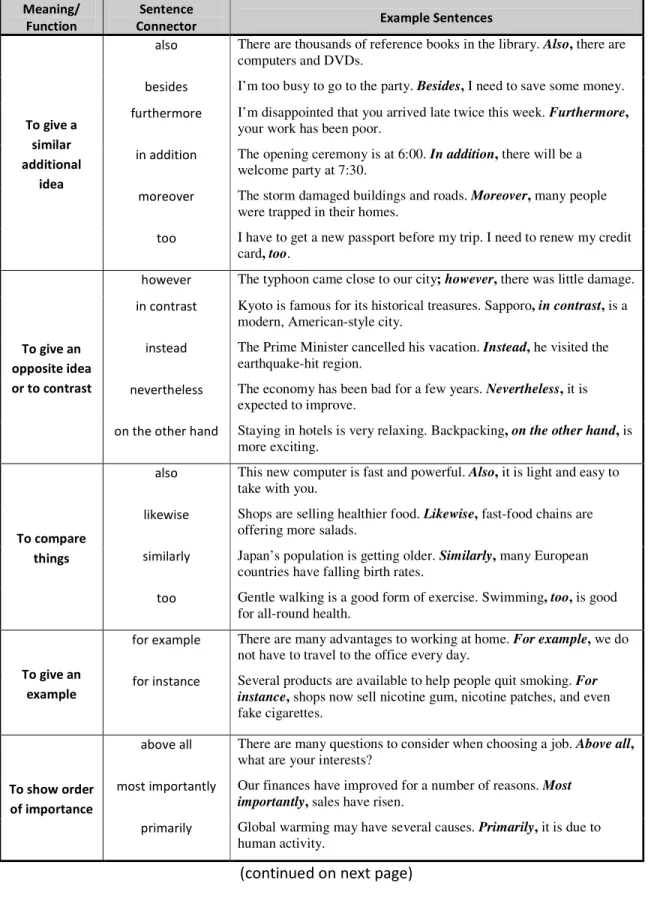
Another way to improve coherence is the use of transition signals. Transition signals are words or phrases that help to show how ideas are related. For example, when a writer wants to add to a previous idea, they might write in addition, also, or simply and. These are transition signals. These transitions have very similar meanings, but they are used in
different ways. The three main types of transition signals are listed below:
• coordinators (see page 76)
• subordinators (see the section on complex sentences, page 80)
• sentence connectors (below) Sentence Connectors
Sentence connectors are words and phrases like however, in addition, and therefore.
Sentence connectors often appear at the beginning of a sentence, but they can also appear in the middle or at the end.
Sentence connectors are always separated from the other words by commas.
In the examples below, however is used at the beginning, middle, and end of the sentence.
Notice the commas:
Sentence connectors can also join two independent clauses. In this case, a semi-colon and a comma are used.
The weather forecast said it would rain. However, it has been sunny all day.
The TV report said it would rain. The weather, however, has been sunny all day.
The TV report said it would rain. The weather has been sunny all day, however.
The TV report said it would rain; however, it has been sunny all day.
Table of Sentence Connectors Meaning/
Function
Sentence
Connector Example Sentences
To give a similar additional
idea
also There are thousands of reference books in the library. Also, there are computers and DVDs.
besides I’m too busy to go to the party. Besides, I need to save some money.
furthermore I’m disappointed that you arrived late twice this week. Furthermore, your work has been poor.
in addition The opening ceremony is at 6:00. In addition, there will be a welcome party at 7:30.
moreover The storm damaged buildings and roads. Moreover, many people were trapped in their homes.
too I have to get a new passport before my trip. I need to renew my credit card, too.
To give an opposite idea or to contrast
however The typhoon came close to our city; however, there was little damage.
in contrast Kyoto is famous for its historical treasures. Sapporo, in contrast, is a modern, American-style city.
instead The Prime Minister cancelled his vacation. Instead, he visited the earthquake-hit region.
nevertheless The economy has been bad for a few years. Nevertheless, it is expected to improve.
on the other hand Staying in hotels is very relaxing. Backpacking, on the other hand, is more exciting.
To compare things
also This new computer is fast and powerful. Also, it is light and easy to take with you.
likewise Shops are selling healthier food. Likewise, fast-food chains are offering more salads.
similarly Japan’s population is getting older. Similarly, many European countries have falling birth rates.
too Gentle walking is a good form of exercise. Swimming, too, is good for all-round health.
To give an example
for example There are many advantages to working at home. For example, we do not have to travel to the office every day.
for instance Several products are available to help people quit smoking. For instance, shops now sell nicotine gum, nicotine patches, and even fake cigarettes.
To show order of importance
above all There are many questions to consider when choosing a job. Above all, what are your interests?
most importantly Our finances have improved for a number of reasons. Most importantly, sales have risen.
primarily Global warming may have several causes. Primarily, it is due to human activity.
(continued on next page)
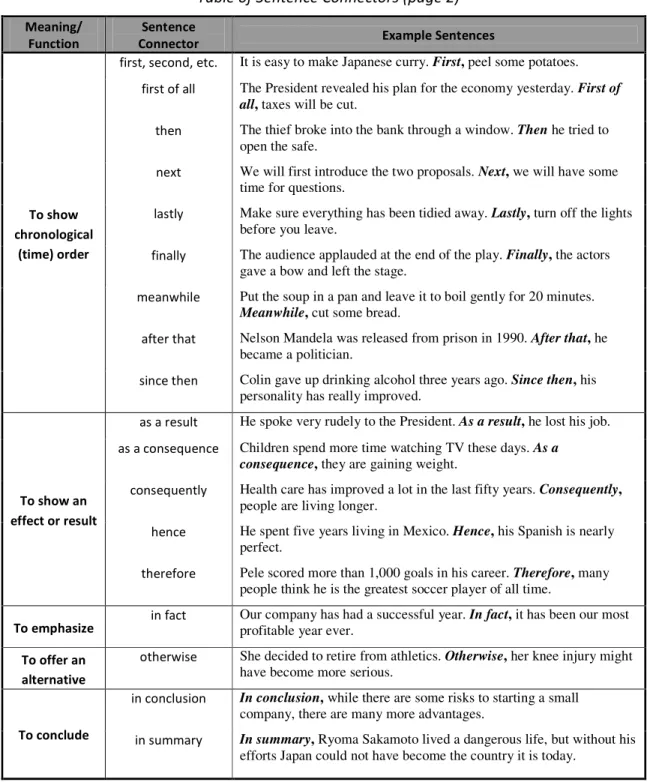
Table of Sentence Connectors (page 2) Meaning/
Function
Sentence
Connector Example Sentences
To show chronological
(time) order
first, second, etc. It is easy to make Japanese curry. First, peel some potatoes.
first of all The President revealed his plan for the economy yesterday. First of all, taxes will be cut.
then The thief broke into the bank through a window. Then he tried to open the safe.
next We will first introduce the two proposa