
34 (2004), 21–56
Mean curvature 1 surfaces in hyperbolic 3-space with low total curvature I
Dedicated to Katsuhiro Shiohama on the occasion of his sixtieth birthday Wayne Rossman, Masaaki Umehara and Kotaro Yamada
(Received May 9, 2003) (Revised October 28, 2003)
Abstract. A complete surface of constant mean curvature 1 (CMC-1) in hyperbolic 3- space with constant curvature1 has two natural notions of ‘‘total curvature’’—one is thetotal absolute curvaturewhich is the integral over the surface of the absolute value of the Gaussian curvature, and the other is thedual total absolute curvaturewhich is the total absolute curvature of the dual CMC-1 surface. In this paper, we completely classify CMC-1 surfaces with dual total absolute curvature at most 4p. Moreover, we give new examples and partially classify CMC-1 surfaces with dual total absolute cur- vature at most 8p.
With the developments of the last decade on constant mean curvature 1 (CMC-1) surfaces in hyperbolic 3-space H3 (the complete simply-connected 3- manifold of constant sectional curvature 1), and with so many examples now known, it is a natural next step to classify all such surfaces with low total absolute curvature.
As CMC-1 surfaces in H3 share quite similar properties with minimal surfaces in Euclidean 3-space R3, let us first comment that the total absolute curvature of a minimal surface in R3 is equal to the area (counted with mul- tiplicity) of the Gauss image of the surface, and that complete minimal surfaces in R3 with total curvature at most 8p have been classified. (See Lopez [6] and also Table 2.) Furthermore, as the Gauss map of a complete conformally parametrized minimal surface is holomorphic, and has a well-defined limit at each end when the surface has finite total curvature, the area of the Gauss image must be an integer multiple of 4p.
The question of classifying low total curvature CMC-1 surfaces in H3 is analogous—however, unlike minimal surfaces in R3, CMC-1 surfaces in H3 have two Gauss maps: the hyperbolic Gauss map G and the secondary Gauss map g. So there are two ways to pose the question in H3, with two very
2000 Mathematics Subject Classification. Primary 53A10; Secondary 53A35, 53A42.
Key words and phrases. hyperbolic space, constant mean curvature, total curvature.
di¤erent answers. One way is to consider the true total absolute curvature, which is the area of the image of g, but since g might not be single-valued on the surface, the total curvature might not be an integer multiple of 4p. This allows for many more possibilities and makes the problem more di‰cult than for minimal surfaces in R3. The authors take up this question in a separate paper [13].
The second way, which is the theme of this paper, is to study the area of the image ofG, which we call thedual total absolute curvature, as it is the true total curvature of the dual CMC-1 surface (which we define in Section 1) inH3. This way has the advantage that G is single-valued on the surface, and so the dual total curvature is always an integer multiple of 4p, like the case of mini- mal surfaces in R3. Furthermore, the dual total curvature satisfies not only the Cohn-Vossen inequality, but also the hyperbolic analogue of the Osserman inequality (which cannot be said about the true total curvature) [19, 23] (see also (2.1) in Section 2). So the dual total curvature shares more properties with the total curvature of minimal surfaces inR3, motivating our interest in it.
In this paper, we classify CMC-1 surfaces with dual total absolute cur- vature at most 4p, and we go much of the way toward classifying CMC-1 sur- faces with dual total absolute curvature at most 8p (as a first step to a full classification of the 8p case). In Section 1, we give a summary of the results, and in Section 2 we give preliminaries for the latter sections. The classification of CMC-1 surfaces with dual total absolute curvature less than or equal to 4p is given in Section 3. Surfaces with dual total absolute curvature 8p are dis- cussed in Section 4—and there we find new examples, we classify certain cases, and we show nonexistence in certain other cases. In Section 5, from defor- mations of corresponding minimal surfaces in R3, we produce two classes of new CMC-1 surfaces with dual total absolute curvature 8p. For the readers’
convenience, we attach Appendix A to explain the computation of log-term coe‰cients of second order linear ordinary di¤erential equations with regular singularities.
Acknowledgement
The authors thank the referee for his careful reading of this paper and for his comments.
1. Summary of the results
To state our results precisely, we begin with some notations. Let f :M!H3 be a complete conformal CMC-1 immersion of a Riemann surface M into H3. By Bryant’s representation formula, there is a holomorphic null immersion F : ~MM!SLð2;CÞ such that f ¼FF, where MM~ is the universal
cover of M and F¼tF. (‘‘null’’ means detðF1dFÞ ¼0.) Here, we con- siderH3¼SLð2;CÞ=SUð2Þ ¼ faajaASLð2;CÞg[1, 15]. We call F theliftof
f, and F satisfies
dF ¼F g g2
1 g
Q ð1:1Þ dg
on MM, where~ g (the secondary Gauss map) is a meromorphic function defined on MM~ and Q (the Hopf di¤erential) is a holomorphic 2-di¤erential on M.
Then the induced metric ds2 and complexification of the second fundamental form h are
ds2¼ ð1þ jgj2Þ2 Q dg
2
; h¼ QQþds2:
By (1.1), the secondary Gauss map satisfies g¼ dF12
dF11¼ dF22
dF21; where FðzÞ ¼ F11ðzÞ F12ðzÞ F21ðzÞ F22ðzÞ
:
The mapg is determined uniquely up to a Mo¨bius transformation g7!a?g by aASUð2Þ, where, for general a¼ ðaijÞASLð2;CÞ, we denote
a?g:¼a11gþa12
a21gþa22: The hyperbolic Gauss map G of f is defined by
G¼dF11
dF21
¼dF12
dF22
;
which can be interpreted as stereographic projection of the endpoints in the sphere at infinity of H3 of the oriented normal geodesics emanating from the surface. In particular, G is a meromorphic function on M.
The inverse matrix F1 is also a holomorphic null immersion, and pro- duces a new CMC-1 immersion f#¼F1ðF1Þ: ~MM !H3, called the dual of
f [19]. The induced metric ds2# and the Hopf di¤erential Q# of f# are ds2#¼ ð1þ jGj2Þ2 Q
dG
2
; Q#¼ Q:
ð1:2Þ
So ds2# and Q# are well-defined on M itself, even though f# might be defined only on MM.~ This duality between f and f# interchanges the roles of the hyperbolic Gauss map G and secondary Gauss map g. In particular, one has
dFF1¼ ðF1Þ1dðF1Þ ¼ G G2
1 G
Q dG: ð1:3Þ
Hence dFF1 is single-valued on M, whereas F1dF generally is not.
Since ds2# is single-valued on M, we can define the dual total absolute curvature
TAðf#Þ:¼ ð
M
ðK#ÞdA#;
where K# ða0ÞanddA# are the Gaussian curvature and area element ofds2#, respectively. As
ds2#:¼ ðK#Þds2#¼ 4dGdG
ð1þ jGj2Þ2 ð1:4Þ
is a pseudo-metric of constant curvature 1 with developing map G, TAðf#Þ is the area of the image ofGon CP1¼S2. The following assertion is important for us:
Lemma 1.1 ([19, 22]). The Riemannian metric ds2# is complete (resp. non- degenerate) if and only if ds2 is complete (resp. nondegenerate).
So from now on, we suppose f is complete and has TAðf#Þ<þy. By Lemma 1.1, the conformal metric ds2# is complete. As TAðf#Þ<þy, M is biholomorphic to a compact Riemann surfaceMg of some genusgwith finitely many points excluded [8, Theorem 9.1]:
M¼Mgnfp1;. . .;png ðp1;. . .;pnAMgÞ:
ð1:5Þ
The points pj are called the ends of the immersion f.
If G has an essential singularity at any end pj, then TAðf#Þ ¼ þy, since TAðf#Þ is the area of GðMÞ in CP1¼S2. Since we have assumed TAðf#Þ<þy, G is meromorphic on all of Mg. In particular, TAðf#Þ ¼ 4pdegGA4pZ.
Since the dual immersion has finite total curvature, the Hopf di¤erential Q#¼ Q can be extended to Mg as a meromorphic 2-di¤erential [1, Prop- osition 5]. Let
dj ¼ordpj Q¼order of Q at the end pj
for each j¼1;. . .;n. We say that f is a surface of type Gðd1;. . .;dnÞ if M¼Mgnfp1;. . .;png and Q has order dj at each end pj. We use G because it is the capitalized letter corresponding to g, the genus of Mg. For instance, the class Ið4Þ(resp. Oð2;3Þ) means the class of surfaces of genus 1 (resp.
genus 0) with 1 end (resp. 2 ends) so thatQ has a pole of order 4 at the single end (resp. a pole of order 2 at one end and order 3 at the other). Then our results are shown in Table 1. In the table,
.
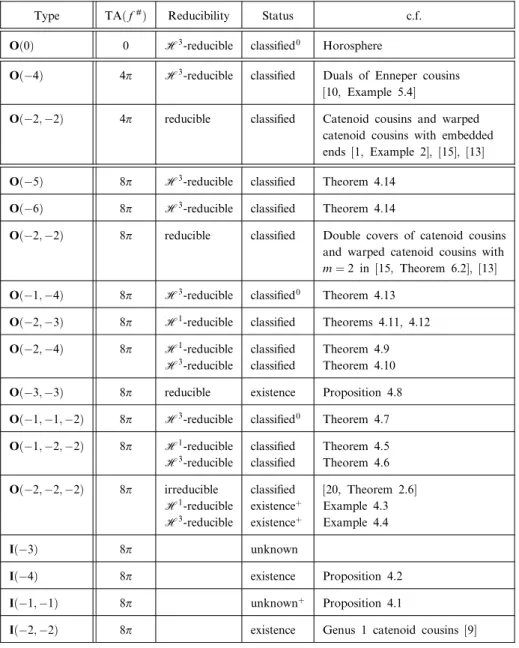
classified means the complete list of the surfaces in such a class is known (and this means not only that we know all the possibilities for the form of the data ðG;QÞ, but that we also know exactly for which ðG;QÞ the period problems of the immersions are solved).Table 1. CMC-1 surfaces inH3 with TAðf#Þa8p. (The corresponding results for minimal surfaces in R3 are shown in Table 2.)
Type TAðf#Þ Reducibility Status c.f.
Oð0Þ 0 H3-reducible classified0 Horosphere
Oð4Þ 4p H3-reducible classified Duals of Enneper cousins [10, Example 5.4]
Oð2;2Þ 4p reducible classified Catenoid cousins and warped catenoid cousins with embedded ends [1, Example 2], [15], [13]
Oð5Þ 8p H3-reducible classified Theorem 4.14 Oð6Þ 8p H3-reducible classified Theorem 4.14
Oð2;2Þ 8p reducible classified Double covers of catenoid cousins and warped catenoid cousins with m¼2 in [15, Theorem 6.2], [13]
Oð1;4Þ 8p H3-reducible classified0 Theorem 4.13 Oð2;3Þ 8p H1-reducible classified Theorems 4.11, 4.12
Oð2;4Þ 8p H1-reducible
H3-reducible
classified classified
Theorem 4.9 Theorem 4.10 Oð3;3Þ 8p reducible existence Proposition 4.8 Oð1;1;2Þ 8p H3-reducible classified0 Theorem 4.7 Oð1;2;2Þ 8p H1-reducible
H3-reducible
classified classified
Theorem 4.5 Theorem 4.6 Oð2;2;2Þ 8p irreducible
H1-reducible H3-reducible
classified existenceþ existenceþ
[20, Theorem 2.6]
Example 4.3 Example 4.4
Ið3Þ 8p unknown
Ið4Þ 8p existence Proposition 4.2
Ið1;1Þ 8p unknownþ Proposition 4.1
Ið2;2Þ 8p existence Genus 1 catenoid cousins [9]
.
classified0 means there exists a unique surface (up to isometries of H3 and deformations that come from its reducibility)..
existence means that examples exist, but they are not yet classified..
existenceþ means that all possibilities for the dataðG;QÞare determined in this paper, but the period problems are solved only for special cases..
unknown means that neither existence nor non-existence is known yet..
unknownþ means that all possibilities for the dataðG;QÞare determined in this paper, but the period problems are still unsolved.Any class and type of reducibility not listed in Table 1 cannot contain sur- faces with TAðf#Þa8p. For example, any irreducible or H3-reducible sur- face of type Oð2;3Þ must have dual total absolute curvature at least 12p.
(See Section 2 for the definitions of irreducibility, H1-reducibility, and H3- reducibility.)
2. Preliminaries
Before we begin proving the results, we prepare some fundamental pro- perties and tools, which will play important roles in the latter sections.
Table 2. The classification of complete minimal surfaces inR3 with TAa8p ([6]), for comparison with Table 1.
Type TA The surface c.f.
Oð0Þ 0 Plane
Oð4Þ 4p Enneper’s surface
Oð5Þ 8p [6, Theorem 6]
Oð6Þ 8p [6, Theorem 6]
Oð2;2Þ 4p
8p
Catenoid
Double cover of the catenoid
Oð1;3Þ 8p [6, Theorem 5]
Oð2;3Þ 8p [6, Theorem 4, 5]
Oð2;4Þ 8p [6, Theorem 5]
Oð3;3Þ 8p [6, Theorem 4]
Oð1;2;2Þ 8p [6, Theorem 5]
Oð2;2;2Þ 8p [6, Theorem 5]
Ið4Þ 8p Chen-Gackstatter surface [6, Theorem 5], [2]
Analogue of the Osserman inequality. The second and third authors showed [19]:
1
2p TAðf#ÞbwðMÞ þn¼2ðgþn1Þ:
ð2:1Þ
Moreover, equality holds exactly when all the ends are properly embedded:
This follows by noting that equality is equivalent to all ends being regular and embedded ([19]), and that any properly embedded end must be regular (proved recently by Collin, Hauswirth and Rosenberg [4]).
Formulas for TAðf#Þ. Let mj#AZ be the branching order of G at the end pj for each j¼1;. . .;n. Since G is a ðmj#þ1Þ-to-1 mapping in a neighborhood of pj,
mj#adegG1¼ 1
4p TAðf#Þ 1:
ð2:2Þ
The umbilic points of f are the zeroes of Q¼ Q#, which are also the umbilic points of f#. Moreover, the order of Qequals the branching order of G at each point in M, since ds2# in (1.2) is non-degenerate. Let q1;. . .;qk be the umbilic points of f and set
xl:¼ordql Q¼ ½the branching order of G at ql ðl¼1;. . .;kÞ:
ð2:3Þ
The pseudometric ds2# in (1.4) is said to have order b at p if it is asymptotic to jzzðpÞj2bdzdz, where z is a complex coordinate around p. Then the branching order of G is equal to the order of the metric ds2# in (1.4), the Gauss-Bonnet theorem implies that
1
2p TAðf#Þ ¼wðMgÞ þXn
j¼1
mj#þXk
l¼1
xl; ð2:4Þ
where wðÞ is the Euler characteristic. (This also follows from the Riemann- Hurwitz formula, since Mg is a branched cover of S2 via the map G.)
Since Q is a meromorphic 2-di¤erential, the total order of Q satisfies Xk
l¼1
xlþXn
j¼1
dj¼ 2wðMgÞ:
ð2:5Þ
By (2.4) and (2.5), we have 1
2p TAðf#Þ ¼ wðMgÞ þXn
j¼1
ðmj#djÞ ¼2g2þXn
j¼1
ðmj#djÞ:
ð2:6Þ
Completeness of the metric ds2# at pj implies mj#djb1. However, the case mj#dj¼1 cannot occur ([19, Lemma 3]), so
mj#djb2:
ð2:7Þ
E¤ects of transforming the lift F. Here we consider the change FF^¼aFb1 of the lift F, where a;bASLð2;CÞ. Then FF^ is also a holomorphic null immer- sion, and the hyperbolic Gauss map GG, the secondary Gauss map^ gg^ and the Hopf di¤erential QQ^ of FF^ are given by (see [17])
G^
G¼a?G; gg^¼b?g; QQ^¼Q:
ð2:8Þ
In particular, the change FF^¼aF moves the surface by a rigid motion of H3, and does not change g and Q. By choosing a suitable rigid motion aASLð2;CÞ of the surface in H3, we shall frequently use the following change of the hyperbolic Gauss map to simplify its expression:
G^
G¼a?G¼a11Gþa12 a21Gþa22
; ðaijÞi;j¼1;2ASLð2;CÞ:
ð2:9Þ
The Schwarzian derivative relation. A direct computation implies that the sec- ondary Gauss map g depends on G and Q as follows ([15]):
SðgÞ SðGÞ ¼2Q;
ð2:10Þ where
SðgÞ ¼ g00 g0
0
1 2
g00 g0
" 2#
dz2 0¼ d dz
is the Schwarzian derivative of g. Here, z is a complex coordinate of Mg. SU(2)-monodromy conditions. Here we recall from [10] the construction of CMC-1 surfaces with given hyperbolic Gauss map G and Hopf di¤erential Q, which will play a crucial role in this paper. Let Mg be a compact Riemann surface and M:¼Mgnfp1;. . .;png. Let G and Qbe a meromorphic function and meromorphic 2-di¤erential on Mg. The pair ðG;QÞ must satisfy the fol- lowing two compatibility conditions:
For all qAM; ordqQ is equal to the branching order of G; and ð2:11Þ
for each end pj;mj#djb2:
ð2:12Þ
The first condition implies that the metric ds2# is (and hence ds2 is also, by Lemma 1.1) non-degenerate at qAM. The second condition implies that the metricds2# is complete (and hence ds2 is also, again by Lemma 1.1) at pjAMg
ðj¼1;. . .;nÞ.
For such a pair ðG;QÞ, a solution g of equation (2.10) has singularities at the branch points of G (umbilic points or ends) and the poles of Q (ends).
However, regardless of whether qAM is a regular or umbilic point, ds2# and Q# as in (1.2) give a (non-degenerate) Riemann metric and holomorphic 2- di¤erential in a neighborhood UqHM of q. Then, by the fundamental the- orem of surfaces, there exists a CMC-1 immersion f# of Uq into H3 with induced metric ds2# and Hopf di¤erential Q#. So the hyperbolic Gauss map g of f#, which is a solution of (2.10), is a well-defined meromorphic function on Uq. Since the solution of (2.10) is unique up to Mo¨bius transformations g7!a?g ðaASLð2;CÞÞ, for any solution g of (2.10) defined on the universal cover MM~ of M, there exists a representation
rg:p1ðMÞ !PSLð2Þ such that gt1¼rgðtÞ?g for each covering transformation tAp1ðMÞ.
We now consider when the dual f ¼ ðf#Þ# (with data ðG;QÞ) of f# is well-defined on M. Choosing F so that F1 is a lift of f# (and then also ðF1Þ1 ¼F is a lift of ðf#Þ#¼ f), and noting that the representation rg: p1ðMÞ !PSLð2;CÞ can be lifted into SLð2;CÞ [10], (2.8) implies
F1t1¼rgðtÞF1 ð2:13Þ
for each tAp1ðMÞ. Thus
f t1¼ ðFt1ÞðFt1Þ¼FðrgðtÞÞ1ððrgðtÞÞ1ÞF; ð2:14Þ
and so f is well-defined on M if rgðtÞASUð2Þ for all tAp1ðMÞ. This is the crux of the following Lemma 2.1. Before stating this lemma, we need a definition:
Definition 1. A CMC-1 immersion f :M!H3 is reducible if frgðtÞgtAp1ðMÞ are simultaneously diagonalizable (i.e. if there exists a PA PSLð2;CÞ such that PrgðtÞP1 is diagonal for all tAp1ðMÞ). If f is not reducible, it is calledirreducible. When f is reducible, it is either H3-reducible or H1-reducible[10], and f is called H3-reducible if frgðtÞgtAp1ðMÞ are all the identity, and is called H1-reducible otherwise.
Clearly f is H3-reducible if and only if the liftF itself is single-valued on M, by (2.13). The name H1-reducibility (resp. H3-reducibility) comes from the fact that the surface has exactly a 1 (resp. 3) dimensional deformation through surfaces preserving G and Q and the mean curvature, which is iden- tified with the 1 (resp. 3) dimensional hyperbolic space H1 (resp. H3) [10].
On the other hand, if f is irreducible, f has no deformation preserving mean curvature and ðG;QÞ (see [17, 10]).
Lemma 2.1 ([17]). Let G and Q be a meromorphic function and a mer- omorphic 2-di¤erential on Mg satisfying (2.11) and (2.12). Assume g is a solution of (2.10)such that the image of rg lies inPSUð2Þ. Then there exists a complete CMC-1 immersion f :M!H3 with hyperbolic Gauss map G, Hopf di¤erential Q, and secondary Gauss map g.
If f is irreducible, then f is the unique surface with data ðG;QÞ. If f is H1-reducible (resp.H3-reducible), then there exists exactly a1(resp.3) param- eter family ofCMC-1surfaces with dataðG;QÞ.
In the case that M is of genusg¼0 with at most two ends, f is reducible, as the fundamental group is commutative. More generally, for the case g¼0 with n ends, by Lemma 2.1 and the theory of linear ordinary di¤erential equa- tions (see Appendix A), we have:
Proposition 2.2. Let M0¼CUfyg and M ¼M0nfp1;. . .;png with
p1;. . .;pn1AC. Let G and Q be a meromorphic function and a meromorphic
2-di¤erential on CUfyg satisfying (2.11) and (2.12). Consider the linear ordi- nary di¤erential equation
d2u
dz2þrðzÞu¼0;
ðE:0Þ
where rðzÞdz2:¼ ðSðGÞ=2Þ þQ. Suppose nb2, and also dj¼ordpj Qb2 and the indicial equation of (E.0) at z¼pj has the two roots lð1jÞ;lð2jÞ and log- term coe‰cient cj, for j¼1;2;. . .;n1.
(1) Suppose that lð1jÞlð2jÞAZþ and cj¼0 for jan1. Then there is exactly a 3-parameter family of complete conformal CMC-1 immer- sions of M into H3 with hyperbolic Gauss map G and Hopf di¤erential Q. Moreover, such surfaces are H3-reducible.
(2) Suppose that lð1jÞlð2jÞAZþ and cj ¼0 for jan2, and that lðn1Þ1 lðn1Þ2 ARnZ. Then there exists exactly a 1-parameter family of complete conformal CMC-1 immersions of M into H3 with hyperbolic Gauss map G and Hopf di¤erential Q. Moreover, such surfaces are H1-reducible.
Here we denoted by Zþ the set of positive integers.
The ordinary di¤erential equation (E.0) has also been applied in [7] for constructing certain classes of H3-reducible CMC-1 surfaces.
Proof. The general theory of Schwarzian derivatives shows ([21, Chapter 4]) that for a linearly independent pair u1;u2 of solutions of (E.0), the func- tion g:¼u1=u2 satisfies (2.10). Conversely, any function g satisfying SðgÞ ¼ 2rðzÞdz2 is obtained in this way.
If lð1jÞlð2jÞ¼mAZþ and cj¼0, then there is a fundamental system of solutions of (E.0) in a neighborhood of pj of the form
u1¼ ðzpjÞlð1jÞj1ðzÞ; u2¼ ðzpjÞlð1jÞmj2ðzÞ;
ð2:15Þ
wherej1ðzÞandj2ðzÞare holomorphic and nonzero atz¼pj. Theng:¼u1=u2 satisfies
gt1j ¼ 1 0 0 1
?g;
ð2:16Þ
where tj is the covering transformation which corresponds to a small loop around z¼pj, implying rgðtjÞ ¼identity. So for case (1), we have rgðtjÞ ¼ identity for all j¼1;. . .;n1, and therefore also for j¼n, which implies that g is a meromorphic function on CUfyg. By Lemma 2.1, there exists a con- formal CMC-1 immersion fa on M with the secondary Gauss mapa?g for all aASLð2;CÞ. If aASUð2Þ, then fa coincides with fidentity by (2.14), so we have that the 3-parameter familyðf½aÞ½aASLð2;CÞ=SUð2Þ are complete conformal CMC-1 immersions with hyperbolic Gauss map G and Hopf di¤erential Q.
We remark here that if lð1jÞlð2jÞ¼mAZþ and cj00, then the mon- odromy matrixrgðtjÞdefined by gt1j ¼rgðtjÞ?g is not diagonalizable and is not even in SUð2Þ. So any CMC-1 immersion on MM~ (with G and Q) cannot be well-defined on M when some cj00.
Next we consider case (2), that is lðn1Þ1 lðn1Þ2 BZ. There exists a fun- damental system of solutions of (E.0) of the form
u1¼ ðzpn1Þlðn1Þ1 j1ðzÞ; u2¼ ðzpn1Þlðn1Þ2 j2ðzÞ;
ð2:17Þ
where j1ðzÞ and j2ðzÞ are holomorphic and nonzero at z¼pn1. When tn1
is the covering transformation induced from a small loop about z¼pn1,g:¼ u1=u2 satisfies
gt1n1¼ epiðlðn1Þ1 lðn1Þ2 Þ 0 0 epiðlðn1Þ2 lðn1Þ1 Þ
" #
?g:
ð2:18Þ
In particular, rgðtn1ÞASUð2Þ. On the other hand, in the proof of (1), we have seen that rgðtjÞ ¼identity for jAð1;. . .;n2Þ. Hence rgðtjÞASUð2Þ and are diagonal matrices for all jAð1;. . .;nÞ, and we are in theH1-reducible case. Note that this remains true when g is replaced by
sgðzÞ ¼aðsÞ?g; where aðsÞ:¼ ffiffis
p 0
0 1=pffiffis
; with sARþ;
where Rþ is the set of positive reals. So we have a one-parameter family of complete conformal CMC-1 immersions with hyperbolic Gauss map G and
Hopf di¤erential Q and secondary Gauss maps sg for sARþ. (s1g and s2g for s10s2 will not produce equivalent surfaces, as aðs1Þðaðs2ÞÞ1BSUð2Þ.) Furthermore, Lemma 2.1 implies there isonlya one-parameter family of CMC-
1 immersions with data ðG;QÞ. r
By (1.3), we have
ðF1Þ1dðF1Þ ¼ g# g#2
1 g#
o#;
where
g#¼G; o#¼ Q dG:
By Lemma 2.1 of [15] (replacing F with F1), we have that X ¼F21ðzÞ;F22ðzÞ satisfies the equation
X00 ðlogðoo^#ÞÞ0X0þQQX^ ¼0;
ðE:1Þ#
and Y ¼F11ðzÞ;F12ðzÞ satisfies the equation
Y00 ðlogðG2oo^#ÞÞ0Y0þQQY^ ¼0;
ðE:2Þ#
where QðzÞ ¼QQðzÞdz^ 2 and o#¼oo^#ðzÞdz. (We call them (E.1)# and (E.2)# because they are the dual versions of equations (E.1) and (E.2) in [15].) These two equations have been shown in [23] as a modification of the corresponding equations in [15]. As we will see later, equations (E.1)# and (E.2)# are some- times more convenient than equation (E.0) for solving monodromy problems.
In fact, we will have use for the following lemma:
Lemma 2.3. Let G and Q be a meromorphic function and a holomorphic2- di¤erential on D ¼ fzAC;0<jzj<1g such that the metric ds2# defined by (1.2) is positive definite on D and complete at 0. Assume ordz¼0Qb2 and Q is not identically zero. Then the following three conditions are all equivalent.
(1) The di¤erence of the solutions of the indicial equation of (E.1)# at z¼0 is a positive integer and the log-term coe‰cient of (E.1)# vanishes.
(2) The di¤erence of the solutions of the indicial equation of (E.2)# at z¼0 is a positive integer and the log-term coe‰cient of (E.2)# vanishes.
(3) The di¤erence of the solutions of the indicial equation of(E.0) at z¼0 is a positive integer and the log-term coe‰cient of (E.0) vanishes.
Proof. The hyperbolic Gauss map of the dual surface f#¼F1ðF1Þ is equal to the secondary Gauss map g of f ¼FF. Thus conditions (1) and (2)
are equivalent to the condition that g is single valued atz¼0, by Lemma 2.2 of [15]. On the other hand, as seen in the proof of Proposition 2.2, condition (3) is also equivalent to the condition that g is single valued at z¼0. r Here is a natural place to include the next lemma, which we shall use in the sequel [13], to this paper.
Lemma 2.4. With the same assumptions as in Lemma 2.3, the following three conditions are all equivalent.
(1) The di¤erence of the solutions of the indicial equation of (E.1)# at z¼0 is a real number.
(2) The di¤erence of the solutions of the indicial equation of (E.2)# at z¼0 is a real number.
(3) The di¤erence of the solutions of the indicial equation of(E.0) at z¼0 is a real number.
Proof. We write
GðzÞ ¼zmGGðzÞ;^ o#ðzÞ ¼znoo^0#ðzÞdz;
where GG^ and oo^0# are nonzero and holomorphic at z¼0, for some integers m and n.
If ordz¼0Q¼ 2, so mþn¼ 1 and Q¼ ðyz2þ Þdz2 for some y00, then the di¤erence of the solutions of the indicial equations is ffiffiffiffiffiffiffiffiffiffiffiffiffiffiffiffi
m24y
p in all
three cases, hence the three statements are clearly equivalent.
If ordz¼0Qb1, then the indicial equation in the first case (resp. second case, third case) is
tðt1Þ nt¼0; resp: tðt1Þ ð2mþnÞt¼0;tðt1Þ þ1m2 4 ¼0
: Hence the di¤erence of the roots is jnþ1j (resp. j2mþnþ1j;jmj), and so all
three statements hold. r
3. The classification of surfaces with TAðf#Þa4p
We begin our consideration of classification with this simple case:
Theorem 3.1. A complete CMC-1immersion f with TAðf#Þa4p is con- gruent to one of the following:
(1) a horosphere,
(2) an Enneper cousin dual, ðg;QÞ ¼ ðtan ffiffiffi py
z;ydz2Þ ðyACnf0gÞ, (3) a catenoid cousin,
ðg;QÞ ¼ azm;1m2 4z2 dz2
ðaARþ;mARþnf1gÞ;
(4) a warped catenoid cousin that has a degree 1 hyperbolic Gauss map, ðg;QÞ ¼ azlþb;1l2
4z2 dz2
ða;bACnf0g;lAZþnf1gÞ:
Proof. Since TAðf#ÞA4pZ, we need to consider only the cases TAðf#Þ ¼0 and 4p. If TAðf#Þ ¼0, then the hyperbolic Gauss map is con- stant, so (1.4) implies K#10. Thus f# is a totally umbilic CMC-1 immer- sion, so both f# and f are horospheres. So we consider the remaining case TAðf#Þ ¼4p. Then G is meromorphic of degree 1 on Mg, which implies g¼0. Hence we may choose M0¼CUfyg, and by (2.9), we may assume G¼z. Since G has no branch points, (2.3) implies there are no umbilic points, and (2.2) implies
mj#¼0 ð3:1Þ
at each end pj. By (2.6) and (3.1) and the fact that g¼0, we have 2¼ 1
2p TAðf#Þ ¼ 2Xn
j¼1
dj: ð3:2Þ
By (2.7), we have 2b2þ2n, so n¼1 or 2.
The case n¼1. In this case, (3.2) implies d1¼ 4. We may put the end at p1¼y, and then Qhas a single pole of order 4 at y and no zeroes. Thus Q¼ydz2 for some yACnf0g.
A CMC-1 surface in H3 with secondary Gauss map g¼z and Hopf di¤erential Q¼ydz2 is called an Enneper cousin [1]. So a surface with data ðG;QÞ ¼ ðz;ydz2Þis the dual of an Enneper cousin [10, Example 5.4]. (Recall that dualizing switches the two Gauss maps, and changes the Hopf di¤erential only by a sign.)
The case n¼2. In this case, (3.2) becomes 4¼ d1d2. Then dj¼ 2 ðj¼1;2Þ, by (2.7). Hence the immersion f is a CMC-1 surface of genus 0 whose two ends must both be regular [15], and this type of surface is classified in [15]. In particular, f is in the case m¼1 of Theorem 6.2 in [15]. So the surface is either a catenoid cousin [1, Example 2] or a warped catenoid cousin with embedded ends (the case m¼1 in Theorem 6.2 in [15]). r
The warped catenoid cousins are described in detail in [13].
4. Surfaces with TAðf#Þ ¼8p
We now assume f has TAðf#Þ ¼8p. Then, by (2.6) and (2.7),
6¼2gþXn
j¼1
ðmj#djÞb2ðgþnÞ ð4:1Þ
holds. Thus the possible cases are
ðg;nÞ ¼ ð0;1Þ;ð0;2Þ;ð0;3Þ;ð1;1Þ;ð1;2Þ; and ð2;1Þ:
Since TAðf#Þ ¼8p, G is meromorphic on Mg of degree 2. Hence (2.2) implies
mj#a1 ðj¼1;2;. . .;nÞ;
ð4:2Þ
and at each umbilic point ql,
xl¼1 ðl¼1;2;. . .;kÞ:
ð4:3Þ
The case ðg;nÞ ¼ ð2;1Þ. Since equality holds in (2.1), the single end p1 is embedded. By (4.1), m1#d1¼2. Thus the possible cases are
ðm1#;d1Þ ¼ ð0;2Þ or ð1;1Þ;
by (4.2). If ðm1#;d1Þ ¼ ð0;2Þ, the end p1 is of type I in the sense of [11], so the flux about this end does not vanish [11, Proposition 2]. If ðm1#;d1Þ ¼ ð1;1Þ, then, since the end is embedded, Corollary 5 in [11] implies that the flux about the end again does not vanish. But non-vanishing flux at a single end contradicts the balancing formula [11, Theorem 1], so the case ðg;nÞ ¼ ð2;1Þ does not occur.
The case ðg;nÞ ¼ ð1;2Þ. In this case, (4.1) implies 4¼ ðm1#d1Þ þ ðm#2 d2Þ.
By (2.7), we have mj#dj¼2 for j¼1;2. Hence (4.2) implies ðmj#;djÞ ¼ ð0;2Þ or ð1;1Þ ðj¼1;2Þ:
Assume d1¼ 2 and d2¼ 1. Then, by the transformation (2.9) if nec- essary, we may assume the hyperbolic Gauss map has a zero or pole at each end. In this case, the end p1 is regular of type I, and p2 is regular of type II in the sense of [11], contradicting Theorem 7 in [11]. Hence this case is impos- sible, leaving the two remaining possibilities:
ðm1#;d1Þ ¼ ðm2#;d2Þ ¼ ð0;2Þ;
ð4:4Þ
ðm1#;d1Þ ¼ ðm2#;d2Þ ¼ ð1;1Þ:
ð4:5Þ
For the case (4.4), the first author and Sato [9] constructed a one-parameter family of ‘‘genus one catenoid cousins’’. Note that such surfaces cannot exist as minimal surfaces in R3, by Schoen’s result [14].
Surfaces of type Ið1;1Þ. For the case (4.5), we can determine the can- didates of ðG;QÞexplicitly as follows (however, the period problem is unsolved and no example is known):
Proposition 4.1. Let M1¼C=G, where G is a lattice on C, and assume there exists a CMC-1 immersion f :M1nfp1;p2g !H3 with TAðf#Þ ¼8p of type Ið1;1Þ. Then, after a suitable rigid motion of H3, there exists a generating pair fv1;v2gHC of G such that the hyperbolic Gauss map G and Hopf di¤erential Q of f are given by
G¼}ðzÞ; QðzÞ ¼ysðzv1=2Þsðzv2=2Þ
sðzÞsðz ðv1þv2Þ=2Þ dz2 ðyACnf0gÞ;
ð4:6Þ
Fig. 1. Two CMC-1 trinoids in H3, which are surfaces of type Oð2;2;2Þ, and a genus 1 catenoid cousin, which is a surface of type Ið2;2Þ, shown in the Poincare´ model of H3. Only one of two congruent pieces of the right-most two surfaces is shown, and the other half of each surface is the reflection (in the plane containing the boundary curves seen here) of the piece shown.
where }ðzÞ is the Weierstrass }-function and s is the entire function defined by sðzÞ:¼z Y
vAGnf0g
1z v
exp z vþ z2
2v2
:
Proof. In this case, the hyperbolic Gauss map G is of degree 2.
Without loss of generality, we may assume that z¼0 is an end of the surface.
Moreover, by (2.9) we may assume that z¼0 is a pole of G. As z¼0 is a branch point of G (since mj#¼1), G has a pole of order 2 at z¼0. Up to a constant multiple and an additive constant, the function }ðzÞ is uniquely characterized as a degree 2 meromorphic function on C=G with a pole of order 2 at the origin [5]. Thus we have GðzÞ ¼c}ðzÞ þb, and we can normalize c¼1 and b¼0, by (2.9).
Suppose fv1;v2g generates G. Then the branch points of } are 0, v1=2,
v2=2 and ðv1þv2Þ=2 modulo G, which are the ends and umbilic points. We
assume 0 and ðv1þv2Þ=2 are the ends. (If v1=2 is an end, for example, we may change the generator G to f~vv1 ¼v1v2;~vv2¼v2g.) Thus the umbilic points are v1=2 and v2=2.
Next we find the Hopf di¤erentialQðzÞ ¼qðzÞdz2, using the following fact:
Fact ([5]). Let a1;. . .;an and b1;. . .;bn be points in C such that aj0bk
ðmodGÞ, j;kAf1;. . .;ng, and Pn
j¼1aj¼Pn
k¼1bk ðmodGÞ. Then
fðzÞ:¼ysðza1Þ. . .sðzanÞ
sðzb1Þ. . .sðzbnÞ ðyACnf0gÞ
is a meromorphic function onC=G such thatfa1;. . .;ang(resp.fb1;. . .;bng) are the set of zeroes (resp. poles), i.e. the divisor of f is a1þ þanb1 bn. Conversely, any elliptic function on C=G with the same divisor is of this form.
The meromorphic function qðzÞ should have poles of order 1 at z¼0, ðv1þv2Þ=2 (ends) and zeroes of order 1 at z¼v1=2;v2=2 (umbilic points).
Thus QðzÞ can be written as in (4.6). r
The case ðg;nÞ ¼ ð1;1Þ. By (4.1) and (4.2), we have two possible cases:
ðm1#;d1Þ ¼ ð0;4Þ or ð1;3Þ:
The second of these cases (theIð3Þcase) is still unknown, but for the first case Ið4Þ, the following proposition provides examples, proven (in Section 5) by deforming from a complete minimal surface in R3 of genus 1 with one end satisfying d1¼ 4.
Proposition4.2. By deforming the Chen-Gackstatter surface inR3 [2], one
obtains a one-parameter family ofCMC-1 surfaces of typeIð4Þwith dual total absolute curvature 8p.
The case ðg;nÞ ¼ ð0;3Þ. Here, (4.1) and (2.7) imply mj#dj¼2 for j¼1;2;3.
Moreover, (2.5) implies d1þd2þd3a4. So (4.2) implies that the possi- bilities are:
Type Oð2;2;2Þ:ðd1;d2;d3Þ ¼ ð2;2;2Þ and ðm1#;m#2;m3#Þ ¼ ð0;0;0Þ; Type Oð1;2;2Þ:ðd1;d2;d3Þ ¼ ð1;2;2Þ and ðm1#;m#2;m3#Þ ¼ ð1;0;0Þ;
Type Oð1;1;2Þ:ðd1;d2;d3Þ ¼ ð1;1;2Þ and ðm1#;m#2;m3#Þ ¼ ð1;1;0Þ:
In each case, equality holds in (2.1), so all ends are embedded. Since the genus of the surface is 0, we can set M0¼CUfyg.
Surfaces of type Oð2;2;2Þ. Such surfaces have three embedded ends with dj¼ 2 ðj¼1;2;3Þ, and the irreducible ones are classified in [20, Theo- rem 2.6]. So here we consider the reducible case.
We may set p1¼0, p2 ¼1 and p3¼y. By (2.5) and (4.3), there are two distinct umbilic points q1 and q2 of order 1. Then the Hopf di¤erential Q must have simple zeroes at q1 and q2 and poles of order 2 at 0;1 and y. Since all three mj#¼0,q1 andq2 are the only branch points ofG. Also,Gðq1Þ, Gðq2Þ, and GðyÞare all distinct, because q1 andq2 are double points ofG and degG¼2. Then, by (2.9), we can set Gðq1Þ ¼0, Gðq2Þ ¼y, and GðyÞ ¼1.
Thus G and Q are written as G¼ zq1
zq2
2
; Q¼yðzq1Þðzq2Þ
z2ðz1Þ2 dz2 ðyACnf0gÞ:
ð4:7Þ
Example 4.3 (H1-reducible examples of type Oð2;2;2Þ). For sAR such that
4 1þ4sþs2
1þ10sþs2 ARnZ;
ð4:8Þ
let
q1¼1þ10sþs2
4sð1sÞ ; q2¼1þ10sþs2
4ðs1Þ ; and y¼ 3
4q1q2: ð4:9Þ
Consider (E.0) for rðzÞdz2¼ ðSðGÞ=2Þ þQ, with G and Q determined by (4.7) and (4.9). Then the roots of the indicial equation of (E.0) at z¼0 are 1=2 and 3=2, so their di¤erence is 2AZ, and one can check by (A.15) that the log-term coe‰cient vanishes. Moreover, the di¤erence of the roots of the
indicial equation at z¼1 equals the value in (4.8). Hence, by (2) of Propo- sition 2.2, there exists an H1-reducible CMC-1 immersion f :Cnf0;1g !H3 with G and Q as in (4.7) and (4.9). Since each surface is H1-reducible (this follows from the fact that the di¤erence of the roots of the indicial equa- tion is an integer at z¼0 and not an integer at z¼1), there exists a one- parameter family of CMC-1 surfaces for each s, with this G and Q. Thus, we have found a 2-parameter family of H1-reducible CMC-1 surfaces of type Oð2;2;2Þ.
Example 4.4 (H3-reducible examples of typeOð2;2;2Þ). Formb2, mAZ, let
q1¼1
2 1þ 1 ffiffiffiffim p
; q2¼1
2 1 1 ffiffiffiffim p
; and y¼ mðmþ1Þ:
Then a meromorphic function g on CUfyg such that dg¼zm1ðz1Þm1ðzq1Þðzq2Þdz
satisfies equation (2.10) for G and Q as in (4.7). Since g is meromorphic, rgðtÞ is the identity for all tAp1ðCnf0;1gÞ, so Lemma 2.1 implies there exists anH3-reducible CMC-1 immersion f :Cnf0;1g !H3 whose hyperbolic Gauss map, Hopf di¤erential, and secondary Gauss map are G;Q, and g, respectively.
Surfaces of type Oð1;2;2Þ. In this case, we will see that there is a 2- parameter family of H1-reducible surfaces, and countably many H3-reducible families. By (2.5), there exists one umbilic point of order 1. Without loss of generality, we can set the ends to be ðp1;p2;p3Þ ¼ ð0;1;pÞ ðpACnf0;1gÞ and the umbilic point to be q1¼y. Then the Hopf di¤erential Q has a pole of order 2 (resp. order 1) at z¼1;p (resp. z¼0) and has no zeroes on C, so it has the form
Q¼ ydz2
zðz1Þ2ðzpÞ2 ðyACnf0gÞ:
By (2.3) and the fact m1#¼1,G has branch points of order 1 atz¼0 and y. Then, by (2.9), we may assume G¼z2, because degG¼2. Consider the ordi- nary di¤erential equation (E.0) with rðzÞdz2¼ ðSðGÞ=2Þ þQ. At the singu- larity z¼0, rðzÞ expands as
rðzÞ ¼ 3 4
1 z2þ y
p2 1
zþ2yðpþ1Þ
p3 þOðzÞ:
Thus the di¤erence of the roots of the indicial equation of (E.0) at z¼0 is 2.
Then, by (A.15), the log-term coe‰cient of (E.0) atz¼0 vanishes if and only if y¼ 2pðpþ1Þ. Hence, if such a surface exists, G and Q are
G¼z2; Q¼ 2pðpþ1Þ
zðz1Þ2ðzpÞ2 dz2 ðpACnf0;1gÞ:
ð4:10Þ
For G and Q as in (4.10), rðzÞ expands at the singularity z¼1 as rðzÞ ¼2pðpþ1Þ
ð1pÞ2 1
ðz1Þ2þOððz1Þ1Þ:
Then the roots of the indicial equation of (E.0) at z¼1 are l1¼2þ 2
p1; l2¼ 1 2 p1:
So l1l2AZ exactly when 4=ðp1ÞAZ. Then, by Proposition 2.2, we have
Theorem 4.5. Let pAR such that p01 and 4=ðp1ÞBZ. Then there exists a conformal H1-reducible CMC-1 immersion f :M¼CUfygnf0;1;pg
!H3 with TAðf#Þ ¼8p and hyperbolic Gauss map and Hopf di¤erential as in (4.10). Moreover, all H1-reducible surfaces with TAðf#Þ ¼8p of type Oð1;2;2Þ are given in this manner.
The above discussion yields that all CMC-1 surfaces of typeOð1;2;2Þ are reducible. So it only remains to classify the H3-reducible case:
Theorem 4.6. Let rb3 be an integer and p¼ ðrþ2Þ=ðr2Þ. Then there exists a conformal H3-reducible CMC-1 immersion f :M¼CUfygn f0;1;pg !H3 with TAðf#Þ ¼8p whose hyperbolic Gauss map and Hopf di¤erential are as in (4.10). Moreover, all H3-reducible surfaces with TAðf#Þ ¼8p of type Oð1;2;2Þ are given in this manner.
Proof. For given rb3, there is a meromorphic function g on CUfyg so that
dg¼zðzpÞr2 ðz1Þrþ2 dz;
ð4:11Þ
since the right-hand side of (4.11) has no residue. One can check that SðgÞ SðGÞ ¼2Q when p¼ ðrþ2Þ=ðr2Þ. Hence, by Lemma 2.1, there exists an H3-reducible CMC-1 immersion f :CUfygnf0;1;pg !H3 with G and Q as in (4.10) and secondary Gauss map g satisfying (4.11).
Conversely, let f :CUfygnf0;1;pg !H3 be an H3-reducible CMC-1 immersion of type Oð1;2;2Þ with TAðf#Þ ¼8p. Then G and Q are as
in (4.10). Let m2 (resp. m3) be the di¤erence of the roots of the indicial equation of (E.0) at z¼1 (resp. z¼p) for such G and Q. Then we have m2¼ j3þ ð4=ðp1ÞÞj and m3¼ j1þ ð4=ðp1ÞÞj. Since f is H3-reducible, m2 and m3 are positive integers (so also 4=ðp1ÞAZ). We may assume m2bm3. (If not, we can exchange the two ends p and 1, by changing p and z to 1=p and z=p. Using (2.9), we see that (4.10) is unchanged.)
Suppose that m2¼m3 ¼1, then g is not branched at both 1 and p.
Noting that the branching orders ofg andGare equal at any finite point of the surface (this follows from equation (2.10)), we see that g has branch points of order 1 at 0 and y and no other branch points. So g has degree 2 and g¼a?z2 for some aASLð2;CÞ and so Q¼ ð1=2ÞðSðgÞ SðGÞÞ ¼0, which is impossible.
Thus m2b2, and it follows that 4=ðp1Þ is a positive integer. By setting r¼2þ ð4=ðp1ÞÞb3, we have
m2¼3þ 4
p1¼rþ1; m3 ¼1þ 4
p1¼r1; and p¼rþ2 r2: Thus G and Q are as in (4.10) with p¼ ðrþ2Þ=ðr2Þ. r
Surfaces of type Oð1;1;2Þ. In this case, by (2.5), the surface has no umbilic points. We set the endsðp1;p2;p3Þ ¼ ð0;1;yÞ. The Hopf di¤erential is then
Q¼ ydz2
zðz1Þ; ðyACnf0gÞ:
ð4:12Þ
The hyperbolic Gauss map Gis a meromorphic function on CUfyg of degree 2 with branch points of order 1 at z¼0 and z¼1. Hence we may set
G¼ z1 z
2
ð4:13Þ :
Theorem4.7. Any completeCMC-1 immersion that is of type Oð1;1;
2Þ with TAðf#Þ ¼8p is congruent to an H3-reducible CMC-1 immersion f :M¼Cnf0;1g !H3 with hyperbolic Gauss map and Hopf di¤erential
G¼ z1 z
2
; Q¼ 2dz2
zðz1Þ:
Proof. Consider equation (E.0) for G and Q in (4.13) and (4.12) respec- tively. Then the roots of the indicial equations of (E.0) are1=2 and 3=2 at bothz¼0 andz¼1. By (A.15), the log-term coe‰cients atz¼0 and atz¼1 both vanish if and only if y¼ 2. By Proposition 2.2, the corresponding 3-
parameter family of CMC-1 immersions consists of immersions that are all well-defined on M¼Cnf0;1g and are H3-reducible. r The case ðg;nÞ ¼ ð0;2Þ. In this case, (4.1) and (2.7) imply that
ðm1#d1;m#2 d2Þ ¼ ð2;4Þ or ðm1#d1;m#2 d2Þ ¼ ð3;3Þ:
Then, by (4.2), all possibilities are:
Type Oð2;4Þ:ðd1;d2Þ ¼ ð2;4Þ and ðm1#;m#2Þ ¼ ð0;0Þ;
Type Oð2;3Þ:ðd1;d2Þ ¼ ð2;3Þ and ðm1#;m2#Þ ¼ ð0;1Þ or ð1;0Þ;
Type Oð1;4Þ:ðd1;d2Þ ¼ ð1;4Þ and ðm1#;m#2Þ ¼ ð1;0Þ; Type Oð1;3Þ:ðd1;d2Þ ¼ ð1;3Þ and ðm1#;m#2Þ ¼ ð1;1Þ; Type Oð3;3Þ:ðd1;d2Þ ¼ ð1;3Þ and ðm1#;m#2Þ ¼ ð0;0Þ;
Type Oð2;2Þ:ðd1;d2Þ ¼ ð2;2Þ and ðm1#;m#2Þ ¼ ð1;1Þ:
Since the surface has genus 0, we can set M0 ¼CUfyg and M¼CUfygn fp1;p2g. Sincep1ðMÞis commutative, all surfaces of these types are reducible.
Surfaces of type Oð3;3Þ. There exists a minimal surface inR3 of class Oð3;3Þ with total absolute curvature 8p [6]. The following is proven in Section 5:
Proposition 4.8. By deforming the minimal surface of type Oð3;3Þ in R3, one obtains a one-parameter family of CMC-1 surfaces of type Oð3;3Þ with dual total absolute curvature 8p.
Surfaces of type Oð2;4Þ. In this case, by (2.5) and (4.3), such a sur- face has two distinct umbilic points of order 1. We may set the ends to be ðp1;p2Þ ¼ ð0;yÞand the umbilic points to be ðq1;q2Þ ¼ ð1;qÞ,qACnf0;1g, on CUfyg. Then we may assume
G¼ zq z1
2
; Q¼yðz1ÞðzqÞ
z2 dz2 ðyACnf0gÞ:
ð4:14Þ
For such G and Q, the roots of the indicial equation of (E.0) at z¼0 are l1¼1
2ð1þ ffiffiffiffiffiffiffiffiffiffiffiffiffiffiffiffi 14yq
p Þ; l2¼1
2ð1 ffiffiffiffiffiffiffiffiffiffiffiffiffiffiffiffi 14yq
p Þ:
Then, by (2) of Proposition 2.2, we have
Theorem 4.9. Let yACnf0g and qACnf0;1g be complex numbers such that
ffiffiffiffiffiffiffiffiffiffiffiffiffiffiffiffi 14yq
p ARnZ:
Then there exists a conformal H1-reducibleCMC-1immersion f :Cnf0g !H3 of type Oð2;4Þ with TAðf#Þ ¼8p whose hyperbolic Gauss map and Hopf differential are as in(4.14). Moreover, allH1-reducible surfaces withTAðf#Þ ¼ 8p of type Oð2;4Þ are given in this manner.
It only remains to consider the H3-reducible case:
Theorem4.10. Let sAR such that ffiffiffiffiffiffiffiffiffiffiffiffiffi 14s p
b2 is an integer. Then there exists at least 1 and at most ffiffiffiffiffiffiffiffiffiffiffiffiffi
14s
p conformal H3-reducible CMC-1 immer- sions f :Cnf0g !H3 of type Oð2;4Þ with TAðf#Þ ¼8p whose hyperbolic Gauss map and Hopf di¤erential are as in (4.14). Moreover, all H3-reducible surfaces with TAðf#Þ ¼8p of type Oð2;4Þ are given in this manner.
Proof. For G and Q in (4.14), equation (E.1)# becomes z2X00þz 2þ 4z
1z
X0þ fyðz1ÞðzqÞgX¼0:
ð4:15Þ
By Lemma 2.3 and Proposition 2.2, it is enough to show that there exists data ðG;QÞ such that the di¤erence of the roots of the indicial equation of (4.15) at z¼0 is an integer and the log-term vanishes.
The coe‰cients of (4.15) expand as z 2þ 4z
1z
¼z 2þ4Xy
j¼1
zj
( )
and yðz1ÞðzqÞ ¼yqyð1þqÞzþyz2
forzsu‰ciently close to 0. Assume the roots l1;l2 of the indicial equation of (4.15) satisfy l1l2 ¼mAZþ. Then
s:¼yq¼1m2
4 and l2¼ mþ1
2 ðmb2Þ:
ð4:16Þ
Let
mj¼
1
jðm jÞ ðj¼1;2;. . .;m1Þ 1
m ðj¼mÞ 8>
>>
<
>>
>:
:
Then by Proposition A.3 in Appendix A, the log-term coe‰cient c of (4.15) is given by c¼am, where
a0¼1; a1¼m1 1
4ðmþ1Þðm9Þ y
;
aj ¼mj
"
Xj2
k¼0
ð4k2m2Þak
! þyaj2
ð4:17Þ
þ 1
4ðmþ1Þðm9Þ 4þ4jy
aj1
#
ðj¼2;. . .;mÞ:
Henceaj is a polynomial iny of order j. We now definet0¼1, and we define tj and uj for j¼1;. . .;m by the relations
aj¼tjyjþujyj1þ ðj¼1;2;. . .;mÞ:
It follows that tj¼ mjtj1, and hence tm00. Then, defining Lj:¼uj=tj, we also have
Lj¼Lj1ðmþ1Þðm9Þ
4 4jþ4þ ðj1Þðmjþ1Þ
for j¼2;. . .;m. Since L1 ¼ ðmþ1Þðm9Þ=4, we have
Lm¼Xm
j¼2
ðmþ1Þðm9Þ
4 4jþ4þ ðj1Þðmjþ1Þ
¼ m
12ð49m2Þ:
If the only roots of the polynomial
c¼tmymþumym1þ ¼tmðymþLmym1þ Þ ¼0
with respect to y are 0 and ð1m2Þ=4<0, then it follows that Lm would be nonnegative. However, Lm<0 for all mb8, hence this polynomial must have some root yACnf0;ð1m2Þ=4g, and then q¼ ð1m2Þ=ð4yÞACnf0;1g.
For thisy andq, we have c¼0, and thus we have at least one surface for each mb8. Since c is a polynomial of degree m in y, there are at most m roots, and hence at most m surfaces.
For ma7, one can check by explicitly computing the polynomial for c that there is always at least one root yACnf0;ð1m2Þ=4g. r Surfaces of type Oð2;3Þ with m1#¼0. Here, by (2.5), there exists only one umbilic point of order 1. We set the ends to be ðp1;p2Þ ¼ ð1;yÞ and the umbilic point to be q1¼0. We may assume
![Table 2. The classification of complete minimal surfaces in R 3 with TA a 8p ([6]), for comparison with Table 1.](https://thumb-ap.123doks.com/thumbv2/123deta/11412887.0/6.918.245.675.247.623/table-classification-complete-minimal-surfaces-ta-comparison-table.webp)


