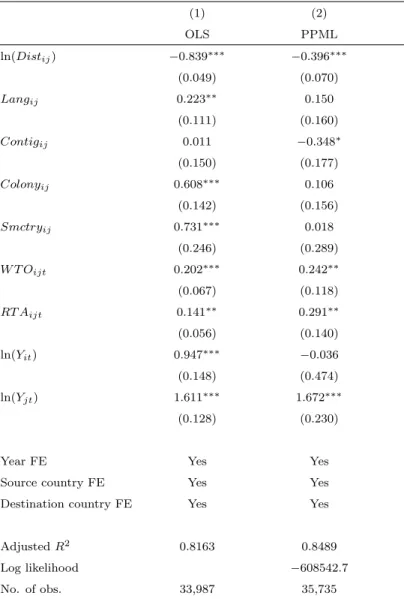
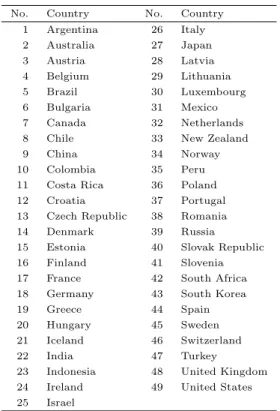
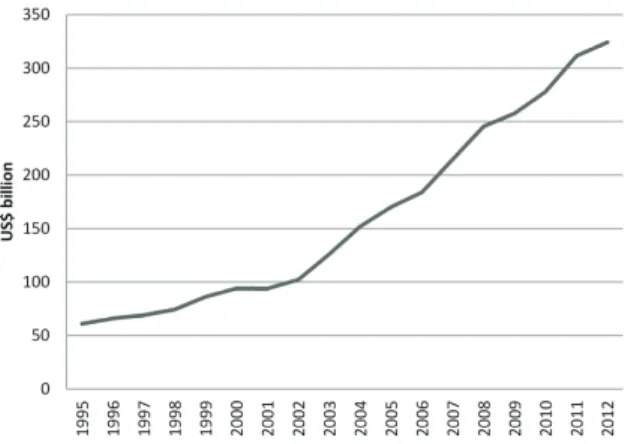
We measure cross-border licensing using data on bilateral flows of royalties and license fees. Columns (1) and (2) both indicate that the gravity equation performs well in explaining cross-border flows of license income.
Risk of imitation
Based on the findings from previous studies (Smith, 2001; Nagaoka, 2009; Ivus et al., 2017) and the anecdote mentioned in the introduction, it seems reasonable to assume that the risk of imitation is highest in licensing, and lowest for export. and intermediary for foreign direct investment. To incorporate this possibility, the risk of imitation is assumed to be country-pair specific, i.e. βij depends on countries iandj.
Firm behavior
Therefore, let the probability of a successful imitation be βij ∈[0,1] if a company in country engages in licensing in countryj, but otherwise the risk is zero. Note that the licensor receives a fraction δ of the sales in the country's market as license fees from the licensee.
Licensing in equilibrium
This avoidance by the licensee is possible due to the partially non-excludable nature of the technology. In particular, the licensor may not fully transfer its technology to the licensee and may reduce the licensee's revenue to zero by exporting its "superior" version of the product.
Sorting of firms
Yj−cfD, (10) where the left-hand side is the licensee's payoff under no rejection after the license fees are paid, whereas the right-hand side is the licensee's payoff under rejection. Yj−cfijX, (11) where the left-hand side is the expected profit under the license contract and the right-hand side is the profit for the licensor surrendered by exporting its product to the domestic market.
Bilateral flows of licensing revenues
The marginal productivity for a country that is indifferent between licensing and exports, φXij, is defined by. Finally, the cut-off productivity for a country firm to be indifferent between exports and FDI, φIij, is defined by. The system equations of Eq. 24) indicates that bilateral license revenue flows increase in both the market size of the destination country (Yj) and that of the source country (Yi), where the fact that bilateral license revenue flows increase in the size of the source country. derived from the assumption that Mi is proportional to Yi. 22), Pj represents the multilateral resistance term.
Zij corresponds to the measure of “bilateral access” of the country's market for the country's firms in the terminology of Head and Mayer (2014) in relation to standard gravity models for bilateral trade. Thus, fijX in our structural gravity model for bilateral licensing revenue flows resembles the trade cost factor in standard gravity models for bilateral trade.
The impact of deep RTAs
From this lemma, we can see that there are two opposite effects on bilateral licensing revenue flows. In the following proposition, we show that the increase in the size of licensing firms more than compensates for the decline in average licensing revenue, resulting in an increase in bilateral flows of licensing revenue. Therefore, Proposition 1 implies that the establishment of a deep RTA increases bilateral licensing revenue flows.
Thus, Lemma 3 implies that when freedom of action is sufficiently high, a further increase in freedom reduces bilateral flows of license revenues. In other words, a tariff reduction can enhance the positive effect of strengthening IPR protection on bilateral flows of licensing revenues when freedom of action is initially relatively low.
The establishment of a deep RTA increases bilateral flows of licensing revenues between member countries
Moreover, this proposal implies that strengthening the protection of intellectual property rights and lowering tariffs together promote bilateral flows of licensing revenues when trade costs are relatively high.
A deep RTA with provisions that strengthen IPR protection increases bilateral flows
The effect of establishing a shallow RTA on bilateral flows of licensing revenues is
4 Empirical Framework and Data
Empirical framework
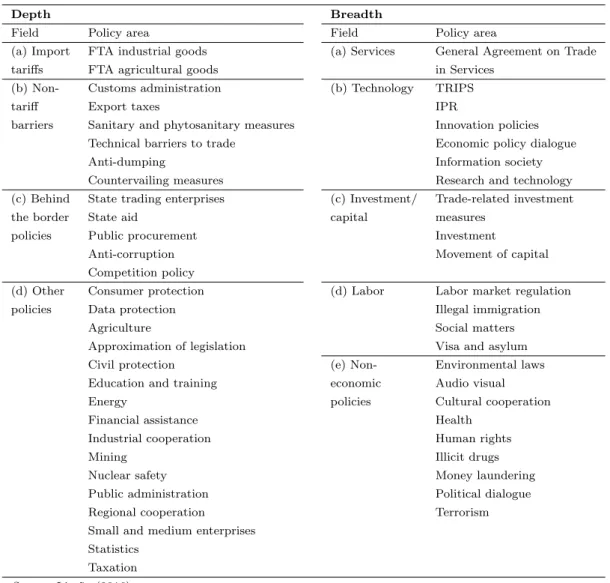
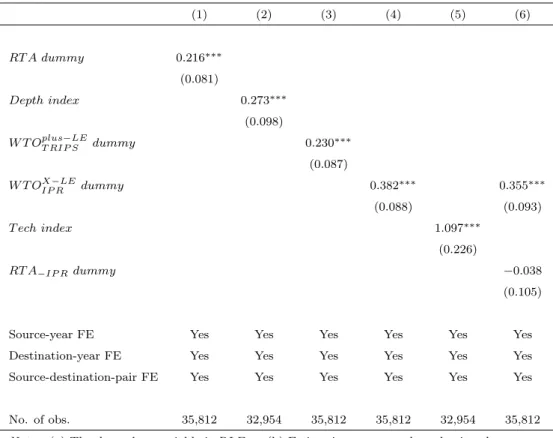
The first is RT A dummyijt, which is the usual RTA dummy and takes the value one if countries i and j belong to the same RTA in year t, and zero otherwise. The following two dummies are W T OplusT RIP S−LE dummies and W T OXIP R−LE dummies, which respectively take the value one if countries and j both belong to the same RTA in year and TRIPS legal applicability (LE) indices. provisions or IPR provisions in RTA takes the value two, and zero otherwise.22 The fourth dummy, the RT A−IP R dummy years, takes the value one if countries and both belong to the same RTA in the year and the LE index of IPR provisions takes a value less than or equal to one, and zero otherwise. Similar to measuring depth, Lim˜ao (2016) proposes to measure the breadth of RTAs in terms of five areas: (a) services;. b) technology; (c) investment/capital; (d) work; and (e) non-economic policies (see Table A.1 in the Supplementary Appendix).
The LE index measures the degree of legal enforceability of each provision in terms of a scale of zero to two, taking zero if the provision is not legally enforceable, one if the provision is legally enforceable but explicitly excluded from dispute resolution provisions, and two, if the provision is legally binding and forms part of dispute resolution provisions. related to the focus of this study. Similar to the Depth index, our Tech index is calculated by adding the LE index scores for the six technology policy areas and dividing the total by 12 to measure coverage on a scale from zero to one.
Description of data
In addition, we use Depth indexijt as a proxy for OBAijt because deep integration improves the market accessibility of country j from country i, regardless of the delivery method. Note that since most RTA variables are highly intercorrelated, we cannot include two or more RTA variables at the same time, except for the combination of W T OXIP R−LE dummyijt and RT A−IP R dummyijt. We use a combination of these two dummies to isolate the impact of RTAs without IPR provisions. 29), the constant term (i.e. γ0) and fixed effects represented by µit, νjt and ζij are also included, while ϵijt is the error term.
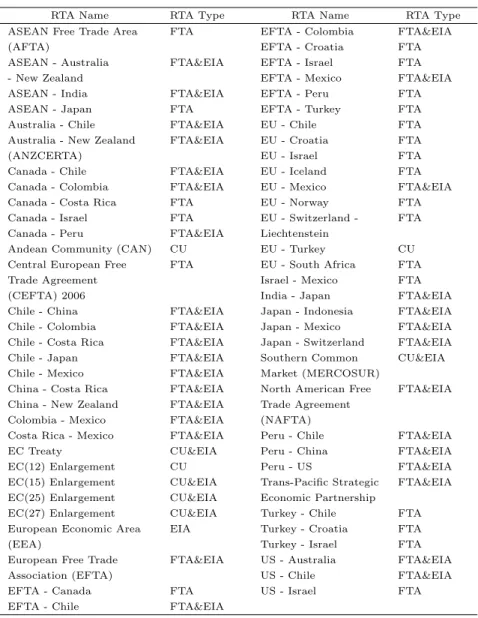
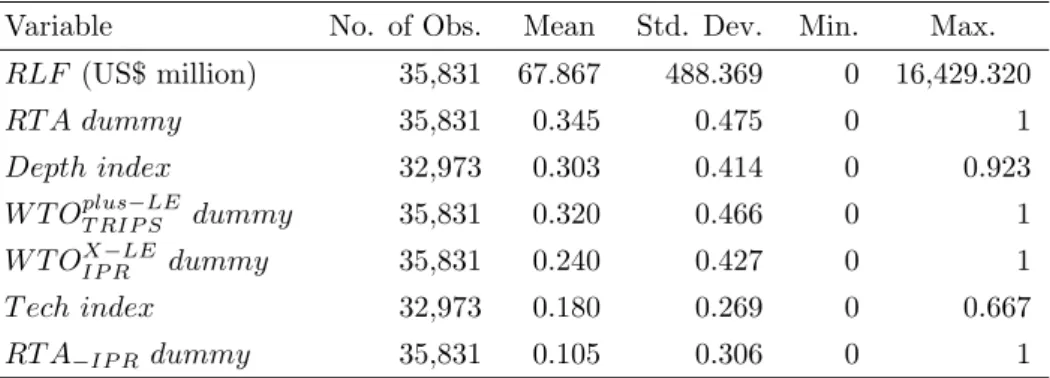
Data on RTAs come from Mario Larch's database (Egger and Larch, 2008),25 while data on the content of RTAs come from the World Bank website.26 Although the World Bank database contains 279 RTAs, we target focus only on RTAs that have at least two countries in our dataset as signatories.27 We end up with 63 RTAs in our sample. Descriptive statistics and correlations of the variables are given in Tables A.4 and A.5 in the Supplementary Appendix, respectively.
5 Empirical Results
Baseline estimation
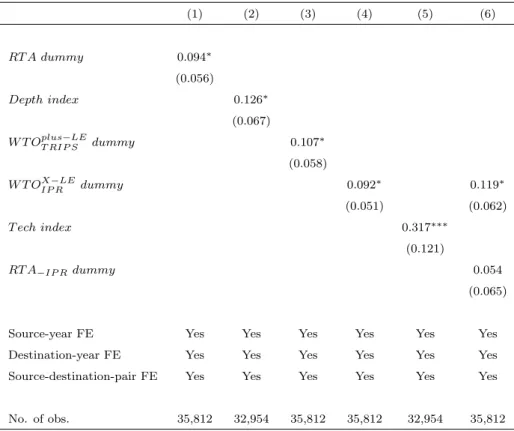
We further exclude country pairs that have no bilateral license revenue flows during our observation period. In contrast, the estimate for the W T OXIP R−LE dummy in column (4) suggests that RTAs with legally enforceable IPR provisions increase bilateral license revenue flows by an average of 46.5%.30 Therefore, the impact of an RTA on cross-border licensing is greater when the RTA contains legally enforceable IPR provisions than when it contains TRIPS provisions. Moreover, the estimated coefficient onDepth index indicates that a one-point increase in the index is associated with a 1.2% increase in bilateral license revenues.31 On the other hand, the estimated coefficient onTech index implies that an increase of this index by one point increases the bilateral flows of license revenues by 16.6%.32.
Finally, the results in column (6) show that when W T OXIP R-LE dummy and RT A-IP Rdummy are jointly included, the estimated coefficient on RT A-IP R dummy is negative and statistically insignificant. This result suggests that a reduction in trade costs by an RTA by itself does not have a positive effect on bilateral flows of licensing revenue.
Robustness checks
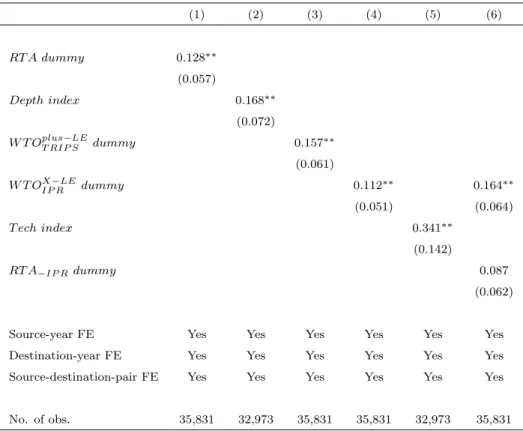
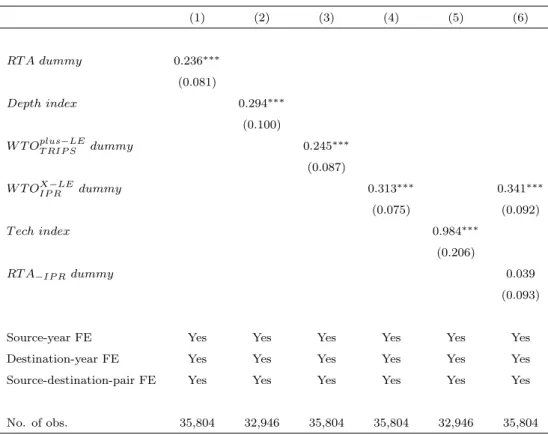
Based on the above results of the robustness check, we conclude that our results in section 5.1 are generally robust.
6 Conclusions
Specifically, we found that improved bilateral access through deep RTAs as well as stronger IPR protection through RTAs with legally enforceable IPR provisions or technology-related provisions increase cross-border flows of licensing income. Deep RTAs with legally enforceable provisions in technology-related areas are, as expected, more conducive to cross-border licensing than RTAs without such provisions. Furthermore, consumers also greatly benefit from the fact that firms engage in cross-border licensing, as some of the products produced under licensing would otherwise be unavailable to them.
Therefore, from a global prosperity perspective, it is desirable that governments pursue deep RTAs with legally enforceable intellectual property rights protections and other technology-related provisions to facilitate cross-border licensing. Appendix Derivation of the structural gravity model for bilateral export flows and FDI.
Appendix Derivation of the Structural Gravity Model for Bi- lateral Flows of Exports and FDI
Endogenous Determination of License Fees through Nash Bargaining
Thus, a potential licensor with a productivity level of φ in the order of φLij < φ < φXij0 leaves the landj market when negotiations fail. In contrast, a potential licensor with productivity φXij0 ≤φ < φXij exports to countryj when negotiations fail. This means that the payoff for a potential licensee at the point of disagreement is zero, regardless of the potential licensor's level of productivity in the negotiations.
For a potential licensor with productivity φLij < φ < φXij0, the payoff at the point of disagreement is zero, because it will leave the country's market if negotiations fail. Therefore, the Nash bargaining outcome of the negotiation between a potential licensor with productivityφLij< φ < φXij0 and a potential licensee is the solution that maximizes the next Nash.
Proofs of Lemmas and Propositions
Chile - China FTA&EIA Japan - Indonesia FTA&EIA Chile - Colombia FTA&OI Japan - Mexico FTA&OI Chile - Costa Rica FTA&EIA Japan - Switzerland FTA&OI Chile - Japan FTA&OI Southern Common CU&EIA Chile - Mexico FTA&EIA Market (MERCOSUR). China - Costa Rica FTA&OI North American Free VHW&EIA China - New Zealand FTA&EIA Trade Agreement. EC(15) Expansion CU&EIA Trans-Pacific Strategic VTA&EIA EC(25) Expansion CU&EIA Economic Partnership.
EC(27) Enlargement CU&EIA Turkey - Chile FTA European Economic Area EIA Turkey - Croatia FTA.