Morphological Changes in Patient Lens Epithelial Cells after Intravitreal
Silicone Oil Injection
Shigeru Takagi, Masao Nagata, Yukiko Ametani, Atsushi Yamasaki, Chiemi Itamochi and Akihiko Tamai
Department of Ophthalmology, Faculty of Medicine, Tottori University, Yonago 683, Japan The subject patient (47-year-old male) had received silicone oil injection into the vitreous cavity of his left eye for the treatment of retinal detachment in 1986. Two months later, the silicone oil was removed from the vitreous cavity, as the retina was reattached. Soon after the operation, the lens of the eye gradually became opaque to mature cataract, and his left visual acuity had fallen to hand motion upon his present admission to the hospital. The lens epithelium obtained by anterior capsulotomy during the extracapsular cataract extraction was examined morphologically by transmission electron microscopy. Inside the anterior lens capsule, abnormal epithelial proliferation was observed. The epithelial cells changed their shapes from cuboidal to spindle, accompanied by new basal lamina-like substances around them. The spindle-shaped cells stretched like pseudopodia. The extracellular matrices were abundant and composed of collagen fibers. Fragments and dissolved materials of the fibers were also seen in some specimens. Lipid-like substances and myelin-like structures were often observed in the relatively well preserved cytoplasm. As a result, it is surmised that cataract formation after intravitreal silicone oil injection may be associated with fibrous pseudometaplasia of the lens epithelial cells and phagocytosed silicone oil deposits in the epithelial cells. Key words: fibrous pseudometaplasia; intravitreal silicone oil injection; lens epithelial cells; phagocytosed silicone oil deposits; transmission electron microscopy
Abbreviation: ECCE, extracapsular cataract extraction
Intravitreal silicone oil injection is effective in treating some types of retinal detachment in human eyes (Armaly, 1962; Cibis et al., 1962; Leaver et al., 1979; Ando, 1985, 1987; Casswell and Gregor, 1987; Laqua et al., 1987; Oshio et al., 1988; Ozaki et al., 1993). It is, however, known to cause various complications, such as cataract, band-shaped keratopathy, intraocular hyper-tension, retinal toxicity, optic nerve atrophy, and so forth (Leaver et al., 1979; Scott, 1982; Ando, 1985, 1987; Casswell and Gregor, 1987; Laqua et al, 1987; Oshio et al., 1988; Ozaki et al., 1993). Among these, complicated cataract formation is considered to be almost unavoid-able (Leaver et al., 1979; Ando, 1985, 1987; Casswell and Gregor, 1987; Oshio et al., 1988). To date, however, there have been few basic
studies on lens opacity caused by intravitreal silicone oil injection in animal or human eyes (Kishimoto and Mori, 1966; Leaver et al., 1979; Scott, 1982; Yamasaki et al., 1994).
In the present study, morphological changes in patient lens after intravitreal silicone oil in-jection were examined by transmission electron microscopy.
Patient and Methods Patient
The subject patient (47-year-old male) was originally admitted to a private hospital in Nagoya, Japan, in March 1963 with idiopathic retinal detachment in the left eye associated with equatorial lattice degeneration with small
Fig. 1. The patient’s left eye showing mature cataract upon his present admission to the hospital.
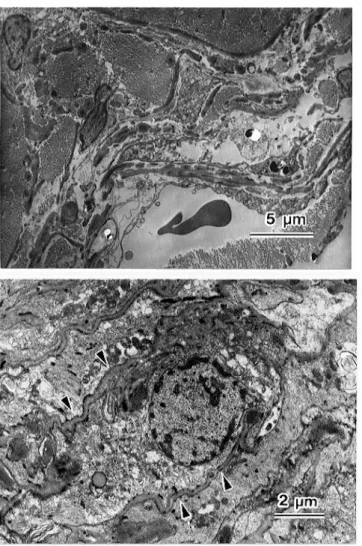
Fig. 2 (upper). Abnormal epithelial proliferation is seen inside the anterior lens capsule.
Fig. 3 (lower). A spindle-shaped lens epithelial cell is seen, accompanied by new basal lamina-like substances (arrowheads) around the cell.
holes. The following day he underwent a buckling procedure with local explant and cryotherapy with subsequent retinal reattach-ment. In July 1986, however, reti-nal detachment recurred in the left eye, with evidence of vitreoretinal traction after the initial surgery. On July 28, 1986, vitreous gel and vitreoretinal, tractional strands were vitrectomized and about 3.5 mL of silicone oil (1000 centi-stokes, Dow Corning, Midland, MI) was injected into the retrohyaloid space via the pars plana. The reti-na was reapposed to the pigment epithelium, so 2 months later the silicone oil was removed from the vitreous cavity. At the time, his corrected visual acuity in the left eye was 0.2 and the intraocular pressure was 15.0 mmHg.
Soon after the operation, how-ever, he noticed misty vision in the left eye. An ophthalmologist whom he consulted, pointed out lens
opacity in the left eye. The lens opacified gradually to mature cataract (Fig. 1), and his corrected visual acuity in the left eye fell to hand motion. On June 15, 1995, he was re-ferred to our department for adequate treat-ment of the cataract and admitted to the Tottori University Hospital on the same day. On June 19, 1995, extracapsular cataract ex-traction (ECCE) and intraocular lens im-plantation were performed in the left eye. During the surgery, the anterior and poste-rior lens capsules were found intact. Post-operatively the visual acuity improved to 0.1 in the left eye.
Methods
The lens epithelium was obtained by anterior capsulotomy using the can-opener technique at the ECCE. The material was immediately fixed in 10% buffered formalin and cut into 2 pieces. The specimens were rinsed overnight in 0.1 M cacodylate buffer containing 7.5% sucrose followed by postfixation with 1% osmium tetroxide for 1.5 h. After block-staining in 1% ura-nyl acetate, they were dehydrated in a graded series of ethanols and finally embedded in Epon. Ultra-thin sections were obtained using a diamond knife and an ultramicro-tome (Type MT 6000-XT, RMC, Tucson, AZ) and examined with a transmission electron microscope (Type H-7100, Hitachi, Tokyo, Japan) at 75 kV after double-staining with uranyl acetate or tannic acid and lead citrate.
Results
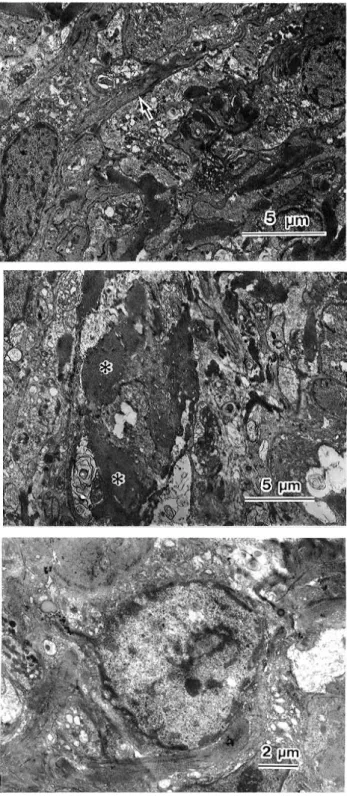
Inside the lens capsule in the anterior polar region, abnormal epithelial proliferation was ob-served by transmission electron microscopy (Fig. 2). The epithelial cells changed their shapes from cuboidal to spindle, accompanied by new basal lamina-like sub-stances around them (Fig. 3). The spindle-shaped cells stretched like pseudopodia (Fig. 4). The extra-cellular matrices were abundant (Fig. 5) and composed of collagen fibers (Fig. 6). The collagen fibers
Fig. 4 ( upper). A spindle-shaped lens epithelial cell (arrow) stretches like a pseudopodium. Fig. 5 (middle). Extracellular matrices (asterisks) are abundant.
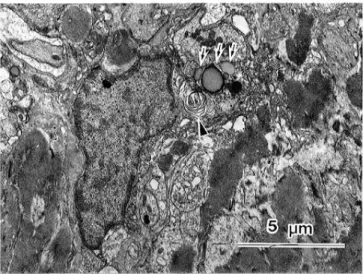
consisted of microfibrils with a period of about 50 nm (Fig. 7). Fragments and dissolved mate-rials of the fibers were also seen in some speci-mens (Fig. 8). The other morphological find-ings showed lipid-like substances full of equal amounts of liquid and myelin-like structures often existing in the relatively well preserved cytoplasm of the epithelial cells (Fig. 9).
Discussion The occurrence of lens opacities, or their progression, is common after the removal of silicone oil, even after a short tamponade of a few weeks, as in the present case (Ando, 1985, 1987; Casswell and Gregor, 1987; Oshio et al., 1988). Thus, the effects of the mechanical stress to the lens (Casswell and Gregor, 1987; Laqua et al., 1987; Ozaki et al., 1993) or exposure of the lens to silicone oil during surgery (Armaly, 1962; Kishimoto and Mori, 1966; Ando, 1985; Casswell and Gregor, 1987; Laqua et al., 1987) and/or obstruction of normal metabolic exchange at the silicone-tissue interface (Leaver et
Fig. 8. Fragments and dissolved materials of the collagen fibers are seen in this specimen.
al., 1979; Yamasaki et al., 1994) of the subject patient’s lens could not be disregarded. It is, however, uncertain how silicone oil removal in the present case influenced the lens itself or intraocular surround-ings around the lens, since the surgical manipulation and slit-lamp biomicroscopic findings of the lens in those days are now un-known.
Few reports have been publish-ed on electron microscopical ob-servation of the human lens epi-thelial cells after silicone oil injec-tion (Leaver et al., 1979). By elec-tron microscopy, Leaver and co-workers (1979) demonstrated phagocytic cells with large vacu-olar inclusions, which were presumed to represent engulfed silicone oil attached to the anterior lens capsule, in their specimen obtain-ed from a human eye enucleatobtain-ed due to severe late complications caused by silicone oil injection. The capsule, basement membrane and epithelium of the lens, however, showed no evidence of infiltration by the oil. As a result, they suggested that the complicated cataract due to silicone oil injection was probably caused not by any toxic effect of silicone oil, Fig. 7. Collagen fibers consist of microfibrils with a period of
Fig. 9. Lipid-like substances (arrows) and a myelin-like structure (arrowhead) are seen in the relatively well preserved cytoplasm of the lens epithelial cell.
but by obstruction of normal metabolic ex-change at the silicone-tissue interface.
In the present study in which attention was paid to the morphological changes in the pa-tient’s lens after intravitreal silicone oil injec-tion, the above characteristic finding was not observed in the lens epithelial cells in the ante-rior polar region. Inside the anteante-rior lens cap-sule, however, abnormal epithelial proliferation was observed by transmission electron micros-copy. The epithelial cells changed their shapes from cuboidal to spindle, accompanied by new basal lamina-like substances around them, and the spindle-shaped cells stretched like pseudo-podia, which resemble fibrocytes. Further-more, the extracellular matrices were abundant and composed of collagen fibers consisting of microfibrils with a period of about 50 nm, which are derived from a metaplastic change in the lens epithelium itself. Fragments and dis-solved materials of the fibers also were detected in some specimens.
These findings were almost consistent with those obtained by Scott’s light microscopic study on the lens which had received intra-vitreal silicone oil injection after surgical treat-ment of retinal detachtreat-ment (Scott, 1982). He observed the excised anterior lens capsules, and the anterior epithelium was found to have been
replaced by a thick layer of fibrous tissue. Both morphological find-ings revealed fibrous pseudo-metaplasia of the lens epithelial cells. As a result, it is surmised that cataract formation after intra-vitreal silicone oil injection may be associated with such a fibrous pseudometaplasia of the lens epi-thelial cells.
In our previous study using adult albino rabbits (Yamasaki et al., 1994), transmission electron microscopical examination reveal-ed that the cytoplasm of the lens epithelial cells, adjacent to the interdigitation, began to show a vesicle-like structure 2 weeks after intravitreal silicone oil injection. This vesicle-like structure resem-bled a micropinocytotic vesicle derived from adsorptive micropinocytosis (Fawcett, 1981). This structure was absent in the control eyes even 3 months after surgery. Therefore, this structure seemed to be associated with silicone oil, although no signs indicating direct intake of silicone oil into the lens were observed in the previous study. It was presumed that such damage to the lens epithelial cells might affect the onset and development of lens opacity.
This unique vesicle-like structure was not detected in the present study, but it is of note that lipid-like substances full of equal amounts of liquid and myelin-like structures were often observed in the relatively well preserved cyto-plasm of the epithelial cells. This shows the possibility of the intake of silicone oil particles into the lens in parallel with the obstruction of normal metabolic exchange at the silicone-tissue interface (Leaver et al., 1979), although no signs indicating direct intake of silicone oil into the lens epithelial cells through the anterior lens capsule were observed even in the subject patient with mature cataract.
The relatively well preserved cytoplasm of the lens epithelial cells indicates that absorbed or phagocytosed silicone oil particles do not inflict toxic damage to the epithelial cells, as intravitreal silicone oil itself is originally
con-sidered to be harmless (Stone, 1958). However, we cannot deny entirely the possibility of cataract formation after intravitreal silicone oil injection caused by chronic metabolic distur-bances (Scott, 1982) in the presence of phago-cytosed silicone oil deposits in the cytoplasm.
In conclusion, our findings suggest that the observed changes in the lens epithelial cells represent cytoplasmic and/or metabolic dys-functions in the cells, and that these changes are closely related to the onset of lens opacity and its progression following intravitreal silicone oil injection. As regards the silicone oil intake into the lens, further observation is needed in cases of removal of intravitreal silicone oil retained for a longer period than in the present case.
Acknowledgments: The authors wish to thank Prof.
Takao Inoué of the Second Department of Anatomy, Faculty of Medicine, Tottori University, for his kind advice and valuable suggestions in this study.
References
1 Ando F. Complications of intraocular silicone and their possible treatment. In: Mizuno K, ed. Ophthalmology, International Congress Series 671. Amsterdam: Excerpta Medica, 1985:124– 130.
2 Ando F. Usefulness and limit of silicone in management of complicated retinal detachment. Jpn J Ophthalmol 1987;31:138–146.
3 Armaly MF. Ocular tolerance to silicones. Arch Ophthalmol 1962;68:390–395.
4 Casswell AG, Gregor ZJ. Silicone oil removal. I. The effect on the complications of silicone oil. Br J Ophthalmol 1987;71:893–897.
5 Cibis PA, Becker B, Okun E, Canaan S. The use of liquid silicone in retinal detachment surgery. Arch Ophthalmol 1962;68:590–599.
6 Fawcett DW. The cell. 2nd ed. Philadelphia: WB Saunders, 1981:108–110.
7 Kishimoto M, Mori S. A long-term observation of intravitreal injection of silicone fluid into rabbit eyes. Nippon Ganka Kiyo 1966;17:71–76 (in Japanese with English abstract).
8 Laqua H, Lucke K, Foerster M. Results of silicone oil surgery. Jpn J Ophthalmol 1987;31: 124–131.
9 Leaver PK, Grey RHB, Garner A. Silicone oil injection in the treatment of massive preretinal retraction: I. Late complications in 93 eyes. Br J Ophthalmol 1979;63:361–367.
10 Oshio Y, Oshima K, Kurata Y. Complications of intravitreal silicone oil and their management. Rinsho Ganka 1988;42:1083-1087 (in Japanese with English abstract).
11 Ozaki H, Shinya Y, Hayashi H, Ohshima K. Visual functions in a case of removal of intra-vitreal silicone oil retained for ten years. Ganka Rinsho Iho 1993;87:1913–1916.
12 Scott JD. Lens epithelial proliferation in retinal detachment. Trans Ophthalmol Soc UK 1982; 102:385–389.
13 Stone W Jr. Alloplasty in surgery of the eye. New Engl J Med 1958;258:486–490.
14 Yamasaki A, Nagata M. Takagi S, Tamai A. Time-course of lens opacity and morphological changes in rabbit lens epithelial cells after intra-vitreal silicone oil injection. Jpn J Ophthalmol 1994;38:116–122.