IDEA
In-situ
Debris
Environmental
九州大学宇宙機ダイナミクス研究室2015年活動報告
九州大学宇宙機ダイナミクス研究室
The IDEA Project Team
背景
OSSAM
IDEA Project
15/12/06 2Contents
UNISEC WS201515/12/06 UNISEC WS2015 4
スペースデブリ|危険性
スペースデブリ|課題
Simulated LEO environment prediction with PMD and ADR scenarios. (ODQN,2011)
ODQN Volume 18 - Issue 4, 2014
衝突によるデブリの自己増殖
15/12/06 UNISEC WS2015 6
15/12/06 UNISEC WS2015 8
光学観測による運動推定
非射出型衛星による姿勢計測
O
nboard
S
atellite for
S
ensing
A
ttitude
M
otion
非射出型衛星 OSSAM
通常の小型衛星と同様にロケットで軌道上まで運ばれた後,
デブリとなったロケットに取り付けられたまま姿勢を計測
ロケット上段のダイナミクスの測定
ライトカーブとの比較による
姿勢運動推定技術の実証
(© Fan!Fun!JAXA!)ミッション目標
能動的除去に不可欠な
デブリの姿勢運動の理解
15/12/06 UNISEC WS2015 10
非射出型衛星の特徴
メリット
従来の小型衛星と同様のインターフェースを利用でき
ロケット側の改造不要
打上環境耐性さえ満たせば他のロケットへ応用可能
姿勢制御不能
ロケットの影の影響
熱
,
電力
,
通信
の要求を
満たすことが通常より難しい
デメリット
OSSAM概要
外寸:250×250×452 [mm]
質量:15.33 [kg]
15/12/06 UNISEC WS2015 12
15/12/06 13
IDEA
プロジェクト
|
背景
UNISEC WS2015微小デブリ|
砂粒ほどの大きさの宇宙ごみ
• 地上からの観測が不可能
• 衝突で衛星の機能停止も
軌道上観測が不可欠
Towards Micron-size Debris Modeling Based on
In-situ Measurements Data From IDEA
By Kazuaki AE1), Toshiya HANADA1),2)
1)Department of Aeronautics and Astronautics, Kyushu University, Fukuoka, Japan
2)International Centre for Space Weather Science and Education, Kyushu University, Fukuoka, Japan
The purpose of this research is to estimate as-yet-unknown environment of tiny debris between 100 µm and 1 mm . Because of its high velocity, even though micron size debris, it is quite possible to cause critical damage on spacecraft. It might be a major obstacle to future development of space technology. Therefore, for the safe and secure space developments, ever-growing the importance of provision about micron size debris. However, micron size debris cannot be observed from grand-based sensors because it is too small. Thus, measurement data are very limited. We have to construct a novel measurement system for micron size debris. This paper introduce IDEA the project for In-situ Debris Environmental Awareness that aims to construct an in-situ measurement network using a group of nano satellites and the usage of actual measurement data acquired from IDEA-1 satellite.
Key Words: Micro Debris, Nano Satellite, In-situ Measurement, Environmental Model
Nomenclature a : semi-major axis e : eccentricity i : inclination : apogee altitude : perigee altitude Subscripts : cataloged object : IDEA-1 satellite 1. Introduction
Since the launch of Suptnik-1 in 1957, the number of artificial object is steadily increasing around the Earth (see Fig. 1). The non-functional artificial objects, which are called space debris. Space debris accounts for more than 90 % of artificial objects. Space debris size’ varies from over 1 m to under 1 mm. Among them, this paper focuses on micron size
debris about 100 µm to 1 mm in the low Earth orbit (LEO) region (altitude 2000 km).
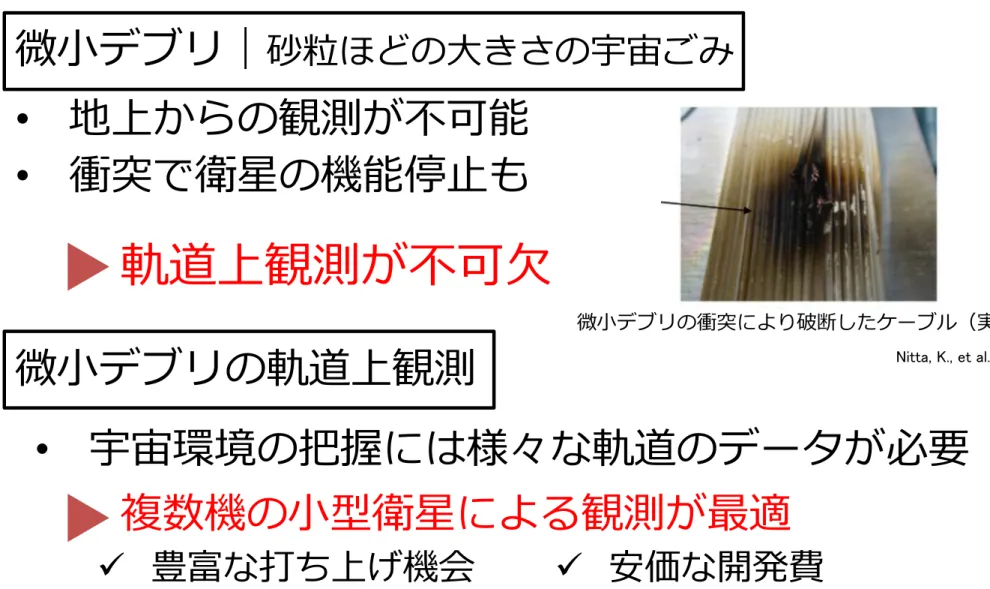
Danger of space debris is its huge destruction force. Objects in LEO are moving at a speed of approximately 8 km/s. Actually, micron size debris doesn’t have destruction force to cause a catastrophic damage on spacecraft. However, the collision with micron size debris may cause loss of functionality, resulting in termination of a spacecraft depending on the part of loss. For example, even approximately 0.2 mm debris fractures the power cable of a satellite, as shown in Fig. 2.
Fig. 2. Breakage of the satellite harness by the collision of micron size debris (0.2 mm) 2)
The collision of the spacecraft with micron size debris in space is not new in these days. In fact, Endeavour and Atlantis have received flesh scars caused by micron size meteoroid or debris impact on their radiator panels 3,4). Moreover, the Cupola module of the International Space Station has been hit by a micron size meteoroid or debris on Window 2 and closes its protective shutter until finishing confirmation of the window damage. In addition, micro debris is assumed a factor causing a solar panel failure of the Earth observation satellite ADEOS-2 in October 20035).
A P
O
I
£
Fig. 1. Monthly number of cataloged objects in Earth orbit1)
微小デブリの衝突により破断したケーブル(実験) Nitta, K., et al. (2010)
• 宇宙環境の把握には様々な軌道のデータが必要
微小デブリの軌道上観測
複数機の小型衛星による観測が最適
豊富な打ち上げ機会
安価な開発費
IDEA Project 概要
14
15/12/06 UNISEC WS2015
IDEA
プロジェクト
|
観測
Space Debris Monitor (SDM)
• 有限会社QPS研究所と株式会社IHIが共同で出願した特許に基づき
宇宙航空研究開発機構(JAXA)が開発
IDEA Project 概要
IDEA
プロジェクト
|
目標
微小デブリの軌道上観測ネットワークを構
築
既存のモデルの検証・校正
動的なモデルの開発
環境変動の迅速な検知
15/12/06 UNISEC WS2015 16
ミッション解析
計測可能項目の追加(衝突角,速度など)
→さらに詳細な環境把握
九大内での衛星開発技術の維持・向上
→独自開発技術の獲得
IDEA参加衛星を増やす
→コンステレーションの実現
IDEA
プロジェクト
|
今後
15/12/06 UNISEC WS2015 19
まとめ
九州大学宇宙機ダイナミクス研究室では,
主にスペースデブリ問題に着目し
ミッション提案・衛星開発を行っている
デブリとなるロケット上段の姿勢を計測する
非射出型衛星OSSAMの検討
微小デブリ観測のためのIDEAプロジェクトは
初号機の打ち上げが決定
次号機に向けた検討も行っている
15/12/06 UNISEC WS2015
IDEA衛星
|
概要
+Z面
-Z面
• 50cm級超小型衛星
• デブリ衝突検知センサを2面に搭載
• 2016年度のH2A相乗り打上を目指す
ミッション
デブリ観測衛星の
技術実証
微小デブリ衝突の
準リアルタイム観測
初号機 IDEA−1
20初号機IDEA−1|概要
IDEA衛星
|
特色
デブリ計測データ取得に特化した
シンプル
・
堅固
なシステム
設計コンセプト
デブリ衝突耐性を考慮した
井桁構造による二重壁
メインCPUによってほぼ全てのタスクをこなす
中央集権処理
できる限り枯れた技術や
実績のある機器を使用
15/12/06 UNISEC WS2015
Space Debris Monitor (SDM)
• 有限会社QPS研究所と株式会社IHIが共同で出願した特許に基づき
宇宙航空研究開発機構(JAXA)が開発
22
ミッション機器
高度800km前後の極軌道を予定
需要が高く,自然浄化も少ないため多くのデブリが存在
これまでに実観測データが得られていない
0 0.1 0.2 0.3 0.4 0.5 0.6 0.7 200 300 400 500 600 700 800 900 1000 1100 1200 S p a ti a l D e n s it y [ 1 /k m ^3 ] Altitude [km]ESA MASTER-2009 Model
2D spatial density distribution vs. S.D. Altitude Global Average: 0.3098E+00 [1/km^3]
Total 欧州宇宙機関の デブリ環境モデル “MASTER2009”による デブリ空間密度
ミッション軌道
15/12/06 UNISEC WS2015 24
軌道:高度798kmSSO
ミッション期間:2年
対象デブリ:100μm以上
衝突個数
1年間に60個程度
飛来方向
衛星進行方向に集中
ミッション解析
各系概要
熱構体系
2mm以下のデブリの衝突に耐えうる設計
機器のユニット化
受動的熱制御
デオービット系
IDEA自身がデブリとならないよう,
IADCの25年ルールを遵守
ミッション終了後,薄い膜面を展開し
大気抵抗を利用して軌道を下げる
大気抵抗
左から処理系ユニット,電源ユニット,通信ユニット15/12/06 UNISEC WS2015 26